







Abstract
The acoustic quality of classrooms is crucial for children’s listening skills and consequently for their learning. Listening abilities in kids are still developing, and an environment with inadequate acoustic characteristics may create additional problems in speech perception and phonetic recognition. Background noise or reverberation may cause auditory processing problems and greater cognitive effort. There are also other elements which can make difficulty in listening and understanding in noisy environments an even more serious problem, such as learning disabilities, mild to severe hearing loss or bilingualism. Therefore, it is important to improve the acoustic quality of the classrooms, taking into account the specific needs of children in terms of signal-to-noise ratio and reverberation time, in order to ensure a proper quality of listening. The aim of this work is to analyse, through the review of previous studies, the impact that the acoustic of classrooms has on children’s listening skills and learning activities.
Introduction
Oral communication is an essential element of everyday life, and it generally takes place in noisy environment. With particular regard to children, they spend most of the daytime in school classrooms, attending lessons and getting in touch with each other and with the teacher. The acoustic design of schools is therefore a crucial factor which needs to be taken into consideration.
Background noise and reverberation time
Classroom acoustic conditions should be such as to ensure a proper quality of listening, without vocal effort of teachers. However, there is almost always a background noise in the school environment. In classrooms, background noise may be due to external noise, for example, traffic or playgrounds, internal noise, which originates outside of the classroom but within the school building, and classroom noise, such as noise from chairs being moved or children talking. 1 Background noise in a classroom may compromise the speech perception in children, especially the consonant perception, since the vowels have a spectral energy more intense than that of the consonants. 1 The characteristics which determine how strongly the background noise interferes with what children need to hear and understand are as follows: the spectrum of the noise, the intensity fluctuations of the noise over time and the signal-to-noise ratio, which is a measure that compares the sound level of speech to the level of background noise. 1 The noises that mainly affect speech perception are generally those which are similar to the speech signal, in terms of spectral content. Another acoustic parameter to be taken into account is the reverberation time (RT), 2 which is a measure of the time required for the sound to decay in a closed area from the moment that the source of the sound has stopped. A too long RT may affect the speech perception by imposing echo effects on the speech signal. The degradation in speech intelligibility due to the reverberation is based on two effects: an overlap masking and a self-masking effect. Classroom acoustics has a significant effect on children listening and learning skills, and exposure to high levels of noise in school environment is associated with lower scholastic performance. 3 Speech perception runs automatically in a quiet environment. 4 However, it often happens that background noise or reverberation degrades the speech signal, and therefore, more cognitive resources are needed to compensate for the signal distortion. 2 Speech recognition performance is negatively affected by both background noise and reverberation, and in particular, their combined effects have an even more negative impact than the sum of each of the two effects considered separately. 5 Furthermore, as regards the reverberation, it is important to consider that its effect may be different depending on timing and number of reflections. 5
The sound reflections arrive at the listener with a time delay after the direct sound. But when these reflections reach the listener within about 50 ms after the direct sound, in a quiet environment, their integration with the direct signal may positively affect the speech recognition. 6 Reverberant energy can therefore have a positive effect on listening, in cases in which it increases the amplitude of the interest signal more than the background noise level. 7 On the contrary, all the reflections with a longer time delay or which are from background noise and not from the sound source of interest have a negative effect on the speech clarity, since they are not integrated with the signal of interest, while they adversely affect its reception. 5
Guidelines and classroom acoustic conditions
Acoustical guidelines
The World Health Organization establishes the following limits: 35 dB(A) and 0.6 s, respectively, for background noise and RT in classrooms, while in the recreation rooms the noise level should not exceed 55 dB(A). 8 The standard limit of background noise, in accordance with the American regulations, is 35 dB(A) and the maximum RT is 0.6 s and 0.7 s, respectively, for unoccupied classrooms under 283 ft3 and classrooms between 283 and 566 m3. 9 According to the UK Legislation, the background noise and RT limit values for unoccupied classrooms are 35 dB(A) and 0.6 s with regard to the kindergarten and the primary school and 35 dB(A) and 0.8 s for the case of secondary school. 10 Instead, for classrooms with children who have hearing problems, the maximum values of background noise and RT are 30 dB(A) and 0.4 s, respectively. 10 An RT of 0.4–0.5 s is generally considered appropriate for a speech-to-noise ratio of +15 dB. 11
A 2016 conference paper provided an overview of the acoustic guidelines and the typical acoustic characteristics found in primary school classrooms from research conducted in Australia, New Zealand and several countries of Europe, America and Asia. 12 An overall summary of the data assembled during this research is as follows: according to the guidelines, the limit values should be, on average, <25–50 dB(A) for unoccupied ambient noise levels, +8.5 ± 20 dB for signal-to-noise ratios and <0.3–0.9 s for RTs. And this is true with respect to typically developing children. Children with hearing impairments or language delays, in fact, would require a higher minimum signal-to-noise ratio and more stringent limit values (<20–35 dB(A) for unoccupied ambient noise levels and <0.3–0.7 s for RTs). As regards the actual measured values, the data are as follows: 22–70.5 dB(A) for unoccupied ambient noise levels, 48–85 dB(A) for occupied background noise levels, –16 to +23 dB for signal-to-noise ratios and 0.2–1.9 s for RTs. 12
The new Italian standard on acoustics for schools was presented during the 23rd International Congress on Acoustics in Aachen. 13 It builds on the previous experience in other European countries, and the main objective of these new standards is to achieve a good speech intelligibility. Six different categories of school environments were defined in relation to their use, and reference values for Speech Transmission Index (STI), RT, noise from continuous operation systems inside the room and environmental noise were established for each type of environments, according to specific formulas. The overall noise level in the unoccupied environments includes the following parameter: noise which comes from outside the school and noise from systems serving the environment. Its reference values should not be higher than 38 dB(A) (classrooms and libraries, single offices) or 48 dB(A) (exhibition environments, gyms and laboratories). The optimal RT was calculated for rooms occupied at 80%, reference values within a range of (0.26 logV – 0.14) s and (0.45 logV + 0.07) s, and for unoccupied rooms, recommended values between (0.75 logV – 1) s and 2 s (V is the volume of the room, expressed in m3).
Ideal requirements and real acoustic conditions
In a 2008 study,14,15 a value of 0.3 s was indicated by the author as an ideal RT in the case of occupied classrooms. In a previous research 16 on children’s perceptions in noise environment, the condition in which they hear noise made by other children from the outside was found to be especially difficult. 17 This is particularly common in open and semi-open schools, for which past studies, 18 however, found noise levels similar or slightly lower than those found in enclosed classrooms. The noise levels that provide good conditions for understanding speech in classroom are different depending on the age. Learners over the age of 12 would require noise levels that do not exceed 40 dB(A), while this level should not exceed 39 dB(A) for 10- to 11-year-old children and 28.5 dB(A) for 6- to 7-year-old children. 11 These values are relative to learners with normal speech processing in noise, whereas in the case of students with any language processing difficulty, such as hearing impaired and not native children, they need even lower noise levels than those, specifically <33 dB(A) for students over 12 years old and <28.5 for 6- to 7-year-old children. Actually, however, the noise levels are nearly always significantly higher. 11 With regard to the enclosed classrooms, the background noise level depends largely on the pupils’ activities. 15 According to several surveys of noise in enclosed classrooms, common noise levels for primary classes (expressed as A-weighted noise levels) were found to be 44 dB L Aeq in a silent condition, 56 dB L Aeq during children’s quiet activities, 65 dB L Aeq when children are engaged in individual work, and 70–77 dB L Aeq when they are engaged in group activities. 15 The results from a study regarding 67 elementary classrooms in the United States 19 showed mean unoccupied noise levels ranging from 33 to 54 dB L Aeq.
Aim of the study
The purpose of this article is to analyse, through the review of previous studies, the impact that the quality of classrooms has on primary school children’s listening skills, and consequently on their learning, also considering those conditions which require specific needs, such as learning disabilities, hearing impairments, and bilingualism.
Methods
This article provides a review of academic literature, peer-reviewed articles, and experimental studies about the topic of the classroom acoustics, and the consequent effects on primary school children’s listening performances. Studies concerning the influence of background noise and reverberation on listening and learning activities, in particular, were taken into consideration. A special attention was paid to the listening skills of children which may have greater difficulties due, for example, to attention and learning disabilities, hearing loss, or bilingualism.
Listening skills in children
Children’s hearing abilities
It is important to note that the maturation of the auditory pathway is not yet complete in children.13,20 They have more variable and less well-developed auditory sensitivity to formants, formant transitions and voice onset time, compared to adults. Phonological processing skills are still developing in childhood, so children find it difficult to understand degraded speech and stay focused on a cognitive task in the presence of distracting noise.21,22 When words and syllables in speech are acoustically degraded, it is more difficult for a listener to remember them, even when speech is understood. 23 Inappropriate acoustic conditions may seriously affect the quality of reading development, particularly for children who have poor neural processing in speech discrimination, while a good classroom acoustic may increase the reading speed. 24 In previous studies, it was found that about 30% of the students detect only 70% of the words spoken by the teacher, in a first-grade classroom. 25 Children’s speech intelligibility, which has been defined as ‘that aspect of speech-language output that allows a listener to understand what a speaker is saying’, 26 differs according to age. 27 Listening in noise ability, in particular, starts in infancy and approaches adult values by 13–15 years of age.28,29 As shown in Figure 1, 30 speech intelligibility in noise for normal-hearing (NH) listeners increases with age, and adults have higher intelligibility levels than children, for the same signal-to-noise ratio. The adult-like ability to perceive speech accurately in noisy and reverberant environments is reached around age 14–15. 30 In the classroom context, teacher’s voice may be considered as the signal, disturbed by noise from both external and internal sources and classroom reverberation. 1
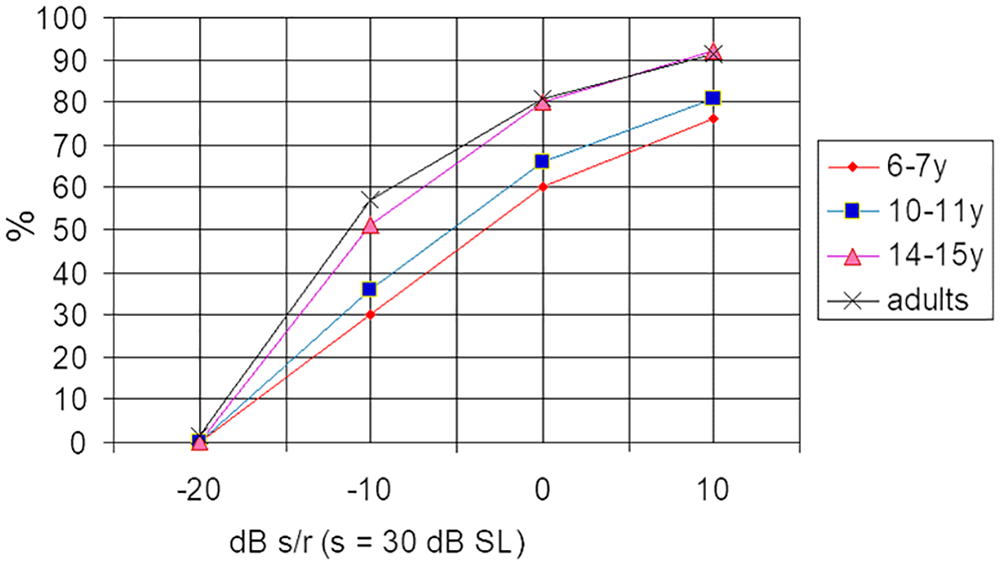
Speech intelligibility in noise, for different age groups.
The effect of noise and reverberation on listening activity
Previous studies showed how the effects of background noise and RT on speech perception skills, in a classroom-like setting, were higher in children than in adults. Klatte et al. 22 analysed the effects of noise and RT on speech perception and listening performance both in children from elementary school and in adults. Speech perception was evaluated by means of a word-to-picture matching task, during which the subjects were asked to discriminate between words with a similar sound, while as regards the listening comprehension assessment, participants were required to execute complex oral instructions. The tests were carried out in quiet and in two different background noise conditions, background speech and typical classroom noise without speech. For speech perception assessment, the experiment was conducted in two virtual classrooms, with two different RT values: 0.47 and 1.1 s. Children’s speech perception and listening comprehension were found more impaired by background noise compared to performance in adults. In particular, speech perception was more impaired by classroom noise, while listening comprehension by background speech. Reverberation did not affect speech perception in silence condition, while it provoked a strong increase in the impairments due to background sounds, for both children and adults, especially when RT was 1.1 s. In a 2018 study, 24 the relationship between classroom acoustic parameters and reading abilities was evaluated. A total of 94 children of the second grade of Italian primary school, and from three different schools, were tested. RT and speech clarity (an objective measure of the intelligibility of speech, expressed in dB) were measured for each classroom, and the children’s reading abilities were measured in terms of reading speed and of number of errors. The reading speed scores were found significantly correlated with the speech clarity parameter, while no significant correlations were found between the reading scores and the RT, and probably a larger variability of this second parameter would be needed to achieve significant correlation with the reading tasks. However, the data showed how it is important to design classrooms which optimize speech clarity and minimize RT, for example, by combining absorptive and diffusive surfaces. Children can be exposed to extraneous noise in the school environment, and the different types of noise may have a peculiar impact, depending on their level, spectral content and temporal fine structure. 31 A previous study 31 analysed the effect of different types of noise on primary school children’s listening performance during the course of a lesson. Three kinds of noises were used to interfere with the speech signal: a continuously fluctuating signal, with the same spectral characteristics as the natural speech but without any semantic meaning, a noise recorded in a silent room while noise was generated on the upper level, and the traffic noise, recorded along a busy road. The intelligibility scores and the response time were evaluated, and older children seem to be more able to manage the noise intrusion, since only due to a prolonged exposition their performance deteriorates, and their respective averaged performance was better for each noise, compared to younger children’s results. It is important, however, to note that the classroom noise level was related to the increase in the response time, which can be interpreted as a symptom of listening effort, and that children responded very differently to each type of noise, also depending on different classroom acoustic characteristics. Temporal fine structure and frequency components composing noise signal are strongly correlated with the noise intrusion effect, and therefore with the impact on the quality of children’s learning. The evaluation of speech transmission quality through the use of measures such as the STI is therefore not sufficient to ensure a complete description of the phenomenon, and for this reason, new methods to predict speech intelligibility are being developed.24,31 It is important not only to consider energetic masking or RT limits but also to assess the subjective listening performance under various noise conditions and to ensure an adequate level of performance in the classroom.24,31 Other aspects that should be considered are the room volume, the number of children, and the distance of the loudspeakers from each child. An Australian study 32 investigated how the acoustics of four different kindergarten classrooms (an enclosed classroom, a double classroom, a fully open plan triple classroom and a semi-open plan with a capacity, respectively, of 25, 44, 91 and 205 children) affect speech perception. Around 22 to 23 children in each classroom participated in a speech perception test. The noise levels were higher the larger the classroom, and children’s performance accuracy and response speed found during the test decreased with increased noise level. In addition, children’s speech perception skills decreased the further away children were seated from the teacher, particularly in the case of high noise levels (above 50 dB(A)). 32
The problem of listening effort
Listening difficulties in noise may cause not only a problem from the point of view of listening perception and speech intelligibility but also auditory processing problems and greater cognitive effort. Even in the case of a good intelligibility score, listeners need to make a greater effort in presence of reverberation and noise, and are therefore required to allocate further cognitive resources. Noise and reverberation, and specifically late reflections, introduces distortion to the speech signal, and this increases the listening effort. 5 Listening effort has been defined by Pichora-Fuller et al. 33 as ‘the deliberate allocation of mental resources to overcome obstacles in goal pursuit when carrying out a task, with listening effort applying more specifically when tasks involve listening’. And when listeners need to maintain high levels of cognitive effort, for example, during lessons, their learning and cognitive achievements may be affected. 34 Even in case of maximum speech intelligibility, the background noise may affect the listening comprehension, intended as the level of understanding the meaning of what the listener has heard, and the working memory process, which refers to a cognitive system for temporarily holding the information necessary to perform cognitive tasks. 35 In a literature review by Peelle, 34 the author puts emphasis on the cognitive processes involved in understanding acoustically degraded speech. Further cognitive efforts have to be done by the listeners to understand degraded speech, and this is reflected in greater neural activity, increased pupil dilation, and behaviour. In a recent article, 36 the authors investigated the listening effort in school-age children during a speech reception task in real classroom. A total of 117 children, aged 5–7 years old, were tested in two different listening conditions, quite classroom and working classroom (with stationary noise), and the test was repeated twice during the experiment. The number of correctly recognized words and the response time were evaluated, and response time was considered as an index of listening effort. On the whole, children performed worse in noisy condition, and greater response time values were found compared with those achieved in quiet condition. Visentin et al. 37 analysed two behavioural parameters involved in listening effort: the measure of response time and a subjective judgement on a rating scale (LE). The response time was found to be a more sensitive measure in order to analyse the effects of the different listening conditions. In the speech in noise tests, response time data were significantly higher in those classrooms for which there had been no acoustic treatment. The increasing in response time values is an indication of increased time spent in processing auditory information, and a prolonged speech processing may reduce information acquired by listening. The response time evaluation can, therefore, provide useful information which needs to be assessed in discerning the effects of the room acoustics and improving the acoustical design of rooms for speech. 37 It has been shown that also dysphonic teachers, speakers with a weak voice, fast-talking or low fluency, may imply higher level of children listening effort and cognitive load, but only few countries provide training courses on the use of voice for teachers. 38 There are also several factors which can make the difficulty in listening and understanding in noisy environments an even greater problem, for certain categories of children.
Specific conditions which require special needs
Learning or language disabilities
A systematic review with reference to the South African context, 39 published in 2017, analysed the effect of noise on children with learning, sensory, or language disabilities, also taking into account the guidelines available in other countries. Learners with any kind of impairment are usually more disadvantaged by noise in the classroom. The ideal condition is a sound pressure level (SPL) in a range of 30–35 dB(A), with a minimum signal-to-noise ratio of +15 dB, and an RT with a value between 0.4 and 0.6 s, according to the published literature and the international guidelines.8–10
Hearing-related problems
Mild temporary hearing loss, mostly due to otitis media
Almost 30% of children have otitis media with effusion during the winter period, and 30% of the children with recurrent otitis media had a mild or moderate hearing loss. 40 This leads to a hearing loss of up to 40 dB (for 12 dB of signal-to-noise ratio), and children with middle ear infections are not capable of perceiving 50% of the words spoken by the teacher. 25
Single-sided deafness
Single-side deafness (SSD) refers to that condition in which a person has one deafened ear and NH in the other ear. Problems that may be resulting from this kind of hearing loss are: difficulty in understanding speech, especially in noisy condition, and difficulties in sound localization. 41 So, a child with SSD may be completely deaf or suffering from hearing impairment in one ear and hears perfectly with the other ear. This condition, in classroom, can create difficulties in terms of sound localization, hearing in noise, selective attention, sound source segregation and speech understanding. Therefore, these children need to make a greater effort to listen and understand when the sound source is moving relative to them, especially in a noisy environment. In a previous study, 42 perception, dictation, working memory and short-term memory function, in both the silence and noise conditions, were evaluated in children with SSD. Specifically, 25 children with SSD were tested before and after bone-anchored hearing implant (BAHI) implantation, and their results were compared with those of NH children. A statistically significant difference in the results of all tests was found between NH children and children with SSD before BAHI implantation. After implantation, the results of SSD children and NH children become very similar with regard to speech perception, working memory and short-term memory performance in silence condition, but there were still differences in the results of the dictation test, both in silence and noise, and in the results of working memory function test in noise condition.
Moderate to severe hearing loss
Children suffering from hearing loss need at least a signal-to-noise ratio of 10 dB. 43 Reverberation effects have a worse impact on their listening skills compared to NH children, 44 and the combination of reverberation and background noise may seriously compromise the speech intelligibility of children with hearing impairment, especially in the case of kids with moderate to severe hearing loss. In order to have a correct identification of the voice signal, good peripheral sensibility and efficient temporal auditory resolution are necessary to differentiate the frequency. These aspects are deficient in patient with hearing loss, explaining why they have so many difficulties in the speech perception in noise. 45 Suffice to say that NH children have a good performance in listening even when the RT of a room is 0.6 s, while this value is 0.3 s in case of hearing loss. 46
Use of hearing aids or cochlear implants
Hearing aids may be the recommended solution for children with mild to moderate hearing loss, while cochlear implant (CI) is recommended in children with severe to profound hearing impairment, who could not get enough benefit from hearing aids (HAs).47,48 In a previous study, the effect of reverberation and noise and their combined effect on speech intelligibility was analysed in 11 children with CI. 33 Children were tested in different reverberation and noise conditions (RT of 0.6 and 0.8 s, signal-to-noise ratio of 5 and 10 dB), and four speech reception threshold (SRT) and RT level combinations were considered. The results showed that the combined effect of noise and reverberation was greater compared to the noise and reverberation effects taken individually, and that, for the signal-to-noise ratio (SNR) taken into account, reverberation degrades speech intelligibility more than the background noise.33,34 In a 2013 study, 49 three groups of children (HA and CI users – mean age = 6.5 years, and NH children – mean age = 6.75 years) were tested on speech recognition in quiet and noise (noise with a flat spectrum, created using a random-noise generator). Eighteen wordlists were presented to the children. During the speech in noise test, the speech level was kept constant at a level of 68 dB SPL, while the level of noise varied in order to present the wordlists at three different signal-to-noise ratios (−3, 0 and +3 dB). The percentages of correct words and phonemes were evaluated. The lower the SNR, the lower was the mean percentage correct recognition scores for phonemes and words, for all groups of children. Statistically significant difference between NH and hearing-impaired children was found, both in the case of quiet and noise condition, and for both phonemes and words recognition. NH children had better recognition than children with HAs or CI. 49 A 2011 study 50 evaluated the spatial hearing ability and the speech intelligibility of 58 children (31 were NH children, and 27 were HAs users). SRTs were measured using an adaptive procedure, in two different conditions: speech and babble noise presented from 0° azimuth, and speech from 0° azimuth and competing babble from ±90° azimuth. Spatial release from masking (SRM) was analysed, defined as the difference between the SRTs measure for the two conditions, in terms of dB SNR. The RT values of the room in which the tests were carried out ranged 0.51–0.18 s depending on the frequency. On average, the performances of children with HAs and NH children were similar when both speech and babble were presented from the frontal source, while children with impaired hearing reached significantly worse outcomes when noise and speech were spatially separated. NH children had a mean SRM of 3 dB, while children with HAs did not demonstrate SRM. This result suggests that children with HAs had, on average, a limited ability of to use spatial separation between speech and noise to improve speech intelligibility. 50 Through the same measurement of SRT and spatial release from masking (SMR) in the two different conditions (speech collocated with babble and speech with spatially separated babble). Ching et al. 51 evaluated speech perception in 252 5-year-old children with hearing loss, using HAs or CIs. On average, CI users needed about 2 dB better SNR than children with HAs, in order to obtain the same speech perception score. The mean SRM values were 2.6 and 3.3 dB for HAs and CIs users, respectively. It is important to underline that in the case of HA children, cognitive and language abilities were found to have a significant effect on speech perception scores, and for children with CI, an early age of implantation was associated with better speech perception outcomes. 51 In our preliminary study 52 of children’s speech intelligibility in a noisy environment, the SRT of normal-hearing and hearing-impaired children was evaluated, and the possible relationship between hearing loss and SRT in a fixed noise condition was analysed using the Italian Matrix Sentence Test.53,54 In this case, SRT was the lowest signal/noise ratio at which speech can be understood 50% of the time. In particular, SRT values were obtained in free field and in a fixed noise condition (noise level: 65 dB), using a standard adaptive measurement, converging to 50% speech intelligibility. The masking noise was a stationary noise with a long-term spectrum that matched the long-term spectrum of the speech material. The study sample consisted of two groups of children attending the ENT Clinic at Padua University Hospital (age range of 6–12 years): 30 CI users (mean age = 10.41 ± 2.03 years) and 30 NH children (mean age = 9.69 ± 1.15 years). Pure Tone Average-PTA2 (which consists of the average of hearing threshold levels at 500, 1000, 2000 and 4000 Hz) was 24.47 ± 4.43 dB in the CI group, while NH children had a hearing threshold value below 15 dB for all frequencies. The test takes a little over 5 min, and it was conducted in the audiometry room. The preliminary results showed a statistically significant difference between CI group and NH group (Mann–Whitney test, p < 0.01). SRT values were higher in children with CI (mean value of 2.68 ± 4.34 dB) than in NH children (mean value of −4.40 ± 1.66 dB) to confirm the fact that CI users have greater difficulty in listening in a noisy environment. These results showed a correlation between SRT values of the children in the noise environment and their pure PTA values, and they are in line with those reported in other researches, such as a 2012 study 55 in which both NH children and children with hearing loss aged between 3 and 6 were tested using the Polish Paediatric Matrix Sentence Test and children with hearing impaired showed significantly higher SRT values compared to NH kids. Another difficulty that may affect children with HAs or CIs concerns the ability to localize sound sources, which is a very important aspect of children’s social and scholastic life. The use of frequency modulation (FM) systems which pick up the teacher’s voice or other useful signals and send them wirelessly to HAs and CIs, may help to improve children’s auditory skills. 56 Even if language perception is usually considered as an auditory process, visual information also has an effect on perception. 57 Speech recognition is affected not only by the auditory signal clarity but also by the clarity of the visual signal. 58 For this reason, not only hearing-impaired children, but also children with visual impairment may need a clearer auditory signal. 39
Bilingualism
Bilingual learners, who show no difference compared to monolingual controls in word recognition under quiet conditions, perform significantly worse under noise with reverberation conditions. 59 Children who have to learn a second language generally acquire very quickly the same lexical and grammatical competence as their monolingual peers, but they do not reach the same phonological competence. 60 Previously, researches have demonstrated how the phonological skills are very important in order to achieve good speech intelligibility in difficult listening conditions. 61 However, it is important to distinguish between simultaneous bilingual (BL) children, who are exposed to both languages from birth, and sequential BLs, who have more difficulties. 62 Children who acquire a second language after age 4–6, reach a less accurate phonological coding, and they have trouble hearing in noisy environments. In fact, while learning in their second language, BL children need to acquire acoustic indexes as complete as possible in order to process the second language, but beyond a certain period, the acquisition of these indexes will never achieve the level of native speaker peers. 60 A recent study 60 evaluated the speech-to-noise ratio needed to obtain 50% intelligibility for Italian words in 15 BL immigrant children (aged 6–10 years) and in 15 controls peers who only spoke Italian. Bilingual children were exposed to their second language, which was Italian, after age 4. The SNR needed to obtain a 50% intelligibility for Italian words was measured against Italian version of ICRA noise, using an adaptive method. Moreover, a presentation of phrases against a contra-lateral continuous discourse was carried out to exclude differences in memory and attention between groups. The SNR was −2.7 dB for the BL group and −5.3 dB for the Italian-only speaking (IO) group (p < 0.01). With contra-lateral continuous discourse masking, the SNR was 32.8 dB for the BL group and −27.8 dB for the IO group (p < 0.01). In the BL group, speech perception in noise did not correlate with age of children, but did correlate significantly with years of exposure to their second language. Hurtig et al. 2 investigated the effect of the interaction between SNR and RT on speech perception. A total of 72 BL children aged 10 years were requested to recall wordlists played with two different RTs, 0.3 and 1.2 s, and two different SNRs, +3 dB(A) and +12 dB(A). Words were presented both in children’s first and second language, Swedish and English, respectively. As expected, more words were recalled when the wordlists were presented in children’s native language, and the higher value of the two SNRs (+12 dB) improved wordlists recall. Moreover, the shorter RT improved recall, but only at +12 dB SNR, while at +3 dB recall was surprisingly better when the RT was longer.
Conclusion
Permanent exposure to inadequate listening conditions in the school environment may compromise the children’s learning experience 63 and increase their listening effort.34,36 Studies shows, in particular, that background noise and reverberation have a significantly negative effect. In general, the background noise made children’s performance worse,31,32,36 and younger children appear to be having more trouble in managing the noise intrusion compared to the older kids. 31 There are specific recommended acoustic conditions of primary school classrooms, based on National Standards from different countries.8–10 However, cases of classrooms with poor acoustics are very common, and in many cases, the acoustic levels were found to be non-compliant with the recommended classroom acoustic guidelines of the respective countries.11,12,15 It is crucial that construction and renovation projects of classrooms are designed to reduce the unoccupied noise levels and RTs, as this is a key prerequisite for achieving adequate conditions also during teaching and learning activities. 64 The unoccupied acoustic conditions, in fact, influence both the background noise and the RT measured during lessons. The application of sound-absorbing panels on classroom ceiling and walls could lead to an acoustic improvement, as well as systems of amplification. Moreover, in specific cases such as kids with CI, personalized wireless connectivity technology and support material to motivate children during their learning may prove to be necessary. 65 It is to be hoped, in this respect, a shared legislation which takes account of all those aspects that may impair a proper quality of listening. The design of places in which it is important to ensure good speech and listening conditions should include a measure of objective acoustical parameters, such as RT and STI (as a measure for speech transmission quality), and a measure of speech reception performance, for example, through the speech intelligibility score. 37
In this respect, regarding Italy, the new Italian standard on acoustics for schools introduces significant improvements. All the parameters linked to the quality of listening were evaluated, and the attention was focused on specific predicting and practical verification methods. Experiences from different countries were considered and analysed, but all this was fitted to the Italian situation, in order to ensure both conformity with the international standards and the concrete applicability of the guidelines.
It would be particularly important to provide shared standards and recommendations for occupied classroom acoustic conditions, for both children without any additional difficulties and children with special educational needs. 12
Footnotes
Declaration of conflicting interests
The author(s) declared no potential conflicts of interest with respect to the research, authorship and/or publication of this article.
Funding
The author(s) received no financial support for the research, authorship and/or publication of this article.
