







Abstract
Unemployment is a significant concern among individuals with multiple sclerosis (MS). Determinations regarding ability to work are highly dependent on measurement tools used by neurologists and allied professionals. However, little is known of the usefulness of these tools when determining issues pertaining to employment status. The purpose of the present investigation was to examine the utility of the Multiple Sclerosis Functional Composite (MSFC) and a brief cognitive test battery when examining employment status in MS. Seventy-seven individuals with MS completed the MSFC and a brief cognitive test battery. On the MSFC, unemployed individuals demonstrated worse upper extremity functioning. There was no difference on the Paced Auditory Serial Addition Task (PASAT), the sole cognitive measure of the MSFC. On cognitive testing, unemployed individuals performed worse on measures of memory, information processing speed, and executive functioning. Through logistic regression analysis, the Symbol Digit Modalities Test (SDMT) was found to be the sole predictor of employment status among the significant disease, MSFC and cognitive variables. Consistent with previous findings, logistic regression found the SDMT to be a significant predictor of employment status. Given the lack of significant group differences on the PASAT, continued consideration of replacing the PASAT with the SDMT in the MSFC appears warranted.
Unemployment is a significant concern among individuals with multiple sclerosis (MS). 1 Making determinations regarding disease progression is highly dependent on measurement tools used by neurologists and neuropsychologists. The gold standard assessing for disease progression, the Expanded Disability Status Scale (EDSS), 2 has been criticized for being heavily reliant on ambulation, to have poor responsiveness at the higher end of the scale, and to have low reproducibility at the lower end of the range. 3 In response to this, the MS Clinical Assessment Task Force developed the Multiple Sclerosis Functional Composite (MSFC) as a measure of disease progression. 4 The MSFC consists of measures of ambulation, upper extremity function, and cognition and is purported to be a better measure of overall function than the EDSS. In fact, previous findings suggest that the MSFC has greater validity than the EDSS and individual measures of cognition when predicting outcomes in MS such as employment. 5 However, use of the Paced Auditory Serial Addition Task (PASAT) as the sole cognitive measure has been brought into question and its replacement with other cognitive tests has been suggested. 6 Furthermore, while some have found a large effect size with the PASAT regarding employment, 7 more recent investigations have found the Symbol Digit Modalities Test (SDMT) to be effective in differentiating employed from unemployed individuals, with no significant differences observed on the PASAT. 8 The purpose of the present investigation was to determine the utility of the MSFC, PASAT, SDMT, and other individual cognitive tests when determining employment status.
Methods
Participants were enrolled in an investigation examining the relationship between cognitive functioning and everyday functional activity. Participants completed a cognitive test battery and the MSFC. All study procedures were approved by the Institutional Review Board.
Measures
The following test battery was administered: the Wide Range Achievement Test to assess premorbid intellectual functioning; the Controlled Oral Word Association Test to measure generative word fluency; Judgment of Line Orientation Test to measure visual spatial perception; Digit Span of the Wechsler Adult Intelligence Scales – Third Edition and SDMT oral version to assess attention/working memory and information processing speed, respectively; Logical Memory subtest of the Wechsler Memory Scales – Third Edition to measure verbal learning and memory; and the Wisconsin Card Sorting Test and Stroop Color–Word Test served as measures of executive functioning.
Individuals who identified themselves as employed full time or part time or as a full time student constituted the employed group. Individuals who identified themselves as disabled or unemployed constituted the unemployed group.
Participants
A total of 77 individuals with clinically-definite MS participated in the study. Fifty-two participants (68%) were diagnosed with a relapsing–remitting course and 25 were diagnosed with either a primary progressive (N=8) or secondary progressive course (N=17). Forty individuals (52%) were in the employed group and 37 (48%) were unemployed.
Statistical analyses
Comparisons were made between employed and unemployed individuals with regard to demographic factors, disease variables, MSFC, and cognitive performance utilizing independent t-tests. An effect size (Cohen’s d) was computed for all variables. χ2 analyses were conducted to examine proportional differences of gender and disease course. Subsequent logistic regression analyses were conducted to determine which factors were most predictive of employment status.
Results
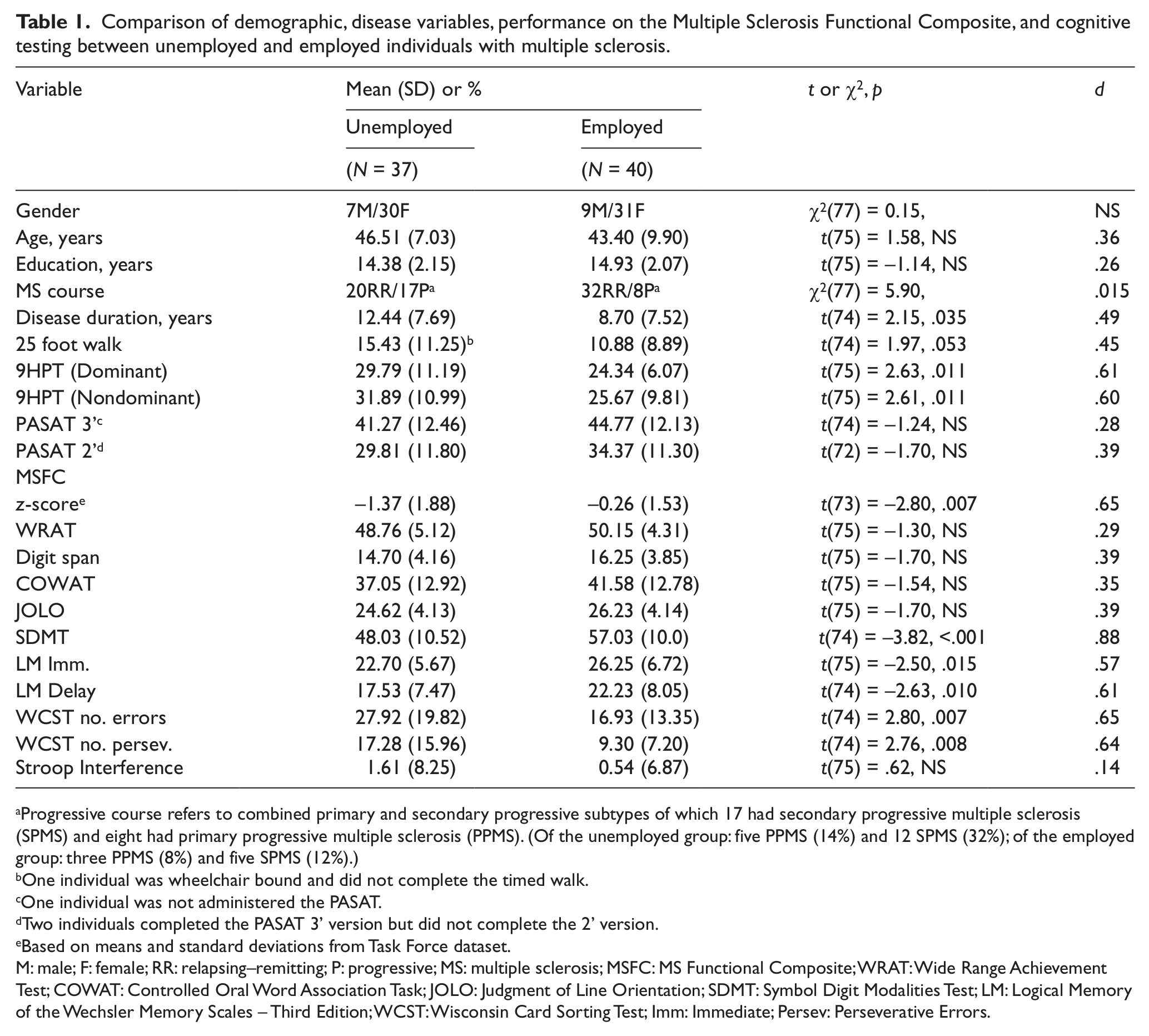
As shown in Table 1, the unemployed compared with the employed MS group had a longer disease duration and a higher proportion with a progressive course. There were no differences with regard to age, gender or education.On the MSFC, a statistically significant difference was noted between the unemployed and employed group on upper extremity functioning. When examining differences between the groups on lower extremity function, only a trend was noted. There were no significant differences between the employed and unemployed individuals with regard to performance on the PASAT.
Comparison of demographic, disease variables, performance on the Multiple Sclerosis Functional Composite, and cognitive testing between unemployed and employed individuals with multiple sclerosis.
Progressive course refers to combined primary and secondary progressive subtypes of which 17 had secondary progressive multiple sclerosis (SPMS) and eight had primary progressive multiple sclerosis (PPMS). (Of the unemployed group: five PPMS (14%) and 12 SPMS (32%); of the employed group: three PPMS (8%) and five SPMS (12%).)
One individual was wheelchair bound and did not complete the timed walk.
One individual was not administered the PASAT.
Two individuals completed the PASAT 3’ version but did not complete the 2’ version.
Based on means and standard deviations from Task Force dataset.
M: male; F: female; RR: relapsing–remitting; P: progressive; MS: multiple sclerosis; MSFC: MS Functional Composite; WRAT: Wide Range Achievement Test; COWAT: Controlled Oral Word Association Task; JOLO: Judgment of Line Orientation; SDMT: Symbol Digit Modalities Test; LM: Logical Memory of the Wechsler Memory Scales – Third Edition; WCST: Wisconsin Card Sorting Test; Imm: Immediate; Persev: Perseverative Errors.
On cognitive testing, results indicated a significant difference between employed and unemployed individuals on measures of information processing speed, verbal learning and memory, and executive functioning.
A stepwise logistic regression analysis was performed to determine the most salient predictors of employment status. Given the significant mean differences, the model included the following variables: disease duration, disease course, 9HPT, SDMT, Logical Memory, and WCST. As shown in Table 2, the only predictor of employment status was the SDMT, accounting for 15–20% of the variance with an overall accuracy of 67%.
Forward (Wald) stepwise logistic regression predicting employment status.

SDMT: Symbol Digit Modalities Test.
Discussion
Unemployment and impairments in everyday functioning are major concerns for people living with MS. Identification of individuals who are at risk for impairment and reduction in functioning is of great importance to clinicians. However, the utility of existing measures of disease progression in predicting functional outcomes and assessing clinically meaningful change has been brought into question. In the present study, we sought to examine the utility of the MSFC and additional cognitive tests in predicting employment status in MS. On the MSFC, we found that measures of upper extremity functioning are capable of differentiating employed and unemployed individuals. The PASAT was not.
On cognitive testing, unemployed individuals performed significantly worse on measures assessing information processing speed, verbal learning and memory, and executive functioning. However, in a logistic regression, only the SDMT was found predictive of employment status. Finally, longer disease duration and a progressive course were associated with being unemployed. There were no significant differences with regard to age, gender, or education.
The important contribution of neurological and cognitive impairments on employment status as demonstrated in this study are supported by prior observations.6,9 However, the most significant contribution of the present investigation is the replication that the SDMT was the most critical predictor of employment status. It has been previously recommended that the SDMT replace the PASAT as the cognitive measure of the MSFC given its ease and speed of use, minimal practice effects, and less aversion by patients. 10 Present findings suggest that further consideration be given to this suggestion as well as at least incorporating the SDMT into clinical practice to help identify patients at greatest risk for unemployment and assist in recommendations or accommodations related to work.
Limitations of the present investigation include the lack of more descriptive employment categories (e.g. homemakers) and the use of a limited cognitive test battery that did not include recommended measures in MS such as those included in the Minimal Assessment of Cognitive Function in Multiple Sclerosis (MACFIMS) battery. Further investigations simultaneously examining the utility of the EDSS, MSFC, and MACFIMS in determining employment status are warranted.
Footnotes
Conflict of interest
The authors declare that there is no conflict of interest.
Funding
This research was funded by the National Multiple Sclerosis Society. The grant number is RG 2596B2/2.