







Abstract

Variations in the geographic distribution of multiple sclerosis (MS) and neuromyelitis optica (NMO) suggest a role for possible genetic and environmental influences in the etiopathogensesis of these diseases. Several hospital based and multi-ethnic population based studies suggest that NMO is more likely among individuals of non-white origin. While the genetic associations of MS have been extensively studied very little is known in this regard about NMO. It is possible that the rarity of the disease coupled with a relatively small sample size under-powers studies that attempt to evaluate genetic associations in NMO. From Brazil, 1 the Caribbean islands 2 and France 3 an association with human leukocyte antigen (HLA) DRB1*03 has been reported. Among the Japanese, 4 the association was noted with the HLA-DPB1*0501 allele. We are reporting the first study from India where a recent population-based epidemiological survey showed a prevalence of 2.7/100,000 for NMO. 5
Ninety three consecutive patients (24 males and 69 females) with relapsing Neuromyelitis optica spectrum disorders (NMO/NMOS) disorders including 61 NMO (Wingerchuck 2006 criteria 6 ), 11 recurrent myelitis with long cord lesions, 20 recurrent optic neuritis and one patient with recurrent tumefactive demyelination were studied. For genotyping patient samples were compared with 300 MS patients who fulfilled McDonald criteria 7 and an equal number of healthy unrelated controls. Anti-AQP4 antibody was detected by fixed cell based assay using a commercially available kit (EUROIMMUN, Germany). HLA-DR typing was performed by polymerase chain reaction with sequence specific primers. Alleles that were DRB1*1501/1502 positive by this low resolution typing technique were sequenced for accurately determining HLA-DRB1*1501 status. The study was approved by the institutional ethics committee. HLA-DRB1 allele frequencies between patients and healthy volunteers were evaluated using UNPHASED3.0.8. Bonferroni–Dunn’s correction was applied to uncorrected p values. A corrected p value (cp) <0.01 was considered significant.
Among the 93 patients, 44 (47.3%, who were all women) were seropositive for anti-AQP4 antibody. When compared with healthy controls, NMO patients had over representation of HLA-DRB1*03 allele (11% vs 2%, odds ratio (OR) 5.69, 95% confidence interval (CI) 2.39–13.5, cp<0.0009). A trend for association was seen with DRB1*10 (12% vs 6%, OR 2.55, 95% CI 1.16–5.63, cp=0.03). After stratification for anti-AQP4 positivity this association with DRB1*03 allele (cp<0.009) persisted (Table 1). In the MS group HLA-DRB1*15:01allele frequency (21% vs 13%, OR 1.62, 95% CI 0.98–2.67, cp<0.003) was significantly different from controls. When MS patients were compared with NMO there was over representation of DRB1*15:01 allele (21% vs 9%, odds ratio 2.21, 95% CI 1.01–4.83, cp<0.00001) in MS but not NMO (Supplementary File – Table S1) patients. HLA DQA1 and DQB1 alleles were not significantly associated with either NMO or MS patients in this study,
HLA-DRB1 allele frequency in neuromyelitis optica (NMO) patients and controls.
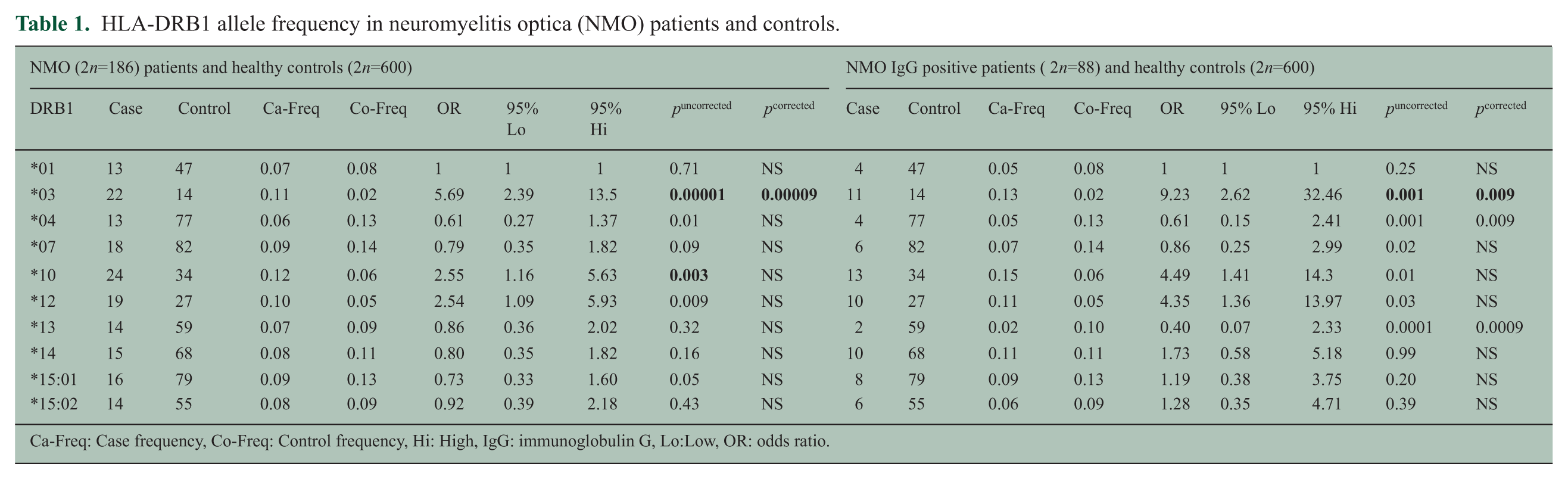
Ca-Freq: Case frequency, Co-Freq: Control frequency, Hi: High, IgG: immunoglobulin G, Lo:Low, OR: odds ratio.
The results of our study are in keeping with published studies on HLA associations in NMO. Irrespective of ethnicity genetic susceptibility for NMO among both white and non-white populations (with the exception of the Japanese) appear to be the same. Larger studies are required to further establish the validity of our findings.
Footnotes
Conflict of interest
None declared.
Funding
This study was funded by a grant from Department of Science and Technolgy, Government of India (grant number SR/SO/HS/127/2010).
References
Supplementary Material
Please find the following supplemental material available below.
For Open Access articles published under a Creative Commons License, all supplemental material carries the same license as the article it is associated with.
For non-Open Access articles published, all supplemental material carries a non-exclusive license, and permission requests for re-use of supplemental material or any part of supplemental material shall be sent directly to the copyright owner as specified in the copyright notice associated with the article.
