







Abstract
This article is concerned with the question of why lesbian, gay, bisexual, and trans (LGBT) rights legislation is introduced at higher levels in some cases and less so in others. To address this puzzle, the article analyzes changes in LGBT rights legislation across European Union (EU) member states between 1970 and 2009. It focuses on the diffusion of five different categories of such legislation (anti-discrimination, criminal law, partnership, parenting rights, and equal sexual offenses provisions) to new EU member states in Central and Eastern Europe, compared with diffusion patterns in older EU member states. I argue that new-adopter states are more dependent on international resources for making new issues visible and are more inclined to see policy adoption as a means to gain external legitimacy and improve reputation. The analysis reveals that the transnational embeddedness of a state’s LGBT advocacy organizations is a powerful statistical explanation for successful policy diffusion to new EU member states, alongside international channels that lead to LGBT visibility among society and state authorities. In addition to lending cross-national, empirical reinforcement to some of the theoretical expectations regarding the international sources of diffusion, the results suggest variability in the determinants of LGBT policy adoption between the 15 old and 12 new EU states. Domestic factors, particularly economic modernization, are more relevant for policy adoption in the older member states, whereas the newer member states display greater dependence on transnational actors and are more influenced by international channels.
Keywords
Introduction
In 1948, Axel and Eigil Axgil and their colleagues founded Denmark’s first gay rights organization, Kredsen af 1948 (The Circle of 1948). Inspired by the 1948 United Nations (UN) Declaration of Human Rights, homophile organizations like Kredsen af 1948 began a process of lobbying states for gay rights. For affluent democracies, the birth of the gay liberation movement and the dawn of the 1970s heralded a marked, albeit gradual, expansion in the forms of legal protections that states provided gay and lesbian minorities. By 1 October 1989, the first same-sex couples — including the Axgils, who celebrated four decades as a couple and as human rights activists — had entered into registered partnerships in Denmark. Although progress has been slow and has provoked countermovements intended to block progressive legislation, the proliferation of lesbian, gay, bisexual, and trans (LGBT) 2 -friendly legislation has amplified the voice of a once politically invisible group and has become a recurrent theme in modern European politics.
The achievement of the legal recognition of LGBT minorities, however, varies greatly across European states. Europe is distinctive in that it houses states at both ends of the spectrum of global LGBT egalitarianism. While some European states (e.g. Denmark) became the world’s leading advocates for LGBT rights, providing the most extensive legal protections to their citizenry, others have only recently decriminalized homosexuality (e.g. Romania in 2001). Figures 1 and 2 show the varied adoption of LGBT legislation over three decades in old (EU-15) and new (EU-12) member states, respectively — countries are listed in order of their standing in 2010. 1 In this article, I examine this variation, exploring why LGBT rights legislation is passed at higher levels in some cases and less so in others.
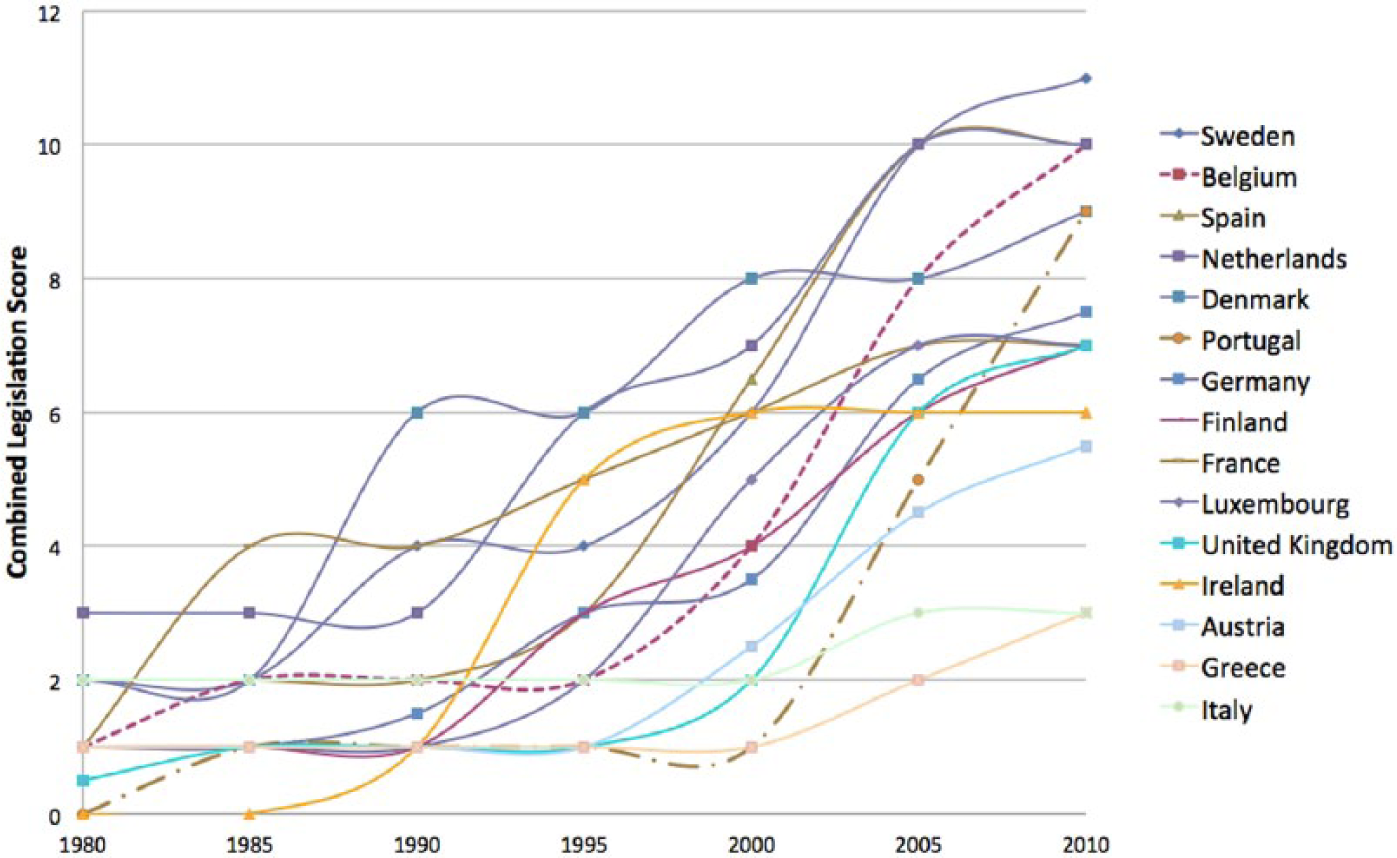
Passage of LGBT legislation in EU-15 states.
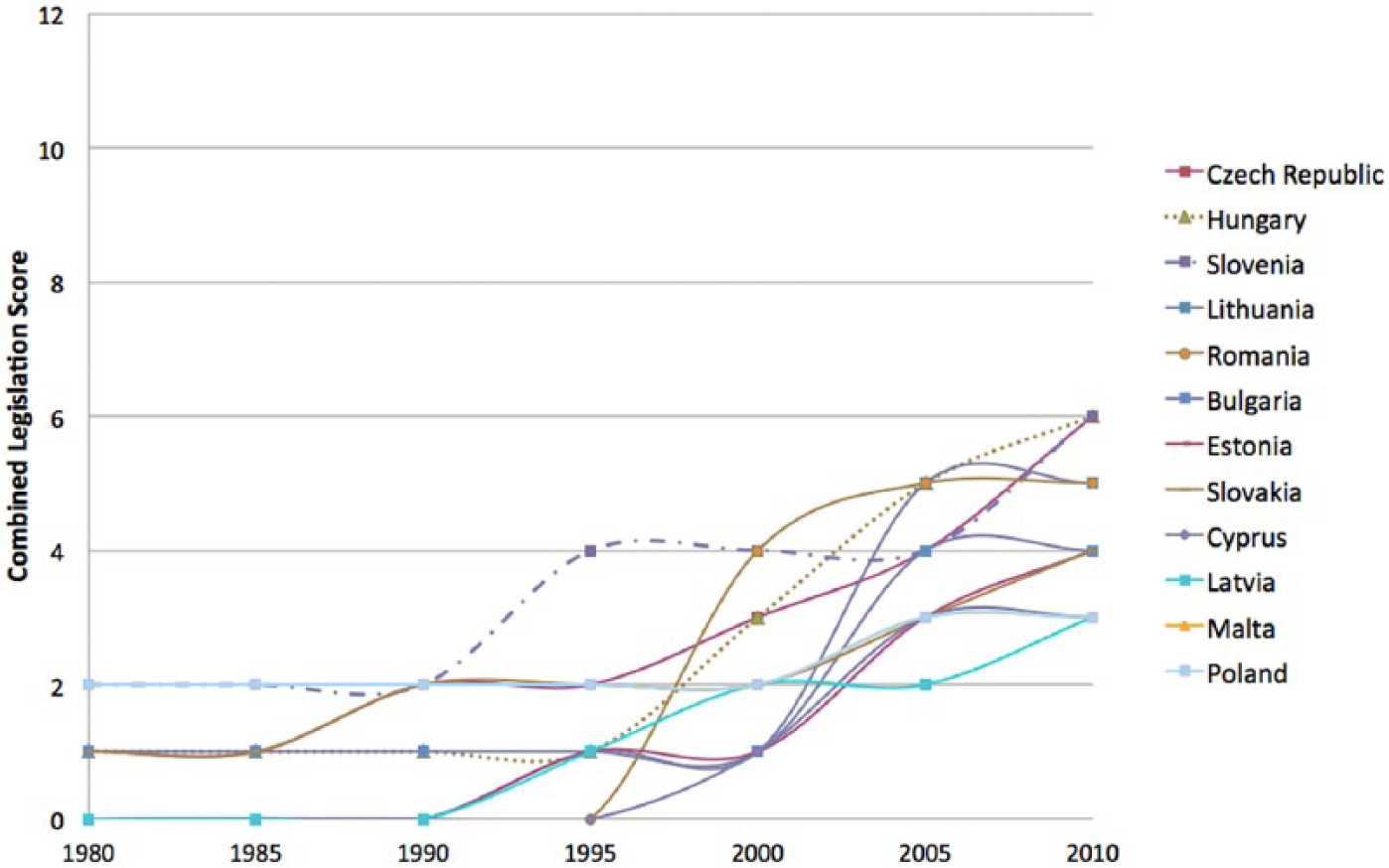
Passage of LGBT legislation in EU-12 states.
The observed variation raises important questions for scholars of international relations and social movements: what accounts for such different levels of legal recognition of sexual minorities across European states? Is change a result of heightened transnational cooperation with groups in states that have previously adopted the legislation? Or, is it a result of the domestic preconditions of the state that allow international norms regarding the legal rights of sexual minorities to proliferate? The answers to these questions are theoretically and practically important for the study of politics. There are few social issues that incite as much controversy in contemporary world politics as LGBT rights; yet, despite their contested nature, a growing number of states are adopting these norms into their legal frameworks (Asal et al., 2013; Barclay et al., 2009; Fernández and Lutter, 2013; Helfer and Voeten, 2014; Kane, 2003, 2007; Sommer et al., 2013; Waaldijk and Bonini-Baraldi, 2006). Understanding the differential levels of adoption brings to light the international channels and domestic conditions of diffusion.
To explain this variation, I argue that transnational and domestic explanations depend on the political identities of the groupings that states find themselves in within the international system. I think of these state groupings in terms of new-adopter and first-mover status, which have different political identities in relation to the international society of states, and subsequently also different political imperatives to adopt pieces of legislation that have become symbolic of political modernity. Thus, looking at the European Union (EU), I expect adoption patterns to differ according to newly admitted EU member states (EU-12) and long-standing EU member states (EU-15). 3 While levels of adoption also vary within both groupings, I expect them to be explained by different factors. In EU-15 states, where the norm was politicized earlier (through the Gay Liberation Movement of the 1970s and the HIV-AIDS crisis of the 1980s), I expect domestic factors — such as the commonly theorized level of modernity — to play a greater role in increasing the likelihood and extent of diffusion. By contrast, transnational interactions — via social and political channels that tie states to the international community — should accelerate the diffusion of LGBT norms in contexts where the issue has only recently attracted widespread public debate (the EU-12 states). In these new-adopter states, transnational channels have the capacity to enhance the salience of norms, and transnationally connected LGBT organizations can act as catalysts in the adoption of legislation by signaling to decision-makers that LGBT rights are connected to the state’s reputation within its international community. Not only do they help states and society, more broadly, to interpret external information, but they also help to frame that information in ways that resonate in local contexts. I thus distinguish between domestic and transnational factors, suggesting that their influence should vary across groupings of first-mover and new-adopter states.
The analysis looks at the adoption of LGBT legislation between 1970 and 2009. I focus on pieces of LGBT legislation because they constitute an observable consequence of norm diffusion. Following the efforts of International Relations, social movements, and Europeanization scholars, I seek to explain the diffusion of LGBT rights policies by using their carefully conceptualized theories of cognitive change among social actors and relational channels between states. I address calls for further research by systematically exploring the (non-)diffusion of five categories of LGBT legislation in multiple domestic contexts and by specifying the international channels, domestic actors, and conditions responsible for change. The analysis combines a large-n, cross-national analysis of changed LGBT rights legislation in Europe with interview material drawn from two years of fieldwork in Europe. The fieldwork included over 80 semi-structured interviews with European activists and parliamentarians, as well as participant observation at strategic activist meetings and demonstrations for and against LGBT rights. Finally, I draw on an original survey of 291 transnationally connected LGBT organizations in Europe. 4 The survey and fieldwork data help to contextualize the correlations observed in the quantitative analysis.
The findings suggest that the transnational embeddedness of a state’s LGBT advocacy organizations — a brokered transnational channel — is a powerful explanation for successful policy diffusion to new EU-12 member states, alongside other transnational channels that lead to LGBT visibility in society and in the minds of state authorities. While the results lend cross-national, empirical reinforcement to some of the theoretical expectations regarding the transnational sources of diffusion, they show substantial variability in the determinants of LGBT policy adoption between first-mover EU-15 and new-adopter EU-12 state groupings. Domestic factors, especially economic modernization, are more relevant for policy adoption in EU-15 states, whereas new EU-12 member states display greater dependence on transnational actors and are more influenced by international social and political channels. In sum, first-mover or new-adopter status matters for how international and domestic factors influence diffusion.
The article proceeds in five parts. First, I draw a set of hypotheses from previous literature. Second, I elaborate on my argument and show how scholars’ expectations regarding the diffusion of law might vary across first-mover EU-15 states and new-adopter EU-12 states. The third and fourth sections discuss the data and methods used and the results of my quantitative analysis. Fifth, I contextualize the quantitative findings with descriptive and qualitative data, explaining the role of transnational socialization in LGBT rights adoption, and why it matters more for new-adopter states. I conclude by discussing the significance of my findings for the study of norm diffusion and global trends in policy adoption.
Explaining the diffusion of rights legislation
Previous scholarship explaining the international diffusion of social policies has generally fallen into one — or a combination — of three camps, wherein successful diffusion is linked to the presence of: (1) advocacy networks connecting international and domestic politics; (2) international channels of socialization and/or sanctioning pressure; and (3) bottom-up domestic resonance. These frameworks inform the core hypotheses tested in this analysis.
Transnational advocacy networks
International Relations and social movement scholars have noted the importance of advocacy groups in influencing the international diffusion of rights legislation (Keck and Sikkink, 1998; Montoya, 2013; Roggeband, 2010). Social movement organizations are commonly theorized as the most experienced type of organization in channeling a social group’s grievances to the relevant authorities (Ayoub, 2010: 473). In particular, Soule’s work on minority rights legislation offers substantial evidence that social movement activity affects the introduction and diffusion of rights and anti-discrimination legislation for various minorities in the US (Soule, 2004; Soule and King, 2006). Focusing particularly on LGBT rights, Kollman’s (2013), Holzhacker’s (2012), and Paternotte and Kollman’s (2013) work has emphasized the centrality of advocacy networks, which organizations like the International Lesbian, Gay, Bisexual, Trans and Intersex Association (ILGA) foster, in addition to a series of domestic factors. Thus:
Hypothesis 1: The likelihood of passing higher levels of LGBT legislation increases when domestic LGBT organizations become embedded in the transnational activist networks Europe provides.
International pressure and socialization
For many International Relations scholars, rights legislation diffuses to states when those states are convinced of the norm’s social appropriateness or when they fear the costs of international pressures. These theories — the first linked to mechanisms of socialization and the second to political conditionality and material incentives — posit logics of appropriateness and consequences, respectively. World polity and constructivist scholars focus on the first set of informal processes of influence, arguing that international norms exert an influence on states by defining the contours of appropriate behavior (Finnemore and Sikkink, 1998; Klotz, 1995; Meyer et al., 1997). Interactions between states in an international community lead to different cognitive understandings of what is acceptable. These indirect channels can engender change via socialization through mechanisms of learning and deliberation (Risse, 2000).
When states are members of international organizations, their representatives are often required to confront the LGBT issue and take a stand. For example, consider the sharp media criticism that the British Conservative Party faced when they formed the European Conservatives and Reformists Group (ECR) with the Polish Law and Justice Party (PiS) in the European Parliament. While their cooperation was based on anti-federalist Euro-skepticism, the media (in the UK and abroad) criticized the Conservative Party for cooperating with the PiS because of the homophobic rhetoric espoused by several PiS members around the time of heightened political homophobia in Poland (Helm, 2010). The international media’s negative portrayal was so severe that some ECR members went to great lengths to prove that they were not homophobic, for example, Conservative Party politicians attending gay pride parades in Warsaw. Other indirect channels of diffusion are social, such as the import of television shows from cultural powers like the US, where featuring gay characters has increased rapidly since the 1990s. Studies show that exposure to media with gay themes positively influences social attitudes and policymakers’ actions regarding LGBT issues (Ayoub and Garretson, 2014; Cooley and Burkholder, 2011). Social channels reconfigure the threat associated with minorities by making them familiar. These channels of interaction lead to social learning, providing images and understandings of what it means to be a member of an international political and social community:
Hypothesis 2a: The likelihood of passing higher levels of LGBT legislation increases when the state’s level of political porosity is higher. Hypothesis 2b: The likelihood of passing higher levels of LGBT legislation increases when the state’s level of social porosity is higher.
Rational institutionalists attribute domestic change to the incentives provided by international organizations and focus on the costs associated with norm adoption (Martin and Simmons, 1998). According to this perspective, political leaders weigh the costs and benefits of adopting a norm. In the EU, non-adoption of the LGBT norm can mean lost material benefits linked to economic and security cooperation at the European level. Scholars have emphasized the unique and direct role of EU conditionality in the adoption of new laws in the EU member states, with sanction, coercion and competition representing the central mechanisms by which this type of process occurs (Schimmelfennig and Sedelmeier, 2005; Toshkov, 2008; Vachudova, 2005). There are reasons to expect that states will adopt LGBT rights legislation through these mechanisms, especially since the EU required applicant states to decriminalize homosexuality and to adopt employment anti-discrimination measures in their legal frameworks in the 1990s. Since my interview and survey respondents suggest that EU conditionality may have a greater effect in the years leading up to accession, when Brussels has a carrot to offer, I also include an indicator of a state’s application to join the EU:
Hypothesis 2c: The likelihood of passing higher levels of LGBT legislation increases when a state accedes to join the EU. Hypothesis 2d: The likelihood of passing higher levels of LGBT legislation increases when a state applies to join the EU.
Domestic resonance
Others have taken a ‘bottom-up’ approach, emphasizing the domestic political and cultural variables that condition the reception of contentious international ideas (Cortell and Davis, 1996; Seybert, 2012; Zürn and Checkel, 2005). This literature focuses on the congruence between international norms and elements of the domestic context, outlining several domestic factors that influence the receptivity of norms concerning social minorities. Post-materialists expect higher levels of democracy and affluence to correspond with a state’s readiness to legislate on minority rights issues (Inglehart and Norris, 2003). Social movement scholars have focused on domestic spaces for LGBT identities and culture, which may influence the reception of legal norms by making the context more susceptible. Various minority movements rely on ‘free’ or ‘safe’ spaces to form associational ties and to mobilize counter-hegemonic identities (Polletta, 1999; Zepeda-Millán, 2014). Finally, the dominant religious institution and orientation of the state may influence its receptivity to LGBT rights norms. Byrnes and Katzenstein (2006) find that the variation in type of religion across Europe is an obstacle to EU integration. In post-socialist societies, Catholic and Orthodox Churches have been especially opposed to the import of EU standards on sexuality (Ramet, 2006a, 2006b: 126). I include a series of domestic variables in the models to tap into these concepts:
Hypothesis 3a: The likelihood of passing higher levels of LGBT legislation increases when more domestic social spaces for LGBT people exist. Hypothesis 3b: The likelihood of passing higher levels of LGBT legislation increases when a state’s level of democracy is higher. Hypothesis 3c: The likelihood of passing higher levels of LGBT legislation increases when a state is wealthier. Hypothesis 3d: The likelihood of passing higher levels of LGBT legislation varies according to the denomination of a state’s dominant religious institution
Theory
Taken individually, existing explanations are simplistic because they ignore the multiple dimensions of diffusion in a complex, multi-level interactive environment (Graham et al., 2013). Following Sil and Katzenstein’s (2010) call to move beyond grand narratives, I combine several of the previously mentioned mechanisms and add insights from the contentious politics literature to argue that international explanations should be more compelling in new-adopter states where issues have been more recently politicized (Hypotheses 1 and 2), while domestic explanations should be more powerful in first-mover states (Hypothesis 3).
This expectation rests on the idea that actors in new-adopter states are more dependent on international resources for making new issues visible and are more inclined to see adoption as a means to gain external legitimacy and improve reputation. When states become more transnationally connected in the international system, this process can occur even before domestic audiences are prepared to embrace the issue. For first-mover states, domestic factors should be more likely to explain the expansion of LGBT rights. Their membership in a club that began to address the issue earlier paradoxically relieves the need to respond to international political pressures to expand on basic LGBT rights. Such a distinction between first movers and new adopters is often overlooked however. An exceptional recent study on the diffusion of same-sex unions by Fernandez and Lutter (2013), for example, finds that a mix of international and domestic theoretical factors matters, but they do not take into account the sub-regional and state identities that others have found to privilege some diffusion factors over others (Gurowitz, 2006; Towns, 2012). According to Towns (2012), states that have historically failed to gain international recognition are often the first to reach higher levels of norm adoption in order to improve their reputations in international hierarchies. In this sense, ‘reputation’ serves ‘as an umbrella term for the subjective image of a state that is held by other actors, both on its own and in relation to others’ (Erickson, 2014: 181). Since states occupy different positions within the international system, and have distinctive histories related to LGBT rights at the international level, I expect state authorities to be motivated to adopt pro-LGBT legislation by different factors in two subsets of states: the EU-15 and the EU-12.
We should thus hypothesize systematic differences between contexts in which the LGBT issue was politicized during the early phases of LGBT norm development in the 1970s (i.e. the EU-15 states), and contexts in which the issue only recently gained widespread public visibility (i.e. the EU-12 states). Drawing on the work of sociologists like Tolbert and Zucker (1983), Strang (1990), and Soule (1997), the diffusion and institutionalization of norms is, then, a two-stage process. The process may thus be more ‘internal’ in a set of states that identify with a first-mover grouping, where local communities responded to domestic political problems and then crystalized a norm, which new EU states adopt later as they seek external legitimacy. In her study of same-sex union policies, Kollman (2013: 185) makes a similar point, arguing that domestic facilitating factors were less imperative for ‘second-wave’ countries, which followed the example of European leaders. This is reminiscent of the distinction between early and late industrializers in international political economy: whereas early industrializers had to come up with technological and social innovations through trial and error, late adopters were able to adapt and replicate templates that were demonstrated to work (Gerschenkron, 1962). 5 Norm evolution in first-mover states was incremental and driven by domestic groups, which had to work within the constraints of the local institutional and normative context. By the time new-adopter EU-12 states became EU members, they were obliged to confront an established and institutionalized European norm, leaving less room for incremental adaptation. Building on Schmidt’s (2008) discursive institutional argument that ideas can only institutionalize after demonstrating their viability at three levels (policy, programmatic, and philosophical), I make the case that the three kinds of viability evolved more simultaneously in first-mover states, whereas new-adopter states were confronted with policy and programmatic frameworks before philosophical viability — favorable public sentiments — could be assured.
In new-adopter EU-12 states, I expect greater norm diffusion as: (1) domestic LGBT organizations become embedded in transnational advocacy networks; and (2) states become more permeable to international influences. I thus see a greater role for international sources of change in these states, as LGBT people are more likely to depend on external resources and frames to make the issue resonant and legitimate in the domestic sphere. Within this group, the states most likely to adopt LGBT legislation, then, are those that are the most porous in terms of political and social connectedness to other states. 6 Political and social porosity primes these contexts by allowing transnational actors to send a clear and legitimate signal to both society and the state that adopting the norm is part of what it means to be part of modern Europe. These actors — usually transnationally embedded domestic LGBT organizations — can harness those ideas and adapt them, manufacturing a narrative of resonance in their domestic contexts, even when they were previously invisible locally. 7 I am thus careful to note that in the case of LGBT rights, states do not passively emulate international examples. The norms governing LGBT rights remain contested, which is why they require careful interpretation by the domestic LGBT groups that can channel international examples to legitimize them locally. These actors help to interpret the norm, and they send a clear signal to the state that norm compliance is necessary to fulfilling its role in international society. When these actors are absent, international norms risk being painted as external impositions, precisely because the opposition can more easily frame LGBT rights as ‘external’ within states that have only recently deliberated the issue. The more internationalized the context, the easier it is for actors to frame the norm as legitimate to policymakers, a process that is particularly important within new-adopter contexts.
For EU-15 states, policymakers should be less likely to feel the pressure to conform to international standards. Their international reputations do not suffer if they do not achieve the highest benchmarks of LGBT recognition. For example, the German government, led by Angela Merkel, balked at international activist demands to implement same-sex marriage after the US movement successfully won rhetorical support from President Barack Obama in 2012. 8 German authorities could reference their leading status on other types of LGBT legislation. By contrast, Prime Minister Sali Berisha of Albania expressed his support for same-sex marriage years earlier, in 2009. He quite clearly geared his rhetoric on same-sex marriage to the international community, and used European standards to justify the position to his domestic audience (see Michels, 2010, 2012). The following analysis tests the three hypotheses within each subset of states (new adopters and first movers) to explore the statistical explanations for why the LGBT norm more rapidly and abundantly spreads to some states rather than others.
Data and methods
This article utilizes panel data to explore changes in the extent of adoption of LGBT legislation across states over 40 years. The complete dataset includes data on the passage of LGBT legislation in EU member states between 1970 and 2009. 9 It combines data collected on LGBT legislation (the dependent variable; DV) with other country contextual data by year. The data used for the independent variables were collected from organizational membership lists and five existing cross-national datasets containing information on levels of globalization (KOF Index of Globalization; see Dreher et al., 2008), democracy (Polity IV; see Marshall et al., 2010), gross domestic product (GDP) measures (Penn World Table; see Heston et al., 2011), and LGBT social spaces (Frank et al., 2010). Appendix Table A1 provides information on coding and the descriptive statistics for the variables used in this study.
Consistent with the propositions of this research, I limit my analysis to: (1) the 27 states that had joined the EU by 2009, since all states are embedded in the EU’s institutional structures; and (2) the years 1970–2009. I begin the analysis in 1970 because it roughly coincides with the time of the 1969 Stonewall Rebellion — the first broadly publicized instance of LGBT resistance — and the birth of the gay liberation movement, which began in the US in 1965 and found its way to Europe by 1971 (Adam et al., 1998). As I describe in greater detail later, I analyze new and old EU member states separately because they have differing political histories. As such, I expect that different conditions hold for these distinct subsets of states. The following sections explain the substantive meaning behind the dependent and independent variables (Appendix Tables A1 and A2 provide additional descriptive statistics).
Dependent variable
Governments select from a set of legislative measures that grant LGBT people state-sanctioned recognition in their respective states. This study focuses on 12 pieces of pro-LGBT legislation that fall under the following five categories: anti-discrimination (employment, goods and services, constitution); criminal law (incitement to hatred prohibited); partnership (cohabitation, registered partnership, and marriage equality); parenting rights (joint adoption, and second parent adoption); and equal sexual offense provisions (age of consent and legality of sex-same relations). The analysis uses both a five-point categorical LGBT legislation DV based on the five categories, and a 12-point legislation DV based on the key legislation components described earlier and in Appendix Table A1. While other studies have focused on one category (Asal et al., 2013; Frank et al., 2010), there are important theoretical justifications for thinking of the adoption of LGBT legislation in an ordered scale. Exploring only the legalization of sexual relations — which is linked to the global spread of individual rights (Frank et al., 2010) — tells us little about the extent of LGBT-friendly legislation achieved by states. Moreover, it cannot fully capture the impact of LGBT activism, which has a rich multi-issue agenda that extends beyond legislation on sodomy. For example, Italy made same-sex activity legal in 1890 and Poland did so in 1932, yet this had little to do with concern for the well-being of LGBT people. While both states are coded as successes in anti-sodomy datasets, they score poorly on many other measures of LGBT legislation.
The measurement of the DV is thus based on the question: what explains the extent to which states adopt LGBT rights legislation? First, the ordinal DV is a combined indicator of the five categories of LGBT legislation, ranging from 0 to 5. A state might score ‘0’ in 1990, but it will score ‘2’ in 1991 if two pieces of legislation, falling under two separate categories (e.g. adoption in the parenting category and civil unions in the partnership category), are passed that year. By contrast, if a nation passes two laws that fall under the same category (e.g. employment and housing discrimination protection) in the same year, it scores only one point for that year. Additionally, the coding reflects the presence of the law. If a nation passes legislation to grant adoption rights and civil unions in 1991 (two points), 1992 is also scored ‘2’ for the continued presence of those rights. Second, the 12-point DV applies the same logic, but includes the full count of the number of pieces of legislation, ranging from 0 to 12 in any given year (it does not break them down by category). A state might score ‘0’ in 1990, but it will score ‘2’ in 1991 if two pieces of legislation are passed, even if these fall under the same category (e.g. employment and housing discrimination protection). Using these two measures of the DV in different regression analyses allows us to conceptualize the extent of pro-LGBT legislation in two different ways, as well as to increase the robustness of the findings. Let us now turn to the operationalization of the independent variables derived from the aforementioned theoretical approaches.
Independent variables
The transnationalization of domestic LGBT organizations
A central variable in this analysis operationalizes the embeddedness of states’ organizations in transnational LGBT networks, referring to the number of domestic organizations that are members of international LGBT umbrella organizations in any given year. Using membership lists of ILGA-Europe and the International Lesbian, Gay, Bisexual, Transgender, Queer Youth and Student Organisation (IGLYO), I have collected data on the 291 transnational LGBT organizations in the broader European region, including the year they joined the European LGBT umbrella organization. The membership lists obtained also indicate when member organizations ceased to exist or canceled their affiliations. The variable is coded 0–3, with countries having zero to three transnational LGBT organizations in any given year. 10
International channels
Five variables operationalize the concept of international channels: social, political, and combined internationalization variables, and the processes of applying to and acceding to the EU. The first three form a set of internationalization variables, based on the theory that porosity leads to LGBT norm visibility. The KOF Index of Globalization Dataset provides a measure for the concept of ‘political globalization, characterized by a diffusion of government policies’ (KOF Method, 2012). Such political channels measure the extent to which a country is a member of international organizations, has signed bilateral and multilateral treaties, hosts embassies and high commissions, and is involved in UN peace missions (KOF Method, 2012). This measure should indicate a state’s self-perception as a member of the international community (KOF Method, 2012). I also use a sub-index measure of social globalization on information flows, which is, for conceptual reasons, most appropriate for the present analysis. The sub-index taps into the idea of social channels that ‘measure the potential flow of ideas and images [with data on] the number of internet hosts and users, cable television subscribers, number of radios (all per 1000 people), and international newspapers traded (in percent of GDP)’ (KOF Method, 2012). Distinguishing between two different forms of internationalization reflects Olzak’s (2011) call to differentiate between channels that differ in terms of who and what they bring to interaction across borders and the (in)direct nature of their effect. I also run the models using a combined channels variable, an overall globalization index of social, political, and also economic channels, which serves as a measure of the overall porousness of a state, and as a measure of robustness (Asal et al., 2013). Finally, I include two dummy variables that distinguish the years before and after a state (1) applies to join and (2) actually does join the EU. While political and social channels should matter most for the spread of ideas, all variables are conceptually similar in that they measure a state’s connection to the international community.
Domestic conditions
Next, a series of measures captures the concept of resonance in the domestic realm: the presence of domestic social spaces, the level of democracy, the level of state wealth, and the dominant state religion. To capture the presence of domestic social spaces, I use the data and coding schema developed by Frank, Camp, and Boutcher (2010). 11 Social spaces are scored on a scale ranging from 0 (no activity) to 5 (widespread gay social life). These scores measure the presence of gay-friendly bars, clubs, organizations, restaurants, and cafes across cities in each country. Research on the US context has used similar measures of LGBT spaces (using the Gayellow Pages) to identify pre-existing movement ties in the 50 states (Kane, 2003: 320). I include additional domestic variables to account for a state’s level of democracy and wealth in a given year. The Polity IV Database provides a measure for the degree to which a state is a consolidated democracy, spanning ‘from fully institutionalized autocracies … to fully institutionalized democracies’ (Marshall et al., 2010). Next, I use the Penn World Table for the GDP measure. Finally, I include a measure of the dominant state religion, separating states into the four groups of: (1) Mixed Christian; (2) Protestant; (3) Catholic; and (4) Other (Andersen and Fetner, 2008: 947; Barrett et al., 2001). These religions qualified as dominant if 70% of the population identifies as a member. Controls for year, population, and group of EU accession wave are included in the analysis but are not reported in the tables.
Method
I test my hypotheses using ordered logit regression and Poisson regression (depending on the DV used) to explore the determinants of the successful passage of legislation. The ordered logit analysis assigns an ordered value according to the extent to which a state passes categories of LGBT legislation (five-point DV), taking into account that some states go much farther (e.g. legalizing LGBT partnerships) than others (e.g. decriminalizing same-sex sexual relations). The Poisson analysis uses a count of all pro-LGBT legislation passed (12-point DV). 12 The dataset includes 826 observations across 40 years in 24 countries. 13 Depending on the subset of states being analyzed, the models include between 266 and 560 yearly observations in 10 or 14 country clusters.
Results
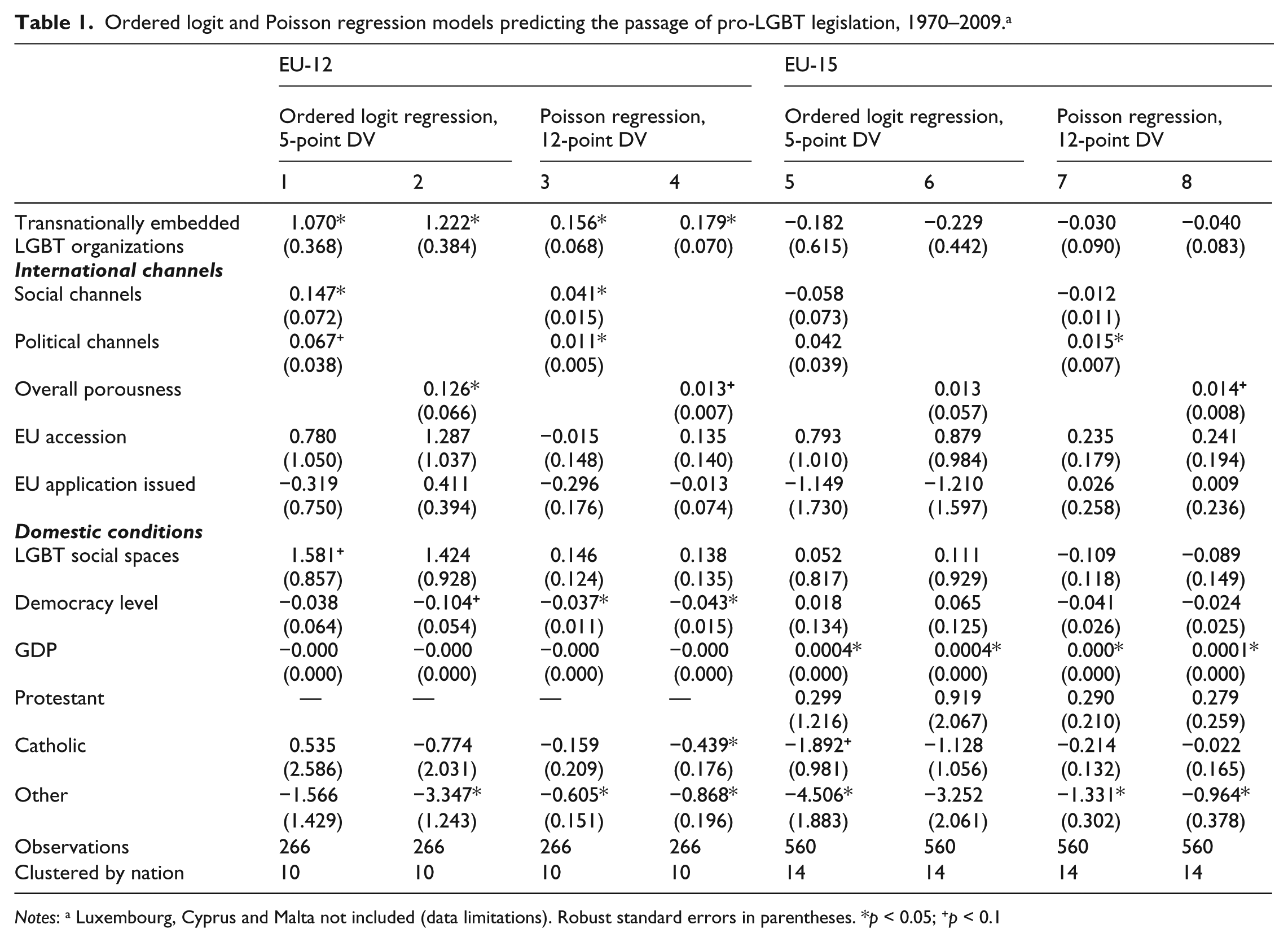
Table 1 presents the results for the ordered logit and Poisson models, reflecting the extent to which states adopt LGBT legislation. It divides results into two groups, according to the subset of states: the new EU member states (Models 1–4) and the old EU member states (Models 5–8). All models reported are run with either the social and political channels variables (Models 1, 3, 5, and 7) or the combined channels variables (Models 2, 4, 6, and 8). 14
Ordered logit and Poisson regression models predicting the passage of pro-LGBT legislation, 1970–2009. a
Notes: a Luxembourg, Cyprus and Malta not included (data limitations). Robust standard errors in parentheses. *p < 0.05; +p < 0.1
In analyzing the adoption of LGBT legislation in Europe, the results are complex, supporting different theoretical approaches according to the subset of states analyzed. The results surrounding the EU-12 models (Models 1–4) provide a measure of support for the hypothesis that transnational and international channels influence the extent to which LGBT-friendly policies diffuse. The variables Transnationally embedded LGBT organizations, Social channels, and Political channels are all significant (p ≤ .05 15 ), controlling for all other variables in the models. 16 The Combined channels variables are also significant at the .05 (Model 2) or .1 (Model 4) levels. An examination of Models 1–4 in Table 1 indicates that, on average, as states have more transnationally embedded LGBT organizations, they are more likely to adopt more LGBT-friendly policies. The findings related to international channels are also in line with the hypothesis that diffusion depends on the international porosity of states.
Figure 3 shows the strong influence of Transnationally embedded LGBT organizations on the adoption of LGBT laws in new EU member states. The y-axis indicates the expected change in the predicted probability that a state will reach various levels of LGBT legislation when such organizations exist. In the new EU states, three categories is the highest level of law that a state passed in 2009. When transnationally embedded LGBT organizations exist, the estimated change in the predicted probability of passing no laws decreases by 30%; the probability of reaching medium and high categories of law increases by 19% and 29%, respectively. Interestingly, the probability that a state will enact one category of law is lower when transnational LGBT organizations exist. Low levels of legislation that have benefited LGBT people have spread without the necessary presence of transnational LGBT movements. While we cannot interpret it directly from this analysis, the figure may reflect the finding established by Frank et al. (2010), which traces the decriminalization of sex to the global cultural underpinnings of respecting individual rights. In general, the decriminalization of same-sex relations has come before the passage of protections against discrimination, which usually preceded the highly symbolic issue of relationship recognition and, ultimately, the most socially contentious issue of parenting rights (Waaldijk, 2000). While new-adopter states have tended to skip some of the steps we have witnessed in first-mover states, this general pattern still plays out. My findings suggest that transnationally connected LGBT organizations influence the probability of moving beyond minimal thresholds of legal recognition in new-adopter states.
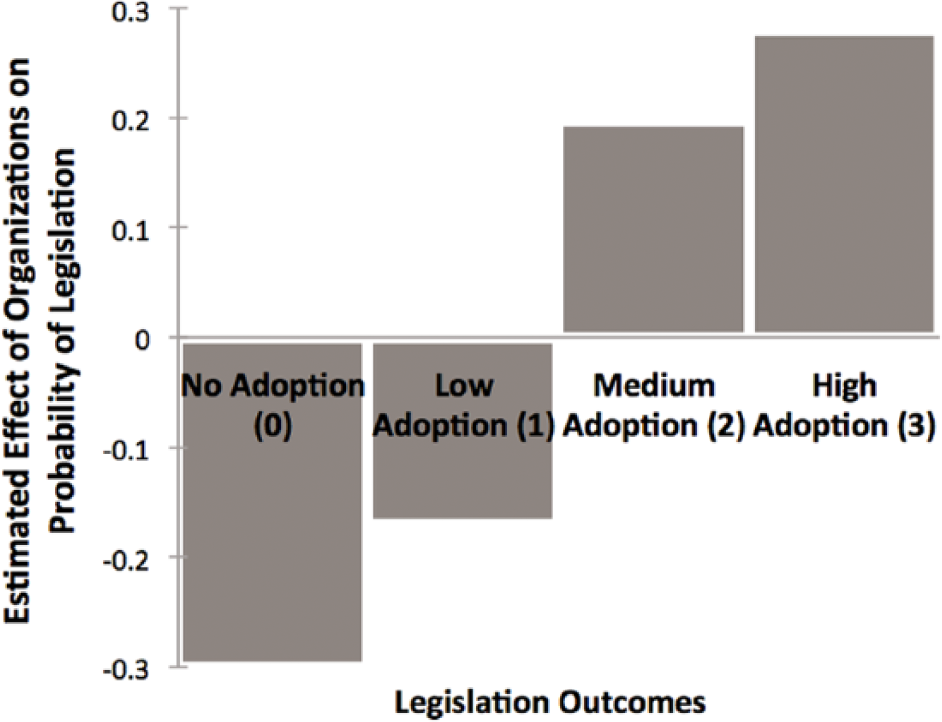
Expected change in the predicted probability of passing LGBT legislation when organizations exist, in new EU states.
The EU accession and EU application variables fail to reach significance across models, which privileges policy adoption via mechanisms of transnational socialization over hard law and EU conditionality (Kollman, 2013). This is likely to also be related to the fact that the EU’s direct pressure mechanism only encourages states to decriminalize homosexuality and pass anti-discrimination legislation in employment. What is striking are the inconclusive findings for the role that domestic variables play in any new EU-12 states. The results suggest that GDP wealth is not significantly correlated with higher levels of policy adoption in any of the models concerning new EU member states. Furthermore, the positive effect of LGBT social spaces on the diffusion of legislation only reaches significance at the .l level, and only in Model 1. States in which the dominant religion is Catholic or Other (generally Orthodox in this analysis) are less likely than Mixed Christian states to pass LGBT legislation, but the significance levels of the results remain mixed across models. The Other religion variable performs the best, reaching significance in Models 2–4, and supporting research on the particularly strong opposition by the Orthodox Church to LGBT rights (Ramet, 2006a).
Surprisingly, Democracy level is negatively correlated with passing higher levels of LGBT legislation in new EU member states, challenging the expectations of the domestic resonance camp. While we should note that this finding applies to one of the most democratic regions in the world — and may be reversed if the analysis went beyond the regional scope of this study — it is interesting to find that among new EU member states, the strongest democracies are not the most successful LGBT rights adopters. This might be related to a similar international society rationale involving state reputation, in that states with strong democratic reputations need not worry about their international image to the extent that weaker democracies do (Towns, 2012). For example, while the Danes were the first movers on registered partnership, they waited until 2012 to approve same-sex marriage, without international criticism. Newer democracies have incentives to make credible human rights commitments for foreign audiences (Moravcsik, 2003), and in many parts of the world (including some states in Latin America, and Spain and Portugal in the EU-15 states), such states went farther when it came to adopting various pieces of LGBT legislation, despite being followers on LGBT rights in earlier years.
The image is somewhat reversed for the EU-15 states (Models 5–8), many of which were early movers in the global expansion of LGBT rights. For this subset of states, a key measure of domestic conditions is significant (p ≤ .05) across models. The results indicate that Economic wealth is positively correlated with high levels of LGBT-friendly policies, suggesting that more affluent EU-15 states were particularly likely to adopt extensive LGBT legislation. In line with modernization theory, domestic affluence is a significant predictor of the extent of policy diffusion, but only in the leading EU-15 states. It matters less for EU-12 adopters, where the diffusion of LGBT legislation is influenced by a host of other transnational and international variables. Of the transnational and international channels, only the Political and Combined channels are significant, at the .05 and .1 level, respectively, and positively correlated with LGBT policy adoption, but only in Models 7 and 8. The later timing of LGBT visibility (Kane, 2007) may also explain why EU-12 states are more susceptible to international channels. EU-15 states began responding to the issue in a less connected world, with fewer outside pressures, but the game changed as such pressures intensified and such state decisions could no longer be made in a vacuum. 17
Religion also plays a role in some EU-15 models, suggesting that states falling under the Other religion category (in this case, Orthodox Greece) are significantly less likely than mixed religious states to pass higher levels of LGBT legislation (Models 5, 7, and 8). The results of Model 5 also suggest that Catholic states are less likely than mixed religious states to pass higher levels of pro-LGBT legislation, at the .1 level of significance. Finally, the null effect for domestic LGBT social spaces does not necessarily diminish the historical importance of these spaces in the development of the LGBT movement. Social spaces brought together an invisible group of people and helped to foment a movement in first-mover countries; however, for several reasons, these spaces matter less for the passage of higher levels of LGBT legislation, which generally comes later. It may also reflect the fact that Europeanization has given some actors, especially rooted cosmopolitans, greater access to established spaces in external contexts (Ayoub, 2013). The notable differences between the EU-12 and EU-15 states in the extent to which LGBT-friendly policies diffuse supports the theoretical expectations outlined in this article, which I elaborate on in the following section.
Why transnational sources matter more for new adopters
Why are new adopters more dependent on transnational and international sources for the adoption of LGBT rights? Qualitative interviews and an expert survey of LGBT organizations suggest two prominent reasons that shed light on the differences between EU-12 and EU-15 states we observed. First, new-adopter states are more dependent on transnational resources because they often have less access to such resources at home, and foreign donors are more likely to perceive new adopters as worthy of their funding. Second, international frames of legitimacy — such as LGBT rights being part of European values — are more necessary in cases where fewer domestic frames of resonance exist.
For narrative clarity, I rely mainly on material from fieldwork carried out in Poland. 18 Poland is intriguing because it is a new-adopter case that exhibited strong state-sponsored resistance to LGBT rights norms, and had minimal discourse around LGBT issues. Around the time of EU accession, policymakers proposed banning LGBT teachers from public schools, and the public assembly of LGBT people was prohibited in several Polish cities (Chetaille, 2011). Yet, in the last decade, local actors were able to mobilize by forming ties to transnational advocacy networks and channeling resources and demonstrators from other states to Poland. In recent years, the Polish Parliament has actively debated LGBT issues — coming far closer to passing a registered partnership bill than in past failed attempts — and a new political party, Ruch Palikota, has made LGBT issues a central theme of its party platform. The 2011 election won Robert Biedroń and Anna Grodzka — both former presidents of transnationally connected LGBT organizations (Kampania Przeciw Homofobii (KPH) and Trans-Fuzja) — seats in Parliament. They became the first openly gay and trans parliamentarians in Poland. However small these steps may be, they are nonetheless important and latterly unexpected steps for a case like Poland, in which the state and societal debate on sexual minorities is incrementally changing.
Resources
As I demonstrate with the Polish case, LGBT advocacy organizations in new-adopter states improved their odds of success when they benefited from external resources. For minority issues that are still deemed radical in new-adopter states, ties to transnational advocacy networks can enhance the effectiveness of marginalized groups — who may not have sufficient resources at home — in channeling their grievances and influencing policy (Montoya, 2013). By connecting groups across borders, transnational networks can yield valuable resources, such as expertise, financing, and access to political actors who can apply pressure to domestic state authorities. New EU member states are especially attractive to international donors because they are seen as a higher priority when donors perceive the LGBT issue to be new in that state (interviews no. 15 and no. 129). Often, perception is skewed, which may explain the media portrayal of ‘homophobic states’ being more focused on Poland than Italy or Greece, despite the fact that all score low on a series of LGBT policy measures.
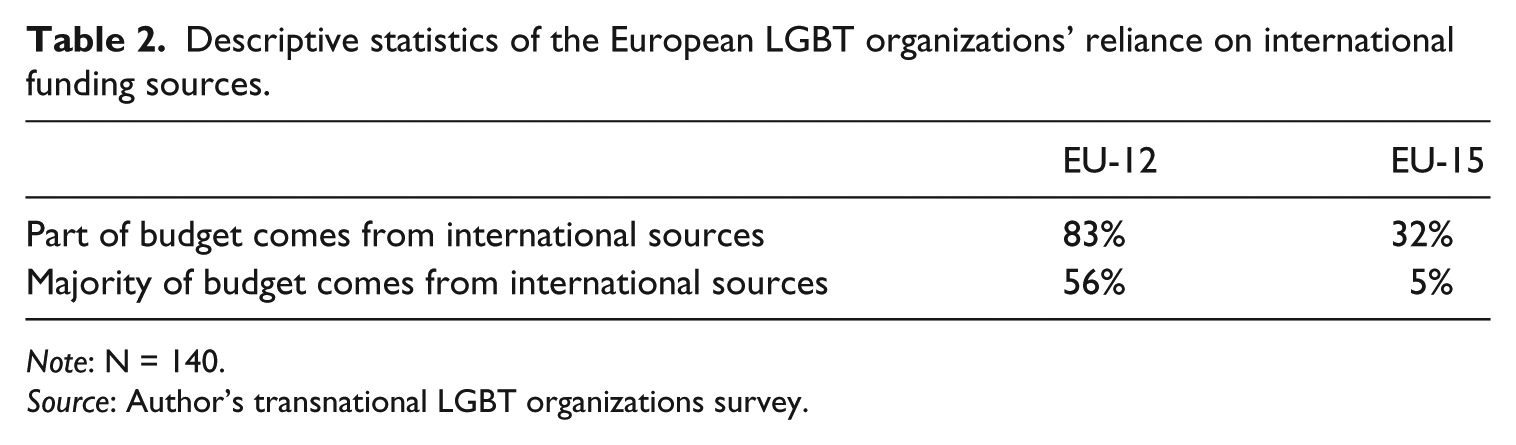
The results of the European LGBT organizational survey reported in Table 2 provide evidence for this notion, showing that resource-poor LGBT organizations in the EU-12 are far more reliant on international grants to finance their projects than are those in EU-15 states. While 56% of LGBT organizations in EU-12 states rely on external sources for a majority of their funding (over half of the budget), only 5% of organizations in EU-15 states do. Without this funding, the campaigns that help make the issue visible and interpretable in the domestic sphere would be less available.
Descriptive statistics of the European LGBT organizations’ reliance on international funding sources.
Note: N = 140.
Source: Author’s transnational LGBT organizations survey.
Such transnational resources have been at play in LGBT politics in Poland. In 2005, realizing that the then mayor, Lech Kaczynski, would again ban the LGBT March for Equality in Warsaw, Polish activists used ties to LGBT organizations in neighboring Germany to organize the march illegally. Transnational cooperation served as a conduit for financial resources, raising funds for marches and campaigns that enhance issue visibility. In the 2005 Warsaw March case, outside organizations helped to raise funds for buses, flyers, and press releases. Similarly, the ‘Let Them See Us’ campaign and the Cracow March of Tolerance in 2003 and 2004, the earliest key moments for gay and lesbian visibility in Poland (Gruszczyńska, 2007: 99), were supported by international sources, including foreign embassies (interview no. 129). 19 Transnational ties also pass on knowledge and best practice. The German Green Party, for example, sent representatives to Warsaw to train activists, using their experiences as a movement-turned-party in Germany (interview no. 8). These ties helped domestic movements create a space for LGBT visibility in Poland, despite the closed domestic political opportunities at home.
Alongside material resources, transnational ties also deliver human resources. In 2005, it is estimated that over one-third of the 5000 participants in the Warsaw March were foreign nationals (interviews no. 124 and no. 125). Since the older and more established organizations in first-mover states had close ties to political elites, they were also able to engage prominent European politicians to march in Poland. By 2006, 32 parliamentarians from 16 different European parliaments marched in Warsaw (interview no. 124).
Legitimacy
For new adopters, political and social channels can also introduce states and societies to LGBT issues while legitimizing them. Political porosity creates channels of influence by embedding states in the international communities within which the LGBT issue receives more attention. It also allows both for processes of political socialization (based on the logic of appropriateness) and the establishment of political rules (based on the logic of consequences) (Zürn and Checkel, 2005). Social porosity — particularly the flow of ideas and images — taps into the international awareness of the new-adopter state and its exposure to issues and norms that have preceded them in first-mover states. These channels expose states to the European norms on LGBT rights.
The activists of local organizations that are embedded in transnational networks are keenly aware of this dynamic, and they use their understandings of the domestic and international realms for effective claims-making. This transnational process is far more complex than local activists simply borrowing from activists in first-mover states (Binnie and Klesse, 2013), nor does it suggest that domestic activism is replaced by transnational activism. Instead, transnationally connected domestic groups in new-adopter states selectively choose and adapt foreign ideas to local traditions and practices, performing as brokers between international and domestic norms. These actors are crucial because they can frame the message — which is often perceived by society as an ‘external’ issue in new-adopter states — to make it resonate with a particular audience (Tarrow, 2005). In Poland, activists often linked the issue to their shared identity as Europeans. For example, they waved EU flags at LGBT marches — marches that were often named after European values, such as ‘Culture of Tolerance’ — and wore T-shirts with the words ‘Europa = Tolerancja’ (interview no. 124, translation ‘Europe = Tolerance’). Foreign diplomats also spoke of their involvement as a responsibility associated with being European (interview no. 127).
The presence of international symbolism can render tangible legitimacy to the LGBT issue on the ground. For example, when foreign diplomats march, it attracts police protection for protesters. In new-adopter states, LGBT marches are often banned and thus denied police protection, obliging local organizers to cancel demonstrations because of serious safety concerns. This obstacle is diminished when local organizing can attract international diplomats to attend, who state authorities must then protect. As a German parliamentarian and participant in multiple LGBT marches across new-adopter states describes: ‘When the ambassadors join the march, the authorities at local level have to react differently. Then they authorize marches and the police protect the participants instead of protecting counter-demonstrations’ (interview no. 127).
The presence of European colleagues promoting the international norm on LGBT rights in Poland can also legitimize the support of sympathetic Polish parliamentarians, who can use the European frame to justify their own involvement. The same is true for intra-party ties across European states. A key example is the roughly 20 members of the Polish Democratic Left Alliance (SLD) party who marched in 2010. The SLD’s support is intriguing because surveys show that its constituents are generally less approving of homosexuality than those of the socially conservative opposition party, PiS (interview no. 124). Activists argued that the SLD support was related to the outside influence of the party’s members in the European Parliament: ‘These politicians read the outside stances of their parties, and whether or not they are convinced, they know what it means to be a Social Democrat [in Europe], which includes being open to LGBTs’ (interview no. 124). While outside influence is controversial among conservative and nationalist parties, most LGBT activists emphasized the overall importance of transnational involvement: ‘It is very important for the marches to have an international presence because we can show that other countries have a better level of [LGBT] rights. Their presence shows that it is important for Poland to do something’ (interview no. 139).
In new-adopter states, international channels have supported domestic activism in making the LGBT norm salient and providing a frame of legitimacy. This analysis has highlighted their importance for processes of socialization that make LGBT issues visible in new-adopter states. 20 Even if this international visibility is at first negatively received and domestically contested, it can still be politically effectual by virtue of creating a legitimizing discourse. It provides the resources and frames to link the LGBT norm to membership in modern Europe, set rules of compliance, and dispense ideas and images about LGBT people that make their local existence visible. When asked what could most erode traditional values in Poland, one anti-LGBT activist responded: ‘Poland and the EU are in permanent moral confrontation concerning social issues. The only thing we fear could change that is the increasing outside imagery of this deviant [sexual] lifestyle as something commonplace, normal, or even appealing for Poland’ (interview no. 141).
Conclusions
This analysis has sought to contribute to, and to test, three theoretical explanations for the diffusion of contentious pieces of legislation. Rights legislation diffuses to states when those states fear the costs of international pressure, when they become convinced of the international norm’s appropriateness, when their advocacy organizations are embedded in transnational networks, and when their pre-existing domestic norms resonate with the international norms. I hypothesized differences among new-adopter and first-mover states, expecting that the presence of transnationally embedded LGBT organizations and channels of internationalization would matter more for diffusion in new-adopter states because they make the issue initially salient in the domestic realm. They send signals to state decision-makers that the issue is a standard in their international community.
A comparison between the EU-12 and EU-15 revealed variation in the extent to which a state passes higher levels of LGBT legislation, according to the state-grouping’s position in the international system. All international channels and the presence of transnationally embedded LGBT organizations proved significant for diffusion in the new-adopter states. In EU-15 states, the results related to these variables were less consistent, with only the combined and political channels appearing as significant predictors of diffusion in some models. Where domestic predictors were not significantly and consistently correlated with adoption in EU-12 states, economic wealth had explanatory power in all models across EU-15 states. To explain these findings, qualitative and descriptive data from the case of Poland illustrated the ways in which international and transnational sources are particularly important for new-adopter states. They provide the resources to make the issue visible, as well as the legitimizing frames to associate the issue with modernity in the contemporary international society that EU states find themselves in.
Whereas previous research has focused largely on a small set of cases, or on a particular type of policy provision (decriminalization of same-sex relations or same-sex unions), this article has sought to promote theoretical and empirical progress by integrating multiple theories and by providing a large-n analysis of various national contexts, detailing the complexity of legislative diffusion across two sets of states and across various pieces of legislation. Large-n studies that look across the globe often overemphasize certain variables, such as the importance of economic wealth for the introduction of LGBT rights (Inglehart and Norris, 2003), taking for granted that the LGBT issue remains invisible in many of the contexts under study and that states have different international imperatives for the adoption of symbolic legislation. The findings also add nuance to domestic cultural explanations that rely on arguments of domestic resonance (Cortell and Davis, 1996), as well as rational institutional models rooted primarily in a logic of cost and benefit (Kaufmann and Pape, 1999). By closely examining a region that advocates an LGBT norm, while also exhibiting variation of its implementation across states, this article has contributed to understanding diffusion patterns using methodologically and theoretically driven conditions.
Future research would benefit from more careful consideration of the role of the issue’s salience according to historical time (Kane, 2007) and on a global scale. Furthermore, the relationship between international norms and the domestic resistances that moderate their reception (Ayoub, 2014), as well as global processes of norm polarization (Symons and Altman, forthcoming), need to be explored carefully and can offer important insights into studies on LGBT rights, since these rights remain hotly contested in multiple contexts. In other regions, porosity to transnational channels may operate differently. Europe is unique in that the systems of knowledge at the regional level privilege the issue of LGBT rights, and this posture toward LGBT rights is not yet global in orientation. Finally, political science scholarship should engage critical perspectives on how the LGBT issue is championed in international politics. Queer theorists have rightly problematized the effects of state hierarchies on LGBT politics (Kulpa and Mizielińska, 2011), as well as use of LGBT rights for homonationalist projects that exclude certain peoples and states (Puar, 2007).
While the analysis focused exclusively on the rights of sexual minorities, there is reason to believe that the results may play out similarly for several other issues concerning marginalized groups in international politics. In particular, the findings hold broad implications for research on the spread of policies against domestic violence (Montoya, 2013), sexual harassment in the workplace (Roggeband, 2010), and the introduction of gender quotas (Towns, 2012), where scholars have shown that state behaviors towards women are linked to both domestic and international politics, such as transnational networks and hierarchies in international society. Given the politically salient and contentious nature of LGBT rights policies, the findings also have important theoretical and practical implications, supporting the notion that state decision-makers in new-adopter states are drawn to internationally visible issues, even if the national debate concerning these issues is not resolved (Karch, 2012). Most generally, the evidence concerning the role of state groupings and hierarchies contributes to what we know about processes of state socialization and norm transfer in international politics (Flockhart, 2006; Greenhill, 2008; Towns, 2009), as well as suggesting pathways for explaining the effectiveness of transnational activism in cross-national comparison (Keck and Sikkink, 1998; Tarrow, 2005).
In conclusion, states care about their image and reputation on the world stage and new adopters are willing to take risky policy decisions when they receive strong signals that their international community expects it of them. In the year after President Obama first expressed his support for same-sex marriage in May of 2012, four countries in three world regions passed such legislation, and several others had it tabled. In 2014, lawmakers in Malta voted 37–0 (with some lawmakers abstaining) to legalize both same-sex unions and joint adoption by same-sex couples, Croatia passed a partnership bill (89 votes for, and 16 against) that gave same-sex unions many of the same rights as married couples, and Estonia has placed a gender-neutral cohabitation bill on Parliament’s agenda. After Malta’s votes, Prime Minister Joseph Muscat said, ‘Malta is now more liberal and more European,’ before adding that the legislation also gives ‘equality to all its people’ (Nielsen, 2014: emphasis added). In these historically unprecedented times of LGBT visibility, international sources of change should have currency in explaining the proliferation of sexual minority rights, especially among new-adopter states.
Footnotes
Appendix: Selected interview sources
8. Former President, 17 July 2009.
15. EU Commission, Agency on Fundamental Rights, Policy Officer, 9 July 2009.
124. Fundacja Równosci, President, 21 February 2011.
125. Maneo/LSVD: Berlin Bradenburg, President, 24 March 2011.
127. Die Grünen, Parliamentarian, 4 April 2011.
129. KPH, Project Coordinator, 12 October 2011.
139. Lambda Warszawa, Chairman, 15 November 2011.
141. All Polish Youth, Former Chairman, 25 November 2011.
Acknowledgements
Invaluable comments on various drafts have been received from Peter Katzenstein, Sid Tarrow, Sarah Soule, Matthew Evangelista, Chris Anderson, Donatella della Porta, Samantha Majic, Deondra Rose, Mary Anne Madeira and Nathan Fronk. I also thank panel participants at the 2013 International Studies Association and American Political Science Association meetings for helpful suggestions. Finally, I thank participants at the University of Minnesota (19 November 2012) and the University of California, Riverside (18 January 2013) for beneficial comments during invited presentations.
Funding
The Alexander von Humboldt Foundation, the Fulbright Commission, and the Cornell Center for European Studies helped fund this research. Errors are my own.
Notes
Author biography
 .
.