







Abstract
International Relations scholars tend to focus their attention on agents with institutional sources of power, such as presidents. Yet, decades of scholarship in other fields has shown that ordinary individuals–traders, missionaries, and soldiers–often have the ability to shape international cooperation and conflict. Under what conditions do individuals distant from institutional power shape international politics? I argue that intermediaries — key figures who broker deals between parties — are crucial for cooperation when information is low and contact between the parties is sparse. To demonstrate the argument that intermediaries matter, I investigate alliances between the US and its non-state allies — non-state political communities abroad and in North America — between 1776 and 1945. In each case, there are intermediaries who are uniquely suited to broker cooperation by identifying partners for cooperation, explaining others’ interests, providing reassurances, and managing identity issues. These intermediaries are often those who we tend to think of as unimportant political agents. However, because they fill key information roles, they have unexpected sources of political power. Using four case studies, I test to see whether intermediaries’ performance of these roles matters in a diverse range of cases.
Introduction
One of the crucial questions that International Relations (IR) scholars continue to ask is: who has influence? Conventional wisdom in political science suggests that agents who are distant from centers of political power are not powerful. Political authority — resources, elected office, or a place within an important institution — confers powers on individuals, which makes them worth studying. These are the “great men” of international politics.
Increasingly, IR scholars are questioning whether distance from centers of political power might often be more of an advantage than a liability in exercising agency in the international system. Scholars of social movements have shown how individuals without political authority can generate pressure on agents by mobilizing domestic and international pressure for policy change. Transnational activists, for example, have pressured governments to change their positions on arms control (Evangelista, 2002), human rights (Keck and Sikkink, 1998), and humanitarianism (Finnemore, 2003). Studies of imperialism also find that actors on the periphery play fundamental roles in colonization. Ronald Robinson (1972), in particular, argues that to understand empire, one needs to understand the roles played by collaborators, like the Raj in India, who broker between societies. These kinds of individuals are important, in part, because civil society or the structure of colonization provide institutional means through which individuals can effect policy change (Gerring et al., 2011).
Individuals who do not have power owing to their place in institutions also matter. Feminist scholars have shown the impact that women may have on cooperation and conflict in occupations that are traditionally disregarded, such as prostitutes, nurses, and diplomats’ wives (Enloe, 2000; Moon, 1997). These studies show that women, who are often systematically excluded from the institutional means of obtaining political power, have influence through non-institutionalized channels. Diplomatic historians have also cataloged how a wide range of agents with no institutional influence — actors, officials’ daughters or wives, film directors, doctors, missionaries, and musicians — dramatically affect the prospects for international cooperation (Costigliola, 2012; Davenport, 2009; Geltzer, 2012; Gienow-Hecht, 2009; Rosenberg, 2012; Shaw, 2012). These figures are often far from their nations’ capitals, do not hold elected office, and have little influence over public opinion, yet, in many ways, they fundamentally shape world politics.
Despite interest in these figures, there is no general framework for understanding when a person with little institutional power will become an influential mover of important political events. When does a person with no institutional authority matter? Under what conditions do they become powerful?
Scholars typically dismiss agents who lack political or organizational power, or posit that they are theoretically unimportant, because one cannot develop systematic, generalizable accounts of their influence. When they matter, it is anecdotal. In contrast, sociologists are increasingly exploring whether there are systematic and generalizable social structures that explain individuals’ influence. Specifically, social network scholars suggest that agents’ placement within a social structure is more important than their statuses or resources. Building on social network theory, I develop a theoretical framework to understand how one class of agents with little institutional authority — whom I term “intermediaries” — become important players in promoting international cooperation because of their strategic position between societies. To secure cooperation in an information-poor environment, potential cooperators must often rely on a socially skilled agent who has experience working within multiple communities. These individuals might be members of a diaspora who can use informal social networks to connect investors in their new country with economic opportunities in their home country, or missionaries who help broker cooperation between colonizers and the colonized. Owing to their position between societies, intermediaries can help secure cooperation by bridging disconnected social networks.
The argument has three steps. The first is to identify problems with international cooperation that emerge because of specific limitations in the information environment. To cooperate, agents need information about potential partners: international firms need overseas clients, diplomats need foreign contacts, transnational activists need personal relationships in other communities, and military officials need to be in contact with irregular groups that they hope to cooperate with. One barrier to cooperation is the scarcity of these relationships. Using a social network approach, I conceptualize cases with insufficient information to identify or contact potential cooperation partners as instances of “structural holes,” that is, two or more discrete networks that do not have a broker that can exchange information between them.
The second step is to outline a theory about why seemingly ordinary people are likely to fill these structural holes, making cooperation possible. The politically influential are unlikely to fill structural holes because they do not usually have the informal social networks that stretch across borders that are necessary to identify key players abroad, understand their interests, and interpret their identities. In the language of network theory, political elites are often central within a network, but do not have ties outside of those networks. Conversely, agents with little institutional authority — traders, investors, missionaries, soldiers, and spies — may develop the necessary contacts and social skills to broker cooperation across structural holes. These agents, I argue, are likely to develop the kinds of social skills identified by social theorists as important for international cooperation. Socially skilled intermediaries may have unique tools available — a monopoly on information and the social skill necessary to use that information to strategically manipulate actors — to promote cooperation. Intermediaries can use this monopoly to identify partners for cooperation, misrepresent parties’ interests to one another, build trust, and mitigate cultural conflicts.
To illustrate these claims, this article focuses on individuals who have helped the US recruit non-state political groups to aid US war efforts, such as the partisans and militias from Albania, Burma, North-eastern India, and Yugoslavia during the Second World War. Relationships with non-state allies often take place in a low-information environment characterized by structural holes. In the 1940s, few policymakers had heard of their future allies before the war (e.g. the Naga), and neither party seriously considered cooperation in the early days of the conflict. More importantly, few policymakers understood — at least more than superficially — non-state allies’ interests, identities, and post-war visions. To understand why these alliances form, one needs to understand how they form. In almost every case in which the US forms an alliance with a non-state ally, there is a key “intermediary” who emerges as a powerful figure, capitalizing on their structural position between communities to promote cooperation.
Who matters: A network approach
Over the past several decades, IR scholars have proposed various empirical and theoretical accounts of who matters in international politics. Most of this discussion, as described in the introduction, relates to transnational activists; recent scholarship in this area shows that agents’ influence depends on the issue area, the strength of the organizations or states that they are connected to, and their individual characteristics, such as power, the regime type in which they operate, or the visibility they provide. In contrast to this previous work, the current article proposes a social network account of the conditions under which agents without substantial political or institutional authority come to have significant roles in international politics, especially in relation to international cooperation.
Two forms of centrality
Social network theory provides a useful tool to understand who matters in international politics. IR scholars have recently begun using network analysis to conceptualize political structures relevant to international politics and to interrogate empirical claims relevant to the diffusion and flow of trade, ideas, material power, and the propensity of states to cooperate or fight (see Hafner-Burton et al., 2009; Maoz, 2011). One powerful line of research in this tradition concerns how agents’ social relationships constrain and empower them (Goddard, 2009). By interrogating how social networks empower agents, this approach provides a powerful resource in explaining the conditions under which agents are influential.
The concept of centrality can be used to explain agents’ power, influence, or social capital. The basic logic of centrality is that an actor central to one or more networks has access to more information, resources, and influence than do actors who lack social connections. One type of centrality — usually captured by measures of degree centrality — highlights how well-connected a specific agent is in a network: a person gains influence, prestige, or social capital as the number and strength of their social connections increase in comparison to other agents (Knoke, 1990: ch. 1). Nexon and Wright (2007: 260), for example, describe one important source of power for empires and hegemons: “actors with more connections have more information about the preferences and orientations of others, than those with fewer connections.” 1 Emile Hafner-Burton and Alexander Montgomery (2006) describe how increasing agents’ social connections increases their prestige.
Another type of centrality — usually captured by measures of betweenness centrality — highlights an agent’s strategic placement. If an agent is placed between parts of a network such that the overall coherence of the network depends on that agent’s existence, then the agent has substantial influence, even if the quantity of connections is low. Building on well-established sociological claims (Burt, 1992, 2005), Stacie Goddard (2009) argues that when networks are fragmented, agents who can bridge different parts can reshape international politics because their position between influential players provides strategic flexibility, a higher potential to develop innovative ideas, and a greater likelihood of seeing their ideas diffuse (see also Carpenter, 2014).
I ask whether these understandings of centrality provide new avenues into thinking about the conditions under which agents exercise influence. Degree centrality captures an important element of how states are powerful: their power depends on the number and strength of their relationships. It does not, however, provide an answer to who is powerful because the same states that have high material capabilities — the great powers, empires, or hegemons — are also the most connected powers. Nexon and Wright’s (2007) work on empires, for example, suggests that imperial powers are stronger than other powers because, in part, empires have access to many more relationships than do peripheral powers and therefore can draw on more information and resources. The who, in other words, remains the empire, but the how is re-described.
Betweenness centrality highlights a second dynamic: it matters where in a network one sits. Stacie Goddard (2009) argues that brokers who sit between networks are powerful, in part, because they bridge disconnected dynastic and liberal networks. In particular, Goddard emphasizes one central argument developed later: because brokers control information, they can manipulate the case for cooperation. Her analysis is limited, however, by the examples she draws on. Goddard’s central argument is that structural holes determine “who can create structural change,” yet she focuses only on how the “great men” — Bismarck, Napoleon III, and others — used structural holes as another resource to secure power. These political elites have power due to their degree centrality (their place within a network) and their strategic position between networks. By only looking at “great men,” it is unclear whether agents’ strategic position is a sufficient condition for influence or whether their strategic position is a necessary condition. We are still missing a new articulation of who matters.
The strength of weak ties
Is the power of one’s strategic position in a network sufficient to provide influence? This section builds on Goddard’s (2009) discussion of brokerage to argue that agents with weak ties can have influence if they are well placed within networks. I refer to these individuals — brokers with only weak ties to positions of authority — as intermediaries. In addition, this section argues that intermediaries with weak ties are likely to have significant roles in promoting international cooperation, especially in environments with low information.
When two parts of a network or two networks are disconnected, there is a “structural hole”: there are no agents across which information or trust can flow (Burt, 1992). An agent who fills a structural hole by bridging these networks can have weak or strong ties to other agents (Granovetter, 1973). An agent with “strong ties” frequently interacts with others within that network and can bridge structural holes. A prime minister, for example, may bridge a structural hole between a network of foreign leaders, who the prime minister meets at international conferences, and her party’s leadership, who she frequently meets in her own capital. An agent with “weak ties,” in contrast, infrequently interacts with members of one or more networks. An intermediary is an agent who bridges a structural hole, while having weak ties to one or more networks that otherwise would be disconnected. In contrast to the brokers analyzed by Goddard, intermediaries have little direct influence stemming from their degree centrality. Instead, their strategic positioning within a network is the key source of their influence.
The language of intermediaries is intended to track the kinds of agents that sociologists often posit are crucial for cooperation in complex social systems. Granovetter (1983: 202) explains that individuals with strong ties within a network are unlikely to bridge structural holes because the people with whom they frequently interact likely interact with one another on a regular basis, creating “a densely knit clump of social structure.” Most complex social systems, however, have many such clumps who do not know one another on a regular basis, such as a network of investors in New York and a network of factory-owners in China. A person with many weak ties becomes important because her acquaintances across social holes put agents in touch with one another. This finding — that complex social systems are usually integrated because of weak ties — has received substantial empirical support, characterizing systems as different as kibbutzim (Weimann, 1983) and global terrorism (Kennedy and Weimann, 2011).
Can intermediaries — agents who use weak ties to bridge structural holes — exert influence disproportionate to their political position? Intermediaries likely have strong advantages over more traditional political elites in international politics. First, having a large number of weak ties likely provides critical information advantages to agents. The central argument behind the strength-of-weak-ties hypothesis is that weak ties that bridge structural holes “provide people with access to information and resources beyond those available in their own social circles” (Granovetter, 1983: 209). The empirical evidence I present later draws out this argument by showing that agents with only weak ties to their own government, such as traders, low-level government employees, or prisoners, have helped the US cooperate with non-state militia groups abroad by serving as an information bridge. Second, intermediaries, at least those in the international politics of interest here, such as British evangelicals in Africa, bridge very diverse networks. In doing so, intermediaries help spread innovative ideas produced within one network to other networks (Rogers, 2003; Uzzi and Spiro, 2005: 462–463). Moreover, if intermediaries learn that agents in different groups tackle similar problems in different ways, they become less likely to accept the conventional wisdom that a current approach is sufficient, and more likely to use their increased information to creatively combine approaches. I argue that intermediaries’ ability to close structural holes through weak ties is critical to understanding international cooperation in a wide range of cases. If this argument is right, then intermediaries — traders, preachers, refugees, and former prisoners — may matter more in some cases than do presidents and generals.
Intermediaries and cooperation
Social network theory is helpful in understanding structural relationships that empower and constrain agents. International cooperation, however, presents special problems of trust and cooperation that are different in kind from issues normally discussed by network theorists. Especially in an anarchic international system, to choose to cooperate, one needs information about others’ preferences and their reliability. Although IR scholars often part ways on whether information and trust are supplied by costly signals and institutions (Glaser, 2011: ch. 3; Keohane, 1984; Kydd, 2005) or shared cultures (Finnemore, 2003: ch. 4; Risse-Kappen, 1996; Wendt, 1999: ch. 5), information and trust are important factors in both rationalist and sociological approaches to cooperation in international politics (Grynaviski, 2014). This section argues that, due to their structural position, intermediaries — brokers with weak ties to one or more networks — likely possess a set of “social skills” useful for manipulating information, generating trust, and securing cooperation.
Developing social skill
The last section argued that intermediaries may be important for cooperation when they serve as necessary informational links between agents. This network account highlights the passive role played by intermediaries: by virtue of their existence as bridges between agents, they are important for cooperation. This section argues that intermediaries may also have an active role in shaping international cooperation and providing incentives for deal-making.
Intermediaries may have at least three incentives to promote cooperation. First, they may have material interests. In playing a central role in brokering cooperation, an intermediary can profit by imposing transaction costs on the partners, such as colonial intermediaries who profited politically and economically from exchanges between colonizers and the colonized (Lawrance et al., 2006). Second, an intermediary may believe that cooperation will enhance the collective interests of a group of which she is a member. Diplomats, for example, may believe that cooperation is in their state’s interests and thus try to promote it on their own initiative, even if they believe that their state prefers other options, such as war (Sharp, 2009: 103–104). Third, intermediaries may actively promote cooperation to enhance their self-esteem. Intermediaries — people who, by definition, do not have “central” places within powerful organizations — may want the esteem benefits that come from being movers and shakers and crafting important deals. These esteem benefits provide recognition and enhance estimates of self-worth.
Intermediaries can promote cooperation through the strategic manipulation of the information over which they have a monopoly (Goddard, 2009). This manipulation, however, requires skill. For a third party to actively promote cooperation between groups — by misrepresenting information or by creating frames or shared meanings — the third party must understand the interests and meanings held by the potential cooperation partners so that she can describe a course of action as being in a party’s interests or conforming to their identity. Following Neil Fligstein (2001: 112), I describe the ability to “empathetically relate to the situations of other people and, in doing so … provide those people with reasons to cooperate” as “social skill.”
There are several reasons why intermediaries may have a higher level of empathy and therefore social skill than agents who are well-connected within a network. First, intermediaries may have experience in promoting cooperation between communities. Owing to their position between communities, intermediaries may develop a set of basic skills that aid in cooperation and understanding others, such as bilingualism and biculturalism. In addition, intermediaries may develop a knack for securing cooperation, or, in more contemporary language, intercommunity cooperation is a “practice” that they are familiar with (Adler and Pouliot, 2011). To be socially skillful, individuals need to control how they present themselves to divergent groups (“self-monitoring”), understand how weak ties can be converted to successful bargains, and have experience creating or dealing with cultural frames that organize cooperation. These may be “learned” elements of social skill: experience gained brokering deals in other contexts — for example, as a diplomat, trader, soldier, or political prisoner abroad — is likely more relevant than experience gained in Washington or another capital.
Mechanisms for promoting cooperation
The previous section described intermediaries — actors strategically placed between groups — as socially skilled agents who may have an active interest in promoting cooperation. This section explains how these elements of social skill can be used to promote cooperation in four ways: identifying partners, manipulating information about interests, establishing trust, and creating cultural frames for cooperation.
Identifying partners
The first mechanism by which intermediaries promote cooperation is through identifying parties for cooperation. Usually, theories of cooperation discuss cases of state-based cooperation. Which states exist is common knowledge. If all international cooperation is interstate cooperation, then identifying partners for cooperation would be reasonably easy because the information environment is rich. Many cases of international cooperation occur under conditions of exceptionally low information, however, such as when firms need new overseas partners or intelligence services want cooperation partners abroad, and parties may not be aware of one another. Recall that the logic of structural holes suggests that two parties do not have contact with one another unless there is a broker through which information flows. Building on this logic, intermediaries are necessary for cooperation if they are the (primary) means through which agents learn of others’ existence. Intermediaries can play this role passively, simply by conveying information to one or more parties, or actively, by bringing parties to one another’s attention and suggesting cooperation as a plausible strategy. The strength of weak ties provides intermediaries with opportunities to connect nodes that other agents lack.
Identifying parties for cooperation does not necessarily require social skill; a passive role by an intermediary may be sufficient because it enables agents to learn about each other. In the case of international investment, for example, there is substantial evidence that international diasporas can convert their knowledge of potential foreign investment partners into opportunities for overseas capital to obtain significant returns. Without the assistance of diasporas, there may be no social relationship between capital and firms that enables the parties to identify mutually beneficial investment opportunities (Leblang, 2010). The role of diasporas in this account is strictly passive. The other mechanisms, in contrast, require social skill because the intermediary plays an active role in shaping communication across the structural hole. To secure cooperation between parties who may not want it ex ante, intermediaries use their understanding of parties’ interests and identities to shape the case for cooperation. Often, this means that intermediaries create different images of cooperation for the different parties, creating a “false intersubjective belief” (Grynaviski, 2014).
Explaining interests
Intermediaries can play an active role in promoting cooperation by identifying and manipulating parties’ understandings of others’ interests. Intermediaries are agents’ primary vehicle for gaining the information on which cooperation decisions are based. This provides opportunities for intermediaries to manipulate information to make cooperation more likely. Moreover, intermediaries with a high level of social skill know the parties’ interests and how to appeal to those interests. This creates a recipe that enables intermediaries to steer agents toward cooperation through manipulation.
Cooperation often depends on parties’ beliefs that it will promote important interests. Painting a positive picture of cooperation — the returns that investments provide, opportunities for gains from international trade, or the kinds of military contributions allies can make — requires information about cooperation partners that is often lacking in international politics. Intermediaries can convey and manipulate this information to show why cooperation would promote both parties’ interests. In particular, intermediaries sometimes sell cooperation to the parties by claiming that both sides are willing to abide by terms that neither has actually agreed on.
Building trust
Intermediaries are crucial for providing reassurances. One challenge for cooperation is mistrust. In IR, rationalists often argue that states do not have enough information about others’ intentions or future plans, making cooperation difficult (Kydd, 2005). In low-information environments, actors have little past history on which to evaluate the trustworthiness of specific agents across structural holes. When the costs of contracting with an untrustworthy partner are especially high, mistrust can undermine the prospects for cooperation. Sociological theory increasingly highlights the importance of personal ties in formal and informal networks to the creation of trust (Coleman, 1988; Granovetter, 1985, 2005; Putnam, 2000; Uzzi, 1996). Individuals often use members of their social network to evaluate the credibility of partners for cooperation. For example, I often trust my friend’s evaluation of the reliability of his friend. Using personal connections to evaluate others’ trustworthiness reduces the costs of gaining information and enables one to use third parties as proxies for the reliability of partners (Granovetter, 1985).
Intermediaries can use two mechanisms to enhance trust. First, intermediaries can frame cooperation such that the parties believe that there is no credible commitment problem; they do this by passing information that suggests a harmony of interests. If intermediaries, in explaining parties’ interests to others, show that the parties all prefer a specific outcome, then there is no credible commitment problem because there is no incentive for a party to renege on the agreement. In these situations, the key to mitigating the trust problem is showing that the information conveyed between parties — the information showing a harmony of interests in some outcome — is reliable. To do so, intermediaries may craft a reputation for being honest brokers of information (see also Milgrom et al., 1990). The more interesting cases are where there is no perceived harmony of interests, and agents need to evaluate whether others will follow through on a promise (a credible commitment problem). This is especially important when one party is more powerful than another and thus has little reason to keep its commitments. An intermediary can help ameliorate credible commitment problems by promising to use her influence to ensure that all sides keep their commitments, or by claiming to have “inside information” that a party intends to keep its commitment.
Managing cultural friction
The final mechanism that intermediaries use to promote cooperation is to manage cultural friction. Frequently, intercultural differences can undermine cooperation. Ideological differences may make potential cooperation partners appear threatening (Haas, 2005), and cultural differences can upset diplomacy when agents make cultural blunders during international negotiations (Cohen, 1987, 1991; Elgström, 1994).
Intermediaries may be well-equipped to reduce the cultural conflicts that can undermine cooperation. In general, social psychologists have found a general psychological tendency for in-groups to demonize out-groups (Miller and Brewer, 1984). This may reduce the chances for international cooperation because policymakers may perceive potential cooperators as undesirable partners (Mercer, 1995). US diplomatic history, some argue, is driven by political elites who have little experience with “others” and hold overtly hostile views about parties abroad (Hunt, 2009). Intermediaries may be less likely than political elites to demonize out-groups. People who work at the margins of multiple societies tend to have a specific package of social attributes — experience working with out-groups and high self-monitoring — that makes interacting with people from different cultures easier (Caldwell and O’Reilly, 1982; Flynn et al., 2001).
Intermediaries can take advantage of their social skill and structural position to reduce cultural friction by crafting communications between parties to avoid offending others’ cultural sensibilities. Successful diplomats, for example, frequently change the language of requests from their home government to ensure that they do not offend foreign partners (De Matos, 2001). More importantly, intermediaries may take a more active role by reframing cooperation through dominant ideological or cultural lenses. Proponents of intervention during the first Gulf War, for example, often framed Kuwaiti independence as consistent with US views of political rights and liberty, despite the drastic cultural differences between the two societies (Manheim, 1994).
Cooperation with non-state allies
The theory described earlier posits that intermediaries — individuals with little institutional authority and few material resources — are influential in promoting cooperation when they bridge structural holes. Their strategic position between communities enables them to develop a set of social skills useful for actively promoting cooperation by identifying parties, explaining and misrepresenting interests, building trust, and mitigating cultural friction. To illustrate these arguments, I focus on cases of international cooperation between the US and its non-state allies.
History of cooperation with US non-state allies
In contemporary international politics, non-state allies play an increasing role in military operations. This section defines non-state allies and briefly overviews their history, describing the importance and nature of US alliances.
A non-state ally is a non-sovereign group that coordinates military operations with a state for political purposes, often by providing military, logistical, or material support, or actively providing intelligence by scouting, guiding, or undertaking intelligence missions. 2 The US has cooperated with non-state allies in almost every major war since its founding, and most minor wars as well.
This study concentrates on cases between 1776 and 1945 in which the US allied with non-state groups. Studying US alliances provides useful variation because factors related to potential alternative explanations vary: between 1776 and 1945, the government, relative power, diplomatic machinery, and types of conflicts it engaged in all varied for the US. I chose the time period for two reasons. During later periods, such as the Cold War, the character of US support for non-state groups changed, shifting from allies to proxies. Instead of relying on alliances to aggregate capabilities, the US frequently provided indirect support to proxies, such as the Cuban exiles in the Bay of Pigs, who fought instead of, and not with, the US. The dynamics of proxies may be different than allies, and today’s alliances in Iraq and Afghanistan seem, in many respects, closer to pre-1945 alliances. Moreover, evidence about the recruitment of non-state allies after 1945 is sparse because of declassification rules; to avoid measurement biases caused by cherry-picking the most well-known and documented cases, only cases until 1945 are assessed.
To study patterns in US alliance behavior, I collected an original data set of known cases of cooperation. The 65 cases of cooperation between the US and non-state allies from 1776 to 1945 are described in Table 1 (this list is not exhaustive).
US non-state allies, 1776–1945.
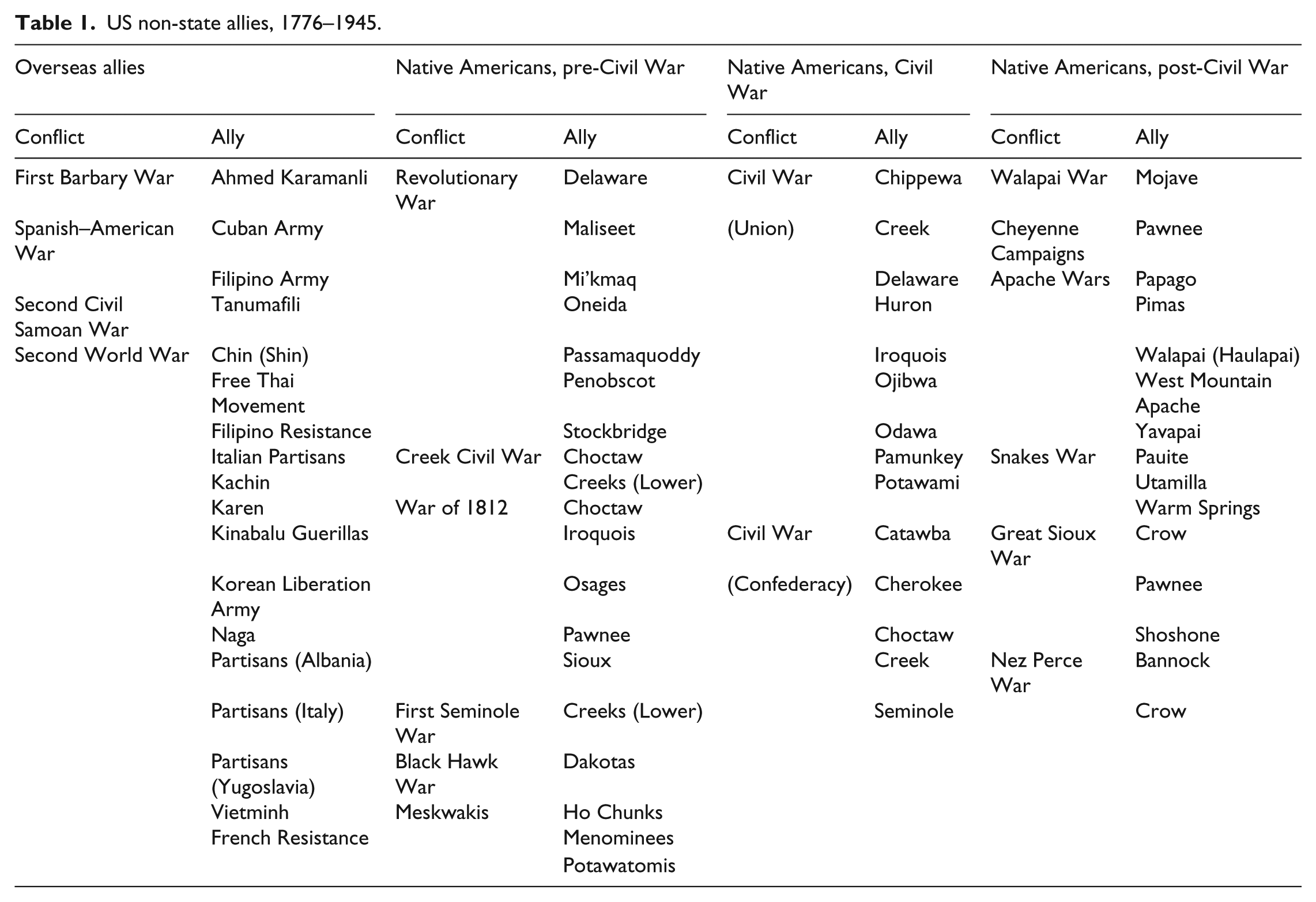
These non-state allies are often credited with making decisive contributions on the battlefield, certainly in Libya, where ground troops were not introduced by the West, and also in Iraq, where the “awakening” of local forces, such as the Sons of Iraq, likely provided a decisive contribution to reducing violence (Biddle et al., 2012). Historical cases of cooperation bear out the same pattern. The Spanish–American War was fought largely by local US allies, especially in the Philippines, where US ground troops played no important role, limiting the commitment of an unprepared US army (Pérez, 1983; Wolff, 1970). During the Second World War, the Naga, Karen, and Kachin fighters in Burma attacked Japanese soldiers in and around Burma, substantially raising the costs of Japan’s offensive toward India (Webster, 2004). In Europe, hundreds of thousands of partisans fought Hitler, hampering German resupply and pinning many German divisions in Central Europe, away from the front (Ford, 2000; Lucas, 2007). In North America, Native Americans operated as local security forces (Cunningham, 1998), mustered volunteers to enlist in the US military (Herek, 1998), and created independent units to pursue US security objectives in almost every major conflict.
The inclusion of Native Americans may seem odd to some IR scholars. However, in analyzing the US experience with non-state allies, their inclusion is vital. Wars against Native Americans, first, are the most common kind of conflict involving the US. These were costly affairs, sometimes involving extra-regional powers (e.g. the War of 1812), and were a primary US security concern. Moreover, in a very real sense, these groups were and remain sovereign nations. Until 1886, the US made agreements with tribes through international treaties, and these treaties, produced by uneven political power, reduced many Native American groups to “dependent nations” (Sadosky, 2010). If empire is a historical theme of European international politics, the study of US foreign policy needs to include Native Americans.
Non-state allies and structural holes
This section shows that the relationship between non-state allies and the US is characterized by structural holes. Networks that contain structural holes and have no intermediaries will have no stable or reasonably direct lines of communication between the parties. In the context of non-state allies, this means that few decision-makers in Washington know much about potential allies, they are frequently unaware that potential allies exist, they certainly do not consider cooperating with them, and there are few means of communication between them.
In every case for which there is sufficient evidence, one or a few intermediaries broker cooperation across the structural hole. Consistent with the theory proposed earlier, these intermediaries have traits that are important for the exercise of social skills: they are bilingual, bicultural, and have substantial experience with deal-making between communities. These intermediaries’ social capital — their personal connections with several groups and skill in using these connections to secure cooperation — comes from their life experiences. Table 2 describes a sample of intermediaries who bridged structural holes between Native American communities and the US.
Characteristics of North American intermediaries.
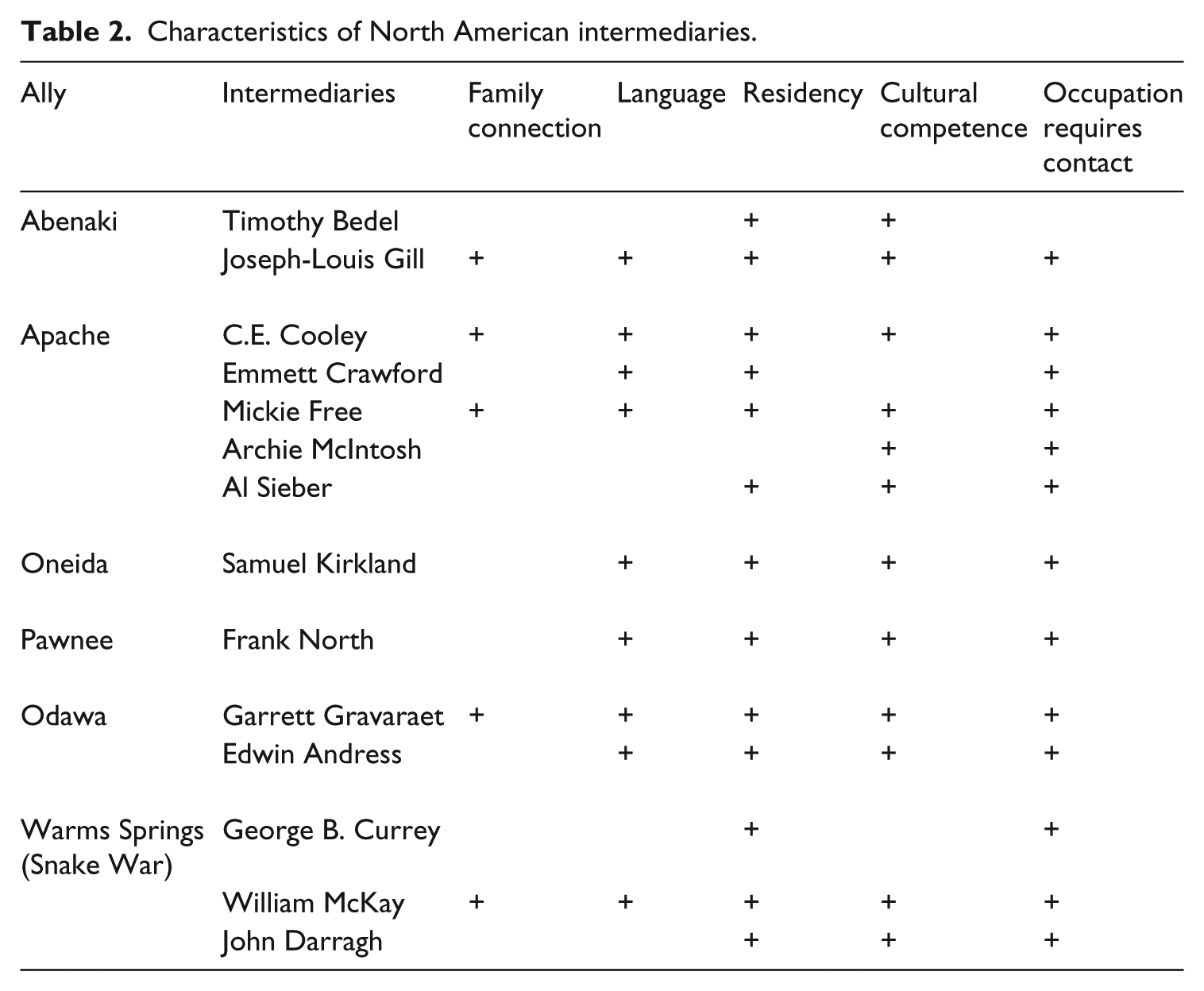
In almost every case, the intermediaries who bridged structural holes between Washington and Native Americans had extensive experience living on both sides of the hole. Most of these intermediaries were from bicultural families. Garrett Gravaraet, who recruited Native Americans in Michigan for the Union Army, “was the perfect candidate, the cultural mediator” because “[a]s a Franco-Indian with one foot in each world, he understood both the indigenous peoples of Michigan and the non-Indians” (Hauptman, 1995: 129–130). Others developed connections after birth, through marriage, migration, or unusual circumstances. Joseph-Louis Gill, who was raised by the Abenaki after being born of two kidnapped European parents, spoke fluent French and English and used his influence to inspire St. Francis Abenaki to support the Continental Army (Calloway, 1990, 1994). Some intermediaries developed these experiences through professions that required working in two or more communities, such as ministers (Kirkland), traders (North), and lawyers (Pike).
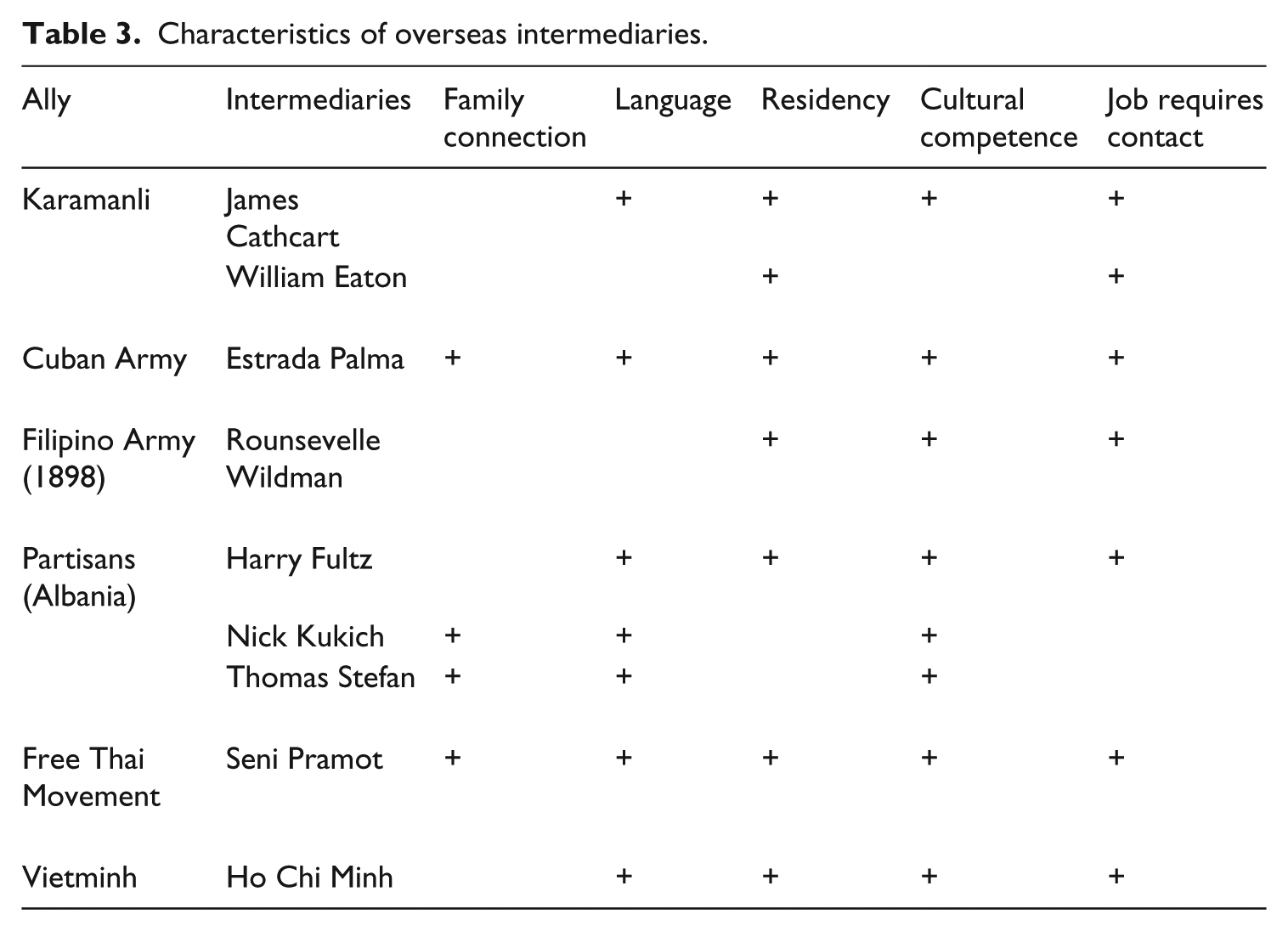
Intermediaries overseas possessed many of the same traits as those along the frontier (see Table 3). Most intermediaries to overseas non-state allies had extensive experience living in both the US and the non-state ally’s community, were bilingual, and had bicultural families. In Yugoslavia in the 1940s, two key intermediaries — George Musulin and George Wuchinich — had families that migrated to the US from Yugoslavia, and at least Wuchinich spoke Serbo-Croat (Ford, 2000: 15; Lindsay, 1996: 12, 33). The US also relied on immigrants to negotiate with partisans in Italy and Yugoslavia. Often, their social skill was reinforced by having an occupation that required brokering deals between communities. Rounsevelle Wildman and E. Spencer Pratt, as discussed later, met with Aguinaldo — the leader of the Filipino Army — while serving as trade consuls in Asia. William Eaton became acquainted with Tripolitan politics while playing the same role in North Africa. Ho Chi Minh is a more unusual case. Ho travelled to the US in 1912, where he learned English (Duiker, 2000: 49–51). When Ho tried to gain US support for the Vietminh in the 1940s, his knowledge of the English language and US culture was important. As Bradley (2000) notes, the Office of War Intelligence was “impressed by Ho’s English, intelligence, and obvious interest in the Allied War effort.” Throughout the conflict, Ho managed to convince Office of Strategic Services (OSS) officers that he intended to create a pro-US democracy (Bradley, 2000: 138–141).
Characteristics of overseas intermediaries.
Structural holes between the US and its non-state allies exist for a number of reasons. The first reason is simple ignorance. In a large number of cases, there is no evidence that policymakers in Washington had heard of their future non-state allies until an intermediary brought these groups to their attention. There is clear evidence, as I discuss later, that President Jefferson had never heard of Ahmed Karamanli, who would cooperate with US forces during the first Barbary War. Similarly, no one in Washington knew much about the Yugoslav partisans who resisted Hitler (De Santis, 1981: 542) or had much faith in the Italian partisans (Le Gac, 2008). Second, structural holes can exist because war renders communication difficult. The US and the Free Thai Movement, for example, could not communicate because of the Japanese occupation of Thailand during the Second World War; a large part of the US intelligence operation was dedicated simply to smuggling a radio into the country (Reynolds, 2005: chs 5–6). Third, structural holes are sometimes due to racism or ideological differences that prevent agents from communicating effectively, as evidenced by the US treatment of Native Americans.
Intermediaries in US foreign policy
This section shows that intermediaries play a crucial role in cooperation between the US and its non-state allies. I use four cases of cooperation to test whether the four roles played by intermediaries — finding plausible partners, identifying interests, crafting shared identities, and providing reassurances — are necessary for cooperation.
First, I establish that in these four cases of cooperation — single historical outcomes — intermediaries were necessary for cooperation because of the reasons highlighted earlier. If intermediaries matter in these four cases because a low-information environment produces a structural hole that only an intermediary can fill, then I have shown that distance from traditional political power is a key source of agency. Second, I want to establish the plausibility that the larger universe of cases — alliances with non-state allies — requires a focus on intermediaries. To lend plausibility to this general claim, I use a diverse case research strategy to select the cases, enabling generalization to the larger sample by ensuring that selected cases are not outliers explained by an unusual factor (Gerring, 2007: 97–101).
Identifying plausible partners for cooperation
The first mechanism that a socially skilled intermediary may use to promote cooperation is to identify potential partners. Intermediaries’ experience provides actors with information on likely cooperation partners, bridging structural holes. The recruitment of Ahmed Karamanli during the First Barbary War shows how intermediaries identify partners for cooperation.
Beginning in the 1790s, US shipping was often captured by the Barbary States in North Africa. Tired of ransoming US vessels, the Jefferson administration sought some way of dealing a blow to Yusuf Karamanli, the leader of Tripoli. William Eaton and James Cathcart played a crucial role as intermediaries, in part, by identifying Yusuf’s brother Ahmed as a likely partner in the first-ever US attempt at regime change. Regime change failed; however, Ahmed’s forces won the decisive Battle of Derna that forced Tripoli to sue for peace, ending the war.
Before Eaton’s and Cathcart’s intervention, there was a clear structural hole between the White House and Northern Africa. No one in Washington — and the historical record seems clear on this point — had heard of Ahmed Karamanli before he was brought to the attention of the White House by Eaton. Eaton and Cathcart were model intermediaries, having the life experience necessary for the creation of social skill. Cathcart became intimately familiar with Barbary politics when he was a slave in the Barbary States, rising to become the Dey Hassan Pasha’s primary secretary (London, 2005: ch. 3). Eaton understood local political issues because he was stationed as the US consul to Tunis. Both men were essential to US cooperation with Ahmed. Cathcart, the consul to Tripoli, devised a scheme to cooperate with Ahmed Karamanli, presenting it to Eaton. Eaton quickly became infatuated with the idea and began lobbying the White House to support Ahmed.
Without Cathcart and Eaton — the intermediaries between Washington and Tripoli — there is little evidence that cooperation would have occurred because there was a clear structural hole. No one in Washington had heard of Ahmed before Eaton arrived: one historian notes, “scarcely anyone mentioned Hamet [Ahmed] as a plausible alternative to his brother” (Wheelan, 2003: 234). Likewise, Ahmed never considered the possibility of cooperating with the US to depose Yusuf. Eaton wrote frequently to Ahmed, strongly arguing that he should cooperate with the US. Ahmed was reluctant and considered reconciling with his brother Yusuf. This would have doomed cooperation before it began; if Ahmed began to support Yusuf, then the US would lose a potential ally. Without authorization from Washington, Eaton gave Ahmed cash to help him leave Tripoli (Whipple, 1991: 180–181). Once Ahmed left, Eaton went to Washington to lobby for cooperation, and Ahmed retired to Egypt. After obtaining presidential approval for the operation, it took some time for Eaton to hunt down Ahmed, form his army, and march it to Derna.
Cathcart’s and Eaton’s crucial role as intermediaries is clear from the historical record. There is no evidence that anyone else, on either side of the Atlantic, had ever considered cooperation plausible. Due to dogged determination and intimate knowledge of Tripolitan politics, Cathcart and Eaton were the essential brokers of cooperation. After Ahmed’s victory at Derna, Yusuf gave favorable terms to the US. The US quickly abandoned Ahmed, reducing him to beggary, and placed a secret clause into the peace treaty that left Ahmed’s family in Yusuf’s hands (Wheelan, 2003: 325).
Explaining interests
Intermediaries promote cooperation by crafting deals that appear to be in parties’ interests. Most episodes of cooperation include parties that have divergent and overly optimistic expectations for the other’s post-war behavior. The source of these misperceptions is usually an intermediary. In their brokerage roles, intermediaries know parties’ interests and can identify incentives likely to promote cooperation. US agents working with the “hills peoples” near Burma in the Second World War exemplify this role.
US and British agents recruited minority ethnic groups in Burma to fight against Japan and the Burmese Army. The British had contact with the “hills peoples” — the Naga, Chin, Karens, and Kachins — before the war, but relations were, at best, mixed. The Chin, Karens, and Kachins were targets of a British recruitment campaign in the 19th century, and the Naga endured a particularly bloody British attempt at colonization (Aung-Thwin, 1985; Thong, 2010). Perhaps surprisingly, the Nagas (victims of the British) and the Karens and Kachins (who previously cooperated with the British) all supported British and US units deployed in the China–Burma–India theatre: they fought a guerilla war against Japan, rescued downed airmen, collected intelligence, and acted as guides (Fellowes-Gordon, 1957; Webster, 2004).
There was a clear structural hole between the US and British governments in Washington and London and Burmese fighters. No reliable means of communication connected the groups; instead, agents had to be dropped or sneaked into Burma to coordinate operations. These groups wanted independence from Japan and the British (Laidlaw, 1991). In this context, British agents, operating beyond political control and without consulting the government, explicitly promised post-war independence. British agents were notoriously untrustworthy, so local insurgent groups looked to US agents for reassurance of British promises (Bower, 1950: ch. 26). Because the US was identified with anti-colonialism, their attitude toward the post-war settlement mattered.
There is significant evidence that one reason that frontier communities chose to cooperate with the US and British forces is the role played by intermediaries in explaining US and British post-war interests. 3 Two groups of intermediaries misled the “hills peoples” into believing that the US would support post-war independence. First, US agents may have unintentionally misled local groups. Roger Hilsman’s account of his service in the region highlights how US agents inadvertently misled those they fought alongside. When commencing operations, Hilsman (1990) gave long and complicated speeches about freedom and equality to local insurgent forces, implicitly suggesting that the US would provide post-war independence. Hilsman was not a socially skilled intermediary; he was politically naive and swept away in the moment, figuring that that was simply what one did before conducting guerrilla campaigns with colonial peoples. His behavior was not unusual; one historian of intelligence operations remarks: “one shudders at what our officers whispered to Kachin chiefs about postwar independence and other goodies” (Asprey, 1975: 434). Moreover, agents’ political claims were supported by General Stilwell, a vocal anti-colonialist, who led US forces in the region. Stillwell frequently highlighted his commitment to end British imperialism. His speeches, rhetoric, and position of influence likely led local groups to believe that US interests were aligned with their own (Selth, 1986: 501–502). In the end, intermediaries promoted the illusion that the US was committed to post-war independence, calming suspicions of Britain’s post-war intentions.
These groups of agents — the only connection between Washington and the hills surrounding Burma — demonstrate how intermediaries can create an image of a harmony of interests in post-war cooperation. Neither US agents nor Stilwell intended to create an overly optimistic image of a post-war harmony of interests; Stilwell may not even have known that he played a crucial role as an intermediary. Yet, non-state groups in Asia came to believe that the US shared their vision for post-war Asia, choosing to cooperate with the US instead of remaining neutral.
Building trust
When intermediaries live and work in the communities they are recruiting, they develop stores of trust and influence. Because both partners trust the intermediary to accurately represent information, and trust the intermediary’s judgments about the reliability of the other, different parts of the network trust one another. By staking their reputation on a great power patron or a non-state ally, these intermediaries provide important reassurances that the ally can be trusted.
US cooperation with Apache scouts highlights many of the causal mechanisms by which intermediaries promote cooperation, especially their role in building trust. In July 1871, US General George Crook organized his first expedition against the Apache (Worcester, 1992: 134–135). Crook knew from his experience in the Pacific Northwest that Native American scouts would be valuable. Yet, there was no reliable set of connections between the Apache and the military — no bridge between the two communities — to help Crook determine which Apache were likely to work for the US military. Taking others’ advice, he briefly used Mexicans and Navajo as guides, but they proved ineffective (Thrapp, 1975: 96–97). Rather than rely on others, Crook began negotiations himself with the Coyoteros and White Mountain Apaches and quickly recruited them.
The US government and the Apache fought a 40-year conflict, beginning in 1851 and lasting to the early 20th century. Crook recruited the Apache to fight in the Yavapai War (1871–1875) and the war against Geronimo (1881–1886). The use of Apache scouts had an important interstate dimension. One part of the Apache strategy to resist the US and Mexican governments was to cross the border when pursued, hoping that tensions between the US and Mexican governments would make cross-border pursuit difficult. US regulars had trouble crossing the border. When the federal army tried to accompany the Apache across the border to chase Geronimo in the summer of 1865, Mexican soldiers shot a US officer. Crook referred to it as an “assassination,” and the Secretaries of War and State became involved, demanding reparations. Mexico, in turn, demanded reparations from the US for sending US soldiers onto Mexican soil (Roberts, 1994: 265–267). The use of Apache scouts prevented this kind of incident because the Apache could operate unofficially on both sides of the border.
Crook recruited the Apache by making political promises. If the Apache refused to live on reservations, then the US government would exterminate them. However, if the Apache lived peacefully, they would receive protection from the US government. The key was Apache unity. If only some Apache lived on reservations, it would be a continuing source of conflict: “if any refused, then he should expect the good men to aid him in running down the bad ones” (Bourke, 1971: 142–144).
Crook — likely because of his experience recruiting in the Pacific Northwest — knew that he needed to outsource management of Apache recruitment to socially skilled agents (Bourke, 1971; Thrapp, 1972). He organized Apache scouts into several companies, and each company had a “chief of scouts” who organized the parties and travelled with them. The chief of scouts was an important position because he had to coordinate the Apache and Western soldiers’ disparate fighting styles and avoid identity-based troubles that might upset cooperation.
For these positions, Crook hired intermediaries who exemplified the logic of living in two worlds. The first intermediary Crook hired was Croydon Eliphalet Cooley. In 1869, Cooley had traveled west, prospecting for gold. He found the White Mountain Apache and quickly befriended them. In 1871, Cooley married two daughters of Pedro, an important Apache leader (Collins, 1999: 6–9). Over the next three years, Cooley helped the Apache preserve land by brokering deals with the US military. His knowledge of Apache customs and language was so extensive that he provided primary source evidence for early studies of Apache life (Bourke, 1890; Loring, 2001). Al Sieber, who led another company, had lived in Arizona since childhood and had extensive experience with Native Americans (Robinson, 2001: 111). Crook also relied on Archie McIntosh, who had extensive experience with Native Americans in the Northwest, and Mickey Free, who was kidnapped by the Apache as a child.
The chief scouts’ key role was to reassure the Apache that the US would protect them after the war. They built personal reputations for honesty and aided the government in convincing the Apache that cooperation was in their interest. Emmett Crawford, a commander of the Apache scouts in the 1880s, frequently took high-visibility actions that assured the Apache of US goodwill. He permitted the Apache to hunt off reservation, turned over convicted Apache to the tribe for punishment, and took legal and military action against settlers to ensure Apache rights (Nalty and Strobridge, 1964: 34–36). Crook himself often reassured the Apache of US credibility. His early experiences in the Northwest had convinced him that the causes of frontier tension were corrupt Native American agents, broken promises, and drunken settlers. While Crook held authority in the region, he kept the deals he struck and cultivated a reputation for honesty. The scouts therefore placed substantial trust in Crook’s personal promises (Shipp, 2001: 530–531).
Within-case variation lends confidence to the emphasis on Crook’s role. When Crook left Arizona in the mid-1870s, his replacements frequently broke their promises to the Apache, losing their confidence (Thrapp, 1972: 110). When Crook returned, the scouts were refusing to cooperate because they felt that they had “been fooled.” Crook intervened on behalf of the Apache, reassuring them that the US would uphold the bargain to leave the Apache unmolested after the Apache Wars. Crook’s reputation for honest dealings led the Apache to again work with the US military (Aleshire, 2000: 309–328).
Reducing cultural friction
Intermediaries often broker cooperation by convincing parties that they share a common identity. Common identities enable parties to identify one another as partners for cooperation, recognize common interests that may be shared by a great power and its non-state ally, and establish reliability by pointing to a common set of values that each believes the other would not betray. Because intermediaries live at the intersection of two cultures, they often have significant experience of negotiating between different worldviews. The efforts of Cuban expatriates in the US during the Spanish–American War highlight this role.
When the US intervened to help the Cuban insurgents during the Spanish–American War, the insurgents had already nearly won. The Spanish military was demoralized and had suffered high losses, and disease and heat were inflicting incredible casualties. In addition, the Cuban and Filipino rebellions were bankrupting the Spanish government, creating mass protests in Spain. The question was when, not if, Spain would leave Cuba (Perez, 1998: ch. 4).
Identity politics made cooperation between the US and Cubans difficult. US impressions of Cubans made them seem more threatening than the Spanish. The US tended to read Caribbean revolutions through the lens of Haiti (Hunt, 2009: 52–68; Schoultz, 1998: 128). As John Offner (1992: 53) explains, the Cleveland administration resisted congressional pressure to support Cuba because:
if the Cuban insurgents, many of whom were impoverished black rural laborers, were militarily successful, they might initiate class and racial warfare when they entered the island’s wealthy towns and cities, which were primarily white. Prolonged and calamitous civil war, as seen in an earlier Haitian revolution, might result.
Conversely, Cuban insurgents worried about the US — they did not want to trade one imperial power for another.
A group of socially skilled expatriates acted as intermediaries between elements in Cuba (the military and provisional government) and the McKinley administration and Congress to recruit US intervention. Tomás Estrada Palma, the leader of the Partido Revolucionario Cubana (PRC), used his position to actively solicit US recognition of Cuban belligerence and US intervention. He used his position between societies to manipulate a structural hole. To obtain information about events in Cuba, US journalists had to meet with the PRC, who gave them intelligence on military developments, Cuban aspirations, and Spanish abuses. The lack of information flowing across the Florida Straits created the kind of structural hole that enables intermediaries to play crucial roles. Estrada Palma was uniquely suited to play the role of intermediary. He had intimate experience with the US government, spoke English well, lived in both communities, and had political contacts on both sides of the Florida Straits.
Estrada Palma’s propaganda machine massaged identity issues, making cooperation possible. He deftly portrayed the Cuban Revolution as akin to the American Revolution, with Estrada Palma cast as the Cuban Benjamin Franklin in the American Paris (Pérez, 1983: 198–199). Moreover, Estrada Palma tried to manage the administration’s perceptions of Spain. In a dramatic episode, he secured and released to the New York Post a letter written by Enrique Dupuy de Lome, the Spanish ambassador to the US, which ridiculed McKinley as weak, leading to tensions that culminated in the ambassador’s dismissal (Trask, 1981: 26–27). Estrada Palma also promoted Cuban freedom in the press, and the PRC hosted festivals and financed theatrical productions that promoted a stylized US image of Cuba’s search for liberty (Auxier, 1939, 1940; Schoultz, 2009: 16–17; Sylwester, 1969). The PRC’s efforts built public and congressional support for Cuba’s liberty, contributing to intervention.
Managing Cuban impressions of the US was an even more complicated task for the PRC. The US framed its intervention as “neutral,” trying to end conflict between Spain and the insurgents. To maintain the neutral frame, the McKinley administration did not recognize the Cubans as belligerents. Influential members of the PRC in New York and Cubans in the field refused to cooperate with the US military under these terms, stating that the intervention was a “declaration of war” against Cuba and promising to resist US troops (Pérez, 2003: 95–97). In Washington, Estrada Palma helped push for the Teller amendment, which implied that the US had no interest in occupying Cuba. With the Teller amendment in hand, he worked on insurgent leaders to convince them to help the US, promising that the US shared Cuban ideals and would later support independence (Hernández, 2010: 30–33). Active insurgent cooperation was short-lived. US forces used Cuban insurgents only in support roles and excluded their leadership from participating in negotiations with the Spanish (Pérez, 2003: 97).
Conclusion
To explain important events in international politics, is it sufficient to focus on the institutionally powerful — the “great men” who sit in capitals? The answer, given by a generation of scholars interested in the contributions that unusual agents make, is clearly “no.” Studying less ordinary forms of political power is important because individuals in professions often thought marginal, such as military or diplomatic wives (Enloe, 1983: 46–91; 2000: 93–123), prostitutes (Moon, 1997), or musicians (Ansari, 2012; Davenport, 2009; Fosler-Lussier, 2012), can dramatically influence international politics. Yet, while these scholars have shown that agents often thought to have little influence matter, they have paid less attention to the conditions under which they matter. When do “marginal” actors take front stage in security politics? I argued that intermediaries — agents with weak ties to two or more networks — have been necessary for the recruitment of US non-state allies over time, from Native Americans during the American Revolution to irregular forces fighting Hitler. Taking advantage of environments with little information, agents who developed special social skills by working between communities were able to leverage cooperation in cases where it was not expected.
Understanding the role of intermediaries is important. If we do not focus on intermediaries, our accounts are limited because we cannot understand the historical processes by which allies overcame conflicts of interest, mistrust, and cultural tension. This has substantial implications for national security. In studying contemporary forms of political violence — terrorism, militias, and other modern conflicts — a focus on the networks through which these individuals organize is increasingly important (e.g. Parkinson, 2013; Staniland, 2012). Moreover, the influence of figures who border communities is likely not limited to security politics. In fact, these kinds of relationships are likely more important for studies of international political economy, where a substantial body of scholarship highlights collaboration between local and international capital (Evans, 1979) and networks between diasporas and their homelands that help secure international investment (Brinkerhoff, 2012; Gillespie et al., 1999). The mechanisms in these discussions tend to emphasize how agents that exist between societies — local economic elites or individuals in a diaspora — face a special set of economic and political incentives that leads to advantages that can help shape development and trade.
Beyond security studies, several broad conclusions can be drawn about the importance of studying intermediaries. First, social network theory has the potential to develop generalizable theories about how the weak influence international politics. Social network theory, at present, is being used to re-describe the importance of traditional hierarchical figures — states or empires — to build new theories about why the powerful are powerful. This study of intermediaries, in contrast, posits that agents who lack institutional authority are often important in international politics because their set of social skills makes cooperation possible. A network-based approach, therefore, may help us do more than re-describe power; instead, it may identify new sources of power.
One benefit to this approach is that it promises a richer understanding of international cooperation. Many early theories of international cooperation and conflict were state-based: realist and liberal institutionalist scholars often posited that states are interested in survival or the maximization of gains, and states use international cooperation to facilitate those gains. In one reaction to this state-based reasoning, liberals and constructivists have shown that states’ interests are more variable than early realists and liberal institutionalists supposed because interests hinge on social actors’ interests and preferences (Moravcsik, 1997) or standards of appropriate behavior into which states are socialized (Finnemore and Sikkink, 1998). In both cases, individuals’ interests and moral intuitions matter only insofar as individuals help construct states’ preferences or constrain states’ policies. As an exercise in rethinking our foundational theories of international politics, these are limited endeavors.
Social network scholars often criticize this way of unpacking states’ interests because it continues to treat the state as a “substance.” Instead of trying to figure out what properties individuals or groups have, a focus on how agents are connected may have special explanatory leverage (Jackson and Nexon, 1999). Political scientists have already shown that thinking about the internal dynamics of organizations, states, and transnational movements in network terms is helpful (Kennedy and Weimann, 2011; Kirkland, 2011; Nexon, 2009: 39–65). Surprisingly, however, studies of social networks in international politics rarely examine ties that cross borders, linking specific social actors within different states. The practice of diplomacy — traditional and non-traditional — has not received much attention in network accounts despite being the “pipes and prisms” (Podolny, 2001) of global politics. Findings about the role of intermediaries in recruiting non-state actors show one way that moving from substances to relations provides concrete advantages. In so doing, emphasizing who knows whom, who likes whom, and who trusts whom provides new opportunities to explore how information, trust, and identity politics affect cooperation.
Perhaps most essential, inserting ordinary influence into the center of IR scholarship is normatively important. For a discipline attracted to the study of the traditionally politically powerful — a discipline that spends much more time talking about Henry Kissinger than William Eaton — rethinking whether those without institutional authority matter is politically important because it inserts everyday people into the center of international politics, taking seriously the influence of ordinary individuals pursuing everyday activities. The finding that the everyday experiences of people without political power can be useful for international cooperation has an empowering, egalitarian spirit, which contrasts starkly with the obsession with “the powerful” that permeates much of today’s scholarship.
Footnotes
Acknowledgements
The author would like to thank Austin Carson, Alexander Downes, Henry Farrell, Martha Finnemore, Grant Hammond, Miles Kahler, Srini Sitaraman, Dillon Tatum, two anonymous reviewers, and the editors for their generous comments and suggestions. Earlier versions of this paper were presented at the American Political Science Association Annual Meeting, Washington, D.C., the Annual Meeting of the International Studies Association, San Diego, and the International Studies Association, Northeast, and the Institute for Security and Conflict Studies at George Washington University.
Funding
This research received no specific grant from any funding agency in the public, commercial, or not-for-profit sectors.