







Abstract
Human rights scholars and activists have often been criticized for being “principled” rather than “pragmatic” actors in international politics. Rarely, though, is such criticism accompanied by a discussion of what pragmatism means, or what pragmatic action looks like. This article conceptually traces and defines three aspects of pragmatism — philosophical, methodological, and political — that might be applied to the global human rights discourse. The article then outlines how these aspects can help resolve debates over human rights beliefs, scientific inquiry, and political action. I argue, first, that critics of human rights do not adequately develop the concept of human rights pragmatism, and then I make the case using examples that human rights discourse already lends itself toward a pragmatic train of thought. The implication of this analysis is that the “pragmatist” critique of human rights actors is, at minimum, unfounded and, at maximum, a mask for more pessimistic anti-rights positions.
Introduction
A centerpiece of the international post-war order, human rights law, is under critical attack for making little difference in today’s world. Eric Posner’s (2014) The Twilight of Human Rights Law, Stephen Hopgood’s (2013) The Endtimes of Human Rights, and Emilie Hafner-Burton’s (2013) Making Human Rights a Reality, as well as various chapters in an upcoming volume entitled Human Rights Futures edited by Hopgood, Jack Snyder, and Leslie Vinjamuri (forthcoming), all argue that a gap is widening between the promises of the universalist human rights regime and political realities in national contexts. “A disconnect,” Hopgood (2013: 14) writes, “is opening up between global humanism with its law, courts, fund-raising, and campaigns on the one hand, and local lived realities on the other.” 1 Others write: that “legalist tactics can backfire” (Snyder and Vinjamuri, 2003/2004: 12); that the human rights movement might “be more part of the problem in today’s world than part of the solution” (Kennedy, 2002: 101); or that it fails to “matter where needed most” (Hafner-Burton and Tsutsui, 2007: 407 ).
These scholars — contemporary human rights pessimists 2 — are reporting a global decline in social well-being that cannot be halted by the development of international law. Some prophesy the collapse of the “legalist” human rights project, which can no longer compete in the global marketplace of ideas (Hopgood, 2013). Others submit that the human rights discourse is so badly flawed that it must be reformed or rethought entirely (Rubin, 2003: 61–62). These works are a grave challenge. Human rights norms and laws are now deeply ingrained into binding international law, which informs the work of national governments, supranational institutions, and transnational advocacy networks. When such a fundamental discourse is called into question, International Relations theory must take notice.
Although recent critics are a diverse group, one can find in their work a repeatedly offered alternative to excessive human rights legalism: more “pragmatic” rights-based thought and action. Contemporary human rights pessimists make the call for human rights pragmatism in subtly distinctive ways. One group treats pragmatism as a possible source of more productive interventionist tactics. Eric Posner, for instance, clearly proposes pragmatism as an alternative to law: “The law doesn’t do much; we should face that fact and move on” to “more focused and pragmatic interventions.” 3 Jack Snyder and Leslie Vinjamuri (2003/2004: 7) also pose pragmatic methods as an alternative to blind legalism, but with a specific focus on bargaining: “the departure for strategies of [criminal] justice must be the ‘logic of consequences,’ in which choice and action are shaped by pragmatic bargaining rather than by rule following.” Used this way, pragmatism appears to refer to a set of approaches that must supplant strategies aimed at institutionalizing the rule of law.
Other scholars turn to pragmatism as a guiding philosophy that challenges human rights absolutism. Emilie Hafner-Burton, for instance, does not confine her pragmatism to an anti-legalist method. She promotes a whatever-works, “stewardship” approach — where great powers seek various means including coercion, sanctions, or legalization to decrease weaker states’ reliance on repressive tactics. She describes this approach as being theoretically inspired by philosophical pragmatism: “Being pragmatic means using legal tools when they are capable of supporting human rights promotion” (Hafner-Burton, 2013: 194). This statement implies an imperative obverse that may be difficult for activists: human rights law must be abandoned when and where it does not work.
Stephen Hopgood (2013: 123) does not explicitly endorse pragmatist philosophy. In fact, he appears critical toward “American pragmatists, who build norms out of existing empirical realities.” He argues that this group is largely responsible for the demise of human rights norms: “pragmatists believe they have done away with the need to replenish their moral authority. Their legitimacy now comes from global norms, they believe. This misconception lies at the heart of the endtimes” (Hopgood, 2013: 123). However, this statement creates ambiguities when countered to Hopgood’s repeated criticism of human rights proponents for being convinced of the “inherent justness” of their norms or that the pursuit of justice is “persuasive in and of itself” (Hopgood, 2013: 142). These complaints echo early pragmatist volleys against moral absolutism tied to the notions of metaphysical truth. 4 Hopgood, with other critics that appeal to pragmatism, is concerned about the lack of practicality and authority written into the human rights legal discourse.
An immediate problem for each of these accounts is that they utilize pragmatist arguments, or appeal to pragmatist ideas, in order to disguise a pervasive and totalizing skepticism that leaves little room for hopeful alternatives. However, in failing to formulate precisely what they mean by pragmatist human rights scholarship or pragmatic human rights activism, they are adopting stances that are markedly un-pragmatic. As Robert Talisse (2007: 21) suggests: “There is not pragmatism per se or in general. An appeal to the term should be accompanied by a suitably nuanced qualification indicating broadly the kind of commitment one takes pragmatism to be.” For their part, new human rights pessimists leave open the question of how pragmatism might operate in the context of human rights. However, this is precisely the question that needs addressing: what could it mean for advocates and scholars working on human rights law to be more pragmatic?
If one looks in earnest for answers, it becomes clear that pragmatism is less the heart of a stunning indictment against current human rights practices and more a useful framework for developing those practices. This article elaborates on three aspects of pragmatist thought — philosophical, methodological, and political — in order to pursue a fuller conception of “human rights pragmatism.” Specifically, it considers how these three aspects of pragmatist thought map onto three elements of the human rights discourse: belief, inquiry, and political action.
This exercise requires an applied historical examination of the legal and political writings of self-ascribed pragmatists. How might some of these thinkers, many of whom died before the issuance of the Universal Declaration of Human Rights in 1948, counsel rights activists and scholars around questions of human rights law and politics? In each section, I start by presenting lessons that can be drawn from the history of pragmatist thought, and then I apply those lessons to the current human rights legal discourse. In so doing, I make two major moves. The first move, more critically oriented, is to show that the pragmatist alternatives proposed by human rights pessimists are narrowly conceived in their attempt to separate human rights law from human rights politics. The second move is to show that human rights law pairs well with pragmatism — and that many advocates and scholars are, by and large, already pragmatic actors.
Philosophical pragmatism and human rights beliefs
Philosophical pragmatism
Pragmatism is a philosophy originally associated with various American thinkers mostly from the American North-east — Charles Peirce, William James, John Dewey, and Oliver Wendell Holmes Jr — who were active in the period between the Civil War and the Second World War. The philosophy endured a brief Cold War hiatus only to be revived by “neo-pragmatists” like Richard Rorty, Hilary Putnam, and Richard Posner in the 1980s and 1990s (Posner, 2003; Putnam, 1995; Rorty, 1989).
The theoretical modus operandi for pragmatists was first articulated (somewhat inarticulately) by Charles Peirce in an 1878 essay called “How to make our ideas clear.” Peirce (1966: 124) wrote: “Consider what effects, which might conceivably have practical bearings, we conceive the object of our conception to have. Then, our conception of these effects is the whole of our conception of the object.” Put simply, a concept is defined by its uses. Borrowing from Kant, Peirce had before referred to this idea as “pragmatism” in an unpublished paper in the early 1870s (Kant, 1947: 84). William James was the first to introduce the term publicly in a well-attended 1898 lecture; in 1907, he defined it in writing more clearly than his friend Charles Peirce: “The pragmatic method … is to try to interpret each notion by tracing its respective practical consequences. What difference would it practically make to anyone if this notion rather than that notion were true?” (James, 1995 [1907]: 18).
Applied, pragmatic thought is concerned with both a central practical problem and a central philosophical problem. The practical problem is that, within human society, “certitude leads to violence,” and that “if the conviction of rightness is powerful enough, resistance to it will be met, sooner or later, with force” (Menand, 2001: 61). The philosophical problem for pragmatists is that the validity of first principles, based on beliefs grounded in systems of logic, science, or religion, can never be satisfactorily proven. That is, claims to truth — like “humans in nature are brutish” or “humans in nature are noble” — are just claims, and when these claims conflict, no objective resolution is possible. Facing the failure of claims to represent reality, pragmatists project human thoughts onto a backdrop of uncertainty and contingency. Once these premises are acknowledged, the task is reckoning with the questions “How do we act in a universe of uncertainty?” and “How do we know things in a world where things happen ‘higgledy-pigglety’?” (Menand, 2001: 199).
Each pragmatist constructs answers to these questions through meditation over concrete issues. An astronomer, Charles Peirce pondered how seemingly technical matters like the statistical observation of celestial bodies are not unlike religious beliefs. In essence, both are guesses about probabilities that we use as a guide (Menand, 2001: 363–365; Peirce, 1966: 96). William James was a psychologist who argued that, finding ourselves within a “pluriverse” composed of many possible futures, we believe because beliefs are useful for self-actualization — not because they bring us closer to Truth (James, 1898). John Dewey shared this notion of beliefs as underlying meaningful action; as an academic and educator, though, he continually pointed to the importance of beliefs grounded in experimentation — and learning through doing — rather than contemplative, ivory-tower philosophy. Finally, Oliver Wendell Holmes Jr was a lawyer and Supreme Court judge who rejected the notion of law as natural and absolute in favor of a new understanding of law as a product of judges’ experience and adaptive judgments — an understanding that would challenge legal formalism, legal utilitarianism, and legal historicism (Holmes, 2004 [1881]: 1).
These progenitors of pragmatism were relatively anti-philosophical philosophers. Rather than speculating on the truth validity of rational propositions, they pondered what the implications would be if various propositions were acted upon. As they were “anti-traditionalists” in this way, and avoided the appellation of a “school,” it is difficult to characterize their thought as having central philosophical precepts (Posner, 2003: 6). “Words, especially epithets, in philosophy are far from self-explaining,” wrote Dewey in 1927 (Dewey, 1984b: 150). Despite this, it is possible to locate certain philosophical tendencies that course through pragmatist texts. Four of these require elaboration.
The first, fallibilism, suggests “that even those beliefs about which we are most convinced may turn out to be false,” and that “whatever certainty we may attain requires that we actively organize experience in such a way that our beliefs are challenged” (Knight and Johnson, 2011: 26). Fallibilism welcomes the discomfort of undergoing a crisis of faith, of facing one’s tormentors, or fraternizing with the enemy; only by engaging such challenges can one consistently travel in the productive space that lies between states of doubt and belief.
The second common tendency, anti-skepticism, is for pragmatists a necessary counterbalance to fallibilism and its potentially relativist implications. It counsels exercising belief even when confronting the doubt that all beliefs are false. Just as there is no way to know whether truth claims are absolutely valid, there is likewise no way to know that truth claims are absolutely invalid. Thus, the pragmatist would approach statements about the absence of God or affirmations of the presence of God in the same way: each claim is equally questionable. The pragmatist is not an atheist, but an agnostic. 5
The third tendency, consequentialism, grows out of utilitarian philosophy, and it is now embedded in the 21st-century shift to impact evaluation in many fields of practice like educational performance or health-care intervention (Vanclay and Esteves, 2011). However, the pragmatist variant needs qualification. Pragmatists approach both beliefs and actions by what they produce, but that does not imply strict utilitarianism, or the doctrine centered on the greatest good for the greatest number. A devoted pragmatist, accepting that all metrics of assessment are fallible, would not set about attempting to produce uniform standards for measuring consequences — as utilitarians were apt to do. They might also recognize that “there are broad expanses of politics in which interpersonal comparisons of utility are unreliable or impossible” (Knight and Johnson, 2011: 44). John Dewey would likely not, for example, rely on quantitative assessments of test scores to measure the performance of primary and secondary schools. As they lack faith in rubrics or expert criteria, pragmatists are committed to a kind of “tempered consequentialism” (Knight and Johnson, 2011).
The fourth tendency, meliorism, is an element of pragmatist thought recently identified and described by Colin Koopman (2006). Meliorism is an alternative to both optimism and pessimism. “These two moods,” writes Koopman (2006: 107), “almost universally proffered by modern philosophers, share a common assumption that progress or decline is inevitable. Meliorism, on the other hand, focuses on what we can do to hasten our progress and mitigate our decline.” A meliorist would recommend continuing the struggle for greater freedom in a power-saturated political world, rather than continuing the endless pursuit of truth for the sake of emancipation from politics (see, e.g., Wright, 2010). The philosophical quest for the eternal, like the social pursuit of perfect justice, blinds us to more immediate practical concerns. Instead of seeking the truth to set ourselves free, we should instead participate in the art of the possible.
Implications for human rights beliefs
When they champion pragmatism, contemporary human rights pessimists could mean that advocates and scholars need to adhere more closely to these four elements of pragmatist philosophy. This raises one immediate concern: inasmuch as human rights are understood to be morally universal, promoting human rights would seem a clear violation of fallibilist commitments. Stephen Hopgood is strident on this point. He interprets the impulse behind public international human rights law as being “derived from natural law principles sanctified in a moment of creation, of ‘constitution’, when an ‘unmoved mover’, an unquestionable authority, a secular god, authorizes all subsequent rules” (Hopgood, 2013: 122). With this, Hopgood intends to draw equivalence between universal legal norms precariously grounded in reason and religious doctrine precariously grounded in revelation. The implication is that belief in the code of human rights law is just as arbitrary as belief in the precepts of religion. Both lack essential truth validity. Challenging the validity of universal moral norms in this fashion is a pragmatic move since fallibilism requires accepting that even root norms out of which others grow — for example, that humans possess inherent dignity — may, in principle, be foundationless.
However, does this mean that the notion of human rights is by its very nature non-pragmatic? To answer, we must consider two points. The first is historical. Human rights ideals are not necessarily grounded in the notion of divinely inspired natural law, as critics like Hopgood assume. Natural rights theory, á la John Locke, did in fact rely on some notion of divinity; every person has a duty to God to preserve life, which is a supernatural gift, and any authority that threatens the maintenance of life is in violation of God’s will (Waldron, 1987: 13). However, Enlightenment thinkers as far back as 250 years ago went some way toward discrediting Locke’s naturalistic account and its philosophical foundations. Some challenged the constructs of nature central to contractarian theory, while others sought justifications for moral laws outside of God’s authority: Kant based universal maxims solely on analytical reason, and Diderot argued that some laws persisted because they reflected consensus among peoples. No solution concerning the metaphysical foundation of rights was ever reached because, as pragmatists are right to notice, no solution is possible.
Human rights, a 20th-century conceptual innovation, represent a practical sidestepping of this foundational conundrum. As Jeremy Waldron (1987: 163) states: “the shift from ‘natural rights’ to ‘human rights’ marks a loss of faith in our ability to justify on the basis of truths about human nature.” Contrary to Hopgood’s claim that they are natural rights based on the “secular word of God,” human rights laws and declarations remain relatively vague with regard to their natural or preternatural foundations.
Philosophically, human rights norms have remained poly-foundational, which goes some way toward explaining why so much intellectual energy has poured into trying to locate sources of human rights in various civilizational traditions. 6 That is to say, human rights claimants rarely presume or explicitly articulate a single source of validity for human rights. They make the claims for a purpose — because doing so will make a more peaceful politics, will help generate pathos among a target audience, or will create space for anti-skeptical pursuits in a world of hard realities. This is completely in line with pragmatist expectations. Most people do not toil mentally over the varying degrees of overlap between rights in language, rights in eternity, and rights in reality. Instead, they just use the term “rights,” and thus appeal to the set of beliefs evoked. The job of the pragmatic observer is to think about the possibilities created and foreclosed by that usage.
A second point is logical. The legal-normative claim that human rights are universal is not necessarily equivalent to the philosophical claim that human rights are universally true. 7 This is not merely a semantic point. The principle of universality backing human rights is a normative argument about the level of applicability of rules — “combining the widest scope of application ratione loci [place] with the widest scope of application ratione personae [person]” (Brems, 2001: 4). This is not the same as a metaphysical proposition about the correspondence between rights and universal truth. It is not difficult to imagine someone remaining painfully aware of the contingency of history and the uncertainty of rights-based beliefs, yet still seeing the benefit of applying the principle of freedom of expression as widely as possible.
Philosophically, a person that holds this combination of views — awareness of contingency and support of human rights precepts — looks a good deal like a “liberal ironist” (Rorty, 1989: 89). As an ironist, this person possesses doubt about “the final vocabulary she currently uses” in furtherance of her privately held beliefs, but still realizes that “without the protection of something like the institutions of bourgeois liberal society, people will be less able to work out their private salvations” (Rorty, 1989: 73, 84). Ironically, promoting human rights law means understanding the randomness of the vocabulary, along with the importance of vernacular translation, but being an ironist does not create a duty to remind people in public that their human rights beliefs, etched into international law, are baseless. 8 For Rorty, doing so is comparable to calling a child’s “precious possessions” trash and throwing them away, or standing in church during a wedding to object that the marriage has no claim to sanctity. 9 Behaving in this way has negative consequences: it risks eroding the bonds of community on which political life is based, and it makes the world a crueler place.
When viewed in this way, Hopgood’s strongly worded anti-foundational criticism of human rights loses some of its power. As Judith Shklar (1986 [1964]: 67) noted decades ago, exposing moral legalist theories for being “political ideologies is not … as fatal to them as is often supposed.” Furthermore, Hopgood uses his fallibilist challenge in service of a pessimistic worldview that might irk pragmatists committed to anti-skepticism.
10
For instance, he closes his book, meant to convince readers that they live amid the death of human rights, with this poetic, yet cryptic, line: The classic humanist space of impartiality — of a space that was not politics, money or power — has foundations that will crumble regardless of how deep they pour the concrete for humanity’s new palace in the sand dunes of the Hague. (Hopgood, 2013: 182)
This amounts to a conviction that human rights law is doomed to failure because it has been exposed as lacking in substance. With this, the author does not, though, deliver a coup de grace. Hopgood only betrays his personal belief that human rights are empty of absolute truth value. As such, his book is simply the extended confession of a human rights atheist. A pragmatist, upon hearing this confession, would shrug and ask: “How could you be so sure?”
Instead of complaining that other idioms have as much truth purchase as “human rights,” 11 pragmatist philosophers would marvel at the staying power of human rights talk and legal claim-making. Human rights law represents beliefs that, in the words of William James (2008 [1909]: 5), appear to have “cash-value.” Figure 1 graphically demonstrates this point, depicting post-war trends in human rights law and political discourse. One can see two potential relationships in this descriptive data. First, rights-based protests, after decreasing with the third wave of democratization in the late 1980s, have begun to steadily increase in number since 1995. This suggests that while some political movements were initially co-opted by new democratic institutions, they have only returned to active demonstrations around rights-based concerns. The second noticeable trend is that the percentage of written texts mentioning human rights has gradually increased since the 1970s. This appears to coincide with spikes since the 1980s in the number of human rights legal treaties ratified by states. Based on these charts, which are simple event counts, human rights talk is just as vibrant intellectually and politically as it has ever been.
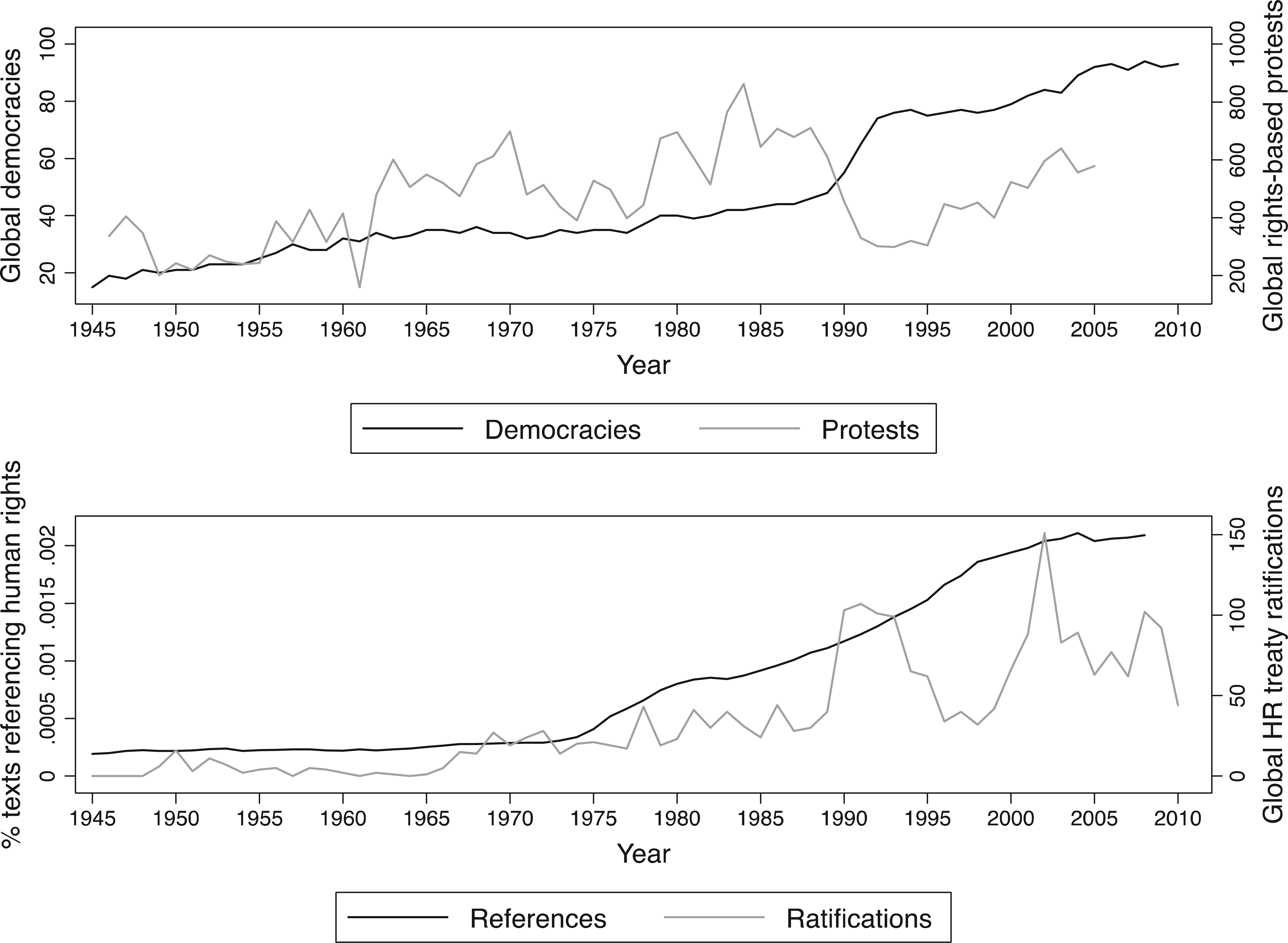
Trends in human rights discourse since 1945.
Pragmatists would not, though, confine their interests to the quantity of political events involving human rights; they may also maintain hope that the beliefs attendant to the human rights project could be skillfully manipulated to assist people in taking meaningful action. This is meliorism. Hypothetically, if a tenuous belief in human rights laws inspires a leader to reconsider the formation of a death squad, helps a social movement rally against corruption, or encourages a local village to protest the military demolition of solar panels providing energy to its only school, then so be it. 12 It does not matter whether the belief is built on pillars of Truth — or whether linguistic appeals to “human rights” are, in fact, representative of objects that exist in pre-political or natural reality. 13 For claimants, these kinds of philosophical meditations are unnecessary. It follows that insofar as human rights are often spoken of, that they give people meaning, and that they sometimes help to adjust course away from cruel or violent behavior, they are at their philosophical core quintessentially pragmatist.
Of course, neither the staying power of legalized human rights talk nor the sometimes-productive nature of rights claim-making is proof for the pragmatist of the inherent value of human rights. A pragmatist philosopher almost certainly would avoid supporting rights-based advocacy when he has determined that it means sure retrogression for the society as a whole. If human rights are used to empower a collectivity in coordinating meaningful and instrumental action, then that is for the best; if human rights are used to obfuscate or tear apart the social fabric, then they should be resisted. However, how might a pragmatist assess such consequences? This question brings us to a discussion of methodological pragmatism.
Methodological pragmatism and human rights inquiry
Methodological pragmatism
Criticism directed at human rights advocates for being too absolutist is often blended with criticism directed at human rights scholars for being insufficiently rigorous, idealist, or guided by belief. 14 As a corrective, human rights pessimists often point to findings from positivist research showing that rights law fails to cause improved practices (see earlier). This resort to positivism, though, creates methodological tensions when embedded within calls for greater pragmatism in the area of human rights. The reason is that methodological pragmatism, traced to its origins, can be understood as an alternative to a narrowly conceived positivist social science.
Positivist social scientists are devoted to falsification, or the notion that the worthiness of an idea may be judged on the basis of how well it performs in comparison to reality. To falsify — or not — one must employ systematized observational techniques to assess whether hypotheses about the world match facts. Positivists also seek causal relationships, but in a narrow sense: they are primarily interested in observing what events most consistently follow other events. The aim is to produce scientific laws of the sort, “when X is observed, Y is also observed” (see, e.g., Waltz, 1979) — or “When democratic elections take place in ethnically divided states, they are followed by election violence.” For positivists, the law and the cause are one and the same in this example. Democracy causes violence in ethnically divided states because democracy is followed by violence. The consequence of this kind of positivism is often to squeeze out unobservable explanations for events, like structures, beliefs, and identities (see King, Keohane, and Verba, cited in Johnson, 2006: 231).
Methodological pragmatism, especially that of Charles Peirce, was in some ways inspired by the positivist revolution of the mid-1800s. Peirce and his father were both magnificent mathematicians who fully understood new principles of statistical covariance and error. However, in the same period, statistics were used to construct homo economicus and buttress laissez-faire liberalism, both of which were distasteful to Peirce. Scientifically, he also assumed that perfect observation, the kind needed to falsify observations, was impossible. When it came to social relations especially, Peirce “did not believe that the universe is a machine. He thought that life is everywhere, and that life means spontaneity” (Menand, 2001: 195). The solution is accepting that the notion of scientific causes and laws are themselves just unrealized metaphysical possibilities, or, in the words of William James (1984: 148): “The word cause is … an altar to an unknown God.”
Outside of realizing that the belief in causes is itself without foundation, pragmatists tend to focus on the emergent properties of a whole social system, rather than attempting to isolate single causal chains between its interlinked and intervening parts. They were thus interested in the processes that together compose the “social organism.” Were they alive today, the original pragmatists would likely subscribe to the relational ontology of sociologists and network theorists (Emirbayer, 1997: 287). When thinking through the dense webs of meaning overlain in social processes, one must abandon hope for sure causal predictions; one can only make “bets” on slow-changing social developments that bounce across nodal points. This is why Oliver Wendell Holmes awkwardly referred to his own standpoint toward the world as bet-tabilitarianism (Menand, 2001: 217).
Maintaining a healthy suspicion toward decontextualized causal claims, alongside an appreciation of systems, processes, and probabilities, is important but not enough to constitute a method. How should the observer begin the process of inquiry? John Dewey was helpful in answering this question. In How We Think (Dewey, 1910: 91, 110), Dewey spoke to the importance of training thought by doing, and by conducting experiments. Dewey shared with positivists and social scientists a desire for systematic thinking: Without adequate method a person grabs, as it were, at the first facts that offer themselves; he does not examine them to see whether they are truly facts or whether … they are relevant to the inference that needs to be made. (Dewey, 1986c: 249)
Further, Dewey appreciated the contributions of quantitative empirical science to the study of facts, but he also foresaw the drawbacks of sustained empiricism: it can lead to “false beliefs,” the “inability to cope with the novel,” “mental inertia,” “unjustifiable conservatism,” or the tendency to divorce facts from their meanings (Dewey, 1986a: 269–270; Farr, 1999: 525).
To be more productive, empirical science needs to be combined with scientific thought, as embodied in experiments, which are “observations formed by variation of conditions on the basis of some idea or theory” (Dewey, 1986a: 273). The conjoining of this kind of method with empirical inference can be done only through direct experience. Experience allows us to move back and forth between a conservative devotion to statistical predictions about events that have already occurred, and a progressive faith in change based on the limited ability to control one’s environment. By drawing on these two reservoirs of knowledge, experience tempers both our impulse to overreact to intense but short-lived anomalies, and our tendency to seek radical change. For Dewey, one of the problems that empirical thinking would have to overcome is its bias toward the “immediate and the forceful”: “What is bright, sudden, loud, secures notice and is given a conspicuous rating. What is dim, feeble, and continuous gets ignored, or is regarded as of slight importance” (Dewey, 1986a: 275). This emphasis on the long term, as well as other elements of social context in general, are elements of the pragmatic method that can be applied most specifically to human rights inquiry.
Implications for human rights inquiry
What does it mean for human rights scholars and professional evaluators to become more methodologically pragmatic in inquiry? For human rights pessimists, it means: experimenting with human rights interventions like economists experiment with development strategies (Posner, 2014); realizing when law can work and when it cannot (Hafner-Burton, 2013); or applying a logic of consequences rather than a logic of appropriateness (Snyder and Vinjamuri, 2003/2004). Drawing on the discussion of methodological pragmatism, all of these seem reasonable suggestions. However, upon closer inspection, these prescriptions raise three concerns.
First, pragmatists would hesitate to define experimentation — or the experience to which it contributes — too restrictively. While he does not propose any concrete examples, Eric Posner champions the experiments used within development economics, like the randomized control trials designed by micro-development experts at the Massachusetts Institute of Technology (MIT) Poverty Lab. The beauty of randomized trials, according to their proponents, is that they allow for true causal inference. When one village is given a fertilizer subsidy while a nearly exact village nearby is denied one, the effects of the subsidy can be precisely estimated.
Randomized experiments are very useful, and many productive and ethically conscious experiments are underway (see Driscoll, forthcoming). However, arguing for the replacement of a system of human rights legal regulations by a loosely organized program of developmentalist experiments (Posner, 2003: 144–147) is potentially dangerous, and non-pragmatic. One reason is that randomizing interventions meant to alter the meaning or outcomes of struggles over political authority could be ethically questionable and infeasible. The level of control necessary to experiment with tormented populations might require the experimenter to coordinate with rights-abusive governments or corporations. Another reason is that micro-processes, such as the willingness of individuals or groups to engage in clientelism, cannot be divorced from the international contexts in which they are deeply embedded. In Posner’s formulation, experiments in local practices could pave the way for better external interventions or more productive structural adjustments led by outside actors. However, research shows that developmentalist adjustment programs have, in many cases, exacerbated rights problems and social inequities not only because they lack causal knowledge at the micro-level, but also because they deliberately resist engagement with international human rights laws and activism against global structural determinants of human rights “underfulfillment” (Abouharb and Cingranelli, 2007; Sarfaty, 2012). The result is that developmentalism has served only to reproduce global and national inequalities, which, in turn, produce even more violations to physical integrity rights (Landman, 2013: 121–125; Landman and Larizza, 2009).
Experimental methods, including localization and learning by doing on the ground, are pragmatic, but not if they exist within a framework that does not recognize the need for larger reforms. John Dewey the experimenter, after all, was inseparable from John Dewey the commentator on great society. Like him, human rights pragmatists should recognize that local actors do not just need outsider-led experiments for how to generate growth for growth’s sake; they also need partners in a simultaneous struggle against systemic poverty and inequality (Kolodko, 2014; Pogge, 2008). A pragmatic approach to human rights improvement requires economic experiments that are modulated by international human rights law, not economic experiments that replace international human rights law (for more, see later section on Kenya).
A second concern is that the human rights pessimists base their calls for pragmatism on context-devoid (and scientifically disputed) positivist readings of cross-national statistical evidence. For example, in Chapter 5 of Making Human Rights a Reality, Emilie Hafner-Burton (2013) takes her readers through the catalogue of quantitative studies on international human rights treaties, arguing that it “paints a dismal picture of the ability of international law to protect human rights among the world’s most vulnerable populations” (Hafner-Burton, 2013: 76). Other pessimists agree. All base their assessment on the perceived fact that legal regulation has achieved few obvious improvements in the sphere of first-generation civil and political rights (Hopgood, 2013: ch. 5; Posner, 2014: ch. 4; Vinjamuri and Snyder, 2015). “We know less from the statistics,” writes Hafner-Burton (2013: 78), “about what role international law plays in the protection of economic, social, and cultural rights.”
While this overall assessment is shared, the prescriptions vary. For Hopgood, the weakness of international human rights law in effecting change is attributable to its allegiances with hegemonic neoliberalism. For Posner, oppositely, the failure to alter civil and political rights is rooted in international law’s ignorance of good neoliberal economics (hence his call for more engagement with developmentalist tactics). For Hafner-Burton, as well as Snyder and Vinjamuri, the problem is inattention to country-specific institutions and politics. The called-for solution — which all but Hopgood explicitly label “pragmatism” of some sort — is to rely on closer examinations of local context rather than continued appeals to international human rights laws.
However, case-oriented human rights analysts and legal advocates are already absorbed in context-sensitive work. The International Center for Transitional Justice (ICTJ), for example, is a non-governmental organization (NGO) that learns by doing, combining in equal parts its role as a participant in post-conflict institutional reforms and as an observer of these processes. With its interventions in countries like Liberia, Morocco, and Colombia, the ICTJ has contributed to best practices in truth-telling and reparations policies that address the needs of victims of violence and comply with international law (De Greif and Duthie, 2009). Other individual researchers have developed experiments and focus groups to investigate the perceptual effects of rights legalization (Wallace, 2013) and human rights interventions (Merry, 2006). Advocates are not limiting their work to first-generation rights; they are also extending analytic and critical approaches to the uses of human rights law in the furtherance of social and economic rights (Kalantry et al., 2010; Sharp, 2013).
In calling for more sensitivity to political or economic context on the basis of dismaying cross-national statistical findings, human rights pessimists are not convincing knowledgeable experts about the need for analytically complex approaches; they are simply reacting to the limited application of their own positivist work. It is true, for example, that the lion’s share of scientific research to date has been devoted to civil and political rights. However, it is not clear that the empirical picture is dismal here. Recently, instead of basing conclusions on short-term correlations between treaty ratification decisions and changes in levels of repressive violence pooled across time periods, mixed-method work is examining the way that human rights law becomes more ingrained and influential over time. For example, once one corrects for the fact that changing legal standards generate more rigorous reporting of rights violations, it becomes clear that the cross-national impact of international human rights treaties on civil and political rights is quite positive (Fariss, 2014). Domestic litigants mobilize international law to simultaneously spread information about abuse and develop “prosecutorial momentum” toward enforcement over time (Dancy and Michel, forthcoming; Dancy and Sikkink, 2012).
The relative lack of cross-national statistical studies on international law and economic and social rights does not mean that human rights scholars are want for understanding in this sphere. Field research reveals the emergence of localized human rights discourses that are highly attuned to economic injustice (Faulk, 2013). Not only are actors using human rights law to seek damages for corruption and economic crimes (Kim and Sharman, 2014), but they are also using the language of human rights to resist the untrammeled advance of neoliberal policies through practical and symbolic politics (Dancy and Weibelhaus-Brahm, 2015; Faulk, 2013). These lessons would remain hidden were one only examining the statistical studies, as many human rights pessimists tend to do.
Methodological pragmatists who truck between macro-level scientific comparisons and micro-level case studies have already arrived. They are showing us this: the picture of human rights law is not as simple or as dark as the one being drawn by pessimists calling for pragmatism. Still, this should not be read as a statement that all is well. Growing inequality is one of the most severe challenges to the realization of human rights today, and it remains unclear whether international law provides the equipment necessary to address that challenge (Donnelly, 2013; Landman, 2013).
This brings us to the third and final concern. To be methodologically pragmatic, human rights researchers need to come to terms with the fact that human rights activism sometimes produces beneficial social consequences, and sometimes does not. Human rights law is itself an unfolding experiment with many unintended consequences. This lesson may seem platitudinous, but it appears that much of the debate over the “impact” of human rights legal interventions or advocacy campaigns revolves around whether they net more negative unintended consequences than positive benefits. These consequences are often thought to be zero-sum, which is itself an un-pragmatic conception: zero-sum assertions require a degree of certainty that rankles with those who can simultaneously observe positive and negative outcomes. Human rights pessimists tend to single-mindedly emphasize negative unintended consequences, perhaps because doing so is highly rewarded in the social-scientific community (Hirschman, 1995: 49). In this desire to discover negative externalities, though, researchers are making a particular choice that rarely exhausts the full range of consequentialist evaluations.
The verdicts of consequentialist assessments of human rights advocacy ultimately depend on the standards researchers applied in judging consequences. If one is judging on a principle of “do no harm,” then an orchestrated human rights protest that resulted in a repressive crackdown is unjustifiable. However, if one is judging on a principle of societal reform, and that crackdown and repression help expose the strained relationship between state and society, then the action begins to look more justifiable. The evaluation of consequences thus depends on the standards of appropriateness applied, and how these standards are balanced. This is why there can be no separation between the logics of consequences and appropriateness (Snyder and Vinjamuri, 2003/2004). This is also why human rights pragmatism cannot be defined by method alone; it requires political judgment.
Political pragmatism and human rights action
Political pragmatism
In reference to political action human rights, “being pragmatic” is often used in connotation as an alternative to “being principled” (see, e.g., Snyder and Vinjamuri, 2003/2004). 15 This usage risks mischaracterizing the political implications of pragmatist thought, which is not synonymous with unprincipled or Machiavellian instrumentalism. A pragmatist engaging in political action must understand that beliefs are fallible but still assert, in William James’s phrase, the “will to believe.” Just like everyone else, pragmatists acting in the political sphere must adopt some set of values. I contend that human rights law could serve as that set of values for contemporary pragmatists, and, further, that promoting human rights law is almost certainly politically pragmatic.
This statement may immediately send up red flags for those well versed in pragmatist history. Uncompromisingly principled beliefs, after all, were a persistent source of worry for the original group. For example, Oliver Wendell Holmes, though a thoughtful abolitionist in his youth, retrospectively dismissed abolitionism after the US Civil War. Post-war, Holmes made an effort to erase anti-slavery letters he wrote as a Union soldier, and he claimed that he preferred the measured lawgiving of the Constitution to the more strident universalism of the Declaration of Independence. Holmes was sour on the radical idea of rights, preferring instead majority rule through law: “I strongly believe that my agreement or disagreement has nothing to do with the right of a majority to embody their opinions in law … I think the word liberty in the 14th amendment is perverted when it is held to prevent the natural outcome of a dominant opinion.” 16 Like Holmes, Dewey was also suspicious of rights claims. They had been responsible for the abuse of the democratic public at the hands of profit-driven capitalists (in Dewey’s day, confusingly, anti-trust cases were often brought against labor, not against capital). Anything that might serve to silence voices was an affront to Dewey’s political preferences.
Holmes’s law-and-order conservatism could be juxtaposed to Dewey’s desire for democratic justice. For example, Dewey was a supporter of the Pullman train car strikes in 1894, which pitted labor activists under Eugene Debs against powerful railroad interests in Chicago. When tensions came to a head, 12 strikers were killed and Debs was indicted for agitating and interrupting interstate commerce. Despite this negative outcome, Dewey wrote to his wife: the strike is lost, & Labor is rather depressed. But if I am a prophet, it really won … it has given the public mind an object lesson that it won’t soon forget … it was the stimulus necessary to direct attention, & it might easily have taken more to get the social organism thinking. (Cited in Menand, 2001: 62)
Here, Dewey’s political judgment is not based simply on do-no-harm, consequentialist thinking; both business and labor interests were bruised in this affair, and people died. Instead, it is informed by Dewey’s principled thinking, through which he subtly positioned himself in favor of class equality over the narrow economic individualism of the US’s Gilded Age. Combined with his work on education and the public, it becomes clear that Dewey valued highly a democratic community arcing toward equality and justice.
As Holmes and Dewey favored adaptive over schematic problem-solving, their political judgments should not be understood as stridently anti-rights. Although Holmes condemned rights talk as arbitrary, he sometimes favored the expansion of legal rights. In Abrams v. United States (1917), Holmes wrote an eloquent dissenting opinion defending rights, specifically the freedom of expression for anti-war activists. Their speech had not presented a “clear and present danger,” it said, and the country might benefit from a larger pool of clashing ideas in the public forum. In no case did Holmes consider the defense of rights for the sake of it: “A right is only the hypostasis of a prophecy — the imagination of substance” (Holmes, 1918–1919: 42). Instead, he placed bets on rights when he saw that they would be most useful for a peaceful society moving forward.
Dewey so avidly supported the spread of democracy that he endorsed US involvement in the First World War — on account of its potential to democratize Europe (Dewey, 1917). For critics, this represented the forfeiture of Dewey’s pragmatic temperament in favor of principled, value-based thinking (Menand, 2001: 404). Later in his career, though, Dewey altered this position. He came to recognize that certain ideas supported by a democratic majority need to be resisted. One is exclusionist nationalism (Dewey, 1984a: 153, 156). Another was war. For someone who had thrown his weight behind US involvement in the First World War, Dewey quite surprisingly became a strong advocate for the international effort to outlaw war. Looking to the Kellogg–Briand Pact of 1928, Dewey marveled at the prospect that war would no longer be accepted as the “ultimate juridical method of settlement” for interstate disputes (Dewey, 1986b: 18). Although he recognized that international legalism would be attacked by political realists — the result of “stupidity” produced by “habit-bound minds” — Dewey would continue to argue for international law as a method for counteracting the erosion of democratic community by government propaganda and the scientific engineering of public opinion (Dewey, 1984c: 174). While not an endorsement of international rights law, Dewey’s position on the international treaty law banning war shows that he could sympathize with an aspirational, universalist project aimed at shifting ideas about common state practices.
From this brief sketch of the affairs of the most legally and politically active pragmatists, we can draw three conclusions. First, the pragmatists did not cleanly separate their decisions about means and ends from decisions about principles, though they may have striven to do so. 17 Holmes wanted a civic-minded society that remained robust and dutiful, while Dewey worried about morally responsible democratic community. Second, they exercised a “propensity to self-subversion” (Hirschman, 1995). They often took positions that seemed to contradict their positions from before, or which flouted expectations, and they did this when they thought it best suited their purposes. Third, and finally, they were willing to adopt whatever means necessary to promote a plurality of voices in the public sphere, even if it meant challenging powerful interests.
Implications for human rights action
Holmes and Dewey wrote on law and politics in the generation before the Universal Declaration of Human Rights (UDHR) was produced in 1948, and three generations before transnational human rights activism and international criminal law began to make an impression. How might their political pragmatism inform human rights practitioners today?
I argue that they would not have advocated a wholesale rejection of rights talk or the appeal to human rights law to achieve political ends. One reason that these thinkers were so critical of the notion of rights, especially those that appeal to natural law, is that they witnessed the spread of this discourse prior to and during the Progressive Era, when the US government was still developing its national democratic institutions and social welfare policies. During that time, rights were anti-progressive, used as a legal truncheon to stifle democratic or welfarist opposition. Another reason they took the pre-existence of some civil and political freedoms in the US for granted. If they had foreseen that at the international level, the rights to participate in government, as well as rights to health and education — written into Articles 21, 25, and 26 of the UDHR — would be used to spread globally the notion of popular political participation and social welfare, they might have looked favorably on the idea.
A pragmatist might reasonably support the development of international law — as we saw with Dewey — to limit the repressive apparatus of the state and corporate bodies. Moreover, Dewey would have promoted a concept that challenges the denial of moral responsibility that actors could claim in the name of sovereignty, or that businesses could claim under the protection of private contracts. Insofar as human rights norms and laws represent a global mental shift away from the rampant abuses of state and corporate power attendant to modernity, pragmatists might have approached them as an effective educative and political tool. 18 While important to consider, these are general points. What specifically might political pragmatism mean on the front lines of human rights legal activism? As an illustration, let us examine the case of Kenya.
The International Criminal Court and Kenya
The International Criminal Court (ICC) became involved in Kenya after a brutal episode of post-election violence in 2007. Prosecutor Luis Moreno-Ocampo decided to indict leaders from two different ethnic groups, and to do so in strategic cooperation with local Kenyan activists. William Ruto, an ethnic Kalenjin, was brought to The Hague for trial at the same time as Uhuru Kenyatta, an ethnic Kikuyu. As these ethnic groups are locked in a long-standing competition over land and influence, prosecuting only one of these men might have led to violence (Sriram and Brown, 2012). The prosecutor also waited to begin an investigation until domestic judicial processes, including a proposed temporary tribunal and a truth commission, had obviously failed to materialize years after the election turmoil. Waiting and targeting both ethnic groups were each pragmatic moves.
Still, even measured interventions will attract opponents. Some critics complain that its intervention in Kenya shows that the ICC is “subject to political manipulation and thus not guided only by judicial principles.” 19 Others lodge the exact opposite complaint: that ICC involvement belies its obsession with legalism rather than political realities. Attacking the Court, Vinjamuri and Snyder write: “processes of political bargaining and coalition-making, more than processes of law, are crucial to understanding the still-unfolding case[s] in Kenya.” 20 That the same intervention could be read as too political or as too legal is probably a sign that it is striking a pragmatic balance between excessive rule-following and valueless deal-making. It also exposes a crucial lesson: human rights legal mobilization is political, and productively so. From the perspective of strengthening the ICC to promote the long-term enforcement of human rights, the pragmatism exercised by the ICC should be welcomed. Despite dissolution of its case against now-sitting President Uhuru Kenyatta, who used his position to obstruct the collection of evidence, the ICC may have deterred further election violence in 2013. 21 It may also have educated the public on the failures of Kenyan judicial institutions. If this is the case, then the ICC involvement could be viewed as at least a partial success because of its diffuse social effects, despite its failure to deliver justice to victims.
The Kenya intervention also provides a good example of pragmatic activism. The main task for human rights activists should be to employ whatever means at their disposal to gain leverage against networks of power that use the veneer of sovereignty to protect themselves from accountability. In Kenya, a group called the Waki Commission was empowered to investigate the post-election violence and make recommendations to the government. Suspicious that its 2008 report would go unnoticed, and its suggestions unheeded, advocates on the Commission provided Kofi Annan with a sealed envelope of evidence meant for ICC investigators. If the Kenyan Parliament did not take action to provide domestic accountability by February 2009, that envelope was to be forwarded to the ICC Prosecutor’s office (Sriram and Brown, 2012). This creative innovation was not part of established protocol, and it was designed as a way of inspiring a corrupt national government to act. It was pragmatic.
The International Chamber of Commerce and Kenya
This attempt by the ICC and local activists to hold leaders responsible for the most recent round of election violence — which also occurred in 1992 and 1997 — was unable to alter the structures supporting human rights violations in the country. We should not have expected it to. Among these root causes are long-standing ethnic competition over resources, the lack of public accountability, rampant corruption, and soaring inequality, for which local leaders and outside actors share blame (Burgis, 2015).
After independence from Britain in 1963, Kenyan leaders, most notably the current president’s father Jomo Kenyatta, enriched themselves by claiming colonial lands, much of which they distributed to ethnically aligned political supporters (see, e.g., Sundet and Moen, 2009). With structural adjustment and global economic integration in the 1980s and 1990s, leaders turned outward, increasing their dealings with transnational corporations (TNCs), while decreasing expenditures on health and education (Rono, 2002: 83). As slums grew larger in Nairobi, high-profile scandals involving politicians hit the front pages. In the Anglo-Leasing scandal, Kenyan officials paid “phantom Western companies” much more for security contracts — for things like passport printing and military surveillance systems — which would be outsourced to other firms. In the end, the sham corporations sued Kenya for breach of contract and won in European courts. 22 Even though scandals like this one have been accompanied by steady annual growth in Kenyan gross domestic product (GDP), endemic corruption at the top has seeped through Kenyan society, frustrating those in the bottom strata and leading to increased tension over political contests because those groups that control the government also control the distribution of resources. Especially when coupled with the presence of unemployed young men organized into gangs, the winner-take-all political economy can easily produce election violence. 23 Such tensions are only heightened by the recent discovery of oil in the Lake Turkana region. New oil contracts mean greater potential for ethnically divisive competition over access to global capital. 24
While some officials have been charged for their involvement in economic crimes, impunity reigns. Very aware of the problem of corruption, Kenyans have lost trust in the government, but outside investors continue to make lucrative business deals. In 2011, Forbes magazine even listed Uhuru Kenyatta in its list of Africa’s 40 richest people, despite ethical questions about the source of his wealth. 25 This congratulatory capitalism is the product of an environment where investor complicity in human rights violations is rarely examined. So long as Kenyan leaders have unlimited access to globally traded resources, something Thomas Pogge (2008: 119–120) calls “international resource privilege,” and so long as international investors are able to enforce contracts with those leaders, the social ramifications of those deals need not enter the equation. That predation worsens and inequality grows might be seen as a general failure of human rights law in this and other cases. However, this logic could also be inverted: general disregard for social and economic welfare exposes a lack of human rights-based legal regulation of transnational investors, which has been a non-starter in international forums since the 1970s.
This brings us to another ICC — the International Chamber of Commerce — and another pragmatism — the “principled pragmatism” reflexively embodied by the United Nations’ (UN’s) 2011 Guiding Principles on Business and Human Rights. Actors at the UN have long thought legal codes of conduct for transnational corporations (TNCs) to be a good idea. In 1977, a working group of 48 countries began drafting a binding international framework, but this and other efforts were repeatedly blocked by the sustained lobbying of the International Chamber of Commerce (Mertens, 2014). When another working group produced a document detailing norms for corporate responsibility in 2003, the ICC again pushed back hard, arguing that legally binding rules would invite “a negative reaction from business” and undermine the “right to development” (Mertens, 2014: 11). This kind of talk — which unsurprisingly mirrors cautionary statements on the potential backlash that could be caused by criminal trials for massive rights atrocities (Snyder and Vinjamuri, 2003/2004) — produced its intended effect. John Ruggie, the Special Representative for business and human rights, created a neutered framework of corporate responsibility that relies exclusively on voluntary compliance. This framework is careful to avoid the “treaty option,” which would generate avenues for litigating against businesses responsible for abusive dealings. 26 Ruggie calls this pragmatic because it treats TNCs as partners in the promotion of human rights standards, rather than treating them as subjects of regulation.
The law-averse pragmatism championed by John Ruggie, as well as the human rights pessimists introduced in this article, would not necessarily sit well with thinkers like Dewey and Holmes. Both recognized the use of legal regulation in checking the accumulation of wealth, the spread of propaganda, and the violent excesses of state leaders. It would have been very clear to them that corporations cannot be trusted to voluntarily make contributions to society. That the International Chamber of Commerce has little allegiance to any human rights agenda, for example, is laid bare by its 2012 report on Kenya. The report eschews any discussion of social concerns in favor of a preoccupation with the enforcement of intellectual property rights, specifically those that would prevent local actors from counterfeiting anti-malarial drugs. 27 The original pragmatists would recognize that creating legal rules for the human rights practices of TNCs would generate possibilities, juridical and political, for counteracting the inequities of the global market by providing remedies for victims of malpractice and abuse. They would also take stock of the fact that hundreds of organizations, individuals, and political delegations have continued to issue calls for such laws. 28 John Ruggie and other proponents of voluntary compliance could best demonstrate their pragmatism by learning to embrace these calls. As it stands, avoiding human rights regulations smacks of debilitating caution, rather than creative adaptation.
Conclusion
This article argues that the pragmatism being championed by human rights pessimists is deceptive in its narrowness and in its low regard for international law. Moreover, I aimed to show that when one recovers the philosophical, methodological, or political traditions of pragmatism, it becomes clear that many advocates and scholars engaged with human rights are already good pragmatists. This means that the pragmatic critique of human rights law is not as stinging as it may seem.
Three additional lessons can be derived from this pragmatic exploration. First, as long as human rights are claimed in acts of defiance against abusive actors, and as long as people are trained into the vast global network of activists and jurists aiming to support emancipatory causes — that is, as long as the belief of human rights continues to perform — it will not serve human ends to argue that a politics of human rights is useless or baseless. Instead, philosophical pragmatists should focus on what is possible within a world characterized by a legally formalized politics of human rights. Focusing on the possible means observing the good and the bad: a belief in rights can cause people to engage in heroic acts of courage, like when the Democratic Voice of Burma continued to confront the military in 2008 in the face of almost certain death, but the language of rights can also be used to issue injunctions against unpalatable political groups. Cultural and religious human rights claims, for example, are often used to prevent the promotion of women’s freedoms or to ban liberal organizations that are working to increase accountability in post-colonial states (Okin, 1999). That rights language can both empower and silence, though, is a reality that political thinkers need to come to terms with, not a paradox that will sow the seeds of the certain destruction of the human rights discourse.
A second lesson is that to be methodologically pragmatic, human rights observers need to replace obsession with statistically supported micro-causal relationships in favor of relational analyses that can handle the notion of both negative and positive unintended consequences. Many scholars are already engaged in this kind of work. However, others need to shift their baselines, or at least be honest about the bases of their comparisons. When Syria’s protests were met with violence by the Assad regime, and the country quickly devolved into a killing zone that bred the Islamic State (ISIS), many used this as evidence that human rights discourse was failing to change politics (see, e.g., Chartrand and Philpot, 2014). That may be, but Syria is not simply a failure of human rights; it is a failure of all global policy. This is not to excuse inaction in the area, but long-standing sources of rules in international relations — including the doctrines of state sovereignty, balance of power, just war, or even offensive realism — have also done little to promote peace and limit suffering in Syria. Simply because human rights law and activism are meant to address the problem of cruelty in the world does not mean that law and activism are to blame in situations where cruelty persists.
A third and final lesson is that writers and observers need to consider the political consequences of their academic work. Why, for example, does a concept like human rights, which is often deployed in situations where preponderant powers are being challenged by weaker parties, get criticized for being too absolutist? Why does it seem to bear the brunt of more criticism than other equally fallible concepts in international relations, like state sovereignty? Although both concepts are grounded in normative political arguments and written into international law, sovereignty enjoys almost sacred status as a basic rule of international politics, while human rights is consistently assailed for its lack of validity. Defenders of relentless human rights critique might argue that sovereignty is a reality, whereas human rights are merely an aspiration. However, sovereignty, like human rights, is a set of norms that are repeatedly violated (e.g. Russia’s invasion of Ukraine). The reason that human rights legal norms are more often criticized, it seems, is that they are an easy target for those eager to predict a decline in the human condition. Human rights laws embody hope, which rankles with pessimists posing as pragmatists. The danger is that just as human rights claims are self-fulfilling beliefs, so, too, is the belief that rights claims are doomed to fail.
Footnotes
Funding
This research received no specific grant from any funding agency in the public, commercial, or not-for-profit sectors.