







Abstract
This article demonstrates how world political binaries (democratic–autocratic, civilized–barbarian, etc.) are materially, as well as ideationally, constructed. By drawing on the analytical sensibilities of Actor-Network Theory, it is shown that differences in the actions, practices and/or behaviours of states usually situated at one or another extreme of socio-political dichotomies are sometimes dependent only on the availability of, and/or global inequalities in, mundane material ‘allies’, such as airplanes, sedatives and military bases. Empirically, the article evidences this claim by constructing a comparative case study of the Argentine torture regime and ‘Death Flights’ programme (c. 1975–1983) and the post-9/11 US-led ‘extraordinary rendition’ programme. By describing the contours of each case in microsociological detail, I suggest that differences in the forms of violence enacted in these two cases (both involving torture but one resulting in death and the other indefinite detention) were not related to the democratic or ‘civilized’ status of the US and the authoritarian or fascist-cum-barbarian status of Argentina (and the subjective motivations that we attribute such binary signifiers), but, rather, to differences in the agencies of the non-human object of the aircraft available in each case. These empirical findings allow the article to affirm the value-added of Actor-Network Theory’s ‘reconstructive’ method in International Relations for: 1) ‘mangling’ power-saturated world political binaries without relying on critical ‘deconstruction’; 2) revealing the ever-present material-semiotic fragility of those dualisms; and 3) unveiling the ideational ‘purifications’ that sustain dichotomies in spite of their often lacking an empirical basis through a refusal to engage with materiality.
Keywords
Introduction
The Consolidated Contractors Company (CCC), essentially a construction conglomerate, was established in Beirut by several Palestinian businessmen in 1945. Today, the CCC is a member of the Iraq Britain Business Council, whose slogan is ‘Together We Build Iraq’. 1 Certainly, the company’s role in building Iraq is deep-rooted. The CCC constructed, for instance, ‘landmarks [like] Iraq’s Abu Ghraib prison … in 1969, before the ascent of Saddam Hussein to the presidency of the country’. 2 With those words, the bricks and mortar shell of Abu Ghraib is described as a neutral architectural achievement and its infamous history is squarely attributed solely to ‘the ascent of Saddam’. The construction of the prison was, however, far from neutral. It emerged as part and parcel of the mid-20th-century Euro-American export of architectural designs and structures to the Middle East, whose ideological underpinnings were summarized as seeking the construction of ‘lighthouses in a sea of ignorance’ (Cody, 2003: 136). Indeed, although the CCC built the facility, they used plans drawn up by an American architect while the company was based in the UK due to the outbreak of war in Beirut (Farrell, 2009). Abu Ghraib began, in sum, as a transnational project of modernity, as a self-conscious product of civilization, but, it hardly needs to be said, finally became a global symbol of barbarism.
Facilities like Abu Ghraib demonstrate the possibility for a single object to (have) simultaneously construct(ed) within itself both halves of a socio-political binary, and the emergence of such paradoxical intimacies are the subject of this article. Specifically, we will inquire into the political violence of torture in order to sketch out the contours of a novel (for International Relations (IR)) avenue through which to disrupt the binaries that continue to structure world politics by drawing on concepts developed within Actor-Network Theory (ANT), which stress a reconstructive rather than deconstructive microsociological smashing-together of socio-political dualisms. As such, this article is situated within a growing literature on ANT in IR that has already provided fruits in its empirical dissections of phenomena such as piracy (Bueger, 2013), garbage (Acuto, 2014), drones (Leander, 2013), failed states (Schouten, 2013) and the arms trade (Bourne, 2012). Within those applications, the theoretical focus has thereafter been on the materiality of world politics (Barry, 2013), the consequences of post-human social theory (Cudworth and Hobden, 2013), the fragility of concepts constructed in the discipline of IR (Bueger and Bethke, 2014) and the effects of technological agency (Leander, 2013).
Surprisingly, however, the originary focus of ANT on exploring the basis of social and scientific binaries (objective–subjective, modern–non-modern, etc.) has yet to be applied within IR. While attention has been given to its ontological disruption of the structure–agency binary, following therein the wider ‘practice’ turn in IR (Adler and Pouliot, 2011), there has been little movement towards ‘mangling’ (Pickering, 1993) other (‘real world’) socio-political binaries. Within ANT, such manglings first focused on the binaries that structure the scientific method. Modifying insights from post-Kuhnian philosophy of science, ANT-directed studies explored the methods of science not through their deconstruction, but, rather, through reconstructing the practices, contradictions, mistakes, chaos and complexities of its practices in the local contexts (like the scientific laboratory) of its enaction. As Bruno Latour (1999: 80, emphasis added) put it: ‘by following the ways in which facts circulate’, we can ‘reconstruct, blood vessel after blood vessel’ (or, for our purposes, tortuous blow after tortuous blow), ‘the whole circulatory system of science’ (or violence), and so see ‘the notion of a science’ (or of particular political regimes) ‘as separated from the rest of society’ (or other dichotomously opposed political regimes) as being as ‘meaningless as the idea of a system of arteries disconnected from the system of veins’. 3 This reconstruction worked to foreground, most obviously, the role of material objects and technologies in solidifying the ‘facts’ of ‘science’, ‘rationality’ or ‘objectivity’, against their binary opposites (‘irrationality’/‘subjectivity’/etc.). The point therein was not to embrace a nihilistic relativism or rejection of science, but to stress its fragile and contingent dependence on the whole panoply of human, non-human and socio-technical devices that make it possible. Here, I seek to similarly foreground the material insecurity (the concrete weaknesses) of socio-political binaries in IR.
The last sustained challenge to such binary thinking in the study of world politics emerged through poststructural or postmodern IR. Now somewhat marginalized as a sustained research programme, many of its thinkers were influenced by notions of discourse and its deconstruction, largely by way of Derridean or Foucauldian influences. In the classic text exploring such deconstructive approaches, Jennifer Milliken (1999: 229, emphasis in original) thus noted how ‘systems of signification’ (discourses) are generally ‘expected to be structured largely in terms of binary oppositions — educated/ignorant, modern/traditional, Western/Third World — that, far from being neutral, establish a relation of power such that one element in the binary is privileged’. Although clearly targeted at the dominance of the blunt and positivistic materialism of neorealism, this approach faced difficulties in converting its acts of deconstruction into a concrete engagement with how such binary oppositions became nonetheless prominent. As Luc Boltanski (2011: 1–2) put it, the ‘sociologies of domination’ underlying many deconstructivist approaches work to ‘fashion a synthetic object, in the sense that it cannot give rise to direct observation’, and seek to ‘posit the existence of profound, enduring asymmetries which … are constantly duplicated to the point of colonizing reality as a whole. They adopt the point of view of the totality’. The problem with such totalities is that they:
Are always liable to be denounced as illusory … as not offering pictures which provide a good likeness of reality, but merely being the expression of a rejection of reality based on nothing but particular (and contestable) points of view. (Boltanski, 2011: 3)
Thus, while such approaches were frequently persuasively employed in conjunction with postcolonial, feminist and other ‘critical’ theories to deconstruct core–periphery, gendered and other binaries, these studies were rarely able to explain the practical differences that can be observed across the entities assigned one or other place in these binaries, except by way of appeal to relativism and/or domination. 4 The fact that autocracies and not democracies do commit, for instance, a greater degree of domestic state repression could not be entirely explained. 5 Crucially, however, precisely such practical differences seem most central to cementing the perennial nature of socio-political binaries. Whether or not one thus agrees with the validity of the findings of deconstructive approaches, they clearly came to lack a critical strategic edge over binary thinking. ANT, I suggest, can revitalize the important intuitions of these earlier literatures vis-a-vis the ‘constructed’ nature of social dichotomies, in part, because, like discourse analysis, the approach is also indebted to the relational semiotics of Saussure or Propp but rejects the view that ‘things do not mean (the material world does not convey meaning)’ (Milliken, 1999: 229) by embracing a far more ontologically ‘thick’ material-semiotic approach (Austin, forthcoming; Law, 2009). A material-semiotics of social phenomena analyses systems of signification through an analysis of the relations that link language and materials, humans and non-humans, ideas and objects. To put it quite literally: if what concerns us is the construction of social realities, then the exclusion of the material is a reductionist oxymoron. Buildings like Abu Ghraib were built by the CCC with the precise goal of embodying meaning (as ‘lighthouses’) and the effects of these material objects, we will see, are most certainly — and multiply — meaningful to world politics.
ANT’s preoccupation with materiality situates it within a wider ‘new materialist’ turn in social theory (Coole and Frost, 2010). However, ANT-directed approaches are unique among this expansive and eclectic literature, first, for working to ‘assume nothing’ in their inquiries (Letiche and Hagemeijer, 2004: 371). By contrast, feminist (Barad, 2007) or ecological (Bennett, 2010) materialisms differ in privileging a certain partial perspective that prefigures the focus of their empirical inquiries on objects like the human body or natural resources. ANT seeks, instead, a description of the quiddity (the just-whatness) of social practices through an abductive rather than deductive mode of inquiry. It follows that ANT is more method than theory (Latour, 2005). Originally developed to offer the thickest of thick microsociologies of science, technology and society, ANT continues to privilege deep empirical description over theoretical explanation. By contrast, other approaches have often been criticized for failing to translate their extended theoretical postulations into ‘indications as how to carry out concrete social analysis’ (Mutch, 2013: 34). Given our concern with the failure of deconstructive approaches to achieve critical strategic effects over binary socio-political thinking through an overreliance on theoretical claims that ‘cannot give rise to direct observation’, the especial value-added of ANT lies in this empirical focus. Importantly, although these deeply empirical accounts can be read as sometimes indistinct from simple thick microsociology, the conclusions of those accounts tend always to be quite unique due to the development of an open repertoire of (theoretical) ‘terms and sensitivities’ that caution against ignoring materiality or privileging other socio-political binaries. Annemarie Mol (2011: 265–266) describes these sensitivities as working to ‘translate and betray what they help to analyse … [to] sharpen the sensitivity of their readers … care … tinker … shift and add perspectives’. In doing so, they leverage theoretical claims empirically so as to describe social practices in an especially thick fashion, stressing especially the hitherto underappreciated centrality of materiality in constructing our (binary) perceptions of world political phenomena like torture.
What now follows is an extended empirical demonstration of ANT’s reconstructive challenging of socio-political dichotomies in action, achieved through a detailed cross-comparative study of the material-semiotics of torture as it was enacted during the Argentinian ‘Death Flights’ programme (c. 1975–1983) and the post-9/11 US-led ‘extraordinary rendition’ programme. By describing the microsociological contours of these cases, I suggest that the (actually very few) differences in the forms of violence implemented therein were not related to the democratic or autocratic status of Argentina or the US and the subjective motivations that we attribute to these signifiers, but, rather, to material-semiotic inequalities between the two regimes. This claim critically disrupts the traditional view that the abolition of torture should be seen as ‘one of the main examples of a global civilising process’ (Linklater, 2007: 111). That semantic coupling of torture and civilization is prominent in both academia and popular discourse alike: torture is always synecdochically situated as the paradigmatic opposite of civilization. 6 It is thus not unremarkable that Amnesty International (2014) has described the frequency of torture’s enaction across democratic–autocratic divides as ‘a global crisis of barbarism, failure and fear’. Herein lies the essential empirical puzzle of this article: how can torture be widely practised by the ‘civilized’ and still exist as a stigmatizing marker of ‘barbarism’? How has this most abhorred form of political violence become a binary ‘standard for classifying nations’ despite its global perpetration (Saez, 1992: 230)? How do world political binaries persist even where their empirical bases often seem so weak? By describing how this paradox is made possible in some cases through material differences in the enaction of torture, we radically disrupt the usual significance attributed to civilized–barbarian or democratic–autocratic socio-political binaries. To reach this conclusion, and because ANT’s conceptual claims are best grasped empirically, the first half of this article is now dedicated to sketching its core case studies in granular detail. The second half of the article then reflects on this empirical material theoretically, beginning by fleshing out the notion of the materiality of world political binaries, continuing with a discussion of the further ANT concept of purification — which describes the socio-political biases that have masked the importance of materiality in structuring the form and visibility of political violences — before concluding with a discussion of what it means for world politics, after this smashing of binaries, if we have indeed never been civilized.
Death or detention: Pan-American lines of flight
Consider the following two descriptions:
Members follow … a simple but standard procedure: Dressed in black, including masks, they blindfold and cut the clothes off their … captives, then administer an enema and sleeping drugs. … [They are then] put into the transportation vehicle. The nurse would give them an injection to knock them out. … In that state … they were taken out the side door of the basement and put on a truck. Half-unconscious they were driven to the military airport, [and] placed on board an airplane.
I have slightly altered these stories of detention to erase the nationalities of their perpetrators and omitted their endings. 7 In each case, military personnel, medical professionals and prisoners are involved. In each case, too, airplanes and drugs are involved. The first tale is taken from accounts of detainees subject to ‘extraordinary rendition’ by the US. The second description was reported by perpetrators of the Argentinian ‘Dirty War’ who undertook a procedure known as ‘transport’. As is well known, the former should end with a list of ‘destinations: either a detention facility operated by cooperative countries … or one of the CIA’s [Central Intelligence Agency’s] own covert prisons’, while the latter concludes with prisoners being ‘placed on board an airplane that flew south, out to sea, where they were thrown out alive’. With these endings omitted, I would venture, however, the two ‘standard procedures’ are hard to tell apart. So, what, I now ask, can account for such differing conclusions? 8
Traditionally, the answer to this question is considered unproblematical by way of the two cases’ construction and thus analysis as a most-different pair. This understanding is founded, first, on the democratic–autocratic binary and the regular quantification of Argentina (between 1976–1982) as a typical authoritarian autocracy on metrics of state type. 9 Additionally, the actions of the Argentine Junta were often placed in direct comparison with Nazi Germany, in part, for its being implicated in the protection of Nazi fugitives (Lewis, 2002; Marchak, 1999). Here, Argentina becomes a proxy for the epitome of barbarism and its use of torture is considered in qualitatively different terms to the ‘civilized torture’ of the US. The usual explanation for the brutality of Argentine torture relates, simply, to this authoritarian status as leading to the employment of ‘terroristic’ as opposed to ‘interrogational’ torture, and the fact that both the Americans and the Argentines employed torture (the ‘dependent’ variable) is reduced to this single ‘barbarian’ difference (Bufacchi and Arrigo, 2006). The US might employ torture-‘lite’ (Dershowitz, 2002), so the logic goes, but only through the spectre of its Schmittian doppelganger (states of exception, states of emergency) and — certainly — the US would never throw its captives alive from airplanes. Guantanamo, yes, into the Gulf of Mexico, no, never.
On closer inspection, however, these claims of difference are tenuous. We can start to appreciate this by taking up the ANT injunction to ‘assume nothing’ simply on the basis of prefigured institutional or ideational labels and, instead, focus empirically on the moment of problematization in each case, where a problem and posited solution are brought together to form our ‘object of analysis … a setting up or a setup … a dispositif’ (Horowitz, 2012: 808–810). The Argentine and US problematizations were remarkably similar. While the Americans described how they faced a ‘coherent, growing, pervasive, and imminent worldwide terrorist threat’ (Carle, 2011: 172), the Argentinian generals stressed that ‘The enemy has no flag nor uniform … nor even a face. Only he knows that he is the enemy’ (Feitlowitz, 1998: 26).
In both cases, therefore, a situation of dangerous flux was articulated and, most tellingly, it was the relational ontology in which the ‘enemy’ was embedded that posed the problem. Having ‘no face’ meant that the enemy lacked definition, just as in the case of the post-9/11 ‘war on terror’, where a ‘hydra of destruction’ was supposed to flow from a few men whose power lay in their relative indistinguishability (Knorr-Cetina, 2005: 213). More than this, however, the problematization articulated by both was in no way parochial. While we are well aware of the Global in the War on Terror, and George Bush’s civilizational declarations, the Argentinian claim was also that ‘a terrorist is not only someone who plants bombs, but a person whose ideas are contrary to our Western, Christian civilisation’ (Feitlowitz, 1998: 27, emphasis in original). Specifically in terms of torture, the Junta argued, again symmetrically to the US, that intelligence gathering was ‘vital’ and ‘torture for the purpose of obtaining information’ was essential to its security and the survival of ‘civilization’ (Marchak, 1999: 319). Killing was a ‘logistical’ afterthought to the same declared ‘interrogational’ purpose of the US and, indeed, distinctions between ‘terroristic’ and ‘interrogational’ torture have been challenged empirically elsewhere in the literature, more generally (Matthews, 2012). Thus far, then, the US and Argentine cases constitute more a ‘most-similar’ than ‘most-different’ pair and, to take up the very traditional logic of analysis that follows the identification of such a set of similar cases, the dependent variable of interest becomes the different outcomes of these identical procedures: death or (perpetual) detention. In the following, this difference is accounted for not by any subjective motivation or identarian label, but, instead, through inequalities in the material and social relational webs in which each state was enmeshed. To make this claim, I first follow the cases beyond their discursive problematizations towards their micro-practical contours, demonstrating how very similar violent trajectories were ‘built out of an indefinite number of possibilities’ in both cases (Akrich and Latour, 1992: 259, emphasis added), before unpacking the material roots underlying the moment at which those trajectories veered in different directions. Priority will be given, in this analysis, to primary source materials that unravel the everyday of Argentine and US violent practices, and each case will be taken in turn, before they are then placed in comparative light, and a detailed theoretical discussion concludes.
Death Flights: The Argentine fight for civilization
The horror of the Argentine ‘Death Flights’ emerged with the revelations of a retired naval officer, Adolfo Scilingo. He began his story by attacking the view that the violence experienced in Argentina was the work of a ‘rogue gang’ of military personnel acting without authorization (Verbitsky, 1996: 6). Scilingo discredited this reductionist explanation with a simple rhetorical question: ‘Can a gang make use of naval installations, mobilize airplanes?’ (Verbitsky, 1996: 6).
Affirming that what occurred in Argentina was not an aberration, the work of a few pathological men alone, first required that voices like Scilingo’s situate that violence organizationally and reveal it to be ‘part of reality, a quotidian, routine, and ordered part’ (Ophir, 2005: 11). Scilingo gave evil a tongue, and that evil is quoted in full:
I participated in two aerial transports. … The prisoners were told they were being taken to a prison in the south and for that reason had to receive a vaccination. They received an initial dose of anaesthetic, which was reinforced by another larger dose during the flight. [Finally,] they were stripped naked and thrown into the waters of the South Atlantic from the planes during the flight. (Verbitsky, 1996: 8)
The victims of this gruesome fate, termed subversives, were first held at one of innumerous detention camps across Argentina that, taken together, came to resemble the Soviet Gulag Archipelago described by Aleksandr Solzhenitsyn; an invisible network of suffering that was so successfully hidden that detainees could hear the cheers of football fans during the 1978 World Cup, hosted by Argentina, as they were being tortured (Feitlowitz, 1998: 45–46). What made this torture archipelago possible was the enrolment of an ordered yet pliable set of human and material forces into a dispositif or script. ANT’s relational approach to reconstructing social phenomena begins by mapping how ‘alliances’ (relations) are formed between different objects symmetrically, without privileging human actors and ‘black-boxing’ material nodes in such networks as passive containers of human intent. The approach thus seeks to follow the actors in their ‘assembly’ into networks, where agency is a distributed rather than centred effect. In the case of Argentina, the form that its torture assemblage took was thus first influenced by the historical embedding of the state in relations of knowledge transfer with French and US military advisors, which led to the importing of French counterinsurgency doctrine from Algeria and the involvement of US advisors (Robin, 2004). The term ‘la guerra sucia’ (‘Dirty War’) is, indeed, a direct translation of the French ‘la sale guerre’. These connections show, as in many cases, how a latent background knowledge circulated by military advisors, textual inscriptions like training manuals and visual inscriptions like the film The Battle of Algiers is central to the form that torture takes (Austin, forthcoming). Beyond this, however, materiality becomes very important. Scilingo mentioned two types of plane used in the last stages of ‘transport’ by name (the ‘Skyvan’ and the ‘Electra’) but he also recounted how the navy stole cars from the streets of Buenos Aires to be used for logistics, including ‘mobile torture’ (Verbitsky, 1996: 38–39). This need to steal the resources required to carry out violence starkly demonstrates the relative material poverty of this torture assemblage, with there being no pre-existing system of material alliances through which to translate the perceived problématique. Indeed, a paradoxical example of the relative instability of the negotiations and accommodations that humans had to make with material objects during the Argentine Death Flights is provided by Scilingo himself, when he describes how:
In the Skyvan, it was through the rear hatch, which slides down to open. It’s a big door, but has no intermediate positions. It’s closed or it’s open, so it was kept in the open position. … We started to lower the subversives through there. I was pretty nervous about the situation I was experiencing and I almost fell out into empty space. (Verbitsky, 1996: 49)
One can consider this account, where the aircraft comes to risk the lives of all involved, in the same vein as Michel Callon’s (1986) famed ANT description of non-cooperative scallops. Callon describes an attempt to import Japanese fish-farming practices to France and suggests its eventual failure as related to the non-cooperation of the non-human object of the scallops in human efforts to ‘mobilize’ or ‘assemble’ them. Callon’s basic point is that the non-human is not always a passive container for human intention (‘tools’ or ‘animals’ are intrinsically unpredictable). To compare this example to that of the instability of the Argentine aircraft is not to belittle the normative gulf between the two, but, rather, to stress how the notion of negotiating with non-human agency is a serious one. 10 To return to the legacy of the French, this procedure of dropping live bodies into the sea also occurred in Algeria. In that case, the bodies were dropped from helicopters, which could not venture far from shore, and so corpses sometimes reappeared. The French thus came to tie concrete blocks to the feet of their victims, which were then referred to as crevettes Bigeard, after the paratroop commander Marcel Bigeard (Robin, 2004: 55). The tides played similar tricks in Argentina when, slowly, ‘handcuffed and mutilated corpses’ began washing up on the coast of Uruguay (Feitlowitz, 1998: 75). To prevent this, the navy eventually moved to conducting meticulous studies determining the ‘appropriate’ place to dump bodies, further from shore, ‘out on the open ocean’ and the rate of their decomposition under water in order to prevent their reappearance (Verbitsky, 1996: 51).
Despite non-human (airplanes) or material (bodies) objects having the potential to be less than reliable in their ‘alliances’ with human intent in the Argentinian case, human actors themselves were ‘drilled’ in a systematic way to form a pliable part of the desired network (Law, 1986). Indeed, a majority of the personnel making up the Argentinian navy were ‘rotated’ through the ‘duty’ of the Death Flights, such that ordinary men found themselves caught in a web in which ‘to refuse … was considered insane’ (Feitlowitz, 1998: 232). This procedure was a ‘kind of communion’ (Verbitsky, 1996: 23) in which discourses of ‘emergency’ served as a mechanism of interessement to ‘corner the entities to be enrolled’ (Horowitz, 2012: 89). Higher-ranking officers joined these flights, as Scilingo describes it, ‘to provide moral support’ (Verbitsky, 1996: 50), and, on the ground, chaplains said this was ‘a Christian death, because they didn’t suffer, because it wasn’t traumatic’ (Verbitsky, 1996: 30). Such a desire to suppress pain is important to stress because, as Scilingo put it, ‘Shooting someone is immoral too. Or is it better? Who suffers more, the one who knows he is going to be shot or the one who dies by our method?’ (Verbitsky, 1996: 31).
Indeed, this focus on methods of ‘low suffering’ brings us to the second core material utilized in the Death Flights: drugs. Detainees described how during a trasladar (transfer), ‘a doctor … always accompanied [it]. [And] all of the transfers [prisoners] were injected with Pen-Naval, a strong sedative’ (Feitlowitz, 1998: 60). During the flight, ‘the doctor gave them [a] second injection, nothing more. Then he went to the cockpit’; this was ‘because of the Hippocratic oath’ (Verbitsky, 1996: 52). The availability of this drug was particularly important to the entire process because in its absence, the violence would take a different, more obviously brutal, form and thus disrupt the perception that even in this situation of ‘emergency’ or ‘necessity’, the Death Flights were a ‘humanitarian’ solution. As Scilingo himself describes this normalization:
It was normal, although now it seems like an aberration. … The use of torture for extracting information from the enemy … [was] a standard practice, and this was too. Within that framework, caught up in the war we were convinced we were waging, it was one of the methodologies. (Verbitsky, 1996: 21, emphasis added)
Especially tellingly, however, after the fact, Scilingo would remark, ‘the problem could have been solved in another way … there was no need to kill them. They could have been hidden anywhere’ (Verbitsky, 1996: 23). In other words, there was not necessarily an inherent fascist subjectivity behind the form that this violence took. Instead, the Argentinian Junta is presented here as not only powerful, deciding who lives and who dies, but also impotent given the limits of its material and social networks in allowing it to take up another, less obviously aberrant, ‘methodology’. For Scilingo, the lasting mental image of his experiences was thus, and nonetheless, of ‘the naked bodies lined up in the plane’s aisle, like something in a movie about Nazis’ (Verbitsky, 1996:49), but ‘That is how we were taught to save Western, Christian civilisation from the Red terror’ (Feitlowitz, 1998: 229).
Detention flights: The US fight for civilization
Stephen Grey, a journalist who was central to uncovering the extraordinary rendition programme, recounts the following advice from a CIA source aiding his inquiries: ‘Look at Guantanamo, and look at the press releases. You’ll see there are prisoners going in, and there are prisoners going out. Ask yourself: Where are they going, and how are they being transported?’ (Grey, 2006: 16, emphasis in original). These are admirable words for an ANT-directed inquiry. They ask us to follow the actors, whether these be (human) CIA personnel or (non-human) aircraft. Understanding the strength of the global web of torture instantiated post-9/11 first requires, indeed, a brief inquiry into the object of the aircraft (the how of transportation) and the CIA’s historical enrolment of them. During the Vietnam War, the CIA set up Air America, which provided covert air support in Burma, Cambodia, Thailand and Laos. As an unidentified CIA intelligence chief reported to a post-Vietnam US select committee:
These kinds of facilities … get established and are used because they are needed in the pursuit of an existing operational requirement. If such an operational requirement should arise again, I would assume that the Agency would [again] consider setting up a large-scale air proprietary with one proviso — that we have a chance at keeping it secret that it is CIA. (Church, 1976: 238, emphasis added)
This is precisely what occurred post-9/11 when global war was declared and bodies needed to be transported securely. Whereas the Argentines lacked such historically embedded alliances with airplanes, causing them to suffer from — as we saw — rather unstable alliances with their chosen transport mediums, the US drew on the same material object (the aircraft) for the same purpose (torture) but with far greater stability. Specifically, the US employed ‘premier executive transport services’, a new CIA front company that flew luxury jets with champagne bars (Amnesty International, 2006: 23). That said, the experiences of prisoners on these planes remained very similar to those in Argentina: ‘They put me on the floor and injected me with something … I blacked out. At some point, I smelled the kind of alcohol they have in a hospital. I received another injection’ (Grey, 2006: 83).
In both the Argentine and US cases, people (frequently innocent) were plucked from the streets by masked men and disappeared. The similarity of the procedures used in these activities might be traced back to the fact that the US also deferred to French experiences in Algeria, as well as its own in Vietnam, when constructing this torture network (McCoy, 2012). Just as in Argentina, then, a ‘bricolage’ of torture emerged, including ‘inherited patterns from the past’, the elements of which were spread through ‘networks of whispers’. (Rejali, 2007: 426). As the legacy of Air America suggests, those whispers were both human (historical French experience) and non-human (the object of the aircraft). When US prisoners arrived at the airport where they were to be rendered, as the earlier account indicates, a method of ‘disinfection’ was instantiated, just as in Argentina. Sedatives were again utilized, and identical to Scilingo’s experience, a doctor was always present (Miles, 2009). In the ‘security check’ that preceded rendition, ‘their clothes were cut to pieces, their hair was thoroughly examined … they were handcuffed and their ankles fettered’ (Grey, 2006: 26). Just as for the Junta’s disappeared, the detainees’ bodies thus became sites of intervention, sometimes — as the following description from a CIA officer reveals — particularly violently so:
One of the [operatives] was a doctor, who greeted us just as they were … taking a hooded and shackled [prisoner] on-board. … He explained that he had conducted a physical examination of [the prisoner], including a proctologic probe, to verify the detainee … posed no threat. (Carle, 2011: 172)
The precise morphologies of these processes did depend, however, on the type of aircraft employed. Detainees ‘were either strapped into seats during flights’ or, mirroring the Death Flights, ‘laid down and strapped to the floor of the plane horizontally like cargo’, as the type of aircraft employed allowed (United States Senate Select Committee on Intelligence, 2014: 64). Nonetheless, however these disappearances were achieved, a particular problem faced by the CIA was living up to the ‘proviso’ stated post-Vietnam of having ‘a chance at keeping it secret’ that these operations existed. The Argentinians faced the same problem, as we saw, when (at first) the prisoners it had killed began reappearing on the seashore. In the US case, however, the issue related to unexpected actors (‘plane-spotters’) recording the flight data of their operations, data that would later be uncovered by investigative journalists. As Stephen Grey (2006: 115) put it:
The owner of a plane could ask, for the sake of privacy, for its movements to be blocked. Under a voluntary code, none of the aviation Web sites would then publish its data. Curiously, in the case of CIA planes, the agency appeared remarkably slow in using this feature … they seemed to ignore the most obvious ways of keeping their operations secure.
Here, the symmetrically improvised nature of the US and Argentine torture programmes becomes visible. Although the US could rely on the legacy of Air America, the CIA was still entirely unprepared to hold, interrogate and torture prisoners and thus came to ‘ignore the most obvious ways of keeping their operations secure’. The micro-practical procedures of both torture regimes were thus remarkably similar throughout, and, moreover, so were the self-reflections and worries of those carrying out these activities. The previously mentioned CIA officer, for example, soon realized that the prisoner he was interrogating was innocent, but continued his activities nonetheless, while other CIA operatives were struck by very similar misgivings to those described by Scilingo, with some becoming ‘profoundly affected … to the point of tears and choking up’ (United States Senate Select Committee on Intelligence, 2014: 44). However, once again: ‘We … [were] defending both ourselves and the safety and survival of civilization itself’ (CNN, 2003).
The materiality of death or detention
The procedures of extraordinary rendition mirrored those of the Death Flights until the moment at which prisoners were either indefinitely detained or thrown alive from the sky. This key difference between the two regimes is now argued to be found in one of the materials discussed earlier: airplanes. We have already seen how the US enrolment of aircraft into torture was related to its experiences in Vietnam, where they were needed for ‘operational requirement[s]’. In Vietnam, that requirement related to generic ‘air support’ (moving cargo); planes did not hold prisoners. When US forces did move prisoners, however, they often employed helicopters and, in the colloquial vocabulary of troops, interrogation by altitude involved ‘interrogating … suspected Viet Cong in a helicopter, throwing those who refused to answer to their death below and thus encouraging cooperation from those left’ (Clark, 1990: 249). Other accounts describe Bell Telephone Hours, torture sessions ‘in which US soldiers used the electricity from field telephones to shock suspected Viet Cong’, which then ‘ended in the prisoners taking their first “flying lesson” out of a helicopter’ (Burke, 2004: 110, emphasis added). In Vietnam, torture-on-the-ground was thus followed by death-in-the-air, just as occurred in Algeria and Argentina. Why, then, did those historical echoes, these ‘flying lessons’, not (re-)emerge post-9/11?
Post-9/11 the ‘operational requirement’ faced by the CIA revolved around holding suspects for ‘interrogation’. The ‘air proprietaries’ established were focused around this goal, not carrying cargo, and the question became how these global operations could be managed in such a way that, presumably, the aberrant and improvised in-the-field use of helicopters for torture could be bettered. In his ‘On the methods of long distance control’, John Law (1986) persuasively draws on ANT to argue that the development of the Portuguese trading ship explains ‘the dominance of the West since the sixteenth century’. As he writes: ‘The mediaeval European sailing vessel was unable to operate with any degree of safety or certainty beyond European waters. Its range and endurance were limited, its carrying capacity small, [and] its ability to handle adverse weather conditions was restricted’ (Law, 1986: 5, emphasis added). The same is true of the Argentinian aircraft employed for torture: their ‘range and endurance’ were ‘limited’, their ‘carrying capacity’ was small and — as Scilingo described — they risked the lives of perpetrators as well as victims. By contrast, the US employed the world’s ‘finest aviators’ and planes that flew ‘about a quarter of the way around the world nonstop’ (Grey, 2006: 21). Just as for the Portuguese, this meant that ‘it was possible to reduce the number of stops along the way, or even to eliminate these altogether’; advanced aircraft technologies increased ‘the scope of independent action’ for the US (Law, 1986: 7). Argentina’s greater difficulties led them, as we saw, to employ meticulous studies of the ocean currents to determine where bodies would reappear on shore. The Portuguese likewise ‘transformed’ currents through ‘geographical knowledge and navigational competence’ but their coupling of this with advanced transportation vessels could not be replicated in Argentina (Law, 1986: 8). More than all this, the US also enjoyed a set of extensive on-the-ground alliances with human and non-human forces. Laleh Khalili (2012), for example, has discussed the role that ‘island prisons’ like Guantanamo Bay play in the power of imperial states, and, indeed, the certain empire of bases that is central to US power projection was key in enabling US planes to move from shore to shore, transporting their human cargo from (black) site to (black) site (Go, 2011).
Recall now Scilingo’s words that the Death Flights programme was essentially logistical but that ‘there was no need to kill them. … They could have been hidden anywhere’ (Verbitsky, 1996: 23). This suggestion that Argentina could have ‘disappeared’ prisoners through hiding rather than killing indicates how contingent the latter outcome was. Moreover, it is vital to specify that disappearance through hiding, through indefinite detention, may have been more attuned to the political logic of terror underlying the Junta’s power than killing. Avery Gordon (2008: 79) has described how the disappearance of bodies follows a necropolitical logic of power that terrorizes ‘a nation’s population … through the uncertainty that … [the] publicized secret [of torture and death] harbours’. Gordon (2008: 75) draws on Michael Taussig’s notion of a ‘public secret’ as ‘something known but unspoken and unacknowledged’ to depict the disappeared as ghosts: figures whose fate haunts society long after they ‘have lost all social and political identity: no bureaucratic records, no funerals, no memorials, no bodies, nobody’ (Gordon, 2008: 80, emphasis added). Indeed, it was to thus strip the disappeared of bodies that the Argentinian Junta directed the press in 1976 that ‘It is forbidden to inform, comment or make reference to subjects related to subversive incidents, the appearance of bodies and the death of subversive elements’ (Smith, 2002: 71).
The (re)appearance of bodies was deemed highly problematical but the need to resort to media censorship to maintain their terrorizing disappearance foregrounds, again, the problematical nature of the killing undertaken by Argentina: its aircraft simply could not disappear dead bodies effectively enough and so the barbarity of its actions (re)appeared. It was for this reason, also, that the navy conducted the aforementioned studies of ocean currents in an effort to prevent the slow reappearance of bodies on the seashore (Verbitsky, 1996: 51). The CIA demonstrated precisely the same concern over ‘hiding’ the prisoners it had brutalized post-9/11, once describing a:
Fairly unanimous sentiment … that [one prisoner] will never be placed in a situation where he has any significant contact with others and/or has the opportunity to be released … [he] should remain incommunicado for the remainder of his life. (United States Senate Select Committee on Intelligence, 2014: 35, emphasis added)
The CIA was willing — it seems — to disappear individuals not just temporarily, but in perpetuity. Unlike Argentina, however, the US did possess the necessary material-semiotic alliances (advanced aircraft, military bases, etc.) to make this possible. Moreover, the combination of intense secrecy surrounding the nature of the US programme but — paradoxically — early public awareness of its existence follows precisely (even more effectively) the notion of torture, death and violence as an interstitial — ghostly — public secret. The fact that the Argentine case was partly domestically delimited, whereas the US case was transnational in scope, obscures the ways in which the latter’s violence was equally terroristic in nature. 11 Indeed, US soldiers detaining individuals in Iraq describe how before the images of Abu Ghraib emerged, Iraqi citizens were already terrorized by the possibility of being imprisoned there (Lagouranis, 2007: 66). While for domestic US audiences, torture was once entirely secret, for its Iraqi audience, it was always and already a public secret. Indeed, does it not seem likely that the spectre of US ghost planes will be haunting many an imagination for years to come?
It might still be presumed that the US would, nonetheless, never have intentionally killed its detainees. What followed the rendition programme reveals the implausibility of that assumption. The expansion of drone-executed extrajudicial killing under President Obama was directly consequent of a need to ‘dispose’ of undesirable bodies, including those of former military and CIA detainees. Drones enable extrajudicial execution because this form of killing lacks visibility and so provides a ‘cleaner’ mode of disappearance than indefinite detention while also enabling more ‘precise’ strikes (Walters, 2014) and muddying the issue of legal responsibility (Leander, 2013). Ultimately, then, the debate surrounding drones rests on the ways in which this material object modifies social relations to render violence possible. As Grégoire Chamayou (2013: 235, emphasis added) has put it:
The drone is … a dream tool. One can always argue, after the blow, that capturing [the suspect], by a particular means, was ‘unfeasible,’ forgetting to specify that this technical incapacity was knowingly prearranged. Swap Guantanamo for the Predator, the advert says.
This view that differences in the Argentine and US torture regimes can be related to distinct forms of aircraft, with drones representing the ‘dream tool’ of finally hiding bodies, follows the already touched upon ANT perspective that humans and non-humans can be considered symmetrically, as actants. This label refers to how the interactions or relations between objects make social phenomena possible (Czarniawska, 2009: 425). Although the exact meaning of this claim is contested vis-a-vis the non-human, I use it to refer to ‘nonhumans as mediator’ (Sayes, 2014: 137–138). Here, non-humans are ‘seen as adding something to a chain of interaction or an association’ by working to ‘continually modify relations between actors’ (Sayes, 2014: 138). These modifications see non-human materials posited as being agentic actors as equally worthy of study as their human counterparts. Such a suggestion is gaining currency in IR but depends, ultimately, ‘on how we define agency’ (Wight, 2006: 181, emphasis added). ANT’s definition of agency is ‘minimal’ by asking only if an entity makes ‘a difference in the course of some other agent’s action or not’ (Sayes, 2014: 141). Making-difference (or ‘modifying’) defines agency for ANT (Latour, 2005: 71). Confusingly, Bruno Latour himself notes that ANT ‘has no general theory of agency’ (Sayes, 2014: 142, emphasis added). This confusion stems from a lack of clarity (for which ANT itself is at fault) over privileging method over theory. ANT’s theoretical constructions, minimal as they are, serve as ‘terms and sensitivities’ (Mol, 2011) to be fed into empirical accounts. The key move is to avoid the deductive ‘foreclosure’ of what distinctions between human and non-human agency are ‘prior to analysis’. It is thus a misinterpretation to speak of ANT as theoretically levelling distinctions between the human and the non-human. Instead, ANT levels these distinctions as a methodological starting point before empirical inquiry seeks to parse out any distinctions between human and non-human agencies. This allows us to understand how non-humans possess agency (making-difference) but does not mean that this form of agency is necessarily the same ‘as given humans have’ (Sayes, 2014: 142). Speaking of non-human agency is thus simply a way to expand the focus of our inquiries into world politics in new and potentially quite valuable and illuminating ways.
Despite continued academic resistance, civil society organizations have long acknowledged the agentic capacity of material objects. Amnesty International’s (2014: 28) recent anti-torture campaign, for instance, demands that states ban equipment that ‘has no other practical use than to inflict’ abuse, and among such equipment, it lists ‘electroshock stun devices’. These electrical torture devices have long been a key ally in ‘civilized torture’ by creating a ‘clean’ violence that leaves tortured bodies unmarked and so inscrutable to medical or legal inquiry. This focus on ‘cleansing’ torture, through electricity, drugs or invisible networks of detention sites, is vitally important. Scilingo argued that his drugged victims suffered less than someone ‘who knows he is going to be shot’ because of the affordances of that material object. Drones and electricity provide the same utility and, so, decisively make-difference in the possibility of enacting violence. It is only through these forms of material agency that, for example, psychologists have felt able to defend their involvement in US torture by suggesting that ‘the military’s concern to find enhanced interrogation techniques that are effective but cause minimal harm may be seen as … virtuous’ (O’Donohue et al., 2014: 120). Likewise, US public support for ‘enhanced interrogation techniques’ has always been measured in opinion polls as limited precisely only to materially mediated ‘clean’ torture techniques and so we might infer that a reversion to less ‘clean’ and more ‘visible’ tortures would radically challenge self-conceptions of ‘civilization’ and, it follows, the validity-cum-stability of world political binaries (Gronke and Rejali, 2010).
Naturally, this understanding will remain controversial. Many will continue to see material objects as neutral carriers of human intent, as tools. To speak with Graham Harman, we can introduce but modify here Heidegger’s understanding of humans as tool-beings. Harman (2002: 1) argues that most readings of Heidegger’s ‘tool-analysis’ have been too enamoured with its notion of ‘human Dasein as the biggest star in the theatre’. He suggests instead that the significance of human–tool relations lies in the ways in which material objects ‘withdraw from human view into a dark subterranean reality that never becomes present to practical action any more than it does to theoretical awareness’ (Harman, 2002:1, emphasis added). For Harman, tools, things or objects exude contingency, uncertainty and — therein — multiple possibilities. He continues that tools ‘stand at the mercy of innumerable terminal points of meaning’ and demonstrates this by noting that ‘the significance of pieces of equipment differs greatly between’ different humans and non-humans (Harman, 2002: 1). For instance, consider ‘the confused misery of a dog’ receiving a ‘vaccine (torture system), an ordeal … [we] know to be highly beneficial (health-system)’ (Harman, 2002: 29–30). The affordances of ‘tools’ cannot be predicted: they can see social systems become torturous, therapeutic or otherwise. Anna Leander (2013) has strikingly demonstrated this vis-a-vis the technological agency of drones on human legal fields: the tool of the drone, designed for killing, has effected human legal deliberations in ways that do not imply it to be badly designed, but, more simply, as unpredictably designed. If agency is minimal — simply making-difference — we see how it is the unpredictability of non-human making-difference that is sometimes important and ANT’s value-added lies in sensitizing us to this possibility and its sometimes-nefarious transformations of world politics.
What this analysis indicates, it should now be clear, is two counterfactuals. First, if Argentina had possessed a similar web of material alliances to the US, then ‘the problem could have been solved in another’, perhaps more ‘civilized’ way. Second, and obviously more controversially, had the US itself lacked that network of alliances, then it may also have resorted to throwing people out of airplanes. The possibility is not unthinkable. US forces in Iraq describe hearing stories from Vietnam where ‘you would be interrogating two people in the helicopter and you push one guy out and the other guy would then … talk’ (Tsukayama, 2014: 80). The knowledge of behaving in a very similar way to the Argentinians did not vanish in Vietnam, but circulated decades later. This knowledge, indeed, sometimes travelled directly. James Steele, a US colonel and veteran of the Salvadorian Dirty War, for example, directly trained Iraqi ‘security forces’ (‘death squads’) in counterinsurgency techniques and is implicated in promoting torture (Mahmood et al., 2013). It is therefore hardly surprising that brutal torture and killing did occur in Iraq. In one case, a soldier described ‘peeling off [the] skin’ from the face of detainees with a knife, which was followed by a procedure known as to ‘take him out’ (hardly lexically dissimilar to Argentine transport), which:
Had a dual meaning; it meant for us to take him out of the COP [Command Observation Post] and then ‘take him out’ [kill him] because this guy can go and tell on us … so we drove him approximately two miles away … and ah … fired a round into the back of his head. (Tsukayama, 2014: 186)
Within Iraq, cases like this demonstrate, the US lacked an extensive network of social and material allegiances to mobilize to its advantage in constructing ‘clean’ and ‘civilized’ forms of invisible violence. Modes of torture and killing similar to ‘authoritarian’ practices thus emerged: ironically, the spatially wider web of torture conjured via rendition was easier to contain and ‘civilize’ than the narrower web of Iraqi torture, largely due to these differences in socio-material alliance formation. 12
To conclude, we must ‘de-dramatize’ this account (Leander, 2013: 814). Planes did not cause the Argentines to kill, or the US to detain and torture. As Annemarie Mol (2002: 261, emphasis added) has put it, ANT seeks not ‘to hunt for causes’, but ‘to trace effects. And these effects do not hang together in a determinist scheme that runs forward rather than backward’ because, as Harman also earlier suggested, ‘the effects being traced are mostly unexpected’. The virtue of this approach is not to take effects as indicative of a cause that is usually predetermined by analytical biases (sometimes based on the aforementioned sociologies of domination and their socio-political dualisms), but to ‘assume nothing’ and so see the particular form that violence takes in any setting (democratic/autocratic, civilized/barbarian, etc.) as fundamentally undetermined and to be cognizant of the role of materiality in pushing violence in one direction or another. This latter claim will be particularly true in cases where, like the US and Argentina, discursive claims (the ‘defence’ of ‘civilization’) are entirely symmetrical in spite of institutional asymmetries. Indeed, the comparative application of ANT and cognate approaches in this way, hitherto untested in IR, demonstrates how global inequalities in material capacities across states radically affect the morphologies of violence. In turn, this approach destabilizes socio-political binaries by stressing how the different actions we expect from entities situated at one extreme or another of those binaries may be related not solely to ideational factors, but also to the ways in which material objects sometimes ‘generate a cumulative advantage’ in ‘civilizing’ the spectacle of violence (Law, 2009: 150). The immaterial ghosts of the disappeared, in a sentence, are made possible in part through the social engineering of the very concretely material.
We have never been civilized
The value-added of ANT as a method for the ‘smashing’ or ‘mangling’ of world political binaries lies, it will hopefully now be clear, in its microsociological attention to detail. By minutely tracing the practical contours of violent actions within binarily situated states, we foreground, first, immense similarities. When a difference is encountered, we should then study it not by way of an assumed (i.e. automatic) appeal to ideational motivations or, worse, abstract binary identities. Instead, we should study how this difference emerged, in practice. Bruno Latour (1993) sketched the philosophical contours of this approach in his We Have Never Been Modern. The title, just as ours, is deliberately rhetorical. If there is such a thing as ‘modernity’, Latour suggests, then it is deeply fragile. Just as deconstructivists, Latour undermines the basis for this label but — critically and in recognition of the fact that such labels are nonetheless ‘lived’ — this act of undermining also asks how binaries are constructed so as to become solid by paying symmetrical attention to the semiotics of language and materials. Latour’s concern is thus with modernity never having been pure (Law et al., 2013: 173). If acts of deconstruction are relativistic demolitions of socio-political binaries, acts of reconstruction are reverse engineerings that map out where each and every rivet of violence was placed to discover certain ‘structural’ weaknesses or impurities in these systems and the binaries they uphold. Indeed, the particular importance of finding such fragilities can now be related to Andrew Linklater’s (2007: 117) use of the sociology of Norbert Elias to argue that:
Civilised self-restraints are not easily set aside by those who defend torture… Civility dictates that coercion must be screened from public view; it requires measures to locate torture in a constitutional framework which licenses coercive behaviour that is excessive by modern expectations, but it limits the pain that can be inflicted legitimately for the sake of security objectives.
What this article has added to such a more classic sociology of socio-political sensibilities is a nuanced understanding of how precisely torture is practically constructed to fit ‘modern expectations’, as well as — when placed in comparative context — a cognizance of the extreme fragility of those socio-material constructions and, as such, a destabilizing of existing world political binaries. If self-understandings of ‘civilization’ depend on material objects that ‘limit’ pain and construct paths that allow the ‘legitimate’ moving of bodies through torture systems ‘for the sake of security objectives’, then we see how very contingent being situated at the ‘civilized’ side of the civilized–barbarian dichotomy is. Nonetheless, it is worth now finally cementing this claim by discussing what allows societies to ‘believe’ in binaries as ‘truths’ in spite of their intense fragility: how do we forget the extent to which ‘civilization’ is materially maintained? Latour’s approach to this question ‘is to eliminate belief as an analytical category’ so as to avoid the ‘iconoclastic tradition of denunciation and its smashing of false idols’ (Redfield, 2004: 362, emphasis added). An appeal to an ideology — a set of simple beliefs — that must be deconstructed is not enough. What must be provided is a reconstruction of how ‘false idols’ (democratic/autocratic or civilized/barbarian) are nonetheless stabilized and ‘lived’ as powerful analytical categories. The goal is to reveal socio-political binaries to be ‘factishes’ or ‘products of fabrication’ (Redfield, 2004: 362).
Latour (1988) thus suggests that ‘beliefs’ rest on processes of purification, which is a concept he most famously described through the example of Louis Pasteur, the French scientist whose achievements are forgotten to have depended on a vast array of interactants such as other scientists or technicians, colonial interests, and technologies, and purified through his name: pasteurization. Purification can be read, indeed, as an ‘everyday’ process of the social-scientific tendency to embrace reductionism, wherein agents arbitrarily displace very complex webs of responsibility for social phenomena onto the shoulders of a neatly delineable actor (either themselves or another agent) in order to erase complexity. The other interactants involved are rendered analytically irrelevant: Hitler invaded Poland; Churchill saved Britain; Saddam or Bush made Abu Ghraib possible. In We Have Never Been Modern, Latour describes this process vis-a-vis the modern–pre-modern binary by attending to the ways in which notions of ‘modernity’ are purified by arbitrarily separating ‘nature’ from ‘society’ such that ‘objective’ knowledge of the former can be seen to be derived without the (‘subjective’) interference of the latter and then seeks to make this picture ‘messy’ by introducing the ANT principle of symmetry between the human (‘society’) and the non-human (‘nature’) through the studies of their continuous entanglement in scientific practice that he and others anthropologically leveraged.
To turn back to torture, we can see how the civilized–barbarian dichotomy has been sustained in spite of both its abolition being seen as ‘one of the main examples of a global civilising process’ (Linklater, 2007: 111) and it being practised by near enough every state on the globe by considering more precisely how the convergences in its practice, described earlier through the Argentine and US examples, have nonetheless been purified around this dichotomy. This can be achieved, first, by turning to the socio-political phenomenology of torture itself. In clinical terms, torture often results for individuals in psychological dissociation, ‘a structured separation of such processes as memory, identity, emotions, and thoughts’ punctuated by ‘intrusions of horror in which … [victims] experience themselves as detached from the self’ and ‘reality’ ‘in unreal or distorted ways’ (Ray et al., 2006: 825). These experiences are central, furthermore, to the actions of the ‘ordinary’ torturer, who separates the horror of their work from reality (Tognato, 2010). Finally, disassociation becomes a societal process of dissembling in which a group’s complicity with torture is split away. It becomes possible to forget, repress or minimize torture only through the construction of such an ‘architecture of amnesia’ (Rejali, 2007: 540), which allows ‘the violence of [a] situation’ to remain ‘contained in the mould of an instrument’ rather than bleeding ‘beyond the limits imposed by a given task’ (Dodd, 2009: 75).
Purifying torture requires that violence be disassociated from society. The most common means of so containing violence is the ‘bad apples’ defence, where atrocity is attributed to individual pathologies instead of the ‘bad barrels’ that form the enabling context of their violence (Shermer, 2007: 34–36). More complex than this knee-jerk purification are at least two frequently employed additional dissociative ploys. The first, which I term the barbarian purification, can be appreciated by redrawing the diagram through which Latour represented the modern–pre-modern binary in Figure 1. By replacing nature with violence, we stress how the ‘civilized’ constitution is seen as being defined by its separation from violence, whereas the ‘barbarian’ constitution is perpetually enmeshed with it. Thus, in the barbarian purification, ‘state violence is a pathology — an action or set of actions that political leaders were simply compelled to take because of some system’ or cultural ‘deficiency’ (Davenport, 2007: 4). ‘Dictatorships’, in the words of one political scientist typifying this line of reductionism, are in the end considered very simply as institutionally ‘protorture regimes’ (Vreeland, 2008: 65).
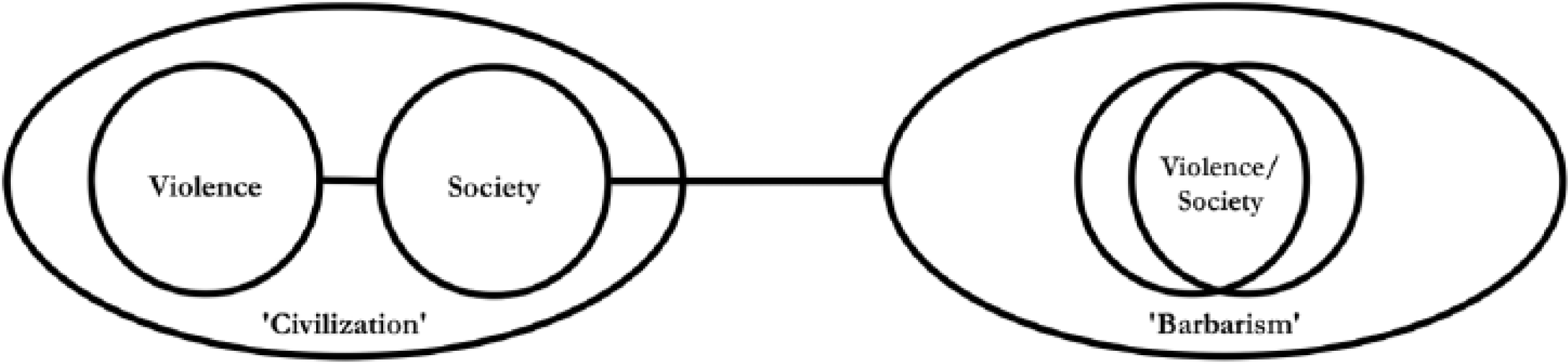
The purification of the civilized–barbarian ‘great divide’.
Supplementing this replacement of individual pathology (bad apples) with institutional pathology (bad systems) is, then, what we can term the Schmittian purification, which relates to the idiom of exceptionalism and political emergency that has frequently justified torture post-9/11. While this discourse acknowledges the capacity of the ‘civilized’ to enact violence in ‘emergency’ settings, it simultaneously places blame for that violence upon the shoulders of the ‘barbarian’. Take, for example, these remarks from Cable News Network (CNN) after the revelations of torture at Abu Ghraib: ‘But, you know, many Americans say that we haven’t heard any apologies, really, from the Arab world for 9/11 or for the torture of Americans in Iraq’ (CNN, 2004). In other words, the ‘civilized’ torture only when forced spatially into the presence of the barbarian Other who has animated the Schmittian exception. As Foucault (1979: 195) put it: ‘there can be no barbarian unless an island of civilisation exists somewhere’ and ‘unless he fights it’ so as to absolve the ‘civilized’ of blame. It was by this logic that Israel justified its legalized ‘moderate’ torture of Palestinians accused of themselves having constructed a barbaric stage of emergency (Ron, 1997). Taken together, these two particularly powerful purifications ensure that torture is always a ‘shock’ (despite its repeated ‘civilized’ perpetration) by forestalling engagement with the idea that atrocity is an intrinsic, and unexceptional, potentiality in every society (Austin, forthcoming). Torture is always purified, in one way or another, as the work of the Other, while the ‘civilized’ embrace it only reluctantly, prosaically, never for terroristic purposes, but only ever with pragmatic restraint.
As the intervention of CNN attests to, the mass media is central to the dissemination of these purified narratives. This is true across democratic–autocratic binaries. Argentina, for instance, coerced the domestic press corps to craft an image of its being engaged in an externally imposed (i.e. barbarian-imposed, as per the Schmittian purification) existential war against (communist) terrorism, while also launching extensive international media campaigns during events like the 1978 World Cup, mentioned previously (Knudson, 1997; Samples, 2010). These campaigns sought to counteract, particularly, pressure from human rights groups. Although those groups were in their infancy at that time, Argentina and other states in the Southern cone were the foci of many early efforts, including a 1976 campaign by Amnesty International to ‘educate journalists preparing to cover the World Cup about the Videla regime with the slogan “Football yes, torture no”’ (Smith, 2002: 72, emphasis added). Likewise, the US has sought to utilize the media to craft an image of its violence as prosaic, exceptional, humane and, ultimately, ‘civilized’. For instance, at Guantanamo Bay, the military has presented the camp to media tours as ‘safe, humane, legal, [and] transparent’ through the presentation of material objects like library books, backgammon boards and religious items that sanitize its violence (Van Veeran, 2014: 28). It is clear, however, that media influence can only go so far in civilizing the spectacle of dead bodies. To return to the earlier discussion of public secrets, the capacity to keep such secrets — with or without the help of the media — rests to an important degree on the capacity to control the appearance of material symbols of violence. Inequalities in material-semiotic networks that enable or disenable the hiding of bodies (from the media) thus remain key. The Argentine efforts to purify their violence were hampered by the simple fact that the bodies of their victims — mutilated, violated and dead — could not help but frequently reappear. The role of the media can thus never be seen solely through the lens of semiotics (the manipulation of ‘purified’ symbols of barbarism or civilization alone), but, instead, as also itself being fundamentally materially-semiotically embedded in society.
Purifications, to conclude, sustain what Latour (1993: 99) termed a Great Divide between the ‘civilized’ and the ‘barbarian’ such that ‘whatever we do, however criminal, however imperialistic we may be’, we are able to remain, somehow, civilized. Any instances of ‘civilized’ atrocity become simply those psychoanalytical ‘intrusions of horror’ in which reality is experienced ‘in unreal or distorted’ Schmittian ways rather than reflecting the deep embedding of the ‘democratic’ or the ‘civilized’ in violent practices. The importance of these mechanisms of disassociation cannot be overstated for, as a US interrogator who tortured prisoners in Iraq put it, ‘we fear most not what evil will do to our bodies, but what it will do to our orderly, civilised worldview’ (Lagouranis, 2007: 128). Purifying torture around socio-political binaries, literally or metaphorically, saves the ‘civilized’ soul. The central importance of the material-semiotics of ANT lies, then, in unmasking the material construction of world political binaries so as to mangle the purification of such dualisms and stress that we have only ever been ‘civilized’ in a constructed, contingent and material sense but have never been civilized in a ‘pure’ ontological sense. Political violences like torture are, as John Law (Law et al., 2013: 173) has put it, both–and phenomena: both restrained and violent, both material and ideational, both civilized and barbarian.
The great divides of world politics
This article has argued that world political binaries are materially, as well as ideationally, constructed. Drawing on the method of ANT, the importance of materiality was stressed through a microsociological reconstruction of the violent practices of torture. It was demonstrated that objects like airplanes, drugs or military bases can sometimes unpredictably influence the form that violence takes. In turn, the agentic capacity of material objects was suggested to sometimes be more important than human (individual or institutional) intentionality and/or subjective motivation in crafting violent actions across civilized–barbarian or democratic–autocratic binaries. The article thus demonstrated how the ways in which violence has been ‘civilized’ in certain advanced ‘democratic’ states remain deeply fragile in their dependence on material apparatuses whose disappearance might see a swift reversion or ‘oscillation’ (Austin, forthcoming) to being seen in precisely the same terms as ‘barbaric’ violences. This disquieting story of violence compels us to consider, finally, how if we have never been civilized:
The tortuous relations that we have maintained with the other nature-cultures … [must] also be transformed. Relativism, domination, imperialism, false consciousness, syncretism — all the problems that anthropologists summarize under the loose expression of ‘Great Divide’ … [must] be explained differently. (Latour, 1993: 11–12)
The ‘great divide’ between the ‘authoritarian’ and the ‘democratic’ is cast in a radically new light when the ideational content of those signifiers is shown to have reduced effects on the format of violence than is usually presumed. This suggestion has, of course, substantive ethico-political implications and the contingency of the materialist explanation offered here will ‘certainly [be] disappointing to those driven by the will to purity’ underlying socio-political binaries (Law et al., 2013: 189). The value-added of ANT’s application to phenomena like political violence lies precisely, however, in the way in which it thus erases neat ideational attributions of ‘goods’ and ‘bads’. By considering the concrete construction of socio-political binaries, we move closer not simply to a deconstruction of domination, imperialism and false consciousness, but, instead, to better reconciling the persistent ‘great divides’ of world politics.
Footnotes
Acknowledgements
For comments, critiques and encouragement, the author would like to thank the editors and anonymous reviewers of EJIR, as well as the audience and participants of a panel at which an earlier version of this article was presented during the 2013 Millennium Conference. Especial gratitude for their help throughout the development of the ideas contained within this article is due to Keith Krause, Anna Leander, Riccardo Bocco, David Sylvan and Stéphanie Perazzone.
Funding
The research underlying this article was supported by Swiss National Science Foundation grant number P0GEP1_155423.