







Abstract
Immersed in the flow of activities, diplomats and other international practitioners are simultaneously influenced by past experiences and constantly innovating in response to situations that are never exactly the same. The conceptual tools of International Relations scholars must be capable of capturing this practical reality. To that end, I introduce in this article a relational approach to agency that can make sense of practitioners’ innovative ways of doing things in practice. Practice theorists in IR often emphasize hierarchies, struggle, and the role of habitus in shaping practices. Both building on and departing from them, I dig into the logic of practical sense and discuss Pierre Bourdieu’s concepts of regulated improvisations, virtuosos/amateurs, and illusio to grasp agency in practice. I develop the idea that international actors are primarily practical and put improvisations and virtuosity — rather than rationality, cognitive processes, emotions, norm-compliance, path-dependency or even habits/habitus — in the foreground. I contend that this approach holds broader promise for the analysis of international politics than existing conceptions. We have much to gain by focusing on how international practitioners in their local contexts actually improvise in the moment. These improvisations in specific sites are constitutive of the ‘big picture’ of international politics. I take diplomatic practices in embassies and in permanent representations as an illustration.
Keywords
Introduction
International Relations (IR) scholars have yet to make the most of the practice turn. As one leading practice theorist laments, most scholars ‘have tended to read the structuralism side of Bourdieu, creat[ing] the problem that change and contingency of any social order fall easily out of sight’ (Adler-Nissen, 2012: 14). As a consequence, ‘there is the risk of losing the main advantages of the recent “turn to practice” in IR’ (Adler-Nissen, 2012: 14). We must further explore the idea that diplomacy practitioners perform specific practices and not general ones (Hansen, 2011). To that end, I develop here an agential and relational reading of practice theory to assist in developing novel ways for studying agency in IR.
The study of practices starts from a simple intuition: social realities — and international politics — are constituted by human beings acting in and on the world. Ways and manners of doing things delineate the practices that enact and give meaning to the world. As Andersen and Neumann (2012: 468) explain, ‘One can look at states, organisations, wars, social movements, class or even personhood as practices’. International practice theory (IPT) scales analysis down to this basic feature of politics — that is, practices — treating them as a basic ontology of international politics. Indeed, ‘by focusing on what practitioners do, [practice theorists] zoom in on the quotidian unfolding of international life and analyze the ongoing accomplishments that, put together, constitute the “big picture” of world politics’ (Adler and Pouliot, 2011: 1). Through this lens, the concerns of other IR approaches — war, peace, negotiations, states, diplomacy, international organizations, and so on — are bundles of individual and collective practices woven together and producing specific outcomes.
This approach delineates a promising research agenda for IR. As some (Adler-Nissen, 2015; Sharp, 2009) have pointed out, IR scholars often produce pictures of the world in which practitioners hardly recognize themselves. By studying stable phenomena, focusing on fixed objects, and usually approaching international politics retroactively, they tend to eliminate agency itself, however unintentionally (Jackson, 2003). Adopting a bird’s-eye perspective on international politics, they consider agential improvisations in situational context to be merely anecdotal or epiphenomenal. Only recently have some scholars begun to focus on hitherto underexplored diplomatic practices (Adler-Nissen, 2012, 2014; Adler-Nissen and Pouliot, 2014; Neumann, 2012; Pouliot, 2010; Pouliot and Cornut, 2015; Sending et al., 2015). Rather than a bird’s-eye perspective, practice ‘invokes the gerund form, the flow or movement of something being done — that is, X-ing’ (Pouliot and Cornut, 2017: 187). These efforts are gaining steam in the discipline, but the practical knowledge on which international politics and diplomacy depend remain poorly understood (Pouliot, 2016a). What international practitioners do is both contingent on the situations they face and path-dependent, and, as researchers, we lack a way to simultaneously grasp both of these tendencies.
A novel conceptualization of agential processes in IR is necessary in order to make up for the shortcomings of the individualistic, objectivist, and materialist approaches that dominate IR. In practice, agents are rarely driven by the calculation of expected returns from alternative choices, as many rationalist scholars contend. When ‘confronted with practical problems that they must urgently solve’, practitioners cannot carefully consider each possibility; ‘in the heat of practice, hunches take precedence over rational calculations’ (Pouliot, 2008: 261). Rationalists’ views on agency tend to conflate the practical modus operandi with one that has been reconstructed, passing off ‘the things of logics as the logics of things’ (Bourdieu, 1990b: 61).
To delineate a novel approach to agency in practice, I build on a discussion of Bourdieu’s concepts of regulated improvisation, virtuosos/amateurs, and illusio. In this framework, to be an international practitioner is to improvise international practices. Individuals may be more or less virtuosic depending on the extent to which they can improvise the right thing (with ‘rightness’ defined not in a moral or normative sense, but in a practical one) at the right moment (Bourdieu, 1990a: 107). As more or less virtuosic agents adjust improvisational practices, new ways of doing emerge that lead to minor adjustments of past practices, but also — incrementally — to major ruptures (Bueger, 2014: 391). Yet, this article is not about change. While it is common to conflate change with agency and link structure with continuity, I show here that there is agency even in what may look like an (agentless) repetition of existing practices. In the framework developed, there is constant improvisation because agents are never placed twice in the same situation. An analysis of change requires a different theoretical discussion.
This study is grounded in an instrumentalist and pragmatic approach to conceptual development in which what matters most is a concept’s heuristic utility (Kustermans, 2016). For those who contend that Bourdieu’s analysis of social phenomena is more structuralist than IR practice theorists admit (e.g. Hopf, 2010: 545), this approach will appear to further accentuate a departure from Bourdieu’s original thinking. Yet, as I will clarify later, practice theory is a theory of agency. Bourdieu himself made this point repeatedly, writing that he was ‘guided by the desire to reintroduce the agent’s practice, his or her capacity for invention and improvisation’ (Bourdieu, 1990b: 13). 1 Even if it often slips from view because scholars, including Bourdieu himself, tend to emphasize the structural side of his conceptual framework, the habitus that generates practices is a ‘system of lasting, transposable dispositions’ that makes ‘possible the achievement of infinitely diversified tasks’ (Bourdieu, 1977: 83, emphases added) (see Figure 1). Building on Bourdieu’s work but also on that of several sympathetic critics (Bouveresse, 1999; Fligstein, 2001; King, 2000; Sewell, 1992), I focus on this aspect of Bourdieu’s thought on practice and center my analysis around agential creativity. While this interpretation has already made its way to other social sciences (Ahearn, 2001; Crossley, 2001; Gorski, 2013; Harker, 1984; Lau, 2004; McNay, 2004; Ratner, 2000; Schiltz, 1982), it has yet to fully enter IR.
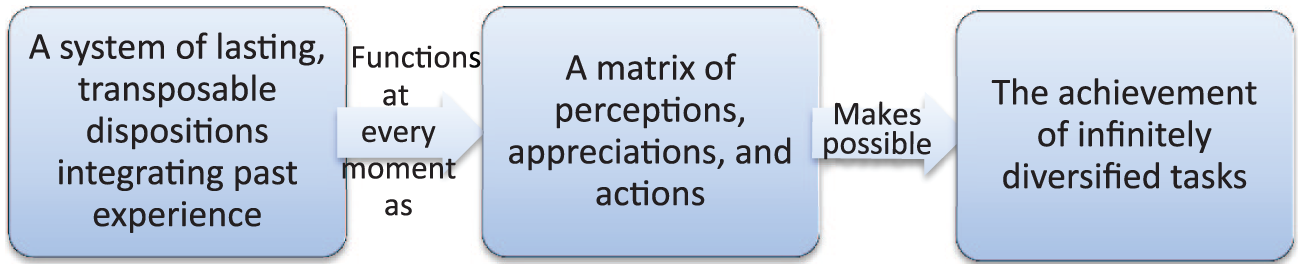
The definition of habitus by Bourdieu.
The article’s first section discusses agency in practice theory. The second develops an approach for studying agency through illusio, virtuosity, and regulated improvisations. The third explains that IR scholars would be well-served by focusing on how international practitioners improvise, taking diplomatic practices in embassies and in permanent representations as an illustration.
Agency in practice theory
Practice theory and its critics
Bourdieu’s approach to agency centers around what he calls habitus. Habitus corresponds to agents’ incorporated ways of doing things, shaping practices that, in turn, produce, reproduce, and change the habitus. In this framework, agency derives its meaning and function from social structure, while agents are embedded in relational contexts that shape their practices. Like the infinite number of points that make up a line segment in geometry, practices are both infinitely diversified and bound by culture and past experiences. On the one hand, practice ‘cannot be reduced to either habitus or through habitus to objective structures, since [specific] historical circumstances play their part in its generation’; on the other, it cannot ‘be reduced to specific historical circumstances or forces, since the perception of these is filtered through the habitus’ (Harker, 1984: 121). In the end, ‘we are left with practice as a dialectical production, formulated anew each time through the cycle’ (Harker, 1984: 121).
Despite its connotations, structure is dynamic and agents are creative in its production. Even ‘the more or less perfect reproduction of structures is a profoundly temporal process that requires resourceful and innovative human conduct’ (Sewell, 1992: 27). This is a dynamic process. Think, for example, of language. Speakers are ‘constrained to some degree by the grammatical structures of their particular language, but they are still capable of producing an infinite number of grammatically well-formed utterances within those constraints’ (Ahearn, 2001: 120). In turn, these utterances change the grammatical structures over the long term. Figure 1 illustrates the link between structures, habitus, and practices.
This approach to agency has been criticized on several accounts. Some see an unresolved tension between Bourdieu’s emphasis on the creative dimension in human practices and the habitualized and socially directed character of social action (Honneth et al., 1986: 42). In suggesting that agents are both determined and reasoning, Bourdieu would produce an incoherent conceptual framework (Brubaker, 1985: 752). For rationalist scholars, the habitus is a theoretical contradiction that fails in its attempt to grasp both non-rational habitus-driven practices and objective-oriented rational motivations (Alexander, 1995: 153). For critical realists and pragmatists, this conceptual framework is incoherent because it does not relinquish the dualistic terms it wishes to transcend. As a result, the location of agency and its causal power are unclear (Farnell, 2000; Margolis, 1999).
Critics also question the absence of reflection and learning in practical agency, leaving no room for subversion, resistance, or ambiguities. For them, Bourdieu’s theory ‘has fallen victim to an impossibly objectified and over totalized conception of society’, where actions inconsistent with the reproduction of social structures never occur (Sewell, 1992: 15). The habitus is seen as an all-encompassing concept, committing individuals to the logic of their field with little or no possibility for them to reason, reflect, and oppose dominant logic (Ahearn, 2001: 118; Bohman, 1999; Bourdieu and Eagleton, 1992: 114–115; Giroux, 1983; Kögler, 1997: 150–151; Shiach, 1993: 218). It tends to reify past experiences, and fails to account for the possibility of improvement, learning, and change (Jenkins, 1982; Noble and Watkins, 2003; Shiach, 1993; Sewell, 1992: 15). For DiMaggio, it is not clear where the habitus comes from and may change over time. For him, ‘the stability and plasticity of personality is one about which Bourdieu has little concrete to say’ (DiMaggio, 1979: 1467–1468). For Elder-Vass (2007), there is no place for conscious deliberation and reflexivity in the production of practices.
IR critics of IPT build on these analyses and similarly take issue with the implicitly structuralist bent of the approaches to agency taken by many international practice theorists. As the latter tend to focus more on habitual dispositions rather than agents’ capacity to improvise, they are criticized for being overly deterministic and tending to reify social realities (Goddard, 2009; Holmes and Traven, 2015: 415). Others charge that practice theorists leave unanswered the question of how change occurs (Schindler and Wille, 2015) because their frameworks exclude the possibility of agents’ being reflexive about their own practice (Schmidt, 2014), or because they fail to take incompetent practices seriously (Duvall and Chowdhury, 2011). Bially Mattern (2011: 72) considers that practice theory does not offer a theoretical account of how agency in repetition is possible. To Ringmar (2014; also see Kratochwil, 2011), it remains unclear how practice theory bridges ontological dichotomies between change and continuity, body and mind, and agents and structures.
Advancing practice theory in IR
Some of these criticisms are unwarranted. While true that many practice theorists emphasize structure, they can still grasp the agential logics that some critics find lacking. Inspired by claims about the co-constitution of agency and structure long proffered by constructivists, the logic of practice grasps both shared structures of meaning within social fields and agents’ individualized practical senses (Adler and Pouliot, 2011: 16; Bigo, 2011: 236; Brown, 2012: 444; Bueger and Gadinger, 2014: 3). The habitus overcomes the agent–structure dichotomy and transcends the opposition between change and continuity (Jackson, 2009: 105–107). Practice theorists are explicit: ‘Practices are intimately related to subjects who are not passive performers of discursive scripts or texts, but are active agents of both stabilization and change’ (Adler and Pouliot, 2011: 23). Agency and ‘the enactment of practice’ are ‘what makes social reality possible in the first place’ (Pouliot, 2010: 20). It is this that differentiates habitus from mere habits — while habits are iterative, habitus is both iterative and generative (Pouliot, 2008). As a consequence, practice theory in IR makes ‘much greater room for individual psychologies and improvisations’ than is usually suggested (Leander, 2011: 300).
Nonetheless, there remains room for clarification about agency in IPT. My focus on improvisation aims to clarify two aspects in particular. First, it allows a deeper exploration of the connection between habitus and practices. I uncover the inarticulate agential processes from which innovations in practice emerge, focusing on unreflexive logics of action stemming from agents’ ‘know-how’, ‘sense of place’, and ‘feel for the game’ (Pouliot, 2008). I dig into the micro-logics of practical sense and clarify the workings of a logic of improvisation over existing practices.
This complements Pouliot’s (2016a, 2016b) exploration of the mundane socio-processes that constitute multilateral negotiations. His compelling analysis of diplomatic know-how, practical mastery, and competent performances in international organizations provides a unique understanding of agency in practice, and my discussion in the following builds on this analysis. Nonetheless, his approach tends to overlook the creative elements involved in exerting practical competence at every moment. The emphasis is on the social construction of interaction orders as he shows that these orders emerge as diplomats construct the world in which they live in and through practice. The implications for agential improvisation are mentioned in his analysis, but remain secondary. Competent performance is not only a question of knowing informal rules, or even knowing how to use those rules (Pouliot, 2016a: 59). I am interested here in how these informal rules are applied creatively given that there ‘is no rule, however precise and explicit … that can provide for all the possible conditions of its execution and which does not, therefore, inevitably leave some degree of play or scope for interpretation’ (Bourdieu, 2000: 162). Practices are not only ways of doing, but also ways of improvising. Putting improvisations and virtuosity at the center of the analysis of practices is another step in the direction of grasping better practitioners’ modus operandi.
Second, I move away from a reading that emphasizes hierarchies and conflict. In the readings of practice theory adopted in IR, fields of practice are defined by the power relationships between dominating and dominated. Members struggling from inequitable positions have conflicting interests and the capital that they possess differs in both nature (i.e. social, economic, cultural, symbolic) and amount. For Pouliot (2008: 275), ‘the control of a variety of historically constructed capitals … defines the structure of power relations in the field and the positions that result’. Abrahamsen and Williams (2011: 313) find social fields to be ‘characterized by both struggles over the distribution of currently recognized forms of capital and by struggles to change the social relationship by changing the structures of valorization within the field’. The dominated most often abide by the rules of the game — practice turners call this acquiescence ‘symbolic domination’ — but they may also attempt to subvert the field by changing or challenging its rules (Eagleton-Pierce, 2013). As Bueger and Gadinger (2014: 28) put it, ‘due to the explicit focus on domination, power, and hierarchies’, the impression is ‘that practice is always embedded in power struggles’. Under this approach, agents jockey for positions in hierarchical orders. What they do and how they do it tends to either reproduce or undermine this hierarchy. Agents use their mastery of the rules of social games to either undermine the domination of others or to secure their own. The central question in such an approach is who will prevail.
However, social relations are not necessarily hierarchical. Bourdieu emphasized struggle and hierarchies on account of the Marxist influences on his thought (DiMaggio, 1979: 1469–1470), 2 but many elements of sociality and exchange between agents are not a constant struggle for domination. Surely, some fields are more hierarchical than others (Sewell, 1992: 22–26). However, first and foremost, social life is made up of practical and negotiated interactions between agents. As habitus is usually treated as an individual’s incorporation of hierarchical structures, the consistent emphasis on the concept has narrowed practice theory’s conception of relationality. Yet, agents might just as easily cooperate, pool resources, and join forces rather than compete — agents relate to one another in all kinds of ways and create communities of practice along any number of interactive lines (Adler, 2008; Wenger, 1998). Agency is the ability to coordinate one’s actions with, as much as against, others (Fligstein, 2001; Friedland, 2009). Even in diplomacy, with fundamental power differences between states, the social world of diplomats is constituted by and through complex relationalities that occur in a variety of sites and settings (Faizullaev, 2006; Neumann, 2012). There are power differences among diplomats and between them and other actors, and, as will be clarified later, some diplomats are more skilled than others, but what they do most of the time goes beyond merely reproducing or undermining social hierarchies.
In the interactional approach developed here, relationality is seen to shape agents’ improvisations but their practical sense is not necessarily oriented towards reproducing or undermining social hierarchies. Many practice theorists acknowledge the variety of relationalities entailed by social life but stick nonetheless to a primarily hierarchical conceptualization. This exposes a flank to those critics that miss practice theory’s main arguments about agency, structure, and practices. I see no reason to privilege vertical relationality. Interactions, rather than hierarchies, structure practices. The focus shifts from how agents comply with, reproduce, or challenge domination to how they improvise in the course of their interactions.
A relational approach to agency
In spite of their differences, both rationalism and cognitivism consider agency to be wielded by humans as atomistic, isolated, units. For rationalists, the origins of agents’ choices reside in rational calculation. Individuals act on their environment, but all that is required for agency itself is a self-interested agent balancing available options and strategizing in pursuit of exogenously determined ends. Being an agent means making calculations. For cognitivists, agents are similarly driven by emotional or cognitive processes in their mind. They interpret an ‘outside’ world according to their internal mental dispositions and feelings and act accordingly. While they may open the rationalist black box of the human brain to explain the frequent departures from ‘rational’ behaviour, they nonetheless share with rationalists an individualistic conception of agency.
Understandably, many consider rationalism and cognitivism to be complementary. Rationalists generally consider rationality to be ‘bounded’ by cognitive biases, available information, and time (Allison, 1971; Bendor, 2010; Lupia et al., 2000; Simon, 2000). Reciprocally, many cognitivists identify the various ways through which emotions or affects influence rational calculus and perceptions (De Sousa, 1990; Hall and Ross, 2015; Holmes and Traven, 2015; Mercer, 2005). Some cognitivists subsume rationality into psychology, considering it to be a dispositional attribute. In this approach, rational behaviour characterizes certain individuals who possess a specific pro-self psychology and display a willingness to think that allows them to act strategically (Rathbun et al., 2017). This rapprochement is also methodological. These approaches maintain that it is possible to isolate agents, allowing for research based on experimental design and scenario-based questionnaires in the laboratory.
As they ‘confuse the actor’s point of view with the spectator’s point of view’ and adopt the latter to grasp the former (Bourdieu, 1990a: 82), rationalism and cognitivism both exhibit a ‘representational bias’ (Pouliot, 2010: 15) and an ‘intellectualist view’ (Wagenaar, 2004: 649). As a consequence, they objectify the subject while suspending ‘the demands of the situation, the constraints of economic and social necessity, and the urgencies it imposes or the ends it proposes’ (Bourdieu, 2000: 12). Agency itself fades away: Once one forgets all that is implied in extracting from the product the principles of its production, from the opus operatum the modus operandi, one condemns oneself to proceed as if the regular product had been produced in accordance with the rules. (Bourdieu, 1977: 36)
The implications are as methodological as they are political. Experiments and surveys by questionnaire often produce ‘laboratory artifacts’ which ‘stand in the same relation to reactions in real situations as folklorized rites, performed for the benefit of tourists (or anthropologists), to the rites imposed by the imperatives of a living tradition or the urgency of a critical situation’ (Bourdieu, 1990a: 294). Equally problematic, rationalism and cognitivism tend to mystify social realities, universalizing ethnocentric conceptions of agency with a false sense of equality, democracy, and fulfillment (Ratner, 2000: 429).
Agency is relational and should be analyzed as such (Ahearn, 2001; Emirbayer, 1997). Take, for instance, preferences and judgements: notions central to both rationalism and cognitivism. As Bourdieu (1984) explains in La distinction, how one feels about food, works of art, clothes, style, music, restaurants, entertainment, people, and so on does not depend on any objective and abstract characteristic of any of these things — nor individual and subjective specificities or a specific natural taste and preference — but rather on the webs of relations in which these preference-holding and judging individuals are enmeshed (see Shiach, 1993: 216–217). Agents are embedded in networks of relations that define their resources, purpose, and capacity to act (Sewell, 1992: 21). This suggests a contextual, interactional, and processual definition of agency in which it only exists in and through practical involvement in webs of relations.
The same is true of agency in international politics. Individual preferences ‘acquired by individuals through complex engagements with objects and others in the world’ are intrinsically relational (Bially Mattern, 2011: 66). Constructivist scholars have already highlighted the problems involved with studying agency separately from the social contexts that inform it (McCourt, 2016; Wendt, 1987). Against substantialism, this approach characterizes agency by the relationships that unite agents with their peers in a social structure (Adler-Nissen, 2015; Jackson and Nexon, 1999; Nexon, 2009; Wagenaar, 2004).
To say that rationalism is an acceptable simplification of more complex processes (Barkin, 2015; Bueno de Mesquita, 2013; Lake and Powell, 1999; MacDonald, 2003), or that it provides an insider’s view on agency while practice theorists adopt an outsider’s approach (Ringmar, 2014: 12), misses the point. Claiming relational agency is also different from claims by some social psychologists or neuro-psychologists: that individual emotions can be transposed to a social and collective level (Crawford, 2014; Hall and Ross, 2015; Hutchison and Bleiker, 2014; Mercer, 2014); that emotions can be shared and collective along the lines of what McDermott (2015: 559), borrowing from Freud, calls ‘mass hysteria’; or that mirror neurons connect individuals by simulating others’ intentions (Holmes, 2013). 3 In a relationalist perspective, ‘Agency emerges from being human, where being human, rather than an innate condition, is itself a practical activity’ (Bially Mattern, 2011: 73). This relationalism digs deep into agency at the definitional level.
Agency in practice
As logic of action, agency in practice does not easily lend itself to empirical investigation. As improvisational agents cope with specific problems innovatively, any universal model or a typology for their innovations is akin to ‘what an etiquette handbook is to the art of living or a harmony treatise to musical composition’ (Bourdieu, 1977: 11) — that is, an impoverished reproduction overshadowing the very creativity of human agency that it aspires to describe. I contend here that Bourdieu’s conceptual triad of regulated improvisations, illusio, and amateurs/virtuosos can help scholars to better grasp agency in practice. This section discusses each of these concepts.
In a nutshell, agents’ illusio corresponds to their unreflexive commitment to the game. It filters what is important from what is irrelevant, unimportant, or uninteresting. It makes sense of everything they do regarding their game. Agents take part in this illusio creatively through regulated improvisations, playing with their relations, and improvising tentative and provisional solutions to cope with the practical problems they face. They improvise unarticulated strategies without conscious strategizing or reflection. The most experienced among them — virtuosos — have an ability to anticipate and improvise with success new ways of doing things in changing circumstances. On the contrary, strict imitation or the unimaginative application of previously established codes of conduct are characteristics of the amateurs or newcomers unable to take part in the illusio of their field.
Regulated improvisations
The habitus generates infinitely varied practices through improvisations. Agents have ‘a permanent capacity for invention’ (Bourdieu, 1990b: 63) as they apply rules, norms, and codes of conduct in ways that cannot be determined in advance. They are endowed with an ability to improvise new ways of doing things, using norms, techniques, words, and knowledge as it comes unreflexively to them given the specific context of their practice. It is from this ability to apply existing schemas to new contexts that improvisations arise (Sewell, 1992: 20). This is an ars inveniendi, an art of invention (Bourdieu and Wacquant, 1992: 122; Mérand, 2010) that presupposes a continuous creation (Bourdieu, 1990a: 105).
Improvisations become especially visible in extraordinary circumstances because of a more pronounced need to adapt, but agents improvise in any and all of their activities (Bouveresse, 1999: 55–56). The ‘most ordinary and even the seemingly most routine exchanges of ordinary life … presuppose an improvisation’ (Bourdieu, 1990a: 99). In his study of administrative work, Wagenaar (2004: 651) showed that routines are an optical illusion because ‘at an experiential level it can best be described as an active, ongoing orientation in a shared world’. An agent ‘creates a fresh script nearly always and continually’ (Margolis, 1999: 69). From this perspective, apparent repetition results from the reactive improvisations that come naturally to agents embedded in quasi-similar social contexts.
Agents are both determined and creative in this approach. Practitioners constantly face new situations, instinctively apply previously elaborated schemes of actions to these new conditions, and instantaneously change them. These improvisations are not pure inventions and Bourdieu excludes the possibility of entirely novel practices. Improvisations are ‘regulated’ and ‘within limits’ (Bourdieu, 1977: 96–158). As the incorporation of socially induced mental dispositions that generates practices, the habitus allows variations within socially determined patterns.
Segmenting improvisations into two different but simultaneous sub-processes makes this point clearer. In each situation, practitioners first recognize similarities with situations that they have experienced previously, and spontaneously adopt the same attitude in these two similar situations. In Bourdieu’s (1977: 83) words, there are ‘analogical transfers of schemes permitting the solution of similarly shaped problems’ as ‘the ars inveniendi is an ars combinatoria’ (Bourdieu, 1990a: 100). Such a transposition of past schemes into present situations has already been noticed by several practice theorists in IR. They show how ‘the past is actualized into the present’, bringing ‘path dependency in social action, for revisions take place on the basis of prior dispositions’ (Pouliot, 2008: 273). They call this process — in which previously appropriate categories of perception and judgement are applied to a new state of affairs — by the name given to it by Bourdieu: ‘hysteresis’ (Bourdieu, 1984; Neumann and Pouliot, 2011; Schindler and Wille, 2015). A fixation on hysteresis can explain why practice theory is sometimes felt to overemphasize continuity and structure over change and agency.
Attitudes that may have been appropriate in the past will not be perfectly adapted to the new situation because past and present situations are never exactly the same. The timing, the context, the people involved or any other practical aspect are always changing. Even what may appear as the most predictable action is, in practice, undertaken under conditions of uncertainty about its consequences and outcome (Bourdieu, 1990a: 98–99). Ambiguity, unpredictability, and uncertainty dominate and an unarticulated process of trial and error is at work. Agents anticipate that ill-adapted practices will incur negative sanctions, creating incentives for them to adapt instantaneously in the present. Bourdieu (1977: 83) describes this second process as ‘the unceasing corrections of the results obtained, dialectically produced by those results’. Skilled practitioners adjust their practices through quick correction of mistakes. As practical sense works through missteps, depending on an agent’s virtuosity (more on this later), there ‘are slips, mistakes and moments of clumsiness to be observed’ (Bourdieu, 1990a: 107). In these incremental changes, improvising agents fumble while adapted and ill-adapted practices intertwine.
These two sub-processes are closely related. They are not successive steps in the process of adaptation of practices, but dialectical moves occurring simultaneously in the lived experience of practitioners. Practical sense appreciates a situation and produces the optimal response instantly. It is anticipatory as improvisations are based on anticipations of tendencies and regularities. The upcoming is immediately present without any objectifying distance (Bourdieu, 2000: 142). This inscribes the imminent future in the immediacy of the present, like a tennis player anticipating where the ball will be placed and placing herself in a position to return (Bourdieu, 2000: 208–213; Bourdieu and Wacquant, 1992: 138). Skilled agents correct their mistakes at once, like musicians or athletes: ‘the improvisations of the pianist or the so-called freestyle figures of the gymnast’ cause them to ‘evaluate instantly the action or posture just produced and to correct a wrong position of the body, to recover an imperfect movement’ (Bourdieu, 2000: 162). This is a form of ‘practical reflection’, that is, ‘the reflection in situation and in action’ (Bourdieu, 2000: 162) and a mastery ‘functioning with the automatic reliability of an instinct’ (Bourdieu, 1990a: 104).
Illusio and strategies
Bourdieu coined the term illusio to describe the purpose of improvising agents. It is the ‘fundamental belief in the interest of the game and the value of the stakes’ (Bourdieu, 2000: 11). It corresponds to the common denominator of all participants involved in a specific practice. Participants in social games believe them to be important, that they must pursue them, that it is what they are expected to do to such a point that it may even become a matter of life and death. This commitment serves to filter between what seems important and what seems irrelevant. Every field has its respective illusio: monetary profits in the economic field, the value of artistic creation in the artistic field, national interests in the field of international relations, the academy’s pursuit of knowledge, and so on (Bourdieu and Wacquant, 1992: 117).
The illusio is unreflexive and taken for granted as agents are ‘caught up in and by the game’ (Bourdieu, 1998: 76). Practitioners ‘aim at certain ends without posing them as such’: [they] are present at the coming moment, the doing, the deed … the immediate correlate of practice … which is not posed as an object of thought, as a possible aimed for in a project, but which is inscribed in the present of the game. (Bourdieu, 1998: 80)
Completely invested and immersed in their activities, they have ‘enchanted relations’ to social games (Bourdieu, 1998: 77). Effective practices often presuppose this total and routine adherence.
The illusio arises from a reflex-like impulse in which strategies are improvised without reflective strategizing. Strategies are ‘objectively oriented lines of action which social agents continually construct in and through practice’ (Bourdieu and Wacquant, 1992: 129). For instance, in his analysis of gifting in traditional Kabyl society, Bourdieu (1977: 7) shows that one can play with time by ‘exploiting the possibilities offered by manipulation of the tempo of the action — holding back or putting off, maintaining suspense or expectation, or on the other hand, hurrying, hustling, [and] surprising’. Other strategies depend less on timing than on the substance of relations — one can play strategically with friendship or family ties. Some may engage with certain players and not others, such as a specific person among a network or a particularly prominent figure. In the artistic field, one needs to be ‘at the heart of the “milieu”, where the information circulates’ and ‘where relationships are forged and protection is acquired’ (Bourdieu, 1996: 227). Bourdieu also highlighted ‘officializing strategies’ (Bourdieu, 1977: 38–43), through which agents can change the rules for other actors through means like introducing new criteria of validity or new concepts and methods.
Strategies should not be understood in a rationalist sense, or as the result of a conscious calculation (Swartz, 2012: 98–100). This does not rule out the possibility of such calculations, but rather limits it to specific situations in determinate fields (Bourdieu, 2000: 63–64). Some agents may need to rely on rational calculus to take part in the illusio of their field — chess players or poker players do need to rationally balance their options. Yet, as Crossley explains, there is no fundamental difference between football players and poker players — even if the latter makes rational calculations — because both are driven by their feel for the game: The competent poker player is no less situated, pre-reflectively, within the arbitrary traditions of their game than the footballer.… All [poker players’ strategies are] necessarily contained in and constructed through a habitually based pre-understanding of the game being played. The game is taken for granted, affecting every slight gesture of the player without ever once becoming an object of thought. For the duration of the game the player is in it, believing in it totally and experiencing its arbitrary, conventional, and narrow limits as the limits of reality and possibility itself. (Crossley, 2001: 90)
There is an important place for critical reflection and debate upon previously unquestioned assumptions in Bourdieu’s analysis (Crossley, 2001: 92–93). In exceptional circumstances, agents might start questioning taken-for-granted beliefs, bringing the heretofore implicit illusio into the sphere of discourse and starting a process of radical change (Bourdieu and Wacquant, 1992: 131). This does not contradict the approach here because humans are primarily agents in their everyday activities and not only when they rise up. As Ahearn (2001: 115) puts it, ‘Agency should not be reduced to [resistance]. Oppositional agency is only one of many forms of agency’. Supporters of the status quo are no less creative than those who contest and oppose the illusio of their field.
Most humans most of the time do what is expected of them without questioning, or even reflecting about, socially accepted aims. Amor fati — the love of one’s fate or ‘love of necessity’ — characterizes most people most of the time (Bourdieu, 2000: 143). 4 All members of a field take part in the illusio of their field, questioning it only in extraordinary circumstances. Participants may stop for a moment to explain their actions in terms of specific principles, their investments may seem absurd to those outside the field, or external observers might identify ‘rational’ behaviour or material side-interests but, most of the time, these are ‘merely post festum rationalizations’ (Bourdieu, 2000: 102). Native theories are often illusory for this reason (Bourdieu, 1990a: 102). This situates the study of improvisations in the camp of those who consider human activities to be shaped by reflex (e.g. Hopf, 2010) rather than reflexivity (e.g. Schmidt, 2014).
This allows further clarification around Bourdieu’s bridge between subjectivism and objectivism (Bouveresse, 1999: 50–51). The illusio is intersubjective — it corresponds to shared beliefs that enrichment, producing works of art, writing scientific articles, promoting national interests, and so on is what matters most — as it is a characteristic of a field, not of any particular individual. It is a product of the network of relations through which it circulates. It is a precondition of the mere existence of the field that has meaning only in relation to others.
Virtuosos and amateurs
Individuals, endowed as they are with practical agency, always improvise. Depending on their practical mastery of social relations, their improvisations are more or less virtuosic. All humans: have some social skill by virtue of their membership in groups. But we know that some actors are more socially skillful in getting others to cooperate, maneuvering around more powerful actors, and generally knowing how to build political coalitions in life. (Fligstein, 2001: 107)
Actors ‘vary in the extent of their control of social relations in the scope of their transformative powers, but all members of society exercise some measure of agency in the conduct of their daily lives’ (Sewell, 1992: 20). Virtuosity is a matter of degree, with amateurs and virtuosos being two extremes of a continuum, and most individuals are situated somewhere in-between. Excellence — ‘practical mastery in its accomplished form’ (Bourdieu, 1990a: 103) — is exceptional, and only a very small number of individuals are able to achieve it; amateurs are more common. Depending on the context and the field of practice, virtuosity may take the form of skilfulness, knack, dexterity, know-how, tact, taste, distinction, mastery, or professionalism.
The most attuned practical agents may become virtuosos. These individuals are masters of social games who instinctively know how to improvise. They intuitively sense how to react to others’ reactions and to improvise amid the improvisations of others. Produced by their incorporation of the immanent necessities of social games, their abilities endow them with an almost perfect sense of what will prove in the future to be the right thing to have done. They instinctively notice tendencies, envision possibilities, and anticipate the effects of present actions. There is no difference between what they do, what they could do, and what they should do. Having ‘an intimate understanding of the object of the game and the kinds of situations it can throw up, they have the practical flexibility to know when and how they should [act]’ (King, 2000: 419). Their practical sense enables them to act as they should, ‘without positing or executing a Kantian “should”, a rule of conduct’ (Bourdieu, 2000: 138). It leads them to constantly feel and foresee ‘“what is to be done” — where, when, how and with whom to do it, given everything that has been done, everything that is done, all those who do it, and where, when, and how they do it’ (Bourdieu, 1996: 165). For instance, Bourdieu described the early 20th-century French artist Marcel Duchamp as ‘the roué painter par excellence’, a ‘virtuoso of the art of playing with all the possibilities offered by the game’ moving ‘in the artistic field like a fish in water’ (Bourdieu, 1996: 244–247).
On the contrary, amateurs do not know how to improvise. They perform practices mechanically, like actors reciting a memorized monologue or amateur artists imitating the works of great masters. Unable to take part in the illusio of their field, they do not intuitively know how to correct their mistakes and change ill-adapted practices. Their imitations may formally fit the situation at hand but demonstrate strict adherence to the rules without contextual adaptation. In doing things ‘by the book’ and strictly following the rules, they are, in fact, played by them. They appear incompetent because they lack relational familiarity with the game and do not know their options. In a study of European Union diplomatic circles, Merje Kuus (2014: 166) shows that virtuosos are those who know how not to follow the rules while beginners are identifiable because they follow them too carefully. She thus turns the constructivist logic of appropriateness on its head: It’s not enough to learn the [social] rules. To use these rules … one has to be able to break them…. Departures from [the rules of the game] are also a part of the game.… It is these departures that signify a true insider.
Many factors can explain where one is located on a continuum of virtuosity. The conversion process of one’s habitus to the requirements of a specific field of practice is ‘a more or less radical process’ that depends on the distance between the original habitus and the practical necessities of the field (Bourdieu, 2000: 11). Virtuosos in one field will often be amateurs in another because of their lack of familiarity with this other field. It is a matter of personal experience with fields of practice; however, structural factors also explain the nature and variety of previous experiences and acquired abilities. As Sewell (1992: 20) explains, ‘Occupancy of different social positions — as defined, for example, by gender, wealth, social prestige, class, ethnicity, occupation, generation, sexual preference, or education — gives people knowledge of different schemas and access to different kinds and amounts of resources’. Mastery of schooling, language, and taste varies among social classes (DiMaggio, 1979: 1465). Structures empower agents differently: depending on where they stand, they will be able to act more or less competently in determinate fields.
Bourdieu identifies different means for the acquisition of practical mastery (Bouveresse, 1999: 51–52; Lau, 2004). The first and most important takes the form of learning by doing. In the course of their activities, agents progressively acquire an unarticulated ability and relational familiarity with their field of practice. This learning process stems from the practice of the game and is ‘practically never set out or imposed in an explicit way’, takes place ‘insensibly, gradually, progressively and imperceptibly’, and ‘passes for the most part unnoticed’ (Bourdieu, 2000: 11). To some extent, agents can also learn through institutional inculcation, training, teaching, and pedagogic actions (Bourdieu, 1984). This mode of acquisition is explicit and gives a central place to the formulation and repetition of social rules. It ‘is one of the major occasions for formulating and converting practical schemes into explicit norms’ (Bourdieu, 1990a: 102–103).
Taken together, the concepts of regulated improvisations, illusio, and virtuosos/amateurs provide an innovative way to study agency in practice and capture practitioners’ modus operandi. The next section illustrates this with the example of diplomats working in embassies and permanent representations.
Diplomats’ improvisations in international politics
There is much to be gained by scaling down analyses to the virtuosic improvisations of practitioners in their local contexts. Ways of improvising things for practitioners on the ground are constitutive of the ‘big picture’ of international politics. The social world is constituted by flesh-and-blood individuals improvising things, and the micro-social is irrevocably linked to macro-politics in any international setting (Sending et al., 2015). When seen through this lens, the improvisations of practitioners in specific sites of practice shape international politics. Negotiating treaties, sitting on the United Nations (UN) Security Council, waging wars, conducting bilateral relations, writing speeches, sending reports, engaging with civil society, and issuing visas are all the activities of improvising agents endowed with practical sense. In each of these contexts, faced with changing circumstances and denied complete information, agents virtuosically adapt their ways of doing to cope with the practical problems they face. They improvise over past practices to do what is expected of them and take part in the illusio of their field. Depending on their level of practical mastery, some international pracitioners will have a better sense of what needs to be done than others.
In practice, when international actors engage with each other, they do so following inarticulate convictions that the things they do are the right things to be doing and the people they meet are the right people to be meeting. They do not consciously balance each of their options and assess the best one, but rather do what, to them, is the obvious thing to do given what is occurring and their social context. When they prioritize some aspects of the practical problems facing them, they are being guided by the illusio of their field. They improvise more or less successfully provisional solutions. There is no conscious strategizing or rule-following in this process.
This further emphasizes the need for scholars to conduct empirical research within the sites where practices are performed — against what Neumann (2002: 628) called ‘armchair analysis’, that is to say, ‘analyses of global politics that are not complemented by different kinds of contextual data from the field, data that may illuminate how foreign policy and global politics are experienced as lived practices’. To that end, practice theorists often conduct semi-directed interviews with practitioners and participant observations. As Bueger and Gadinger (2014: 4) explain, ‘rather than trying to be “objective” and “distant” observers, they ha[ve] to engage with their subject of investigation. This requir[es] not only to observe practices, but also learn and adapt and become active’. This engagement gives scholars an insider view on the field of practice under study, without which they are unable to link improvisational practices with the practical sense from which these practices stem (Pouliot, 2012, 2014).
I illustrate in the following what is gained from an analysis of improvisations in two different diplomatic contexts. Foreign ministries are tasked with promoting the interests of their governments at the international level. Diplomats’ illusio is to take part in that endeavour, which can imply different things in different contexts. I first look at diplomats in embassies, and then at diplomats in permanent representations.
Diplomats’ improvisations in embassies
The illusio of diplomats in embassies is multifaceted. Their task is to report in a manner that adequately informs their own governments about political developments. In their political work, they are expected to promote collaboration and close relations with foreign governments. Western diplomats sent to autocratic countries increasingly promote dialogue with and empower civil societies and non-governmental actors yearning for change. Their practical sense and the improvisations generated by this practical sense make sense because they contribute to this many-sided illusio.
The productivity of bilateral contacts depends on reciprocal trust and friendship, which embassy diplomats are tasked with cultivating. Done effectively, this can ease problems and disagreements in bilateral relationships, facilitate collaboration and cooperation, and enable high-level visits and beneficial access to foreign decision-makers. As such, diplomats are status-quo forces that tend to ally with the strongest political forces and acquiesce to the existing regime. They incline towards stability and the reproduction of intergovernmental order (Constantinou, 2013). They adopt policies of non-interference and prefer the political stability of a friendly country. Their non-interference in the affairs of foreign countries is justified with the legal norms regarding sovereignty.
It is increasingly common for diplomats — Western diplomats in particular — to bypass their host governmental counterparts and directly promote the values and interests of their country through public engagement with foreign civil societies. The progressive adoption of social media as a diplomatic tool has only increased the frequency and visibility of these practices. Western public diplomats seek ways to encourage reforms within autocratic or repressive regimes. They may press non-democratic regimes to transit towards a more open, peaceful, and democratic political system with an agenda emphasizing respect for human rights (Kinsman and Bassuener, 2013). This places them in complex and contradictory roles, forcing them to exist simultaneously as both agents of change and managers of the status quo.
To take part in this illusio, diplomats in embassies need to know as many people as possible, at different levels and positions in the state apparatus of the host country and within civil society at large. They make speeches to official audiences, and meet with civil society representatives. They gather information through monitoring the media, contacting people in their network, and conducting direct observation in the streets. They meet or phone other diplomats to share information. A diplomat’s prime asset is social capital, that is, the networks of contacts developed over time, personally and/or institutionally (Bicchi, 2014).
Yet, relations are not something possessed, but something they strategically create and virtuosically manipulate in the course of their activities. The nature of their relationship and the way in which these contacts are used remain fundamental. A wealth of contacts in one context might be useless in another. For instance, elsewhere, I have analyzed diplomatic reporting in Western embassies during the revolt in Egypt in 2011 (Cornut, 2015). This research showed how diplomats placed in a tense situation improvised in contacting and networking with foreign connections from other embassies, in civil society, and in the host government to gather information and analyze social and political change.
The most successful diplomats become virtuosos in their field, knowing instinctively when, how, and with whom to relate. They have a deep knowledge about their host country but keep an open mind about what is possible. They strive for objectivity in their analysis, trying to be as accurate and complete as possible. Thanks to their past experiences, training, and skills, they know how to select relevant information and express it in clear, well-written, and synthetic reports sent to their capital. As they know the country, its culture, and its political traditions, as well as the respective influence of various political forces, they are able to embed specific political events into long-term trends. They have progressively developed a good sense of the likelihood of different political outcomes and scenarios. They are able to anticipate successfully who will reach power. In their political work, they will know when and how to balance respect for sovereignty and interference. They will adopt several strategies, such as: making nuanced public discourses that both support changes and avoid direct confrontations with the governments that host them; strategically receiving prominent opponents in private; expressing concerns over human rights in closed meetings with their counterparts; and limiting public interventions to general or consensual statements that have already been made in similar terms by other diplomats.
Improvisations by amateurs and beginners will fail to successfully navigate the various requirements of their illusio. For instance, diplomats who have just arrived in a country with a limited understanding of internal politics sometimes see political developments through the eyes of their official contacts and ‘go native’. Rookie political officers tend to uncritically use information produced thanks to contacts with elite circles. On the one hand, such contacts provide precious information that no one else has — precisely the kind of information that headquarters expect their embassy to collect. On the other hand, they may contribute to diplomats’ faulty assumptions about political developments and bias their understanding of the country. Diplomats diagnose colleagues with ‘localitis’ when they begin ‘adopting local views and perspectives without remembering those of their own countries, in effect representing their country of accreditation to their own capital more than the other way around’ (Malone, 2012: 228). As I show in my article on diplomatic reporting during the revolt in Egypt, when facing exceptional circumstances, even seasoned diplomats may act like beginners (Cornut, 2015).
Diplomats’ improvisations in permanent representations
The illusio of multilateral diplomats is to enhance the influence of their country using the international organization to which they are sent. Through meetings, informal exchanges, and speeches, their objective is to generate decisions, practices, and treaties that correspond to the values and interests of their government. Along the way, they seek support from international civil servants, non-state actors, and other permanent representatives to influence collective decisions and get elected at committees.
Discourses of international law often play a crucial role here, in particular, at the UN. Diplomats aim to show that the actions, goals, and interests of their states are the most congruent with international legal norms. The contemporary international order ‘rests on a widely shared commitment to the international rule of law — the belief that the primary virtue of states, and the main machinery of international stability, is compliance with international law’ (Hurd, 2015: 31). As a consequence, successful actions and interactions in the multilateral arena require the building and presenting of coherent international law-oriented discourses. Diplomats try to convince other diplomats and international actors about the legality and legitimacy of their claims in attempts to ensure their narrative wins (Faizullaev and Cornut, 2017).
Multilateral diplomats improvise in both the discursive and non-discursive elements of their exchanges, speeches, and communications. As for the discursive elements, they try to choose words and formulations in a way that best fits the context in which their speech is delivered. They follow the instructions that they have received, but improvise over these instructions to maximize their influence (Pouliot, 2016b: 19–20). Even when reading a statement written by others, there are margins of improvisation. For instance, they may take into account previous speeches or the latest happenings on the ground, or make a joke aimed at captivating the audience. An anecdote analyzed by Pouliot (2016a) illustrates the importance of these improvisations. As Madeleine Albright, the American permanent representative to the UN under the first Clinton administration, ‘tended to speak from prepared statements rather than engaging extemporaneously’, she was considered incompetent; in contrast, UK ambassador David Hannay was deemed competent because ‘he paired his substantive expertise with often cunning wit’ (Bosco, cited in Pouliot, 2016a: 61–62). A diplomat’s ability to improvise is crucial to enhancing their credibility and, hence, their influence.
The non-discursive aspects of diplomatic communication also matter. A diplomat’s tone, elocution, accent, and body language — all aspects linked with the delivery of a communication — are crucial. For instance, in an article with Faizullaev (Faizullaev and Cornut, 2017), we use the Crimea crisis in 2014 to illustrate how speech performances at the UN Security Council make a difference in the process of political narration. In certain contexts, ‘personal effectiveness of a speaker can hide some flaws of the presented narrative and vice versa’ (Faizullaev and Cornut, 2017: 585). The performances of the speakers correlate with their impact and (lack of) success. In face-to-face diplomacy, diplomats’ ‘tone of speech, and hand and body gestures carry emotive information’ (Wong, 2016: 145). These non-discursive aspects create infinite opportunities for improvisation.
Virtuosity in multilateral negotiations is also a matter of improvisation over the informal procedures and rules of negotiations. What makes some diplomats: more highly regarded than others is the social attribution of a practical mastery of the local rules of the game, which takes the shape of an ability to craft compromises, take initiatives, or herd others in ways that locally resound with others. (Pouliot, 2016a: 62)
They need to know where their country stands compared to other countries and have a good ‘sense of their place’, knowing how they can herd consensus, who can be an ally, who opposes their positions, and how it might be possible to circumvent these obstacles. They need to know how and when to take an initiative, or let others set the agenda before bandwagoning or obstructing them.
Multilateral diplomats improvise various strategies. In cooperation with other international actors sharing the same interests and values against others with opposing views, they convince or constrain other members of international organizations to support their claims. They develop joint positions, compromise, or make concessions. Building on the literature on strategic action in sociology, Fligstein (2001: 113–115; see also Buchet de Neuilly, 2009) identifies various tactics used by social actors to gain cooperation from others: framing, agenda setting, brokering, and robust action. Like diplomats in embassies, diplomats improvise in approaching certain interlocutors rather than others, as well as what to tell them and how to tell it.
Their social skills endow virtuosos with a good intuitive understanding of group dynamics and collective action, making them more able to induce cooperation and collaboration, constructing, reproducing, and changing emergent social interactions for their own advantage. They master the informal practices, rules of the game, and interpersonal communication. These skilful entrepreneurs have a comparative advantage and are able to promote the interests of their country more efficiently. Adler-Nissen and Pouliot show how, during the negotiations preceding the UN intervention in Libya, diplomats from permanent member countries of the UN Security Council were able to improvise over established ways of doing things to convince the UN Security Council to intervene. They notably played with accreditation practices to have the Libyan deputy permanent representatives support the intervention (Adler-Nissen and Pouliot, 2014: 900). Similarly, in his studies on the evolution of informal rules, norms, and routines at the UN Security Council, Ambrosetti (2012) shows that they influence the interventionist practices of the organization, often to the advantage of its more virtuosic permanent members.
Amateurs and beginners are less able to promote the interests of their country due to their lack of practical mastery. Schia (2013) shows that representatives of the UN Security Council’s smaller countries do not perfectly master the informal rules of the game. Their country holds a seat on the UN Security Council for two years of every 10 years at best, and they are therefore much less aware of how decisions are taken in practice. They lack experience and knowledge of the informal decision-making processes and rules of the game that diplomats from permanent member countries have accumulated over decades of active participation. They do not know how to successfully improvise over existing practices. As a consequence, they run the risk of ‘going native’ by giving precedence to UN Security Council consensus to the detriment of their countries’ interests.
Conclusion
It is problematic to study agency outside of the social contexts that inform it. Preferences, purposes, and strategies are expressions of a practical sense that is not, at its base, intentional, emotional, or even dispositional, but primarily relational and improvisational. Agency in practice is less a careful balancing of alternatives or manifestations of cognitive and emotional dispositions, and more an iterated relational adaptation. In practice, agents in international politics do not do what they do primarily because they think, perceive, or feel, but because what they do is the practical thing to do. Rather than look to reconstruct rationalities, identify cognitive and emotional biases, or pinpoint the phenomenon of norm compliance, IR scholars should focus on how practical sense manifests itself in various contexts. We need to understand better practitioners’ modus operandi and how diplomatic agents and other international actors on the ground improvise in their daily activities.
This has important implications for the discipline. New questions must be answered if we are to understand international politics in practice. What makes the practitioners of international politics do what they do in context? How do they innovate in their relations with others? For each move they make, what do they anticipate? How do they creatively improvise over past practices? How do they build on their past experiences and their mistakes? Who are the most successful agents and what makes them that way? What are their discursive and non-discursive strategies? What makes amateurs and newcomers incompetent? Why, how, and under what circumstances might international practitioners begin to articulate and question the illusio of their field? What is the place for rational calculations in their practices? Against the tendency to emphasize generalization rather than contextual practices, adopting relational lenses and beginning from the improvisations of more or less virtuosic agents has much to offer for the study of international politics.
Footnotes
Acknowledgements
The author thanks the two reviewers of EJIR, as well as Andrew Cooper, Ben Foldy, Vincent Pouliot, and Srdjan Vucetic for comments on a previous version of this article.
Funding
This research received no specific grant from any funding agency in the public, commercial, or not-for-profit sectors.