







Abstract
China is now second only to the US as a world economic power. Its economic rise has challenged US ability to fundamentally shape the world trade order. However, the importance of the rise of the Chinese economy for international security affairs is less clear. The key analytical issue for international politics and for an understanding of the sources of power is whether economic power is fungible in international security affairs, whether it can independently determine the strategic alignments of small states. This is also the key question in assessing the implications of China’s economic rise for the East Asian security order. The political-economy literature argues that trade dependence can lead small states to realign within great power politics, regardless of the military balance. However, poor case selection challenges this prior literature. By using contemporary East Asia as a source of multiple bilateral case studies, I argue that the economic dependence of a small state on a great economic power is insufficient to influence independently small state strategic alignment preferences and that China’s rising economic power is not fungible in East Asian security affairs.
Introduction
From the onset of China’s post-Mao economic reforms following the December 1978 third plenum of the 11th Central Committee of the Chinese Communist Party through 2010, Chinese gross domestic product (GDP) grew at approximately 10% per year. Although, since 2011, China’s growth rate has slowed to approximately 7% per year, China continues to grow far faster than the US and any of its neighbors in East Asia. In 2010, Chinese GDP surpassed Japanese GDP and China became the world’s second-largest economy. China’s nominal GDP is expected to surpass US GDP within the next 10 years. Using purchasing power parity, in October 2014, the International Monetary Fund (IMF) calculated that Chinese GDP was larger than US GDP. In 2013, China became the world’s largest trader in goods, surpassing the US (Anderlini and Hornby, 2014; The Economist, 2014). Many countries now depend on the Chinese market for economic growth.
China is now second only to the US as a world economic power. China’s economic rise has challenged US ability to fundamentally shape the world trade order as the world’s dominant economic power. With the US, China now shapes the course of World Trade Organization negotiations (Bergsten, 2008; Brzezinski, 2009; Drezner, 2014). China is also emerging as an influential actor in the IMF and in international energy politics. In East Asia, China is a major driver of regional trade arrangements, using its continental-size market as a regional trade hub. In 2004, it concluded the China–ASEAN
China is an economic great power that wields growing influence over the international economic order. However, the importance of the rise of the Chinese economy for international security affairs is less clear. Observers have argued that the rise of China’s international economic influence will enable Beijing to challenge the regional strategic order and US security (Friedberg, 2000: 17–26; Hoge, 2004: 5; Palley, 2012; Wright, 2017: 147). This issue has taken on greater significance since China launched its “Belt and Road Initiative” initiative for developing a China-based regional economic order. Scholars and foreign policy analysts have argued that this initiative will expand China’s strategic influence in Asia and generate greater US–China security competition (Arase, 2015; Fallon, 2015; Rolland, 2015; Flynt Leverett and Wu Bingbing, 2017).
These expectations are frequently grounded in the international political economy (IPE) literature on the effect of trade dependence on security relations. There is a consensus in the IPE literature on the fungibility of economic power in security affairs and the importance of economic dependence for secondary state alignment decisions. The security studies literature agrees that, in important respects, economic capabilities are fungible. It stresses that a country’s economy is a critical foundation of its national military power; economic power can be converted into military power (Art, 1996; Morgenthau, 1978; Organski, 1968).
Nonetheless, in contrast to the IPE literature, the security studies literature minimizes the role of economic dependence in determining state alignment preferences, suggesting a significant limit to the fungibility of economic power (Morgenthau, 1978; Paul et al., 2004; Snyder and Jervis, 1991; Waltz, 1979). On the other hand, the political economy literature uniformly overlooks the role of military power in its analysis of economic dependence as an independent variable determining strategic alignments. This literature suggests that an economic great power possessing second-level military capabilities can use its economic power to determine the security alignment of small states in great power competition (Hirschman, 1980; Abdelal and Kirshner, 1999: 119–156; Baldwin, 1985; Norris, 2010).
The key analytical issue in this debate is the fungibility of economic power and whether a state can convert market power into strategic power to determine the security alignments of small states (Art, 1996; Baldwin, 1979). The nature of power has been an enduring focus of the international politics literature (Baldwin, 1979; Deutsch, 1988; Knorr, 1975; Lebow, 2005; Morgenthau, 1978; Nye, 1990; Sprout and Sprout, 1971). Thus, this analytical issue and the divergent understanding of power between the IPE literature and the security studies literature are important issues regarding understanding of the sources of power in international politics. Nonetheless, the issue of the fungibility of economic power has not been addressed since the 1996 debate between Robert Art (1996) and David Baldwin (1999), and subsequent research indicates that the gap between the IPE literature and the security studies literature persists and that this issue remains unresolved.
The fungibility of economic power is also a key question in assessing the implications of the economic rise of China for the emerging East Asian security order. Should China be able to use its economic influence to realize its security objectives in maritime East Asia, regardless of US maritime military superiority vis-a-vis China, it could challenge US security interests in East Asia and destabilize the regional security order.
I argue that the economic dependence of a small state on a great economic power is an insufficient force to influence independently small state strategic alignment preferences; that market power is not fungible into international security affairs (Pape, 1997: 93, 99–102). By using contemporary East Asia as a source of multiple bilateral case studies, this article also argues that China’s rising asymmetric economic power does not generate strategic accommodation by East Asia’s economically dependent small states.
The first section of this article examines political economy arguments regarding the effect of trade dependence on small state alignment. It does so by analyzing the assumptions in this literature about the leverage of trade power over small states. This section also critiques the methodology of this political economy literature. It argues that this literature’s selection of cases where both superior economic and military capabilities exist makes it impossible to establish the independent effect of dependence on small state alignments. The second section of this article examines China’s role in the East Asian economic order to show that predictions of China’s emergence as the region’s economic hegemon are, at best, premature. It observes that China is the number one market for many East Asian countries, but it argues that an examination of GDP dependence reveals that the economic rise of China has contributed to the emergence of a bipolar rather than a unipolar economic region within China’s economic orbit. The third section of this article examines those states in maritime East Asia that had experienced significant economic dependence on China but had yet to experience the rise of relative Chinese military power that can challenge US maritime dominance. These case studies of economic dependence constitute a natural experiment that enables us to isolate the independent effect of economic power on small state alignment and thereby show that economic power in the absence of military power does not determine small state alignments. The conclusion considers the implications of the article’s findings for understanding the fungibility of trade power in great power politics and the challenges posed by the rise of China as an economic power to the regional security order and US-China strategic competition.
Market power and international security affairs
Military power and economic power are the two sources of hard power in international politics. Both military power and economic power derive their political affects from a state’s ability to use a target state’s vulnerability to affect its material welfare. The extent of influence for both sources of power corresponds with the extent of asymmetric vulnerability between a smaller state and the more powerful state.
Political influence from international trade relations derives from the dependence of a weaker state on its trade with the superior state. Whereas economists focus on the economic advantages of trade surpluses for growth and domestic employment in the exporting state, in bilateral relations in the international political economy, power derives from trade deficits (Gilpin, 2001; Krasner, 1976). Market power, not exports, yields economic dependence and hence political power. Albert O. Hirschman (1980) first developed this argument in 1947 in National Power and the Structure of Foreign Trade.
Following Hirschman’s work, political scientists remained largely disinterested in the role of market power in international politics. Baldwin (1985: 53) found that between 1948 and 1970, there was altogether only one reference to Hirschman’s work in World Politics, International Organization, and International Studies Quarterly. (The one reference was to Baldwin’s own publication.) The situation improved following the publication of Strange’s (1970) article calling for political scientists to study the importance of economics in international security affairs. Later authors, including Knorr (1975), Murdock (1977), and Baldwin (1980), recognized the importance of Hirschman’s argument. These and other scholars expanded on Hirschman’s understanding of leverage and the conditions in which dependence could be used as leverage. As scholars focused on the impact of trade interdependence on international politics, “asymmetric interdependence” emerged as a common perspective on dependence relationships (Baldwin, 1979; Caporaso, 1978; Keohane and Nye, 1977; Knorr, 1975; Wagner, 1988). Nonetheless, as Mastanduno (1998: 826) observed nearly 30 years after Strange’s (1970) publication, the division in scholarship “between security and IPE persists.” This division is reflected in the ongoing absence of literature that critically examines Hirschman’s core assumptions on the fungibility of economic power.
Large economies that have trade deficits with smaller economies benefit from the dependence of the smaller states on their exports to the larger state. The smaller economies’ exports contribute to economic development and employment and, thus, to the political interests of incumbent leaderships (Murdock, 1977: 81). A state’s interest in sustaining these economic and political benefits can encourage it to avoid conflict with the importing state to avoid the loss of the market. In this way, market dependence can affect policy. As Hirschman (1980: 16) observed: “the power to interrupt commercial or financial relations … is the root cause of the … power position which a country acquires in countries, just as it is the root cause of dependence.” Gilpin (2001: 81) concurred, observing that “economic ties among states almost always involve power relations.” Thus, in the international political economy, as in international security affairs, states prefer to be self-reliant: the less dependence on another state’s capabilities for security, the better, and the less dependence on another state’s market for development, employment, and political stability, the better.
A large economy’s trade deficit and the corresponding small state’s market dependence can also yield the larger economy political power from the development of dependence on the part of politically influential economic interest groups in the exporting or investing country. Hirschman (1980: 26–29) wrote that “vested interests” can become an influential “commercial fifth column” that can affect security policy. Abdelal and Kirshner (1999) conducted case-study research to argue that such powerful “fifth columns” with corporate interests can influence the security policy of the smaller state so that it “redefines” its national interest, giving rise to new strategic alignments.
Economic dependence is relative in two respects. First, relative market dependence can reflect which foreign market attracts the most exports of the smaller state. The economic power with the greatest share of a smaller state’s exports exercises the greater economic-based influence over the exporting state, compared to other economic powers. Rank matters in international politics.
However, market rank is an insufficient measure of trade leverage. First, there must be a considerable difference between the number one market and the number two and three markets for the number one market to have superior economic leverage over the exporting state. Keohane and Nye (1977: 10–11) argued that this situation tends toward the “extreme in trade relations.” As Knorr (1977: 200–201) observed: “possession of a high degree of control is extremely rare, because foreign markets … are usually dispersed.” Thus, when trade is dispersed, a “balance of economic power” weakens the relative economic influence of large economies. Nonetheless, in trade between large markets and small economies, such asymmetries can exist. This is the situation in the case studies examined later.
Second, following Hirschman’s analysis of the effects of economic dependence, relative trade dependence also reflects the amount of exports to a particular market as a share of a country’s GDP. A country may export all of its export products to a single market, but if the contribution of these exports to the state’s GDP is small, there is no market dependence (Murdock, 1977: 83–84). This is the experience of many developing economies: as they do not produce significant quantities of exports, they are not dependent on trade. This dynamic also explains the limited effect of trade sanctions on smaller economies, such as North Korea and Burma. GDP dependence is necessary to create small state vulnerability to market power.
A significant issue for the study of power in international politics is whether a state can use economic leverage to pursue bilateral security objectives. It is sometimes argued that the cost of imposing economic sanctions prevents their use to pursue political objectives. This is frequently argued regarding China’s reputed inability to impose economic sanctions on Taiwan in response to Taiwan’s independence diplomacy — the cost to the Chinese economy of the loss of Taiwan foreign direct investment (FDI) would be prohibitively costly (Shlapak et al., 2009: 10–13). This perspective suffers from two fallacies. First, as in military affairs, states do not need to use superior economic capabilities to enjoy the benefits of economic superiority. Smaller states will frequently accommodate the interests of stronger states rather than test the stronger state’s resolve and risk the cost of conflict (Drezner, 1999; Knorr, 1977; Miller, 2014). This is Hirschman’s (1980: 95–112) argument regarding the effect of German economic influence on the security alignments of the South-east European states in the 1930s. In an implicit argument regarding the fungibility of economic power, he argued that as German market power grew over its South-east European neighbors, Germany used its market power to transform the strategic order in South-east Europe.
Second, the argument that the cost of employing economic power deters its use fails to acknowledge the costs that states incur to secure important interests. If states were unwilling to wage economic conflict for fear of the costs, a similar calculation would make war inconceivable; the costs of military conflict are far greater than the costs of economic conflict. Cost–benefit decision-making and the axiom “no pain, no gain” applies to the use of economic power as much as it applies to the use of military power. The extent of asymmetry in economic relations, the costs of conflict, and the interests at stake determine the resolve of the stronger state to impose trade sanctions (Wagner, 1988).
It is equally important to distinguish between the deterrence effects and compellence/coercive effects of economic dependence on political relations. As in international security affairs, the use of economic power to deter unwanted behavior requires less capability than the use of economic power to coerce desired behavior. As Schelling (1966), George (2009), and Art (2003) have argued, it is easier to prevent a state from doing something that it is not already doing than to persuade it to do something that it is not already doing. This logic applies equally to a threat to use economic capabilities. For example, Taiwan’s dependence on the mainland economy may be sufficient to enable Beijing to deter Taiwan from declaring independence, but it may be insufficient to enable Beijing to compel Taiwan to accept unification with the mainland.
In international security affairs, small power realignment from market dependence would reflect the risk that an economic power may carry out coercive economic diplomacy. Thus, rather than arguing that market dependence can merely deter strategic realignment, Hirschman (1980), Richardson (1976), Spaulding (1991), and Abdelal and Kirshner (1999) argue that market dependence can independently coerce small state realignment. This is a strong claim for the fungibility of economic power.
Case-study selection and the sources of small state realignment
In the political economy scholarship, the difficulty has been to evaluate the independent effect of economic power on a small state when the small state is simultaneously vulnerable to a larger state’s military power. When these two independent variables are simultaneously present, it is a methodological error to impute the cause of small state realignment to coercive economic leverage (George and Bennett, 2005). Hirschman ignores this methodological challenge in his argument that Germany used its market power to compel the alignment of the dependent South-east European states in the 1930s.
In the short time following the German National Socialist Party’s assumption of government control in January 1933, German funding for rearmament rapidly increased, contributing to rapid rearmament and the abrogation of the restrictions on German rearmament in the Treaty of Versailles. By most estimates, German military spending increased by over 700% from 1933 to 1935. At the end of 1933, Germany began to rebuild its army, beginning with a force of 300,000 men; by autumn 1935 Germany had implemented general conscription and the size of army had increased to 400,000 men, with three armored and two cavalry divisions. Military aircraft production increased from zero to 840 in 1934 and to 1,823 in 1935 (Deist, 1998: 410–413, 421, 425; Volkmann, 1998: 232, 237). The occupation of Rhineland in March 1936 signaled Germany’s first step toward its re-emergence as a military power and its resolve to use force, and it signaled the limited resolve of other European states to restrain German ambitions.
Moreover, rapid German rearmament was the primary driver of German economic growth in the 1930s and its emergence as a large market for the raw material exports of its neighbors in South-east Europe. Thus, from the mid-1930s, Germany simultaneously exercised growing, superior, and unchecked military power, as well as economic power, vis-a-vis its smaller neighbors. Contrary to Hirschman (1980: 71–73), it is not possible to argue that German economic superiority independently enabled Berlin to create a sphere of strategic influence in South-east Europe.
Since Hirschman’s (1980) study, few works have critically examined whether states can exploit dependence for security. Wagner (1988) and Caporaso (1978) refined Hirschman’s argument by considering the complexity of bargaining over values across issues areas, but accepted the basic principle that market power is fungible in security affairs. Baldwin’s work considered the fungibility of dependence across different domains, including into security affairs, but he neither analyzed nor resolved the issue. In other places, he suggested that military power may frequently be less effective than economic power in securing security objectives (Baldwin, 1980). Other scholars have uncritically and implicitly accepted Hirschman’s argument. Weber and Zysman (1992: 168, 172) argued that whereas, during the Cold War the US relied on its superior economic power to sustain its alliance relationships, the combination of the relative decline of US economic power and the greater importance of economic capabilities in the post-Cold War era would lead to the erosion of US alliances, regardless of ongoing US military superiority. Rosecrance (2010: 49), on the other hand, argued that in the 21st century US economic power will prove more effective than military power in attracting allies and contending with potential adversaries. Wright (2017: 129–130, 147) argued that Hirschman’s findings on Germany’s use of trade to expand its strategic influence in Europe apply to contemporary China’s use of its economy to expand its strategic influence in East Asia.
Richardson’s large-n study of voting behavior in the United Nations General Assembly found that countries dependent on the US economy voted more frequently with the US than non-dependencies. However, as Richardson (1976: 1108) acknowledged, because his data set included states that were also vulnerable to US military capabilities, he could not determine if his results reflected economic dependence or military vulnerability. Spaulding (1991) examined the impact of different regime types on Germany’s ability from 1890 to 1990 to exploit dependence for security objectives. However, Spaulding did not consider variation in German military power on policy outcomes. Abdelal and Kirshner (1999) also used case-study research to argue that states can use market power to coerce the realignment of dependent states. However, their examination of post-Cold War Russian economic power in determining the alignment policies of its smaller neighbors reflected the similar methodological problem that undermines Hirschman’s and Spaulding’s analysis of German economic power. Since the 1990s, Russia has possessed both superior economic and military power over its smaller neighbors in the Caucuses.
Establishing that economic power can independently determine the alignment of smaller states requires the selection of case studies in which a state that creates the economic vulnerability of a smaller state does not simultaneously possess superior military power that creates the military vulnerability of the smaller state. Such case studies are rare. I have yet to find any such cases in European history, so case studies drawn from European diplomacy likely cannot reveal the independent influence of economic dependence on small state alignment policies.
In recent East Asian international politics, there have been multiple bilateral cases in which there has not been an alignment of a great coercive economic power and military power; the East Asian economic order is not a perfect match with the East Asian strategic order. Thus, toward some East Asian countries, China has possessed economic coercive capabilities but it has been militarily weaker than the US. Where US–China economic and military power distributions have not overlaid each other, it is possible to assess the independent effect of China’s rising economic power on regional security affairs.
This analysis is based on the 2014 export statistics and GDP of East Asia’s major trading countries (see Table 1). The year 2014 was selected for analysis because it followed the peak of China’s GDP growth in the post-Cold War era and of the corresponding post-Cold War surge in exports from East Asian countries to China during the era of maximum Chinese growth. If China’s market power influenced regional security alignments through 2014, this should be evident by the peak of its market power.
Exports trends for selected East Asian countries (goods and services), 2014.
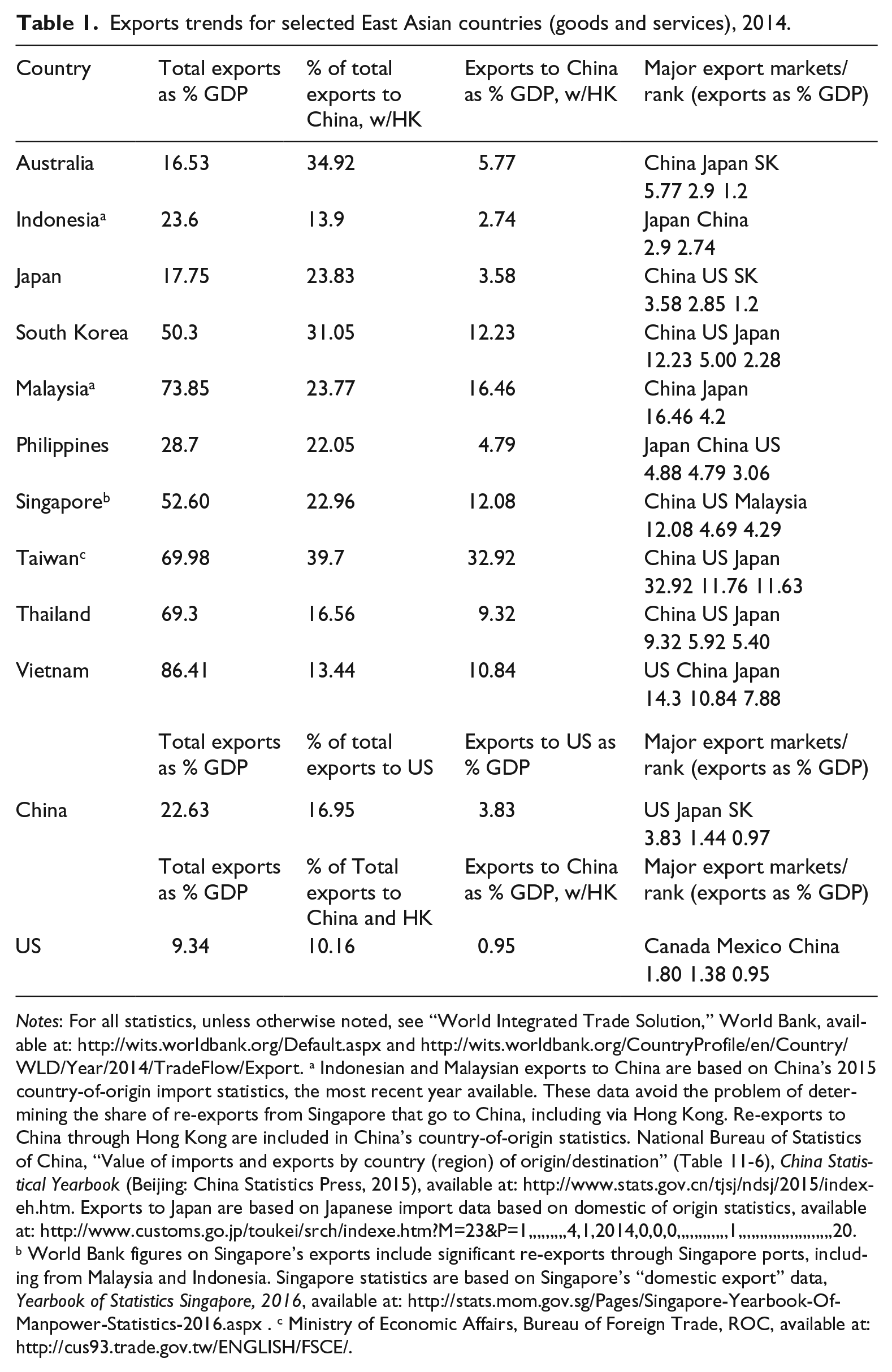
Notes: For all statistics, unless otherwise noted, see “World Integrated Trade Solution,” World Bank, available at: http://wits.worldbank.org/Default.aspx and http://wits.worldbank.org/CountryProfile/en/Country/WLD/Year/2014/TradeFlow/Export. a Indonesian and Malaysian exports to China are based on China’s 2015 country-of-origin import statistics, the most recent year available. These data avoid the problem of determining the share of re-exports from Singapore that go to China, including via Hong Kong. Re-exports to China through Hong Kong are included in China’s country-of-origin statistics. National Bureau of Statistics of China, “Value of imports and exports by country (region) of origin/destination” (Table 11-6), China Statistical Yearbook (Beijing: China Statistics Press, 2015), available at: http://www.stats.gov.cn/tjsj/ndsj/2015/indexeh.htm. Exports to Japan are based on Japanese import data based on domestic of origin statistics, available at: http://www.customs.go.jp/toukei/srch/indexe.htm?M=23&P=1,,,,,,,,,4,1,2014,0,0,0,,,,,,,,,,,,1,,,,,,,,,,,,,,,,,,,,,,20. b World Bank figures on Singapore’s exports include significant re-exports through Singapore ports, including from Malaysia and Indonesia. Singapore statistics are based on Singapore’s “domestic export” data, Yearbook of Statistics Singapore, 2016, available at: http://stats.mom.gov.sg/Pages/Singapore-Yearbook-Of-Manpower-Statistics-2016.aspx . c Ministry of Economic Affairs, Bureau of Foreign Trade, ROC, available at: http://cus93.trade.gov.tw/ENGLISH/FSCE/.
The statistics in Table 1 do not take into account global production networks and value added in determining import and export values. Insofar as China is a major exporter of finished goods, this is a factor for assessing the value of Chinese exports. However, insofar as the value of exports to China from advanced industrial countries reflects the value of component parts, the statistics accurately reflect the value of their exports to China. Such is the case, for example, regarding exports to China from Japan, South Korea, Taiwan and the US. Regarding less advanced countries, their exports to China are not components in global production networks, so the statistics accurately reflect the value of their exports to China.
China’s rise and the bipolar hub-and-spoke economic system
China’s emergence as an East Asian economic power began in 2000/2001, when it replaced the US as the largest export market for Taiwan and South Korea (Naughton, 2007: 393–394, 413–416). In 2009, China replaced the US as Japan’s largest export market (World Bank, 2012). Table 1 shows that by 2014, China had emerged as the most important export market for Australia, Japan, Malaysia, the Philippines, Singapore, and Thailand. For these countries’ economic development, employment, and political stability, China was number one and the US was, at best, number two. By 2014, as China’s GDP had grown significantly faster than the GDP of both the US and Japan, China had consolidated its role as an emerging hub of a regional trade system.
Table 1 reveals the GDP export dependence of selected East Asian countries. The statistics on these countries’ exports to China combine their exports directly to China with their exports to Hong Kong. Hong Kong is a major port for South China’s Pearl River Delta. The population of Hong Kong is less than 8 million; the population of the Pearl River Delta is approximately 260 million. Thus, in 2012, for example, Hong Kong exported to mainland China nearly 90% of its non-mainland imports (Fong, 2014; UN Comtrade, no date; Wong and Zhang, 2013). Equally important for understanding the implications of exports to Hong Kong for calculating small state export dependence on China is Hong Kong’s subservience to Beijing’s political authority. Beijing has the ability to deny other countries access to the Hong Kong economy as easily as it can deny them access to the mainland economy. Thus, China and Hong Kong are a single market.
Analysis of the statistics in Table 1 on the rankings of East Asian countries’ export markets and on their GDP dependence reveals the analytical fallacy of using rankings to determine dependence and economic leverage. Commentators have attached importance to China’s position as Japan’s number one export market (Masaki, 2010). Although China did become Japan’s number one export market in 2009, China does not possess market leverage over Japan. First, in 2014, Japanese GDP dependence on the combined China/Hong Kong market was approximately 3.58%. This is a relatively small share of the Japanese economy. Second, the Japanese economy has enjoyed sufficient export diversity to minimize its export dependence on a single market. In 2014, approximately 2.85% of its GDP depended on exports to the US. Thus, in 2014, China did not possess asymmetric trade leverage over Japan. Insofar as Japanese accommodation of Chinese security interests to protect its market access could jeopardize Japanese access to the US market, Tokyo would have minimal incentives to accommodate Chinese economic coercion.
It is also important that China has not been the most important export market for a number of politically important East Asian countries. In 2014, the number one export market for both Indonesia and the Philippines was Japan, accounting for 2.9 and 4.88 per cent of their exports, respectively. China/Hong Kong was their number two export market, accounting for approximately 2.74 of Indonesia’s GDP and approximately 4.79 per cent of the Philippines’ GDP. The Philippines number three market was the United States, accounting for approximately three per cent on Philippine exports. Similarly, in 2014 the United States was the number one export market for Vietnam, a country critical to Chinese border security, accounting for over 14 per cent of Vietnamese exports.
The trade data thus underscore that China has not become the region’s economic hegemon (Perlez, 2014c) and that it is misleading to use trade rankings to determine market dependence and trade leverage. Nonetheless, the combined data on export market rankings and GDP dependence in East Asia indicate that the regional political economy has changed as China has emerged as a region-wide economic power. There are now two overlapping hub-and-spoke trade systems, with both the Chinese and US markets serving as anchors for the bipolar regional economy.
It is likely that the Chinese economy will continue to expand at a slower rate over the next decade than it did from 1978 to 2010. This will affect the rate at which Chinese imports from East Asia grow faster than US imports from East Asia (Garnaut et al., 2014). Thus, the current configuration of the East Asian regional trade order will likely endure for at least the next decade. For example, whereas from 2009 to 2014 China was Japan’s largest export market, in the first half of 2014 the US was Japan’s largest export market (Masaki, 2014).
It is also significant that Chinese GDP dependence on the US market in 2014 (3.83%) was far greater than US GDP dependence on the Chinese market (0.95%). China’s relative asymmetric vulnerability to US–China trade conflict challenges China’s ability to use coercive economic power to challenge US security partnerships in East Asia (Drezner, 2009).
Taiwan and South Korea: Overdetermined strategic realignment
South Korea and Taiwan have both experienced considerable GDP dependence on the Chinese market. In 2014, nearly 15% of South Korean GDP depended on exports to China, nearly three times the percentage of its GDP that came from exports to the US, its second-largest export market. Taiwan is even more dependent on the Chinese market. Nearly 25% of its GDP derived from its exports to mainland China, over three times the percentage of its GDP dependence on the US (Kastner, 2016: 65–69). However, Taiwan and South Korea have simultaneously experienced increased Chinese relative military power vis-a-vis the US. Their cooperation with China was overdetermined, in that multiple variables were contributed to change in their security policies.
Through 2016, Taiwan improved its political relationship with China. It abandoned any effort to move actively toward de jure sovereign independence. In March 2008, the Nationalist Party candidate for President, Ma Ying-jeou, campaigned on a platform of “one-China” and improved cross-strait economic and political relations. He defeated Taiwan’s “pro-independence” Democratic Progressive Party (DPP) candidate with 63% of the vote (Romberg, 2012a, 2012b, 2012c). Ma’s government then pursued expanded trade and societal relations with the mainland. In 2012, Ma won re-election. In the 2016 presidential election, none of the candidates advocated independence, including the DPP candidate, Tsai Ying-wen, who won the election. Moreover, Taiwan’s defense spending has rapidly declined as a share of the budget and GDP as Taiwan has focused on domestic spending rather than directly challenging China’s security in the Taiwan Strait (Directorate-General of Budget, Accounting and Statistics, 2005–2014; Taiwan Affairs Office of the State Council PRC, 2012).
However, coinciding with growing Taiwanese dependence on its exports to the mainland has been the rise of Chinese military power, including in the Taiwan Strait (Dutton et al., 2014). As Taiwan’s independence movement gained momentum in the mid-1990s, China deployed between 50 and 100 short-range M-9 ballistic missiles per year across from Taiwan (US Department of Defense, 2003: 5). These missiles provide China with the capability to inflict high costs on Taiwan in a war over Taiwan independence. By 2005, Beijing had deployed as many as 750 of these missiles (Shirley, 2000: 11–12; US Department of Defense, 2005: 4; Vick, 2001). Complementing China’s development of missile power had been its acquisition of advanced Russian military aircraft, contributing to Chinese air superiority vis-a-vis Taiwan over the Taiwan Strait (US Department of Defense, 2015). Beijing’s land-based missile and air capability provides Beijing with an assured capability to inflict high costs on Taiwan. Neither US missile defense systems nor the rapid deployment of US forces can protect Taiwan from the costs of war with China. These capabilities, combined with its submarine fleet, have given China an anti-access capability that challenges US ability to successfully wage an air war over the Taiwan Strait (Heginbotham, 2015; Lindsay and O’Hanlon, 2001: 123–130). Taiwan’s policy change has been overdetermined, reflecting its vulnerability to both Chinese economic and military power.
Since the early 2000s, as South Korea experienced increasing trade dependence on the Chinese market, it has increasingly accommodated the rise of China. This trend is reflected in Seoul’s resistance to post-Cold War “out-of-area” alliance cooperation with the US in East Asia, whereby US forces are not deployed in South Korea only to defend South Korea, but also to deal with whatever regional contingency might arise. In 2005, President Roh Moo-hyun declared that South Korean facilities could not be used by US forces in a Taiwan conflict (Roh, 2005; US Department of State, 2006). This has been South Korean policy ever since. For many years, South Korea also resisted US efforts to develop US–South Korean cooperation in a regional missile defense system, reflecting its sensitivity to Chinese opposition to US missile defense deployments in North-east Asia (Rowland, 2014). In 2016, the Park administration agreed to the deployment of the US Terminal High Altitude Area Defense (THAAD) system. However, this was a protracted process and it elicited significant domestic opposition, reflecting South Korean reluctance to challenge Chinese interests (Kim and Cha, 2016: 101–121). In 2017, Moon Jae-in won the South Korean presidency based, in part, on a commitment to oppose the US deployment of THAAD in South Korea. He then reached agreement with China to limit South Korean missile defense cooperation with the US (Panda, 2017).
However, similar to the analysis of Taiwan’s changing security policy, it is not possible to ascribe South Korea’s changing security policy to its vulnerability to Chinese economic coercion; the rise of China has also transformed South Korea’s strategic environment. Modest increases in the People’s Liberation Army’s (PLA’s) ground forces’ budget have had a major impact on its war-fighting capability. Select Chinese forces receive priority funding for training and advanced weapons, including imports from Russia. They have also benefited from the modernization of China’s C4ISR (Command, Control, Communications, Computers, Intelligence, Surveillance, and Reconnaissance) infrastructure (Henley, 2000: 72–73; Mulvenon, 2003; Yang and Liao, 1999). As early as 2002, the PLA had the ability to impose “great risks and costs for potential opponents in China’s near periphery” (Puska, 2002: 223, 244–245).
Since then, China’s acquisition of advanced aircraft and advanced Russian surface-to-air missiles (SAM) has further strengthened Chinese military power on the Korean Peninsula. More recently, the development of Chinese maritime capabilities presents a growing challenge to South Korean security in the Yellow Sea. China’s submarine fleet and its improving surface fleet increasingly dwarf the capabilities of the South Korean Navy. China’s civilian maritime force can challenge South Korean fishing interests in the Yellow Sea. Similarly, China’s land-based missiles and aircraft can project power into the Yellow Sea (Dutton et al., 2014). Furthermore, the China–South Korean dispute over the demarcation of their exclusive economic zones (EEZs) in the East China Sea and over submerged rocks within their overlapping EEZ claims could escalate and challenge South Korean security (Morris, 2017). Simultaneously, the value of the US–South Korean alliance to balancing China’s rise has diminished as China has developed its anti-access capability in the Yellow Sea (Heginbotham, 2015).
Since the mid-2000s, South Korea has gradually accommodated itself to Chinese security interests. However, similar to the analytical challenge in explaining Taiwan’s security policy shift, it is not possible to determine whether Chinese coercive economic power has independently determined South Korea’s changing security policy. South Korean policy has also been overdetermined, coinciding with its vulnerability to both Chinese economic and military power.
Singapore, Malaysia, and Australia: Trade vulnerability with strategic stability
Singapore, Malaysia, and Australia are the three East Asian countries that experienced significant vulnerability to potential Chinese economic coercion but did not experience growing Chinese military power that challenged US military capabilities in their immediate environment. They have also been US strategic partners in East Asia. Hence, analysis of their strategic response to GDP dependence on the Chinese market allows for determination of the independent effect of coercive economic capabilities on state security alignments and the implications of China’s economic rise and trade power for the East Asian strategic order.
Table 1 indicates that China was the largest export market for the Malaysian, Singapore, and Australian economies in 2014. More importantly, Malaysia, Singapore, and Australia all experienced significant GDP dependence on their exports to the Chinese market. Based on Chinese country-of-origin import statistics, Malaysian exports to China contributed approximately 16.5% to Malaysia’s GDP. Malaysian GDP dependence on Japan, its next largest market, accounted for only 4.2% of its GDP. In 2014, Singapore GDP dependence on the Chinese market was over 12%. Singapore’s exports to the US, its next largest market, accounted for approximately 4.7% of its GDP. Moreover, since 2010, Singapore’s exports to China have increased by over 6%, while its exports to each of its other major export markets declined (Department of Statistics, 2014; Fong, 2014; UN Comtrade, no date; Wong and Zhang, 2013). In 2014, Australian GDP dependence on China was nearly 5.8%, twice as large as its GDP dependence on Japan and nearly five times larger than its dependence on its exports to South Korea, its third-largest export market. Equally important, Australia experienced a rapid increase in exports to China. Since 2009, its exports to China more than tripled, and during the 12 months from March 2013 to March 2014 its GDP dependence on China’s market increased to 7% (Archer, 2013; Feast, 2014). By 2014, Malaysia, Singapore, and Australia were all falling into the Chinese “economic orbit.”
As the exports of these three East Asian countries that are GDP dependent on China are not comprised of manufactured goods with re-export components, the export statistics in Table 1 accurately reflect the value of these countries’ exports to China. International supply chains are not involved in Singaporean, Malaysian, and Australian exports to China.
In 2014, all three countries resided within US military dominance of maritime East Asia. China’s land-based aircraft and Russian SAMs offered the PLA significant war-fighting capability in its near seas, including in the Taiwan Strait, the Yellow Sea, and the northern reaches of the South China Sea. Further from the Chinese coast, China lacked the naval capability to challenge the US Navy’s ability to readily dominate East Asia’s maritime theaters and defeat the Chinese Navy in the waters near Australia and in the southern reaches of the South China Sea near Singapore and Malaysia (Heginbotham, 2015).
In 2013, only one in three Chinese war planes were “modern.” Moreover, China has lacked a credible air-refueling capability and sophisticated airborne warning systems; its advanced Russian aircraft and their on-board missiles cannot project power into distant waters dominated by US ship-based and forward-deployed aircraft and missiles in Japan and Guam (Shlapak, 2014: 65–67). China’s domestic-produced advanced diesel submarine force has grown, but through 2014 the limited range and slow speed of its submarines made them ill-suited for open-sea torpedo warfare against the US surface fleet (Murray, 2014: 18–19). China has been developing a sophisticated surface fleet of Houbei-class fast-attack ships equipped with the YJ-8/C801 anti-ship cruise missiles (ASCM). However, the Houbei require air-defense support from other PLA platforms, which the PLA air force and naval air force cannot provide beyond China’s near seas; China is far from having an operational aircraft carrier capability. Moreover, the cruise missile targeting of US ships at sea remains a challenge, requiring coordination with other vulnerable short-range surveillance platforms (Patch, 2014: 4–9; also personal communication with Singapore Ministry of Defence official, 2014). The intrinsic limited accuracy of over-the-horizon radar and the technological challenges of placing effective surveillance capabilities on either missiles or satellites also constrain the utility of China’s submarine-based ASCMs and the deployment of an effective DF-21D anti-ship ballistic missile (ASBM), as well as of its nascent drone fleet. The US is also developing a range of capabilities to counter any potential Chinese ASBM capability (Biddle and Oelrich, 2016; Cote, 2011: 12–14; Greenert, 2014; Murray, 2014: 20–21; O’Rourke, 2014).
Non-fungibility of economic power in East Asian security affairs
In the context of China’s ongoing naval weakness vis-a-vis the US in maritime East Asia, through 2014, China’s market power did not affect the alignments of the dependent East Asian states. On the contrary, even as China’s market power grew, the economically dependent states increased their contribution to expanded US military presence in East Asia.
Since the mid-2000s, Malaysia has improved defense ties with Washington. In 2005, about 15–20 US Navy vessels visited Malaysian ports each year; in 2013, over 30 US ships visited Malaysian ports and US aircraft carriers often berth at Port Klang in the Malacca Strait (Malaysiakini, 2006; Shapiro, 2012; Storey, 2005: 5). US–Malaysia defense cooperation increased during the Obama administration. Malaysia first joined the US–led Cobra Gold East Asian joint naval exercises during the Obama administration in 2011. Each year since then, it contributed a greater number of ships and personnel to this exercise. Malaysia provides jungle warfare training for US military personnel. In 2013, Malaysia invited the US Marine Corps to help it develop its marine corps and its amphibious and rapid deployment capabilities, and in 2014 the US Marine Corps and the Malaysian Marine Corps carried out multiple joint amphibious operations on Malaysian beaches (Goldman, 2014; Gonzalez, 2014; Ricks, 2014). Each year, the US military conducts approximately 14–16 bilateral and multilateral exercises with the Malaysian Armed Forces and altogether over 75 cooperative activities with the Malaysian Armed Forces and the Royal Malaysian Police (Rinehart, 2014). In 2014, Malaysia allowed US anti-submarine aircraft to conduct surveillance of Chinese submarines from its airfields (Perlez, 2014a).
Singapore has been particularly active in cooperation with the US military, including in basing, defense planning, and arms acquisitions. In 2000, Singapore began annual participation in the US Cobra Gold military exercises. In 2001, it completed the construction of its Changi naval port facility, which is designed to accommodate a US aircraft carrier, and in March 2001 it hosted the first visit of the USS Kitty Hawk (Chan, 2001; Tang, 2000). In 2005, Singapore and the US signed the Singapore–US Strategic Framework Agreement, enabling greater cooperation in joint exercises (Garamone, 2005; Smith, 2005: 4–5). The US Navy also established a regional logistical command unit — Commander, Logistics Group Western Pacific — in Singapore to coordinate warship deployment and logistics in the South China Sea. Squadrons of US fighter planes are rotated to Singapore for a month at a time, and approximately 100 US naval ships visit Singapore each year. Singapore has joined in the US program for development of the Lockheed Martin Joint Strike Fighter, and in 2014 it reaffirmed its commitment to purchase F-35s. During the Obama administration, Singapore and the US increased bilateral exercises and training, including combined air combat exercises. In 2013, Singapore became the first country to offer forward US deployment for US Littoral Combat Ships (LCSs); it agreed to the US stationing four LCSs in Singapore by 2017. The Singapore Minister of Defense reported that Singapore welcomed the US deployment of the LCSs because it allowed the US to maintain “a strong presence, a continued presence in the Asia Pacific region” (Chanlett-Aver, 2013; see also Globalsecurity.org, no date).
Despite its growing GDP dependence on its natural resource exports to China, Australia has also been increasing defense cooperation with the US (Reilly, 2012). Since the early 2000s, as Australian mining exports steadily increased, the US has based substantial satellite communication ground stations in Australia, enabling both communication intercepts (Echelon) and satellite communication to support US Navy activities (Mobile User Objective System) (Australian Department of Defence, 2008; Nautilus Institute for Security and Sustainability, 2014: 2). In November 2011, it agreed to host initially 250 US marines in Northern Australia, with plans to host 2500 marines, and it agreed to increased US use of Australian airfields for B52 bomber training flights. In 2014, Australia and the US signed a force posture agreement, formalizing the plans to expand Australian military facilities to host 2500 US marines by 2017, to expand access for US B52 bombers to Australian bombing ranges and training facilities, and to expand US naval access to Australian ports (ABC News, 2013; Calmes, 2011; Lowy Institute for International Policy, 2014). In 2014, Australia also expanded satellite cooperation with the US to improve US command and control systems for naval surveillance and communication, and it began discussions on an Australian contribution to US missile defense capabilities (Garnaut, 2014; Stewart, 2014; Tanter, 2012). In 2011, the US and Australia opened discussions regarding US military access to the Cocos Islands. The Australian government’s 2012 Defense Force Posture Review then recommended that Australia expand its air facilities on Cocos Islands to enable US P-8 anti-submarine warfare aircraft and UAV (Unmanned Aerial Vehicle) operations. The Cocos Islands are located south of Indonesia and military facilities on the islands could support US air and naval operations throughout the South China Sea (Hawke and Smith, 2012: 26; Kerin, 2011; Kopp, 2012).
Australia also provides a case study on the role of natural resource export dependence on security policies, which Hirschman used to assess Germany’s use of market power to establish a sphere of influence in South-east Europe. Australian GDP dependence on China is highly concentrated in mineral exports, with a growing concentration in exports to China. This is especially pronounced for iron ore exports. The value of Australia’s export of iron ore increased from $5.2 billion in 2001 to $64.1 billion (AU$) in 2011, representing average growth of 31.9% per year and nearly four times the rate of increase of total Australian exports. The share of iron ore exports in total exports rose from 3.3% in 2001 to 20.5% in 2011. In 2011, Australia exported nearly 70% of its iron ore to China (Australian Department of Foreign Affairs and Trade, 2012: 6–7). Overall, tax revenues and employment from exports to China by mineral corporations are critical parts of the Australian local and national economies. In 2011/2012, Australian federal tax revenue from the mineral industries supplied nearly 24% of total federal revenue from corporate taxes (Australian Taxation Office, 2013). Dependence on iron ore exports to China for the state of Western Australia is especially severe. In 2012, direct employment in the iron ore industry accounted for 43% of the state’s employment; 76% of the state’s iron ore exports went to China. From 2004 to 2014, iron ore exports to China increased from approximately 50 million metric tons to nearly 600 million metric tons, and in 2014/2015, it accounted for 80% of the state’s iron ore exports. Overall, mining sector exports to China accounted for nearly 75% of the state’s exports (Australian Mining, 2015; Department of State Development, 2015; Department of Treasury, 2014).
Despite Australia’s significant dependence on natural resource exports to China, Australia not only expanded defense cooperation with the US, but also adopted “unfriendly” policies toward China. In 2009, China’s effort to purchase a large stake in Rio Tinto, the world’s second-largest iron ore producer, encountered significant opposition from Australian politicians (Barboza and Wines, 2009; Lu, 2012). In 2012, Australia denied the Chinese information technology company Huawei Technologies access to its domestic communication network. China expressed its opposition and the possibility that Australian foreign policy might affect Australia–China economic bilateral cooperation. Australian mining corporations’ executives tried to influence Australian security policies toward China and the US. They personally advised Foreign Minister Bob Carr that Australia should not antagonize China. Carr, however, resisted their advice and Australia continued to expand defense cooperation with the US (Carr, 2014: 52–53, 201, 254; also personal communication with Bob Carr, 2014).
Conclusion
China is no longer a rising economic power. After 35 years of nearly 10% annual economic growth, China is approaching approximate international economic parity with the US in the international political economy. China’s economic rise is reflected in its leadership role in major international economic institutions, its establishment of international economic organizations that offer alternatives to the international economic institutions that the US established after the Second World War, and its impact on the global trade order.
However, China’s influence in the international political economy does not have consequential strategic implications, either for the East Asian strategic order or for US security interests. First, China is not developing market dominance throughout East Asia. Rather, regarding most East Asian countries, China’s importance as an export market now rivals rather than exceeds the market importance of the US. In this respect, the relative equal distribution of US and Chinese market power means that neither China nor the US possesses region-wide asymmetric economic power that it could use for political advantage.
Second, this trend also has implications for the emergence of a regional trade system based on the Chinese market. In 2013, nearly 45% of the exports of East Asian countries were extra-regional trade (Asian Development Bank, 2008; Kahler, 2012; UNESCAP, 2014). Moreover, there has been minimal bilateral trade expansion among the smaller economies of East Asia (Ravenhill, 2010). Thus, East Asia remains integrated with the world economy, challenging any effort to develop a China-dominated regional trade order. Similarly, the emergence of multiple hub–spoke regional trade systems suggests the need for caution regarding the likely emergence of region-wide East Asian interdependence that could contribute to political change.
Nonetheless, through 2014, important US security partners in East Asia experienced significant GDP dependence on the Chinese market. Singapore, Malaysia, and Australia depend on exports to China for economic stability and growth. However, China’s asymmetric economic power is not fungible in international security affairs. As China’s market power over Singapore, Malaysia, and Australia grew, each strengthened strategic cooperation with the US. US strategic superiority in maritime East Asia, rather than Chinese market power, determined their alignment preferences.
The only East Asian countries that have experienced GDP dependence on China and have adjusted their security policies are Taiwan and South Korea, yet both have also experienced the military rise of China. China’s combined economic and strategic dominance over Taiwan and South Korea creates the same policymaking context as interwar German economic and strategic dominance over South-east Europe, and Russian economic and strategic dominance over its near abroad in the Caucuses. Only when the superior economic power possesses superior military power do small states realign.
This article’s findings complement Robert Pape’s findings regarding the independent efficacy of economic sanctions. Pape’s (1997: 93, 99–102) research establishes that, for the most part, the so-called “successful” use of economic sanctions has reflected the concurrent presence of coercive military power. Thus, neither economic sanctions nor GDP dependence is sufficient to determine a target’s state’s security policy.
This research contributes to our understanding of the fungibility of power in international politics. The case studies in this article establish that economic coercive power cannot independently influence small state security policy, while independent military power is sufficient to shape small state security policy. Other research establishes that military power can independently shape international economic policy. This has been the case in both Europe and the Middle East, where US dominant military power has contributed to small state economic cooperation with the US (Art, 1996). Together, these findings on the fungibility of military power and on the efficacy of sanctions and market dependence suggest that military power wields greater fungibility in international politics than economic power.
These findings further suggest should China’s Belt and Road Initiative develop an East Asian infrastructure that establishes China as the hub of a regional trading system, market dependence will not reshape the regional security order. The US–China military balance will determine small state security alignments and the regional security order. However, the fungibility of economics as an underlying base of military power suggests that the strategic order in East Asia is not fixed. Should China’s economy continue to grow and should it develop increasingly advanced technology, its defense spending will grow and its military will be better able to compete with the US in maritime East Asia. Ultimately, these trends will determine China’s ability to reshape the regional security order, rather than China’s market power.
Footnotes
Funding
The author is grateful for the support of the East Asian Peace Programme, Department of Peace and Conflict Research, Uppsala University, to Robert Art for his helpful comments on an early draft of his article, and to Yin Chengzhi and Zhang Chenrong for their research assistance.