







Abstract
IR has long been concerned about its claim on disciplinary status. This includes concerns about its differentiation from Political Science and a divide between scholars who advocate a narrow disciplinary approach and others who conceive of IR as a pluri-disciplinary concept. Although these dilemmas revolve around its position vis-à-vis other disciplines, the vast majority of the recent disciplinary-sociology debates have focused on the extent of IR scholarship’s intradisciplinary fragmentation, along epistemological, topical, national, status and other lines. However, the sociology of science literature stresses that disciplines are the product of not only internal practice but also their knowledge relations to and differentiation from other disciplines. In short, intradisciplinary fragmentation cannot be considered as detached from a discipline’s relations to other disciplines – and, by extension, the differentiated knowledge relationships held by distinct intradisciplinary fragments to other disciplines. Taking this into account, this article uses bibliometric analysis of journals as a proxy for analysing the relationship between IR’s intradisciplinary make-up and its interdisciplinary relations to eight cognate disciplines between 2013 and 2017. Three distinct modes of bibliometric analysis are operationalised to map three different aspects of interdisciplinary knowledge practice: (inter)disciplinary debates (direct citation), multidisciplinary knowledge bases (bibliographic coupling) and interdisciplinary knowledge production (co-citation). On this basis, the article asks, one, whether and how differences in the interdisciplinary knowledge relations practised by IR scholarship correlate with intra-IR lines of fragmentation. And two, what are the implications for how IR’s socio-intellectual composition is understood and its disciplinary status evaluated?
Keywords
International Relations (IR) scholarship frequently expresses concern about its disciplinary identity and health. 1 It has been suggested that this is due to IR’s ‘inferiority complex’ about its status as a standalone discipline (Turton, 2015b: 248; see also Rosenberg, 2016; Lawson and Shilliam, 2010; Albert and Buzan, 2017). Such disciplinary handwringing is often seen as taking place against the seemingly perennial dilemma of how to interpret the grey area of IR’s independent status vis-à-vis Political Science (Reiter, 2015; Rosenberg, 2016). While, in parallel, a growing number of voices are advocating that IR be understood as a multi-, pluri- or inter-disciplinary object of study, around which all production of knowledge on the ‘international’ can coalesce (Aalto, 2015; Grenier, 2015; Jackson, 2017). In this way, questions about its relationships to other disciplines are commonly regarded as integral to IR’s disciplinary disposition.
Yet, IR’s disciplinary composition, status and health have predominantly been studied from an exclusively intradisciplinary perspective, most often mapping out its internal intellectual and institutional organisation. As noted by Kristensen (2015: 244), most such studies and commentaries have concluded that IR is a ‘more fragmented discipline today’. Indeed, several scholars have, drawing on Whitley’s (2000) typology, suggested that the contemporary socio-intellectual organisation of IR is best described as a ‘fragmented adhocracy’ (Oren, 2016; Waever, 2016; Wight, 2019) – fragmentation that is frequently attributed to intradisciplinary differentiation along epistemological, 2 theoretical, 3 methodological, 4 topical 5 and national/regional 6 dividing lines. The upshot is that IR often characterises itself as a ‘dividing discipline’ (Holsti, 1985; Kristensen, 2012), splintered into different ‘sects’ (Lake, 2011), ‘campfires’ (Sylvester, 2007) or ‘paradigms’ (Lapid, 1989). This perception often encompasses the implicit, and sometimes explicit, assumption that IR is more fragmented than other disciplines, and that this constitutes a threat to IR’s disciplinary status (Holsti, 1985; Lake, 2011).
The sociology of science literature, however, stresses that disciplines are a product not only of internal coherence but also of the external differentiation of this internal practice to that of other disciplines (Abbott, 2001; Frodeman, 2014; Klein, 1996; Weingart, 2010). This is not to say that academic disciplines are closed knowledge systems (Leydesdorff, 2015; Luhmann, 1995). To the contrary, the knowledge produced by one discipline is openly available and able to flow to all others. In this context, disciplinary knowledge production centres on the continual practice of engaging with knowledge derived from other disciplines, but reinscribing it according to intradisciplinary codes, debates and positions, thereby constituting the boundary that differentiates its disciplinary knowledge to all others (Barry et al., 2008; Büger and Gadinger, 2007; Gieryn, 1983; Klein, 1996). From this vantage point, healthy disciplinary practice involves more than internal unity; it is based on balancing internal enclosure with external exchange with other disciplines. Put differently, scholarly practice that both generates distinctive disciplinary debates, problematiques and objects of study, and engages with new ideas from other disciplines and disseminates its ideas into other disciplines.
Taking this into account, it is not possible to neatly bracket off intra- and interdisciplinary 7 relations of knowledge production from one another. In line with this standpoint, this article suggests that one potential source of and outcome from the fragmentation of IR scholarship that has largely been neglected by the existent literature is IR’s interdisciplinary relations. This does not represent a claim that interdisciplinary relations are the primary source of fragmentation, or indeed force of attraction, among IR scholarship. It is rather an assertion that it is analytically valuable to ask if and how the intradisciplinary fragmentation of IR scholarship into distinct ‘sects’, ‘campfires’ and ‘paradigms’ correlates with diverging associations to other disciplines.
To this end, this article uses bibliometric analysis of journals as a proxy for analysing the relationship between IR’s intradisciplinary make-up and its interdisciplinary relations to eight cognate disciplines between 2013 and 2017. Three distinct modes of bibliometric analysis are operationalised to map three different aspects of interdisciplinary knowledge practice: (inter)disciplinary debates (direct citation), multidisciplinary knowledge bases (bibliographic coupling) and interdisciplinary knowledge production (co-citation), respectively (Leydesdorff et al., 2018). Using a distance-based mapping approach, the bibliometric ‘closeness’ of these journals is visually analysed to identify the diverging geometries and extents of interdisciplinary knowledge practice among the IR journals under study. On this basis, this article asks, one, whether and how differences in the interdisciplinary knowledge relations practised by IR scholarship correlate with intra-IR lines of fragmentation. And two, what are the implications for how IR’s socio-intellectual composition is understood and its disciplinary status and health evaluated?
The article begins by outlining the existent debate on IR’s intradisciplinary fragmentation. Secondly, it sets out the political, disciplinary and analytical stakes at play in IR’s knowledge relations with other disciplines. Thirdly, it lays out its bibliometric framework of analysis. Fourthly, the three bibliometric maps are analysed. Fifth, the implications for the IR fragmentation debate are discussed. Finally, a brief conclusion is outlined.
Fragmentation among IR journals
Over recent decades, an extensive debate about the intradisciplinary constitution of IR scholarship has emerged. Among the various approaches used to map IR scholarship, one of the most common is to consider journals as the key institution through which both its intellectual debates and social structures are organised (Kristensen, 2012; Maliniak et al., 2011; Oren, 2016; Waever, 1998, 2016). This is premised on the view that journals, via their practices of peer review, act as the main reputational legitimiser and regulator of ‘new knowledge’, which may be regarded as ‘the primary currency of exchange’ in academia (Waever, 2016: 317). In line with these assumptions and this article’s use of journals as heuristics for examining IR’s interdisciplinary relations, this section lays out a review of the existent sociology of IR literature based on its journals. This survey will be subsequently utilised as a vocabulary that can be drawn upon to analyse the relationship between the intra- and interdisciplinary bibliometric fragmentation among IR journals.
A large body of recent scholarship argues that theory no longer represents the predominant line of differentiation amongst IR scholarship, due to a proliferation in the number and diversity of theories being used (e.g. Dunne et al., 2013; Kristensen, 2018; Oren, 2016; Waever, 2016). Several scholars have suggested that there has been a downplaying of the ‘Great Debates’ as a structuring discourse, which has led IR to transition from a socio-intellectual structure similar to what Whitley (2000) describes as a ‘polycentric oligarchy’ to one more akin to a ‘fragmented adhocracy’ (Oren, 2016; Waever, 2016; Wight, 2019). In the former context, journals were strongly associated to a particular ‘ism’ or school: ‘theoretical oligarchies.’ Consequently, assessments of whether an article represented ‘new’ knowledge were based on its perceived contribution to advancing that oligarchy either on its own terms or vis-à-vis the others. Whereas in the more theoretically fragmented and less oligarchical contemporary context, the criteria for determining what constitutes ‘new’ knowledge are less proscribed by strategic allegiance to a particular theoretical oligarchy. Thereby, journals are, in general, more likely to publish articles that are theoretically distinct from one another than during the 1990s and 2000s.
Although not unchallenged, many have suggested that, while theory is a less relevant differentiator, different groups of IR scholarship continue to distinguish themselves from one another on the basis of their distinctive macro-epistemological commitments. Waever (2016: 315), for example, notes ‘the rationalism-reflectivism axis’ as the most important. This is loosely reflected by journals that tend to publish a majority of content that conforms more with one side of the axis than the other (Maliniak et al., 2011; see also Kristensen, 2012; Waever, 2016). 8 The extent of this correspondence, however, varies between journals. For example, most articles in International Security (IS) and Security Dialogue (SD) are premised on broadly rationalist and reflectivist epistemological premises, respectively. Whereas International Organisation (IO) and the European Journal of International Relations (EJIR) tend to publish more articles framed on rationalist and reflectivist epistemologies, respectively, but also fairly regularly publish articles based on the other standpoint (see Kristensen, 2012).
Another noted intradisciplinary division is that between topical speciality literatures. These ‘subfields’, such as ‘security studies’, ‘conflict studies’ or ‘international organisation’, often have their own debates that are reflected in journals that are either expressly established to serve them or tend to mostly publish articles about them (Buzan and Hansen, 2009; Seabrooke and Young, 2017; Sillanpää and Koivula, 2010). 9 These can, to a limited extent, be contrasted with those journals that Kristensen (2012: 44) considers as falling on the former side of what he terms the ‘generality/specialization’ divide. These ‘generalist’ journals, such as IO, outline that they are open to publishing any type of IR scholarship broadly defined. 10
A variety of works have documented the US and West European domination of IR scholarship (Aydinli and Mathews, 2000; Bilgin, 2008; Tickner, 2013). Even within this heavily skewed context, scholars have highlighted a geographical difference between IR journals in terms of whether their institutional base and editorial team are based in the USA or in Europe (Kristensen, 2015; Maliniak et al., 2011). This often corresponds to whether the articles are, one, authored by US or European scholars, and two, whether they are orientated towards, and in many respects create, a distinguishable US or European IR debate (Kristensen, 2012; Waever, 1998, 2016).
A further point of differentiation, and one that is playing an increasingly important part in scholars’ professional life and career prospects, is the status hierarchy among IR journals. Publications in journals considered to be at the top of the hierarchy hold much greater social capital, with this reflected in job prospects and disciplinary prestige (Oren, 2016; Waever, 2016). Metrics that proclaim to evaluate the relative importance of particular journals, such as Thomson’s ‘impact factor’, have become an increasingly commonplace shorthand to communicate this hierarchy (see Appendix 1 for Thomson’s Web of Science ‘5-Year Impact Factor’ score for the IR journals under study).
In practice, these lines of differentiation interact with one another, whereby journals identified as part of one fragment category are also more likely to be classified together in another. For example, many scholars have noted that US-based journals are more likely to publish rationalist-based articles, while Europe-based journals are ‘generally more constructivist, postmodernist’ in epistemological outlook (Kristensen, 2012: 46; Maliniak et al., 2011; Waever, 2016). At the same time, some journals will not neatly fit into one or all other categories, and other divides may also be relevant. 11 While keeping this in mind, this article will draw on this survey of IR journal fragmentation, for analytical and heuristic purposes, as a speculative vocabulary with which to compare and contrast intradisciplinary and interdisciplinary bibliometric practice among the IR journals under study.
Disciplinarity–interdisciplinarity: closure, differentiation and exchange
The popular concern among IR scholars about their discipline’s status and health stems from the view that there are significant stakes at play in maintaining a discrete disciplinary identity within the social system of the academy. On the one hand, the relevance, integrity and legitimacy of academic knowledge production are seen as corollaries to disciplinary practices: the widely accepted norm is that good academic knowledge is produced in dialogue with iterative internal disciplinary debates about a particular object of study (Albert and Buzan, 2017; Bourdieu, 1988; Frodeman, 2014; Rosenberg, 2016). On the other hand, the institutional and professional organisation of the academy is largely based on disciplinary differentiation: departments, jobs, publication outlets, conferences and professional associations all justify themselves – and the allocation of resources to them – through their identification with and contribution to a discipline (Jørgensen et al., 2017; Turton, 2015b; Weingart, 2010).
These interrelated intellectual and social stakes animate the debate about the proclaimed ever greater fragmentation of IR scholarship, and the premise that this represents a threat to disciplinary status (Holsti, 1985; Kristensen, 2015a; Lake, 2011; Turton, 2015b). This claim is derived from a traditional Kuhnian outlook, in which the vitality and validity of a discipline is determined by its position on the spectrum of internal unity-fragmentation: a unified discipline is strong and works towards the production of an iteratively developed singular knowledge and a fragmented one is weak and produces disparate knowledges that do not build on one another. Viewed from this standpoint, the existent literature outlining various lines of division among IR scholarship, as outlined above, appears as a source of concern for IR’s disciplinary health (e.g. Dunne et al., 2013; Holsti, 1985; Kristensen, 2018; Lake, 2011; Waever, 2013).
The status of IR is, however, not only a question of intradisciplinary cohesion. The perceived unity of a discipline is partly constituted by its differential position vis-à-vis other disciplines, whereby disciplinary imaginaries are orientated towards the ideal of ‘block[ing] off most of the world in order to pursue infinite knowledge within a limited domain, ideally with no outside interference’ (Frodeman, 2014: 3). This bounding of disciplinary knowledge production can only take shape via the demarcation of a symbolic and institutional space in distinction to those of other disciplines. In addition, productive interdisciplinary exchange is also fundamental to the constitution of a discipline’s distinctive use-value within the academy (Valbjørn, 2017).
As a result, the archetypal discipline is one that can optimally manage the maintenance of its own bounded conceptual space, alongside active engagement with and contribution to other disciplines. On the one hand, too much exchange is considered as evidence of a lack of disciplinary self-sustainability, with such disciplines labelled as ‘parasitic’, because they ‘depend on bodies of knowledge generated elsewhere’ (Jørgensen et al., 2017: 73). Such perspectives have found manifestation in the depiction of IR as ‘a magpie subject without a recognizable or respected ethos of its own’, a state of affairs often accounted for by reference to its multidisciplinary origins (Mayall, 1998: 242).
Another explanation for IR’s uncertain sense of disciplinary status is its failure to carve out a distinct object of study. IR is most commonly understood as the investigation of ‘the international’: a spatial or scalar object of study (Albert and Buzan, 2017). However, there is a well noted tendency within the (social science) academy to value functional/thematic objects of study over other forms (Albert and Buzan, 2017; Bell, 2009; Rosenberg, 2016; Teti, 2007). In this context, IR is often seen as struggling to command unique control over a subject matter that it can call its own (Albert and Buzan, 2017; Rosenberg, 2016). The work of scholars studying the economy, politics or society is inevitably not constrained to developments within a domestic – national or otherwise – context. It often strays into ‘international’ contexts (Albert and Buzan, 2017). This production of knowledge on ‘the international' by other disciplines is said by some to represent a challenge to IR’s disciplinary identity, because it leaves IR restricted to the role of a ‘second order’ discipline vis-à-vis the ‘master disciplines’ of the social sciences (Rosenberg, 2016).
Too little knowledge exchange with other disciplines, on the other hand, is also interpreted as a negative for disciplinary health. A degree of interdisciplinary exchange is widely viewed as a way for new ideas, approaches and resources to enter the discipline (Frodeman, 2014), in order to stave off ‘intellectual autism’ (Lawson and Shilliam, 2010: 81). In the current academic context, in which a rhetoric of interdisciplinary research is promoted by universities, funders and public institutions alike, it has become common practice for IR scholars to proclaim to be introducing new ideas, methods and perspectives from History, Law, Sociology, Geography, Area Studies, Psychology and even the traditional ‘hard sciences’, such as Biology.
According to some scholars, such interdisciplinary knowledge exchange is, however, only healthy if it is reciprocal in nature. From a social system perspective, the health of a discipline may be determined by the value of its ‘tradeable “goods”, such as theories, concepts, methods, and empirical data’ to other disciplines (Valbjørn, 2017: 293). Almost two decades ago, Buzan and Little (2001) suggested that IR is a failure as an intellectual project, because it has not exported big ideas that have influenced the conceptions or research practices of other disciplines. The implication being that IR is confined to play the role of a second order discipline, until it produces knowledge that is deemed relevant enough to be taken up by other disciplines (Lawson and Shilliam, 2010; Rosenberg, 2016).
In sum, good disciplinary practice is associated with striking the right balance between internal enclosure and external engagement with other disciplines. In other words, intradisciplinary and interdisciplinary knowledge relations are mutually integral to disciplinary status. Indeed, a noted phenomenon within the sociology of science literature is for the fragmentation of a discipline to be manifest in these fragments’ distinctive interdisciplinary relations. There are indications of this in IR. As noted above, IR scholarship of differing persuasions have advocated greater engagement with particular other disciplines, while Albert and Buzan (2017: 903) highlight a tendency to internally differentiate IR in ways that ‘reproduce the others [disciplines] within themselves’ – for example, the expression of the multidisciplinary or liminal fields of ‘international political sociology’, ‘international historical sociology’ or ‘international political theory’. These developments, arguably, contribute to the fragmentation of IR scholarship, because they ingrain new and distinct sub-, multi- and interdisciplinary identities (see Scott, 2005; Jørgensen et al., 2017). In other words, the interplay of internal disciplinary differentiation with interdisciplinary relations may well be mutually reinforcing and, in some cases, a force magnifier for fragmentation.
Taking this into account, this article seeks to offer a new vantage point on the IR fragmentation debate by examining whether and how the diverging geometries and extents of IR journals’ bibliometric associations to other disciplines correspond to intradisciplinary lines of fragmentation.
Analysing interdisciplinarity: a bibliometric framework
Bibliometric analysis may be understood as the relational mapping of the attributes of publications, such as citations, authorship, institutional affiliation or keywords – with this mapping treated as a proxy for the latent structures of scientific practice (Leydesdorff and Milojević, 2012). Indeed, bibliometric analysis has already been used to examine a number of intradisciplinary fractures within IR (Kristensen, 2012, 2015b, 2018; Maliniak et al., 2013; Seabrooke and Young, 2017), 12 while it is commonly used to investigate interdisciplinarity in Science Studies (Klein and Mitcham, 2010; Wagner et al., 2011).
Most bibliometric studies of interdisciplinarity focus on the analysis of journals (Leydesdorff, 2007; Wagner et al., 2011). This is premised on the view that journals play an integral organisational, regulatory and boundary-creating role in the ongoing differentiation of science as a realm composed of distinct disciplines (Leydesdorff et al., 2018, see also Wæver, 1998). In this way, journals provide ‘a systems view of the disciplines’, from which it is possible to trace practices of scientific knowledge production that transcend disciplinary boundaries (Leydesdorff et al., 2018: 568). The most commonly used bibliometric tool for analysing interdisciplinarity is citation analysis, with the giving and receiving of citations across disciplinary boundary lines considered as a proxy measure of interdisciplinary practices of knowledge communication, overlap and integration (Rafols and Meyer, 2010).
Although conventional accounts tend to interpret citation practice as a token of exchange for intellectual inspiration and debt (e.g. Merton, 1968), others have highlighted that many other factors may motivate the giving of a citation (e.g. Small, 1978; Latour, 1987; Kristensen, 2018). For example, giving a citation is often ‘a form of strategic behavior’ and/or ‘a reflection of a social hierarchy within the scientific community’ (Wyatt et al., 2016: 17; see also Kristensen, 2018). Hence, one cannot assume that interdisciplinary citation exchange is straightforwardly representative of a significant import of new concepts, methods or empirics from one discipline into another (intellectual debt). It may also be a rhetorical move, aimed at capitalising on the high value currency of interdisciplinary research (strategic), or a reflection of a social hierarchy among the disciplines – or a combination of all three (Kristensen, 2018).
The algorithmic citation analytical tools used in this article cannot differentiate between these modes of citation practice. Therefore, the bibliometric maps they produce may potentially be interpreted differently, depending on whether one deems particular citation flows as based on intellectual debt, strategic behaviour or social hierarchical communication. While keeping this nuanced understanding in mind, the author posits that one can expect that the balance between these different modes of citation practice will tend towards evening themselves out between journals, if the sample size is large enough. As detailed below, this article analyses all citations in articles published by the journals under study over a 5-year period. At this scale, it is assumed that the distribution of motives for giving citations across the journals can be expected to broadly equate to one another, thereby making it possible to consider one citation link between two journals as comparable to that between another two.
This discussion about what interdisciplinary citation represents also interacts with commonly-held assumptions about the intuitive or structural closeness of two disciplines. For example, one may expect disciplines with overlapping historical development paths and objects of study to more frequently acknowledge their intellectual debt to one another via citation. However, the nature of such high-frequency interdisciplinary exchange also be less transformative than a knowledge transfer between two disciplines that are conventionally seen as distinct from one another. In this sense, one may think of the sociological turn in sections of IR scholarship, whereby the ‘sociological imagination’ (Scott, 2005) has opened up new research agendas including that of the disciplinary sociology of IR, but this may not be reflected in IR scholars heavily citing Sociology publications. It may, rather, be expressed through the symbolic citing of a high-profile author or work as ‘a shorthand for a specific argument, theory, method, or school’ (Kristensen, 2018: 250).
In this way, interdisciplinary citation analysis may be seen as a better measure of the micro-practices of exchange that produce academic knowledge, rather than as a way to assess the macro influence of one discipline on another in terms of ‘big ideas’ or ‘paradigm shifts’. In many respects, this less ‘paradigm-shifting’ citation practice is more constitutive of the ongoing ‘boundary work’ that functions to reproduce, and sometimes challenge, disciplinary boundaries and constructs (Büger and Gadinger, 2007; Gieryn, 1983), than the ‘big ideas’ that seem to transcend the disciplinary paradigm entirely.
Journal selection: representing disciplines
IR scholarship is engaged in interdisciplinary knowledge exchange with many disciplines. However, this article limits its analysis to eight, due to the pragmatic methodological concern of restricting the size of its bibliometric maps to a scale at which visual analysis is viable. It is argued that these eight disciplines are among the most relevant to IR’s interdisciplinary practice, as they are historically intertwined with IR or are core components of the social sciences. Historiographical accounts highlight the important role played by Area Studies, Geography, History, Law and Political Science in IR's evolution from a multidisciplinary meeting place to a ‘scientific’ discipline (Ashworth, 2009, 2013; Bell, 2009). In addition, Economics, Social Psychology and Sociology were selected, because scholars have noted their pivotal position in the contemporary system of the social sciences (Albert and Buzan, 2017; Klein, 2010; Lawson and Shilliam, 2010).
To analyse interdisciplinary knowledge exchange between journals, the analyst must make choices about which journals represent each discipline (Wyatt et al., 2016). This is a highly contentious act. As Seabrooke and Young (2017: 294) note, whatever selection is made will likely generate ‘the same feeling’ among scholars, whereby what they consider to be important journals are excluded, while others are included that they deem irrelevant to disciplinary debate. The article’s approach to this quandary is to select a relatively large number of journals to represent each discipline: 25. Following other bibliometric studies, it is argued that this represents a good balance between including enough journals to ‘broadly capture the diversity’ of a discipline and restricting the sample to a ‘small number of journals that are best representative’ (Seabrooke and Young, 2017: 294).
This article’s nine disciplinary sets of journals are selected using the Web of Science’s (WoS) ‘5-Year Impact Factor’ (2013–2017) metric to identify the 25 ‘highest-ranked’ journals in each of its disciplinary categories (see Table 1). The rationale is, one, that this approach provides a uniform framework to the selection of journals for each discipline, especially given the author’s lack of detailed knowledge about the journal landscape of some of the disciplines. And two, the WoS’s formatted data are readable by the processing tool used to produce its bibliometric maps.
Top 25 journals from WoS disciplinary categories, 5-year impact factor.
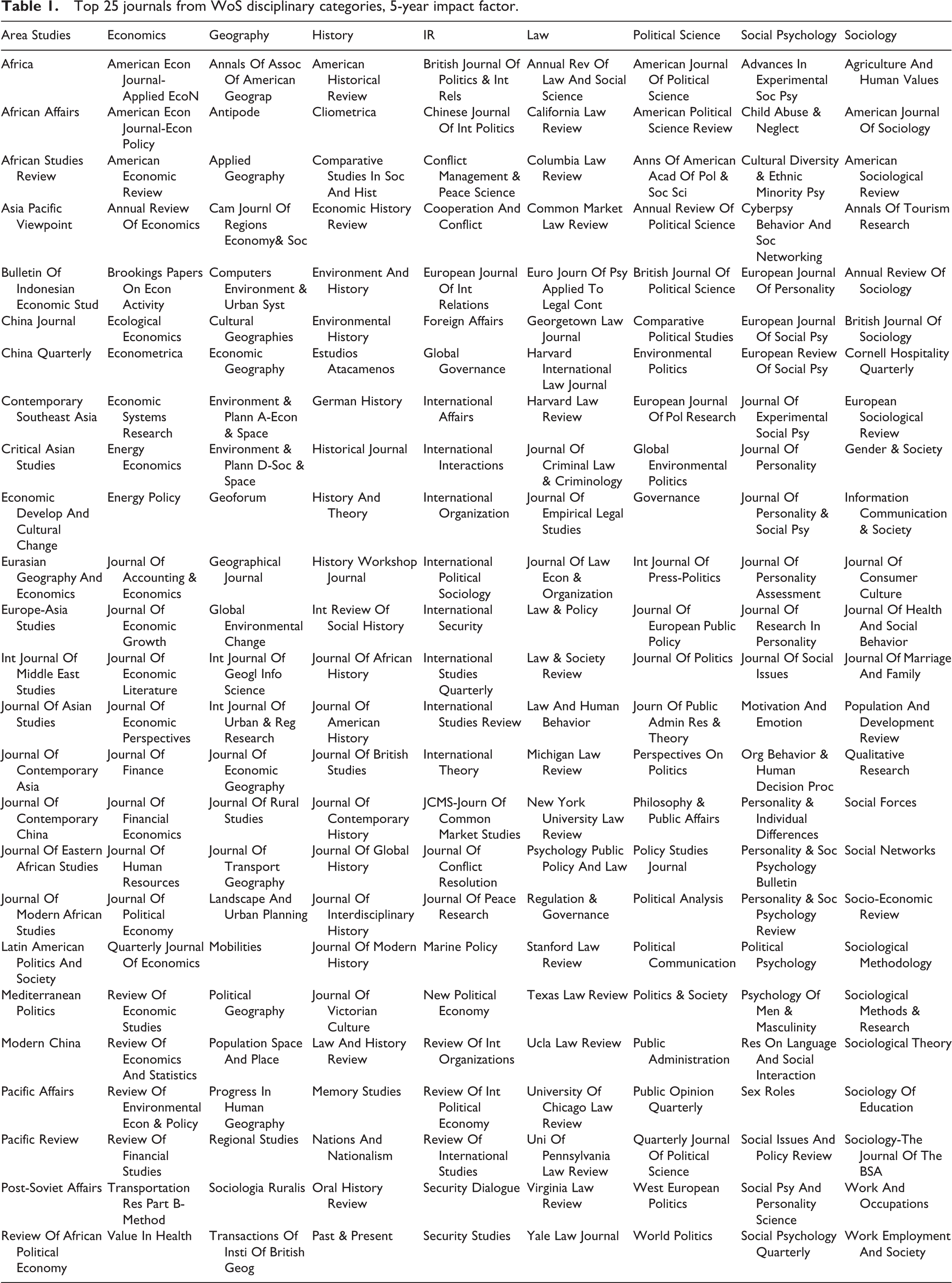
Although it argues that these selection criteria represent a good compromise between representing a diversity of scholarship and parsimony for visual analysis, this article acknowledges important limitations with regard to the former. The WoS’s disciplinary categories are problematic, because they tend to reify ‘mainstream’ disciplinary scholarship (Kristensen, 2012: 2018). The journals included are almost exclusively English-language ones that are geo-institutionally based in the USA or Europe and published by large commercial conglomerates and well-known universities (see also Oren, 2016).
Similar concerns about the bias of the WoS’s impact factor metric towards certain types of research are relevant. Among many other limitations (e.g. Larivière and Gingras, 2010; Wilcox, 2008), the WoS’s impact factor has been criticised for overvaluing ‘orthodox’ and undervaluing ‘heterodox’ types of scholarship (Kapeller, 2010). Selecting journals by impact factor is, therefore, liable to overrepresent ‘orthodox’ disciplinary scholarship. However, some of this ‘impact factor’ bias is counteracted by the relatively large sample size, whereby many ‘non-top 10 ranked’ journals that may be considered as more likely to produce ‘heterodox’ scholarship are included. It is, however, important to keep in the mind that all claims made in this article are limited to the disciplinary sets of journals that were selected on the above sampling criteria, and that the analysis is based on the relations between ‘mainstream’ versions of the disciplines.
There is also a selection problem in using the WoS classifications to allocate disciplinary identities to journals. The WoS classifies some journals as belonging to more than one of its disciplinary categories, reflecting the shades of grey underlying any schema that divides knowledge production up into distinct categories. The author allocated these double-category journals to a single disciplinary set, based on their best judgement from a review of abstracts and tables of contents (see Appendix 2). This is necessary to avoid journals being represented by two identically positioned nodes in the bibliometric maps. It is important to note that each journal node is analysed as a discrete object by the bibliometric tool. Therefore, the disciplinary category to which a journal is allocated has no impact on its positionality in the bibliometric maps, which is based solely on the extent of its bibliometric association to all other journals under study.
The IR disciplinary category includes journals that many would not consider as relevant to IR. Notably, some IR scholars do not view ‘International Political Economy’ journals as part of disciplinary IR (see Seabrooke and Young, 2017), while most would not consider Marine Policy as important for IR disciplinary debates. Therefore, this article excludes these journals from its analysis of IR’s intradisciplinary and interdisciplinary bibliometric associations.
Modes of bibliometric analysis
This article utilises three different modes of bibliometric analysis: direct citation, bibliographic coupling and co-citation analysis. The distinction between these three modes is visualised in Figure 1, in which A, B and C represent articles and the directed arrows depict the giving of citations.
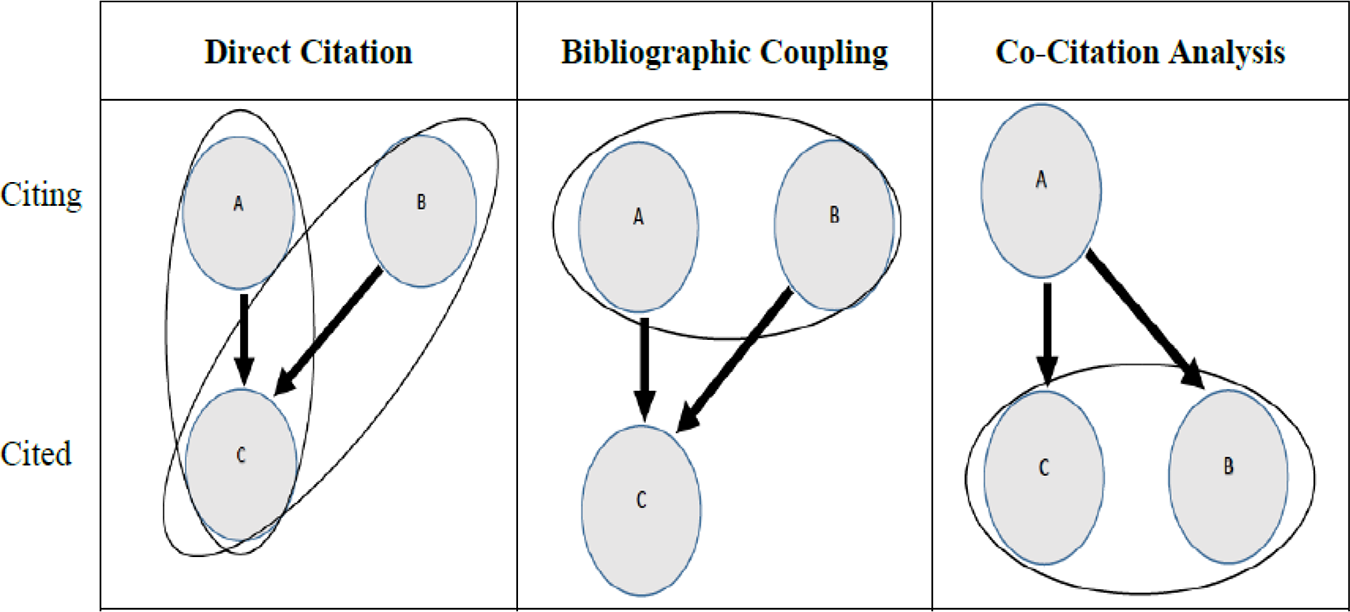
Modes of bibliometric analysis.
Direct citation (DC) is the most self-explanatory mode of citation analysis. It simply traces the citation of one publication by another. These maps, thus, indicate which disciplinary publications consider communication with another discipline as relevant and important. DC communication does not suggest that the works of different disciplines are regularly used together, but rather counts one-off citation linkages between two journals. It is, thus, useful for examining high-frequency citation exchange, such as that which may be associated to iterative disciplinary debates.
Bibliographic coupling (BC) and co-citation (CC) analysis examine the similarity of bibliographies, which is taken to be indicative of an overlapping or integrated knowledge base, respectively. BC assesses how similar one bibliography is to another (Kristensen, 2012). Commonality in bibliographies is regarded as a measure of the extent to which knowledge from one discipline has diffused to another, and thus of the extent to which a knowledge base may be considered as multidisciplinary in composition (Leydesdorff et al., 2018: 576).
By contrast, CC examines the sources listed in the bibliographies, measuring how frequently these sources are cited together in all of the bibliographies under study. Hence, ‘[t]wo publications are co-cited if there is a third publication that cites both publications’. As such, CC seeks to uncover how related particular works are to one another in terms of their combined usage to produce new knowledge, and is seen as ‘an indicator of knowledge integration’ or ‘interdisciplinary’ knowledge production (Klein, 2010; Leydesdorff et al., 2018: 567).
VOSviewer: distance-based visualisations of bibliometric maps
Among the wide array of processing techniques and layout algorithms used to produce bibliometric maps, a fundamental distinction can be drawn between graph-based and distance-based mapping. In graph-based maps, the nodes (journals, in this article) are ‘distributed relatively uniformly’, with ‘the strength of the relation’ between them communicated by a line indicating its numerical weight. By contrast, distance-based maps are ‘unevenly distributed’, because ‘the distance between two nodes approximately indicates the relatedness of the nodes’ (van Eck and Waltman, 2014: 293). Hence, while a graph-based map, using a force-directed algorithm, may produce a network map in which the most significant nodes, by whatever network measure (e.g. degree, betweenness centrality), are positioned in the centre and the least significant in the periphery, a distance-based mapping lays out a network that communicates relative associations between all nodes, in terms of distance between them, but does not position the nodes in a way that communicates their absolute significance.
The main advantage of distance-based mapping is that ‘it is easier to visually identify clusters’ (van Eck and Waltman, 2010). However, this visual parsimony comes at the cost of a loss of information, due to the exclusion of links labelled with numerical weights and a lack of visual indications about the significance of singular nodes in the network. Therefore, the choice between using a graph-based or a distance-based mapping is conditioned by the aim of the analysis. If it is to scrutinise the micro-connections between a small group of nodes according to their absolute strength, then a graph-based approach is better equipped. However, for analysing macro-relations between a large sets of nodes based on the relative strength of their links, a distance-based approach is more appropriate. Taking into account, this article uses a distance-based technique. This is because, one, its maps are large with 225 nodes (journals) and two, the primary focus and mode of analysis is the author’s visual interpretation of the clustering associations among the nodes, and thereby visual parsimony is paramount.
The software tool VOSviewer (van Eck and Waltman, 2010) was used to both process and produce this article’s distance-based bibliometric maps. The VOS mapping technique provides ‘a low-dimensional visualization in which objects are located in such a way that the distance between any pair of objects reflects their similarity as accurately as possible’ (van Eck and Waltman, 2007: 299). VOSviewer has commonly been used to visually analyse bibliometric clustering across and between disciplines (Chen et al., 2015; Leydesdorff et al., 2018).
The full bibliometric data for all articles published in the 225 journals under study from 2013 to 2017 was extracted from the WoS (see Appendix 3 for full details). The WoS ‘provides high-quality, easily retrievable citation data’, but it is not error free (Kristensen, 2018: 246). Therefore, the data were reviewed manually to eliminate errors in classifications (see also Kristensen, 2018; Seabrooke and Young, 2017). A thesaurus file was uploaded to VOSviewer to correct for these errors.
All maps are rendered using VOSviewer’s ‘overlay visualisation’ mode. To aid the visual identification of interdisciplinary clustering patterns, the author preconfigured the colours of the nodes (journals), according to the disciplinary category that they were allocated to in the above selection process. In addition, it is important to note the following parameter choices: the distance-based relations between nodes are normalised according to ‘association strength’, a probabilistic measure of similarity as set out in van Eck and Waltman (2009), while the size of a node (journal) is weighted by ‘links’, which represents the number of citation links held by one journal (node) to all others in the map, otherwise known as a node’s degree (the more links, the larger the node).
Analysis: mapping bibliometric relations between IR and other disciplines
This section lays out and visually interprets the bibliometric maps. The maps below are visualised as static images that represent either the full configurations of journals or close-up views of the strongest associations between IR journals and those of other disciplines. The close-up maps have been annotated by the author with circles identifying the clustering patterns discussed in the text. The maps may also be explored interactively if the map file is downloaded and loaded into VOSviewer.
To reiterate the section above, VOSviewer configures network maps based on the relative bibliometric associations between all nodes as expressed through the distance between them, rather than positioning the most and least significant nodes in the centre and periphery of the map, respectively. It should also be noted that the subsequent sub-sections draw on the vocabulary of IR intradisciplinary journal fragmentation set out in section two. Furthermore, to aid the clarity of the analytical narrative that follows, it is useful to highlight that all uses of the noun ‘cluster’ and the verb ‘to cluster’ refer to the author’s visual analysis of the network map. While to avoid any confusion, the sets of journals selected to represent the nine disciplines are always referred to as the ‘disciplinary categories/sets’ or ‘WoS-based disciplinary categories’, and never as ‘clusters’.
Direct citation: (inter)disciplinary debates
A visualisation of DC flows between journals is likely to deliver a map that is more clearly differentiated in terms of disciplines, than either the BC or CC ones. As argued above, good disciplinary practice is associated with having a collection of journals that are engaged in internal debates about the latest relevant knowledge on the discipline’s object of study. By the very terms of this disciplinary practice, new publications are expected, and thus inclined, to heavily cite articles from other journals within their discipline, in the name of situating it and outlining their contribution to the disciplinary debate.
As Map 1 visualises, the nine disciplinary sets of journals (illustrated by distinct colours in all maps) are relatively clearly differentiated from each other in DC communication. The vast majority of the journals from each of the Law (dark brown), Social Psychology (light grey), Sociology (purple), History (dark green), Economics (pink) and Geography (light blue) WoS-based disciplinary categories are tightly coupled with the journals of the same category and are clearly distinguishable vis-à-vis journals of other categories. The IR (red) journals are tightly associated with one another, with the exception of Marine Policy. At the same time, however, the configuration of the IR journals is comparatively less distinct to those of some other disciplines. The journals from the IR, Political Science (dark blue) and, to a lesser degree, Area Studies (light green) disciplinary categories are positioned in greater proximity to one another compared with the association between the journals of any of the others. The only vaguely comparable interdisciplinary clustering is between Economics and Sociology journals in the centre of the map. As is evident in all three modes of citation mapping, there are only negligible differences in the size of the nodes (journals) in the maps, indicating that they all hold a comparable number of citation links to all other nodes (degree) and thus that it is not analytically significant to distinguish them in this regard.
At closer inspection (see Map 2), the tightness of the clustering between IR and Political Science journals varies according to the journal. The largest cluster of IR journals is also the most strongly associated to the bulk of Political Science journals. This cluster is mostly composed of journals that are among the highest ranking by ‘Thomson’s Impact Factor Metric’, tend to publish articles that are rationalist in epistemological commitments and most of which are institutionally-based in the US. It includes three generalist-institutionalist journals (IO, International Studies Quarterly and Review of International Organizations (RIO) 13 ), as well as one conflict studies journal (Journal of Conflict Resolution (JCR)), with another in relatively close proximity (the European-based Journal of Peace Research (JPR)).
The outlier in the largest cluster is the Journal of Common Market Studies (JCMS). Like the IR journal positioned closest to the main clusters of Political Science journals, the British Journal of Politics and International Relations (BJPIR), JCMS is predominately focused on scholarship about European affairs and is a European-based and epistemologically-mixed journal. Notably, many would consider both JCMS and BJPIR as more ‘Political Science’ than ‘IR’ journals, orientated more around the intradisciplinary debates of the former than the latter 14 – an interpretation supported by their close association to Political Science journals in the DC map.
The next largest cluster is that of EJIR, Review of International Studies (RIS), Cooperation and Conflict (CC) and International Studies Review (ISR), which can be broadly characterised as generalist journals that are sympathetic, albeit not exclusively, towards reflectivist-orientated scholarship and which, with the exception of ISR, are European-based. This cluster is noticeably both more distant from the Political Science journals and more clearly differentiated from any other discipline’s journals. Perhaps surprisingly, the rationalist and US-based traditional security studies journals, IS and Security Studies (SS), along with International Theory (IT), are situated in close proximity to this cluster and are relatively distant from the rationalist and US-based one that is strongly associated to Political Science journals. Below and to the right of the reflectivist and European-based cluster are several journals that may be described, following Kristensen’s (2012) ‘theory/policy’ spectrum, as more-policy orientated, including International Affairs (IA) and Foreign Affairs 15 (FA). These journals are relatively closely positioned to a number of Area Studies journals. Finally, the IR journals that are least associated to the largest clusters of Political Science journals, other than Marine Policy, are International Political Sociology (IPS) and SD, which are both strongly identified with a ‘critical’ reflectivist research agenda and are institutionally-based in Europe. These two journals are more associated to one another and several Area Studies journals, than they are to other IR journals.
Bibliographic coupling: multidisciplinary knowledge bases
BC is often considered as a better measure of interdisciplinary knowledge production than DC analysis. As opposed to tracking all citations, BC assesses the extent to which the bibliographies of articles overlap. Examining the relative similarity of whole bibliographies means that the citations of works that are not directed at a particular’s discipline’s contemporary internal debates may also have significant weight. For example, whereas DC analysis downplays citations to older sources, BC analysis often identifies patterns in the common use of classic works of social theory. Hence, one may expect knowledge-produced in different disciplines, but based on similar epistemological perspectives or common subject matter to exhibit more bibliographic commonality, by virtue of their shared citation of the same ‘classic works’.
In line with these assumptions, the BC map (see Map 3) is less neatly ordered into distinctive clusters that correspond to the WoS-based disciplinary categories. The densest clustering of IR journals is that made up of two closely related groupings of institutionalist-generalist, IO, ISQ and RIO, and conflict studies, JCR, JPR and Conflict Management and Peace Science (CMPS), journals. As with the DC map, this cluster is closely associated to the largest clusters of Political Science journals, most of which are also US-based and rationalist, as well as a smaller cluster of Economics journals. Likewise, the European-orientated ‘Political Science’ journals, JCMS and BJPIR, are also strongly associated to similarly orientated Political Science journals, along with the two political-economy journals included in the IR journal sample.
There is also more variation in the other clusters’ interdisciplinary associations than in the DC map (see Map 4). On the left of the map, the traditional security studies journals, especially IS but also SS, and a number of policy-orientated journals, such as IA, are situated in close proximity to clusters of journals from the Law, History and Area Studies disciplinary categories. This is noteworthy, because IS is associated with, arguably, the most recognisable and distinctive theory of IR: neorealism. Such scholarship is framed on rationalist assumptions and strongly identified with US-based IR scholarship. Yet, in terms of bibliographic similarity, IS is not closely associated to other highly-ranked, rationalist and US-based IR journals and their predominant interdisciplinarily association to Political Science journals. It is, rather, clustered with Law, Area Studies, policy-focused IR and, to a lesser extent, History journals. This confluence of disciplines harks back to one of the central founding narratives about the disciplinary development of IR as an expressly multidisciplinary enterprise, in which the empirical insights of these disciplines could be brought together, in order to produce more informed empirical understandings of international affairs (see Ashworth, 2009; Bell, 2009). While overtly depicting themselves as theoretical, IS and SS articles often contain single or small-N empirical case studies and posit policy implications in their conclusions.
Most of the other IR journals are equidistantly positioned between the abovementioned IR-Political Science and IR-Law-History-Area Studies clusters. These journals include the mostly reflectivist-orientated generalist and European-based journals identified in the DC map (EJIR, RIS and CC), with the addition of IT as a second US-based journal alongside ISR. The cluster is bibliographically associated to small clusters of Area Studies and Political Science, and to a lesser extent Law, journals. While, as in the DC map, IPS and SD are the IR journals most distant from the large IR-Political Science cluster. They are, rather, bibliographically closer to clusters of Area Studies and Geography journals. It is posited that this bibliographic association correlates with shared reflectivist-orientated research approaches and epistemological assumptions.
Co-citation: interdisciplinary knowledge production
CC analysis examines the frequency with which two publications are cited together within the bibliographies of the publications under investigation. Therefore, it is important to note that CC analysis is not restricted to the 225 journals selected above. As a network map including all sources cited in the bibliographies of articles from 225 journals across 5 years would be hugely complex, the CC map was limited to the 500 sources (nodes) with the strongest CC relations (links), in order to aid parsimonious visual analysis. As a result, the map only includes 17 of the 25 journals designated as ‘IR’ by this article’s disciplinary sampling framework. CC analysis is often regarded as a heuristic measure of the integration of prior knowledge into new knowledge.
The full-view CC map (see Map 5) identifies the majority of the disciplinary categories of journals as distinct and separated groupings. As with the DC map, journals from the IR, Political Science and Area Studies disciplinary categories are positioned in much closer relative proximity to each other than are the other disciplinary categories. In contrast to the BC map, the IR journals are relatively closely associated to one another (see Map 6).
Among a larger but looser clustering of US-based and rationalist journals, there is no distinction between groupings of institutionalist-generalist and conflict studies journals as in the DC and BC map. Notably, this cluster is larger as it includes the traditional security studies journals, IS and SS, and the more policy-focused journals, IA and FA. This cluster is positioned in relatively close proximity to a number of Political Science journals (fewer than in the other maps), as well as several Economics journals. This suggests that although the bibliographies on which traditional security studies articles are constructed have a relatively greater degree of similarity to those of certain Area Studies and Law journals, as compared with Political Science. The combined usage of, for example, IS articles and those of Political Science journals to build new knowledge is much greater in comparison to the use of IS articles and articles from Area Studies, and especially, Law journals.
Several of the more reflectivist and European-based IR journals are not among the strongest 500 co-cited journals in the map. Of those included, the generalist journals, EJIR, RIS, as well as the European-orientated ‘Political Science’ journal, JCMS, are closer in relative terms to the US-based and rationalist cluster of IR journals than in the BC map. These journals are closely associated to a few European-orientated Political Science journals and some Area Studies journals. While the more ‘critical’ SD is the journal most distant from both other IR and Political Science journals, with the exception of the two political-economy journals, and relatively closer to a few Area Studies journals.
Although journals from the Political Science disciplinary category are the most related to the IR journals in terms of co-citation, generally speaking this association is less strong than in terms of DC. There is also less variation between the intradisciplinary clusters and their respective associations to other disciplines.
Discussion: fragmentation and interdisciplinarity in IR’s bibliometric relations
The bibliometric maps offer a visual representation of IR’s interdisciplinary context. This encompasses its intradisciplinary coherence relative to other disciplines’ journals, the other social sciences with which it is most and least related, and how this correlates to its intradisciplinary fragmentation. This section discusses each in turn, before offering an interpretation of what this suggests about contemporary IR’s socio-intellectual structure and the significance for the ‘fragmentation debate’.
First, the bibliometric maps do not support either the common – sometimes implicit – claim that IR is a uniquely divided discipline in comparison to other social science disciplines, or, by implication, that it is falling short of disciplinary ideals of paradigmatic cohesion. The maps, almost uniformly, depict distinct disciplinary configurations of journals, composed of a series of differentiated clusters and a few outliers. Broadly speaking, IR appears to be no more internally bibliometrically fragmented than other disciplines. The partial exception is in terms of BC, in which the extent of fragmentation among the IR journals is somewhat greater than that in the other disciplinary categories. This difference is, however, not marked.
In the majority of disciplinary categories, the intradisciplinary configuration of journals includes one cluster that is both larger and denser in its bibliometric associations than the others. For IR, this cluster is interpreted as being made up of six to ten journals, which tend to be the highest-ranking (in terms of WoS impact rating), rationalist and US-based journals. Most prominently, these are generalist-institutionalist journals, such as IO and ISQ, and conflict studies journals, such as JPR and JCR. A pair of traditional security studies journals, IS and SS, which may also be described as US-based and rationalist, are clustered to the abovementioned journals in the CC map. These journals are, however, noticeably distinguishable as a separate cluster in the DC and, especially, BC map. Some scholars have suggested that this distinction is a product of the former journals emphasise on large-N ‘hypothesis testing’, and the latter’s on small-N ‘theory testing’ (see Mearsheimer and Walt, 2013; also Oren, 2016)
Among the other clusters identified across the maps above, some are closer to and others farther from the aforementioned largest cluster: The two journals described as focused on scholarship about European affairs, JCMS and BJPIR, and which many would regard as being more ‘Political Science’ than ‘IR’ journals, are the most closely related in several maps. The next closest is the largest and relatively tightly coupled cluster of generalist and predominantly reflectivist journals, including mostly European-based journals, such as EJIR, RIS and CC, as well as a few US-based ones, namely ISR and IT. With the exception of the CC map, the more policy-focused journals, IA and FA, are relatively distant, while the IPS and SD pairing, which are European-based and most strongly identified with critical approaches, are bibliometrically the most distinct to both the largest IR cluster and all of the other clusters, with the exception of Marine Policy and the two political-economy journals which this article has not considered as ‘IR’ journals. On average, the journals in each of the clusters mentioned in this paragraph are ranked lower by impact factor than the larger cluster of mainly US-based and rationalist institutionalist and conflict studies journals.
Second, all three maps suggest that, overall, the IR disciplinary category is more strongly bibliometrically associated to the Political Science category than any other. From an overarching map-ecology perspective, the most commonly-held assumptions about IR’s interdisciplinary relationships are thus borne out, at least as far as the micro-practices of citations are concerned. In short, Political Science, Area Studies and, to a lesser extent, History and Geography are the other disciplines most frequently cited by IR knowledge production as a source of acknowledged intellectual debt, strategic value and/or symbol of disciplinary hierarchical relations. This corresponds to historiographical accounts of IR’s disciplinary origins (Ashworth, 2009; Bell, 2009). This is not to downplay the potential impact that ‘big ideas’ from Sociology, Social Psychology, Economics or Law may have had on IR between 2013 and 2017. It, however, suggests that IR’s ongoing citational ‘boundary work’ (Büger and Gadinger, 2007; Gieryn, 1983), aimed at balancing disciplinary closure and interdisciplinary engagement is concentrated on the former set of disciplines, rather than the latter.
Third, the maps visually identify differences in the geometry and extent of IR journals’ interdisciplinary bibliometric relations that correlate with their differentiation into the abovementioned intradisciplinary clusters. In general, the largest, mainly US-based and rationalist, cluster of institutionalist and conflict studies journals is very closely positioned to the largest cluster of journals from the Political Science disciplinary category, which are also mostly based in the USA and rationalist in epistemological standpoint. Oren (2016: 22, 11) has accounted for this strong association by arguing that the latter’s ‘neopositivist and quantitative orthodoxy’ has increasingly ‘become by default the primary standards for assessing [the former’s] IR research’. Whereas, broadly speaking, the other clusters of IR journals can be distinguished from the largest IR cluster, because they are less extensively associated to Political Science journals. Indeed, many of these journals have as strong a bibliometric relationship to Area Studies journals as to Political Science.
However, within this broad brush characterisation, there are notable variations related to the type of bibliometric interdisciplinary practice being analysed. In both the DC and CC maps, all of the WoS-based disciplinary sets of journals are more clearly differentiated from one another, than they are in the BC map. The extent of this difference is, however, relatively greater in terms of the IR journals, and is more obviously related to associations with divergent other disciplines. This is indicative of IR journals being engaged in multidisciplinary research practice.
Klein (2010) distinguishes between ‘multi-disciplinary’ and ‘inter-disciplinary’ practices in terms of the difference between the juxtaposition and integration of disciplinary knowledges, respectively. According to Klein (2010: 17), juxtaposition ‘fosters wider knowledge, information, and methods’, but the ‘disciplines remain separate, disciplinary elements retain their original identity, and the existing structure of knowledge is not questioned’. Following the assumptions about the different modes of bibliometric analysis outlined above, the relatively closer proximity of IR journals to one another and their greater distinctiveness to the journals of other disciplines in terms of direction citation suggests a strong sense of disciplinary identity based on heavy citation around iterative intradisciplinary debates. While the even tighter clustering and clearer disciplinary differentiation of the IR journals with respect to CC is indicative of a lack of ‘inter-disciplinary’ synthesised knowledge production. This relatively coherent configuration of IR journals, however, breaks down in the BC map, with intradisciplinary clusters more distinct both with regard to another and in their associations to other disciplines.
This article’s distance-based mapping cannot offer a definitive explanation as to why there is a greater diversity in the direction and extent of IR journals’ BC to journals from other disciplines compared with the other modes of bibliometric association. It can only offer a speculative interpretation based on the account of interdisciplinary knowledge practice set out above. Hence, one interpretation would be that all IR journals cite classic works of ‘social theory’ and methodology, just not the same ones. They draw on both classic works and introduce contemporary new perspectives from different disciplines, with these knowledge imports often taken from journals in disciplines that are generally more in line with their respective epistemological standpoints and topical foci. Thereby, the largest, US-based and rationalist, cluster draws predominantly on Political Science journals with similar orientations; traditional security studies journals and policy-focused journals, by contrast, use more Law, Area Studies and to lesser extent, History sources. The mostly reflectivist and European-based cluster’s bibliographies are not predominantly influenced by a particular other discipline, but draw on all of the abovementioned disciplines to lesser extents. Whereas, the ‘critical’ reflectivist pair of journals rely more on Area Studies and ‘critical’ reflectivist Geography journals than other IR journals. To differing extents, this divergence in the multidisciplinary knowledge bases of these distinct IR journal clusters is refracted into relatively concentrated DC and CC of other IR journals. This pattern is emblematic of distinctively disciplinary knowledge production.
According to this interpretation, the internally distinct fragments cite works from other disciplines in order to substantiate a claim that they are introducing interdisciplinary insights into the discipline (intellectual debt or social hierarchical citation practice) and, at the same time, deploy this cited import to reinforce their position vis-à-vis other fragments within the discipline (strategic citation practice) (see also Waever, 2016: 319). Such engagement with other disciplines is thus based on juxtaposing, rather than synthesising, frameworks, methods or claims. In Klein’s terms, IR journals practice more ‘multi-disciplinary’, than ‘inter-disciplinary’, knowledge production.
As well as distinctions between IR journal clusters in terms of which other disciplines they are associated to, the network maps also indicate differences in the extent to which the clusters are bibliometrically distinguishable from other disciplines. As outlined above, IR journals are less disciplinarily distinct from those of Political Science and, to a lesser extent, Area Studies, relative to the association between any other disciplines. However, the extent of this interdisciplinary bibliometric association varies according to the intradisciplinary cluster in question. In all three maps, the US-based and rationalist larger cluster, as well as the two European-orientated ‘Political Science’ journals, are visibly less distinct to similarly orientated Political Science journals, than are other IR journal clusters. By contrast, the traditional security studies and the mostly reflectivist and European-based clusters stand out as relatively distinct to all other disciplines in the DC map. This speculatively suggests that while the former clusters are engaged, at least partially, in common iterative debates that encompass Political Science journals, the latter are focused on more exclusively IR debates.
In this way, the bibliometric maps highlight a broad macro-distinction in the correlative relation between IR’s intradisciplinary fragmentation and interdisciplinary relations: a close interdisciplinary association between a cluster of Political Science journals and the largest, and least intradisciplinarily fragmented, cluster of mostly rationalist, US-based and higher-status IR journals; and, a more intradisciplinary fragmented collection of clusters that are less strongly associated to Political Science journals, or the journals of any other disciplinary category. A notable exception to this distinction is the ‘critical’ reflectivist cluster. Although these two journals are the least bibliometrically associated to other IR journals, they are relatively closely associated to Area Studies and a few Geography journals, and are thus less distinguishable as a uniquely IR grouping.
Notwithstanding the critical reflectivist cluster, the implications of this correlative distinction can be interpreted from differing standpoints. If intradisciplinary coherence is directly related to disciplinary health, then the former cluster of mostly rationalist, US-based and higher-status IR journals would be assessed as closer to this ideal than any other cluster. Moreover, the extensive bibliometric associations that this cluster of generalist-institutionalist and conflict studies journals has with a large cluster of Political Science journals would suggest that it may be producing interdisciplinary ‘tradeable goods’ that are being taken up by another discipline: a sign of disciplinary health (Jørgensen and Valbjørn, 2012; Valbjørn, 2017). By contrast, the less extensive interdisciplinary bibliometric associations held by the other IR journal clusters may be viewed as these journals having comparatively ‘too little’ influence over any other discipline and producing fewer ‘tradeable goods’ (Buzan and Little, 2001; Lawson and Shilliam, 2010).
However, if interpreted from a perspective emphasising the importance of differentiation to other disciplines, then the implications in terms of disciplinary health are envisioned rather differently. The extent of the bibliometric association between the largest cluster of IR journals and journals from Political Science makes this cluster of generalist-institutionalist and conflict studies journals the most difficult to disaggregate as representing a distinct discipline. In line with the account of disciplinary differentiation set out above, such extensive coupling could be described as being ‘too much’. Some scholars argue that a discipline is ‘parasitic’, if it is excessively dependent on knowledge produced by another (Jørgensen et al., 2017). While others note that tight coupling to a ‘master’ social science confines IR to the status and function of a ‘second order” discipline, especially because Political Science’s thematic object of study subsumes IR’s ‘spatial or scalar’ one (Albert and Buzan, 2017; Bell, 2009; Rosenberg, 2016).
Conversely, the other IR journal clusters’ less extensive, but more balanced bibliometric associations to several other disciplines better conforms with the aim of clear differentiation to other disciplines. According to this latter perspective, it is not intradisciplinary convergence, but rather divergence that is symptomatic of disciplinary health, in the case of IR at least. In short, it is the fragmentation of IR journals into clusters distinct to the largest, most coherent and highest-ranked grouping of mostly US-based, rationalist-orientated and institutionalist/conflict studies journals that allows IR to stand out as a discipline of practice discernible from that of Political Science, at least as far as bibliometric associations are concerned.
Conclusion
The preceding visual analysis of this article’s bibliometric maps has sought to consider how the intradisciplinary fragmentation and interdisciplinary relations of IR journals interact with one another. It is important to reiterate that this analysis was restricted to ‘mainstream’ journals from both IR and the eight other disciplines under study, because the selection criteria used was based on the WoS and thus exhibits its inherent biases, as discussed above. Within these limitations, the author’s visual analysis of the three distinct modes of bibliometric relations depicted in distance-based maps identified an intradisciplinary configuration among the 25 IR journals based around a number of differentiated clusters, some of which are distinctively (dis)associated to other disciplines. The most pronounced distinction between the interdisciplinary associations of these intradisciplinary journal clusters is that between the largest and densest cluster of predominately highest-ranked, US-based and rationalist IR journals and the other visually identified clusters of IR journals: traditional security studies journals, mostly reflectivist and European-based journals, policy-focus journals and critical reflectivist journals. While the former are more extensively associated to similarly orientated Political Science journals, the latter are less dominated by Political Science journals and relatively more closely related to those from Area Studies, as well as particular other disciplines, such as Law and Geography, depending on the cluster. Indeed, the latter’s interdisciplinary relations are less extensive in bibliometric association in general.
Visual analysis of distance-based bibliometric maps cannot offer an explanation as to why IR journals are related to the journals of other disciplines in these divergent ways. However, this correlative pattern in the geometry and extents of IR journals’ intradisciplinary and interdisciplinary bibliometric associations problematises the viewpoint that the socio-intellectual cluster of the highest-ranked, US-based and rationalist institutionalist/conflict studies IR journals is closer than any others to the ideal of disciplinary status and health. On the one hand, this viewpoint is supported by the network maps’ identification of these journals as the largest and most bibliometrically coherent cluster. Moreover, they are also engaged in the most bibliometrically extensive interdisciplinary practice, suggesting that they may hold influence over another discipline. However, on the other hand, such an overwhelming bibliometric association on a single other discipline may be interpreted as representing ‘too much’ and ‘too narrow’ a form of interdisciplinary practice. This is because such a strong association undermines IR’s capacity to continually reproduce a strategic narrative about its uniqueness and differentiation to all other disciplines, as an institutional construct, object of study and intellectual imaginary. It is from this perspective that Rosenberg (2016: 127) advocates that IR break out of ‘the prison of Political Science’, in order to re-ground IR according to its ‘own disciplinary problematique’. The other socio-intellectual clusters of IR journals identified in the bibliometric maps above are much closer to this ideal of disciplinary differentiation. While these journals are less densely clustered in relation to one another in a way that may be considered as indicative of them following a common research ‘paradigm’, they are more bibliometrically differentiated from the journals of other disciplines and thus are more distinguishable as producers of distinctively IR knowledge.
These differing extents in the interdisciplinary bibliometric associations of IR journal clusters are somewhat counterintuitive: most of the concerns expressed about IR lacking a distinctive sense of disciplinary identity have tended to emanate from the highest-ranked and mostly US-based and rationalist cluster of IR journals that are the least distinguishable from Political Science journals. Conversely, most of the advocacy for a pluri-disciplinary conception of IR has originated from journals that are identified in the network maps as the most bibliometrically differentiated to other disciplines, namely the mostly reflectivist and European-based journal cluster. This suggests an inverse logic is at play: the least interdisciplinarily distinct fragment is the most associated to and assertive about the proclaimed need for a narrow, coherent and distinct conception of what counts as IR, whereas the fragments that are among the most interdisciplinarily distinct advocate for and proclaim to practise a more open, disparate and overlapping version of IR.
This depiction of the relationship between intradisciplinary fragmentation and interdisciplinary engagement, to a large extent, tallies with the assertion by some scholars that the socio-intellectual composition of contemporary IR is best described as a ‘fragmented adhocracy’, following Whitley’s (2000) typology (Kristensen, 2018; Oren, 2016; Waever, 2016; Wight, 2019). Indeed, the diversity in the interdisciplinary associations of different clusters of IR scholarship suggests that there is significant ‘task certainty’ and disagreement ‘as to what the legitimate parameters of the discipline are’ (Wight, 2019: 78). Whereas it also points to low ‘strategic dependence’ among IR scholarship, whereby there is a lack of established framework(s) against which ‘new’ IR knowledge should be tailored (Oren, 2016). The resulting ‘intellectual variety and fluidity’ (Wight, 2019: 78) of the IR journal system would seem to extend to the disciplines from which knowledge may be imported from and the extent of this exchange. In this respect, the diversity among IR journals’ interdisciplinary associations may be seen as reflecting, and perhaps even magnifying, the contemporary trend towards intradisciplinary adhocracy.
Research Data
Research Data abstract for Fragmenting and connecting? The diverging geometries and extents of IR’s interdisciplinary knowledge-relations
Research Data abstract for Fragmenting and connecting? The diverging geometries and extents of IR’s interdisciplinary knowledge-relations by Stephen Aris in European Journal of International Relations
Research Data
Research Data abstract for Fragmenting and connecting? The diverging geometries and extents of IR’s interdisciplinary knowledge-relations
Research Data abstract for Fragmenting and connecting? The diverging geometries and extents of IR’s interdisciplinary knowledge-relations by Stephen Aris in European Journal of International Relations
Research Data
Research Data abstract for Fragmenting and connecting? The diverging geometries and extents of IR’s interdisciplinary knowledge-relations
Research Data abstract for Fragmenting and connecting? The diverging geometries and extents of IR’s interdisciplinary knowledge-relations by Stephen Aris in European Journal of International Relations
Supplemental material
Supplemental Material, Appendices - Fragmenting and connecting? The diverging geometries and extents of IR’s interdisciplinary knowledge-relations
Supplemental Material, Appendices for Fragmenting and connecting? The diverging geometries and extents of IR’s interdisciplinary knowledge-relations by Stephen Aris in European Journal of International Relations
Footnotes
Disclosure
The authors report no conflict of interest. The authors alone are responsible for the content and writing of the paper.
Funding
The author disclosed receipt of the following financial support for the research, authorship, and/or publication of this article: The work on this article was partially supported by the Swiss National Science Foundation, as part of the funded project: ‘Which region? The politics of the UN Security Council P5 in international security crises’ (SNF Project Number: 162925).

Supplemental material
Supplemental material for this article is available online.
Notes
References
Supplementary Material
Please find the following supplemental material available below.
For Open Access articles published under a Creative Commons License, all supplemental material carries the same license as the article it is associated with.
For non-Open Access articles published, all supplemental material carries a non-exclusive license, and permission requests for re-use of supplemental material or any part of supplemental material shall be sent directly to the copyright owner as specified in the copyright notice associated with the article.
