







Abstract
Scholars who study public opinion and American foreign policy have accepted what Rathbun et al. (2016) call the “Vertical Hierarchy Model,” which says that policy attitudes are determined by more abstract moral ideas about right and wrong. This article turns this idea on its head by introducing the Prejudice First Model, arguing that foreign policy preferences and orientations are driven by attitudes toward the groups being affected by specific policies. Three experiments are used to test the utility of this framework. First, when conservatives heard about Muslims killing Christians, as opposed to the opposite scenario, they were more likely to support a humanitarian intervention and agree that the United States has a moral obligation to help those persecuted by their governments. Liberals showed no religious preference. When the relevant identity group was race, however, liberals were more likely to want to help blacks persecuted by whites, while conservatives showed no racial bias. In contrast, the degree of persecution mattered relatively little to respondents in either experiment, and the effects of moral foundations were shown to be generally weak relative to those of prejudice. In another experiment, conservatives adopted more isolationist policies after reading a text about the country becoming more liberal, as opposed to a paragraph that said the United States was a relatively conservative country. While not necessarily contradicting the Vertical Hierarchy Model, the results indicate that under most conditions the Prejudice First Model presents a better lens through which to understand how foreign policy preferences are formed.
Introduction
In late 2015, France suffered a wave of coordinated terrorist attacks that left 130 dead and hundreds more injured. In response, Facebook created an option that allowed people to change their profile photos to a picture of the French flag, and many Americans and Europeans took advantage of this feature. While the company may not have imagined that it would face a backlash over such a well-meaning gesture, critics accused Facebook of racism (McHugh, 2015). After all, there had been recent terrorist attacks that killed dozens or hundreds in countries such as Kenya, Pakistan, and Lebanon, and yet none of these events had elicited similar reactions.
While this recent episode may seem trivial, it reflects a fundamental truth about international politics that is easily overlooked. Westerners tend to care more about terrorist attacks in countries where the people are ethnically or culturally similar to themselves. Likewise, the Muslim world takes a disproportionate interest in the suffering of the Palestinians, while Russia concerns itself with the fate of its coethnics in neighboring states. Although these kinds of prejudices clearly play an important role in international politics, Western countries such as the United States pride themselves on their supposed adherence to universal values. Yet even Americans and Britons are more likely to perceive a threat from a potential adversary when the country in question is culturally distant (Johns and Davies, 2012; Tomz and Weeks, 2013, 2018).
Previous work has generally looked at foreign policy preferences through the perspective of what Rathbun et al. (2016) call the Vertical Hierarchy Model. In this view, the policy orientations and concrete preferences that political scientists are interested in are driven by more fundamental ideas of right and wrong. While this perspective is compelling, much less attention has been paid to the possibility that the prejudices that have been so extensively studied in the domestic context (e.g. Kinder and Sears, 1981; Tesler, 2012) are also pivotal in determining how Americans want to interact with the rest of the world. Research shows that political preferences are driven not only by abstract moral values (Haidt, 2012; Hanania, 2019; Rathbun et al., 2016), but also by prejudice toward individuals and groups (Baum and Groeling, 2009; Henry et al., 2004). It is surprising, then, that despite a large literature on the moral foundations of foreign policy preferences (Holsti, 2009; Hurwitz and Peffley, 1987; Kertzer et al., 2014), there has been relatively little experimental work addressing the possibility that the role of prejudice may be as extensive in foreign policy as it is in the domestic sphere.
This article presents the Prejudice First Model in investigating under what conditions Americans of different ideologies become more or less willing to intervene for humanitarian reasons. In the first experiment, the relevant dimension of identity is religion, while in the second experiment, we vary the races of the oppressors and the oppressed. Finally, the article addresses the possible causes of an isolationist foreign policy orientation among Americans from the perspective of the Prejudice First Model. Thus, this article explores not only the degree to which Americans are prejudiced in their foreign policy preferences, but also how prejudice varies by ideology, and how important it is relative to more abstract moral considerations.
Moral values and foreign policy preferences
Scholars that rely on moral psychology to explain views on International Relations, or the adjacent study of the effects of emotions (Bayram and Holmes, 2019), have generally made use of either Moral Foundations theory (Graham et al., 2009; Haidt, 2012; Hanania and Trager, 2017) or the Schwartz Theory of Basic Values (Schwartz, 1992; Schwartz et al., 2001). Using Moral Foundations theory, it appears that the values of harm/care and fairness/reciprocity predict support for Cooperative Internationalism (CI), while the more conservative values of authority/respect, ingroup/loyalty, and purity/sanctity are associated with Militant Internationalism (MI) (Kertzer et al., 2014). In terms of the Schwartz model, CI is associated with universalism, and MI is linked to conservation values (Rathbun et al., 2016).
This kind of work relies on what has been called the Vertical Hierarchy Model (Rathbun et al., 2016). In this framework, when thinking about politics, people bring preexisting abstract attitudes toward right and wrong with them. As a result, they form general ideas about the appropriate way for their country to interact with the rest of the world, which in turn leads to specific policy preferences. This makes inherent sense, as one would expect our evolutionary history to equip us with certain moral ideas but not directly determine how we feel about relatively recent phenomena such as international diplomacy. Both the Schwartz model and Moral Foundations explicitly ground their theories in evolutionary psychology, arguing that the values measured developed in order to aid us in our struggle for individual, and sometimes group, survival (Haidt, 2012; Schwartz and Bardi, 2001).
The Vertical Hierarchy Model seems to explain both differences between individuals and those of differing ideologies. Yet it can only tell part of the story. In most times and places, the main political divisions we see fall along cultural, ethnic, religious, and linguistic fault lines, with identity largely shaping how individuals understand the world (Hintz, 2016). One could imagine a study that found that Muslim Americans were more conservative on social issues than Christian Americans. A researcher may be tempted to conclude that some people are higher on purity/sanctity than others, and those that care more about this value decided to become Muslims, while those that are more indifferent became Christians! Because we know that individuals overwhelmingly adopt the religious identity that they are born into, it is more likely that people “decided” to be Christians or Muslims first and then accepted the value systems associated with their religion (see Hatemi et al., 2019). Of course, the analogy is not perfect; Western democracies pride themselves on having citizens that are independent, willing to consider issues for themselves, and vote according to their own moral values and interests. Yet even in US elections, race is by far the best single demographic predictor of voting, trumping income by a wide margin (Tyson and Maniam, 2016). It is unlikely that ethnic or racial differences in moral values can explain the large variations we see across demographics.
This article presents the Prejudice First Model. Rather than placing moral values at the top in a chain of causation, this model holds that people begin by asking “who am I?” or more precisely, “whose side am I on?” They then form specific views, taking the side of the group with which they identify and forming moral values or general policy orientations as post-hoc justifications of their prejudices. Figure 1 illustrates the difference.This article borrows from Brown (2011: 11) in defining prejudice as an attitude or emotion that values the material and social well-being of the individuals of one group over another. We break with some whose definition of prejudice includes a feeling of hatred or disgust toward certain groups, or a view of them as intrinsically inferior (Kinder and Drake, 2009). On this understanding, prejudice need not be a preference for an in-group over an out-group, although it often takes that form. Individuals may prefer the well-being of citizens of one country over the well-being of citizens of another, for example, even though they themselves are citizens of neither country. Similarly, during the Cold War, a communist living in the United States may have been prejudiced in favor of the Soviet Union despite having American citizenship.
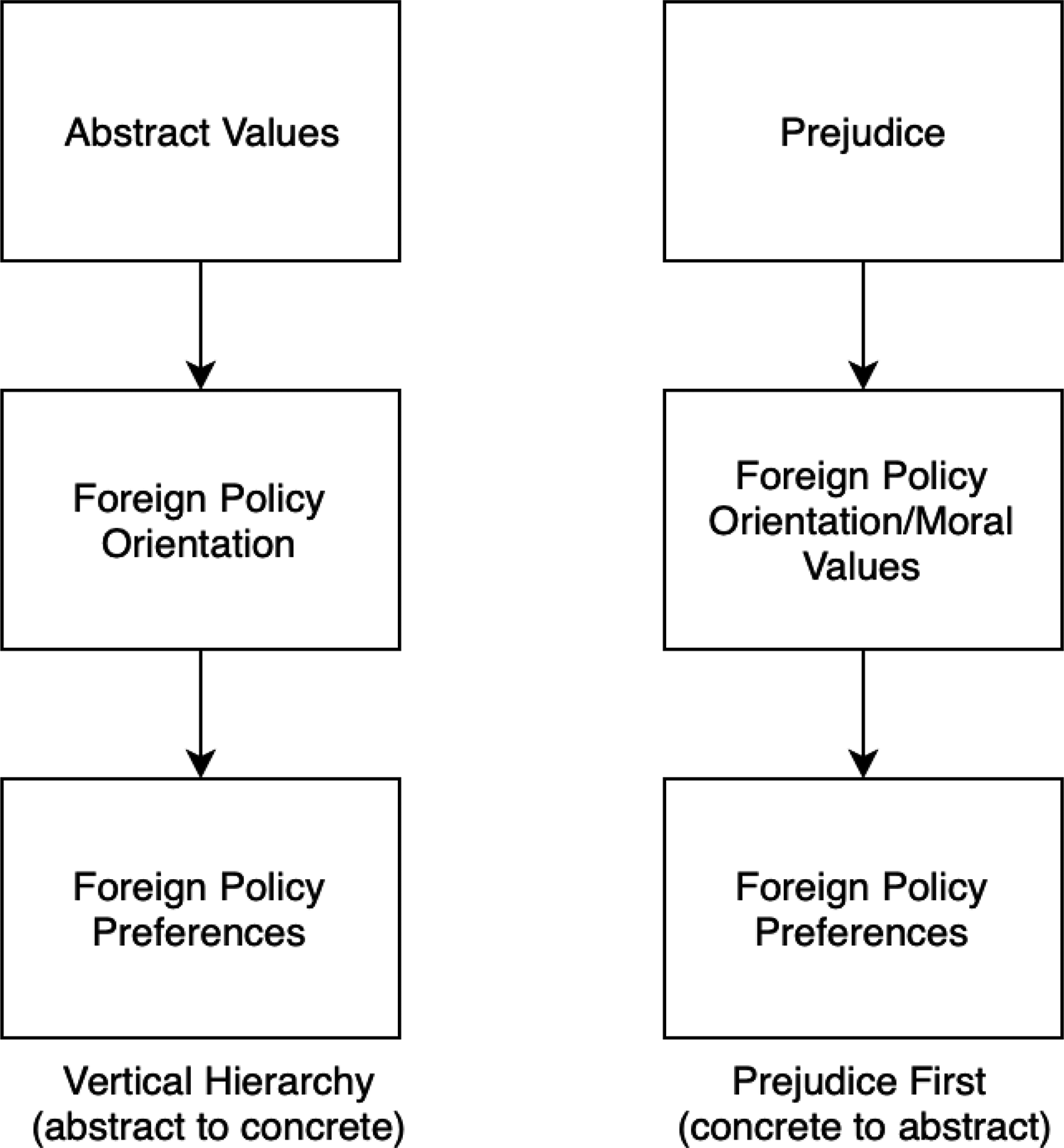
Two models of foreign policy preference formation.
While the Vertical Hierarchy Model assumes that we go from more abstract to more concrete, the Prejudice First Model assumes the opposite. This is motivated by the finding that people have limited cognitive resources, and will prefer answering an easier question to grappling with a more difficult one (Kahneman, 2011). This is especially likely when they are thinking about politics, where people are highly unlikely to directly face the consequences of their preferences, and are free to seek expressive utility alone (Caplan, 2011). Applying moral intuitions to policy issues is hard when compared to simply deciding which side one is on first and then adopting the appropriate beliefs.
The Prejudice First Model is not intended to completely supplant the Vertical Hierarchy Model. Both models are clearly simplifications and will apply more or less given the political and societal context. It is unquestionably true that people sometimes adopt positions for principled reasons and are guided by moral intuitions. At the same time, it is no less subject to doubt that we also engage in tribal thinking, adopting and abandoning positions depending on how we feel toward the parties endorsing or benefiting from them (e.g. Tesler, 2012; Druckman et al., 2013). Both models are true in part because people seek to avoid cognitive dissonance, or noticeable inconsistencies between their differing beliefs or between their beliefs and actions (Mullainathan and Washington, 2009; Taber and Lodge, 2006). In some countries, identity is an almost perfect predictor of voting and explains most of the variation in moral and political attitudes. In other times and places, people are allowed to pick their “tribe,” and the Vertical Hierarchy Model is more useful, although even in these cases once the tribe is formed we would expect to see aspects of the Prejudice First Model.
Below, we investigate the effects of prejudices on political attitudes; we do not investigate the origins of attitudes. It is possible that some prejudices originated in part in moral judgments. For example, a prejudice in favor of protecting some group from harm may have formed from the experience of witnessing that group mistreated. This is an intriguing possibility that we do not investigate. Rather, we examine political decision-making at a later stage when existing prejudices interact with moral and political questions. We will show that when these prejudices are engaged, they interfere with the application of abstract principles to concrete foreign policy situations. While we expect the abstract principles of the Vertical Hierarchy Model to influence political attitudes, when prejudices are engaged, we expect them to usually have the larger effect. In these cases, our model predicts that prejudice motivates individuals to reason from the concrete to the abstract, from desired outcome in terms of groups helped and hurt to moral justification rather than from principle to desired outcome as the Vertical Hierarchy Model predicts.
Some examples will perhaps make the distinction between the Prejudice First Model and the Vertical Hierarchy Model easier to understand. Imagine there are atrocities being committed in a foreign country, by a government affiliated with one demographic group against a group that is out of power. The Moral Foundations or Schwartz model would predict that factors such as the degree of the repression and the nature of the relationship between the two ethnic groups before the killing started would tap into values such as care and fairness and predict how people respond. The Prejudice First Model, in contrast, believes that while one might find moral values to have an effect in an experiment, when Americans are interpreting events in the real world, they are driven more by their feelings toward the groups involved. Donald Trump while running for president, for example, would occasionally mention the plight of Middle Eastern Christian oppressed by Islamists, in a campaign that was not otherwise noted for its concern with global human rights. Those on the left can arguably be just as selective. As Jeremy Rabkin (2005: 172–173) has pointed out, internationalist liberals who run NGOs and work at the UN acted in unison on the issue of white discrimination against blacks in South Africa and the former Rhodesia, while remaining almost completely indifferent to Idi Amin’s expulsion of a hundred thousand people of Asian descent from Uganda, or the slaughter of Hutus by the Tutsi-controlled government of Burundi in 1972. The Prejudice First Model argues that such double standards are the norm rather than the exception in explaining public opinion, and that an observer seeking to make accurate predictions about which kinds of oppression will attract notice and outrage by a particular segment of the US public will do better by knowing the identities of the relevant foreign groups than other facts specific to what is happening.
There are four reasons why the Prejudice First Model deserves more consideration in the International Relations literature. Perhaps the most important among these is that, while abstract moral values do seem to provide an explanation for political differences when such values are considered in isolation, such factors have often been shown to be extremely weak when they are measured against prejudice, whether partisan, racial, or religious in nature. When US voters judge the behavior of leaders that is arguably immoral, partisanship rather than moral foundations drives most of their reactions (Walter and Redlawsk, 2019). Interestingly, how respondents scored on moral foundations had much more of a predictive effect when the politician being judged was unaffiliated with a party, showing how studies that abstract out matters of identity can mislead us about what is driving political attitudes in the real world. Turning away from partisanship and toward race, analysts of US politics have found that racial identity similarly trumps practically all other variables in predicting voting behavior (Hersh and Clayton, 2016). When scholars have measured preferences with regard to issues such as school busing and affirmative action, attitudes toward the group the policy seeks to help have been shown to dwarf the impact of economic interest as objectively measured (Caplan, 2011: ch. 3–4; Kinder and Sears, 1981). The universal importance of group prejudice can be seen in the degree to which combatants in civil wars coalesce around ethnic and religious identities (Sambanis, 2001). While there is evidence that abstract moral values can fade into irrelevance when racial, religious, and partisan identities are activated, we are unaware of any literature that finds the opposite: that people’s prejudice can be made irrelevant through moral appeals. 1
A second line of evidence in favor of the Prejudice First Model is studies showing that partisans take cues from elites on issues, sometimes changing their opinions on a topic virtually overnight (Baum and Groeling, 2009; Hooghe and Marks, 2005). A 2015 experiment asked Americans their views on the issues of entitlement reform, universal healthcare, affirmative action, and the Iran nuclear deal (Edwards-Levy, 2015), presenting each proposal as made by either a Democrat or then-candidate Trump. Both Democrats and Republicans showed a bias toward positions endorsed by a member of their own party. Natural experiments from the recent past show how quickly public opinion can change based on what politicians tell their followers. After President Obama endorsed same-sex marriage in 2012, support for it among African Americans immediately jumped by 18 points according to one poll (Demby, 2012), while the 2016 presidential campaign appears to have led Republicans to shift their views of Vladimir Putin (Nussbaum and Oreskes, 2016).
Third, research shows that people in Western democracies, and perhaps elsewhere, do not only let their prejudices affect attitudes toward political questions that are domestic in nature. Sabet (2016) finds that economic interest is a “second order” determinant of opinion towards foreign trade among workers in the United States, only showing a noticeable impact when cultural attitudes toward foreign influences are weak (see also Rho and Tomz, 2017). Cross-nationally and among individuals, cosmopolitan sentiments are generally correlated with pro-trade views, with nationalist and patriotic attitudes predicting opposition (Mayda and Rodrik, 2005). Similar results are found with regard to the issue of immigration, with perceptions of cultural threat being more important than perceptions of economic threat (Kaufmann, 2019; Lucassen and Lubers, 2012). Even when economic considerations appear to play a role, it is often because an underlying bias drives reasoning with regard to the costs and benefits of a given policy; people are more likely to imagine that they are losing out in interactions with members of an outgroup (Caplan, 2011).
Finally, it is clear that prejudice has a role to play in how individuals consider issues of war and peace, with the identity of a potential target affecting citizens’ perceptions of the adversary and their willingness to take action against it (Alexander et al., 2005; Herrmann and Fischerkeller, 1995; Herrmann et al., 1997). One of the most relevant discoveries in this area is the finding that in the United States and Great Britain, respondents are less likely to want to go to war if the potential target is a democratic state (Herrmann et al., 1999; Johns and Davies, 2012; Mintz and Geva, 1993). These studies are important because they suggest a mechanism that may be partly responsible for the democratic peace: the public may be less likely to support war against those who share a similar political system. Americans are also more likely to want to strike at an enemy that violates human rights and to see such states as threatening (Tomz and Weeks, 2013, 2018). The same applies if a potential adversary is Muslim rather than Christian, although the effects are only apparent among respondents who are themselves Christians (Johns and Davies, 2012).
Thus, given the fundamental role that prejudice plays in politics, it is necessary to more fully explore its role in shaping foreign policy preferences. This article presents the results of three experiments designed to test the validity of the Prejudice First Model and explores whether it can explain the abstract values that people adopt in addition to their policy preferences. We also seek to test the strength of the Prejudice First Model against the Vertical Hierarchy Model. The first two experiments involve humanitarian interventions, and predict that conservatives and liberals will be prejudiced with regard to whom they want to help but in different ways. In the final experiment, we utilize a widely used measure of Isolationism to investigate the extent to which manipulating how Americans feel about their country makes them want to withdraw from the international arena.
Humanitarian intervention and prejudice
Previous studies on how perceptions of the enemy affect support for conflict have assumed that citizens reason in a strategic context. Yet today virtually all wars fought by developed democracies have a humanitarian component; leaders take great pains to avoid casualties, and in many cases even try to leave behind democratic institutions. While prejudice has been shown to play a role in perceptions of threat, do attitudes toward affected parties matter when respondents are asked to consider interventions that are exclusively humanitarian in nature?
Wars framed as humanitarian missions have traditionally had more support among the US public than other kinds of conflict, and humanitarian justifications can be key to mobilizing domestic coalitions (Jentleson and Britton, 1998; Maxey, 2019). Such conflicts have more support if they are endorsed by international organizations such as the UN or domestic political elites (Grillo and Pupcenoks, 2017; Grillo et al., 2011) and are seen as having a higher likelihood of success (Boettcher and Williams, 2004; Grieco et al., 2011; Lyon and Malone, 2009). They become less popular when respondents are told of the possibility of US or foreign casualties (Eichenberg, 2005; Gelpi et al., 2009).
Relatively little research, however, has explored how the nature of the relevant victim and potential enemy affects preferences over humanitarian action. Humanitarian intervention is an ideal place to look for bias in foreign policy preferences, as it involves what is essentially a form of international charity. Although previous studies show that prejudice influences perception of the intention and threat coming from a potential adversary (James and Davies, 2012; Stein, 2016), such results could reflect an underlying strategic reasoning. Meanwhile, similar differences in support or opposition to humanitarian intervention are more likely to be the result of prejudice, or favoring the well-being of some groups over others.
In the context of humanitarian intervention, groups and individuals are prejudiced when, all else equal, their attitudes toward the use of force or other aggressive action are determined in part by the identities of the oppressors or those being persecuted. In other words, moral or political judgments are made based on the identities of those affected rather than universalist principles. Prejudice, as defined in this article, exists across the political aisle. An earlier literature tended to only look for—and find—prejudice among those with conservative political leanings (e.g. Whitley, 1999; Laythe et al., 2001). Other scholars, however, have taken issue with this characterization of the data, finding that conservatives and liberals are both biased, but in favor of and against different groups of people (Chambers et al., 2013; Crawford, 2012; Duarte et al., 2015; Ray, 1985). In our first two experiments, we will evaluate the foreign policy effects of two clear prejudices that other research identifies in the contemporary United States.
Religious prejudice
Humans all over the world tend to divide themselves by religion and show a preference for members of their own faith. The majority of Americans identify as Christians. Muslims, in contrast, not only make up a minority of the population, but also fall outside the cultural mainstream and, compared to other racial and ethnic groups, are seen quite negatively by the public (Kalkan et al., 2009). This prejudice is driven in part by perceptions of threat that are reinforced whenever there are terrorist attacks committed by Islamic extremists (Wike and Grim, 2010). This leads to our first prediction from the Prejudice First Model.
We have no reason to think that all Americans are equally biased, however. First, conservatives are more likely to be believing Christians themselves and more likely to hold negative views of Muslims due to anti-Muslim rhetoric concentrated on the right (Layman, 2001). Second, liberals often see themselves as champions of minorities that are discriminated against, and there is evidence that in some contexts they actually exhibit an anti-Christian or pro-Muslim bias (Crawford, 2012). Therefore, we expect that:
The Prejudice First Model predicts not only that prejudice will influence policy preferences, but that it will also change ideas about morality. As individuals are thought to move from more concrete instincts to more abstract reasoning, the prejudice will manifest itself in a desire to help the favored group, which in turn could affect perceptions of how the United States should behave internationally (Figure 1). This leads to our third and fourth hypotheses derived from the Prejudice First Model. The Vertical Hierarchy Model, by contrast, which views morality as a cause rather than an effect, predicts a null effect in each case.
Racial prejudice
As virtually any state or national exit poll will show, Americans tend to vote along racial lines. Whites tend to support the Republicans, while non-white Americans, especially African Americans, vote overwhelmingly for Democrats. Among white Americans, racial attitudes predict ideology and partisan identification (Kinder and Sears, 1981). Once race is accounted for, in fact, over the last few presidential elections the connection between income and voting has been small to nonexistent (Tyson and Maniam, 2016). Attitudes toward race issues appear to be at the heart of what it means to be liberal or conservative in the United States. One may therefore expect liberals to be biased toward helping blacks persecuted by whites, while conservatives are more likely to have the opposite prejudice.
Previous research suggests that if racial bias exists, however, it is likely to be there among liberals only. Tetlock et al. (2000) showed that when told a policy disproportionately hurt African Americans, liberals were more likely to oppose it, while they were unaffected if they knew that it disproportionately harmed white Americans. Conservatives, in contrast, showed no preference in either direction. Uhlmann et al. (2009) carried out a version of the famous trolley experiment in which they asked individuals whether it was morally appropriate to throw one large man in front of a trolley in order to save 100 lives. For half of the participants, the man being thrown had a stereotypically black name, while for others he was given a stereotypically white one. It was implied that the 100 people being saved were predominately of the opposite race from the person who might be thrown. Liberals were more likely to want to throw Chip Elsworth III in front of the trolley than Tyrone Payton, while changing the name had no discernable effect on conservatives. The results were replicated in a follow-up experiment in which researchers asked participants whether it was appropriate to throw an individual overboard in order to save others on a lifeboat. Given the state of the research, we expect that:
This preference of liberals, many of them white, is different from a prejudice for coethnics or coreligionists. It is not necessarily a preference for the well-being of an in-group over an out-group. Nevertheless, it fits our definition of prejudice and we believe it is useful to consider all attitudes that value the well-being of one group over another in a unified framework. Note that H5 does not necessarily imply that liberals are consciously biased (see Chambers et al., 2012; Norton et al., 2004). Rather, in randomized conditions, they are more inclined toward helping blacks, even when everything besides race is held constant in a given scenario.
The Vertical Hierarchy Model has no category for the race of victims and perpetrators and therefore predicts a null result for H5. Note, however, that H5 is consistent with the origin of a liberal prejudice for helping black victims to be found in moral judgments. The experience of witnessing racial discrimination domestically may lead liberals to draw on this analogy in forming a judgment about what to do internationally. In effect, left-leaning respondents may side with the international analogues to groups they consider historically marginalized and whom they feel a duty to protect. Our analyses do not allow us to detect the origin of this prejudice, but merely to detect its existence and effects. It is nevertheless important to recognize that support for H5 represents prejudice according to our definition when the racial bias does not stem from morally relevant facts in a particular instance.
Determinants of isolationism
As mentioned, scholars have generally found that US foreign policy beliefs fall along three dimensions: CI, MI, and Isolationism (Holsti and Rosenau, 1990; Rathbun, 2007; Rathbun et al., 2016). While the first two belief systems are related to liberalism and conservatism respectively, Isolationism has puzzled students of US foreign policy preferences (Kertzer, 2013). Observers have noted that pundits and thinkers on both the far right and the far left are often highly critical of US foreign policy and urge the country to focus more on its internal affairs (Rachman, 2016). Investigations into the moral roots of Isolationism have met with limited success. Rathbun (2007) found that Americans who support isolationism tend to be those who have a stronger attachment to fellow Americans but less attachment to the international community. Some have tried to use the Schwartz or Moral Foundations frameworks to investigate whether support for isolationist foreign policy is tied to more abstract beliefs about right and wrong. Yet Kertzer et al. (2014) found that none of the five Moral Foundations predicted support for isolationist principles. Rathbun et al. (2016) used the Schwartz moral values framework and although they found that isolationists were high on conservation values and low on benevolence, the associations were not very strong (see also Gries, 2014: 102–103). The limited and weak findings when investigating Isolationism stand in contrast to the findings on CI and MI, which have been more consistent with the Vertical Hierarchy Model.
While the ideology has been hard to pin down, popular understandings of isolationism suggest that it could be best understood through the lens of the Prejudice First Model. This article argues that Isolationism stems in part from a sense of alienation from the country, or at the very least those who make decisions about foreign policy. This sense of non-belonging can come from a variety of sources, including the belief that one’s country is seriously flawed or heading in the wrong direction, or that its leaders are somehow unrepresentative of the public. Isolationism has less of an ideological component than MI or CI. Rather, what is key is that the isolationist, whether on the right or left, feels alienated from the polity that others would like to see influence the rest of the world. This also explains the widely observed bipartisan consensus that perhaps until recently led centrists of both parties to defend US involvement abroad (Kupchan and Trubowitz, 2007). Presumably, those who are centrist in their politics are most satisfied with the status quo, and more likely to want to spread US values. In the Prejudice First Model, attitudes are driven less by moral intuitions about the value of cooperation and appropriateness of using force in the international system, and more by how closely one identifies with the United States.
The Vertical Hierarchy Model has argued that foreign policy orientation derives from values, without considering the possibility that it is more fundamentally an expression of how one feels about national identity. This approach has had limited success when explaining Isolationism, even in the context of a literature on moral values that has a tendency, as we argued above, to be constructed in a way that exaggerates the influence of objective moral reasoning under realistic conditions. In the Prejudice First Model, in contrast, how one interacts with the rest of the world is more dependent on the way and the degree to which one identifies with the nation as a whole. While conservatives are more likely to identify with the nation and praise loyalty as a virtue as an abstract matter, this is different from actually supporting the US government when one stops to consider one’s beliefs about the nation in the midst of the political debates that animate the general public. We therefore put forth the following predictions.
While most of our earlier hypotheses use the Prejudice First Model to explain concrete views of policy, when we measure Isolationism we are trying to understand determinants views that are more abstract. By manipulating how individuals feel about the United States and showing that this can be connected to the degree to which respondents endorse a more isolationist foreign policy, we show how instinctual feelings toward the relevant group, in this case the nation, drive beliefs about what is considered right or wrong behavior. Although it is possible that morality drives any results we find by making individuals change their minds about what the United States would actually do abroad, we believe that the findings would be most consistent with the Prejudice First model given our other results, the simplistic models that seem to drive reasoning about political issues, and the difficulty scholars have had connecting Isolationism to moral values.
Methods
This article involves three different experiments. The first two were designed to test for racial and religious prejudice in preferences over humanitarian intervention and were part of a study involving a representative sample of 2702 US respondents. They were part of a questionnaire that included a measure of Moral Foundations and Schwartz’ 10 basic values (see Supplemental Material). The third experiment was carried out through MTurk with the recruitment of 1502 individuals and was designed to test whether a Prejudice First Model prediction can explain the vexing problem of why respondents adopt an isolationist outlook.
Experiment 1
Respondents were asked to provide demographic information and to rate themselves on a five-point ideological scale from “very liberal” to “very conservative.” In both of the first two experiments, the researchers altered the identities of those doing the oppressing and the group being persecuted along racial and religious lines. Other aspects of the vignette were also manipulated for two reasons. First, this was done to address the possibility that we were unintentionally inserting confounding variables while testing our variables of interest (see Dafoe et al., 2015; Tomz and Weeks, 2015). In particular, the vignettes manipulate the degree of discrimination against one of the groups and the permissibility of an attack under international law. In none of the examples was the potential target presented as any kind of threat to the United States, and participants were only made aware of potential downsides of intervention to the country. Therefore, differences in willingness to use force among respondents should reflect prejudice toward the actors involved. See the Supplemental Material for the exact wording of the prompts and questions. Second, adding other manipulations allows us to test the effects of prejudice against other variables. It is important not only to study the role of prejudice in shaping foreign policy preferences, but to also see how important prejudice is compared to other variables that may influence support for aggressive action.
In Experiment 1, Zykonia is an African country that is composed of Christians and Muslims, with one religious group or the other, depending on the prompt, making up 90% of the population. Members of the majority begin killing the minority. Respondents are told that either hundreds or thousands have been killed, to manipulate the extent of the persecution. In one vignette, participants also read that bombing Zykonia would be inconsistent with international law, while the rest were told that the United States could legally intervene under the concept of the “right to protect.” The survey then asked whether the respondents would support a bombing campaign to prevent further deaths. They were also told to indicate their level of agreement with the statement that “The US has a moral obligation to help those who are targeted by their governments” on a seven-point scale, in order to test H3 and H4.
Experiment 2
In the second experiment, Cyton is a biracial state, made up of blacks and whites, located in either Europe or Africa depending on which is the majority population in a given prompt. The country is having economic problems, and the government begins to blame the prosperous minority—once again, either black or white—living in its midst. The state begins to expropriate property from the disfavored group and discriminate against it in hiring. Changing the races of the oppressors and the oppressed allows us to see the effects of racial prejudice when the circumstances are otherwise as similar as possible. In half of the prompts, a few individuals from the minority are killed. The government is presented as either picking on the minority unfairly or being justified in claiming some members of the group were responsible for economic troubles. Finally, some respondents were told that the United States has a treaty to defend human rights on the relevant continent, while others heard that the United States traditionally tries to stay out of the internal affairs of the region. We then posed questions that enable tests of H5 and H6. Participants were asked whether the United States should put sanctions on Cyton and whether they could see themselves supporting a war if the situation deteriorated further. Once again, the intervention is presented as only bringing potential harms to the United States.
Experiment 3
In the final experiment, individuals were asked to provide basic demographic information, and once again identify themselves politically on a five-point scale. Half of participants read a text where the United States was presented as trending liberal, while the others heard an argument that the country was very conservative compared to other developed nations. Participants are then asked to answer four questions commonly used in the literature to measure support for an isolationist foreign policy (Rathbun, 2007; Rathbun et al., 2016), enabling tests of H7 and H8 (see the Supplemental Materials).
Results and discussion
In Table 1, we present the results of six OLS regression models based on Experiment 1. Respondents were divided into three groups: those that identified as very or somewhat liberal, those who called themselves moderates, and a third group that said they were very or somewhat conservative. We include all the treatment variables in each model. They are as follows:
Muslim Majority. Coded as 1 if Muslims are the majority oppressing a Christian minority, 0 in the opposite scenario.
International Law. Coded as 1 if the mission is said to be consistent with international law, 0 otherwise.
High Kill. If hundreds have been killed, this is coded as 0, and 1 if thousands have been killed.
Support for bombing Zykonia, by ideology.
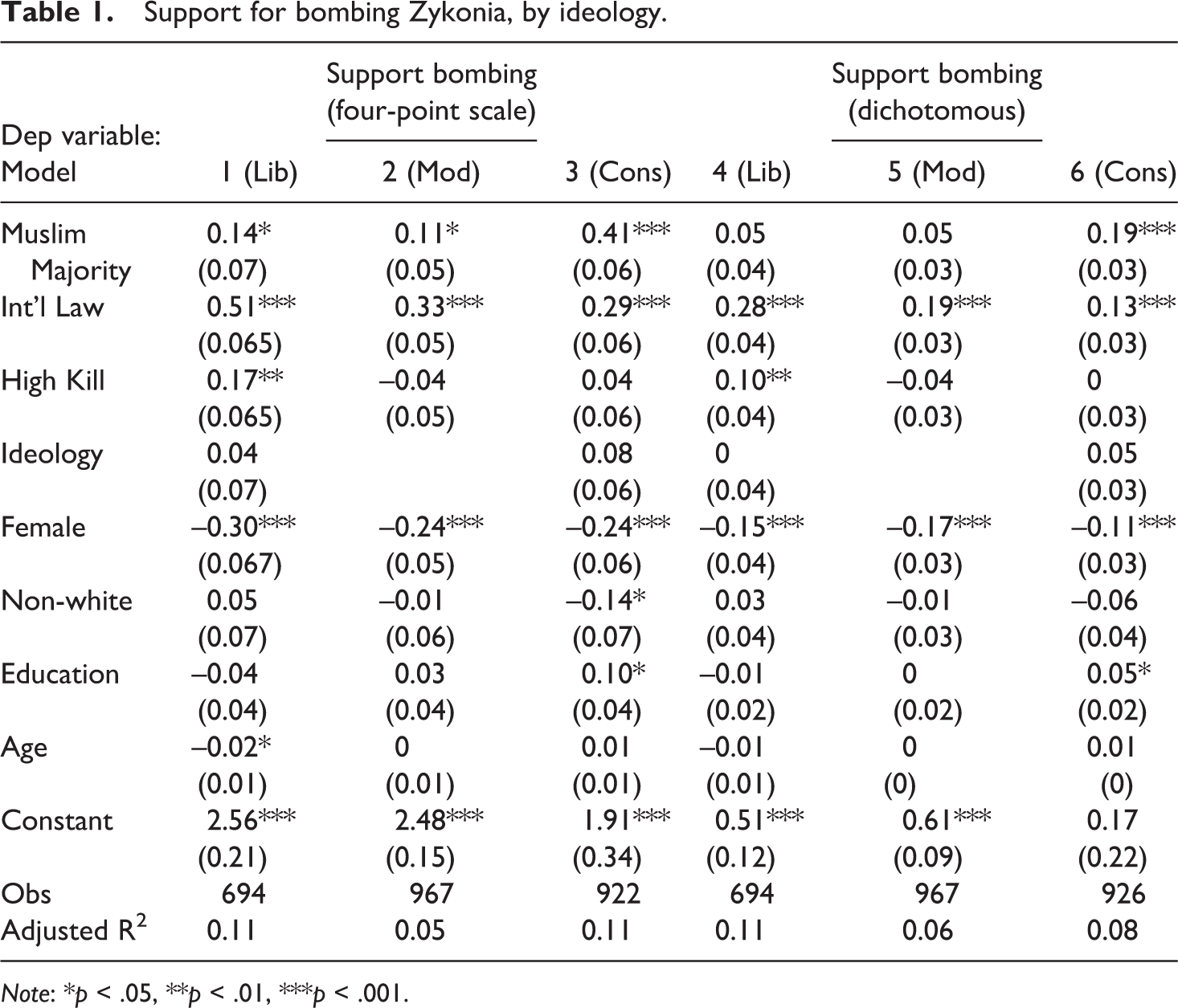
Note: *p < .05, **p < .01, ***p < .001.
Certain demographic and socioeconomic variables correlate with ideology, and in order to determine whether the effects we are interested in are not influenced by these factors, we control for the most important of these.
Sex. 0 = male, 1 = female.
Education. 1 = no high school degree, 2 = high school graduate, 3= college graduate, 4= post-college degree.
Age. Broken down into 13 cohorts, from 18–25 to 81 and over.
Ideology. Within the categories of conservative and liberal, there is a dummy variable for whether respondents said that they were very or somewhat conservative/liberal. In the models for liberals, 0 = very liberal, and 1 = somewhat liberal. For the models involving conservative respondents, 0 = somewhat conservative, 1 = very conservative. This is done so that the variable Ideology can consistently be interpreted as indicating more conservative across the models.
Non-white is coded 0 if the individual identified as white, 1 otherwise.
Models 1–3 take willingness to bomb Zykonia on a four-point scale as their dependent variable. Responses are coded from 1 through 4 for strongly oppose bombing, somewhat oppose bombing, somewhat support bombing, and strongly support bombing. Models 4–6 have the same independent variables, but the dependent variable is changed to dichotomous support for bombing (0 = no, 1 = yes). We find strong support for both H1 and H2. In every model, the coefficient for Muslim Majority is positive, with the largest effects being on conservatives. While liberal and moderate dichotomous support for bombing increases by 5% when Muslims are the majority, the effect on conservatives is nearly four times as strong. Consistent with previous research (Chilton, 2014; Wallace, 2013), an action being allowed by international law makes respondents more likely to want to intervene. To conservatives and moderates, it mattered little whether respondents were told that hundreds or thousands had been killed. Liberals, however, became 10% more likely to support an attack in treatments with the higher number of victims. For conservatives, the identity of the oppressors and the oppressed mattered more than any other treatment variable. The effect of Muslim Majority is also statistically significant if probit or logistic regression is used in place of Model 6. Overall, the results of the first experiment strongly support the first two Prejudice First Model hypotheses.
Table 2 presents Models 7–9. This time, the dependent variable is whether respondents agree with the statement that the United States has a moral obligation to help those being harmed by their own governments on a seven-point scale (Moral Obligation), with a higher number indicating greater agreement. The independent variables are the same as in Table 1.
Support for moral obligation to help others (seven-point scale).
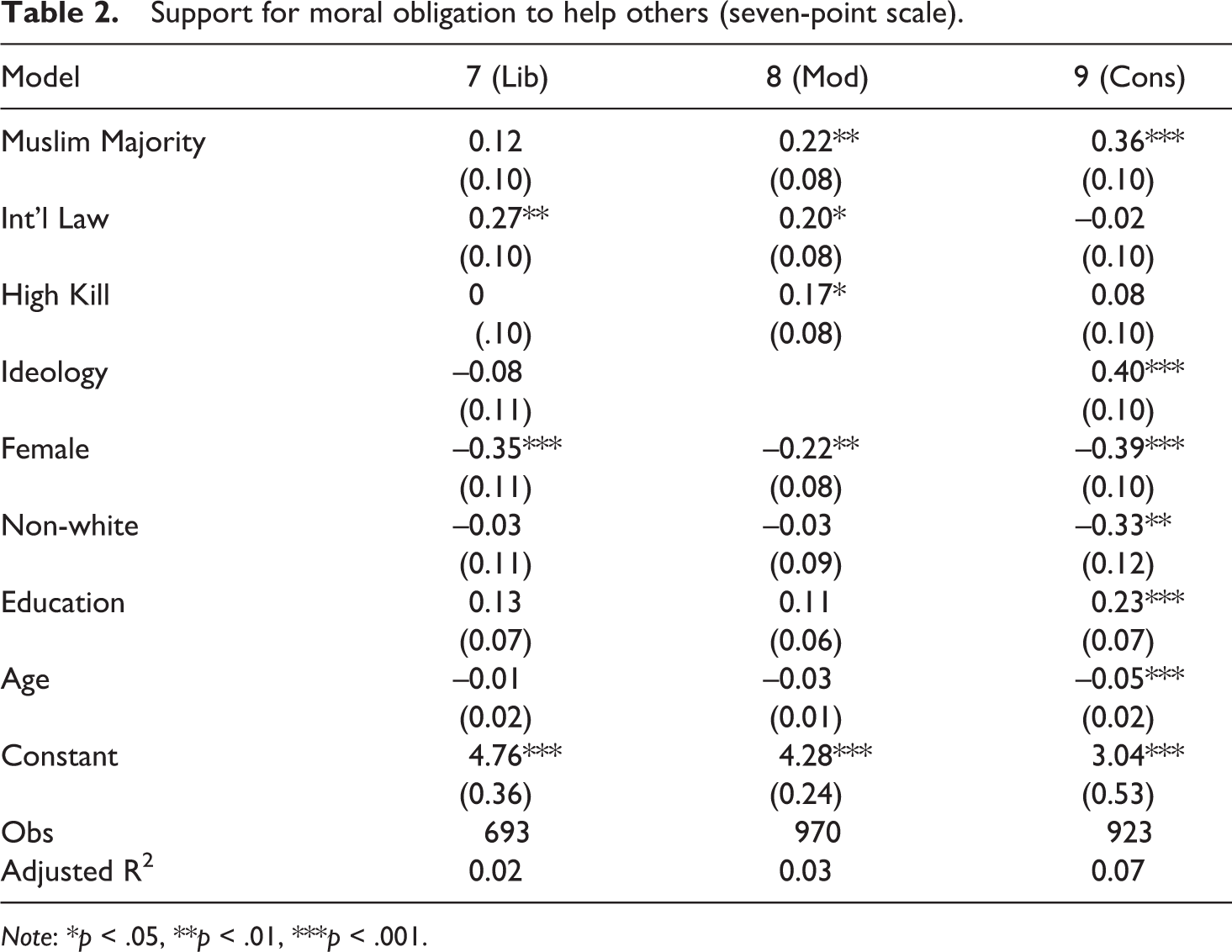
Note: *p < .05, **p < .01, ***p < .001.
Consistent with H3, we find that conservative Americans in particular are more likely to agree that there is a moral obligation to interfere after hearing about Muslims killing Christians. A smaller effect is found for moderates, while the coefficient for liberals is in the expected direction but not statistically significant. Figure 2 shows support for intervention based on ideology, which allows us to understand absolute levels of support for war depending on ideology and the prompt received. When there is a Christian majority killing Muslims, ideology has no discernable effect on desire to intervene, as liberals and conservatives are about equally hawkish. However, in the opposite scenario, where Christians are the victims, conservatives become much more likely to want to go to war. As expected, the largest effect of the treatment is on those who call themselves “very conservative”; while only 46% of this group wants US military force to be used to stop Christians killing Muslims, the number goes up to 69% when Christians are the victims. As individuals become more conservative, the effect of the treatment increases.
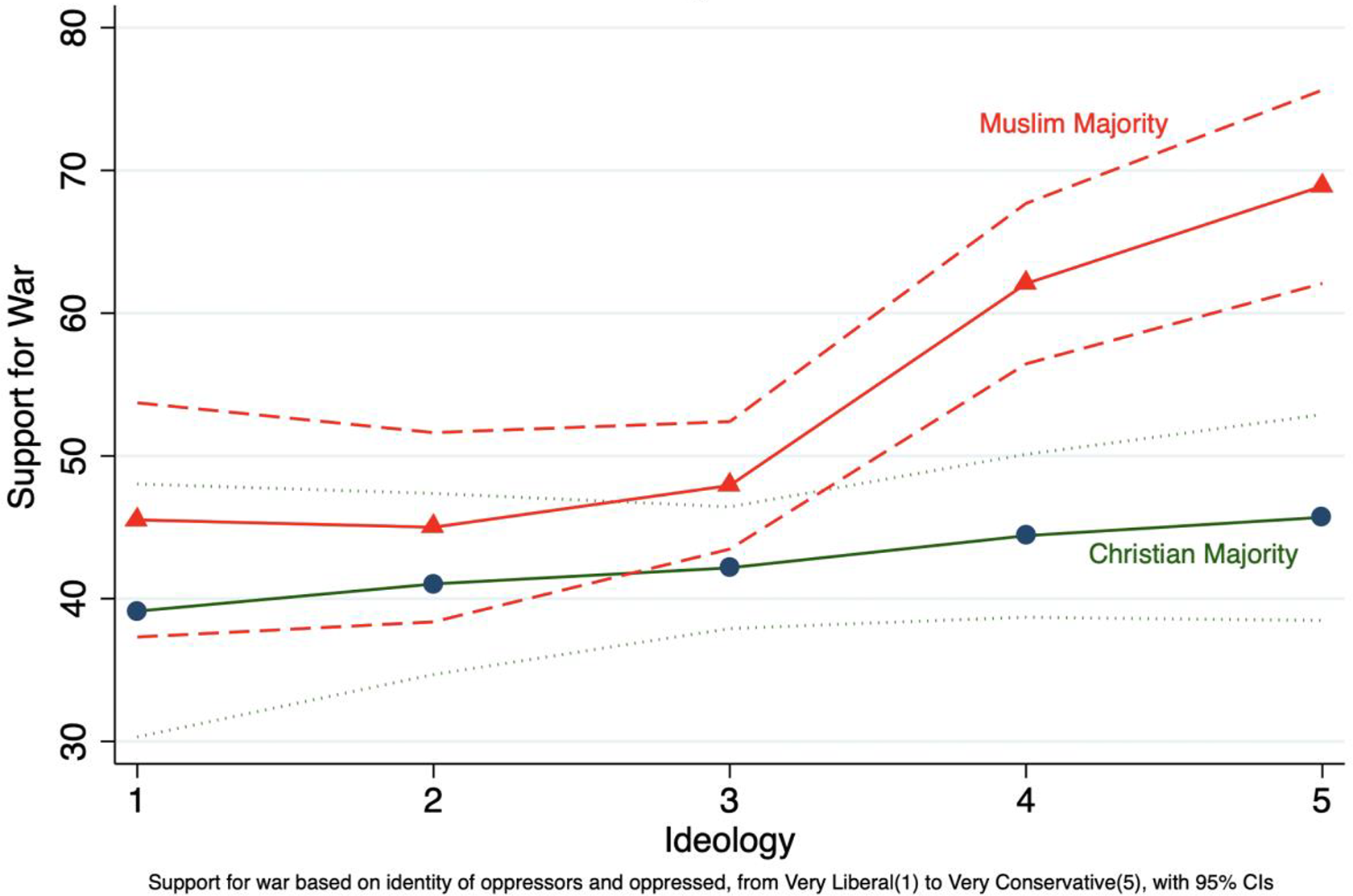
Support for war based on identity of oppressors and oppressed, from Very Liberal (1) to Very Conservative (5), with 95% CIs.
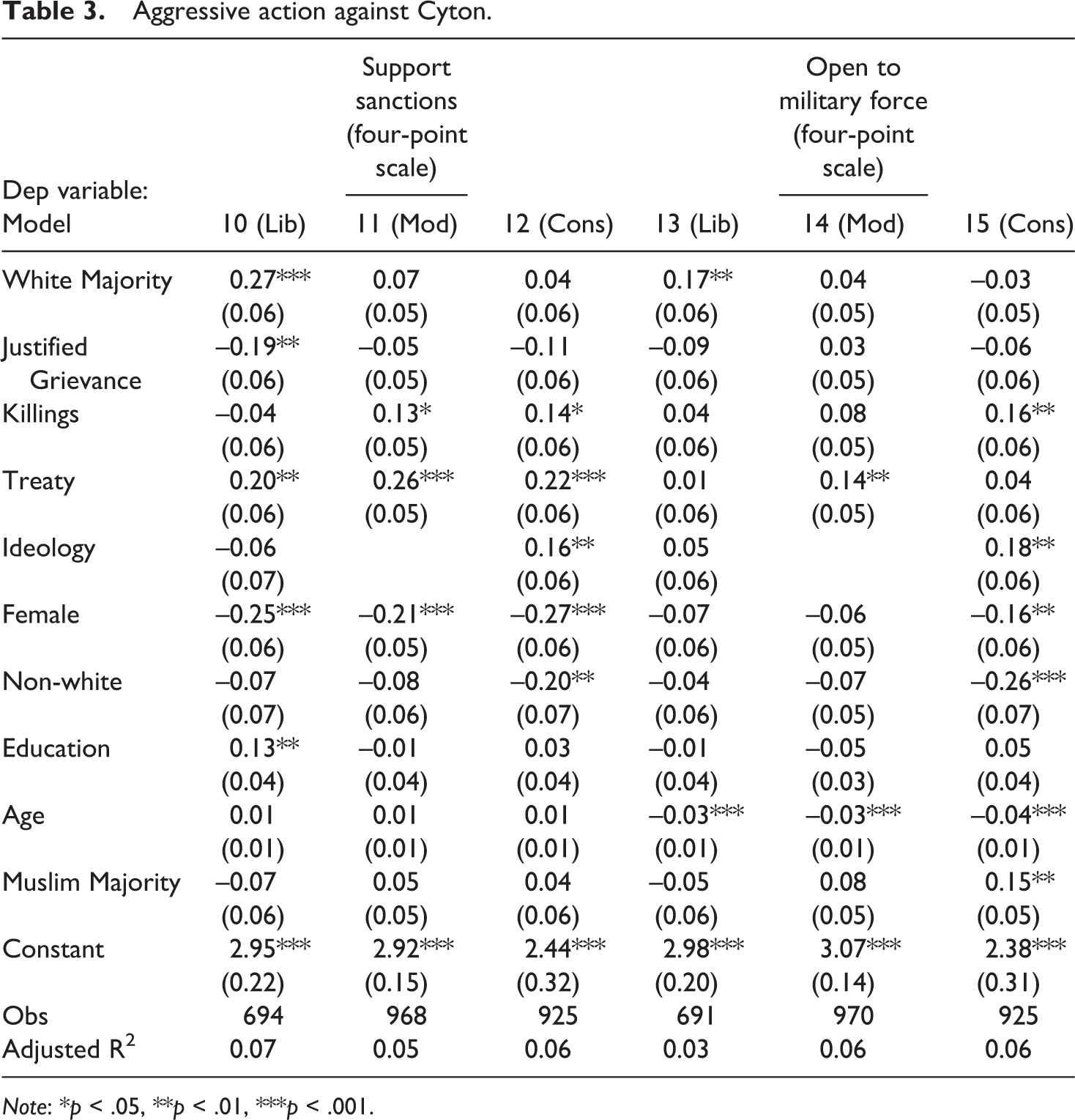
Table 3 shows the results of six regression models that analyze Experiment 2. In the first three, the dependent variable is willingness to put sanctions on Cyton on a four-point scale from “strongly oppose” to “strongly support.” In the second set of models, respondents were asked to indicate the extent to which they thought that they could support using military force to intervene if the situation deteriorated further, once again on a four-point scale. The treatment variables are as follows.
Aggressive action against Cyton.
Note: *p < .05, **p < .01, ***p < .001.
White Majority is coded 1 if whites are the majority oppressing a minority black population in Europe, 0 if blacks in Africa are oppressing a white minority.
Justified Grievance is 1 if the minority being persecuted had some role in bringing about the economic problems of the country, 0 if the government is scapegoating them without cause. This is to account for the possibility that respondents may make assumptions about the degree to which grievances are justified based on the identities of the actors or the location of the dispute (see Dafoe et al., 2015).
Killings is 1 in cases where a few individuals are killed as a result of government scapegoating the minority in question, 0 otherwise.
Treaty is coded as 1 in treatments in which the United States has a treaty to uphold human rights on the continent in question, 0 if respondents are told that it has traditionally tried to stay out of the problems of the region. This is to address the possibility that moving the location of the conflict to a different continent influences ideas about norms regarding the use of force there.
Muslim Majority, a treatment from Experiment 1 fielded immediately prior to Experiment 2 on the same set of respondents, is included in this analysis. According to the Prejudice First Model, a treatment that made respondents more likely to support a moral obligation to use force in one scenario will lead them to become more supportive of force in another context, due to a need to minimize cognitive dissonance. The same controls for ideology, sex, age, and education mentioned in the previous models are also included.
We find support for both H5 and H6. The largest treatment effect for liberals in both Model 10 and Model 13 is White Majority, while this time it is conservatives that show no identity-based bias. Figures 3 and 4 reveal the change in support for sanctions and war depending on ideology and the identities of the perpetrators and victims in a given scenario.
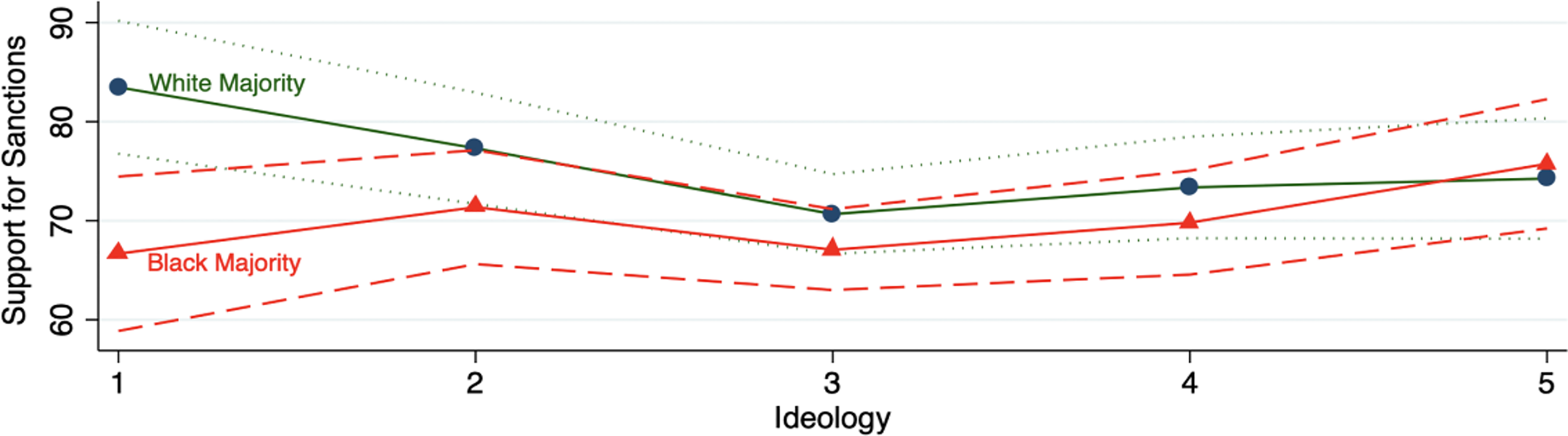
Support for sanctions based on identities of oppressors and oppressed, from Very Liberal (1) to Very Conservative (5), with 95% CIs.
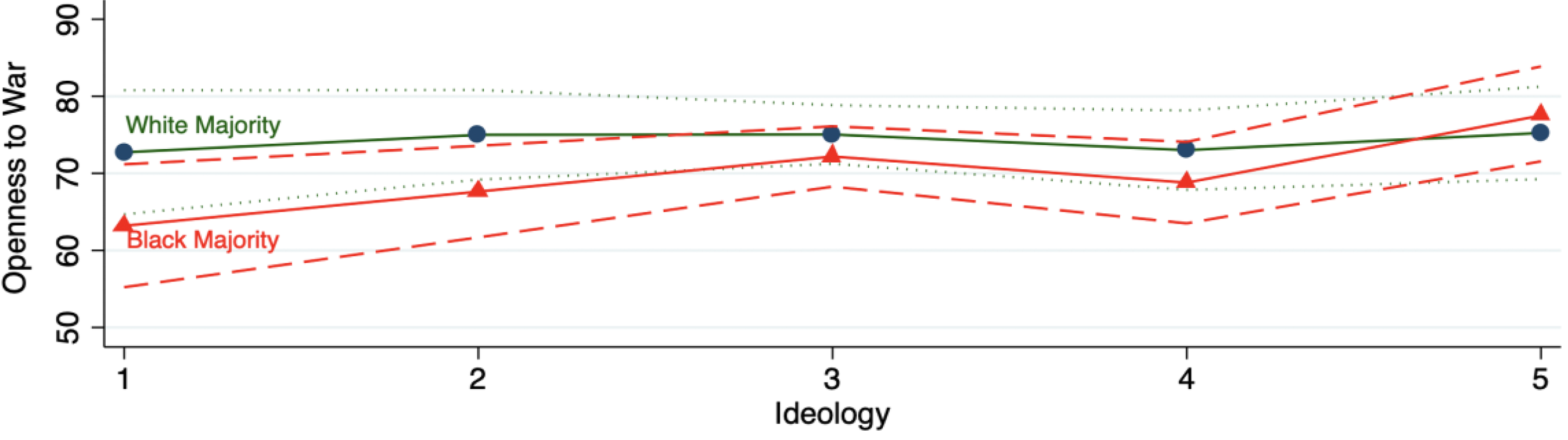
Openness to war based on identities of oppressors and oppressed, from Very Liberal (1) to Very Conservative (5), with 95% CIs.
Among those who are very liberal, support for sanctions went from 67% to 83% when the identity of the oppressing race was changed from blacks to whites. The effects were much smaller on those who identified as somewhat liberal, and practically nonexistent among everyone else. Among conservatives, hearing about a Muslim majority killing Christians made respondents more likely to believe in a moral obligation to intervene as a general principle, and more supportive of military intervention in both the first and second experiments. Figure 5 shows mediation analysis for support for intervention in Experiment 1 and Experiment 2 among conservatives using structural equation modeling (Preacher et al., 2007). Standard errors and confidence intervals are calculated through bootstrapping using 1000 replications. Conservatives who received the Muslim Majority prompt became more likely to endorse Moral Obligation, and also more likely to support war in both scenarios. 2 In other words, when conservatives heard about a Muslim majority oppressing Christians in Experiment 1, they became not only more likely to support war in that experiment, but also in a completely unrelated scenario, with the effects being mediated by changes in their beliefs about the moral necessity of the United States helping those oppressed by their governments. This is notable in that it indicates that individuals seek consistency in their moral views in a relatively sophisticated manner; changes in moral beliefs are not simply adopted or discarded for the purposes of reasoning about one issue, but have downstream effects when an individual is thinking about others. Somewhat ironically, however, the consistency in principle observed in this study is at its root driven by prejudice. In our view, this is important evidence in favor of H3, namely the Prejudice First Model prediction that moral values are sometimes shaped by group prejudices rather than the other way around. Note that we single out conservatives here as having their moral values shaped by prejudice only because the experiment design did not allow us to test the same for liberals, given that the question about having a moral obligation to help the oppressed came before Experiment 2, in which liberals showed a preference for helping blacks over whites. It is possible, perhaps even likely, that liberals would have similarly had their moral views shaped by prejudice. In addition, although it is possible that conservatives in the Muslim Majority condition were influenced by the social desirability bias when answering the question on moral obligation, this is unlikely in an anonymous self-administered survey, the kind of experiment that is least likely to generate such effects (Kreuter et al., 2008).
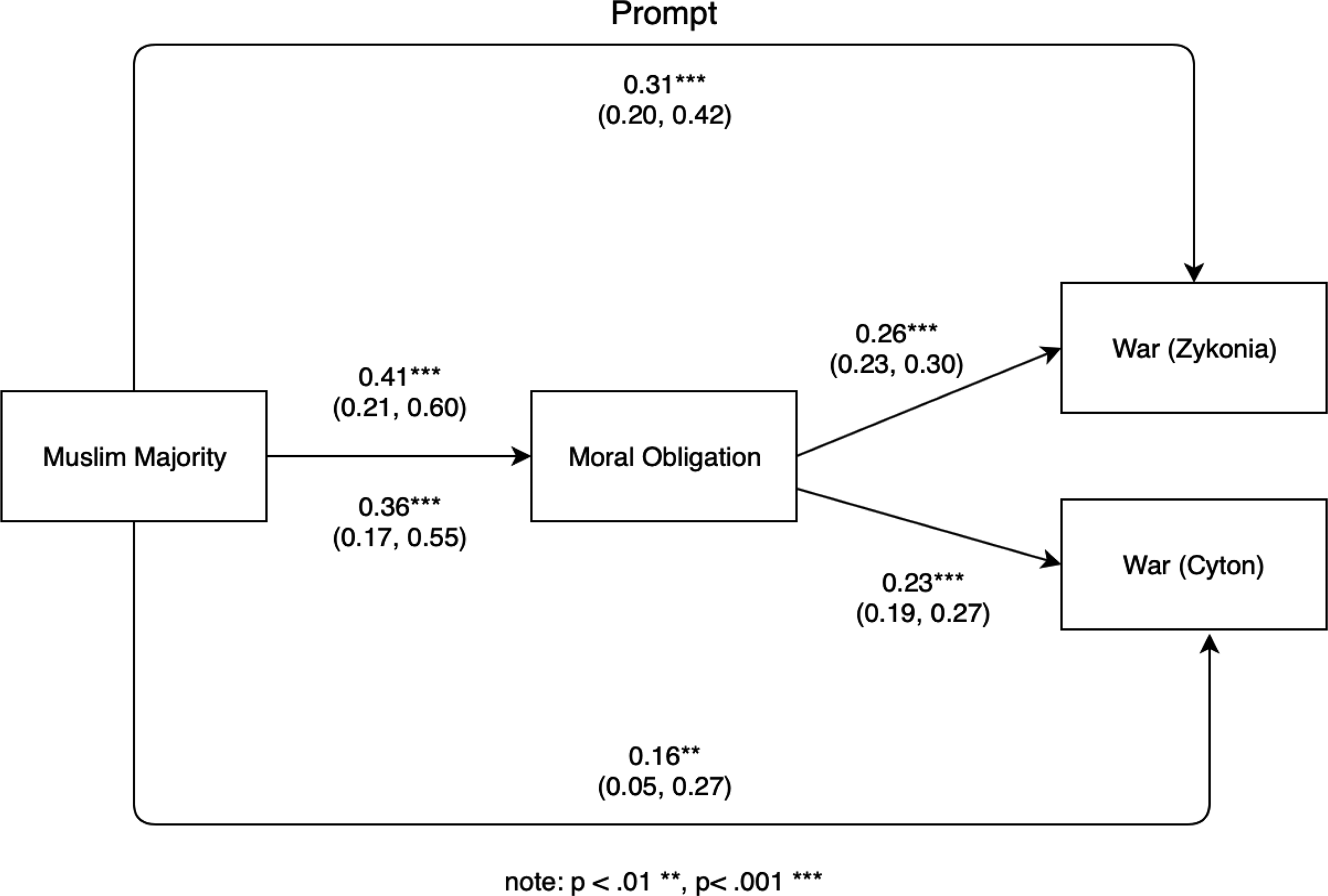
Influence of Muslim Majority prompt.
Moving on to Experiment 3, Figure 6 shows the 95% confidence intervals on standardized isolationist scores by ideology and prompt received for liberals and conservatives. We find initial support for H7 and H8. Conservatives become much more isolationist when receiving the liberal prompt, while for liberals the opposite is true. In order to ensure that these differences are not based on confounding due to demographic variables and check for statistical significance, Table 4 presents the results of OLS regressions for Experiment 3, once again dividing respondents into categories of liberals, moderates, and conservatives. The variable Conservative Prompt is 1 if the individual received the prompt that portrayed the United States as a relatively right-wing country, with the reference text being the one that argues that the United States is becoming more liberal. Ideology is once again 1 or 0, with 1 being more conservative. Education and age are broken down into six groups, with higher numbers indicating older and more educated. The dependent variable, Isolationism, is standardized in each of the models.
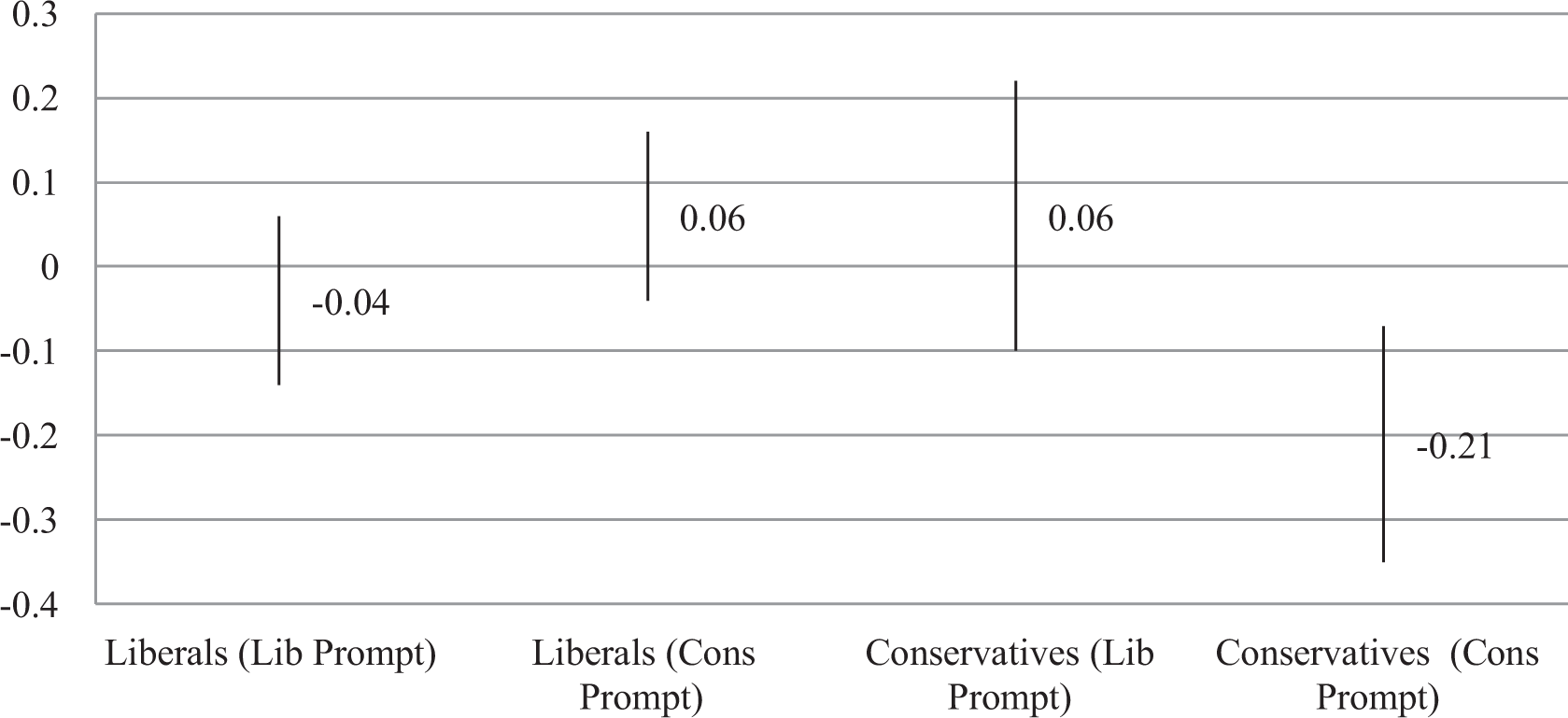
Isolationism (standardized) by ideology and prompt received.
Support for isolationism.
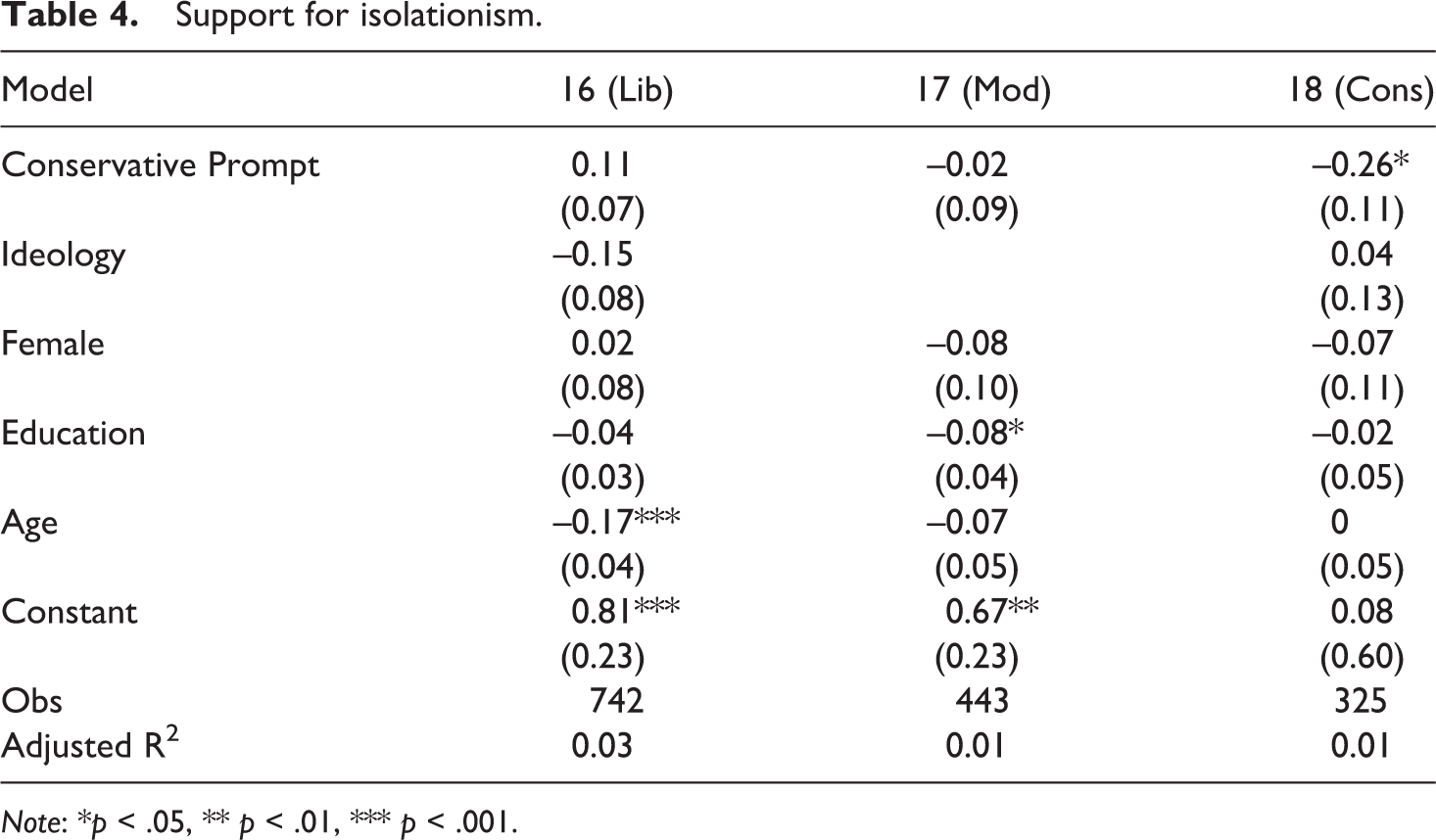
Note: *p < .05, ** p < .01, *** p < .001.
Adding controls does little to change the effect of the prompts. When conservatives received the conservative prompt, they shifted 0.26 standard deviations on the isolationism scale toward more interventionist preferences. We therefore find some evidence for H7. There is less support for H8, although the coefficient shows liberals shifting 0.11 standard deviations in the opposite direction, with the result approaching significance at the p < .10 threshold. We checked for mediation by asking a yes or no question about whether the United States was headed in the right or wrong direction, but found no statistically significant result, perhaps because of the lack of gradations among the choices presented to participants.
Other treatments, moral foundations, and demographic effects
Although they are not the focus of this article, it is worthwhile to summarize some of the demographic effects unrelated to the main arguments presented and compare them to past research. In the first two experiments, females are consistently less likely to support aggressive action across the various models, a finding consistent with previous surveys (Eichenberg, 2003). Despite this, the results presented are inconsistent with other work that indicating that if the mission of a conflict is framed as humanitarian in nature, the gender gap can go away or even be reversed (Brooks and Valentino, 2011). The other demographic variables of race, age, and education for the most part have inconsistent if any effects. One exception is the finding that non-white conservatives are generally less hawkish than white conservatives, a result that does not appear in any previous literature, as far as the authors know. It would be interesting if future studies sought to replicate this result and explain why this may be the case. Unsurprisingly, there is more support for aggressive action when there is a treaty in place to defend human rights or the action is presented as consistent with international law (Chilton, 2014; Wallace, 2013), and the effect of international law is greater on liberals than on other groups.
Interestingly, the degree of oppression perpetrated on victims seems to matter little. In the Zykonia experiment, only liberals were more likely to want to intervene when a higher number of people were killed. Yet only conservatives were affected by the degree of oppression when the question was whether to use force against Cyton. Even when the coefficients for these variables are statistically significant, their magnitudes are dwarfed by the effects of treaties, international law, and prejudice. Thus, while there is some support for humanitarian intervention across the political spectrum, it does not appear that people tend to think about the issues involved in largely utilitarian terms. This is unsurprising, as moral cost-benefit analysis is mentally taxing, and it is much easier to follow a few simple rules such as how much one likes the groups involved or whether an action would be sanctioned by law.
Finally, our design in the first two experiments allows us to evaluate the effects of Moral Foundations variables and compare their effects to those of the prejudice treatments. To do this, for each main group exhibiting prejudice in Experiment 1 and Experiment 2, we run the same models presented above, that is Models 3, 10, and 13, but with the five Moral Foundations as described by Graham et al. (2009) added as independent variables, and excluding the Muslim Majority variable in the model involving liberals for Experiment 2, as it did not have an effect in Table 3. Figure 7 shows the effect size of the prejudice treatments compared to a one standard deviation shift in the Moral Foundations variables that achieve statistical significance at the p < .05 threshold in each model. For conservatives, the Muslim Majority prompt is equivalent to a 2.5 standard deviation shift in the Moral Foundation with the largest effect size. When the same analysis is conducted in Experiment 2 with liberals, we find that when sanctioning Cyton is the dependent variable, not a single Moral Foundation reaches statistical significance. Only when openness toward war is considered as the dependent variable do we see the effects of Moral Foundations rival those of prejudice. Thus, we have two models in which prejudice is clearly more important than Moral Foundations, and a third in which the Vertical Hierarchy Model and the Prejudice First Model both find support.
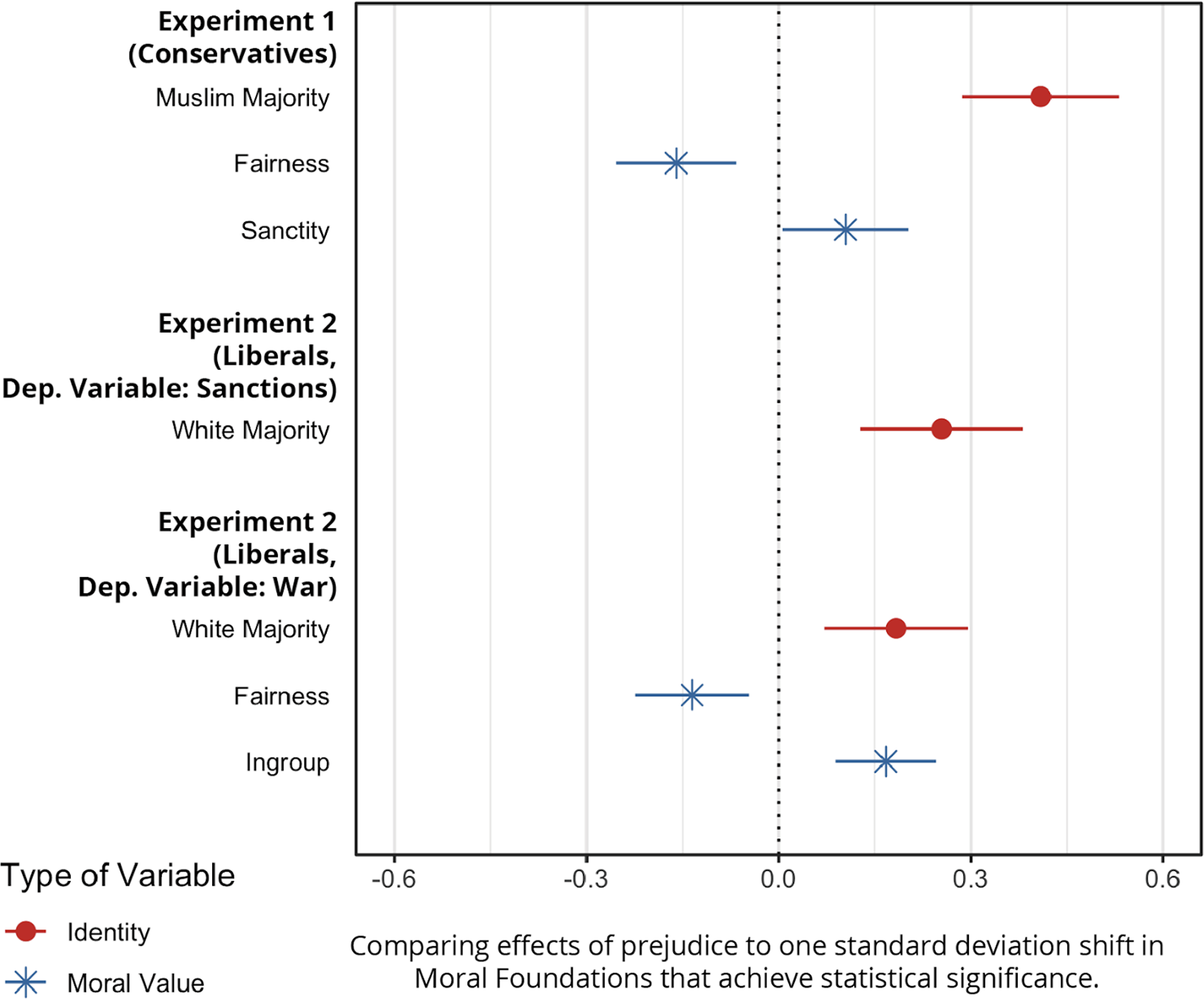
Comparing effects of prejudice to one standard deviation shift in Moral Foundations that achieve statistical significance.
Conclusion
According to Rathbun et al. (2016: 124), “we now know that foreign policy attitudes have structure and that values supply the mortar that holds them together.” Certainly, scholars have found correlations between abstract moral values and foreign policy preferences. And because frameworks derived from moral psychology query individuals on generalized principles, while foreign policy attitudes are domain-specific, it is reasonable to conclude that the former are the cause of the latter (see Haidt, 2012). This article presents a possibility that is commonplace in political psychology (e.g. Henry et al., 2004), but has been overlooked in the literature on foreign policy preferences. Prejudices not only drive preferences, but shape the moral rationalizations that we use to justify our principles.
When deciding whether to support a humanitarian intervention or other costly actions such as imposing sanctions, public rhetoric suggests that people mainly consider the good that can be done for the group being helped and the potential downsides of a policy. It would be considered taboo to express the view that in considering whether to save human life or prevent atrocities, one should make decisions based on the identities of those involved. Yet on both sides of the political aisle, identity mattered even more than other factors that one would think are important, being rivaled only be international law and the effects of treaties. While the extent to which prejudice shapes domestic political attitudes has been known for decades (Kinder and Sears, 1981), previously it may have been possible to implicitly assume that the only prejudice important for foreign policy preferences among the US population is the preference for Americans over foreigners (see Hurwitz and Peffley, 1987). Yet the results here suggest that prejudices based on race and religion may be as important in foreign policy as they are in the domestic sphere. Not only do prejudices affect foreign policy preferences, but through changing policy attitudes, the evidence here indicates that they influence abstract moral ideas about how the United States should behave in the international system, which in turn makes individuals more likely to adopt certain policy positions. In effect, the Prejudice First Model turns the Vertical Hierarchy Model on its head.
Future scholars should not examine prejudice in isolation, but investigate whether the various results here and in other experiments can come together to tell a coherent story about foreign policy preference formation. The results presented indicate that in deciding whether to engage in humanitarian intervention, people are more affected by prejudice, the existence of treaties, and international law than they are by the degree of oppression or the details of the dispute between the foreign peoples in question. This is consistent with the idea of the “cognitive miser,” which says that people gravitate toward asking the simplest question possible when deciding an issue (Kahneman, 2011; Orbell and Dawes, 1991). “Do we have a treaty to do something?” and “How do I feel about the groups affected?” are easier to answer than “How does the degree of oppression influence the cost/benefit ratio of starting a new war?” The cognitive miser model implies that individuals seize on the questions that require the least mental energy in order to make political decisions.
The findings here are not meant to imply that the Vertical Hierarchy Model has been contradicted. Indeed, we found evidence that changed views of a general principle as a result of treatments in Experiment 1 influenced specific foreign policy preferences in Experiment 2. But the findings do indicate that when scholars find connections between abstract values and more concrete preferences, they should be aware of the possibility that the causal arrow goes in both directions. Moral values likely influence the formation of prejudices as the Vertical Hierarchy Model predicts, but prejudices also influence individuals’ views on general moral questions, which in turn causes attitudes to shift regarding specific foreign policy issues, resulting in what might be called a reflective equilibrium (Rawls, 1971). We believe that which kind of variable has the greater influence often depends on the kind of question that requires fewer cognitive resources. Most often, this will mean reasoning from specific group prejudices to moral principles and political preferences. Studies that involve experiments in which prejudice is simply abstracted away, such as asking about a politician not identified with either party, are likely to create a misleading picture in the literature by exaggerating the influence of moral reasoning, or even moral instincts, which in the real world will rarely be divorced from some context that will invoke either affinity or hostility towards the party being judged (Walter and Redlawsk, 2019).
The findings presented here can put even well-known facts about public opinion and foreign policy in a new light. For example, during the Cold War conservatives were higher on MI, while liberals were more in favor of CI (Holsti and Rosenau, 1990). It may have been sensible to assume that these difference were based on conservatives being more open to the morality of using force abroad as a general matter (Hurwitz and Peffley, 1987). Another possibility, however, is that the nature of the enemy as an atheistic left-wing dictatorship made conservatives more hawkish. It is interesting to ponder an alternative universe where the rival superpower was a totalitarian system committed to white Christian supremacy rather than economic equality and international solidarity, and to ask whether under those circumstances we would have seen liberals more open to the use of force abroad. Here, we note that when the main international enemy of the United States was fascism in the 1930s, by far the largest antiwar movement in the country was on the political right (Kauffman, 2008). Scholars of foreign policy preference formation should do more to consider the possibility that general attitudes toward the appropriateness of the use of force abroad may be less fundamental than the relationships individuals have with others in their society and the nature of potential adversaries.
Supplemental material
Supplemental Material, Data - The prejudice first model and foreign policy values: racial and religious bias among conservatives and liberals
Supplemental Material, Data for The prejudice first model and foreign policy values: racial and religious bias among conservatives and liberals by Richard Hanania and Robert Trager in European Journal of International Relations
Footnotes
Declaration of conflicting interests
The authors report no conflict of interest. The authors alone are responsible for the content and writing of the paper.
Funding
The authors received financial support for the research, authorship, and/or publication of this article: The Gerda Henkel Stiftung Foundation.

Notes
Supplemental material
Supplemental material for this article is available online.
References
Supplementary Material
Please find the following supplemental material available below.
For Open Access articles published under a Creative Commons License, all supplemental material carries the same license as the article it is associated with.
For non-Open Access articles published, all supplemental material carries a non-exclusive license, and permission requests for re-use of supplemental material or any part of supplemental material shall be sent directly to the copyright owner as specified in the copyright notice associated with the article.
