







Abstract
“War made the state, and the state made war” is Charles Tilly’s famous dictum that has become highly influential both in comparative macrosociology and in International Relations. An extensive literature suggests that this mechanism has played a pivotal role in European processes of state formation. However, its applicability to warfare in the Global South is controversial. While some argue that the relationship remains the same, others are skeptical of the effects of the bellicist mechanism. Against the background of the debate as to whether war makes or un-makes states in the Global South, this paper examines the conditions under which wars have formative effects and result in state-making. Revisiting the war-making/state-making paradigm, I argue that the mode of economic reproduction of “wielders of coercion” determines whether war has formative effects. Wielders of coercion, or more specifically, non-state armed movements may draw on (1) rents, (2) indirect extraction, or (3) direct extraction to sustain their economic base and organize coercion. However, they institutionalize and develop into a state-like organization only when they rely on direct extraction. To support these claims, I conduct a plausibility probe drawing on evidence from highly successful armed insurgencies: Eritrea’s EPLF, Somaliland’s SNM, and Namibia’s SWAPO. In sum, the bellicist relationship remains valid for the Global South, even if the conditions under which war makes states are rare. A more nuanced reading of the bellicist theory improves our understanding of the dynamics of state formation and decay in the post-colonial world.
Introduction
The social world is messy—explaining phenomena requires turning to complex causal relationships and easy take-home messages are rare. Charles Tilly’s famous aphorism “war made the state and the state made war” seems, in contrast, a beautiful exception in the world of complexity explaining the most powerful organizations existing (Tilly, 1975: 42). The bellicist argument has become highly influential both in comparative macrosociology and in International Relations (IR). While an extensive literature suggests that this mechanism has played a pivotal role in early modern European state formation, it is controversial whether the relationship also applies to more contemporary contexts in the Global South. Some argue that the relationship holds there as well. Others, however, object, claiming that the different geographical and historical conditions nullify the relationship or even invert it (see Atzili, 2012; Hui, 2017; Leander, 2004; Thies, 2004, 2005, 2007). Despite a sustained scholarly debate, “the jury is still out” on this question (Malešević, 2020: 677).
IR scholars debating this issue have often interpreted the bellicist relationship simplistically and have not looked beyond Tilly’s aphorism and at the more subtle organizational processes linking warfare and state formation. Instead, they have domesticized Tilly’s arguments by adapting them to established IR conversations. This import of ideas from other fields by IR scholarship is common but problematic because it prevents seeing across disciplinary borders (Daxecker et al., 2020: 7–12; Gildea, 2020: 178–179). Scholars have focused on macro factors that would obstruct the bellicist mechanisms such as the proliferation of intra-state compared with interstate wars or internationally recognized borders (Atzili, 2012; Leander, 2004; Sorensen, 2001); or they have discarded the model due to its alleged reproduction of neorealism, a narrow view resulting from a mere focus on interstate war (Hobson, 2002: 64; Hui, 2017: 271–272). Moreover, the debate has been framed as an either-or question ignoring that historically warfare was only a state-making force for few survivors but overall has massively reduced the number of states.
In this article, I engage in a more thorough investigation of whether the bellicist relationship holds in the Global South and develop an argument that explains both under which conditions war makes states and when it does not. Revisiting the Tillyan argument, I focus on armed movements in conflict and argue that war has formative effects only if they engage in direct extraction to sustain their economic base, but not if they rely on alternative modes of economic reproduction. When armed movements extract directly, they set up their own extractive structure to obtain the necessary resources and this triggers a major organizational development. Yet, when insurgents evade this challenging task by securing their economic reproduction either through indirect extraction relying on intermediaries for resource collection or by drawing on rents, they forego war’s formative effects. To support these claims, I draw on evidence from successful armed movements in sub-Saharan Africa. The analysis demonstrates that war still makes states in more contemporary settings in the Global South but suggests that the conditions under which the bellicist relationship holds are rare.
According to Tilly, states emerge as by-products of warfare, due to the organizational complexities “wielders of coercion” have to master. Consequently, when meeting the challenge of organizing warfare, armed movements should also develop an advanced organizational structure comparable to that of a state (Bereketeab, 2007: 407). 1 Analyzing armed movements in violent conflict instead of states in war lowers the level of abstraction and facilitates grasping the generative process that links war with the emergence of statehood. Considering that European studies on war and state formation cover centuries-long periods, focusing on such movements and examining whether they develop according to the prediction of the bellicist account is more appropriate when analyzing current conflicts involving much shorter periods. From this perspective, wars have formative effects whenever violent non-state actors become highly institutionalized and develop a state-like organization. Wars have no formative effect when this institutionalization is absent. There is a great variety in armed movements: some indeed become states within states during conflict, for example, the Liberation Tigers of Tamil Eelam in Sri Lanka or the Eritrean Liberation Front, yet others, such as the Revolutionary United Forces of Sierra Leone remain a band of armed militias spreading primarily violence and terror instead of establishing a proto-state (see Abdullah and Muana, 1998: 184–193; Radtke, 2009: 84–85).
Re-reading Tilly, the main organizational challenge wielders of coercion must tackle is ensuring a sound economic base since recruiting and equipping fighters as well as sustaining them and their relatives is a resource-intense endeavor. The state organization develops as a by-product of warfare since it is a prerequisite of obtaining the means for war if these organizational efforts cannot be circumvented. While Tilly’s wielders of coercion had little opportunity to escape the resource imperative when they wanted to go to war, today’s wielders of coercion have plenty. Organizing economic reproduction is easy when there are precious resources or international rents available, or when this requirement is outsourced to intermediaries like traditional authorities. Linking insights from the taxation-rents with the bellicist theory, there are three main modes to ensure the economic reproduction of an armed movement: (1) rents, (2) indirect extraction/revenue collection via intermediaries, and (3) direct extraction/revenue collection by the coercion organization itself. I argue that only in the latter mode of economic reproduction armed movements must institutionalize and develop state-like capacities.
I consider armed movements 2 a state-like organization when they control territory, set up a functionally differentiated governing apparatus ruling and providing public goods. To conduct a plausibility probe, I draw on evidence from three armed movements: the South West Africa People’s Organization (SWAPO), the Somali National Movement (SNM), and the Eritrean People’s Liberation Front (EPLF). Each of the insurgencies was successful and took over governmental power after the war in Namibia, Somaliland, and Eritrea. As the bellicist relationship is more likely to apply to winners, all three wielders of coercion potentially fulfilled the conditions to transform into state-like organizations during war. Yet only the EPLF developed a proto-state while neither the SNM nor SWAPO obtained this degree of organizational capacity. The EPLF controlled territory and installed there an advanced administrative structure during conflict, and it was the only movement extracting directly and neither receiving rents nor relying on local intermediaries.
In the following, I first introduce the debate on the bellicist theory in the Global South. Next, I unpack the theoretical argument claiming the mode of economic reproduction determines whether war has formative effects. Subsequently, I support these claims with evidence from the insurgencies of SWAPO, the SNM, and the EPLF. Concluding, the bellicist theory remains relevant for studying warfare and state formation in the Global South. Even if the conditions under which war has formative effects are rare, a more nuanced reading of the bellicist theory improves our understanding of dynamics of state formation and decay in the post-colonial world and points out new avenues for research into the organization of coercion of armed insurgency.
Warfare beyond Europe—Making or un-making states?
War has had a decisive impact on European processes of state formation and its influence has been discussed for more than one century among historians and social scientists (Elias, 1989 [1939]; Ertman, 1997; Finer, 1975; Hui, 2005; Tilly, 1975, 1985, 1992). Although the bellicist mechanism has gained wide acceptance, the question of whether it still holds true or whether it was primarily telling for early modern Europe is still open (Malešević, 2020: 677). Inspired by the popularization of the notion of state fragility, a sustained debate has evolved on the question of whether war makes states as well in the Global South. Below, I will first introduce this discussion and then point to its shortcomings.
Despite recurrent patterns of conflict, state capacity is often weakly established particularly in Africa, but also in Asia, the Middle East, or Latin America (Iqbal and Starr, 2016). Key works explaining this weakness argue that European states had to face unprecedented geopolitical competition in their formative phase and therefore became unusually strong (Kurtz, 2013: 6–7). Herbst (2014) claims that in Africa power projection over a defined territory was costly and yielded few returns. Therefore, war did not drive state formation, and this has not changed in the post-colonial period (Herbst, 2014: 272; Péclard, 2019: 14). Centeno (2002) argues similarly that owing to altered context conditions in Latin America mostly limited wars occurred. Unlike European mass or total war these make only limited states. Holden (2017) complements Centeno’s thesis by analyzing Central American states and concludes that the “Tillyesque idea (. . .) should be discarded for Latin America at large” (p. 254). Processes of African and Latin American state formation are in this sense counterfactuals to the European experience. Similarly, Jung (2017) considers the war model as a useful heuristic to understand state weakness in the Middle East.
Further contributions to the debate explain contemporary state fragility by a profound shift of the transnational environment in which state formation is embedded. War no longer makes states but rather un-makes them in the Global South (Atzili, 2012; Leander, 2004; Sorensen, 2001). The survival of late-comers to state formation is secured by strong international norms named “border fixity” or “norm against conquest” (Atzili, 2012; Fazal, 2011). Without the threat of interstate wars, the drive to internal consolidation and sustainable state-building that power-holders face is barely existent (Sorensen, 2001: 346–347; Stathopoulos, 2019: 180). On the contrary, this low external threat environment allows for internal wars that have no state-building effect but result in a vicious circle of state deterioration and further war reinforcing state failure (Atzili, 2012: 44–45). Moreover, strong economic agendas in civil war prolong internal strife, and the privatization of profits leads to a dismantling of state administrations (Leander, 2004: 9–10).
However, some scholars contradict this diagnosis that the bellicist relationship has lost explanatory power for the Global South. In a series of statistical analyses, Thies (2004, 2005, 2007) modifies the bellicist theory and finds that interstate rivalry has a positive effect on states’ extractive capacities across the post-colonial world in Asia, North and sub-Saharan Africa, the Middle East and Latin and Central America. The results for domestic rivals are mixed. From a qualitative viewpoint, Taylor and Botea (2008) argue that war makes states under certain conditions in the Global South. Equally, Hui (2017) is skeptical toward the criticism that the bellicist argument does not travel beyond Europe. The model explains Chinese state formation during the Warring States period (453–221 BC) and additional periods of imperial and modern Chinese history suggest that war shaped state formation.
Inconsistent findings both confirming and disconfirming the bellicist hypothesis result from important shortcomings in the debate. First, scholarship has not paid sufficient attention to the fact that the formation and decay of states have historically been related. In war-prone Europe, many more states were destroyed than were made by war, and around 500 entities were forcefully reduced to 25 from 1500 to 1900 (Porter, 1994: 12). In Europe, war rarely made states, even if the survivors of this process seemingly tell a different story. Investigating whether the bellicist relationship does or does not hold is thus not appropriate. Instead of an “either-or approach,” an integrative theoretical framework accounting for both destructive and generative processes is needed.
Second, scholars—of both qualitative and quantitative kinds—usually adopt a macro-perspective and analyze whole continents or regions over long periods, or they employ a mainly theoretical argument supported by anecdotal evidence from present-day conflicts. So far, little attention has been paid to a systematic analysis of whether and when the mechanisms specified by the theory operate in contemporary wars (Taylor and Botea, 2008: 28). Scholarly debate has instead focused on systemic changes such as fixed borders and the decline of interstate wars. These observations resonate well with IR conversations but miss the domestic organizational processes at the heart of Tilly’s sociological account. Disregarding the historical conditions of European state formation and ignoring the organizational imperatives of warfare suggest difficulties in transferring arguments across disciplinary borders (Daxecker et al., 2020).
One attempt to arrive at a more comprehensive theoretical framework is the illuminating study by Taylor and Botea. They argue that wars only make states when two conditions are present: (i) the existence of a core ethnic group and (ii) the combination of war and revolution providing for a uniting ideology (Taylor and Botea, 2008: 28). Both conditions were present in Vietnam where war had a positive effect on state formation. In Afghanistan, in contrast, they were lacking, and thus enduring war eroded statehood (Taylor and Botea, 2008: 48–49). The two conditions imply that a quite strongly united community is necessary for wars to have a state-building effect. However, debates on identity and war emphasize that war itself is a homogenizing and a community-building experience (Shapiro, 1997: 52–54; Neumann, 1996: 156–157; Tilly, 1992: 116). Taylor and Botea (2008: 34) also grant warfare this effect and define nation-making as one of the key state-building mechanisms induced by war. This makes their argument somewhat circular as (i) and (ii) are not independent (pre-)conditions but a part of the generative state formation process resulting from warfare. If Taylor’s and Botea’s key theoretical insight is that war only makes states when it triggers the nation-making mechanism, then identifying conditions independent of the generative process of that mechanism would be helpful. My argument that the mode of economic reproduction of an armed movement determines whether war makes states is of such kind.
Besides the debate on whether the bellicist model holds in the Global South, somewhat related questions have been addressed in the literature on rebel governance (Arjona, 2014, 2016; Mampilly, 2011; Staniland, 2012; Weinstein, 2007). Weinstein’s (2007) distinction between resource-poor and resource-rich armed movements bears some similarity to this article’s reasoning. However, distinguishing between insurgents with economic endowments that engage in indiscriminate violence toward civilians and poor movements exhibiting restraint rather focuses on levels of wealth instead of its origin. Economic endowments may for example result from diverse modes of economic reproduction including both rents and taxation (Weinstein, 2007: 7). While Weinstein’s primary focus is on explaining insurgent violence, other contributions relate more directly to aspects of state formation as they examine the variety of wartime political orders that may emerge during conflict (see Arjona, 2014; Staniland, 2012). Mampilly (2011) investigates types of governance arrangements on rebel-controlled territories by drawing on a multifaceted theory considering various factors that may shape this diversity. Similarly, Arjona (2016) develops a model explaining different degrees of wartime social order that emerged in different local communities in FARC’s (Fuerzas Armadas Revolucionarias de Colombia) operational area in Colombia.
Unlike these rich studies investigating the diversity of rebel’s wartime orders or even exploring the variety of micro-orders emerging under the same rebel organization, this paper’s focus is more limited. To answer the macro-question of a bellicist state formation, it examines under which conditions armed movements transform during conflict into a proto-state. These proto-state structures may be unevenly established across territories and their local manifestation be shaped by additional contextual factors, yet the question is whether or not armed movements undertake the major effort of controlling and governing territory and providing public goods at all. I argue in the following section that only do-it-yourself wars in which wielders of coercion cannot circumvent the organizational challenges of acquiring the means of coercion make states. This argument considers that war historically made and unmade states and focuses on its key organizational imperatives. Both factors have often been overlooked when discussing the applicability of the bellicist model beyond Europe.
“Do-it-yourself war” makes states
Tilly’s famous aphorism “war made the state and the state made war” conveys two main lines of argument. One is about territorial control and violent conquest; the second refers to the structuration of the state by the organizational imperatives that war and its preparation imply. In the first sense—“men who controlled concentrated means of coercion ordinarily tried to use them to extend the range of populations and resources over which they wielded power”—the bellicist theory suggests a pathway of territorial consolidation by conquest accounting for the emergence of certain borders (Tilly, 1992: 14). However, even for Europe to what extent this logic applied is contested (see Abrahamson, 2013). Besides war, borders have often changed by marriage and other contractual relationships. In the current international system, this logic is even more unlikely to hold. Critics of the bellicist theory are right in emphasizing that the norm of sovereignty limits the opportunity for new political units created by conquest. Yet even though the explanatory power of this first bellicist relationship is limited today, this does not thwart Tilly’s main line of argument based on the organization of coercion.
In its second sense, the bellicist theory conveys that war and the threat of war account for the development of an institutional apparatus and accordingly for the internal structuration of states. The core argument is that states emerged as by-products from the competition over territories and resources (Tilly, 1992: 14). This relationship does not primarily refer to a logic of territorial expansion by conquest but to the organizational imperatives of warfare: “preparation for war created the internal structures of the states within it” (Tilly, 1992: 76). The acquisition and maintenance of concentrated means of coercion require actors to master a huge organizational challenge. If there is no possibility to escape these imperatives, for example, by outsourcing them, wielders of coercion must set up an apparatus to extract from and control territory. This constraint applies as well to armed movements in civil wars and the states they challenge. Regardless of whether wielders of coercion aim for state formation or not: if they have to organize the acquisition and maintenance of the means of war through a “do-it-yourself” approach, they must institutionalize and develop organizational capacity. It was this focus on the organization of coercion and not on the amount or type of war that made Tilly’s approach novel and more sophisticated compared with previous bellicist arguments (Ertman, 1997: 13–14; Tilly, 1992: 14–15). Subsequent research followed this track investigating how domestic factors such as medieval and religious institutions impacted the way states organized coercion and how this led to the early modern European state (Gorski, 2003; Grzymala-Busse, 2020). Yet this focus on the organization of coercion has partially been lost in debates on the applicability of the theory beyond Europe. In addition, the bellicist theory highlights that competition for survival ensures that these organizational challenges are accomplished effectively (Herbst, 2014: 21–22). Today’s internal wars are similarly highly competitive because armed movements fight other irregular or regular security forces.
I argue that in its second sense the bellicist theory spells out a logical prerequisite for any wielder of coercion independent of whether foes are internal or external to contested territories. However, this logic only unfolds in do-it-yourself wars in which wielders of coercion cannot circumvent the organization of coercion. I translate these theoretical considerations into an argument about the mode of economic reproduction and argue that the degree of institutionalization of armed movements is contingent on whether this mode is based on rents, indirect extraction, or direct extraction. Both rents and indirect extraction represent low levels of the organization of coercion and under these conditions, war has no formative effect, only with direct extraction and thus a high level of the organization of coercion war makes states. Historically, war and its preparation were the main stimuli to build up ever-increasing extractive apparatuses as the costs of war accounted for up to 90 percent of the state’s budget (Porter, 1994: 14). Over time, these apparatuses became more and more powerful but developed also close ties to societies and catered for their wants. This idea of a state-building process driven by extraction is equally at the heart of theories focusing on the relationship between taxation, rents, and state formation (Bräutigam, 2008; Campbell, 1993; Karl, 1997). Taxation scholarship argues that the revenue imperative states face stimulates the construction of collection institutions—the more complex the taxes are to levy, the more institutional capacity has to be built up (Bräutigam, 2008: 2–9). Rent theory tells us, however, that the challenge of levying taxes can be avoided if there are rents available. Rents do not require developing institutions for extraction and are usually associated with institutional decay as rulers focus on rent-seeking and stay detached from societies (Karl, 1997: 25–26; Ross, 2001: 35–37). In the bellicist account, this possibility has been mostly ignored. High windfall profits from rents were in the past less available. Moreover, the theory focuses primarily on the effective survivors, and this implies a selection bias toward better adapted and thus taxing entities (Kurtz, 2009: 489; 2013: 19).
I therefore enrich the logic of the bellicist model by drawing on the taxation-rents theory to specify the argument on armed movements and their mode of economic reproduction. Both theories apply to insurgencies since they are in a competitive situation and must effectively organize coercion to survive. Primarily they are challenged by the resource imperative, and there are three basic models of how armed movements can address this imperative: they can either opt for economic reproduction through rents, indirect extraction, or direct extraction.
Rents
If rents are available, armed movements escape the functionalist constraint from the resource imperative. Rents are easy money stemming either from financial support by external sponsors or the export of precious resources. With rents, the positive incentives for building institutions for extraction are lost, and they make the beneficiaries independent from domestic support. Rulers, a rent-seeking elite, organize rule by directing flows of payments instead of deeply penetrating societies through institutions (Karl, 1997: 25–26; Kurtz, 2009: 483; Ross, 2001: 35–37). Theories of civil war have pointed in a similar direction by identifying competition over rents as motivation for insurgency. Although scholars have criticized the simplistic “greed versus grievance” distinction (Krause, 2012: 47–48; Hazen, 2013: 34–37), scholarship has suggested that rent-based armed movements do not build up close ties to local populations and remain rather unstable organizations with underdeveloped political agendas (Hazen, 2013: 70–71; Schlichte, 2009: 139–143). Armed movements relying on rents need neither to build an extraction apparatus on a territory nor to forge close ties with a population, and thus rents represent a low level of the organization of coercion. With rents, armed movements do not engage in the complex endeavor of state-building and war has no formative effect. Without rents, wielders of coercion are dependent on their domestic context for conducting war. The more complex the extractive challenge, the more capacity armed movements must develop.
Indirect extraction
This is a rather simple way to meet the resources imperative. Material and people are extracted from the domestic context using intermediaries and established structures of societal organization based on, for example, clan, religion, or ethnicity. I argue that indirect extraction is another way to escape the organizational prerequisites of war and equally constitutes a low level of the organization of coercion. Collaborating with elders, chiefs, or other societal elites who represent local communities and provide the armed movements with money, material, and recruits does not require a structure for extraction sustained by the armed movement. Somewhat similar practices of resorting to intermediaries for extraction have been common in historical Europe. For example, instead of establishing a state administration to raise money, rulers sold the right to collect revenue to private individuals for a specified fee. Tax farming and other techniques of relying on intermediate resource holders to go to war have no positive state-building effect and have proven rather detrimental for statehood in the long run (Ertman, 1997: 22–33; Hui, 2005: 32–34). When contemporary armed movements pursue indirect extraction, they are not required to control or penetrate a territory strongly, as they outsource levying resources. Many armed movements rely in their early phase on kinship ties and persuasion to acquire the necessary support locally, yet with increased strength they might tap into other sources of funding (Lewis, 2020). For indirect extraction, fighters need the cooperation with local intermediaries and thus depend on legitimacy for their insurgency. However, the main state formation driver setting up a comprehensive extractive apparatus, which has been so significant for Europe, is missing.
Direct extraction
Direct extraction demonstrates a high level of the organization of coercion and is a sufficient condition for the development of (proto-)state structures. All wielders of coercion face a resource imperative to organize coercion: if they have neither access to rents nor can outsource extraction to others, they must acquire the capacity to extract in a self-organized manner or they fail. The acquisition of the resources for war presupposes the development of institutions for collection and building close relations to society. Historically, extraction rested both on coercion and persuasion. When bargaining over resources, rulers had to make concessions to societies and links between state and society developed. Without the persuasive power of nationalism, the recruitment, equipment, and provision of militaries on an unprecedented scale in the 19th century would not have been possible (Finer, 1975: 96–97; Tilly, 1992: 206–207). Armed movements that directly extract money, material, and recruits must establish territorial control to set up an organization generating income, and it obliges insurgents to mobilize their host society to make it supportive for warfare. In this mode of economic reproduction, armed movements are most dependent on building close societal relations. They build institutions like parties or mass organizations and promote a political narrative, for example, national liberation, administer territories, and provide public goods that are closely related to the war effort such as health services, schooling, or economic reform. The extent of participation in the armed movement and its civilian institutions provide a measure for the ties between insurgents and society. Support may also derive from coercion, yet violence has delegitimizing effects that threaten the success of insurgencies particularly if local society is their resource base (Schlichte, 2009: 22; Weinstein, 2007). In sum, direct extraction represents a high level of the organization of coercion as it is the most challenging mode of economic reproduction. Extracting directly requires from armed movements a major organizational development that transforms them into a state-like entity. Thus, only when armed movement self-organize their capacity to go to war do they develop according to the bellicist model: war has formative effects and makes states.
When does war make states? Summary of the theoretical framework.
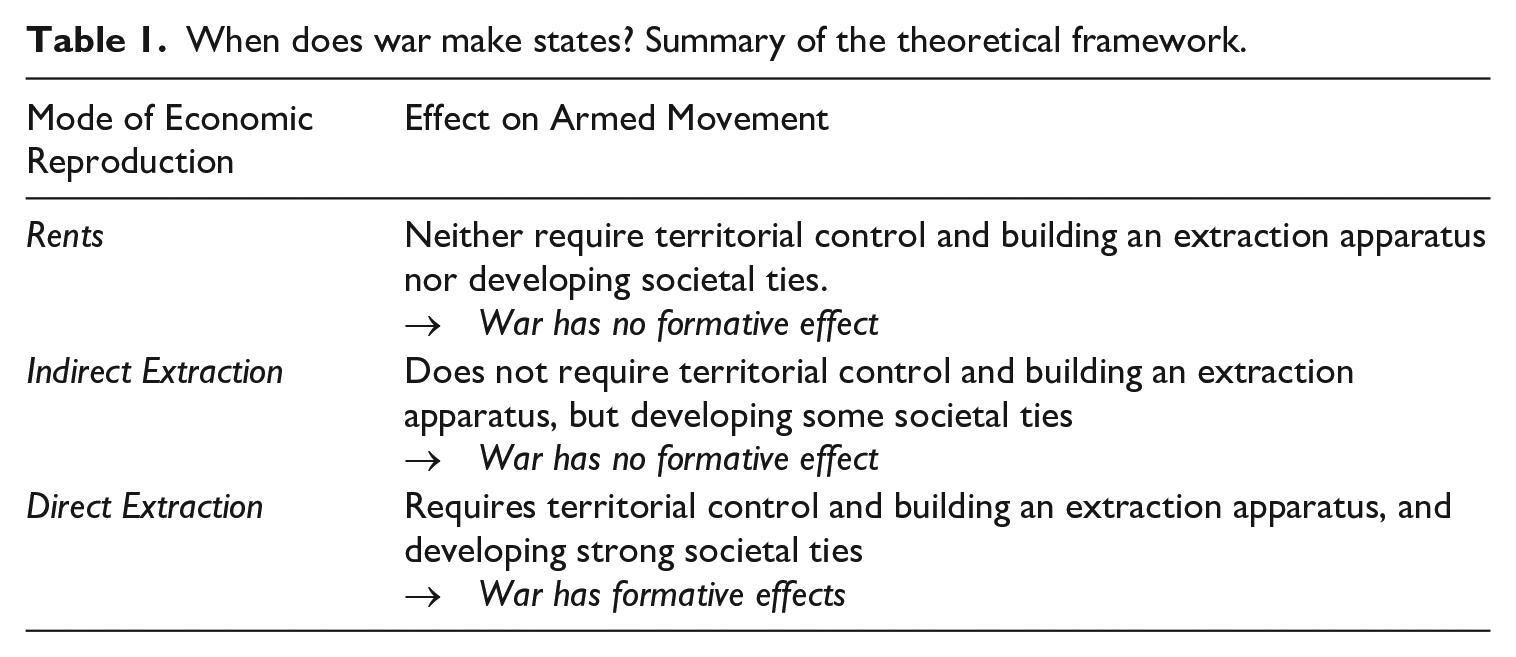
In conclusion, this section argued that the war-/state-making paradigm as a theory of increasing territorial concentration by conquest has been historically overrated and is even more obsolete today. However, the bellicist argument is particularly strong in its second sense: war and the threat of war accounted for the internal structuration and institutional development of European states as rulers had to meet organizational imperatives, in particular ensuring a sound resource base to wield coercion. This logic applies as well to armed movements in the Global South. Contingent on their mode of economic reproduction their internal structure develops. While rents and indirect extraction do not require an advanced level of the organization of coercion, direct extraction entails huge organizational challenges that further the development of a state-like organization. While these three modes of economic reproduction are not mutually exclusive, I will base my argument on the main mode each of the armed movements relied on.
Victorious armed movements and the formative effects of war
In this section, I conduct a plausibility probe of these theoretical considerations comparing evidence from three armed movements from sub-Saharan Africa. Plausibility probes represent an intermediary step between generating and testing a hypothesis, and the goal of these illustrative case studies is to demonstrate the relevance of the theoretical argument (Levy, 2008: 3, 6–7). Following Mill’s method of difference, I analyze the South West Africa People’s Organization, the Somali National Movement, and the Eritrean People’s Liberation Front. The three movements share crucial similarities: they fought an armed struggle for independent statehood. They were each successful in their wars which ended in their favor in the early 1990s, and the movements replaced the previous rulers becoming the first post-war government of the newly founded states of Namibia and Eritrea and the de facto state of Somaliland. Yet, alongside these similarities the armed movements differ with respect to their mode of economic reproduction: only the EPLF extracted directly, while the SNM and SWAPO relied on indirect extraction or rents.
The rationale of this case selection is to investigate highly successful armed movements because the bellicist mechanism is most likely to apply to winners. Moreover, as later governments of new states, all three movements are likely candidates to develop state-like organizations already during their respective struggles. To assess my theoretical conjectures, I examine what kind of organization these movements had established during their violent insurgency before taking power and investigate which mode of economic reproduction they had primarily employed. Eritrea’s EPLF extracted directly and developed during warfare a (proto)-state in liberated areas which became the base for the post-conflict state. While SWAPO was heavily subsidized by external allies, its organizational capacity was feeble. The SNM in turn extracted through intermediaries drawing on established clan structures, yet as a post-war government, it soon fragmented into warring factions.
SWAPO—over-financed under institutionalized
In April 1989, SWAPO and the Southern African government agreed on a ceasefire that initiated Namibia’s decolonization, and finally in March 1990 Namibia became a sovereign state and the former insurgents became the new government. The struggle for independence against South Africa’s occupation had started in the late 1950s and SWAPO, founded in 1960, soon took the lead. The 23-year-long liberation war that SWAPO and its military branch the PLAN (People’s Liberation Army of Namibia) led had a major impact in furthering the process of decolonization and inflicted considerable costs on South Africa (Cliffe, 1994: 57–59; Melber, 2007: 61–62). PLAN fought South Africa not only on Namibian territory but since the mid-1970s also in the civil/proxy war in Angola. When in 1988 a diplomatic resolution of the Angolan conflict became possible, this also paved the way for the settlement of the Namibian question. Upon independence, SWAPO took over governing power winning all elections from 1989 onward. It was only in 2005 that Sam Nujoma the long-term leader of SWAPO retired from his post-liberation office as incumbent president of Namibia.
Namibia was a former German colony that had been governed by South Africa as a mandated territory since World War I. While already in the late 1950s the first ethnicity-based liberation movements emerged, the South-West African People’s Organization was formed as a pan-Namibian movement in 1960. One year later, the movement decided to train fighters for an armed struggle to end the occupation by South Africa (Jaster, 1990: 6–7). Although SWAPO had always had some kind of visible party apparatus inside Namibia, its external wing was much more important as the movement’s struggle for liberation was organized and steered from exile in neighboring countries. As the exile branch ran the violent insurgency, it is the focus of this section.
SWAPO neither institutionalized highly nor developed a state-like organization: Although it claimed to have liberated territories in Namibia, it never controlled territory or built a governing apparatus providing public goods (Dobell, 1998: 63; Lamb, 1998: 139–140). Its organization structure existed mainly on paper, but in fact, a small group in exile the National Executive or Politburo controlled the armed movement and took the crucial decisions (Lamb, 1998: 73–75). The domestic SWAPO leadership in Namibia was weak and largely neglected by its external counterpart. Had the latter not controlled all the funds, a complete split between the external and the internal wing would have been likely due to the tensions (Udogu, 2012: 81–82). The leadership style of the exile branch running an organization devoid of constituents produced at times serious crises and internal revolts. SWAPO’s main audience was international, and this outward orientation overdetermined organizational life as the liberation movement devoted little attention to bottom-up mobilization on the ground (Dobell, 1998: 22, 40f). Yet, the repressive character of the South African regime stirred up domestic support for the anti-colonial struggle. Due to SWAPO’s international success, it was the only organization considered to be capable of ending South African occupation (Cliffe, 1994: 31–32; Dobell, 1998: 25).
SWAPO’s mode of economic reproduction was based fully on rents from state sponsors or international organizations. With these allocations controlling territory and populations for extraction was not necessary. While the bellicist account suggests that because war is costly, new sources of income are required, for SWAPO the logic worked in a reverse way. The first military operations in 1966 were motivated by financial incentives. The OAU (Organization of African Unity) and its liberation committee were more likely to provide funds in the case of a violent insurgency (Cliffe, 1994: 20; Udogu, 2012: 96–97). In addition, SWAPO received rents from many states. Eastern state sponsors, especially the Soviet Union and Cuba but also China, Yugoslavia, and North Korea covered most expenses and material for the violent insurgency and paid, according to estimates, 60 percent of all funds that SWAPO received. Western sponsors provided mostly humanitarian assistance and usually channeled it through the UN’s specialized agencies (Dobell, 1998: 64–65; Udogu, 2012: 121–122). SWAPO was extraordinarily successful in acquiring external funds, and its income grew steadily until it enjoyed more financial support per capita than any other Southern African liberation movement (Dobell, 1998: 20).
Key to this success in receiving external funding was SWAPO’s international recognition as liberation movement. In addition to the recognition by the OAU, the UN General Assembly declared SWAPO in 1973 as “the sole and authentic representative of the Namibian people.” This diplomatic success made SWAPO the legitimate recipient of support for the Namibian cause (Udogu, 2012: 89–93, 116). However, this outward orientation largely determined the life of the organization. SWAPO developed little in-house capacity for running the insurgency and relied even for this task on outside support, as the following two episodes illustrate.
SWAPO had at times to cope with major dissidence among its fighters. They criticized corruption and mismanagement among the movement’s leadership. The SWAPO leaders were not responsive to the criticism and let the country hosting their bases arrest the critics. In 1969, the SWAPO leadership asked the Tanzanian army to detain a cadre of SWAPO fighters that had denounced the state of the organization publicly (Lamb, 1998: 83–84; Leys and Saul, 1994: 126–127). The dissatisfaction of many PLAN cadres continued in the early- to mid-1970s and was fueled by exclusion from the SWAPO leadership circle, weak logistics and chronic supply problems (Leys and Saul, 1994: 127). The situation escalated in 1976 when a grouping of several hundred fighters calling themselves the “Anti-Corruption Fighters” formed. 3 As before, the leadership ignored the criticism, and several mutinies broke out in SWAPO’s Zambian bases. SWAPO resorted to outside help again and the Zambian army surrounded the rebelling bases. In total 1,600 to 2,000 fighters—about one-half of PLAN’s force at that time—ended up in Zambian prisons or detention camps (Dobell, 1998; 47–50; Lamb, 1998: 104–113; Leys and Saul, 1994: 133–139).
In the following years, the situation within PLAN eased. With the start of the proxy war in Angola, most PLAN combatants were incorporated into the regular Angolan army, and integrated Cuban-PLAN battalions were formed as well (Jaster, 1990: 21; Lamb, 2006: 31). Thus, PLAN increasingly resembled a semi-regular army. This outside support led to an increasing number of successful military incursions into Namibia and effective operations in Angola against South Africa and its proxies (Lamb, 1998: 117–120).
These episodes in SWAPO’s organizational life highlight its internal weakness and the massive external support it relied on. Warfare did not induce a transformation into a state-like organization, and the gap between SWAPO’s major achievements for the independence of Namibia and its little internal organizational capacity seems puzzling. Yet, SWAPO did not engage in do-it-yourself warfare but largely avoided the organization of coercion. Relying on international rents, the armed movement was neither dependent on territorial control nor on setting up an extraction apparatus.
The SNM—an armed movement decentrally managed by clans
In May 1991, the leadership of the SNM and the clan elders of the northern Somali clans declared an independent state in the north-west of Somalia. Having dispelled the army of the Siad Barre regime, the SNM held the monopoly of force in an area that covers roughly 20 percent of Somalia’s territory and became the first government of the de facto state. While civil war has continued in south-central Somalia until today despite improvements since 2012, in north-west Somalia a new state formed. Somaliland is pacified since 1997 and is widely regarded as a successful de facto state (Adam, 2008: 210–212; Bradbury, 2008: 245; Holzer, 2009: 5–6). Its clan-based government has proven stable and provides basic public goods. Thus, the SNM, who defeated the Barre regime in the north after one decade of fighting and became subsequently the governing power, is another armed movement that according to the bellicist projections should have been likely to develop a state-like character.
Somalia started to fall apart in the late 1970s when Barre’s reign after the lost Ogaden War (1977–1978) became increasingly repressive. The first anti-government insurgency flared up in 1978 and 3 years later the SNM formed in London and then moved to Ethiopia. Initially, it started as a small guerilla movement claiming to represent the Isaaq clan—the predominant clan in north-western Somalia. Yet, in 1988 the SNM engaged in a major offensive attacking several northern Somalia cities. The massive retaliatory attacks of Barre weakened the SNM. However, they generated a flood of refugees into Ethiopia and major support for the SNM in the Isaaq civilian population (Adam, 2008: 194–196, 201). In the Ethiopian refugee camps, the SNM re-organized and drove the Somalian armed forces out of the north-west—first from the rural areas and then from the cities.
Unlike SWAPO, the SNM controlled territory within Somalia from 1988, yet as an organization it remained weak and limited to the military dimension. The SNM established a military command structure of five regular regiments that were set up along sub-clan lines 4 and held regular popular congresses to elect its leadership, which rotated regularly (Bradbury, 2008: 66–68). The lack of organizational capacity and centralized control became apparent after the SNM had taken over the first government. The SNM failed to establish a governance structure in the separatist state, fragmented soon, and civil war returned. Conducting war had not led as a by-product to organizational capacity that could serve as the nucleus of a state. Central steps like setting up a basic state administration, starting taxation or demobilizing fighters were only accomplished under the subsequent government, which took office in 1993. The period of SNM government is remembered as the “lost years” for Somaliland (Hagmann and Hoehne, 2009: 49; Holzer, 2009: 62–64). Thus again, the organizational development that the bellicist account of state formation predicts did not materialize. How could the SNM succeed militarily without a capable organization of its own?
The large armed movement of the late 1980s had outsourced key organizational challenges to the traditional governance structures of the Isaaq clan. Initially, Ethiopia supplied the SNM fighters and provided sanctuaries for them. The SNM thus relied initially on rents and lacked widespread support among Somalia’s Isaaq community. When the tensions between Ethiopia and Somalia softened, the SNM lost Ethiopian support and sanctuaries (Bradbury, 2008: 61–62, 68–70; Adam, 2008: 201–202). Thus, the movement started an offensive in major northern Somali cities in 1988. The reaction of the Barre regime—a massive military retaliation not discriminating between civilians and insurgents—generated widespread support and loyalty with the SNM among the Isaaq population (Holzer, 2009: 54–55).
The offensive had weakened the SNM, yet it had to cope with a rush of new recruits and relied on traditional institutions to reorganize. The insurgents outsourced key tasks to clan and religious authorities and extracted indirectly. The so-called elders organized revenue collection, the distribution of food, conflict resolution, and the recruitment of fighters. Combat units organized decentrally along clan lines in regiments for every big Isaaq sub-clan. 5 After the loss of rents from Ethiopia, the war was largely financed by voluntary contributions which the elders collected from the Isaaq diaspora, businesspeople, and rural communities. The SNM did thus not establish a central fundraising structure of its own (Adam, 2008: 197–201; Bradbury, 2008: 69–70). The problems of the SNM substantiate the claim that it had only a military command structure but lacked organizational capacity drawing on local clan authorities for key organizational challenges. Roving combat units searching for food when they operated out of their own clan’s area were a problem as well as the lack of order and discipline within larger units which were composed of several (sub-)clan units. Logistics, in particular, were difficult: it was easy to mobilize several thousand SNM fighters, yet there were no food supplies to keep them for more than a few days together (Prunier, 1990: 112–114).
In conclusion, despite the success in the war against Siad Barre, the imperatives of warfare did not transform the SNM into a state-like organization. Extracting resources, recruiting and providing for combatants were outsourced to the existing governance structures of the Isaaq clan. Relying on indirect extraction, the SNM did not develop much own capacity. It is thus no surprise that the SNM as the first government of Somaliland failed. Yet, as a societally embedded armed movement, the SNM had a unique attribute among the numerous Somali insurgencies, and this facilitated demobilization and long-term peace in Somaliland.
The EPLF—a self-reliant organization with a state-like character
In May 1991, the EPLF conquered Asmara, the capital of present-day Eritrea, while at the same time the united Ethiopian liberation movements captured Addis Ababa. The fall of the regime of Mengistu Haile Mariam resulted in the independence of Eritrea from Ethiopia and ended the Eritrean liberation war. After the war, the EPLF, later renamed as PFDJ (Party for Democracy and Justice), was the sole dominating power. It remains so today ruling autocratically under President Isaias Afeworki. International observers applauded the swift and successful formation of Eritrean state structures and achievements in the implementation of economic and developmental policies in its first decade (Bereketeab, 2007: 415; Hirt, 2001: 160). Today Eritrea is still considered a strong state, yet President Afeworki’s regime has long been heavily criticized due to its repressive political system violating fundamental human rights (Bereketeab, 2009: 108; Müller, 2012: 794).
The Eritrean liberation war started already in the 1960s and was initially dominated by the ELF (Eritrean Liberation Front). Eritrea is a country with multiple ethnic groups, languages, and religions and the ELF was therefore organized in a decentralized way along ethnic and religious lines. This led however to conflicts: several reform movements splintered from the ELF in the early 1970s and merged in 1973/1974 to the EPLF that was formally founded only in 1977 at their first congress (Pool, 2001: 63–64). After an Ethiopian offensive in 1977/1978, the EPLF managed to take over territory from the ELF and in 1981 it destroyed the rival movement. From the mid-1980s, the EPLF started its offensive against the Mengistu regime. The EPLF was one of the strongest insurgencies of the modern era and highly effective on the battlefield (Schlichte, 2009: 172). They prevailed both in the inner Eritrean civil war and against the Ethiopian regime that was externally sponsored by the Soviet Union. To accomplish that, the insurgents built a massive organization supporting their war machinery and developed from “small factions of guerrilla fighters to an autonomous state-like organization” (Jüde, 2020: 99–103; Pool, 2001: 59).
The EPLF governed liberated territories, and in 1987, a decade after its official foundation, the organizational apparatus was highly developed. It comprised, in addition to the organization of the armed forces—the EPLA (Eritrean People’s Liberation Army)—a government and administration for the liberated zones and societal mass organizations generating popular support and raising revenue. The government system included a central committee of 71 representatives elected by the EPLF congress. 6 After independence, this committee was the nucleus of the new state’s legislative authority. The political bureau consisted of 13 members from the central committee, and it acted as the executive of the EPLF organization. Its 11 departments each with a secretary administered policy fields like security, economy, or health. The political bureau also oversaw the regional and local administration. In 1991, the fighters that had taken up administrative tasks within the EPLF—roughly 12,000—became the basis of the new Eritrean state administration (Ottaway, 1999: 48–50; Pool, 2001: 83–87; Radtke, 2009: 93–96).
Next to this administrative and governance structure, the EPLF mobilized the society by its mass organization to generate support and facilitate recruiting. They were organized as national bottom-up movements at the village level, propagating the “Eritrean struggle” among different societal groups like farmers, workers, youth, and women (Pool, 2001: 105–106). Socialization into the EPLF and mobilization for war was highly successful. The EPLF comprised at its peak 95,000 combatants drawn from a population of only 2.5 to 3 million and recruits often renamed to affirm their national instead of ethnic affiliation (Hepner, 2009: 53–56; Schlichte, 2009: 172). The international offshoots of the mass organizations promoted the liberation war within the Eritrean diaspora to raise revenue for the war. Next to security, the EPLF provided public goods particularly in the health and education sector in liberated zones. Their system of several main health clinics and decentralized partially mobile medical facilities was renowned, as was their system of primary and secondary schools. While, initially, the armed movement established medical care to minimize fatalities on the front and the schools were taking care of the fighters’ children, in the long run the wider population profited from this infrastructure. Beyond that, the EPLF also set up its own enterprises, implemented land reform, and developed controlled territories with some basic transportation infrastructure for supply routes (Hirt, 2001: 75–77; Pool, 2001: 105–106; Schlichte, 2009: 174–175).
Thus, in the case of the EPLF, the organizational development that the bellicist account of state formation projects is to a large degree observable. Under the pressure of war, the EPLF formed, survived, and ultimately prevailed. To allow for this success, the armed movement built a powerful state-like organization governing, administering, and extracting liberated zones. The key difference between the EPLF and SWAPO or the SNM is that they organized their economic reproduction around complete self-reliance and extracted directly. Taking their official foundation in 1977 as a starting point, the EPLF never received rents nor did it outsource revenue collection, but it developed internal capacities to extract.
The ELF’s main fundraiser, Oman S. Sabbe, switched sides when in 1970 the reform movements left the ELF. He provided the three splinters that later would merge to become the EPLF through his so-called Foreign Mission with financial and military support from Arab states (Iyob, 1995: 114–116). The relationship between Sabbe and the splinters was, however, problematic due to ideological and strategic differences. These tensions grew rapidly in 1974 when the [E]PLF just had formed. Already one year later the insurgents had broken with Sabbe’s Foreign Mission and were deprived of international rents (Iyob, 1995: 128; Radtke, 2009: 118–119). After the split with Sabbe, the EPLF never regained rents from state sponsors. The Soviet Union, which massively supported the Ethiopian socialist Derg regime as of 1976, prevented that states from the Eastern bloc render support to the leftist-Marxist EPLF (Hirt, 2001: 68, 71; Pool, 2001: 98; Radtke, 2009: 119).
From now on, the EPLF had to rely exclusively on self-organized sources and at their founding congress in 1977 they officially introduced their policy of self-reliance. They established a planned economy with own enterprises and raised taxes mainly from import/export customs on the Eritrean-Sudanese border. For obtaining armaments, the EPLF was dependent on raiding Ethiopian garrisons and collecting military leftovers after victories. Crucial for their economic reproduction was however the major expansion of their mass organizations to systematically collect revenue from the Eritrean diaspora. The EPLF established transnational branches mobilizing the diaspora in Western Europe and North America to finance the war (Hirt, 2001: 76–78; Pool, 2001: 142–143; Radtke, 2009: 122–124). The mass organizations collecting donations had offshoots in cities with a larger Eritrean community and, as within Eritrea, they propagated the EPLF’s war. These fundraising efforts were, moreover, accompanied by a public relations strategy of frequently inviting journalists to territories that the EPLF governed. The funds raised were estimated at up to US$ 25 million per month and corresponded allegedly to about 1 month’s salary per year and person. These contributions are due to their regularity sometimes described as revolution taxes but they were not enforced. Yet, in 1991 the EPLF/PFDJ government made the payments mandatory as an income tax of initially 10 percent for Eritreans living abroad (Angoustures and Pascal, 1999: 425; Radtke, 2009: 212–214).
In addition, the EPLF built a huge economic sector in liberated zones. Besides land reform and redistribution to improve relations with the population, the EPLF “nationalized” land and cultivated it to feed its members. Beyond food production, the EPLF’s business sector developed medical supplies for the health care system, educational material for schooling and clothes for the fighters, and a system of garages to support their war logistics (Hirt, 2001: 76–77; Iyob, 1995: 129–130). The enterprises of the liberation war continue to dominate the Eritrean economy and are tools of the EPLF/PFDJ’s state-led development policy (Bereketeab, 2009: 56–60, 174–178).
That war and preparation for war was the key driver of the EPLF’s development into a highly effective organization is traceable throughout its history. The ELF’s mode of operation, which based on ethnic and sectarian lines, was highly ineffective, and the first Ethiopian offensive in 1967 had devastating effects on the insurgents. After military failure continued, a reform movement developed in 1969 and sought to overhaul the ELF’s sectarian and kin-based structure which it had identified as a key obstacle. As the ELF-leadership reacted to these demands with violence and executed 300 fighters, several factions splintered from the ELF in 1970 (Hepner, 2009: 41; Iyob, 1995: 113–114). Under pressure from war, these factions merged into the EPLF arduously only in 1973/1974, after they had been individually weakened through major ELF attacks throughout 1972 (Connell, 2001: 352–353; Pool, 2001: 70–82). In this situation of intense military competition, the loss of Sabbe’s international support network in 1975 brought the EPLF in a precarious situation: “It was that period of isolation, 1975-1977, that gave rise to the [E]PLF’s emphasis on self-reliance and inward-oriented development” (Iyob, 1995: 128). After the loss of funding, the EPLF faced problems to feed its fighters and had to develop coping mechanisms. Next to raiding Ethiopian positions, the armed movement began to actively foster support from the local population in 1975. It established the first “people’s committees” to sideline locally established traditional authorities. These were the nucleus of the later EPLF-controlled local administrations that the armed movements gradually built in liberated zones (Hepner, 2009: 49–50; Pool, 2001: 119, 138; Radtke, 2009: 123). Constant fighting with Ethiopian forces finally led to major military successes in 1977 and drove further organizational development. Having captured several cities, the EPLF began to organize its first liberated territory in the northern mountainous Sahel area and started to integrate the diaspora in EPLF institutions to extract funding (Pool, 2001: 90, 114–115; Radtke, 2009: 189–190). Although the EPLF strategically retreated from many territories in 1978, it defended the liberated area around the city of Nakfa throughout the war and already in 1978–1979 fought off five Ethiopian offensives (Pool, 2001: 142–145; Tseggai, 1988: 80–81). Large-scale Ethiopian offensives with more than 100,000 troops continued in the 1980s, yet the EPLF expanded territorial control and further developed the liberated areas by upgrading its administrative structures, public good provision, and the war economy until these zones increasingly resembled a state. These highly organized zones were the backbone of the EPLF’s war effort and allowed them to sustain warfare for so long until victory was achieved (Bereketeab, 2016: 166–168; Pool, 2001: 119–120, 131; Tseggai, 1988: 81–82).
In conclusion, the EPLF organized its economic reproduction self-reliantly and extracted directly from the liberated zones and the transnational diaspora. In contrast to SWAPO and the SNM, it could neither rely on rents nor on outsourcing their economic reproduction. Thus in Eritrea, war made the state: the imperatives of war drove the transformation of the EPLF into a state-like organization, and the EPLF’s proto-state in liberated areas was in several regards the foundation of the later sovereign Eritrea and continuities persist until today (Jüde, 2020: 103).
Conclusion
Tilly’s work on war and state formation has become highly influential in social sciences far beyond comparative macrosociology. Yet, critics have pointed to the Eurocentrism of the argument and contest its applicability to the Global South. IR debates usually associate areas of intense violence with state fragility and scholarship has emphasized that the proliferation of intrastate war and the norm of territorial integrity obstructs the war–state relationship. In this view, modern warfare rather un-makes states as civilian functions of statehood decay, economic recession, and the growth of informal economies drain the public purse, and societies are divided (Cheeseman et al., 2018: 34; Schlichte, 2009: 30). Revisiting the bellicist theory, it is however evident that there has never been an automatic connection between warfare and state formation, and thus the question of whether war makes states can only be answered in an “as-well-as” but not in an “either-or” way.
This article argued that warfare also unfolds a state-making effect in contemporary wars in the Global South, yet only under specific conditions. Investigating armed movements that, due to their success, should have been likely cases for developing a state-like organization as a by-product of war, I contend that such a transformation only occurs when insurgents cannot evade the imperatives of war. Combining the key Tillyan argument focusing on the organization of coercion with insights from the relationship between taxation, rents, and state formation, I translated this into three basic modes demonstrating how armed movements can solve their key organizational problem of economic reproduction.
Rents represent a low level of the organization of coercion, as economic reproduction with rents is easy and armed movements can disregard controlling and administering territories, investing in organizational development and as well their constituency. SWAPO illustrates this very well: despite leading a long-term insurgency and winning Namibian independence, it had developed little in-house capacity and acted largely independently of its domestic context and partly its members. Armed movements engaging in indirect extraction borrow the capacity to extract from intermediaries and due to this outsourcing, the organization of coercion remains on a low level and own organizational capacity does not develop. The SNM, which won the war against Siad Barre in northwestern Somalia, drew on traditional authorities for economic reproduction and was therefore well embedded in the local clan society. Yet, besides a military command structure, a capable SNM-organization failed to develop. After the war, Somaliland’s SNM government soon split into warring factions. Only the EPLF engaged in do-it-yourself warfare requiring a high level of the organization of coercion. Having already lost external support in its formation phase in 1975, it extracted directly. It taxed, set up societal organizations to extract the diaspora, and built a war economy. Only the EPLF became a state-like organization. It established a government and administration and produced public goods. Thus, in Eritrea war made the state as the EPLF’s organizational structure became the nucleus of post-conflict statehood.
The cases analyzed highlight the impact of the mode of economic reproduction on armed movements and support the theoretical argument. Yet a plausibility probe working with an illustrative, but not a representative, sample of case studies can only be an interim step and additional research is needed. Still, I argue that direct extraction constitutes a sufficient condition for the development of (proto-)state structures, as modern wielders of coercion must satisfy the resource imperative to organize coercion like their European predecessors. If they cannot resort to rents or intermediaries, they must develop major capacity to extract.
There is evidence that this relationship is also observable beyond the EPLF: Another but little-known case from Africa is the Rwenzururu insurgency (1962–1982). It operated an elaborate de facto state sustaining an administration, judiciary, schooling, and health services in western Uganda. Failing to attract international support, the movement relied on direct extraction and levied various personal and business taxes (Kasfir, 2004: 24–26, 36; Syahuka-Muhindo and Titeca, 2016: 8–10). The connection between direct extraction and state formation seems also valid in Asia or the Middle East: The Liberation Tigers of Tamil Eelam (LTTE) set up an impressive de facto state during the civil war in Sri Lanka (1983–2009) including strict border controls (Mampilly, 2011: 93; Radtke, 2009: 84–85). After initial access to rents, they had to extract directly. The insurgents built up their own industries, established different forms of taxation, and systematically collected revenue from the Tamil diaspora estimated at US$ 2 million per month (Mampilly, 2011: 104–105; Radtke, 2009: 114, 104–114). A highly interesting case is also the Islamic State (IS), which briefly operated a de facto state in parts of Syria and Iraq (2014–2017). The self-styled Caliphate maintained an administration and judiciary and provided public goods such as health care, schools, or public transport. Although the insurgents extracted directly and operated a sophisticated taxation system, they had access to substantial rents from natural resources, particularly oil (Revkin, 2020). Yet this rent income dwindled quickly due to attacks on the oil infrastructure, and already in 2014 the income from taxation (US$ 600 million) was estimated to be six times higher than the income from oil (Jacoby, 2021). Revkin (2020) stresses that the IS had to tax because the cost of war was immense and rent income did not suffice. The swift Taliban takeover in Afghanistan in August 2021 has shocked observers, yet taking a longer-term perspective it seems rather a further, albeit critical, step in a bellicist state-building project. In the previous years, the armed movements had expanded direct extraction as well as its territorial control and shadow government delivering public goods, for example, in health or education often on a higher level than the internationally supported government in Kabul (Jackson, 2018). After their resurgence in the mid-2000s, the Taliban’s economic mode of reproduction had been mixed including rents from state sponsors and taxation, for example, on agriculture. Yet, since the reform of the organization’s financial commission in 2016, the Taliban have developed a comprehensive taxation system including various economic sectors, and tax revenue became their primary income. For example, they directed the insurgency toward Afghanistan’s mining regions to tax this sector. As a result, annual revenue has risen considerably and was estimated in 2020 up to US$ 1.6 billion (Bezhan, 2020; Sufizada, 2020; UNSC, 2021: 14–16). Thus, the Taliban are another case where warfare, direct extraction, and state-making are closely related.
While the Eritrean case convincingly demonstrates that war also makes states in a rather contemporary setting of the Global South, additional evidence from the Rwenzururu, the LTTE, the IS, and the Taliban indicate that this pattern can be found across diverse contexts. Yet the argument also suggests why a bellicist state formation as observed in Eritrea is rare: intrastate wars are often internationalized, and foreign governments provide armed movements with rents crowding out the formative effects of war. Moreover, self-organized warfare and relying on direct extraction is inherently challenging and the likelihood of failing in this task is high, as the military defeat of the LTTE and the IS also demonstrates. Why do armed movements then opt for the challenge of direct extraction which requires a high level of the organization of coercion? The bellicist model highlights the opportunity structure, in particular the availability of resources. Tilly (1992) distinguishes between coercion-intensive, capital-intensive and capitalized coercion pathways to explain variation in war-driven state formation across Europe. Depending on the local conditions of socio-economic development, the organization of coercion varies and so does state formation (Tilly, 1992: 30–31, 98–99, 136–137). Drawing on this logic, the availability of resources shapes the mode of economic reproduction of armed movements. Only if sufficient resources for warfare can neither be obtained by rents nor by indirect extraction do armed movements opt for direct extraction, as this mode of economic reproduction is the most challenging. Further research is however necessary, as additional factors such as political objectives or emulation and learning among movements might shape how rebels run an insurgency next to these structural material conditions (see Stewart, 2021).
How can the results of this analysis be interpreted for the wider context of warfare and state formation in the Global South? Other than in Europe where wielders of coercion competed for territories, European colonizers drew most borders in Africa, Asia, the Middle East or Latin America. Thereby, they globalized the Westphalian state system with its spatially defined concept of sovereign authority that constitutes the ideational base for a bellicist dynamic of state formation (Spruyt, 2020: 75–76, 282–283). Yet, the rise of the norm of territorial integrity in the 20th century locked this system of arbitrary borders in and thereby reduced interstate war. For these reasons, IR contributions emphasize that bellicist arguments do not apply to the Global South. In this vein, the debate on state fragility assumes that the impossibility of state death would be a key reason why weak statehood persists: fragile states trapped in a cycle of violent internal conflict stay weak and are not anymore coercively selected out of the state system. Yet, the results of this article suggest that this IR debate has domesticized Tilly’s argument prematurely and a more nuanced perspective is necessary. It is the mode of economic reproduction but not the type of war that drives or obstructs the key bellicist mechanism connected to the organization of coercion. Internal wars can lead to state formation and trigger the institution-building mechanisms that have been pivotal in Europe. The reason why we rarely observe this buildup of capacity in contemporary war is that wielders of coercion are rarely forced to directly extract. Rents provided by foreign states to rebels and governments alike, or in some cases access to valuable resources and international markets, relieve these wielders of coercion from the burden of extraction. Yet this also prevents a gain in capacity. From this perspective, weak statehood in the Global South is not only a legacy of the past connected to arbitrary colonial yet fixed borders that may further internal conflicts but it also has a pronounced present-day dimension: transnational flows of rents financing wars.
In sum, the Tillyan perspective continues to be relevant for debates on state-making in the Global South. Although these arguments have to be scrutinized more broadly, investigating the organization of coercion of armed insurgency remains a fruitful area for future research.
Footnotes
Acknowledgements
I thank the reviewers and editors of European Journal of International Relations for the very helpful and targeted feedback that strengthened the article’s core contribution. Early drafts of this article were presented in research colloquia at the European University Institute, at ISA’s 57th Annual Convention, and the 9th Pan-European Conference on IR. I am grateful to the participants in these fora and thank Stefano Bartolini, Anders Wivel, Marsha Giselle Henry, Morten Bøâs, Fabio Bulfone, Anna Kyriazi, Mariana Mendes, Lorenzo Piccoli, Manès Weisskircher, and Raphaële Xenidis for their very valuable comments.
Funding
The author(s) received no financial support for the research, authorship, and/or publication of this article.
