







Abstract
Why do some displays of gold in diplomacy appear legitimate while others are judged excessive or inauthentic? This article develops a framework for analyzing the moral foundations of diplomatic aesthetics. Drawing on Charles Taylor’s notion of hypergoods and integrating it with practice theory in International Relations, it conceptualizes diplomatic aesthetics as material and visual practices whose legitimacy rests not only on procedural appropriateness but also on alignment with deeper moral commitments and shared background knowledge about what is considered “proper,” “authentic” or “excessive” in diplomacy. Hypergoods and practical competence are therefore treated as intertwined. The analysis builds on interviews and photo elicitation with Swedish diplomats, civil servants, politicians and representatives of the Royal Court. It identifies two sets of hypergoods that orient Swedish understandings of diplomatic aesthetics: authenticity and restraint, and inclusion and equality. In Swedish settings, gilding is legitimized through its association with these values, allowing it to coexist with an egalitarian self-identity. By contrast, similar ornamentation in autocratic contexts, such as Russia, is widely interpreted as projecting hierarchy and domination. The article contributes by introducing hypergoods as an analytical lens for studying legitimacy in diplomacy and by shifting empirical attention to the perspectives of those who stage diplomatic aesthetics. It further shows how moral vocabularies function as boundary-drawing resources through which some aesthetic performances are authorized as tasteful and legitimate while others are dismissed as vulgar, derivative or morally suspect.
Introduction
Contemporary autocrats often embrace what York (2017) describes as “dictator chic,” an aesthetic marked by gold, curated claims to authenticity and carefully staged grandeur. This style relies on newly produced and highly legible symbols of wealth and dominance, designed to impress and intimidate audiences through spectacle. Read in this light, President Donald Trump’s visual aesthetic aligns him with autocratic figures such as Mobutu Sese Seko and Saddam Hussein, for whom gold functioned as a means of performing authority rather than signaling historical continuity. Trump’s recent redecoration of the Oval Office offers an illustrative example (Mesa, 2025; Miranda, 2025; see Figures 1 and 2). The introduction of golden accents, including gilded angels nestled in the pediments above the doors and ornate floral moldings along the fireplace and walls, stands in sharp contrast to the White House’s original Georgian design, which was intended to project restraint and to avoid the visual excesses associated with European monarchies.
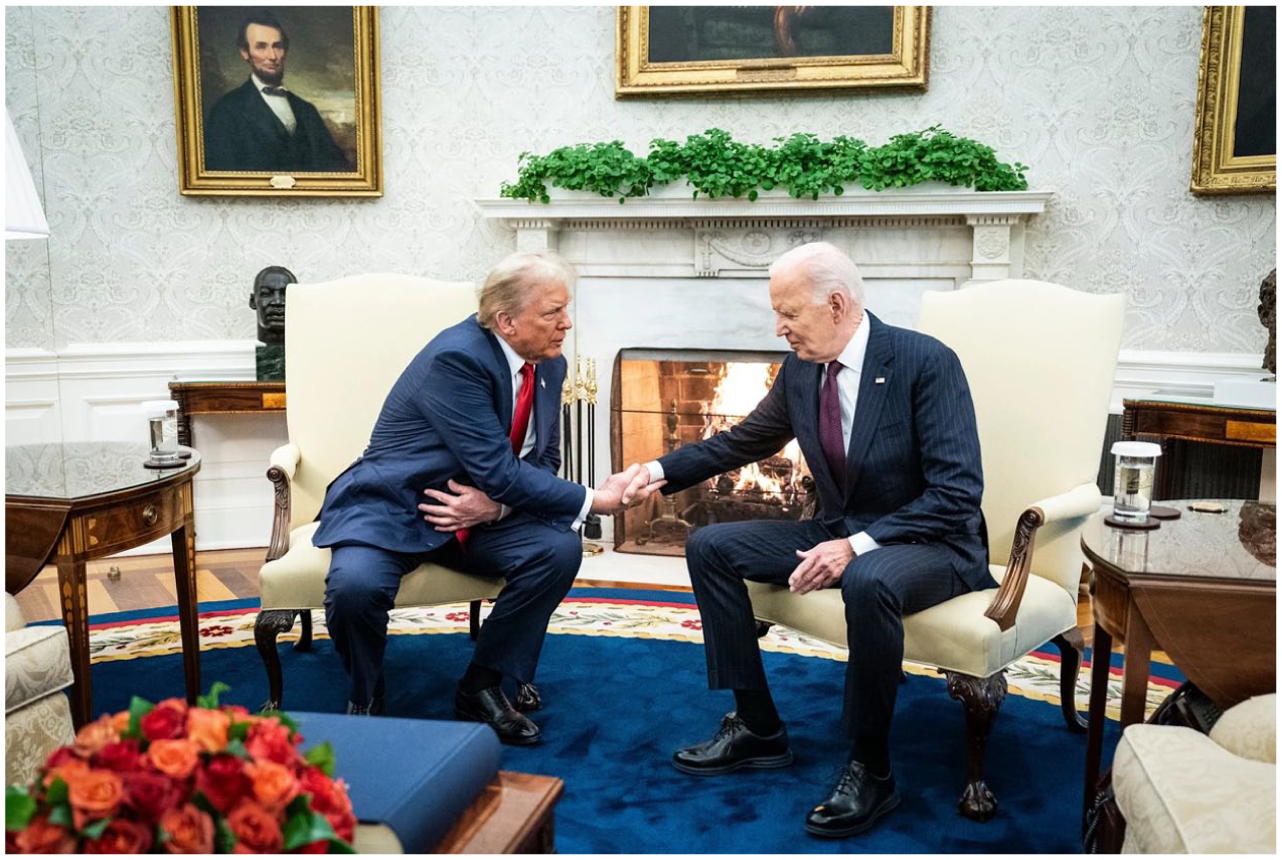
Donald Trump and Joe Biden in the Oval Office on 13 November 2024 (Jabin Botsford/The Washington Post).
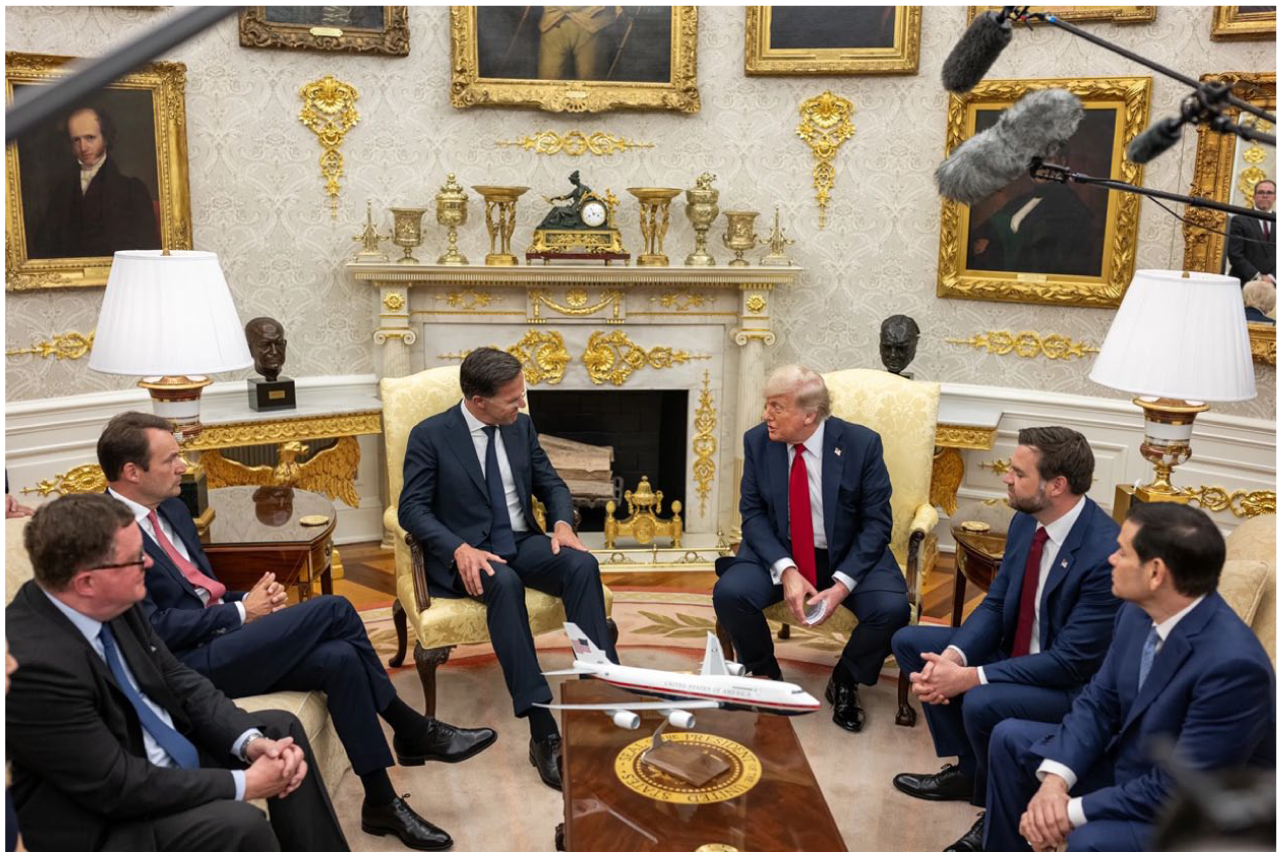
NATO Secretary General Mark Rutte and Donald Trump in the Oval Office on 14 July 2025 (The White House/Daniel Torok).
It is, however, not only Trump and authoritarian leaders who make extensive use of gold in the presentation of the state. Many European republics, despite their formal break with monarchical rule, continue to conduct diplomacy in settings saturated with aristocratic grandeur. France’s Élysée Palace, with its gilded moldings and chandeliers, and the ornate reception halls of the Quai d’Orsay illustrate how a courtly aesthetic has endured as a dominant visual language of the French state long after the end of monarchy. Similar continuities can be observed in Italy, Portugal, Romania, and the Czech Republic, where historic interiors originally associated with royal power continue to frame the visual presentation of republican states. The same holds for contemporary monarchies such as Sweden and the United Kingdom. While monarchical heritage often renders such aesthetics unremarkable, the underlying logic guiding the use of gold in diplomatic settings is shared across monarchical and republican contexts.
Why, then, is gold condemned as excessive or vulgar when used by figures such as Trump or contemporary autocrats, yet taken as natural and even prestigious when displayed in European palaces? One answer lies in how observers interpret the values behind aesthetic choices. How such interpretations are formed, and which underlying values they mobilize, is not self-evident. Depending on the actor’s status and perceived legitimacy, similar aesthetic choices may be interpreted either as a performance of personal authority or as an inherited and naturalized backdrop of state tradition. These inconsistencies point to deeper normative logics that shape how diplomatic actors are judged, and why only certain individuals and states come to be recognized as legitimate and competent performers of diplomatic practice, even when they act in similar ways.
They also expose a tension at the heart of modern diplomacy: the simultaneous pursuit of egalitarian ideals and hierarchical forms of distinction, both of which carry strong moral weight in the international sphere. For example, egalitarian diplomatic norms, such as the principle of flag equality (Faizullaev, 2013), often coexist with status-seeking practices, including the use of ornate furniture and large baroque-style meeting rooms when hosting bilateral or multilateral gatherings (Danielson and Hedling, 2022). The Swedish case makes this tension especially clear. Internationally portrayed as a “moral superpower” (Dahl, 2006; Emmerson et al., 2025) committed to egalitarian values, Sweden nonetheless conducts much of its diplomacy in settings rich with aristocratic ornamentation, gold leaf and royal insignia, housed in Baroque or French classicist buildings. At first glance, these elements appear at odds with the state’s egalitarian self-understanding. Yet they endure as integral to the visual and material language of Swedish diplomacy. Rather than suggesting that Swedish society is in fact egalitarian, this points to the role of egalitarianism as a powerful self-identity upheld by Swedish elites, one that can obscure enduring hierarchies and exclusions and, in doing so, enable practices that reproduce the very distinctions it seeks to deny.
The article examines this paradox through the lens of Charles Taylor’s (1989) concept of hypergoods, understood as the deeper sources from which moral understandings and judgments arise. Hypergoods are values regarded as highest in worth, against which other values are assessed. They orient action and identity, yet they are rarely coherent or singular. Modern societies, Taylor argues, are marked by moral pluralism, in which goods such as freedom, equality, authenticity, status and tradition coexist in tension and are negotiated through everyday practice. Taylor’s notion of hypergoods thus helps explain how the same material form can acquire divergent meanings depending on the moral sources to which it is anchored. This makes it possible to analyze diplomatic aesthetics not only in terms of competent performance, but also in relation to their alignment with perceived normative commitments.
By integrating practice theory with Taylor’s moral philosophy, this article contributes to the literatures on diplomatic practice and visual politics. The primary contribution is to illustrate how the performance of practices, including visual diplomatic practices, is judged based on its alignment with moral standards. In other words, diplomatic aesthetics are structured by higher-order moral benchmarks that define the standards against which visual presentation is judged. Rather than treating the use of gold solely as an instrument of status signaling or a source of symbolic capital, the analysis shows how practitioners assess aesthetic forms, including gilding, through evaluative standards that they experience as morally binding. This perspective reframes visual politics as a domain of moral ordering and extends practice theory by specifying the evaluative architecture that orients practical judgment. It also helps explain why certain actors are recognized as legitimate performers of visual diplomatic practice while others are stigmatized. Only certain “established” actors can credibly deploy gold in ways that convey authenticity, restraint, equality and inclusivity, whereas those cast as outsiders are presumed incapable of embodying these same values through identical material forms. In sum, these dynamics show how diplomatic interiors function as sites where legitimacy is negotiated and where hierarchies are reproduced, even in societies that explicitly claim to be committed to their dissolution.
The analysis builds on 21 in-depth interviews with Swedish diplomats, civil servants, politicians and Royal Court representatives, using photo elicitation. Participants were shown images depicting accreditation ceremonies, meetings, and interiors from locations such as the Swedish Royal Palace and the Ministry for Foreign Affairs (Arvfurstens Palats, “the Palace of the Hereditary Prince”), alongside comparable settings in both European and non-European contexts. In doing so, the method elicited immediate, affective comparisons and responses that revealed normative orientations regarding the perceived (il)legitimate use of diplomatic aesthetics.
The article continues by first situating diplomatic interiors and other aesthetic choices within the literature on visual diplomacy and the aesthetic turn in IR, arguing that visual representation is best understood as part of a broader repertoire of diplomatic practice rather than as images detached from the know-how that sustains them. It then introduces Taylor’s concept of hypergoods and integrates it with practice theory to explain how judgments about legitimate diplomatic aesthetics are oriented by higher-order moral commitments. After outlining the interview and photo-elicitation design, the analysis traces how Swedish diplomatic practitioners justify the “proper” use of gold by foregrounding two interlocking moral benchmarks, authenticity and restraint, and inclusion and equality, and by contrasting these with how similar ornamentation is read in settings associated with insecurity, domination or exclusion. The conclusion draws out what the analysis reveals about moral evaluation, stigma and the persistence of hierarchy within ostensibly egalitarian diplomatic practice.
Visual diplomatic practices and the aesthetics of international politics
While diplomacy is conventionally understood as the institutionalized management of peaceful relations between states (Satow, 2016: 3), it is sustained in practice through a dense web of tacit rules, routines and expectations. These practices, embedded in protocol, custom and shared understandings, constitute the everyday infrastructure of diplomatic interaction. A growing body of work on diplomatic practices has sought to unpack these dynamics (Adler and Pouliot, 2011; Adler-Nissen and Eggeling, 2022; Bicchi and Bremberg, 2016; Cooper and Cornut, 2019). Yet this strand of research remains largely disconnected from the emerging visual turn in IR (Aalberts et al., 2020; Bleiker, 2018, 2023; Callahan, 2020; Galai, 2025; Hansen, 2011; Hansen et al., 2021; Lundgren, 2018; Phillips and Shimazu, 2025; Schlag and Geis, 2017; Shimazu, 2014).
As Bleiker (2018) notes, the surge of interest in the role of the visual in international politics has been shaped by assumptions drawn from semiotics and cultural studies, with emphasis placed on the reception and representational content of visual materials. Much of this work analyses images of international political events, asking how they circulate, what they signify and how they shape emotional and political responses (Freistein et al., 2022; Heck and Schlag, 2013). For this reason, the field of study has so far primarily focused on the discourses and narratives that surround iconic images, such as the image of 2-year-old Alan Kurdi lying dead on a beach in Turkey (Hansen et al., 2021) and the image of Angela Merkel standing over a seated Donald Trump at the 2018 G7 summit (Freistein and Gadinger, 2022). However, the focus on the effects of iconic images risks detaching visual outputs from the practical know-how that underpins their production. It can tell us how photographs of summits are interpreted and imbued with meaning, but less about why summits are staged in the ways they are; why certain spatial arrangements, dress codes or architectural settings are selected; and how such choices draw on shared professional repertoires.
Building on the visual turn in IR, some scholars have in recent years increasingly examined how imagery, spectacle and aesthetic forms shape diplomatic practice and international representation (Adler-Nissen and Tsinovoi, 2019; Constantinou, 2018; Eggeling, 2025; Freistein and Gadinger, 2022; Møller et al., 2024; Markussen, 2024; Neumann, 2020). Constantinou defines visual diplomacy as the use of images by diplomatic actors to transmit ideas and shape relations across publics (Constantinou, 2018: 391). From staged summits to cinematic representations, such visual practices constitute a form of “diplomatic spectacle” through which political orders are enacted and remembered. Iconic depictions of events like the Paris Peace Conference or the meetings of the Concert of Europe, with their lavish halls and ornate costumes continue to shape how these moments are imagined.
Such attention to visual detail, such as the use of monumental architecture, elaborate decorations and other forms of splendor to convey status, remains a long-standing and ongoing feature of diplomatic practice (Faizullaev, 2013). These symbolic displays rest on the assumption that status and prestige enhance a state’s ability to influence others. By showcasing wealth, cultural refinement, or historical depth, states seek, consciously or not, to signal the power they possess, believe they possess, or want others to believe they possess (Cohen, 1987; Danielson and Hedling, 2022). Visual diplomacy thus operates as both statecraft and symbolic struggle, as actors seek recognition and distinction through curated aesthetic forms. Yet even in this growing literature, the emphasis remains largely on images as representational outputs or strategic instruments. Less attention has been paid to the practical knowledge and evaluative standards through which such aesthetic forms are produced and judged within diplomatic communities.
The disconnect between practice theory and visual politics is therefore empirically puzzling. Choices around visual diplomatic representation, such as staging, design, or bodily comportment, are routine yet rarely arbitrary. Although diplomats may not always acknowledge the impact of the visual, states spend significant resources and effort on the visual dimension of diplomatic rituals, for instance, during ambassador accreditation ceremonies. This reliance on visuality extends a long-standing tradition in which diplomacy has been closely bound up with values rooted in aristocratic culture: prestige, honor, and reciprocity. As Guzzini (2013) notes, the habitus of the court aristocracy persists in modern diplomacy because the field remains shaped by symbolic hierarchies, ritualized practices, and embodied dispositions that have been inherited from French court society. Rules governing dress, speech, and comportment codified hierarchy; reinforced dependence on the monarch; and demanded continual calibration to symbolic cues of status (Elias, 1969). The persistence of these dispositions is visible in recurring visual forms, from early modern royal portraiture (Sowerby, 2014) to the uniform “family photos” traditionally taken during multilateral summits (Naylor, 2020). The governed processes behind these family photos demonstrate the point (Lundgren, 2018). As Neumann notes, “little is said about it, although a lot of work goes into it” (Neumann, 2020). When visually communicating in the context of diplomacy, states and their representatives draw on an implicit sense of appropriateness shaped by the background knowledge of diplomatic practitioners. Recurring visual forms, such as the family photo, thus enable states to assert their place in the international order and compete for recognition.
Recent work on sociability in international politics sharpens this point. Much of diplomacy unfolds in what Neumann calls its “wings”: banquets, reception halls, golf courses, and saunas (Nair, 2020; Rösch, 2020, 2025). Rather than treating these settings as peripheral, this scholarship shows how sociable practices shape recognition and authority through embodied co-presence and affective dynamics. These encounters are neither placeless nor random. They take shape in specific material environments that structure participation and signal status, such as ballrooms and elite clubs. Nor are they socially neutral. Even where sociability may momentarily suspend rank, such informal interactions remain embedded in hierarchies that shape access and belonging (Nair, 2020: 4–6). As Towns (2024) has shown, diplomatic sociability is patterned by classed and gendered expectations, including unequal demands regarding dress and appearance management. Yet while the sociability literature recognizes that such spaces matter for interactions between diplomatic actors, it largely treats them as contextual backdrops. What remains under-theorized are the evaluative standards through which these environments, and the actors performing within them, are judged.
This article addresses that gap by shifting attention to the practical sense that guides the production and staging of diplomatic visuals. Rather than focusing solely on the effects of images, it examines the background knowledge of those responsible for diplomatic protocol and etiquette, and shows how this knowledge renders aesthetic choices appropriate and legitimate within a given diplomatic field.
The role of aesthetics in diplomacy
To understand why certain visual choices become visual diplomatic practices, we must also understand the general role of aesthetics in diplomacy – in other words, how diplomatic actors, including state leaders, diplomats and the state itself are displayed, seen or sensed. This includes not only the interior design of diplomatic buildings, but also their architectural style (De Maeyer et al., 2021), the choice of dress (Kuus, 2015), symbolic objects (Faizullaev, 2013) and ceremonial arrangements. Even seemingly minor details, from the type of pen used to sign an agreement, to whether one is surrounded by advisors or seated alone, to the floral arrangements at a press conference, or the placement of a religious text on one’s desk, can send signals of strategic alignment, convey inclusion, or assert hierarchy (Danielson and Hedling, 2022: 259).
Scholars of diplomatic protocol also emphasize that these choices matter. As Hamilton and Langhorne (2010: 54) observe, ceremonial practices served a practical purpose. It gave a palpable demonstration of the relative power and influence of both sender and receiver . . . The lavishness or otherwise of a mission and the seniority of its head said something about the wealth and power of the sender and the importance attached to the recipient.
A similar logic is visible in contemporary diplomacy. Russian president Vladimir Putin hosted French president Emmanuel Macron, on 7 February 2022, only weeks before the full-scale Russian invasion of Ukraine, images showed the two sitting at a six-meter-long table (see Figure 3). As Le Monde’s Russian correspondent noted, “In the eminently Byzantine world that is the Kremlin, proximity or distance are subtle markers of esteem or disgrace” (Vitkine, 2022). The signal, in this case, was unlikely to convey esteem. As Sofer (1997) argues, diplomatic encounters rest on an inherent tension in that they are socially intimate interactions between political strangers and rivals. From this perspective, the exaggerated spatial distance staged during the meeting can be read as unsettling the delicate balance between estrangement and proximity on which diplomacy depends, thereby turning physical distance into excessive social and political distance.
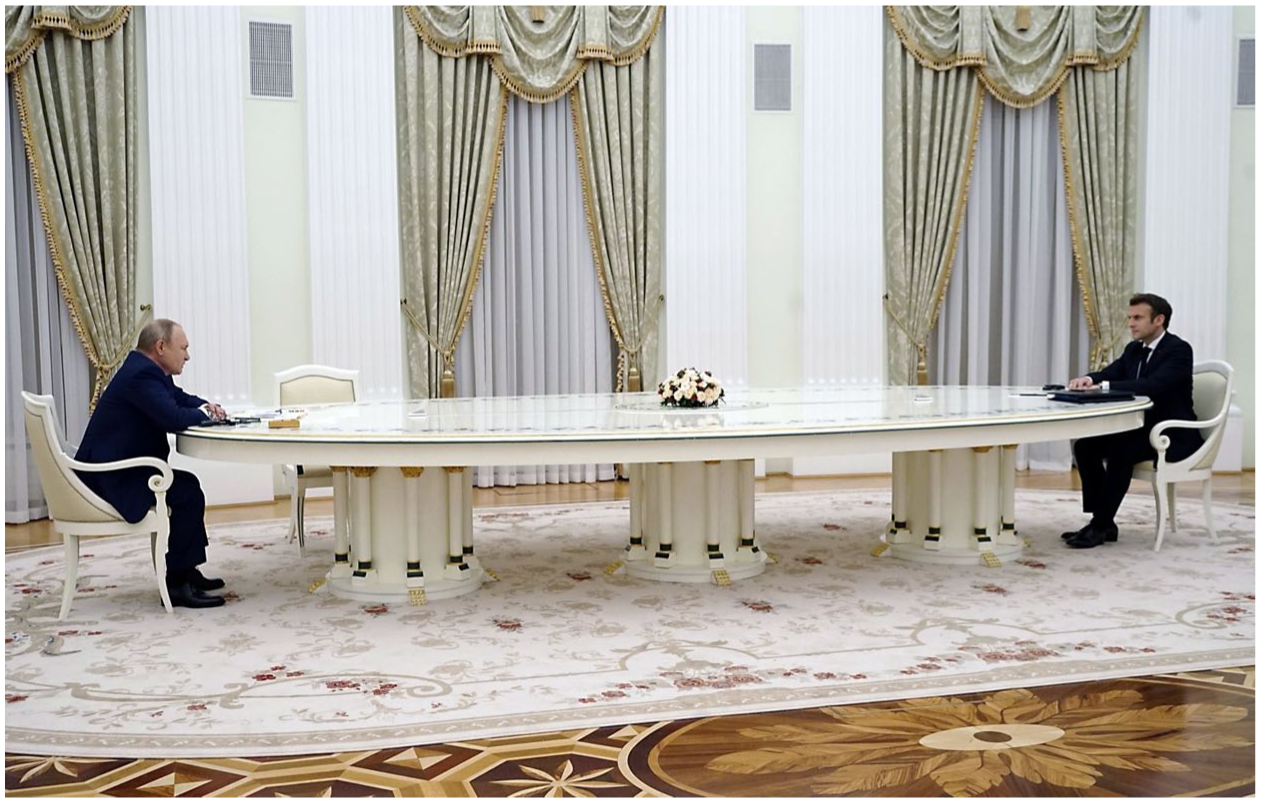
Meeting between Vladimir Putin and Emmanuel Macron on 7 February 2022 (Kremlin).
In short, ceremonial form exceeds mere ornamentation. It operates as a purposeful mode of communication within diplomatic exchange, grounded in the expectation that visual presentation will resonate with at least one relevant audience, whether a domestic political community, representatives of another state, or international society more broadly. From this vantage point, Wood and Serres (1970: 17), who treat ceremonial and protocol as synonymous, maintain that “there is no society without hierarchy and no civilization without ceremonial.” Together, these accounts underline that aesthetic choices are integral to how power and hierarchy are communicated through diplomatic practice. According to Zarakol (2011), the impact of such signals can partly explain why government officials in states such as Turkey and Japan chose to abandon traditional attire and conform to European dress codes. As Zarakol argues, such shifts were less about fashion than about the consequences of internalizing the stigma of being perceived as falling short of Western standards of a modern, civilized state.
The shared understanding that the visual dimension of diplomacy matters does not mean, however, that all diplomatic actors share the same understanding of which aesthetic practice is most appropriate or legitimate in each context. Although the spread of modernity has arguably led to a “Western cultural hegemonic order,” often embodied in diplomatic dress codes through the haute couture–inspired dark suit and tie, this standard has never been universally accepted. For example, since 1979, Iran has deliberately distanced itself from this model. As Neumann (2020: 63) notes, the tie is avoided by Iranian officials and functions as a pejorative marker of Westernization – focoli, or “tie-wearer.” Whereas in much of the West the tie has shifted from a marker of class distinction to a signifier of formality, in Iran it has been recast as a symbol of the corrupt West.
Diplomatic buildings also play an important, but often understated role in a state’s visual politics. For example, throughout the Cold War, the United States and France used embassy construction to project national ideals, commissioning prominent architects to create façades and interiors that would impress host-country elites. By placing large modernist embassies in the center of foreign capitals, the United States was seen as projecting confidence and openness. After 9/11, however, this approach was abandoned in favor of a “fortress model” of embassy construction: standardized compounds set apart from city centers, heavily secured and stripped of much of their architectural ambition (Loeffler, 2012). Other scholars have shown how diplomatic architecture can also signal friendship – whether with the host country, as in the Belgian embassy in New Delhi, or in partnership with other states, as in case of the Nordic embassy complex in Berlin (De Maeyer et al., 2021).
The use of gold in diplomatic aesthetics
Gold in gilded surfaces, ornate ornaments, and lavish décor has long been integral to the staging of diplomatic authority. Scholars in art history, diplomatic history, and cultural studies have shown how gilding and gold ornamentation function in diplomatic ceremonies, the exchange of gifts and in interior design. Throughout history, state actors have employed gold as both material and aesthetic element to project power and prestige, enhancing the image of the state embodied in the space or object that symbolizes it (Jardine, 1998). It is embedded in a material and visual culture of social differentiation, marking the divide between those who possess wealth and status and those who do not (Cherry et al., 2018). Gold, as a luxury material in gifts and décor, has thus been a calculated diplomatic instrument as far back as the Late Bronze Age (Feldman, 2006).
As with diplomatic aesthetics more broadly, the meanings attached to gilding as a diplomatic instrument have been multiple and layered. Beyond projecting status and differentiation, gold has also served to instill feelings of humility, awe, and even fear in its audiences. The most striking instances of such deployment can be found in Byzantium, where imperial audiences were staged in highly choreographed environments saturated with gilded surfaces and mechanical devices (Hilsdale, 2014: 200). Liutprand of Cremona, who was sent to Constantinople on behalf of the Pope in 949 and 968, describes a golden throne that could rise into the air, automaton lions that roared and flicked their tails and a tree of gilt bronze filled with mechanical birds (Brett, 1954). These effects formed part of a calculated aesthetic designed to unsettle envoys by enveloping them in a sensory display of shimmering gold, dazzling movement and overwhelming sound. Ceremonial manuals, such as the De Ceremoniis, the book of ceremonial protocol at the Byzantine court, make this intention explicit. As Featherstone (2007) shows, the De Ceremoniis presents such rituals as performed δι’ ἔνδειξιν (“for the sake of display”), with particular reference to receptions of Arab ambassadors, such as Abbasid envoy ʿUmāra b. Ḥamza. Other studies on the Byzantine court have also emphasized how the gilded throne room in the Great Palace of Constantinople was engineered to elicit awe and intimidation, pairing golden ornament with water-driven organs to create a synesthetic spectacle (El-Cheikh, 2004; Mahmoudian, 2021).
This logic resonates with Veblen’s (2017 [1899]) notion of conspicuous consumption, according to which visible displays of luxury function as markers of status and distinction. From this perspective, gold and splendor signal the capacity to expend resources in ways that enhance prestige. Recent work in IR by Gilady (2018) extends this insight to the state level – states often pursue costly and seemingly wasteful projects to signal their distinction from states with lower status. Gilding in diplomatic interiors can plausibly be read in similar terms, as a display intended generate awe, command recognition from other states and reinforce hierarchies. As mentioned above, Trump’s recent redecoration of the Oval Office in the White House provides an illustrative example. This interpretation is nevertheless context-dependent. Depending on the values this aesthetic is assumed to signal, gold may be perceived either as a deliberate performance of personal authority or as an inherited and naturalized backdrop of state tradition, as in the case of former or current monarchies. It is therefore necessary to understand what these values are, how they are ranked against each other and why. 1
Hypergoods in international politics and diplomatic practice
Before proceeding, it is useful to briefly outline Charles Taylor’s concept of hypergoods, or what Taylor also terms “constitutive goods” (Taylor, 1989: 4) and its use in IR. In Sources of the Self, Taylor (1989: 62–63) describes the concept in the following way: Most of us not only live with many goods but find that we have to rank them, and in some cases, this ranking makes one of them of supreme importance relative to the others . . . Let me call higher-order goods of this kind “hypergoods.”
According to Taylor, hypergoods differ across individuals, yet everyone necessarily relies on some. They underpin what he describes as “strong evaluations,” that is, judgments about what is better and worse, higher and lower, or right and wrong, which cannot be reduced to personal preferences or inclinations but instead function as standards by which such preferences are assessed (Taylor, 1985: 3). Such strong evaluations are unavoidable: they provide orientation, define horizons, and give structure to our lives by imposing implicit limits on what can be chosen, thereby making meaningful action possible. The concept of hypergoods thus explains not only how meanings are assigned to actions – such as visual diplomatic practice – but also why these meanings are significant to actors, thereby shaping their actions and identities.
A hypergood anchors what Taylor calls our “moral space” (Taylor, 1989: 28). It shapes not only how we assess our own conduct, but also how actions more generally appear within a shared evaluative horizon. Living in accordance with such a good can sustain a sense of integrity, whereas acting against it may bring guilt or shame. When others violate what one takes to be of highest worth, their conduct can register as a denial of something objectively significant, eliciting indignation or anger. These responses arise within a shared moral vocabulary, acquired through participation in a common space of judgment in which certain actions count as worthy or as failures. Emotions in this sense express an actor’s orientation within a socially constituted field of evaluation and thus illuminate the affective dimension of what practice theory conceptualizes as a practical sense (Taylor, 1989: 35–36). 2
For IR, the concept of hypergoods is useful because it foregrounds how values operate as structuring forces in international politics, shaping both the legitimacy of practices and the identities of actors. Hypergoods help explain why certain practices endure and command recognition even when they resist instrumental justification. Crucially, they operate at the level of moral orientation, shaping what counts as worthy or excessive before actors are ranked within a given social field. Whereas related concepts such as symbolic capital or ritual action capture the political work of symbols, they tend to bracket the moral sources from which legitimacy claims are derived. Approaches centered on (mis)recognition, including status, stigma, and norms, do address legitimacy and are valuable for explaining how actors are ranked, but often leave underexplored why certain norms or values come to be regarded as more important than others, and how this hierarchy of worth structures judgment in the first place. The notion of hypergoods shifts attention to this prior level. It directs analysis to the background standards of worth that render some practices self-evidently appropriate and others inappropriate, and that make such hierarchies intelligible and persuasive.
Although well established in moral philosophy, the concept of hypergoods has received limited attention in IR. Where it has been taken up, it forms part of a broader effort to examine how actors justify conduct and organize preferences around ultimate values. Guillaume (2007), for example, employs the notion in his analysis of the French “veil affair,” where republicanism and secularism (laïcité) function as hypergoods that provide the moral horizon within which French national identity is articulated. These commitments outweigh competing claims for recognition and help account for the persistence of practices that sit uneasily with alternative understandings of citizenship or multiculturalism. More recently, Acharya et al. (2023) analyze culturally distinct hypergoods such as tianxia or dharma, showing how they underpin plural visions of rightful order. These civilizational moral horizons function as higher-order values that organize political life and shape judgments of legitimacy and desirability. Bringing such non-Western sources of order into view underscores that international practices are sustained by multiple, culturally embedded hypergoods that support different, and sometimes overlapping, conceptions of world order.
While these insights are valuable, the IR literature’s limited use of the concept can be criticized for privileging discursive articulations of hypergoods, leaving underexplored how such values are enacted in practice. From a practice-theoretical perspective, hypergoods are not merely expressed in language, but embedded in routines and performances that make the expression of certain values appear appropriate, self-evident and competent. International order is reproduced through what actors do as much as they say, through the assumptions they draw on and the repertoires they enact. For this reason, I adopt the concept of hypergoods by integrating it with practice theory, treating them as higher-order values realized in everyday diplomatic routines and aesthetic choices.
A final clarification concerns how the concept operates analytically. Hypergoods help explain why evaluative judgments carry moral weight for actors and why certain goods override others. They do not, however, account for how such judgments become intelligible and persuasive in the first place. The ability to recognize a gilded interior as heritage rather than excessive depends on forms of practical competence that are distributed unevenly across audiences and anchored in communities of practice (Adler et al., 2024). What counts as an “obvious” reading of a certain diplomatic aesthetic therefore largely depends on one’s background and prior socialization. For this reason, the analysis treats moral evaluation and practical competence as mutually constitutive features of how diplomatic aesthetics are read and ranked. It is also why the interviews focus specifically on actors presumed to possess the practical competence to judge what counts as an appropriate diplomatic aesthetic, and what does not.
Method and material
The empirical material consists of 21 in-depth interviews with Swedish diplomats, civil servants, politicians and representatives of the Royal Court, conducted using a photo-elicitation method. Respondents were recruited on the basis of their practical involvement in, or professional familiarity with, the visual representation of the Swedish state. For some, such as interior designers at the Ministry for Foreign Affairs, this involvement was direct and hands-on, while for others, including former Ministers of Foreign Affairs, it was more indirect. All respondents were nonetheless assumed to hold informed views on what constitutes appropriate or legitimate visual state representation, in Sweden and beyond. In order to increase the number of respondents, a snowball sampling strategy was used to identify and access participants (Cohen and Arieli, 2011; Mendez, 2020). A full list of respondents can be found in Appendix 1.
This sampling strategy also defines the analytical scope of the article. Because the respondents are Swedish diplomatic practitioners and adjacent elites, the material captures an emic repertoire of judgment: how insiders authorize Swedish diplomatic aesthetics and how they evaluate comparable scenes elsewhere. Crucially, this is not treated as a neutral benchmark for what diplomatic aesthetics “really” mean. It is instead treated as evidence of how legitimacy is claimed and defended through moral language and professional competence, including the ways in which categories such as authenticity, restraint, and good taste are used to draw boundaries between competent and incompetent performances of diplomacy. The analysis therefore does not assume that Ghanaian, Russian or other practitioners would narrate their own aesthetic choices in the same terms (most likely not), nor does it claim that Swedish readings travel unproblematically across audiences.
Interviews lasted on average approximately 60 minutes, of which about half was devoted to photo elicitation. Photo elicitation is an interview technique in which participants are shown photographs, produced by the researcher, created by participants, or drawn from archives, to stimulate dialogue and encourage richer, more reflective responses than verbal questions alone (Collier and Collier, 1986: 99–113; Harper, 2002; Rose, 2016: 240–243). Visual prompts can help interviewees recall details, express tacit knowledge, or broach sensitive subjects more indirectly, often leading to more candid and nuanced accounts. The method can also rebalance the interview dynamic by centering the participants’ interpretations – they become “expert guides leading the fieldworker” (Collier and Collier, 1986: 106). However, it requires careful selection and framing of images to avoid leading responses, and participants’ interpretations may diverge sharply from the researcher’s intended focus, demanding flexibility in analysis.
Respondents were shown a curated set of photographs depicting diplomatic ceremonies, meetings, press conferences with state leaders and the interior design of a range of diplomatic spaces. The images featured scenes from Sweden’s Royal Palace and Arvfurstens Palats, alongside comparative examples from other well-known diplomatic spaces: the Kremlin, the Quai d’Orsay, the Europa Building in Brussels, the Great Hall of the People in Beijing, the Oval Office and the US State Department. They also included several instances of the ceremonial presentation of diplomatic credentials in China, Ghana, Indonesia, Luxembourg, Maldives, Russia, Serbia, Singapore and Sweden. This approach was designed to provoke reflection on both familiar and foreign contexts, enabling respondents to articulate their evaluative perceptions of them. By prompting immediate, affective responses to visual cues, the method surfaced normative comparisons and evaluations that might otherwise remain tacit.
The selection and use of visual material followed an iterative and abductive logic, in which emerging interpretations informed subsequent empirical choices rather than being fixed in advance (Timmermans and Tavory, 2012). Rather than relying on a uniform set of images shown across interviews, the choice of photographs evolved over the course of the study in response to how respondents engaged with them. While the initial images were selected to capture variation in diplomatic settings and degrees of ornamentation, only some consistently prompted detailed evaluative responses. Images that appeared visually ordinary or closely aligned with the Swedish diplomatic aesthetic often failed to provoke reflection precisely because they did not disrupt respondents’ expectations. As the analysis progressed, the set of images shown to respondents was refined to sharpen contrasts and probe emerging evaluative distinctions. Photographs that repeatedly generated categorical judgments were used to explore the moral boundaries respondents drew around legitimate diplomatic aesthetics, while images that elicited little response across interviews were set aside. More familiar images were retained to serve as an implicit baseline against which such judgments were formed, for example, images from Swedish diplomatic spaces.
In a similar vein to the selection of images used in the photo elicitation, the identification of hypergoods emerged through an iterative and abductive process. Respondents were not asked to articulate their values directly. Instead, the analysis focused on how they assessed concrete aesthetic situations, for example, by judging whether a setting appeared legitimate or embarrassing, appropriate or simply unthinkable. Particular analytical weight was given to moments where such evaluations were expressed in categorical terms, as in statements like “we would never” or “nobody should.” Such formulations suggest that certain moral judgments are treated as settled and non-negotiable. The analysis then examined how more familiar goods associated with diplomacy were handled in relation to these judgments. Elements that might otherwise be seen as positive (such as elegance or grandeur) were sometimes accepted and sometimes rejected, depending on whether they aligned with what respondents took to be more fundamental standards. When such considerations were consistently overridden by other concerns or values, this pointed to the presence of a moral ordering. Those standards that repeatedly were invoked to draw boundaries between legitimate and illegitimate practice, were therefore interpreted as hypergoods in Taylor’s sense: moral reference points through which respondents oriented judgment and articulated a sense of collective identity in relation to others.
The Swedish lagom way of using gold in diplomatic aesthetics
As outlined above, gold and other forms of diplomatic aesthetics have long been used to embody and communicate values. Through the staging of diplomatic encounters, states and their representatives are presented in ways that invite particular associations and reactions. When audiences interpret a gilded hall, they are responding to underlying ideas about what the state does and should embody: majesty or modesty, continuity or change, authority or equality. Aesthetic choices thus operate as carriers of value, whether deliberately mobilized or inherited through historical circumstance. It is at this level that the notion of hypergoods becomes analytically useful. Most often, the same material choices can maintain multiple, even competing, interpretations of what is being signaled, depending on the identities, positions, and expectations of both the sender and the receiver of the visual communication. In this sense, the ambivalence of diplomatic aesthetics becomes a means of both invoking such higher-order goods (e.g. whether authority is privileged over equality) and leaving room for interpretation, allowing states and their representatives to assert their own understanding of which values should be upheld and valued in international society.
The interviews conducted for this study reveal how Swedish diplomatic actors themselves engage with this ambivalence. They show a clear awareness of which values a state should project, and of how aesthetic choices in diplomatic settings can affirm or undermine those values. However, instead of formulating these evaluations as abstract ideals, the respondents’ understanding of appropriate diplomatic aesthetics emerge through the distinctions they make and the contrasts they construct vis-à-vis other states. In this sense, hypergoods appear as practical moral benchmarks embedded in everyday professional judgments. The analysis that follows traces how these benchmarks are articulated and sustained in practice, focusing on two interrelated sets of values: authenticity and restraint, and inclusion and equality.
Authenticity and restraint
A central theme in the interviews is that Sweden’s use of gold must be characterized by moderation, restraint and authenticity. Gold is deemed acceptable, even dignified, when it is tied to history and continuity, but it becomes problematic when it appears excessive or staged to simulate a past that does not exist. When shown an image of an accreditation ceremony in Ghana (Figure 4), one respondent summed up his view by remarking that “it looks a little theatrical, like it’s a copy of something it isn’t” (Respondent 7). When asked why this is an issue, he explained: Because it doesn’t impress – it becomes ridiculous. The higher up you go, the more it should be “less is more.” That’s why people talk about nouveau riche and old money. Nouveau riche is bad – too many gold rings and too many symbols (. . .) Old is beautiful, it has higher status.
Would you say that this logic is also reflected in the work of the Royal Court?
Absolutely. You shouldn’t have too much. It should be dignified, elegant. You have everything – you just don’t show it. (Respondent 7)
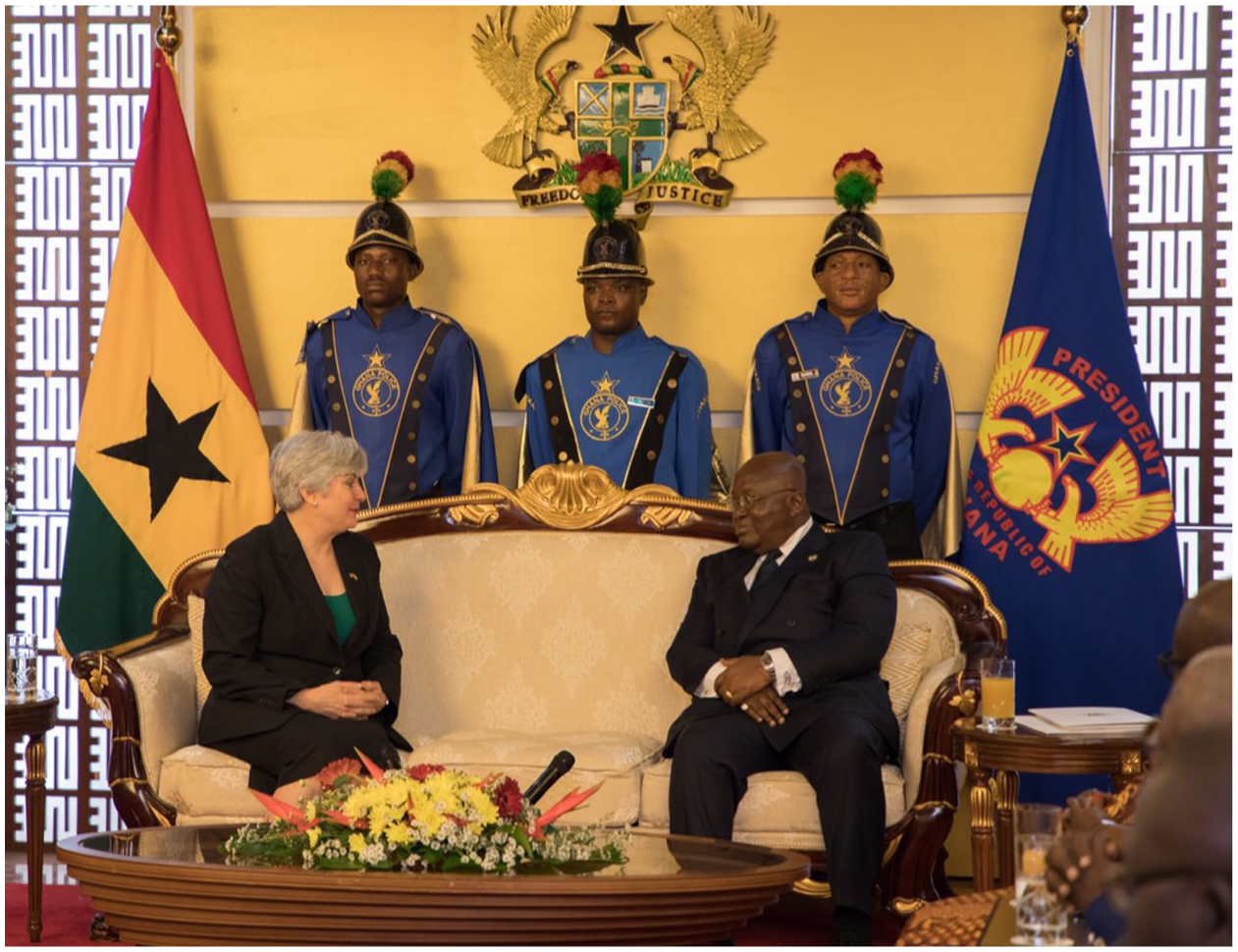
US ambassador Stephanie S. Sullivan presents her credentials to President Nana Akufo-Addo on 23 January 2019 (@USEmbassyGhana on X/Twitter).
In this way of reasoning, restraint is not the absence of authority but its condition. Authority becomes credible when it does not need to announce itself through too much or newly added splendor. Even a highly gilded environment in the Royal Palace may be read as natural and self-evident because “it’s a king that is hosting. If it had been a president, it might not have felt natural. One expects national grandeur in a thousand-year-old kingdom” (Respondent 7). The legitimate use of gold is thus tied not only to quantity, but also to proportionality – that is, whether the room’s ornamentation appears to “belong” to a historically continuous setting and to the identity of the host.
These quotes are revealing, not because they establish an objective aesthetic standard, but because they show how taste is socialized within a particular diplomatic community. When applied to postcolonial settings, such distinctions also resonate with older civilizational narratives in which non-Western display is cast as imitation or excess, with Europe positioned as the implicit “original,” understood as the only “replicable conception of what it means to be human and political” (Opondo, 2010: 119). This dynamic also connects to what Steele (2019) identifies in his analysis of Established–Outsider relations: that discourses of restraint have historically served to discipline outsider groups, premised on the assumption that the “outgroup is incapable of restraining themselves, whether that lack of restraint is due to an overactive energy or strength, or because they are not yet cultured or socialized enough to know how to restrain” (Steele, 2019: 93). Crucially, such discourses serve to deny agency to the groups they target and have historically been used to justify violent intervention against them. These moral judgments surrounding the appropriate degree of restraint in a state’s visual presentation should thus be understood as part of the politics of diplomatic taste, rather than as neutral descriptions of what counts as appropriate diplomatic aesthetics.
The judgments also point toward a concern with authenticity, which becomes clearer when respondents discuss the Swedish palace rooms whose décor originates from Sweden’s Great Power era, such as the Hall of State (Rikssalen), or Karl XI’s Gallery (Figure 5). In those cases, gilding is read as acceptable precisely because it has been moved from a present political claim to a matter of historical preservation: [Karl XI’s Gallery] was meant to display the grandeur and glory of the [Swedish] Great Power era. The ceiling paintings are about Karl XI’s successful wars. It’s a room filled with imperial and great-power symbolism. A crucial difference is that it is history. That makes it obvious that the room should be preserved as part of the story of our country. That this is how we presented ourselves, how we wanted to show off Sweden in the seventeenth and eighteenth centuries . . . But it doesn’t create unease today, because it is not today’s Sweden. Today it’s a beautiful room, filled with history and cultural heritage. (Respondent 11)
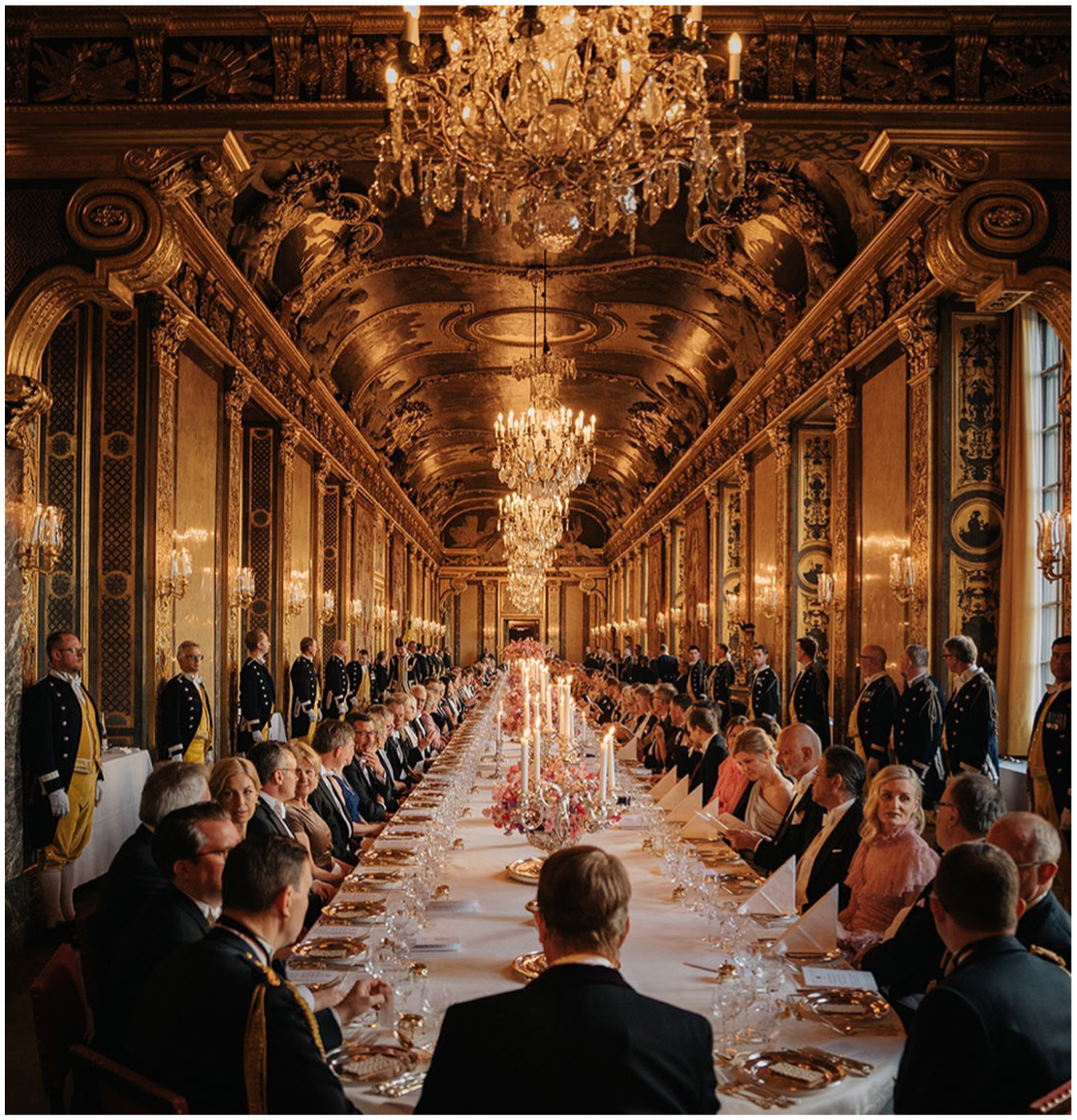
A dinner in Karl XI’s Gallery in the Royal Palace in Stockholm (Clément Morin/Kungl. Hovstaterna).
In other words, the perception of moderation and restraint depends not only on the amount of gold used but also on whether its use is embedded in a historical narrative. The extent of gilding is only perceived as legitimate and authentic if it stands in proportion to the historicity tied to the building and host. Swedish gilding is thus perceived as acceptable because it is viewed as the preservation of cultural heritage instead of a renewed display of grandeur or imperial aspiration. As another respondent pointed out, this is not a new phenomenon. Like other European states, Sweden has upheld historicity as a higher-order value for centuries. As one respondent remarked, it has certainly been important to emphasize the age of the realm. In earlier times, states even went to war over such things – which country was the oldest, which monarchy came first, and so on. And we Swedes suffered from delusions of grandeur just like others. (Respondent 9)
Unlike in the past, however, when Swedish actors may have fabricated or embellished their past to project greater antiquity, contemporary diplomatic actors place value on presenting their history as long, rich and authentic. Authenticity has, in effect, displaced antiquity as the dominant hypergood. In contrast, respondents described other contexts – especially Russia and certain states in the Middle East – as examples of inauthentic historicity and excess. When asked about whether there can be “too much gold” in diplomatic settings, one recalled a visit to Saddam Hussein’s old palace Baghdad in 2007: Yes, there can be too much gold. And especially too much gold when it’s so obvious that you didn’t have this from the beginning. (. . .) You have these fake environments where it’s not even real gold. It’s obvious that you’ve just piled it on to give the impression that you’re bigger, more important, more significant – when you might have actually gained more by keeping an originality. And I think that’s interesting, actually. It gives the impression that you’re trying to be something you really aren’t. So yes, there can be too much gold. Arvfurstens Palats [the Swedish MFA] and The Royal Palace here in Stockholm have a history. It isn’t fabricated or redone. It isn’t falsified, so to speak. (Respondent 12)
Interestingly, the respondent unprompted chose to make the comparison to Swedish way of using gold in its diplomatic interiors. Such a remark highlights how aesthetic choices are not only taken to express a state’s self-image but also serve, in Neumann’s (1996) terms, as markers of difference that help constitute boundaries between the Self and the Other.
The importance of authenticity in diplomatic aesthetics was also emphasized when some respondents linked the use of “fabricated” gold to the authority behind such aesthetic choices. For them, inauthentic uses of gold, understood as excessive or as attempts to simulate a past grandeur, are treated as signs of political authority that is insecure, compensatory, and therefore morally questionable. For example, when reflecting on the use of gilding in autocratic settings, and specifically on Vladimir Putin’s choice to use the Alexander Hall in the Kremlin for accreditation ceremonies (Figure 6), one of the respondents described the effect as an insecurity that “shines through”: if one needs a gilded backdrop in order to stand in front of others, then one lacks authority in oneself (Respondent 21). A similar judgment came from a respondent who described Trump’s recent redecoration of the Oval Office as casting “a shimmer of ridicule” over the president. In this view, the issue is not that the newly added gold signals power and authority, but that it reads as self-indulgent – as if the leader “thinks he is gold,” which undermines the very authority such décor is meant to project (Respondent 14). Importantly, this perception is tied to temporality: a Swedish actor could use gilded rooms if they already exist, the respondent argued, but would face harsh public criticism if they sought to build or introduce such ornamentation: “we just couldn’t build the Golden Hall [in the Stockholm City Hall] today. It would be political suicide, and that’s putting it mildly” (Respondent 14).
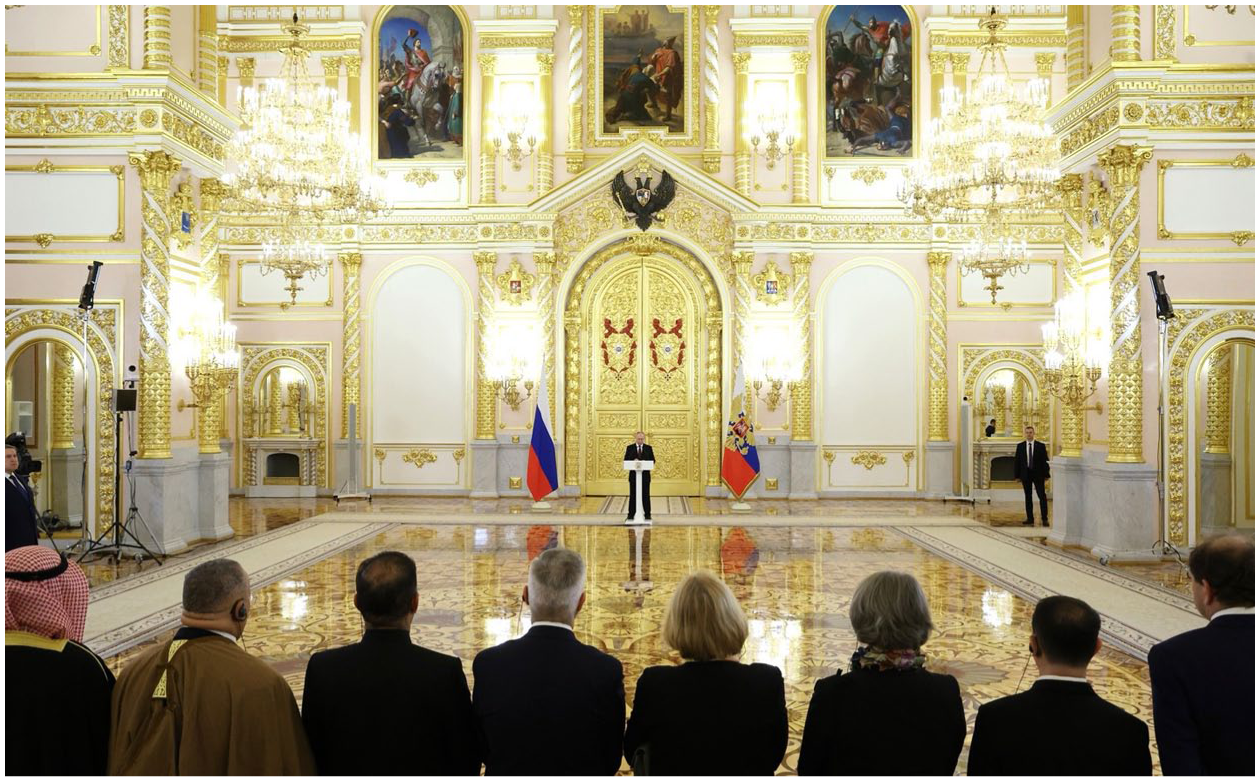
Vladimir Putin speaking during the ceremony for the presentation of ambassadors’ letters of credence in the Alexander Hall of the Grand Kremlin Palace on December 5, 2023 (Vyacheslav Prokofyev, TASS).
This “temporal morality” was further developed by another respondent, who argued that the Swedish state’s aesthetic restraint is inseparable from a fiscal and moral understanding of public office. The modern political administration is perceived as acting on behalf of the public, funded by taxpayers, and must therefore avoid any aesthetic signal that it is using “more money than necessary” (Respondent 16). She also described newly staged grandeur as “constructed abundance” that would not be accepted by the Swedish public, not least because it would be regarded as “boasting” (skryt). One notable exception to this rule, however, concerns members of the royal house: “the king is the king . . . he gets a free pass for most things” (Respondent 16). 3
Taken together, these evaluations clarify that authenticity and restraint function as higher-order moral benchmarks for legitimate authority. Restraint signals ontological security in authority, insofar as office can be inhabited without an anxious need to stabilize legitimacy through excessive gilding. It also signals fiscal and moral responsibility, understood as an obligation to avoid waste and the appearance of self-aggrandizement at public expense. Authenticity, in turn, is more than a matter of historical accuracy. Depending on how the purpose of splendor is interpreted, even historically correct uses of gold can be read either as heritage or as an insecure attempt to fabricate status. The same aesthetic elements, produced in the same periods and originally fashioned for similar purposes, can therefore generate sharply divergent judgments about their legitimate contemporary use, depending on the presumed aims and self-understandings of the actor in question, such as Sweden or Russia.
One respondent put this bluntly when she noted that while Putin’s use of the Alexander Hall in the Kremlin felt excessive and signaled great-power ambition, it would not have been inappropriate if the Swedish King stood in the same room – because “then it would have been our history.” Sweden, she argued, has also been a great power, but unlike Russia, “we have moved on. So you can use these symbols to show a history of what you once were. It doesn’t have to be what we identify with now” (Respondent 19). What defines an authentic use of gilding thus depends on how respondents interpret the intent underpinning its use. Gold is acceptable, but only when the user’s intent is read as authentic, in the sense that the actor is deemed morally secure enough to deploy symbols of past power without seeking to augment present status or revive imperial ambition. This, in turn, reveals authenticity as a hypergood, to which values such as wealth, beauty, and historicity are subordinated. In this sense, authenticity and restraint work together as hypergoods through which Swedish diplomatic actors distinguish legitimate from illegitimate performances of authority in diplomatic aesthetics.
Inclusivity and equality
The two other higher-order values expressed in the interviews were that of inclusivity and equality. In this context, inclusivity refers to the notion that the aesthetics of Swedish diplomatic spaces should project dignity without slipping into domination. Gold and ceremony should elevate an event, but never at the expense of the guests’ comfort or recognition. One respondent working at the Royal Court stressed that the aim of Swedish diplomatic ceremonies is not to intimidate but to create a hospitable and welcome environment: Here, we would always want – whether at the Royal Palace or in government contexts – to make sure that no one feels small or insignificant. No one is striving for the opposite. We want our guests, regardless of the occasion, to feel comfortable. And if it’s a festive event, then it should feel festive. Of course, it’s a monarchy, and then there are expectations that things should have a certain style. And the government wants it to be dignified and elegant, but it’s not an exercise of power. It isn’t. And it wouldn’t fit with the image of modern Sweden. (Respondent 9, emphasis added)
This concern with not making others feel “small” reflects the hypergood of inclusivity. Swedish diplomatic actors see dignity as legitimate only if it is paired with inclusion, making guests feel respected, recognized and part of the occasion. And this intended effect is directly tied to the perceived contemporary identity of Sweden. The Karl XI Gallery again served as an illustrative example. Though filled with gold and great-power symbolism, respondents emphasized how its contemporary use is perceived as shared rather than hierarchical: I’ve sat there quite a few times at dinners, state banquets, and official receptions. And then it feels like a very warm room. Because you have this very long table in the middle with 150 people around it. Then we fill the room, we who are there. It’s not a room used today to create distance or coldness. On the contrary, it conveys warmth and togetherness. (Respondent 11)
Gold, in this reading, functions only when it lessens feelings of social differentiation. This is a striking conclusion in light of the historical role of gold, which has typically been to underscore the divide between those with wealth and status and those without. The comparison with Russia was also yet again made clear. Respondents interpreted Putin’s ceremonial settings as designed precisely to create distance and subordination. Reflecting on the image of Putin speaking during a ceremony in the Alexander Hall in the Kremlin (Figure 6), one respondent noted, In this case the purpose is clearly to create distance and to signal that this is where the “chosen one” stands. It’s an imperial room, with one man standing there who has imperial ambitions. The symbolism is there in an almost eerie way. Here it’s not just about signaling history, tradition, and ceremonial, as a way of showing respect for two parties in a diplomatic setting. Normally, you display your country’s history and traditions while also doing so in a way that shows respect for the counterpart. But here it’s about an “emperor” who, through all the trappings around him, signals immense power claims and imperial ambition. (. . .) And of course, then the signal becomes unsettling, but that’s because we know the context. (Respondent 11)
One respondent described how the spatial arrangement in the room is intentionally “intimidating,” and that “this is made so that you should feel small” (Respondent 19). Similarly, another respondent stated that “here, they want to show that there is just one person who holds all the power” (Respondent 6).
In other words, for all three respondents, the context of the image is essential to understand the role of the aesthetics. It is precisely because they know the contemporary political ambitions of Russia and Vladimir Putin that they assign these values to the signals being sent by the décor in the room. Whereas Sweden was perceived as using gold furnishing primarily to signal dignity and conviviality, Russia was perceived to use it to project difference and domination. Although some respondents emphasized that much of the Kremlin’s décor is historically accurate, this was not enough to make it a legitimate and appropriate aesthetic. 4 To create subordination, even unintentionally, would be to undermine the understanding of Sweden as a modern, egalitarian state. For this reason, the respondents seemingly regard inclusivity and equality as hypergoods that even take precedence over historicity, as well as over more surface-level values such as beauty or grandeur. It also showcases how inclusivity and equality are tightly linked to the value of “authenticity” – it is only by striving to uphold the former values that one’s use of gold is deemed authentic.
This also helps explain why gold becomes ambivalent in Swedish visual diplomacy. As stated by representatives of the Swedish Institute, the government agency responsible with promoting the image of Sweden abroad, gilded halls may be acceptable as a historical backdrop, but they are not necessarily an “ingredient” in how Sweden wishes to communicate itself in contemporary imagery (Respondent 20). Gold always runs the risk of evoking a power-laden aesthetic that sits uneasily with the desired signals of modernity, innovation and equality (Respondent 17). There is thus a need to continuously ensure a correct “balance between the old and the new” (Respondent 19).
For respondents directly responsible for the staging and interior design of diplomatic spaces, equality was treated as a concrete visual practice expressed through arrangements and design choices. For instance, while Sweden possesses ceremonial spaces almost as grand as those in the Kremlin, vast halls with gilded ceilings, one respondent stressed that they deliberately avoid using them in ways that would create excessive distance: We wouldn’t place the king in the Hall of State. It’s a gigantic hall, and in theory we could place him in front of the throne. He could give his Christmas speech there, and the camera could be set 30 meters back. That would symbolize something grandiose. But we don’t want that. (. . .) [In contrast], this man [Putin] wants to symbolize distance and “I am unreachable,” while we want the king to appear close. So it’s completely out of the question for us. (Respondent 4)
Spatial distance thus figures as a key visual cue through which equality and hierarchy are read in diplomatic settings. Similarly, one of the MFA’s interior designers recounted how they chose to remove a gilded chair from an embassy because it was “uncomfortable” and therefore undermined the intended signal of inclusiveness (Respondent 18). In this case, inclusiveness was treated as a higher-order value that outweighed the status or symbolic authority the gold might otherwise have conveyed. The same logic and value hierarchy steered the design of the new Swedish representation to the North Atlantic Treaty Organization (NATO) headquarters. By using textiles and natural materials, such as wood and wool, the interior designers aimed to create a “homey” and comfortable feeling: “you should feel taken care of; that’s extremely important” (Respondent 13). The respondents thus emphasize that proper diplomatic aesthetics, including choices about whether and how gold is used, should produce feelings of warmth, inclusion and equality, ensuring that participants do not feel belittled or excluded. Aesthetics are judged successful only if they embody parity between the senders (e.g. the King, the state or high-ranking officials) and their audience. Excessive or hierarchical uses of gold, by contrast, are read as illegitimate precisely because they produce feelings of subordination.
In sum, Swedish diplomatic actors consistently frame their own use of gold as restrained, dignified, and embedded in historical continuity, in stark contrast to the excessive and intimidating aesthetics associated with autocratic states. In Sweden, gold is perceived as legitimate when it reflects heritage and tradition, and when its purpose is to create inclusiveness and equality among participants. The distinction thus lies not in whether gold is used, but how. To use gold the “proper way” is described as a moral necessity. Inclusion and equality thus function as hypergoods because they override other values – again, such as beauty, grandeur or historicity.
Conclusion
This article has examined how gold and diplomatic aesthetics are understood and deployed in Swedish diplomacy, and how these practices are contrasted with those of autocratic states, particularly Russia. Through photo-elicitation interviews, the study demonstrates how diplomatic aesthetics become sites where hypergoods are enacted and negotiated in practice. Respondents framed Swedish uses of gold as legitimate when associated with authenticity, restraint, inclusion and equality, while interpreting similar aesthetic forms elsewhere as expressions of domination, hierarchy or insecurity.
The argument made in this article is not that this gilding itself embodies an objective moral difference, but that Swedish diplomatic actors interpret similar aesthetic forms in different ways depending on the moral sources they associate with them. Highlighting such differences is thus not an endorsement of the view held by the respondents, but an empirical finding about how actors justify their own aesthetic practices and critique others’. The fact that such ethnocentric framings exist – that is, legitimizing one’s own practices through “moral” language while pathologizing others for employing similar ones – is itself part of the politics of diplomatic aesthetics and taste.
A further theoretical implication, though not fully developed here but deserving of further exploration in the future, is the structural position from which such moral evaluations are made. Steele’s (2019) application of Elias’s Established–Outsider framework to the politics of restraint suggests that the capacity to invoke restraint as a normative standard is itself a form of power, as illustrated by the respondents’ collective assessment that a state “shouldn’t use too much” gold in its visual presentation. From this perspective, restraint operates as a normative criterion mobilized by established powers to discipline outsider groups deemed “unable” to restrain themselves without external intervention. That respondents consistently cast Sweden’s aesthetic practices as the benchmark of moderation and authenticity, while rendering others’ use of gold as deficient, therefore reflects not only a moral claim, but also a positional one: as an established, legitimate diplomatic actor, Sweden has both the capacity and the right to set the terms by which (visual) diplomatic conduct is evaluated. This dynamic invites a broader reflection on whose evaluations count in international politics, and how moral evaluations of diplomatic aesthetics may reify hierarchies of status and recognition.
In sum, the article contributes to IR in several interrelated ways. First, by introducing the concept of hypergoods into the study of diplomatic practice, it shows how aesthetic choices in diplomacy are evaluated against deeper moral horizons – the “good” way to interact in international politics – without necessarily being explicitly articulated. The analysis demonstrates how such hypergoods shape who is recognized as a legitimate and competent practitioner of diplomacy and international politics. Second, by focusing on the understandings of those who stage and regulate diplomatic aesthetics, the article shifts attention from the political impact of iconic images to the professional judgments that underpin visual diplomatic communication. This perspective reveals how understandings about legitimacy in international politics are routinely produced through evaluations about design, ceremony and display. Third, the Swedish case shows how visual and material practices are used to manage tensions between equality and distinction, and between modernity and tradition. Rather than resolving these tensions, the ambiguity of diplomatic aesthetics allow hierarchical distinctions to persist even in societies that present themselves as champions of egalitarian ideals.
Together, these contributions move beyond a semiotic view of diplomatic aesthetics as merely symbols or signals. They show that diplomatic aesthetics operate as practices through which international order is reproduced, by shaping how legitimacy and authority are judged in everyday diplomatic encounters. Paying attention to how such practices are evaluated reveals how diplomatic spaces become sites where broader understandings of international order are read and contested. Seen from this angle, the analysis suggests that much of what is treated in IR as differences in norms, values and competence is also sustained through routine judgments about style and appropriateness. Such judgments shape how states are compared and positioned in everyday diplomatic life, often in ways that remain politically consequential precisely because they are taken for granted. Future research could build on this insight by examining how such evaluative repertoires vary across diplomatic communities, and how moments of contestation or disruption render these otherwise taken-for-granted standards visible.
Footnotes
Appendix 1
List of respondents, in alphabetical order (date of interview in parentheses)
Acknowledgements
For generous suggestions and critical engagement with earlier versions of this article, the author is particularly grateful to Jorg Kustermans, Tamas Peragovics, Katarina Soldan and members of the GenDip network, including Ann Towns, Kasia Jezierska, Haley McEwen, Monika de Silva and Sindre Gade Viksand, as well as the editors and anonymous reviewers of EJIR.
Ethical approval and informed consent statements
In Sweden, ethical review of research involving human participants is regulated by the Ethical Review Act (2003: 460). The Act applies to research that entails the processing of sensitive personal data, such as information on an individual’s political opinions. As this project neither involved nor intended to involve the processing of such data, it did not fall within the scope of mandatory review by the Swedish Ethical Review Authority. All material has been anonymized, and no individual can be identified from the quotations presented. Informed consent was secured through extensive pre-interview conversations with participants, including the sharing of a full description of the research, clarification of the researcher’s role and explanation of how the data would be used and presented.
Funding
The author disclosed receipt of the following financial support for the research, authorship, and/or publication of this article: This work was supported by Catharina Högbom’s and Michael Cocozza’s foundation for research and culture in Linköping municipality.
Declaration of conflicting interests
The author declared no potential conflicts of interest with respect to the research, authorship and/or publication of this article.
1.
It should, however, be noted that the choice to incorporate significant amounts of gold into the architecture of government buildings is not a universal one. In Germany, many official buildings constructed in the early 20th century drew on Bauhaus and Neue Sachlichkeit principles, privileging functionality, restraint and sobriety over other aesthetic signals. Examples include the former Foreign Office in Bonn and the Kanzlerbungalow, the residence of the Federal Chancellors until the capital moved to Berlin in 1999. Similarly, contemporary government buildings in Sweden rarely adopt or retain architectural styles designed to project wealth and grandeur, with the Ministry for Foreign Affairs as a clear exception.
2.
On emotions and emotional practices in diplomacy, see Hall (2017) and  .
.
3.
While no survey data capture Swedish attitudes toward gilding in government settings, the contrast described by the respondent likely reflects a broader public sensibility. Opinion polls show stable support for the monarchy, around 65 to 70 percent in 2025, despite the Royal Court’s substantial wealth and its public funding of roughly 150 million kronor annually. Swedish politics, however, has repeatedly seen intense backlash over minor personal uses of public resources. The Toblerone affair, in which Mona Sahlin used a government credit card for private expenses in the early 1990s and subsequently resigned, and Maria Borelius’s 2006 resignation over unpaid taxes for domestic help and failure to pay her television license are well-known examples. In both cases, the sums were limited, yet the reactions were politically consequential. This pattern points to differentiated standards. Gold and material abundance appear acceptable when tied to the monarchy, even though it is publicly funded. Similar associations with personal benefit among elected officials tend to trigger moral scrutiny. The legitimacy of publicly funded visible wealth thus appears to depend on the role of the actor with whom it is associated.
4.
For example, Respondent 12: “in the Kremlin – much of it is original”; and Respondent 7: “Russia was fabulous, glittering, and richly gilded, already in the time of the tsars.”