







Abstract
This study compares Muslim women’s views on wearing the veil in a Muslim majority society, Indonesia, with the Muslim minority in India. In-depth interviews reveal significant differences between the two: Majority women talk in terms of convenience, fashion, and modesty with little reference to religion as their reasons for veiling. The responses of Muslim minority women are diverse: their account of veiling stretches from religiously inspired arguments through to reasons of convenience, and to opposition against stereotypes and discrimination. Most minority women see the veil as a way of affirming their cultural identity. We argue that religious minorities are forced into constructing their cultural identity in ways that exaggerate their group belonging and difference from broader society. This may be motivated either by falling back on religious resources or by using ethnic markers to overtly oppose endemic prejudice. No such identity issue exists for the Muslim majority women. This contradicts the dominant view in non-Muslim countries in the West, where the female scarf is primarily considered a symbol of religious fundamentalism and patriarchal oppression.
Introduction
Women, Islam and the Occident
References to veiling saturate colonial and “Oriental” representations of Muslim societies (Kandiyoti, 1991; Mabro, 1996). A vast array of discursive tropes and metaphorical figures are employed by the Occident to construct the Muslim “Other” and many of these relate to the veil. The veiled woman is at once to be feared, to be pitied, to be desired, to be educated and to be respected (Ahmed, 1992; Dwyer, 1999; Moghadam, 1994; Secor, 2002). Bullock (2002) argues that such stereotypical images do not reflect the lives of veiled women and do not recognize that the heterogeneity of contemporary veiling practices are a product of changing historical, cultural and political processes (Alvi, Hoodfar, & McDonough, 2003; Scott, 2007). The recent French and Belgian laws banning the wearing of the hijab are warnings which show that political leaders often view historically established communities and cultures as homogeneous units rather than treating them as multi-faceted, dynamic and fluid constructs (Scott, 2007). It is hard to see how such reifying laws will encourage the peaceful co-existence of different groups in today’s increasingly multicultural and multi-faith worlds. The French laic principle, which rests on their traditional Jacobinic vision of the separation between the church and the state (Killian, 2003), requires a revised interpretation to fit the social contexts of today rather than the time when it was written. Constitutions, religious texts and religious dress need to be situated and understood within their contemporary, and diverse, socio-political contexts.
We need to be wary of modern day replicas of Lord Cromer in British-ruled Egypt (Ahmed, 1992) who was highly critical of Egyptian women wearing the veil but did not support their education or suffrage, or the French ladies in Algiers who by “ … unveil[ing] women at a well choreographed ceremony added to the event a symbolic dimension that dramatized the one constant feature of the Algerian occupation by France: its obsession with women” (Lazreg, 1994, p. 135). The image of “saving” the Oriental woman by the “enlightened” Occident backed by military troops and with hegemonic interests has been replayed time and again. The veil has become one of the most contested and symbolic motifs in Western imagery of the East and of Islam. Despite this, not much has been done to decode it and veiling is often depicted as almost ahistoric and static; a symbol of archaic, gender-oppressive practices within Muslim societies (Hoodfar, 1991; Kahf, 1999; Read and Bartkowski, 2000; Yegenoglu, 1998). Ironically, though, the veil remains as a romantic and traditional gesture within a Christian wedding ceremony. It is assumed that the gendered practices and traditions of Islamic societies represent a civilization deficit (Razack, 2004) which needs to be modernized and corrected. Now its cacophony irks the “veiled woman” who, in turn, is beginning to resist the imposition of “liberation” and “equality” as defined by the West. Instead, she may use the veil to present a different way of asserting identity and to challenge society’s stereotypical images and assumptions. Hence, the veil has become a weighty and contested symbol that requires careful decoding. Because of its connections to cultural representations of others, prejudice and social identities, such an analysis needs to be both cultural and psychological.
“Muslim” women: Are they a unity?
While women’s rights movements have highlighted the historical and cultural specificities of gendered inequalities for some decades (Cutrufelli, 1983), issues relating to religious differences have remained largely unexplored (Bracke, 2008), particularly with regard to the differences within and across Muslim communities. This is in part due to the historically contentious relationship between Islam and the “West”. It is also a result of challenges posed by contemporary Islamic movements, such as in Turkey in 2008, and the anti-Shah movement in Iran in the 1970’s, where the re-emergence of veiling signalled the rejection of Euro- and USA-centric gender ideologies. New dilemmas arise for Western activists as they encounter such instances of secular Muslim women supporting the veil that seems to be inimical to their own interests (Gill, 2007), precisely at a moment when the possibility of emancipation appears to be within reach (Mahmood, 2001).
What is needed is a shift to a more nuanced and multifaceted analysis, which takes as a starting point that the veil is a lived, situated, social experience and can be a means of asserting identity and even resistance. Just as images of the veil can be reifying and otherizing, Muslim women are often perceived as a homogeneous entity with similar cognitions, affects and behaviours (Hoodfar, 1991; Minces, 1980). Such an approach tends to suppress the heterogeneity of the subjects it sets out to analyze. Whether it is “Western feminism” or home-grown “middle class feminism”, this over-generalizing tendency exists when dealing with people of colour or women of “cover’, in social debates, in the media and even in academia (Howarth, 2009). This leads to the construction of a “third-world difference”, a stable, a-historical force that supposedly oppresses most women in these regions (Mohanty, 1988) and from which they need to be liberated in ways which are prescribed from a Western, most often white, yardstick which codes and represents cultural “Others” from a position of dominance and superiority.
Where such an ethnocentric universalism prevails, we see the creation of artificial social categories. Western women’s rights-activists are generally presented as the subjects of this counter-history and the third world monolithic of coloured and “covered” women are rarely depicted as rising above the silencing generality of being “Other” (Abu-Lughod, 2002). Pluralities are eliminated and by default they become one uniform category, devoid of subjectivity or agency (Bracke, 2008). Western voices thereby recreate a situation where the “objects” of the talk cannot represent themselves (Spivak, 1988): “they have to be represented” (Marx, 1852).
In the present article, we examine these issues though first-hand accounts of veiling. Comparing women’s responses from a country with a Muslim majority, Indonesia, with Muslim-minority women’s responses in India, we show that the use of the veil in these different socio-political contexts reveals a complex relationship between self-presentation and the stereotypes of the larger society. Reflecting differences in politics, life experiences and education, minority women’s identity work relates both to resistance to social stereotyping and prejudice and to religious obscurantism. By contrast, women living in Muslim majorities do not seem to have a contested relationship with dress code and Muslim identity.
Majorities, minorities and identity labour
A social identity is “that part of an individual’s self concept which derives from his [or her] knowledge of … membership of a social group (or groups) together with the value and emotional significance attached to that membership” (Tajfel, 1978, p. 63). Societies are patterned into numerous groups and these groups produce complex intersections of racial, ethnic, religious, national, gender-based and class-based belonging (Brah & Phoenix, 2004). Membership is often imposed, and associated with a habitus of ways of living, cooking, dressing, talking, relating and so forth.
Social categorization is essential to social recognition. It is generally a matter of split-seconds to determine whether somebody is a woman or a man, whether somebody is of African, Asian, or European origin. Language and accent also immediately reveals which social group somebody belongs to (cf. Hewstone, Hantzi, & Johnston, 1991).
Majority groups in most societies define what is “normal” social practice in the domains of religion, language use, dress and other sectors of public life. Consequently, there are fewer pressures on majority members to engage in conscious identity work except in those cases where a majority’s status appears threatened, such as in situations of political tension.
The situation is different for minorities. Minorities exist as long as they are seen as “other” and as long as they engage in the labour of identity construction and cultural maintenance, resisting pressures to assimilate (Berry, 2011). Enacting identity strengthens the bonds among group members and makes the group visible as an entity with a reason to exist, a set of beliefs (a religion) and a set of ambitions (an agenda). A well-defined identity strengthens the members’ feeling of worthiness in a potentially hostile social and psychological environment.
Identity is always produced through and against the views of others, and so a minority’s identity construction is always a response to how they have been stereotyped by the majority. Perceived prejudice increases the level of identification by disadvantaged group members with their ingroup and perceived discrimination leads to increased hostility towards the outgroup (Branscombe, Schmitt, & Harvey, 1999; Herriot, 2007). Furthermore, the permeability of group boundaries on one hand, and the legitimacy and stability of status differences between groups on the other, influence the ways in which a low status minority responds to discrimination by a majority (Howarth, 2002). When group boundaries are perceived as permeable, individual members may attempt to pass and join the majority group and so decrease their identification with the group of origin. If the status difference between groups is seen as stable and legitimate, members are more likely to identify with their ingroup and act collectively to compete with the outgroup (Reicher, 2004). The perception of the permeable boundaries, however, is affected by the social representation of identities and the beliefs and values characteristic of a specific group, particularly if they are seen as incommensurable with the higher status group (Herriot, 2007). Incommensurability leads members of the lower status group – mostly minorities – to identify more strongly with their ingroup and attempt other strategies to re-establish a positive social identity. They are forced to find ways to re-present their identities not only to wider society but also to themselves, in order to protect their sense of worth and belonging (Geschke, Mummendey, Kessler, & Funke, 2010; Howarth, 2006; Wagner, Holtz, Kashima, 2009).
Ingroup identification and hostility towards the majority can, therefore, be seen as a means of overcoming the psychological violence of discrimination. In a study of female African immigrants in Europe, perceived cultural discrimination was positively related to self-esteem, whereas perceived personal discrimination was negatively related to individual self-esteem (Bourgoignon, Seron, Yzerbyt, & Herman, 2006). To complicate the picture, Muslims in Europe may identify with their ethnic group or original culture and at the same time with their host society, forming hyphenated or mixed identities (Zaal, Salah, & Fine, 2007). Identity work is often complex and often contested.
In the wake of the 2009 ban of minarets in Switzerland, for example, European Muslims were strongly divided on how to properly respond to this blatant discrimination (Holtz, Wagner & Sartawi, unpublished). For the majority of German Turkish immigrants, this event triggered intense debate on how to re-define or re-consider their identity as Turkish-Germans. They felt their “hyphenated identity” under threat and were divided on how to respond, whether to emphasize integration in the host culture (cf. Verkuyten, 2003), to emphasizing their Turkish cultural inheritance or to reject any non-Muslim influence (as was a common response amongst more fundamentalist Muslims). Hence, the minaret ban could be seen to encourage extremist attitudes and politics.
What we see is that ingroup identity and outgroup stereotyping are interconnected in many ways: first, minoritized groups have a strong representation not only of their own “being-a-group” but this representation relates to the views and expectations of the wider society more generally (Howarth, 2002). Second, dominant stereotypes of minorities are not arbitrary but are determined by the out-group’s own political interests as well as by the attributes and behaviour of the minority group. The stereotype will reflect bits and pieces of the ingroup’s identity markers, but is distorted through the prism of the majority’s power interests (Wagner, et al., 2009).
Method
Sample
The samples consisted of middle class Muslim women from Jakarta, Indonesia (30 respondents) and from Mumbai, India (20 respondents) with above-average education, ranging from 15 to 55 years of age. Participants were recruited through gatekeepers in both countries who were familiar with the milieu and religion.
In Indonesia, the interviews were conducted in local Javanese. The female interviewer did not wear a veil but was recognizably Muslim. Muslims are the dominant group in Indonesia. The sample comprised three Islamic variants: (1) the Nahdatul Ulama or the traditional organization of Islamic movement; (2) urban-modernized Muslims that represent the home-grown middle class. Both are moderate and strongly attached to local values; and (3) A Muslim group influenced by the Islamic international movement, which represents a very small but well educated portion of the population. However, since it is connected to the international Islamic movement, they are more visible in the media. This was the only group of respondents who referred to the Quran.
In India, the interviews were conducted in Hindi, Urdu and English. The female interviewer was a Hindu and dressed in neutral attire. Respondents were a mix of professionals, students and housewives. They belonged to different Islamic sub-groups such as Sunni, Shia, Bahai, Bohra, and Ismaili.
Interview flow and rationale
Because the veil is a politicized issue, and because some women are reluctant to talk about their use of the veil (Williamson & Ahmad, 2007), we used the unstructured interview technique as suggested by Fontana and Frey (2005) to elicit people’s life realities. After an introductory question, they were asked about the purdah (the modern veil), which catalyzed narratives about the veil and its symbolic value. The respondents were then led into more polemical issues such as their views on why women had started, or given up, wearing the veil. The final section of the interview dealt with the general issue of Muslim female clothing in countries where it is contested. Overall, the interviews elicited a basket of responses from the personal to the general. Due to the more contested images of Islam in India, the Indian interviewees produced a large variety of views, whereas Indonesian women showed much less variance in their responses.
The veil or head scarf, as used here, has several manifestations and is regarded as a generic term with numerous sub categories such as purdah, hijab, chador, burkha, niqab, etc. (Figure 1).
Varieties of Muslim women’s veils. Retrieved from www.biyokulule.com.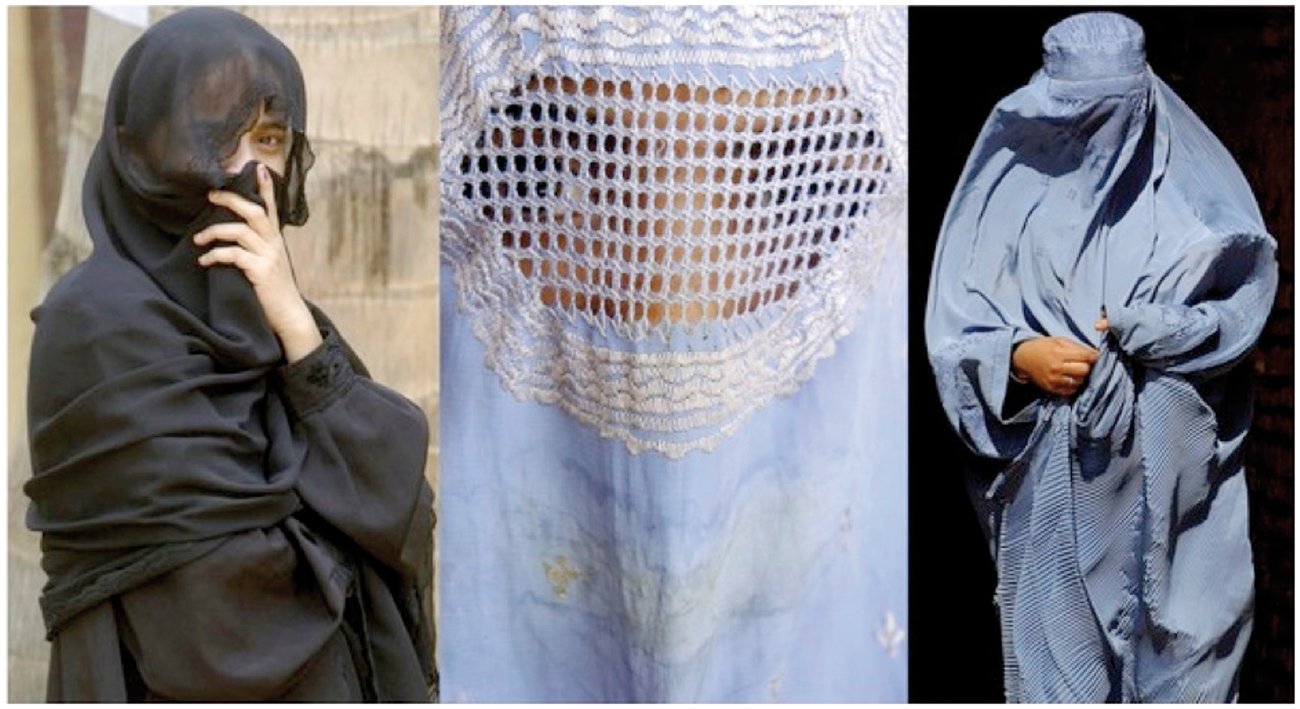
Cultural background
Terminology
In current political debates, different terms for different forms of Islam are used in a very confusing manner. In this article we use the term “fundamentalism” to denote a form of religion that is a reaction against the spread of a secular global culture, that maintains a dualism of all things being either “good” or “bad”, and that acknowledges only sacred texts as authority. Not all “fundamentalist” groups endorse all these characteristics, though. This pattern of beliefs is widespread and commonly known as Salafism in Saudi Arabia, but it also gains strongholds in other regions of the world. The term “Islamism” denotes the political extension of fundamentalism that strives to transform governance and policy according to religious rules (e.g. Desai, 2007). A few currents of Islamism may resort to violence for furthering their goals.
In the following we provide an overview on how Muslim cultural expression is developed in Indonesia and in India and discuss a variety of institutions that popularize Islam to produce what can be understood as “pop-Islam”.
The Muslims’ endorsement of cultural identity
Local religion is generally a “condensed” version of past and present culture; a normative ideological framework that justifies otherwise unexplained behaviors that exist by virtue of tradition. The present Islamic culture in Indonesia began sometime after the 1965 communist coup d’état. In the following period, to control Communist tendencies seen as associated with Atheism, the State demanded that all citizens to hold one of five recognized religions: Islam, Catholic, Christian Protestant, Hindu and Buddhist. During the late 1980s, governmental powers lost their grip and Islam gained much influence as it was depicted as an alternative to the increasing corruption and Westernization that countered local moral values. Television and Islamic magazines spread religious preaching and attracted many converts. Historically, being Moslem was an attractive option for the majority of people as there is no central institution regulating religious practices. This made it easier to translate and embed Islamic principles into their localized practices. Today, the female veil has become a principal marker of Muslim identity, while Islam itself is relatively heterogeneous and interwoven with different local beliefs and customs.
In India, Islam is popularized through several channels. First, there are religious congregations (Istema) and discussion groups (Tabliq). Second, death ceremonies play an important role: at these, the segregation of the sexes is the norm, even amidst liberal Muslims. Female mourners sermonize the female division (zenana) and provoke deep feelings of vulnerability which have a profound effect on women. Anecdotal evidence suggests that after such encounters some liberal women who did not wear the veil not only started wearing it but also started covering their hands and feet. A respondent said “Media are spreading this [message of Islam] in a big way. TV channels, Millat, Tabliq, Istema … All this is on the rise”; “Religious hold is getting strong. Everything is becoming strict”.
The widely shared syncretic Indian culture from the 1960s is becoming slowly replaced by a more purified version of religion where Muslim women switch from wearing the sari to traditional Muslim dress (salwaar-kameez, churidaar-kameez). Simultaneously, they become more interested in Islamic rituals, shunning all other cultural influences and non-Muslims. It is evident from our interviewees that a tolerant and diverse culture is being replaced by an emphasis on a singular and ritualized religion, and that this shift has a significant effect on cognitions, behaviours and affects. The interviews show that Muslim rituals and ideas of purity and contamination are gaining ground in social discourses about religion, identity and culture. The minority Muslim culture so becomes increasingly sharpened and at odds from the majority culture. The veil is also a principal marker of Muslim identity, but in this context Islam is less open to local variation and hence appears more fundamental.
The role of religious institutions
Religious congregations (Istema) and discussion groups (Tabliq) appear to have existed in the Muslim communities of both countries for a long time but they have gained in popularity, especially among women, in the recent socio-political situation. An Indian interviewee explained that “In the stress of modern life you need peace”, which has led to a greater “desire for connectivity with religion”. These institutions spread religious teaching and provide them with a new perspective by “opening” the “outside world” of Islam to them. This view beyond the boundaries of homes changes the dynamics of the Muslim cultural situation and adds to the hold of Islam in everyday life and identity politics. In this way, Muslim women are becoming the multipliers of religious “propaganda”: Muslim women are quietly changing the course of events. All this is bringing awareness and is building up as a big force. This change is happening not because of family pressure or societal norms. This is happening amongst the educated women. [Indian]
“Pop Islam”
Almost all Muslims have read the Koran. They may not have actually understood it since the Koran is written in Arabic, which many do not read, and previously the text was rarely translated or explained. An Indian interviewee explained, “I never understood it because it was taught in Arabic and it was more a ritual than understanding”. In fact, a significant change in religious teaching is taking place and this has resulted in a more “user-friendly” religion, which at times is referred to as “Pop Islam” and targets the younger generation. Prior to this change, “Children would go to Islamic schools where the traditions they were taught were Arabic and they never understood their religion. It was just a ritual” [Indian]. After 9/11, Muslims felt the need to unite and make their religion more accessible. Markers of Muslim identity become more important and more visible, and consequently identity politics becomes more defiant: I am becoming more religious and I don the hijab. I am defiantly Muslim … so what?” Religion, it was felt, had become “more pop and less rigid – more acceptable, less Arabic. [Indian]
Pop Islam in Indonesia took off approximately at the same time as in India, that is, towards the end of the Cold War, when domestic and international actors forced the issue of democracy onto the social and political agenda. From the 1980s, it became fashionable to be seen as simultaneously religious and democratic. Pop Islam was born from modern democratic ideology where members of the urban middle class attended courses on Islam and democracy. In its wake, television series became popular, where the preacher was not just an inspirational figure, but also “good-looking” and expressing religious competence in common parlance. Preachers conveyed modernity by connecting English and Muslim traditions and by speaking Arabic. In Indonesia, younger participants frequently used the expression “It is cool to wear the veil”; middle-aged women said, “We do not feel oppressed just because we are veiling”; educated respondents stressed, “You know Islam is very democratic”.
Our interviews suggest three basic themes that have to do with veil use: First, the veil as shrinking the democratic space of Muslim women; here the woman’s body is perceived as seductive and sinful. Second, the veil is convenient. These women explain their behavior as convenient and proper for their everyday errands. This is typical for the Indonesian majority context, while in India the tone reveals some ambivalence. Third, the veil as an identity marker and as a form of resistance in the face of rising of xenophobia and stereotyping.
Veiling as a personal and political response
De-sexualizing and the shrinking of personal space
An archetype in all monotheistic religions is the female body as seductive and sinful. This theme exists in both Indonesia and in Indian Muslim circles, but is especially evident in Indian responses. “Magical” representations hold women responsible for the rise in xenophobia and related trouble is attributed to women becoming less modest. A woman’s duty is to be chaste while men are absolved as “victims” of female seduction: Now I think that Jamaat and Islaami (religious congregations and teachings) brainwash the girls. They are made to feel that at every step they are committing a sin … Even small girls/infants are made to wear socks and gloves and sometimes their face is hidden. [Indian]
Simultaneously, though, women need to be sensual for the husband: “In fact a woman should be ‘tip-top so that the husband does not look at anyone else” [Indian]. Sin, guilt, protection and male desire all justify the need for women to veil themselves and be exclusively available for their male “protector”.
In order to contain the essentially provocative woman, her sexuality must be covered: “ … My husband says, since the bedding is already rolled up [women in purdah] I can sit around with ease [with other women]” [Indian]. Such metaphors as “rolled up bedding” normalize the perception of Muslim women being trapped in a traditionally gendered community. “Rolled-up bedding” is not sensuous, just as the woman is supposed to cover all that is alluring and so hide, as per Islamic norms, chest, feet and hair: “Beauty is in the hair … a bald woman is not attractive. If you hide the hair you have de-sexed her” [Indian]. The woman will infringe cultural values if she allures and she should not be a “fun” thing for “free”.
The need for de-sexualizing when confronted with public gaze is underscored because women are seen as a precious possession for the male protector. It is felt that the “wrongs in societies, rape etc.” are on the increase because women are not modest and flaunt their sexuality; a discourse that is also well known from many cultures including the West: If a person is criminal his eyes will fall on expensive ornaments hence we keep them safe and covered. Woman is like an ornament, she is a very expensive thing, and hence she should be covered and kept. [Indian]
Through this trajectory, the Muslim woman becomes entrapped in terms of her religion and consequently caught in “obscurantism”. Religious culture is only done justice if the woman incorporates these rules in her internal posture: “Purdah is more an internal attitude. […] It’s about internal discipline”. It was often stated that hijab should not be superficial but done properly. Simply covering the hair and then wearing tight pants would not make sense. Half-hearted measures “make you stand out as a Muslim and then you get dissected. It’s a great contradiction that you want to wear the hijab yet go around drawing attention and prancing around: All or nothing” [Indian].
The guilt and sin theme are constant undercurrents in discourses where women were made to feel that they have contributed to the Gujarat communal riots in 2002 (cf. Sen & Wagner, 2005). At this time, some women said, their cultural compatriots did not wear purdah or observed the namaaz (Islamic prayers), which may have contributed to spark the turmoil. Such beliefs tend to turn up in times of crisis for threatened minorities where a solution appears feasible by magical means. Hence, women start to wear the purdah. After the Gujarat riots, even young female students who had never done so before started wearing the veil.
Some of the respondents felt that the hijab has become a religious-political issue and is blindly criticized by feminists who do not realize that in Islam, “there are many more rules for men and their conduct”. However, they did agree that the basic “Dictum is: Cover our women”, which according to them, begins with teaching and later becomes their habitual identity. Hence, the veil is one way of portraying a “proper” identity.
Convenience
Functional garment
This group represents women for whom burkha is not an ideological statement but a matter of convenience. Virtually all responses of Muslim women living as a majority in Indonesia fall in this category, giving reasons related to convenience and fashion. For instance, they cited the benefit of a veil for covering grey or disorderly hair. This argument was primarily given by middle-aged women who, from time to time, need to dress up for festive opportunities such as parties or weddings where traditional apparel is expected.
Many women would agree with this view from a teacher: At the beginning I put the veil because I went to Islamic boarding school, well it is a part of school rule. But later on you have to adventure yourself spiritually to find justification of what you are doing […] actually Islam teaches us to cover the woman body properly, nothing is specified clearly for the veil […] you should not burden yourself with Quran or Hadist in a narrow minded perspective. [Indonesian]
For Indonesian interviewees, “Hadith” books” (collections of religious essays by Mohammad's closest friend) support their adherence of fashion. The most cited phrase “Cleanliness [as] part of the faith”, is always taken to justify a lot of things such as “being materialistic” or “being rich as a part of the faith”, and that a “global” joyful life style is in accordance with Islamic faith. Hence, interviewees concluded, becoming global in terms of fashion is an expression of Islamic modernization.
With Indian Muslim women, the reasons for wearing the veil are much more varied. The interviewees refer to a “trend” that is fuelled by social pressures, but what matters is only the surface: “You can be wearing anything underneath and need not be bothered. Just don this on top”. The purdha also makes some work easier: “My fieldwork was in a Muslim area and I felt that if I wore it I would get more attention and be better able to communicate. It’s easy for building up relationships. Practical” [Indian].
For a number of respondents, it was an on-off affair with conformity and societal expectations: “You do not want to look different in your milieu and stand out and so I wear it. It’s the same logic, which is applied when I do not wear it where no one is wearing it. Basically women do not want to stand out” [Indian]. Religious dress-code, therefore, is contextual-driven and derives from women’s personal experiences in public and private spaces.
One Indian interviewee catches the meaning of veiling as convenience equally for Indian and Indonesian respondents: “There is no religious reason [for veiling]. There are only “stupid” [convenience] reasons”. However, at a deeper level of analysis, minority (Indian) and majority (Indonesian) representations of convenience diverge. In Indonesia, convenience means being free to follow local fashion while, given the choice, some of the Indian interviewees might well want to stop wearing the veil, but pressures from their community prohibit this.
Social and psychological “security”
In India, the women’s feeling of security has two facets. The first one centres on the issue of the majority society ostracizing the Islamic minority. Indian Muslim women are left with little choice. If they do not wear the veil, they are excluded from their own community and, being Muslim, they are excluded by the majority’s stereotyping. This shunning by both groups is difficult to cope with and consequentially women feel that it is better to adopt wearing the veil since it gives them the protection within their own community: The feeling of insecurity has increased among the Muslims … the stigma of “terrorist” hovers all around … this threatening atmosphere makes us want to stick together. You are not going to be fully accepted by others hence stick to your own is the feeling. [Indian] The more the world moves towards materialism the greater is the sense of emptiness … no belongingness. Hence there is a greater move towards religion for answers. Religion is filling the gap … Western capitalism, Marxists, communists … nobody has given answers so religion is becoming a defining element of identity … where to go? [Indian]
Marking identity and resistance
Responding to stereotypes and prejudice
A large number of Indian respondents felt that Muslim women had been stereotyped as backward, illiterate, oppressed and victims of a barbaric society and/or closely aligned to terrorists in some way. When they reacted to such stereotyping by wearing the veil, they felt that they may have aggravated their situation, provoking labels such as “terrorist” and “fundamentalist” with a madrasa (Islamic religious school) education and obscuring their professional status. They were literally robbed of their social standing in the eyes of the majority. Obviously, this stigma applied only to the Muslim sample in Hindu India.
Such situations catalyze feelings of resentment and their minority identity became very salient. Women felt the need to establish their credibility: “I wanted to look like a Muslim, be a Muslim and at the same time make people believe that Muslims are not bad”. They are aware of the non-Muslims’ fear of terrorism but see this as a gross exaggeration that stereotypes all Muslims in an unjust manner: “If a man has a beard he is bad; if a man is fair you can trust him. Everyone with a beard is a terrorist. There is a need for dialogue”.
In a paradoxical twist, following the Muslim dress code strengthened the self-confidence of some women and made them proud of community memberships. They rejected the idea that being modern necessarily means “uncovering” themselves and so resisted assimilation demands. Their reaction is overtly political as a conscious decision to oppose prejudice. This stereotyping was seen to persist throughout the entire islamophobic ideology in which progressive elements of the religion are completely ignored: When I began to read about Islam I realized that unlike what is portrayed, Islam was the first to give a right to women to do business. My religion was aware of women’s rights, property rights for women … for instance “Meher” [the contract signed at marriage stating what the woman will get in case of divorce] is not there in any other religion … Islam is a progressive religion and has dealt with the kind of rights that ladies should have. [Indian]
Rebellion as identity work
In order to overcome the feelings of insecurities and also as a rebellion against stereotyping, the veil is used to signify identity: People want to be part of the same group, culture. They do not want to be singled out. A shared identity … they seek that … let us all go together. Wearing of overt symbols give a sense of religious identity.
Displaying the hijab is seen as a political choice that has to do with identity and bonding to their ingroup; that should have nothing to do with their societal worth, particularly post-9/11. They sought to withstand the stigma of being Muslim in a “hysterical” world obsessed with anti-Muslim witch-hunts that fails to take the full diversity of the Islamic community into account: People have a lot of pre conceived notions. It’s not a question of your own identity but the identity of your community. It is often believed that you are orthodox if you are religious … but … that does not always go together. [Indian]
The change in behaviour and related emotions were the result of stereotyping and being consistently judged as a group representative and not as an individual. The rise in xenophobia and the marginalization of Muslims in India has led the respondents to assert an identity of difference: “We young people now want to openly say we are not like what you describe us as … so people are now consciously showing their identity … yes I am a Muslim!”
Insistent stereotyping and discrimination invokes reactions that sometimes may feed religious zealotry: “Religion is becoming a rebellion. You have cast me aside, look down upon me and marginalized me … so here I am. I will flaunt my religious identity”. Some respondents mentioned that when they were confronted with the image of Islam as violent and backward, they began to “study” their religion in-depth and this led them to conclude: “This religion can’t be all wrong”. Stigma, paradoxically, led to a confirmation of stigmatized identities and beliefs.
Even though this segment of interviewees may refer to religion, underlying the responses is not a striving for devoutness but for an ethnic cultural marker. For them, this marker has not much religious significance as they reject the de-sexualizing and “female-invisibility” discourse of the more religiously inclined respondents. Their action is intended to rebuff endemic prejudice and discrimination by the majority.
Never ever
In contrast to the fore-mentioned categories there was a group in the Indian sample, who clearly stated that they would wear any form of the veil under no circumstances. But they did not reject religion per se: “Not my cup of tea, leave it alone”. They are convinced that their stature and posture are enough to incorporate their identity and rebuff a condemning gaze: “My eyes had modesty … why should I cover them?”
This justification for not wearing the veil is linked to stressing individualist values where true religion is above hijab, physical existence and prejudice. These women appear to be idealists in believing that their good deeds will serve as principal testimony to their religion. It is worth noting that the veil was rejected in its ostensive form – an overt symbol, which made you stand out as displaying religious identity. Some reported that those who have the confidence to wear these overt symbols were “stronger”, “confident” and had “high self esteem”, and that the non wearers by contrast were weaker. The veil, as a symbol, cannot therefore be seen as being in any way a reliable barometer of religiosity.
Discussion and conclusions
Our study shows that the situation of Muslim women living as a majority, e.g. in Indonesia, is incomparable to women in a minority setting such as in India and in most of the Western world. For women in a majority Muslim context, a particular item of Islamic dress such as the veil is not a contested issue and therefore is not questioned, just as Western women would not question wearing a visible g-string or cropped top (Gill, 2007). The social and political experience for minoritized Muslim women is quite different and brings about an array of responses related to the veil in the contemporary global situation.
In minority settings, the veil is part of identity construction that is worked through the twin pillars of fundamentalism and rebellion. This identity work is triggered by collision of endemic prejudice on the one hand and by a bigoted religion on the other, and this may contribute to the consolidation of stereotypes.
Members of a dominant majority often hold a strong belief in the “inference potential” of a minority’s superficial markers that lets them infer a host of – mostly negative – attributes of the bearer. This phenomenon is a by-product of psychological essentialism where perceivers project an intrinsic “group-essence” on members of ethnic and racial groups that unequivocally determines the person’s belonging, similar to the thought that all exemplars of a biological species are the same (e.g. Barret, 2001; Wagner, et al., 2009). Some Indian interviewees felt that when majority members see a hijab, they immediately inferred a backward and illiterate woman “underneath”; they “see only a hijab and talk to a hijab”.
Some minority women’s reaction, hence, was informed by rebellion. This behaviour confirms our expectation that identity work does, at times, involve reactive tendencies: Obviously, the ethnic boundary between Hindus and Muslims is relatively impermeable. This motivates minority women to “return” to the ingroup if stereotyping by the outgroup increases (Howarth, 2004). Consequently, this section of women takes great pride in displaying traditional attire and, many being educated, to “disprove” the majority’s negative preconception.
More conservative women supported arguments espoused by religious thinking, which compels women to create their identity around religious tenets. They thereby perpetuate stereotypes, but gain the support of their ingroup. There is no denying that some women follow this course of cultural conservative pressures as the easiest way of securing acknowledgement by “their people” and thereby some form of social inclusion.
It would be easy to call this adherence to traditional ways “false consciousness” and see wearing the veil as women having incorporated their inferior status in Islamic culture. We believe, however, that the decision of what is “false” and what is “correct” consciousness cannot be imposed from the outside position of the researcher or by Western politicians; this is a political decision for those concerned. This is particularly true for societies that are still deeply gendered in everyday divisions of labour, activities and spaces (Illich, 1990; Wagner, et al., 1990).
Hence, wearing the veil may result from diametrically opposed processes: conservativeness and protest. The end result, the veil, may be a consequence of different trajectories.
Classifying Muslim women as a homogeneous entity by political right-wing and left-wing activists in the West is a fallacy. Depicting the veil as an overt sign of religiosity misconstrues the cultural and psychological realities of “Others” and so denies these “others” the right to an identity of their own. Trapped in both the “Third World” and “Oriental” frames of reference, non-Muslim majorities’ rejection and critique of veiling reflects a lack of cultural understanding and shallow analysis of a complex symbol embedded within the rise in xenophobia and Islamophobia in the present global context. This leads the “Othered” to feel that “Islam has … been made into a Monster” [Indian]. As a corollary, this leads to increasing tensions since identities are a matter of negotiation, connection, imagination and resistance. The representations on which stereotyping tendencies rest are not neutral. They are inseparable from relations of power, privilege and discrimination (Duveen, 2001; Wagner, et al., 2009).
This study did not include Muslim minority women in Europe as participants. However, extensive informal evidence from conversations with members of the Muslim community shows similar patterns: yielding to cultural pressures, convenience, and resistant identities. The present findings from women living within minority groups in India, hence, may well be generalizable to other countries.
The present minority narratives illustrate cultural fluidity, permeability and shifting boundaries (Khan, 2000) that some sectors of Muslim women initiate. Their reactions are as much about infringement of cultural identity and asserting group esteem as they are religiously inspired. Cultural representations of the “Orient” prevailing in the West hurt the addressees: I was always considered one of those people (non Muslim) but I belonged to them (Muslims) and although I was never targeted, it hurt. Even if my friends knew that I was a Muslim, they would say, but you are not one of them. But I was. I started feeling bit of a cheat. Why was I lying to them about my identity? So I started contemplating the idea of wearing a scarf. My way of asserting an identity of being the person I was … I thought why should I not attempt to break the stereotype of what a Muslim woman is. [That’s what] I wanted to tell them. [Indian]
Footnotes
Acknowledgement
The authors gratefully acknowledge Teresa Whitney's helpful comments on an earlier version.