







Abstract
Graffiti as writing and painting with spray cans in public spaces was recognised as a special youth movement in the 1960s and 1970s in New York City. From there, it spread to other metropolitan cities around the world. Through graffiti activity, young people positioned themselves in a youth movement that violates public spaces. This article focuses on the contradictions and tensions of being part of an illegal subculture and being recognised as painting art. The tensions will be analysed from the perspective of societal conditions as well as painters’ experiences, drawing on literature about graffiti and an interview project with graffiti painters in Denmark. Psychological aspects of the young person’s engagement are analysed using concepts from Vygotsky’s theory of creativity and art. The analyses contribute to understanding what graffiti activity means for a group of young persons in their change of position from childhood to young adulthood, and to a differentiation of Vygotsky’s theory of art.
Graffiti is today associated as a youth activity of writing and painting letters in public spaces in metropolitan areas. This activity transcends national and societal boundaries and has created a subculture that connects young people who may never get to see each other personally. It also creates local communities of young people, where the status among the members is important. In most cities (e.g. New York, London, Oslo, Copenhagen), graffiti is considered an activity at the edge of legal society. The question is what motivates young persons over several generations to enter into this subculture that in many societies are viewed as promoting illegal activity?
To untangle how youth become motivated for this activity, one has to look into youth as a cultural period in human’s development that are created in relation to the societal conditions, as well as specific persons’ relation to reality identifying oneself as part of an illegal subculture and being recognised as painting art. The societal conditions that youth have in Western society – being biological mature but not being expected to create family relations of their own and being outside the workforce – have created a specific position for this age group in society (K. McDonald, 1999; Mørch, 2006; Valsiner, 2000). The wish that a group of young people have towards creation graffiti art I will discuss in relation to Vygotsky’s theory of art, creativity and children’s development (Vygotsky, 1971, 1998, 2004). In my analyses, I will draw from literature about graffiti and from an interview project in Denmark with graffiti writers/painters. 1
Graffiti in a historical context
Graffiti is not a new activity, what is special today is that it is taken up as a youth activity. In the book Moscow Graffiti, Bushnell (1990) writes that graffiti means incised, scratched or carved in objects. Bushnell describes graffiti, which comes from an archaeological fund that can be dated to around the 1100 century in Kiev. This graffiti appeared in large quantities during the restoration of the city as carvings in remnants of walls from churches, city walls and other buildings. Bushnell writes that old documents shows, that it was a widespread phenomenon in Kiev in 1100, so much that a ban was issued, documented in old scripts, though that did not prevent people from continuing to scratch their messages. Such scratching is rarely preserved, but under these special circumstances the new wall constructions have protected the graffiti.
Illegal graffiti is a phenomenon found in several contexts. Tourist scribbles, where visitors scratch their names on important and famous places, dates mostly no more than the mid-1850s, but it is probably also connected with the fact that tourism is a relatively new invention. More recent forms for graffiti are seen as carvings or scratching in public toilets.
What is special for the youth graffiti today in contrast to these mentioned forms of graffiti is that the writing of a name is a symbol and a synonym for the writer and not his/her real name or initials. To be counted as a graffiti painter, it is not enough just to paint or write ones graffiti name; there is a tradition that young people follow to be counted as part of the graffiti community, a community which is as much virtual as it is real. To create ones graffiti name as a painting take some time and skills, often through writing sketches over a long period being together with other graffiti painters (Høigård, 2002).When painted in public with spray cans graffiti are often carefully planned and the results of these planed paintings are named pieces. Graffiti pieces can be contrasted to the scribbling of ones graffiti name; most young people who call themselves painters, do both. A painter gets fame through painting pieces and s/he gets known through writing tags. In the following, it will primarily be the painting of pieces that is referred to when the term graffiti is used.
Graffiti appeared in New York City and Philadelphia as a special youth movement in the 1960s and 1970s and spread to Los Angeles and San Francisco and other metropolitan cities in the United States (Austin, 2002; Castleman, 1984; Ferrell, 1997). In the early 1980s, graffiti started to spread to Europe, especially because graffiti painters were invited to present at art exhibitions and because of two popular art books, Martha Cooper and Henry Chalfant’s (1984) Subway Art and Henry Chalfant and James Prigoff’s (1987) Spray Can Art and a documentary movie, Style Wars (1983) were published. Youth painting graffiti will in the following section be seen in relation to the changing conditions of being young people in Western societies.
Painting graffiti is connected to social conditions for youth as an age period
Graffiti activity varies and has changed in relation to how it started because the graffiti activity is influenced by how different societies react to youth’s graffiti activity. Across the societal differences, graffiti in late modern societies still survive as a youth culture. Differences in how the activity evolves can both be found generally between societies and locally, i.e. as in the history of graffiti in New York (Austin, 2002; Castleman, 1984; Kramer, 2010; N. McDonald, 2001) or in Denmark (Hedegaard, 2007; Poulsen, 1997). In Denmark, a change could be found from the early 1990s when the movement got foothold and until graffiti became a criminal activity in 2002 (Hedegaard, 2007). This can be contrasted to Spain at the same time period where graffiti was not seen as criminal activity as one of the interviewed graffiti painters tells based on a school visit to Granada in 2002. CHUCKY: I was in Granada with my high school. I talked to some other graffiti artists from the city, and they said I could paint where I wanted. So I found a wall where there was no other graffiti around, and so I just started painting. It was the center of the city, and there were people everywhere, there were also police cars passing by, but they did not stop to inquire whether I had permission to paint.
These changing conditions for being young are reflected in the development of the graffiti movement. New York City where graffiti started was dominated by youth who were segregated into local groups and gangs in the 1950s and 1960s (Castleman, 1984). Graffiti was in the upcoming period of this activity mostly expressed as tags that were marking gang borders as demonstrated in the film West Side Story from 1960, which shows graffiti around the areas where the gangs met. If a young male went alone outside of the ghetto that he belonged to, it could be dangerous because of the gang fights. 2 Castleman (1984) writes that graffiti as a specific movement was started by persons who wanted to break out from their ghettos by writing their tags all over New York City. The graffiti movement then gradually changed into a struggle between graffiti painters and the Transportation Authorities in New York (Austin, 2002); graffiti also developed in this context into a painting activity.
Today in Denmark, graffiti painting is not motivated by a desire to transcend gang territories; instead the painters see themselves as part of an international youth movement that also has other kinds of expression (i.e. music, clothing, food). Graffiti painters today though have kept central the original characteristics to show their independence of specific territories. The painters are striving for ‘fame’ by painting all over a city. This aspect has been combined more explicitly with a striving for quality in the graffiti pieces as noted by Kramer (2010). I also found this change from one generation to the next generation of painters and from being young to becoming older in the local graffiti community. LABAN (18 years): Before, I was more integrated in the hip-hop culture that was more competition-minded than the group I am with now. At that time, I got my identity from writing my name that I had to live up to every time I draw a single line. If I made an ugly piece, everybody in the culture knew that. And this would bother me. I became oriented toward transcending myself, to be praised and to get respect from the culture. I would feel bad if I had to fall down on the social ladder [among graffiti painters in Aarhus]. Today, it does not worry me so much if others like my pieces or not. I still try to transcend myself by taking new challenges, but I have found more confidence in the process of creation.
Young people are attracted to graffiti paintings primarily when they start to transcend being a school child and before entering a position with responsibilities as an adult with work and children.
Children orienting themselves to leave school and not knowing what comes next find themselves in an empty space (Valsiner, 2000), where it may be difficult to see a meaningful future (K. McDonald, 1999). They therefore orient themselves to youth groups to find meaningful relations (Hundeide, 2004). Vygotsky (1998) and Elkonin (1999) describe the transition between different age periods in children development as crisis that leads to new psychic formations where the transformation are both connected to a child’s biological maturation and to societal demands. Transition between age periods, as Vygotsky describes, is a turbulent emotional period with opposite emotions connected to the transformation. If we analyse young persons in Western societies, the young persons’ leaving the school age period have to find a position in new settings, recreating their identity (Hundeide, 2004). Some become attracted to the youth culture of graffiti and try to make themselves a position here. But this new position may imply tension. For young people, it may create controversial feeling to be in situations with these opposing demands of a youth movement, that locate them in a secret society violating public space, and at the same time demands creative and competent artistic paintings.
Tensions in graffiti
Graffiti painters relate to each other in a type of community that is loosely organised and within this they organise themselves into smaller groups called ‘crews’, in which the painters support each other when painting. The graffiti community can be viewed as a parallel society (N. McDonald, 2001) that is created around the craft of graffiti painting with its own figured world (Valle & Weiss, 2008) and with its own terms. The first painters’ activities were viewed as criminal (Austin, 2002; Ferrell, 1997; N. McDonald, 2001). Høigård (2002) and N. McDonald (2001) argue that this activity is still mostly illegal because part of the motivation for writing graffiti is to demonstrate freedom from authorities. This argument is questioned by Kramer (2010) who argues that the painters also have a motive for contributing to public space with art. Some of the painters I interviewed (KIGSET, LABAN) also formulated that they were engaged in both opposition and contributing to the public.
Kramer (2010) presents a model that places graffiti within two dimensions in a 2 × 2 table, the first dimension being graffiti as either art or kitsch, and the second being graffiti as an illegal or legal activity. Kramer, in his research on graffiti paintings in New York City, chose to explore legal graffiti. Most legal graffiti, Kramer would characterise as art. Within the illegal graffiti, the amount of art and kitsch is nearly the same. Kramer does not define what he means by kitsch and art. Kitsch I will in this context understand as sloppy reproduction of pieces that are common in the graffiti culture and that do not contain any innovative or creative aspect.
The contradiction between writing in public places with a desire to be seen and, at the same time, knowing that the ‘pieces’ will not stay very long – at trains, mostly a day, and at illegal walls not much longer – is a dilemma that graffiti writers must face and may be one of the reasons that they also like to write at legal locations. Even at a legal location, it is accepted that a graffiti ‘piece’ does not stay long because the other painters are allowed to paint over it, especially if they have a higher social status in the graffiti community. This short life span may create an emotional tension because the painter uses so much energy 3 to paint and, at the same time, he can expect his painting either to be destroyed in a couple of days by the ‘graffiti squad’ or perhaps after a couple of months when another painter has painted over it. 4
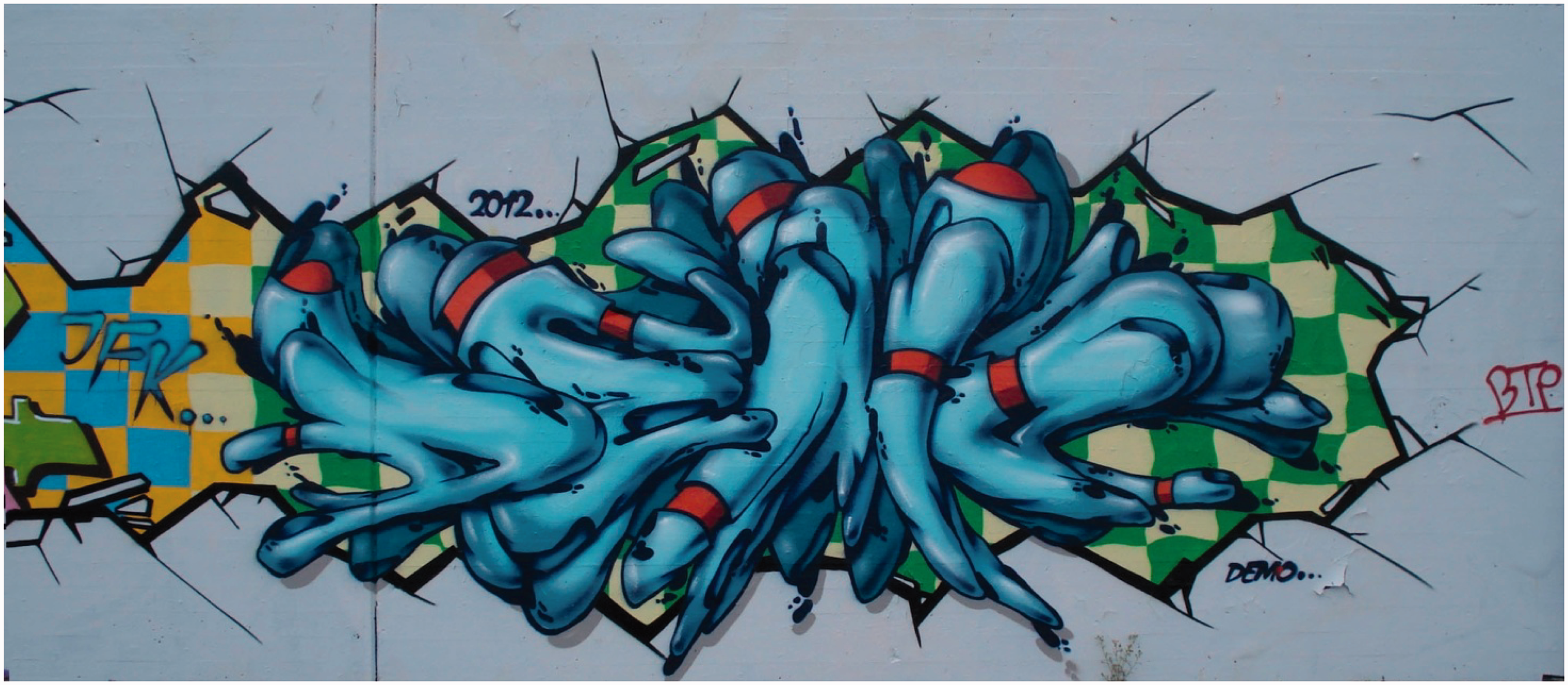
Another tension is an incongruity between the content in the form of the graffiti name – and the form it takes where it often is impossible to decode the graffiti name, especially in the ‘masterpieces’ that the painters call ‘wild style’ and ‘3D’ (three dimension) (see Figures 1 and 2). The graffiti painters want to create graffiti art so they can be recognised, but they paint their name in their pieces so deconstructed that it becomes unrecognisable for the unskilled onlooker.
Wild-style graffiti: ERSE at The wall of fame, Sydhavnen, Copenhagen, 2012. 3D graffiti: DEMO at The wall of fame, Sydhavnen, Copenhagen, 2012.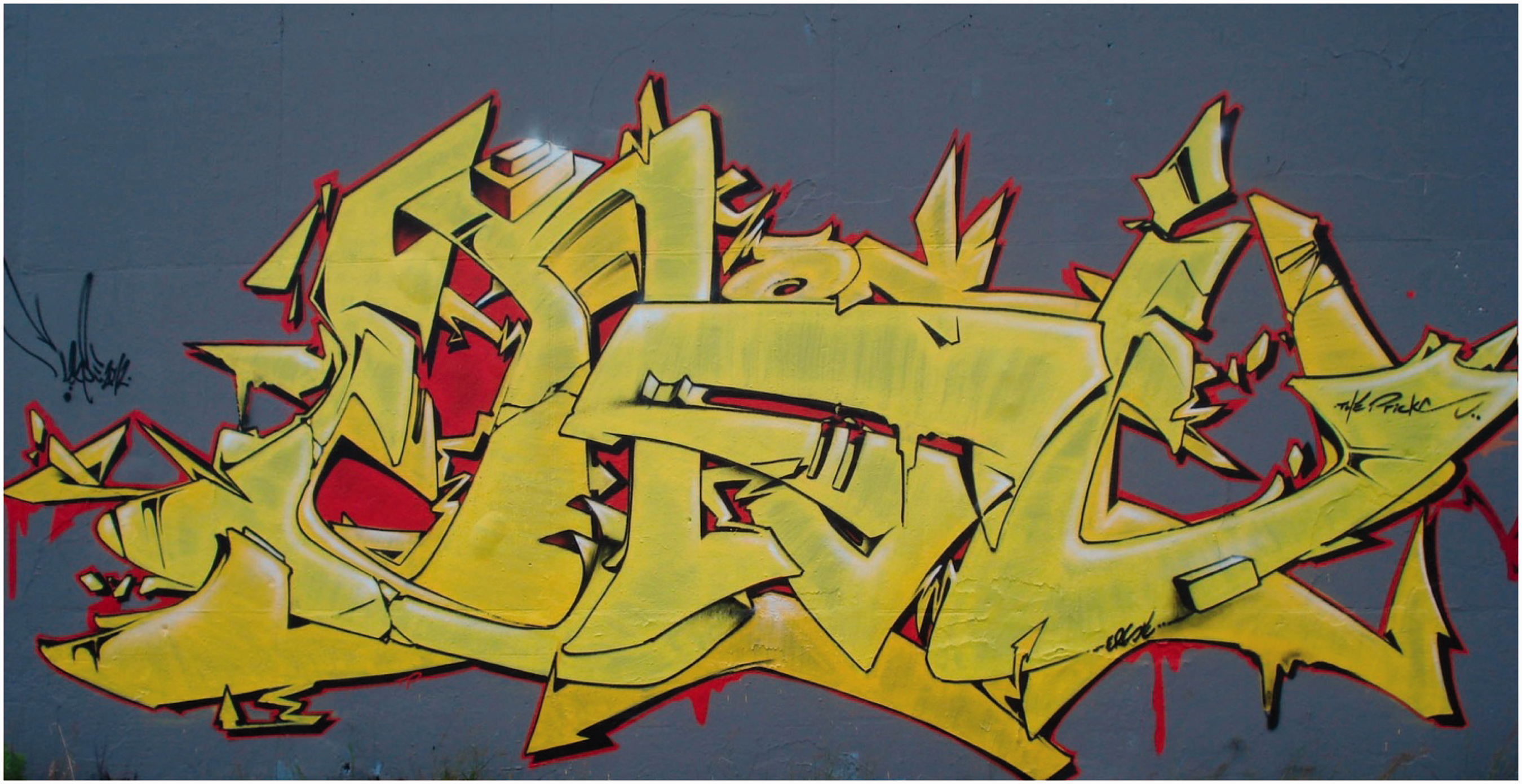
In the following section, Vygotsky’s (1925/1971, 1933/2004) theory of art and creativity will be outlined. The focus in his theory is on the psychological aspect of creating art as a tension between reality, imagination and emotions. These psychological tensions can be parallelised to different tensions formulated by the graffiti painters: a tension between feeling of freedom through drawing graffiti and the same time being restricted being part of a subculture a ‘secret graffiti society’; a tension between becoming known through painting one’s graffiti name or make the name artistic; painting graffiti at illegal places to be part of the graffiti movement or painting graffiti as art in public places.
Vygotsky’ theory of creativity and art
Vygotsky (2004) ascribes creativity to be a central aspect in development of human activity. He depicts a pathway of development of creativity that goes from children’s combination of aspects of reality into imagination (as in play) to a final point where emotions influence imagination and through this turns the subjective imagination into productive activity relevant for the person in real life. Vygotsky depicts this development taking place at the same time as the child’s intellectual reason develops. How these two processes relate to each other change through a child’s development. Vygotsky depicts two phases; a first phase where imagination has primacy over children’s reason and children’s intellectual development is subordinate to their imaginations, and a second where intellectual development has primacy over development of imagination. For most persons, the development of imagination declines, but for some persons imagination and the intellectual development continue in parallel. In the transitional period for those persons where imagination continues to develop, Vygotsky writes: ‘The imagination undergoes a profound transformation: it changes from subjective to objective’. (2004, p. 35), which means that young people’s imagination may be externalised and is evaluated as something detached from the person. Vygotsky writes that this change can be followed in children’s drawing activities. Only a few children continue to draw entering the youth period, mainly those that are particular talented or those who are encouraged to do so by external conditions such as special drawing lessons, because youth start to evaluate their own production objectively. For most youth, this evaluation does not fit with how they experience the world and the aesthetic demands, and they cannot produce what they want to draw. In creativity and art, both imagination and competence are central that is why both imagination and intellect has to develop in parallel.
Vygotsky argues that perception is necessary, but emotion and imagination are the core in the aesthetic experience (1971, p. 178 ff.). Further, he argues that imagination and emotion in art only become real through relating to the person’s life as a cultural and societal being. Art proceeds from certain live feelings and in art humans realise aspects of psychic tensions that find no expression in everyday life. Art is based upon the union of feeling and imagination. Another peculiarity of art is that, while it generates in us opposing affects, it delays (on account of the antithetic principle) the motor expression of emotions and, by making opposite impulses collide it destroys the effect of content and form, and initiates an explosive discharge of nervous energy. Cathartic of the aesthetic response is the transformation of affects, the explosive response which culminates in the discharge of emotions. (Vygotsky, 1971, p. 215)
Art is the social within us, even if its action is performed by a single individual, it does not mean that its essence is individual. It is quite naïve and inappropriate to take the social to be collective, as with a large crowd of persons. The social also existed where there is only one person with his individual experience and tribulations (1971, p. 249). Art, Vygotsky writes, is the social technique of emotion, a tool of society which brings the most intimate and personal aspects of our being into the circle of social life. It would be more correct to say that emotion becomes personal when every one of us experiences a work of art; it becomes personal without ceasing to be social.
Analysing Vygotsky’s theory of art, three main aspects can be singled out, these are: the emotional tensions that may lead to catharsis, the transformation of content and form in this process, and the collective aspect in art even though it is produced by a single person. Since I want to analyse young people’s engagement in writing graffiti with focus on art production, I will draw on these aspects in my further analyses of youth painting graffiti.
A research project
Interviews with graffiti painters.
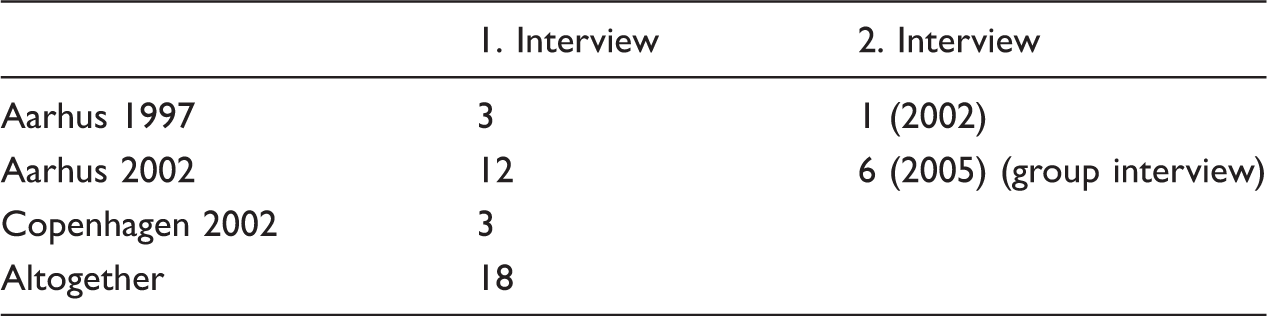
Most painters start rather young. The painters interviewed here mostly started between the ages of 11–12, and a few started at approximately 14–15 years of age. Most painters, I was told, stop painting at approximately 24–25 years of age, according to Cris, 5 a Copenhagen painter who specialises in trains. As he argued, it is difficult to get out at night when you start to work or start to have children.
Freedom to express oneself and conformity
SATE is one of the first graffiti writers in Aarhus; he started in approximately 1992. When he was interviewed in 1997, he denied that there was some type of revolt behind his writing; he told, he went out to paint both because of the artistic aspect in painting graffiti and for the feeling of freedom. SATE: It is the feeling that you can do whatever you want, it is the total freedom to be able to go out and ‘get up’. There is no one that controls you. This is what it’s all about. The adrenalin is pumping, but it is not rebellion. There is no one who has pissed on me, and I do not have anything especially rebellious that I want to show through my graffiti. I am trying to get as much respect as possible through the hip-hop culture, that’s why I paint. I mostly paint at legal places but in between I have to go out and get this adrenalin kick; this is part of the graffiti. All painters have tried to paint at illegal places. The feeling just before you go out, the excitement and expectation when you are out there, when you are in a world by yourself, where it is difficult for others to get in contact with you, and the relief you feel afterward, and a couple of days later when you go out and look at it.
From an artistic point, SATE’s description is close to how Vygotsky (1971) describes the artist’s feeling of ‘catharses’, i.e. the complex transformation of emotions when creating a piece of art. What is special about artistic production is that it opposes conformity, and this process of creation build up tension that finally is released when the art is finished.
A Danish international recognised artist Asker Jorn expressed this feeling after he has finished installing a big painted ceramic relief in Aarhus High school. He has been worked on this piece for month and expressed (Schade, 1968): Jorn: I am sick of ceramic I do not want to work with ceramic for some time. The interviewer then asked why he paints. Jorn cannot explain this but said: It is so exiting to paint. I: It is exiting? Jorn: Yes it is some of the most exiting that exist. I: But ceramic is not so exiting anymore? Jorn: Ooh, yes, all art are some kind of explosion – a release. The thing is finished and the excitement is over. [My translation] a work of art contains an indispensable affective contradiction, causes opposite emotions and finally leads to a short circuit of destruction.--The catharsis of an aesthetic reaction lies in this transformation of emotions, in their self-burning, in the explosive reaction that leads to bringing emotions to their climax with their subsequent relaxation. (Zinchenko, 2006, p. 165)
SATE, who was interviewed in 1997, was described as an old-style graffiti painter by those being interviewed in 2002 who were still in their teens. What he painted was not the style that was appreciated by the Aarhus painters who began 10 years later. However, the younger painters also recognise that their renewal was not always appreciated by the ‘Old-Style’ painters. KIGSET (2002): I think I am the most hated graffiti painter in Aarhus [among the ‘Old Style’ graffiti painters]. I: Why? - Because one should not make this kind of graffiti. You have to make real letters, where there is one type of colours within and others around. But I just get inspiration from some I have seen on the Internet, but ‘people’ [Old Style’ graffiti writers] get real vehement and peppery about this. I: How do you know? - Because they write on the Internet, where one of my friends (a painter) has a site where he put out photos of graffiti and it is possible for others to write comments. Often others write ugly things about me.
Graffiti as art – The painters’ evaluation
The different painters agreed that it is the creative aspect and the flow in a graffiti piece that is important, e.g. if the letters rhythmically flow into each other. There were also other aspects that the different painters find important. LABAN and STOE stressed the outline, the concept behind the pieces and the colour. LABAN: There are many different aspects in a graffiti piece that are important, but I find that what are most important are the form language and the contour of the outline. It is through this one can see the competence of the person behind the piece. In my own writing, I try to create new styles in the form of different logical or mathematical systems that go through the letters and combine these into the harmony of the piece as a whole. The colour of course also means a lot, e.g., how the colours are matched and composed into form language in the piece. STOE: What is important depends on what style you paint. I vary a lot. To paint wild style, you have to be good. Many try to paint without having the competence, and then it ends up being ugly. I do not paint wild style so often. When I paint, I always try to work through the colour in my head or even sometimes do it with magic markers before I go out to paint. It is important that it looks good. Also, the background can lift a piece, so even when you make simple bubble letters, if the colour and the background are nice and varied, it can look good anyway.
According to Vygotsky, contradiction is the essential feature between artistic form and content. To become art, the form must destroy the content and recreate it in a new way. The tension in the creation of art can be found in artistic graffiti when the structure of the artistic form destroys the letters and the meaning is difficult to decipher, such as when the letters are transformed so that the flow creates a symbol instead of a series of letters that can be recognised as a name (see Figure 3).
Graffiti: ANCE at The wall of fame, Sydhavnen, Copenhagen, 2012.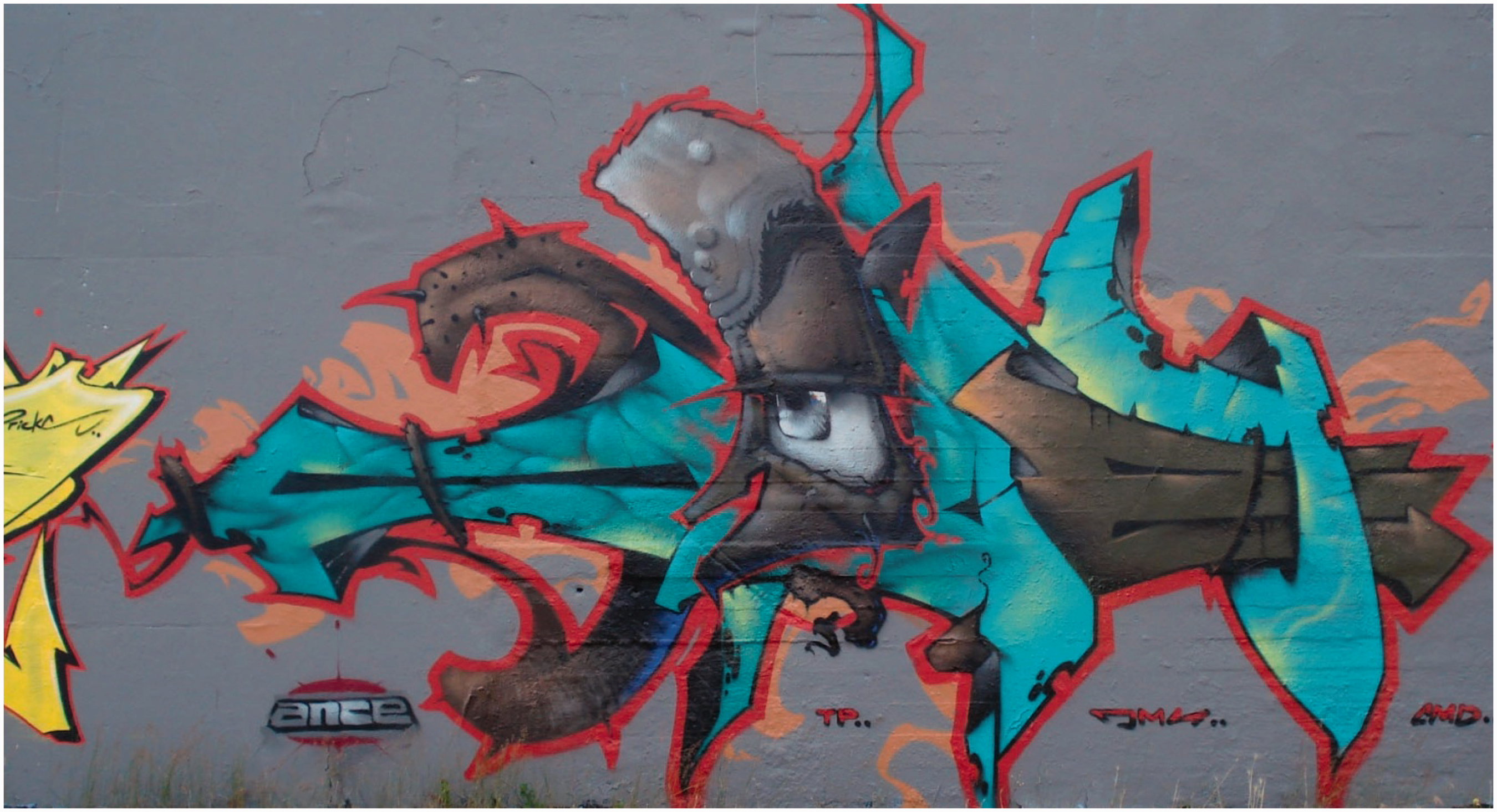
In the historical development of the alphabet, symbols became letters (Lester 2006). In the cultural-historical development of graffiti, it appears that the movement goes the opposite way, in that graffiti names turn into symbols, and the letters can no longer be recognised. Often, it is difficult to read a writer’s name, and the entire name becomes a symbol in a masterpiece, but at the same time the piece can be recognised as a symbol for the painter by the persons who are knowledgeable within the field. 6 The aim for experienced painters is to create graffiti as art and thereby destroy and change the meaning in their graffiti name.
Legal and illegal graffiti
The young painters discuss places where they can paint and the importance of ‘getting up’. However, as we saw, LABAN and several other more experienced painters from Aarhus did not find this aspect to be particularly important, and this change was especially pronounced three years later for some of the same painters when I had a group interview with six of these painters (they were now approximately 20 years of age). These more experienced painters had only shoulder shrugs or even contempt for the painters that were only interested in ‘fame’ by ‘getting up’ (painting at illegal but highly visible places). For these experienced painters, it was instead the quality of the painting that counted. CHUCKY (2005): I have seen several people in Aarhus who think it is fun to paint graffiti for a period, and who mostly paint illegal, but I believe that the ones who keep going [like the six in the group interview], are the ones who find that there should be more of everything [legal and illegal paintings]. But some only paint for their own sake –to get fame– or get their aggressions out. It is difficult for them not to get caught [by the police], especially if they paint a lot, and when they had been caught a couple of times their interest fails, if they do not have the creative side also. It can be uncreative to paint a silver piece with a black outline 40 times– so at last there is nothing else than the excitement of ‘getting up’. The ones who do not have the creative aspect lose their interest in graffiti if they get caught because they cannot stay at home and play with graffiti and develop their style and because the only thing they are interested in basically is satisfaction for themselves and not to make it dashing beautiful for other people. The dilemma with tags is that to become known and get fame in some way, you have to play the ‘commercial game’ of ‘getting up’, that is to advertise for oneself. So one comes to play their [the commercialist] game - in an anarchistic way. There are, like, two groups [of graffiti painters]: the ones that do it to get fame and the others that do it for creative reasons.
Many of the more experienced painters from Aarhus, KIGSET; MRS; IROE; LABAN; CHUCKY; KENY, painted at the ‘Wall of Fame’ in Aarhus – Nørre Stenbro (it does not exist any longer) – during the period when we interviewed them. These painters said that when they were beginners, the illegal aspect of transcending society’s borders and the feeling of having the freedom to do whatever they like were the most important aspects of being a graffiti painter. Later, their goal became to communicate with non-graffiti writers – ‘ordinary people’; therefore, the quality of their paintings – ‘pieces’– became the most important aspect. Nevertheless, the painters still said that they appreciated tags, the writing of their graffiti names that most outsiders see as scribbling and that most ‘ordinary people’ dislike.
For the Aarhus painters, their relationship to society also depends on the facilities and the city municipality’s relationship to graffiti paintings. The six Aarhus painters just mentioned were much more interested in legal graffiti than the Copenhagen painters interviewed in the same period. The Aarhus painters had a legal wall in the middle of the city. 7 The Copenhagen graffiti was not supported by the municipality, and the Copenhagen painters’ attitudes were not so different from that of SATE, one of the first painters in Aarhus. The painters’ orientation to what is important to them is also connected to how settled they are in the tradition and how well they belong to the group. I found that the Aarhus painters had a strong coherent group of experienced painters who together developed their own style at their wall of fame in Aarhus.
Conclusion
This article has addressed two issues: (a) how in Western societies the motives for painting graffiti have evolved and changed in relation to societal conditions for young people; (b) how painting graffiti can be interpreted psychologically as a way for some young persons to deal with crises in the change from childhood to adulthood.
Painting graffiti has become a subculture transcending national borders. This movement has found different expression in different locations influenced by societal policy. When the movement started in the 1960s in New York City, the motive, according to Castleman (1984), was a way for youth to break out of territories and avoid local gang fights, by writing tags all over the city (the first form of graffiti). Then, it turned into a fight with railway authorities as a way to oppose societal conditions in New York City for youth. Graffiti in 1970s became primarily an activity in the city’s non-places (i.e. the places that do not have any importance), transport places and worn down places, connected to modern industrialised cities (Augé, 2000). The painting was and is still done primarily on public property, where trains belong to this category. There is a moral code among graffiti painters, as several of the interviewed graffiti painters formulated, that graffiti should not be painted on private property. Graffiti spread as a youth activity, uniting graffiti painters across national borders, coming in this way to Denmark in the 1980s. In the mid-1990s and early 2000s, graffiti started to be seen as part of a street art. This movement included besides graffiti as name writing a variety of new forms of drawing and paintings, such as stencil, paperwork, posters, as well as installments, which were used to make comments about commercialism. Street art may be seen as connected to the societal change from industrialised to information societies and is directed more as a critique towards the consumer culture than solely as youth expressing themselves in public places (Augé, 2000). The place for this new graffiti activity has moved into the center of the cities (Manco, 2004). This new trend was also formulated in the second interviews with graffiti painters that then have grown older. CHUCKY (2005): It is so that graffiti changes, it has become more street art, where people make stencils, and small stickers and posters more like advertisements so they can repeat things different places.
The interviews with the Aarhus painters showed that when the graffiti painters are beginners, they are engaged in creating their own life, independent of school and family, where graffiti painting gives them a voice to express their freedom. When they become more experienced painters, the orientation to the quality of their production become central, and they want to be evaluated by their production as CHUCKY describes. Being part of a graffiti movement imitating other painters’ graffiti may be seen as the first step in a young person’s graffiti career; if his or her paintings are kitsch, it does not matter so much in the beginning. At some point though as CHUCKY describes when there is no artistic content in the activity and the creative and intellectual parts of painting graffiti does not merges, the young person will stop painting. Following Vygotsky (2004), children’s creativity change when their intellectual competence develops, and they thereby become able to evaluate their own creative production.
To characterise graffiti as art, the three aspects that I outlined based on Vygotsky theory of art (1971) have to be recognised: catharsis of opposite feelings, transformation of content and form, and a collective aspect though it is produced by a single person. Graffiti may be seen as a way for young people to express conflicts and crises of growing up in a society where the transition from school to adult life is not easy to overview. The difficulty young people have in imagining a future life after school may orient them towards other youth in the same situation. Graffiti may be seen as way to overcome this emptiness, but since the activity is controversial because it involves painting in public space in a way that transcend legal society, painting graffiti may, because of the tension involved, result in a kind catharsis. If graffiti only has an attraction for a young person to act at the edge of society, then the activity may be seen as a performance but it is not likely to lead to creative or artistic contribution. However, graffiti painters, who work with refining their skill, are more likely to identify with the creative production that will last beyond the youth period. For experienced painters, the tension between developing their graffiti name so both content and form are destroyed and are transformed into a new formation may result in an objectified production that among the graffiti subculture is evaluated as graffiti art. Art is a relation between the public and the artist, where the public for a graffiti painter in the beginning primarily is the local graffiti community; but evaluation of a graffiti artist work may transcend generations. A person’s production that is only evaluated by the graffiti community as artistic may later be evaluated as art by others outside that community because the tension in the produced objects may be reflected in observers’ experiences. The graffiti painters/street artists HUSK, MIT, NAVN from Denmark and BANKSY from England are examples of this.
Footnotes
Funding
This research received no specific grant from any funding agency in the public, commercial, or not-for-profit sectors.