







Abstract
Adolescents choose to be graffiti painters for very different reasons. Depending on their motivations as well as their abilities, different developmental trajectories can be observed within a given group of graffiti painters. In addition, the significance of movement and places has to be considered. On the one hand, the adolescents must have access to certain groups so that these groups can become meaningful for the individual. On the other hand, moving through different places and through time can open up new opportunities as well as creating tensions around different experiences within and between identity facets. Identity development is thus not a static but an ongoing process. For the observer, different influential factors must be considered in order to achieve a rudimentary understanding of this complex process.
Keywords
The activity of painting graffiti in today's society, particularly among youths, is an interesting subject for psychology, as Hedegaard (2014) points out. She shows how different motives can lead to the decision of becoming a graffiti painter (e.g. group belonging, demonstrating freedom from authorities, being recognized as an artist, achieving fame, contributing art to public places, longing for adrenaline kicks), and how—within the group of graffiti painters—different subgroups can be identified (e.g. rebels and artists). By identifying different motives, which can certainly coincide, Hedegaard proves her point and specifies how graffiti can be “a way for young people to express their emotional relationship to life” (p. 396)—which in itself would stay rather abstract otherwise. Themes that she identifies in her interviews with Danish graffiti painters also emerge in other resources. Deutsch (2013a), who summarizes interviews with German graffiti painters, also describes similar, sometimes contradictory motives. In addition, interviews with famous graffiti artists like Dondi (1961–1998), prove Hedegaard's point: When asked why he started painting graffiti, 1 Dondi answered that he enjoyed its special kind of creativity—designing letters—which, as he says, was a kind of creativity you did not learn in school and that others, looking in from the outside, did not understand. Dondi described graffiti as a stepping-stone for him, since he had been a creative person all along. He liked how graffiti allowed him to tell his story and communicate with people, at first unconsciously and later very consciously, knowing that he was good at it and recognized for it (cp. Deutsch, 2013a).
Dondi's answers show that he considered himself as part of a group (of insiders), whose creativity cannot be understood by outsiders, and that his way of painting and the perception of it changed with levels of experience. Also, Hedegaard points out that over time, the self-concept of graffiti painters changes, if they do not stop painting altogether. Adolescents and young adults thus not only discover or choose a certain group and with it a certain identity facet (e.g. becoming a graffiti painter), they also refine or restructure this identity facet over time. Although the terms “identity” and “self” are mentioned in Hedegaard's article, the terms are not specified further since she is focusing on Vygotsky's theory of creativity and art. In the following paragraphs, identity development will be the center of attention, since Hedegaard states correctly that when analyzing “young persons in Western societies, the young persons' leaving the school age period have to find a position in new settings, recreating their identity” (p. 391).
Becoming what you can become—If you dare
Hedegaard says that some adolescents “become attracted to the youth culture of graffiti and try to make themselves a position here” (p. 391), while others do not. Why? One German adolescent graffiti painter, H., describes his attraction to graffiti as follows (cp. Deutsch, 2013a, p. 98): Interviewer: Why did you choose graffiti? H.: I saw a painting one day, and really liked it, and then I thought: you could do something like that. Interviewer: Did friends introduce you to graffiti? H.: No, not really. I just saw the paintings. It is experiencing a boom at the moment—especially, in [names of towns], which is something that did not exist before. It got into fashion, but that is ok. Also with the Hip-Hop-Movement and stuff.
The changing importance of identity facets
Developmental trajectories become visible in Hedegaard's article on several levels: within the identity facet of being a graffiti painter (see paragraph above), and by showing how this facet might be replaced by others over time. Deutsch (2013a) describes graffiti as an art between “provocation and innovation” (p. 93). By painting on public property, graffiti painters are doing something illegal, which means that they often have to paint at night—always in danger of getting caught. In Hedegaard's article, graffiti painters state that fellow painters left the graffiti scene when they became parents and “could not get out at night that easily anymore” (p. 394). It is likely that the responsibility for a partner and children as well as other factors (e.g. cognitive development) also influence this decision. In general, delinquent behaviors—and illegal graffiti painting can be considered as such—peak in late adolescence and early adulthood, but decline after that (see Figure 1). On the one hand, delinquent behaviors offer opportunities to release tension and can, for example, be seen as transitory rebellion against authorities or as an attempt to find a position within new settings while becoming more and more autonomous—as Hedegaard describes it. On the other hand, the decline might also be explained by delinquents becoming more experienced and, therefore, harder to catch. Nevertheless, more supportive evidence for the first explanation can be found (cp. Spieß, 2012; Wittenberg, Reinecke, & Boers, 2009), showing that what constitutes identity can shift over time. The birth of a child, taking the example given by the graffiti painters, can be seen as critical moments (Thomson et al., 2002) or as a fateful moment (Giddens, 1991), a critical life event (Filipp, 1995) or rupture (Zittoun, 2006) that demands reorganization.
Number of convicted delinquents in different age groups in Germany (not including traffic related delinquencies, not including Non-Germans) (Spieß, 2012, p. 11).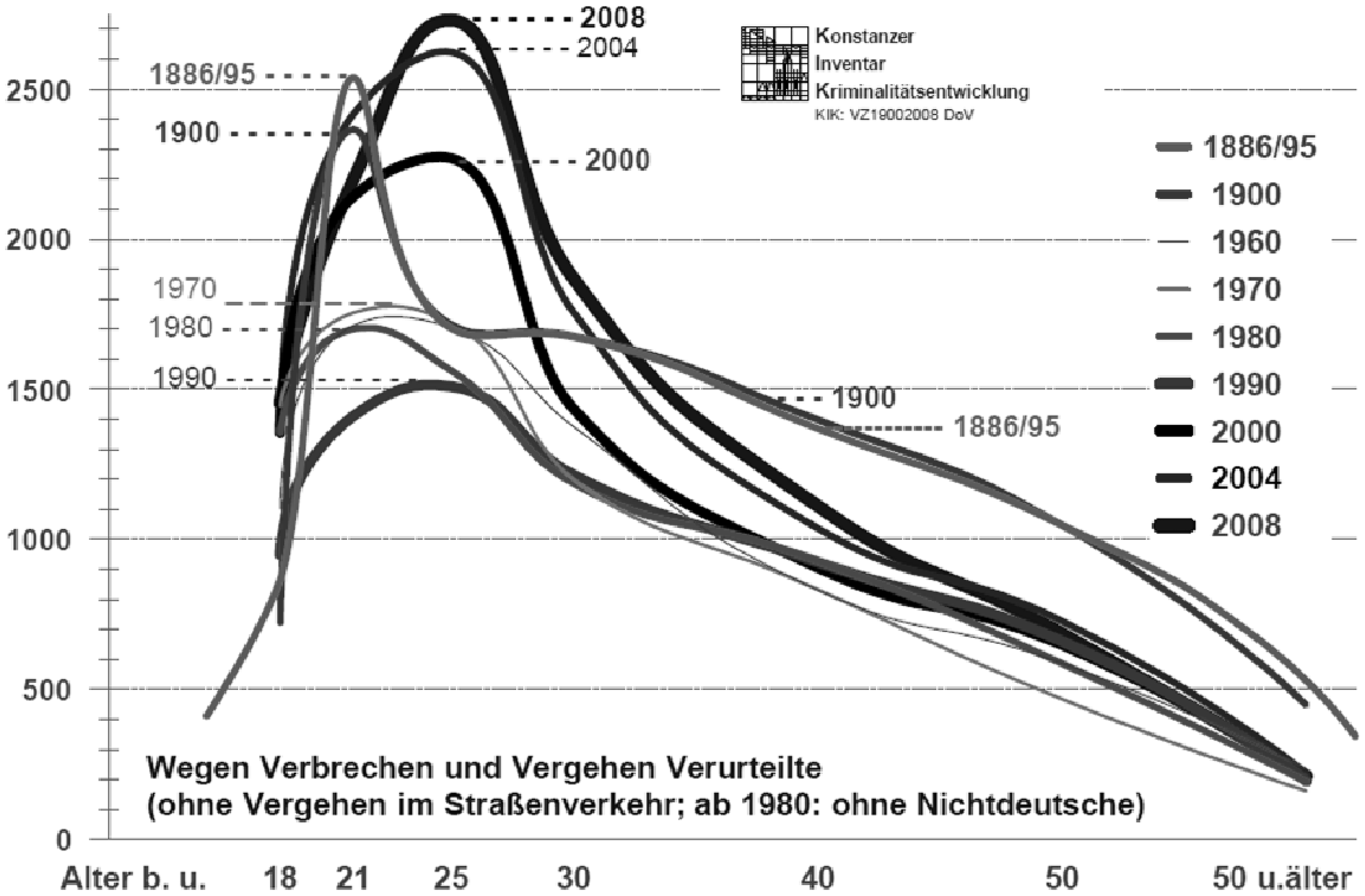
Following such a life change, the normal flow of events is interrupted, because one now has to take care of another human being; the current system is altered. The individual is—in the course of adaptation—confronted with perceptions that contradict those that were congruent up until now (e.g. participating in illegal actions). The self-concept must then be modified until relative stability (congruence) is achieved (cp. Zittoun, 2006). In this process, the identity facet “graffiti painter” might lose its significance and be pushed to the periphery of the self-concept (or it is dismissed completely), whereas “being a father/mother” becomes more important and is moved to the center of the self-concept.
Tensions as a motor driving the development of identity facets
Identity as well as the self-concept of an individual can be defined in many different ways. If the terms are not used synonymously, as done in this article, a possible differentiation is the following: According to Zhao, Grasmuck, and Martin (2008), the self-concept represents “the totality of a person's thoughts and feelings in reference to oneself as an object […]” (p. 1817). Given that definition, identity can then be understood as the “part of the self ‘by which we are known to others’” (p. 1817). This definition relates to James’ (1890) definition of the self, in which he differentiates between the “I,” as subject or knower, and “Me,” as object or known. We can “be known by others” in many different ways (cp. James, 1890). We can be a friend, colleague, a man, a woman, neither of the two, a good athlete, a great scientist, an awful lover, the owner of a certain property—and we are known by our physical appearance, to give only a few examples. All facets of ourselves—be they known or unknown to others—can act in support of or in contradiction to each other, and not all of them are in the foreground at the same time. James (1890, cited in Barresi, 2002) points this out when saying that the stream of thought “is always interested more in one part of its objects than in another, and welcomes or rejects, or chooses, all the while it thinks.” Contradictions like the ones described above, in which a new identity facet (“being a parent”) suddenly contradicts value systems related to other facets (“being a graffiti painter”) can be solved by rejecting one facet or focusing on the one that is more important at the time. This process can also be described in terms of Hermans' Dialogical Self Theory, in which different voices representing the different facets within the individual exist. These voices then interact in a dialogical fashion, which can lead to tensions that need to be solved by finding compromises, by prioritizing, or, if this is not possible, by simply enduring them (cp. Hermans & Kempen, 1993). As Hedegaard points out, these tensions do not only occur between different identity facets, but also within the same ones. She describes “tension between the feeling of freedom through drawing graffiti and the same time being restricted being part of a subculture a ‘secret graffiti society’; a tension between becoming known through painting one's graffiti name or making the name artistic; painting graffiti at illegal places to be part of the graffiti movement or painting graffiti as art in public places” (Hedegaard, 2014, p. 392). Solutions for these contradictions, for example, through prioritizing, can be temporary, as Hedegaard shows. Whereas the younger graffiti painters often state that the illegal aspect of their work (disobedience as a sign of freedom) is most important for their identities, older and more experienced graffiti painters more often stress the importance of communicating with outsiders as well as the quality of their art. This shows how, by moving forward and becoming more experienced, graffiti artists' evaluations of themselves change. These changes in and of themselves also create contradictions and tensions, namely between the past and the present (or even with the anticipated future). In other words, what the adolescent believed to be most important in the past is not as important any more. Surprisingly, these changes do not seem to be contradictory for the adolescents interviewed by Hedegaard. Keupp (2012) offers an explanation. He says that telling the story of one's own development—a creative process in itself—allows the individual to experience continuity and coherence despite these apparent contradictions. The negotiation of “multiple and conflicting versions, positions and projected possibilities” (Taylor, 2010, p. 129) leads not to just one but to many stories told in different situations and for different audiences (cp. Bamberg, 2008). According to Zittoun (2006), the meaning-making process involved includes (a) the linking of time and (b) relating events to a system of orientation that includes values and criteria on which thinking and actions are based (the “piloting system,” p. 191). The linkage in time is achieved by acknowledging and referring to past events, while, in the present, taking future options into account (see also Watzlawik, Schachter, & Cunha, in press). In this process the reference to and narration of the past can change. Josselson (2009) even states that the present constructs the past and stresses “how autobiographical memory may be used dialogically to create and contrast with current self-constructions, to disavow intolerable aspects of self, and to preserve disused but valued self-representations” (p. 647). When looking at identity development, we thus have to consider these linkages through time while the individual is moving forward and from place to place.
Opportunities and challenges influenced by places
While Zittoun and Gillespie (2014) differentiate between society and the contexts within society that an individual moves through, others prefer the terms places and spaces (cp. Merrifield, 1993). Context, as defined in WordNet 3.0 (Princeton University, 2012), can refer to linguistic context describing the “discourse that surrounds a language unit and helps to determine its interpretation.” Based on this definition, one can “cite out of context.” Context can also refer to a certain setting describing a “set of facts or circumstances that surround a situation or event (e.g. the historical context).” Conditions or environment are listed as possible synonyms. Identity development should also always be examined in relation to the context (environment, conditions) that the individual is surrounded by. Nevertheless, how the individual relates to the context (other people, artifacts, tools, objects, etc.) is probably of greater importance. Taylor (2010), for example, hints at this interaction when saying that “cultural context and the associated knowledge and values which shape and mediate people's experience and interpretations of their lives” have to be taken into account (p. 129). Whether culture is, from the perspective of the individual, an internal or external (contextual) phenomenon—or both—has been discussed widely (cp. Jahoda, 2012; Valsiner, 2012), which shows that the distinction might be problematic. A possible solution for our case is the differentiation between space and place.
We all live in a three-dimensional world (space) and “with years of experience, we are all highly skilled at structuring and interpreting space for our individual or interactive purposes“ (Harrision & Dourish, 1996, p. 67). We thus create places. Harrision and Dourish (1996) differentiate space and place as follows: “Space is the opportunity; place is the understood reality” (p. 67). This is closest to the humanist approach described by Merrifield (1993): Recent research on place […] has, in broad terms, attempted to reconcile the traditional spatial analyst's concern for space (chorological ‘areal differentiation’ in Hartshorne's neo-Kantian lexicon), Marxists' concern with social relations and structural factors, and humanists' appeals for subjectivity, place meaning and place experience (see Entrikin, 1991).
What places are, again, depends on the individual piloting system, as Zittoun (2006) calls it. Places are created by relating certain aspects in space to a system of orientation that includes (shared) values and criteria on which thinking and actions are based. This also includes scripts for certain places (e.g. how to behave in a restaurant). Despite this shared knowledge, individual perceptions of places can vary widely. A technically well-equipped room at a university can be a great place for studying and meeting fellow scholars for one student (focus on atmosphere and people), but a thief entering the same room might be thrilled by all the technical devices he can steal later on (and to which the student might not pay particular attention). 4 A wall in Aarhus can depict the history of the local graffiti painters for one person, but can be mere proof of delinquency for another, again leading to very different perceptions and evaluations (pride or disgust). Since individuals assign meaning to certain places, these places then emerge in their self-narratives as well (e.g. when going “home” or saying that a small village had nothing to offer). Continuity is established by describing movements from one place to the other, always incorporating established value systems that shape the meaning-making processes involved, for example, graffiti being delinquency by law. Non-places, as Hedegaard cites from Augé (2000), would then only exist if no one recognizes them as places. As soon as graffiti painters choose these so called non-places to create art, they turn into places. They would also be considered places for those who react with disgust, as recognition does not necessarily have to be positive.
Conclusions
Identity development, as shown here by referring to the graffiti painters described by Hedegaard, is a complex process that can be viewed on different levels (see Figure 2). On the one hand, movement in and between places must be taken into account. This movement has a passive aspect (being exposed to), but also an active aspect (choosing and shaping places). Both influence the experiences an individual makes over the course of time. Zittoun and Gillespie (2014) differentiate between proximal, distal, and integrative experiences. According to them, experiences can either directly relate to what is happening in that moment at a certain place, or they can “entail memories, meanings and feelings from a distal [place] intruding into the immediate” (p. 3). An individual can thus have the immediate experience of painting a piece, but might think of the partner who is waiting at home while doing so (distal experience). In this situation, tension can occur between the identity facets of being a graffiti painter and being the partner of somebody else. Experiences thus shape and constitute certain identity facets that can be seen as categorical schemata. These schemata can, on the one hand, help the individual to develop a sense of identity, but they can, on the other, create tensions by the expectation that might be linked with them (e.g. “a good partner should be home at night”). That tension can occur within and between identity facets was shown above. Another aspect that has not been explicitly mentioned thus far is described by the concept of intersectionality (cp. Budde, 2013). Identity facets do not just contradict but also influence each other when not being contradictory. An individual can be a woman, a graffiti painter, and an African immigrant at the same time, but it is likely that her experiences as a “graffiti painter” are different from those of a male, Danish graffiti painter—due to her gender and ethnic background. If the identity development of graffiti painters is examined, these interactions should not be neglected or should at least be discussed, since, as Budde (2013, p. 248) states, […] one would need infinite categories to describe the complexity of circumstances as well as power relations in a differentiated and appropriate way. Out of numerous—mainly methodological and research-related pragmatic—reasons, this expansion is not limitless.
Different aspects of identity development (selection).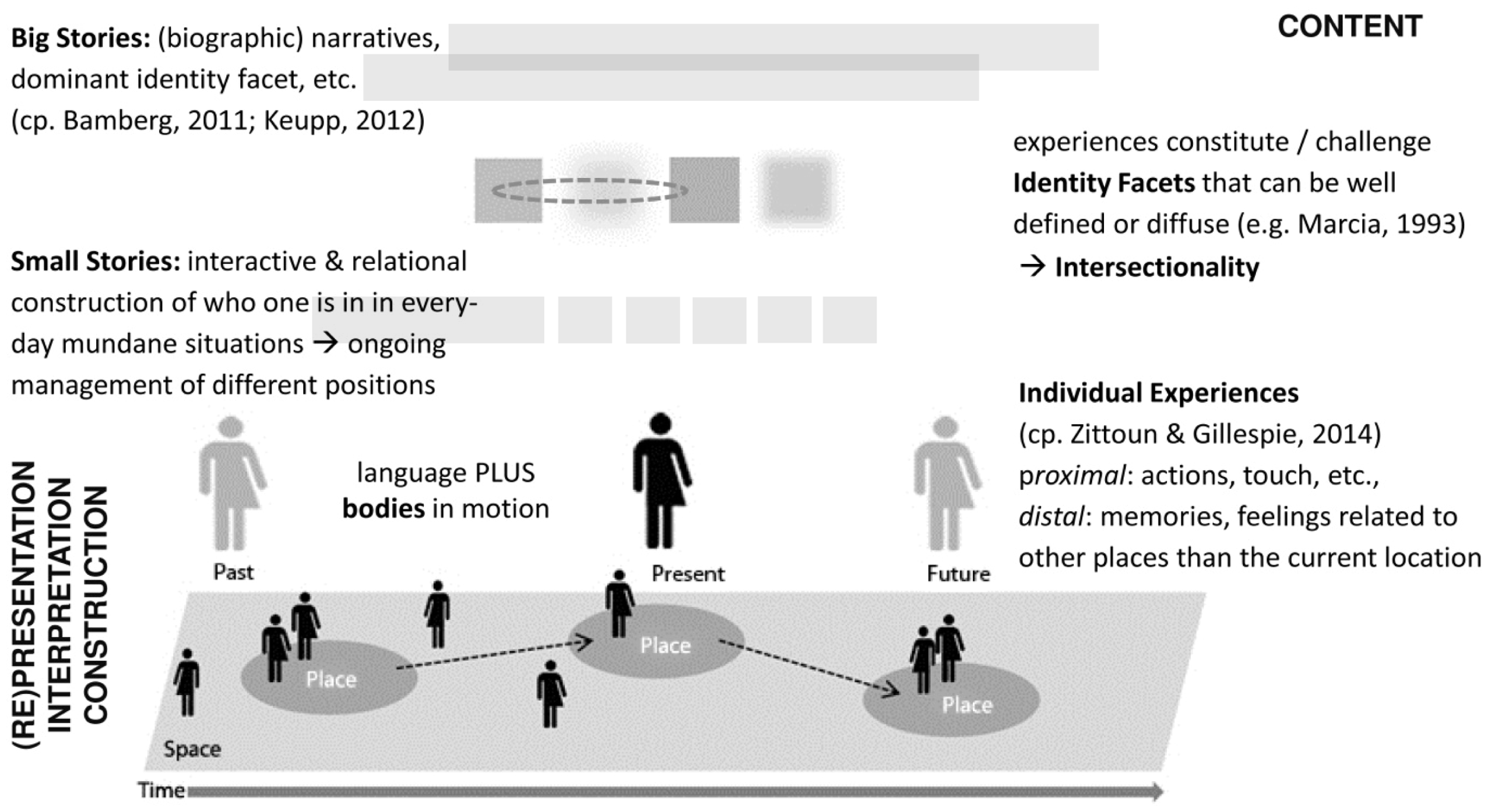
Hedegaard shows many of these aspects in her article without explicitly referring to identity development. She shows how “graffiti may be seen as a way for young people to express conflicts” (p. 401) and to “fill emptiness” (p. 401). Her examples underline the variability of motives and individual meaning-making in the course of identity development. Since painting, as well as singing are ways of expressing oneself that are often lost in adolescence and adulthood, the article shows quite vividly how these artistic activities can have a cathartic effect, and—in some cases—can lead to a certain expertise and appreciation of one's own products (objects), beyond the borders of the graffiti community. These can be considered valuable experiences supporting the development of certain identity facets. Even if space is provided for legal graffiti painting, the illegal tagging and painting will probably still continue, since disobedience is a major motive for many painters. Nevertheless, we would probably have more artists like Banksy, whose pictures greet me every day when I boot my computer, if we supported the artistic endeavors of the young as a form of self-expression outside given aesthetic standards. As always, beauty is in the eye of the beholder.
Footnotes

2
Other identity facets, like gender identity or sexual identity, are not based on certain skills, but on discovering certain (emotional, sexual, social, etc.) preferences (cp. Watzlawik et al., in press).
3
For example: “The different painters agreed that it is the creative aspect and the flow in a graffiti piece that is important, e.g. if the letters rhythmically flow into each other.” (Hedegaard, 2014, p. 397).
4
Assuming that we are not talking about different identity facets of the same person.