







Abstract
This article seeks to develop the concept of shadow trajectories through analyzing narratives of six sisters on the process of becoming mothers. Development implies a dynamic tension between literal and imagined domains, which has been called poetic motion. Psychological novelty emerges from the polarized connections between literal × imagined, possible × performed domains, and between past–present–future. The six sisters (interviewed when they were 65–82 years old, and referred along the text by numbers—Sister 1 to Sister 6, to emphasize that chronological order in time), and I discuss, through their diverse experiences, personal movements that can represent cultural novelty inside their social contexts. Novelty seems to emerge from the interplay of what is seen, dreamed of, or planned as possibilities and what is effectively performed along their trajectories. I call these directions “shadow trajectories,” in opposition to other lines supposed to be “dominant,” both lines present and dynamically tensioned within the dialogical self-territory. The article intends to explore how these two kinds of trajectories are actualized in the women’s current experience, focusing on how “shadow trajectories” can support, amplify, direct, undermine, and create developmental continuity concerning “dominant or main trajectories.”
Introduction
For a long time I thought that absence meant missing.
And regretted, ignorant, what I lack.
Today I don’t regret it anymore.
There is no shortage in the absence.
Absence is a being within myself.
And I feel it, white, so glued, cozy in my arms,
that I laugh and dance and invent cheerful exclamations,
because the absence, this assimilated absence,
nobody steals from me, ever again.
1
(Carlos Drummond de Andrade. In: Corpo. Rio de Janeiro: Record, 2002)
According to Bergson, psychological life implies a particular conception of time, the durée, where each lived moment is unique, although not separated from the precedent ones, rather prolonged itself into the next moment, in a stream-like continuous movement. It is at the level of the durée where we live the reality of our psychological existence; that is why every action contains part of the precedent actions and deliberations; every action is full of our own life as a whole (Simão, 2010). In Valsiner’s words, the subjective world of a human being is constantly in the state of a complex whole of the immediate experience which is dynamically changing (durée). The durée is the subjective reality of the “here-and-now” personal being” However, to be communicated, that full and flowing subjectivity turns into “relatively stable reflexive entities. That discretization is accomplished by the invention and use of signs – semiotic mediation - (…) to regulate and direct that flow in some selected future direction. (2007, p. 351)
This process entails a poetic dynamic: a potential for invention, creativity, and novelty, in the measure as it comprehends many forms of AS-IF relations between past and future, which feedforward new directions and reduce uncertainty in the course of developmental trajectories. Narratives can be characterized as strategies to reduce uncertainty: one history is told out of multiple possibilities. They also set up new possibilities—out of many—to create developmental trajectories.
I’ll present here a case study to illustrate the way I intend to elaborate on that issue, with the theoretical support of Sato and Valsiner’s Trajectory Equifinality Model (TEM) Model and Abbey and Valsiner’s concept of poetic motion.
Narratives, poetic motion, and TEM model
The construction of the self can be conceived as narrative art, processing between inner and outer personal worlds, which only can be understood if we take into account the immeasurable diversity and variability of human experience in cultural context, open to abundant possibilities of meaning making and marked by innovative potential. Narratives have a temporal organization, where past–present–future coexist and are remade in the irreversible time.
Beliefs, values, and representations are historically situated; however, a narrative can bring together a mosaic of representations coming from diverse historical contexts and times. This is poetic motion, a dynamic tension between literal and imagined domains (Abbey, 2006): meanings travel making possible what would be thought as logically impossible. In this sense, experience transcends the logical nexus supposed to form a linear sequence of events and opens to new possibilities, which do not meet any strict idea of determination and predictability. Developmental psychological novelty emerges from the polarized tensions between literal versus imagined, possible versus performed domains, and between past–present–future.
Autobiographical narratives are full of poetic motion, as much as they allow us to focus on agency as a plot that induces a person to engage in something not necessarily formulated at the present moment yet—or to recreate the past by means of narrating past experience under new meanings.
Motherhood is understood as a process that requires the reconciliation of past, present, and future experiences, in order to make sense of the various events that are part of it, and to integrate them into the life course, so to say, to integrate them in a personal sense of experiential wholeness (Abbey & Surgan, 2012; Bastos, Santos, Meneses, & Santos, 2015). The very act of narrating gives cohesion to the diversity of our experiences, promoting the connection between past, present, and future events (Bruner, Acts of Meaning). Through the activity of construction and reconstruction of narratives, people give unity and coherence to life events and construct identities.
Ochs and Capps (2001) characterize narratives by a plot structure that depicts a sequence of temporally and causally ordered events organized around a point, with a beginning that situates a significant, i.e. unexpected and hence tellable, incident and moves logically towards an ending that provides a sense of psychological closure. (p. 4)
The unity and coherence of narratives, according to Michael Berstein (as cited in Ochs and Capps, 2001), depend on some techniques that deal with that multiple temporal structure. Examples of such techniques are foreshadowing (the present is taken not by itself, but as the harbinger of an already determined future), backshadowing (when the shared knowledge of the outcome of events in the past are assumed by narrator and listener as if the protagonist in those events should have known what would happen), and sideshadowing (where the presentness of the past is restored, with a sense that something else might have happened). These narrative strategies entail meaning-making processes where the AS-IF, AS-IS, AS-IT-COULD/SHOULD HAVE BEEN relationships are widely applied.
Development is a process where the temporal REAL course of movement is created, from all the POSSIBLE, POTENTIAL different courses, in the future as in the past (Valsiner, 2009). It entails a poetic motion (Abbey, 2006): as-is versus as-if, as-it-could-be, as-i-want-it-to-be, as it should have been. Psychological novelty emerges precisely from the tensions between literal-imagined, potential-accomplished, past–present–future. Transition to motherhood is a field where these tensions can be clearly observed; besides, motherhood can be seen as a hypergeneralized sign, which therefore tends to involve and regulate the whole experience.
The Trajectory Equifinality Approach (TEA), proposed as a methodological, theoretical, and epistemological construct to overcome the cause–effect kind of explanation, is appropriate to analyze the complexity entailed in the multiple temporal structure of narratives. Among the tasks TEA is proposed to accomplish there are, precisely: “uniting the psychologically real to the imaginary through the construction of a model of life trajectories within the irreversible time” and “creating the arena for developing ways of analyzing oppositions (tensions) that cross the line of past and future” (Sato, Yasuda, Kanzaki, & Valsiner, 2014).
Sato and Valsiner’s TEM model (Sato & Valsiner, 2010), insofar as it allows for the articulation of social guidance and social direction mechanisms into a personal synthesis, is tentatively used here as a theoretical framework. Proposed by its authors as a new methodological device based on a systemic vision and allowing for serious consideration of the notion of the irreversibility of time, TEM model is therefore consistent with the perspective of the life course, which emphasizes the role of human agency through developmental transitions, properly situated in historical context. TEM model has gone beyond identifying pathways to focus on the person’s movement toward the future. Here, history is understood as the stable component of a particular direction, whose probability of occurrence can be estimated, for a given destination in life (the equifinality). In this sense, it also discusses the tendency to persist in certain patterns through life course as it is possible, after narratives, to follow the multiple trajectories (actualized, planned, or interrupted), and the bifurcation points along the process to reach a relevant equifinality point. Multiple trajectories can lead to the same equifinality point. Simultaneously, even in parallel, other movements are done involving trajectories that are not actualized but can persist at the experiential domain as shadows. Points of obligatory passage are also present along the process.
Figure 1 shows a schematic representation of the TEM model. Each equifinality point establishes a polarized relationship with other possible equifinality point (the polarized equifinality point). Each actualized trajectory can somehow shelter other movements that were not fully accomplished, or were simply abandoned, suggesting the possibility of invisible trajectories. The relationships between actualized and nonactualized trajectories will matter for the multiple trajectories that unfold in the future.
Equifinality point within irreversible time (Valsiner & Sato, 2006).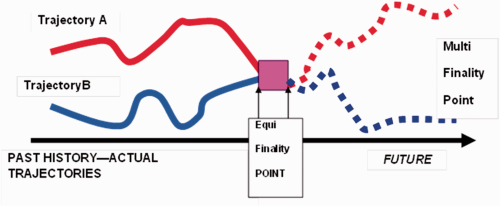
Sato and Valsiner (2010) suggest the metaphor of “channel” to better address the notion of trajectory: the channel can modify its course eventually, and yet it continues to represent a concrete track. The model fits the complexity of life history, assuming effectively that human lives unfold in irreversible time, from a known point toward the unknown. Potential or unrealized trajectories are also considered, both in the past and the future, which presents a broad field of possibilities; such dimensions are relevant in building individual personal lives in the present. The notion of equifinality comes from systems theory and refers to the principle that, in open systems, a final state can be achieved through many means or potential paths; this notion somehow articulates the different trajectories and brings to life experience an immeasurable richness.
This paper aims to analyze how poetic motion operates in the present, creating new meanings about not accomplished or interrupted developmental trajectories in the past—metaphorically named here as “shadow trajectories,” borrowing from Bernstein's shadowing narrative strategies (mainly backshadowing and sideshadowing). Additionally, I propose a taxonomy of relationships to discuss how these shadow trajectories interact with main trajectories, understood here as the accomplished and persistent trajectories.
Methodological aspects
I present here a case study constructed after narratives of six women of one singular family surrounding their experiences along their times and trajectories to motherhood (considering pregnancy and childbirth as critical life events). The interviewees’ ages ranged between 60 and 84 years of age. They are referred by numbers to indicate the family chronological order and the interesting aspect that, within the same family, we have narratives about becoming mothers along four different decades. The analysis focuses on two of the sisters, Sister 4 and Sister 5 (named here by the pseudonyms Elvira and Marta, respectively), which narratives illustrate more and better our main discussion about the relationship between potential or interrupted and actualized trajectories.
The narratives were carried out in a conversational context, where three or four women from the same family participated. In three cases, these women belong to different generations (mothers and daughters). This context created a favorable atmosphere, not only because of the sharing within the family added to the sharing with the researcher, but for the more natural and spontaneous conversation that happened. All the participants signed an informed consent form. Their privacy is assured here by using pseudonyms and also by keeping untold the towns and states where they have lived.
For the data analysis, the first approach to their narratives has described the interviewees’ experience through relevant domains or fields where motherhood as an experience is built: I-as a Mother × Motherhood; I-as a Mother × Marriage; I-as a Mother × other I-positions related to career, social orientation, politics, religion; I-as a Mother × Symbolic and Material Resources (family versus medical cultures); I-as a Mother × Attitudes toward Daughters-as-Mothers (transgenerational coconstruction of women’s roles). In a second stage, data analysis and interpretation were oriented by TEM model, focusing on the main field of the motherhood where the participants have drawn their multiple trajectories. The “shadows” metaphor came from the analysis of the relationship between planned, interrupted, and actualized trajectories, which allowed for the identification of mechanisms of sideshadowing and related emerging signs and meaning-making processes.
The house of six sisters: Times and trajectories of motherhood
To begin with, I would like to stress how interesting this case is, as we can visualize, within the same family, certain social changes around childbirth which took place over four decades: from the 40 s to the 70 s. It can be said that the most important of these changes is that childbirth goes from being a family event, managed by women in the family context, to being a medical event, managed by health professionals (initially men; in contemporary Brazilian society, medicine is becoming a feminine activity, particularly when it comes to the care of women and children). Thus, some general remarks are done, aiming to characterize the semiosphere where these women became mothers.
The sisters had different experiences concerning education, career, and motherhood; raised their children mainly in medium size towns in the countryside; only the two oldest gave birth at home, with doulas’ assistance—most of them went to the hospital and were assisted by physicians.
I will focus on the trajectories of Sisters 4 and 5 (the numeration indicates the age of the sisters: Sister 1 is the oldest, Sister 6 the youngest), but will briefly describe the other sisters’ experiences, to better contextualize our research participants’ stories. From the narratives constructed by Sisters 1, 2, 3, and 6, it is evident how to form a family and becoming mothers are central values orienting women’s trajectories. Sisters 4 and 5 present somehow contrasting new I-positions: they did not think with priority of being mothers. In the House, only these sisters had their first babies at over than 30 years of age, which was nonnormative at that time. They also followed differentiated personal and professional trajectories which distinguished them with respect to their sisters’ family-centered patterns. These aspects make their narratives particularly interesting to analyze meaning-making processes at bifurcation points along developmental trajectories, concerning the multiple possibilities these women dreamt of and effectively followed. Of course, every woman experiences life transitions like becoming mother in her own, singular way, and the sisters are not different; my point here is that it is possible for the researcher to visualize the process better when a trajectory follows a path that differs from the canonic one.
She used to positively value being prepared for marriage and motherhood and this sign had a promoter function in her coping with childbearing. Through her experience, she has also shown strength and initiative—for instance, she decided to have her second baby at home, against her husband-doctor's opinion.
She gave support to her daughters’ when they had babies (except one, who had her first baby right after Sister 2 widowed), and most of parenting. As soon as she stopped bearing children, she started working outside the house.
She had five more children when they returned to their hometown, continuing to work with her husband in a new school, and teaching in a college. She supported her daughters’ deliveries (acting almost as a midwife on one occasion) and parenting.
However, we didn’t talk about that. I was never afraid. I knew I could be as strong as my sisters were, I
Elvira, Marta (Sisters 4 and 5), and the emergence of differentiated trajectories to motherhood
Elvira and Marta’s narratives on their trajectories to become mothers follow a quite different pattern, comparing to their sisters. I chose their examples as the dynamics of potential or interrupted and actualized trajectories is more explicit in their narratives.
As a teenager, Elvira relates that she thought of getting married, but she did not want to have many children. When a girl, she counteracted her mother’s demands for babysitting her baby brothers, finding ways to escape so that she could play. She says: To be a mother is to spend nine months crippled and crazy for the rest of your life. However, I don’t like to say that in front of my children, I don’t want to upset them. (…) I’m not crazy about babies like my sisters. R. had nine children and can’t see a baby! She ran to carry N’s grandson. I asked her: ‘haven’t you had enough’?
She has a strong social orientation: friends, extended family. She has been, on different occasions, a city councilwoman and the secretary of education in her town.
I lived until my thirties without thinking about being a mother. Even so, somehow, I was always taking care of others: nun … nurse … However, when I was at nursing school, I watched a very difficult delivery and any will I could have toward being a mother disappeared … sincerely!
Concerning childbirths, she persisted in her choice for normal delivery, even going against the doctor—who was her own brother, which might have made her positioning easier. However, her position at work also empowered her in this aspect, as she was at that time head nurse in the maternity ward. She also made the decision to stay at home and identify the right moment to go to the hospital, after her own evaluation (the same was related by her older sisters—they knew the time to go to the hospital).
Her adoptive daughters had been premature babies to whom she feels she “gave birth” again; her care saved their lives. She had not planned to adopt these particular children. However, she accepted to keep them in face of the circumstances—they had been born in the hospital where she worked as a nurse—and based on her professional and personal skills. “I don’t remember they are adopted, only when I’m introducing them to someone. What I feel is not different from what I feel toward my biological children.” She did not want to use induction or similar procedures, as she trusted in her body constitution and understood that her previous losses were due to complications in the early months of pregnancy; so, by the end of pregnancy, she thought she had no reasons to be afraid.
The dynamics of shadow and dominant trajectories within Marta and Elvira’s cases
The multilinearity of developmental trajectories is evident for each sister’s experience: each new stage is constrained by new possibilities and new limits, generating new structures of opportunity. The various trajectories within this family illustrate the uniqueness of the trajectories (among the many possible) completed by the participants.
The sisters move along their life courses within a semiosphere that is common only at the most abstract hierarchical level. The general descriptive category of “fields of motherhood” allows for a reading of the different pathways followed by them to becoming mothers, taken here as an equifinality point.
The trajectories accomplished, the experiences to-be, and the potential ones (WHAT COULD HAVE BEEN OR SHOULD HAVE BEEN) generate promoter signs, so to say, multilevel semiotic regulators that regulate the dynamics within polarized semiotic fields (Valsiner, 2007). Promoter signs enter the present experiences and relate in complex ways to the person’s I-positions. In this way, present–past–future, potential and accomplished trajectories coexist within fields that are organized in an infinite progression and about which we only know the initial state, as their courses are open for unpredictable ends. Figure 2 illustrates this dynamics. Still, continuity is actively constructed: semiotic maintenance and semiotic emergence continually recombine themselves.
Dominant and shadow trajectories: multiple connections in the present.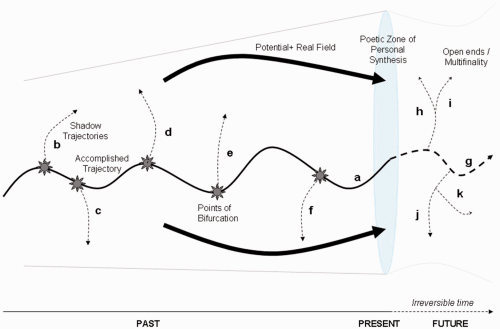
Development is a process in which the temporal, REAL course of movement is created, from all the POSSIBLE, POTENTIAL different courses, in the future as in the past (Valsiner, 2009). As such, it entails a poetic motion (Abbey, 2006): as-is versus: as-if, as-it-could-be, as-I-want-it-to-be, as-it-should have been.
My particular concern relates to the possibility that the TEM model considers all these dimensions within the developmental system (Valsiner, 2009), having in perspective equifinality points which can be related in a polarized way (or coexist) with other finalities (Sato, Hidaka, & Fukuda, 2009). It includes nonactualized or partially actualized possibilities (Valsiner & Sato, 2006), which can persist as “shadows” for the so-called dominant trajectories (trajectories in course, performed, or actualized possibilities). These tensions are expressed in the narratives through sideshadowing strategies (Bernstein, as cited by Ochs & Capps, 2001); an analogy can be made also with Cunha’s (2007) analysis of proto-voices and secondary voices to describe dynamical processes inside the dialogical self.
The trajectories briefly sketched here illustrate the nature of lived reality of our psychological existence, which only makes sense at the level of the durée as every action contains part of the precedent actions and deliberations and is full of our own life as a whole. Thus, becoming mother is a part of the whole life, intertwined with other domains of the experience, spread through the diverse life contexts, relating with them through relationships characterized by dependence, conflict, complementarity, all of which can persist on time in more or less subtle ways. A relevant question to be proposed here is: which are the relationships, tensions, polarities, between dominant and shadow trajectories?
Taking into account the trajectories of the sisters Elvira and Marta, whose initial perspectives did not include being a mother (which happened to be a main focus for the other sisters), the most intriguing point is that their “shadow” trajectories
Elvira, who used to make explicit her feelings about not having many children; who, when a girl, resisted her mother’s demands that she babysit her baby brothers; was not as family-centered like her sisters, as her movements show: it is evident from her narrative that she has many friends, how much she appreciates meeting the big, extensive family, and the fact that she had been a city councilwoman years ago, being one of the first women in her city to assume a public position in the department of education—had her motherly style modified by her strong social orientation. Thus, she persists being the one who socializes and organizes family meetings. She engages her children in social activities (friendship networks or politics). At 76, she still has activities which are not family-centered.
New qualities emerge at the personal poetic zone of synthesis, as a result of tensioned relationship between Elvira’s interrupted trajectory as (for instance) a politician and her main (because permanent and persistent) trajectory as a mother.
In the interview with Elvira, we missed a question: would she define “being a mother” as the main dimension in her life? The criteria assumed in the study concern persistence and permanence; no doubt, this is the dimension in the spotlight for the researcher. However, considering her own perspective, we could meet here a quite different discourse.
Another aspect concerns the emergence of new meanings about motherhood within the trajectory of becoming a mother and its changes along life span. Marta’s case is a good example here. She had never thought of becoming a mother before the day she left the congregation where she was a nun—and leaving the congregation was not her choice: she was compelled to leave because of health problems. Having been a nun and a nurse before being a mother, she became known in the family for her strength and ability to handle difficult situations, shaping a missionary-like style which marked intensely her mothering. She is the one who faces challenges and comes to help in every difficult situation. Shadow trajectory may be present, for instance, in the way she became an adoptive mother and in the way she influenced her children’s choices concerning career (they oriented themselves to be a priest and a politician). By the time she was interviewed for the first time, her youngest son was recovering from a treatment for leukemia; he had died when a second interview (aiming to discuss the results of the study) happened.
Again, the shadow trajectory (being a nun) is seen modifying the main, dominant trajectory (being a mother), poetically providing a style (missionary-like), directions, and a particular affective flavor.
Conclusions
Along Elvira and Marta’s narratives shadow trajectories act as catalysts (in the sense of Cabell, 2010); time, or the memory of it, is a catalyst. AS-IT-SHOULD-HAVE-BEEN is poetically made present in AS-IT-COULD-BE. When migrating within the dialogical self landscape, meanings generate new qualities at the level of the personal and social experience, not only at the personal level of the feeling–thinking–acting but with evident social implications, as new possibilities are constructed for women along their complex transition to become mothers.
We can see, from Elvira’s and Marta’s examples, how a particular semiosphere is personally signified and lived. Inside this particular semiosphere, with dominant and peripherical social demands—for instance, suggesting that motherhood is rather a destiny than a choice for the women—the relationship between past–present–future, in a predominantly relational context, has a family meaning. A very interesting unfolding for the present analysis would be to look at how those multiple meanings and trajectories of motherhood are intertwined and jointly constructed along the interaction between the six sisters. All of the sisters’ narratives, for instance, refer to their mother as a sign of woman strength and self-determination: the mother model can be taken here as a generalized sign, highly abstract, and present at her daughters’ multiple spheres of family experience. The self, in the Northeast of Brazil, is a familial self, in the sense Nandita Chaudhary proposes the self is in India (Chaudhary, 2004).
The present analysis also has contributed to make explicit the different domains through which motherhood is constructed within particular social and historical realities. Is it not possible to consider the subject of motherhood as a reduced to the individual experience (destiny or choice) of a woman, and neither to circumscribe this experience to the sphere of mother–children relationship disconnected of a broader field of a social semiosphere (and I am being redundant, here), with strong implication for gender relationships and meaning-making processes that constrain actual possibilities for women to be and to act in the world. The notion of shadow trajectories is supposed to contribute, depending on posterior developments, for a better apprehension of the theoretical issues present in the field of memory and remembering, in the personal and collective dimensions.
These initial analyses suggest that the elaboration of a taxonomy of the relationships between the dominant trajectory and shadow trajectories is a necessary task—not accomplished yet by this article, but suggested as a valuable theoretical enterprise. Shadow trajectories can support dominant trajectories amplifying, directing, creating continuity, even through different generations; they can also undermine the realized trajectories. No matter what the directions of the relationship between the two realities are, shadow trajectories surely modify, in the present, the way dominant trajectories are lived.
Footnotes
Acknowledgements
The author thanks to Kenneth Cabell, Jaan Valsiner, and Pina Marsico for their thoughtful readings on previous versions of this article.
Declaration of conflicting interests
The author(s) declared no potential conflicts of interest with respect to the research, authorship, and/or publication of this article.
Funding
The author(s) disclosed receipt of the following financial support for the research, authorship, and/or publication of this article: This work was supported by the Brazilian National Council for Research and Technology—CNPq (grant number 302976/2010-8).