







Abstract
The professional life of Vladimir Petrovich Zinchenko (1931–2014) is presented from an American perspective. Three themes are highlighted: a) an enduring quest to find some degree of freedom in human action, including his own, b) a deep appreciation of his intellectual genealogy, and c) an abiding generosity toward students and colleagues. Particular episodes of Zinchenko’s life as a scholar are examined from this perspective, with special emphasis given to some of the struggles he encountered in an intellectual atmosphere charged by Marxist-Leninist ideology during the Soviet years.
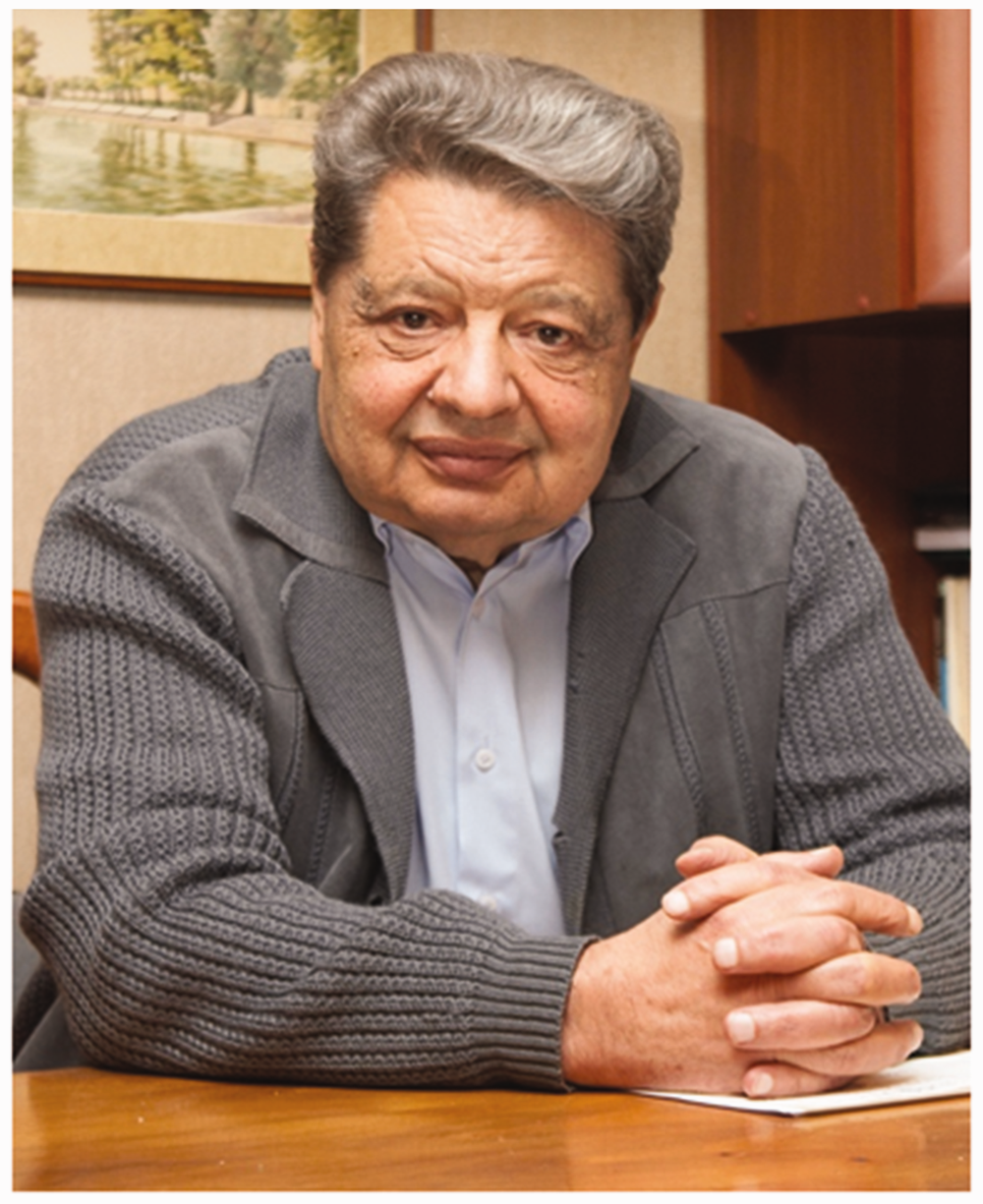 Vladimir Petrovich Zinchenko (1931–2014) (Photo courtesy of AV Zinchenko)
People in the U.S. are often surprised to find out that I lived and studied in Moscow during the Cold War. They assume that it must have been difficult, if not frightening for an American to live in the hostile Soviet environment, but as I always tell them it was actually a good time for an American to live there. Indeed, in those years it was one of the few places in the world where an American could be popular not despite, but because he was an American. The enthusiastic welcome Americans received from Soviet colleagues and friends in those years contrasted with the hostility they could expect elsewhere at the end of the Vietnam War.
With the help of informal settings characterized by endless conversation and lubricated by vodka, Americans developed deep, life-long friendships with their Soviet counterparts, and in my case, a particularly important part of this experience stemmed from my relationship with Vladimir Petrovich Zinchenko. By the end of his life, I counted him as a mentor and colleague, and one of my closest friends. This relationship, however, took a while to evolve, and how it came to pass is revealing about Vladimir Petrovich and myself and about Russia and America in general.
Preparing for Moscow
Well before starting my postdoctoral studies in Moscow in 1975, I had been fascinated with what I would find there. To be honest, I approached my year-long stay with some trepidation. Like many Americans, I had something of a bipolar view of Russia and the Soviet Union. On the one hand, I expected to find courageous moral exemplars in the ilk of Andrei Sakharov—perhaps even a little Tolstoy or two! On the other hand, I expected to find cruel, abusive purveyors of power, miniature copies of the notorious Lavrenti Beria perhaps.
In the end I did not find such stark heroes and villains. To be sure, I did meet some heroes and villains in Moscow in the 1970s, but they were pretty mild specimens and no more prevalent than what I could find in the U.S. My real discovery was that practically no one fit neatly into one or the other of these bipolar categories. When I told this to other Americans, they often thought I was saying people are the same everywhere, but that is not what I took away from my experience. Indeed, I came to believe that there are fundamental differences between Russian and American ways of living and thinking and we should recognize, indeed celebrate and learn from these differences.
To be sure some aspects of the atmosphere in Moscow were sobering for an American. The aspects I have in mind grew out of a political setting that could go to great lengths to control independent reflection and discussion, a setting that presented particular challenges for someone like Vladimir Petrovich as he strove to live a life that was both productive and honorable. Before arriving in Moscow in 1975, I tried to do some background research on this topic by reading works such as The Lysenko Affair by David Joravsky, an historian who would later become my colleague at Northwestern University. Lysenko’s disastrous impact on genetics was one of the most egregious cases in which Soviet science was perverted as researchers subordinated the needs of scientific inquiry to the dictates of Marxist, indeed Stalinist, thought. Fortunately, this was not representative of the routines of normal science that I found in Moscow in the 1970s, but some parts of its heritage could still be felt.
Vladimir Petrovich’s productivity
As I got my bearings after arriving in Moscow, I must say that I started out being somewhat wary of Vladimir Petrovich. After all, he was known to work on Soviet defense projects and was a Party member—two points against him in the eyes of many of my fellow Americans. But as I got to know him, I came to understand him as a brilliant and generous person doing his best to negotiate the tricky challenge of operating in some very difficult circumstances. In one way or another this is a challenge that has to be negotiated everywhere, but it took on very special overtones in his context.
The first part of the picture I eventually developed of Vladimir Petrovich had to do with his productivity. I soon realized that he served as something of a case study of how to be a productive scientist in the Soviet Union in the 1970s. The extraordinary number and range of his publications alone speak to that. He studied everything from child psychology to ergonomics to esthetics to the philosophy of consciousness, and his brilliance on all these topics is perhaps more widely appreciated in many quarters than that of any other Russian psychologist of the past half century.
Even at first glance this is impressive, but to appreciate the real extent of Vladimir Petrovich’s accomplishments, one has to understand the setting in which he lived and worked, a setting riven by impediments unlike those faced by Western scholars. Just with regard to equipment, any American visiting his laboratories in the 1970s came away doubly impressed with what he managed to get done. Unlike his counterparts in the U.S., he was not provided with a state-of-the-art lab. Instead, he had to rely on doggedness and ingenuity to overcome the material and bureaucratic impediments standing in the way of any ambitious researcher, impediments that convinced many of his contemporaries that it simply made more sense to pursue philosophical and methodological critique rather than empirical studies.
Given this, the number and sophistication of experimental studies Vladimir Petrovich and his research team conducted was simply astounding. Outlets in English for his endless articles were limited to occasional issues of Soviet Psychology edited by Michael Cole at the time and a few other publications such as chapters in my edited volume The Concept of Activity in Soviet Psychology. These, however, hardly did justice to the major body of publications and unpublished reports that Vladimir Petrovich and his colleagues, especially Natalya Dmitrevich Gordeeva were producing at the time (for an overview, see Cole and Wertsch, 2011).
These early decades of Vladimir Petrovich’s career saw him move from the study of stabilized images in children to those of adults, and from schoolrooms to complex work settings characterized by advanced, information technologies such as studies of operators manipulating joy sticks to control an image on a computer screen. Much of this was cutting edge not only in the Soviet Union, but on the international scene. For example, articles on perception and motor action appeared in the early 1960s, at a time when the category of engineering psychology was emerging in the West and in the Soviet Union had to recover from its ideologically-driven abandonment in the 1930s. By the end of the 1960s ergonomics, the study of man-machine interactions, became an acceptable discipline, and articles growing from Vladimir Petrovich’s research began to appear in Ergonomika and the proceedings of VNIITE (All-Union Scientific and Research Institute of Industrial Design).
Much of this research was conducted in the Soviet military-industrial complex, and as a result its results remained inaccessible to the public in the Soviet Union, let alone to Western colleagues. But even in those Cold War years Vladimir Petrovich managed to find ways to retain ties with the few Western colleagues visiting Moscow. His conversations with them did not have to do with specifics from his laboratory, but with general conceptual issues of interest anywhere in the world. For example, in the 1960s he developed professional and personal ties with Herbert Pick, a leading scholar of perceptual motor skills at the University of Minnesota. Michael Cole entered the Moscow scene in those years as well and became a leader in Western efforts to understand Soviet psychology, and Urie Bronfenbrenner also was a steady presence in keeping ties between Soviet and American psychology alive and well.
All this engagement with Western colleagues was not simply an act of friendship—though it was that as well. It also involved a sort of intellectual kinship that Vladimir Petrovich sometimes shared more closely with colleagues outside of the Soviet Union than with those in his own country. Namely, it was driven by a philosophical commitment to include an element of human freedom into the study of human action, a topic to which I return below. For him personally, this sometimes meant straying beyond the accepted borders of the ideological constraints that shaped Soviet psychology.
In my observation, scientific inquiry in the 1970s and 1980s in Moscow was often distorted as it attempted to jump through the hoops of Marxism-Leninism, activity theory, and the like, and these constraints sometimes had unfortunate unintended consequences. One thing that struck me as an American scholar trying to understand Soviet academic discourse, for example, was its pervasive undertone of cynicism, something about which Peeter Tulviste, a distinguished alumnus of the Faculty of Psychology at MGU, provided me with some insight. He related how he had finished everything in the scholarly content for his Candidate’s dissertation at Moscow State University but was not allowed to defend it because he resisted inserting the “hallelujah paragraph” celebrating Marx, Engels, and Lenin as the intellectual giants who provided the foundation for all Soviet scientific thought. Peeter considered this requirement to be cynical, if not ridiculous, and he relayed how he argued with his mentor Alexander Romanovich Luria over inserting these phrases, but finally gave in so he could receive his degree. Like many of his contemporaries, Peeter found this distasteful, but necessary.
As I came to understand the cynicism involved in such episodes, I also came to understand that the stakes could be quite high for getting something wrong. This included the constraints on what research topics could be examined and how they had to be framed in theoretical terms. In some instances, disregarding these guidelines could mean a research project or career could hit a dead end. In cases such as the hallelujah paragraph the constraints came from the top in the Soviet state and were fairly straightforward. Others, however, involved more local disputes between schools of thought, making them not entirely dissimilar to what one could find elsewhere. Just as graduate students in some psychology departments in the U.S. might have been well advised to formulate their dissertation project in information processing terms, students at MGU needed to cast their topic in one or another form of activity theory. The difference was that disputes over the use of information processing psychology had little in the way of higher ideological commitments to back them up, whereas the genealogy of activity theory involved Marx.
Having said all this, it is important to understand the brilliant contributions being made to world science in those years by Soviet psychology. These contributions involved scholarship starting soon after the Russian Revolution and continued through the work of several individuals in Vladimir Petrovich’s generation, and they eventually had a major impact on several disciplines in the U.S., Europe, Latin America, and Asia, Japan in particular. One should never doubt, therefore, that figures such as Vladimir Petrovich were extremely productive in their scholarly life and that this made a difference to world science. But for him and other in the Soviet Union this involved operating in some very complex political conditions, which is another important part of Vladimir Petrovich’s story.
Negotiating the constraints of Soviet life
How did Vladimir Petrovich negotiate the constraints of the Soviet system in a way that allowed him to be both productive and honorable? My perspective on this is limited by my outsider status, but after observing the lives of intellectual figures in Moscow, and Vladimir Petrovich in particular, over some four decades, I came to see a few basic themes guiding their actions. In Vladimir Petrovich’s case, I came to appreciate three general proclivities that guided his professional life: a) an enduring quest to find some degree of freedom in human action, including his own, b) a deep appreciation of his intellectual genealogy, and c) an abiding generosity toward students and colleagues.
The concern with human freedom was manifested in Vladimir Petrovich’s research interests ranging from the most fine-grained motor processes to broad philosophical issues of consciousness. With regard to the former, consider his account of action framed in the shadow of one of his intellectual heroes, the physiologist Nikolai Bernshtein. An action is not rehearsed, but constructed. According to N.A. Bernshtein, exercise is rehearsal without repetition. In other words, in the construction of an action, one can always observe rivalry or competition between its conservative properties, determined by already-existing programs and mnemonic schemata, and its dynamic properties, determined by the novelty of the situation and of the goals and by the sense implicit in the motor task. (2004, p. 51)
For Bartlett and Neisser, claims about schemata were driven largely by empirical evidence, but I came to believe that something more was involved in Vladimir Petrovich’s case. Namely, his concern stemmed from the view that human freedom needed to be included in the analytic picture for ethical reasons. It was part of a broad approach to human life up to, and including consciousness as examined in literature and philosophy. In this vein, the inherent tension between the repeated forms of language and the creative dimension of unique, situated utterances was central to Mikhail Bakhtin’s account of text, a point of contact that was obvious to Vladimir Petrovich but was rare among other psychologists in the world. The intellectual connections come full circle when one considers that the physiologist Alexei Ukhtomsky influenced both him and Bakhtin. In the end, I suspect that Vladimir Petrovich’s ubiquitous commitment to human freedom was part of his way of keeping a corner of his own life vibrant in times of heavy-handed oppression by academic and state authorities.
The great success as a scholar and public intellectual that Vladimir Petrovich enjoyed during the Soviet years sometimes involved testing the limits of bureaucratic and political authority. I came to understand this at a general level by watching how it played out in concrete ways in his daily life. For example, it surfaced in the lectures he gave at MGU, which students often found not only humorous, but bold in ways that approached being dangerous. In my mind’s eye I can still see him covering the microphone with his hand as he made an aside or slipped in a joke about life in the USSR, a practice used by others as well, but something that became a work of art for Vladimir Petrovich.
Unfortunately, I was witness to an episode in 1980 that was less happy. By that time, I was deeply involved in the study of Vygotsky’s intellectual tradition, having translated several of his works and published articles about his ideas. One upshot of this was that I was positioned on one side of a growing rift with another school of thought in Soviet psychology, namely one grounded in forms of activity theory traced back to S.L. Rubinshtein or other scholars. In retrospect, the tensions might appear to be a tempest in a teapot, but at the time access to resources, institutes, and career advancement was being decided on the basis of one’s affinity to the “correct” way of thinking—which was not that of the school founded by Vygotsky, A.N. Leont’ev, and their advocates. This was more than an intellectual issue, and people were often forced into taking sides with one or the other camp on the basis of crude pressure tactics.
These disputes took on greater weight and had greater consequences in the Soviet Union than elsewhere because they were formulated in terms of who had the most correct and doctrinaire version of Marxism. The discussion might have appeared at first to an outsider to be similar to those between theoretical schools in the West. Whereas my American colleagues might have waged their struggle over funding for research and graduate students with the help of, say, the National Science Foundation, in Moscow it played out in terms of support from one or another Soviet academy or major university. The difference, however, was that the stakes could be much higher in the USSR in the 1970s. With sufficient help from higher ups in the party or government, it was possible to interfere with scholars’ professional and personal lives to a much greater degree than is possible in the West. I witnessed this in the 1970s and 1980s, which was a period when I and others were introducing the ideas of Vygotsky and his followers to enthusiastic audiences in the U.S. and Europe. The increasing visibility of this school of thought outside the Soviet Union was accompanied by more and more tension between schools of thought within.
This was the context in which my efforts to organize the first international conference on Vygotsky in the fall of 1980. This meeting was sponsored by the Center for Psychosocial Studies in Chicago and featured participants such as Jerome Bruner, Michael Cole, Vera John Steiner, Ragnar Rommetveit—and from Moscow, Vladimir Petrovich and Vasili Vasilevich Davydov. In the months leading up to the October conference I sent numerous communications out to the participants. Given that this was all occurring in 1980, it meant sending “snail mail” letters to everyone, and my letters to Vladimir Petrovich and Vasili Vasilevich would take about 10 days to get from Chicago to Moscow. I knew from the outset that there was always a possibility that our two Moscow colleagues might have trouble obtaining Soviet visas, and indeed at one point I sent out a general memo to all the participants in the U.S. and Western Europe saying that while we expected Vladimir Petrovich and Vasili Vasilevich to attend I could not guarantee this would happen until they actually got off the plane in Chicago. Accidentally, I made the embarrassing mistake of sending this memo to both of them as well.
After Vladimir Petrovich received this letter in Moscow and about a month prior to the conference, I had one of my rare phone conversations with him in those years, and he was his usual jovial self, even joking about my doubts that he and Vasili Vasilevich would show up in Chicago. In fact, however, when I went to meet them at the airport, only Vasili Vasilevich got off the plane. This was shocking for me and the other conference participants, and as I was able to piece the story together from Vasili Vasilevich and others, it involved harsh actions by the leader of another school of psychology who controlled the new Institute of Psychology in the Academy of Sciences. With the help of higher-level Party officials, he had managed to stop Vladimir Petrovich on the way to Sheremetovo by revoking the visa he had to travel to the U.S. The fact that Vladimir Petrovich was a highly visible and popular public intellectual, if anything, worked against him in this case as he struggled to operate in a system that allowed envious competitors with stronger ties to the right Party figures to thwart his efforts.
The conference proceedings in Chicago went on as otherwise planned and yielded the 1985 volume Culture, Communication, and Cognition: Vygotskian Perspectives published by Cambridge University Press, which included chapters authored by Vladimir Petrovich and Vasili Vasilevich. But meanwhile in Moscow, times became increasingly more difficult for these two figures and others like them who were not followers of the other, competing school of Soviet psychology. They lost prestigious positions in institutes and eventually their party cards.
What struck me at the time was that even during this dark period Vladimir Petrovich managed to continue much of his research and be productive in his publication efforts. He also managed to maintain his strong ties with colleagues from the U.S., Europe, and Japan. And through all this, he also kept up his quest to understand the element of freedom in human action, including in the realm of the choices made by individuals in pursuing a professional life in a setting that involved impediments to such freedom. I sometimes speculated that this was a sort of defense mechanism that allowed Vladimir Petrovich to be a productive scholar while living with honor in a context that could be stifling, frustrating, and sometimes dangerous.
A second guiding force for Vladimir Petrovich—in good times and bad—was his self-definition as part of a rich intellectual genealogy. He thought of himself as the beneficiary of a forminable host of intellectual progenitors and as having special responsibilities for making sure their ideas were carried cared for and carried forward. The list started with his father Petr I. Zinchenko, a brilliant psychologist of the Khar’kiv School, and it expanded outward from there. A.R. Luria, A.V. Zaporozhets, D.B. El’konin, A.N. Leont’ev, and others come to mind just from this immediate circle. For Vladimir Petrovich, these were much more than intellectual mentors. Indeed, they were more like family members who had watched over him as he came of age and people to whom he was committed to giving back to society in the future. These progenitors sprang to life as real personalities for visitors like me in the endless stories, often humorous, that Vladimir Petrovich told, and thanks to his generosity, I was able to meet many of them in person, leaving me with some very profound, lasting impressions.
The intellectual ancestry that Vladimir Petrovich carried as part of his self-image extended to numerous figures from earlier periods as well. Among these, individuals such as Bernshtein, Bakhtin, L.S. Vygotsky, G.G. Shpet, and G.I. Chelpanov come to mind. Never did one of my countless lunches and bankety with Vladimir Petrovich conclude without at least one of the endless toasts dedicated to “our teachers,” and I came to count many of those he viewed as his teachers as mine as well. His deep commitment to honoring his intellectual forbearers reflected an essential fact about his identity project. Namely, he viewed himself as part of a network of brilliant and often courageous individuals, including some who had suffered for their ideas, but all of whom deserved credit for one or another of the insights of a larger intellectual project. It was a community in Vladimir Petrovich’s vision that even included “honorary foreign members” such as Jerry Bruner, Mike Cole, and Herb Pick.
This is not to say that Vladimir Petrovich was indiscriminate in his praise of others and the quality of their thinking. Like any serious thinker, he was often critical of ideas and individuals, and he invariably had good reason for taking the stance he did. But he was consistently fair in assessing the intellectual quality of someone’s work, even when he differed with the individual as a person. On balance, he was more generous that many of us often are and less inclined to dismiss a project or individual completely based on personal differences. On those rare occasions when he did this, it often involved an assessment of the ethical worth of the effort, especially if he sensed that someone was advancing claims solely for reasons of a personal career or in the service of seeking favor from higher authorities. Even in the context of some very tough debate and competition, however, I found Vladimir Petrovich to be generous and willing to give credit where credit was due for serious ideas. For him, this was an element of a life enriched by an appreciation of his place a grand intellectual genealogy.
The third theme I saw at work in Vladimir Petrovich’s life and work was his generosity toward students and colleagues. He was extremely productive in his own research and writing, but he always seemed to have time for others. This applied to all of the many students he had in Moscow and elsewhere around the former Soviet Union. His extensive network of students ranged all the way from those with whom he had a single meaningful encounter to those who worked extensively with him on an extended basis. It seemed to me that I could go to a university just about anywhere in the former Soviet Union and meet someone who would enthusiastically recount an experience they had with Valdimir Petrovich as a teacher or mentor.
And this generosity extended to his international guests as well. Like many others, I benefited immensely from my hours of discussion and debate with him about research concerns. This debate and hospitality extended to social occasions such as the trips he organized to places such as Suzdal and Vladimir. On those occasions I was reminded that in addition to being a world-class scholar, Vladimir Petrovich was both a cosmopolitan and a patriot in the best sense of this latter term. He was proud of what was best about Soviet and Russian life, but he was also curious and respectful of other cultural traditions. And he did not hesitate to reflect on the shortcomings of any society, including his own.
In the 1980s the tensions between patriotism and cosmopolitanism took on new meaning as various nationalities in the Soviet Union began to become restive and antagonistic and to move toward independence. This was a difficult and tense time for everyone, and I watched Vladimir Petrovich struggle with how to function in this environment. His deep personal ties with students and colleagues remained largely intact even when for others, political and national differences sometimes severed relationships irrevocably. Part of the reason for this was his endless efforts to learn from others, even when this involved coming to terms with views that challenged beliefs he had held for decades.
At a meeting in the early 1990s in Estonia, for example, I watched as he encountered some heated responses from Lithuanian and Estonian colleague to his claims about the friendly relationship between different nationalities during the Soviet period. He was taken aback at the vehement reaction to some of this claims, and through a difficult and honest effort to come to terms with these, he both changed and maintained his relationship with others with whom he would continue to engage in the future. The issues at stake were very emotional at the time and were bigger than any of us were able to resolve, but Vladimir Petrovich demonstrated that he was capable of understanding and growth even while he continued to defend his own (evolving) beliefs.
Coming to terms in a life well lived
In the end, one can only marvel at Vladimir Petrovich’s ability to live a productive and honorable life in such a complex and politically loaded setting as the one in which he existed. I am sure he managed to do this in many more ways than I was able to detect, but I was able to see how he organized his efforts around the three themes I have outlined. This involved an ongoing struggle to understand freedom and creativity in all forms of human action. Parallels can be found in the work of other scholars in the Europe and the U.S., but for Vladimir Petrovich it had the added dimension of being an attempt not only to reflect on, but to engage in an essential element of freedom, even if only in small ways.
This is a theme that guided his intellectual inquiry and his life, and it sometimes led him to challenge a political system in ways that could involve paying a price. He did not consider his efforts to be heroic, given how aware he was of the much higher price that figures such as Gustav Gustavovich Shpet (executed in 1937) paid for their intellectual honesty. Shpet’s fate, along with his brilliance, was what motivated an ongoing dedication in Vladimir Petrovich to understand Shpet’s ideas (Zinchenko & Wertsch, 2009). Even when it was unpopular and personally costly, this was part of the intellectual drive that kept him going through good times and bad. This was just part of his commitment to his intellectual genealogy, and it enhanced the joy and productivity attained as a generous teacher and colleague.
Over my years of visiting the Soviet Union, I came to conclude that it was hard to find the kind of stark heroes and villains I mentioned at the outset of this article. My naïve and uniformed search for them in Moscow was replaced by some wisdom that I found among my friends and colleagues. One of the favorite phrases I learned from Peeter Tulviste (actually, his father) was “God’s zoo is very large,” which helped me understand and appreciate the broad range of characters I have encountered in Russia over the past several decades. I am not sure, however, that I ever found anyone as distinctive and inspirational as Vladimir Petrovich when it came to being so successful at scholarly productivity while at the same time living an honorable life in a complicated context.
In 2020 the American journalist Joshua Yaffa published a book titled Between Two Fires: Truth, Ambition and Compromise in Putin’s Russia, where he mapped out and then rejected the temptation to talk about stark heroes and villains. Instead, his point was that many of the most successful and inspirational people in today’s Russia have figured out how to pursue a deeply human agenda while having to negotiate compromises with the state in order to make their contribution to Russian and world society. They lead much more nuanced lives than one might expect in this regard and by no means can be categorized either as careerists who have sold out to the authorities or as hapless heroes who are dismissed by everyone around them. As I read Yaffa’s book, I was struck by how the template he outlined applies to Vladimir Petrovich. In a podcast, Yaffa notes that the choices one must make about whether to stay in the good graces of political leaders in order to do honorable things unfortunately applies to some cases to my own country as well. In that sense Vladimir Petrovich may be a sort of case study for the larger world today, leaving us with valuable life lessons even after he has passed from the scene.
Footnotes
Declaration of Conflicting Interests
The author(s) declared no potential conflicts of interest with respect to the research, authorship, and/or publication of this article.
Funding
The author(s) received no financial support for the research, authorship, and/or publication of this article.
