







Abstract
Psychology and psychiatry are in a constant search for an adequate model of affective disorders. Psychology has classified depression as a mood disorder, but a growing literature links mental disorders with socioculturally relevant ways in which people experience and express distress. With this study, we link depression with proverbs as omnipresent narrative structures and mini-theories that help people interpret reality and categorize personal experience. Proverbs are omnipresent narrative structures that describe, explain, and prescribe human behavior. Hence, we offer a paremiological approach to better understand the minds of the depressed. Our tenet is that proverbs may also reflect people’s mental states and attitudes by conveying different levels of optimism versus pessimism. We evidence empirically that proverbs convey optimistic and pessimistic attitudes and, thus, have the capacity to capture peoples’ mental states. Moreover, we show that this capacity is limited for people with high depressiveness. Finally, we discuss how proverbial thinking links collective experience and wisdom imprinted in proverbs with an individual’s mental states, which has important research and practical implications.
Introduction
According to the APA, 25–33% of the world population suffers from a depressive disorder at least once during their lifetime (Kessler et al., 2006), and the WHO estimates that depression will be one of the primary diseases of civilization across all countries by 2030. Depression is a medical illness affecting how one feels, thinks, and acts. It drastically diminishes the quality of life by causing emotional and physical problems at work and during daily life (American Psychiatric Association, 2013) and increases mortality risk as half to two-thirds of people dying by suicide had depression at the time of their death.
Despite the continuous development of psychotherapeutic and medical intervention, still many patients are resistant to current therapy or counseling (Gelenberg et al., 2006). Thus, a need still exists to better understand depression and its sociocultural environmental correlates as mental states are determined by the sociocultural environment. Researchers have acknowledged the role of language and culture in the development of affective disorders (Nichter, 2010; Ramos & Alegría, 2014), for example, in culture-specific ways in which people experience and talk about distress (so-called “idioms of distress”) that shape the personal and interpersonal course of trauma-related disorders (Hinton & Lewis-Fernández, 2010; Kaiser et al., 2015; Kaiser & Jo Weaver, 2019; Nichter, 2010).
Following scholars’ calls for diverting attention from the prevalent mind–body relation to the mind–culture relation (Kirmayer & Ryder, 2016; Laughlin & Throop, 2006), we link depressiveness (and mental disorders in general) with proverbs as narrative structures embedded in culture, which is in line with new psychiatric trends laid down in the Diagnostic and Statistical Manual of Mental Disorders (DSM-5) (Nichter, 2010). By focusing on proverbs as nuggets of collective experience and wisdom of a sociocultural group, which may influence the mental states of the members of that group, we extend prior research on culture-specific idioms of distress. We argue that paremiology has potential to offer new insights into the study of mental disorders in a culturally adequate manner (Chen et al., 2019a; Kirmayer & Ryder, 2016).
We apply a social constructionist approach to culture understood as a contextually (re)constructed phenomenon and a symbolic system of explicit and tacit assumptions and values shared by a community and passed to its new members through social interaction (Burr, 2006; Kirmayer & Ryder, 2016; Wilczewski, 2019).
This article aims to link depressiveness with proverbs understood as a specific kind of narrative structure. They are unique expressions that explicitly encapsulate the truths accepted and shared by communities over time (Kreitler, 2014). They perform a prescriptive function of mini-theories that guide people’s interpretation of reality, motivate them to or discourage them from taking action, and calibrate their mental states (Tannen, 1988). Accordingly, we propose a more culture-oriented paremiological perspective of depression by focusing on how proverbs may capture the mental states of the depressed (Kreitler, 2020).
Pessimism is the most frequently mentioned indicator of depressiveness among other clinical traits (Robinson-Whelen et al., 1997), while the optimism–pessimism continuum is regarded as a significant mediating variable influencing depressive symptoms in suicide attempts (Hirsch et al., 2014). The complexity of the phenomenon of depression still challenges studies that aim to better understand the mental schemes of depressed people and how they interpret figurative language, including proverbs. Despite intense research on the cultural roots of affective disorders in diverse ethnic samples, no study to date has explored what language data, specifically, commonly used proverb-like narratives on optimism and pessimism, may reveal about the interplay between culture and depression—in the same vein as, for example, narrative research allows access to personal experience (Hermans & Gieser, 2012) and intercultural experience (Wilczewski, 2019).
Aiming to develop our understanding of how pessimistic attitudes constructed in proverbs are enacted in people’s mental states, it is relevant to address the question of whether proverbs have the capacity to capture the mental states of people with depression. There is evidence that depressive people tend to think in particular ways (Kreitler, 2014) and have particular beliefs that may be considered as depression generating (Kreitler, 2004). We focus on the collective mind as imprinted in proverbs (Wołońciej, 2013) to link proverbs with an individual’s mental state, thus overcoming the reductionist approach that seeks to explain social phenomena through a focus on the individual mind only (Kirmayer & Ryder, 2016).
In the ensuing sections, we link “proverbial thinking” (Gibbs & Beitel, 1995; Mieder, 2015) with people’s mental states by bridging culture and psychology. Next, we present proverbs as powerful culture-specific narrative structures that reflect patterns of thinking in societies with diverse depressiveness. To empirically support the assumption of the relationship between proverbiality and depressiveness, we examine the relationship between pessimism/optimism-loaded Polish proverbs with depressive symptoms. The article concludes by showing how proverbial thinking links collective experience and wisdom imprinted in proverbs with an individual’s discourse and mental states, followed by opportunities for future research and practice.
Narratives the depressed live by
Just like cultural factors underlie emotional mechanisms and mental health, so does language that—according to the social perspective—“is the principal means whereby we conduct our social lives” (Kramsch, 2010). Language is a major means of expressing and communicating meanings. Thus, it serves a social function by allowing people to communicate their implicit theories and helping them understand reality and everyday life behaviors. It is also a primary cognitive tool people use to categorize experience as it embodies their naive perception of reality and their selves.
It is hence reasonable to assume that being immersed in a particular discourse impacts how people view themselves, others, and the surrounding environment. A good example of such a discourse is the narratives that convey optimistic or pessimistic views or attitudes, specifically, proverbs. They serve people as sense-giving tools for interpreting why certain experiences or events happen and prompting them to apply either a positive or negative lens on those experiences (Tannen, 1988), which is cogently expressed in the narrative “the optimist sees the glass as half full, while the pessimist sees the glass as half empty.”
According to narrative psychology, people’s capacity to narrate, understand, and integrate their life stories, or “big” stories that represent and reflect people’s worlds and identities (Bamberg & Georgakopoulou, 2008), is crucial in the creation of culture as based on commonly created and used narratives. Thus, proverbial narratives may be conceived of as vehicles of culture-specific patterns (McAdams, 2019). Permeating everyday discourse, proverbs are also utilized in the internal dialogue of people with depression. The concept of the “dialogical self” proposed in Hermans’ theory (Hermans & Gieser, 2012) can help us better understand affective disorder mechanisms using language as a carrier of culture. Narrative psychology posits that the self is dialogical by nature, which means it is negotiated through an internal dialogue or internal speech. McLean and Syed (2015) describe the process of self-construction as a kind of synthesis, whereby the self is emerging over a (re)negotiation of conventional narratives and internal positions of “I” in relation to other agents. Because the self is inseparably linked to experience in the social environment and discourse, its negotiation involves commonly used narratives circulating in society (McLean et al., 2018). It is thus logical to seek sources of people’s mental states, including depression, in the sociocultural context and language as the primary means of functioning in that context. Prior empirical studies in narrative psychology indicate a link between self-narratives and emotional states (Hermans & Gieser, 2012), which may be explored by means of a linguistic analysis of narratives and semantic fields to diagnose mood disorders.
Dimaggio et al. (2003) show that a careful recalibration of the internal dialogue in the psychotherapeutic process may positively affect patients’ psychological well-being. In their study, patients who rewrote their stories creating more adaptive self-narratives, constructing their selves independently and without a feeling that it may be harmful to others, overcame internal conflicts and their negative emotions diminished. Similarly, Angus and Greenberg (2011) view self-narrative activity as guiding future actions and note that life satisfaction often depends on the relationship between an individual’s self-speech and their expectations. In turn, Watkins (2008) emphasizes the role of negative narratives and repetitive thinking in the prevention/development of depression and anxiety disorders. He describes mindfulness practices where a therapeutic intervention seeks to discourage automatic, habitual patterns of thoughts and typical narratives in patients with depressed moods. Not surprisingly, the consolidation of the self through patients’ verbalizations (or communicative actions) has become a vital part of the therapeutic process as a result of the potential of language to construct reality (Watkins, 2008).
In view of the above, the dialogical approach unlocks the potential to better understand the “culture of depressiveness” by focusing on the patients’ narratives that draw on common sayings, that is, proverbs. Permeating the daily discourse, proverbs function as mini-stories that profile experiences and ruminative thinking in depression (Cunha et al., 2012) in the same way as other culture-bound narratives (e.g., idioms of distress) influence individuals making sense of their disorder, as well as their help-seeking and self-treatment (e.g., Hinton & Lewis-Fernández, 2010; Nichter, 2010). This is why they often apply the language of images and proverbial expressions as tools for better articulating their feelings and state of mind.
Proverbs as a window to the depressed mind
Checking the Cambridge Dictionary of Linguistics (Brown & Miller, 2013) for a concise definition, we find that a proverb (Greek paroimia: para—another, oimos—way) is a “memorable saying expressing a perceived truth or moral lesson: e.g. He who laughs last laughs best; People who live in glass houses shouldn’t throw stones. ‘Proverb’ is applied particularly to traditional sayings; new aphorisms are coined, but not new proverbs” as it takes some time to become accredited by a community. Accordingly, proverbs are understood as expressions coming from the past, generalized, repeated, and frequently grasped by a figurative statement. They may be used as a discursive tool for sharing the truths that have been intersubjectively accepted by members of a society (Honeck, 2013).
Proverbs are automatic, previously learned figurative expressions of collective experience recorded in one’s long-term memory, which are “unperturbed and therefore ecologically valid” (Honeck, 2013, p. 36–37). They perform descriptive, interpretative, and prescriptive functions (Tannen, 1988) by fulfilling the need for recording experiences and observations into nuggets of wisdom, thereby providing people with truths about the world or advice on interpersonal relationships and social affairs. Proverbs permeate cultures (Mieder, 2012) because they are a natural component of people’s daily discourse. In addition, by reflecting beliefs, attitudes, and traits of a cultural group (although those are different for individual members of such a group), proverbs reflect culture. For example, based on their daily communication behaviors, Poles are described as compliant and pessimistic as compared to other nations (Kurtyka, 2019).
How can proverbs be linked to people’s mental states? A fundamental property of affective disorders is a system of mental pessimism- and optimism-loaded structures/attitudes acquired and created along with the lifespan and stored as “latent but reactive” factors activated in stressful moments (Beck & Bredemeier, 2016; Young et al., 2014). According to Segal & Shaw, (1986), these latent structures may create or activate negative cognitive patterns underlying one’s personality profile. Such negative patterns are regarded as depressive cognitive structures (Beck & Bredemeier, 2016), which are anchored in proverbial narratives. Just like language plays a prominent role in therapeutic change (Hermans & Gieser, 2012), the proverbs people use in everyday discourse may affect their experience because such narratives “reflect normative aspects of how people [should] think and behave in social situations” (Gibbs & Beitel, 1995, p. 150); and vice versa, the specific proverbs may serve as markers of depression (Leahy & Dowd, 2002).
The power of proverbs comes from their specific enthymematic nature; enthymeme is a syllogism or a deductive formula where at least one premise is missing, though obvious. For example, in the following pessimistic Polish proverb porywać się z motyką na słońce (“to jump at the sun with a hoe”), the enthymematic reasoning overlooks the premise concerning the large Earth–Sun distance and the power of the Sun, which prevents one from conquering it (Goel et al., 2017). Accordingly, the proverb implies that taking up a specific action is doomed to failure. By contrast, the optimistic proverb po nocy wschodzi słońce (“after night the sun rises”) overlooks the premise of the natural cycle of day and night, so the proverb implies that difficulties and failures are a natural component of human life. Importantly, because the missing premise cannot be questioned, nor can the self-evident truth the proverb conveys, this is their persuasive power. And even if some proverbs (e.g., pessimistic ones) are contested by individuals who do not agree with the truth they convey, such individuals may favor and use these proverbs that better reflect their beliefs and mental states (e.g., optimistic ones).
Proverbs as cultural markers of depression: An empirical study
According to Markowitz (2001), the key to mental disorders is a distorted self-concept imprinted in naive personal theories rooted in the social context. Proverbs exemplify cultural artifacts that may shape, through a narrative form, people’s perception and interpretation of reality. But most importantly, proverbs may also tune people’s mental states and their attitudes by conveying different levels of optimism versus pessimism.
Studies indicate little predictive value of proverbs and proverb tests in evaluating possible thought disorders and question their utility in thought disorders diagnosis as they require abstract thinking (Gibbs & Beitel, 1995; Kauschke et al., 2018). Because major depressive disorders severely undermine cognitive performance (reasoning, working memory, verbal fluency, attention, and processing speed) (Chen et al., 2019a, 2019b), we assume that—in a similar vein—depression should have a hindering effect on proverbial thinking. To determine the capacity of proverbs to capture the mental state of a person with depression, we conducted an empirical study in which we test the following hypotheses:
Method
The purpose of this study was to link mental states of the depressed with proverbs to gather initial evidence concerning the principles guiding proverbial thinking of the depressed. After exploratory and correlational analysis (individual level, Analysis 1) aimed at establishing the internal structure of people’s responses to proverbs, we carried out intergroup comparisons of three clusters (low, medium, and high) distinguished by the level of depressiveness (Analysis 2). This allowed us to verify whether people with different levels of depressiveness differently assessed optimistic and pessimistic proverbs.
Participants
Having obtained the approval from the research ethics committee, we recruited 167 voluntary participants (122 women; 73%) aged between 21 and 71 (M = 29.49, SD = 13.15). The sample comprised 89 students (67 women; 75%) and 78 nonstudents undergoing psychotherapy (55 women; 70%); the latter participants could not receive psychotropic drugs as those could have influenced their mood and thinking. Participants received no financial remuneration and completed paper-and-pencil interviews.
Measures
Depressiveness
Participants completed the Beck Depression Inventory-II (BDI; Beck et al., 1988); Cronbach’s α = .81 and α = .92 in the present study), which is a 21-item self-reporting questionnaire that measures affective, cognitive, behavioral, and somatic symptoms of depression in normal and psychiatric populations. The total score ranges from 0 to 63, indicating four levels of depression severity. Scores between 0 and 9 demonstrate the absence of depression, 10 and 18—mild to moderate depression, 19 and 29—moderate to severe depression, and 30 and 63—severe depression.
Proverbial material
To link depressiveness with proverbial narratives, participants assessed on a five-point scale (1 = not at all, 5 = very much) the extent to which 20 optimism-loaded and 20 pessimism-loaded proverbs characterized them, based on their current experience. The list of 40 Polish proverbs used in the main study was developed through a multiphase semantic analysis of about 400 proverbs extracted by the first author from a few dozen major paremiographical Polish anthologies. Out of that pool, 15 competent judges (psychologists) selected 190 optimistic and pessimistic proverbs. Those proverbs that were inconsistently categorized (as optimistic or pessimistic) by five or more judges were further excluded from the pool, leaving 85 proverbs (47 optimistic and 38 pessimistic). Next, the judges rated the degree of optimism/pessimism of each proverb on a five-point scale (1 = low degree, 5 = high). To exclude the equivocally rated and still ambiguous proverbs, the statistical cut-off criterion of evaluations was set at M ≥ 4 and SD ≤ 1.4, which resulted in the final set of 40 proverbs.
Procedure
Data were collected between October 2014 and May 2015 as part of a project titled “The use of paremioscripts in the therapy of people with depression” financed by the city of Warsaw, Poland (no. UDA.POKL.08.02.01–14-024/11). Considering the required population profile, we collected data from students and from persons with elevated depression rates who—at that time—were undergoing psychotherapy in hospitals or private practices. Data were collected from students during their university classes and from depression patients at the end of their therapeutic session by the therapist, who had been instructed by the first author on how to collect these particular data. Participants completed the BDI scale and rated the degree to which each of the 40 optimistic/pessimistic proverbs characterized them. They were asked not to rate the proverbs they regarded as unclear. It took participants about 18 minutes on average to complete the survey.
Results
Analysis 1
Factor loadings of optimistic and pessimistic proverbs.
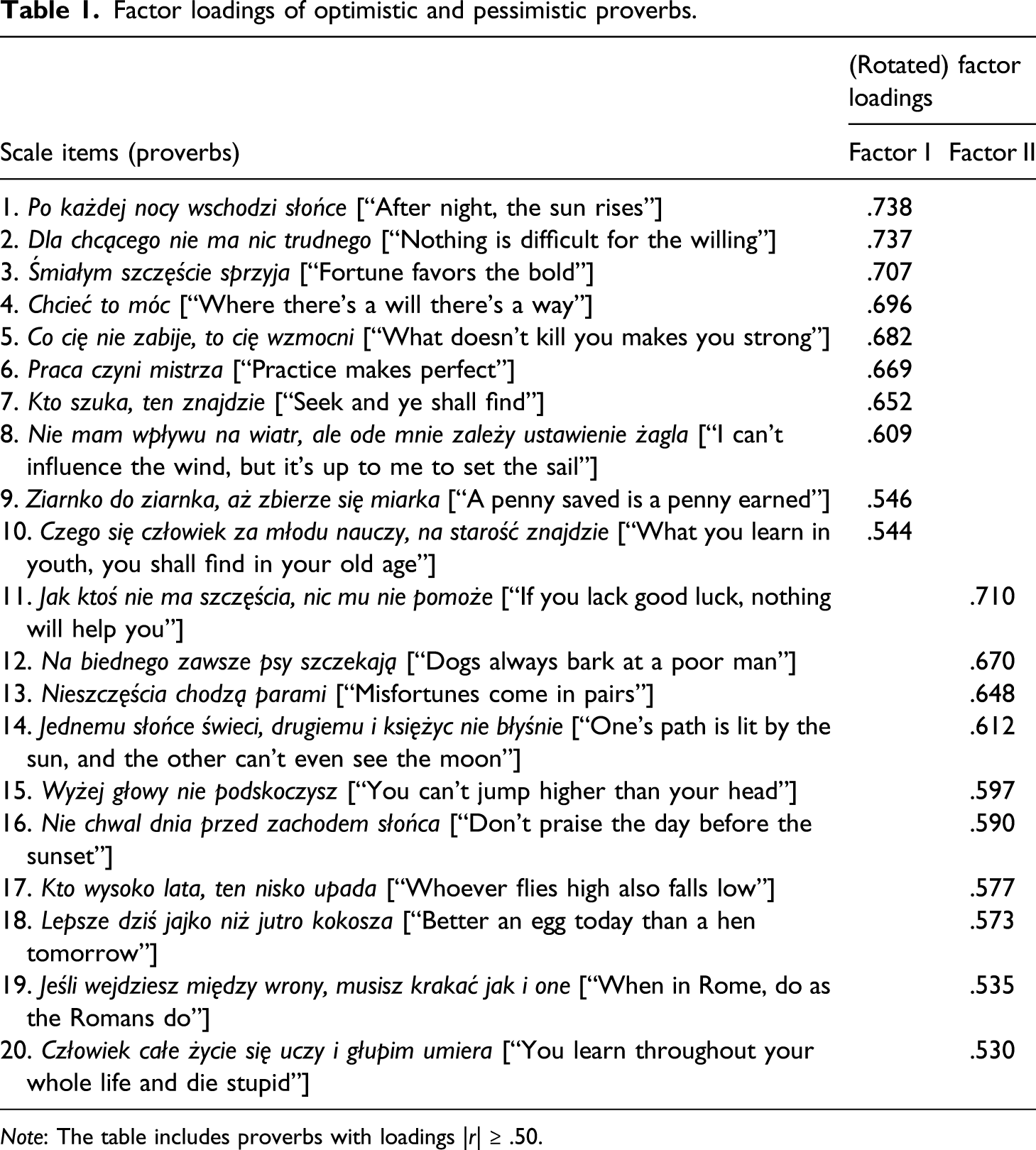
Note: The table includes proverbs with loadings |r| ≥ .50.
The analysis allowed us to establish representative proverbial material for testing Hypotheses 2 and 3. It encompassed two lists of 10 optimism-loaded and 10 pessimism-loaded popular Polish proverbs, used as separate subscales.
Analysis 2
With depressiveness being the key variable in testing Hypothesis 2, we measured participants’ levels of depression. Sixty-nine participants (41%) had elevated depressive symptoms (10–63 points), of whom 34 (20%) displayed mild, 24 (14%) moderate, and 11 (7%) deep depression. The remaining 98 participants (59%) showed no depression. The obtained depressiveness variation allowed for conducting correlation analyses.
Correlations between Factor I (optimism), Factor II (pessimism), and depressiveness (BDI).
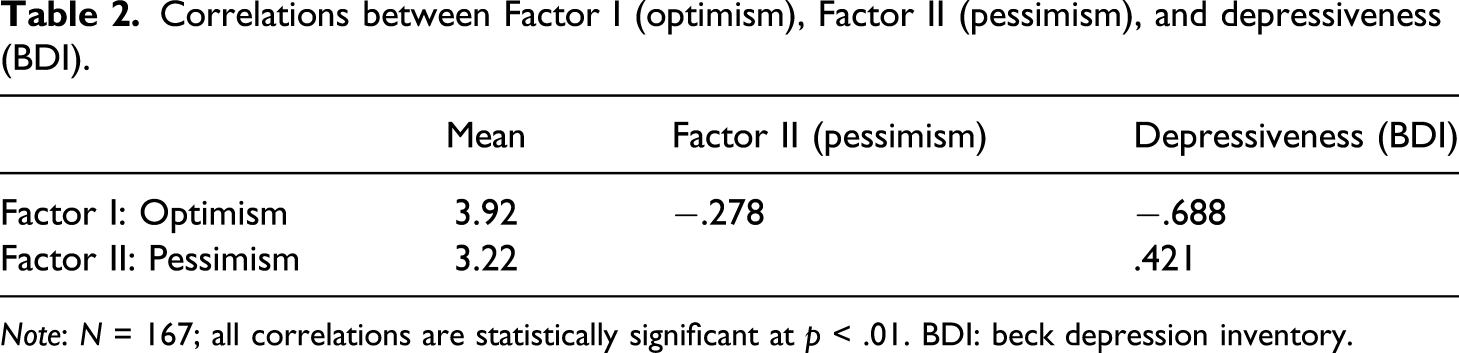
Note: N = 167; all correlations are statistically significant at p < .01. BDI: beck depression inventory.
Analysis 3
To examine the influence of depressiveness on people’s ability to discriminate between optimistic and pessimistic proverbs, we analyzed the structure of proverbial characterizations within Factors I and II (10 items per factor) across three groups displaying different levels of depressiveness (low, medium, and high).
The groups were distinguished using empirical (not clinical) criteria around three quartiles to assess how participants characterized themselves using proverbs. The first group (Low) comprised participants without depressiveness (scores below 3 on the BDI scale), the second (Medium)—with medium depressiveness (scores 6–9), and the third (High)—with high depressiveness (scores above 15). The main effect was similarly significant for four clinical depressiveness levels: 1—no depression (scores below 9 N = 98); 2—mild (scores 10–18; N = 34); 3—moderate (scores 19–29; N = 24); 4—severe (sores over 30; N = 11); however, for psychometric purposes based on group size inequalities, we followed empirical distribution based on quartiles.
We ran a two-way analysis of variance (ANOVA) with a mixed 2 × 3 design, with a within-subject factor of proverbs (optimistic/pessimistic) and a between-subject factor of depressiveness (Low/Medium/High). Bonferroni-corrected post-hoc tests were used to correct for multiple comparisons. The main effect of the proverb category was significant (F[1, 105] = 70.02, p < .001, η2 = .40) in that the mean response for optimistic proverbs was higher (M = 3.83, SE = .06) than for pessimistic proverbs (M = 2.9, SE = .07).
The main effect of depressive symptoms was significant (F[2, 105] = 3.74, p < .05, η2 = .07) in that the mean response for proverbs was higher for low-depressive participants (M = 3.44, SE = .07) than for high-depressive participants (M = 3.2, SE = .07; p = .067) and higher for medium-depressiveness participants (M = 3.46, SE = .07) than for high-depressiveness participants (p = .057) which indicates a trend. There was no difference in the mean response for proverbs between low- and medium-depressiveness participants (p = 1.0).
The interaction effect between the optimism and pessimism factors and depressiveness symptoms was significant (F[2, 105] = 38.1, p < .001, η2 = .42). Figure 1 illustrates the quality of that effect. Bonferroni-corrected post-hoc tests revealed that for low-depressiveness participants, the mean response for optimistic proverbs (M = 4.32, SE = .10) was higher than for pessimistic proverbs (M = 2.55, SE = .12; p < .001; Cohen’s d = 2.35). The same pattern was established for medium-depressiveness participants (M = 4.13, SE = .12 for optimistic proverbs; M = 2.79, SE = .13 for pessimistic proverbs; p < .001; Cohen’s d = 1.45). On the contrary, for high-depressiveness participants, the mean response for pessimistic proverbs (M = 3.4, SE = .12) was higher than for optimistic proverbs (M = 3.03, SE = .11; p < .05; Cohen’s d = .44). Interaction effect between optimism, pessimism, and depressiveness (low/medium/high).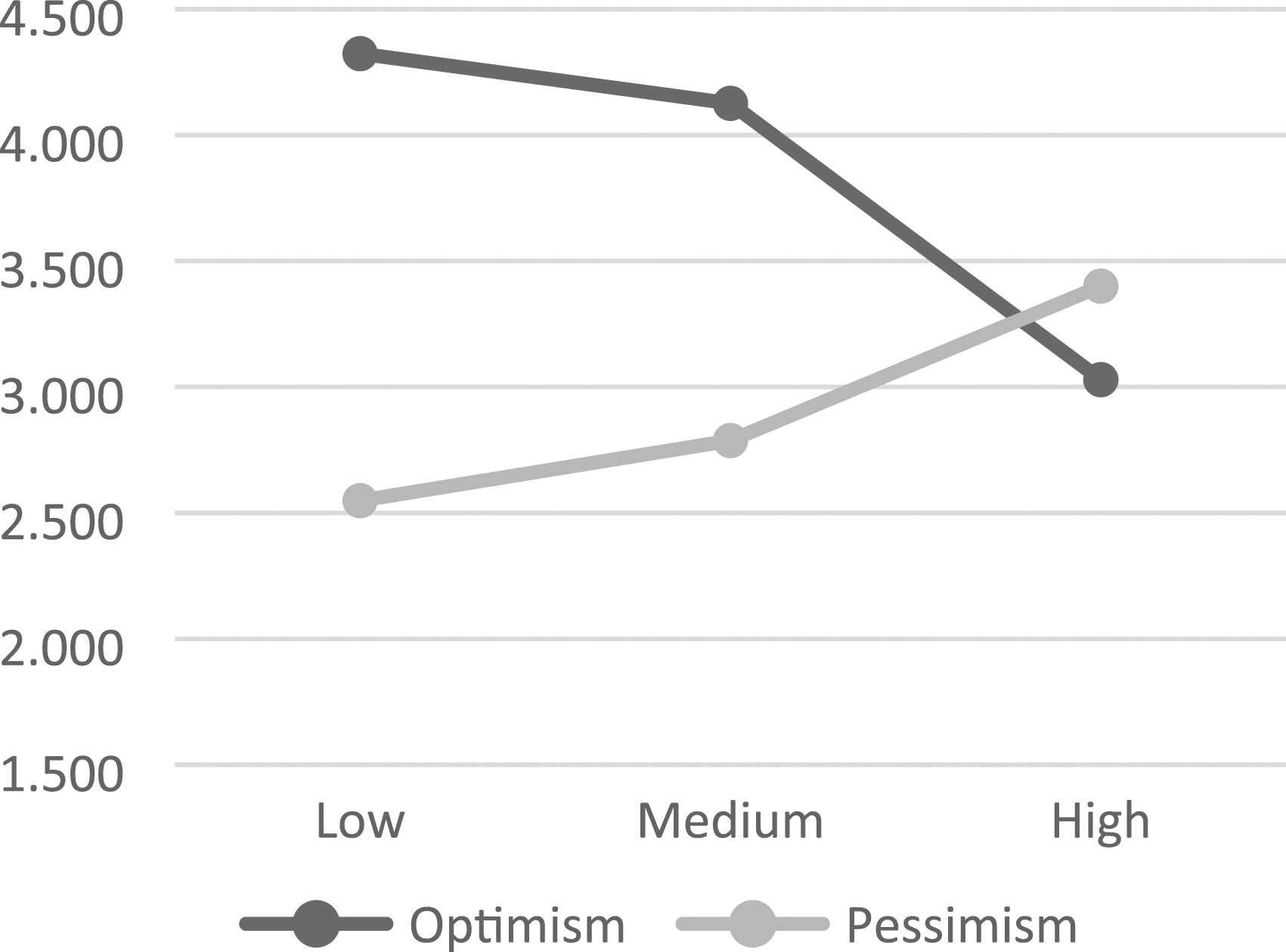
Cohen’s d reached very high scores in the low- and medium-depressiveness groups and low scores in the high-depressiveness group. People with the highest depressiveness showed the smallest differences in self-characterization using optimistic and pessimistic proverbs. Accordingly, the results supported Hypothesis 3.
Discussion
This study links depressiveness with culture through proverbs. The findings revealed that proverbs convey optimistic and pessimistic attitudes (Hypothesis 1). Because the factors of optimism and pessimism were significantly correlated with the mental states of people with diverse levels of depression, the capacity of proverbs to capture people’s mental states was confirmed (Hypothesis 2).
As expected, the capacity of proverbs to capture and differentiate people’s mental states was limited by the level of depression (Hypothesis 3). Specifically, despite a sharp semantic contrast between optimistic and pessimistic proverbs found in our proverbial material, participants with higher depression exhibited an affective-cognitive reversal in discriminating between the proverbs. There are two possible interpretations of this finding. First, the poorer assessment of the semantic aspect of optimistic and pessimistic proverbs (Chen et al., 2019a, 2019b) may be caused by the figurative nature of proverbs whose interpretation requires abstract thinking and higher-level cognitive skills (Austin et al., 2001). Hence, highly depressed participants may have had difficulty understanding proverbs through which they characterized themselves. Second, the lower discrimination ability may be explained by differences in preferences for what proverbs mean (Gibbs & Beitel, 1995). In other words, a similar assessment of optimistic and pessimistic proverbs by highly depressed participants may be indicative of an indifferent attitude toward life, rather than by the ability to provide interpretations of particular proverbs (and such an ability would have to be tested using context-sensitive measures of proverbs). The second interpretation appears more probable in the light of the symmetrical distribution of the opposing but complementary narratives of optimism and pessimism (Figure 1) for participants with low- and medium-level depression, and the intersection and a slight predominance of pessimistic narratives in highly depressed participants (Kauschke et al., 2018). Additionally, a relatively low negative correlation between optimistic and pessimistic proverbs (Table 1) might imply a limited autonomy of optimism and pessimism domains or the existence of another hidden and related dimension reducing the strength of this correlation.
Concluding remarks: Toward a culture-oriented perspective of depressiveness
Psychology and psychiatry are in a constant search for an adequate model of affective disorders. Although psychology has defined and classified depression as a mood disorder (American Psychiatric Association, 2013), still little is known about its cultural correlates that affect people’s patterns of thinking, emotions, and mental states accompanying major depression and bipolar disorder (Kirmayer & Ryder, 2016).
To advance our understanding of the minds of the depressed, more focus should be placed on the interplay between depression and cultural contexts in which the depressed function or between individual cognition and collective experience imprinted in culture-bound narratives and enacted in everyday discourses. These two levels, that is, the personal and the collective, seem to be bridged by proverbial thinking, which fuses a relatively stable aspect of collective experience and wisdom with individual experience by means of proverbial narratives.
Using paremiological data, we showed that proverbial thinking reveals a unique kind of rationality that, unlike analytic thinking, enacts the functional aspect of a culture and serves individuals as a means of cognition, knowledge, or a method to explain, guide, and make sense of their experiences. Proverbs serve people as strategies for dealing with situations—people develop names for situations typical of their culture and for strategies to deal with them (Burke, 1973). In other words, being “a pertinent way of identifying ‘what is going on here’, of picking out and directing notice to its salient features,” proverbs calibrate different situations differently and provide individuals with resources and referential realities for acting differently in these situations (Shapin, 2001, p. 740). In this sense, proverbial thinking resembles “personal rationality” or “narrative thinking” (Hermans & Gieser, 2012), which establishes an intersubjective view of reality and seeks to reveal how it is constructed and how to deal with it based on the collective experiences of the cultural group. This intersubjective view of reality may be best conceptualized in terms of the cognitive processes and beliefs that are both rooted in meanings being molded by a culture and adopted by individuals (Kreitler, 2004, 2018) through proverbs. Being narrative carriers of the culture-specific collective experience and wisdom, proverbs offer researchers new insights into the role of cultural resources in prompting people with depression how to deal with experiential situations, thus shaping their experiences and mental states.
With this article, we linked depressiveness with proverbs as culture-bound narratives by offering a paremiological perspective of mental disorders. This perspective sheds light on the role of proverbs and proverbial thinking in shaping people’s mental states and tuning their self-perceptions, as well as attitudes to and interactions with others and the environment. This study contributes to the literature in several ways. First, we identified the key markers of depressiveness (i.e., pessimism vs. optimism) imprinted in proverb-like narratives, using paremiological data from Polish. Second, we linked the collective experience with the individual experience by giving empirical evidence for the relationship between proverbial thinking and a mental state in a large sample of Poles, including patients with depression. Third, we offer avenues for future research and practical implications of the paremiological perspective.
Because this study specifically focuses on Polish proverbs, we do not argue that the links between proverbs and depressiveness are universal across cultures. Thus, we expect that further research could examine such links in other countries, thereby developing a cross-cultural paremiological perspective of depressiveness.
One of the epistemological implications of the paremiological approach is that it may advance our knowledge of how culture affects the life and behavior of individuals in general and affective disorders in particular. Proverbiality highlights a new perspective on depression, exposing its culture-bound and narrative nature. Further research should explore the correlates of depression (e.g., pessimism and optimism) and other mental states across cultures and how such correlates are narratively constructed in proverbs and enacted in individuals’ proverbial thinking and personal experiences. By doing so, the paremiological perspective could overcome the limitations of prior ethnocentric tendencies in psychology and respond to phenomena related to globalization processes, especially to the massive and dynamic social, cultural, and economic processes of migration. Specifically, there arise questions of the extent to which cultural factors determine mental disorders and their treatment, whether such factors differ across countries or how and to what degree new sociocultural and economic contexts affect the mental states of migrants and culturally diverse societies in general.
Furthermore, because we managed to establish the relationship between proverbs and depression through optimism versus pessimism, this relationship could further be explored in terms of other semantic categories imprinted in proverbs, for example, light versus darkness, power versus powerlessness, and hope versus hopelessness. This would allow researchers to better understand the experiences and the clinical portrait of affective disorders.
Another research implication results from a methodological limitation of our study. The power of proverbs in shaping culture-specific patterns of perception, thinking, behavior, and emotions depends on the familiarity effect, that is, the more familiarized with the proverb a person is, the stronger effect that proverb exerts on their mental state. Because we did not measure the degree of familiarization, or the degree to which a given proverb permeates the patient’s discourse, we could not determine how it affected the patient’s mental state. This issue should be considered in future research by developing innovative methodologies involving narrative psychological research.
One of the practical implications is the applicability of the internal dialogue stimulated by proverbs for priming the adequate ways of constructing oneself and the surrounding reality in the psychotherapeutic process. As prior narrative psychological studies have shown the relevance of communicative actions in the psychotherapeutic process, encouraging the patient to conduct an internal dialogue by eliciting stories in which optimism-oriented proverbs are brought out could help recalibrate their self-concept (Hermans & Gieser, 2012). Assuming that people’s mental states are shaped in sociocultural contexts, employing positive “paremioscripts,” that is, mental scripts imprinted in proverbs (Wołońciej, 2013), in the psychotherapy of affective disorders could be one of he possible ways to stimulate a change in the patient’s (proverbial) thinking and mental state.
Psychiatric practice indicates that interventions with proverbs enhance motivation and participation in therapy, while also decreasing defensiveness. Using proverbs, patients can depict their personal, culture-rooted experience and express psychologically sensitive problems, as well as articulate otherwise inaccessible thoughts and feelings. It must be emphasized, however, that because understanding proverbs requires higher-level cognitive processes to grasp their figurative meaning, the applicability of proverbs in the therapeutic process may be limited for patients with severe depression, mental disabilities, including age-related cognitive changes, or under pharmacotherapy (Austin et al., 2001).
Footnotes
Declaration of Conflicting Interests
The author(s) declared no potential conflicts of interest with respect to the research, authorship, and/or publication of this article.
Funding
The author(s) received no financial support for the research, authorship, and/or publication of this article.
