







Abstract
The Life of the Mind (1978) opens with a reflection of thinking. By thinking, Hannah Arendt means our capacity to withdraw from the world so as to reflect about the meaning of things. Thinking is an activity with no results in itself: searching for meaning, it cannot reach a goal, as any meaning hence produced can only be questioned again. Thinking is made possible through imagination, and demands the use of language and metaphors. It also has to be part of a form of inner dialogue – a moment in which we become two-in-one. Hence, Arendt seems to define thinking as a dynamic, mediated dialogical process of meaning making. In this paper, I first situate Arendt’s reflection on thinking within her life work. I then present her main propositions: that thinking is not knowing; that it demands a form of withdrawal; that it implies imagination; that it is mediated by language and metaphors; that it is a form of inner dialogue; and that it escapes time. Finally, I examine some of the implications of this approach to thinking for contemporary cultural psychology.
Swift like a thought – old as Homer, the great delight of the impatient ones.
H. Arendt, June 1970 (2005, p. 974)
The Life of the Mind (1978) opens with a reflection of thinking. By thinking, Hannah Arendt means our capacity to withdraw from the world so as to reflect about the meaning of things. Thinking is an activity with no results in itself: searching for meaning, it cannot reach a goal, as any meaning hence produced can only be questioned again. Thinking is made possible through imagination, and demands the use of language and metaphors. It also has to be part of a form of inner dialogue – a moment in which we become two-in-one. Hence, Arendt seems to define thinking as a dynamic, mediated dialogical process of meaning making. Such a definition is of course intriguing for psychologists. In this paper, I wish thus to explore Arendt’s understanding of thinking – where it comes from, how it works and what it may imply for cultural psychology today.
Reflecting about thinking
The Life of the Mind is Hanna Arendt’s (1906–1975) last book; after an acknowledged career of political philosopher, she comes back to the question of thinking – the vita contemplativa she escaped by a form of vita activa – a turn, she explains in the introduction of the volume, motivated by her need to understand the link between lack of thinking and evil doing she observed at Eichmann’s trial in 1961 (Arendt, 1963). Actually, her interest in thinking was not totally absent from her earlier work. Richard Bernstein (2000) has carefully retraced earlier traces of Arendt’s reflection on thinking in her published work, and finds a first occurrence in her 1944 text on ‘pariah’ in Jewish thought, notably quoting her on Kafka for whom ‘thinking is the new weapon – the only one which, in Kafka’s opinion, the pariah is endowed at birth in his vital struggle against society’ (quoted in Bernstein, 2000, p. 278). Bernstein then retraces the evolution of Arendt’s views of thinking in her published texts; she thus associated thinking to freedom, saw it as practice demanding courage and independence, and as connected to lived experience, before in the 50s, highlighting the political function of thinking (Bernstein, 2000, pp. 278–282).
There is however another access to Arendt’s reflection on thinking. In effect, in parallel to her published work and conferences, Hannah Arendt initiated a ‘thinking diary’ in 1950, her Denktagebuch. She started writing it after the completion of her book on totalitarianism (Arendt, 1951), and after meeting again both Heidegger and Jaspers during a trip to Switzerland; it was then kept until 1973. There, it seems, she felt the need to come back to philosophy, yet to question it with new eyes, that would take in account the events that transformed Europe a few years earlier (Courtine-Denamy, 2005; Ludz & Nordmann, 2005). Her diary reflects the evolution of her intellectual enquiry (for an overview see Storey, 2017). It mostly contains fragments of her ongoing thinking, in German or in English with quotes in Greek, Hebrew and French, sometimes with traces of her correspondences, conferences heard or discussions, quotes of her current readings, and at times, full analysis of philosophical work (Plato, Kant, Heidegger, Buber). There are, although rarely, mentions of changes in her life – a friend died, she and her husband are on vacation – and poems she herself wrote. Interestingly, most of the themes that would constitute the Life of the Mind appear in this thinking diary, and their treatment evolves with time, along her real and imaginary dialogues.
The diary is interesting as it was called by herself a ‘thinking diary’; and it seems thus to have been part of – enabling, sustaining – her own inner dialogue, her ‘two-in-one’ – which, as we will see, is what she proposes as being the essence of thinking. Indeed, she considers that the dialogue with others is the only way to avoid the absolute loneliness of thinking, and these others thus populate her thinking and writing; for her, ‘to interpret, to quote – only to have witnesses, and also friends’ (November 1969, Arendt, 2005, p. 948). More generally, diaries are more than externalization of thinking; they become part of the process of sense-making itself (Bolger et al., 2003; Gillespie & Zittoun, 2010; Grossen, 2015; Zittoun & Gillespie, 2012, 2021). Hence, it may indeed be the case that her thinking diaries play a double role in her later theorization of thinking: as an experienced practice, and as she reflects on thinking itself.
It would go beyond the purpose of this paper to fully retrace the evolution of her inner dialogue in link to thinking in her diary. I wish however to mention it for two reasons. First, the diary is a witness of, and probably also part of the development of the ideas that are presented in the Life of the Mind. More specifically, most ideas and arguments presented across the volume seem the condensation of a reflection maturing for years. Hence, the main themes of Arendt’s reflection on thinking appear already in the 1950s, such as the relations between thinking and action, solitude and action, thinking and language, and the role of metaphors. The key idea that thinking is a form of inner dialogue also appears in the 50s. In September 1952, Arendt reflects on ‘thinking and talking: insofar that thinking in solitude is always dialogical, it is, per definitionem, doubt. Doubt has to firmly hold on the two possibilities, those of difference and indecision; dialogue goes from one to the other until the sparkle of thought springs - as from the friction of the firestone in Plato’ (Arendt, 2005, p. 269, p. 269) 1 . In 1953, the theme of common sense and its link to thinking appears, yet it is only in the mid-1960s that the question of thinking related to an ‘internal’ life and distinct from experience, as well as her mistrust for psychology, comes clearly to the fore. It is also in 1967 that Arendt more systematically explore the temporality of thinking, as here: ‘Ad time concept: Man between past and future: 1) I look backward and remember and look forward and expect. 2) Or: seen from the viewpoint of Time: The past pushes me forward, the future kommt auf mich zu and pushes me backward (Kafka)’. (Arendt, 2005, p. 864). Yet, it is only in 1970 that the idea that thinking requires preliminary de-sensing enabled by imagination appears. Hence, reading these ideas in the diary enables to see how these were shaped along Arendt’s readings and working, coming back to questions once asked, finding new solutions, etc., and also perhaps related to more personal or existential questions about the purpose of a life of thinking, ageing or finitude. From October 1969 to November 1970 (the death of her husband), Arendt more systematically put together ideas about thinking, first for a conference (Arendt, 2005, p. 935), then for what seems to be the project of a book. From this perspective, in the Life of the Mind, the reader discovers the synthesis made by Arendt of 20 years or reflection on thinking, and can hear the echoes of existential questions that accompanied the thinker along her life.
The second reason to examine the diary is that it enables the interested reader to enter in a way of thinking, an unique sensibility; it thus also helps to reduce uncertainty when examining obscure points in The Life of Mind – some interpretation then more clearly appear compatible than others with the more general ‘melody’ (Zittoun et al., 2013), or the orientations and the style of the diary. This general sensibility to Arendt’s writing was very useful in the preparation of this paper, and for discussions accompanying the preparation of the present special issue.
Thinking as infinite dialogue: Arendt’s propositions
Hannah Arendt was a philosopher, who read philosophers from the past and present, a variety of scientists from her time (in biology, linguistics, physics, psychology), and a great amount of authors of literature and poetry (Franz Kafka, William Shakespeare, and many others). In The Life of Mind, she tries to account for the nature of thinking through a dialogue with philosophers, and personal intuitions nourished by her readings of science and literature. She thus explores classical questions in philosophy, organized by a core double interrogation (Arendt, 1978, pp. 5–8): what is thinking, if its lack may lead to commit evil; and how can one be thinking, and still be concerned with the events of the world. In The Life of Mind, Thinking is the title of the first of two, long volumes, the other one being on Will (see Marková et al., this issue). The reflection progresses through a series of questions: what is the relation between appearances and thinking, what makes us think, and where are we when we think? In this section, rather than following exactly the logic of Arendt’s demonstrations, I identify a series of stepping stones, which all participate in defining and presenting her conception of thinking, and that offer a basis for dialogue with psychology: the difference between thinking and other mental activities and their relation to truth; thinking as a form of disengagement of the world; the role of imagination, language and metaphors in thinking; and the dynamic nature of the activity of thinking as meaning making.
Thinking is not Knowing
One of the most remarkable propositions of Arendt in relation to thinking is her distinction between thinking as meaning making, and cognizing as knowledge building (cf. Table 1). ‘To anticipate, and put it in a nutshell: The need of reason is not inspired by the quest for truth but by the quest for meaning. And truth and meaning are not the same’ (Arendt, 1978, p. 15, emphasis original, here and elsewhere). To ground such a position, Arendt engages in dialogue with the authors of the past – and here, the main interlocutor is Kant, and his distinction between intellect (Verstand), and reason (Vernunft): ‘the intellect (Verstand) desires to grasp what is given to the senses, but reason (Vernunft) wishes to understand its meaning’ (Arendt, 1978, p. 57). In her reading, intellect, or what she at times calls cognition, or knowing, has as object the world of appearances, given to our senses. Knowing is thus close to common sense, which unites our senses in our feeling of reality, and also is about the world. Thus, the activity of both scientists and lay people is about knowing and mastering the world; both tend toward truth. The activity of the scientist, even engaged in fundamental sciences such as mathematics, is indeed always ultimately oriented toward reality, and anticipates a change in the ‘real’ world; a scientist in a lab works like a plumber, and in that sense, ‘The activity of knowing is no less related to our sense of reality and no less a world-building activity than the building of houses’ (Arendt, 1978, p. 57) (See also Zadeh and Coultas, this issue; Brinkmann, this issue). Hence, thinking as cognizing or knowing is about the world, and aims at truth, in relation to the world. The ‘truth’ of its outcome can always be confirmed, when it holds: the carpenter’s table holds, the physicist’s formula allows the engineer to send a racket to the moon; and even 2 + 2 = 4 holds as truth for cognition. As consequence, Arendt insists, knowing is the only form of activity which can aim at truth, and even more: there are no truths beyond and above factual truths: all scientific truths are factual truths, those engendered by sheer brain power and expressed in a specially designed sign language not excluded, and only factual statements are scientifically verifiable. (Arendt, 1978, p. 62). Conceptual distinctions on thinking in Arendt.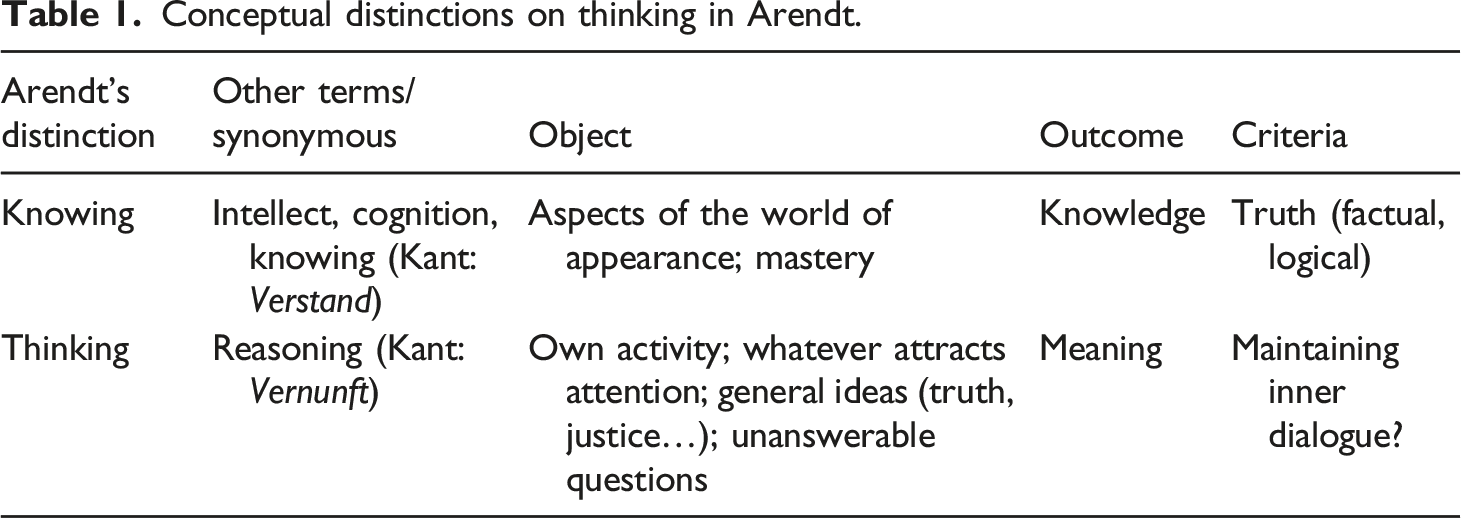
This point is important to underlie, as many philosophers, including Kant, tried to ascribe other forms of truth to other activities of mind than knowing – which Arendt sees a fallacy. Indeed, if one considers seriously the specificity of the second mental activity that is thinking, one must admit that it will never be oriented toward truth.
In contrast to knowing, oriented toward truth, thinking is a quest for meaning 2 ; and meaning cannot be true or false. Thinking as meaning making, which she mostly calls reasoning, has no aim but itself. In her characterization of the objects of thinking, Arendt moves across the volume between the general and the particular. On the one hand, thinking addresses ‘unanswerable questions’ (Arendt, 1978, p. 62) and issues ‘such as truth, justice, and beauty’ (Arendt, 1978, p. 84), and it ‘deals with the invisibles in all experience and always tends to generalize’ (Arendt, 1978, p. 213). On the other hand, it addresses deeds or the thought in which each of us is engaged in our daily lives: ‘the activity of thinking as such [is] the habit of examining whatever happens to come to pass or to attract attention, regardless of results and specific content’ (Arendt, 1978, p. 4). Thinking is thus not the privilege of ‘professional thinkers’. It is a process in which we all engage when we step out of the flow of activities, and reflect upon them: ‘thinking (…) interrupts any doing, any ordinary activities, no matter what they happen to be. All thinking demands a stop-and-think’ (Arendt, 1978, p. 78). Or even more: ‘Practically, thinking means that each time you are confronted with some difficulty in life you have to make up your mind anew’ (Arendt, 1978, p. 177). These points thus suggest that, unlike knowing which is triggered by some curiosity we have about the world, by our desire to master it, or the wish to ameliorate our practical lives, thinking is triggered by our own activities, whether initiated by ourselves or by others, and the need we may have to understand what they mean in more general terms: thinking demands a halt, a rupture or a gap to be triggered, before eventually carrying on.
In that sense, for Arendt, thinking has no need to have results: the meanings thinking produces are only temporary, and can, and always need, to be questioned again. And so, contrarily to knowing, which can achieve truths that can remain and build progress and societies, ‘the thinking activity on the contrary leaves nothing so tangible behind, and the need to think can therefore never be stilled by the insights of “wise men”’ (Arendt, 1978, p. 62). So, what would be the criteria of an acceptable meaning? Although Arendt does not mention it explicitly, it seems dependent on the fact that it maintains the movement of thinking alive, which, as we will see below, depends on inner dialogue.
In any case, the process of meaning making seems vital, both for each person and for humankind: if [men] were ever to lose the appetite for meaning we call thinking and cease to ask unanswerable questions, they would lose not only the ability to produce those thought-things that we call work of art but also the capacity to ask all the answerable questions upon which every civilization is founded (Arendt, 1978, p. 62).
Thinking is also indispensable as safeguard to our other activities, including knowing: it is fundamental for scientists to question the meaning of their findings; otherwise they rely on common sense, which ‘lacks the safeguards inherent in sheer thinking, namely, thinking’s critical capacity, which, as we shall see, harbors within itself a highly self-destructive tendency’ (Arendt, 1978, p. 56). Without thinking, scientists could see products of their work used for unacceptable aims; without thinking, and question the meaning of things, we could be brought to obey and follow any new rules or societal organization offered to us by any political leader – and Arendt here alludes explicitly to people’s uncritical admission of the Nazi rule in Germany or the Stalinists one in Russia (Arendt, 1978, p. 177). Hence, thinking appears here as ethical safeguard. This proposition of a distinction between thinking as reasoning and intellectual knowing is the most radical one proposed by Arendt, and the most intriguing for psychology, and I will come back to it.
Thinking and withdrawal
Because thinking as meaning making demands us to step out of the flow of activity, it may thus appear to be separated from action or from our engagement with the world. It demands a form of withdrawal, or what psychologist would call a form of distancing. So, ‘where are we when we think’, asks Arendt? To answer this question, Arendt proposes a metaphysical inversion: against philosophers who have long seen as primacy the life of ideas, and considered the world of appearances a world of illusion beyond which we should intent, Arendt starts by grounding the undeniable primacy of what is in the world, and which is given to our senses. Drawing on the work of a Swiss biologist and zoologist, Adolf Portmann, she thus defends the primacy of appearances: for most living organisms, what matters is what is given to perception, such as the beautiful and unique feathers of a bird, not what is hidden, which is ugly and common, such as its entrails. It is also the primacy of appearances to which we are exposed through or five senses; as these usually converge, and as other people tend to agree on our perception of what is, we develop our ‘common sense’, ‘sixth sense’, or ‘sensation of reality’ (Arendt, 1978, p. 50).
So where does thinking occur? Arendt first examines the relation between common sense, or inner sense, and thinking: both are invisible and located in the ‘brain’; yet they deeply differ. Common sense is given to us in our relation to the real; it is natural and spontaneous; and it cannot question itself. Thinking, at the contrary, can doubt common sense, our relation to reality (and itself): ‘when thinking withdraws from the world of appearances, it withdraws from the sensorily given and hence also from the feeling of realness, given by common sense’ (Arendt, 1978, p. 52). Thinking is thus characterized by its withdrawing, a suspension from the real, known to others as it is visible through the absent-mindedness ‘to be observed in anyone who happens to be absorbed in no matter what sort of thought. (…) The loss of common sense (…) happens to everybody who ever reflects on something; it only happens more often to professional thinkers’ (Arendt, 1978, p. 53).
With this, Arendt has established the basis of her equation: the world is given through appearances because we relate with it and others in specific contexts, we establish it as real, through our common sense; yet, every time we are confronted with a difficulty, we stop-and-think, and can temporarily withdraw from this reality in order to think. But how do we withdraw from the world, what are the processes involved in distancing oneself from it?
Psychologists have long been interested by this capacity by which we may separate our thoughts from our activity; it may be that schema become abstracted and differentiated (Piaget, 1952, 1999), or that we use complex semiotic mediation, including verbal language, to achieve such distancing (Valsiner, 2014; 2019; Vygotsky, 1986; Zavershneva & van der Veer, 2018). For Arendt, distancing requires a combination of imagination, language and metaphors.
Thinking and imagination
If we withdraw from the environment, how can then thinking enable us to examine whatever we experience? For this, we need imagination, which enables to make present to our mind what we do not experience. ‘In imagination, we de-sense whatever had been given to our senses. And only in this immaterial form can our thinking faculty now begin to concern itself with these data’ (Arendt, 1978, p. 87). Imagination is not only about having ‘images’ in mind; it is about re-presenting what is absent to our senses (Arendt, 1978, p. 76). And thus, imagination, as The mind’s faculty of making present what is absent [,] is of course by no means restricted to mental images of absent objects; memory quite generally stores, and holds at the disposition of recollection, whatever is no more, and the will anticipates what the future may bring but is not yet. (Arendt, 1978, p. 76).
Hence, imagination demands a double movement: first, to de-sensorialise experience, that is, to withdraw, or distance, from immediate experience; and second, to make present to mind experiences from the past or the future. Imagination is for Arendt more than simple reproduction, it is a creative imagination (which is one specific option in philosophy (Zittoun et al., 2020)). Imagination is thus a necessary preparatory process for thinking. For everybody, imagination seems to be the core movement of mind, which then will be the basis of judgement of the past and willing the future (see papers by Cabra, this issue; Marková, this issue;). For ‘professional thinkers’, that is, philosophers, experience de-sensed through imagination can then become ‘thought-objects’ (Arendt, 1978, p. 77), thanks to which they can engage in thinking about things that have never and will never be directly experienced: these thought-objects come into being only when the mind actively and deliberately remembers, recollects and selects from the storehouse of memory whatever arouses its interest sufficiently to induce concentration; in these operations the mind learns how to deal with things that are absent and prepares itself to “go further”; toward the understanding of things that are always absent, that cannot be remembered because they were never present to sense experience (Arendt, 1978, p. 77).
Non-philosophers can also withdraw from the world of experience and engage in thinking and search for meaning through imagination; they also would use more abstract terms to think, even though it may take different forms that the philosophers’ – they may then tell stories or write poems. ‘For thinking, then, though not for philosophy, technically speaking, withdrawal from the world of appearances is the only essential precondition’ (Arendt, 1978, p. 78).
Hence, although we may not follow Arendt on the idea of the ‘storehouse of memory’, a metaphor not valid since we know the dynamic and reconstructive nature of memory (Boyer & Wertsch, 2009; Danziger, 2008; Wagoner, 2018), it is important to identify the role of imagination in Arendt’s theory of thinking: it is a fundamental process enabling to take distance from immediate sensory experience, so as to move through past and future; it is the precondition for more abstract thinking and thus making meaning of ‘unanswerable questions’, whether in philosophical terms or through the stories we tell.
Thinking and metaphor and language
But then, what is the vehicle for imagination and thinking, how can these thought-objects come to mind? For this, we need language: In all such reflecting activities men move outside the world of appearances and use a language filled with abstract words which, of course, had long been part and parcel of everyday speech before they became the special currency of philosophy (Arendt, 1978, p. 78).
Arendt thus has to develop a theory of language in relation to thinking, in which she will confer a special status to metaphors. Mental activities, which are invisible, need words to become visible to ourselves. Words are ‘carriers of meaning’; we use them to ‘appropriate’ the world and make it thinkable (Arendt, 1978, pp. 99–100). Language is thus apt to capture experiences from our contact with the world, our common sense. However, there is a problem when it comes to thinking: ‘no language has a readymade vocabulary for the needs of mental activity; they all borrow their vocabulary from words originally meant to correspond either to sense experience or to other experiences of ordinary life’ (Arendt, 1978, p. 102). To accede to ideas disconnected from common sense, to ideas and concepts designating things which are invisible and beyond appearances, we use metaphors: The metaphor provides the “abstract”, imageless thought with an intuition drawn from the world of appearances whose function it is “to establish the reality of our concepts” (Kant) and thus undo, as it were, the withdrawal from the world of appearances that is the precondition of mental activities (Arendt, 1978, p. 103).
Indeed, the metaphor, which is based on analogies, enables us to move from the world of phenomenon to the world of ideas and back, ‘the transition’ from one existential state to another (p. 103), or ‘its turning the mind back to the sensory world in order to illuminate the mind’s non-sensory experiences for which there are no words in any language’ (Arendt, 1978, p. 106).
This has surprising implications; for if thinking through metaphors is the only way we can apprehend invisible ideas, then is some ways, these bring in a bit of the world of appearances, a bit of embodiment, in thinking. Even more, metaphors ‘guarantee the unity of human experience’ (Arendt, 1978, p. 109) even when it seems disconnected from the world. The power of metaphor for thinking thus becomes an argument against dualism (mind-body) and toward monism: Language, by lending itself to metaphorical usage, enables us to think, that is, to have traffic with non-sensory matters, because it permits a carrying-over, metapherein, of our sense experiences. There are not two worlds because metaphor unites them (Arendt, 1978, p. 110).
Of course, metaphors have limits. First, they can introduce fallacies in thinking, as their power of conviction can elude the need to support reflection with further explanation or proof, leading to unsound speculation or ‘pseudo-science’ (and Arendt here criticizes, without mentioning Freud, the ‘iceberg’ metaphor of the unconscious (Arendt, 1978, p. 113)). Second, and more importantly here, metaphors have limits: there are some intuitions they cannot capture. Arendt thus shows how the ‘great philosophers’ – Plato, Aristotle, Wittgenstein, Nietzsche, Heidegger – all used metaphors in their attempt to capture thinking; yet, they all at some point failed, as language did not allow them capturing their ultimate intuition – there is something ineffable about thinking. For Arendt, the core of thinking escapes language, because its main characteristic is that it is a process, a movement. If thinking is in the movement, and can never achieve its goal, then any attempt to translate this into written language loses the very core of thinking. In other words, the chief difficulty here seems to be that for thinking itself (…) there exists no metaphor that could plausibly illuminate this special activity of the mind, in which something invisible within us deals with the invisibles of the world. (…) Thinking is out of order because the quest for meaning produces no end result that will survive the activity, that will make sense after the activity has come to its end. (…). The only possible metaphor one may conceive of for the life of the mind is the sensation of being alive. Without the breath of life the human body is a corpse; without thinking the human mind is dead. (Arendt, 1978, p. 123).
This is a very interesting idea, that the experience of thinking is an activity, a living movement, a breath 3 . How can then Arendt specify this further? There are two aspects qualifying the living nature of thinking: first, thinking is a form of dialogue, and second, thinking has to be understood as a temporal phenomenon.
Thinking as inner dialogue
To capture the movement of thinking, Arendt questions again ‘what makes us think’ – we have evoked the question of the difficulty, or the need to stop; but what makes the movement of thinking? As she often does in the Life of the Mind when she addresses a new question, Arendt engages in her genealogic enquiry and looks for answers in classical philosophy. According to her reading, if Roman thinkers used to consider that one engages in thinking to escape a hostile world, the Greeks at the contrary considered that they were brought to thinking by wonder: what sets men wondering is something familiar and yet normally invisible, and something men are forced to admire. The wonder that is the starting-point of thinking is neither puzzlement nor surprise nor perplexity; it is an admiring wonder (Arendt, 1978, p. 163).
However, not satisfied with either of these solutions, Arendt turns back to Socrates. Never proposing a positive philosophy, Socrates was defining his role as that of a gadfly, instilling doubt and waking people up from their non-thinking state; as a midwife, bringing life to people’s thinking and purging them from opinions; and as an electric ray, which, through thinking, may paralyse action (Arendt, 1978, pp. 172–173). For Socrates, then, thinking was a movement not to be stopped; it is he who introduced the metaphor of wind to designate the thinking activity (Arendt, 1978, p. 174). Arendt further examines the core of the activity of thinking through her reading of Socrates, until she formulates the idea that thinking demands a form of inner dialogue, which she calls a ‘two-in-one’: Thinking, existentially speaking, is a solitary but not a lonely business; solitude is that human situation in which I keep myself company (…). It is this duality of myself with myself that makes thinking a true activity, in which I am both the one who asks and the one who answers. Thinking can become dialectical and critical because it goes through this questioning and answering process, through the dialogue of dialegesthai, which actually is a “traveling through words”, a poreuesthai dia ton logon, whereby we constantly raise the basic Socratic question: What do you mean when you say … Except that this legein, saying, is soundless and therefore so swift that its dialogical structure is somewhat difficult to detect. (Arendt, 1978, p. 185).
The origin of this inner dialogue has to be found in real dialogues we have experienced in the world, for it is ‘difference and otherness’, which we find in the world around us, that ‘are the very conditions for the existence of man’s mental ego as well, for this ego actually exists only in duality’ (Arendt, 1978, p. 187, p. 187)
4
. Paradoxically, however, when we are with others, engaged in real dialogues, we appear as ‘one’, having an identity: only when we are alone can we experience this inner dialogue, this two-in-one. And thus, solitude is not loneliness (see also Zadeh and Coultas, this issue)
5
: Loneliness comes about when I am alone without being able to split up into the two-in-one, without being able to keep myself company, when, as Jaspers used to say, I am in default of myself (ich bleibe mir aus), or, to put it differently, when I am one and without company (Arendt, 1978, p. 185).
Through this description of thinking as process, life and breath, Arendt turns thinking in an essential feature or our livelihood: Thinking accompanies life and is itself the de-materialized quintessence of being alive; and since life is a process, its quintessence can only lie in the actual thinking process and not in any solid results or specific thoughts. A life without thinking is quite possible; it then fails to develop its own essence – it is not merely meaningless; it is not fully alive. Unthinking men are like sleepwalkers. (Arendt, 1978, p. 191, p. 191)
The metaphor of the sleepwalker is very strong – the person who walks or lives while his mind is asleep to the world; it was the title of the novel of a close friend of Arendt, Hermann Broch, which describes three characters at the turn of the 20th century who live their lives without actually thinking, following a vague sense of what they should do or what other people expect from them (Broch, 1986). This fundamental inner dialogue by which we confer meaning to our activity, in the aftermath or in anticipation, or by which we question other people’s discourses, as well as rules and opinions, is the grounding of our capacity to judge and to define what is right and what is wrong. If thinking – the two-in-one of the soundless dialogue – actualizes the difference within our identity as given in consciousness and thereby results in conscience as its byproduct, then judging, the by-product of the liberating effect of thinking, realizes thinking, makes it manifest in the world of appearances, where I am never alone and always too busy to be able to think. The manifestation of the wind of thought is not knowledge; it is the ability to tell right from wrong, beautiful from ugly. And this, at the rare moments when the stakes are on the table, may indeed prevent catastrophes, at least for the self. (Arendt, 1978, p. 193, p. 193)
Thinking has thus an ethical dimension it is manifested by judgement, the ability to tell right from wrong (see Brinkmann, this issue; Zadeh and Coultas, this issue). In any case, if thinking is a breath, and a dynamic movement, it occurs in time. So how can we qualify the temporality of thinking?
Impermanence of thinking – temporality of thinking
Hannah Arendt’s conception of thinking appears as fundamentally processual and dynamic. First, as we have seen, thinking has no tangible results: even when it produces meaning, it demands always be re-examined; it demands to un-wave what it has woven. Second, the core of thinking is a two-in-one, an inner dialogue which, like a breath, is a never ending living movement. In other words, thinking is both impermanent, yet necessarily needs to unfold, as dynamic, in time. How then to qualify the temporality of thinking?
In the demonstration of The Life of Mind, Arendt considers thinking in time as an alternative to the question of ‘where are we when we think’: as it was left without satisfying answers, she proposes to move away from a spatial metaphor of thinking, to a temporal metaphor
6
. In order to define the temporality of thinking, Arendt first draws on a novel by Kafka, which enables her to metaphorically consider thinking as emerging somewhere between the pressing past, and the pull of the future. The thinking person thus creates a gap in the ‘continuously flowing everlasting stream’ of time (Arendt, 1978, p. 205): The gap between past and future opens only in reflection, whose subject matter is what is absent – either what has already disappeared or what has not yet appeared. Reflection draws these absent “regions” into the mind’s presence; from that perspective the activity of thinking can be understood as a fight against time itself (Arendt, 1978, p. 206).
Yet still not satisfied with the spatial metaphors involved in the idea of a gap ‘between’ past and future, or as ‘region’, Arendt rather proposes to emphasize a language of forces: past and future exert their force, coming from an infinite, to the present; because these forces are orthogonal, a resulting force can emerge, pushing toward the infinite – and this is thinking. This, she formulates as follows in Figure 1. Thinking in “the gap between past and future”, Arendt (1978, p. 267).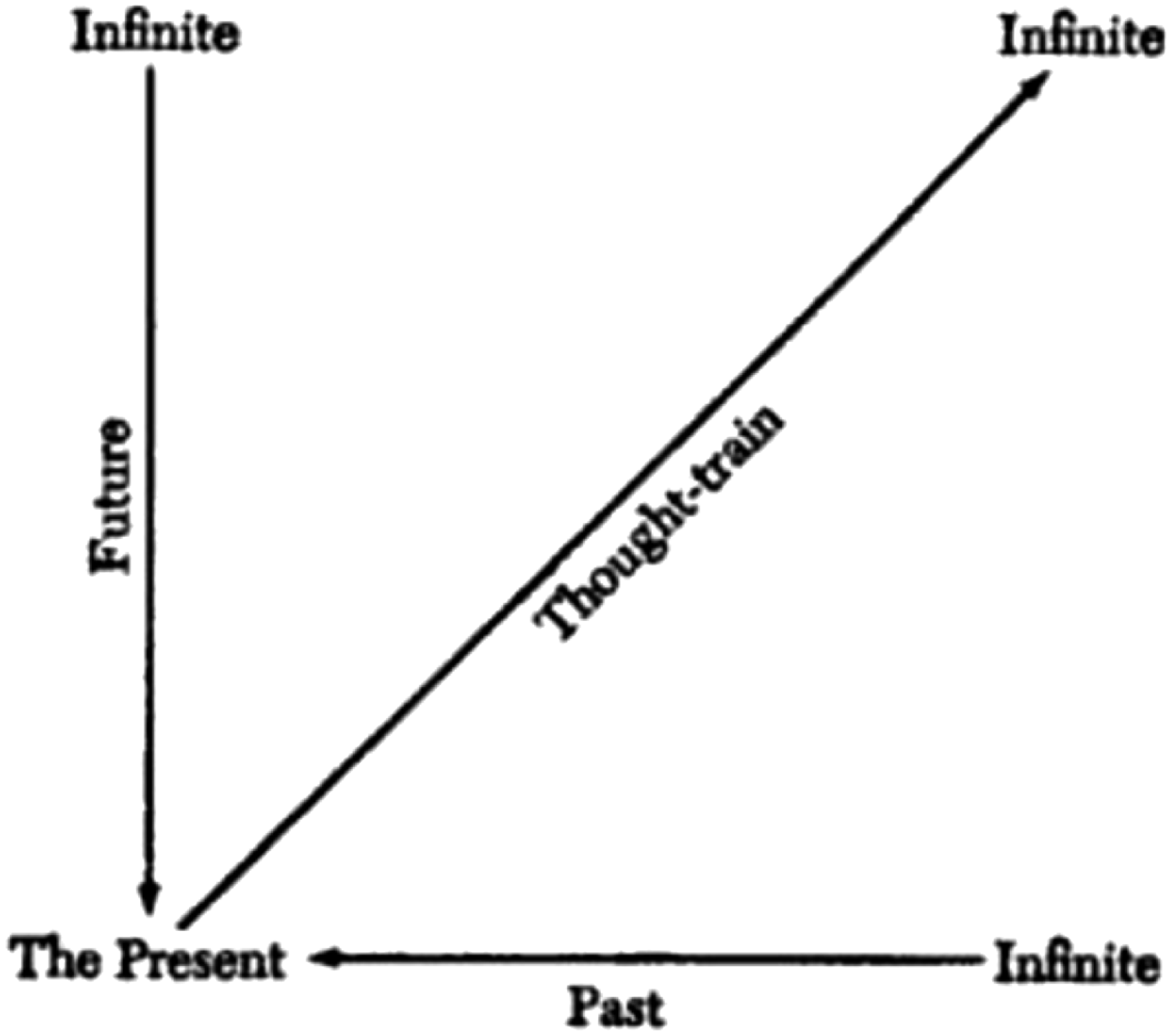
On this diagonal toward infinite, the thinker escapes to the pressures of past and future, and he or she can find a form of peace: In this gap between past and future, we find our place in time when we think, that is, when we are sufficiently removed from past and future to be relied on to find out their meaning, to assume the position of “umpire”, of arbiter and judge over the manifold, never-ending affairs of human existence in the world, never arriving at a final solution to their riddles but ready with ever-new answers to the question of what It may be all about. (1978, pp. 209–210).
And thus, thinking is not only ‘out of order’, it is also ‘out of time’. Although it is tending toward the infinity, it is everlasting and passing, and it only exists as impermanent activity. In that sense, we can never rely on past thinking, and the only way to learn about thinking, is to rediscover the movement of thinking for oneself, to experience it. But then, if thinking is a dynamic, and if attempts to write it down always destroy it, can we never rely on other people’s writing? Pushed here to a difficult implication of her stance, Arendt proposes two answers: across time, people can recognize that other authors had experiences comparable to them – such as her own recognition of Socrates, Kant and many others; and second, perhaps, we can still leave traces of our activity of thinking, to be found by others. Quoting two poems, one by Shakespeare, the other by W. H. Auden, evoking the beautiful fragments of a past long gone, Arendt thus hopes that some of her own work may leave comparable traces that critical readers may preserve: If some of my listeners or readers should be tempted to try their luck at the technique of dismantling, let them be careful not to destroy the “rich and strange,” the “coral” and the “pearls,” which can probably be saved only as fragments (Arendt, 1978, p. 212).
Hence, in her attempt to define thinking as process, Arendt finds herself in a difficult situation: the temporality of thinking seems to escape so much to the pressure of mundane time, it may so much be experienced, as we withdraw from the world, as form of ‘other temporality’, that she is brought to formulate a temporality of thinking which seems to point to a form of eternity, or at least, a form of different temporality that connects thinking fellows across time and space. This statement has two implications: on the one hand, it excludes any grand theory of meaning, as thinking is always evanescent. On the other hand, there is something fundamentally melancholic about this statement. By acknowledging the impermanence of meaning, Arendt has to recognize that her own lifework as thinker may vanish as ashes blown by the wind; as only consolation, she can point at some meeting point, beyond time, between her intuitions and these of past authors and hope that some other thinkers or readers may equally recognize the beauty of some aspects of her work.
As psychologists, we may perhaps see this as a form of recognition of the circulation of meaning through generations; but more interestingly, it raises the question of the experienced temporality of thinking – which may indeed escape objective time.
Dialoguing with Arendt’s views on thinking
So far I have retraced Hana Arendt’s understanding of thinking, developed both through her own practice and experience, and through philosophical reflection, in dialogue with philosophers and scientists. But why and how is this reflection useful for psychology? In particular, why enter in dialogue with Arendt, when she herself believed that the enterprise of psychology was of no interest? It is worth examining Arendt because she proposes answers to questions at the core of psychology and especially cultural psychology.
Epistemologically, the fact that Arendt shared some assumptions with cultural psychology facilitates this dialogue (Cornish et al., 2007; Rosa & Valsiner, 2018). First, as is assumed by cultural psychology, Arendt seems to admit the irreversibility of time, an idea she has from classical philosophy, Hegel or Bergson – perhaps also from Whitehead, whom she quotes on a different point. By this, she admits both the distinction between ‘objective’ time and experienced time, and the fact that the latter involves a past for always gone, and a future in the making – hence setting the condition of our human finitude (Arendt, 1978, p. 202).
Second, her political philosophy commitment also brings her to consider people as part of society, a community, and she is aware of the fact that we can think ourselves, or think at all, only through our interactions with others and the world. Finally, she admits the mediated nature of thinking, as her deep reflection on the language and metaphors revels, in a way which is compatible with psychology. Her understanding of language is close to that proposed by Vygotsky (Vygotsky, 1986) and now largely demonstrated in clinical (Green, 2011) as well as in developmental psychology (Nelson, 1996, 2007). The role of embodied metaphors in thinking (Lakoff & Johnson, 1980; Ricoeur, 2003) and especially in theoretical development has also largely been explored (Campill & Valsiner, 2021; Christensen & Wagoner, 2015; Danziger, 2008; Leary, 1994; Zittoun, 2021; Zittoun & Gillespie, 2020). In addition, it is worth underlying that Arendt’s understanding of imagination as process that enables us to make present to mind what is absent, and especially, in the past, the future or the possible, is surprisingly comparable to our recent attempts to redefine imagination on the basis of Vygotsky’s intuitions (Vygotsky, 1994, 2004; Zittoun et al., 2020; Zittoun & Gillespie, 2016; Zittoun & Glăveanu, 2018). So, if Arendt seems to be such a good companion to cultural psychologists, what can we learn from her reflection on thinking?
First, it is interesting to come back to Arendt’s apprehension of the movement of thought. Thinking is both something that is fed with and through dialogue with others, yet practiced as inner dialogue in solitude, once one withdraws from the world. For this, one has to suspend action – or more precisely, ‘stop and think’, triggered by any form of anomaly in the course of things, and foremost, to question the sense and meaning of experience. In psychology, as in philosophy as reported by Arendt, authors have tried to qualify that experience of rupture: is it actually experienced as anxiety, thinking then being a response to such anxious experience of lack (Baldacci, 2015), or rather, is what triggers experience positive, as in the case of wonder (Glăveanu, 2020)? As we have seen, Arendt objects to the idea that wonder may trigger thinking; for her it paralyses thinking (Arendt, 2005, p. 988). In cultural psychology, the idea is usually that thinking is triggered by anything which questions the taken for granted or usual expectations – an irritation (Dewey, 1896), a resistance from the world (Piaget, 1952), an opposition from others now internalized (Bell et al., 1985; Zittoun et al., 1997), or more generally, an experience of rupture (Valsiner, 2020a, 2021; Zittoun et al., 2003). What is interesting and new is that the idea of ‘stop and think’ proposed by Arendt is not only caused by an event or an experience in the world; rather, it should be a voluntarily disengagement from the world. Thinking is a practice, requiring a deliberate movement of stepping out, of withdrawal from the normal flow of time – out of order, out of time. In that sense, it suggests, thinking needs to be cultivated: only these that find the space and time to think out of the rush of events may make sense of their action and the world. This may invite psychology to redefine thinking as an activity: if it is a deliberate practice, we can create the conditions for it to happen, we can learn to be active in our capacity to stop and think.
Second, cultural psychology as developmental science admits the irreversibility of time (Valsiner, 2002). Thinking, in that sense, takes place in time, even though it may imply a changing sense of time – an infinite short instant or an experience extending into duration (Bergson, 1938; Zittoun et al., 2013). Arendt proposes a controversial idea: thinking extracts us from this duration; stuck between past and future, it opens a different temporality, one in which experientially we are out of time – as we have seen with her ‘diagonal’ metaphor, in which thinking opens a radical new dimension escaping the tension between past and future. In thinking, Arendt writes, ‘the me that thinks is ageless; for the experience of thinking time does not exist’ (June 1968) (Arendt, 2005, p. 880). In other words, during the experience of thinking, our subjective experience of time is independent from the constraints of objective physical time – its usual direction and speed (we age, past has gone, we die). This is how we can, on the one hand, be ‘ageless’ as we think, and on the other, think liberated from the directionality of time: our mind can freely move across history, back and forward. In that second sense, the experience of thinking may share some characteristics with daydreaming and dreaming, which do indeed escape the linearity of physical time (Freud, 1940, 2001; Green, 2000a, 2000b; Zittoun & Cabra, 2020). The fact that thinking escapes the irreversibility of time has two consequences. On the one hand, thinking enables Arendt to meet in dialogue authors long past as if they were her contemporary friends – she thus tries to understand Plato and Socrates, and argues with them, as if they were there. On the other hand, her Thinking diary also shows how Arendt can remain ‘the same’ thinker through time; 20 years apart, she comes back to ideas long opened, and continues a conversation with herself as if today. Hence, the practice of thinking escapes the irreversibility of time. This, perhaps, could inspire theorising in cultural psychology: on the one side, it opens interesting avenues to reflect on the subjective sense of time in the course of life, distinct from physical time, and especially in ageing; on the other hand, beyond the illusion of progress of psychological science, and the awareness of the historico-cultural context of mind, it may invite us to examine theoretical ideas about humans and mind which maintain their validity over time. At times, we learn more by dialoguing with past thinkers and psychologists (Valsiner, 2007, 2012, 2020b) than by re-inventing the wheel.
The third and central point I wish to highlight is Arendt’s contribution to the understanding of thinking for psychologists. Psychology has as an object the psyche, and it has, with the exception of psychoanalysis (Freud, 1940), focused on the conscious part of the individual psyche. Consequently, in psychology, thinking mostly designates rational, logical, problem solving, or hypothetico-deductive thinking; it is what enables us to understand and predict the course of things, to make rational decisions, and to act in the world (Baltes et al., 2006; Piaget, 1952, 1972; Robertson, 2020) (see also Brinkmann, this issue). Other forms of thinking have long been considered as biases, or doubtful common sense (Moscovici, 1993; Tversky & Kahneman, 2018). When the relationship between rational and other forms of thinking has been addressed, it is often in terms of their end-product – what sorts of knowledge are produced (e.g., Jodelet, 2013, 2015). A few psychologists have explored alternatives to individualistic, rational thinking: Ivana Marková has differentiated ‘dialogical rationality’ from individualistic rationality (Marková, 2009, 2016); Jerome Bruner distinguished two forms of thinking, one paradigmatic or scientific one, from another, aiming at render experience meaningful; yet, he then reduced the latter to narrative thinking (Bruner, 1979, 1990, 2003) 7 . In contrast to cognitive psychology, since the ‘second cognitive revolution’ (Bruner, 1990; Christensen, 2019; Harré, 1992), cultural psychology, dialogical and semiotic orientations in cultural psychology are mostly oriented toward the study of thinking as meaning making or sense-making (Neuman, 2014; Salvatore, 2016; Valsiner, 2014). What seems radically new for psychology in Arendt is the distinction she makes between knowing, and thinking as sense-making in terms of their processes, their intended object, and their truth criteria. All forms of cognitive knowing are ultimately about the world and aim at truth; thinking as internal dialogue is about our action in the world, our relation to others, and large questions, and can only achieve temporary meaning. I believe that semiotic and dialogical approach would agree with Arendt’s proposition that sense-making is an ongoing process involving inner dialogue; yet, I do not think they always admit that sense-making can never aim at truth. Hence, Arendt’s reflection highlights two problems in psychology. On the one hand, it invites semiotic and dialogical psychologists to make more explicit the relation between the sorts of sense-making processes they study, and other forms of thinking, especially rational ones. On the other hand, it emphasises the ethical implications of the activity of thinking. It thus invite to question approaches in psychology that suggest that people may find ‘their truth’, or general answers – any illusion that readymade meaning could lead people’s lives. From Arendt’s perspective, this is but an illusion, and can only bring people to a form of sleepwalking, if not morally dangerous action. It indeed dispenses people to keep examining the sense of their actions, and to reflect on their implications; it dissolves ethical responsibility.
Finally, reading Hannah Arendt’s reflection on thinking, the synthesis of a lifelong reflection, now addressed to the audience of conferences and a future readership, one can only be struck by her deep engagement in her practice of thinking. Mary McCarthy, her long-term friend and editor, wrote in a short obituary: Hannah is the only person I ever watched think. She lay motionless on a sofa or a day-bed, arms folded behind her head, eyes shut but occasionally open to stare upward. This lasted – I don’t know – from ten minutes to half an hour. Everyone tiptoed past if we had to come into the room in which she lay oblivious. (McCarthy, 1976)
Hannah Arendt is someone who withdrew from the world when she was thinking; and we now have a sense of where she went when she did so. And so, it appears, thinking may be a demanding activity, it may be directed at difficult questions, and have important ethical implications. Yet, foremost it remains a movement, a dialogue with friends and within oneself, a breath and a pleasure. Experiencing thinking is the invigorating experience of being fully alive; and this, perhaps, is the deepest lesson we, psychologists, can learn from Hannah Arendt.
Footnotes
Declaration of Conflicting Interests
The author(s) declared no potential conflicts of interest with respect to the research, authorship, and/or publication of this article.
Funding
The author(s) received no financial support for the research, authorship, and/or publication of this article.
