







Abstract
Contrary to common sense and the heteronormative thought that “man is born a man” and “woman is born a woman”, the construction of a gender/sexual identity can be seen as an intensely dynamic process involving the internalization and externalization of collective and individual meanings, enclosing a crucial importance for the development of subjects. The present article addresses the issue from a dialogical and Semiotic Cultural Psychology approaches, in their relationship with other theoretical discussions concerning the subject of gender/sexual identity processes. Numerous are the debates about gender/sexual identities in present-day sociocultural contexts, but the topic requires a systemic, all-inclusive analysis of sociocultural structures, practices, and the dynamics between micro, meso and macro cultural levels, in interaction with the active role of subjectivity. We then propose a new construct within the framework of a Dialogical Self Theoretical approach designated as Irradiating Self Positioning, to better explain the power of gender/sexual dimensions within the Dialogical Self. Knowledge so constructed may contribute to making sense of developmental issues concerning the subject, and this may support the full acceptance of sexual and gender diversities in our societies.
Issues concerning gender, self, sexuality, identity, and development are necessarily complex and dynamic, and should be approached from a systemic perspective (Lerner, 2006; Thelen & Smith, 1994). According to Lerner (2006), a systemic approach is grounded on three major principles: (1) multi-level integrative organization of different psychological processes; (2) interdependency of a plurality of factors contributing to human development regulation throughout ontogeny; and (3) the intertwined nature of the mutual constitution between the individual and her/his contexts, which takes place according to parameters of temporality and plasticity. The present article assumes this systemic and processual perspective as it adopts a Semiotic Cultural Psychology theoretical approach (Tateo & Marsico, 2018; Valsiner, 2014, 2021), in articulation with Dialogical Self Theory (Hermans, 2001, 2018). The combination of both theories—Semiotic Cultural Approach and Dialogical Self Theory—allows for constructing a broader theoretical elaboration on the coconstruction of gender and sexual identity issues along ontogenesis, highlighting the intertwined nature of self-development and the dynamics of individual’s active internalizations of historically and culturally engendered social attributions and expectations about the meanings of femininity and masculinity. Both theories, being interconnected, provide researchers with a new and fruitful basis for analyzing individuals’ gender/sexual identities throughout their life course.
Possible articulations between Cultural Psychology, Dialogical Self Theory and gender studies have been elaborated and investigated in the context of our Laboratory of Cultural Psychology at the University of Brasília (Branco, 2021; Madureira & Branco, 2007; Monteiro, 1998). Here it is worth mentioning the work by Borgatti (2022), and Borgatti and Lopes de Oliveira (2023), also from our Laboratory, which addressed the transversality of gender in the Dialogical Self system, and particularly inspired this article. The coconstruction of the Self is a dialogical phenomenon occurring as the person develops vis-á-vis interactions with social others (alterity) (Hermans, 2001, 2018; Marková, 2017) within cultural-historical contexts. Such interactions weave together affective-semiotic materials found in social relations in those cultural contexts within which people live their experiences. As the person’s ontogeny progresses, certain practices and meanings are actively internalized by the subject (Branco, 2016), mobilizing feelings, ideas, and reflexive thoughts about who s/he is and who are others (Silva, 2014). Body and biology intimately interact with cultural canalization processes (Branco et al., 2020) infused with affective semiosis to give rise to value-laden conceptualizations of what it means to be a man or a woman, mostly in accordance with a binary logic historically and culturally cultivated and applied to human beings. Gender issues are redundantly marked by dichotomous framework, norms and regulations directed to constrain individuals to develop according to their strict guiding orientations.
However, human beings are active and constructive, and resist such constraints. Individuals are intrinsically complex and diverse, and such diversity can be found in all aspects and dimensions of humanity, including gender and sexuality. Our research question, therefore, is how psychology can contribute to explore and help explaining the ontogenesis of sexual/gender diversity, taking into account the simultaneous operation of multiple, interdependent and dynamic factors intermingled at the basis of this complex phenomena.
The present article aims at proposing new possibilities to make sense of the development of gender identities from a dialogical and Semiotic Cultural Psychology approach, by analyzing processes of internalization/externalization (Valsiner, 2014) of affective-semiotic messages together with the dynamics of positioning and repositioning of the Self, according to the Dialogical Self Theory (Hermans, 2001, 2018). In the first section, we present a brief discussion of sociocultural constructions of gender/sexual identities, including recent research and conceptions of the relations between body, gender, sexuality, and culture mediation. Next, we highlight how Semiotic Cultural Psychology can contribute to issues of gender/sexual development and identity, particularly by emphasizing the role of internalization/externalization processes and hypergeneralized affective-semiotic fields (Branco, 2021; Valsiner, 2021), together with the active and constructive role of the subject regarding her/his own gender/sexual identity development. In the third section, we present the major principles of the Dialogical Self Theory as we build on a novel perspective to make sense of gender/sexuality issues and development. There we introduce and elaborate on the notion of gender/sexuality as an irradiating and all-encompassing I-Position that, despite being considered as a positioning (I-as-a-lesbian, for instance), strongly impregnates all other I-positions –or Self positionings—within the realm of the individual’s Dialogical Self System.
The sociocultural construction of gender/sexual identities
Culture, from a Semiotic Cultural Psychology perspective, encompasses a vast and complex set of systemic relations between practices and affect-laden signs, taking place in specific temporal-spatial contexts that are dynamically structured and in constant movement—characterized by change and relative stability—along irreversible time (Branco, 2021). Culture can also be conceptualized as a system that operates through signs that are created, transformed and eventually deconstructed throughout historical time (Lopes de Oliveira, 2021). Culture is socially constructed—hence the term sociocultural used above. In the literature concerning issues of gender and sexuality, most authors agree on the sociocultural construction of individuals’ identities (Louro, 2019; Preciado, 2014; Zanello, 2018) to the detriment of biological approaches. More recently, though, we can find a growing interest in the investigation of how body, culture and Self participate of gender and sexual identities, being these deconstructed by a Queer theoretical perspective (Anjos & Lima, 2016; Butler, 2018).
According to Parker (1991), patriarchalism—a social system based on cultural practices and values that enforce power relations favoring men—should be understood as an ideological construction. It encompasses a system of social representations that remain strong and active in our societies, despite minor changes occurring along the irreversible time. It is a system that deeply affects the way human beings live and interpret their experiences and relations with others and themselves. Binary definitions of masculinity and femininity, and the way such notions guide human sexuality, are so powerful that they are unconsciously accepted and internalized by people (Parker, 1991). This binary system becomes a sort of foundation for the person’s Self-system, topic to be further elaborated in this article. Meanings and expectations concerning gender and sexuality strongly guide the individual’s sense of Self as a unique, singular being who moves on along life trajectory. In other words, gender and sexuality consist of a basic reference to oneself as an individual, a subject.
Historically, the concept of man/masculinity has been construed in opposition to woman/femininity, a result of the sexual/gender binary system deriving from biology. “Natural” attributions of men should be strength, virility, sexual potency, while women should be seen as fragile and delicate (Parker, 1991). Cultural stereotypes then emerge as generalized beliefs about what means to be a man or a woman from this reductionist perspective (Madureira, 2018). As reported by Zanello (2018), despite all criticisms on gender binarism, Western culture remains intimately binary, and such cultural (and subjective) resistance needs to be addressed and investigated from an interdisciplinary approach. From a Semiotic Cultural Psychology perspective, the roots of such resistances lie in the affective dimension (Wagoner & Brescó de Luna, 2018; Wagoner et al., 2021), which has been poorly addressed or investigated by current sociocultural studies. That is why this dimension is specially highlighted in this article.
According to Zanello (2018), culture is formed by shared patterns of interactions, activities and interpretations, and language consists of its most important cornerstone; it is the “semiotic system that mediates (its) transgenerational reproduction” (p. 31). Therefore, language and all sorts of practices work together to preserve gender stereotypes in history, as in contexts of children’s play, games, music, conversations, movies, soap operas, series, books, jokes, advertisements etc. Many are the collective cultural rituals that constantly remind people of those prejudices and constraints imposed by a binary gender/sexual framework, even though, today, more individuals agentively move to resist to such impositions and find their own way to live their lives, due to some sociocultural support (via minority movements) to do so. However, serious obstacles persist against their struggle for equal rights and social respectability.
Since early childhood, the person learns what is right or wrong for boys and for girls, what they should wear, do, say, think and feel. Girls’ parents pierce their ears, but not their boys’. Girls move within a universe where things are pink, playing with dolls and household miniature items. Boys, on the contrary, play tough with their peers (rough-and-tumble), and are captured by a universe of little cars, trucks, and miniature weapons. Women are expected to be beautiful to later conquer a male partner and are encouraged to play with make-up stuff, while boys are incentivized to engage in wild sports such as football. After all, women should become future caretakers while men should provide his family with material support. This would explain why women are (are they?) more passive and sentimental, while men are (?) bolder and more rational (Madureira, 2018; Obando, 2021).
Biological sexual differences exist for sure, but the way masculinity and femininity are culturally conceived and practiced has no direct or necessary relation to the kind of genitalia a person holds (Obando, 2021). Thus, it is possible to assert that one’s Self and social identities result from social relational backgrounds and affective-semiotic experiences. Social and symbolic processes are, therefore, essential for the construction and development of a person’s gender/sexual identity (Woodward, 2014).
Preciado (2014), in his manifest in favor of a counter-sexual (contrassexual) theory, discusses how the heteronormative culture affects human bodies. According to the author, the very architecture of the body is political, so sex issues are infused with a domination technologies that function to keep the power asymmetry found between genders. The author argues that Bodies recognize themselves not as men or women, but as talking bodies (corpos falantes). They recognize in themselves the possibility to engage in all significant practices, as well as to assume all enunciation positions as subjects that history determined as masculine, feminine or perverse. (Preciado, 2014, p. 21, p. 21)
Gender and sexuality, far from spontaneously arising from each newborn body, in fact reinscribe or re-instruct themselves through constant operations of repetition and recitation of codes (masculine and feminine), socially invested as natural (Haraway, 995; Preciado, 2014). But human beings are diverse, unique, and deviations from social norms do occur. According to Preciado (2014), the word “perverse”, is then applied to those non-normative identities included in the LGBTQIA + spectrum. He claims that all gender/sexual identities that do not conform to the traditional binary classification of men/women, male/female, are considered as antinatural or monstruous. Such injurious classifications are, of course, very problematic, discriminatory, thus demanding for scientific and cultural initiatives to deconstruct prejudices that negatively affect people who are simply diverse from the cultural and historical binary logic.
Donna Haraway (1995) argues that what is meant by “human nature” originates from constant frontiers’ negotiations between humans and animals, body and machine, subject and culture. Gender performances correspond to a language endowed with a historical power guided to legitimize a body as masculine or feminine, punishing all bodies that defy the traditional gender binary system. For the author, sexual/gender identity is the effect of cultural practices upon the body, and not a pre-discursive, instinctive expression of the subject’s physical constitution. Haraway (1995) proposes the concept ‘‘cyborg body’, which can be translated into the way we modify our body, resulting in a ‘cyborg body’ that breaks the dichotomy nature versus culture. Hence, there is no pure nature (biology), and not everything human is purely cultural. Language constitutes us in the same way we are constituted by affection. She argues that humans constitute language and vice versa, along infinite processes. To this, we add the pervasive roles of the body and affectivity in such processes.
In line with the interpretation of Haraway (1995) and Preciado (2014) about body and sexuality, Gomes (2020) proposes that sex can be seen as a discursive production that is part of the processes promoted by Western coloniality. The author elaborates on the notion of ‘speaking bodies’ (corpos falantes) as a way of breaking with the idea of the body as a blank canvas (nature) to which meaning is imprinted through culture. More precisely, according to Gomes (2020) we only have access to bodies as sexed bodies, and the process of assigning sex and creating gender ideals is a discursive process that gains strength within the framework of coloniality. Thereby, body and sex should be understood beyond a simplistic “description of nature or culture”, but as a performative reading. He argues that the speech act of ‘speaking bodies’ constantly produces different meanings concerning what is intended—what results, in our perspective, from the subjects’ active role. To the author, the relationship between speech and body is, then, a troubled and scandalous one, being both consistent and incongruous. In short, speech acts of ‘speaking bodies’ always produce meanings that are different from what was intended (Gomes, 2020).
Stuart Hall (2019) claims that cultures generally embrace a huge diversity of messages, therefore, an immense variety of possible identities are offered in society. Moreover, people process their experiences considering their own role in society, as well as what others attribute to and expect from them and the way they position themselves in relation to the world. According to Gusmão (2003), there is a mutual influence between who the other ‘is’, and who I ‘am’, although this is not a linear, clear-cut process. The recognition of others and self depends on numerous factors, such as one’s place and role in society, to which group one belongs, and how the person positions him/herself in different circumstances. Therefore, social class, race/ethnicity, gender/sexuality do exert a crucial impact over the contextualized development of one’s self-perception and identification.
The personal coconstruction of gender/sexuality
As previously explained, each culture promotes practices and values historically coconstructed by preceding generations through the action of diverse mechanisms that operate simultaneously at macro, meso and micro levels. At a macro level, the general structural functioning and rules of a society canalize specific practices, values, and beliefs in various formats, what also happens at institutional levels (meso level). Within micro contexts, where face-to-face relationships develop, cultural practices and messages explicitly and subtly work to encourage actions and instill values and beliefs compatible to the prevailing dynamics of such contexts. However, especially in contemporary societies, a multitude of values, beliefs, meanings, and rules coexist and proliferate, and it is never easy to single out which ones the individual will identify with. Moreover, many messages are so subtle or tacit that people do not become aware of their existence (Zanello, 2018)—and, consequently, they may have better chances to be internalized.
Heilborn (1999) carried out a research in Rio de Janeiro in which he investigated gender categorizations and sexual preferences of adults along their life trajectories, concluding for the major role of culture in transforming bodies into sexualized entities. Cultural practices, values and beliefs are, therefore, fundamental to forge personal desires and the different ways people prefer to live their sexualities (Bourdieu, 2019; Foucault, 2014, 2020; Heilborn, 1999).
Another matter deserving attention is the fact that the concept of identity itself, in most theories, stands no longer for a single, stable, or fixed characteristics that identify a person or a social group (Sawaia, 2018). Sawaia (2018) argues that identity is presently devised as a cultural construction emerging from a continuous process of meaning-making, deeply articulated with narratives and other discursive structures. Its dynamic, developmental nature, though, does not turn its canalization power less significant, for identitary processes strongly contribute—as do personal values—to the way people interpret the world, deal, or react to others and relate to themselves. As values and prejudices, identity processes also filter information, transform meanings, give rise to certain expectations, and produce positionings concerning almost everything, ultimately creating those Self-positionings, or I-Positions, which configure the person’s Dialogical Self System (Hermans, 2001), concepts to be later analyzed in this article.
Fausto-Sterling (2019) and McEwen (2003) agree that the psychosocial nature of identity development occurs along the person’s movements throughout life—resulting from interactions with different social contexts, such as family, social institutions and cultural settings within which people are inserted in a certain historical period. Therefore, the term identity is used and interpreted in several ways, providing a sense of Self, of being and belonging, sometimes even referring to one’s global identity. Moreover, the authors consider identity as a highly fluid and dynamic process expressed in different aspects or dimensions, such as gender/sexuality and sexual orientation. The last should be interpreted as interdependent embodied dynamic systems that compose a unified whole that plays a crucial role in identity development (Bates et al., 2020; Fausto-Sterling, 2019; McEwen, 2003).
According to Butler (2018), gender should be conceptualized as an inconstant and contextual phenomenon, which does not denote a substantive being “but a relative point of convergence between specific sets of relations, culturally and historically convergent” (p. 29). In this way, the author proposes the idea that gender is an effect, instead of a subject itself. That is, there would be no gender identity behind gender expressions, and identity would therefore be performatively constituted. Butler (2018) stresses the role of language in the social formation of subjectivity and body, and argues that performativity is not a matter of transcendental references, but is temporally situated.
To further elaborate on the dynamics of the intermingled nature of culture, body and subjectivity over gender/sexual identities development, we present next the major contributions of Semiotic Cultural Psychology to its study.
Semiotic cultural psychology and the development gender/sexual identities
Madureira and Bizerril (2021) explain that the cultural psychology approach works against the individualistic perspective adopted by most traditional theories. It derives from Bruner’s cultural psychology (Bruner, 1997), which emphasizes the mutual construction of subject and culture, and the role of meaning-coconstructive processes between human beings. The authors argue that both culture and subjectivity should be conceived as complex interactive systems, reciprocally constituted, within which practices, values and beliefs permeate both individual (subjective) and collective (cultural) spaces, guiding the development of subjects and social contexts. In other words, the individual develops through a dialectical tension identified in her/his relationships with culture. This allows the person to develop in unique ways, despite sharing similar sociocultural contexts with others (Madureira, 2018).
From a semiotic cultural standpoint (Lopes de Oliveira, 2021; Valsiner, 2014, 2021), the way individuals develop in the irreversibility of time occurs throughout their relations and interactions with social others, within historically constructed sociocultural contexts. During ontogenesis, practices, beliefs, and values experienced as meaningful for each subject are actively internalized and participate of the person’s Self-system configuration (Branco, 2016). In turn, the person acts upon culture through processes of externalization. During these dynamics, the wide-spread normalization of a binary gender system has been historically created and culturally incorporated as a powerful regulator of the moral order of most societies. From such binary dynamics, a universe of meanings and social expectations is created for that body, that will then be interpreted and constructed as a man or a woman. Any deviation from this logic is seen as highly problematic.
Masculinities and femininities are produced through toys, use of colors, names, speeches, clothing, expectations, and so on., even before the body comes into the world (Bento, 2008). It is through this process that symbolic boundaries are drawn (Madureira, 2018) to guide and regulate the individual’s life trajectory, favoring of the development of strict boundaries and differentiations between men and women.
According to Semiotic Cultural Psychology (Valsiner, 2021), the internalization of beliefs, values and conceptualizations take place within historical-cultural contexts, understood as a systemic set of interconnected signs and artifacts that participate of cultural and social practices that tend to canalize human experiences and subjectivities in certain directions. As individuals are embedded in cultural contexts, they naturalize those recurrent practices and values in their daily lives, without much critical questioning. Nevertheless, there is no “natural” reality concerning the existence of humans, for culture is the fundamental, inherent condition of being human. In other words, culture provides the person with those affective-semiotic signs that help constituting her/him as a singular subject. However, people also actively participate of their own Self configuration and development (Bruner, 1997; Valsiner, 2014, 2021), and it is exactly this reciprocal constitution between subject and culture that characterizes the Cultural Psychology theoretical approach. The investigation of how internalizations/externalization processes take place, then, can be a fruitful way to reveal the major mechanisms through which the development of sexual/gender identities, as well as sexism, emerge and eventually change along ontogenesis.
Internalization/externalization
During development and Self constructions, a person is exposed to multiple and varied cultural messages that may generate internalization/externalizations of meanings and positionings related, among others, to gender and sexuality. Valsiner (2014) proposes a model to help explain how such processes take place. He suggests the existence of three concentric layers to represent the degree of sensibility, or vulnerability, of the individual concerning messages received from the culture—particularly those mediated by social others. These messages would have the potential—or not—to elicit internalization processes that, eventually, may affect and modify the person’s Self-system configurations. The first layer (Layer I) represents a more superficial domain of the Self-system, the second (Layer II) is closer to the individual’s sense of Self, and the third (Layer III) consists of the core of the Self-system, namely, the very heart of one’s subjectivity. Figure 1 depicts some possibilities regarding the operation of internalization/externalization processes. Internalization/externalization processes (based on Valsiner, 2014).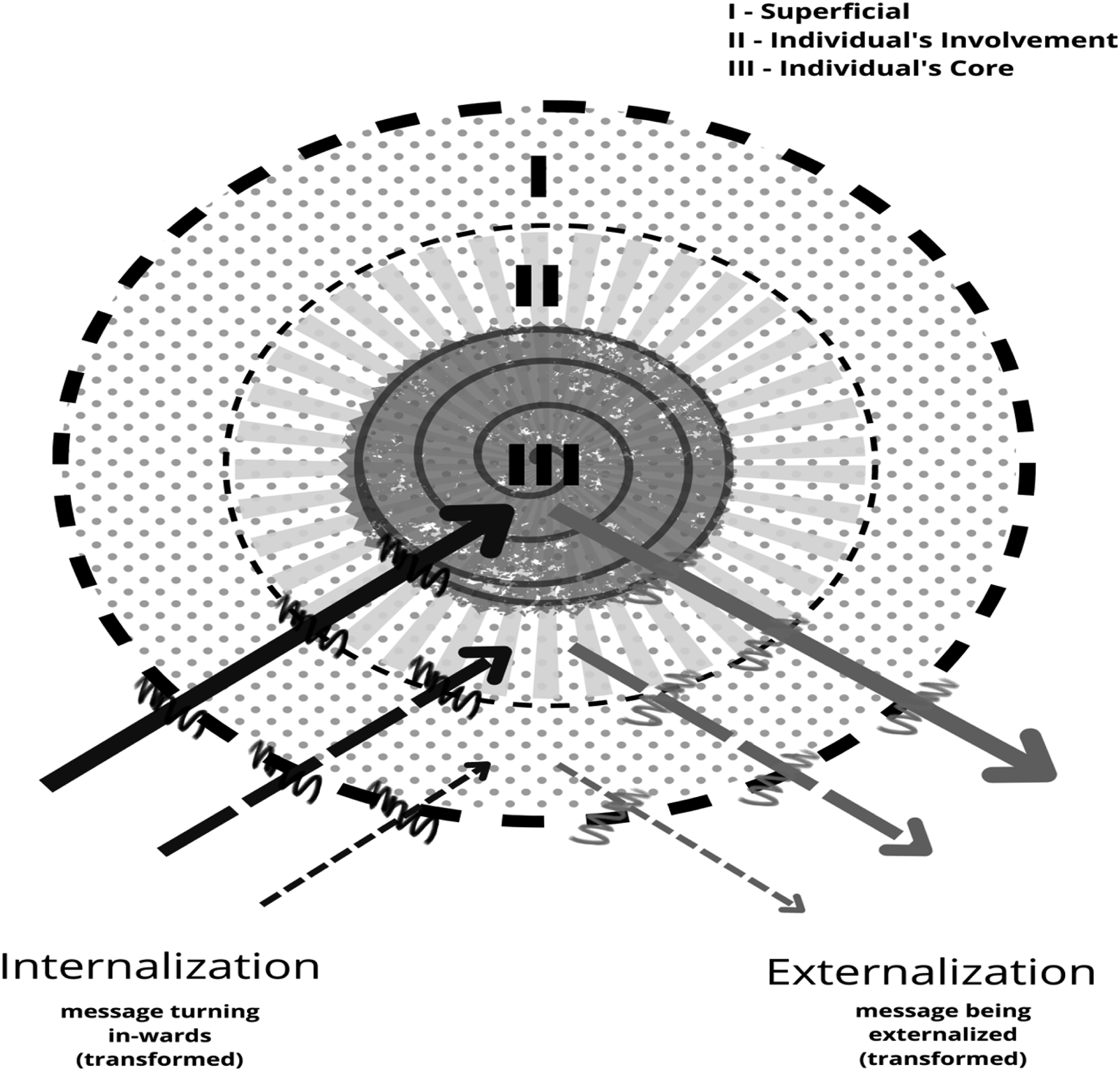
Processes are represented by arrows in Figure 1, and they entail specific social regulatory mechanisms of affective-semiotic nature. In both cases, there is a continuous movement of messages (meanings) from outside in (internalization - I) and inside out (externalization - E), which can penetrate, or not, each of the layers depending on the actual significance (for the person) of the message. Messages are actively transformed by the individual as one internalizes (I) or externalizes (E) specific messages. To our purpose, it is worth explaining what happens when a message succeeds to cross the barriers to Layer III—the individual’s core, where Hypergeneralized Affective-Semiotic fields (Valsiner, 2014) are located. In this case, the message can be either appropriated or rejected. Why so? Layer III is characterized by the presence of post-verbal (beyond words) Hypergeneralized Affective-Semiotic fields - HASF, mostly consisting of values, strong expectations, and possible ingrained fears and prejudices. HASF are progressively constituted along life experiences and provide the basis upon which the Self system develops along ontogeny. Such empowered fields guide the person’s perceptions, feelings, thoughts, and actions (Branco, 2016, 2021), and tend to grant a degree of stability and continuity of Self-development.
An example can illustrate the above elaborations. When a group of High School students informally exchange ideas about liberal sexual experiences and expectations, the incoming messages might operate at Layer I or II (superficial or personal interest layers), and I/E processes can be mostly constrained to these levels for them. Notwithstanding, if there is a teacher in the group who is passionate about the subject—think of a highly religious person—or a non-experienced student, the messages might cross all the way to Layer III, and their reactions or participation in the conversation would be vastly emotional, affect-laden, and impregnated with affectivity. In sum, depending on the content of the messages, they can either trigger an active rejection (as in our example) or acceptance, due to people’s values and prejudices.
Thereby, internalization/externalization processes are central for investigating the construction processes emerging from one’s social experiences. Consider another example: in a house where demonstrations of affection between son and father are not encouraged, even denied/avoided, when the son eventually expresses a little physical affection, the father says “Hey, man, this is a girly thing!”. Such experience may be internalized by the son and externalized in uncountable ways, amongst them sexist and homophobic thoughts, anger, violent behavior against LGBT + or, even, against himself.
The point is, how do some messages end up affecting a certain individual and not others? What gives birth to the subject’s singularity, individuality? From a semiotic cultural perspective, the internalization of feelings and meanings that participate of the person’s identity constructions occur according to the above-described processes, throughout social relationships and subjective preferences emerging from relevant interactions during the life course (deAbreu et al., 2021). Significant others and affectivity play a fundamental role in I/E processes, therefore contributing to individuals’ values and, ultimately, their sense of Self and identity. Hence, they play a crucial role in processes that mobilize the ways individuals position themselves concerning their identification with specific social groups, favoring the development of possible gender/sexual identities. Namely, life experiences generate not just knowledge and feelings in relation to the world, but especially engender self-realizations regarding one’s own positionings, values and sense of belonging. In short, both individual’s social identities (entailing identification with specific social groups) and the configuration of the Self system arise through complex and systemic interactive dynamics between one’s body, mind, and intersubjective experiences (Mascolo, 2016).
Monteiro (1998), while investigating the ontogenesis of gender differences in young children from a Semiotic Cultural Psychology perspective, found in dyads of 3-years-old boys and girls, early preferences and meaning-coconstructions concerning toys they would rather play with. In the experimental design, the researcher provided to the dyads, formed by one boy and one girl, two boxes containing toys typically used either by boys or by girls. The goal was to observe participants’ reactions when they individually received from the researcher the box containing counter-cultural toys. Some boys receiving girls’ toys rejected the box immediately, saying to the researcher “Look, you gave us the wrong box!”. Others showed different degrees of ambivalence and negotiation, and only one dyad simply accepted the given boxes and started playing naturally. Boys, but not girls, corrected the researcher and actively changed the boxes with their partner. One of the boys went further with his rejection, and aggressively expressed verbally and nonverbally his contempt for the girl’s toys, doing it with such an intensity and disdain that the girl felt uncomfortable and asked to leave the experiment! Monteiro (1998), then, concluded that when parents participate in daily activities with their boys and girls, children learn, from an early age, gender meanings that permeate their interactions, internalizing a whole network of meanings related to gender issues that tend to guide their worldviews in the present and in the future. In short, the selection of what is or is not culturally accepted by the micro, meso and macro culture as characteristics of man or women is early experienced during the first years: to boys, trucks, and weapons; to girls, dolls, and miniature jewelry.
However, Semiotic Cultural Psychology does not conceive the subject as a product of the culture: individuals possess agency, and should be regarded as open, complex, and intentionally future-oriented human beings endowed with desires, will, expectations, rationality, goals, and imagination. People act upon canalization processes and constraints provided by culture, due to their agentive and constructive power, the power of their subjectivity. Next, we add, to this cultural perspective, a dialogical Self approach built on the assumptions of the Dialogical Self Theory proposed by Hermans and colleagues (Hermans, 2001, 2018; Hermans & Gieser, 2012; Hermans et al., 2017).
Dialogical self, identities, and gender/sexual issues
According to Kullasepp (2007), different identities such as sexual/gender or ethnic, should not be seen as distinct or separate constructs since they all are dialogically related to the Self. In the Dialogical Self Theory-DST (Hermans, 2001, 2018; Hermans, et al., 2017), all Self positions are in constant relation and dialogue with each other. Our next step is to address the matter of subjectivity, and how it operates concerning the issue at hand by analyzing the contributions of the DST not only regarding the Self, but on issues of gender identities. The central pillar of the Dialogical Self Theory is the conceptualization of Self not as a single integrated unity, but, instead, as a multiplicity of I-Positions (Hermans, 2001), or Dynamic Self Positionings (Branco et al., 2020) that permanently dialogue with each other, either intentionally or not, within a complex and dynamic open system.
The system is formed by the gradual internalization of positionings emerging from relationships established with relevant social others along ontogeny. The result is a Dialogical Self System (DSS) that is configured and constantly develops across irreversible time and cultural contexts. This explains why Semiotic Cultural Psychology and DST approaches are so compatible with each other. Within the system (DSS), Dynamic Self Positionings (DSP) are hierarchically organized since some positionings dominate over others; yet, depending on circumstances such as contexts, interactors or personal dispositions, the hierarchy within the DSS can eventually change. Therefore, the DSS is dynamic and subject to development. What grants the system a relative stability and continuity, though, is the weight of affectivity invested in each positioning, namely, positionings deeply rooted in individual values are, indeed, more powerful, and resistant to change. They are rooted in Hypergeneralized Affective-Semiotic fields (values, prejudices …), previously referred in this article. The affect-laden quality of such powerful Self positionings, then, avoids undesired fluidity or chaos in the DSS. Notwithstanding, even dominant positions, derived from values, may eventually change (transform) and lead to the system development because of specific events, like ruptures, or experiences strong enough to impact the system along the person’s life trajectory (Branco, 2016).
In fewer words, the Dialogical Self System (DSS) is characterized by its dynamicity, openness, and the existence of both centrifugal and centripetal forces that grant the system with the possibility to change and to resist change, keeping a sense of continuity and relative coherence. The question now is, how can one make sense of matters of gender and sexuality in relation to the DSS?
Gender and sexuality in the Dialogical Self System: a fresh perspective
The present elaboration is a perspective grounded on both Semiotic Cultural Psychology and the Dialogical Self Theory, and it emphasizes the central role of historical-cultural practices and values, affective-social relationships with relevant others, and the constructive role of individuals’ subjectivities. To better explain this innovative perspective on sexual/gender identities, it is necessary to acknowledge contributions on the topic by Borgatti (2022; Borgatti & Lopes de Oliveira, 2023), from our Laboratory of Cultural Psychology at the University of Brasilia, concerning possible articulations between both theories, as well as to further elaborate on the concept of identity (Bates et al., 2020; Bussey, 2011; Galinkin & Zauli, 2011; Louro, 2019; Madureira, 2018; McEwen, 2003; Roudinesco, 2022). Depending on the theoretical framework within which the construct of identity is employed, it may refer to a person’s individuality (oneself) or a person’s sense of belonging to a specific group of people in society (social identity). The present approach, though, derives from the need to reconstruct this concept when it denotes subjective dimensions concerning gender and sexuality, and we explain why.
According to Bussey (2011), gender/sexuality might be considered a significant aspect of Self-definition for most people in many societies and cultures. It develops, changes, and is transformed across life span through a combination of social and personal factors. Such factors generate gender-related conducts through motivational and Self-regulatory processes associated with specific gender identities. The author affirms that, over time, gender/sexual roles change through people’s actions, experiences, and affections, affecting not only individuals but, also, social subsystems that play a role in the development and transformation of gender identities within cultural frames.
The Dialogical Self Theory is a fruitful proposal to make sense of issues related to the Self, and, we here underline, to subjectivity. It analyzes how plural social relationships instigate the development of I-Positions (Hermans & Gieser, 2012), construct we have recently redefined as Dynamic Self Positionings-DSP (Branco et al., 2020) to highlight the dynamic and fluid nature of these positions. DSP are in constant dialogue within the Self system. As they dialogue with each other (intrapersonal dialogues) and with social others (interpersonal dialogues), the DSS develops and its configuration changes, with the emergence of new positionings and the transformation or disappearance of others. For example, a married man who never imagined he would ever have any erotic or sexual relation with another man—thus recognizing himself as heterosexual—one day is somehow seduced by a man who instigates him to engage in a homosexual relation. His experience results in being so intensively strong, sexually and affectively significant to him, that from that day on a new gender/sexual I-Positioning emerges and develops.
However, we cannot envision sexuality and gender as consisting of one or more specific positionings dialoging with each other in the system, being separated from other positionings. In fact, sexuality and gender are so profoundly ingrained in the DSS that they strongly participate in the emergence, constitution and operation of all other DSP. That is, sexuality and gender participate in the very foundation of Self, impregnating all DSP in one’s relations and experiences with oneself and the world.
To acknowledge the omnipresence of gender and sexuality in the DSS, then, requires the proposal of a different kind of self-related dimension within the system, for they impact and confer very special qualities to all positionings within the system. Therefore, we propose that gender/sexual positionings operate in a different way within the DSS, and its singular quality should be conceptualized as Irradiating Self Positionings. What would such Irradiating Self Positionings mean?
Irradiating Self Positionings – ISP would be those Self Positionings that exert a special power over all other Self Positionings in the DSS, granting that all positions are imbued of its peculiar quality. Some possible ISP could be those concerning gender and race, for example. It is very unlikely that Self Positionings such as ‘I-as a Teacher”, ‘I-as-a mother” or any others would not be impregnated with core, irradiating positionings such as ‘I-as-a Lesbian”, or ‘I-as-a black woman”. In terms of gender/sexual positionings (yes, they can be plural, and in tension with each other), besides the generation of inner ambivalences—as those resulting from actual doubts concerning the Self—these core positionings are strongly endowed with the powerful irradiation quality of ISPs, therefore impacting the very nature of all other positionings. However, even though ISPs are powerful, they are still dynamic, and susceptible to change in some ways, and such changes, in the case of gender/sexual positionings, would probably require the emergence of other possibilities/positionings regarding sexuality or gender. Among such possibilities are new experiences, doubts, questions and conflicts about one’s preferences and identification issues. In such case, a different ISP would arise, become identifiable, and subsequently exert its power over other positionings by engaging in dialogue with them within the DSS.
The proposal of ISP, elaborated above, opens a new venue to be explored and investigated by granting a particular quality and role to gender and sexuality in the DSS, as it may also prove meaningful to positionings related to race. This could be an interesting contribution by psychology to the necessary transdisciplinary efforts to conceive and understand this specific topic, and we hope that the perspective here presented provides fresh ideas to instigate further research about the matter, as well as about the ontogenesis of other psychological processes imbued with strong affect-laden complexities.
Final remarks
In this article we addressed the possibility of analyzing sexual/gender identity coconstruction from a dialogical and systemic theoretical perspective grounded in Semiotic Cultural Psychology (deAbreu et al., 2018; Valsiner, 2021; Xu & Wu, 2021) and in Dialogical Self Theory (Hermans, 2018). The proposal here elaborated stresses the systemic and complex construction processes involved in gender/sexual identity issues that take place across several and varied experiences during a person’s life trajectory.
Gender/sexual identity does not derive from an instinctive expression of pre-discursive truths about the flesh, but it relates to a cultural inscription of gendered social practices in the human body. Gender binary logic and related dichotomies need to be urgently overcome by comprehending the diversity and complexity of the processes that participate of each person’s Self development, which can be productively addressed by the theories upon which we elaborated our contributions. The very concept of identity demands further critical analysis in order to evaluate its fruitfulness vis-à-vis the multiple factors and systemic processes involved in gender/sexual Self development.
Our perspective reaffirms both the dynamicity and the centrality of sexual/gender “identification” processes, advocating their special power within the DSS. To answer the power of such processes we proposed a new construct, the Irradiating Self Positionings, derived from the Dialogical Self Theory. Gender and sexuality, therefore, do not give rise to specific I-Positions, but undertake a privileged role in the system as it affects all DSS’s multiple positionings. It is worthwhile, however, to stress the idea that other human basic, body-related or highly relevant sociocultural characteristics—such as race/ethnicity, nationality, and others—would also have a potential general (irradiating) role in the DSS, and this certainly demands further research potentially leading to novel theoretical elaborations. The research question would be, How do potent, ingrained feelings of belongingness exert a generalized power over DSS’s various positionings? In this paper, though, we targeted only one such important issue.
Last but not least, we hope that the recognition of the complexities of the topic empowers the arguments in favor of the flexible, diverse, and open-ended quality of the sexual/gender human dimension. This may encourage the demystification of norms stemming from the rigid sexual/gender binary system grounded in biology and traditional cultures throughout history. As a cultural and future-oriented species, it is about time that theorists and people in general face the existence of human diversity and engage in promoting values and practices to foster social inclusion and ethical principles in the cultures and contexts of our societies.
Footnotes
Author’s note
The first author is supported by a doctoral scholarship by CAPES - a governamental funding agency in Brazil. The second author did not receive support from any organization for the submitted work.
Author contributions
All authors contributed to the study conception and design. Material preparation, theoretical analysis and elaborations were performed by Juliane Mesquita Obando and Angela Uchoa Branco.
Declaration of Conflicting Interests
The author(s) declared no potential conflicts of interest with respect to the research, authorship, and/or publication of this article.
Funding
The author(s) received no financial support for the research, authorship, and/or publication of this article.
Correction (November 2023):
This article has been updated with textual changes on page 2 & 12 and added 03 new references to the list since its original publication.
