







Abstract
Occupational health and safety (OHS) governance is not experienced in a culturally neutral way. The meanings workers bring to risk, authority, voice, and institutional protection are shaped by the cultural worlds in which they live and labour, yet this dimension of occupational health has received almost no qualitative attention in the Caribbean and Latin America. This study explored how sugarcane workers in Guyana experience OHS governance and what those experiences reveal about the relationship between culture, working conditions, and psychological wellbeing. Fourteen male workers were recruited through snowball sampling and interviewed by telephone using interpretative phenomenological analysis (IPA). Four master themes emerged: employer accountability experienced as absent; protective standards experienced as inadequate; worker voice experienced as structurally suppressed; and an occupational psychological health burden experienced as unrecognised. Findings indicate that inadequate protection was absorbed rather than contested, silence was communally sustained, and psychological distress was carried privately and without institutional recognition. The cultural world these workers inhabit shaped not only their exposure to governance failures but the very terms on which those failures were lived and made sense of. Culturally grounded approaches to OHS policy and occupational mental health are not supplementary considerations but preconditions of meaningful worker protection.
Introduction
How a worker understands danger, interprets authority, communicates distress, or chooses silence is not simply a matter of individual personality. It is a culturally situated act, shaped by history, social structure, community norms, and the specific relational world in which a person works and lives (Markus & Kitayama, 1991; Shweder, 1991). This insight, central to cultural psychology, has rarely been applied to the domain of occupational health and safety (OHS). The frameworks that govern workplace safety in much of the non-Western world, rooted in industrial models developed in Northern Europe and North America, enshrined in ILO conventions, and reproduced by national legislation, are typically applied as though worker experience were universal (Leka & Jain, 2010; Quinlan & Bohle, 2014). Yet when those frameworks encounter the particular cultural formations of working communities shaped by distinct histories of labour and authority, they may produce something quite different from what was intended: governance systems that exist formally but are experienced by workers as alien, indifferent, or simply not real (Green & Thorogood, 2018; Sarfraz et al., 2022). Understanding this gap, and doing so from within the cultural world of the workers themselves rather than by measuring it from without, is what this study sets out to do.
Guyana makes a particularly instructive case for this kind of inquiry. Its sugar industry carries a cultural history of labour stretching back across centuries of indentureship and agricultural work, and the communities that work in it bring to the workplace norms, expectations, and relational patterns shaped by that history (Daly, 1974; Singh, 2021). At the same time, Guyana is in the midst of one of the most rapid economic transformations in recent Caribbean history, driven by oil revenues that have produced visible national wealth while leaving the conditions of legacy-industry workers largely unchanged (IMF, 2025; Mohabir, 2023). This combination, a deep cultural inheritance of labouring under hierarchical authority alongside a present-day experience of being left outside a national story of progress, creates a specific set of conditions under which OHS governance is experienced and psychological wellbeing is shaped (Benach et al., 2014; Ross, 2012). The present study examines those conditions from the perspectives of the workers living within them, aiming to contribute to culturally grounded occupational health research and to extend the reach of cultural psychology into a community, and a problem, that has received almost no qualitative attention.
Literature Review
Culture, Occupational Experience, and Psychological Wellbeing
The relationship between culture and working life, including how workers experience risk, authority, and wellbeing, has been theorised across cultural psychology, sociology, and organisational studies. A central insight of cultural psychology is that psychological processes, including the perception of risk, the interpretation of authority, and the experience of distress, are not universal but are constituted within and through the meaning systems of particular cultural worlds (Markus & Kitayama, 1991; Shweder, 1991). What a person understands a workplace hazard to be, whose responsibility it is to address, and whether raising it is an available or imaginable act: these are not simply cognitive responses to objective conditions but are shaped by the cultural frameworks through which working life is made sense of. Triandis (1994) drew attention to the significance of collectivist cultural orientations in this regard, noting that the suppression of individual complaint in favour of group cohesion and the preservation of social hierarchy may be deeply internalised norms rather than situational choices. In more hierarchically structured cultural contexts, workers may experience psychological distress as a private matter, feel inhibited from challenging managerial authority even when their own safety judgements conflict with it, and approach the reporting of hazards as a risk rather than a right (Hofstede, 2001; Leka & Jain, 2010).
These cultural dynamics are not incidental to OHS governance; they are woven into it. Zohar (2003) argued that safety climate, the shared perception within a workplace of how much priority is genuinely accorded to safety, is itself culturally mediated. Workers do not simply read signals about organisational commitment to safety and respond accordingly; they interpret those signals through culturally shaped frameworks of authority, reciprocity, and trust. In settings where workers have historically found themselves in subordinate or structurally voiceless positions, the experience of safety governance is likely to be shaped by those accumulated histories in ways that standardised instruments, designed for other cultural contexts, are unlikely to capture (Green & Thorogood, 2018; Quinlan & Bohle, 2014).
The same cultural dynamics that shape how OHS governance is experienced also shape how its psychological consequences are held and understood. What it means to be psychologically well, how distress is expressed, and whether suffering is understood as a private burden or a legitimate social claim are not culturally neutral matters; they vary across cultural contexts in ways that have significant implications for both the experience of occupational harm and the possibility of addressing it (Kleinman, 1988; Leka & Jain, 2010). The dominant frameworks used to study occupational psychological health have been developed predominantly in Western, industrialised settings and do not automatically translate to other cultural contexts. Understanding the psychological health and wellbeing consequences of OHS governance therefore requires a theoretically grounded account of wellbeing alongside an appreciation of the specific cultural conditions that shape how it is experienced, expressed, and addressed in the contexts under study.
Ryff’s (1989) multidimensional model offers a useful conceptual starting point. Rather than equating wellbeing with the absence of distress, Ryff identified six positive dimensions: self-acceptance, positive relations with others, autonomy, environmental mastery, purpose in life, and personal growth. This framework is relevant to the present study because it positions wellbeing not only as a hedonic state but as a function of how effectively a person is able to exercise agency, maintain meaningful relationships, and feel that their life has direction and worth. Workers who experience their conditions as uncontrollable, who are unable to speak about hazards that threaten them, and who carry psychological burdens without any institutional language for their expression may experience impairment across several of these dimensions simultaneously, not as a clinical disorder but as a sustained erosion of the conditions under which flourishing is possible.
Culture shapes both the likelihood and the form of such impairment. Stansfeld & Candy (2006) and Theorell et al. (2015) documented robust associations between adverse psychosocial working conditions, including low control, job insecurity, and poor workplace relationships, and elevated risk of depression, anxiety, and reduced quality of life. These associations are amplified when workers are unable to seek help or name their distress as work-related, a pattern particularly pronounced in cultural contexts where the expression of psychological vulnerability carries social stigma (Bhui, Dinos, & Stansfeld, 2016; Messing & Ostlin, 2006). Leka & Jain (2010) argued that psychosocial hazards, which the World Health Organization (WHO, 2000) defines as aspects of work design and organisation that may cause psychological or physical harm, are among the most consistently underreported occupational health risks globally, partly because they are embedded in the relational and cultural conditions of work rather than in its physical environment, and partly because workers in many settings have no shared cultural framework through which to identify and name them.
Understanding the mechanisms through which adverse working conditions translate into psychological harm helps to specify what is at stake in contexts where cultural factors compound both the exposure and the invisibility of that harm. Karasek’s (1979) demands-control model proposed that the most damaging working conditions combine high job demands with low decision latitude, a configuration associated with elevated risk of anxiety, depression, and physical ill-health (Karasek & Theorell, 1990). Crucially for the present study, the experience of low control is not simply a function of task structure; it is shaped by the cultural meaning of authority and agency within a given working context. In cultural settings where authority is not expected to be challenged and individual agency over working conditions is not experienced as a right, the psychological costs of low control may be compounded by the absence of any cultural framework through which those costs can be named and addressed. Lazarus & Folkman’s (1984) transactional model of stress and coping extends this point: the appraisal of a situation as threatening or manageable is not a purely internal cognitive process but is shaped by the cultural resources and social positions available to the person making that appraisal. Whether a hazardous working condition is experienced as something to be contested or something to be endured depends, in part, on the cultural world in which the worker is situated.
Dollard et al.’s (2019) concept of psychosocial safety climate (PSC) extends this analysis to the organisational level. PSC refers to the shared perceptions of workers regarding the degree to which management prioritises and protects their psychological health. Critically, Dollard et al. demonstrated that PSC functions as a primary organisational resource: where it is high, workers are more likely to seek help, report concerns, and maintain healthy coping strategies; where it is low, the psychological consequences of adverse conditions are compounded by the shared recognition that those conditions will not be addressed. PSC is not, however, a culturally neutral concept. In contexts where authority is experienced as hierarchical and non-negotiable, where individual complaint is socially represented as a threat to collective stability, and where psychological vulnerability is managed privately within family and community systems rather than institutionally, PSC may be structurally low in ways that no organisational intervention alone can address. This is the terrain the present study enters.
Together, this body of work establishes that culture is not a peripheral consideration in understanding occupational health and safety; it is central to how governance is experienced, how psychological harm is produced and held, and whether the conditions under which wellbeing can flourish are present or absent. Yet despite this, OHS research in contexts such as the Caribbean and Latin America has tended to rely on frameworks developed elsewhere, measuring incidence and compliance while leaving largely unexplored the cultural mediations through which workers experience, make sense of, and live within the systems formally designated to protect them. The cultural dimensions of occupational health experience in this region, and their consequences for psychological wellbeing, remain substantially underexamined.
Occupational Health Governance in Structurally Marginalised Settings
The cultural dynamics described in the preceding section do not operate in a vacuum. They are amplified or constrained by the structural conditions under which workers labour: the degree of job security available to them, the power of their collective voice, the resources available to regulatory institutions, and the political and economic priorities that shape how seriously worker protection is taken. Where cultural dispositions toward deference and endurance meet structurally precarious working conditions, the result is not simply an accumulation of separate risks but a compounding dynamic in which each reinforces the other and both are rendered less visible by the very cultural formations that might otherwise make them contestable.
Workers in precarious, low-status positions are particularly exposed to the compounding effects of structural and cultural vulnerability. Mayhew & Quinlan (2002) drew attention to how precarious, low-status employment, historically associated with racialised and structurally marginalised labour markets, tends to generate distinctive patterns of OHS vulnerability, including reduced bargaining power, elevated physical risk exposure, and limited access to legal protections. Benach et al. (2014) situated these dynamics within a broader framework of precarious employment as a social determinant of health, suggesting that the structural conditions from which occupational ill-health tends to emerge are inseparable from the political and economic arrangements that produce poverty and inequality. For workers whose cultural worlds have shaped them to endure rather than contest, and to manage distress privately rather than institutionally, precarious structural conditions and cultural dispositions reinforce one another in ways that standard OHS frameworks are poorly equipped to address.
Quinlan & Bohle (2014) described the resulting situation as a governance gap: the divergence between the formal architecture of worker protection and what workers actually encounter in daily working life. They argued that closing this gap requires understanding how it is experienced, not only measuring the incidence of the harms it produces. This argument is particularly pertinent in the context of resource-boom economies. Ross (2012) documented the tendency for windfall revenues to concentrate at the level of the state and the extractive sector, leaving behind the institutional reforms, including labour market regulation and OHS enforcement, that more equitable development would require. For workers in legacy industries in such economies, this dynamic produces a specific form of double marginalisation: structurally exposed to conditions that have not been reformed, while the growing prosperity of the national economy makes that exposure increasingly visible and, for those experiencing it, increasingly difficult to understand as acceptable. The governance gap in such settings is not merely an administrative shortfall; it is an experiential and psychological one, and its consequences are shaped at every turn by the cultural worlds in which workers make sense of what they live.
The Guyanese Context: Sugar, Culture, and the Legacy of Labour
The conditions identified across the preceding literature converge in Guyana with particular force. A deeply culturally mediated relationship to labour, a legacy of structurally marginalised working conditions, and a rapidly shifting economic landscape that has produced visible national prosperity without reaching the workers in its legacy industries: these are the conditions that make Guyana’s sugarcane sector a setting in which the gap between formal OHS governance and its experiential reality is especially likely to be shaped by cultural factors that standard frameworks have not been designed to see.
Guyana is the only English-speaking country on the South American continent, and its social and cultural landscape has been shaped by more than three centuries of history involving the transatlantic slave trade and the indentureship of South Asian labourers (Daly, 1974). The country’s population is predominantly of Afro-Guyanese and Indo-Guyanese heritage, with each community carrying distinct but overlapping cultural formations shaped by particular histories of displacement, labour, and community life. These communities share a deep and longstanding relationship to the sugar industry, which was for generations the primary site of agricultural labour in Guyana and which carries a cultural significance that extends well beyond its economic function. The sugar estate as a social institution has shaped community understandings of work, authority, endurance, and the proper relationship between employer and worker across generations (Singh, 2021). Community norms in both Afro- and Indo-Guyanese working-class contexts have tended to valorise collective endurance and to manage expressions of individual grievance with caution, norms that sit in direct tension with the hazard-reporting mechanisms on which modern OHS governance depends. Psychological distress, in both communities, has historically been managed within family and community systems rather than through formal institutional channels (Leka & Jain, 2010).
Guyana’s recent economic transformation adds a further layer of significance to this cultural context. Since 2022, oil-driven growth has elevated the country to World Bank high-income status (IMF, 2025; World Bank, 2023), producing a rapid and visible shift in national prosperity. For workers in legacy industries such as sugar, this transformation raises a particular experiential question: what does it feel like to inhabit a country that is told it is now wealthy, when your own working conditions have not changed? Whether this creates a distinctive form of psychological distress rooted in perceived exclusion from a national narrative of progress is among the questions this study sets out to explore.
The sugar industry that is the setting for this study sits at the intersection of these historical and economic currents. Operated through the Guyana Sugar Corporation (GuySuCo), a state-owned enterprise established following nationalisation in 1976, the industry was for much of the 20th century the largest single employer in Guyana and the primary driver of the country’s export economy. However, the industry entered a period of sustained contraction from the early 2000s onwards, driven by declining global sugar prices, ageing infrastructure, and chronic underinvestment. Between 2016 and 2018, under a government restructuring programme, several major estates were closed, including Wales, Enmore, and Rose Hall, resulting in the retrenchment of thousands of workers. The Guyana Agricultural and General Workers Union (GAWU), which has historically represented sugar workers and has been a significant presence in both the industry and national political life, challenged these closures through the courts without success. An ILO-commissioned study (Singh, 2021) documented the consequences for retrenched workers: severely compromised livelihoods, limited prospects of alternative employment in a context of broader economic uncertainty, and the loss of an identity and way of life that, for many families, had extended across multiple generations. Active production in 2023 and 2024, when the present study was conducted, was concentrated on the remaining estates at Albion, Blairmont, and Uitvlugt, with the workforce substantially reduced from its peak but still comprising thousands of workers employed in manual and semi-mechanised cultivation, harvesting, and processing roles.
The physical conditions of sugarcane work create a distinctive and demanding occupational health environment. Manual cane cutting, which remains the dominant mode of harvesting across Guyana’s remaining estates, involves sustained physical exertion in conditions of high heat and humidity, repetitive cutting motions with a machete that carry substantial risk of musculoskeletal injury, and exposure to cane leaves that cause lacerations to the skin and eyes. The practice of controlled cane burning, used across Guyanese estates to clear the field prior to harvest, generates smoke containing particulate matter and combustion products associated with respiratory disease and cardiovascular strain; Gamell et al. (2020) specifically documented respiratory health risks among populations in communities adjacent to GuySuCo’s burning operations at Uitvlugt and Ogle. Workers are also exposed to pesticides and fertilisers during cultivation phases. A scoping review of occupational health in the global sugarcane sector identified high temperatures, soot, agrochemical residues, repetitive movements, prolonged physical exertion, and payment by production as consistent determinants of health risk among sugarcane harvest workers, with documented consequences including respiratory, musculoskeletal, renal, and cardiovascular disease (Ruths et al., 2023). These hazards represent the material backdrop against which the OHS governance failures described by participants in the present study take on their full significance: the adequacy or otherwise of protective equipment and training is not an abstract concern but a direct determinant of whether workers are exposed to conditions with known and documented health consequences.
The formal regulatory framework for occupational health and safety in Guyana is established by the Occupational Safety and Health Act 1997 (Chapter 99:06 of the Laws of Guyana), which applies to industrial establishments, agricultural undertakings, and construction sites. Guyana was the first CARICOM member state to introduce occupational safety and health legislation modelled on the CARICOM framework, developed with ILO technical assistance, and has ratified ILO Convention C155 on occupational safety and health (Guyana, 2011; ILO, 2014). The Act establishes obligations for employers, including the requirement to maintain written safety and health policies, to establish joint safety and health committees in workplaces employing twenty or more workers, and to report accidents and occupational diseases. Oversight is vested in the Occupational Safety and Health Authority. The National Policy on Occupational Safety and Health, revised in 2018, reaffirmed these commitments and acknowledged the need to build inspectorate capacity and improve data collection on workplace injuries and illness (Ministry of Labour, 2018). What this architecture establishes on paper is substantive. Whether its obligations are experienced as operative by the workers it covers is a different question, and one that the legislation itself cannot answer.
Taken together, the three bodies of literature reviewed here identify a gap that sits at their intersection. The cultural psychology and wellbeing literature establishes that culture shapes how occupational harm is experienced, how psychological distress is held, and whether it can be named or addressed. The structural literature establishes that workers in precarious, legacy-industry contexts in resource-boom economies face specific patterns of OHS vulnerability and governance failure. The Guyanese literature establishes that sugarcane workers in this setting carry a specific cultural inheritance in relation to labour, authority, and endurance, and face documented occupational hazards within a formal regulatory framework whose reach into daily working life is uncertain. What none of this literature has yet provided is an account, grounded in the perspectives of workers themselves, of how OHS governance is actually experienced in this setting, what it does to their psychological wellbeing, and what role culture plays in mediating both. That is the question this study addresses.
The Purpose of the Present Study
This study set out to address a gap at the intersection of cultural psychology, occupational health, and the study of psychological wellbeing. Existing research on OHS in Guyana and the wider Caribbean has tended to focus on incidence, regulatory compliance, and physical hazard exposure, giving considerably less attention to how workers themselves make sense of the governance systems that are formally in place to protect them, and what living within those systems does to their psychological health and sense of wellbeing. The study was guided by interpretative phenomenological analysis (IPA), a methodology concerned with the texture of individual lived experience and the meanings people bring to the situations they inhabit. IPA was chosen precisely because it attends to how institutional conditions are encountered and understood from within, rather than measured from without, and because it treats the cultural embeddedness of experience as analytically significant rather than incidental (Smith et al., 2009; Willig, 2022).
The study was guided by the following research question: How do sugarcane workers in Guyana experience occupational health and safety governance, and what does that experience reveal about the relationship between culture, working conditions, and psychological wellbeing?
Method
Design
This study was situated within a qualitative, interpretive paradigm, concerned with understanding how people make sense of their experiences rather than with establishing causal relationships or generalisable patterns across populations. Within this paradigm, interpretative phenomenological analysis (IPA) was adopted as the methodological framework. IPA is a qualitative approach that attends to the idiographic texture of individual lived experience: how specific people, in specific situations, make sense of what is happening to them and around them (Smith et al., 2009; Willig, 2022). It proceeds from the phenomenological recognition that experience is always already shaped by the meanings a person brings to it, and from the hermeneutic commitment to interpretive engagement with those meanings, reading accounts closely and attending to both what is said and how it is said. IPA was particularly well suited to the aims of this study for two reasons. First, the study was concerned not with measuring OHS outcomes but with understanding how OHS governance is encountered, interpreted, and made sense of by workers living within a particular cultural world. This is precisely the kind of question IPA is designed to address: not “what is the incidence of” but “what is the experience of.” Second, IPA’s sensitivity to the cultural embeddedness of sense-making made it an appropriate fit for a study conducted within a cultural psychology framework. Rather than treating culture as a variable to be controlled for, IPA treats the cultural context of experience as analytically significant, attending to the ways in which participants’ use of language, invocation of community norms, and framing of their situations reflect and reproduce the meaning systems of the cultural world they inhabit. This alignment between IPA and cultural psychology was central to the analytical approach adopted throughout the study. Reporting followed the Consolidated Criteria for Reporting Qualitative Research (COREQ; Tong et al., 2007).
Setting and Participants
The study was conducted across active sugarcane worksites in Guyana, situated along the country’s coastal sugar-producing belt where the majority of remaining cane cultivation, harvesting, and processing operations are concentrated. Fieldwork took place between 2023 and 2024, during which time active production was centred on the estates at Albion, Blairmont, and Uitvlugt. These worksites represent the surviving operational core of an industry that has contracted significantly since the early 2000s, employing a workforce whose relationship to the sugar industry frequently extends across generations of family history in the sector (Singh, 2021).
Participant Sociodemographic Characteristics (N = 14)
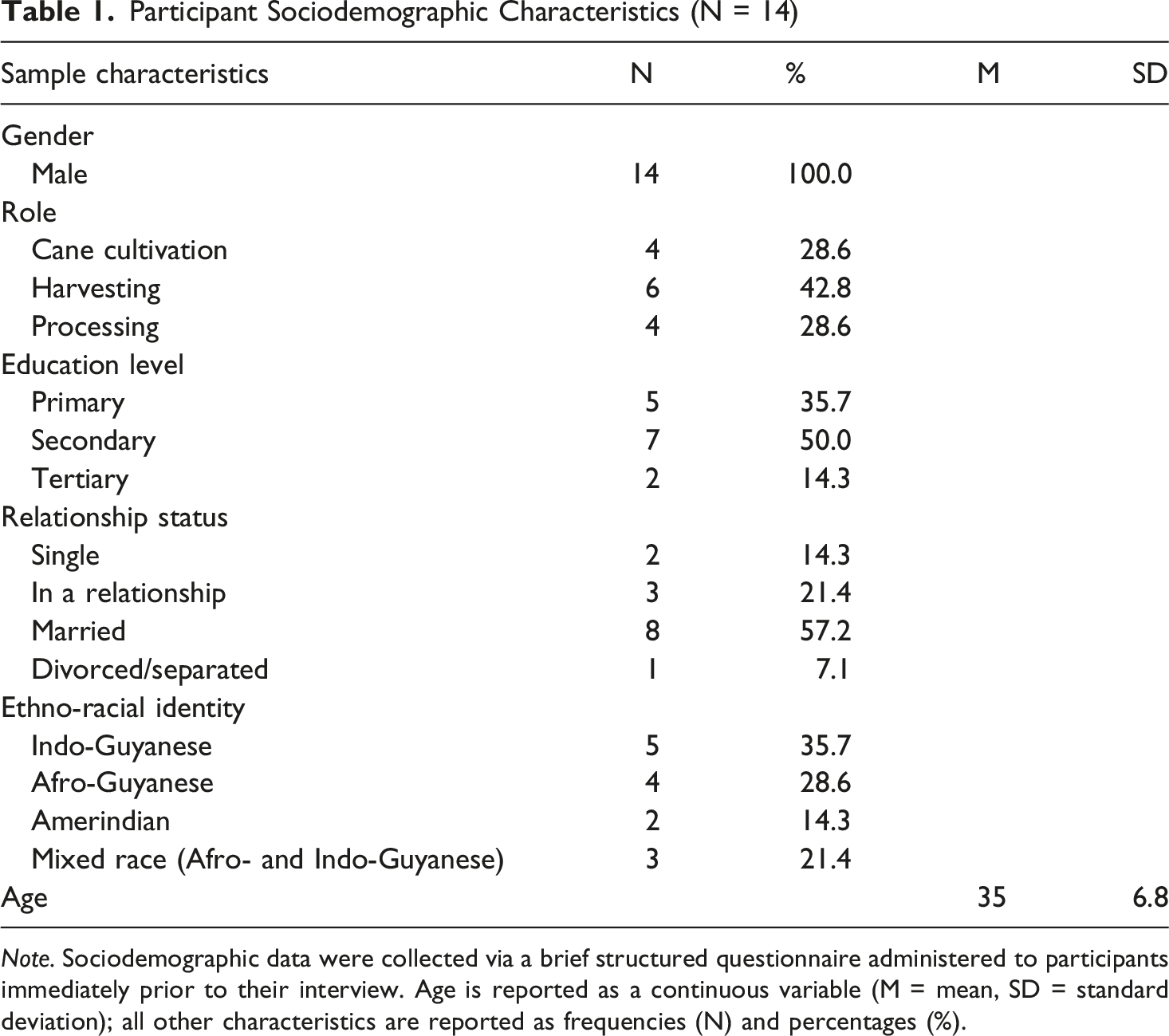
Note. Sociodemographic data were collected via a brief structured questionnaire administered to participants immediately prior to their interview. Age is reported as a continuous variable (M = mean, SD = standard deviation); all other characteristics are reported as frequencies (N) and percentages (%).
Recruitment proceeded through snowball sampling. Given the absence of formal worker registries, the geographic dispersal of worksites across the coastal belt, and the well-documented reluctance of workers in precarious employment contexts to engage with external researchers when disclosure may carry personal risk (Atkinson & Flint, 2001; Heckathorn, 2011), this approach was judged appropriate for accessing a population whose participation could not be secured through conventional purposive or random methods. Initial seed contacts were individuals with established relationships within the sugar-producing communities, identified through the research team’s existing networks in those regions. Each seed contact facilitated introductions to further participants, and recruitment chains extended across multiple worksites. Participants drew on a shared cultural repertoire shaped by Guyanese working-class life, including norms around authority, endurance, community solidarity, and the management of risk, though their accounts revealed considerable individual variation in how those norms were inhabited, negotiated, and sometimes contested.
Data Collection
Data were collected through one-to-one semi-structured telephone interviews conducted by members of the research team, each lasting approximately 40 min. Telephone interviews were selected to enable access across the geographic spread of worksites along the coastal sugar belt and to reduce barriers to participation among workers who might have been reluctant to meet in person given concerns about identification and retaliation. The interview guide was developed collaboratively by the research team, drawing on the occupational health and safety literature, the cultural psychology framework underpinning the study, and the team members’ own knowledge of Guyanese working-class culture and the sugar industry context. The guide was reviewed for cultural resonance and clarity by a community-familiar colleague prior to piloting, and further refined on the basis of the first two pilot interviews before full data collection commenced. The guide explored four broad domains: participants’ perceptions of workplace safety and employer accountability; their experience of protective equipment and training; the degree to which they felt able to raise safety concerns; and the effects of their working conditions on their psychological wellbeing, health, family relationships, and daily life.
Questions were open and non-leading, inviting participants to describe their experiences in their own terms and linguistic register. Representative questions included: “Can you tell me a little about what it is like for you to work here day to day?”; “I would love to hear about your experience of health and safety in your work – what comes to mind when you think about that?”; “Can you tell me about what it is like if you ever have a worry or concern about something at work?”; and “How would you describe what life has been like for you outside of work since you have been doing this job?”
Given the particular sensitivity of questions relating to psychological health and wellbeing, and the cultural norms around the expression of personal distress in this context, these questions were approached flexibly, with interviewers responsive to each participant’s pace and readiness to engage. Where participants touched on relevant experiences but did not elaborate, a set of pre-established follow-up probes was used to encourage deeper reflection without leading. These included, for example: “Earlier in our conversation you mentioned [topic] – would you be willing to tell me a little more about what you meant by that?”; “Could you help me understand what you mean when you said [participant’s own words]?”; “How did that experience affect you personally?”; and “Has anything like that had any effect on your health or your sense of wellbeing, either at work or outside of it?” These probes were applied judiciously and in a culturally attuned way, recognising that direct questions about psychological distress may feel unfamiliar or uncomfortable in communities where such experiences are typically managed privately. All interviews were audio-recorded with participant consent and transcribed verbatim; transcripts were subsequently verified against recordings to ensure accuracy.
Analytical Strategy
Analysis followed IPA procedures as described by Willig (2022) and Smith et al. (2009). Each member of the research team independently annotated transcripts, identifying experiential statements and formulating preliminary themes. Researchers then convened to compare interpretations and build consensus through iterative collaborative review, with all themes anchored in the participant accounts from which they were derived (Birt et al., 2016). Throughout the analytical process, cultural context was treated not as background noise to be controlled for but as an active analytical resource: participants’ use of dialectal Creolese expressions, their invocation of community norms, and their framing of experiences in terms of collective rather than individual identity were attended to as meaningful cultural data.
Saturation was assessed throughout; no new master themes emerged after the 12th interview, and the final two interviews were conducted to confirm rather than extend the analytical framework, with both corroborating the established themes without introducing substantively new experiential content. Trustworthiness was supported through a two-stage member checking process (Lincoln & Guba, 1985; Naipaul & Kyriakou, 2026). First, all participants were provided with transcripts of their own interviews prior to analysis and invited to review the accuracy of the record, and to add, clarify, or withdraw any content; no participant requested substantive changes. Second, following the development of the master themes, participants were invited to review the emergent findings and reflect on the extent to which the themes resonated with their experiences; all participants confirmed that the themes captured something meaningful about their working lives, with several noting that seeing their experiences reflected in the analytical framework was itself a validating experience. Participant quotations are reproduced verbatim throughout, preserving the authenticity of each account and the integrity of participants’ dialectal expression (Naipaul et al., 2026; Riessman, 2008).
The presentation of findings follows a two-level analytical approach consistent with IPA methodology (Kyriakou et al., 2025; Smith et al., 2009). The Results section presents findings at the semantic level, offering close and interpretively engaged readings of what participants described, how they expressed it, and what their accounts convey about the experiences and meanings of those living them. Analysis at this level stays close to participant voices and prioritises the foregrounding of their accounts. The Discussion section then moves to the latent level, drawing on the theoretical frameworks introduced in the literature review to explore the broader cultural, psychological, and structural significance of what participants described. This distinction is deliberate, reflecting a commitment to presenting participant experience on its own terms before bringing scholarly interpretation to bear upon it.
Ethical Considerations
The study received ethical approval from the Institutional Review Board at the International Executive School, Strasbourg, France. All procedures were conducted in accordance with the ethical guidelines of the British Psychological Society (BPS, 2021), including the principles of respect for autonomy, non-maleficence, beneficence, and justice. Prior to participation, all participants were provided with a clear explanation of the study’s purpose, what participation would involve, and how their data would be used. Participants were informed of their right to withdraw at any point during the interview without consequence, and were assured that all data would be anonymised and stored securely in accordance with BPS data protection guidelines. Given the documented risk of retaliation for workers who disclose concerns about working conditions, particular care was taken to protect participant confidentiality: no identifying information was recorded, interviews were conducted privately by telephone, and any details that might identify an individual within a small worksite community were handled with additional caution in the reporting of findings. Verbal informed consent was obtained from all participants prior to commencement of each interview, consistent with the absence of a written literacy requirement in this context and in line with BPS guidance on consent in qualitative research. To further protect participant identity, all participants were assigned pseudonyms; these are used throughout the findings alongside each participant’s age and role to contextualise individual accounts without compromising anonymity.
Reflexivity
The team’s collective proximity to the study context generated distinctive analytical insight but also introduced specific reflexive responsibilities that required active management throughout the study (Naipaul & Kouyaté, 2026). Several potential biases were identified and attended to explicitly. The biographical connection that three team members hold to the Guyanese sugar industry created a risk of over-identification with participant accounts of harm and of unconsciously filtering out evidence that complicated or contradicted the anticipated narrative of governance failure and worker suffering. There was also a risk of cultural over-generalisation: of applying community norms observed within particular family and community contexts as though they were uniformly applicable across all Guyanese working-class settings. The power differential between the research team – whose members hold academic and professional positions – and participants who are manual labourers in a precarious employment context was also considered. In settings where workers fear retaliation for disclosure, the dynamics of an interview with researchers who hold institutional standing may themselves shape what participants feel able to say, even when confidentiality is assured. Interviewers were attentive to this dynamic and took care not to probe in ways that might induce participants to disclose beyond what they were comfortable sharing. The team also recognised and drew on the productive tensions within its own composition. The insider perspectives held by team members with Guyanese heritage and personal industry connections provided cultural fluency, linguistic sensitivity, and a capacity to read contextual meaning in participant accounts. The more distanced perspectives held by team members without biographical connection to the setting (particularly the second and fourth authors) provided analytical leverage against the risk of over-familiarity: a readiness to ask why things were as participants described them, rather than receiving those descriptions as self-evident. Regular team discussions throughout the analytical phase used these differences in positioning as a resource, inviting interpretations to be tested against one another and requiring that all claims be grounded in what participants actually said rather than in what the team expected or hoped to find.
Results
Summary of Master Themes, Sub-Themes, and Overarching Descriptions (N = 14)
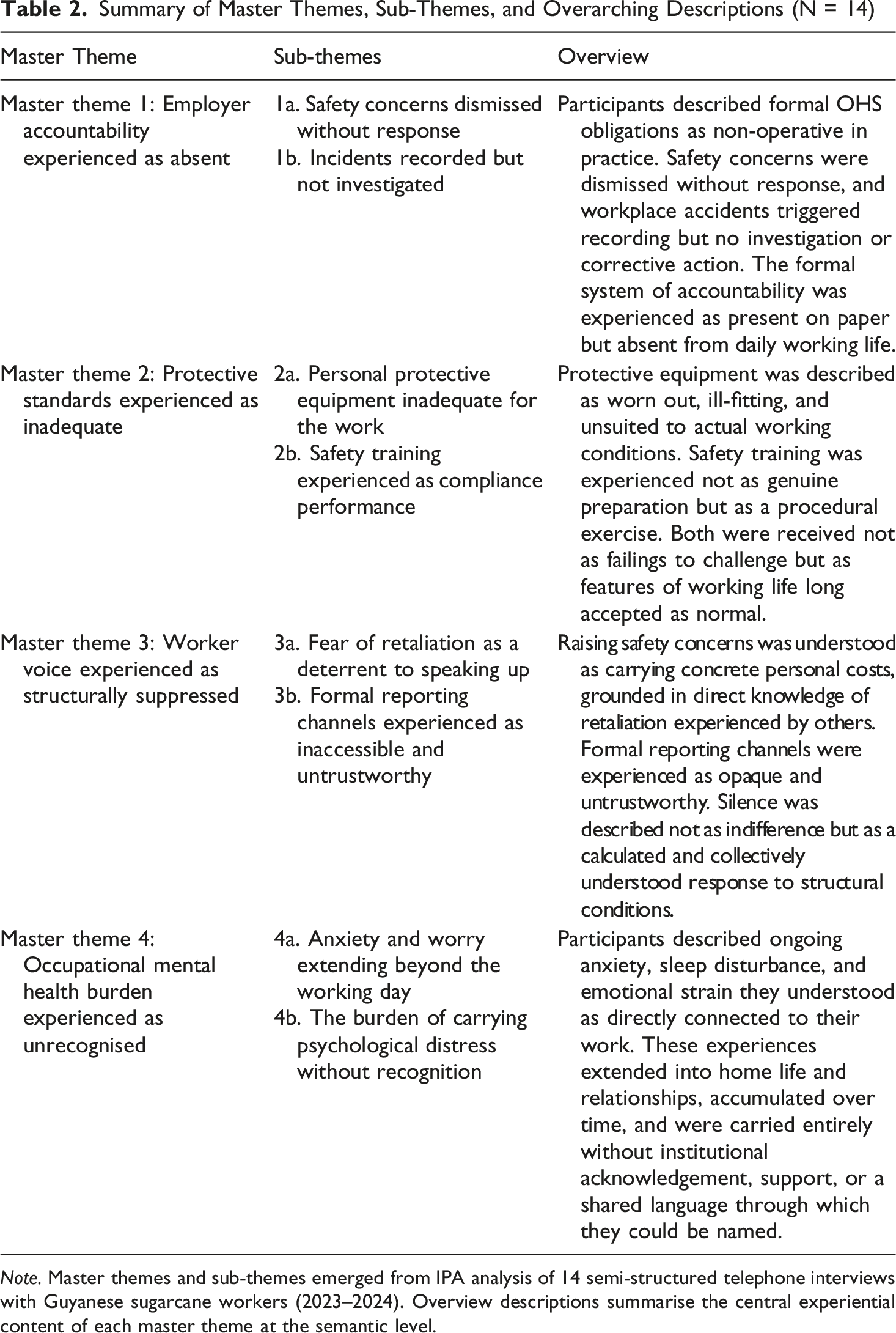
Note. Master themes and sub-themes emerged from IPA analysis of 14 semi-structured telephone interviews with Guyanese sugarcane workers (2023–2024). Overview descriptions summarise the central experiential content of each master theme at the semantic level.
Master Theme 1: Employer Accountability Experienced as Absent
The first master theme concerned how participants experienced the accountability of their employers under occupational health and safety frameworks. Across accounts, the formal obligations that were in place were not experienced as operative. Workers described safety concerns that went unaddressed and accidents that appeared to trigger neither investigation nor corrective response. What emerged was a consistent and shared recognition: that the formal structures of employer accountability, while present on paper, played no meaningful role in their daily working lives.
Sub-Theme 1a: Safety Concerns Dismissed Without Response
Several participants described raising safety concerns directly with supervisors or managers, and in each case the response was dismissal. Speaking up about a hazard was met not with acknowledgement or action but with instruction to continue working. One participant described this directly: “When you tell them something dangerous, they just say keep working. They don't really care if you get hurt, as long as the work done.” (Devan, 31, cane harvester)
What this account conveys is not simply that a concern went unaddressed on one occasion, but that the response was immediate and unambiguous: the concern was irrelevant. The instruction to keep working communicated, as participants understood it, that the employer’s interest in the continuation of work took precedence over the worker’s safety. This was described not as a surprising encounter but as a predictable one.
Sub-Theme 1b: Incidents Recorded but Not Investigated
When accidents did occur, participants described a formal process that began and ended with the recording of the event. There was no follow-up investigation, no return visit, and no corrective action. One worker described what followed a serious injury to a colleague: “My friend get injured real bad, and all they do is write it down in a book. Nobody come back to see what really caused it or how to stop it happening again. Make you feel like you expendable.” (Marcus, 44, cane harvester)
The phrase “Make you feel like you expendable” was offered by this participant as his own interpretation of what the absence of investigation communicated. It is worth noting how the experience is framed: not “I feel expendable” but “make you feel”: a construction that locates the feeling not in personal sensitivity but in what the situation itself produces. This framing was characteristic of how participants across this theme described their psychological experience of employer indifference: not as their own reaction but as the natural outcome of how the system operated. The word “expendable” appeared in more than one account, offered without hesitation, as though it named a condition that was already understood and did not require explanation. What participants described in this theme was not only an external governance failure but a specific psychological experience associated with it: the feeling of being known to be replaceable, and finding that this was simply how things were.
Master Theme 2: Protective Standards Experienced as Inadequate
The second master theme concerned the adequacy of the protective equipment and safety training participants received. Across accounts, both were described as falling substantially short of what the work demanded. What was notable in these accounts was not only the material inadequacy but the manner in which it was held: as an accepted and unremarkable feature of working life rather than as a failing to be challenged.
Sub-Theme 2a: Personal Protective Equipment Inadequate for the Work
Participants consistently described personal protective equipment that was worn out, ill-fitting, or unsuitable for the conditions they faced. Protective boots, gloves, and other items were described as inadequate in ways that directly affected participants’ ability to protect themselves. The following account was representative of what was described across the interviews: “The boots they giving we is old and mash up. Sometimes the gloves don’t even fit proper. How I suppose to protect myself when the equipment barely working?” (Rohan, 28, cane cultivator)
What is striking in this account is the final question: not a complaint addressed to anyone in particular but a statement of experienced helplessness in the face of inadequate provision. Participants did not describe the inadequacy of their PPE as something they had attempted to raise or resolve; it was presented as a given, part of the landscape of work rather than a problem with a remedy.
Sub-Theme 2b: Safety Training Experienced as Compliance Performance
Safety training was described across accounts in similar terms: occasional, generic, and bearing little relationship to the actual hazards of the work. Where training did take place, it was experienced not as a genuine attempt to prepare workers for the conditions they faced but as a procedural exercise. “They does give we a quick talk about safety once in a while, but it ain’t really match what we facing out there every day. Seem like they just ticking boxes, not trying to prepare we for the real dangers.” (Trevor, 38, cane processor)
The phrase “ticking boxes” was offered spontaneously and appeared in more than one account. It describes an understanding of the training’s purpose that participants held with confidence: it was not for them. They were clear that the safety talk existed to satisfy an administrative requirement rather than to address the real dangers of their work. This recognition, shared across accounts, contributed to the broader experience of protective standards as a formal performance disconnected from working reality. Psychologically, what participants described across this theme was a gradual and settled diminishment of expectation: the sense that adequate protection was not something one could reasonably anticipate, and that the inadequacy of what was provided was not a problem to be solved but a condition to be absorbed. Several participants described this not with anger but with a kind of resigned familiarity, as though the gap between what protection should look like and what it actually was had long since ceased to feel remarkable.
Master Theme 3: Worker Voice Experienced as Structurally Suppressed
The third master theme concerned participants’ experience of being unable to raise safety concerns or seek redress for hazardous conditions. Across accounts, the possibility of speaking up was understood as something that came with concrete personal costs. This was not a vague reluctance but a specific and calculated assessment, shaped by direct knowledge of what had happened to others who had tried.
Sub-Theme 3a: Fear of Retaliation as a Deterrent to Speaking up
Participants described a clear and consistent pattern: workers who raised concerns were reassigned to harder work or subjected to pressure that eventually led to their departure. This knowledge circulated in the workplace and shaped the behaviour of those who had witnessed it. One participant described how this operated: “If you complaining too much, they does put you on the hardest jobs or start finding reasons to get rid of you. We see it happen to other fellas before, so most of we just keep quiet.” (Vikram, 35, cane harvester)
The reference to what had happened to “other fellas” is significant. Participants were not describing an abstract fear but a pattern they had personally observed, and the collective “most of we just keep quiet” signals that this was a shared understanding across the workforce. The use of “we” rather than “I” throughout this account is characteristic of how participants across this theme framed their experience of silence: not as an individual decision but as a communal one, something arrived at together and held together. Silence was not experienced as a personal choice but as a rational and communally understood response to a structural condition, one that belonged to the group as much as to any individual within it.
Sub-Theme 3b: Formal Reporting Channels Experienced as Inaccessible and Untrustworthy
Several participants also spoke about the formal reporting channels that were nominally available to them. These were not simply unknown; they were experienced as fundamentally untrustworthy. The concern was not only that a complaint might go unaddressed but that making it would expose the worker to identification and targeting. “We don’t even know who to report these things to, or if anybody actually gonna do something about it. And you can’t trust that they won’t figure out is you who complain and then target you.” (Carlton, 47, cane processor)
What this account reveals is a dual experience of the formal system: opacity about where to report, and distrust that reporting would remain confidential. Neither the destination of a complaint nor its consequences felt safe or predictable. Several participants described a further dimension: the sense that raising a concern individually could put colleagues at risk, and that staying quiet was, in its own way, a means of protecting one another. Taken together, these accounts describe reporting mechanisms that existed formally but were experienced as entirely unavailable in practice. The psychological experience associated with this theme, described across accounts in various ways, was one of sustained vigilance: a constant background awareness of risk, of what could not be said, and of what doing so might cost. Participants did not describe this as an unusual or temporary state but as the ordinary texture of their working days.
Master Theme 4: Occupational Mental Health Burden Experienced as Unrecognised
The fourth master theme concerned the psychological and emotional dimensions of participants’ working experience. Alongside the physical and material conditions described in earlier themes, all participants described forms of psychological distress that they understood as directly connected to their work. These experiences were characterised by their persistence and their pervasiveness: they did not remain within the hours of the working day but extended into sleep, home life, and relationships.
Sub-Theme 4a: Anxiety and Worry Extending Beyond the Working Day
Participants described anxiety about what might happen at work as a constant presence, one that shaped their sleep and their experience of time outside the workplace. The following account describes the way this anxiety had become embedded in daily life: “I can’t sleep good at night because I always thinking about what might happen tomorrow at work. My wife does tell me I stressing all the time now. The worrying don’t leave you, even when you home.” (Suresh, 26, cane cultivator)
The detail of a spouse observing the change is notable: the distress had become visible to those living alongside these workers, not only to the workers themselves. Several participants described similar experiences of the worry following them home, of not being able to leave the working day behind when they left the workplace. The distress was described not as acute or crisis-level but as chronic and constant: a background condition of working life that accumulated rather than resolved.
Sub-Theme 4b: The Burden of Carrying Psychological Distress Without Recognition
A further dimension of this theme concerned how participants held this psychological experience: privately, without access to any form of recognition or support within the workplace. One participant articulated the cumulative and embodied quality of this burden with particular directness: “Every day you going out there not knowing if today is the day something bad happen. That stress does build up inside you, and you carrying it everywhere you go. It ain’t just the body that suffering, is the mind too.” (Dwayne, 40, cane harvester)
The use of the progressive form, “that suffering” rather than “that suffers”, is worth noting: it conveys an ongoing and unresolved state rather than a completed or occasional one. The suffering is present tense, part of the ongoing texture of life rather than a reaction to a specific event.
Discussion
This study explored how sugarcane workers in Guyana experience occupational health and safety governance and what those experiences reveal about the relationship between culture, working conditions, and psychological wellbeing. Four master themes emerged from the IPA analysis: employer accountability experienced as absent, protective standards experienced as inadequate, worker voice experienced as structurally suppressed, and an occupational mental health burden experienced as unrecognised. Taken individually, each theme documents a distinct dimension of governance failure. Taken together, they point toward something more fundamental: that OHS governance is not merely an institutional matter but a cultural one, and that the psychological consequences of its failures cannot be understood apart from the cultural world in which those failures are lived. The following discussion draws on cultural psychology, wellbeing theory, and the psychosocial hazards literature to interpret what these themes suggest, to examine how they connect and reinforce one another, and to consider their implications for policy and practice.
What participants described regarding absent accountability and inadequate protective standards was significant not only as governance failure but as a particular kind of cultural experience. In settings where OHS frameworks function as intended, the absence of adequate PPE or the failure to investigate an accident would be understood as wrongs to be contested. What emerged from these accounts was something different: inadequate protection was absorbed as a feature of working life rather than named as a failure, and employer indifference was received not with anger but with a kind of settled recognition. This is consistent with Triandis’s (1994) analysis of deeply internalised collectivist orientations, in which accepting hardship carries more cultural coherence than individual contestation of it, and where complaint directed upward is understood to risk the relational stability of the group. Zohar’s (2003) concept of safety climate is equally illuminating here: workers do not simply assess whether safety is prioritised but interpret the signals they receive through historically formed frameworks of authority and expectation. For workers whose relationship to employer authority has been shaped by generations of hierarchical labour, dismissed concerns and uninvestigated accidents may be received not as exceptional failures but as confirmations of something already understood: that the system is not designed with their protection as its primary concern.
These dynamics extended into the conditions under which workers could speak about their situation at all. Silence in this study was not passive or unreflective. Participants described a rational and communally shared calculation: that speaking would carry concrete costs, that formal channels were neither accessible nor trustworthy, and that staying quiet was a form of collective self-protection as much as individual self-preservation. The consistent use of ‘we’ throughout these accounts was not incidental; it reflected the communal character of silence as it was lived and understood within these workplaces. Dollard et al.’s (2019) concept of psychosocial safety climate (PSC) is directly relevant here. Where PSC is low, workers share the recognition that their psychological concerns will not be prioritised, and this shared understanding becomes self-reinforcing: suppressed disclosure limits the data available to management, which confirms workers’ existing expectations and deepens the climate of mistrust. In this study, the suppression of voice was not merely a feature of poor management; it was reproduced through cultural norms of deference and community solidarity that made silence feel both rational and morally coherent. Karasek & Theorell’s (1990) demands-control model offers a further lens: workers facing high demands with minimal decision latitude are at elevated risk of psychological harm, and that risk is compounded when the cultural world offers no framework through which control might legitimately be claimed. The absence of voice, in these accounts, was not simply a policy failure but a culturally sanctioned condition whose psychological costs were correspondingly deep.
What these conditions accumulated into was a psychological burden that participants described as chronic, unrelenting, and entirely unacknowledged. The distress they spoke of was not acute crisis but a settled, pervasive weight: worry that did not leave when the working day ended, sleep persistently disrupted, and an emotional load that had become visible to spouses and family members who observed the change over time. Read through Ryff’s (1989) multidimensional wellbeing model, the dimensions most evidently compromised were autonomy, environmental mastery, and purpose in life. Workers who cannot raise safety concerns, whose protective equipment cannot protect them, and whose psychological burden goes entirely unacknowledged are workers unable to exercise meaningful control over the conditions of their working lives, unable to trust that the environment in which they labour is manageable, and whose sense that their work serves a dignifying purpose is steadily eroded by the daily confirmation that they are considered expendable. That word, offered spontaneously and without apparent awareness of its weight, may be the sharpest distillation of this experience: not merely suffering but the specific psychological condition of knowing that one’s suffering does not register as a concern for the institution nominally responsible for preventing it. Stansfeld & Candy (2006) and Theorell et al. (2015) have documented robust associations between adverse psychosocial working conditions and elevated risk of depression, anxiety, and reduced quality of life; those associations are intensified when workers cannot name their distress as work-related or seek help for it, a pattern that Bhui et al. (2016) found to be particularly pronounced in cultural contexts where psychological vulnerability carries social stigma.
What makes this constellation analytically significant is not that these experiences coexist but that they appear to draw from a shared cultural and historical ground. The absorption of inadequate protection as normal, the communal management of silence, and the private bearing of psychological distress are not separate adaptations to separate problems. They are different expressions of a culturally constituted way of inhabiting conditions that could not be changed and, over generations, ceased to feel as though they were meant to be. Each reflects norms that Guyanese working-class communities appear to have developed across a long history of hierarchical labour, institutional distance, and collective self-reliance, norms in which endurance reads as coherence, complaint reads as social risk, and suffering belongs inside the household rather than inside an institutional process. This has important implications for how OHS governance failures in this setting should be understood. The governance gap identified in these accounts, to borrow Quinlan & Bohle’s (2014) term, is not simply administrative; it has been absorbed into and reproduced through the cultural formations of the communities it affects. Procedural interventions that address a single dimension in isolation, whether revised PPE protocols, anonymous reporting systems, or one-off safety briefings, are unlikely to reach conditions reproduced at this depth, because they do not address the cultural ground from which those conditions grow.
A further dimension gave additional psychological weight to what participants described. Several accounts conveyed something beyond long-standing historical formation: a present-tense experience of being excluded from a national story of progress. Guyana’s rapid economic ascent, driven by oil revenues that have produced visible national prosperity since 2022, appears to have created a specific form of comparative suffering for workers whose conditions have not changed alongside the country’s headline trajectory. The question of what it means to inhabit a country declared wealthy when one’s own working life remains materially unchanged is not merely rhetorical; it is, for these workers, a daily experiential fact. This dynamic resonates with Benach et al.’s (2014) analysis of precarious employment as a social determinant of health and Ross’s (2012) account of the tendency for resource-boom revenues to leave legacy-industry workers behind, and it adds a contemporary layer of psychological harm that is specific to this historical moment in Guyana’s development and is not reducible to cultural inheritance alone.
Taken together, these interpretations suggest that the relationship between culture, governance, and psychological wellbeing in this study is not one of cultural factors modifying otherwise universal processes. What the themes point toward is something more constitutive: that the cultural world these workers inhabit shaped the very terms on which governance failures were encountered, what could be named or claimed within them, and the particular forms that psychological harm took. This is precisely the argument advanced in the cultural psychology literature from Markus & Kitayama (1991) to Kleinman (1988): that experience is not culturally influenced but culturally constituted. What this study contributes is an empirical account of that constitution in a specific occupational and cultural context that has received almost no qualitative attention.
Practical Implications
The implications for policy are clear but require cultural grounding to be effective. Investment in inspectorate capacity, protected reporting mechanisms, participatory safety training, and the integration of occupational mental health into OHS frameworks have all been proposed in comparable settings (Dollard et al., 2019; Mohabir, 2023; Vinodkumar & Bhasi, 2010; WHO, 2000). What this study adds is the argument that none of these interventions will achieve their intended effects if designed without reference to the cultural context in which they will operate. Participatory training that does not account for authority-deferential norms will reproduce compliance theatre in a different format. Reporting mechanisms that are not designed to be trusted within the specific social and historical context of Guyanese labour will not be used. Mental health integration that does not attend to the cultural stigma around psychological vulnerability will not be experienced as addressed to the people it is meant to serve. Cultural attunement is not an optional supplement to good OHS policy, in this context, it is a precondition for it.
The findings also have specific implications for how occupational psychological health and wellbeing support might be conceived in this context. The experience described by participants in Theme 4 was not primarily one of clinical disorder requiring treatment but of chronic, accumulated distress arising from conditions that remained unaddressed and unacknowledged. Any meaningful response to this must begin with the question of recognition: how do workers come to understand their psychological experience as something that has a cause in their working conditions and that they are entitled to have addressed? In communities where psychological vulnerability carries social stigma and where the public acknowledgement of distress is culturally managed with considerable care, conventional occupational mental health interventions, imported from other contexts and delivered without cultural adaptation, are unlikely to be received as relevant or trustworthy. What is needed instead are approaches that begin from within the cultural worlds of workers themselves: community-based, relationally grounded, and attentive to the specific ways in which psychological wellbeing is understood and expressed in Afro- and Indo-Guyanese working-class communities. Psychosocial support that is delivered through trusted community channels, that uses the language and concepts already present in working-class Guyanese life, and that treats the naming of occupational psychological harm as a first and necessary step rather than an assumed starting point is more likely to reach workers whose experience has been, for so long, invisible.
The present findings also speak to a methodological argument. The use of IPA in this study was not merely a method choice; it was a theoretical commitment: to understanding experience from within rather than measuring it from without (Smith et al., 2009; Willig, 2022). The richness of what participants shared, and the cultural specificity of how they shared it: the use of Creolese dialect, the invocation of community norms, the particular weight carried by words like “expendable”, could not have been accessed through a survey instrument or captured in an incidence rate. Occupational health research in the Caribbean and Latin American region needs more of this kind of work: qualitative, culturally grounded, and committed to generating knowledge from within the communities whose health is at stake.
Limitations and Future Research
Several limitations should inform how these findings are read. The sample comprised 14 male workers from a single industry, and female workers are entirely absent, a significant gap given the distinct OHS vulnerabilities and cultural experiences that research with women in agricultural settings has highlighted (Messing & Ostlin, 2006). The all-male composition reflects the gendered structure of the manual workforce in Guyana’s remaining sugarcane operations, but future studies should make concerted efforts to include women whose occupational health experiences may differ in important ways. Snowball sampling, though appropriate for this population, may introduce referral bias by over-representing workers within particular social networks (Atkinson & Flint, 2001). Telephone interviews enabled access across geographic distance but precluded observation of non-verbal communication and the physical workplace context that might have enriched interpretation (Bryman, 2016). Given the documented fear of retaliation among participants, social desirability effects may also have shaped accounts, and the study relies on self-report without objective triangulation against regulatory compliance or incident data (Krumpal, 2013).
These findings are not statistically generalisable (Lincoln & Guba, 1985), though their cultural and analytical transferability to postcolonial agricultural industries and resource-dependent economies where occupational health governance has lagged behind the demands of working populations is argued to be meaningful (Tobin & Begley, 2004). A further limitation concerns the role of occupational tenure. The length of time participants had spent in the sugarcane sector was not systematically collected, and, more importantly, the analysis did not examine how duration of exposure may have shaped the experiences described. It is plausible that workers with longer histories in the sector experience governance failures differently from those more recently employed, whether through deeper habituation to inadequate conditions, accumulated physical and psychological toll, or a more entrenched sense of institutional abandonment. This study cannot speak to those distinctions, and that is a meaningful boundary on its interpretive reach. Future research should incorporate time-in-role as a standard participant characteristic and design analyses that are sensitive to how tenure intersects with the cultural and structural dynamics identified here. More broadly, future research should prioritise observation-based methods to complement interview data, and the development of culturally validated OHS measurement instruments grounded in the Guyanese context.
Future work might also draw on Martín-Baró’s (1994) tradition of Liberation Psychology to consider the role that psychologists might play in working alongside sugarcane communities, not merely as researchers of occupational suffering but as partners in processes of conscientisation and collective empowerment that enable workers to name and contest the conditions they inhabit. In this tradition, knowledge production is inseparable from the struggle for dignity and justice, a framing that sits with particular force alongside the experiences described in this study. In methodological terms, participatory action research offers a promising complement to interpretive approaches such as IPA. By positioning participants as co-investigators rather than informants, participatory methods can themselves function as a form of empowerment, generating knowledge from within communities while simultaneously creating conditions for the social and institutional change that knowledge might support.
Conclusion
This study provides one of the first culturally situated, qualitatively grounded accounts of how OHS governance is experienced by sugarcane workers in Guyana. What participants described was not merely a set of policy failures but a culturally constituted experience of systems that do not fit: absent accountability absorbed through a cultural lens of historical dispensability; inadequate protection endured through collective stoicism; voice suppressed through norms of deference that predate and outlast any particular regulatory regime; and psychological harm borne in silence within communities that have no institutional language through which to name it. These are not incidental features of poor governance. They are the forms that OHS failure takes in this particular cultural world, and addressing them requires culturally grounded responses as much as institutional reform. The study makes two broader claims. Methodologically, it demonstrates that phenomenologically grounded qualitative inquiry is not supplementary in this kind of culturally specific setting but irreplaceable: what participants described could not have been reached through compliance audits, injury statistics, or survey instruments designed for other contexts. Theoretically, it argues that the relationship between culture, governance, and psychological wellbeing is not a matter of cultural factors modifying otherwise universal processes, but of culture constituting the very terms under which occupational experience becomes recognisable, communicable, and amenable to change. The voices of the workers in this study, speaking from within a cultural world that has given them few categories through which to name what they carry, represent both the subject of this inquiry and its most compelling argument for why it matters.
Footnotes

Ethical Considerations
Ethical approval was obtained from the Institutional Review Board, International Executive School, Strasbourg, France.
Consent to Participate
All participants provided informed consent. The study was conducted in accordance with the Declaration of Helsinki and reported in accordance with COREQ guidelines.
Funding
The authors received no financial support for the research, authorship, and/or publication of this article.
Declaration of Conflicting Interests
The authors declared no potential conflicts of interest with respect to the research, authorship, and/or publication of this article.