







Abstract
The Internet has become a relevant campaign tool in the United States and the 2008 presidential elections have marked a turning point in the recognition of its potential. This study analyzed candidate websites during the 2008 presidential primaries through a quantitative coding frame supplemented by latent trait analysis and meta-analysis of coding frames employed by seven earlier studies. The online competitive scenario was found to be less affected by offline dynamics than normalization theory suggests, as the money raised by candidates was not significantly correlated with the amount of features on their websites. However, the websites of candidates who already were in public office other than the Presidency had more features than those of out-of-office aspirants; by contrast, the number of years candidates had spent in public office was negatively correlated with the number of features on their websites. Moreover, Democratic candidates' websites were found to offer substantially more features than Republicans', particularly with respect to engagement tools, thus providing the challenger party with a sizeable competitive advantage.
Keywords
Introduction
The Internet has become a fundamental campaigning tool in the United States (US). In the spring of 2008, 46 percent of Americans reported that they used the web, email, or text messaging for purposes related to the presidential primary. 1 After the general election, 36 percent claimed that the Internet was one of their two main sources of information about the campaign, second only to television; the majority of respondents (56 percent) claimed to have got some campaign news online. 2
In light of the increasingly relevant role of the Internet in Americans' political behavior, this article analyzes web campaigning by major-party candidates in the 2008 presidential primaries. I start from an overview of the literature on the Internet and political communication, based on which I specify hypotheses about online electioneering in the context of the primaries; I then test these hypotheses through a quantitative longitudinal analysis of candidate websites from July 2007 to January 2008. Finally, I discuss the implications of the findings for future research. Because I identified significant differences in online campaigning that are related to candidates' party affiliation, my research will shed light on the interrelations between party politics, political competition, and changes in campaigning.
New media and transformations in political communication
For more than a decade, scholars have argued that political communication is experiencing a paradigm shift. Researchers who write about a ‘third age of political communication’ (Blumler and Kavanagh, 1999) and ‘postmodern campaigning’ (Farrell and Webb, 2000; Norris, 2000) describe an increasingly fragmented, decentralized, and professionalized campaign environment, coupled with voter cynicism, electoral de-alignment and a less cohesive public sphere. Parties have adapted to these changes by shifting their focus from broadcast television and repetitive distribution of catch-all messages to campaigns that are permanent, attentive to feedback, and focused on specific segments of the electorate. Moreover, because ties between parties and voters have weakened (Dalton, 2000), electoral participation has declined, and turnout rates increasingly affect election outcomes (Endersby et al., 2006: 334).
As a consequence, American campaigns are paying increasing attention to voter mobilization (Beck and Heidemann, 2010) where personal, unmediated contacts are more effective than impersonal and mediated ones (Green and Gerber, 2004). The Internet dovetails with this trend because it can help promote supporter engagement and organize voter contact in a cost-effective way. As was recently observed, ‘Campaigns know that indirect mobilization through their supporters' social networks is cheaper and more effective than direct mobilization’ (Haynes and Pitts, 2009: 58). Because campaign websites are mostly accessed purposefully rather than by coincidence (Bimber and Davis, 2003), their users are more interested in politics and more partisan than the rest of the population (Norris, 2003). As campaigns increasingly emphasize mobilization through personal contacts, the Internet can help turn supporters into campaign advocates in their social networks. Moreover, studies have found that visiting candidates' sites enhances both online and offline political participation (Park and Perry, 2008). By contrast, Howard (2006) has claimed that Internet campaigning allows elites to manage citizen preferences and responses instead of promoting genuine grassroots engagement.
These developments imply that, as a result of both contextual incentives (weakened voter attachments and greater emphasis on mobilization) and technology-specific dynamics (audience selectivity and engagement potential), campaigns increasingly harness the Internet to motivate their supporters to participate on the ground and to expand their volunteer base, so that ‘the distinction between being a citizen offline and being one online has started to dissolve’ (Chadwick, 2006: 172).
The Internet, party competition, and primaries
Many studies have analyzed the implications of Internet campaigning for electoral competition. Whereas early predictions claimed that new media would level the playing field between major and minor parties, Margolis and Resnick (2000) found that offline disparities are often reproduced online, a dynamic they called ‘normalization’. Scholars supporting normalization generally argue that major parties' and candidates' websites have richer contents and/or higher visibility than their minor counterparts' (Strandberg, 2008: 232). This theory has been supported in US inter-party competition (Margolis et al., 2003), as Republican and Democratic candidates outperform those from minor parties. The most convincing explanation is that the pluralitarian electoral system gives minor party candidates few incentives to compete, as their chances to win seats are nonexistent (Strandberg, 2008: 238). However, while normalization has been upheld with respect to inter-party competition between major and minor parties, it has not been tested in intra-party competition, particularly in major-party primaries.
Whether the Internet can affect competition among primary candidates is a relevant question in light of recent literature on presidential primaries showing that, after the surprising outcomes of the 1972 and 1976 Democratic contests, party elites now control the process, so that the insider-monopolized ‘invisible primary’ determines the nominee (Cohen et al., 2008). This tendency, however, was not completely confirmed in 2008, particularly on the Democratic side, where Barack Obama defeated Hillary Clinton despite her solid network of fundraisers and elite support. Obama countered Clinton’s political machine with a grassroots movement that was by and large organized online, thus raising the question of whether the Internet can widen the playing field in intra-party competition.
The 2008 US presidential primaries offer a promising environment to study developments in online electioneering. First, the diffusion of Internet campaigning has been accelerated in the US by the configuration of its political institutions – federalism and separation of powers, lack of institutionalized party membership, candidate selection through primaries, campaign finance, and traditional media (Anstead and Chadwick, 2008). Primaries, in particular, are an uncertain environment that encourages candidates to experiment: as a result, ‘in the United States, most of the innovations [in Internet campaigning] have occurred during the primary season’ (Anstead and Chadwick, 2008: 65). Moreover, for the first time since 1952, in 2008 no incumbent President or Vice-President was on the ballot, thus making the Republican and Democratic races comparable for research.
Although presidential primaries offer fertile ground for online campaigning, little research on the topic has been conducted so far. A study of the 1996 race (Margolis et al., 1997) focused on differences between major- and minor-party candidate websites, but did not code them systematically. More significantly, a quantitative analysis of Democratic and Republican candidates' websites in the 2000 and 2004 primaries did not find large differences between the strongest candidates and others (Foot and Schneider, 2006b: 27), thus apparently contradicting normalization theory for intra-party competition. Minor candidates for the Democratic and Republican presidential nominations might face different competitive incentives than minor-party candidates in general elections. Moreover, the national prominence of the competition, and the fact that it occurs within the two major parties, selects more experienced and better financed candidates than those who run in minor parties for lower offices.
Online campaigning can also have important implications for major-party competition if one party achieves technological and strategic supremacy. Two studies of Congressional candidates' websites, one in the 2006 campaign (Galati and Williams, 2007), the other in the 2002 and 2004 races (Druckman et al., 2007), found that Democrats' websites were significantly more likely to present interactive and engaging features than Republicans'. Different theoretical rationales for these imbalances have been proposed. Kerbel (2009: 5) claims that the left has produced a more functional online infrastructure than the right because the former is keener on horizontal organization, while the latter tends to espouse vertical power arrangements. Karpf (2009) makes the more nuanced argument that this situation is only partially the result of ideological differences between the parties and cannot be considered to be immutable, but derives from the particular configuration of the progressive and conservative coalitions in the current political environment. Kaprf also claims that Democrats have made better use of the Internet because their out-party status in Washington has provided incentives to innovate and in turn has shifted the intra-party balance of power in favor of new-media-savvy candidates and consultants. If these trends are confirmed, and depending on how long they sustain themselves, their implications for US inter-party competition may be momentous.
Hypotheses
The purpose of this research is to explore the dynamics of online electioneering in the 2008 primaries through a quantitative analysis of candidate websites. This represents an important research topic because, as Foot and Schneider (2006a: 13) have observed, the effects of Internet campaigning on citizen engagement and party competition depend on how candidates employ these tools.
The study was guided by seven hypotheses, grounded in theory and evidence from previous research. The first hypothesis differentiates among the functions that candidate websites can offer. Research has shown that campaign professionals are wary that interactivity might jeopardize control over the campaign’s message (Druckman et al., 2007; Foot and Schneider, 2006a; Gibson et al., 2003) and that they prefer to provide voters with centrally-controlled information. I thus hypothesize a hierarchy of website functions: H1: Functions that entail disseminating information will be more common on candidate websites than functions that allow users to engage in online dialogue and to autonomously participate in the campaign.
Second, research has found that websites develop more features as time progresses (Druckman et al., 2007: 433–6; Foot and Schneider, 2006a: 158, 2006b: 29). Time makes technologies less costly and, within the context of a long campaign, the passing of time implies higher stakes and greater resources; furthermore, some Internet features only have to be built once. Thus, Hypothesis 2 was formulated: H2: Candidate websites will develop more features as the campaign progresses.
The third hypothesis is grounded in the debate on normalization summarized earlier. Because online campaigning is costly, financial resources are expected to positively affect the number of features found on websites: H3: The amount of funds raised by candidates will be positively correlated with the number of features on their websites.
The fourth hypothesis is crucial to the study of party politics and postulates a ‘party divide’ between Democrats and Republicans in order to assess whether the differences found in Congressional candidates' websites between 2002 and 2006 were replicated in the 2008 presidential primaries: H4: Candidates' affiliation with the Democratic rather than the Republican party will be positively correlated with the number of features on their websites.
The fifth and sixth hypotheses relate to a candidate’s tenure in public office. Various studies (Foot and Schneider, 2006a: 174; Galati and Williams, 2007: 457–8) found that challengers in Congressional races are more likely to engage their users online: Druckman et al. (2007: 435) found that incumbents' websites are less likely to offer multimedia features and updated information; Hernson et al. (2007: 37) also found that, among state legislative candidates, challengers campaigned more intensely online. As we have already observed, no sitting President or Vice-President was running in 2008, which allows us to control for presidential incumbency. However, in such an open-seat race, tenure in public office may affect Internet efforts because candidates who already held an elective office other than the Presidency could be expected to have a more solid online presence, as they had previously run online campaigns to win their current offices and could leverage on the legacies of these previous efforts. However, I also hypothesize that the longer candidates had been in public office, the more they may be inclined towards traditional campaigning tools compared to shorter-tenured officeholders who had spent a greater portion of their political life in an environment where the Internet was commonplace. From these considerations, I draw the following hypotheses related to candidates' tenure in office: H5a: Candidates' status as incumbents in non-presidential elective offices at the beginning of the campaign will be positively correlated with the number of features on their websites. H5b: The number of years that candidates had spent in public office at the beginning of the campaign will be negatively correlated with the number of features on their websites.
The final hypothesis deals with the competitiveness of the race. In Congressional campaigns, candidates in competitive races have been found to produce more engaging and feature-rich websites (Foot and Schneider, 2006a: 174; Galati and Williams, 2007: 457–8; Hernson et al., 2007: 37). I will thus assess how the competitiveness of the race (measured as the concentration of voting intentions in the Republican and Democratic fields) affects candidate websites: H6: The concentration of voting intentions in opinion polls within each party will be negatively correlated with the number of features on candidates' websites.
The hypotheses do not address contextual features related to demographic attributes of the voters and Internet use, which other studies have examined. I excluded these variables from the models because I treated the part of the campaign that I analyzed as a national competition. During the so-called ‘invisible primary’ candidates vie not only for votes but also for money and recognition, and while the race for votes prioritizes a few states where the first ballots are cast, the battle for funds and visibility takes place nationally. Moreover, Latimer (2009) has found weak correlations between district-level demographic variables and the characteristics of candidate websites, while Farmer and Fender’s (2005) study of state party websites has shown that party organization affects them more than contextual features.
Data and methods
In order to test the hypotheses, I analyzed the contents of primary candidates' websites from July 2007 until January 2008. Various scholars have followed Gibson and Ward’s seminal work (2000), which suggested identifying basic functions of political websites, operationalizing variables that measured specific content features, coding websites for the presence or absence of these features, and developing indices to measure how websites performed the identified functions (see, e.g., Farmer and Fender, 2005; Foot and Schneider, 2006a, 2006b; Galati and Williams, 2007; Gibson et al., 2003; Latimer, 2009; Lusoli and Ward, 2005; Norris, 2003). However, each study has employed different sets of variables and has constructed indices that measure different dimensions, thus making it difficult to compare results. Moreover, researchers have generally overlooked Gibson and Ward’s recommendation to abstain from constructing indices based on face validity that would prejudge the dimensions of website functions and instead adopt ‘a more flexible method that allows the sites to speak for themselves' (Gibson and Ward, 2000: 302).
In order to analyze candidate websites, I devised an initial coding scheme consisting of 87 variables, most of which were dichotomous to measure the presence or absence of a particular characteristic, with a few ordinal-level variables to provide a more refined measure of the degree to which a website performed a certain function. The websites were analyzed in all their publicly-accessible pages, including those that required a free registration. The coding was performed by the author. 3 About two-thirds of the variables were drawn from studies cited in this paragraph, while one-third consisted of new variables introduced to account for online tools that were not relevant when earlier research was conducted. 4 These include blogs, applications enabling users to create their blogs within the candidate’s website, social networking tools (either hosted on the website or on external platforms such as Facebook and MySpace), event-organizing tools (either hosted on the website or on external platforms such as MeetUp and Eventful), volunteer recruitment tools (such as interfaces to invite one’s email contacts), publication of user-produced audiovisuals (either hosted on the website or on external platforms such as YouTube), subscription to mobile phone alerts, and syndication of content through really simple syndication (RSS) feeds. Including these variables allowed me to account for the most recent and relevant technological developments and to acknowledge that online campaigning increasingly occurs in ‘third places' (Chadwick, 2009: 30) and through ‘Web 2.0’ platforms. However, my study has not treated these separate domains through a specific focus and methodology, but only addresses them to the extent that candidate websites linked to them or reproduced some of their features.
Because the campaign stretched for longer than a year, the analysis features a longitudinal component that is not common in the Internet electioneering literature. Websites were originally coded in 11 separate periods: five in 2007 (March, July, September, November, and December) and six in 2008 (January, February, March, April, May, and June). The analysis was performed in the first two weeks of each month. During each observation, I included the websites of all candidates who were officially running or were credited to be willing to. This procedure resulted in 128 observations of 20 total candidate websites, with a maximum of 11 observations for three candidates and a minimum of two for two candidates. However, including all 128 cases would have introduced biases, as the websites of the candidates who stayed in the race longer would be overrepresented and those of candidates who retired early would be underrepresented. To avoid this distortion, I limited the analysis to five time points (from July 2007 until January 2008) and to 15 candidates that consistently stayed in the race throughout that period. This decision eliminated marginal candidates 5 and still allowed to account for the status of the online campaign until a few days prior to the so-called ‘Super Tuesday’ (5 February 2008), when votes were held in 25 states, terminating the Republican contest and leaving only Obama and Clinton competing for the Democratic nomination.
After coding websites, selecting the cases, and defining the longitudinal limits, I devised a three-step statistical strategy to construct indices grounded in the empirical reality of the data. The main methodological issues included the small number of units (15), the fact that observations of the same units at different time points were not independent, and the dichotomous nature of most variables, which precluded standard factor analysis. Given the first limitation, I could not include all measured variables in a standard exploratory factor analysis, but instead conducted a series of exploratory analyses based on various subsets of variables. This procedure generated some preliminary hypotheses regarding the structure of the data and the variables representing it, which I then tested within a dynamic latent trait model framework that allowed me to accommodate for the categorical nature of the data and, being a multilevel technique, enabled me to account for both cross-sectional and longitudinal correlations between variables (Jöreskog and Sörbom, 1979). I thus assumed variables belonging to the same latent dimension to be correlated both with each other and with themselves over time. I also assumed that factor loadings would be invariant over time (measurement invariance), so that the model represents only dimensions that were stable enough to be found at all time points. This part of the analysis was conducted with LISREL 8.52 statistical package (Jöreskog and Sörbom, 1996).
The findings of this analysis were then used to construct indices based on the resulting loadings; subsequently, I constructed a second type of indices that combined the results of the factor analysis with those of a meta-analysis of the coding schemes employed in relevant previous studies on the subject. Both these sets of indices were then entered as dependent variables in a multivariate model constructed to test the hypotheses.
Findings
The results of the dynamic latent trait analysis are shown in Figure 1 . The model fits the data quite satisfactorily, as the p value for the null hypothesis is greater than .05 and the root mean square error of approximation (RMSEA) equals .08, a conventional threshold for goodness of fit in structural equation models (Bollen, 1989).
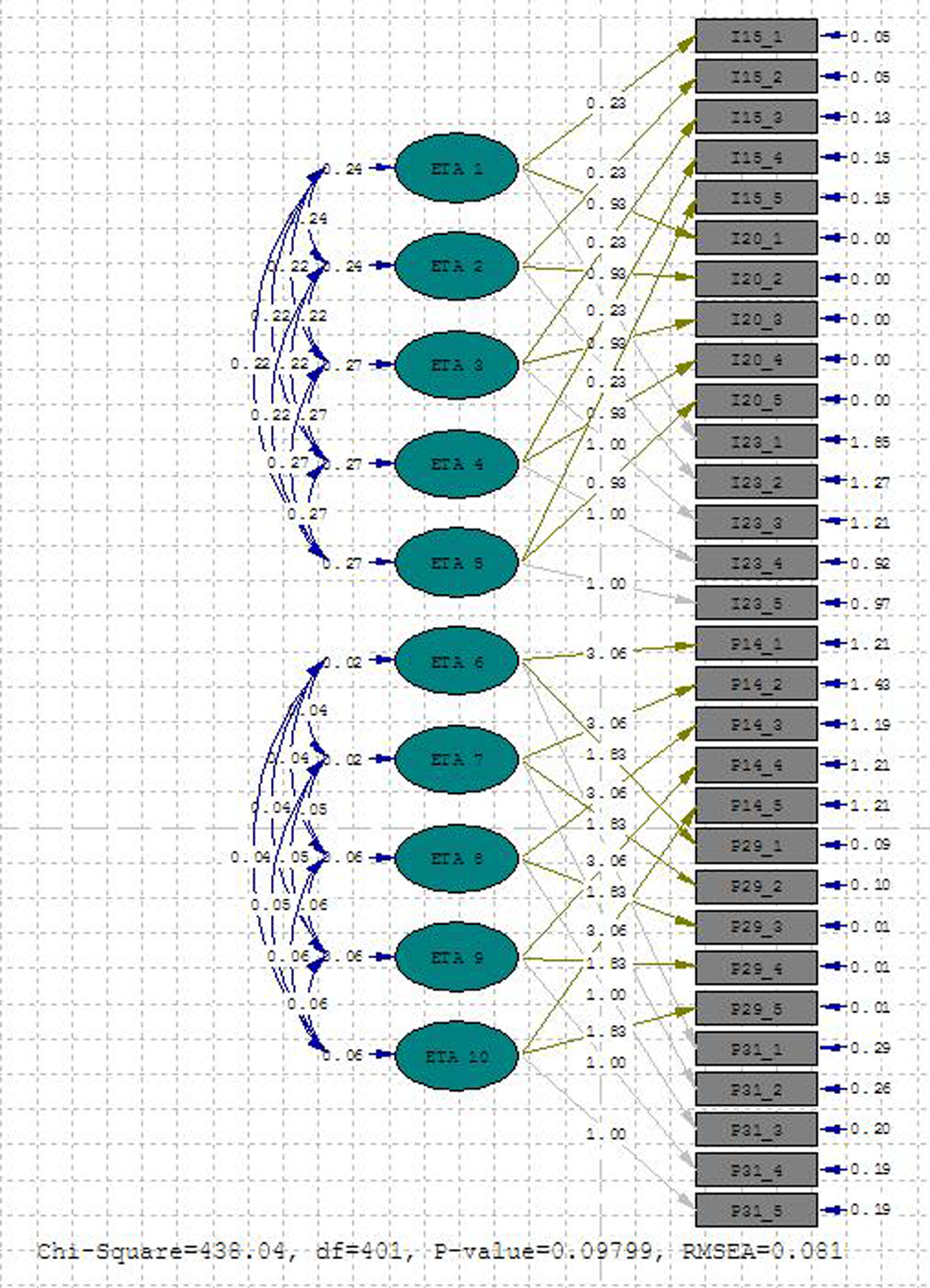
Results of dynamic latent trait analysis of website features
As the path diagram shows, I found support for the existence of two factors, each represented by three variables. The first factor is represented by the average number of emails sent weekly (factor loading 1.00), the possibility to subscribe to mobile phone alerts (.93), and the presence of a ‘frequently-asked questions' page (.23). I interpret this factor as a compound of information tools, which is also treated as a relevant dimension (often termed ‘content’) in other studies. The second factor is represented by the possibility for users to upload self-produced audiovisuals on the website or via YouTube (factor loading 1.00), the time the campaign took to answer an email requesting how the sender could get involved (3.06), and the possibility for users to build blogs linked to the website (1.83). I interpret this factor as a compound of participation tools, which again is invariably present in other scholars' classifications, although at times with different names (‘engagement’, ‘involvement’, ‘interactivity’) and with narrower distinctions, for example between ‘participation’ and ‘resource generation’ (Gibson et al., 2003), ‘involving’ and ‘mobilizing’ (Foot and Schneider, 2006a), ‘engagement’ and ‘mobilization’ (Galati and Williams, 2007). The two-dimensional structure that emerged from the factor analysis is consistent with most research on campaign websites, as summarized by Galati and Williams: ‘Most treatments distinguish between passive informational content and those features or tools that facilitate user manipulation of, or interaction with, the content, other users, and/or the campaign enterprise’ (2007: 2–3).
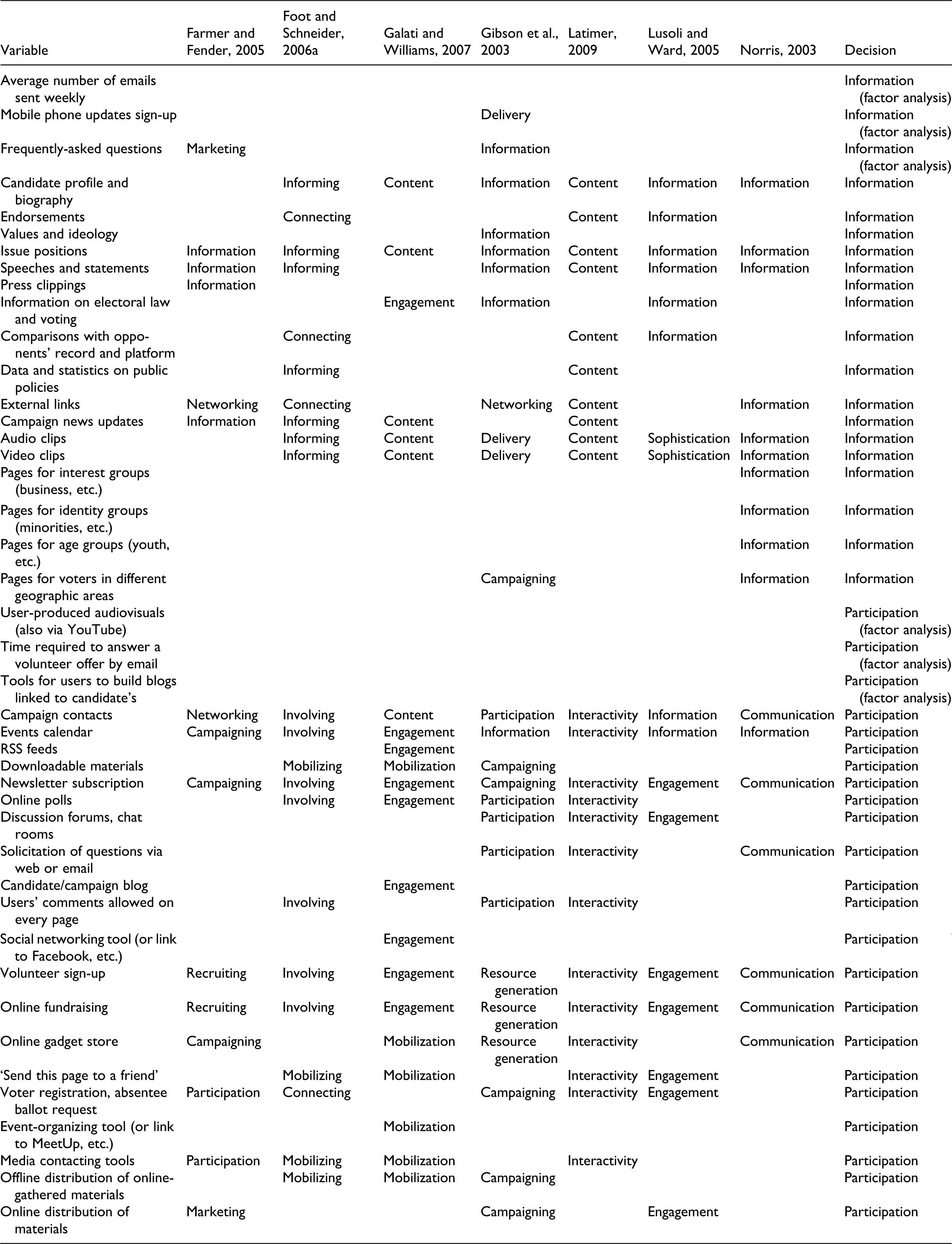
However, because the limitations of the data only allowed me to test factor structures which included a small number of variables, I decided to consider the factor analysis as a first rather than last step. In order to construct indices measuring the two dimensions of information and participation that have been identified, I conducted a meta-analysis of the coding schemes employed in seven relevant studies to ensure that the classifications were as consistent as possible with other researchers'. When scholars had used more than two categories to classify items related to information or participation, I conflated them into the two dimensions. Thus, Gibson et al.’s (2003) ‘campaigning’, ‘participation’, and ‘resource generation’ were treated as participation; Foot and Schneider’s (2006a) ‘connecting’, which involved links, was treated as information, while ‘involving’ and ‘mobilizing’ were classified as participation, as were Galati and Williams' (2007) ‘engagement’ and ‘mobilization’. Moreover, while the initial coding scheme featured various items that previous researchers had coded to measure technical and usability aspects, classified as ‘site delivery’ by Gibson and Ward (2000) and ‘sophistication’ by Lusoli and Ward (2005), I omitted these variables because the factor analysis did not support the existence of a third dimension in the structure of the data. I also excluded variables that I coded but which were absent from all seven coding frames included in the meta-analysis, apart from those that turned out to represent relevant dimensions in the factor analysis. 6 When disagreement was found among the coding schemes, I resorted to majority rule. By applying this method, I classified 43 variables, 20 for information and 23 for participation. The results of the meta-analysis are shown in Appendix 1.
After defining the structure of the data, I now turn to describing them in detail. Table 1 shows the mean values for the variables that were classified within the information and participation domains, as well as the two types of indices that measure each dimension. The first indices include only the variables (three for information, three for participation) that resulted from the factor analysis. Because the categorical nature of the variables made calculation of factor scores with LISREL problematic, I followed the classical approach to factor analysis and computed the factor scores by multiplying the observed value of each variable by its factor loading. The second indices were constructed by adding the observed values of all the variables (20 for information, 23 for participation) that were found to represent each dimension through the combination of the factor analysis and meta-analysis.
Mean values of information and participation variables and indexes
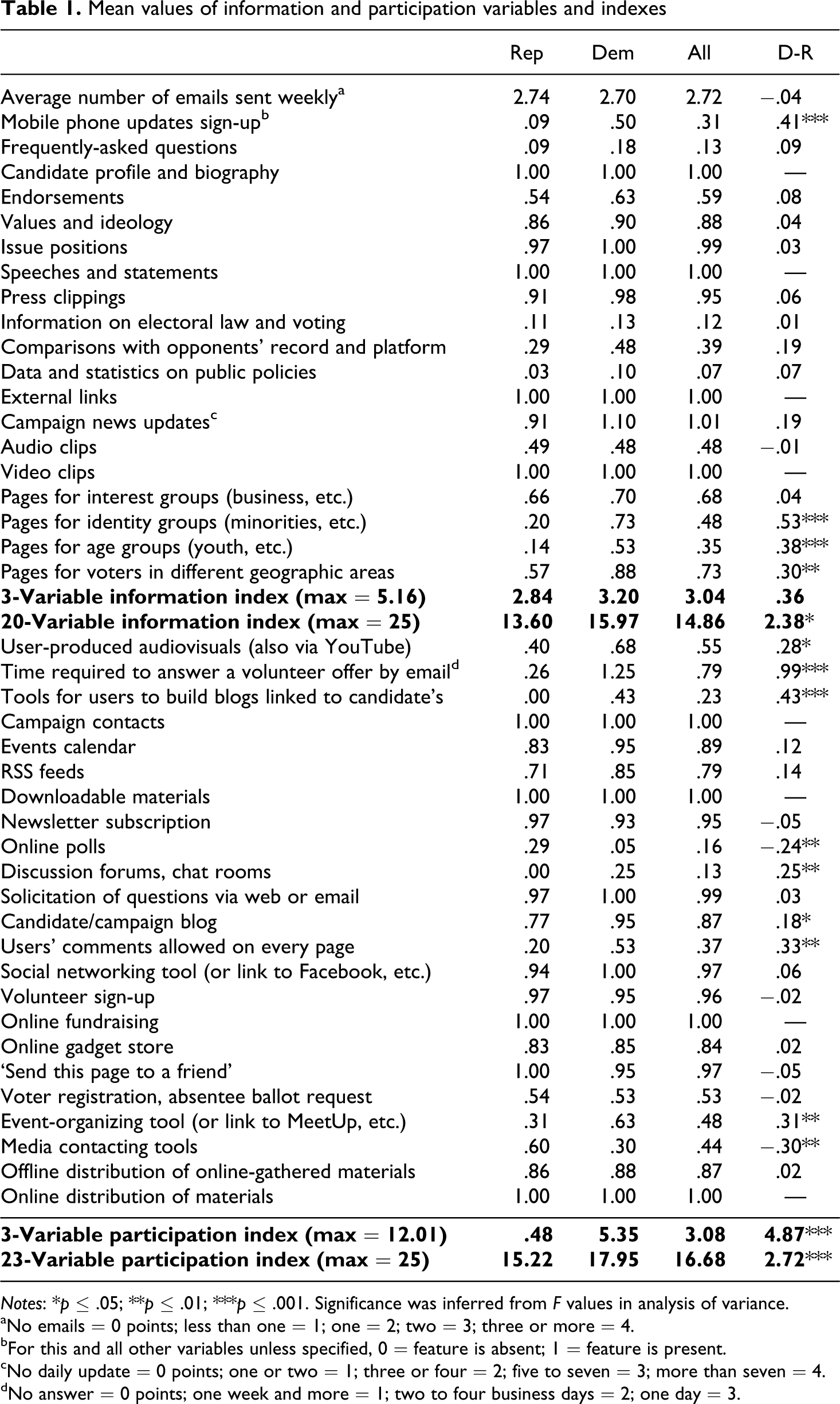
Notes: *p ≤ .05; **p ≤ .01; ***p ≤ .001. Significance was inferred from F values in analysis of variance.
aNo emails = 0 points; less than one = 1; one = 2; two = 3; three or more = 4.
bFor this and all other variables unless specified, 0 = feature is absent; 1 = feature is present.
cNo daily update = 0 points; one or two = 1; three or four = 2; five to seven = 3; more than seven = 4.
dNo answer = 0 points; one week and more = 1; two to four business days = 2; one day = 3.
The data partially contradict H1, which claimed that candidate websites would focus more on information than participation. While the three-item indices confirm the hypothesis, as the average values were similar but the participation index had a maximum value that was more than twice that of the information index, the indices resulting from the combination of the factor analysis and the meta-analysis show that Republicans and, especially, Democrats were more likely to offer engagement features than to provide content. Because the results vary according to which type of index is considered, we cannot conclude that candidates have reversed their online priorities, but vertical and horizontal endeavors on their websites were more balanced than has been found in the past.
Table 1 also shows statistically-significant differences between Democratic and Republican websites in the distribution of several features. Democrats were significantly more likely than Republicans to offer mobile phone updates, pages targeting identity groups, age groups, and voters in different geographic areas, campaign blogs and tools for users to build their own, discussion forums and chats, and tools to organize events, while they were also faster in answering emails from prospective volunteers; by contrast, Republicans relied more than Democrats on web polls and applications to contact the media. While these differences can be interpreted as signs that Democrats invested online more than Republicans, some differences might reflect the parties' specific electoral strategies. For instance, since the Democrats' social base is more fragmented than Republicans', it is not surprising that Democratic candidates' websites presented more targeted material than Republicans'; by contrast, Republicans' greater use of media contacting tools is consistent with their strategy to denounce the media as liberal and activate supporters against them.
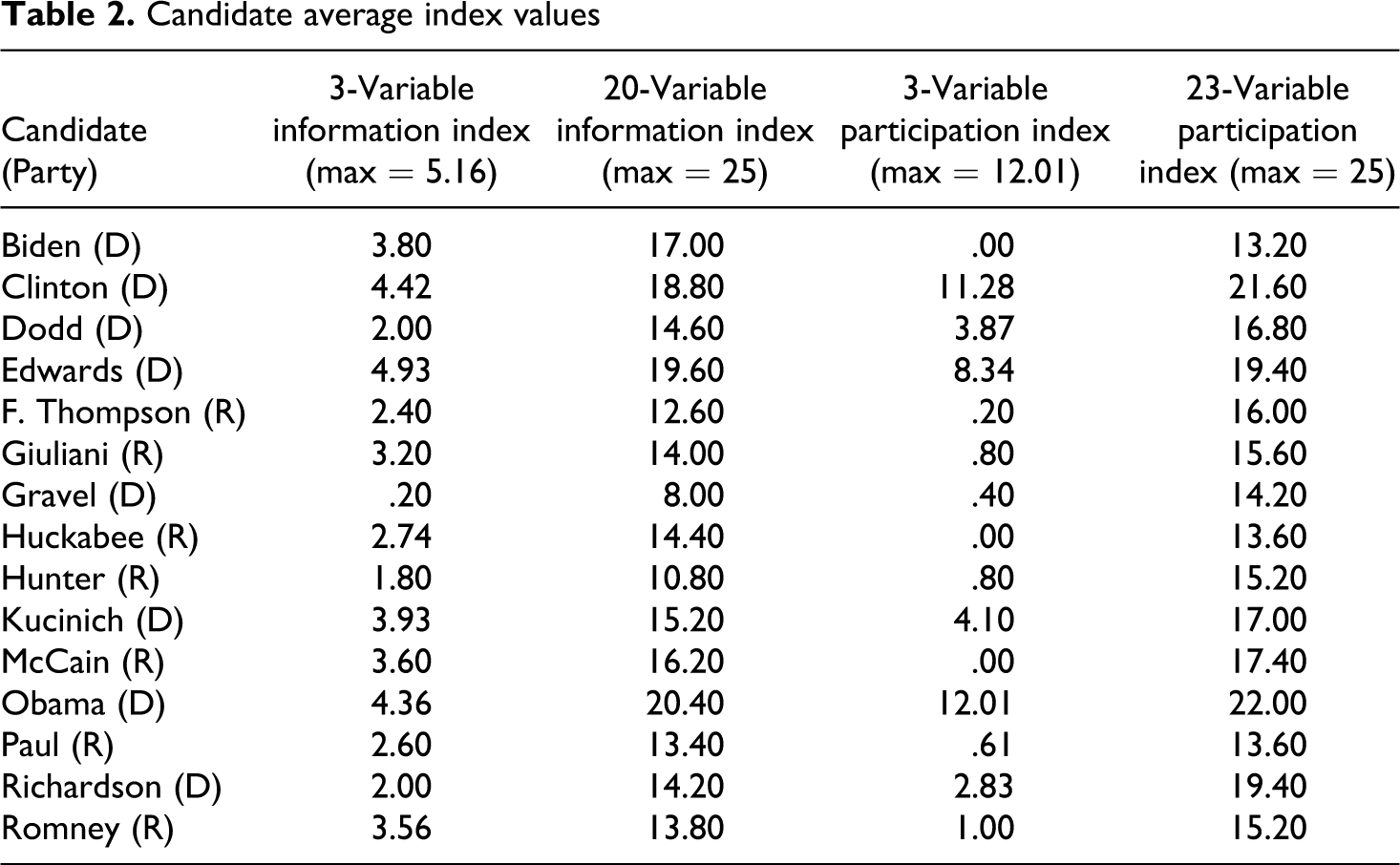
Table 2 offers an assessment of online competition at the individual candidate level and confirms that most Democrats' websites tended overall to have more features than the majority of Republicans'. The data also certify the superiority of Obama’s online operations compared to all other candidates, while among Republicans McCain’s website achieved the highest values.
Candidate average index values
So far I have presented anecdotal evidence of party-based differences in candidate websites. To systematically test the party divide and the remaining hypotheses, I ran four ordinary least squares (OLS) regression models where the indices of information and participation constituted the dependent variables and six independent variables were entered. H2 postulated that the passage of time would be positively correlated with the number of features on candidates' websites. Thus, I included a variable that measured the number of months that had elapsed since the beginning of the analysis. H3 hypothesized that the amount of money raised by candidates would be positively correlated with the number of features on their websites. To test this hypothesis, I entered a variable that measured the millions of dollars raised by each candidate in the previous filing with the Federal Election Commission. H4 claimed that Democrats' websites would present more features than Republicans'. To test it, I included party affiliation as a dichotomous variable, coded ‘0’ for Republicans and ‘1’ for Democrats. H5a claimed that the websites of candidates who were incumbent in any elective office at the beginning of the race would present more features than those of out-of-office candidates. To test this hypothesis, I included a dichotomous variable, coded ‘0’ for out of office and ‘1’ for non-presidential incumbent. H5b claimed that the years spent in public office would be negatively correlated with the amount of features on candidates' websites. To assess this hypothesis, I included a variable measuring the number of years for which a candidate had held elective office when the campaign started. Finally, H6 claimed that the less competitive the race was within each party, the fewer features would be found on candidates' websites. To test it, I included an independent variable reporting Gini’s concentration index of voting intentions among Democratic and Republican primary voters in the first Gallup poll of each month.
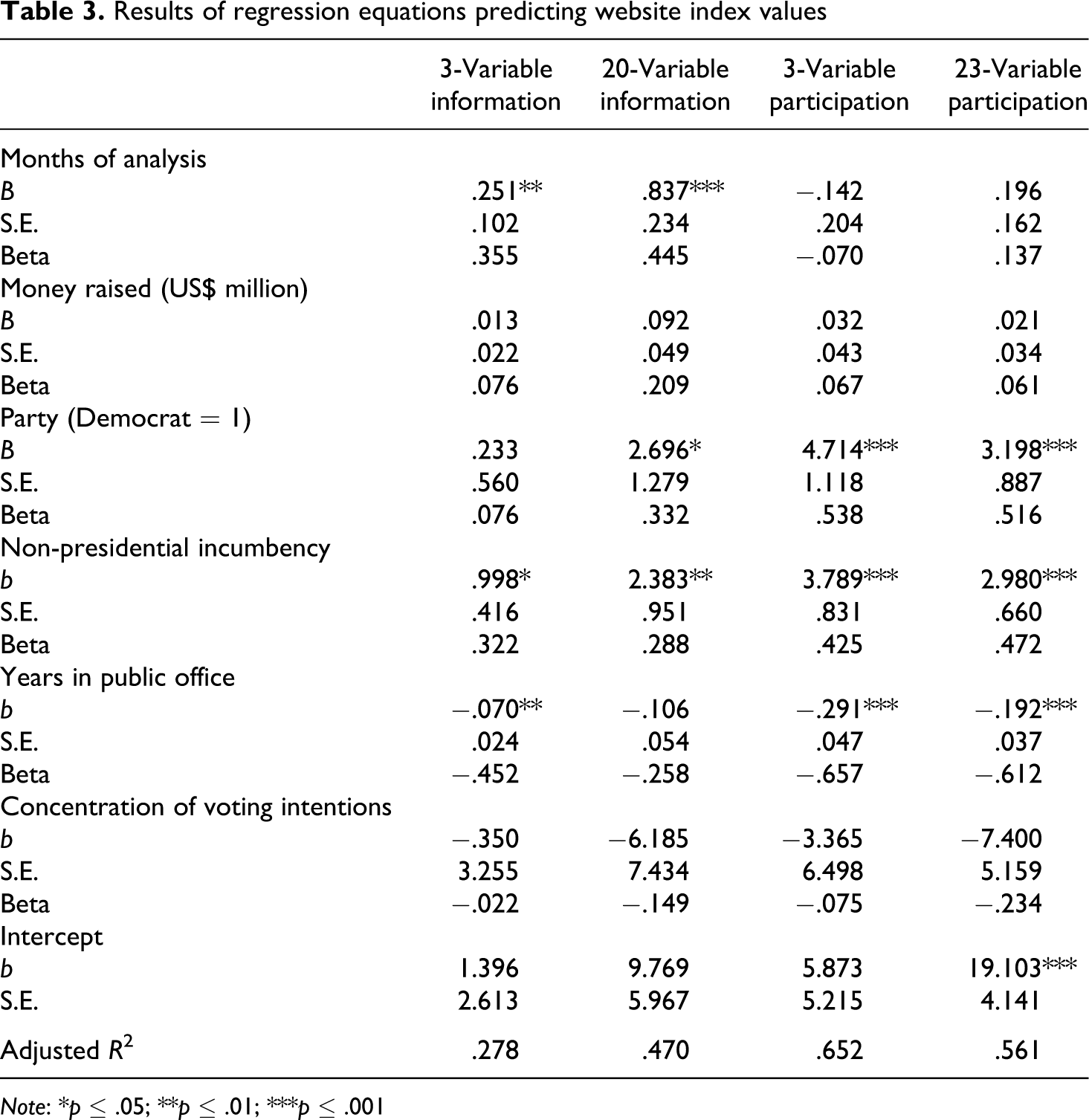
The results of the regressions are presented in Table 3 . As shown by the R2 values, the models account for a satisfactory portion of the variance, especially with respect to participation.
Results of regression equations predicting website index values
Note: *p ≤ .05; **p ≤ .01; ***p ≤ .001
The variable that most affected website features was party affiliation, which was positively correlated with all four indices, with three statistically-significant coefficients. The relationship was particularly strong with respect to participation: being a Democratic candidate increased by almost 5 (out of a maximum score of 12.01) the index of participation derived from factor analysis, and by more than 3 (out of a maximum score of 25) the index derived from a combination of the factor analysis and the meta-analysis. The party divide hypothesis (H4) was thus decisively upheld.
The models also provided support for the hypotheses related to candidates' tenure in public office. Non-presidential incumbency was positively correlated with all four indices and in all cases the correlation was statistically significant, thus validating H5a. The number of years spent in office was negatively correlated with all four indices with three statistically significant coefficients, thus confirming H5b.
The hypothesis related to the passing of time (H2) was supported for information, but not for participation. In order to disentangle the effects of time, I estimated models that included interaction effects between time and money raised as well as time and party. While no coefficient achieved statistical significance, the interaction variable for time and money always had positive coefficients and the one for time and party had negative coefficients in three of four regressions (data not shown). Thus, the effect of money seems to increase, and that of party affiliation to decrease, as time passes.
The other two hypotheses were not confirmed. The most conspicuous null finding involves the intra-party extension of the normalization theory (H3), as the correlation between funds raised and all four indices, while positive as predicted, never achieved statistical significance. The competitiveness of the race was also found to have no significant effect, although the coefficients were negative as predicted. H6 was thus rejected.
Conclusions
I suggest caution in interpreting these findings. Candidate websites constituted only a subset of Internet campaigning in the 2008 primaries and ‘Web 2.0’ platforms clearly played a major role alongside official outlets. The coding scheme measured whether websites included social-networking, event-organizing, and video-sharing applications, either built in-house or linked-to, but it did not assess how many people populated these spaces or how candidates employed them. A full evaluation of these aspects would usefully complement the data presented here. I must also acknowledge that, while this study aimed at clarifying how website functions are empirically distributed, the indices I constructed are imperfect measures of the underlying dimensions. Moreover, the data offer some insights into candidates' online strategies, but they cannot address the effects of Internet electioneering on citizens' information, attitudes, and behaviors, nor can they illuminate which particular facets of online campaigning affect resource mobilization and voting behavior. Therefore, future research should address the relationship between website features and user responses.
The findings confirm that, rather than adopting all available tools, candidates selectively construct their online campaigns by investing in some features and avoiding others, based on strategic calculations as well as individual and collective (i.e. party-related) preferences and campaigning styles. Thus incumbency in public office constitutes a solid base for online electioneering, most likely because mounting an effective presidential Internet campaign requires a degree of professionalism and organization that is more easily found among those who are already experienced in electoral politics. Online presidential campaigns are clearly no place for outsiders and, in this respect, normalization theory is relevant. However, the longer candidates had been in office, the less informing and, particularly, engaging their websites were. Candidates with longer tenures in politics were socialized to a campaigning style that does not easily integrate the Internet, while those who have been in electoral politics for shorter periods may be more open to innovation and earlier adopters of new media.
Although the positive effect of incumbency is consistent with normalization theory, the evidence that financial resources do not affect candidates' ability to build informing and engaging websites contradicts it. Because this finding runs counter to a vast US literature, I am compelled to offer some explanatory considerations. First, I observed the most heated part of a long campaign and limited the research to those candidates that sustained themselves throughout the most competitive six months in American elections: thus the candidates I studied, while unequally resourced, were all prepared for a very costly effort and started from a high financial baseline. Second, the evidence rejects intra-party normalization during presidential primaries within the two major parties, not normalization per se. Third, the 2008 primaries have proved that the Internet is less a cost factor than a revenue source, as shown by success stories such as Ron Paul’s and Obama’s. Thus, the question to be asked in the future may not be whether fundraising underwrites online campaigning, but whether online campaigning enhances fundraising.
Accordingly, the lack of clear support for the hypothesis related to the prominence of information vis-à-vis participation may signal that, at least at the US presidential level, candidates and their staffs are realizing that enabling supporter participation is not only a necessity dictated by voters' expectations, but an opportunity to mobilize valuable resources such as money, volunteer hours, and contacts.
The longitudinal analysis has shown that candidate websites added more informational features as the campaign progressed. This finding implies that the length of US campaigns is one of the reasons why online electioneering is more intense and innovative there than in other Western democracies. Unlike televised advertisements, online tools require time to be implemented and longer campaigns allow more time to experiment with, and accumulate resources for, innovative projects. Therefore, time may be a more important resource than money in online campaigns, particularly for poorly-financed candidates who can incrementally develop their Internet presence and take advantage of the fact that, once a tool has been built, the staff that has developed it can be redeployed to other online enterprises. However, web-based participatory platforms, such as campaign social networks and volunteer organizing tools, require large amounts of staff to manage relationships with users and monitor their activities (Vaccari, 2010). This may explain why a significant positive correlation was observed between time and information, but not participation.
The most significant finding is the party divide between Democratic and Republican candidates' websites. Previous research has claimed that adoption of online campaigning by political actors depends on internal variables such as party resources, incentives, and philosophical orientation (Nixon et al., 2003: 241). Future research should attempt at disentangling this causal puzzle and continue assessing the competitive outlook of web campaigning, as the gap that I found between Democratic and Republican candidates may have momentous implications for US party competition given the Internet’s growing electoral relevance.
Footnotes
Appendix 1. Meta-analysis of seven coding frames
| Variable | Farmer and Fender, 2005 | Foot and Schneider, 2006a | Galati and Williams, 2007 | Gibson et al., 2003 | Latimer, 2009 | Lusoli and Ward, 2005 | Norris, 2003 | Decision |
|---|---|---|---|---|---|---|---|---|
| Average number of emails sent weekly | Information (factor analysis) | |||||||
| Mobile phone updates sign-up | Delivery | Information (factor analysis) | ||||||
| Frequently-asked questions | Marketing | Information | Information (factor analysis) | |||||
| Candidate profile and biography | Informing | Content | Information | Content | Information | Information | Information | |
| Endorsements | Connecting | Content | Information | Information | ||||
| Values and ideology | Information | Information | ||||||
| Issue positions | Information | Informing | Content | Information | Content | Information | Information | Information |
| Speeches and statements | Information | Informing | Information | Content | Information | Information | Information | |
| Press clippings | Information | Information | ||||||
| Information on electoral law and voting | Engagement | Information | Information | Information | ||||
| Comparisons with opponents' record and platform | Connecting | Content | Information | Information | ||||
| Data and statistics on public policies | Informing | Content | Information | |||||
| External links | Networking | Connecting | Networking | Content | Information | Information | ||
| Campaign news updates | Information | Informing | Content | Content | Information | |||
| Audio clips | Informing | Content | Delivery | Content | Sophistication | Information | Information | |
| Video clips | Informing | Content | Delivery | Content | Sophistication | Information | Information | |
| Pages for interest groups (business, etc.) | Information | Information | ||||||
| Pages for identity groups (minorities, etc.) | Information | Information | ||||||
| Pages for age groups (youth, etc.) | Information | Information | ||||||
| Pages for voters in different geographic areas | Campaigning | Information | Information | |||||
| User-produced audiovisuals (also via YouTube) | Participation (factor analysis) | |||||||
| Time required to answer a volunteer offer by email | Participation (factor analysis) | |||||||
| Tools for users to build blogs linked to candidate's | Participation (factor analysis) | |||||||
| Campaign contacts | Networking | Involving | Content | Participation | Interactivity | Information | Communication | Participation |
| Events calendar | Campaigning | Involving | Engagement | Information | Interactivity | Information | Information | Participation |
| RSS feeds | Engagement | Participation | ||||||
| Downloadable materials | Mobilizing | Mobilization | Campaigning | Participation | ||||
| Newsletter subscription | Campaigning | Involving | Engagement | Campaigning | Interactivity | Engagement | Communication | Participation |
| Online polls | Involving | Engagement | Participation | Interactivity | Participation | |||
| Discussion forums, chat rooms | Participation | Interactivity | Engagement | Participation | ||||
| Solicitation of questions via web or email | Participation | Interactivity | Communication | Participation | ||||
| Candidate/campaign blog | Engagement | Participation | ||||||
| Users' comments allowed on every page | Involving | Participation | Interactivity | Participation | ||||
| Social networking tool (or link to Facebook, etc.) | Engagement | Participation | ||||||
| Volunteer sign-up | Recruiting | Involving | Engagement | Resource generation | Interactivity | Engagement | Communication | Participation |
| Online fundraising | Recruiting | Involving | Engagement | Resource generation | Interactivity | Engagement | Communication | Participation |
| Online gadget store | Campaigning | Mobilization | Resource generation | Interactivity | Communication | Participation | ||
| 'Send this page to a friend' | Mobilizing | Mobilization | Interactivity | Engagement | Participation | |||
| Voter registration, absentee ballot request | Participation | Connecting | Campaigning | Interactivity | Engagement | Participation | ||
| Event-organizing tool (or link to MeetUp, etc.) | Mobilization | Participation | ||||||
| Media contacting tools | Participation | Mobilizing | Mobilization | Interactivity | Participation | |||
| Offline distribution of online-gathered materials | Mobilizing | Mobilization | Campaigning | Participation | ||||
| Online distribution of materials | Marketing | Campaigning | Engagement | Participation |
Acknowledgments
I would like to thank Rasmus Kleis Nielsen, Sam Popkin, Michael Schudson, the editors, the three anonymous reviewers and all those who offered feedback on an earlier version of this paper presented at the ‘Politics Web 2.0’ international conference (Royal Holloway University of London, 2008). I am particularly grateful to Silvia Bianconcini for her invaluable assistance with the data analysis. This article was partially written during my residence as a visiting scholar at Columbia University’s Graduate School of Journalism, for which I would like to thank Michael Schudson for inviting me and the University of Bologna for providing a travel grant.