







Abstract
The left/right semantic is used widely to describe the patterns of party competition in democratic countries. This article examines the patterns of party policy in Anglo-American and Western European countries on three dimensions of left/right disagreement: wealth redistribution, social morality and immigration. The central questions are whether, and why, parties with left-wing or right-wing positions on the economy systematically adopt left-wing or right-wing positions on immigration and social morality. The central argument is that left/right disagreement is asymmetrical: leftists and rightists derive from different sources, and thus structure in different ways, their opinions about policy. Drawing on evidence from Benoit and Laver’s (2006) survey of experts about the policy positions of political parties, the results of the empirical analysis indicate that party policy on the economic, social and immigration dimensions are bound together by parties on the left, but not by parties on the right. The article concludes with an outline of the potential implications of left/right asymmetry for unified theories of party competition.
Introduction
This article widens the empirical front in the campaign to bring individual opinions and party competition under the same theoretical umbrella (Achen, 2002; Adams et al., 2005; Miller and Schofield, 2008; Roemer, 2001). Spatial theories of party competition now incorporate elements that are widely familiar to empiricists, including multidimensionality, issue salience and ideologically motivated political elites (Adams et al., 2005; Calvert, 1985; Chappell and Keetch, 1986; Cox, 1987; Miller and Schofield, 2008; Roemer, 2001; Wittman, 1983). Despite these developments, little attention has been devoted to the systematic differences between individuals and groups in the ways that policy preferences about multiple issues are bundled together. The following analysis focuses in particular on the patterns of party competition in Anglo-American and Western European countries on three dimensions of left/right disagreement: wealth redistribution, immigration and social morality. 1
Wealth redistribution is a long-standing source of political disagreement in democratic countries (Laponce, 1981). Issues surrounding gay rights and immigration have popped up more recently (Betz, 1994; Inglehart, 1977, 1990, 1997; Kitschelt, 1995; Kitschelt and Hellemans, 1990). The article examines how the origins of opinions about these issues shape the contours of left/right disagreement. The central questions are whether, and why, parties with left-wing or right-wing positions on the economy systematically adopt left-wing or right-wing positions on immigration and social morality. On this front, an important advantage of the comparative approach is that it disentangles the broader trends in party-positioning from the peculiar patterns of competition and alliances that may prevail from time to time in individual countries.
The core argument is that the content and structure of opinions are congenitally entwined. Recent studies have found that people who think about a political issue in different ways are also likely to package that issue alongside altogether different elements of their political and social environment (Cochrane, 2010). From this perspective, the distinctive origins of left-wing and right-wing ideas give rise to differences between leftists and rightists in the ways that they bundle together their opinions about multiple issues, including wealth redistribution, social morality and immigration. Predictable left/right asymmetries have been found in the patterns of public opinion within countries and in the political preferences of party activists within parties (Cochrane, 2010). Do the patterns of party policy reflect these asymmetries?
Theory
Theories of political disagreement commonly adopt at least one of the following postulates: unidimensionality (e.g. Downs, 1957b; see Budge et al., 2001), mirror-image symmetry (e.g. Laponce, 1981; Miller and Schofield, 2008; but see Conover and Feldman, 1981), and a mass-elite dichotomy (e.g. Downs, 1957a; McClosky and Zaller, 1984; Zaller, 1992). The first of these constraints manifests itself most clearly in the notion of a single left/right continuum; an assumption that has been challenged and defended on empirical grounds (e.g. Conover and Feldman, 1981; Klingemann et al., 2006; Stokes, 1963; Weisberg, 1980). The second constraint, mirror-image symmetry, is the political science equivalent of Newton’s third law of motion: for every set of opinions there is an equal and opposite set of opinions (Laponce, 1981). The third constraint, a mass-elite dichotomy, is at the centre of a core conceptual disagreement in the study of political competition: to what extent do voters respond to party cues rather than the other way round (Campbell et al., 1960; Goren, 2005)?
This article builds from a less ordered conceptualization of political disagreement. The core assumption is that there are no inherent or normative connections between opinions or policies about any two issues (cf. Converse, 1964). The organization of policy preferences is a dependent variable worthy of its own hypotheses (Hurwitz and Peffley, 1987). On this point, the evidence indicates that while people may be born with predispositions, they are not born with ready-made opinions (Alford et al., 2005, 2008). Opinions are formed through interactions of individual-level factors like personality, religiosity, partisanship and rationality (i.e. self-interest) and social factors like family upbringing, religion, party membership and socio-economic class (Hatemi et al., 2007; Lipset, 1960). Each of these influences generates a distinctive intersection of opinions for individuals and groups by affecting simultaneously more than one opinion. There are distinctive consequences for different configurations of influences. And each person is often subject to influences that push in opposing directions about exactly the same issues (Lipset and Rokkan, 1967). Conceptualizing opinions as intervening variables – that is, as ideas that do not exist a priori – limits the empirical prospects of mirror-image symmetry for three reasons. First, some of the best known influences on public opinion fail to generate comprehensive bundles of opinions about the universe of politically salient issues. Whatever the innate propensity toward religiosity, the dominant religious traditions in Western countries proscribe homosexuality and abortion but are not as consistently one-sided when it comes to tax policy and government spending initiatives. Thus, there is no guarantee that the complete preferences of any two individuals cover the same range of issues. Individuals may agree on some issues and disagree on others, but it is also possible that there could be no agreement or disagreement of any kind in cases where two or more sets of preferences plough altogether parallel segneuries of ideational terrain.
Second, diametrically opposing levels of exposure to a particular influence do not generate opposing opinions. Non-exposure should have no effect on opinions rather than an equal and opposite effect on the same range of opinions. Strongly pro-choice positions on abortion do not stem from ‘non-religion’, even though non-religion may underlie indifference and non-opinions about the issue. Conversely, strongly pro-life positions on abortion do not emerge from non-feminism, even though a non-commitment to gender equality may also underlie non-opinions and indifference about abortion. In short, different opinions about precisely the same issue stem nonetheless from different sources.
Third, two individuals can share the same opinion about the same issue, but for entirely different reasons. These different reasons can in turn underlie opposing opinions about some other issue. A highly religious citizen and a xenophobe may share an identical opinion about gays and lesbians, but they may part company in their opinions about abortion and immigration. Thus, the extent to which two individuals share common cause across multiple dimensions of political disagreement is not simply contingent on their agreement on a single issue, but also on the reasons for their agreement on that issue.
Taken together, there are few reasons to expect that symmetrical opposition across multiple dimensions of political thought is a characteristic of real-world political disagreement. Indeed, political parties are conglomerations of leaders and activists with shared and opposing objectives about the purpose and direction of the party (Aldrich, 1983; Kitschelt, 1994; Miller and Schofield, 2008). If interests, beliefs and predispositions influence the opinions of voters in the electorate, then it seems reasonable to suppose that these influences bear down on the opinions of party insiders as well (Aldrich, 1983; Wittman, 1983). And if party policy reflects the effort by politicians to balance the sometimes competing demands of policy-seeking activists, on the one hand, with the strategic pressures toward office-seeking positions on the other (Conger and McGraw, 2008; Miller and Schofield, 2008), then how party activists organize their policy preferences across multiple dimensions of political disagreement is likely to affect in important ways how this balancing act plays out. For this reason, the following analyses abandon the notions of a single-dimensional political world, symmetrical preference structures and a mass-elite dichotomy.
Postulates and hypotheses
There are at least four distinct ideological orientations that play key roles in shaping left/right opinions on the economic, social and immigration dimensions. These ideological orientations are equality (Bobbio, 1996), free-market materialism (Inglehart, 1977, 1990, 1997), religion and out-group intolerance (Laponce, 1981). The theory adopted here proposes that political disagreements emerge when different ideologies push in opposing directions on opinions about the same issue. While a commitment to the principle of equality may underlie support for same-sex marriage (Bobbio, 1996; Matthews, 2005), it does not follow that a commitment to ‘inequality’ is what drives opposition to same-sex marriage. Rather, opposition to same-sex marriage may well stem from altogether different ideologies, like religion or out-group intolerance. This distinction is more than pedantic. It opens the possibility of fundamental differences between leftists and rightists in the way that they structure their opinions about the political world. These asymmetries are likely to manifest themselves at the level of party policy via the influences of core beliefs and values on the policy-seeking positions of party activists (Aldrich, 1983; Chappell and Keech, 1986; Wittman, 1983). 2
According to Bobbio (1996), the ideological underpinning of the political left is the abstract commitment to equality. Equality binds together for left-wing activists their opinions about the economy, social morality and immigrants. Political activists who support wealth redistribution, despite their own socio-economic security, are likely to adopt left-wing positions on the social and immigration dimensions. As a result, left-wing parties that are far removed from the centre on any one of these policy dimensions are likely to be far-removed from the centre on the other policy dimensions as well. These parties are constrained, in effect, by the left-wing positions that their activists hold on multiple dimensions of political disagreement. Thus, the first expectation, H1, is that political parties with left-wing positions about the economy will also tend to hold left-wing positions about social morality and immigration.
The expectations are somewhat different when it comes to religion, free-market materialism and out-group intolerance. These ideological influences do not transcend to the same extent as equality the multiple dimensions of left/right disagreement. Religions tend to generate right-wing opinions about social morality, but they are not systematically one-sided when it comes to wealth redistribution and immigration (Laponce, 1981). Free-market materialism may well generate right-wing opinions about the economy, but free-market materialists are probably indifferent when it comes to ‘post-material’ debates surrounding immigration and social morality (Inglehart, 1997: 109). And those who harbour out-group animosity are likely to express negative opinions about people who are different, including, typically, gays, lesbians, racial minorities and immigrants, but there is little reason to suppose that out-group intolerance affects opinions about wealth redistribution (Ivarsflaten, 2005), at least insofar as that redistribution does not benefit disproportionately people from undesirable out-groups (Gilens, 1995, 1996). As a result, political parties that are constrained by the convictions of their activists on one of these dimensions are not necessarily constrained on these other dimensions.
More formally, then, the second hypothesis, H2, is that political parties with right-wing positions on social morality will not necessarily adopt right-wing positions on the economic and immigration dimensions. The third hypothesis, H3, is that parties with right-wing opinions on the economic dimension will not necessarily have right-wing opinions on the social and immigration dimensions. And the fourth hypothesis, H4, is that parties with right-wing opinions on the immigration dimension will tend to have right-wing opinions on the social dimension, but they will not necessarily have right-wing positions on the economic dimension. The core point in the case of H4 is that the activists who dislike out-groups are unlikely to accept left-wing positions about either immigration or homosexuality. In effect, then, H2 and H4 combine to suggest that anti-immigrant parties are likely to be socially conservative, but socially conservative parties are not necessarily anti-immigrant.
Empirical findings
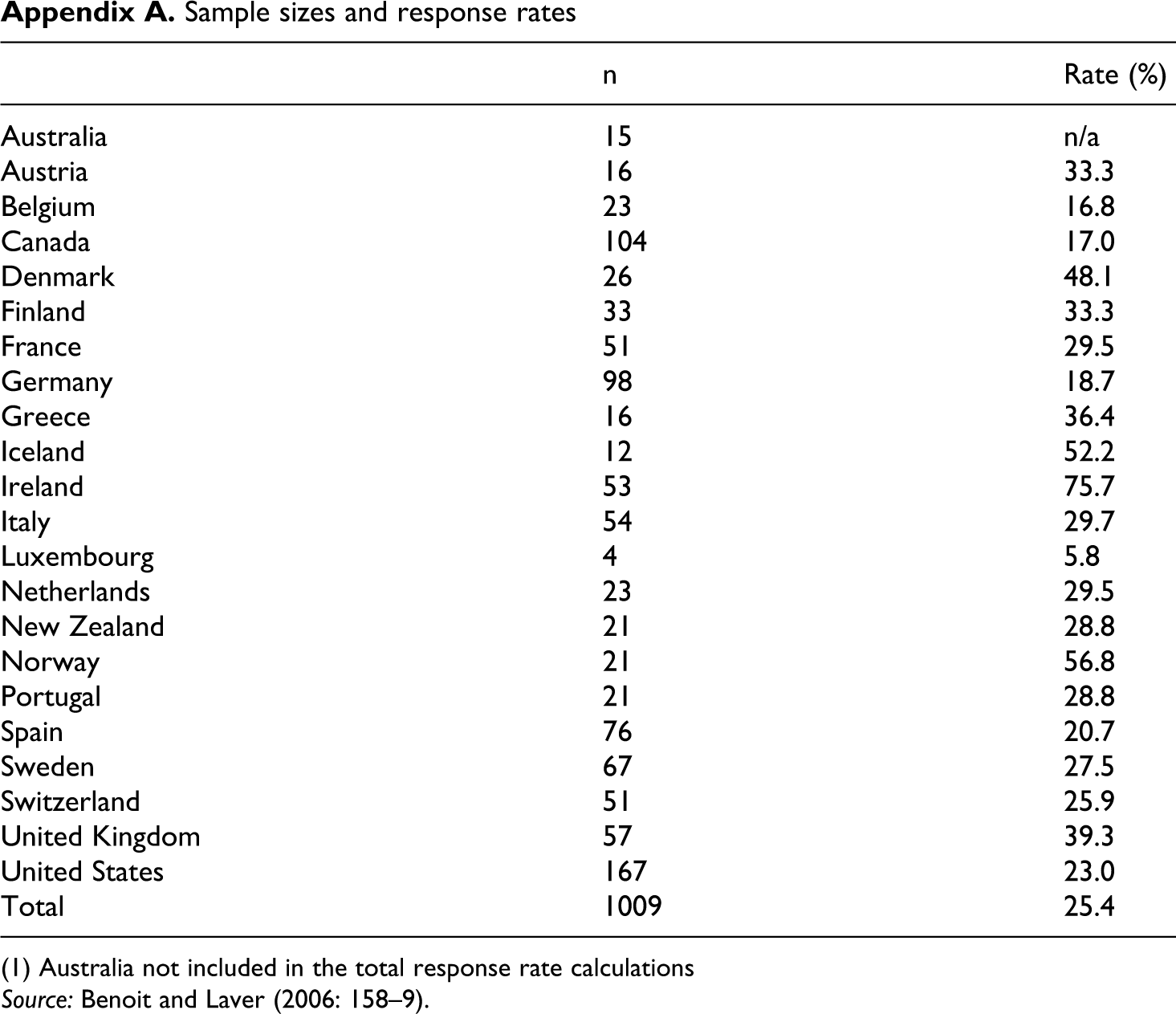
To test these hypotheses, the analysis turns to data from Benoit and Laver’s (2006) survey of experts about the policy positions of political parties. Benoit and Laver (2006) surveyed a total of 1009 political scientists and national political experts from Western European and Anglo-American countries. Each expert was asked to locate the positions of the political parties in their country on a common battery of policy dimensions. These data are useful in research designs where it is necessary to treat the policies of a political party as potentially different from the opinions of the party’s supporters in the electorate. The current analysis focuses in particular on party positions in 22 countries along three dimensions of left/right disagreement: ‘taxes versus spending’, ‘immigration’ and ‘social liberalism’. 3 The cross-national breadth includes the 22 Western European and Anglo-American countries that were covered in Benoit and Laver’s (2006) survey. And the analysis includes all of the political parties that received at least some (i.e. > 0.0 percent) of the popular vote in a national election. 4
Overall, the political parties are distributed somewhat unevenly across the immigration and social dimensions. About 60 percent of the parties are to the left of the centre (i.e. <10.5) on each of these dimensions. On the economic dimension, the parties divide symmetrically to the left and right of the centre. There are 83 parties on the economic left (53 percent); 74 parties on the economic right (47 percent). Nevertheless, party policies on the economic, social and immigration dimensions are firmly intertwined. The correlations (Pearson’s r) between positions on the economic dimension and positions on the social and immigration dimensions are 0.59 and 0.72, respectively. The correlation between party policies on the immigration and social dimensions is even stronger: 0.82. The strength of these relationships is also reflected in their respective slopes: moving 10 points to the right on the economic dimension is associated, on average, with a 7-point increase in social conservatism and an 8-point increase in anti-immigration. Similarly, there is a 9-point increase in social conservatism that accompanies each 10 points rightward on the immigration dimension.
A closer inspection of party policies reveals that the strength of the linkages between party policies on the economic, immigration and social dimensions varies systematically across the political spectrum. Figure 1 plots the positions of parties on the economic (x-axis) and immigration (y-axis) dimensions. Political parties that combine their policy positions into ‘left–left’ packages are in the bottom-left quadrant of the plane; parties with ‘right–right’ packages are in the top-right quadrant. Thus, the axis of ‘left–right’ disagreement runs diagonally from the bottom-left to the top-right corner in the graph. Linear (OLS) regression estimates of the magnitudes of the relationships are provided underneath the Figure. 5 Notice how the positions of political parties – the dots in the graph – appear to trend diagonally from the bottom-left to the upper-right. The OLS estimates confirm this observation: the line of best fit begins at 2.0 on the y-axis when tax/spend is at 1 (i.e. 1.54 + 1 (0.796) = 2.0), and it slopes upward to 17.5 on the y-axis when tax/spend is at 20 (i.e. 1.54 + 20 (0.796) = 17.5). Yet, note as well that the parties on the economic left are clustered together, and the parties on the economic right are comparatively dispersed. As positioning on the economic dimension moves from left to right, the distance between the points in the graph increases substantially. The interpretation is straightforward. Immigration and economic policies are bundled tightly by parties on the left. But the immigration policies of political parties on the economic right are spread more evenly across the left/right continuum.
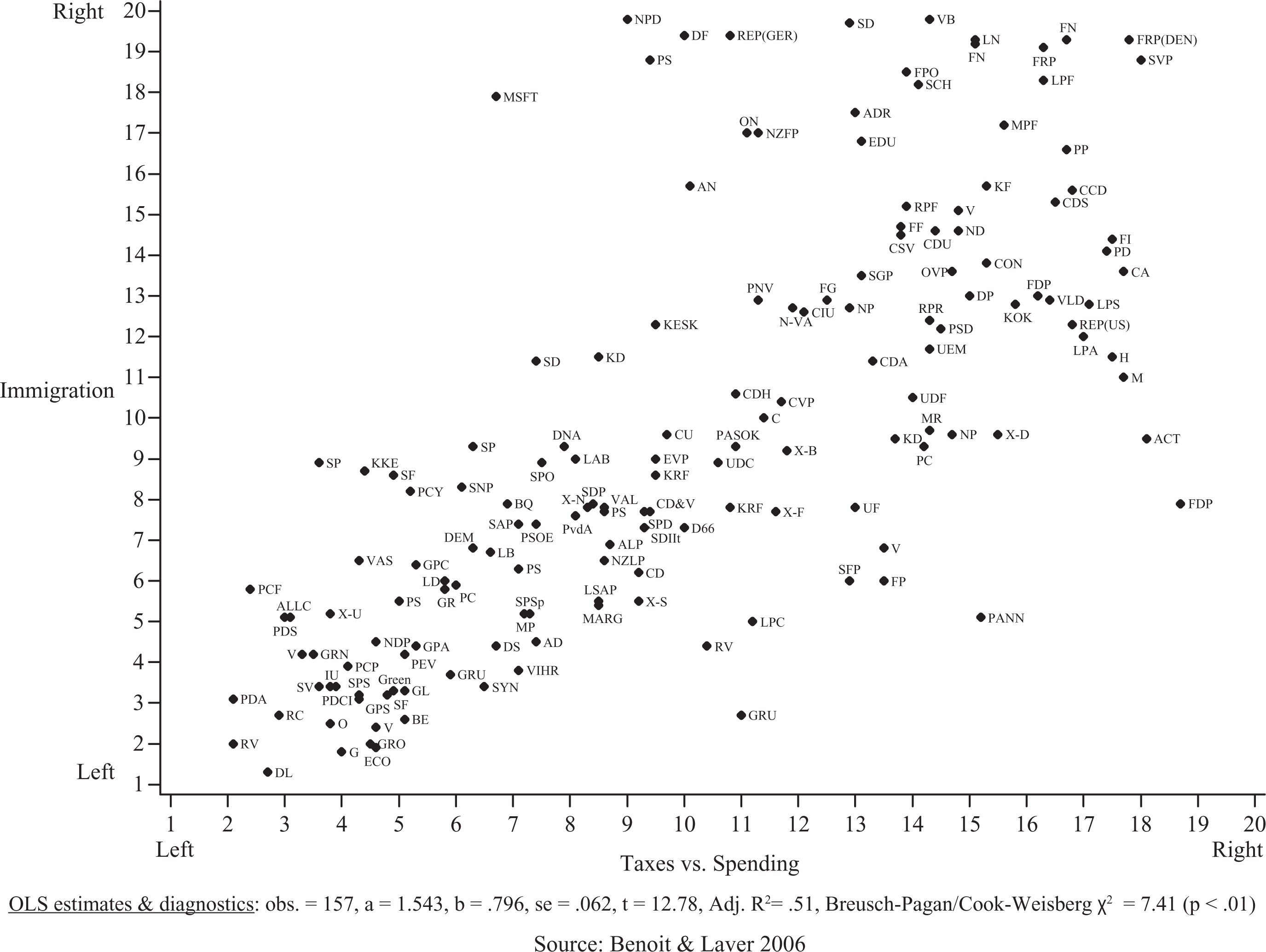
Party policy on the economic and immigration dimensions in two-dimensional space
The results summarized in Figure 2 reflect a more pronounced version of the same pattern. Party positions on the economic dimension are summarized along the x-axis, and the y-axis corresponds to policy positions on the social liberalism dimension. Notice, first, that the regression line runs from the southwest to the northeast quadrant: the line begins at 3.1 on the social liberalism scale when tax/spend is at 1 (i.e. 2.43 + 1 (0.715) = 3.1), and it ends at 16.7 on the social liberalism scale when tax/spend is at 20 (i.e. 2.43 + 20 (0.715) = 16.7). In this case, however, the discrepancy between the coherence of the economic left, on the one hand, and the fragmentation of the economic right, on the other, is even more striking. The left-wing parties are huddled together in the bottom-left quadrant. But the social policies of economically conservative parties are strewn across the left/right continuum. Indeed, of the 29 parties on the far economic right (i.e. ≥15), 40 percent of them are to the left of centre in their social polices. By comparison, not one of the 31 parties on the far economic left (i.e. ≤ 5) is to the right of centre in its social policies. There is, in short, a clear left–left pattern, but there is no right–right pattern. More formally, the magnitude of the relationship between the economic and social dimensions declines as economic policies move from left to right.
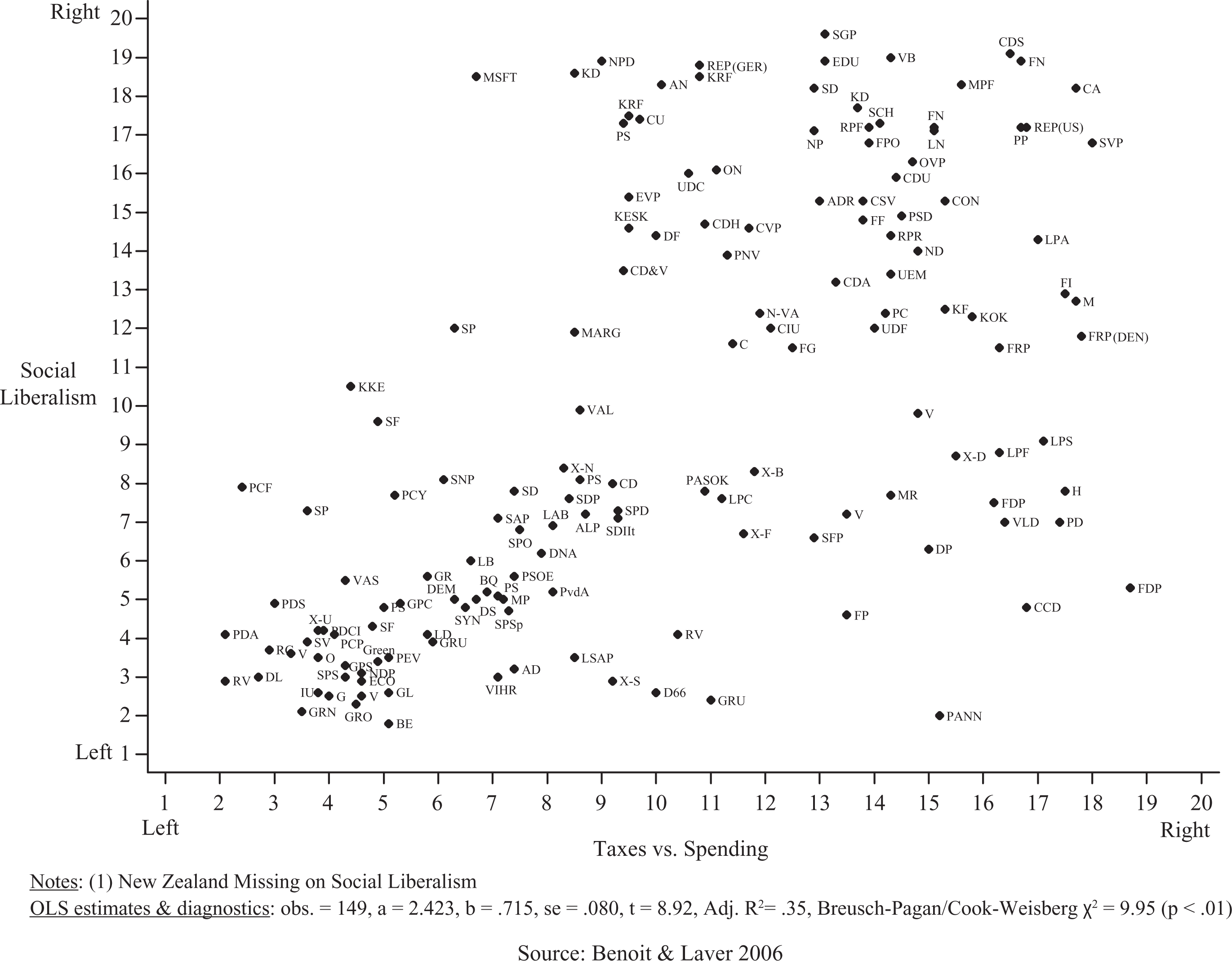
Party policy on the economic and social liberalism ldimensions in two-dimensional space
To this point, one plausible explanation for the fragmentation of the right is that there are, in effect, two rights: an economic right and a non-economic right. Parties on the economic right adopt right-wing positions on taxation and spending; parties on the non-economic right take up right-wing positions on social liberalism and immigration. An implication of this line of argument is that measuring the fragmentation of economically conservative parties by looking separately at their positions on the social and immigration dimensions is tantamount to double-counting: right-wing parties are not twice fragmented in their social and immigration policies, but singularly fragmented between an economic and a non-economic right.
The evidence in Figure 3 provides little support for this line of reasoning. Figure 3 plots the positioning of political parties on the immigration and social dimensions. On the whole, the connection between policies on the immigration and social dimension is very strong. The trajectory of the regression line slopes upward from left to right: it begins at 2.1 on the social dimension when immigration policy is at 1 (i.e. 1.181+ 1 (0.877) = 2.1), and it ends at 18.7 on the social dimension when immigration policy is at 20 (i.e. 1.181 + 20 (0.877) = 18.7). Indeed, the variation on the immigration dimension explains 67 percent of the variation on the social dimension. Even so, the magnitude of the relationship is not distributed evenly across the left/right continuum. The results indicate a great deal of left-wing coherence. Notice the cluster of parties in the bottom-left corner of the graphic. Of the 33 political parties on the far pro-immigrant left (i.e. ≤ 5), 100 percent are to the left of the centre on the social dimension. And of the 45 parties on the far social left (i.e. ≤ 5), all but one of these parties (98 percent) are to the left of centre on the immigration dimension.
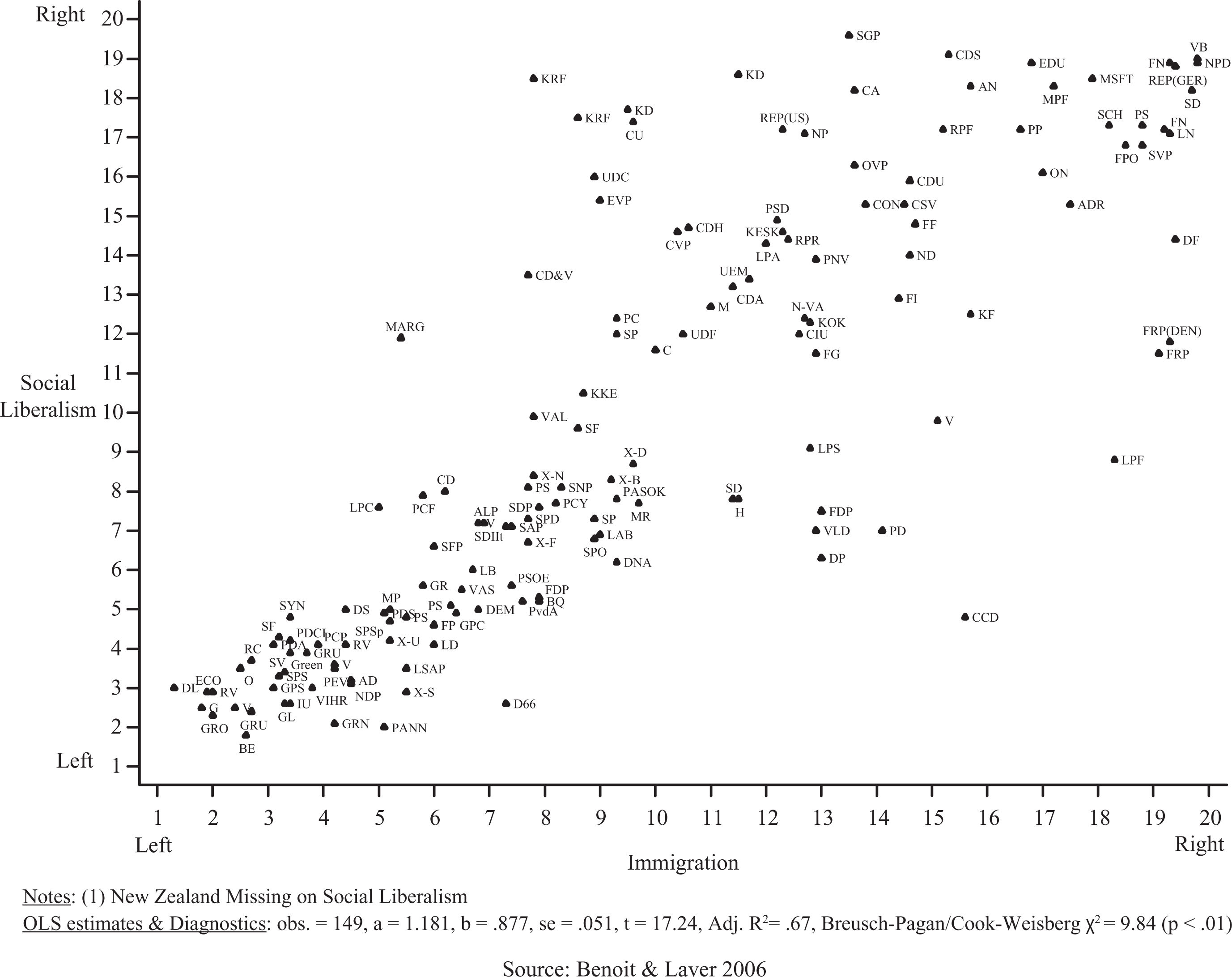
Party policy on the immigration and social liberalism dimensions in two-dimensional space
The distribution of parties on the right, however, is more spread out. There is no single ‘non-economic’ right. But there is a caveat. Far-right anti-immigration parties are socially conservative, but socially conservative parties are not opposed to immigration. Of the 27 political parties on the far anti-immigrant right (i.e. ≥15), all but 3 (89 percent) of these parties are to the right of centre in their social policies. Despite the social conservatism of anti-immigration parties, 10 of the 43 political parties (23 percent) on the far social right are actually to the left of centre in their immigration policies. In short, the fragmentation of the right is uneven. There appears to be little about social conservatism that generates opposition to immigration, but something about opposition to immigration that generates social conservatism. There is an unrequited relationship, it seems, between the anti-immigrant right and the socially conservative right.
Taken together, the results of these analyses indicate that party policies on the economic, immigration and social dimensions are organized coherently among parties on the left, but not among parties on the right. These findings differ in a few ways from the kinds of expectation that arise from the ‘economic-left/social-left’ and the ‘economic-right/social-right’ dichotomies (for a discussion, see Conover and Feldman, 1981: 618; Miller and Schofield 2008: 433). There is little evidence here of a distinction between an ‘economic left’, on the one hand, and a ‘non-economic left’ on the other. Political parties are likely to differ in the extent to which they prioritize their positions on the economic, social and immigration dimensions, but when it comes to their positions on these dimensions the political parties that are on the economic left are simultaneously on the immigration and social lefts. Indeed, there are 31 political parties on the far economic left (i.e. ≤5); 100 percent of these parties are simultaneously to the left of centre on the immigration and social dimensions. In policy terms, there is only one left on these issues; not two. H1 is therefore confirmed.
The evidence for a distinction between the ‘economic’ and ‘non-economic’ right is similarly tenuous, but for precisely the opposite reason: there appear to be three rights, rather than two rights. There is an economic right, a social right and an anti-immigrant right. As a result, the political parties that occupy the ‘right-wing’ on a single-dimensional left/right continuum are in fact scattered, in multiple dimensions, across the political landscape. Socially conservative parties are not invariably committed to right-wing positions on the economic and immigration dimensions. H2 is therefore confirmed. Fiscally conservative parties are flexible in their positions about social issues and immigration. H3 is therefore confirmed. And anti-immigrant parties are systematically conservative in their positions on social issues, but they are spread quite evenly across the economic dimension. H4 is therefore confirmed as well.
Conclusion
In this article I have argued that the discrete ideological underpinnings of left-wing and right-wing ideas generate asymmetries between the left and the right in the ways that ideologues bundle together their opinions across multiple dimensions of political disagreement. The article hypothesizes that party policies in Anglo-American and Western European countries would reflect these asymmetries as differences between left-wing and right-wing parties in the cross-national consistency of their positions on the economic, social and immigration dimensions. In particular, the positions of left-wing political parties were expected to be bound across multiple dimensions by the tendency of left-wing activists to organize around the principle of equality of their opinions about wealth distribution, social morality and immigration. And yet the same level of constraint was not expected to apply to parties on the political right because the influence of various right-wing ideologies is not spread as extensively across the multidimensional space of political disagreement.
The core argument in this article is that asymmetries in the ideological underpinnings of left-wing and right-wing activists generate asymmetries in the multidimensional coherence of left/right disagreement. The patterns of party policy are consistent with an argument of left/right asymmetry. Although there is evidence that this same finding emerges in the opinions of voters and in the preferences of political activists (Cochrane, 2010), more direct tests of the explanation proposed here will have to examine in cross-national perspective the preference structures of individuals, especially the activists and leaders within left-wing and right-wing parties. Moreover, it is worth emphasizing that there is no guarantee that these findings will persist outside the Anglo-American and Western European political context. According to the theory proposed in this article, the patterns of public opinion are constrained by the predispositions of activists, but they are not determined by these predispositions. As Zaller (1992: 6) has argued, ‘every opinion is a marriage of information and predisposition: information to form a mental picture of the given issue, and predisposition to motivate some conclusion about it. This article has argued that the information–predisposition nexus in Anglo-American and Western European countries generates asymmetries between the left and the right when it comes to opinions about the issues of immigration, social morality and wealth redistribution. There is no guarantee that these same patterns would persist in contexts where these issues are framed in different ways.
Even so, if the core argument proposed here turns out to be correct, then it is likely to have notable implications for theories about the internal dynamics of political parties in Anglo-American and Western European countries. One implication, for example, is that left-wing parties are more likely than are their right-wing counterparts to resemble an assemblage of like-minded individuals. Right-wing parties, by contrast, look more like a pragmatic coalition of different groups, particularly when these parties run on right-wing agendas across multiple policy dimensions. These internal configurations could turn out to be mixed blessings for right-wing and left-wing parties. On the one hand, the ideological coherence within left-wing parties may render them less susceptible to fragmentation, at least on those policy dimensions that are within the reach of egalitarian frames. On the other hand, however, the concerted multidimensional pull of left-wing activists may make it more difficult for pragmatic politicians to manoeuvre these parties toward the political centre. In mixed right-wing parties, by contrast, social conservatives may be able to work alongside party pragmatists for office-seeking positions on the economic dimension (e.g. Conger and McGraw, 2008: 261). And fiscal conservatives may be able to work alongside party pragmatists for office-seeking positions on the social dimension. Presumably, neither the fiscal conservatives nor the social conservatives will want to jeopardize their party’s shot at political power for the sake of ideological purity on policy dimensions that they care nothing about. In effect, then, right-wing pragmatists may be able to pit ideologues against each other in a way that the pragmatists on the left cannot. As a result, the ‘electoral pull’ may be stronger vis-à-vis the ‘activist pull’ in multidimensional right-wing parties than it is in multidimensional left-wing parties (Miller and Schofield, 2008: 435). Even so, the activist pull that drives left-wing parties leftward drives right-wing parties apart. In this respect, the prospect of left/right differences in the origins and organization of opinions may pose unique challenges for left-wing and right-wing parties.
Footnotes
Appendix A. Sample sizes and response rates
| n | Rate (%) | |
|---|---|---|
| Australia | 15 | n/a |
| Austria | 16 | 33.3 |
| Belgium | 23 | 16.8 |
| Canada | 104 | 17.0 |
| Denmark | 26 | 48.1 |
| Finland | 33 | 33.3 |
| France | 51 | 29.5 |
| Germany | 98 | 18.7 |
| Greece | 16 | 36.4 |
| Iceland | 12 | 52.2 |
| Ireland | 53 | 75.7 |
| Italy | 54 | 29.7 |
| Luxembourg | 4 | 5.8 |
| Netherlands | 23 | 29.5 |
| New Zealand | 21 | 28.8 |
| Norway | 21 | 56.8 |
| Portugal | 21 | 28.8 |
| Spain | 76 | 20.7 |
| Sweden | 67 | 27.5 |
| Switzerland | 51 | 25.9 |
| United Kingdom | 57 | 39.3 |
| United States | 167 | 23.0 |
| Total | 1009 | 25.4 |
(1) Australia not included in the total response rate calculations
Source: Benoit and Laver (2006: 158–9).
Appendix B
| Australia | |
| GRN | Greens |
| AD | Democrats |
| ALP | Labour Party |
| NP | National Party |
| LPA | Liberal Party |
| ON | One Nation |
| Austria | |
| SPO | Social Democrats |
| GRU | Greens |
| FPO | Freedom Party |
| OVP | People’s Party |
| Belgium | |
| VB | Flemish Bloc |
| PS | Socialist Party |
| N-VA | New Flem. All. |
| GRO | Groen! |
| FN | National Front |
| ECO | Ecolo |
| CDH | Hum. Dem. Center |
| CD&V | Chris. Dem. & Flem. |
| SPSp | SP.A-Spirit |
| MR | Ref. Movement |
| VLD | Flem. Lib. & Dem. |
| Canada | |
| LPC | Liberal Party |
| BQ | Bloc Quebecois |
| CA | Canadian Alliance |
| GPC | Green Party |
| NDP | New Dem. Party |
| PC | Prog. Conservative |
| Denmark | |
| K | Kons. Folkeparti |
| V | Liberal |
| CD | Center Democrats |
| DF | People’s Party |
| O | Red–Green Alliance |
| FRP | Progress Party |
| KRF | Christ. People’s |
| RV | Radical Lib. Party |
| SD | Social Democrats |
| SF | Soc. People’s Party |
| Finland | |
| KESK | Centre Party |
| SDP | Social Democrats |
| SFP | Swedish People’s |
| KD | Christ. Democrats |
| KOK | Nat. Coal. Party |
| PS | True Finns |
| VAS | Left Alliance |
| VIHR | Green League |
| France | |
| UDF | Un. p. Dem. Fra. |
| RPF | Ras. p. la France |
| RPR | Ras. p. la Repub. |
| UEM | Union en Mouve. |
| FN | Front Nationale |
| MPF | Mouve. p. la FRA |
| PCF | Parti Communiste |
| PS | Parti Socialiste |
| V | Les Verts |
| Germany | |
| SPD | Social Dem. Party |
| GRU | Green Party |
| CDU | Christ. Dem. Un. |
| DVU | People’s Union |
| FDP | Free Dem. Party |
| NPD | Nat. Dem. Party |
| PDS | Par. of Dem. Soc. |
| REP | Republicans |
| SCH | Recht. Offensive |
| Greece | |
| ND | Nea Dimokratia |
| KKE | Komm. K. Ella. |
| PASOK | Pan. Sos. Kin. |
| SYN | Synaspismos |
| Iceland | |
| X-D | Indep. Party |
| X-B | Progressive Party |
| X-F | Liberal Party |
| X-N | New Force |
| X-S | Social Dem. All. |
| X-U | Left–Green Mov. |
| Ireland | |
| FF | Fianna Fail |
| PDS | Prog. Democrats |
| FG | Fine Gael |
| GRU | Greens |
| LB | Labour |
| SF | Sinn Fein |
| Italy | |
| FI | Forza Italia |
| AN | Allenza Nazionale |
| LN | Lega Nord |
| DS | Dem. di Sinistra |
| Green | Fed. dei Verdi |
| VAL | Lista di Pietro |
| MSFT | Mov. Soc. Fl. Tri. |
| MARG | La Margherita |
| PDCI | Communisti Italiani |
| PANN | Lisa Pannella Bonino |
| RC | Rif. Comunista |
| SDI | Socialisti Democratici |
| UDC | Unione di Centro |
| Luxembourg | |
| CSV | Christ. Soc. People’s |
| DP | Democratic Party |
| ADR | Alt. Dem. Reform |
| DL | The Left |
| G | The Greens |
| LSAP | Soc. Worker’s Party |
| Netherlands | |
| CDA | Christ. Dem. Appeal |
| D66 | Democrats 66 |
| VVD | Party for Fr. & Dem. |
| CU | Christian Union |
| GL | Green Left |
| LPF | List Pim Fortuyn |
| PvdA | Labour Party |
| SGP | Ref. Political Party |
| SP | Socialist Party |
| New Zealand | |
| NZLP | Labour Party |
| PC | Prog. Coalition |
| ALLC | Alliance |
| ACT | ACT New Zealand |
| GPA | Green Party |
| NP | National Party |
| NZFP | NZL First Party |
| UF | United Future |
| Norway | |
| H | Conservative Party |
| KRF | Christian Dem. Party |
| V | Liberal Party |
| DNA | Labour Party |
| FRP | Progress Party |
| RV | Red Elect. |
| SV | Soc. Left Party |
| SP | Centre Party |
| Portugal | |
| PSD | Social Dem. Party |
| CDS | People’s Party |
| BE | Left Bloc |
| PCP | Communist Party |
| PEV | Ecology Party |
| PS | Socialist Party |
| Spain | |
| PSOE | Soc.Workers' |
| CiU | Converg. & Union |
| IU | United Left |
| PNV | Basque National. |
| PP | People’s Party |
| Sweden | |
| SAP | Social Dem. Party |
| C | Centre Party |
| FP | Lib. People’s |
| KD | Christ. Democrats |
| M | Moder. Coalition |
| MP | Green Party |
| Switzerland | |
| CVP | Christ. Dem. Party |
| FDP | Free Dem. Party |
| SPS | Social Dem. Party |
| SVP | People’s Party |
| EDU | Fed. Dem. Union |
| SD | Swiss Democrats |
| EVP | Evangel. People’s |
| GPS | Green Party |
| LPS | Liberal Party |
| United Kingdom | |
| SNP | Scot. Nat. Party |
| PCY | Plaid Cymru |
| LD | Liberal Democrats |
| CON | Cons. Party |
| LAB | Labour Party |
| United States | |
| REP | Republican Party |
| DEM | Democratic Party |

Party names and abbreviations by country.
Source: Benoit & Laver (2006).
Funding
This research received no specific grant from any funding agency in the public, commercial, or not-for-profit sectors.