






Abstract
We propose a framework for analysing party elite perceptions of voting behaviour based on four party competition and voting behaviour models: the Downsian proximity, saliency, competence and directional models. We analyse whether and to what extent party elite perceptions support these theories of party competition and voting behaviour. Empirical analysis is based solely on internal party documents from two Swedish parties, the Social Democrats and the Conservatives, from 1964 to 1988/1991. We demonstrate that elements of all four party competition models have characterized Swedish party elite thinking and reasoning about voting behaviour in recent decades. Discussion in the Social Democratic elite was most in line with Downs' model. Until the mid-1970s, Downs' model tended to be combined with the competence model and thereafter with the saliency model. The Conservative elite clearly favoured the salience and competence models until the early 1970s and the saliency and Downs' models since then.
Introduction
Anthony Downs' economic theory of democracy (1957) and Gunnar Sjöblom’s arena model of party strategy (1968) are obvious points of departure for research into party strategy and party competition, bearing in mind that most of the popular and historically successful models of party strategy and competition were originally developed on the basis of empirical data and experience from the 1950s and 1960s (Budge and Farlie, 1983; Downs, 1957; Sartori, 1976; Sjöblom, 1968). Since then, the evolution of modern election campaigning is supposed to have greatly influenced parties' strategic reasoning and action. Electorates are becoming increasingly volatile and less attached to political parties (Dalton, 2006). Many party systems are displaying signs of ideological depolarization, and election campaigns are becoming increasingly important as the proportion of late deciders among voters continues to rise (Holmberg and Oscarsson, 2004). Similar developments have been reported from many European countries, often accompanied by calls for further empirical observation of party competition and its implications (Gunther and Diamond, 2003). In this context, we believe that much can be learned from juxtaposing established models of party competition – which all claim to have something important to say on voting behaviour – with empirical data on how party elites perceive voting behaviour. Under the influence of modernization and individualization trends in voting behaviour, are party elites changing their perceptions of voting behaviour? If so, does this have any implications for popular theories of party strategy and models of party competition?
This article examines how and to what extent party elites believe that voters behave according to the central underlying assumptions of popular models of party competition and voting behaviour. 1 More specifically, we investigate the coherence between observed party elite perceptions of voting behaviour and the theoretical implications of voting behaviour derived from four spatial models of party competition: (1) Downs' proximity theory (1957), which claims that voters choose the parties to which they are ideologically closest; (2) Budge and Farlie’s saliency theory (1983), which claims that voters choose the parties that best succeed in drawing attention to political issues voters think are important; (3) the issue competence theory (Fiorina, 1981; Holmberg and Oscarsson, 2004: Ch. 5), which claims that voters choose the parties they consider to be (or have been historically) the most competent in implementing policies in domains the voters think are important. 2 and (4) Rabinowitz and Macdonald’s directional theory (1989) of issue voting, which claims that voters tend to choose the parties with the most distinctive positions along important issue dimensions.
We aim to make an empirical contribution to research into party strategy and party competition by actually studying how party elites describe voting behaviour. Existing theories have traditionally mainly been applied in explanatory models of voting behaviour, which of course have implications for how parties are believed to behave strategically in the electoral arena to win votes (Geer, 1996). This study complements earlier work by focusing on party elite perceptions of voting behaviour using unique material from party archives.
The article proceeds as follows. First, we introduce the analytical framework for analysing party elite perceptions of voting behaviour. Each model relies on a distinctive set of assumptions about how voters behave. Admittedly, since the models share the same intellectual history, a couple of them rest on a few similar assumptions, which of course makes it more difficult to distinguish between them. As we see it, the main point is how the assumptions are combined, and we must therefore study several dimensions of elite perceptions of voting behaviour to be able to exclude between the models. Their uniqueness is discovered only when all parts are put together.
We derive implications of these four models that can be used in empirical analyses to identify the reasoning underlying differing perceptions of voting behaviour. Second, we justify our choice of study design and discuss the pros and cons of analysing internal party documents to draw inferences about party elite perceptions. The empirical analyses of the Social Democratic and Conservative 3 parties in the 1964–91 period are reported and, finally, the main findings are summarized and discussed.
Analytical framework
Anthony Downs' proximity model of party competition and voting behaviour has been extended several times over the past half century. Our theoretical framework includes three additional models that complement the Downsian model. These models' driving forces, which represent important factors determining voting behaviour, can be summarized according to the categories proximity, agenda-setting, competence and distinctiveness (Oscarsson, 2002). We argue that reasonable recommendations for party strategic action can deduced from these models, i.e. how a given party should act strategically if the party elite believe that certain driving forces are shaping voters' choice of party.
As a starting point for a study of party elite perceptions of voting behaviour, we propose a simple and straightforward framework for the textual analysis that constitutes the basis of the empirical section. The analytical framework is set up to allow us to identify relevant elite statements about voting behaviour. Under each category, we summarize the main features of the theoretical model and also what the empirical findings would have to be for us to conclude that the elites perceive voters according to a specific model. In the empirical analyses, we focus on three dimensions of voting behaviour: what driving forces of voting behaviour the party elite believe are valid, how the elite perceive the opinion-formation process that determines the voting decision, and how the elite explain the election outcome. How the models relate to the three dimensions is condensed into the analytical categories reported in Table 1 .
Theoretical models of how party elites perceive voting behaviour.

Ideological proximity
In the classical version of Downs' well-known theory, ideological proximity and issue proximity are the most important factors in the struggle for votes. The only way a party can increase its share of the vote is to manoeuvre into a better position along important ideological dimensions. The most advantageous position can be determined by knowing and assessing the distribution of the electorate in the political space. Downs' proximity model rests on the classical assumption that voters are rational actors with full access to information on party programmes; they know their own interests and can calculate what is to their advantage based on this information. 4 Furthermore, voters are believed to have the inclination to vote for the party to which they are ideologically closest.
Indications that a party elite is arguing in line with Downs' model are as follows: it tends to focus on ideology (specifically, on party positions along main issue dimensions, e.g. left–right); it discusses alternative dimensions; it tries to understand how the voters position themselves along these dimensions; and it discusses its own position along important dimensions in relation to the electoral market. Electoral success would probably be explained by claims that the party had upheld the ‘correct’ ideological position along the most important ideological dimensions in the party space, which implies that the ideology attracted many individuals. ‘The electorate is motivated by ideological statements such as fairness and solidarity’ or ‘A liberal wind determined the election outcome’ exemplify statements categorized as expressing a Downsian view of voting behaviour.
Agenda-setting
Early criticism of Downs (e.g. Stokes, 1966) contributed to the development of alternative spatial models of party competition. In several of these models, ideological proximity is not the most prominent guiding principle of voting behaviour. For example, most party systems are best described as multidimensional, and spatial models assume parties cannot manoeuvre into advantageous positions along more than one issue dimension at a time. In addition, different issue dimensions are important to different groups of voters. This criticism implies that it is crucial to take the political initiative and draw attention to a certain issue dimension in which the party has strategic advantages over other parties. The recipe for winning votes is not proximity, but rather agenda-setting: a party tries to increase the attention paid to issues in which it has a strategic advantage vis-à-vis its competitors. The main idea underlying this model was formulated by Ian Budge and Dennis Farlie (1983) in their saliency theory, partly inspired by media research into agenda-setting and priming effects. The logic of this party strategy implies that one tries to win the agenda-setting battle rather than struggling to attain the winning position during the election campaign.
One indication that a party elite thinks that voters are guided by agenda-matching principles is that it believes voters are responsive to and guided primarily by the political issues at the top of the political agenda – if the top issues change, voters' priority list will change too, as well as their party choice. It does not even matter which issues are put there, as long as they dominate the agenda and the party has something interesting to say. Another indication is that the voters are believed to be guided by the issues dominating the mass media and their reporting. If this is a significant way of thinking about the voters, the party elite will try to put its own issues at the centre of debate, reaching out to mass media. In such a case, electoral success could be explained by successful agenda-setting. ‘To reach out to the voters, you need to reach out in the media’ or ‘Bad coverage in the biggest newspapers is a disadvantage in the election’ exemplify statements categorized as expressing an agenda-setting view of voting behaviour.
Competence
A third proposed model with which to understand voting behaviour and party competition is based on the value of party competence. According to this model, parties compete for voters by building a sense of trust in the party and its prime representatives. Parties try to offer successful solutions to the problems a certain society faces; accordingly, voter opinion on party competence and ability to run the country becomes an important factor determining how to vote. The focus is not primarily on ideology, but on actual results and past performance (Fiorina, 1981; Holmberg, 2000). The party elite adjust to the fact that the voters chiefly ask themselves: (a) What has party X done for me/my social group/my country over the last term? (i.e. accountability) or (b) Who is best suited to solving upcoming problems in the next term? (i.e. mandate) (Oscarsson, 2002). In our version of the competence model, both accountability and mandate may be important aspects of the opinion-formation process. According to the more elaborate models, voters are capable of knowing what issues a certain government is responsible for (Chappell and Keech, 1985).
Indications that party elites believe voters to be governed by this type of argument are: they believe that voters strongly emphasize competence matters; extensively evaluate what the government can be held accountable for; regard future party pledges as important; and recall whether past promises have been kept. Electoral success could probably be explained by the party being regarded as competent and as delivering what it had promised earlier. ‘Disagreement with possible government partners led to diminished trust in our effectiveness' or ‘Favourable handling of the economic crisis meant that the electorate favoured the government’ exemplify statements categorized as expressing a competence view of voting behaviour.
Distinctiveness/pervasiveness
In a fourth model of voting behaviour, distinctiveness is suggested as important for electoral success. This model, also known as the directional theory of issue voting (Listhaug et al., 1990; Rabinowitz and Macdonald, 1989), downplays voter ability to grasp party positions along various issue dimensions. The voters are believed to be incapable, because of lack of information, of accurately perceiving the nuances of party issue positions, at least not the way Downs anticipated. Instead, voters can only be aware of party positions that are sufficiently distinct, persistent and coherent to penetrate the cacophony of political messages during an election campaign. Parties with more distinctive positions on various issues are believed to be able to communicate their positions more efficiently than can parties with less distinctive positions, even though the latter may be ideologically closer to voter positions. Those parties can, in a more credible and persistent way than others, call media attention to their distinct issue positions and thereby convey a clear political message. Instead of voting for parties perceived as close to their own positions, voters are believed to be attracted to parties that (a) are on the same side, and (b) represent a clear and emphatic political alternative.
Indications that a party elite is arguing in line with the directional model are: it believes that voters are attracted to parties with a clearly profiled position, and it advocates a more distinctive position for its own party. In short, demands for a clearer party profile indicate this category. Electoral success could probably be explained by the party managing to profile itself vis-à-vis its competitors. ‘Our profile is not distinct enough in the environmental issue’ or ‘We have failed to explain our position to the voters' exemplify statements categorized as expressing the distinctiveness view of voting behaviour.
These four theoretical models are summarized in Table 1. Each model answers three questions directly relevant to our understanding of elite perceptions of voting behaviour: (1) What are the voters' driving forces? (2) How do party elites perceive the opinion-formation process that determines the voting decision? (3) How do party elites explain the election outcome? 5
These four models of party competition are constantly being tested in studies of voting behaviour and are used by analysts trying to understand the results of democratic elections. The present study systematically examines party elite perceptions of voters and investigates how and to what extent the four models can be applied to their thinking. Thus, our study can be seen as both using existing theories on voting behaviour and developing these, since they are applied to a new empirical field.
Our research questions are: (1) To what extent and under what circumstances do party elites perceive voting behaviour in a way that is in accordance with the central assumptions of the four models? (2) Is it possible to identify any trends over time when it comes to which model of voting behaviour is favoured as a guiding principle? (3) Is it possible to identify any differences in perception of voting behaviour between parties with different ideologies?
Regarding the third question, we argue that one can expect to find different party elite perceptions of voting behaviour in different parties. Party elites are supposed to embrace a model that garners increasing support from voters. If the party elite believe they have succeeded due to a particular strength, they will probably uphold the associated model more than others; for example, if the elite think they have won on the agenda-setting front, they will probably believe that voters behave according to this model.
Study design and data
Designing a study of party elite perceptions of voting behaviour is challenging. Because of the lack of prior research into this particular empirical phenomenon, our task has been to compile a large data material as well as to analyse it with our analytical tools derived from the literature on voting behaviour. Since our main focus is on historical trends, interviewing or surveying members of contemporary party elites was not considered; instead, we collected and compiled unique internal party data from a wide range of sources and archives. 6
Sweden stands out as a typical case when it comes to the relationship between party elites and voters and how this relationship might have evolved in Western Europe. Sweden faces the same shifts as have many other Western democracies over the past 30 years: voter volatility has increased, voters make up their minds later in the election campaigns, and the psychological bonds between parties and voters have weakened (Gilljam and Möller, 1996; Panebianco, 1998). Furthermore, Sweden is dominated by a one-dimensional multiparty system, party-centred election campaigns and, usually, minority governments. This of course puts restraints in the way in which we can generalize the results.
We study party elites at the highest possible level. We expect party elites to have highly nuanced perceptions of the voters and their voting behaviour. Top-ranked party elites bear most responsibility for planning and executing national election campaigns. Before elections, executive committee members are involved in decisions concerning how many resources should be devoted to campaign activities such as pre-election polling, marketing and focus groups. After elections, party elites are involved in decisions concerning how to analyse the election results.
The party elites under study represent the two major political parties in Sweden, the Social Democratic Party and the Conservative Party. 7 We have selected parties that have actually had a chance to be in a position of power after elections, thinking that this might lead to more nuanced consideration of the voters and their behaviour. Both parties can be classified as mass parties, in that they rely on membership and want their members to involve themselves in party activities (Panebianco, 1988). At the same time, the emphasis on class-based action has diminished over time, and the two parties studied here are believed usually to recruit voters among the population at large, in line with Kirchheimer’s catch-all party thesis (Krouwel, 2003). Our chosen parties were also representative of two different political blocs. Since the two parties differed ideologically, it was possible to investigate whether different ideological positions led to different favoured models of voting behaviour. However, we saw it as an open question about what differences would eventually appear.
For this project, we have collected and compiled original data from a great variety of archives. The empirical analyses are based exclusively on internal party documents, which constitute a rare data source in this research tradition. The documents are both formerly official and unofficial, and have given us a good overview of general trends of how party elites have perceived voting and elections. To cover a relatively long historical process, we initially decided to systematically examine all documents that might reveal any traces of the reasoning underlying voter and opinion trends. As soon as opinion, voters or elections were mentioned in any document, this was read thoroughly. In this first phase of collecting the data we surveyed a vast number of archival documents over many weeks.
In the end, some documents proved to be more important for our study, i.e. minutes of meetings of party leadership, memos from individuals responsible for collecting and analysing opinion trends on behalf of party leadership, minutes, memos and reports from working groups planning election campaigns, and minutes and memos from special internal party commissions established to evaluate election outcomes. In the second phase, all documents analysed resulted, directly or indirectly, from decisions made by members of party executive committees. The documents were analysed with the help of the analytic scheme reported in Table 1.
The Social Democratic and Conservative parties granted us access to all relevant documents, including several kinds of official documentation, such as official reports published by the parties' internal election evaluation commissions as well as formerly secret campaign evaluations and internal working memos.
Although the selection of national context (Sweden) and parties (Conservative and Social Democratic) may appear narrow, we have been fortunate to study a long period of time. We analyse the Social Democratic Party’s perceptions of voting behaviour in 10 consecutive national elections over the 1964–91 period, and the Conservative Party’s perceptions of the same phenomenon in nine consecutive elections over the 1964–88 period (depending on access to relevant material). The long study period lets us examine possible variation in perceived voting behaviour and covers the earlier described shift in voting behaviour, marked, for example, by increasing volatility.
The longitudinal nature of the study sometimes affects the analytical depth negatively: it is not easy to do justice to sources covering approximately 25 years. In order to convince the readers of a thorough research process we have tried to highlight the central statements and summarize the dominant categories in tables as well as to substantiate our interpretations with very short, but illustrative quotations. Hopefully, this will give adequate evidence for our analysis.
The existing documentation differs quantitatively between the two parties in one respect. The minutes from the Social Democratic leadership are much more extensive, while those from the Conservative leadership are very short, making their addendums very important. This might lead to overestimation of how much the Social Democratic elite actually concentrated on voting behaviour, and underestimation of how much the Conservative elite discussed these matters. As a result, we do not attempt to draw direct comparisons between the parties; rather, we focus on how the party elites made their assessments. When we conclude that one party elite discuss a certain phenomenon ‘a little’ or ‘considerably’, this is relative to other matters the elite discuss. This is our strategy for drawing reasonable conclusions and not being influenced by the fact that the material differs in quantity between the two parties.
An important methodological problem to be addressed is the difficulty of determining how people ‘think’ just from reading minutes. This is a classic problem in almost all historical research into personal belief systems or motives. Here, we assume that what elites say behind closed doors at internal party meetings can actually be taken at face value and that the statements lack significant ‘window dressing’. Thus, throughout this article, we analyse the explicit statements of party elites. Moreover, if elite representatives tend to repeat similar arguments and reasoning in different contexts, this serves as validation that their views are sincere and well thought out. Therefore, we believe it is beneficial to have many types of written documents, some written for a broader official readership and others for a strict party internal discussion. 8
The Social Democratic Party elite views the voters
The Social Democratic Party has dominated Swedish political life since before World War II. Between 1936 and 1976, the party’s leader served as Prime Minister. With few exceptions (1976–82 and 1991–94), the party has governed Sweden continuously from 1936 to 2006. Not surprisingly, the Social Democratic Party has become largely synonymous with the Swedish state in general and the Swedish welfare state in particular.
The first research question concerns how the Social Democratic Party elite perceive the voters' driving forces. The Social Democratic elite believe that the voters are driven by several forces: economic interests, ideology and other, sometimes more specific, political issues (see Table 2 ). Economic interests were emphasized in the mid-1960s and late 1980s; in between, in the ‘long 1970s', 9 ideology was viewed as the most important factor influencing voters.
The Social Democratic elite’s perceptions of voting behaviour.
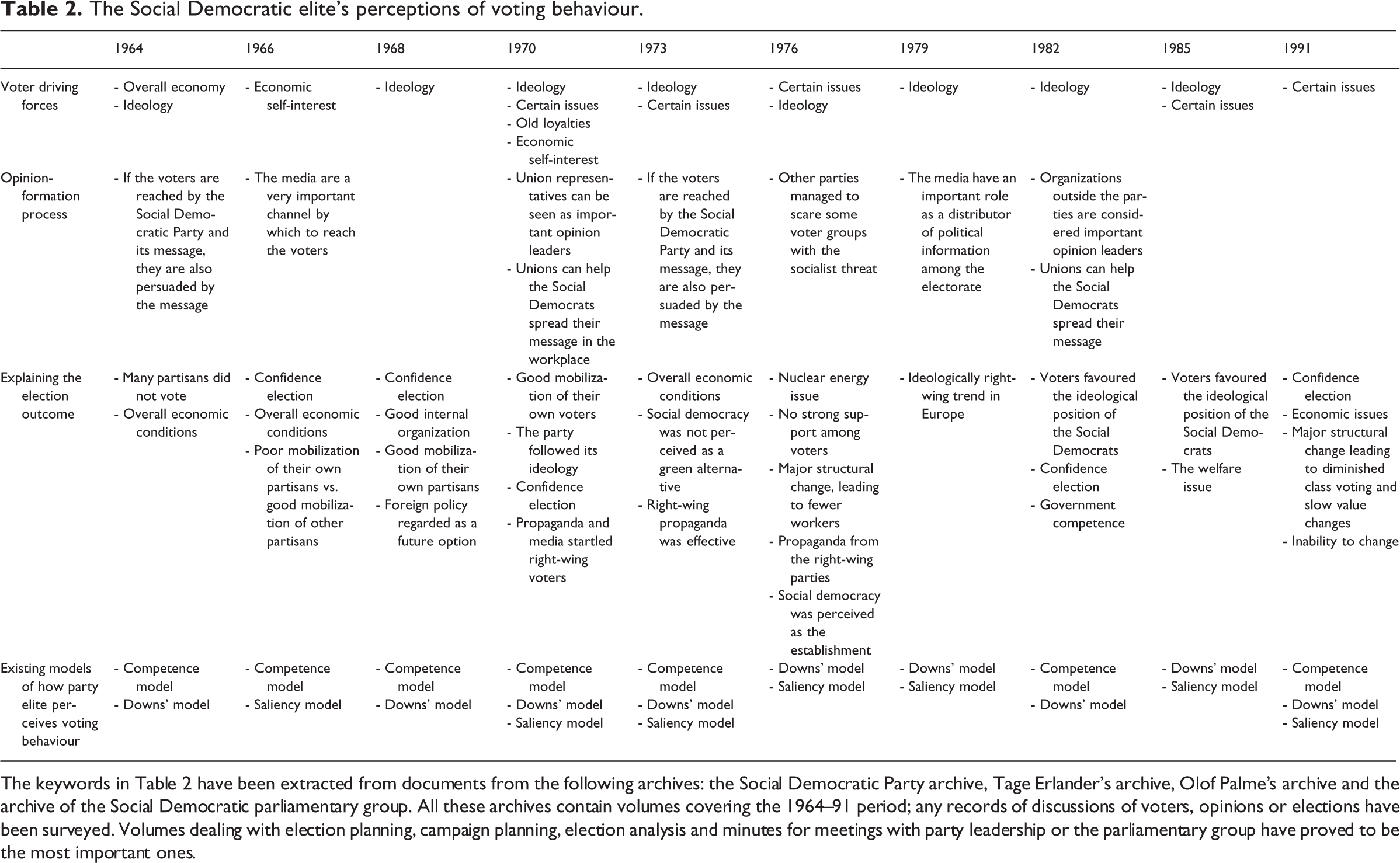
The keywords in Table 2 have been extracted from documents from the following archives: the Social Democratic Party archive, Tage Erlander’s archive, Olof Palme’s archive and the archive of the Social Democratic parliamentary group. All these archives contain volumes covering the 1964–91 period; any records of discussions of voters, opinions or elections have been surveyed. Volumes dealing with election planning, campaign planning, election analysis and minutes for meetings with party leadership or the parliamentary group have proved to be the most important ones.
The Conservative elite’s perceptions of voting behaviour.
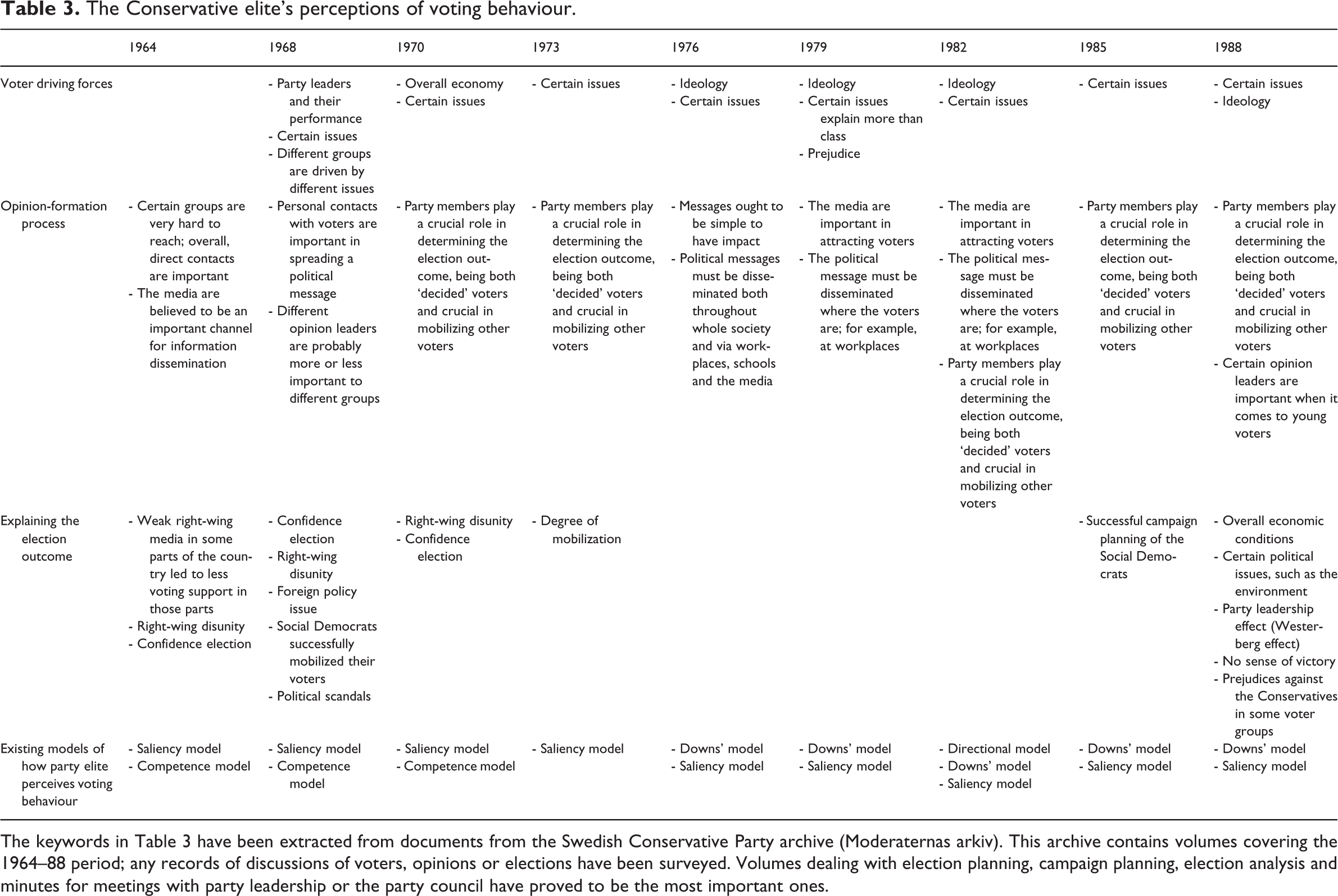
The keywords in Table 3 have been extracted from documents from the Swedish Conservative Party archive (Moderaternas arkiv). This archive contains volumes covering the 1964–88 period; any records of discussions of voters, opinions or elections have been surveyed. Volumes dealing with election planning, campaign planning, election analysis and minutes for meetings with party leadership or the party council have proved to be the most important ones.
In greater detail, in the mid-1960s, economic factors were often discussed in relation to perceived economic decline and the difficulty of speeding up the reform process. 10 Economic setbacks were perceived as vital for the voters' decision-making process. 11 In the ‘long 1970s', ideology and ideological positions were treated as crucial factors determining voter behaviour. The left–right dimension was long perceived as the most important and profound dimension in the Swedish party system. The voters were believed to use this dimension as a decision-making shortcut for an array of issues. 12 In accordance with this line of reasoning, the campaign material should ‘be sent to all voters and should give the voters the “big picture”, i.e. the parties ideology’. 13
The voters were also perceived as interested in the alternative ‘green’ dimension, especially in the mid-1970s and late 1980s. The perceived interest in green issues goes hand in hand with discussion of certain issues, for example, that ‘the nuclear issue’ determined the 1976 election. 14 In the late 1970s and early 1980s, the party elite perceived ‘a strong liberal wind’, which changed the ideological landscape in a direction unfavourable for the Social Democrats. The voters were still believed to be affected by the left–right dimension, but the party was believed to occupy a less favourable position along this dimension. 15 Altogether, the Social Democratic elite paid considerable attention to various ideological dimensions and to how their own positions along these might be perceived by the electorate. This is very much in line with the Downsian view of voting behaviour.
When it comes to our second research question, regarding the opinion-formation process, the voters are believed to be affected by the parties themselves, the media message and unions and other organizations. However, how opinion formation occurs is not dealt with very explicitly. Discussion of this issue is much rarer than discussion of other voting-related behaviour. Specifically, in discussion of opinion formation, the party and its ideological message was mentioned in the mid-1960s and early 1970s, the media in the 1960s and 1970s and the role of unions and other organizations in the early 1970s and the 1980s. 16 The party elite tended to be confident that, as long as it could reach the voters, the voters would be convinced by the ideological message. 17 A low prevalence of pro-Social Democratic media, for example, was considered a problem, since that might lead to less attention being paid to issues that were Social Democratic strong points. Overall, parties to the right were considered as favoured by media coverage in Sweden. 18 To overcome this obstacle, the party elite emphasized the need to set the agenda in order to win the elections. 19 In sum, the Social Democratic elite tended to perceive the opinion-formation process as driven both by their ideological message, as in the Downsian model, and by the media and the need to set the agenda, as is consistent with the saliency model.
Our third and last research question concerns how the party elite explain election outcomes. How are electoral failures and successes explained? One overall impression is that every election is regarded as unique and deserving special attention, and that explanations tend to vary with time. Often, more than one explanation is used to understand the election outcome. Generally, ideological trends, trustworthiness, competence, certain issues, economic development and structural socio-economic development are the most frequent explanations for particular electoral outcomes.
In 1964, the Social Democratic Party retained power, which was perceived as a success, though the margin of victory was less than previously. This outcome was understood with reference to the fact that other parties were more successful at convincing their partisans to vote. The fact that the Social Democrats did not get more votes was explained by the fact that overall economic decline had led to disappointment with economic conditions and increased prices. 20 This disappointment was mainly interpreted as a questioning of whether or not the Social Democrats were skilled enough to deal with the economic situation, as delineated in the competence model.
The 1966 election led to continued Social Democratic power. The outcome was nevertheless perceived as disappointing, since expectations had been high. The outcome was mainly explained by ‘poor mobilization’ of Social Democratic voters and better mobilization by other parties. In addition, overall economic decline was perceived as leading to increasing disappointment and lessened confidence in the Social Democrats.
21
This view was expressed as follows by the party elite evaluation team in 1966: There is no doubt that people generally appreciate and are grateful for what the Social Democratic party has achieved in Swedish society. At the same time, there is no doubt that they blame us for the things that are still perceived as problematic.
22
The 1968 election outcome was perceived as a great success. The result was understood as a strong statement of voter confidence in the Social Democrats, who keep their promises, ‘haven’t promised too much’, and will deliver in the future. The fact that the Social Democrats also stood for trustworthy foreign policy was a particular issue that enhanced confidence in the party. 23 This focus on party pledges and a sense of trust and confidence is very much in line with the competence model.
In 1970, the Social Democrats managed to retain power. This was understood with references to partisans being well mobilized, the party following its ideological message and the voters having confidence in the party. The party elite believed the election outcome would have been even better if the media had not startled conservative voters so much by invoking the ‘socialist threat’. 24 In their efforts to explain the outcome of the 1970 election, the Social Democratic elite mixed three models. Their reference to ideology was consistent with the Downsian model, the confidence remark with the competence model and the mentioning of media with the saliency model.
In 1973, the election outcome was evenly split between left and right, but the Social Democrats retained government power. The electoral setback for the Social Democrats can be understood with the help of three explanations: slow economic decline, the party was not perceived as a green alternative and the messages from the Conservative and Liberal parties had been persuasive. 25 Obviously, the Social Democratic elite believed their ideological position was less favourable than that of their opponents, indicating a Downsian perspective on the election outcome. Voter response to economic decline can rather be interpreted as indicating that voters felt the government lacked the competence to deal with the economic situation.
In 1976, the Social Democrats finally lost power and a new government was formed, an outcome mainly attributed to the ‘nuclear issue’. The Swedish Centre Party was perceived as the big winner in the election, and they had taken a different position regarding the nuclear issue from that of the Social Democrats. In addition, the Social Democrats had been facing a slow, gradual, decline in votes as the number of workers was declining. The Social Democrats were also, according to the party elite, perceived as ‘old fashioned’ and too representative of the establishment. Altogether, the explanation for the 1976 election outcome resembles the Downsian thinking on the importance of positioning the party where the voters are.
In 1979, the emphasized explanation of the negative election outcome was the overall ideological shift to the right that was taking place in Europe. According to the party elite, the ‘overall liberal wind’ was working against the Social Democrats. 26 A Downsian perspective and a focus on ideology can best describe the explanation for the 1979 election results.
In 1982, the election outcome was perceived as the second best ever, after 1968. The voters were believed to approve of the Social Democratic ideology and to want this ideology to shape Sweden’s politics in coming years. The welfare issue and the relationship between the Social Democratic Party and the voters recalled the Downsian perspective. The party elite were also convinced that voters had great confidence in the Social Democrats and their ability to handle the tough economic conditions facing Sweden. 27 This focus on the ability to handle economic conditions could be categorized as consistent with the competence model.
In 1985, the election outcome was perceived as worse than in 1982, though the Social Democrats stayed in power. The main explanation for the outcome was essentially the same as in 1982, i.e. the Social Democrats stood for a ‘good’ ideology, which was approved by the voters. The ideology was perceived as a guarantor of a welfare state in Sweden.
28
This can be illustrated by the following statement in the party elite’s post-election analysis: Knowing the facts, we won the battle over the welfare society against the Conservative Party. It is a victory that will last for a very long time. Their election campaign lost pace and did not recover. The Liberal party noticed this and changed course during the campaign. The Liberal party became less liberal and more social liberal. The new liberalism was defeated twice.
29
This analysis is very much in line with Downsian thinking, in which the party positions itself favourably in relation to the electorate and other parties. Besides that, we can find traces of the saliency model, which is sometimes combined with Downs' emphasis on positions:
Early in the election campaign we ought to establish the agenda for the entire campaign and then hold on to that planning. The actor who determines the agenda also wins the election. This year this was facilitated by the position taken by the Conservative party.
30
Comparing the above evidence with the models previously outlined, it is quite clear that the Social Democratic Party has had a tendency to argue in line with Downs' model, this model being totally absent only once. Ideology and ideological proximity are considered important determinants of voting behaviour and election outcomes. However, as can be seen in Table 2, it is not the only model evident in Social Democratic elite discussions; traces of both the saliency and competence models can frequently be found as well. It is quite obvious that ideology is seen as a very important factor that is sometimes combined with other factors, such as media interest in certain issues at the top of the election agenda. At other times, ideological position is still viewed as very important, but which party the voters feel most confident in is also crucial. The voters are perceived as favouring parties that can persuade them of their skill and ability to run the country even in times of crisis.
Even though Downs' model is a recurring theme in how the Social Democratic Party elite perceive the voters, the saliency and competence models are also evident in elite reasoning on voting behaviour. The only election results that were not analysed by the Social Democratic elite according to the Downsian model were those of the 1966 election. The competence model seems to have been favoured until the mid-1970s, and then again starting in the early 1980s. The competence model was absent in the elite reasoning on voting behaviour in the 1976, 1979 and 1985 elections. The saliency model was favoured in the 1970s as well as the late 1980s and early 1990s. It was not present in analysis of the 1964, 1968 and 1982 elections. In sum, the only discernible patterns are that the Downsian model was almost always favoured, the competence model was slightly more favoured in the early period, while the saliency model was slightly more favoured in the late period.
As a final reflection, is it possible to make sense of how and when the Social Democratic Party elite used the mentioned models? One might expect the Social Democratic elite to use different models to understand successful versus not so successful elections. The theoretical argument for this expectation is that, since the party elite has invested its prestige in a certain ideological message, it will probably understand voting behaviour with reference to ideology and ideological proximity at times when it is satisfied, or at least not worried, about the election outcome. When the election outcome is seen as a setback in some respect, this would probably lead to the use of other models to understand voting behaviour, for example, unexpected issues had dominated the agenda or voters did not feel sufficient confidence in measures the party had taken. However, none of these expectations can be said to be fulfilled. In times of perceived success (e.g. 1968, 1982 and 1985) and perceived failure (e.g. 1966, 1976 and 1991), no obvious pattern can be discerned; the models are used together in different patterns.
The Conservative Party elite view the voters
Since the late 1970s, the Swedish Conservatives have been the largest party to the right in Swedish political life. From 1976 to 1982, Sweden was governed by several constellations of conservative as well as centre and liberal parties. The Conservative Party was part of the 1976–78 and 1979–81 governments. In 1991, the Conservative Party regained power, this time together with the Centre Party, the Liberal Party and the Christian Democrats. After losing power in 1994, the Conservatives once again won an election in 2006. Until 2006, the Conservatives in Sweden had mainly been associated with law and order issues, tax reductions and less political regulation of daily life.
Our first research question pertains to how the party elite view the voters' driving forces. The Conservative Party elite thought that the voters were driven by many considerations: party leaders and their performance and competence, economic development, ideology, clear ideological profile and party position on specific political issues.
In the late 1960s, the Conservative Party emphasized its leadership. The party elite believed that if the party leader had a more positive image, this would mean more votes and could even be decisive for the party, since restored trust in the leader could be transferred to the party. 32 The party, as well as the party leaders, must ‘show its ability to take Government responsibility’ and election losses were explained by the party’s and its leaders ‘inability to present themselves as capable of quickly and efficiently taking control of the Government’. 33
This can be interpreted as a belief that a skilled party leader would probably have an easier task of reaching out to voters if he/she is regarded as trustworthy and competent, which is consistent with the competence model.
In the late 1960s and early 1970s, positions on certain issues were also perceived as important incentives prompting the voters to get out and vote. Certain issues were commented on mainly if they were believed to put the Conservative Party at a disadvantage; for example, in 1968 when foreign policy led to increased support for the Social Democrats, 34 and in 1976 when the environment led to increased support for the Centre Party. The Conservative Party was not believed to have a favourable position on these issues, which is very much in line with Downs' model.
In the late 1970s and early 1980s, ideology was viewed as the most important voter motivation. The Conservative Party elite argued, in the same way as had the Social Democrats, that the liberal right-wing wind that was blowing across Europe was benefiting the Conservatives, which is a view consistent with Downs' model regarding the importance of party position vis-à-vis the electorate. The Conservative elite also believed that a clearer profile and position along the left–right dimension would benefit the own party, and conservatives and liberals as a group. 35 This statement can easily be interpreted as fitting the directional model.
In the late 1980s, certain issues were again believed to be the important driving force of voters. The Conservatives believed themselves to be strong on issues such as defence and crime. The environment was again perceived as an issue that did not promote the Conservatives, since they were perceived as less environmentally friendly than other parties. 36 The Conservative Party was very concerned with its own and the electorate’s position along important dimensions, which is very much in line with a Downsian view of voting behaviour.
The next research question concerns how the Conservative Party elite perceived the opinion-formation process. We can conclude that the ultimately most important factor in the opinion-formation process is personal contact with voters, especially Conservative Party members and potential supporters. In addition, party members were seen as crucial in the opinion-formation process: they could disseminate the party message to other groups, such as family and friends. Conservative Party members are frequently mentioned as the most important way to reach voters with the party message. An interesting aspect of this understanding of the opinion-formation process is that it was persistently evident in all decades. 37 Party members were obviously deemed important to the Conservative Party, as the party was depending on their enthusiasm and hard work to spread the Conservative message via personal contacts. This is something that differs radically from the Social Democratic elite, who do not mention party members as particularly important to their opinion-formation process. Putting the members of one’s own party at the centre of attention is interpreted as supporting the saliency model, with its focus on how to reach out to various opinion leaders. Party members are believed to be able to convince family members, work colleagues and other opinion leaders.
Even though the party members' hard work is seen as the most important factor in the opinion-formation process, additional factors are mentioned as well. In the 1960s and 1970s the media were believed to be of utmost importance. The parties forming the government were believed to be more favoured than the opposition by having an advantage in the media struggle. 38 This view of opinion formation is also most consistent with the saliency model.
The final research question concerns how the Conservative Party elite explained the election outcomes and whether we can discern any favourite explanations that tend to be repeated. An overall impression is that competence and trustworthiness are explanatory factors that tend to be repeated.
In 1964, the negative election outcome was explained by the fact that the Conservative and Liberal parties could not project a sense of unity. The discord between the Conservative and Liberal parties made them look less competent than the parties on the left, very much in line with the competence model. In addition, the media coverage was not perceived as optimal for the Conservatives, consistent with the saliency model. 39
The same explanations were repeated in seeking to understand the negative election outcome in 1968. The Conservative and Liberal parties had never been able to present themselves as a competent alternative; the Conservatives had not managed to convince the voters that they would be able, quickly and efficiently, to assume government responsibility, 40 so they were never viewed as trustworthy or competent. The Social Democrats, on the other hand, were considered well organized and well prepared. In addition, the foreign policy crisis associated with events in Czechoslovakia favoured the existing Social Democratic government. 41 The foreign policy issue was also framed as a competence issue, since the Social Democrats were believed to be capable of handling a delicate international situation.
The explanation for the 1970 election outcome in the Conservative Party elite was internal party discord. This closely echoes earlier explanations of why the party had been unable to establish itself as a trustworthy alternative, 42 and again favours an interpretation according to the competence model.
The 1973 election result was seen as an improvement for the Conservative Party, and the elite attributed this success to more of their partisans having been mobilized to vote than before. No other explanation was suggested as to why the election was successful; 43 no other existing model applies to this relatively un-nuanced discussion of the election outcome.
The 1976 and 1979 election results were again seen as minor successes, while the 1982 election outcome was seen as disappointing. However, no specific analysis was offered to make sense of any of these election outcomes. Analytical efforts were made before the election to understand the driving forces of the voters; after the elections were held, no efforts were made to understand why they produced the results they did. 44
The 1985 election outcome was perceived as a failure, since the voters were not attracted by the message of the Conservatives. The main explanation for this was competition with the Liberal Party, which attracted many new voters. 45 The Conservatives and the Liberals competed for the same voters, and the liberals managed to take a more favourable position along the dominant left–right dimension – an explanation very much in line with Downs' model.
The 1988 election was perceived as a failure. The Conservative Party had not managed to present itself as caring, considerate or green enough, and the party elite believed that prejudices against the party were still severe. The elite also emphasized competition with the Liberal Party, and the fact that the two parties tended to vie for the same voters, i.e. they positioned themselves similarly along the same ideological dimension.
Competition with the Liberal Party was the toughest game during the election campaign and the environmental issue was our weakest issue – these were two important explanations why the outcome was not better. 46
Poor positioning and competition to uphold a certain position can be understood as the main explanations, both derived from a Downsian perspective.
Our empirical section has answered the research questions regarding how party elites perceived the voters' driving forces and the opinion-formation process, and how they explained election outcomes. It is now time to relate these answers more systematically to our models of voting behaviour. One clear result is that the Conservative Party elite has tended to think in line with the saliency model, as their perception of voting behaviour in all analysed elections displayed traces of the saliency model. The Conservatives deemed it important to reach out to voters and position their message at the top of voters' minds. Agenda-setting, media effects and partisan connections with other voters were among the most important themes when voting behaviour was discussed. However, the saliency and competence models were combined in the 1960s and early 1970s due to discussion of perceived discord among the Conservatives and Liberals, which contributed to voter distrust in their ability to lead the country. In the late 1970s and 1980s, the saliency model was combined with Downs' model, since ideology was perceived as a driving force of voters. Only once can we interpret the data in a way consistent with the directional model: in 1982 the Conservative Party elite discussed the possibility of sharpening the party profile and adjusting the ideological position along the left–right dimension in a more distinctive way.
What reasonable interpretation can be given to the patterns mentioned above? In the case of the Social Democratic Party, it was impossible to understand the party elite’s overall impression of the elections in light of one particular model. Furthermore, it was not possible to say that the elite used one model in times of electoral success and another in times of electoral defeat. A quick look at the Conservative elite’s perception of voting behaviour confirms this lack of conjunction.
Instead, the most obvious pattern is that, until the early 1970s, the Conservative Party tended to combine the saliency and competence models. Starting in the mid-1970s, the Conservatives tended to combine the Downs and saliency models. While the Social Democrats favoured the Downs model combined with various other models, the Conservatives tended to favour the saliency model combined with various other models. The shift from the competence to the Downs model is clearer among the Conservative elite than is the shift from the competence to the saliency model among the Social Democratic elite.
One future research task would be to explore in greater depth why we see these patterns among the party elite, i.e. a clear shift among the Conservative elite and the somewhat less clear shift among the Social Democratic elite. The aim of the discussion here has been to explore some possible explanations of these patterns.
A very interesting finding is that the perceptions of Social Democratic and Conservative elites have become more alike over time. Although the party elites tend to favour different models, development over time has brought forward similar views of voting behaviour. This is because the Social Democratic elite has more often combined the Downsian view with the saliency model, while the Conservative elite has combined the saliency model with a Downsian view. This could reinforce the increasing similarity between Sweden’s two major parties.
Conclusion
Owing to the lack of previous, similar, studies on party elites' perceptions of voting behaviour, our research has mainly been to investigate the applicability of voting behaviour models and their usefulness if we want to analyse elites' perceptions. It is time to consider the ways in which this ambition has been fulfilled.
This study can be viewed as an effort to bring new empirical evidence into a field of research on party competition which we argue has not paid sufficient attention to elite perceptions on voting behaviour. Our intention was to include empirical evidence from the Swedish case into the general discussion on elites' perceptions of voting behaviour, and more specifically to the discussion on voters' driving forces, the opinion-formation process and the election outcome. The analysis rests on a vast number of archival documents dating from 1964 to 1988/1991 and covering both official and unofficial sources. We have mapped how voting behaviours were perceived by the political elites of the Conservative Party and the Social Democratic Party in Sweden.
This study aimed to investigate whether it was possible to extend the use of voting behaviour models to party elite perceptions of voting behaviour. We have demonstrated that popular models of party competition and voting behaviour can indeed also be used to describe and analyse party elite perceptions of voting behaviour. It is both possible and illuminating to analyse party elite statements with reference to these models.
The article started by describing some overall trends in the party system: party–voter ties have weakened, voters are more volatile, many party systems display signs of ideological depolarization and election campaigns tend to be more important. The starting point for the investigation was to ask whether these overall changes co-vary with changing party elite perceptions of voters. A clear result in this direction would imply that both parties should have started viewing voters differently in the late 1970s than in earlier periods.
However, the empirical evidence suggests a clear split between the late 1970s and earlier phases in one of the investigated cases. The Conservative Party elite changed their view of the voters, and this change occurred in the 1970s. In the 1960s and 1970s, Conservative elite perceptions of voters were in line with the saliency and competence models. From the mid-1970s until the early 1990s, the saliency model was complemented by Downs' model. When we turn to the Social Democratic Party elite, we see no such clear break with earlier reasoning: up until the mid-1970s there was a weak tendency to combine the Downs' model with the competence model, and thereafter with the saliency model. However, the existence of these trends led to greater similarities between the perceptions of voting behaviour on the part of both parties' elites.
We also explored whether or not it would be possible to explain the observed patterns by how the election results were perceived among the party elite. A perceived election success was believed to go hand in hand with Downs' model and a negative election experience with the competence or the saliency model. No evidence to support such an interpretation was found.
Even though we cannot interpret the empirical evidence exactly as expected, we can draw one important conclusion: the models used here are definitely applicable to party elite reasoning. These models, usually used to understand voting behaviour, are also applicable to party elite perceptions of voting behaviour. Three of the models, the Downs, saliency and competence models, are frequently used as described above. The directional model stands out in this respect, as the elite in Sweden’s two largest parties almost never reason in line with this model.
So far we have been unable to find any convincing explanation for the general patterns evident in both parties. Instead, the empirical patterns suggest that we should look for more party-specific explanations, since the party elites under investigation clearly had different ways of thinking about the voters and their behaviour at the start of the study period. Future research would benefit from including more parties and more countries that might have different party systems and somewhat different experiences of voting results. This would make it possible to study which patterns are unique and which are generalizable. When the next step has been taken, we can investigate further how different perceptions of voting behaviour affect party strategies. For example, do party elites which rely more heavily on a Downsian perspective tend to emphasize ideological positioning in campaign planning more often than others? Or, do party elites which rely on a competence model more extensively focus on past and future performances than other actors?
Footnotes
Appendix. Election results for the Swedish parties 1960–91 (per cent).
| Voter Turnout | Cons. | Centre | Liberal | Chr. | Green | Pop. | Soc. | Left | Other | |
|---|---|---|---|---|---|---|---|---|---|---|
| 1960 | 85.9 | 16.5 | 13.6 | 17.5 | . | . | . | 47.8 | 4.5 | 0.1 |
| 1964 | 83.9 | 13.7 | 13.2 | 17.0 | 1.8 | . | . | 47.3 | 5.2 | 0.0 |
| 1968 | 89.3 | 12.9 | 15.7 | 14.3 | 1.5 | . | . | 50.1 | 3.0 | 0.0 |
| 1970 | 88.3 | 11.5 | 19.9 | 16.2 | 1.8 | . | . | 45.3 | 4.8 | 0.4 |
| 1973 | 90.8 | 14.3 | 25.1 | 9.4 | 1.8 | . | . | 43.6 | 5.3 | 0.6 |
| 1976 | 91.8 | 15.6 | 24.1 | 11.1 | 1.4 | . | . | 42.7 | 4.8 | 0.4 |
| 1979 | 90.7 | 20.3 | 18.1 | 10.6 | 1.4 | . | . | 43.2 | 5.6 | 0.8 |
| 1982 | 91.4 | 23.6 | 15.5 | 5.9 | 1.9 | 1.7 | . | 45.6 | 5.6 | 0.2 |
| 1985 | 89.9 | 21.3 | 12.4 | 14.2 | .2 | 1.5 | . | 44.7 | 5.4 | 0.5 |
| 1988 | 86.0 | 18.3 | 11.3 | 12.2 | 2.9 | 5.5 | . | 43.2 | 5.8 | 0.7 |
| 1991 | 86.7 | 21.9 | 8.5 | 9.1 | 7.1 | 3.4 | 6.7 | 37.7 | 4.5 | 1.0 |

The table gives the election results in the Swedish national elections. Source: SCB, Allmänna valen 2006. Del 1. [Statistics, Sweden. National Elections 2006. Part I]. This can be compared to how the party elites perceive the outcomes, which is reported and discussed in the article.
Notes
Acknowledgments
We express our sincere gratitude to Emma Andersson, Ulf Bjereld, Marie Demker, Peter Esaiasson, Jonas Hinnfors, Veronica Norell, Jesper Strömbäck and our anonymous reviewers for comments and advice.
Funding
This research was financed through a generous grant from the Swedish Research Council.