







Abstract
The article applies and develops Katz and Mair’s ‘cartel party’ thesis to the Russian case. Challenging the accepted characterization of the Russian party system as ‘hegemonic’, the article contends that this underplays the systemic importance of the Communist Party of the Russian Federation and its collusion with pro-Kremlin parties in the fields of electoral and party reform. By applying the concepts of cartelization to the Russian case, it appears that the intersection of state and party goes beyond simply the ‘top-down’ establishment of political parties towards a party system in which there is inter-party collusion around a strong state-based regime.
Introduction
In their seminal article, Katz and Mair (1995) noted the emergence of what they termed ‘cartel parties’, which colluded with others to draw resources from the state and put up barriers to entry to newcomers outside the cartel. This manifested itself in two ways – a movement of parties away from society towards the colonization of the state and a shift in the dynamics of intra-party relations towards the party in public office (Katz and Mair, 2009). As party leaders realized that they had more in common with each other as a political class than with their voters, they could use their privileged position as both framers and enforcers of the rules to reinforce their positions (Kitschelt, 2000: 151–152).
The applicability of this model has been subject to critique, most recently by the original authors themselves (e.g. Katz and Mair, 2009; Kitschelt, 2000; Koole, 1996; Scarrow, 2006). Studies have suggested that political cartels can emerge from a number of sources, including a response to a crisis of party resources, the greater involvement of the state in institutions of civil society, and simply from a realization that collective action can secure greater rewards (Detterbeck, 2005; Pierre et al., 2000: 20).
The majority of studies have applied cartel theory to developed Western democracies, but in recent years there have been several studies examining the concept more widely. Kwak (2003), for instance, has concluded that the Korean party system shows signs of petrifying through the cartel-like behaviour of its actors; Jones and Hwang (2005) have focused on South America; while Roper (2006) and Grzymała-Busse (2007) have analysed party-funding regimes and party–state relations in various countries of post-communist Europe.
The present article, which examines the Russian Federation, adds to this growing literature. Russia gives us a suitable case for ‘most different systems design’ analysis. Despite different inputs and a different path towards cartelization, the behaviour of Russian parliamentary parties in defending their privileges and resource base appears comparable with many of their Western counterparts’.
It might be contended, in the context of a system of ‘managed democracy’ in which frequent questions are raised about the openness of the electoral process, that the application of a model conceptualized in developed democracies is inappropriate. A number of scholars, as we shall see below, have argued plausibly that Russia (like other post-Soviet countries) more closely resembles a hegemonic multiparty system, 1 with a strong elite-sponsored ‘party of power’ at its centre. 2 However, while it offers some explanation, the analytical prism fails to appreciate the role played by the nominally oppositional Communist Party of the Russian Federation (CPRF) within the cartel.
It might also be argued that parties are marginalized in the Russian system (where the dominant locus of power is the dual executive of president and government, headed respectively by President Dmitrii Medvedev and former president Vladimir Putin) and therefore cartelization is unimportant. However, although their relative lack of bottom-up influence on government is a feature of Russian politics, parties’ systemic role has increased in recent years, and simply dismissing them as unimportant does not give us any explanation for their behaviour. In particular, the CPRF has come to collude with the ‘parties of power’ in reinforcing certain privileges. Its opposition was not always token. It and its allies commanded a majority in the State Duma from 1995 to 1999, during which period President Yeltsin vetoed over a quarter of the laws emanating from the legislature (Remington, 2001: 221) and considered postponing the 1996 presidential election and banning the party for fear of losing to it (Yeltsin, 2000: 31–32). A decade-and-a-half later, it has become part of the parliamentary ‘cartel’ and now forms a ‘within-system’ opposition. The article examines the dynamics of this relationship.
The Russian party system: From floating to consolidated
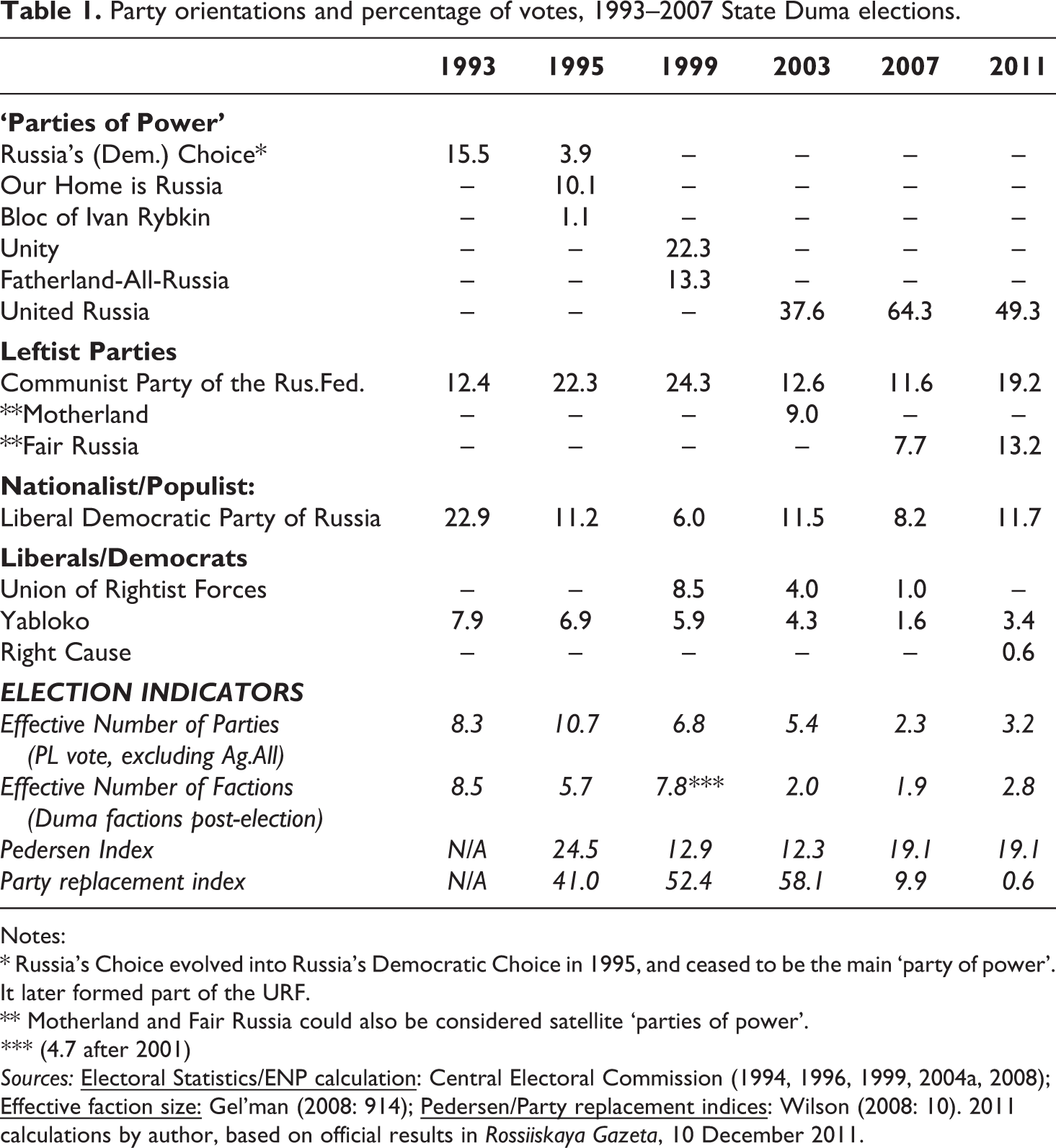
It is necessary to give only a brief introduction to the current actors in the Russian party system as individual party histories can be studied in more detail elsewhere (e.g. Barygin et al., 1999; Golosov, 2004; Hale, 2006; Hutcheson 2003, 2009a; March, 2002). Table 1 gives election results for the major parties from 1993 to 2007 (focusing in the 1993–2003 period on the party list section of the vote only; an equal number of deputies, often with tenuous or no party affiliations, were elected in this period from single-member district constituencies using a mixed unconnected system).
Party orientations and percentage of votes, 1993–2007 State Duma elections.
Notes:
* Russia’s Choice evolved into Russia’s Democratic Choice in 1995, and ceased to be the main ‘party of power’. It later formed part of the URF.
** Motherland and Fair Russia could also be considered satellite ‘parties of power’.
*** (4.7 after 2001)
Sources:
Of the four parties represented in the 2007–11 and 2012–16 State Duma convocations, three are consistently loyal to the Kremlin. The dominant party is United Russia (UR) – the latest and by far the most successful incarnation of the ‘party of power’. Alongside it, and much smaller, is Fair Russia (FR), a second, left-leaning ‘party of power’, led by the former speaker of the Federation Council, Sergei Mironov. Vladimir Zhirinovsky’s Liberal Democratic Party of Russia (LDPR), a moniker which disguises a populist–nationalist platform, has been represented in the legislature since 1993. One of the first parties to be formed after the legalization of parties in 1990 (Wilson, 2005: 23–27), it depicts itself as an opposition force despite covert loyalty to the Kremlin in Duma voting.
The Communist Party of the Russian Federation (CPRF) has the greatest claim to be ideologically grounded rather than pragmatically formed. As noted above, it was considered a real threat to the elite’s position in the mid-1990s but has become increasingly benign in its leftist–nationalist opposition since. It remains the second-largest parliamentary faction by a small margin, but is overwhelmed numerically by the combined votes of the other three factions. Nonetheless, as we will see below, it has skilfully utilized its position and formed tactical alliances where necessary to ensure its organizational survival.
Outside parliament, the liberal wing of Russian party politics is now all but non-existent. Yabloko has been unrepresented in the State Duma since 2003, while the Union of Rightist Forces (URF) failed to win Duma representation in 2003 or 2007 and merged with other minor parties of the right to found Right Cause, a more Kremlin-loyal umbrella party that won just 0.6 percent of the vote in the 2011 election.
Since the turn of the century, Russia’s 1990s ‘floating party system’ (Rose et al., 2001; Rose, 2009: 145), with its weak party institutionalization, has given way to a more stable picture. 3 After the 2007 Duma election there were just 2.3 (by vote) and 1.9 (by seat) ‘effective parties’, 4 while volatility also diminished substantially. The ‘party replacement index’, detailing the percentage of the vote that went to parties that had not competed in the previous election, fell in 2007 from consistently high post-communist levels to just 9.9 percent and further to just 0.6 percent in 2011. 5 Given this high concentration of the vote, the dominant paradigm of analysis in recent studies has been to describe Russia as a hegemonic party system, with United Russia at its centre. United Russia won 315 of the Duma’s 450 seats in 2007, and by the time of the Putin–Medvedev succession a few months later it claimed the allegiance of 65 percent of members of the Federation Council, 90 percent of regional governors and 84 percent of the mayors of regional capitals. 6 By March 2010 it had majorities in all but two regional parliaments (and even in those it had a plurality) and accounted for 73 percent of regional parliament deputies (Ross, 2010). It lost some support in the 2011 State Duma election but retained a majority in parliament. The ‘licensed, second-class parties’ in this context are the satellite ‘parties of power’ – the LDPR and Fair Russia.
There are several reasons why United Russia has come to occupy a central place in the political landscape. First, it has moved inter-factional competition to within a manageable framework (Reuter and Remington, 2009; Smyth et al., 2007), mitigating against the emergence of alternative elite competitors and creating a stable framework for patronage distribution (Gel’man, 2008: 915; Konitzer and Wegren, 2006; Reuter, 2010). Study of other regimes has shown this to be a factor that increases regime stability (Brownlee, 2008). The few non-affiliated politicians in power find themselves outside this network and pressured to join it. Seen in this light, UR is primarily a functional instrument at the party system/state nexus, consolidating the elite, synchronizing the work of federal, regional and local political machines and transmitting the official ideology of the state (Ivanov, 2008: 10–12; Peregudov, 2009: 33).
Nonetheless, as an analytical prism, the hegemonic party system has some shortcomings when applied to Russia. First, theories in this vein (e.g. Magaloni, 2008) focus on the need for a dictator to buy off opposition through a limited degree of power-sharing – in other words, a voluntary diminution by the centre of its own power to ensure stability. In Russia, the concentration of power and the translation of that into a legislative majority emerged from a process of consolidation rather than disintegration. The Communist Party had an incentive to moderate its behaviour to guarantee itself a place at the table at the expense of more peripheral opposition. It then moved into a position of collusion with more overtly pro-Kremlin parties to reinforce its and their positions relative to extra-parliamentary opposition.
Second, in contrast to dominant party systems such as Mexico, UR has not achieved a position of dominance by forcing other parties to the periphery (cf. Greene, 2007: 37–41), by overt electoral fraud (ibid., 42–44) or by manipulating party finance rules to its own advantage (ibid., 107–115). Rather, as will be seen below, it is the lynchpin of a party system in which all four parliamentary parties have converged on the centre and colluded with each other in the regulation of party finance.
Moreover, UR’s hegemony can be overstated. Its role in securing leadership succession and distributing resources in strategic economic areas – key functions of a dominant party – is limited. Its executive-led formation means that leading figures’ membership of the party is a formality rather than the basis of their power, and recent rotation of regional governors has diminished its patronage network to some extent. UR also remains a coalition of different elite groups – evinced by its internal discussion clubs spanning the political left to right and its subdivision in the Duma into four sub-factions. Most significantly, the continued presence of the CPRF in the party system also challenges UR’s hegemonic nature. The CPRF remains a vocal critic of Medvedev’s and Putin’s social and economic policies while colluding on or tacitly accepting certain party and electoral reforms.
All of these factors together lead us to the conclusion that the Russian party system – though dominated by UR’s presence – is actually based on symbiosis of the main parties’ and the Kremlin’s interests. Several of the features that we observe in the parties’ behaviour point beyond the domination of one party to the relationship between the party system and the state itself. In other words, it appears that Russia has developed a party cartel.
Cartel parties in Russia?
In economics, cartel overcharge emerges where actors collude for the collective benefit of all suppliers. Such activities are most likely to occur in markets with a small number of sellers, high market concentration, low elasticity of demand, homogeneity of products and high barriers to entry (Boltova, 2009: 322), and are most effective where there is a stable incentive structure to prevent entry and punish defection (De, 2010). Transferring this into the party arena, we can make a number of parallels (Detterbeck, 2005: 174). First, we can examine the extent to which parties inside the cartel place themselves at an institutional advantage within the political system (‘small number of sellers/market dominance’). Second, cartel parties are theoretically characterized by the internal dominance of the party in public office and the passive involvement of activists and voters (although empirical evidence is mixed) (Birnir, 2010). Third, they can be politically estranged from society and their role as a bridge between state and society is compromised accordingly (‘low elasticity of demand’). Fourth, inter-party competition is constrained (‘homogeneity of product’) and takes place within a narrow framework aimed at excluding newcomers and restricting policy choices (‘barriers to entry’). Finally, the most obvious manifestation of the interpenetration of state and parties is in terms of their resource bases (‘cartel overcharge’).
The privileged position of the ‘cartel’
The first manifestation of a party cartel is in the privileged position held by larger parties and their attempts to maintain this advantage (Katz and Mair, 2009: 759). In Russia, major political parties are placed at a considerable institutional advantage when it comes to electoral participation, largely due to laws that they themselves have passed.
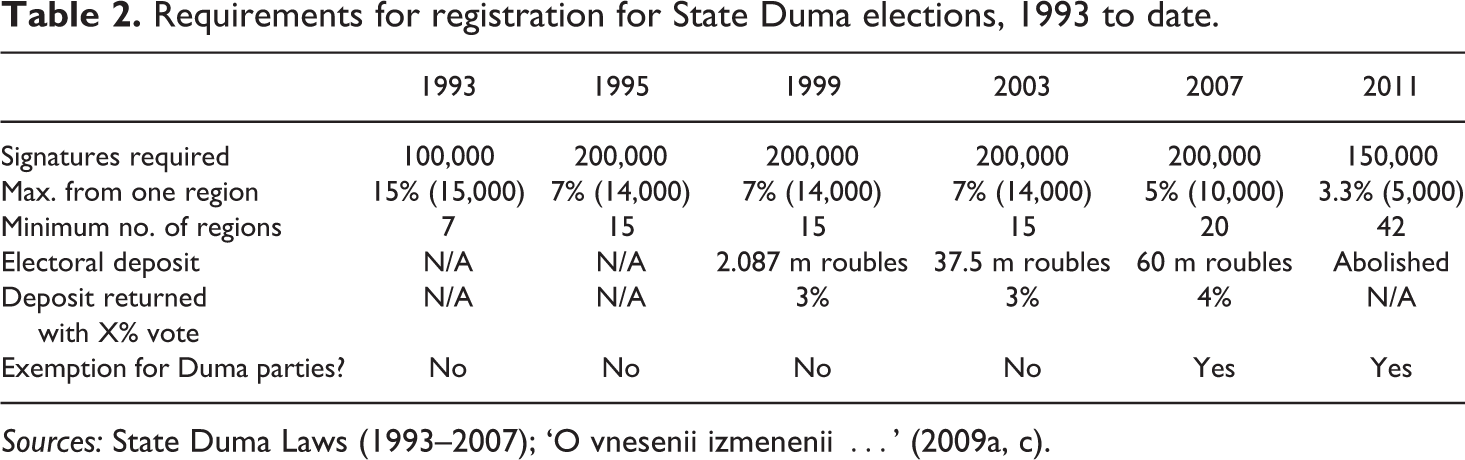
Parties with State Duma factions are exempted for the duration of the parliamentary convocation from legal minimum membership requirements (Law on Political Parties, §39.5). This is significant as only registered political parties are eligible to stand for election in the first place. They are also exempted from electoral registration hurdles for the subsequent State Duma election.
As Table 2 shows, the requirements for electoral registration by non-Duma parties have become more stringent. Appearing to move in the opposite direction, the four Duma parties voted unanimously in 2009 for President Medvedev’s initiative to reduce the number of signatures for non-Duma parties to 150,000 and 120,000 for the next two elections, and to allow parties represented in a third of regional parliaments automatic registration (State Duma Protocols, 2009: nos 136, §11; 150, §11; 152, §25). This was a superficially liberalizing measure, but in practice only the Duma parties have factions in a third of regional parliaments anyway. The effect was also mitigated by the abolition of the electoral deposit as an option for registration (‘O vnesenii izmenenii’, 2009a) and the stipulation that signatures must now be collected in more than half the (eighty-three) subjects of the Federation (‘O vnesenii izmenenii’, 2009c), rather than twenty as before. Moreover, since 2007 those parties that are required to collect signatures can be refused registration if more than 5 percent of the signatures collected are declared invalid – a significant decrease on the previous 25 percent (State Duma Laws, 2007/11: §43.18).
Requirements for registration for State Duma elections, 1993 to date.
Sources: State Duma Laws (1993–2007); ‘O vnesenii izmenenii …’ (2009a, c).
Larger parties were similarly privileged in 2007 when it came to party political broadcasts. The requirement that parties winning less than 3 percent of the vote (increased from 2 percent – State Duma Law, 2007: §69.3) pay for their ‘free’ advertising had far-reaching effects. A number of small but well-established parties were subsumed into larger ones or changed their status to that of ordinary public associations in order to escape their debts. 7 Within fifteen months of the election, only seven of the fifteen parties that had been eligible to stand in the previous election were left in existence – narrowing the field of future participants to the ‘cartel’ and three very small organizations outside it (Ministry of Justice, 2011). This contrasts with the 258 public organizations that were entitled to participate in the 1995 election. Henceforth parties will not be allocated advertising time unless they received 3 percent of the vote in the previous election or pay for it in advance (‘O vnesenii izmenenii’, 2009d), although this particular measure was not unanimously endorsed by the Duma parties.
Organizational aspects
Since an active and engaged membership can restrict the party leadership’s room for manoeuvre at the elite level (May, 1973), the cartel model would lead us to anticipate an atomized party membership comprising disempowered activists, While members can provide benefits of financial resources, outreach, labour and legitimacy (Scarrow, 1996: 46–48), these are less useful in the cartel model as key financial wherewithal is state-provided and the mode of electoral campaigning is capital-intensive rather than labour-intensive (Katz and Mair, 2009: 759). All parties practise highly centralised, professionalized campaign techniques with the help of outside contractors, with a focus on technocratic election specialization rather than amateur party labour (Hutcheson, 2009b: 333–336).
Parties need a minimum number of members and branches of sufficient size in a majority of Russian regions to qualify for registration (Law on Political Parties, 2001: §23). The minimum figures have been subject to frequent change that has advantaged larger parties over smaller ones, increasing from 10,000 in 2001 to 50,000 from 2004 onwards (with a minimum of 500 members in each of half the subjects of the Federation) (‘O vnesenii izmenenii’, 2004) and dropping slightly to 45,000 from January 2010 and 40,000 from January 2012 at President Medvedev’s initiative (Medvedev, 2008; ‘O vnesenii izmenenii’, 2009b). This latter amendment carried with it a precondition that parties introduce compulsory leadership rotation, and the CPRF faction voted against it as a result (Kolomeitsev, 2009; State Duma Protocol, 2009, No. 136, §§26–27). The primary beneficiary could be the new pro-Kremlin Right Cause party, which might struggle to gather the requisite number of members. This challenges the ‘cartel’ thesis by indicating a desire to open access to the system, but assuming it could later be co-opted into the cartel the defection would lead to long-term reward by giving representation across the political spectrum, which the cartel currently lacks.
All told, the seven parties officially registered in 2011 had a total membership of just over 3 million, approximately 2.8 percent of the electorate. In comparative terms this is low, but above some long-standing democracies (van Biezen et al., 2012). United Russia had more than twice as many members in 2011 as all other parties combined (2,073,772 compared with Fair Russia’s 414,558, the LDPR’s 185,573, the CPRF’s 154,244 and a combined 203,224 for the three non-Duma parties) (Ministry of Justice, 2011). The parties have a limited reliance on members for resources. Most receive less than 1 percent of their income from membership fees, if anything at all (Central Electoral Commission, 2004b, 2011). Only the CPRF has relied on them as a major source of income, but even in that case the dependence has fallen substantially from 55.4 percent of its resources in 2002 to just 19.5 percent in 2009. The only other party with any significant membership income – United Russia – has never derived more than 5 percent of its resources from this source and changed its statute in November 2008 to make the payments voluntary. 8
Of less interest than their absolute number is the role of members in the parties. Are they simply loosely connected individuals with no real say in party affairs – as would be expected in a cartelized system – or do they play a meaningful role in the organizations? Examination of party statutes suggests that the number of formal obligations on party members has increased in recent years (Ministry of Justice, 2011; cf. Hutcheson, 2003: 87). The ‘parties of power’ have traditionally used members for legitimacy rather than outreach. Until United Russia introduced rules in 2008 requiring new members to serve a six-month probationary period as ‘supporters’ (arguably a logical response to its role as a gatekeeper to patronage resources), it adopted a very loose approach to gathering members. In 2003, for example, the author witnessed the signing-up en masse of a local dance troupe in Ul’yanovsk, most of whom could not even remember the name of the party whose ideals they were supposed to be endorsing. There were numerous anecdotal reports of similar administrative means being used to boost membership numbers.
The prevalence of the party in public office is apparent in almost all State Duma parties and particularly in United Russia. The party’s leader, Vladimir Putin, is not even formally a member, while the leading organs are dominated by members of the political elite. More than three-quarters of the 60 members of its Supreme Council (as of May 2011) held legislative, executive or some other state office, including 18 members of the Federal Assembly and 21 governors or former governors (United Russia, 2011). The central reaches of the party have also extended: in 2008 it gave its auditing commission powers to conduct regular inspections of regional branches and, if necessary, recommend the removal of regional secretaries, 9 while the party commission for the nomination of gubernatorial candidates was put under the control of the Supreme Council a year later. 10
Political role
The cartel thesis hypothesizes that parties’ political role has moved from being one representing societal interests to representing the interests of the state and interest groups. Parties played a relatively minor role in politics during the Yeltsin years. The president and government were non-partisan; the State Duma contained substantial numbers of independents whose power derived from their regions; and regional politics, particularly at the executive level, were largely non-partisan. Although the political system is still dominated by a strong executive, parties now play a much larger formal role: regional legislatures now comprise at least half party-nominated deputies; the State Duma is now formed purely on the basis of party lists; and several government ministers are members of United Russia. But although a party leader (Vladimir Putin) served as prime minister for four years, his premiership did not emanate from this fact.
Parties are also weakly anchored in society, as hypothesized by Katz and Mair (2009: 760). Throughout the post-communist period, political parties and the parliament have been among the least trusted of all institutions, although trust levels had risen from just 6 percent in 1994 to 18 percent by 2008 (Klingemann, 1994: v88; White and McAllister, 2010: B14). By contrast, the president and government enjoy much higher levels of public support (60 percent and 41 percent, respectively, in 2010).
A further element of linkage between society and state is the extent to which parties act as the articulators of societal interests. All major parties are the targets of lobbying efforts by business and other interests, and each has well documented links to certain sponsors. In 2006 Moscow-based think-tank noted that many of the main parties, especially the Communists, were beholden to sponsors’ interests, although it excluded United Russia from its analysis. 11 Substantial intra-party lobbying takes place in UR before legislation is discussed in the Duma, turning the party structure into an intra-elite, inter-sectoral bargaining arena (Remington, 2008). There are various sub-factions in the party with links to the financial, oil, agrarian and construction and energy industries as well as regional interests (Tolstykh, 2006: 72–79). Moreover, the main access points to the legislature’s agenda are through its Council and its committees, and in addition to chairing all the parliamentary committees between 2003 and 2011, United Russia also had eight of the eleven positions on the Duma Council.
Competition within the cartel
Parties inside the cartel have a common interest in the perpetuation of competition while recognizing that they will benefit from their fair share of patronage and resources. This is one area in which the Russian case may be anomalous: United Russia’s domination of the legislative agenda since 2003 has resulted in significantly reduced opportunities for patronage for other parties. Nonetheless, the continued inclusion of at least one representative in the Duma Council from each faction, and regular meetings between Duma party leaders and the president, means that they have some potential for lobbying and retain parliamentary immunity, which contrasts with the relative impotence of non-Duma parties.
Implicit collusion between the pro-Kremlin parties became more explicit in February 2010 when United Russia and Fair Russia signed a Political Agreement in which the two parties undertook to ‘strive for coalition actions’ on foreign policy, national security, fundamental constitutional structures, the fight against extremism and personnel matters, while reserving their opposition in certain other areas (Fair Russia and United Russia, 2010).
The extent to which there is real programmatic difference between Russian parties can be assessed by examining their electoral platforms since 1995. Figure 1 shows the policy positions of the major parties in each of the State Duma elections from 1995 to 2007. Only niche parties retained any programmatic differentiation by 2007, and the LDPR and CPRF have long-since ceased to be ‘anti-system’ parties in the Sartorian sense (March, 2001; Timmermann, 1997: 754). Overall, the impression is of a set of parties competing over different sections of the centre ground – further suggesting a four-party ‘cartel’ and contrasting with Greene’s characterization of a dominant party regime in which one party’s dominance causes polarization among the opposition.
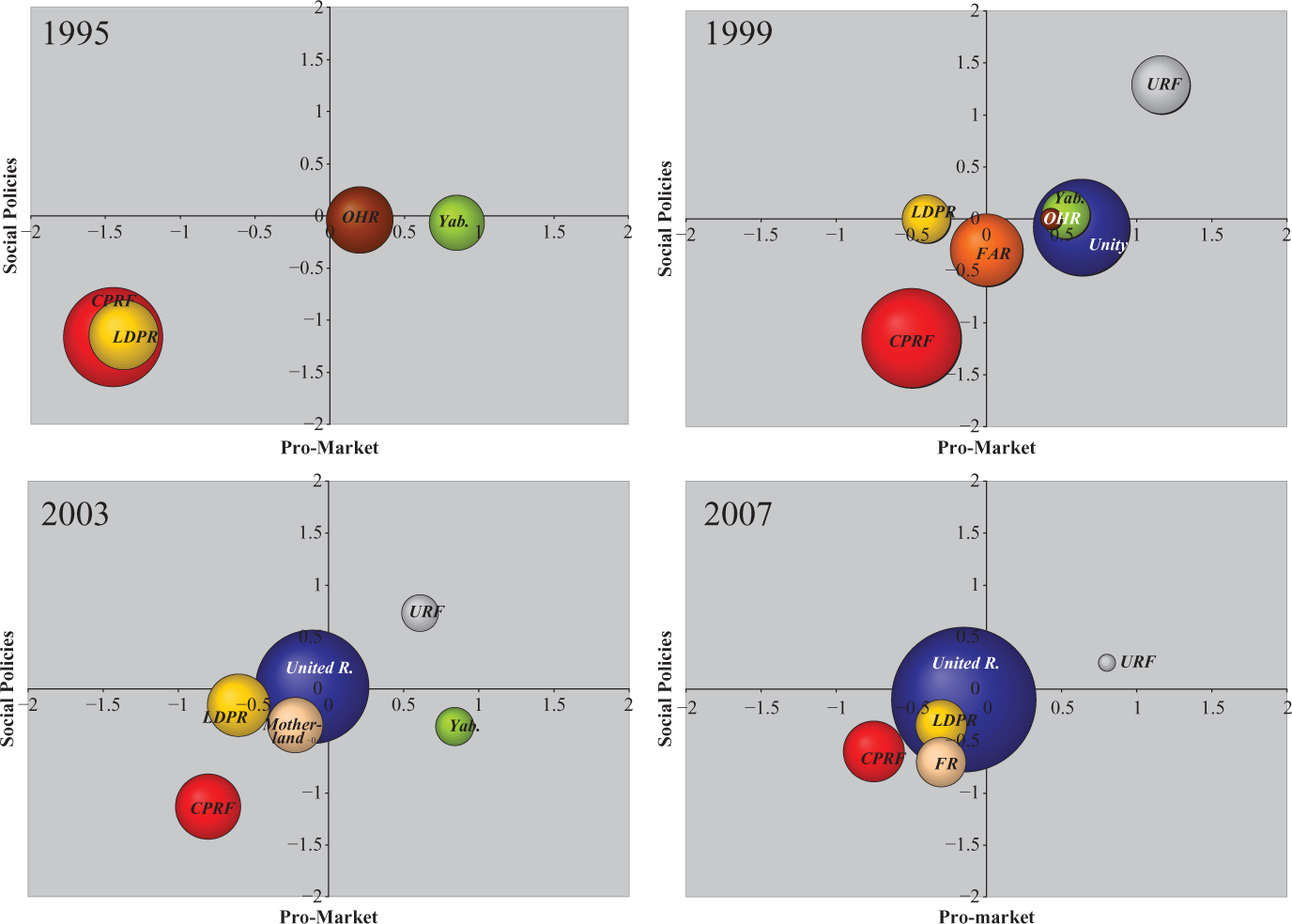
Party socio-economic platforms, 1993–2007.
Key/Notes
Scales move from left (negative) to right (positive) on a scale of −2 to +2.
The size of each circle depicts each party’s relative electoral strength, with each circle centred on a party’s policy position.
Party names: CPRF = Communist Party of the Russian Federation; FAR = Fatherland-All Russia; FR = Fair Russia; LDPR = Liberal Democratic Party of Russia; OHR = Our Home is Russia; United R. = United Russia; URF = Union of Rightist Forces; Yab.
Party finance
One of the most widely cited factors evincing cartelization cross-nationally has been the introduction of state subventions for parties (even if Katz and Mair (2009: 754) now feel this factor’s pre-eminence to have been initially overstated). Cartel parties can use state resources to give themselves a resource advantage, benefiting incumbents and blurring the distinction between their role as regulators and recipients of state resources. A more positive view suggests that state funding insulates parties from the vested interests of pressure groups, business interests or wealthy private individuals and ensures that the party system remains well resourced, something normatively desirable in a democratic system.
Internationally, the rules on state funding vary enormously, as does its importance to parties (Pierre et al., 2000: 14; Scarrow, 2006; van Biezen, 2008). Although direct electoral subvention was phased out from the 2003 parliamentary election onwards in Russia, there is inter-election state subsidy of larger parties, some of which can find its way back into campaigns indirectly as parties are entitled to contribute up to half their election budgets from party funds. Parties winning over 3 percent of the vote in State Duma elections, or whose presidential candidate wins over 3 percent (Law on Political Parties, §§32–33), are given direct subvention in annual sums, based on their vote-shares. There has been a steady increase in the sums involved. In its first iteration in 2001, the Law allocated an annual subsidy of 0.5 percent of the Minimum Wage Unit (in practice, 50 kopecks) per vote won in the previous State Duma election, and the same as a once-off sum per vote in the presidential election. With effect from January 2006, this increased to 5 roubles per vote (‘O vnesenii izmenenii’, 2005: §7.13) and again, with effect from January 2009, to 20 roubles per vote (‘O vnesenii izmenenii’, 2008: §2.a). This forty-fold increase compares with price inflation of 1.91 times in the same period. 12
State funding plays an increasing role in parties’ budgets, as Table 3 shows. For the CPRF and LDPR, it now constitutes the bulk of their incomes. United Russia’s 894 million rouble (approximately US$29m) subsidy in 2009 was just over a quarter of its total 3.3 billion rouble (US$110.1m) budget, but approximately twice the total budgets of any of the other Duma parties. No non-Duma parties received over 3 percent of the vote in 2007, so none received state funding for the following four years, but from 2003 to 2007 a number of smaller parties received modest sums that in some cases constituted the bulk of their incomes. Yabloko should once again receive funds from 2012, having won 3.4 percent of the vote in the 2011 election.
Funds from Federal Budget, 2005–2009 (million roubles).
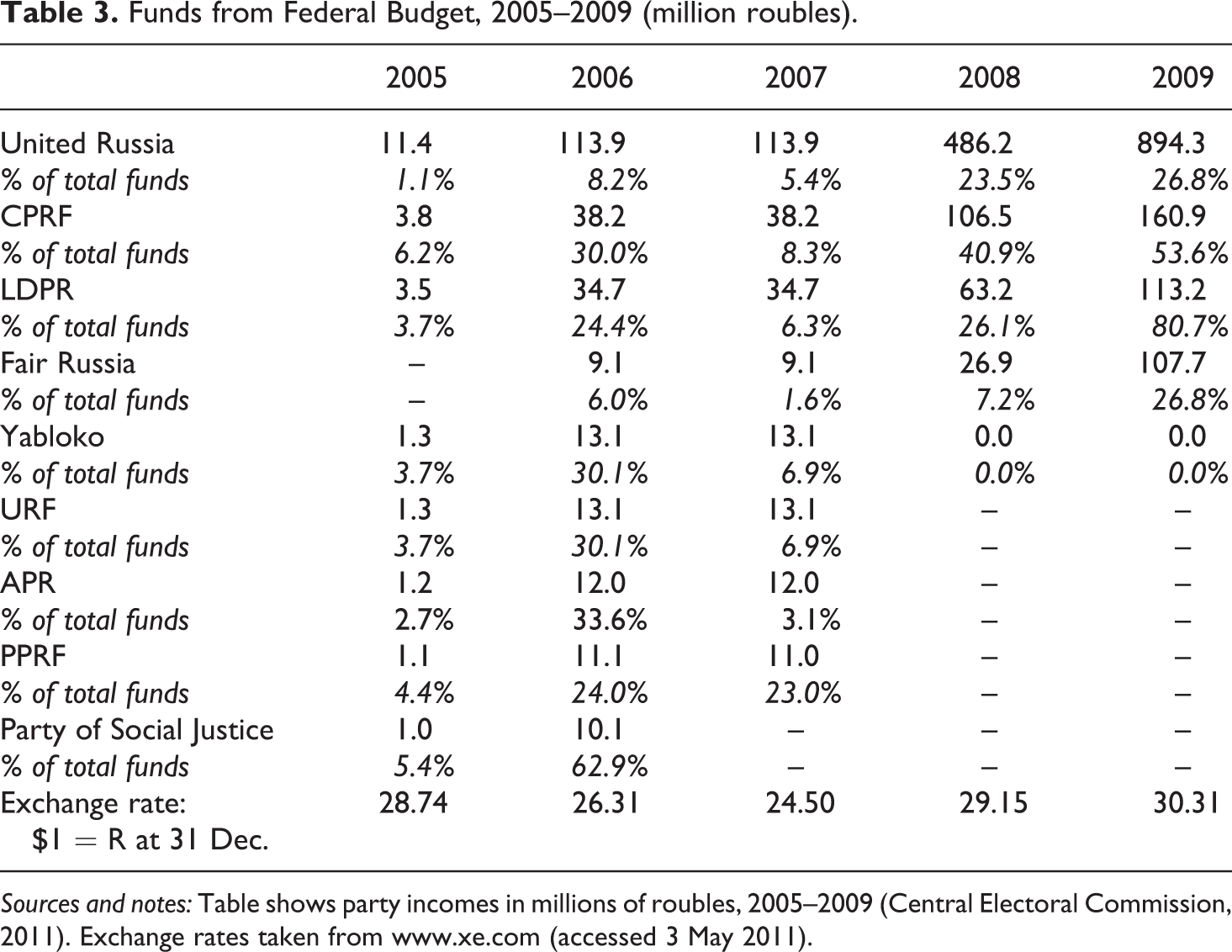
Sources and notes: Table shows party incomes in millions of roubles, 2005–2009 (Central Electoral Commission, 2011). Exchange rates taken from www.xe.com (accessed 3 May 2011).
From the point of view of the cartel thesis, the growing cross-party consensus on state funding is interesting to note. In its final reading in 2001, the Law on Parties was passed by a majority of 238 to 164 votes in the State Duma. The increase effective from 2006 was bundled together with a complex list of other electoral legislation alterations, ultimately supported by 331 deputies with 97 opposed (State Duma Protocol, 2005: no. 179). If the 2005 amendment saw diminished opposition to the principle of state funding, the further four-fold increase approved in 2008 saw none at all. The initiators came from all four factions in the State Duma, including the Communists. From first reading to ratification, the amendments were passed unanimously in two days with minimal on-floor debate (State Duma transcript, 2008). As no other party had gained more than 3 percent of the vote in the 2007 election, these four factions were the sole beneficiaries of the change (State Duma Protocols 2008: no. 49, §§120–122; no. 50, §§43–46.). A more classic example of the ‘cartelization’ of state resources would be difficult to find.
Conclusion
As the foregoing has demonstrated, Russia does appear to demonstrate characteristics consistent with the cartelization of the party system. In particular, the degree of state–party interpenetration has increased markedly in recent years, contrasting with the weakly institutionalized party system of the 1990s. Members play a superficial role in party affairs. Larger parties are advantaged institutionally in elections and in terms of resources available to them from the state. These parties in turn have found an increasing consensus on legislation intended further to advantage Duma parties over other parties and increase barriers to entry into the system.
Given the choice of ‘exit, voice or loyalty’ (Hirschman, 1970), the decisions taken by opposition parties have affected their fates. While stopping short of ‘loyalty’, the Communist Party has notably toned down the extent of its fundamental systemic criticism. Its monopoly as the electoral receptacle for anti-Kremlin votes has been best preserved by following the incentives to collusion and supporting the same barriers to entry that make the ‘parties of power’ so powerful, without affecting the nature of its policy differences with the Kremlin. Privileging Duma parties over non-Duma parties contributes towards the ‘freezing’ of the party system, and its position inside rather than outside the system ensures its long-term survival, albeit as a marginal actor. As the political system has become more centralized and the party system more compact, those that have chosen to ‘exit’ – the liberal parties such as the URF and Yabloko and fringe oppositionists such as former chess grandmaster Garry Kasparov and former prime minister Mikhail Kas’yanov – have lost traction, their positions further weakened by the institutional advantages now afforded to Duma parties.
Returning to the original model, the Russian case has implications for our wider understanding of cartelized systems outside the West European orbit, and presents challenges that add to Katz and Mair’s (2009: 759–763) research agenda on the topic. First, it challenges the notion that cartels must be formed from below (parties colonizing the state) rather than in the reverse direction. In Russia, a strong state colonized the ‘parties of power’, using them as vehicles to obtain societal legitimation, then used them as a means of co-opting the Communists into the cartel. They in turn have provided legislative support and legitimation for the various measures which have further isolated non-aligned parties, particularly since the 2007 election, and the four parties now co-exist as a parliamentary elite.
Second, it confirms their notion that party systems might now be regarded as indigenous rather than cross-national entities. Parties clearly exist in the Russian political system, yet their role and organizational forms have little in common with parties of Western Europe. The mass party is not so much dead (Katz and Mair, 2009: 760) as never born in the first place. This is not unique to Russia; across much of the Slavic post-Soviet space there is a similar disconnect between voters and the parties that nominally represent them, yet we see certain similarities in the institutional and organizational frameworks developing in these countries’ party systems as elsewhere.
Finally, it confirms the notion that cartel parties and party systems can exist in the absence of a party-based polity – albeit that the parties’ ultimate influence is lower. Unlike Belgium and Italy, where party leaders have been trying in recent years to downplay their partisanship while still operating within a party-based political system, Russian party leaders play up their partisan affiliations while in reality operating in a power structure that provides little real power for political parties. Nonetheless, within this sphere there is a mutual benefit for forces close to the Kremlin and the Communists to collaborate in structuring the party system in a manner that reinforces the status quo.
Katz and Mair’s initial discussions focused on the emergence of cartel parties in Western Europe. The case of Russia indicates that, two decades on from the collapse of communism, the post-Soviet space may be heading in the same direction.