







Abstract
While party membership figures are clearly in decline in several Western countries, different interpretations have been offered on the likely consequences of this trend. Some authors stress that members have lost most of their importance for political parties that increasingly rely on professionalized campaign techniques. Other scholars have expressed concern about the decline of party membership. They emphasize the fact that party members continue to function as an important linkage mechanism providing a structural alignment between the party and society (and thus also to potential voters). By means of an election forecasting model for Belgium, we test whether party membership figures can still be related to election results. Results show that party membership has a strong effect on election results and, furthermore, that this relation does not weaken during the period under investigation (1981–2010). The analysis also demonstrates that forecasting models can also be used in a complex multiparty system like that of Belgium.
Introduction
In almost all Western democracies, political parties are rapidly losing members (Mair and van Biezen, 2001; Whiteley, 2011). The statistical evidence suggests that the phenomenon can be documented in most countries, while the various party families all seem to be equally affected (Dalton et al., 2000). The decline, furthermore, does not remain limited to passive membership, but is also clearly present among formerly active party members (Heidar and Saglie, 2003; Whiteley, 2009). While all the statistical evidence suggests that there is indeed an erosion of party membership, there is ongoing debate within the academic literature about the likely consequences of this trend. Some authors assume that the trend is just another indication of the structural evolution toward a cartel party or a professional-electoral party. Others, however, are concerned about the possible consequences of this trend, and argue that a solid membership basis remains an important linkage mechanism for political parties (Scarrow, 1996; Whiteley, 2009). This latter claim, however, often remains unsubstantiated. Whiteley (2009: 254), for example, notes that the percentage of the population that is a member of a political party is positively correlated with government effectiveness in that country. The study, however, does not detail a causal mechanism that could help us explain this relation.
In this article, we propose a much more direct test of the linkage argument. If members really present an important social anchorage element for political parties, a close relationship between membership trends and electoral outcomes should be observed. In that case, the fewer members a political party has, the less likely it is that a political party will be able to reach out to society and gain votes. If, on the other hand, the professionalization thesis were to be correct, we would observe that membership figures lose their predictive power with regard to election results. In that case, parties increasingly rely on marketing strategies, professional and personalized election campaigns to mobilize voters, and they are no longer in need of having access to a large body of party members and supporters.
In order to test the impact of party membership on electoral outcomes, we rely on the relatively new technique of election forecasting, that, as far as we know, has never been used for this purpose (Lebo and Norpoth, 2011; Lewis-Beck, 2005). More specifically, we use the case of Belgian political parties in this article; first, because Belgium is a mainstream European country with regard to membership rates and electoral volatility, and, second, because for Belgian political parties we have access to three decades of time series on party membership and electoral results, and these time-series data are essential if we are to use election forecasting as a technique.
In the remainder of this article, we first briefly review the literature on the importance of party membership as a linkage mechanism. Subsequently, we explain data and methods, where we clarify in more detail the still new method of election forecasting. After presenting the results of the analysis, we reflect on the relevance of our findings for the debate about the role of party members in contemporary political parties.
Do political parties still need members?
The observation that political parties tend to lose members rapidly must be considered against the background of a structural transformation of political parties in Western democracies. Political parties evolve toward a more professionalized political organization that is aimed primarily at winning elections and securing elected office. This evolution has been described in terms of a cartel party (Katz and Mair, 1995, 2009), but also as a trend toward professional-electoral parties (Panebianco, 1988). Although there is a persistent debate within the literature about the exact characteristics and consequences of this transformation, most authors agree on the fact that political parties gradually move closer to the state apparatus, as parties increasingly become dependent on government resources for their day-to-day functioning. They are therefore less dependent on their membership base than are more traditional mass-membership political parties. This process also leads to changes within the party organization, as professionals gain influence within the party, and the role of volunteers, militants and party members is strongly reduced. This trend toward professional-electoral parties, or cartel parties, in the long run might even strengthen the structural position of political parties, as the parties can consolidate their position as power brokers within the political system. Most authors working in this area of the literature therefore do not treat the decline of membership figures as something inherently problematic. In the past, political parties developed new organizational forms in order to respond to structural changes in society, and it is assumed that the current changes can also be regarded as functional for the long-term survival of political parties. With regard to electoral outcomes, the assumption is that highly professionalized and centralized campaigns can be just as effective as traditional grass-roots-based campaigning (Farrell, 1996). Even if parties tend to lose members, new campaign techniques would still enable them to reach out to new voters and to win elections.
Rather in contrast to this assumption is the position taken by a number of authors highlighting the continued importance of grass-roots membership for the functioning and the legitimacy of political parties (Scarrow, 1996; Whiteley, 2011). According to these authors, members remain an important resource for political parties with regard to internal decision-making, electoral campaigns and by providing a structural linkage mechanism to society in general (Spier and von Alemann, 2008).
Party members contribute in various ways to the electoral success of political parties. First, they provide a form of legitimacy, as the presence of the members makes clear that the party is not just some elite initiative but is rooted within society (Scarrow and Gzegor, 2010). Second, it can be safely assumed that the members themselves are very likely to vote for their political party, thus providing a relatively safe reservoir of votes. Third, during electoral campaigns, members can also be called upon to get involved in campaign strategy. Exactly the fact that they are not political professionals, and usually well connected within their own community, might make their message even more effective (Scarrow, 1996, 2000). Despite the fact that campaigning is now largely media-orientated, and is heavily professionalized, Whiteley (2009: 255) argues that volunteers (who are most likely also party members) remain crucial to explaining electoral success: ‘It is fairly clear that the political parties need their volunteers to be effective and that if action is not taken to reverse the current trends then governance in Britain will suffer in the long run.’
In the United Kingdom, in particular, there is some empirical research available on the relationship between party membership and electoral outcomes. It is expected that party members are very likely to be mobilized during an election campaign, and that they will take part in the various activities of their political party. As such, the presence and participation of party members is seen as a crucial element explaining electoral success (Whiteley and Seyd, 1998). Other research, however, points to the importance of centralized targeting (Denver and Hands, 2004). Given the characteristics of the British electoral system, central party offices will decide to target resources to specific constituencies, while other constituencies, either because they are considered as safe seats or because the party does not have a chance anyhow of gaining a seat, are not considered as a priority. This intervention from the central party office can reinforce and dramatically amplify the effectiveness of the efforts of local campaign volunteers, and, as such, points to the importance of professionalised campaign management. It is clear, however, that the findings of these British studies cannot be generalized toward other political systems, as they focus heavily on constituencies with strongly contested seats. Given the characteristics of the British electoral system, political parties might indeed decide to spend a considerable amount of resources on these swing constituencies. It remains to be investigated, however, whether similar logic is also applicable in the case of proportional electoral systems with multi-member constituencies.
This review of the literature leads to two competing and contradictory hypotheses. The cartel party thesis assumes that party membership gradually becomes less important, and might even have lost all of its meaning for the electoral success of political parties. The linkage assumption, on the other hand, implies that the level of party membership still remains important for political parties as members remain an important electoral resource for political parties. Using data from Belgium for the period 1981–2010, the aim of the current article is to investigate the validity of both hypotheses in this specific political system. Belgium offers an ideal testing ground for our hypotheses. First, the Belgian electoral system is extremely proportional, thus counterbalancing the current dominance in the literature of case studies in majoritarian systems. Second, since Belgium has a very comprehensive system of party financing, it can be assumed that the trend toward a professionalization of party politics is clearly present within the Belgian party system (Hooghe et al., 2006).
Election forecasting
The technique of election forecasting is used here to test these two competing hypotheses. The theoretical foundation of the technique is that the electoral result of a political party can be seen as the result of a popularity function and economic circumstances (Lewis-Beck, 2005; Lewis-Beck and Jêrôme, 2010; Lewis-Beck and Tien, forthcoming). The first paper that attempted to forecast election results in a theoretically-based way was published in 1950 (Whiteley et al., 2011). Since then, there has been a boom of election forecasting models in the United States. Europe, on the other hand, is lagging behind in the application of this technique. Only in some of the major European democracies have forecasting models been developed (Lewis-Beck, 2005; Lewis-Beck and Jêrôme, 2010). Those efforts show that forecasting models have to be adapted to the specific electoral context of each country (Bellucci, 2010; Fisher et al., 2011; Lebo and Norpoth, 2006; Nadeau et al., 2010; Norpoth, 2004; Norpoth and Gschwend, 2010). While there are now a number of election forecasting studies available for Europe, these tend to remain concentrated on two-party systems.
The popularity function in this model is routinely operationalized by including information about electoral or political polls. This, however, is also one of the main points of criticism of this technique. First, not all political systems have access to reliable time series of public opinion polls, and this reduces the potential scope of the technique rather dramatically. Furthermore, we also know that the quality of commercially available polls tends to vary quite strongly depending on the professional standards of the polling agency involved (Fisher et al., 2011). Given the theoretical claims of the literature, this dependency on the quality of commercially available data is troublesome, and there is a need to have access to an alternative operationalization of the popularity function.
In this article, we propose therefore to operationalize the popularity function in the equation with figures on party membership, a step that thus far has not been taken in this emerging line of the literature. This step has two major advantages. First, there is a theoretical relevance, as it allows us to assess whether party membership is indeed related to the popularity of a party in society at large. Does the number of party members inform us of the anchorage of a political party within society? Second, there is a methodological advantage. The main criticism of the current use of prediction techniques is that they are to some extent tautological, as they use election polls to ‘predict’ real elections. If, however, we replace election polls with party membership as an independent variable, tautological relations are no longer present, and this strengthens some of the claims that have been made with regard to the theoretical validity of these models.
It has to be noted in this regard that the technique of election forecasting is clearly rooted in the literature on economic voting (Lewis-Beck and Stegmaier, 2007). Following the tradition inaugurated by V. O. Key (Key 1966), the incumbent party or candidate is believed to be rewarded for economic prosperity and punished for economic downturn (Lewis-Beck, 2006). The central equation for most forecasting models is therefore:

As the incumbent’s vote-share is seen as a linear function of both elements, the model can be estimated by means of an Ordinary Least Squares regression (Lewis-Beck, 2005).
The model only applies to incumbent parties that can be credited, or blamed, for economic shifts (Anderson, 2007). The most straightforward use of the model therefore occurs in two-party systems where one political party is incumbent and the other is seen as the opposition or challenging party. Applying the model in more complicated party systems entails a number of problems and challenges (Bélanger et al., 2010). For most voters, accountability is much more difficult to assess when confronted with coalition governments (Arzheimer and Evans, 2010). As a consequence, forecasts within multiparty systems usually focus on one single party, either the lead party or another party. Another question is whether all relevant parties can be included in a single forecasting model. In the current article we opt for an equation in which the dependent variable is the vote-share of each incumbent, i.e. governing coalition party separately. We do not include the summed vote-share of the parties in office, but all parties as individual cases. The unit of observation is thus the electoral score of one specific incumbent party during a specific election. By including several parties per election, we arrive at a sufficient number of observations to develop a stable forecasting model.
Within the federal country of Belgium there are two completely segregated electoral and party systems. With the exception of the inhabitants of the bilingual greater Brussels area, Belgian citizens can only vote for political parties of their own language group (Deschouwer, 2009). For the sake of clarity, we only include one party system in this study, the Dutch-language region. Not only is this the largest community within Belgium (c. 60 percent of the population), since 1974 the Prime Minister of the country has always been a Dutch-speaking politician, so for the inhabitants of this region it should be straightforward to assess who can be held ‘responsible’ for conducting government affairs. Moreover, a focus on one region allows us to include regional election results in the dataset, enlarging the number of cases for the analysis. Within the Belgian federal system, regional elections are considered first-order elections. When regional and federal elections are organized on the same day, the parties’ vote-shares for both levels are remarkably similar (Deschouwer. 2009). 1
For the dependent variable we focus on the vote-shares of Dutch language incumbent parties, either in federal or in regional elections. Because the Belgian electoral system is fairly proportional, forecasting vote-shares as such is relevant and useful. There is no need to include an extra step and to forecast seats in parliament (Fisher et al., 2011). As we have time series available since 1981, all electoral scores of incumbent parties during the past three decades (N = 26) can be included in the model. The elections included are the federal elections of 1981, 1985, 1987, 1991, 1995, 1999, 2003, 2007 and 2010. Moreover, we add the regional elections of 2004 and 2009. When regional and federal elections were organized on the same day (this was the case for the elections of 1995 and 1999), we included only the federal election results. The parties included are those that belonged to the governing coalition before election day. It has to be observed that during this period the majorities on the federal and regional level were identical, so that for the model, and for most voters, it should not be difficult determining who the incumbent parties were (Table 1). 2 In total, this means we have 26 observations of incumbent political parties during the period 1981–2010.
Elections and incumbent parties included in the analysis.
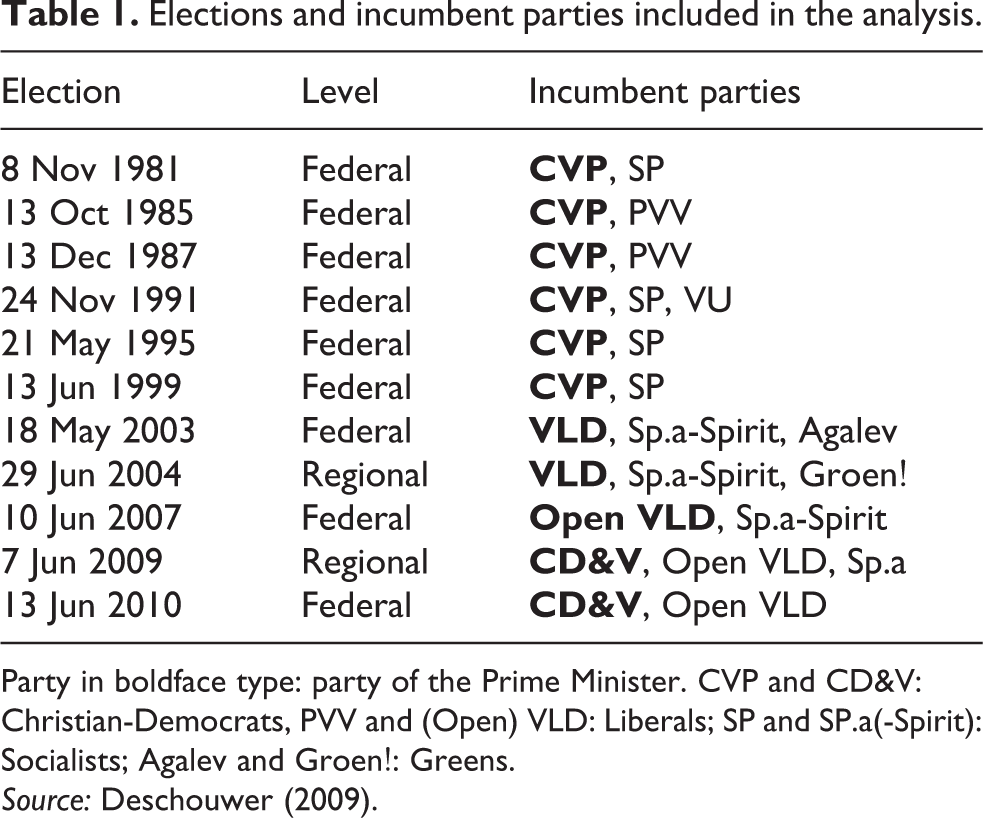
Party in boldface type: party of the Prime Minister. CVP and CD&V: Christian-Democrats, PVV and (Open) VLD: Liberals; SP and SP.a(-Spirit): Socialists; Agalev and Groen!: Greens.
Source: Deschouwer (2009).
Constructing the model
Following the assumptions of election forecasting, we need information about a popularity function and an objective economic indicator if we are to predict the vote-share of incumbent parties. In accordance with our main research question, and in order to test the impact of party membership, we first use the absolute number of party members for every party that is included. These data were obtained from the study by Quintelier and Hooghe (2010) building on the documents that were published every year in the Belgian political science journal Res Publica. The figures were obtained directly from the administrative staff of the Belgian political parties. Although in that case there are of course concerns about the reliability of the figures, within the Belgian political science community they are usually regarded as highly reliable. First, these data have now been collected every year over a 30-year period, and they show no discontinuities despite the fact that the administrative staff of most political parties has changed several times in that period. If political parties exaggerate their membership figures they at least do so in a remarkably consistent manner over a 30-year period. Second, for most of the major political parties a downward trend can be observed, and there is no indication that political parties try to cover up this trend. Therefore, there is no reason to believe that membership figures would be highly unreliable in the Belgian context.
If we assume that party members provide a linkage mechanism for political parties, ideally the measurement of the number of members should precede the electoral outcome. As there are no theoretical grounds for preferring a specific time lag, we conducted an empirical test to assess what time lag produces the strongest results. Therefore we developed a limited regression model, where we try to explain the 26 election results under observation for the membership figures with varying time lag (ranging between 0 and 4 years).
Table 2 lists the estimates of linear regression models between party membership figures and the election results. There is a declining trend of party membership figures within Belgium (Quintelier and Hooghe, 2010). Because this declining trend might distort the effects of membership on election outcomes, and because party popularity implies a comparison with other political parties, we make use of relative party membership figures. By doing so we can be sure that the general downward trend with regard to membership figures in Belgium no longer has any role in the analysis. For each party we calculate the share of party members on the total number of party members in a certain year (M). Separate regression models with membership measured at various times all produce a similar r2 value (ca. 0.680). Therefore, we can conclude that using a different time lag for the membership variable does not have a clear impact on the model fit. Since we only have membership figures from 1980 onwards, we lose some observations when we set the time lag at two years or more. 3 As our aim is to develop a forecasting model, there should be at least some time lag between the independent variable and the election result (Gibson and Lewis-Beck, 2011). When we include membership information from the same year as the election, this might not always be the case, so we use party membership measured one year before the election year (E-1) as the key popularity variable in our forecasting model.
Optimal time lag between party membership and election results.
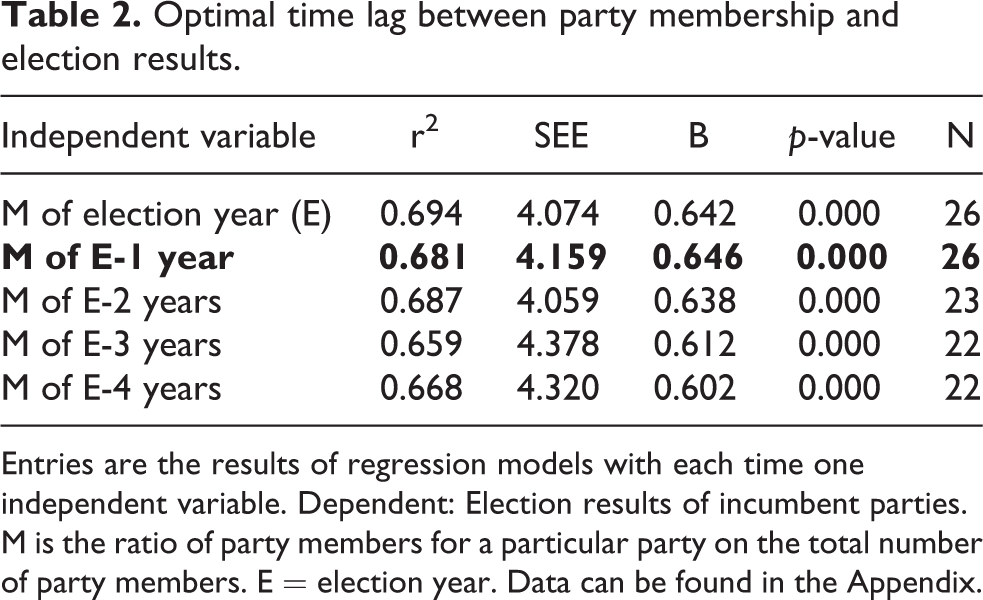
Entries are the results of regression models with each time one independent variable. Dependent: Election results of incumbent parties. M is the ratio of party members for a particular party on the total number of party members. E = election year. Data can be found in the Appendix.
As we aim to develop a valid forecasting model, our main analysis is limited to incumbent parties. Over recent decades, however, it has mostly been the larger and traditional parties (Christian Democrats, Socialists and Liberals) that have been in government. One might question whether this overrepresentation of the larger parties does not distort the overall picture and whether the strong correlation between party membership and electoral results also holds for smaller and fringe parties. In that account it has to be noted that Greens and nationalists were also included whenever they were in government. Furthermore, in order to judge the validity of the party membership as an explanatory variable for electoral results, we also tested the correlation between party membership and vote-shares for all parties. These correlations were about equally strong as those when we limited the analysis to incumbent parties. 4 We can therefore conclude that the strong correlation between party membership and electoral results apparent in our analysis is not due to the cases selected (incumbents) for the analysis.
In order to include a valid economic assessment indicator, we proceed in more or less the same manner, where we include GDP growth rates (quarterly accounts measured as price indices) measured with different time lags (Table 3). 5 We include national GDP rates, which is consistent with the information most voters will receive by means of mass media reports (Geys and Vermeir, 2008). As can be seen in Table 3, only the growth rate from the fourth quarter before the election proved significantly related to incumbent parties’ vote-shares. Because we wanted to control for the impact of sudden economic events, we also tested the relation between the average GDP growth rate of different quarters and vote-shares. Table 3 reflects a regression with the average GDP growth rate of the second, third and fourth quarters before the election quarter results in a p-value of 0.053. As our hypothesis is one-directional, this, too, might be considered a significant result.
Optimal economic indicator for election result forecasting.
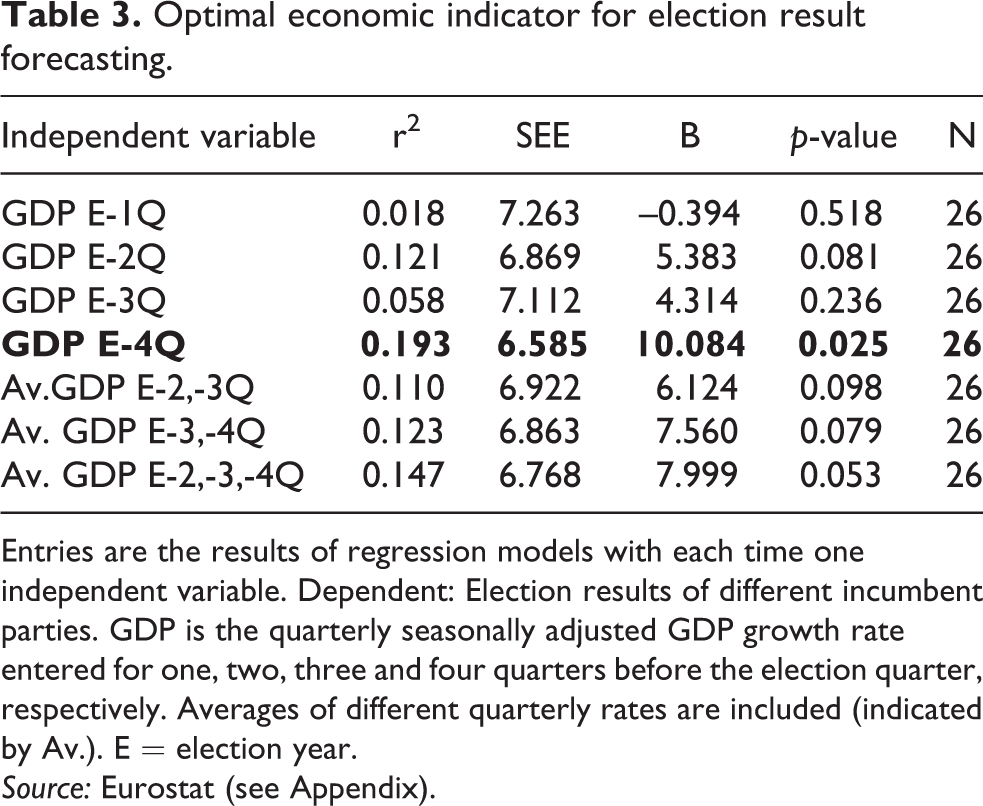
Entries are the results of regression models with each time one independent variable. Dependent: Election results of different incumbent parties. GDP is the quarterly seasonally adjusted GDP growth rate entered for one, two, three and four quarters before the election quarter, respectively. Averages of different quarterly rates are included (indicated by Av.). E = election year.
Source: Eurostat (see Appendix).
For the empirical tests in Table 3, we treated every incumbent party as equally accountable for the economy. It should be remembered, however, in multiparty systems with coalition governments, meeting some of the standard assumptions about accountability is not always straightforward (Nadeau et al., 2002; Powell and Whitten, 1993). More specifically, it is not clear whether voters will attribute the responsibility for the state of the economy equally to senior and junior coalition partners. During the observation period, the largest partner in the governing coalition was always the party of the Prime Minister, thus further contributing to the visibility of that party. Therefore a likely assumption is that it is mainly the party of the Prime Minister that will be held responsible for the state of the economy. Research in Britain has shown that approval ratings are linked to satisfaction with the prime minister rather than to satisfaction with the government as such, thus indicating that the prime minister can account for a more straightforward mechanism of rewarding and punishing by the voters (Lebo and Norpoth, 2011). To test whether this effect occurs, we allowed for an interaction effect between the GDP figure and whether or not the incumbent party was also the party of the Prime Minister (PM).
As is clear in Table 4, all interaction terms are significantly related to incumbent parties’ vote-shares. The indicator that has by far the best fit when interacted with the PM dummy is the GDP growth rate from the fourth quarter before the election quarter (r2 = 0.555). This finding means that we include this variable, and the corresponding interaction effect, in our forecasting model.
Optimal economic indicator – interaction effects.
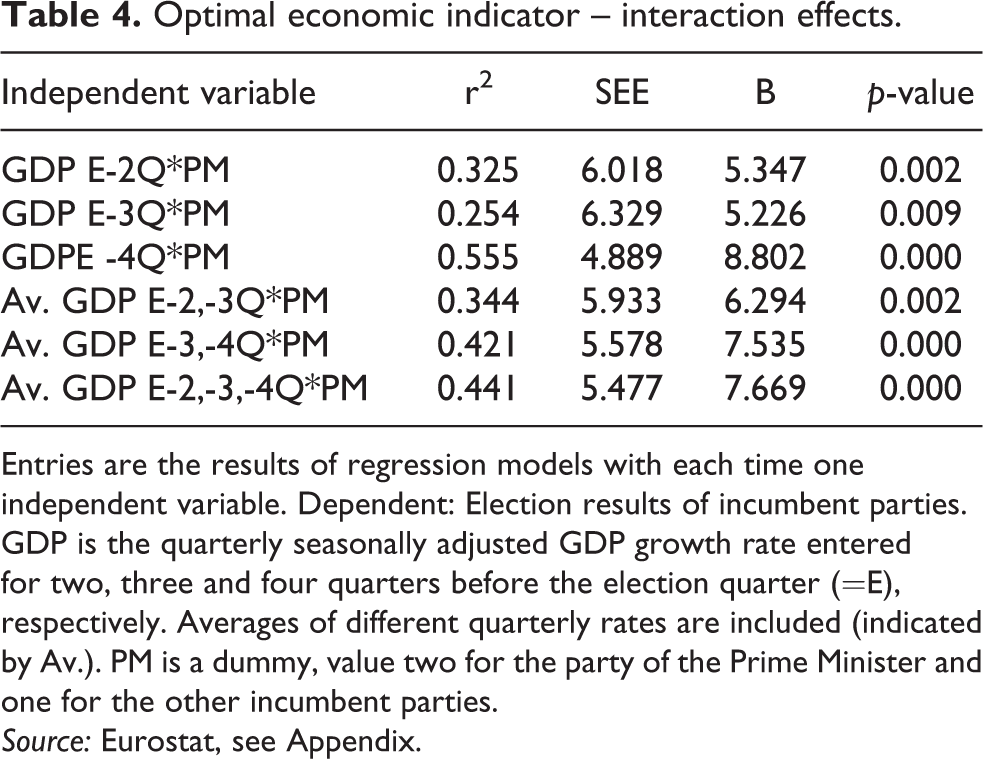
Entries are the results of regression models with each time one independent variable. Dependent: Election results of incumbent parties. GDP is the quarterly seasonally adjusted GDP growth rate entered for two, three and four quarters before the election quarter (=E), respectively. Averages of different quarterly rates are included (indicated by Av.). PM is a dummy, value two for the party of the Prime Minister and one for the other incumbent parties.
Source: Eurostat, see Appendix.
Empirical tests have already shown that the indicator producing the strongest results is the GDP growth rate four quarters before the election (Table 3). Moreover, the interaction term (with the PM dummy) performed even better and is strongly correlated with the incumbent’s vote-shares. Therefore, in line with the option taken by Lewis-Beck and Tien (2004), we include the economic indicator (GDP E-4Q) for the forecasting model as an interactive term in the model and not as an additive term.
Forecasting model
Estimation
Having found a macro-economic indicator that is significantly related to the election scores of incumbent parties and having established that membership is a good predictor of parties’ vote-shares, we now proceed with the forecasting model, which takes the form:
where M is the percentage of party members for a particular party on the total number of party members within Flanders one year before the election. GDP is the seasonally adjusted GDP growth rate from the fourth quarter before the election quarter. PM is a dummy for the position of a party within government. Its value is 2 for the party of the prime minister and 1 otherwise. The vote-shares of incumbent parties in the 1981 to 2010 elections were used for developing the model.
In a next step we estimate the model by means of an ordinary least squares regression. The estimates for the coefficients of the variables in the regression are then used to create the forecasting equation. The model for forecasting the electoral results of the incumbent parties is: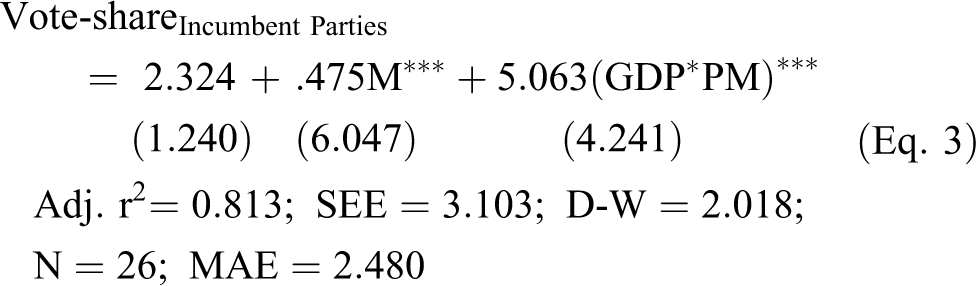
The values in parentheses are t-ratios. Sign.:
Based on the results of Equation 3, we can now predict for every one of our 26 observations the vote-share of that party (Table 5). In the last column, we include standardized residuals; as can be noted, one prediction lies more than 2 standard deviations outside the expected value. The predictions of the Socialist result of 2003 can thus be considered as an outlier.
Forecasting electoral results of incumbent parties.
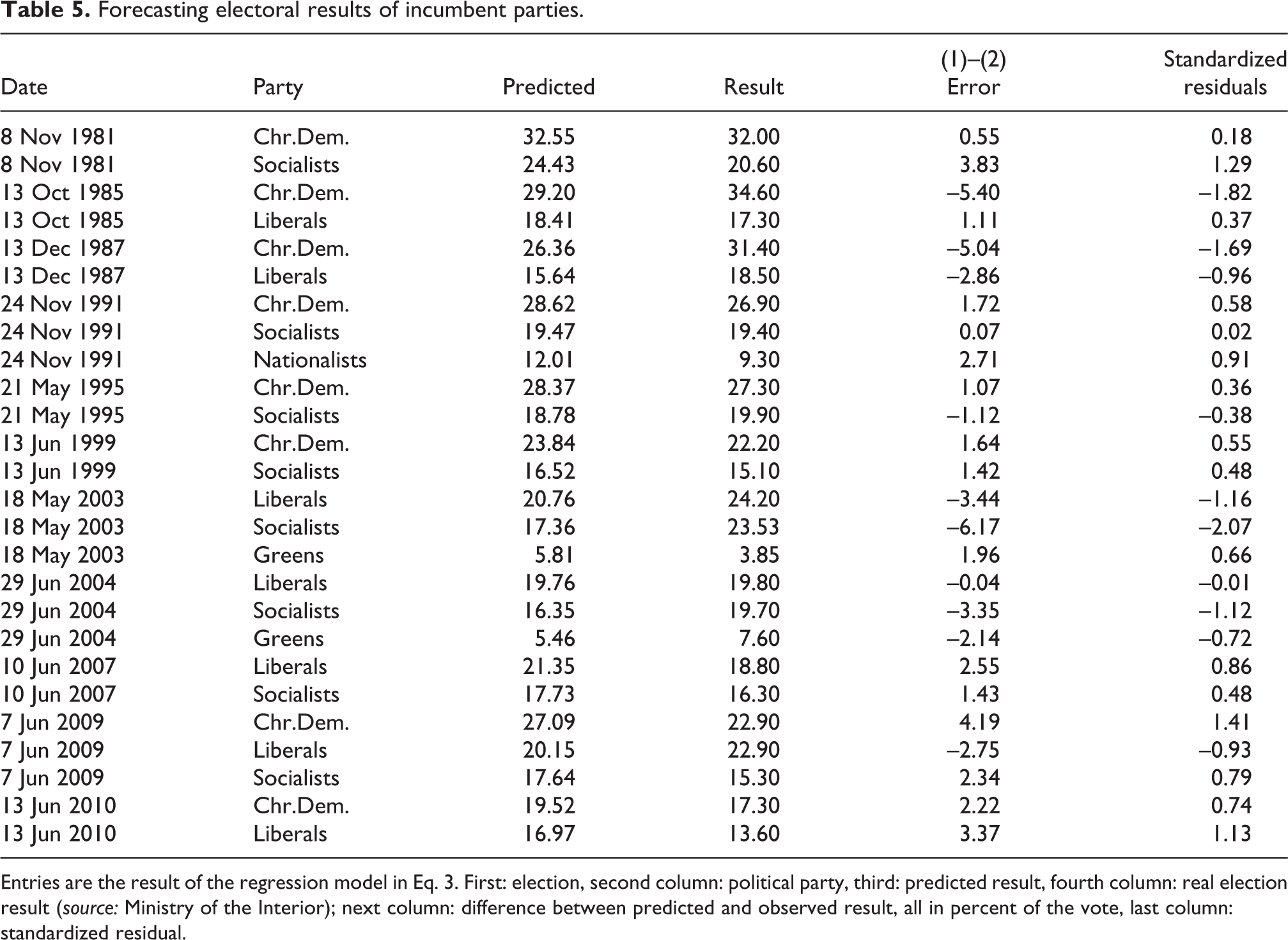
Entries are the result of the regression model in Eq. 3. First: election, second column: political party, third: predicted result, fourth column: real election result (source: Ministry of the Interior); next column: difference between predicted and observed result, all in percent of the vote, last column: standardized residual.
Although the model is based on only two independent variables, the predictions fare quite well. The percentage of party members belonging to a certain party informs us, quite strongly, about the likely election results of a political party in the subsequent year. Economic indicators, too, prove to have a significant effect on electoral results for incumbent parties, but clearly weaker than the information about the number of party members. The information on these two variables is sufficient to arrive at predictions with a mean absolute error of 2.480, which can be considered as convincing.
As already mentioned, most election forecasting models use election polls to operationalize the popularity function in the model. In line with the argument that party membership provides a linkage mechanism between the party and society as a whole, in this analysis we used information about party membership as an operationalization of that popularity function. The model performed remarkably well, with an explained variance of 81.3 percent. In line with the linkage argument, put forward most strongly by Scarrow (1996), it can be observed that information about the membership base allows us to predict the electoral result of an incumbent party quite accurately.
In order to assess whether party membership is indeed a good substitute for the popularity function, we compare the performance of this model with a more straightforward replication of the Lewis-Beck government-approval model. Therefore we developed a model that includes, besides our central economic variable, polling results as the popularity function.
6
Poll results are derived from La Libre Belgique, as this newspaper provides the longest time series in election polls within Belgium and has held a poll about vote intentions every three months since 1984 (we thus lose the two oldest cases for the analysis). We estimate the model by means of polling results from approximately three months before the election (see Equation 4). As such, this time lag is comparable to what Lewis-Beck (2005) proposes.
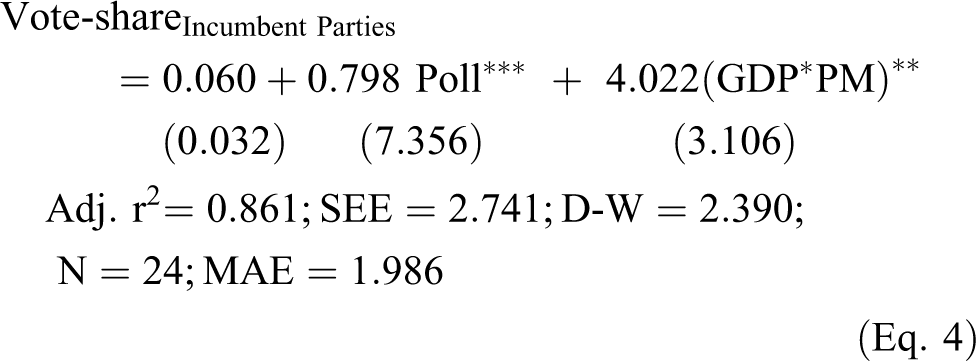
The values in parentheses are t-ratios. Sign.:
Comparing our initial model, which included party membership figures (Equation 3), with a model that includes polling results (Equation 4) further stresses the relevance of party membership figures in a forecasting model. Although the model that included polling results performed slightly better than the party membership model (higher adjuster R2 and a lower MAE), both models are comparable and competitive. After this test we can conclude that party membership figures constitute a valid proxy of party popularity. Therefore, in countries where neither government approval figures nor valid polling results are available, party membership figures can be a good alternative as the popularity function in forecasting models.
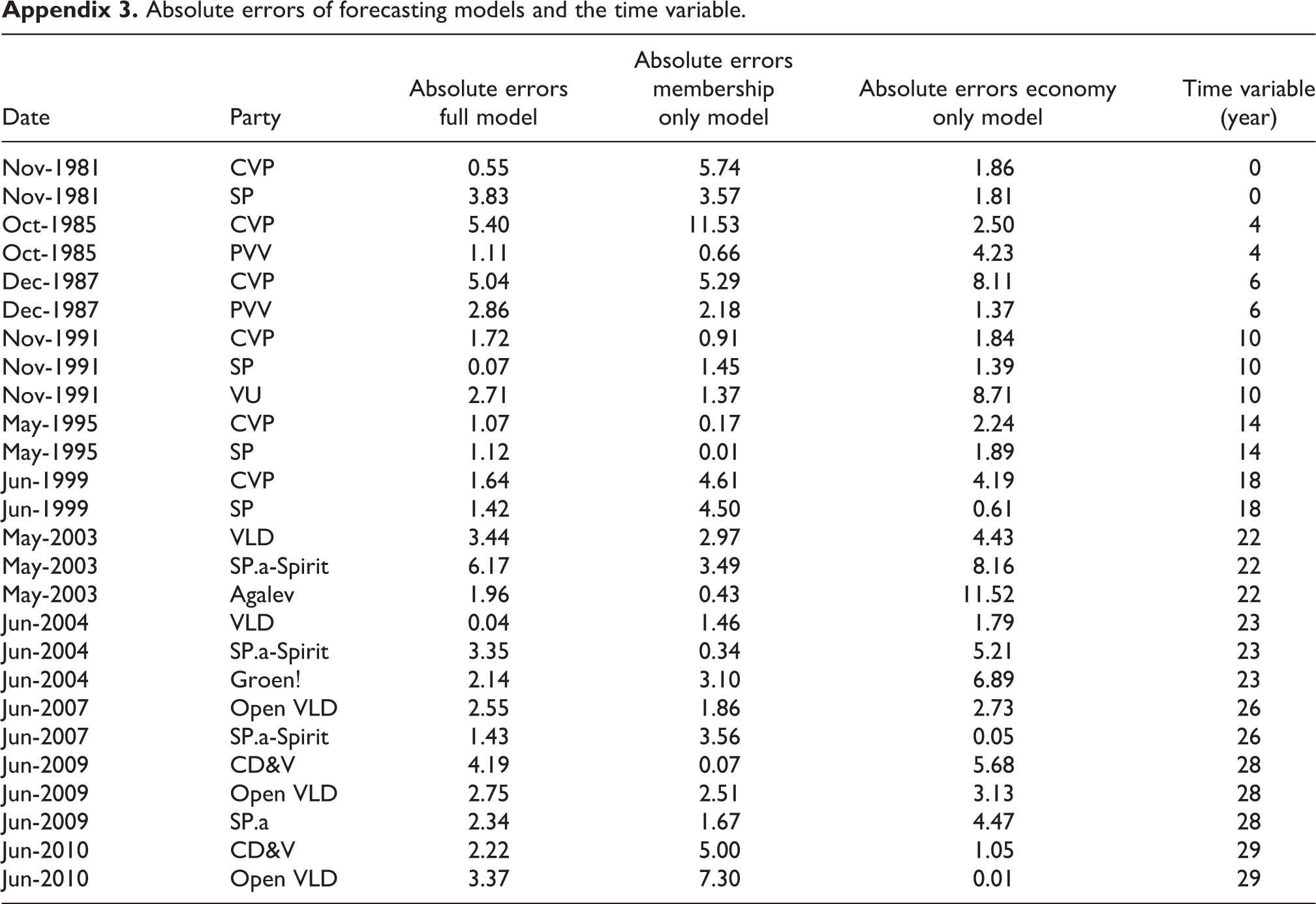
We can rely on a three-decade time series on the one hand strengthening our results, as it is clear that these figures are not driven by unique fluctuations. On the other hand, it might be argued that only an average relationship can be seen over the entire period, and that during those three decades the effect of party membership might have weakened in accordance with the thesis that parties do become electoral-professional organizations. We therefore conducted an additional test to assess whether the predictive power of our two independent variables becomes weaker over time. We calculated the correlation between the absolute errors of the forecasting model and the election year (1981=0; 2010=29). This correlation is not significant (Table 6), which means that the predictive power of the forecasting model does not decline or increase significantly over time. This test still cannot be considered as absolute proof of the stability of the relation between membership and election results, as declining predictive power of membership might be compensated by increasing importance of the economy or vice versa. Therefore, we also calculated correlation coefficients for the errors of forecasts with only membership and the economic variable (GDP*PM), respectively, with the time variable. Here too, nothing reaches conventional levels of significance. As can be observed, the errors resulting from the limited model with only party membership included as an independent variable even tend to become smaller over time. Although this trend is not significant, we can observe that party membership now allows us to make more successful predictions of electoral results than three decades ago. In any case, we do not find any indication whatsoever of party membership becoming less important over time. As such, this test confirms the hypothesis about the continued importance of party membership for political parties (Scarrow, 1996).
Pearson correlations between forecasting models absolute errors and time.
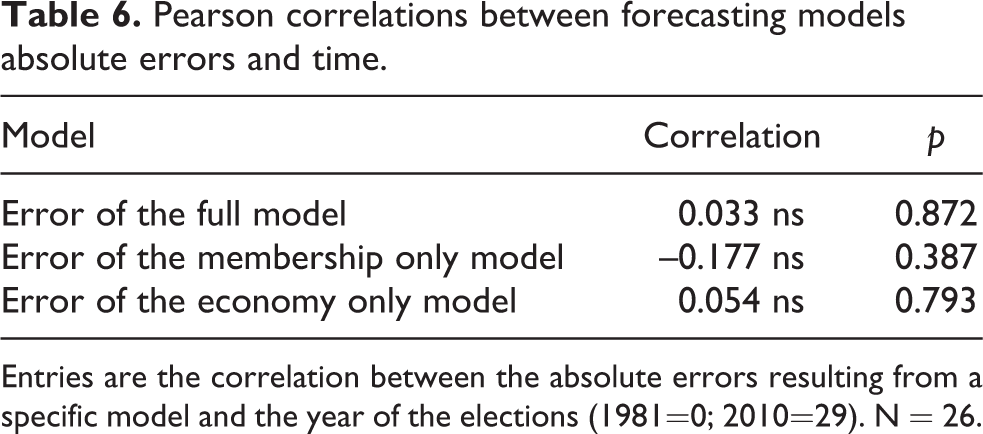
Entries are the correlation between the absolute errors resulting from a specific model and the year of the elections (1981=0; 2010=29). N = 26.
Diagnostics of the model
When using election forecasting techniques, it is customary to include robustness tests to ascertain the validity of the findings. Usually this is done by out-of-sample predictions. By doing so, one assesses whether the model performs as well with a smaller sample size, and this helps in ensuring that results are not dependent on some outliers. As we want to assess whether party membership can still be considered a valid predictor for electoral results, we leave the oldest cases out of the sample. We then estimate the model again with limited sample size (Table 7). As can be observed in Table 7, eliminating the oldest election results does not have an impact on the predictions, and we can conclude that models are robust in this regard.
Out-of-sample diagnostics without oldest elections.
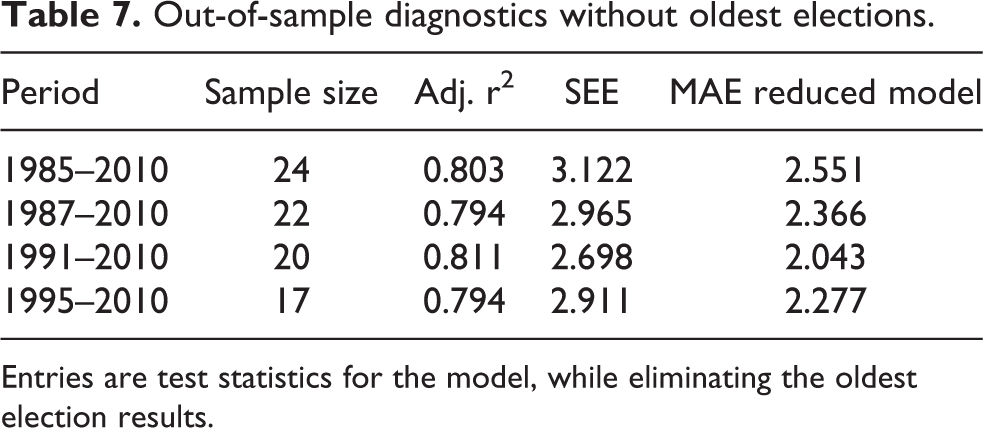
Entries are test statistics for the model, while eliminating the oldest election results.
Out-of-sample diagnostics and prediction errors when parties are left out
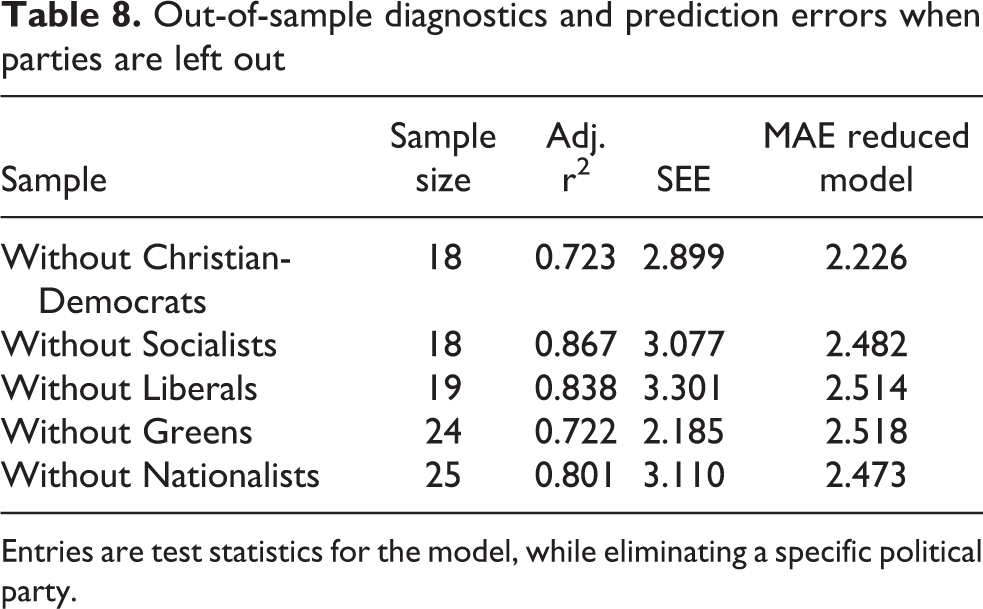
Entries are test statistics for the model, while eliminating a specific political party.
A second test is based on the same logic, but this time we leave out one specific political party (Table 8).
Again, the model appears to be quite stable and we do not observe a substantial rise in the errors of the predictions. The model fit of the election forecasting model for Flemish incumbent parties is thus not dependent on one or more political parties.
Discussion
Do political parties still have an interest in investing in their membership? Authors such as Susan Scarrow and Paul Whiteley have argued that members still provide a strong linkage mechanism to political parties, and as such cannot be replaced by more modern campaign techniques. The empirical evidence for this ‘nostalgic’ look on the era of mass parties, however, thus far has remained rather limited. In this article we have demonstrated that figures on party membership allow us to predict electoral outcomes quite precisely, at least for incumbent political parties. This suggests that members do remain important as an electoral linkage mechanism for political parties. Since we considered figures for the entire 1981–2010 period, we can even demonstrate quite clearly that during these three decades the importance of membership figures has not declined at all. Apparently, members remain as important as ever for Belgian political parties.
A number of caveats are in order, however. It has to be remembered that the technique of election forecasting can only be used for incumbent political parties, as they, at least to some degree, can be held responsible for economic conditions. The opposite claim, that opposition parties would be rewarded for an economic downturn is not automatically warranted in the theory of economic voting. Our conclusions, therefore, apply only to coalition parties, and we do not know for the moment whether opposition parties are equally vulnerable to the effects of losing members. It also has to be noted that our analysis is heavily dominated by three traditional political parties that are responsible for the bulk of the incumbent parties in Belgium. In particular, Socialists and Christian Democrats tend to be in decline, but it has to be said that the Liberals have held their ground, both with regard to membership and percentage of the votes. Our results, therefore, are not the result of a general downward trend for these political parties. Nevertheless, it would be useful to investigate in other political systems whether our model is also successful in countries where strong or emerging parties are more strongly represented in governing coalitions. Third, this test was only conducted within the Dutch-speaking party system in Belgium, and additional tests are surely necessary if we are to determine whether our findings can be generalized toward other contexts.
Nevertheless, we do believe that this approach also has a number of merits. Thus far, election forecasting models have been dependent on election polls to operationalize the popularity of a political party. The current tests suggest that party membership figures are equally appropriate as a test for the popularity of a party. Theoretically, this is highly relevant, as it indeed suggests that, for a political party, loss of members can be equated with loss of popularity. Again, this drives home the point that members remain crucially important for political parties. Furthermore, this approach can help us to solve one of the weak points of the forecasting approach, i.e. that election polls are used to predict election results. If reliable party membership figures are available, these can easily be integrated within the forecasting models. As such, these findings also strengthen the theoretical assumptions of the use of election forecasting models.
Footnotes
Appendix
Absolute errors of forecasting models and the time variable.
| Date | Party | Absolute errors full model | Absolute errors membership only model | Absolute errors economy only model | Time variable (year) |
|---|---|---|---|---|---|
| Nov-1981 | CVP | 0.55 | 5.74 | 1.86 | 0 |
| Nov-1981 | SP | 3.83 | 3.57 | 1.81 | 0 |
| Oct-1985 | CVP | 5.40 | 11.53 | 2.50 | 4 |
| Oct-1985 | PVV | 1.11 | 0.66 | 4.23 | 4 |
| Dec-1987 | CVP | 5.04 | 5.29 | 8.11 | 6 |
| Dec-1987 | PVV | 2.86 | 2.18 | 1.37 | 6 |
| Nov-1991 | CVP | 1.72 | 0.91 | 1.84 | 10 |
| Nov-1991 | SP | 0.07 | 1.45 | 1.39 | 10 |
| Nov-1991 | VU | 2.71 | 1.37 | 8.71 | 10 |
| May-1995 | CVP | 1.07 | 0.17 | 2.24 | 14 |
| May-1995 | SP | 1.12 | 0.01 | 1.89 | 14 |
| Jun-1999 | CVP | 1.64 | 4.61 | 4.19 | 18 |
| Jun-1999 | SP | 1.42 | 4.50 | 0.61 | 18 |
| May-2003 | VLD | 3.44 | 2.97 | 4.43 | 22 |
| May-2003 | SP.a-Spirit | 6.17 | 3.49 | 8.16 | 22 |
| May-2003 | Agalev | 1.96 | 0.43 | 11.52 | 22 |
| Jun-2004 | VLD | 0.04 | 1.46 | 1.79 | 23 |
| Jun-2004 | SP.a-Spirit | 3.35 | 0.34 | 5.21 | 23 |
| Jun-2004 | Groen! | 2.14 | 3.10 | 6.89 | 23 |
| Jun-2007 | Open VLD | 2.55 | 1.86 | 2.73 | 26 |
| Jun-2007 | SP.a-Spirit | 1.43 | 3.56 | 0.05 | 26 |
| Jun-2009 | CD&V | 4.19 | 0.07 | 5.68 | 28 |
| Jun-2009 | Open VLD | 2.75 | 2.51 | 3.13 | 28 |
| Jun-2009 | SP.a | 2.34 | 1.67 | 4.47 | 28 |
| Jun-2010 | CD&V | 2.22 | 5.00 | 1.05 | 29 |
| Jun-2010 | Open VLD | 3.37 | 7.30 | 0.01 | 29 |
Acknowledgements
Ruth Dassonneville gratefully acknowledges generous support received from the Research Foundation Flanders-Belgium (FWO). Marc Hooghe acknowledges the support of the Belgian Federal Science Agency Belspo (IUAP ‘Participation and Representation’). We thank the anonymous reviewers of this journal for their comments and constructive suggestions.
Funding
This research received no specific grant from any funding agency in the public, commercial or not-for-profit sectors.