







Abstract
In this article, we test the effects of interest group endorsements on potential voters in the 2008 presidential election. Specifically, we use a posttest-only, multiple control group experiment (N = 701) to examine how real-world endorsements affect citizens. We find that endorsements have profound effects on some voters. Specifically, we find that interest-group endorsements profoundly affect the candidate evaluations and stated voting preferences of potential voters who are what we call ‘poorly aligned’ – that is, whose stand on the issue on which the endorsement is based (in this case, abortion) does not align ‘properly’ with their party identification and ideology. Moreover, we find that the effects of endorsements are most profound among poorly aligned voters who are not well informed. In all, our results confirm that interest-group endorsements indeed act as cues for voters, even in high-information elections.
Keywords
Introduction
In 2008, both major party presidential candidates racked up numerous interest-group endorsements. For example, several groups, including the AFL-CIO, the National Education Association, NARAL Pro-Choice America and the Sierra Club, endorsed Barack Obama, while a number of groups including Log Cabin Republicans, the National Rifle Association, and the National Right to Life Committee endorsed John McCain.
It is now accepted wisdom that most citizens are neither politically sophisticated nor politically informed. Thus, they rely on shorthand methods of understanding the political world and reaching political decisions. Many people, for example, rely on cues to help them make political decisions. The most obvious are partisan cues. But there are other types of cues as well. Do interest-group endorsements act as cues to citizens? In this study, we address this question via a laboratory experiment conducted during the waning days of the 2008 presidential campaign. In the experiment, some of our 701 respondents were exposed to genuine interest-group endorsements and some were not. After this exposure (or lack thereof) we measured the political preferences of our subjects. Overall, our results indicate that interest-group endorsements can indeed influence some citizens’ preferences. Specifically, our data suggest that interest-group endorsements help people sort themselves out – that is, they provide information that moves many people away from candidates with whom they disagree on important policy issues and toward candidates with whom they agree.
Interest-group endorsements as cues
In democratic polities, citizens encourage governmental responsiveness and accountability by informing themselves about political affairs and registering their preferences through the franchise. Regrettably, a great deal of evidence indicates that the American mass public does not discharge this responsibility well. Empirical studies show that most citizens invest little effort in learning about politics (Campbell et al., 1960; Delli-Carpini and Keeter, 1996), and very few either maintain stable attitudes about political issues or organize their beliefs consistently (Converse, 1964). In sum, citizens have a difficult time shouldering the burden of informed voting. This is not surprising. Like any complex decision, the vote choice comes with high information costs. During election season, potential voters are faced with the daunting task of learning candidates’ stands on many issues. This burden is compounded by the frequency of elections and the fact that multiple offices are often contested simultaneously. Rational choice theorists (starting with Downs, 1957) have argued that it is neither apathy nor ineptitude that explains citizens’ failure to honour their civic obligations. Rather, this failure is the result of a cost-benefit analysis in which individuals prioritize their day-to-day affairs over political learning because the costs of learning and informed voting are high, while the probability of casting a decisive vote is low.
So how do voters decide? One answer is by using shortcuts and heuristics. These mechanisms allow voters to make rational decisions while lowering information costs, saving time and reducing complexity (Chaiken et al., 1989). During the decision-making process, voters make inferences about candidates based on cues present in the electoral environment. These cues may include party identification (Feldman and Conover, 1983; Rahn, 1993), social attributes (Popkin, 1991; Riggle et al., 1992), racial cues (McDermott, 1998) and/or gender cues (Koch, 2000; McDermott, 1997). While relying on cues may lead voters to reach inaccurate conclusions about candidates, in many cases voters who use cues ‘guess right’, thereby reaching reasonable decisions while expending little time and effort.
Interest-group endorsements as voting cues
Theoretical treatments indicate that interest-group endorsements may act as cues that simplify the electoral process and help potential voters formulate judgments about candidates, especially in low information settings (Lupia, 1994; Wlezien and Miller, 1997). Group endorsements, this argument goes, serve as ‘sign posts’ that tell potential voters whether or not a given candidate shares their views (Brady and Sniderman, 1985; Sniderman et al., 1991). This view assumes that potential voters know enough about endorsing groups to place them on the ideological spectrum relative to their own views and interests (Brady and Sniderman, 1985). When a voter can determine where his/her interests lie relative to those of an interest group endorser, he/she can make a relatively informed vote choice (Sniderman et al., 1991). In sum, potential voters will form a favourable opinion of candidates endorsed by groups they support and a negative opinion of candidates endorsed by groups they oppose.
Although theoretical work explains why people might rely on endorsements as voting cues, the empirical literature on the subject is limited. Moreover, this literature has yielded inconsistent results. On the one hand, several studies show that labour union members are more inclined to support union-endorsed candidates than non-endorsed candidates (Asher et al., 2001; Delaney et al., 1990; Hojnacki and Baum, 1992). On the other hand, some studies (e.g., Patton and Marrone, 1984) question the efficacy of union endorsements, noting that many union members are unaware of union endorsements. Other studies stake out a middle ground, concluding that individuals who are the most engaged in union affairs or the most supportive of union objectives are more likely than less committed union members to consider union endorsements when they vote (Clark and Masters, 2001; Juravich and Shergold, 1988; Rapoport et al., 1991).
McDermott (2006) is one of the few published scholars to examine empirically how an interest group’s endorsement can shape the voting behaviour of individuals who do not belong to the group. After analysing both experimental results and survey data from the American National Election Studies (ANES), McDermott concludes that when the AFL-CIO endorses a Democrat in a House race, voters take this as evidence that the candidate is liberal and react accordingly. Specifically, support for endorsed candidates increases among liberals – even liberals who are not members of the AFL-CIO. Conservative voters, McDermott finds, also respond to the liberal cue. Specifically, they decrease their level of support for endorsed Democrats. In another study that looks beyond labour unions, Rapoport et al. (1991) examined whether endorsements from unions, teachers’ organizations and the National Organization for Women affected the behaviour of delegates in the 1984 Democratic presidential caucuses. They find that delegates who were members of endorsing groups were more inclined to vote for and lobby on behalf of Walter Mondale, the candidate endorsed by the group(s).
Finally, Arceneaux and Kolodny (2009) recently published the results of an impressive large-scale experimental field study on the effects of endorsements in two 2006 state legislative races. They conclude that group endorsements act as cues for some voters. Their study is noteworthy not just for this general conclusion, but for two others as well. First, they find that political awareness conditions the use of group endorsements as heuristics. Group endorsements, they find, are much less likely to affect well-informed voters than poorly informed voters. Following Lupia (1994), they conclude that well-informed voters simply have no use for heuristics, as they have plenty of other information on which to base their preferences. Second, Arceneaux and Kolodny find that group endorsements can backfire. The group whose endorsement they study – a ‘pro-choice’ group – endorses the Democratic candidate in both of the races they examine. Ultimately, the group’s endorsement acts as a cue for ‘pro-choice’ Republican voters to stay away from the Democratic candidate, even though they agree with the candidate on abortion. These negative effects, the authors suggest, owe to the fact that a ‘source cue’ can overwhelm a message. In summary, many Republican voters who agreed with the endorsing group’s message nonetheless turned away from the Democratic candidate because they viewed the endorsing group negatively as a partisan Democratic group that backed only the types of candidates they disliked.
Additional research has examined the role of group endorsements in ballot initiative campaigns – campaigns in which group endorsements may be especially significant because competing cues are absent. Lupia (1994), for example, found that citizens who knew little about the substance of insurance-related initiatives were able to vote in accordance with their interests by learning about the positions of affected insurance companies. The voting cue provided by insurance companies was utilized by voters who agreed with the insurance companies and those who opposed them (Lupia, 1994). More recently, Gerber and Phillips (2003) concluded that interest-group endorsements increased public support for complex community development plans by helping voters assess how the plans affected them personally.
Four general conclusions (and one additional general conclusion)
The extant literature leads to four general conclusions about the effects of interest-group endorsements. First, interest-group endorsements act as voting cues for some voters. This is the case because many voters do not have a large store of information they can rely upon to make voting decisions. Second, interest-group endorsements act as evaluation cues (cues that affect evaluations of candidates) for some citizens. Because evaluations precede the vote choice, it would be surprising if this were not the case. Third, interest-group endorsements are more likely to matter in low information settings than in high information settings. Theoretical and empirical work suggests that group endorsement cues are likely to be most effectual when voters lack other cues. Fourth, interest-group endorsements are likely to have more of an impact on uninformed citizens than on informed citizens. Well-informed citizens simply do not have the need for endorsements that poorly informed citizens do.
These four conclusions are uncontroversial and flow directly from research on interest-group endorsements. This study, however, is informed also by an additional general conclusion – one that does not flow from the extant work on interest-group endorsements, but instead flows from a recent study by Bafumi and Shapiro (2009). That conclusion is this: An interest-group endorsement is most likely to be effective when it contains information that contradicts a person’s party identification and political ideology. In a path-breaking recent work on the nature of partisanship and voting in America, Bafumi and Shapiro argue persuasively that for more and more Americans, party identification, ideology and issue stands are logically and ‘properly aligned’. For example, now perhaps more than ever there are large numbers of people who call themselves Republicans and call themselves conservative and take the ‘correct’ issue stands (e.g. they are ‘pro-life’ and oppose gay marriage). Similarly, there are large numbers of people who call themselves Democrats and call themselves liberal and take the ‘correct’ issue stands (e.g. they are ‘pro-choice’, and support gay marriage). In short, today there are large numbers of citizens who are ‘well aligned’. This is relevant to the current study because research on interest-group endorsements clearly shows that endorsements are likely to have more of an impact on some people – for example, the politically unaware and people who lack other cues – than others. We extend this logic a bit further and conclude that well-aligned citizens are likely to be affected differently by interest-group endorsements than poorly aligned citizens. Specifically, we believe that interest-group endorsements are likely to have no impact on well-aligned voters. For these people, an endorsement by any group is likely only to reinforce their predispositions. For example, we contend that the Obama endorsement offered by the AFL-CIO in 2008 had no impact on either well-aligned Democrats or well-aligned Republicans. People in both of these categories already had made up their minds before the AFL-CIO offered its endorsement. And even if people had not decided, the endorsement simply would reinforce both their predisposition to vote ‘correctly’ and their positive evaluations of their party’s candidate. 1 As for the poorly aligned, we contend that for these people interest-group endorsements may indeed have an impact. For example, the AFL-CIO’s endorsement of Barack Obama may indeed have affected the opinions and/or behaviour of pro-union, conservative Republicans, or anti-union, liberal Democrats by calling into question their allegiance to their party’s candidate. In short, it is our contention that an interest-group endorsement is most likely to be effective when it contains information that contradicts a person’s party identification and political ideology. Practically speaking, this means that citizens who are poorly aligned are much more susceptible to the influence of interest-group endorsements than those who are well aligned.
Need for further study
There is substantial evidence that interest-group endorsements affect citizens’ political behaviour and opinions, especially in low information settings. The evidence, however, is limited. First of all, most of the evidence comes from studies of labour unions, which comprise a small fraction of the interest group universe. Second, one of the most compelling studies, Rapoport et al. (1991), examines a campaign (the 1984 campaign for the Democratic presidential nomination) in which there was a prohibitive front-runner (Walter Mondale). This raises the possibility that endorsements had limited impact, as voters decided simply to back the probable winner (Hill, 2003). Third, we know relatively little about the effects of endorsements in high information elections. Fourth, most extant studies focus on the voting decision itself. It is possible that endorsements have other, perhaps longer-term, effects. An endorsement may, for example, affect how a person evaluates a candidate or his/her party without affecting whether or not he or she actually votes for the candidate. If this is the case, endorsement effects may not show up in one election, but may show up in the next. In short, numerous questions about the effects of interest-group endorsements remain.
Data, methods and hypotheses
To examine the effects of interest-group endorsements we conducted a posttest-only, multiple control group experiment (see Shadish et al., 2001: 115–123). Our subject pool comprised 701 university students who participated in exchange for extra course credit. We conducted the experiment during the week of 19 October to 25 October 2008 – that is, in the heat of the 2008 presidential campaign. We randomly assigned each of our 701 subjects to one of three groups. The first group – the baseline group (N = 229) – completed a survey that contained questions about their political activities, beliefs and opinions, as well as a few questions about their personal characteristics (e.g., age, sex).
2
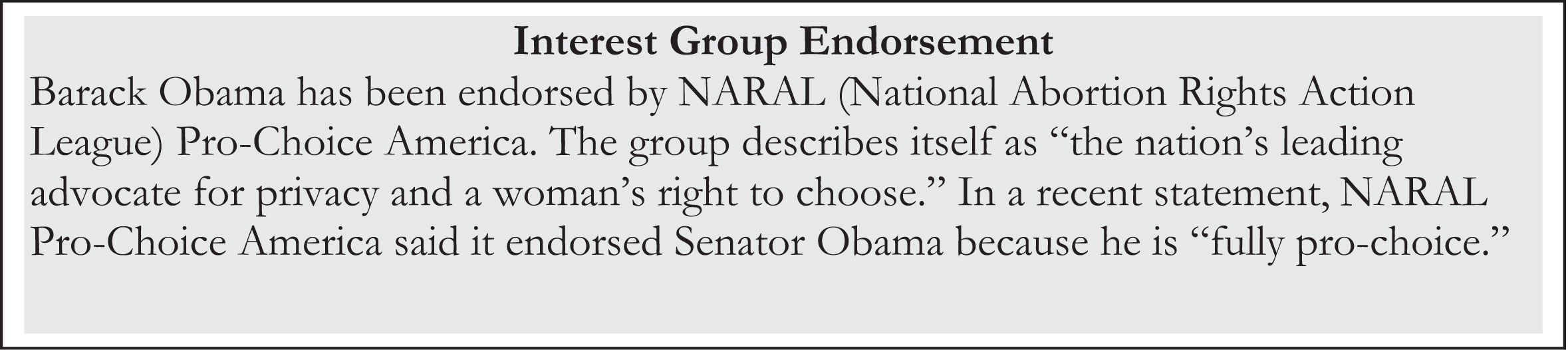
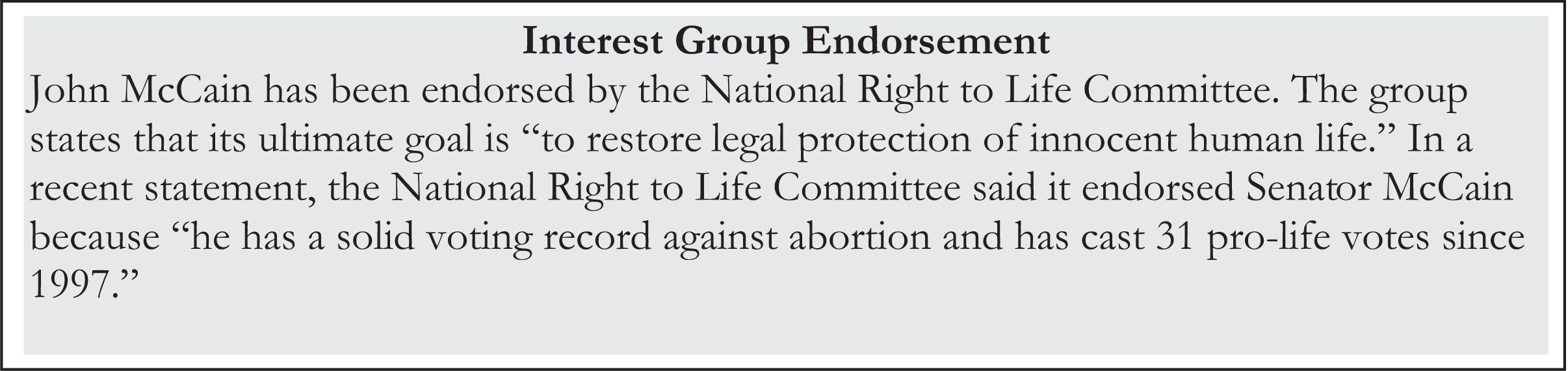
The second group – the biography group (N = 232) – completed the same survey. However, stapled between the cover sheet of the survey and the survey itself was a one-page insert that contained a brief biography of each candidate. A facsimile of this biographical information sheet is found in Figure 1. The third group – the treatment group (N = 240) – completed the same survey. However, stapled between the cover sheet of the survey and the survey itself was an insert that contained the biographical sketches and an interest-group endorsement for each candidate. The interest-group endorsement of Barack Obama read as follows: Barack Obama has been endorsed by NARAL (National Abortion Rights Action League) Pro-Choice America. The group describes itself as ‘the nation’s leading advocate for privacy and a woman’s right to choose’. In a recent statement, NARAL Pro-Choice America said it endorsed Senator Obama because he is ‘fully pro-choice’. Biographical information sheet provided to biography group.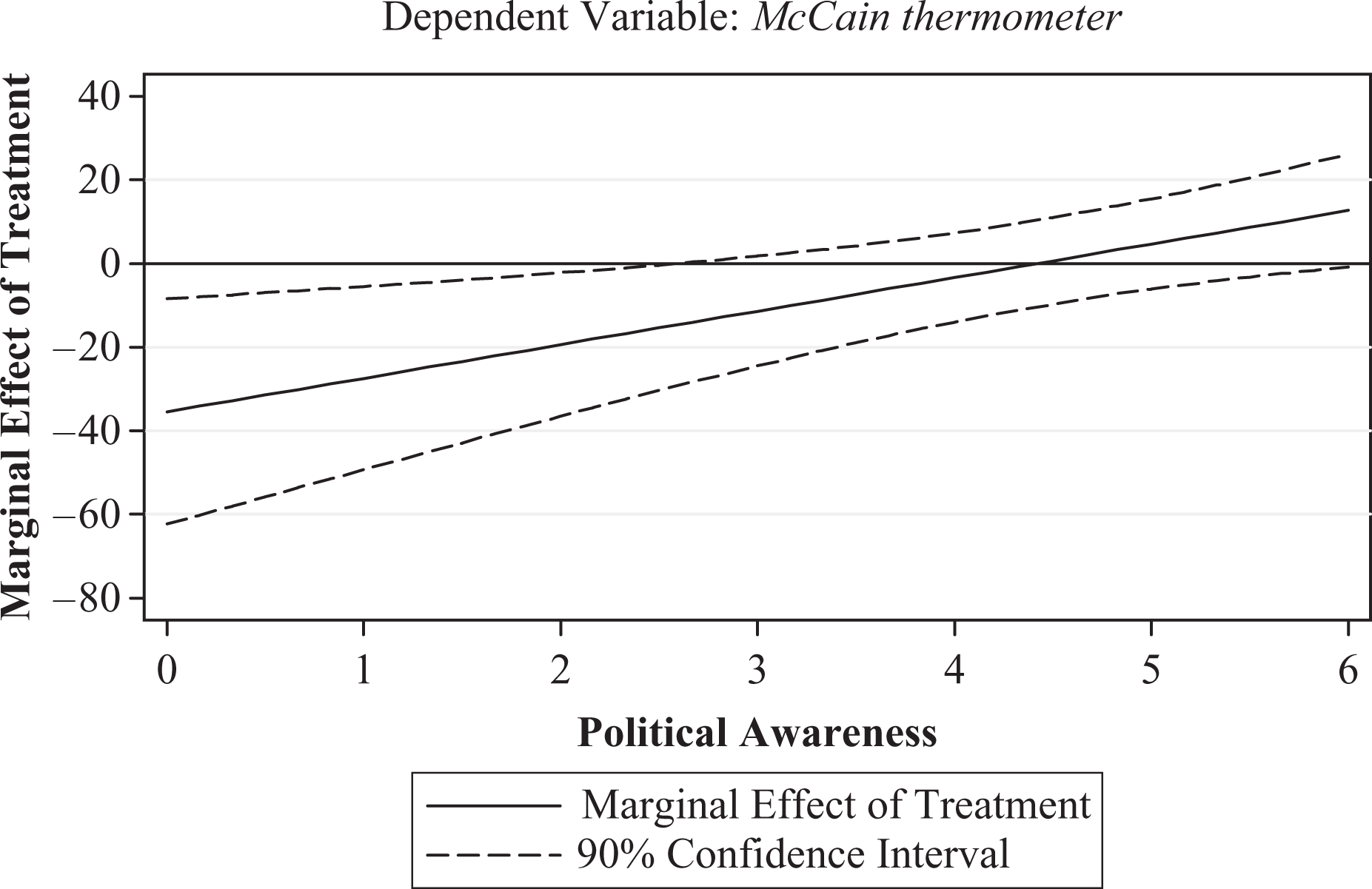
The interest group endorsement of John McCain read as follows: John McCain has been endorsed by the National Right to Life Committee. The group states that its ultimate goal is ‘to restore legal protection of innocent human life’. In a recent statement, the National Right to Life Committee said it endorsed Senator McCain because ‘he has a solid voting record against abortion and has cast 31 pro-life votes since 1997’.
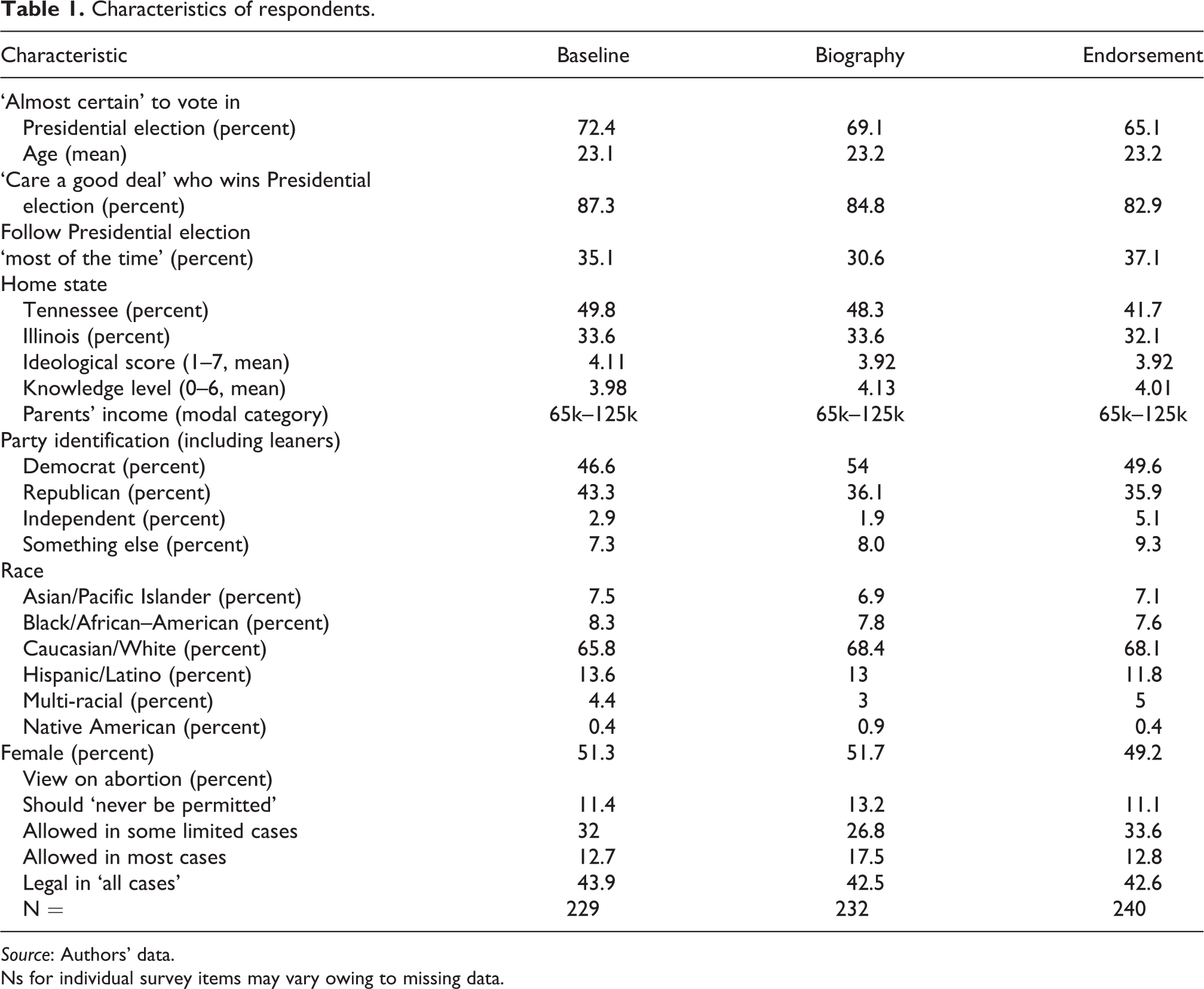
We placed each endorsement directly below each candidate’s biography in a shaded text box. A facsimile of the information sheet provided to respondents in the treatment group is provided in Figure 2. Table 1 shows that our three experimental groups are similar in composition. 3
Interest-group endorsement sheet provided to treatment group.
Characteristics of respondents.
Source: Authors’ data.
Ns for individual survey items may vary owing to missing data.
The standard concerns
Experimental studies are often criticized for producing results that are not generalizable to the real political world (Kinder and Palfrey, 1993: 26–31). To address generalizability concerns we took several steps to ensure that our experiment replicated real-world conditions. First of all, we utilized real-world interest-group endorsements. Second, we carried out our experiment during an actual election campaign and asked respondents about actual presidential candidates. Third, we exposed the treatment group to interest-group endorsements in the manner in which the vast majority of people are exposed to interest-group endorsements in the real world – through a third party. In a typical national election very few people are contacted directly by an interest group. Most, if they hear about an endorsement, hear about it from the media. 4 Fourth, rather than exposing our subjects to one interest-group endorsement only – that is, an endorsement on one side of an issue – we exposed our respondents to two interest-group endorsements, one on each side of the abortion issue. We did this because a wealth of evidence going back to The American Voter (1960) suggests that most people do not pay a great deal of attention to politics. This means that most people during most election campaigns probably are unaware of virtually all interest-group endorsements. It also means that if a person does hear about an interest-group endorsement he/she most likely hears about it in the context of other information, including information about the endorsements (or lack thereof) of other interest groups interested in the same issue. Fifth, we focused on the issue of abortion. We did this because abortion is a highly salient issue on which most people have an opinion. Endorsements concerning issues about which no one cares are unlikely to get much attention from citizens, and thus are likely to have no impact. Sixth, we utilized two control groups instead of just one. We utilized a second control group because we assumed that in the real world if a person hears about an interest-group’s endorsement of a candidate he/she hears about it in the context of other information about the candidate. We utilized this second control group to account for the possibility that any differences we uncover between the treatment group and the baseline group were due to candidate information rather than the endorsements.
There is, of course, one additional concern – the so-called ‘college sophomore problem’. The ‘college sophomore problem’ refers to the perceived threat to external validity posed by conducting an experiment on a sample of college students. Here, we relied solely upon a convenience sample of college students. We acknowledge that such generalizability concerns are legitimate. Nonetheless, we do not believe that our reliance on college students compromises our results. A spate of recent research suggests that the ‘college sophomore’ problem is not all that problematic after all. For example, in a well-known meta-analysis of framing research, Kühberger (1998) concludes that a reliance on college student samples has not led to misleading results. As Best and Hubbard (1999: 465) note: ‘Although college students and the broader population may demonstrate differences in their distribution of political preferences, there is no reason to expect differences in their responses to stimuli, political or otherwise.’ Moreover, as Druckman and Kam (2011) point out, college student samples are generally similar to non-student samples. Furthermore, the variables on which students are likely to differ from non-students (e.g. education, family income) are not purported here to affect the size or direction of the treatment effect. Unfortunately, we cannot say for sure how much more or less likely than non-students college students are to be poorly aligned. In the end, however, this does not really matter; we do not theorize or speculate about either the sources of poor alignment or the distribution of poorly aligned individuals in society. Rather, we simply assume (correctly we think) that there are some poorly aligned citizens out there, and then hypothesize about the effects of interest-group endorsements on these individuals. In short, while we recognize that our convenience sample of college students raises concerns about external validity, we believe our results are defensible.
An additional concern
There is one additional problem that we cannot ignore. That problem is this: The interest-group endorsements we utilize here are not free-standing interest-group endorsements, but rather are endorsements plus information. For example, the NARAL Pro-Choice America endorsement does not simply say, ‘Barack Obama has been endorsed by NARAL (National Abortion Rights Action League) Pro-Choice America’. Rather, it says this and includes the information that Obama is ‘fully pro-choice’. Similarly, the McCain endorsement says that he has been endorsed by the National Right to Life Committee, and it includes additional (although scant) information about McCain’s pro-choice bona fides. This presents a problem for us because it means that any treatment effects we uncover may be due either to the endorsement or the information or both. 5
Can we do anything about this problem? In technical terms, the answer is ‘No’. In choosing to simulate the real world, we are stuck with the endorsements that the groups themselves issued – and both were endorsements plus information. In our opinion, however, this problem does not significantly detract from the enterprise at hand. In the real world, endorsements are often accompanied by additional information. As such, to parse out the effects of the endorsement from the information that accompanied the endorsement is superfluous at best and disingenuous at worst. No one to our knowledge has ever analysed interest-group endorsements in an effort to determine how often they contain or do not contain additional information. But our admittedly unscientific perusal of genuine endorsements suggests that interest groups very often accompany their endorsements with information. At the very least we know that some interest group endorsements are issued with additional information. Finally, it is worth mentioning that one recent experimental study on the effects of endorsements (Arceneaux and Kolodny, 2009) took a similar approach to ours and explicitly included information in its experimental (endorsement) treatment.
In short, endorsements with accompanying information are important and seemingly commonplace political phenomena, and should be investigated as such. It may well be that many interest groups issue endorsements without accompanying information. We acknowledge that our results cannot speak to the effects of such free-standing, uninformative endorsements. We also acknowledge that the effects we uncover may be due more to the information that accompanies the endorsement than to the endorsement itself. In the end, however, we have decided to study the political world as we encountered it – as a place where interest groups often issue endorsements with accompanying information.
The hypotheses
In what follows, we test three hypotheses about the effects of interest-group endorsements. The hypotheses – which flow directly from the five general conclusions we present above – are as follows:
Before we go any further, we acknowledge two things. First, we did not test the effects of endorsements on well-aligned voters; space limitations preclude us from doing so. But we fully intend to explore this issue in a future paper. Second, we did not test the effects of endorsements on poorly aligned voters’ stated voting preferences. Initially, we intended to do this, but our small sample sizes for some of the groups precluded us from estimating vote choice models.
The dependent variables
To test our hypotheses we used two dependent variables. They are Obama thermometer and McCain thermometer. The two variables are based on the standard feeling thermometer survey item from the ANES. Obama thermometer has a range of 0–100, a mean of 61.7 and a standard deviation of 30.44. McCain thermometer has a range of 0–100, a mean of 51.27 and a standard deviation of 28.65. 6
The independent variables
Our primary independent variables of interest are Biography group and Treatment group. Biography group takes a value of 1 if a respondent fell into the biography group and a 0 otherwise. Treatment group takes a value of 1 if a respondent fell into the treatment group and a 0 otherwise. The baseline category here is the baseline group. Another independent variable of interest is Political awareness*Treatment group. We measured political awareness in the standard way by asking respondents six factual questions and coding correct answers 1 and incorrect answers 0. 7 We then summed the responses to all six items into a political awareness scale. Our variable Political awareness has a range of 0–6, a mean of 4.04 and a standard deviation of 1.78. 8 To create Political awareness*Treatment group, we multiplied values on Political awareness by values on Treatment group.
As controls, we included the following three variables: Political awareness, Black or Hispanic and Illinois. We included Political awareness because it must be included to properly interpret our interaction variable. We included Black or Hispanic because Barack Obama is the first ethnic/racial minority major party presidential candidate in American history and we expected him to be viewed very favourably by Black and/or Hispanic respondents. We assigned this variable a value of 1 if a respondent reported that he/she was Black, Hispanic or Black and Hispanic, and a 0 otherwise. The variable Illinois takes a value of 1 if the respondent is from Illinois and 0 otherwise. 9
The groups
To test our hypotheses we divided our respondents into several groups based on their party identification, ideology and position on abortion. Before we describe the groups, we describe the survey items we used to create them. First, to measure party identification we used a variation of the standard ANES question wording. 10 Responses were coded as follows: 1 = strong Democrat, 2 = not very strong Democrat, 3 = independent leaning Democrat, 4 = true independent, 5 = independent leaning Republican, 6 = not very strong Republican, 7 = strong Republican and 8 = something else. Second, to measure ideology, we used a version of the standard ANES question wording. 11 Responses were coded as follows: 1 = extremely liberal, 2 = liberal, 3 = slightly liberal, 4 = moderate/middle of the road, 5 = slightly conservative, 6 = conservative, 7 = extremely conservative. Finally, to measure where respondents stood on the issue of abortion, we used this survey item: ‘Which one of the opinions below best agrees with your view on abortion?’ Responses were coded as follows: 0 = By law, abortion should never be permitted; 1 = The law should permit abortion only in the case of rape, incest or when the woman’s life is in danger; 2 = The law should permit abortion for reasons other than rape, incest or danger to the woman’s life, but only after the need for the abortion has been clearly established; 3 = By law, a woman should always be able to obtain an abortion as a matter of personal choice.
On the basis of responses to these survey items, we defined four groups of poorly aligned voters. 12 The first is called conservative, ‘pro-choice’, Republicans (CPCRs; 13 N = 55). These are respondents who scored 5, 6 or 7 on ideology and 2 or 3 on abortion and 5, 6 or 7 on party identification. We also created a group of liberal, ‘pro-life’, Democrats (LPLDs; N = 33). These are respondents who scored 1, 2, or 3 on ideology and 0 or 1 on abortion and 1, 2 or 3 on party identification. We call respondents in these two groups ‘poorly-aligned’ because their views on abortion do not match up with their ideology and party identification.
Both of the interest groups whose real-world endorsements we used here are quite uncompromising on the issue of abortion. Because this is the case, to provide for more stringent tests of our hypotheses, we created two additional poorly aligned groups. The first is conservative, mildly ‘pro-choice’, Republicans (CMPCRs; N = 152). The key word here is ‘mildly’. This group comprises the same respondents who comprise the group CPCRs as well as conservative Republicans who score 1 on abortion. The next group is liberal, mildly ‘pro-life’, Democrats (LMPLDs; N = 54). Again, the key word here is ‘mildly’. This group includes the same respondents who comprise the group LPLDs as well as liberal Democrats who score 2 on abortion. 14
Results
First, we explore the impact of endorsements on conservative, ‘pro-choice’, Republicans (CPCRs) – one group of poorly aligned respondents. To do this, we created two OLS regression models. The dependent variables in the models are Obama thermometer and McCain thermometer. Each model contains the same set of independent variables – Biography group, Treatment group, Black or Hispanic, Political awareness, Political awareness*Treatment group and Illinois.
Effects of endorsements on poorly aligned Republicans
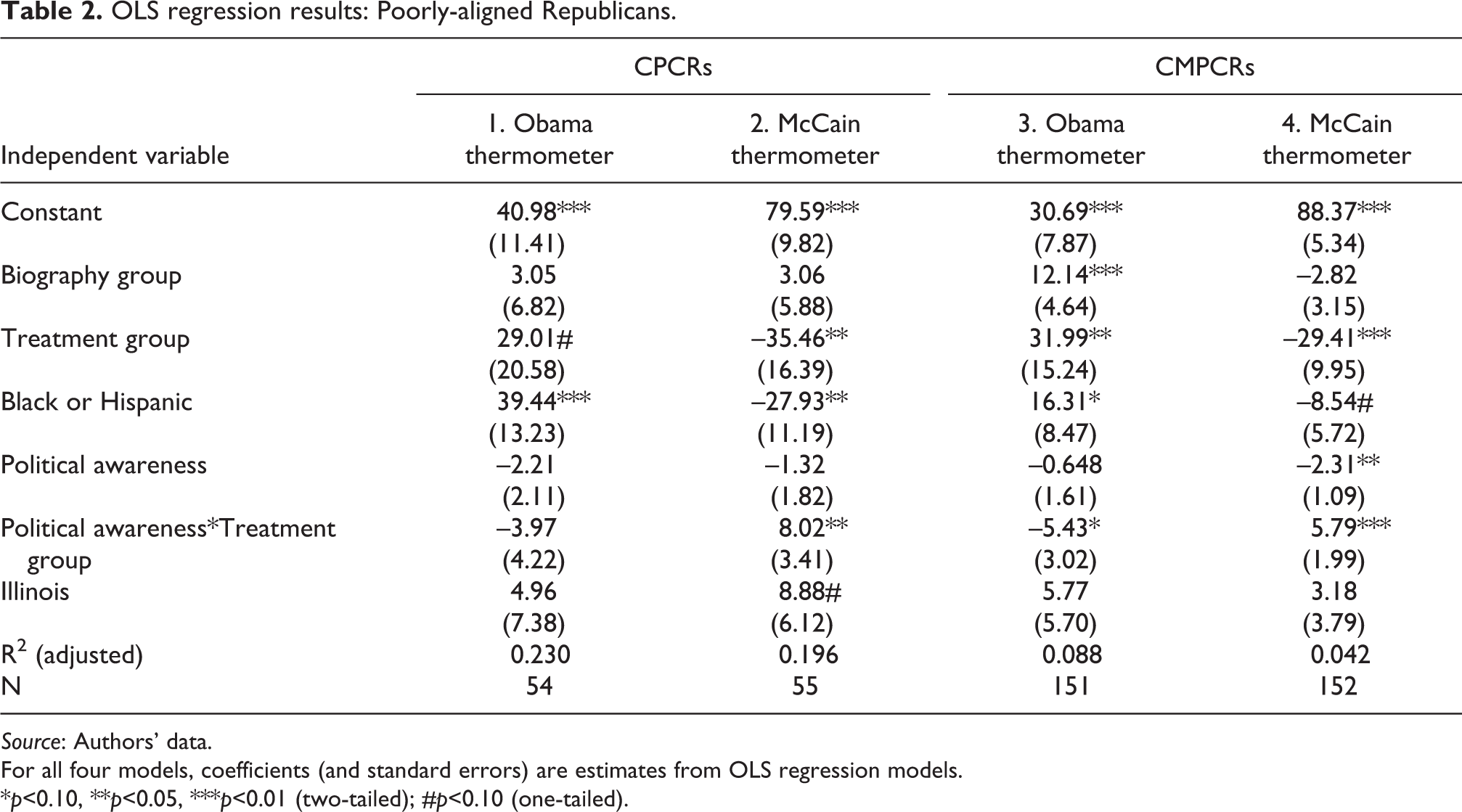
Table 2 presents the results of these two models (Models 1 and 2). The coefficient on Treatment group is not significant in Model 1. It is, however, significant in Model 2 (p<0.05, two-tailed test), 15 which indicates that the treatment had some impact on exposed CPCR respondents. However, because Model 2 contains an interaction term (which is also significant), care must be taken in interpreting its results (see Brambor et al., 2006). The coefficient on Treatment group (–35.46) in Model 2 represents the treatment effect for CPCRs who scored 0 on Political awareness; this indicates that among CPCRs with no political information the treatment had a strong reductive impact on John McCain’s thermometer ratings. 16 To further understand the effects of the treatment (i.e. the endorsements) on CPCRs’ views of John McCain, we produced Figure 3. The solid sloping line in Figure 3 illustrates how the treatment affects values on McCain thermometer and how the marginal effect of the treatment among CPCRs changes with level of political awareness. The 90 percent confidence intervals around the line indicate the conditions under which the treatment has a statistically significant (p<0.05, one-tailed test) impact on values of McCain thermometer (the treatment has a statistically significant impact when the upper and lower bounds of the confidence interval are both above and below 0). In all, Figure 3 shows that among CPCRs who score 0, 1 or 2 on Political awareness (16 percent of CPCRs), the endorsements have a strong reductive impact on values of McCain thermometer. However, this reductive effect decreases as level of political awareness increases and then disappears altogether for CPCRs with moderate to high levels of political information (that is, among CPCR respondents who scored 3, 4, 5 or 6 on Political awareness).
OLS regression results: Poorly-aligned Republicans.
Source: Authors’ data.
For all four models, coefficients (and standard errors) are estimates from OLS regression models.
*p<0.10, **p<0.05, ***p<0.01 (two-tailed); #p<0.10 (one-tailed).
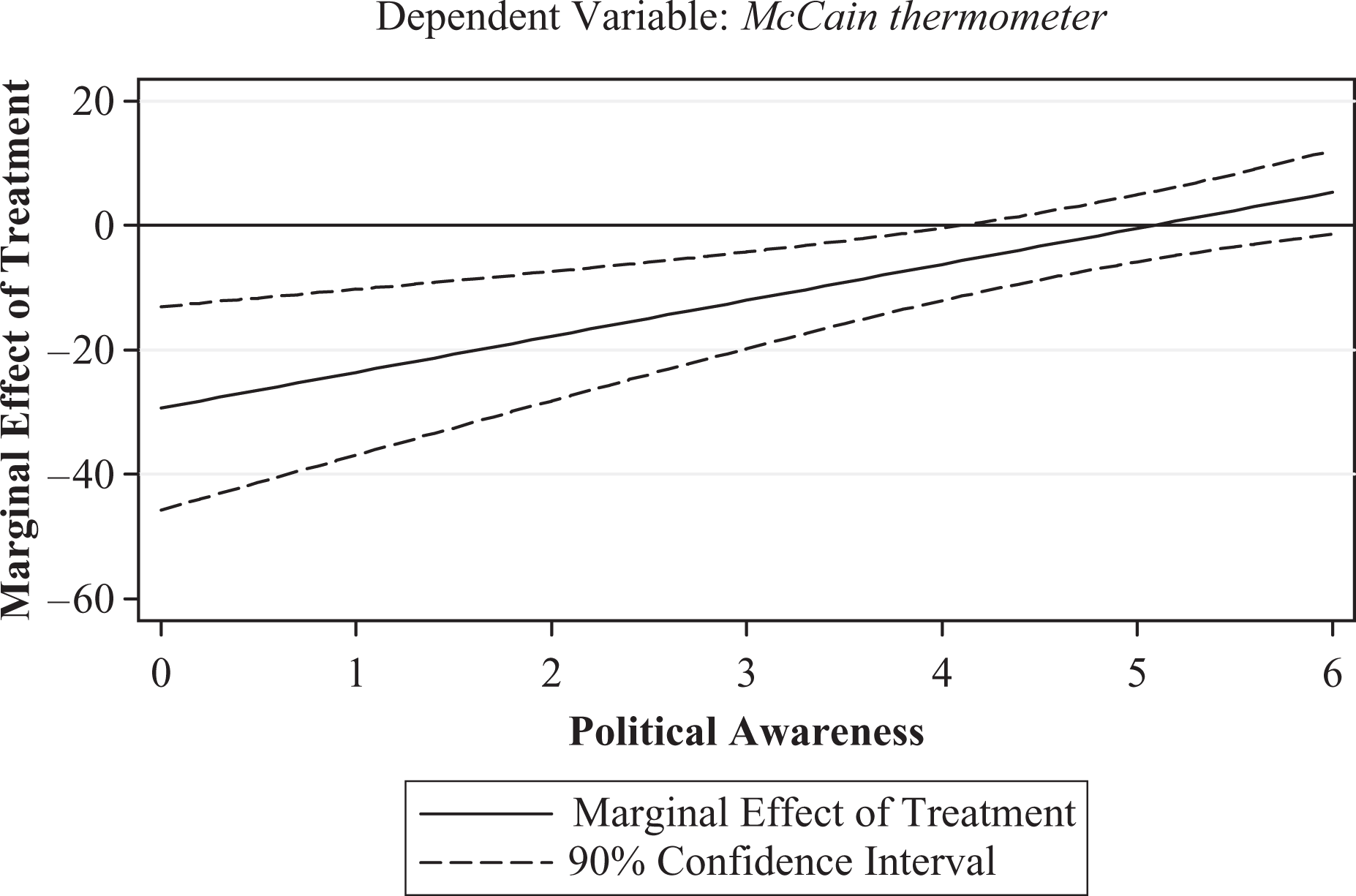
Marginal effect of treatment on McCain thermometer as level of political awareness changes for CPCRs.
Just how strong are the effects of the endorsements? To get an answer to this question, we used Clarify (King et al., 2000; Tomz et al., 2003) to generate expected values on McCain thermometer for several different scenarios. (For these and all subsequent scenarios, Biography group was set to 0, and all other independent variables were set at their means). We found that for CPCRs who scored 1 on the political awareness scale, the endorsements were associated with a 35 percent decrease in scores on McCain thermometer. For CPCRs who scored 2 on the political awareness scale, the endorsements were associated with a 25 percent decrease in scores on McCain thermometer.
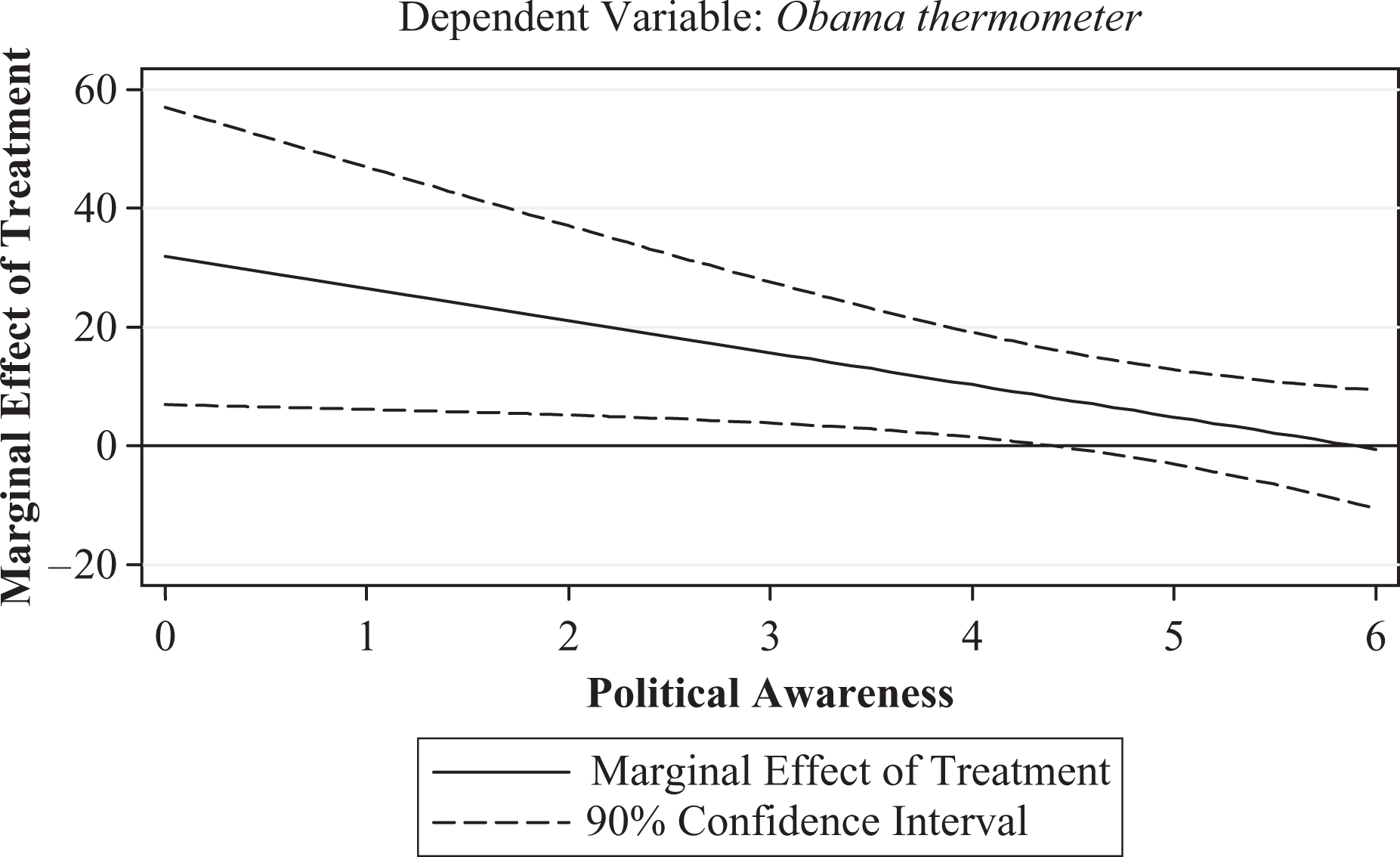
We turn next to conservative, mildly pro-choice, Republicans (CMPCRs) – another group of poorly aligned Republicans. Table 2 (Models 3 and 4) presents the results of two OLS regression models. The dependent variables in these models are, respectively, Obama thermometer and McCain thermometer. The coefficient on Treatment group is significant (p<0.05, two-tailed) in both models, which indicates that the treatment had an impact on exposed CMPCRs. Again, however, because both models contain an interaction term, care must be taken in interpreting their results. Turning first to the Obama thermometer model (Table 2, Model 3), the coefficient on Treatment group (31.98) signifies the treatment effect on CMPCRs who scored 0 on the political awareness scale; this indicates that the treatment had a strong positive impact on Obama’s thermometer rating among CMPCRs with virtually no political information. To further understand the effects of the endorsements on CMPCRs’ views of Barack Obama, we produced Figure 4. The solid line in Figure 4 illustrates how the treatment affects Obama thermometer and how the marginal effect of the treatment among CMPCRs changes with the level of political awareness. The 90 percent confidence intervals around the line show that among CMPCRs who score 0, 1, 2, 3 or 4 on Political awareness (37.5 percent of CMPCRs), the endorsements have a positive impact on Barack Obama’s thermometer ratings. However, this positive impact decreases as level of political awareness increases, and then disappears altogether for CMPCRs with above average levels of political information (that is, among CMPCRs who scored 5 or 6 on Political awareness).
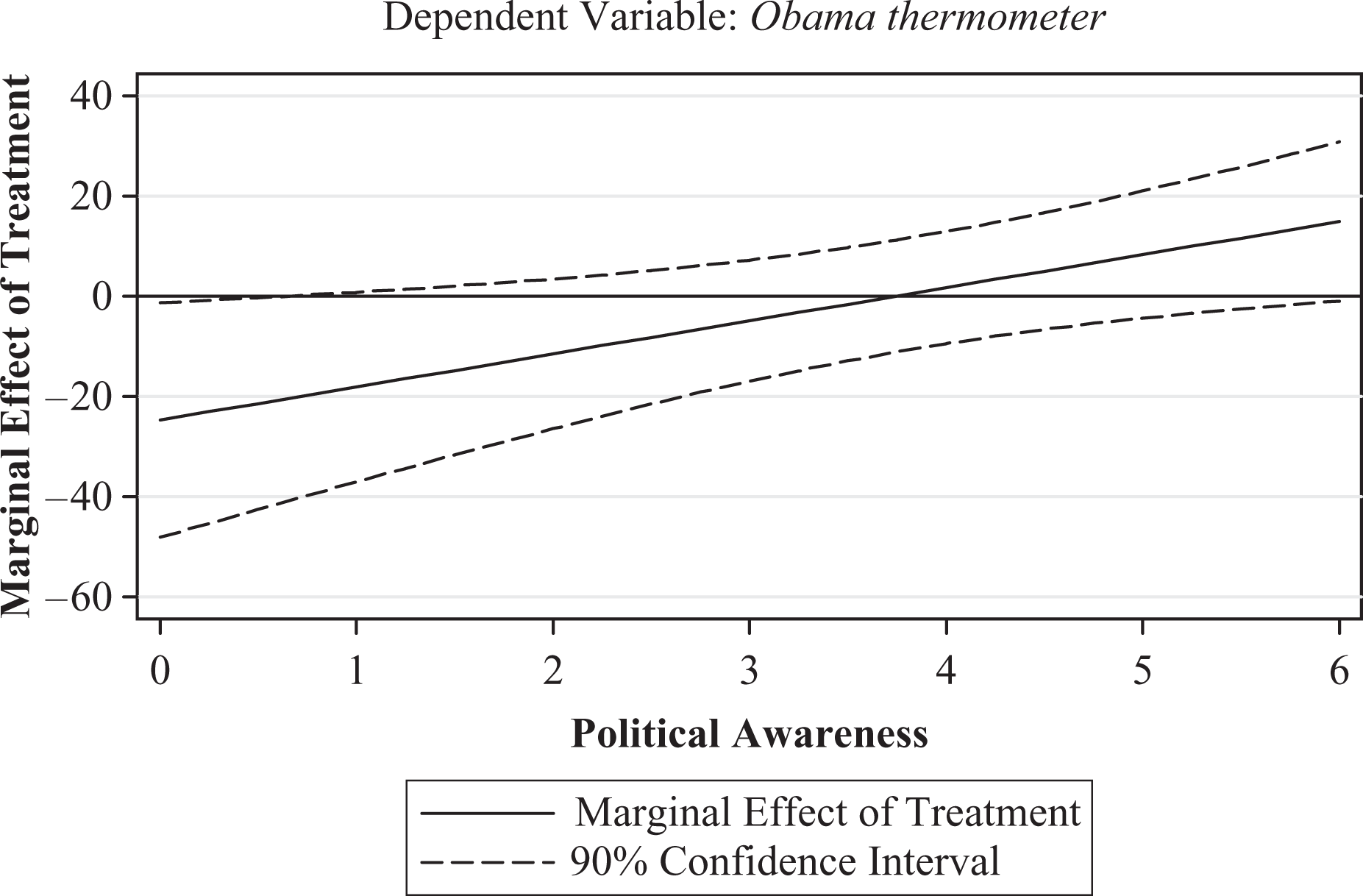
Marginal effect of treatment on Obama thermometer as level of political awareness changes for CMPCRs.
The coefficient on Treatment group is also significant (p<0.01, two-tailed) in Model 4 (the McCain thermometer model). Again, the coefficient (–29.41) signifies the treatment effect on CMPCRs who scored 0 on the political awareness scale; this indicates that the treatment had a strong negative impact on John McCain’s thermometer rating among CMPCRs with virtually no political information. To further understand the effects of the endorsements on CMPCRs’ views of John McCain, we produced Figure 5. The solid line in Figure 5 illustrates how the treatment affects values on McCain thermometer and how the marginal effect of the treatment among CMPCRs changes with the level of political awareness. The 90 percent confidence intervals around the line show that among CMPCRs who score 0, 1, 2, 3 or 4 on Political awareness (again, 37.5 percent of CMPCRs), the endorsements have a negative impact on John McCain’s thermometer rating. However, this negative impact decreases as level of political awareness increases, and then disappears altogether for CMPCRs with above average levels of political information (that is, among CMPCRs who scored 5 or 6 on Political awareness).
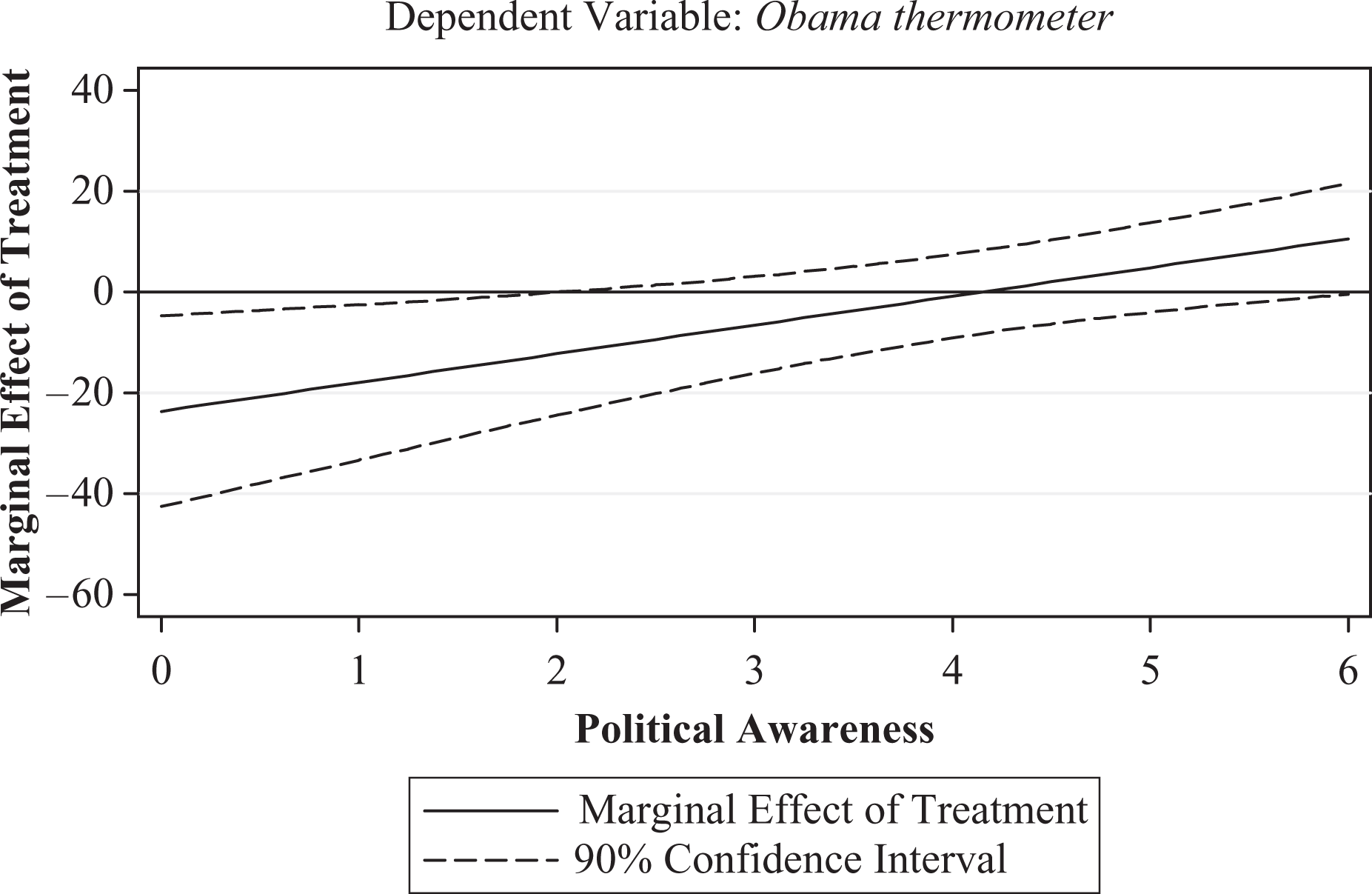
Marginal effect of treatment on McCain thermometer as level of political awareness changes for CMPCRs.
How strong are the effects of the endorsements for CMPCRs? Again, to address this question we used Clarify to generate expected values on Obama thermometer and McCain thermometer for several different scenarios. We found that for CMPCRs who scored 1 on the political awareness scale, the endorsements were associated with a 27 percent decrease in scores on McCain thermometer, and an 84 percent increase in scores on Obama thermometer. For CMPCRs who scored 2 on the political awareness scale, the endorsements were associated with a 14.5 percent decrease in scores on McCain thermometer and a 52 percent increase in scores on Obama thermometer.
Effects of endorsements on poorly aligned Democrats
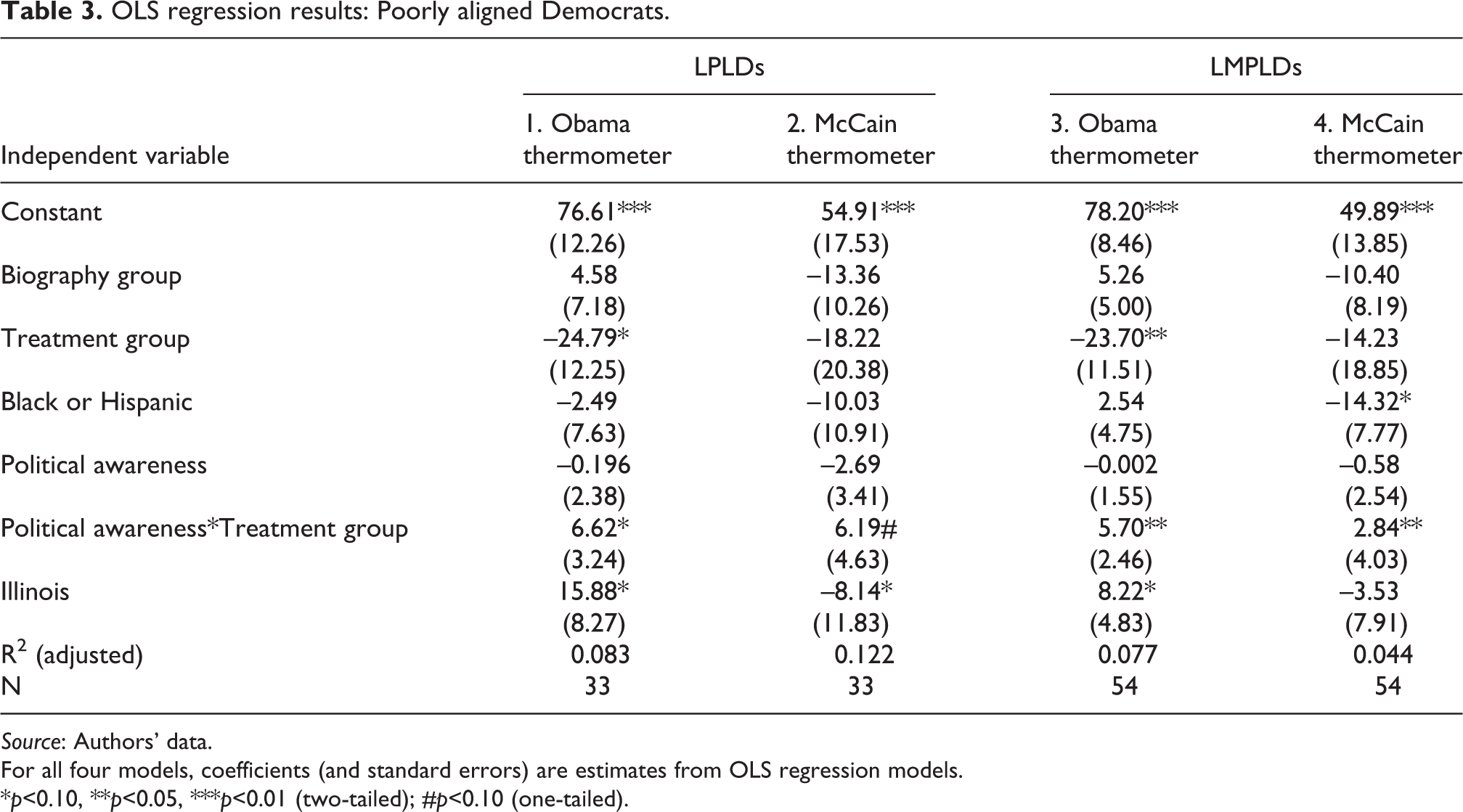
Next, we examine the effects of endorsements on two groups of poorly aligned Democrats – liberal, ‘pro-life’ Democrats (LPLDs) and liberal, mildly ‘pro-life’ Democrats (LMPLDs). Specifically, for both groups we cast two regression models, one using Obama thermometer as the dependent variable and the other using McCain thermometer as the dependent variable. Table 3 presents the results of these four models. The coefficient on Treatment group is significant in Models 1 (p<0.05, one-tailed test) and 3 (p<0.05, two-tailed test), as is the coefficient on Political awareness*Treatment group (p<0.05, one-tailed test in Model 1; p<0.05, two-tailed test in Model 3). All of this suggests that the treatment had some impact on poorly aligned Democrats’ views of Barack Obama. We look first at the results of Model 1. The coefficient on Treatment group (–24.79) in Model 1 represents the treatment effect for LPLDs who scored 0 on Political awareness; this indicates that the treatment had a strong reductive effect on the least informed LPLDs’ thermometer ratings of Barack Obama. To further understand the effects of the treatment (i.e. the endorsements) on LPLDs’ views of Barack Obama, we produced Figure 6. The solid sloping line illustrates how the treatment affects values on Obama thermometer and how the marginal effect of the treatment among LPLDs changes with level of political awareness. The 90 percent confidence intervals around the line show that among LPLDs who score 0 on Political awareness (6 percent of LPLDs), the endorsements have a strong reductive impact on values of Obama thermometer. However, this reductive effect disappears for LPLDs with higher levels of political awareness.
OLS regression results: Poorly aligned Democrats.
Source: Authors’ data.
For all four models, coefficients (and standard errors) are estimates from OLS regression models.
*p<0.10, **p<0.05, ***p<0.01 (two-tailed); #p<0.10 (one-tailed).
Marginal effect of treatment on Obama thermometer as level of political awareness changes, for LPLDs.
The treatment has similar effects on LMPLDs. The coefficient on Treatment group (–23.70) in Model 3 represents the treatment effect for LMPLDs who scored 0 on Political awareness; this indicates that the treatment had a strong reductive effect on the least informed LMPLDs’ thermometer ratings of Barack Obama. To further understand the effects of the treatment (i.e. the endorsements) on LMPLDs’ views of Barack Obama, we produced Figure 7. The solid sloping line shows how the treatment affects values on Obama thermometer and how the marginal effect of the treatment among LMPLDs changes with level of political awareness. The 90 percent confidence intervals around the line show that among LMPLDs who score 0, 1 or 2 on Political awareness (11 percent of LMPLDs), the endorsements have a strong reductive impact on values of Obama thermometer. However, this reductive effect decreases as level of political awareness increases, and then disappears altogether for LMPLDs who score 3 or better on our political awareness scale.
Marginal Effect of Treatment on Obama Thermometer as Level of Political Awareness Changes, for LMPLDs.
How strong are the effects of the endorsements for LPLDs and LMPLDs? To address this question we used Clarify to generate expected values on Obama thermometer for two different scenarios. We found that for LPLDs who scored 0 on the political awareness scale, the endorsements were associated with a 29 percent decrease in scores on Obama thermometer. For LMPLDs who scored 1 on the political awareness scale, the endorsements were associated with a 22 percent decrease in scores on Obama thermometer.
The hypotheses
We are now in a position to evaluate our hypotheses. Our results provide strong support for Hypothesis 1, and very strong support for Hypotheses 2 and 3. First, our results show that for a substantial number of poorly aligned Republicans, exposure to the endorsements was associated with markedly lower thermometer ratings for the Republican presidential candidate (John McCain), as well as markedly higher thermometer ratings for the Democratic presidential candidate (Barack Obama). Second, our results show that for substantial numbers of poorly aligned Democrats, exposure to the endorsements was associated with markedly lower thermometer ratings for the Democratic presidential candidate (Barack Obama). Third, our data show that endorsement effects are limited to respondents at the lower end of the political awareness scale. Indeed, we uncovered no endorsement effects of any kind for respondents who scored 5 or 6 on the political awareness scale (again, the average score on Political awareness for the whole sample is 4.04). Moreover, when we uncover endorsement effects among poorly aligned citizens, in all instances they are less pronounced as we move up the political awareness scale.
Conclusions
Every four years interest groups endorse candidates for president. Do endorsements matter? Our results suggest that the answer is yes; interest-group endorsements have the ability to influence how some people evaluate candidates.17
For this article we conducted an experiment designed to see how interest-group endorsements affect different sets of citizens. As hypothesized, we found that many poorly aligned respondents – that is, respondents whose views on abortion do not align with their party identification and ideology – were profoundly affected by interest-group endorsements. Specifically, our results show that among poorly informed, poorly aligned Republicans, exposure to the NARAL and NRTLC endorsements was associated with consistently and decidedly lower thermometer ratings of the Republican candidate John McCain, and consistently and decidedly higher thermometer ratings of the Democratic candidate, Barack Obama. Our results also show that among poorly aligned, poorly informed Democrats, exposure to the NARAL and NRTLC endorsements was associated with consistently and decidedly lower thermometer ratings of the Democratic candidate, Barack Obama.
In all, our data point to the obvious conclusion that interest-group endorsements are used heuristically by many voters. As such, our results support those of empirical (e.g. Arceneaux and Kolodny, 2009; Asher et al., 2001; Clark and Masters, 2001; Delaney et al., 1990; Hojnacki and Baum, 1992; Juravich and Shergold, 1988; Lupia, 1994; McDermott, 2006; Rapoport et al., 1991) and theoretical studies (Brady and Sniderman, 1985; Sniderman et al., 1991; Wlezien and Miller, 1997), which conclude that voters make inferences about candidates based on cues present in the electoral environment. Our findings suggest that in some cases the effects of group endorsements are profound; so profound, in fact, that they are capable of overwhelming even party and ideology cues. In addition, our results support the notion that poorly informed voters are more susceptible to the effects of endorsements than are well-informed voters, as they use endorsements and accompanying information to compensate for their lack of information.
Our results point up two other general conclusions. First, the effects of endorsements are not limited to members of the groups doing the endorsing. Only a handful (six to be exact) of our 701 respondents reported belonging to either one of the groups that offered the endorsements we study, and yet many respondents were affected by them. Second, endorsements matter even in high-information settings. There is, of course, no higher information election than the presidential election.
Implications for interest groups
What do our findings mean for interest groups? This is a difficult question to answer. Our results suggest that interest groups continuing to ‘get the word out’ by publicizing their endorsements to and through the media are dealing with a proverbial double-edged sword. Their endorsements contain valuable information that some poorly informed, poorly aligned citizens use to make inferences about candidates. In this sense, endorsements represent valuable means by which interest groups can mobilize and rally their supporters (active and passive) in support of their preferred candidates. But there is a danger here. A group endorsement communicated by the broadcast media invariably reaches people who oppose the group offering the endorsement. This raises the possibility that a group’s media-publicized endorsement will serve as a negative cue to voters who oppose the group’s views. Perhaps the main lesson here is that for a group that has public opinion squarely on its side, a broadcast endorsement cannot hurt. But for a group – for example, a group on either side of the abortion issue – whose issue is somewhat evenly divisive, a broadly publicized endorsement may do as much harm as good.
Our results point up another dilemma for interest groups that wish to make use of endorsements. In his landmark book, The Nature and Origins of Mass Opinion (1992), John Zaller argues that citizens with low levels of political information are not likely to be affected by new information because they are highly unlikely to be exposed to new information. Our results, then, lead to the following conclusion: interest-group endorsements affect some poorly aligned citizens, but only the poorly aligned citizens who are least likely to be exposed to them! This presents a challenge for interest groups – they have to find the voters who may actually be affected by their endorsements, and this may not be easy.
Footnotes
Funding
This research received no specific grant from any funding agency in the public, commercial or not-for-profit sectors.