







Abstract
District magnitude structures the options open to voters and shapes the incentives legislators have to cultivate a personal reputation. But district magnitude can be a proxy of different ‘mechanisms’ tying to the electoral rules the one trait that is capable of attracting a personal vote across a wide range of electoral systems: that is, a legislator’s local roots. For the first time, recent alternative measures regarding the underlying causal variable are tested using new data in the six countries. On the one hand, district magnitude is found to have the predicted differential effect on legislators’ local office-holding in open-list and closed-list systems. Even as the number of legislators having held local office decreases as their electoral constituency grows in size, on the other hand it is intra-party competition that is the key.
Introduction
The way in which legislators are elected is an important feature of democratic political systems. The conditions that legislators compete under for re-election delimit the shape of political representation (Mayhew, 1974). At the macro level the degree of proportionality shapes the party system and thereby party government. A long tradition of research has built and commented on Duverger’s law and hypothesis, concentrating on the mechanical and psychological effects of majoritarian, as opposed to proportional, electoral systems (for a recent review, see Benoit, 2006). At the micro level the electoral rules determine the relative value of a legislator’s personal reputation, as opposed to the party record, and thereby shape the incentive he or she has to keep in touch with constituents (Cain et al., 1987; Carey and Shugart, 1995).
Electoral rules structure the choices open to voters and create incentives for elected representatives. Ballot structure and district magnitude in particular shape the value of a personal, as opposed to the party, reputation (Carey and Shugart, 1995: 418). The personal vote literature has linked both candidates’ basic traits and their behaviour to ballot structure and district magnitude. Electoral rules shape legislators’ behaviour in terms of constituency service (Farrell and Scully, 2007; Heitshusen et al., 2005), sponsorship of particularized legislation (Bräuninger et al., 2012; Crisp et al., 2004) and party discipline (Carey, 2009). Legislators have also been found to cultivate a personal vote on the basis of their gender (Thames and Williams, 2010) or their local roots in the district (Shugart et al., 2005). Research, however, Shugart (2008) noted, has largely missed the theoretical link connecting legislators’ personal vote-seeking to the mechanical effects of the electoral rules. That research has been rather casual in its explanation as to how and why district magnitude’s effect is produced.
Frequently, similar mechanisms of electoral competition and free-riding on the part of elected representatives and limited cognitive abilities on the part of voters to monitor individual representatives and hold them accountable are invoked to explain contradicting behavioural consequences. As a result ‘theories’ of personal vote-seeking continue to be plural and fragmented. District magnitude in particular can be an indicator for several incentives or disincentives. It can – as suggested by Carey and Shugart (1995) – be a proxy for the scope of intra-party competition (but see Crisp et al., 2007). It can also be a measure of the size of a legislator’s ‘electoral constituency’ – that is, of the number of people who voted for him or her (Grofman, 1999, 2005). And it can also simply be related to the degree of proportionality of the electoral system and thus to the chances of smaller parties to win at least one seat (e.g. Lijphart, 1994; Taagepera and Shugart, 1989). Until we disentangle the effects of district magnitude and clarify the explanation for how and why electoral rules shape elected representatives’ incentives, an ‘accumulation of knowledge’ (Shugart, 2008: 50) on the intra-party dimension will continue to elude us.
To this end, we have gathered new data in the three open-list (Finland, Luxembourg and Switzerland) and three closed-list systems (Norway, Portugal and Spain) that Shugart et al. (2005) originally researched. The article proceeds in four parts. The first part outlines the theoretical basis for the argument, discussing Carey and Shugart’s (1995) claim of district magnitude’s differential effect and the ‘mechanisms and processes’ responsible for that effect. The second part presents the case selection and describes the new data gathered using the biographies of legislators and district-level electoral results. The third part demonstrates that legislators who have previously held local elected office in the district grow more numerous in open-list systems with district magnitude, but decrease in number in closed-list systems as the district grows in magnitude. Even as legislators who have previously held local office in the district decrease in number as their electoral constituency grows in size, however, we demonstrate that it is intra-party competition that is the key: the size of a legislator’s electoral constituency is determined by the inter-party allocation of seats in closed-list systems, but by the intra-party allocation of seats in open-list systems. The fourth part discusses these results, as well as possible ways forward.
Relative value of party versus personal reputation
Electoral rules structure the choices open to voters and the different information shortcuts they use to make their choice. Voters typically do not know much about politics or policies and are reluctant to spend time and effort learning about them. To make a ‘reasoned’ voting decision, they employ a combination of party-based and candidate-based information shortcuts (Popkin, 1991). They will use different information shortcuts, moreover, under different electoral rules. Where ballot papers allow voters to indicate a preference among co-partisans running under the same party label, more voters will employ candidate-based shortcuts. Where ballot papers do not allow that option, party-based shortcuts are sufficient (Valdini, 2005). On the one hand, political parties act as brand names and voters readily infer from the party label information about the preferred policies of the candidates running under it (Kiewiet and McCubbins, 1991: 39). On the other hand, candidates’ traits or reputations may similarly act as shortcuts: voters look at candidates’ physical attractiveness (e.g. Rosenberg et al., 1986), at some easily observable group trait like sex or race (e.g. Holli and Wass, 2010; Sigelman and Sigelman, 1982), or – most importantly – at their local roots (e.g. Tavits, 2010), and they will readily make inferences from them regarding the candidates’ abilities, issue positions and expected behaviour once elected (Conover and Feldman, 1989; Valdini, 2005).
In their seminal article, Carey and Shugart (1995) make two claims about the value of a legislator’s personal reputation to his or her re-election – as opposed to the party reputation. First, district magnitude (M) has a differential effect on the value of a personal reputation: in open-list systems, the value of a personal reputation increases with magnitude, whereas it decreases as magnitude grows in closed-list systems (1995: 418). Second, at any magnitude, personal reputations are of greater value as the impact preference votes have on the order in which seats are allocated to candidates grows (1995: 432). 1 Research has not always been very precise, however, in identifying the ‘mechanism’ linking district magnitude to the behavioural consequences observed among legislators. In particular, district magnitude is considered to be related to both the ‘scope of intra-party competition’ (Carey and Shugart, 1995: 431; Shugart et al., 2005) and the ‘size of the electoral constituency’ (Grofman, 1999, 2005).
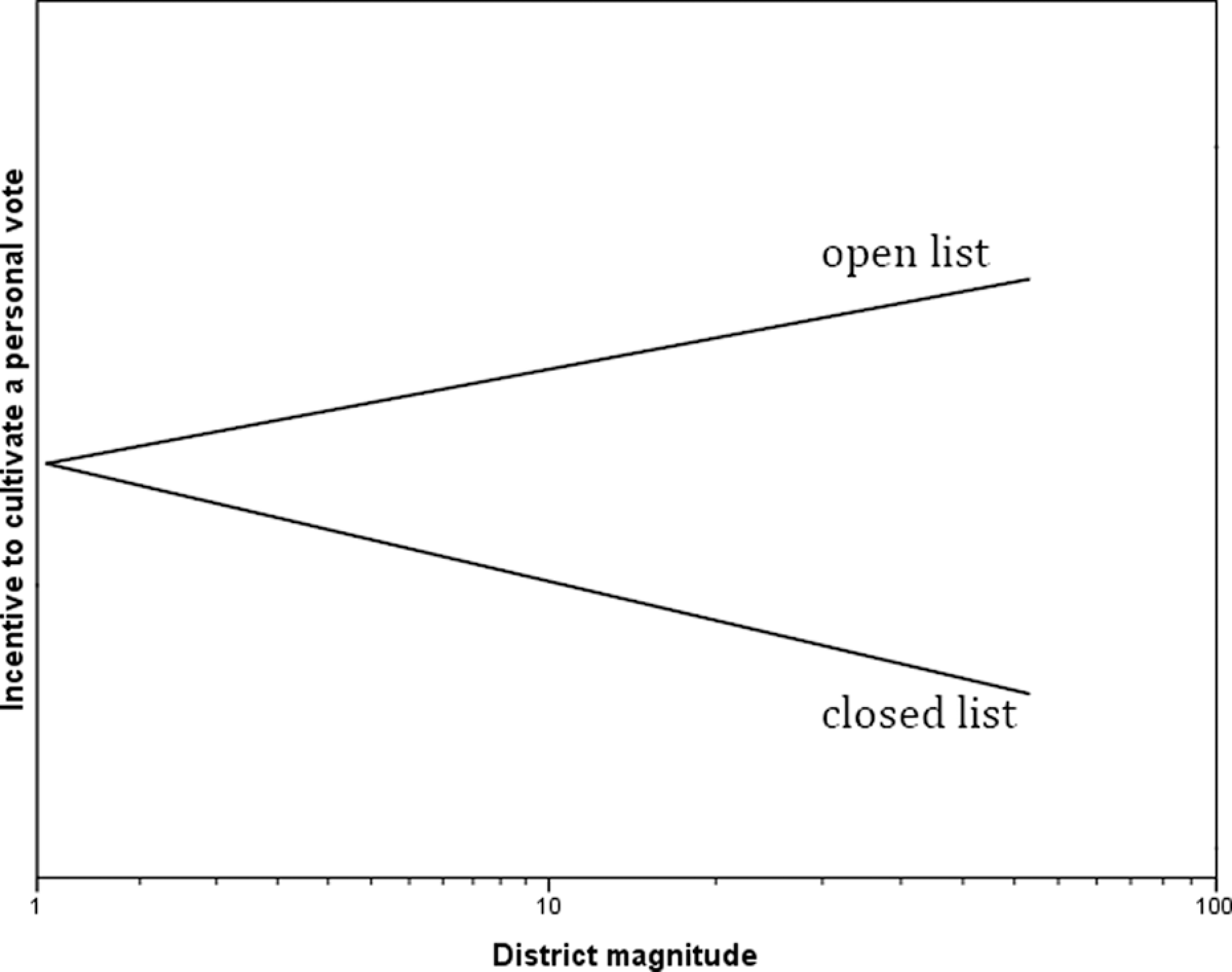
District magnitude and the incentive to cultivate a personal vote (Shugart, 2008: 47).
Where ballot papers allow voters to indicate a preference among co-partisans, legislators running under the same party label face a ‘product differentiation problem’ (Cox and Thies, 1998: 271). Where voters use candidate-based cues, the incentive legislators have to ‘play up’ some trait or personal reputation that makes them stand out in voters’ minds and thereby increase the likelihood of being re-elected grows stronger the more co-partisan competitors they face. The scope of intra-party competition is defined, then, by the ratio of co-partisan competitors on the ballot (C) to the number of seats contested (M). Carey and Shugart (1995: 431) advocated using district magnitude as the ‘fixed and identifiable determinant’ of the ratio C: M. This practice, however, is inaccurate for two reasons (Crisp et al., 2007: 730). First, that the number of co-partisans on the ballot (C) tends to increase with magnitude (M) does not mean that the ratio between the two (C: M) will increase. Second, rather than considering the number of co-partisan competitors per seat in the district, only the seats contested within the party (P) ought to be taken into account.
Where voters cannot indicate a preference among co-partisans, there is no intra-party competition of this kind. The order in which seats are allocated to candidates is fixed and, given their position on the party list, legislators may enhance their prospect for re-election only by ‘putting a human face to the party’ and winning the party the additional seat (Shugart, 2008: 46). The personal vote they are able to bring in this manner, Carey and Shugart (1995: 430) argued, will increasingly pale compared to the party reputation as district magnitude increases. On the one hand, any legislator’s ability to attract extra votes to the party will shrink as the co-partisans on the ballot grow in number. Free-rider problems will arise over credit claiming, for instance, for the pork obtained for the district (Carey and Shugart, 1995; Lancaster, 1986). On the other hand, the number of votes needed to win the additional seat will increase with district magnitude (Shugart, 2008: 46). The net effect is that candidates must seek to strengthen the party reputation or risk losing (Crisp et al., 2007: 731 f.).
Legislators’ propensity to cater to narrow local interests, Grofman (2005: 737) agreed, is a product of the number of votes needed to win re-election (rather than the number of competitors). The smaller a legislator’s ‘electoral constituency’, the more narrow-cast his appeals to voters can be (see Cox, 1990; Myerson, 1993). Contrary to Carey and Shugart (1995), Grofman (2005) suspects that catering to local interests grows stronger as the ‘electoral constituency’ shrinks in size in open-list and closed-list systems alike. The ‘electoral constituency’ is conceptualized differently, however. 2 In closed-list systems a legislator’s re-election is determined by the inter-party allocation of seats, whereas in open-list systems his re-election is further and, more importantly, shaped by the intra-party allocation of seats. In pure open-list systems, preference votes alone determine a legislator’s re-election – provided the party wins at least one seat in the district. By restricting the incentive to catering to ‘localistic/parochial interests’, moreover, Grofman (2005: 737) suggests that district magnitude does not determine the incentive to cultivate a personal vote, irrespective of the manner in which it is established – a fact that was not lost on Carey and Shugart (1995: 430). 3
In sum, the effect of district magnitude has been variously attributed to the number of co-partisan competitors that legislators face and the number of votes that will win them re-election. Uncovering the empirical interrelations will help to identify the ‘theoretical link’ tying the personal vote-earning traits of elected representatives to the electoral rules they compete under for re-election. In particular, we argue that intra-party competition is the key in open-list systems, in terms of both the number of co-partisans on the ballot and the number of preference votes needed to win one of the party’s seats. At the 2007 Finnish general election for instance, Arter (2011: 132) ciphered out, 15 percent of the incumbents lost their seat to a candidate running under the same party label, while only 8 percent suffered defeat in the inter-party allocation of seats (see also Katz, 1986). In closed-list systems, on the other hand, defeat may only result from votes lost to other parties. Co-partisans under these conditions do not face the ‘product differentiation problem’ (Cox and Thies, 1998: 271) that they do in open-list systems. Contrary to Crisp et al. (2007) and Carey and Shugart (1995) we do not expect representatives’ personal vote-earning traits to be affected by the number of co-partisan challengers in closed-list systems. The free-rider argument should not be used indiscriminately to explain personal vote-seeking beyond actions that credit-claiming is ‘indivisible’ for (Buck and Cain, 1990). Instead, we concur with Shugart’s (2008) later explanation and expect representatives’ personal vote-earning traits to be affected by the number of votes required to win the party the extra seat. To disentangle the causal mechanisms underlying the effect of district magnitude we return to legislators’ previous local office-holding in the three open-list and three closed-list systems first studied by Shugart et al. (2005).
The dependent variable and the case selection
The premium that open-list and closed-list systems put on candidates’ personal vote-seeking differs with district magnitude, thereby altering the practice of political representation. Cross-national data on the traits and behaviours that, winning and losing, candidates strategically ‘play up’ or ‘play down’ in order to cultivate a personal vote are not available, however. For the time being, therefore, we compare legislators in three open-list and three closed-list systems, that is, we concentrate on the winning candidates in order to ascertain the value of one particular personal reputation under varying electoral rules. For sure, nomination processes are an important intermediate factor, but cross-national data on party selectorates’ preferences for nomination are equally few and far between (Hazan and Rahat, 2010). Moreover, differences in nomination procedures between countries are likely to overshadow intra-country variation. For this reason country dummies tap into at least some of their effects. The one personal reputation studied here is – very consciously – exactly the same as the one used by Shugart et al. (2005): that is, having held local office in the district. 4 From having previously served on a municipal council in the district, constituents are likely to infer that the legislator has first-hand knowledge of local problems, needs and wants, and that he is able to solve and defend these (Shugart et al., 2005: 441). It is a low-effort candidate-based shortcut for voters who do not want to spend much time and effort learning about candidates and, as such, it can be expected to be used more often by voters as the number of candidates grows in open-list systems.
Admittedly, a legislator’s local office-holding is a crude indicator, but it is one that is likely to be relevant to, and comparable across, a large number of parliaments and legislators in various stages of their career. The argument is predicated on the assumption that local roots yield personal votes and help candidates in securing (re)election. Though studies addressing the electoral payoff of a legislator’s localism are few and far between, there is increasing evidentiary support for this proposition. Finnish legislators, Arter (2011) observed, frequently hold a local council seat and obtain the highest proportion of their preference votes in their home municipality. Candidates that have held local elected office, moreover, were found to attract significantly more preference votes than candidates lacking similar experience in Ireland (Marsh, 1987), Switzerland (Lutz and Selb, 2010) and Estonia (Tavits, 2010). Even in Spain’s closed-list system, Riera (2011) found some evidence of a personal vote related to candidates’ localness: parties tend to obtain higher vote-shares in those districts where a mayor holds the highest position on the party list.
The dependent variable, furthermore, more closely resembles a legislator’s basic trait that cannot be easily manipulated by legislators for strategic reasons: legislators do not have the option to alter their basic traits in response to the electoral environment (Shugart et al., 2005: 439). The impact is also less likely to be dependent on legislators’ estimate of how safe their electoral position is. Facing the prospect of defeat, legislators will engage strategically in activities that build a personal vote, which explains why first-term legislators typically do more constituency service (Heitshusen et al., 2005). A legislator’s local office-holding, it can be argued, is also an indication to the party selectorates of his or her political skills and devotion to the party. This is true, however, irrespective of the electoral rules and cannot explain differences in consequences.
Our dependent variable is operationalized as a dichotomous indicator, taking the value of ‘1’ when having served on a municipal council and/or executive within one’s district at one time prior to the most recent general elections and ‘0’ otherwise. To guarantee optimal cross-national comparability, regional-level electoral offices were excluded from the analysis. 5 The data were taken from the biographies of 1,208 legislators 6 elected in 138 constituencies in the general elections (2007–2009) as published on the websites of six parliaments. In some cases, legislators’ personal websites, party websites and municipal websites provided corroboration, in particular of local office-holding (e.g. in attendance records of council meetings and executives). For this purpose, Shugart et al.’s (2005) case selection was retained: three closed-list systems (Norway 7 , Portugal and Spain) and three open-list systems (Finland, Luxembourg and Switzerland). They are pure non-preferential and strong preferential list systems in which the allocation of seats to candidates is solely based on their position on the party list or on their share of preference votes, respectively (Karvonen, 2004). Finland and Portugal are, moreover, two cases used by Crisp et al. (2007) to introduce their concept of co-partisan crowdedness.
As Table 1 indicates, the six cases exhibit a wide variety on the independent variable of primary interest – that is, district magnitude – both within and across countries. Low or high district magnitudes are not confined to a particular country. The means of office-holding at the local level displayed in Table 1 tend to support the hypothesis that having held office at the municipal level is more common in open-list than in closed-list systems. Yet, Norwegian legislators are as likely to have served on the municipal council or executive as legislators in open-list systems, whereas municipal office-holding is not as common among Swiss legislators.
District magnitude and previous local office-holding by country and list type.
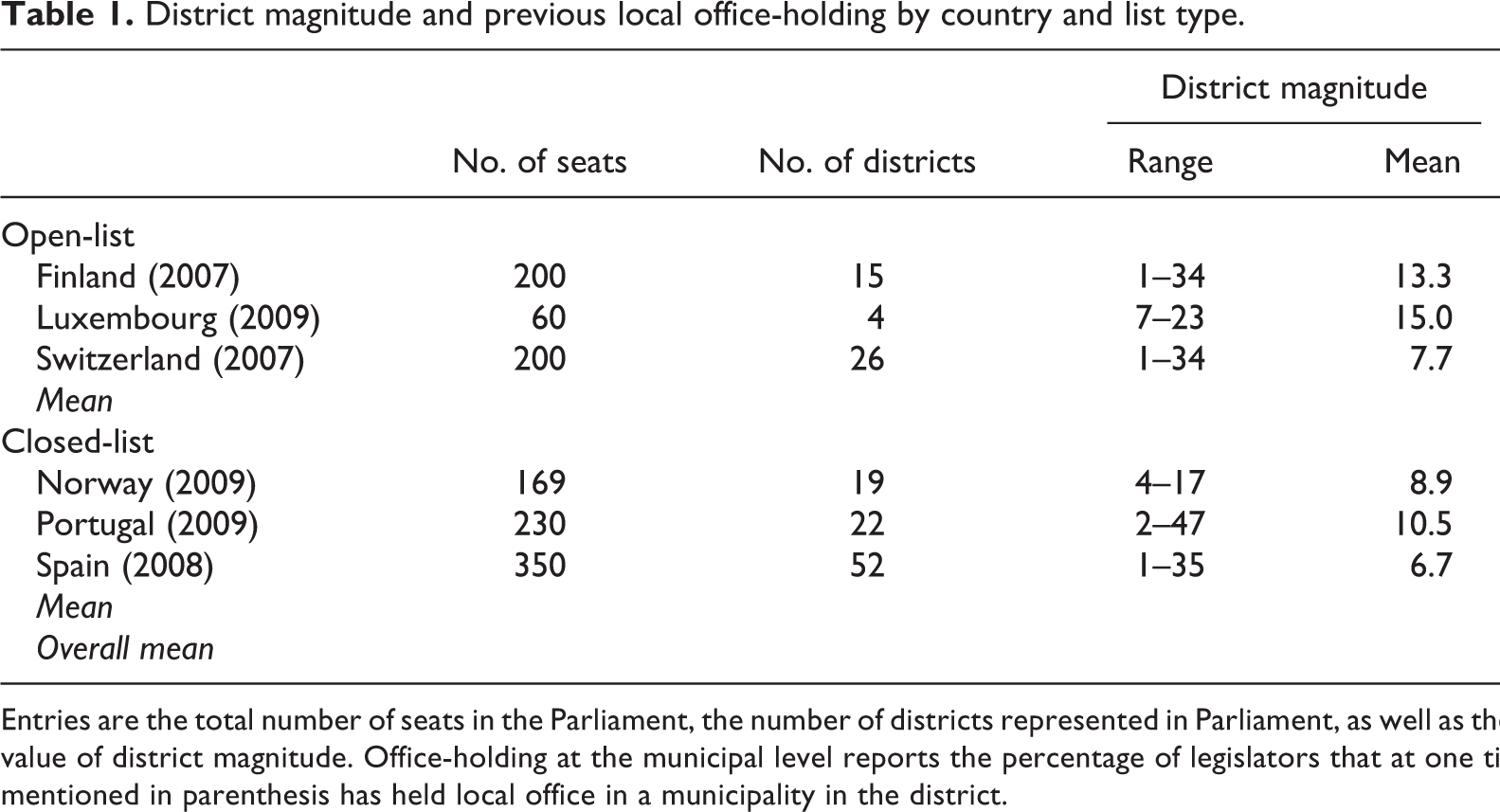
Entries are the total number of seats in the Parliament, the number of districts represented in Parliament, as well as the minimum, maximum and mean value of district magnitude. Office-holding at the municipal level reports the percentage of legislators that at one time previous to the election mentioned in parenthesis has held local office in a municipality in the district.
Legislators’ local office-holding in open-list and closed-list systems
District magnitude and local office-holding in the district. District magnitude affects the relative value of personal and party reputations differently, provided lists are open or closed. We measure this as the probability that a legislator previously has held office at the municipal level in the district. The primary independent variables are (the decimal logarithm of) district magnitude and a binary indicator open-list coded ‘1’ for open-list systems and ‘0’ for closed-list systems. An interaction term between both is added to the model to analyse the conditional effect of district magnitude. Given the dichotomous nature of the outcome variable, a probit model is the appropriate estimation technique. In addition, disregarding the non-independence of observations at the district level would lead to incorrect standard errors and erroneously high levels of statistical significance (Steenbergen and Jones, 2002). To account for the hierarchical structure of the data, clustered sandwich estimation of the standard errors is used.
In closed-list systems the likelihood of having held office at the municipal level decreases as magnitude grows. In open-list systems, by contrast, the value of having held local office appears to increase with magnitude. The results presented in Table 2a closely resemble Shugart et al.’s (2005) findings. To ascertain that the effect of district magnitude on the chance of having held office at the local level under both list types is statistically significant, we present the results graphically using King et al.’s (2000) simulation-based approach and software package (
The effect of district magnitude on previous local office-holding.
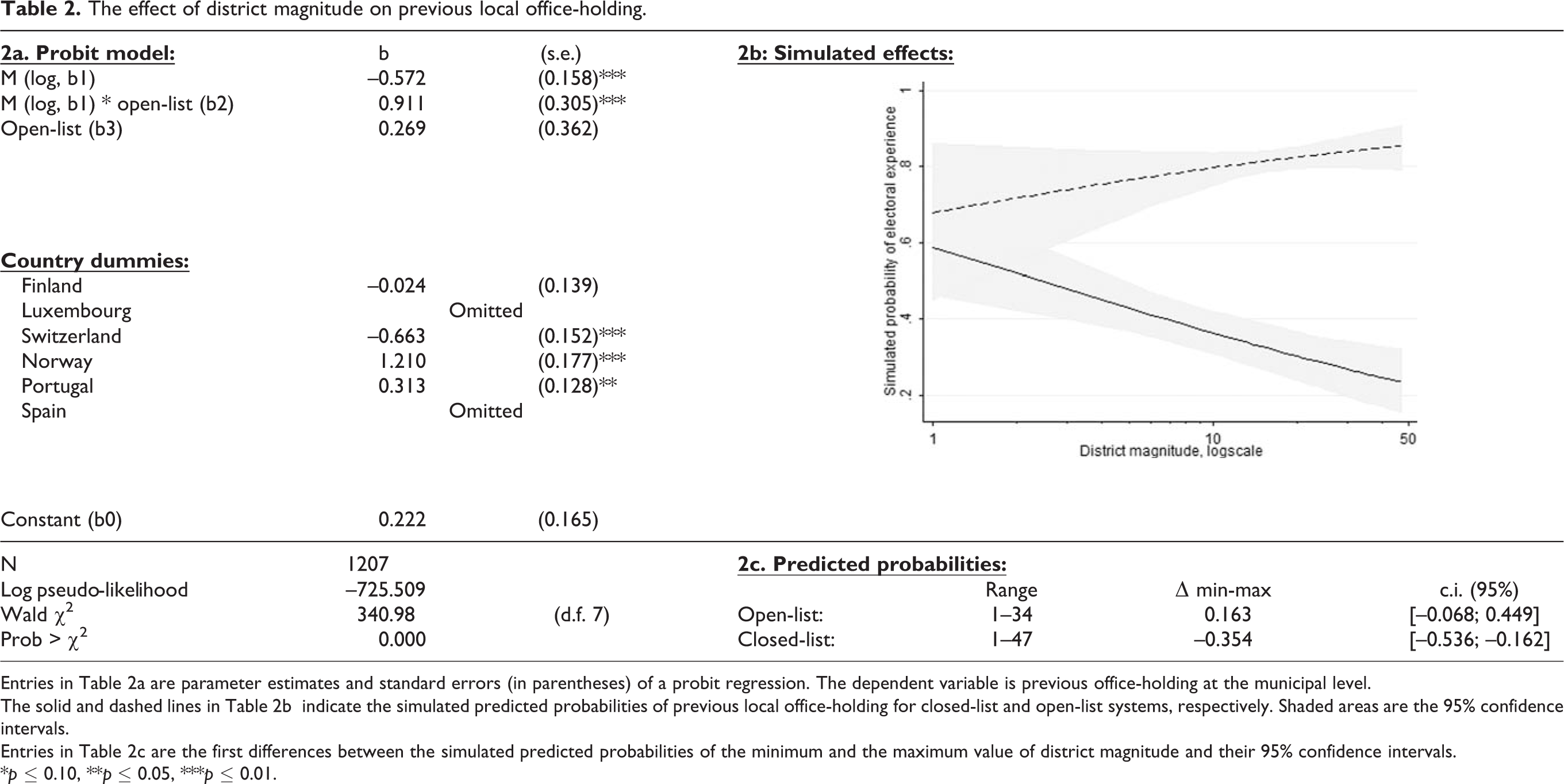
Entries in Table 2a are parameter estimates and standard errors (in parentheses) of a probit regression. The dependent variable is previous office-holding at the municipal level.
The solid and dashed lines in Table 2b indicate the simulated predicted probabilities of previous local office-holding for closed-list and open-list systems, respectively. Shaded areas are the 95% confidence intervals.
Entries in Table 2c are the first differences between the simulated predicted probabilities of the minimum and the maximum value of district magnitude and their 95% confidence intervals.
*p ≤ 0.10, **p ≤ 0.05, ***p ≤ 0.01.
It is less common for legislators to have held local office in closed-list systems as district magnitude grows larger. But where intra-party competition is fiercest, it is not more common for legislators to have held local office – that is, as district magnitude grows larger in open-list systems. Although these results hold without controlling for country differences, 8 the country dummies further explain a considerable proportion of the variance in the dependent variable. More Norwegian legislators have previously served in local office than expected. Decentralized candidate selection procedures (Valen et al., 2002) and the use of open ballots at municipal elections (van der Kolk, 2007) could be part of the answer, but even among Norwegian legislators the likelihood of local office-holding decreases significantly as district magnitude increases. In spite of decentralized candidate selection procedures, moreover, fewer Swiss legislators have held local office than expected on the basis of district magnitude as a proxy of ‘intra-party competition’. Using a more precise measurement, we demonstrate in the next section that the number of co-partisan competitors increases a legislator’s probability of local office-holding in open-list systems, but the number of co-partisan competitors is not the reason why district magnitude decreases that probability in closed-list systems.
District magnitude and intra-party competition. Carey and Shugart (1995: 431) take district magnitude to be a measure of the scope of intra-party competition in open-list systems. More precisely, they argued, the incentives to cultivate a personal reputation increase, and decrease, with the ratio of the number of candidates running under the party label (C) to the total number of seats available in the district (M). Yet, the negative correlations between the ratio C: M and M displayed in Table 3 illustrate that, even as the number of co-partisans rises with magnitude, the ratio C: M does not. Moreover, electoral laws dramatically reduce the variation in the ratio C: M.
The ratio C: M and C: P, by country and list type.
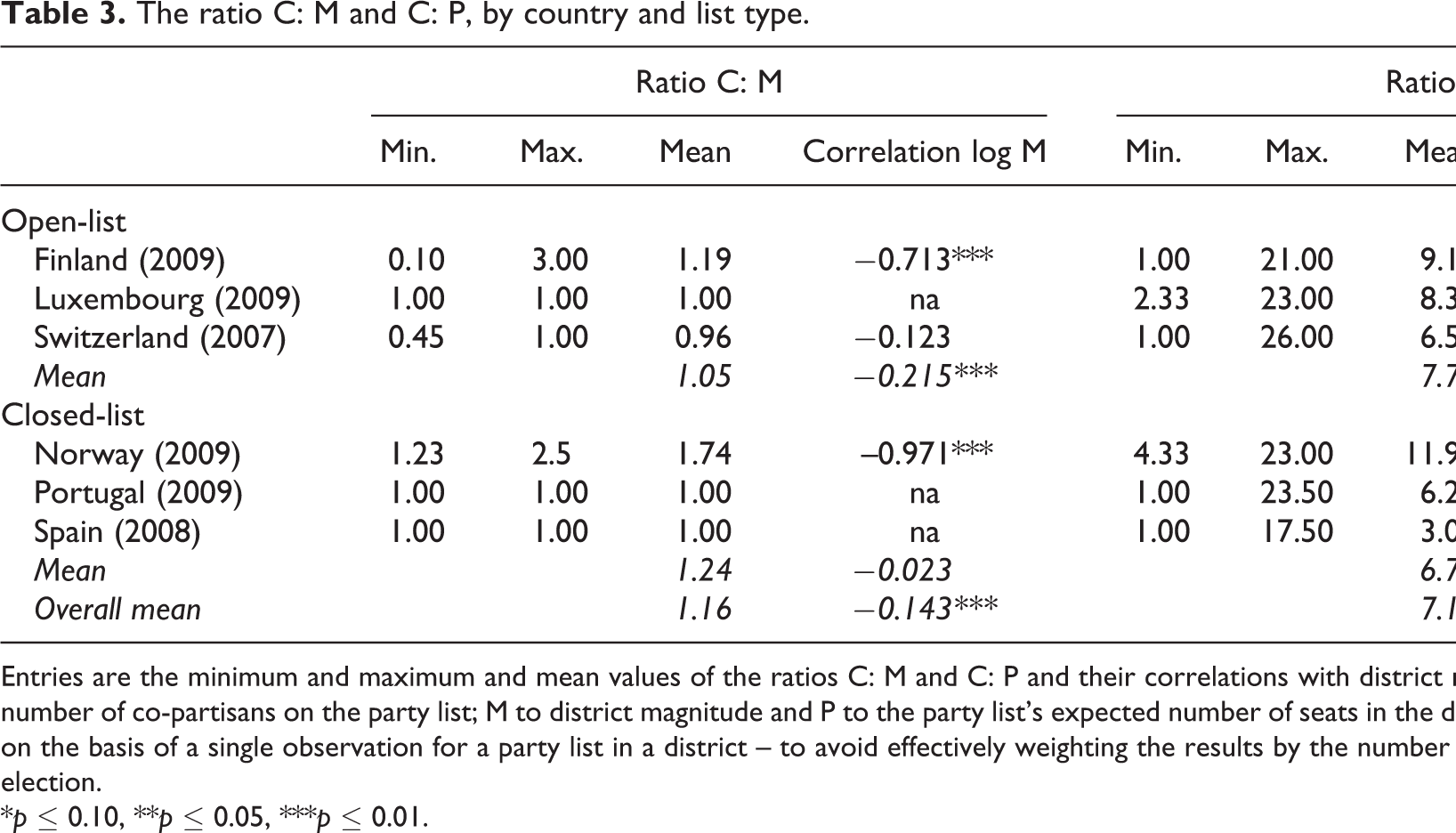
Entries are the minimum and maximum and mean values of the ratios C: M and C: P and their correlations with district magnitude. C refers to the number of co-partisans on the party list; M to district magnitude and P to the party list’s expected number of seats in the district. Entries are calculated on the basis of a single observation for a party list in a district – to avoid effectively weighting the results by the number of seats the list won in the election.
*p ≤ 0.10, **p ≤ 0.05, ***p ≤ 0.01.
Each of the six selected countries legally restricts the length of party lists. Variation in the number of candidates parties put forward in a given constituency is substantial in Finland. For 65.5 percent of the candidates winning a seat in the 2007 general elections, the number of intra-party competitors equalled the legal maximum of district magnitude (or 14 in the smaller constituencies). The proportion is considerably higher, however, when taking into account that smaller parties tend to run joint lists of full length. Variation in the ratio C: M is also substantial in Switzerland. Even though the number of candidates included on a list cannot exceed M, the system of (sous)apparantement allows political parties to bypass this restriction by presenting more than one list in a single district (Bochsler, 2010). 9 In the other countries the ratio C: M almost invariably equals 1, as there are no penalties for over-nomination. In Spain and Portugal, the number of co-partisan competitors is legally fixed at M. 10 That is not the case in Luxembourg, but parties without exception still field the legal maximum of M candidates. In the Norwegian 2009 elections, 85 of the 90 party lists returning at least one member to parliament nominated the legal maximum (of M to M + 6 candidates).
Crisp et al. (2007: 731) argue that a measure of the scope of intra-party competition should not be a function of district magnitude at all. When determining the number of co-partisan competitors they face, candidates will take into account the number of seats their party is likely to win in the district (P) rather than the total number of seats available (M). One important downside of the use of the expected party magnitude, however, is that it is not a readily observable quantity. Parties may take into consideration public opinion polls, by-elections and results from mid-term local or European elections. Here, the expected party magnitude is operationalized by taking the lowest number of seats a party won in a given district in the two preceding general elections with a minimum of one. Table 3 shows that there are noticeable differences in the number of co-partisan competitors a legislator faces per seat his or her party is likely to win. Yet, in the absence of penalties for over-nomination, within-district variation in the ratio C: P is almost exclusively due to differences in expected party magnitude.
As the within-district variation in the C: P ratio is grouped by party, the model specification in Table 4 clusters observations at the level of the ‘party-in-a-district’ – rather than at the district level – in order to obtain correct standard errors and significance levels. The probit estimates demonstrate that the effect of the C: P ratio varies according to list type, consistent with Crisp et al.’s (2007) expectations. In open-list systems, the coefficient of the ratio C: P remains positive, implying that the probability of having served on a municipal council or executive increases with the number of co-partisans competing per seat. By contrast, the value of previous office-holding at the local level decreases with said ratio in closed-list systems. These results, moreover, hold within each of the six countries individually (though they attain the 0.05 level of significance only in Portugal).
The effect the ratio C: P on previous local office-holding.
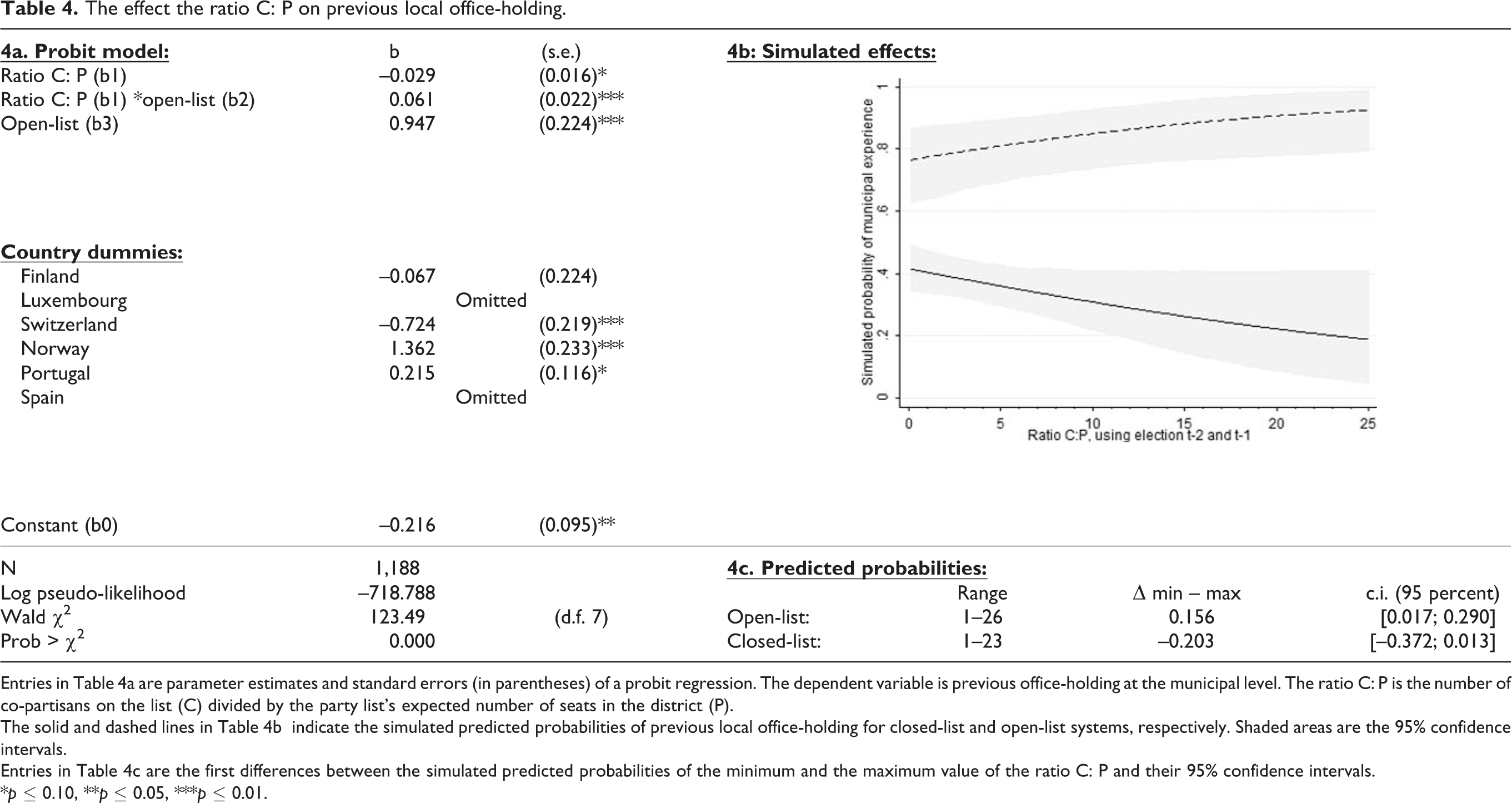
Entries in Table 4a are parameter estimates and standard errors (in parentheses) of a probit regression. The dependent variable is previous office-holding at the municipal level. The ratio C: P is the number of co-partisans on the list (C) divided by the party list’s expected number of seats in the district (P).
The solid and dashed lines in Table 4b indicate the simulated predicted probabilities of previous local office-holding for closed-list and open-list systems, respectively. Shaded areas are the 95% confidence intervals.
Entries in Table 4c are the first differences between the simulated predicted probabilities of the minimum and the maximum value of the ratio C: P and their 95% confidence intervals.
*p ≤ 0.10, **p ≤ 0.05, ***p ≤ 0.01.
The graphics and predicted probabilities based on
District magnitude and the size of the electoral constituency. So far we have looked at the way in which district magnitude can be an indicator of the scope of intra-party competition in terms of the number of candidates running. In closed-list systems, legislators’ likelihood of having local roots is not related to legislators’ ability to stand out among co-partisan competitors and thereby attract additional votes to the party – at least not without taking into account also the number of votes typically required to win the party the additional seat. District magnitude can also be an indicator of the size of the electoral constituency. Within the confines of the district, legislators indeed tend to see such an ‘electoral constituency’ composed of the people who vote for them (Fenno, 1978). If the size of this electoral constituency could be reliably ascertained across a range of electoral rules, that number of votes would provide a better proxy than district magnitude for legislators’ incentives to cater to ‘parochial/local interests’ (Grofman, 1999, 2005). The lower the number of voters a legislator has to ‘connect’ to, the narrower the net of appeals he or she casts can be.
Thresholds of inclusion and exclusion provide a good proxy for the size of legislators’ electoral constituency (see Grofman, 1999; Rae et al., 1971), that is, of the number of votes they would need for re-election. Legislators’ incentives are better captured, we argue, by ‘what they estimate they would need’ than by ‘what they got’ in the way of votes. The threshold of exclusion equals the number of votes they could not fail to be re-elected by – even in the worst possible circumstances regarding the distribution of votes among their competitors. The threshold of inclusion indicates the minimum number of votes they could not be re-elected without – in the best possible circumstances. The geometric mean of both is assumed to approximate the most likely distribution of votes among competitors (Taagepera, 1998). Comparing thresholds in terms of vote-shares across districts of varying population sizes is misleading, however (Grofman, 1999, 2005). These vote-shares are thus adjusted by the number of entitled voters in the district. Thresholds to win a seat range from 2,600 votes in Luxembourg to 87,420 votes in Spain (see Table 5).
The thresholds of inter-party and intra-party competition, by country and list type.
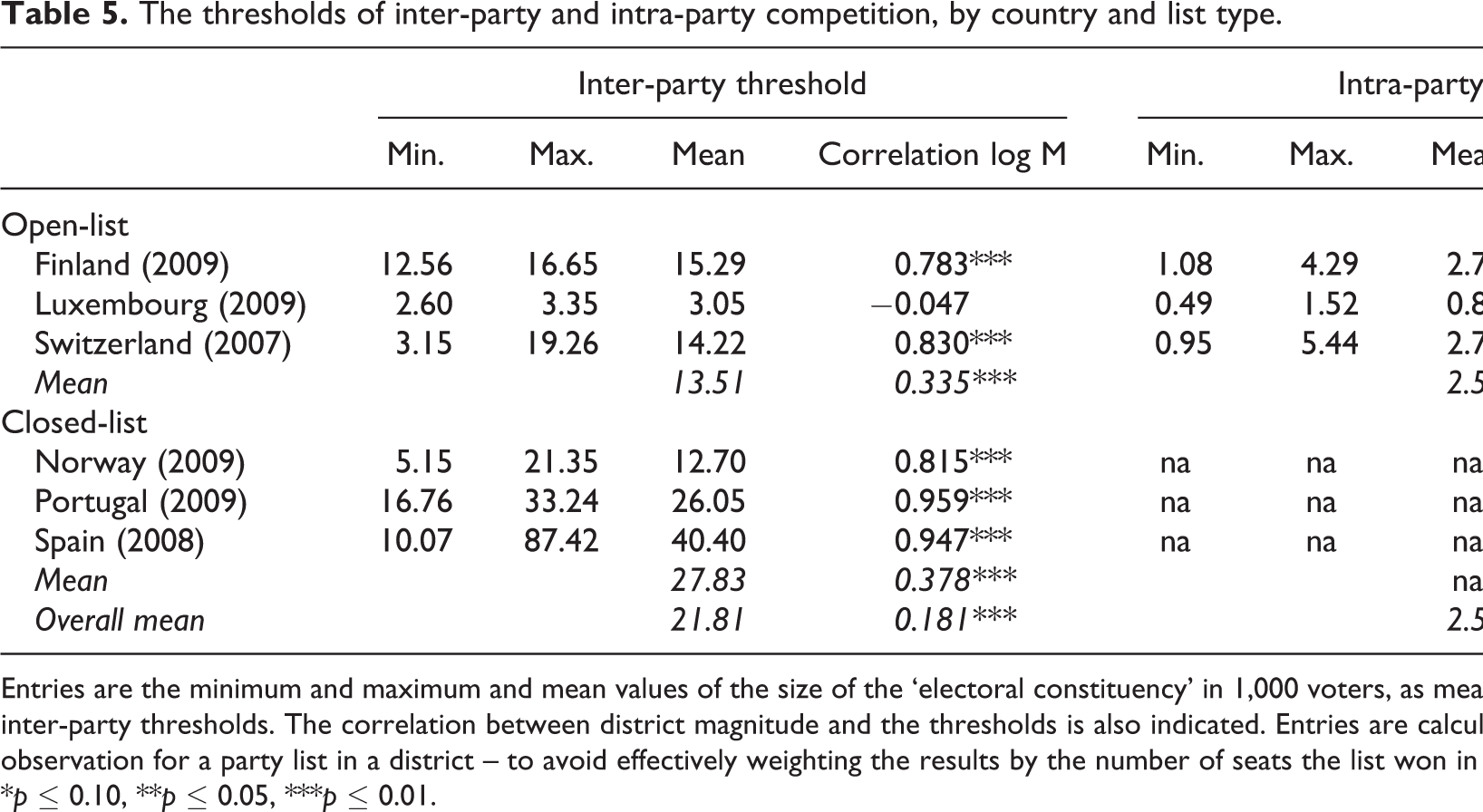
Entries are the minimum and maximum and mean values of the size of the ‘electoral constituency’ in 1,000 voters, as measured by the intra-party and inter-party thresholds. The correlation between district magnitude and the thresholds is also indicated. Entries are calculated on the basis of a single observation for a party list in a district – to avoid effectively weighting the results by the number of seats the list won in the election.
*p ≤ 0.10, **p ≤ 0.05, ***p ≤ 0.01.
Furthermore, in closed-list systems a legislator’s incentives are shaped by the inter-party allocation of seats alone 11 , whereas in open-list systems the intra-party allocation of seats to candidates needs to be taken into account as well. Details on how these electoral thresholds were computed can be found in the appendix. Table 6a confirms that as the ‘inter-party threshold’ increases in closed-list systems the number of legislators catering to the local community decreases. That is, a legislator’s electoral constituency is determined by his ability to win the party the additional seat – in accordance with Shugart’s (2008) later specification. As the number of voters a legislator needs to connect to grows, electoral appeals that build on his or her local roots will start to look less promising. The inter-party threshold is closely related to district magnitude, Table 5 indicates: with magnitude the number of votes needed to win the additional seat and secure re-election increases.
The thresholds of inter-party and intra-party competition and previous local office-holding.
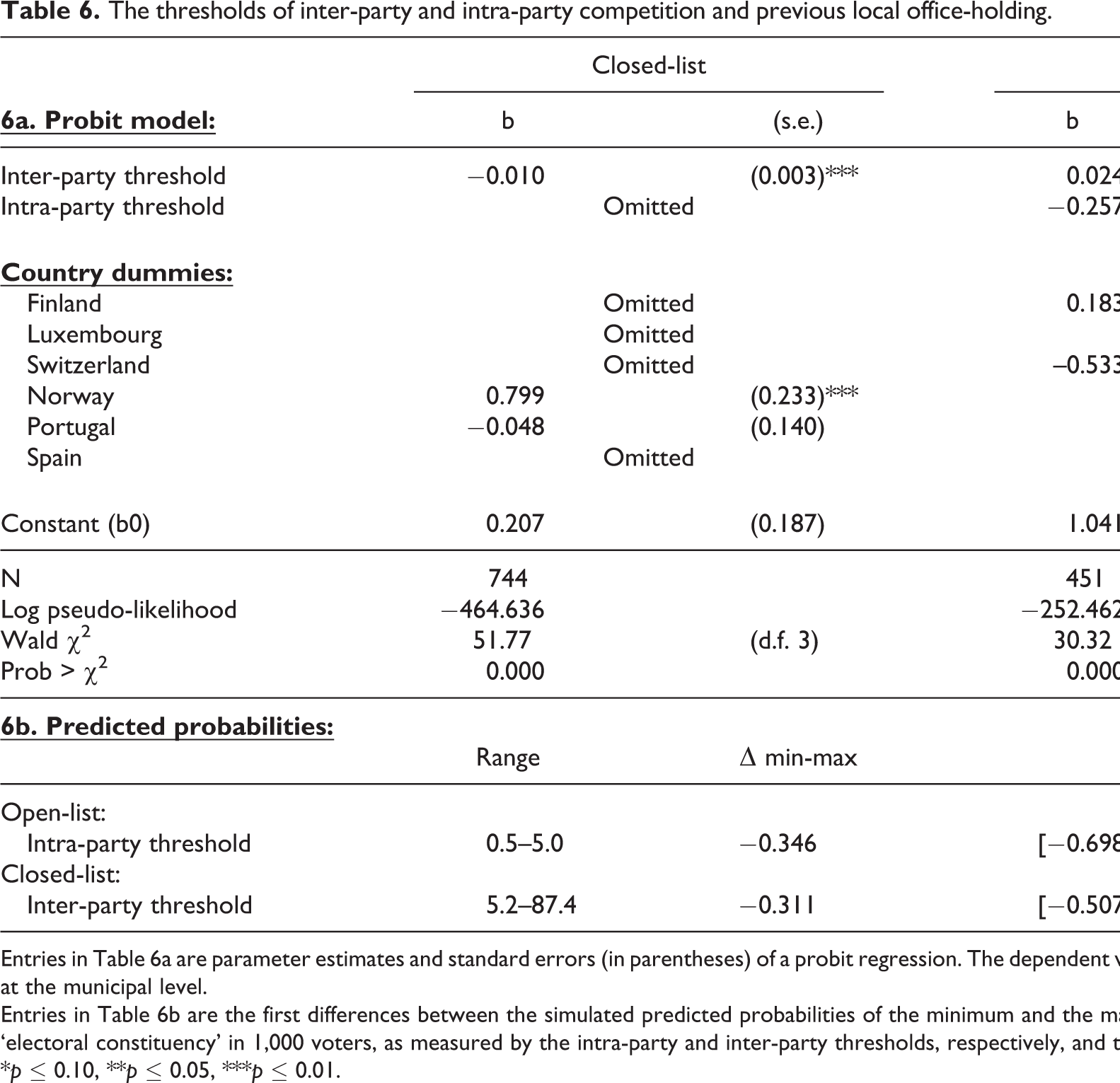
Entries in Table 6a are parameter estimates and standard errors (in parentheses) of a probit regression. The dependent variable is previous office-holding at the municipal level.
Entries in Table 6b are the first differences between the simulated predicted probabilities of the minimum and the maximum value of the size of the ‘electoral constituency’ in 1,000 voters, as measured by the intra-party and inter-party thresholds, respectively, and their 95% confidence intervals.
*p ≤ 0.10, **p ≤ 0.05, ***p ≤ 0.01.
In open-list systems, by contrast, the thresholds of ‘inter-party allocation of seats’ have no influence on the number of legislators who have held local office. Intra-party competition is probably what motivates legislators to seek a localized personal vote, like Carey and Shugart (1995) argued. Table 6b demonstrates that the size of a legislator’s electoral constituency has a negative effect: that is, the more elevated is the electoral threshold of obtaining the final seat in the intra-party allocation of seats to candidates, the weaker are the incentives for localized personal vote-seeking. A legislator’s probability of local office-holding drops from 0.86 to 0.52 when the number of preference votes he or she needs to win a seat increases from the minimum to the maximum in the selection. That is, while the intra-party competition increases a legislator’s incentives to cultivate a personal vote, his or her probability to try and build one on the basis of his local roots will decrease as the thresholds of the intra-party allocation of seats grow higher and he or she needs more preference votes to gain re-election. The number of votes needed to win the final seat on the party list can simply not be obtained when concentrating on the local community alone – in the spirit of Grofman’s (1999, 2005) assumption. In fact, district magnitude and the size of a legislator’s intra-party electoral constituency are strongly and negatively related (see Table 5).
Conclusion
Electoral systems matter. The conditions legislators compete under for re-election shape the nature of political representation. It is generally assumed that district magnitude is a crucial variable in this respect. Dependent on the ballot structure – open or closed lists – district magnitude shapes the incentive that legislators have to cultivate a personal reputation, or the party record, when presenting themselves to voters. But research has been more casual about the precise ‘theoretical mechanism’ linking legislators’ incentives to district magnitude. In this article we have tried to look a bit deeper into the exact meaning of the district magnitude.
District magnitude is related to both the scope of intra-party competition in the district and to the size of the electoral constituency – that is, to the number of candidates competing and the number of votes needed to secure a seat. Disentangling both will contribute to identifying the mechanism that motivates legislators to ‘play up’ a particular trait or engage in a particular behaviour. To this end, whether a legislator has previously held office at the local level in the district was used as a proxy, replicating Shugart et al. (2005). Strong roots in the local community may serve to protect a legislator when his party reputation cannot see him elected or when that reputation has turned unfavourable. Municipal elected office communicates to voters both a legislator’s knowledge of local issues, wants and needs and his ability to look after the district. As a result, legislators’ probability of having served on a municipal council or executive in the district was found to increase in three open-list systems (Finland, Luxembourg and Switzerland) as magnitude grows; in three closed-list systems (Norway, Portugal and Spain) that probability decreases as magnitude grows.
District magnitude is commonly understood to be a proxy for the number of co-partisan competitors. But it is equally related to the size of candidates’ electoral constituency or the seat distribution’s proportionality. On the one hand, the negative effect of district magnitude on the dependent variable in closed-list systems is not linked to the number of co-partisan competitors (or the free-riding that might ensue regarding credit claiming). Rather, a legislator’s probability of local office-holding shrinks as the size of his electoral constituency grows: that is, as the threshold of the inter-party allocation of seats rises and, with it, the number of votes he or she needs to win the additional seat. On the other hand, intra-party competition encourages a legislator in open-list systems to seek a personal vote. The number of co-partisan competitors has a positive effect on legislators’ incentives. Whether that personal vote is to be sought in the local community is further influenced by the size of his or her electoral constituency. In other words, as more preference votes are needed to win a seat, the incentive to seek those votes in the local community decreases.
Carey and Shugart (1995) argued that electoral rules affect the incentive legislators have to cultivate a personal vote irrespective of the way in which it is established (Carey and Shugart, 1995: 430). But where one strategy may be offset by another, a simple positive relation cannot be assumed – a fact that Carey and Shugart (1995: 430) did not fail to recognize. It has long been the assumption in the literature that any personal vote-seeking strategy will be related to district magnitude. But this assumption needs to be re-addressed.
One element to consider is the time and effort voters are required to expend keeping track of legislators’ personal vote-seeking activities: learning about a candidate’s roots in the local community will be easier for most voters than trying to monitor legislators’ voting records in Parliament and deviations from the party line, for instance. As legislators may trade-off various personal vote-getting traits and activities, the effect of electoral rules on any single indicator may shrink. Electoral rules, Morgenstern and Vázquez-D’Elía (2007: 143) argue, are after all but the rules of the game, ‘creating bounds within which politicians make decisions, but seldom force particular actions’.
Second, a closer dialogue between the personal vote literature and research concentrating on voters’ decision-making processes at election time is needed. We do not know much about the reasons why voters vote for candidates rather than parties (Karvonen, 2004; Shugart, 2008; van Holsteyn and Andeweg, 2010). We know even less about how electoral rules and these reasons are interrelated. Previous research has focused almost exclusively on party leaders (Aarts et al., 2011), disregarding voting for rank-and-file legislators. A closer dialogue is needed to test and corroborate the many assumptions the personal vote literature makes about voters’ behaviour and the effectiveness of the ‘personal vote-getting traits and activities’ that legislators engage in.
Footnotes
Acknowledgements
We thank Thomas Zittel and Kenichi Ariga for helpful comments on earlier drafts of this article.
Funding
The research for this paper was supported by the
Notes
Appendix: Computing the inter- and intra-party thresholds of seat allocation
For the inter-party threshold of seat allocation, the thresholds of exclusion and inclusion are computed on the basis of the formulae provided by Lijphart and Gibberd (1977: 225): D’Hondt in the case of Finland, Luxembourg, Portugal, Spain and Switzerland and modified Sainte-Laguë in the case of Norway. While the threshold of exclusion is a function of district magnitude, the threshold of inclusion includes the number of parties competing as well.
For the intra-party threshold of seat allocation, the threshold of exclusion is a function of the number of seats won by the list in Finland; in Luxembourg and Switzerland district magnitude is taken into account as well, since voters have the option to indicate a number of preferences up to district magnitude. 12 Strictly speaking the threshold of inclusion is one vote (in the case all other voters stay at home, Katz, 1986: 93 f.); for a more realistic threshold we estimate that the first s-1 seats are filled by a Hare quota (1/s), with the remaining votes divided equally among the remaining candidates (see Grofman, 1999). For comparison, these vote-shares are multiplied by the party electorate in the case of Finland and by the ‘adjusted’ party electorate in Luxembourg and Switzerland. The number of votes cast for candidates on the party list is conflated by the option to indicate more than one preference (and cumulated votes): the number is adjusted by the proportion of votes for candidates on the party list to votes for all candidates on all lists.
The formulae for the thresholds of inclusion and exclusion used are reported in the table below.