







Abstract
Most studies that aim to measure the influence of ideology on policymaking use the share of cabinet seats held by left versus right parties, manifesto data, expert judgments, or ideology scores as ways to operationalize ideology. These measures, however, cannot systematically capture the content of policy debates, ideological arguments used, or how these arguments change over time. Based on the concept of framing, this article presents an alternative methodology to study the role of ideology in welfare retrenchment proposals across countries and over time. By identifying recurring arguments, welfare ‘frames’ within which reform debates play out can be identified and compared over time. Applying this methodology to 578 New Zealand parliamentary budget debate speeches from 1970 to 2012, this article finds that there is more overlap in the welfare arguments used by both Labour and National in 1984 and 2000 – years when the Labour Party was in government. Thus instead of welfare frames being defined strictly along ideological party lines as Labour versus National, they might also be defined in terms of a multi-party ‘in power’ frame versus a multi-party ‘in opposition’ frame. In other words, whichever party is in power may matter more to welfare retrenchment debates than traditional party positions.
Do the welfare state cutbacks that have taken place since the late 1970s indicate a shift in political parties’ ideological positions on the welfare state? 1 Many scholars examining welfare state change since the end of the welfare state’s ‘golden age’ have juxtaposed left versus right parties and have sought to show that each side – based on traditional party platforms – pursue reform efforts in line with party expectations. Since cutbacks have taken place in all types of Esping-Andersen’s welfare state regimes – liberal, conservative, and social democratic (1990) – and have varied widely in breadth and depth, this raises the question of whether post-WWII welfare cutbacks have been driven by ideological rather than structural concerns.
This article explores ideological shifts in welfare reform proposals using a new framing-based methodology to isolate the arguments policymakers use to support or contest changes to existing welfare policy. Looking specifically at New Zealand parliamentary budget debates from 1970–2012, 2 the 578 speeches analyzed show that arguments used by Labour and National MPs were not always in line with traditional party platforms (left in favor of welfare assistance, right against). Instead, when Labour was in power in 1984 and 2000, the rhetoric of Labour MPs drastically shifted and they began using traditional National Party arguments; National MPs did the reverse and drew heavily upon traditional Labour Party arguments when in opposition – a result that suggests the juxtaposition of left versus right parties is too simplistic.
The first section of this article discusses previous research methods that have been used to investigate the role of ideology in welfare state change. The second section introduces the concept of framing and describes why and how a framing-based methodology can be applied to the study of ideological shifts on the welfare state. The third section demonstrates how this methodology has been applied to New Zealand as a case study, while the fourth discusses the results and implications. The fifth and final section concludes.
The role of ideology in welfare retrenchment: Traditional approaches
Scholars have used a variety of different approaches to examine the role of ideology in welfare retrenchment. Pierson (1996), for example, has argued that policymakers recognize the significant electoral risks involved in welfare cutbacks and that this makes significant welfare retrenchment impossible. As a result, a ‘new politics’ of the welfare state exists, one where traditional party politics plays a smaller role than previously assumed. Other prominent work (Huber and Stephens, 2001; Kittel and Obinger, 2003) supports this ‘new politics’ approach, concluding that partisan politics plays much less of a role in welfare retrenchment than expected. Conversely, some scholars who have tested the conclusions of the ‘new politics’ approach have concluded that neo-liberal/rightist parties have indeed sought more retrenchment since the 1980s (Allan and Scruggs, 2004) and that the risk of major cuts to welfare programs is significantly less with left-leaning cabinets than with secular center-right parties (Korpi and Palme, 2003).
Though these studies consider a wide range of variables, most operationalize partisanship as the share of cabinet seats held by left-, center-, or right-leaning parties. Although this is a useful way to measure a party’s strength in government, these partisanship scores lack explanatory power since the share of party seats reveals nothing about the nature of national welfare debates. Specifically, this measure of partisanship takes as a given that left parties – as a result of traditional party ideology – will be more supportive of the welfare state than right-leaning parties. Thus in aiming to measure partisanship, these authors also instantiate a static measure of party ideology, making it impossible to account for shifts in party ideology over time or make convincing links between ideology and policy outcomes.
More general studies of ideology also do not remedy this shortcoming. Some rely on self-report scales (Claassen et al., 2013; Wood and Oliver, 2012) and national survey data (Federico and Hunt, 2011; Munzert and Bauer, 2013; Putz, 2002) to measure the ideological beliefs of individuals, public opinion polarization, or partisanship, while others use scores based on Congressional roll-calls (Berry et al., 2010) or ratings developed by interest groups like Americans for Democratic Action or the AFL-CIO. Since an ideology score calculated in 1965 is theoretically not comparable with a score calculated in 2005 (the orientation of parties’ ideological beliefs inevitably shifts over the years), these measures cannot track changing party discourse on a particular topic over time. Studies that rely on methodologies based on self-reporting present a raft of issues related to longitudinal data collection and the reliability of self-reported information, but are also limited by the fact that ideology scores are calculated each year often based on the results of public opinion surveys or congressional votes, both of which reveal very little about the nature of policy debates. Even if policymakers were surveyed to measure their ideological beliefs on a particular issue, these surveys would most likely not be fine-grained enough to capture subtle ideological variations, would suffer from a low response rate, and would only be valid for a particular point in time, among other issues (see Budge, 2000).
Much academic work has also used the Comparative Manifesto Project dataset, which aims to measure the political preferences of parties over time. The project’s coding scheme captures several welfare-related codes but fails to capture some important ideological nuances. For example, examining the dataset’s welfare-related codes reveals that in 1984 the Labour Party made no references to welfare state limitation (code 505) and 92 references (or 6.3% of the manifesto) to welfare state expansion (code 504). These results fall in line with expectations of a left party’s normal policy preferences. But this does not square with the historical record, which shows that it was the Labour Party that instituted some of the harshest welfare reforms the country had ever seen, beginning in 1984. Thus the manifesto data is useful for tracking overall ideological trends, but is incapable of picking up on subtle intra-party changes, like those that occurred in the Labour Party in 1984.
Considering the fundamental issues in approaches to studying ideology, especially those specifically associated with studies of welfare state retrenchment, a new methodology that can capture the subtleties of intra- and inter-party political change over time is needed.
Left vs right and the welfare state
As previously mentioned, there can be stark differences in policy proposals put forth by left and right parties. For example, the drastic welfare reforms that took place during the Clinton administration to ‘end welfare as we know it’ seemed atypical for a Democratic president. Similarly, it was Social Democratic Chancellor Gerhard Schröder who implemented radical welfare reforms in Germany in 2003, and ‘New Labour’ in the United Kingdom that failed to reverse many of the strict privatization efforts and welfare cutbacks begun by Margaret Thatcher.
This illustrates the common misperception that welfare cuts can normally be broken down by party: the left normally does x, while the right normally does y. But doing so overlooks the possibility that traditional party positions may not influence legislative outcomes as much as is generally believed. This is not to suggest that ideology does not matter to major policy decisions, but that perhaps its role is less intuitive than it first appears. This lack of clarity surrounding the role of ideology in welfare reform is significant, and demands detailed study to understand more thoroughly the role traditional ‘party lines’ play in welfare retrenchment.
Any new study, however, must be able to capture the subtle societal beliefs and stereotypes 3 that lurk implicitly beneath the surface of welfare reform debates. For example, in the American context, tropes entrenched in American political culture – like dependence on government ‘handouts’ versus independence – have effectively been used to manipulate perceptions of who deserves welfare assistance. Though this deservingness rhetoric, associated with the American right, often serves as the backdrop to American welfare debates, how it shifts and the role it plays over time cannot be captured by traditional approaches of operationalizing ideology – whether as a percentage of a party’s seats in cabinet, or as ideology scores. This begs the question, how can these implicit arguments – in addition to the more obvious ones – be systematically isolated and then compared between countries and over time?
One way to address this question is to use framing, a concept borrowed from sociology and political psychology. A framing-based methodology places the focus on the arguments used by policymakers – in this case, for and against welfare cutbacks. Systematically tracking these arguments can thus reveal the contours of framing efforts. This fine-grained approach offers an alternative way to study changing ideology and partisan positions, both between and within parties but also over time.
Framing and the study of welfare cutbacks
We know from studies of political psychology that political issues are often framed 4 by journalists and policymakers, and that these framing efforts can shift perceptions and opinions (Chong and Druckman, 2007; Kahneman and Tversky, 1984). For example, in an experimental study examining participants’ views on welfare reform, one group read a news article that framed welfare reform as necessary since recipients lacked self-discipline, while the other group read an article describing the negative impact welfare reform would have on children. Those who read the self-discipline article were more supportive of the proposed welfare caps discussed in the study, and those who read the second article were more opposed to them (Nelson and Oxley, 1999). Importantly, the authors of this study successfully manipulated the way welfare reform was framed by inserting different arguments into the text to depict their chosen policy problem in different ways.
The varied construction and portrayal of policy issues through framing occurs constantly, and one of the primary elements manipulated by policymakers and the news media is commonly-repeated narratives. These narratives are not only repeated by government actors but are also made more salient through persistent media coverage (Blood and Phillips, 1995) and other forms of public discourse, and can appeal to common psychological biases like stereotypes or hostile attitudes towards certain groups (Reese, 2001). For this article, these repeated narratives are broken down into arguments in favor of or against welfare cutbacks. In the welfare retrenchment context, certain tropes – like those centered on just desert in America – are consistently repeated. This makes it possible to identify different arguments for and against welfare reform, to track how these arguments shift over time, and to compare them across countries to determine if cutbacks to the welfare state are similar or different in ideological terms.
Identifying arguments and characterizing frames
Many popular framing techniques require researchers to define possible frames – by identifying keywords and common phrases used, for example – before proceeding with a content analysis of their primary source materials. 5 This approach is problematic as not all instances of framing use the same keywords and common language, thus an electronic search for keywords may automatically eliminate some pertinent examples of framing. This sacrifices the potential complexity of framing attempts and reduces the explanatory power of frames.
It is with this in mind that this content analysis-based framing approach was developed. My methodology aims to capture all arguments related to government-sponsored social assistance in the primary source materials analyzed – not just those arguments that contain particular words like ‘welfare’ or ‘superannuation.’ Benford and Snow argue ‘frames are not static, reified entities but are continuously being constituted, contested, reproduced, transformed, and/or replaced during the course of social movement activity. Hence, framing is a dynamic, ongoing process’ (2000: 628). Thus as new welfare issues came to the forefront each year, new codes were added to the codebook to capture the changing picture. This permits us to get a more complete picture of the debates surrounding welfare changes, and can also reveal whether arguments become more polarized or converge 6 over time, either domestically between parties or transnationally.
Application of framing as a methodology: New Zealand
In a first effort to apply this methodology, this article identifies arguments for and against government welfare spending in parliamentary budget debate speeches of MPs in New Zealand. 7 New Zealand, a country with a long history of social welfare provision that began in 1898 with the Old Age Pensions Act, is an interesting case study as it was the Labour Party that enacted some of the toughest welfare reforms in the country’s history in 1984 – an unexpected outcome if we consider traditional left/right party positions on welfare. This raises some interesting questions; namely, how were Labour MPs talking about these cutbacks during the debates? What arguments did they use, and did these arguments indicate a rightward shift in the Labour Party’s overall position on welfare? What arguments were National MPs making?
To analyze arguments for and against welfare reform in New Zealand, a content analysis was carried out on parliamentary budget debates in four time periods from 1970 to 2012 (these are 1970-1972, 1979-1984, 1995-2000, and 2010-2012). 8 As economic/financial hardship is often cited as a motive for welfare cutbacks, these time periods were chosen to reflect changing economic conditions over the last 40 years. Additionally, using these same time periods in future analyses facilitates cross-country comparisons. Periodization also addresses the ‘small n’ issue – since the number of speeches per year ranges from 23 in 1996 to 50 in 1983, aggregating together the speeches from several years helps to ensure a larger n in each time period, and a more even distribution of data.
Parliamentary budget speeches were selected for analysis using a random sampling procedure. After numbering each speech for a given year, random sequences of numbers were generated. Based on the number of speeches in a year, half were selected using the random numbers generated. When there was an odd number of speeches, the preceding even number of speeches was used to determine the number of speeches to be analyzed (thus 83 speeches in a given year would mean 41 would be coded).
Content analysis
The ‘welfare state’ is not a single unit but is decomposable into different parts or issue areas. To guide the content analysis presented in this article, the welfare state was divided into eight broad issue areas: 1) education; 2) health; 3) housing; 4) pensioners/elderly; 5) employment; 6) general social welfare codes; 7) miscellaneous; and 8) taxes. The employment, general, miscellaneous, and taxes categories were included to capture arguments indirectly related to welfare state reform. 9 For example, though the codes ‘tax revenue required for social spending’ and ‘government spending unsustainable’ do not refer to a specific welfare program or method of assistance, they are important as they hit on structural explanations for welfare state cutbacks. Using these eight major issue areas as a guide, popular pro-/anti-welfare retrenchment arguments were mapped onto these eight issue areas based on common arguments in the policymaking discourse about why welfare cutbacks should or should not be pursued. 10
To conduct the content analysis, arguments for and against welfare changes were coded (for example, an argument against cutting back the welfare state is captured by the code ‘modest earners are society’s backbone and deserve support’). Blanket statements about what the budget would achieve in a certain sector of government assistance (for example, ‘health funding decreased’ or ‘increases funding for education’) were also coded as implicit pro-/anti-cutback arguments. More general arguments that were indirectly related to welfare, the role of government, government spending, and taxation were also coded to capture a more complete picture of the political situation in New Zealand over time. 11 For this preliminary analysis of overlap, a total of 656 parliamentary budget speeches (out of a universe of 1118 speeches) were coded and 578 – the speeches by National (300) and Labour (278) MPs only 12 – were considered for the analysis.
Most frequently used arguments
Figure 1 shows the arguments used in at least 10 or more Labour speeches over the entire time period and all issue areas; Figure 2 shows the arguments used in at least 10 or more National speeches over the entire time period and all issue areas.
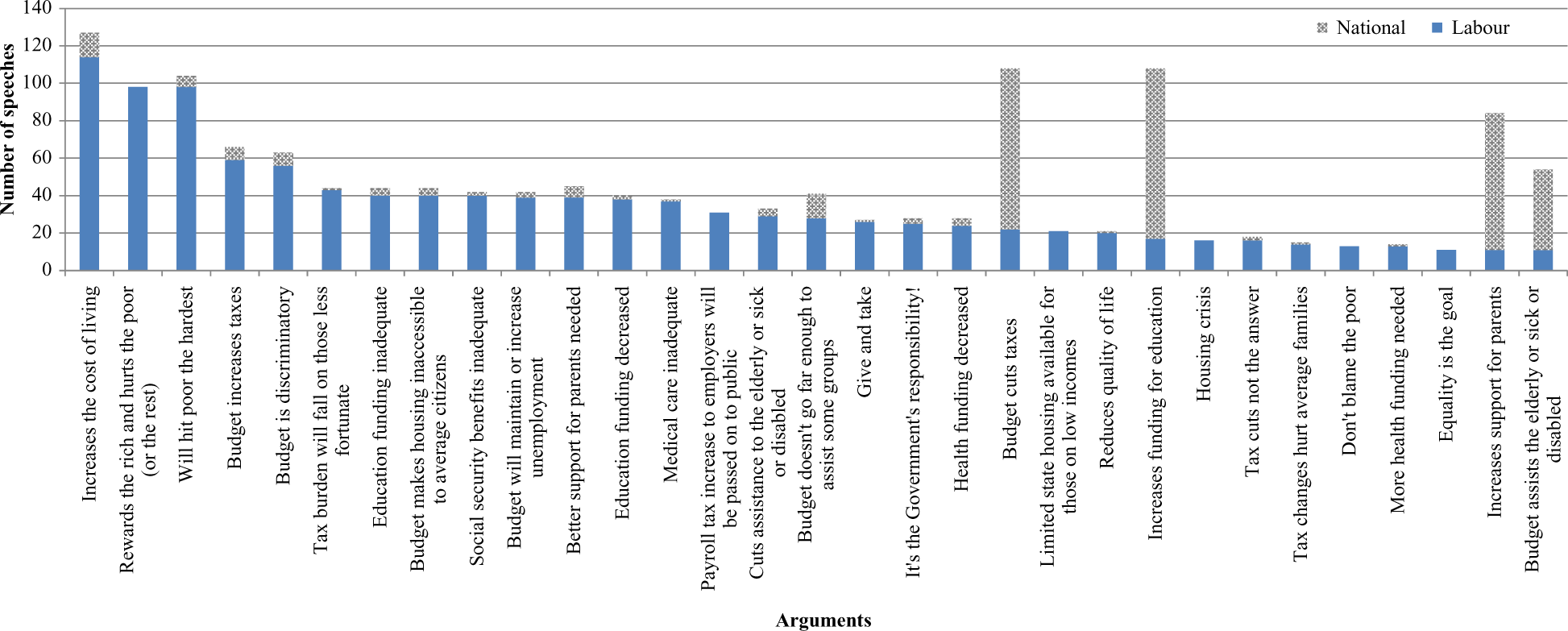
Most frequently used Labour Party arguments (1970–2012).
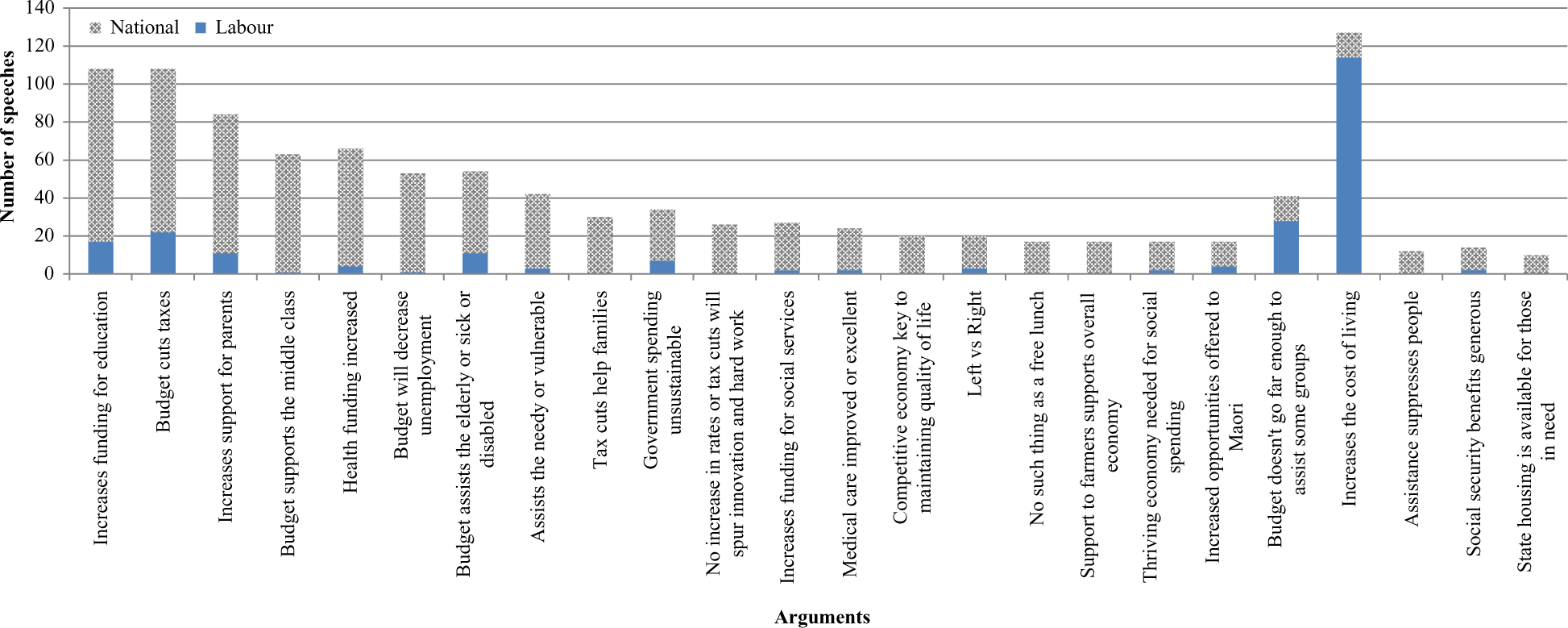
Most frequently used National Party arguments (1970–2012).
The figures show a distinct difference between the most frequently used Labour and National arguments. The Labour Party consistently expressed concern for the poor, average New Zealanders (as opposed to the rich) and retirees, suggesting budget changes would ‘increase the cost of living,’ would ‘reward the rich and hurt the poor,’ would ‘hit the poor the hardest,’ ‘increases taxes,’ that the ‘tax burden would fall on those less fortunate’ and that the budget overall ‘is discriminatory’ (against the poor). Few National MPs made these arguments, and none made the argument ‘rewards the rich and hurts the poor.’ Labour MPs also articulated concern over access to particular services or benefits, arguing the ‘budget makes housing inaccessible to average citizens’ (argued in 40 Labour speeches [L] and four National speeches [N]), that ‘limited state housing is available for those in need’ (21 L, 0 N), and that ‘medical care is inadequate’ (37 L, 1 N). Emphasis was also placed by Labour MPs on inadequate education funding (40 L, 4 N), social security benefits (40 L, 2 N), and parental support (39 L, 6 N). 13
The most frequently used National Party arguments focused on the positive things the budget would do: ‘increases funding for education’(91 N, 17 L), ‘cuts taxes’ (86 N, 22 L), ‘increases support for parents’ (73 N, 11 L),‘supports the middle class’ (62 N, 0 L), ‘health funding increased’ (62 N, 4 L), ‘will decrease unemployment’ (52 N, 0 L), and ‘assists the elderly or sick or disabled’ (43 N, 11 L). This is an intuitive finding as the National Party was in power for the majority of the time periods analyzed thus protecting its record – by highlighting the good things the budget would achieve – was important.
But the presence of other arguments frequently used by National MPs (and never by Labour MPs) conflict with some of the arguments mentioned above. They are ‘competitive economy key to maintaining quality of life,’ ‘no such thing as a free lunch’, and ‘assistance suppresses people.’ In essence, these arguments put the focus on personal responsibility and financing. Despite efforts of the National Party to say Labour did not have a monopoly on ‘humanitarian’ concerns, National’s rhetoric reveals its primary concern is not with individuals’ needs. This is bolstered by political decisions that are not captured by this analysis. For example, in 1996 the National government’s minister of finance reported a nearly NZ $4 billion surplus in his annual budget speech. But this surplus – much to the dismay of Labour Party politicians – did not translate into a more robust social spending budget or an increased allocation for faltering areas like health care. Instead, Minister of Finance Bill Birch said the government had to ‘prioritize.’ That year, the priority was placed on tax cuts as it was argued that all social spending was contingent on economic success, and that economic success was driven by tax cuts.
This analysis reveals that Labour and National were arguing from different points of view, with Labour putting its primary focus on people and their needs, and with National focused on the importance of a strong economy and the need for people to be hardworking and responsible – arguments that fall in line with traditional left/right ideological expectations. A closer look at the data, however, shows this might be an oversimplified interpretation.
A closer look
Despite the differences in some arguments made by National and Labour MPs, there were also some similarities. Looking at the most commonly used arguments by each of the major political parties in New Zealand aggregated over time reveals important information about the major topics of concern for each party. This aggregated view, however, cannot tell us anything about the differences or similarities between the parties at given points in time. Only by examining how the arguments used by one party over time – in relation to those used by another – can we truly get a picture of how policymakers’ political positions have evolved and whether they have converged or become more polarized.
To get at this variation, arguments that are used by both Labour and National MPs – i.e. arguments that overlap – in each time period must be identified. Overlapping arguments that are used repeatedly over time gesture at the importance of a particular rhetorical device or political position to a national welfare debate, whereas arguments that are used in one year never to appear again may reveal something about the politics of a particular year but cannot reveal anything about broader patterns of the way welfare retrenchment proposals are framed.
To determine the arguments used by both Labour and National MPs in a particular time period, a ‘polarization score’ and an ‘overlap score’ were developed for each issue area. To determine each score, the data were disaggregated by issue area, code, time period, and political party. Then for each issue area, for each code, for each time period, the most ‘polarized’ code for both the Labour Party and the National Party was determined. For example, Table 1 shows the number of speeches by Labour and National MPs that used each code in the health issue area for 1970–1972 (there were 16 Labour speeches and eight National speeches for this issue area and time period).
Health issue area, 1970–1972: Number of Labour and National speeches per code.

To determine the polarization scores, the argument most frequently used by the Labour Party and never used by National MPs (‘medical care inadequate’) and the argument most frequently used by the National Party that was never used by Labour MPs (‘health funding increased’) were identified. Next, the number of speeches for these categories was divided by the total number of speeches for each party and a percentage was generated. This percentage is the polarization score for each party. In this particular example of health codes, the Labour polarization score is 81.2% and the National polarization score is 62.5%. This means that 81% of Labour MPs in 1970–1972 made the Labour-only argument that medical care was inadequate, and that 62% of National MPs in the same time period made the National-only argument that health funding had been increased. 14
To calculate the overlap score, the code where the highest number of National and Labour MPs made the same argument was looked at. The total number of speeches for that code was added and divided by the total number of Labour and National speeches combined. For the above example, the overlap score was 0 as Labour and National MPs never made the same argument about health in 1970–1972. If we look at the health issue area later, from 1995–2000 (see Table 2), we see an interesting example of overlap (in this time period, there were 24 total Labour speeches and 23 National speeches).
Health issue area, 1995–2000: Number of Labour and National speeches per code.

In this case, the argument used by both parties was ‘health funding decreased’ and the overlap score was 19.1%. Thus 19% of both Labour and National MPs made the argument that health funding was decreased in this time period. 15
After compiling the data, I calculated the polarization and overlap scores for all issue areas by argument and time period. 16 The most interesting result of this exercise emerged when the polarization/overlap scores for each time period were averaged across issue areas (see Figure 3 and Table 3). This revealed a distinct pattern of convergence, or increasing overlap, in T2 and T3. (This pattern was mirrored in the education, employment, health, housing, general, and miscellaneous issue areas. Only the pensioners/elderly and taxes issue areas strayed from this pattern). What these percentages show (see Table 3) is that Labour and National Party messages converged from T1 to T2 and from T2 to T3, and then diverged significantly from T3 to T4. There was significant overlap in T2 and T3, and there was very little overlap in T1 and T4.
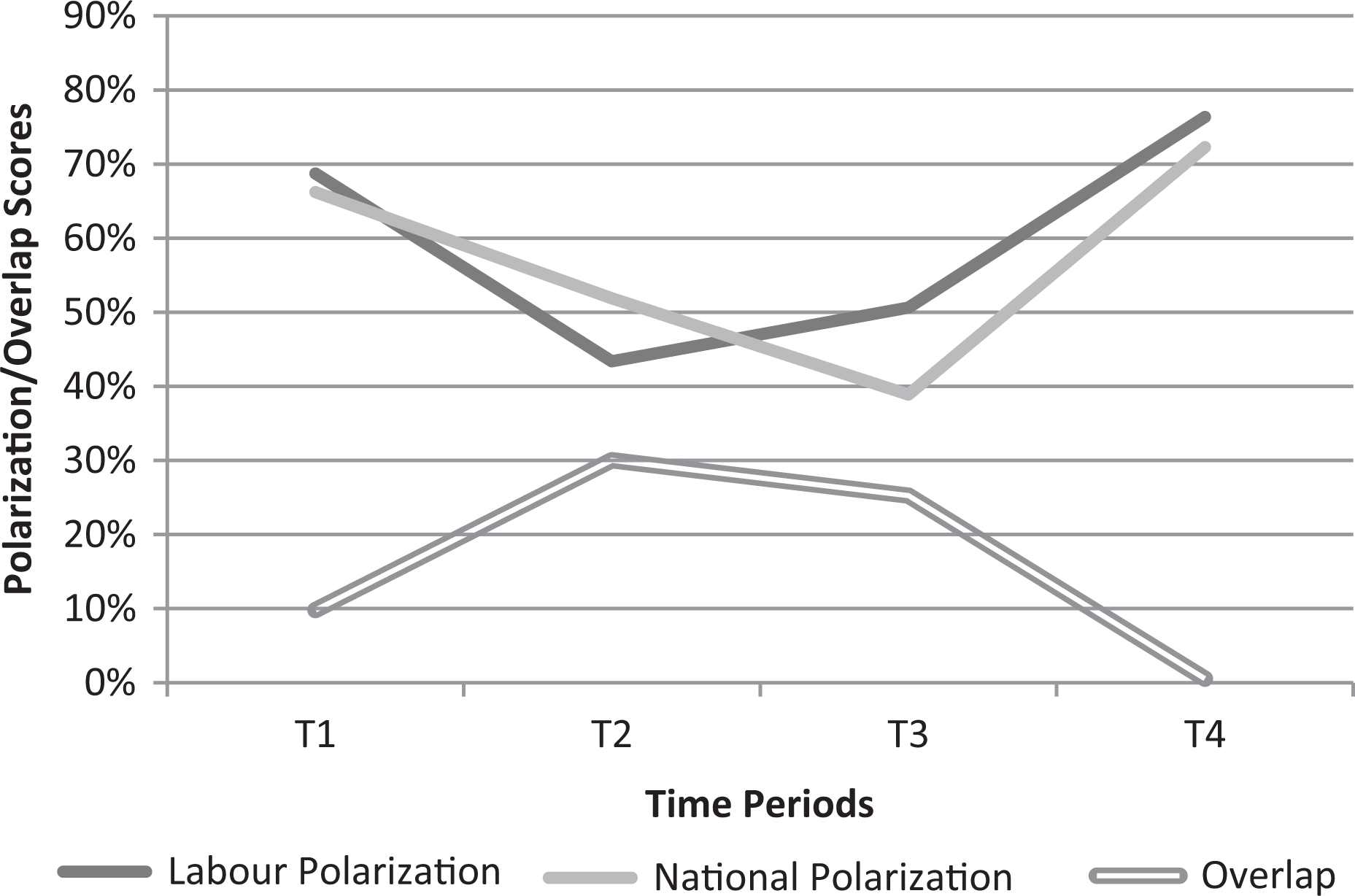
Average polarization: All eight issue areas.
Polarization and overlap scores: average scores of all 8 issue areas by time period.

The mirror image of the polarization scores to overlap scores suggests that two different party-specific welfare frames might exist: one for Labour and one for National. But beyond showing these general trends, it is impossible to tell which main arguments were used, how they were used, or how focused the arguments were from the scores alone. The scores simply show the percentage of speeches by each party that used entirely different arguments, in the case of the polarization score, or the same argument, in the case of the overlap score. In addition, polarized/overlapping arguments in each category for one time period might not be the same for the next.
Competing welfare frames: Labour vs National or government vs opposition
Thus far, the data compiled here suggest two main findings: The frequency of the arguments most used by Labour and National suggests real differences in their view of welfare. Specifically, Labour MPs lamented cuts to welfare and services, and articulated concern for the potential effects of these cutbacks on average New Zealanders. National MPs, however, applauded the welfare changes they were making and assured New Zealanders that the National Party’s measures would support important sectors (like education and health), would protect vulnerable people (like parents, the elderly, and the middle class), and would cut their taxes. Overlap varied significantly over time: in 1979–1984, 30% of all arguments coded in this dataset were used by both parties; in 1995–2000 the overlap was slightly less, 25%, but this is still significant overlap compared to the overlap in 1970–1972 (about 9%) and in 2010–2012 (about 0.5%).
What might explain these dramatic changes in the overlap scores over the four time periods? As previously mentioned, the time periods used – although practical for a future comparative study of cross-country framing data – do not correspond to the time a particular government was in power. As a result, in both T2 and T3 there is a change of government. Specifically, the Labour Party came back into power in 1984. Faced with rising unemployment and decreasing living standards, the Labour government sought to reduce the growing deficit. 17 New Zealand’s National Superannuation program came under review in 1984; the Labour government imposed a surtax of 25 cents per dollar on additional income to superannuitants over NZ $5200 per year. Additionally, the Labour Party sparked a major controversy when it instituted a NZ $1 charge for all prescriptions – except contraceptives, which were paid for entirely by the patient.
Table 4 shows the number of speeches in which the top five opposition arguments each year were used. In 1984, when National was in opposition, none of the top-five arguments used by Labour MPs in 1984 and 2000 is used when the Labour Party was in opposition. The arguments ‘increases support for parents’ and ‘budget makes housing more accessible’ are used in both 1984 and 2000; other arguments are used in only one year. Somewhat expectedly, many of the arguments used by Labour when in power – like ‘increases funding for education’ or ‘budget assists the elderly or sick or disabled’—appear to be promoting the party’s record and achievements. What is more interesting are two specific arguments, namely ‘government spending unsustainable’ and ‘universal pensions should be cut for the rich,’ that are used in 1984. Both ‘government spending unsustainable’(a top-five National argument used in five of the sample years; see Table 5) and the idea that universal pensions should be cut for the rich are arguments that fall way outside the traditional rhetoric used by the Labour Party. As previously mentioned, the most frequently used Labour Party arguments focused on the needs of the poor and middle-class New Zealanders, and the negative effects proposed welfare cutbacks might have on these groups.
Top five most frequently used opposition arguments by year (number of speeches).
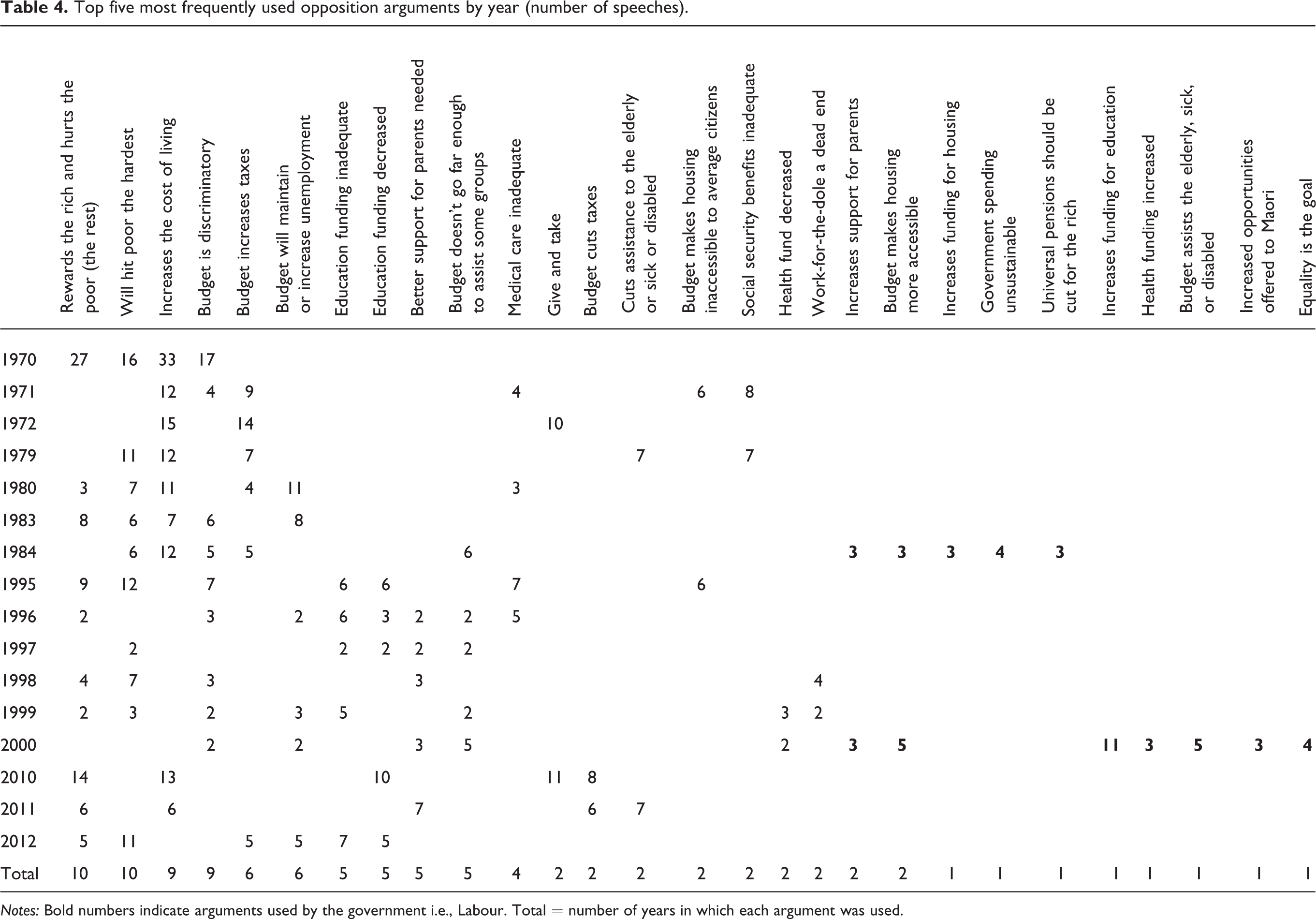
Notes: Bold numbers indicate arguments used by the government i.e., Labour. Total = number of years in which each argument was used.
Top five most frequently used government arguments by year (number of speeches).
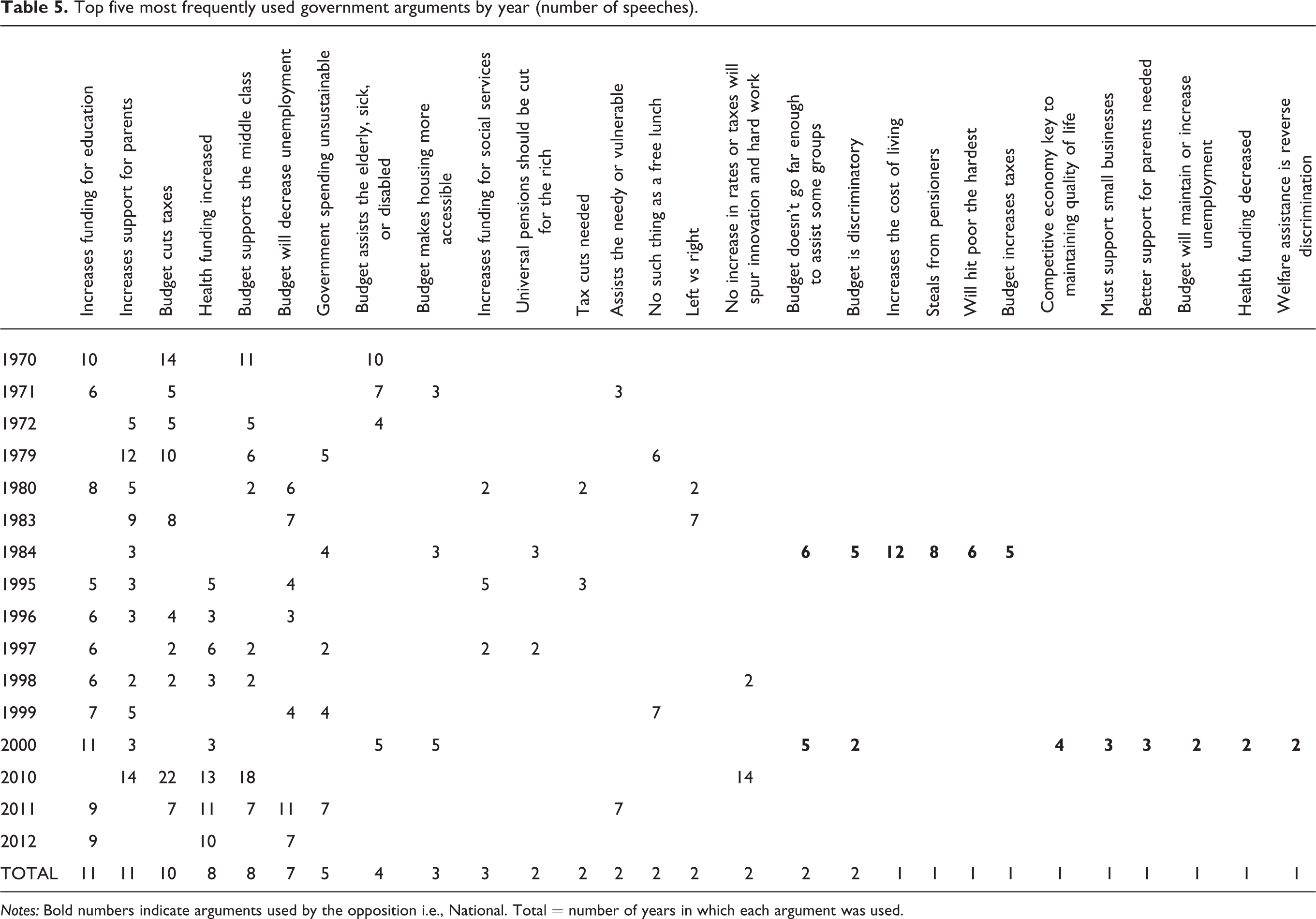
Notes: Bold numbers indicate arguments used by the opposition i.e., National. Total = number of years in which each argument was used.
Similarly, Table 5 shows the number of speeches in which the top five government arguments each year were used. Again, a similar pattern is repeated here as the top five most popular arguments used by National when it was in opposition in 1984 and 2000 were never otherwise used by the National Party. Indeed, National MPs borrowed some of the Labour Party’s most popular arguments like ‘increases the cost of living,’ ‘budget is discriminatory’, and ‘will hit poor the hardest.’ Besides the argument ‘welfare assistance is reverse discrimination,’ which was used in two National speeches when the party was in opposition in 2000, National MPs also dramatically changed their rhetoric. In 2010, 2011, and 2012, National reverted back to their previous ways of talking about welfare reform proposals.
This finer-grained analysis suggests that examining welfare framing defined only by party is an oversimplification of the situation; looking at the arguments used by both parties while in opposition versus in government shows that some of the seemingly party-specific rhetoric falls away. 18 When in opposition, the National Party began making arguments traditionally made by the Labour opposition, and when Labour came to power Labour MPs began making several arguments traditionally made by National when it was in power. 19 Labour, for its part, used several traditionally National arguments while it was in power in 2000: ‘increased funding for hospitals or healthcare,’ ‘increases funding for housing,’ and ‘budget assists the elderly or sick or disabled.’ Note that these arguments are simply a statement of what has been achieved, which is entirely predictable for a party in power.
Conclusion
This article introduced a new framing-based methodology to systematically examine the role of ideology in welfare reform proposals both within and between parties and over time. Using framing as a methodological tool represents a significant improvement over standard approaches to operationalizing ideology as it allows for the detailed study of arguments over time, shedding light on changing intra- and inter-party arguments in the debate over welfare cutbacks.
Using this technique to study arguments in favor of and against welfare reform in New Zealand, the data presented here suggest that in 1984 the two parties swapped discourses: the Labour government strayed from its traditional party position of protecting the poor and vulnerable, while the National opposition used some arguments more often associated with Labour Party principles. In essence, the parties swapped their traditional stances on welfare proposals and adopted arguments more often used by the other party.
Although it is impossible to tell from this analysis whether this swap occurred because the Labour Party was shifting rightward, the data does show that the shifts in messages that occurred in 1984 were not permanent. When the Labour Party returned to power in 2000, Labour MPs did not go back to making the arguments they made in 1984 but instead chose to focus more on equality and ‘rebuilding a fair and sustainable economic order’ (though these arguments are still within the realm of traditional Labour Party politics). Likewise, when National found itself in opposition again in 2000, National MPs did not adopt traditional Labour Party rhetoric and made none of the arguments they had made while in opposition in 1984. But National MPs did step back from the more polarized rhetoric they began to use when they returned to power in 1990. This suggests that the shifts in Labour/National rhetoric that occurred in 1984 and 2000 were not strictly driven by ideology. 20 Ideological positions on welfare thus appear to be more flexible than originally assumed, as they shifted dramatically under certain conditions – a change from government to opposition or vice versa – in the New Zealand case study.
These results also hint at the possibility that framing is strongly influenced by whether a particular party is in government or opposition, and not so much by traditional party positions. This is not to say that traditional ideological positions are entirely defunct – indeed, the National Party reverted back to its customary arguments when it came back into power in 1990 and pushed for even more economic liberalization in subsequent years, while the Labour Party appears to have (at least partially) returned to its more traditional line of argumentation in support of social assistance – but to suggest that operationalizing ideology as simply left vs right cannot capture the complicated nature of the relationship between ideology and policy outcomes. The framing-based methodology presented here is a more effective approach to examining the role of ideology in welfare reform proposals, capturing a much more nuanced picture of welfare retrenchment debates than that revealed by the share of cabinet seats held by political parties, ideology scores, or manifesto data.
Footnotes
Acknowledgements
Many thanks to David Sylvan, Ravi Bhavnani, Jonas Pontusson, Ben Ansell, and Martin Seeleib-Kaiser and the participants in the Politics of Social Policy Research Group at the Department of Social Policy and Intervention, University of Oxford, for their insightful comments on several versions of this article. Thanks go as well to two anonymous reviewers for their detailed critiques of a previous version.
Declaration of Conflicting Interests
The author(s) declared no potential conflicts of interest with respect to the research, authorship, and/or publication of this article.
Funding
The author(s) disclosed receipt of the following financial support for the research, authorship, and/or publication of this article: This research was partially supported by the Swiss National Science Foundation.