







Abstract
This study argues that three recent societal trends have increased parties’ incentives to give election promises in campaigns: the increasing volatility of voters, the professionalization and marketization of politics, and the mediatization of politics. Arguments are empirically tested on the case of Sweden between 1991 and 2010. All promises presented in election manifestos by Swedish parliamentary parties are analyzed, enabling analyses of six elections, nine parties, 44 manifestos and almost 4000 election promises. We find that Swedish parties increased their pledge making considerably during the period, from an average of 46 per manifesto to 149. Specific promises have increased, as have the pledges that are unrelated to other parties’ pledges. Altogether, the results point at an increasingly specific vote choice for voters.
Introduction
From time immemorial, political leaders have sworn to fulfil promises to their people. In the excavation of Pompeii, archaeologists found slogans painted on the walls containing promises from contenders for elective office, illustrating the ageless nature of promises in election campaigns. In more recent political science, we say that parties ‘seek office’ while voters ‘seek policy’ (Downs, 1957). Pledges of future actions form the theoretical starting point in the chain of representation in which voters’ preferences are eventually turned into public policy (Budge, 2001; Mansbridge, 2003; Royed, 1996; Schmitt and Thomassen, 1999).
In theory, the effort by parties to issue promises is seen as a timeless one, carried out in representative democracies regardless of other circumstances in society. In real life, scholars have suggested that parties today in general are less concerned with policy in their competition for power than before, indicating that pledges should have less significance in campaigns (see for example Katz and Mair, 1995). However, empirical studies that specifically identify election pledges in manifestos sometimes find indications, but not explanations, of increasing pledge making by parties in elections (Artés, 2013; Mansergh and Thomson, 2007).
In this article, we discuss parties’ incentives to give pledges in elections. We argue that research on election pledges, together with the broader research on manifesto content, has for a long time lacked discussion of what prompts parties to bind themselves to actions in election manifestos. Since manifesto pledges obviously affect government action (Naurin, 2014; Artés, 2013; Thomson, 2001; Royed, 1996), we need a better understanding of the logic behind the making of these promises.
Our approach is to argue that recent decades have seen fundamental changes in relationships between parties, voters and the media that affect parties’ incentives to make promises; changes that increase party pledge making even more than we have seen historically. We lift forward three societal trends that should affect parties’ incentives to give election promises, trends for which research literature has provided ample pieces of empirical evidence as well as theoretical accounts: the increasing volatility of voters; the professionalization and marketization of politics; and the mediatization of politics. Our main argument is that it is reasonable to expect that authoritative policy proposals in advance of elections should have grown in importance for the parties.
We do not test the causal link between the trends and parties’ pledge making. However, we provide an extensive empirical account by investigating whether our arguments are consistent with parties’ actual pledge making. More specifically, we analyze parties’ pledge making in a stable, democratic, multiparty context, namely Sweden during the period 1991 to 2010. The analyses focus on the frequency of promises, on how specifically promises are expressed, how distinguishable promises of different parties are from each other, as well as which subject areas the promises cover. Studies that specifically consider parties’ pledges have analyzed subsets of promises or particular parties’ promises in chosen contexts. We differ from them in that we examine all promises given in all parliamentary parties’ election manifestos. Furthermore, we cover a long time period compared to most other studies of pledge making in recent decades. Previous studies typically put effort into analyses of fulfillment of pledges, during a limited number of election periods. Our aim to study the making of promises rather than their fulfillment enables us to present an account of the total number of promises made in Swedish parliamentary elections over 20 years, based on material comprising six elections, nine parties, 44 manifestos and almost 4000 election promises.
While previous studies on party pledges have contributed empirical results indicating an increase in pledge making, they have not combined the results with an informed discussion as to why this is the case. Our aim is to contribute an informed and reasoned argument regarding three important developments likely to have an impact on parties’ incentives to make promises. We also wish to provide more extensive analyses of pledge making than previously made in a single context, covering all different parties, types of promises and subject areas.
Background
It is a reasonable assumption that political parties use election promises as strategic devices for reaching goals in different arenas (Sjöblom, 1968; Strömbäck, 2007; Strömbäck and Van Aelst, 2013). There is the internal party arena where promises keep fractions of the party together and specify general ideology; there is the parliamentary arena where they serve as a foundation for future policies as well as a basis for negotiation in coalition-building; and there are the voter arena and media arena where they serve as messages forming part of electoral campaigns, i.e. as communicative devices directed at voters and the news media. 1 Although many systemic conditions such as electoral rules and party systems usually remain fairly stable within countries over time, it is evident that relations between the actors in these different arenas change.
The trends that we argue have relevance for parties’ making of election pledges are found in the voter arena and the media arena. They are intertwined developments and point in the direction of changing modes of communication. The trends we identify are seen at least in the western world, and certainly in a European context of representative democracy and multiparty systems, although with variations in degree and extent of some of the phenomena. Taken together, they have led to the need for parties to reach altogether new audiences, as well as old ones through new means. However, little attention has been given to the possible consequences these trends might have for the actual and specific policy messages the parties direct to voters during election campaigns.
Increasing volatility of voters
We begin with the fact that our time sees increasing volatility of voters. A couple of decades ago, political parties in Western democracies could rest assured that a substantial share of their votes was cast by citizens tied to them by emotional or interest-based identification. Party membership and loyalty has since declined substantially (Dalton and Wattenberg, 2000; Thomassen, 2005). Individuals generally feel less and less part of specific groups in society such as ‘workers’ or ‘farmers’, which in turn affects parties’ possibilities of engaging with groups of people rather than individual voters (Oscarsson and Holmberg, 2013; Popkin, 1991). Issue voting instead of class voting has become more relevant (see for example Aardal and van Wijnen, 2005). Furthermore, as party identification and other group affiliations decrease, voters have fewer incentives to vote for a party simply out of habit (compare Gerber et al., 2003). Voters also change parties between elections more often than before. Moreover, it is known that citizens make later voting decisions, which in turn raises the importance of the final weeks and days of election campaigns. Sweden is one of several clear examples of all these trends (Oscarsson and Holmberg, 2013). Altogether, the developments indicate that citizens are becoming more independent from their representatives and more demanding of political parties. Fewer votes can be taken for granted. Intensifying electoral competition requires greater efforts to gain the votes that some decades ago were given for free. Election promises are tools in these efforts, as they provide clarity to uncertain voters and allow the independent voter to take control over otherwise blurry representative processes by binding the party to certain actions.
Professionalization and marketization of politics
Parallel to the increasing volatility of voters, election campaigns have undergone changes in many respects, both with reference to techniques and channels used and with regard to the scope and aims of the campaigns. Long-term changes to political campaigns have been described as a development from a pre-modern stage, through modern to postmodern campaigns (Blumler and Kavanagh, 1999; Norris, 2000). These changes are characterized by longer, more coordinated and centralized campaign operations. The most significant feature is the process of professionalization of political campaigns, which includes the growing use of political consultants and communication experts (Strömbäck, 2007). Political marketing is another feature often discussed in the campaign literature. The concept stands for a propensity to conduct electoral campaigns with methods taken from product marketing. Lilleker and Lees-Marshment (2005: 6) state that political marketing ‘is concerned with how political organizations such as political parties understand the demands of those they serve or seek support from, determine their behaviour in response to public wants, and communicate them’ (see also Gibson and Römmele, 2009; Norris, 2000; Plasser and Plasser, 2002; Strömbäck, 2007; Strömbäck et al., 2010).
Empirically, the use of political marketing techniques has been associated with an increasing focus on image-making and personal traits of politicians, and less attention to political matters (see for example Blumler and Kavanagh, 1999; Plasser and Plasser, 2002). However, election promises play a role also in a political marketing environment. Scammell (1999) notes that ‘[r]eputation, based on record and credible promises, is the only thing of substance that the party can promote to its voters’.
Furthermore, political marketing is not only about using marketing techniques. Parties adopting a marketing orientation also tend to change their relation to their own policy proposals. There is a readiness to adjust not only the ‘packaging’ but the policies themselves to the demands of the electorate (Lilleker and Lees-Marshment, 2005; Strömbäck, 2007). Although the pace and extent to which marketing orientation has developed vary across countries and parties (see for example Nord, 2006; Tenscher et al., 2012), there is evidence enough for a general trend that should highlight policy formation as a strategic tool in election campaigns. Parties that are more responsive to opinion shifts, and sensitive about their standpoints on issues, are challenged to provide clear-cut, distinguishing messages, in the hope that they grab media attention and make them stand out in public against their competitors.
Mediatization and media logic
The third trend in our focus is mediatization. As a general concept, mediatization refers to a meta-process in which institutions in society become transformed and dependent on the media (Hjarvard, 2008; Mazzoleni and Schulz, 1999). Central to the mediatization concept is the adaptation to certain norms and practices of the media by actors who are seeking public attention. Mediatization of politics assigns a dominant role for media logic in the reporting of politics (Brants and Van Praag, 2006; Brants and Voltmer, 2011; Mazzoleni, 1987; Mazzoleni and Schulz, 1999; Meyer and Hinchman, 2002). This adjustment means that perceived future actions of the news media become integrated in the decision making process of, among others, political parties. Parties plan their communication in anticipation of news selection and news presentation techniques used by the media. Several studies have concluded that media coverage of politics, and in particular election campaigns, has changed over time. Among the findings is an increasing tendency to emphasize politics as game/strategy rather than based on ideology, an increasing focus on easily digested information such as personal traits and/or private lives of politicians, as well as the blurring of news and entertainment (‘infotainment’) (Meyer and Hinchman, 2002. See also Cappella and Jamieson, 1997; Farnsworth and Lichter, 2008; Scammell and Semetko, 2008). Swedish news coverage is no exception, although comparisons in particular with the USA have shown fewer traits associated with media logic, for example lower levels of game frames (Strömbäck, 2008; Strömbäck and Dimitrova, 2011). The latter gives an indication that media logic is not a deterministic, uniform force, but rather has different impacts in different contexts.
Without doubt the abovementioned consequences of media logic are important. However, there are aspects of mediatized political communication that lead us to believe that election promises are put in the foreground by both parties and news media. First, in a general sense, elections and their main actors – parties and top politicians – have a high news value due to their perceived importance, their ‘eliteness’ and their novelty within a familiar framework (see for example Shoemaker and Reese, 1996). Research confirms this picture for the Swedish case, as campaign activities of central political figures are widely reported and politicians are by far the most important sources of news on the election (Asp, 2011; Petersson, 2006). As central components of the campaigns, election pledges constitute typical ‘hard’ news, rendering them high news value (Patterson, 2000). For the news media, election promises form an ideal basis of scrutiny for the fulfillment of their watchdog ideal. Promises from the election campaigns can be evoked when evaluating policy during and after the election terms. The inherently moral aspect of promises also provides a foundation for media narratives of political success and/or failure, often featuring the typecast ‘promise-breaking politician’. Furthermore, among the particular techniques used for creating compelling and interesting news are simplification and polarization (see for example Strömbäck and Esser, 2009). These techniques may work in the direction of more concrete, distinct and tangible standpoints from politicians in the media. For example, an important role for present-day news journalists is as ombudsman or representative of the citizen (see for example Djerf-Pierre, 2000). This role manifests itself in journalists’ demands for clear-cut and unambiguous policy standpoints, something which is supported by previous research on Swedish political broadcast interviews (Esaiasson and Håkansson, 2013). In order to meet such demands of the media, parties are challenged in their strategic communication to cut through with their policies and create interest in what they want to achieve.
Taken together, the literature both on media logic and on marketization suggests that political actors should adopt strategies for entering the radar of the media. There are several reasons to expect election pledges as expressed in election manifestos to be a basis for ‘hitting the news’, and thereby attractive for campaigning parties. The attention-seeking party is likely to advance on several fronts, one of them being the ‘marketplace of standpoints’ where election promises are central elements.
Hypotheses
In this article, we hypothesize that the increased incentives of parties to give promises in electoral campaigns will be visible in three ways in contemporary democracies: promises will have become more frequent, increasingly specific, as well as increasingly distinguishable i.e. distinct from other parties’ promises. The first hypothesis concerns the frequency of promises:
Previous research on parties’ election pledges has shown that some promises are specific enough not to allow the party any room for maneuver when fulfilling them. Other promises leave the party with more than one option of acting (compare Artés, 2013; Thomson et al., 2014). In our second hypothesis we use this finding to articulate our expectation that parties have increased incentives to specify their messages as much as possible, because of increased competition for attention around elections:
Our third hypothesis focuses on the relation between promises from different parties. We expect that the increased incentives for parties to make clear pledges about the future will be visible also in the sense that parties make increasingly distinguishable promises – i.e. promises that either stand in disagreement to other parties’ pledges or are not at all related to other parties’ pledges, the rationale being that parties experience stronger incentives to profile themselves, something which can be done in several ways. Concerning the competitive role of political issues in the campaigns, research on party competition and saliency theory (Green-Pedersen, 2007; Klingemann et al., 1994; see also Mansergh and Thomson, 2007) has shown that parties in general compete by underlining different issues rather than competing on the same issues (Budge, 2001). We expect that hardening electoral competition for ever more volatile voters, stronger striving for media attention and handling of increasingly demanding media actors will force parties to distance themselves from one another even more. We expect an increase in distinguishable promises in two ways, as expressed in the following hypotheses:
The study: Design and selection
Our study is a content analysis of party manifestos from all parliamentary Swedish parties from the six parliamentary elections held in the period 1991 through 2010. The time period captures the trends that we argue affect pledge making: the shifting conditions for political communication such as mediatization and professionalization of election campaigning. Furthermore, Swedish voters are typical in the sense that they vote less out of habit, feel less attached to a political party, decide later what to vote for and split their vote more often between national, regional and local levels (Oscarsson and Holmberg, 2013).
Election manifestos have been chosen as our source of election promises. Manifestos are central to election campaigns, as they form ‘the main linguistic representation of a party’s offering at election time’ (Ormrod and Henneberg, 2009: 191; see also Klingemann et al., 1994; Rölle et al., 2001). Certainly, parties turn to a number of strategies and channels for the proliferation of their messages during campaigns. However, election manifestos have a long history in many countries, and particularly so in Sweden, making them suitable for longitudinal studies. It is also clear that manifestos affect parties’ strategies in other documents and in media appearances in campaigns (Costello and Thomson, 2008; Rose, 1980).
The time frame chosen for the study captures different parliamentary majorities and government types, whereas the election system as such has remained without major changes. Until 1994, a proportional closed list system was in use. Since 1998, voters have been allowed to mark a personal vote, although the change has only had a minor impact on voting behaviour (Oscarsson and Holmberg, 2013). With some exceptions, voters have encountered the same set of main parties in each studied election. During the decades following the Second World War, the Swedish party system was characterized as a stable five party system (the Communist Party, Social Democratic Party, Liberal Party, Center Party and the Conservative Party). In the late 1980s and early 1990s, the Green Party and the Christian Democrats entered parliament. A populist party, New Democracy, was successful in the 1991 election, but did not reenter after the 1994 election. In 2010, the anti-immigration Sweden Democrats entered parliament.
From 2006, party alliances have issued manifestos in addition to the party manifestos. Both individual party manifestos and joint (alliance) manifestos are included in the analysis where applicable, i.e. in 2006 and 2010 for the four-party Alliance for Sweden (Conservatives, Centre, Christian Democrats and Liberals) and in 2010 for the Red Greens (Social Democrats, Left Party and Greens). Conservatives and Social Democrats refrained from individual party manifestos in those years.
The study: Methods and definitions
We analyse the frequency of promises made and their degree of specificity. We also analyse whether promises given by the parties are unique or whether they share content and meaning with other parties. In addition, we code promises for issue area and whether they are directed at change or status quo, expenses or cuts in budgets (see Royed, 1996; Thomson, 2001). By doing so, we are able to control for whether different kinds of pledges increase or decrease more than others during the studied period.
The analysis started by reading the manifestos and singling out all messages about the future. These ‘potential pledges’ (Royed, 1996: 79) are then evaluated according to whether they would be testable had we analyzed fulfilment. The coding thereby follows recent studies on whether parties fulfill election pledges (Mansergh and Thomson, 2007; Royed, 1996; Thomson, 2001; Naurin, 2014; Thomson et al., 2014). A promise is defined as ‘a commitment to carry out some action or to produce some outcome, where an objective estimation can be made as to whether or not the action was indeed taken or the outcome produced’ (Royed, 1996: 79). 2
We measure frequency of promises by counting all promises once. For promises repeated in the text, the most specific expression is included in the dataset. Attention is paid first and foremost to the meaning of the statement, rather than to the choice of words. As in most pledge studies, no restriction was therefore made as to how the promises were expressed, as long as the purpose of the statement was clear. In the words of Royed (1996), the article includes soft (‘we want to’) as well as hard (‘we promise’, ‘we will’) promises.
We measure degree of specificity by distinguishing between promises that bind the party to one course of action and those that leave the party with two or more ways of fulfilling the promise. Thus, specific promises are those where ‘the criteria used to judge the fulfillment of pledges…in principle [are] provided by the writers of election programmes, not by the researcher’ (Thomson, 2001: 180). Vague promises are those which the party can fulfill in two or more ways and where the scholar herself/himself therefore has to decide which actions are relevant to assess (compare Artés, 2013; Thomson et al., 2014).
Examples of specific promises that leave the party with no room for discretion when choosing actions include: ‘a ban on the import of timber from endangered rainforests’ (Left Party, 1991) and ‘[i]n order to improve the situation of families further, while encouraging more people to take the step into work or increase their working hours, we want to introduce a maximum rate of childcare of 700 SEK for the first child with lower fees for the following children’ (Social Democrats, 1998). Examples of vague promises where the party can choose between more than one course of action are: ‘ensure long-term and stable conditions for the Swedish agricultural production’ (Christian Democrats, 1994) and ‘We want to strengthen local and regional municipalities’ power over their own infrastructure’ (Left Party, 2010). 3
To be able to analyze to what extent political parties give different promises, we coded the relationship between the pledges. More specifically, we compared each promise to all the other promises given during the same election campaign. A pledge made by a particular party was classified as being in agreement, in disagreement or unrelated to the pledges made by another party. 4 It is worth noting that each statement is coded as related to another pledge if it contains the same substantive promise, regardless of the exact wording. 5
Results
The three sections of our results report analyses over time of the frequency and specificity of promises, as well as of their relation to other parties’ promises.
An increasing number of promises are given
The hypothesis that political parties have increased their making of election promises (H1) gains strong support in the analyses. The number of promises has clearly risen during the studied period. Figure 1 shows the average number of promises per manifesto during the period 1991–2010.
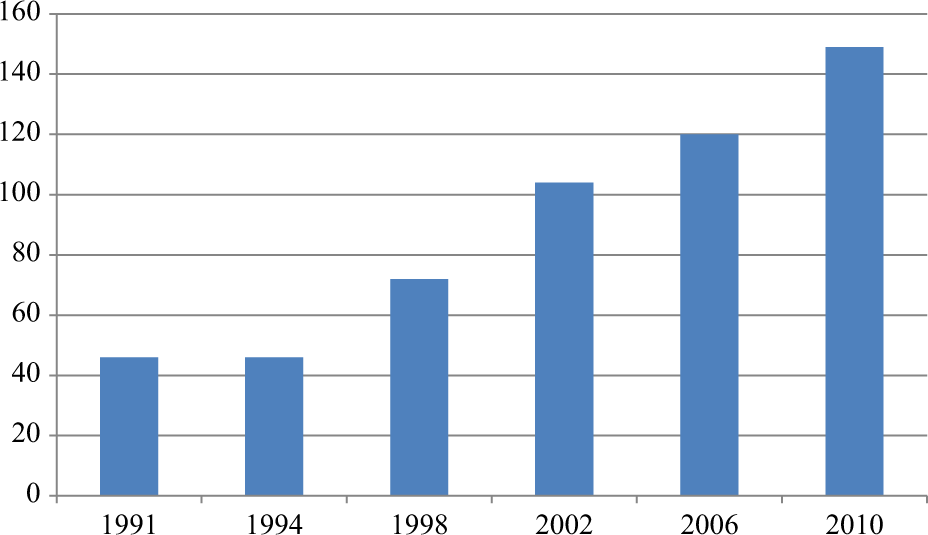
Average number of election promises per manifesto in Swedish parliamentary parties’ election manifestos from the six most recent elections (1991 to 2010).
In 1991 and 1994 the parties gave on average 46 promises in their election manifestos. From 1998 to 2010 the average numbers were 72 (1998), 104 (2002), 120 (2006) and 149 (2010). Hence, the average has tripled between 1994 and 2010. Furthermore, the trend is visible in all studied parties. Table 1 presents the detailed development for the parties during the different elections.
Number of pledges made in Swedish parliamentary parties’ election manifestos between 1991 and 2010.
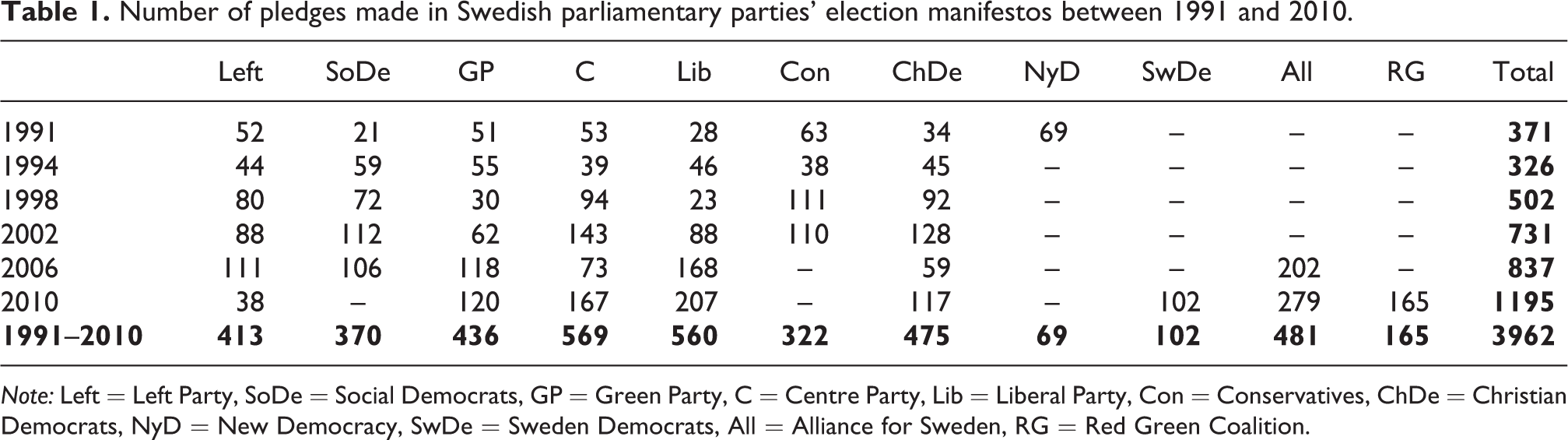
Note: Left = Left Party, SoDe = Social Democrats, GP = Green Party, C = Centre Party, Lib = Liberal Party, Con = Conservatives, ChDe = Christian Democrats, NyD = New Democracy, SwDe = Sweden Democrats, All = Alliance for Sweden, RG = Red Green Coalition.
Table 1 shows that all parties share the general trend of increasing pledge making during the studied period. The Social Democrats, for example, increased their pledge making in their manifestos from 21 in 1991 to 165 in the joint election manifesto they issued with the Greens and the Left Party in 2010 (‘Red Greens’, or ‘RG’ in the table).
The table also shows that all parties have occasional drops in one or two of the studied election periods. In this sense, none of the parties shows an unbroken trend. The Green Party made fewer promises in 1998 compared to 1994 (30 vs 55). The Conservatives made 63 promises in 1991, but only 38 in 1994. Also the Centre Party made fewer promises in 1994 compared to 1991 (39 vs 53). Table 1 also shows that in 2010 the Left Party had a noteworthy drop in the making of promises in their individual manifesto (from 111 in 2006 to 38 in 2010). At the time, the Left Party issued a joint election manifesto together with the Green Party and the Social Democrats that included 165 promises. Taken together, the pledge making of the Left Party (and the Greens and the Social Democrats) increased substantially also between 2006 and 2010. The Centre Party and the Christian Democrats made fewer promises in their individual manifestos in 2006 as compared to 2002 (73 vs 143 and 59 vs 128). However, the Alliance for Sweden (the coalition that included the Centre Party, The Liberal Party, the Conservatives and the Christian Democrats) included 202 promises in its joint election manifesto in 2006. All in all, pledge making increased for the four center-right wing parties between 2002 and 2006. In 2010, when the four parties again presented a joint election manifesto, promise making reached an all-time high for all four center-right parties.
Table 1 also gives an illustration of how many promises the Swedish voters would need to consider had they wanted to evaluate all promises presented by parliamentary parties. During the elections of 1991 and 1994, the Swedish voter had 371 and 326 promises respectively to evaluate. In 2010, the same number was 1195. A pertinent question is whether the large amount of promises is relevant for the voters. We do not have measures of whether voters in each election called for the promises that the parties made. We share this lack of possibility to compare voters’ specific policy preferences and parties’ pledge making with the other election pledge studies (for a discussion see Naurin, 2011; Thomson, 2011). However, we can test whether the observed increase in promises is a consequence of parties resorting to making more pledges in less salient issue areas. In Figure 2, we control for salience by comparing frequency of promises for the four issues of highest relevance to voters’ party choice in each election to the frequency for all promises. This gives us a measure of whether the pledge making is reasonably consistent with what was seen as important at the time of the election.
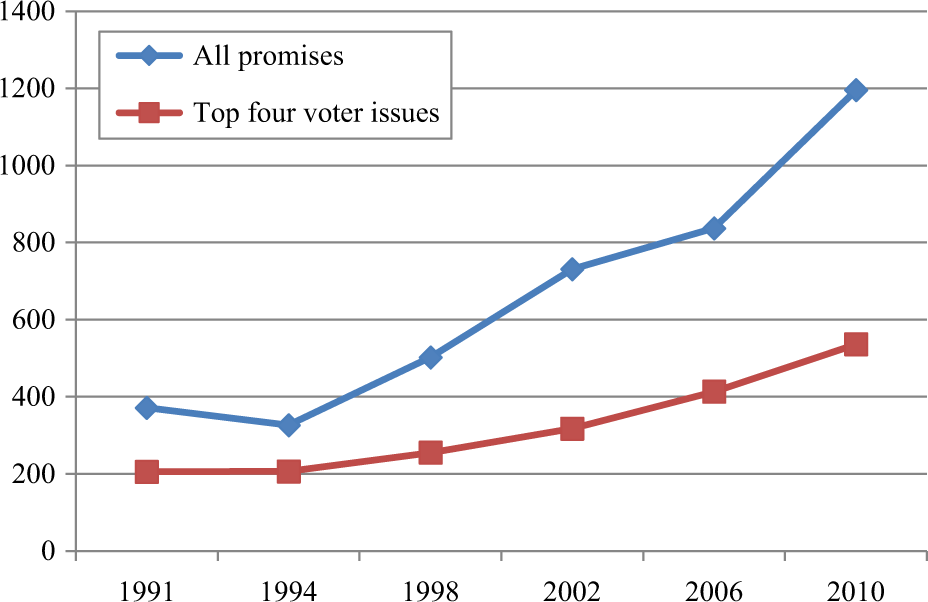
Promises made within the four most important issues for voters’ party choice compared to all promises (absolute numbers).
Figure 2 shows an increase for the most salient issues, although the curve is not as steep as the general one (an increase by 2.6 times between 1991 and 2010 compared to 3.2). This indicates that manifestos give an increasing amount of information about policy intentions in central issue areas, notwithstanding the fact that we also see more promises concerning less salient issues. When we compare voters’ ranking of issues and frequency of promises in the same issue areas, the image is strengthened. The rank order correlation for 14 issue areas varies between 0.55 (1991) and 0.85 (1994) for the studied period, and shows no trend over time. Taken together, with the caveat that these analyses measure broad areas rather than specific suggestions, there is no support in our analyses for the argument that the increase in promises made by the parties has made promises less relevant to voters.
Another possibility is that parties increasingly make promises that are easier to fulfill. One way of testing this is to make use of previous studies’ results which show that promises to keep the status quo or to review issues are easier to fulfill than promises to change the current state of affairs (Mansergh and Thomson, 2007; Royed, 1996). Do parties give fewer ‘change pledges’ as they increase their pledge making? In Figure 3, we separate out promises which call for changes from those pledging to maintain status quo or to just review or investigate possibilities for future policies.
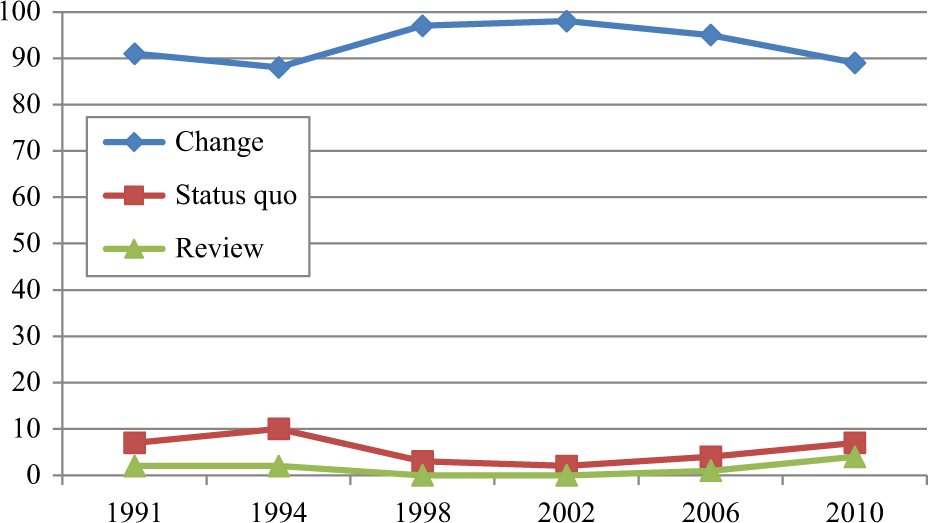
Promises aimed at change, preserving status quo and the review of issues (percent of all promises).
From Figure 3 it is clear that an overwhelming majority of promises express intentions to change things (e.g. ‘abolish the property tax’) rather than to preserve status quo (e.g. ‘we do not accept further privatization of our health care’) or to review (e.g. ‘we will investigate the possibility to allow…’). We also see that although the share of status quo and review promises has risen in recent elections, their level is similar to that of the early 1990s.
More specific promises
Our second hypothesis (H2) stipulated that the development in the last couple of decades has led parties to express increasingly specific election promises. Figure 4 shows the difference between the increase in specific promises and the increase in vague promises.
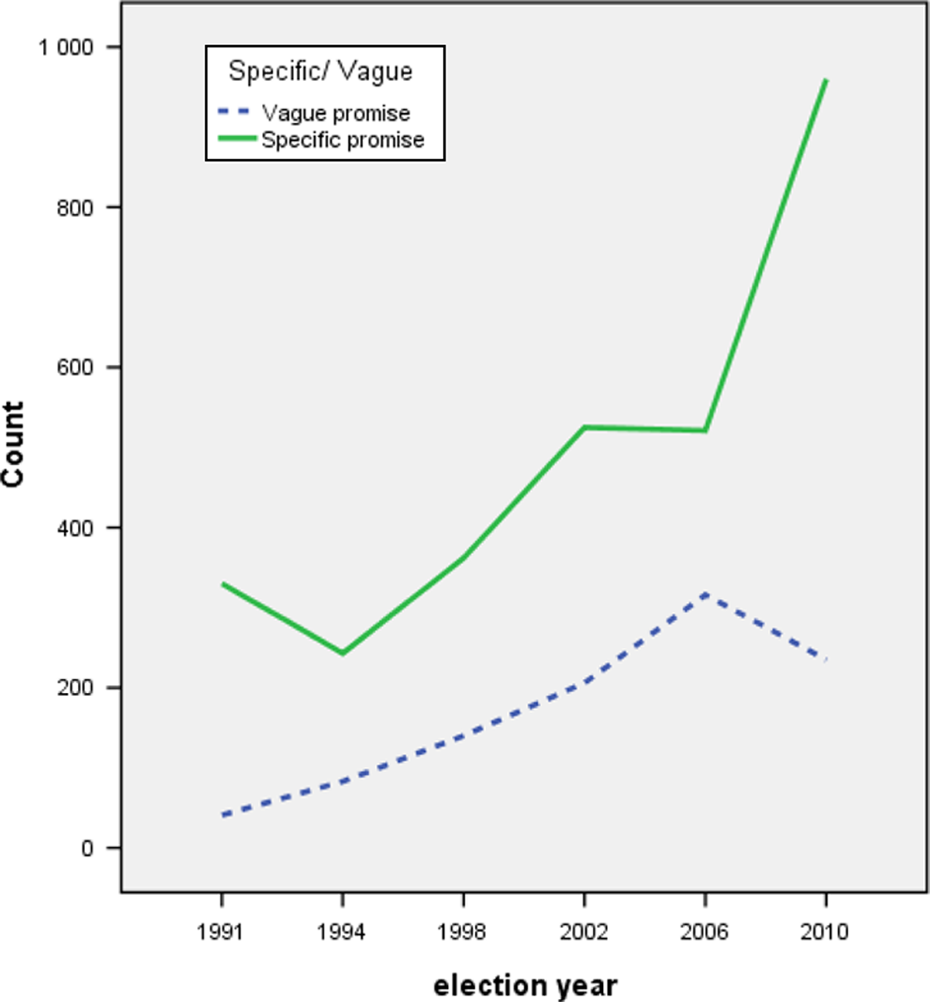
Frequency of specific and vague promises in Swedish election manifestos 1991–2010 (absolute numbers).
To begin with, Figure 4 illustrates that specific promises are more common than vague promises during all studied periods. A majority of the promises are so specific that the party ties itself to one and only one way of fulfilling the pledge. When focusing on the relative numbers, the growth of vague promises has been more rapid than that of specific ones. However, in absolute numbers the vague promises in the party manifestos have increased from 41 in 1991 to 235 in 2010, a rise by 194, while the specific promises have risen by no less than 630, from 330 to 960. Table 2 illustrates the occurrences of specific promises as percentage of all promises, by year and parties.
Specific promises as percentages of all promises, by election year and party.
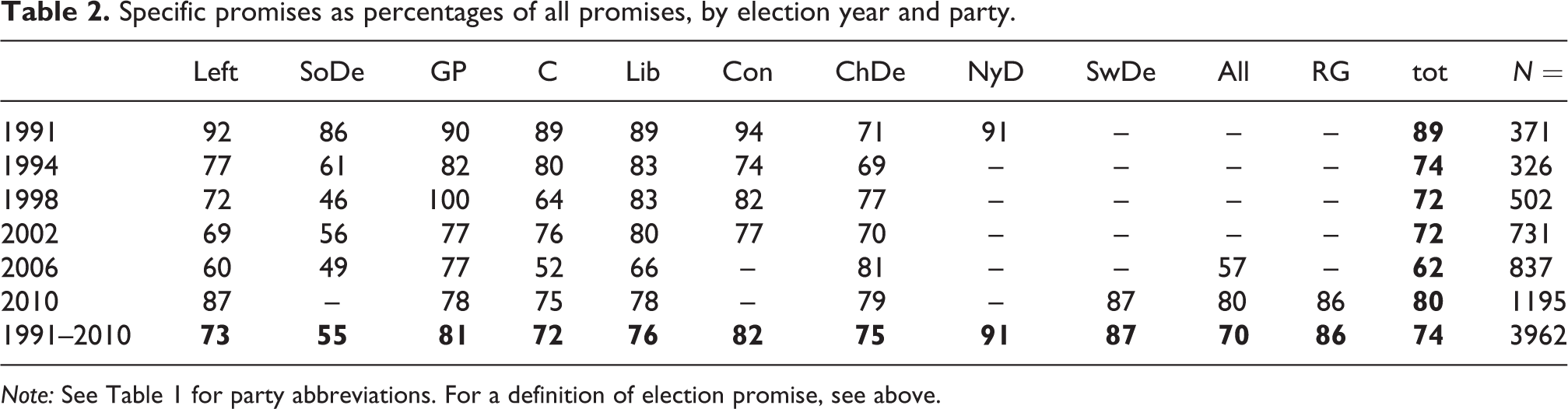
Note: See Table 1 for party abbreviations. For a definition of election promise, see above.
The detailed analysis in Table 2 shows that for all parties the specific promises are more frequent than the vague ones, although some parties consistently deviate by showing lower (Social Democrats) or higher (Greens) than average percentage for the specific promises. The table illustrates that the relative increase of vague promises has been more rapid than the relative increase of specific promises. Still, the hypothesis (H2) that parties have increased their production of specific promises gets support.
Parties as copycats or producers of unique pledges?
In addition to frequency and specificity of promises, we also wish to know whether the growing numbers of pledges made by the parties are unique in the sense that they express commitments that other parties do not express. In hypotheses H3a and H3b we expected parties to distinguish themselves from other parties by presenting unique promises and promises that contradict other parties’ promises. Figure 5 and Table 3 help us draw conclusions about to what extent parties give distinguishable promises.
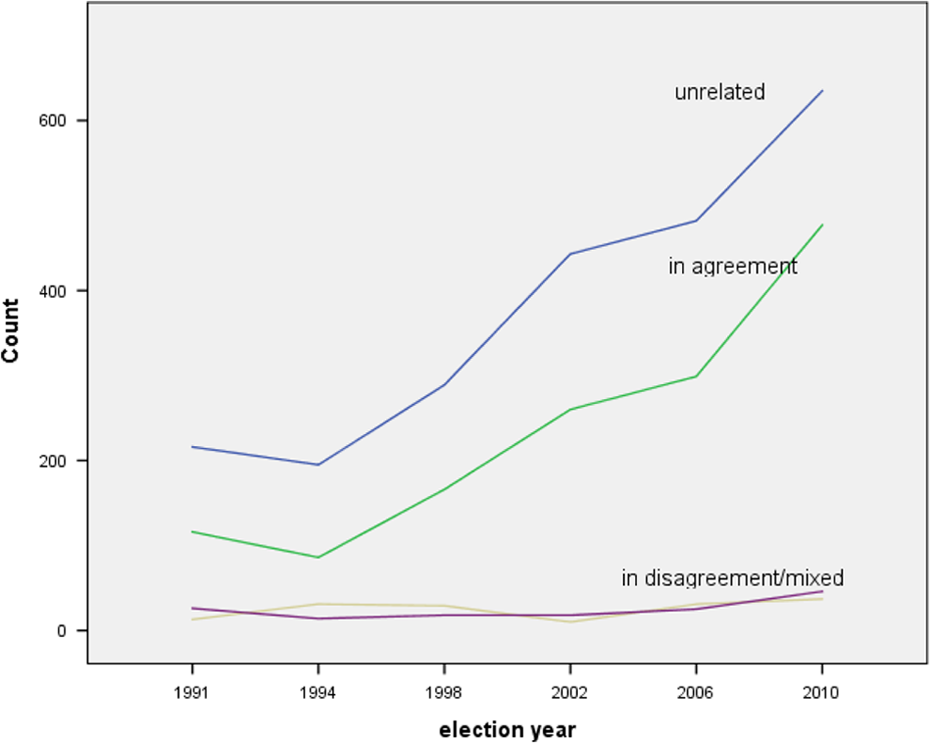
Frequency of promises related/unrelated to other parties’ promises (absolute numbers).
Unrelated promises as percentage of all promises, by party and year.
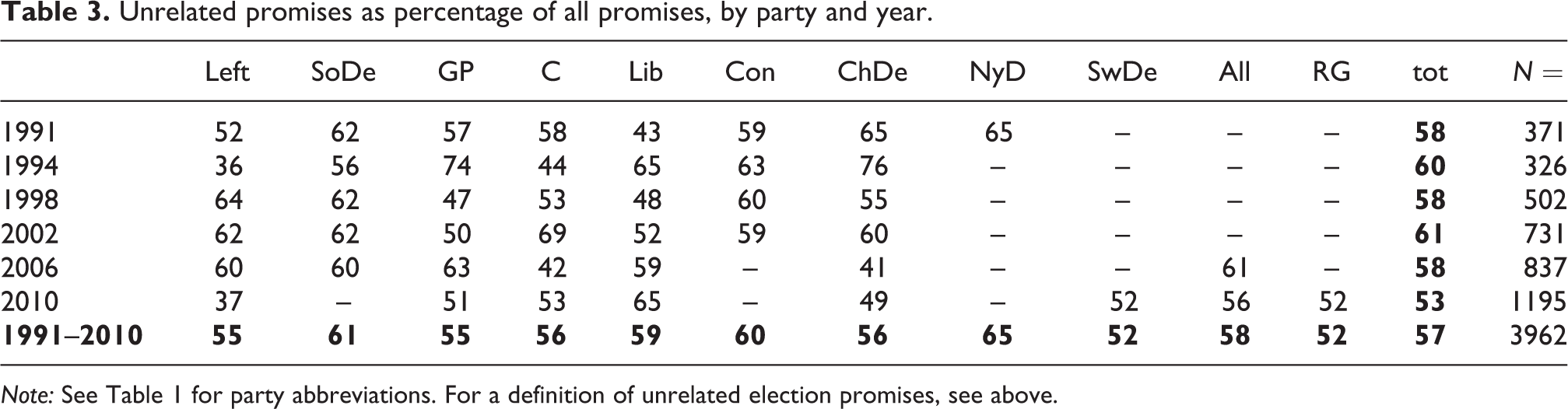
Note: See Table 1 for party abbreviations. For a definition of unrelated election promises, see above.
Figure 5 shows a clear tendency towards more distinguishable promises as ever more promises unrelated to those of other parties are found in the manifestos. These unrelated promises and those that are in agreement with pledges from other parties have increased more or less proportionally over the years. This result supports the assumptions expressed in H3a. The number of pledges ‘in disagreement’ with other parties’ proposals (H3b) have not grown in numbers, however. Parties tend to make their election pledges unique not by taking up competition against opponents by adversarial promises but by committing themselves to policy measures for which other parties do not make pledges at all.
As shown in Table 3 there is little variation between parties, although for individual parties the share of unrelated promises can differ substantially between two elections. The analyses reported in Table 3 indicate that the greater number of pledges has not created a false diversity. The results do not support a conclusion that parties are copycats repeating the same promises to voters. More than half of the promises (57 percent) are not related to any of the other promises made in the same election campaign. Thirty-five percent are in agreement with one or more of the promises given by the other parties. With this said, only 4 percent are in disagreement, i.e. contradicting other parties’ promises, and another 4 percent show both agreement and disagreement with other parties (see Figure 5).
Conclusions
This article has argued that recent developments in modes of communication between voters, parties and media have increased parties’ incentives to make pledges in election campaigns. With the help of comprehensive content analyses of all promises in all Swedish parliamentary parties’ election manifestos from 1991 to 2010, we have presented analyses of around 4000 election promises. In our study we can confirm our assumptions that manifestos contain considerably more promises than two decades ago. And although the share of vague promises, in which the course toward fulfilment is not obvious, has risen more, it is clear that the voter who reads party manifestos in 2010 encounters three times as many specific promises than a reader of a similar manifesto in 1991.
When giving focus to exact election pledges as we do, parties do not appear to become increasingly similar or difficult to tell apart. They instead appear as distinct policy bearers who provide voters with clear cut choices in elections. The development has in this sense been beneficial for the real choice the voter should have according to the ideal models of democracy. Such an interpretation is further underlined by the fact that a clear majority of the promises the parties issue in their manifestos are unique in the sense that they are not identical to pledges from other parties competing in the same election. The increase in promises has thus not happened at the expense of a real choice. We have also seen that most pledges promise change, rather than preserving the status quo or merely reviewing possibilities for change.
However, being faced with many pledges which are neither contested by other parties nor related in any way to other promises may be a disadvantage for voters trying to orient themselves in the election campaign. Moreover, while increasing voters’ choice on Election Day, the great amount of pledges from parties indicates that representative democratic theories are unrealistic in their demands that voters should compare their own views to parties’ policy proposals. Even though having plentiful election promises, in theory, facilitates voter choice, the sheer number of promises given in the manifesto makes the task of voters to make an informed choice an overwhelming one. It is not reasonable to expect voters to take into account all promises given by parties that later enter Parliament. The conclusion we draw from this is that we need tools to understand which promises are most relevant to voters’ interests.
The results may also form the basis for further research on party competition and strategies. The finding that parties increasingly ‘talk past each other’ (in the words of Mansergh and Thomson, 2007: 324), i.e. distance themselves from competitors whose promises are unrelated and thus neither opposed nor in agreement with them, supports previous research results on increasing issue competition among parties (see Klingemann et al., 1994; Mair et al., 2004).
The fact that election pledges can be counted in hundreds, or even thousands, in a single election campaign may seem surprising. Still, in an international comparison the numbers do not seem high. Previous studies have indicated that parties in other systems give about the same or even more promises than Swedish parties do (see for example Artés, 2013; Kostadinova, 2013; Mansergh and Thomson, 2007). However, future research needs to put more emphasis on making coding of election promises comparable across contexts (compare Thomson et al., 2014).
Our argument that election promises increase over time rests on the assumption that broader changes concerning politics and the media have facilitated this development. Although the question of the exact status and role that election promises have in this social context is beyond the scope of this study, our results indicate that in a time of ever-growing competition for media and voter attention, political parties find it worthwhile to produce more and increasingly detailed commitments about the future. The development is hardly haphazard, but rather forms part of parties’ strategic considerations.
Footnotes
Acknowledgements
This article has benefited from collaborations with Henrik Oscarsson. Christian Björkdahl, Daniel Kihlström, Anna Holmqvist and Björn Werner have contributed research assistance in the project. The authors are also indebted to scholars participating in the workshops of the Comparative Party Pledges Group, especially Terry Royed and Robert Thomson. Remaining errors are our own.
Declaration of Conflicting Interests
The author(s) declared no potential conflicts of interest with respect to the research, authorship, and/or publication of this article.
Funding
The author(s) disclosed receipt of the following financial support for the research, authorship, and/or publication of this article: This research received valuable funding from the Swedish Research Council (grant no 421-2007-7276) and Forte Marie Curie International Postdoc Fellowship Programme.
Notes
Both authors contributed equally to this article.