







Abstract
We analyze elite-level issue dynamics of culture war issues in the US from 1971 to 2008 to compare and contrast three theories of issue change: issue evolution, conflict extension, and ideological polarization. Previous studies often conflate these perspectives by only focusing on increased partisanship as evidence of issue change. We argue that these theories differ on a key aspect of issue conflict: dimensionality, that is, the relationship between political conflict on the issue in question and conflict on other issues. We analyze changes in the dimensionality of roll call voting in the US House on the environment, women’s rights, gun control, abortion, and immigration to present a more comprehensive view of issue dynamics. Our results suggest that these perspectives need further clarification and can complement one another. In particular, considering degrees of an issue evolution is beneficial. Although most issues became more partisan as they were simply absorbed into existing partisan cleavages, which is not consistent with some descriptions of an evolution, the more prominent culture war issues, such as abortion and gun control, showed more distinctive and prominent characteristics.
One of the most significant changes in American politics since the 1970s is the increased polarization and partisanship of political elites. Poole and Rosenthal (2007) and Theriault (2008) analyze the divergence on the main liberal–conservative ideological dimension (see also Hetherington, 2009). Other researchers have looked within this broad ideological trend by studying party changes on individual issues, such as civil rights (Carmines and Stimson, 1989), women’s rights (Wolbrecht, 2000, 2002), the environment (Lindaman and Haider-Markel, 2002), gun control (Lindaman and Haider-Markel, 2002), and abortion (Adams, 1997). Some observers describe the increased partisanship on new issues as signaling the rise of a culture war, which stresses the increased salience of moral values, relative to traditional economic values (e.g. Frank, 2004; Hunter, 1991).
In this paper, we clarify the nature of elite polarization (roll call voting of members of Congress) on specific issues, some of which are considered culture war issues, in order to develop a more comprehensive view of issue change. Previous works on issue dynamics provide an incomplete picture because they only track changes in the degree of polarization or partisanship on the issue, e.g. the difference in preferences (roll call voting) on an issue between the average Democrat and the average Republican. Such a measure, however, only illustrates one aspect of change.
Our paper places increased partisanship on a particular issue into perspective by observing how conflict on that issue changes in relation to conflict on other issues, that is, the dimensionality of the issue. If two issues are on the same underlying dimension, then legislator preferences on one issue, which predicts voting on that issue, also predicts voting on the other issue. If these issues are instead on different (orthogonal) dimensions, then legislator preferences between the two issues are not correlated: conflict on one issue does not help explain conflict on the other issue.
By focusing on changes in issue dimensionality, we highlight similarities and differences between various theoretical perspectives of issue change: issue evolution (Carmines and Stimson, 1989), ideological polarization (McCarty et al., 2006; Poole and Rosenthal, 2007), and conflict extension (Layman and Carsey, 2002). 1 Distinguishing between these theories based on their claims on issue dimensionality is important because the consequences and significance of an issue change can vary vastly. What we call the “strong version” of issue evolution leads to a transformation of party conflict. Rather than reinforce the status quo, a cross-cutting issue rotates politics onto a new dimension, such as racial politics during the civil rights era or social and moral (culture war) values, such as abortion policy, during the 1990s. In contrast, according to the party polarization and conflict extension literatures, more issues have become ideologically contentious over the past few decades, falling in line with status quo and existing party conflict. McCarty, Poole, and Rosenthal highlight the stark difference between these two perspectives in writing, “For Carmines and Stimson [issue evolution], American politics has become the politics of race. We are suggesting that racial politics has become more like the rest of politics” (McCarty et al., 2006: 52). 2
The purpose of this paper is both theoretical and empirical. We first clarify the theoretical connections across these three perspectives of issue change. We then analyze roll-call voting in the US House from 1971 to 2008 on issues that have been argued in the literature to be examples of an issue evolution: the environment (Lindaman and Haider-Markel, 2002; Shipan and Lowry, 2001), gun control (Lindaman and Haider-Markel, 2002), abortion (Adams, 1997), and women’s rights (Wolbrecht, 2002). 3 These works already demonstrate elite polarization on each of these issues. We extend their findings by observing how partisanship tracks with changes in dimensionality. We additionally consider the recently salient issue of immigration, which some view as part of the contemporary culture war.
Our empirical analysis suggests that these competing theories can complement one another. In particular, considering degrees of an issue evolution enables us to rank the issues in terms of the significance of an issue change. We also reconcile contradictory accounts of issue conflict since the 1970s. Some observers stress the increased presence of a culture war, which has introduced newly divisive rhetoric into the political debate, challenging traditional, economic political arguments and old lines of division. Meanwhile, other researchers instead note the increasing partisanship and concurrent drop in the influence of cross-cutting cultural divisions during that same time period. We show how both accounts are to some extent true, depending on the issue.
1 Theories of issue change
A few theories of issue change have been asserted in the literature. Most of the them have some element of an elite–mass linkage, whereby the public responds to the increased inter-party differences of elites. 4 In this regard, these perspectives are actually very similar. 5 But given our paper’s focus on the characteristics party conflict over issues, our comparisons only focus on their claims on the nature of elite behavior and issue dimensionality.
1.1 Strong issue evolution
In many published works, proponents of the issue evolution perspective make a very specific claim on the nature of partisan change. At the heart of the theory is the introduction of a cross-cutting issue that alters the existing partisan cleavage. Stressing the notion party realignment, Carmines and Stimson write: “But occasionally issues rise from partisan obscurity and become so contentious, so partisan, and so long lasting that they come to define the party system in which they arise, to transform the grounds of debate which were their origin. This joint transformation of issues and party systems, which we call issue evolution, is realignment in the ordinary English usage of that term.” [emphasis added] (Carmines and Stimson, 1986: 901)
6
“[Issue evolutions] do not reinforce the existing party alignment. Instead, they cut across the direct line of evolutionary development. They emerge from the old environment, but once having emerged they introduce fundamental tensions into the party system and are inconsistent with the continued stability of old patterns.” [emphasis added] (Carmines, 1991:74)
Previous research, however, does not appropriately assess such changes to partisan cleavages and instead only base evidence on comparisons of voting scores (e.g. party unity) on a particular issue over time. 8 Showing an increase in partisan differences on an issue, however, falls short of conclusively showing a strong issue evolution. One cannot determine, for example, whether an evolution has occurred on abortion by simply observing votes on abortion. One needs to also assess how voting on abortion changes in relation to voting on other issues, in particular issues related to the party cleavage that dominated before the conjectured evolution. Does conflict on abortion coalesce onto the pre-existing dominant dimension, or are voting patterns on abortion distinct, i.e. is the issue on a separate dimension? Answering this question about its dimensionality is needed to determine whether a strong evolution has occurred.
To be clear and fair, even the strong issue evolution perspective does not necessarily call for a complete displacement of the originally dominant dimension. Carmines and Stimson (1989) give considerable thought to the similarities between issue evolution and realignment (see also Carmines and Wagner, 2006), and they note that issue evolution is “a considerably more subtle phenomenon” compared with the realignments during the Civil War and the New Deal (Carmines and Stimson, 1989: 20). We account for this possibility in our analysis.
1.2 Weak issue evolution
We believe that a second version of issue evolution has been asserted in the literature. The “weak” version of issue evolution lacks the dimensionality requirement. All that is required is increased partisanship on an issue. This weaker view is what Stimson (2004) and numerous applications (e.g. Adams, 1997; Wolbrecht, 2000) of issue evolution adhere to, albeit at times inconsistently, which we point out below. 9 These studies de-emphasize the earlier claims on dimensionality and instead focus on the elite–mass linkage.
We find only one instance (to the best of the authors’ knowledge) of an issue evolution study explicitly theorizing this weaker version of issue change. In his updated discussion of the topic, Stimson writes: “We know that a two-party system tends to create a single issue division that is stable over time, that it generates new issues as a predictable response to the needs of otherwise losing parties to shake up the system, and that these new issues gradually become incorporated into the old issue configuration with the passage of time.” [emphasis added] (Stimson, 2004: 69)
Although applications of the issue evolution perspective show evidence in support of the weak version, they still have tended to use the language of the strong version (see, for instance, Adams, 1997: 719). As a specific example, Wolbrecht (2000) conflates the two versions in her analysis of women’s rights. In parts, Wolbrecht argues for the strong version, at one point contending, “polarization over women’s rights has emerged as one of the most readily identifiable, if not defining, distinctions between the parties” (emphasis added, Wolbrecht, 2000: 4 ). Her theoretical discussion also draws heavily from the classical realignment literature and views issue evolution as directly extending that literature (Wolbrecht, 2000: 111–115). At the same time, Wolbrecht alludes to the weak version in her theoretical discussion, which is based on the one-dimensional Downsian model (Wolbrecht, 2000: 108–111). Any discussion of realignment (strong version), however, should utilize a multi-dimensional model (e.g. Miller and Schofield, 2003). This one-dimensional focus then contributes to her empirical approach, which then only supports the weak version by showing that “[w]omen’s rights issues took on a sharp dimensionality, mapping onto the left–right political spectrum” (Wolbrecht, 2000: 12).
The difference between the strong and weak versions puts into perspective the substantive significance of issue change. Wolbrecht claims that women’s rights is now perhaps the defining distinction between the parties. The problem with this statement is that one could pick nearly any issue today and claim that it is a defining distinction between the parties, since the parties are polarized on nearly all issues. Based simply on tracking partisanship on issues, which is what these studies on issue evolution studies do, one would have difficulty in judging whether women’s rights, the environment, abortion, immigration, tax policy, or gun control is better or worse at distinguishing between the parties and defining party politics, since all of these issues have become more partisan. 10
1.3 Ideological polarization and conflict extension
A third perspective is that supposed issue evolutions were simply instances of increased issue ideological consistency across issues. Conflict across disparate issues is increasingly explained by a common dimension, as the parties have incorporated more issues into the existing major party cleavage: Democrats take one side and the Republicans take the other side. Poole and Rosenthal (2007) and McCarty et al. (2006) take this view, which we refer to as ideological polarization. 11 These authors show that legislative roll call voting became increasingly one-dimensional and ideological polarization between the parties increased during the 20th century.
A fourth perspective, conflict extension, explicates the general patterns noted by Poole and Rosenthal in more detail (Layman and Carsey, 2002; Layman et al., 2010). This theory assesses movement in specific issue areas, while also studying the response of the mass public. Although the unidimensional argument of ideological polarization of Poole and Rosenthal differs from the multidimensional conflict extension perspective, that difference is somewhat semantic, at least for our focus. Layman et al. (2010) treat each issue area (social welfare, racial, and cultural) as its own separate issue dimension, but in the process of conflict extension, the parties’ positions across issue areas become increasingly correlated. That is, conflict extension contributes to greater ideological consistency within each party across more issues, which consequently leads to the reduction of politics to a single liberal–conservative dimension (Layman et al., 2010: 328; Carmines et al., 2012: 5). 12
1.4 Focusing on dimensionality
There are two primary aspects on which we can make comparisons between theories of elite issue change. One is the increased partisan division and polarization on issues. The second is the change issue dimensionality: how conflict on the issue in question relates to conflict on other issues. If two issues are on the same dimension, then conflict between these issues replicate one another, i.e. preferences across issues are correlated. If they are on different dimensions, then voting coalitions will differ, i.e. preferences on one issue do not predict preferences on a separate issue.
All four perspectives agree that elite polarization is evidence of issue change. The difference lies in the claims regarding dimensionality. The odd perspective out in this regard is strong issue evolution, which posits a realigning quality of evolving issues (see Online Appendix A for an illustration of the competing claims on dimensionality). 13 Does an issue increasingly reflect divisions that are common on other issues as it develops, or does conflict coalesce along different lines. For instance, did the emergence of culture war issues, which gained prominence during the time period we study, add something new to party conflict, or did they merely reinforce the status quo of party conflict? Asking these questions can help gauge the “significance” of an issue change or how closely a change approximates a strong evolution.
We contribute to the literature by using dimensionality as an additional metric that can distinguish between issues in the significance of their evolutions. Doing so can help identify the issues that truly have the potential to transform party politics, if not permanently then at least temporarily. Our empirical results show variation in the extent to which issues satisfy the dimensionality condition for a strong evolution, which suggests the usefulness of considering degrees of an issue evolution.
2 Analysis
We analyze changes over time in the dimensionality of roll call voting on the environment, gun control, abortion, women’s rights, and immigration. Our data set of roll call voting in the US House spans the 92nd to 110th Congresses (1971–2008), which is the timeframe of the supposed issue evolutions. By analyzing roll call votes, we are of course limiting ourselves to observed conflict on issues that successfully make it onto the legislative agenda. Observing these votes (a byproduct of whatever “agenda-setting powers” the parties may have) is not problematic for our purposes. In fact, observing the votes that do make it to the House floor is precisely what we should analyze to assess elite issue change, since issue change relates to the parties’ use of agenda control. We give further discussion of agenda control later in our paper.
We use first- and second-dimension DW-NOMINATE scores (henceforth, “NOMINATE”) to place each House member in a two-dimensional policy space, which have the commonly accepted interpretation that the first dimension captures government intervention in the economy, and the second dimension tends to capture regional or social conflict, oftentimes questions on race (Poole and Rosenthal, 2007). Each dimension score runs from −1 to 1 (liberal to conservative). Implicit in our analysis is the assumption that there was not a significant shift in the content of the first-dimension NOMINATE during this time period, which has been substantiated in earlier work (e.g. McCarty et al., 2006), as well as in our analysis that uses taxation and budget as a baseline. Lastly, our analysis requires a determination of which roll-call votes deal with each policy area. We use the Public Institutions and Public Choice (PIPC) House Roll Call Database to make these determinations. 14
2.1 Assessing dimensionality: Using and interpreting NOMINATE
Our empirical approach utilizes NOMINATE scores to analyze issue dimensionality.
15
These scores allow us to gauge dimensionality in the following way. First-dimensional: If voting on an issue is explained by existing partisan cleavages, then first-dimension NOMINATE scores largely predict voting behavior on that issue. Cross-cutting: Second-dimension NOMINATE scores predict voting on that issue. There can be variation in the degree to which an issue is cross-cutting. If the issue is somewhat cross-cutting, then accounting for both first and second-dimension NOMINATE scores predicts voting on that issue. If perfectly orthogonal, second-dimension NOMINATE scores alone predict votes.
16
Although Poole and Rosenthal (2007) have shown that overall roll call voting has become increasingly one-dimensional since the 1970s, our analysis examines differences across issues within that larger trend. If there is a strong issue evolution, then legislator preferences on some other dimension adds independent information to preferences on the pre-existing dominant partisan dimension of conflict. In other words, if the environment (or abortion or women’s rights) is transformative, then conflict on that issue should not simply reproduce pre-existing partisan conflicts. It should bring to the table something unique and new, moving beyond first-dimension NOMINATE, i.e. the cross-cutting case.
To gauge the importance of each dimension of NOMINATE for each issue, we estimate various probit models that predict roll call votes on a given issue within a Congress. The models differ in the independent variables included, and the predictive success of each model is compared to gauge which factors (dimensions) most influence voting. To assess model fit, we compare the per cent correctly classified, i.e. the percentage of votes that are correctly predicted by the model. 17 As a concrete example, suppose we are assessing whether first-dimension NOMINATE scores capture preferences on the environment. We can compare a model that uses first-dimension NOMINATE scores to a model that uses both first- and second-dimension NOMINATE scores to predict votes on the environment. For each environmental roll call vote, we estimate the equations,


where (1) is the one-dimensional NOMINATE model and (2) is the two-dimensional model, pi is the probability legislator i votes yea, and ε is a normally distributed error term. Using the estimated parameters of this probit model, we then predict whether a legislator votes yea or nay, and a vote is correctly classified if the model correctly predicts the member’s vote. We do this for every environmental roll call vote during a Congress and then aggregate, calculating the percentage of environmental votes correctly classified during that Congress. For each issue i in each Congress (in this case environmental votes), we calculate, based on the estimated probit vote models:

If the issue is highly structured on the first-dimension, then (2) will not improve classification success over (1). On the other hand, if the issue is structured off of the first dimension, as captured by second-dimension NOMINATE, then (2) will improve classification success.
2.2 Results: Changes in dimensionality
Previous work on issue change and issue evolution has focused on the increased partisanship in roll call voting, tracking inter-party differences in issue support scores. As another measure of partisanship, Figure 1 plots for each issue area the percentage of roll call votes that are “party votes” (defined in this figure as votes that 60% of Democrats vote in opposition to 60% of Republicans) in each Congress for each issue. We use a slightly higher threshold, rather than say 50–50, to track more intense partisan differences. The reader should take some of these patterns with a grain of salt, since some issues had only one roll call vote in a Congress. Generally speaking, voting has become increasingly partisan, especially since the early 1980s. Table 1 reports the number of roll call votes per Congress for each issue.
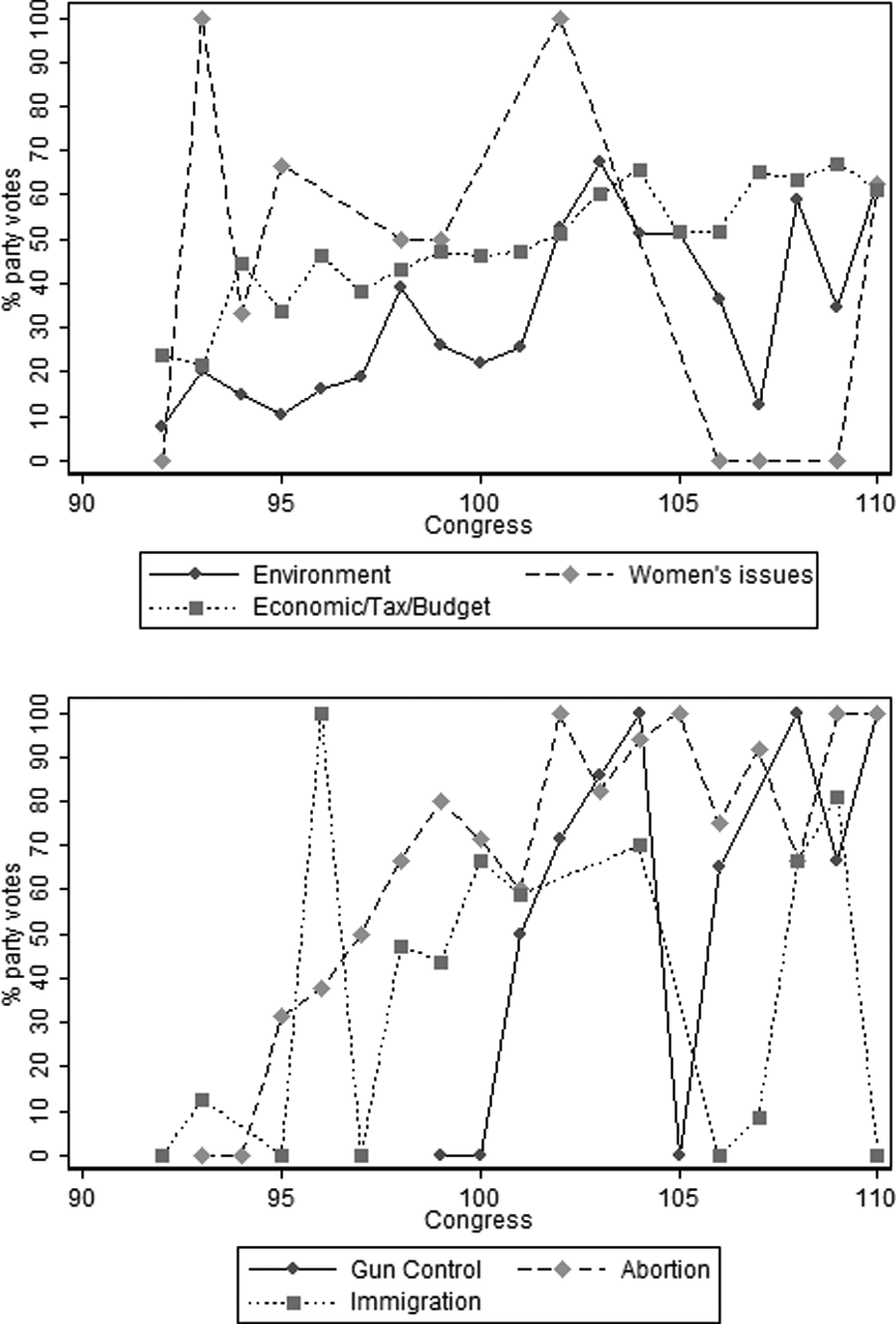
Per cent party votes. Note: party votes are defined as roll calls in which 60% of Democrats vote in opposition to 60% of Republicans. Using other thresholds give similar over time patterns, although the averages are higher or lower as expected from using a more or less stringent threshold.
Number of roll calls per congress.
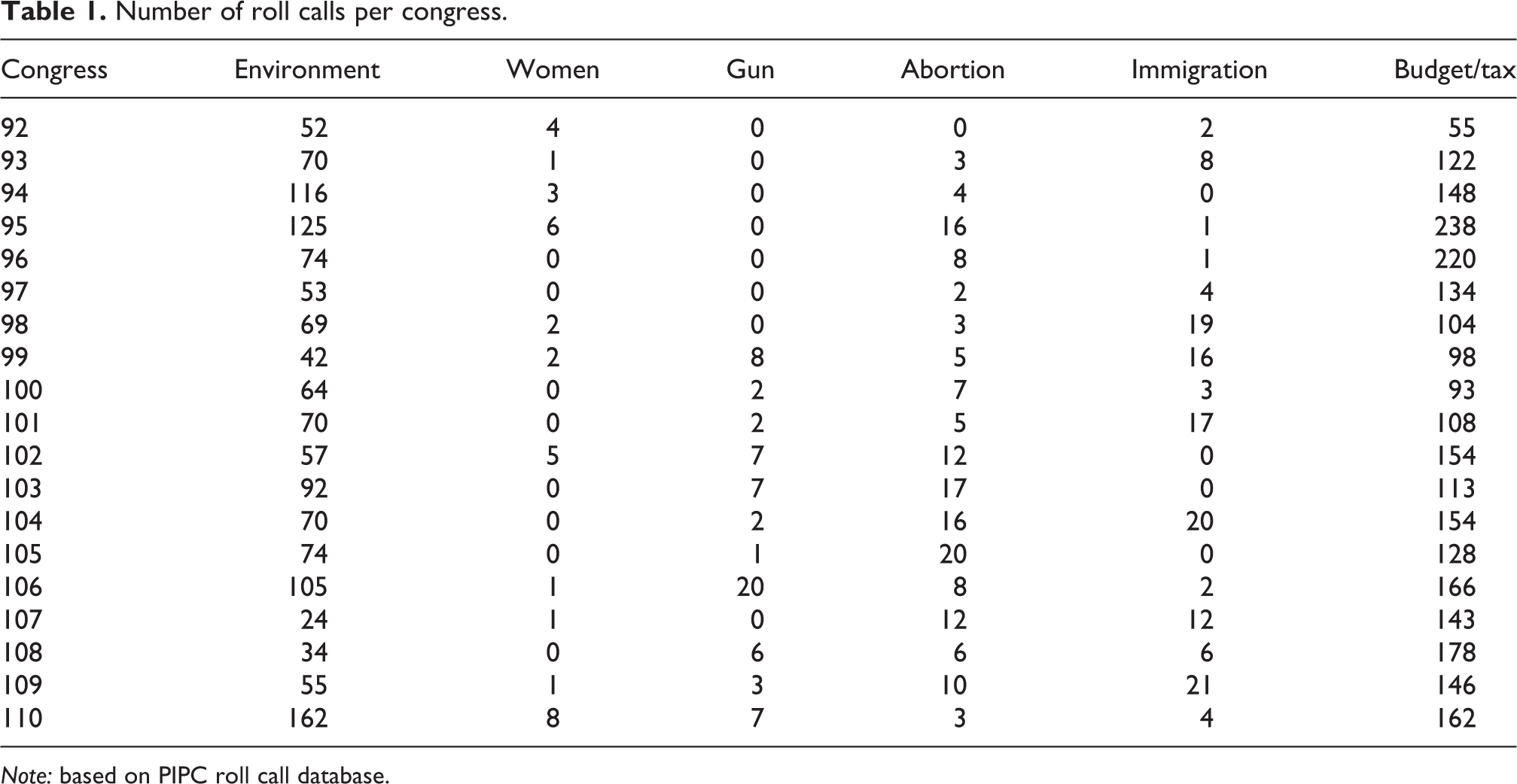
Note: based on PIPC roll call database.
We run the vote classification analysis for each issue, i.e. we estimate equations (1) and (2) to calculate issue-by-Congress classification rates. Figure 2 presents our results of the dimensionality for all five issues. To further highlight potential differences between these new issues and traditionally ideological and partisan issues, we present results on economic/tax/budget votes as a baseline. If issues are one-dimensional, then there will not be a gap between the per cent of votes correctly classified for the one- and two-dimensional models. As an issue is increasingly cross-cutting, the gap between the one- and two-dimensional models increases.
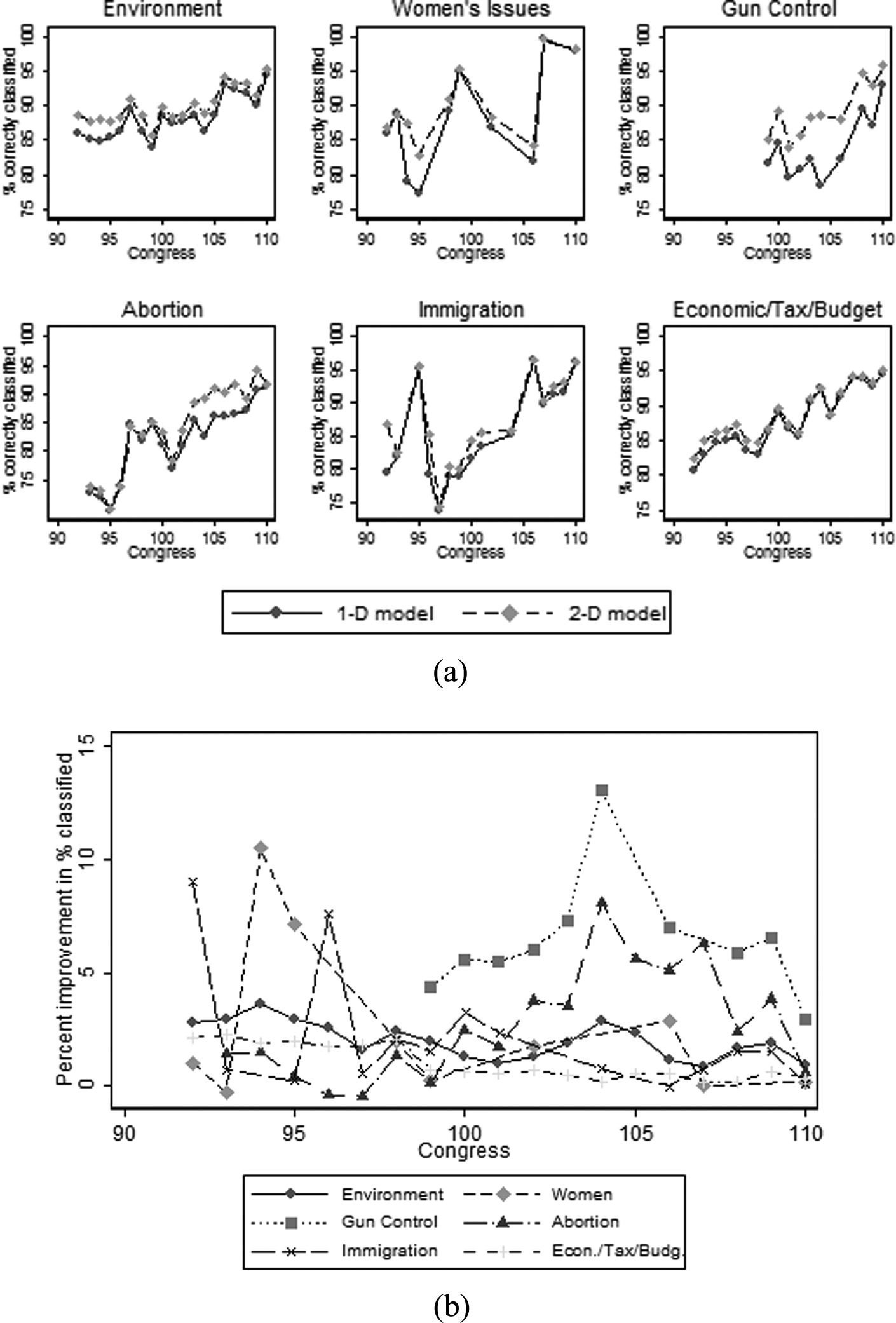
Vote classification: (A) percentage of vote correctly classified (by issue area); (b) per cent improvement, calculated as the difference between per cent classified of the one-dimensional and one- and two-dimensional models, divided by per cent classified by the one-dimensional model.
Some general observations are immediately evident. Voting for all issue areas has become increasingly predictable over the time period (McCarty et al., 2006). A second observation is that all issue areas have become increasingly one-dimensional. Even for economic policy, which is the canonical first-dimensional issue, one might remember, for instance, the support by some Democrats for Reagan’s spending and tax cuts during the 97th Congress (1981–1982). All in all, the pattern for economic votes provides a basic baseline on which to compare the other issues.
We assess the extent to which an issue approaches a strong evolution by tracking the improvement of two-dimensional over the one-dimensional model. Although there is quite a bit of variability across issues, which we further delve into below, the general pattern is that the second-dimension significantly improved vote classification for the culture war issues, but its salience has diminished over time. 18 The per cent improvement from the two-dimensional model at times hovers above the line for economic policy during the earlier periods in Figure 2(b), but they converged by the 110th Congress (per cent improvement of the two-dimensional model is roughly 1.5% for all issues).
At first glance, there is no evidence of strong issue evolutions, given the convergence of all issues to one-dimensionality. This conclusion, however, is premature. The differences across issues in how the issues converged to one-dimensionality suggest some issues may have showed more signs of a strong evolution than others. We first briefly assess changes in the per cent improvement of the two-dimensional model for each issue before covering additional analyses that highlight their differences even further.
2.2.1 Environment
This issue shows a steady trajectory towards increased one-dimensionality, which coincides with increased partisanship on the issue. This issue therefore appears to be a relatively straightforward case of conflict extension. 19
2.2.2 Women’s rights
Consistent with earlier accounts of the women’s rights movement, conflict on that issue was cross-cutting soon after passage of the Equal Rights Amendment by the House and Senate in the 92nd Congress. Figure 2 suggests that this did not really occur until the 94th Congress (1975–1977), where the per cent improvement of the two-dimensional model reaches a high point. Since that period, however, as for the environment, the issue immediately began to fall back onto the existing partisan cleavage, coinciding with increases polarization and partisanship on those issues. There was an interruption, however, in that pattern during the 102nd and 106th Congresses.
2.2.3 Immigration
Immigration shows quite a bit of variability in the earlier Congresses, in part due to the small number of roll call votes per Congress. But over time, volatility decreases and the issue has become increasingly one-dimensional. 20 Notice that there is a small interruption in that trend, however, during the 108th and 109th Congresses. That bump in the dimensionality of voting coincides with heightened discussion of immigration reform, which crescendoed with mass protests across the country in 2006. For the most part, the issue was highly partisan with battle lines largely drawn between the Democratic and Republican parties. Further analysis, however, shows that party was not the only determining factor of roll call voting.
2.2.4 Abortion
Of the five issues in our analysis, abortion and gun control show the most stark differences. Voting on abortion during the period soon after Roe v. Wade (1973) is characterized by low predictability, regardless of whether one accounts for a second dimension. Evidence of abortion as a structured cross-cutting issue does not begin to emerge until the very end of the 1980s and the early 1990s. Its pinnacle coincides with the Republican Revolution in the 104th Congress: controlling for a second dimension increases classification success by over eight percentage points. Immediately following that Congress, however, abortion began to incorporate back into the first dimension, and looking at voting in the 110th Congress, we see that abortion has been fully collapsed onto the first dimension.
What is especially interesting about abortion is that the era during which abortion is systematically a cross-cutting issue is precisely a period of a sharp increase in partisanship (the 1990s). Thus, the interesting change for abortion is not simply that roll call voting became more partisan. Rather, something beyond partisanship systematically influenced the votes for some members, even while partisanship was intensifying.
2.2.5 Gun control
As for abortion, gun control roll call votes show evidence of systematic influence of the second dimension. After gun control made a sustained presence on the legislative agenda by the 99th Congress, voting increasingly was structured on the second dimension, reaching a high-point in the 104th Congress. 21 Furthermore, both votes in that Congress were party votes. Thus, as for abortion, even though voting was highly partisan, some additional factor (dimension) systematically influenced votes. But in the end, gun control fell back onto the first dimension by the 110th Congress.
2.3 Correlation between dimensionality and partisanship: Evidence of strong evolutions
Our initial observations suggest that changes in dimensionality and partisanship do not necessarily move in lock-step, which highlights the benefits of considering dimensionality as an additional measure of issue change. These findings are summarized in Table 2, which reports for each issue area the correlation between the percentage of votes that are party votes (measure of partisanship/polarization) and the per cent improvement of the two-dimensional over the one-dimensional model (measure of dimensionality). Although the general trend in roll call voting is increased polarization as issues coalesce onto the main ideological dimension on which the parties have been polarizing (Jochim and Jones, 2012; Poole and Rosenthal, 2007), which is a negative correlation, that pattern does not hold for all issues.
Correlation between per cent party votes and per cent improvement of the two-dimensional model.
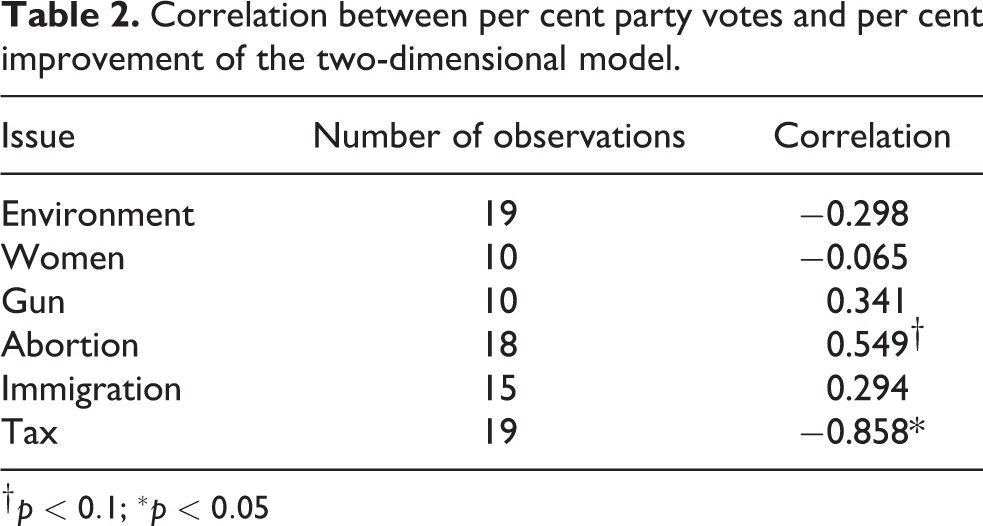
The correlation is negative for the environment, women’s rights, and budget and tax votes. The less the second dimension contributes to roll call voting, the more partisan voting is on that issue. This negative correlation is especially strong among economic votes, which is to be expected since this issue area is the canonical first-dimensional issue. Thus for these issues, issue polarization reflects the general trend of the polarizing Congress. Although displaying a positive correlation, women’s rights is a borderline case as the correlation is very small.
Abortion, immigration, and gun control, on the other hand, each have a positive correlation. As suggested by our earlier observations, the correlation is strongest for abortion (
2.3.1 Ranking the issues
A simplistic view of ideological polarization would gloss over these distinctions, and we can see how these competing perspectives on issue change can complement one another. By accounting for dimensionality, we can rank-order these issues in terms of the significance of their evolution, i.e. the extent to which the issue adds a flavor of conflict distinct from the existing, dominant partisan cleavage. Based on our analysis thus far, we rank from strongest to weakest: abortion, gun control, immigration, women’s rights, and finally the environment.
2.4 Graphical examples and substantive effects
Judging the substantive significance of these issue changes is difficult from simply observing the differences in classification rates. For instance, one might wonder whether a gap of eight percentage points is really that significant. To put this metric into perspective and provide an illustration of the impact of dimensionality, we analyze four specific roll call votes.
In light of the patterns in Figure 2 and Table 2, we analyze votes on abortion, gun control, immigration, and women’s rights, each drawn from a Congress that showed signs of a salient second dimension. These four issues, as opposed to the environment and taxation, showed some deviating patterns from a straightforward trend of increased one-dimensionality. Their correlations between issue dimensionality and partisanship also differ from canonical partisan issues, such as taxation. This additional analysis will help clarify how an issue can be both highly partisan and influenced by a second dimension. We can also show using these concrete examples how the small bump for immigration in the 108th and 109th Congresses compares to the larger and more sustained periods of two-dimensionality of abortion and gun control. Immigration bill in the 109th Congress: Border Protection, Anti-terrorism, and Illegal Immigration Control Act of 2005 (H.R. 4437). Yea vote is for more restrictive immigration policy. Abortion bill in the 104th Congress: Partial-Birth Abortion Ban Act of 1995 (H.R. 1833). Yea vote is for more restrictive abortion policy. Gun control bill in the 104th Congress: Gun Crime Enforcement and Second Amendment Restoration Act of 1996 (H.R. 125). Yea vote is for less restrictive gun control policy. Women’s rights bill in the 106th Congress: Mink Amendment (H.Amdt 535/Amendment A002) to Student Results Act of 1999 (H.R. 2). Nay vote is against restoring language concerning gender equity and reinstating the Women’s Educational Equity Act.
Figure 3 plots each House member’s NOMINATE score in the two-dimensional space. The vertical line in each sub-figure is the cut-line that separates the predicted yea and nay votes based on the one-dimensional NOMINATE vote model: a conservative vote is yea for the first three votes, but a nay vote for the women’s rights bill. We distinguish between three groups: (a) those who were incorrectly classified by the one-dimensional model but correctly classified by the two-dimensional model (splitting up yea and nay votes); (b) the remainder who voted yea; (c) the remainder who voted nay. Note that members in the left cloud of NOMINATE scores are Democrats and members in the right cloud are Republicans, which depicts the well-documented polarized contemporary Congress.
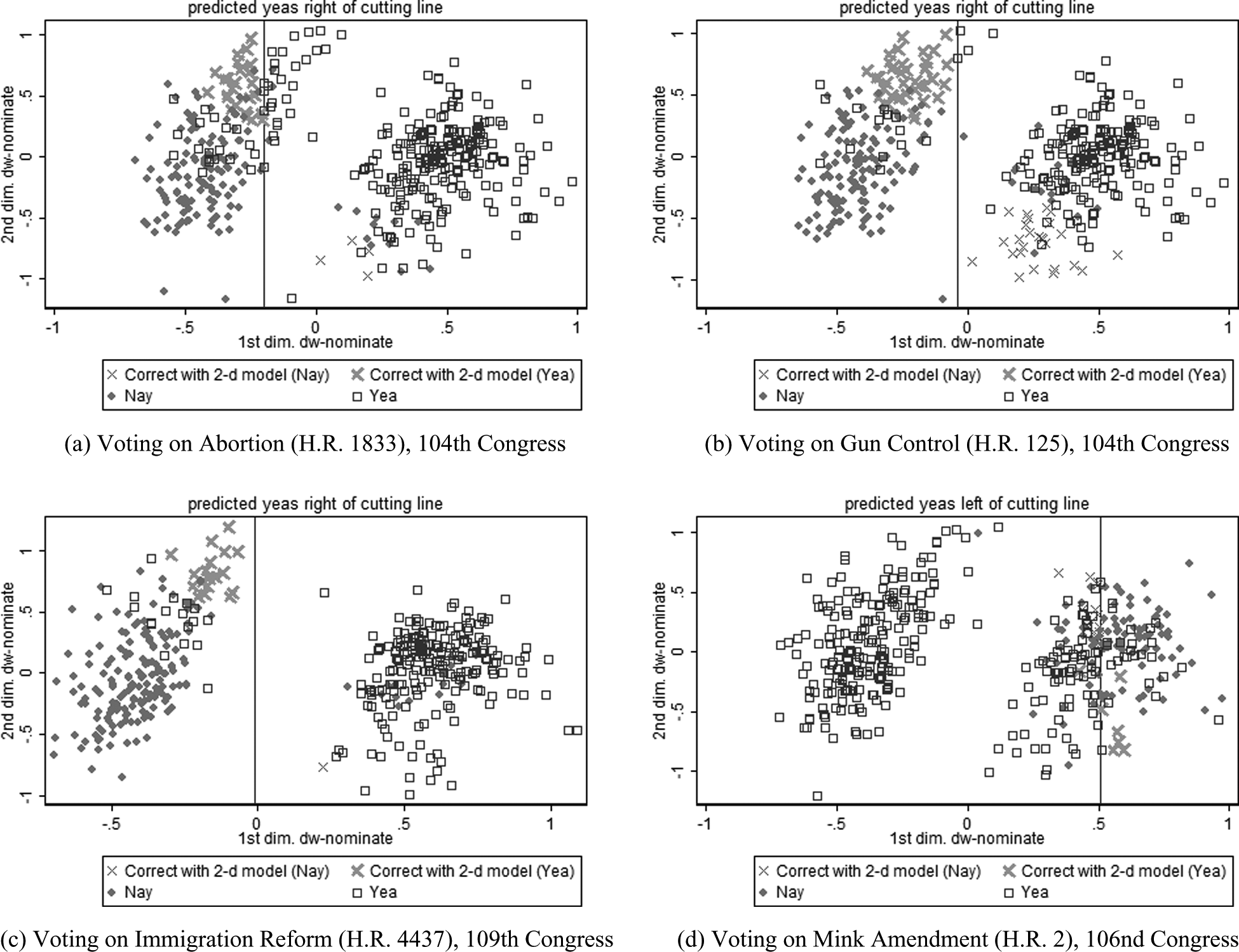
Voting and NOMINATE Scores: which members are influenced by the 2nd dimension?
There is a distinct pattern of which members are correctly classified once we account for second-dimension NOMINATE scores (the Xs), i.e. which members votes are corrected by the two-dimensional model. For the votes on abortion and gun control, note the large cluster of Democrats on the high end of the second dimension who are correctly classified by the two-dimensional model, as well as the cluster of Republicans on the low end who are correctly predicted. These are Democrats who are predicted to vote yea (socially conservative votes) once we account for their second dimension score (25 Democrats for the abortion vote, 37 for gun control). Among the Republicans, these are members who are correctly predicted to vote nay (socially liberal votes) once we account for the second dimension (4 Republicans for the abortion bill, 26 for gun control). For immigration, including the second dimension corrected the votes of 18 Democrats (predicting a socially conservative yea vote), while the second dimension explains the liberal nay vote of 1 Republican. 22
The women’s rights Mink amendment vote differed from the other votes in that an internal party split was predominantly within the Republican party. All misclassified votes of the one-dimensional model, except one, were among Republicans. That is, the Democratic party was cohesively in favor of women’s educational equality, while the GOP majority was split. The actual vote breakdown was: Democrats 206 yea, 1 nay; GOP 105 yea, 110 nay. Second-dimension NOMINATE helps explain this Republican split. A total of 16 Republicans are correctly predicted to vote against the amendment by the two-dimensional model, while 7 are correctly predicted to vote for the amendment. 23
These figures help visualize the differences between a strongly versus weakly two-dimensional issue first seen in Figure 2. More members’ votes from both parties are corrected by the two-dimensional model for the abortion and gun control votes compared to the immigration and women’s rights votes. Furthermore, these snapshots of specific roll call votes are also reflective of the broad patterns of issue change. Looking beyond these specific votes, abortion and gun control also showed more pronounced cross-time patterns in Figure 2 (in terms of the size and duration of second-dimension improvement).
These specific roll calls also illustrate how second-dimension NOMINATE systematically captures elements of a culture war during the 1990s and early 2000s. We can interpret the y-axis as capturing social/moral liberalism-conservatism with higher values as more conservative. In these examples, members who are high on the y-axis are more likely to vote for more restrictive immigration and abortion policies, less restrictive gun control, and against pro-women education policies. Thus, the claim that moral attitudes systematically influenced roll call voting is somewhat true: it is captured by second-dimension NOMINATE, although the degree to which it does varies across issues.
3 Agenda control and polarization
One might wonder the extent to which agenda control contributes to increased one-dimensionality, which is of course correlated with partisanship. Cox and McCubbins (2005) for instance have shown that negative agenda power is a tool that is used by majority party leadership to attain party goals. This power was a topic of conversation around the time of the government shutdown in 2013. Speaker Boehner, applying what was understood to be the “Hastert Rule,” blocked the Senate’s “clean CR” (spending bill that did not include any provisions to defund Obamacare) from reaching the House floor for a vote, in spite of having majority support in the House, because a majority of the Republican conference did not support the bill. 24
We can offer a few observations that show the effectiveness of agenda control. First, note in our analysis of specific roll call votes in Figure 3 that the two-dimensional model improved fit the most among minority party members (Democrats in those examples) for three out of the four votes. This pattern is consistent with the majority party keeping issues that can potentially split the party off of the agenda (via something akin to the Hastert Rule). Omitted analyses show that this pattern of greater internal party splits among the minority party is consistent across other issues and across time.
The fourth vote, which was on women’s rights (on the Mink amendment), illustrates what can happen if the majority party acquiesces agenda control. The bill under question (H.R. 2) was debated under a modified open rule (H.Res. 336). This rule gave an opportunity for the minority party to offer an amendment that could split the majority party and pass, which is exactly what occurred. Given the Republican party’s internal split on the issue, one might therefore expect few women’s rights votes under that party’s majority control. This was precisely the case under their control during the 104th through 109th Congresses. 25 Three of those Congresses had no votes, one vote was an amendment raised by the minority party (Mink amendment in 106th), and two votes were non-controversial bill that passed with unanimous support (416–3 in the 107th, 378–0 in the 109th, which explains the dip in party votes during GOP control in Figure 1). 26 Only after the Democratic party took majority control, which was more cohesive on this issue, did a substantively significant and contentious bill make it onto the agenda. A total of 7 out of the 8 votes (5 of which were party votes) during that Congress were in regards to H.R. 1338, the Paycheck Fairness Act, which dealt with sex discrimination in the payment of wages. The legislative battle on this issue was strongly partisan, and in this case the GOP-minority was united in their opposition to the bill. Voting was completely captured by first-dimension NOMINATE (see Figure 2).
As a further illustration of agenda control, we reran the one- and two-dimensional vote classification analysis by limiting attention to procedural votes, specifically votes on rules. 27 Although such an analysis again looks at votes that made it onto the agenda (in terms of receiving, at minimum, a vote on rules), rules captures aspects of agenda control (debate time and allowance for amendments) that highlight its importance, as evident in the case of the Mink amendment. We should expect a smaller improvement of the two-dimensional model among these rules votes. Not only are these votes central to party leadership attaining their goals, but they are better able to minimize splits on procedural votes, since these are less visible to constituents (Cox and McCubbins, 2005).
The patterns in Figure 4 reiterate the earlier substantive findings that issue dynamics were stronger and more unique on abortion and gun control compared to the other issues. For instance, voting on rules for environmental bills is consistently one-dimensional, even during the early Congresses where a second dimension significantly improved vote classification on all roll calls regarding that issue. Rules votes on bills related to abortion and gun control, however, were similarly two-dimensional as for their non-rules votes.
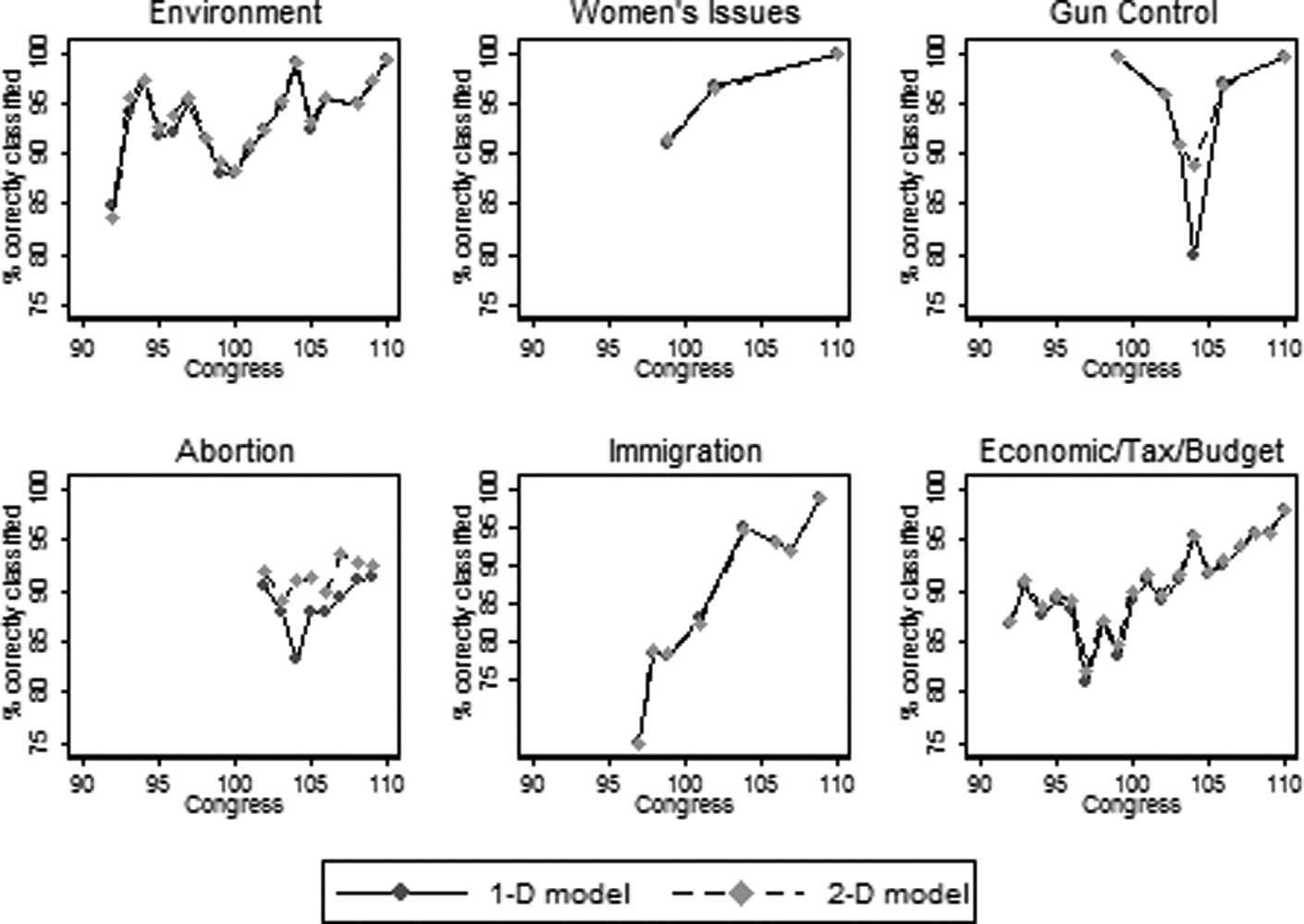
Percentage of votes correctly classified (by issue area).
For example, looking at the 104th Congress for abortion in Figures 2 and 4, both show large improvement from the two-dimensional model. The vote on rules for the consideration of H.R. 1833 (H.Res. 251, which set a “closed rule”) was in fact even more cross-cutting than the final passage vote on that bill (see Figures 3(a) and 5). Both parties, including the majority (Republican) party were split among its ranks: in this case, socially liberal Republicans voting against the rule and final passage. Thus, the abortion issue showed strong signs of splitting the parties, since even the majority party had difficulty in holding the party together on a procedural vote on that issue. This observation reiterates our earlier issue rankings. Rising conflict over abortion policy had a more substantial impact on party politics compared to the other issues, showing its unique effect even on votes on rules.
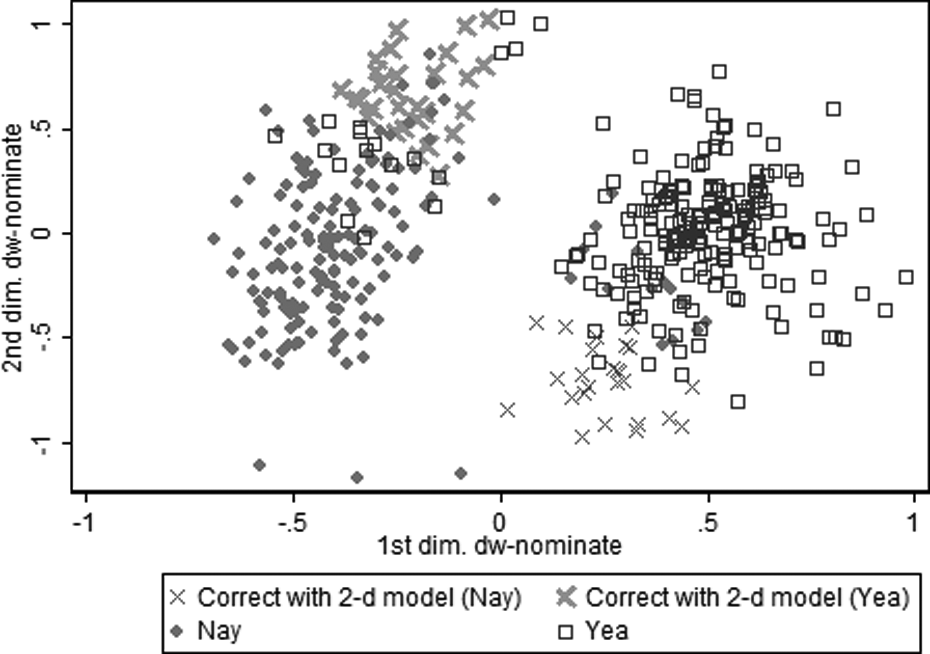
H.Res. 251 (Rule for H.R. 1833), 104th Congress: voting and NOMINATE Scores, which members are influenced by the second dimension?
4 Discussion and concluding remarks
Considering issue dimensionality, in addition to polarization and partisanship, contributes to understanding how the varying perspectives on issue change complement each other. For instance, the ideological polarization literature tends to ignore issue-specific differences in polarization and dimensionality, often simply noting the aggregate trend of increased one-dimensionality since the 1970s. We show, however, that the timing and trajectories of issues can differ. Issue evolution can help explain these differences.
Our analysis suggests that the significance of an issue change is a matter of degree, rather than a dichotomous typology of whether or not an evolution occurred. We rank-order the issues from the most to least dynamic: abortion, gun control, immigration, women’s rights, then environment. Various metrics support this ranking. For abortion and gun control, (1) the per cent improvement from second-dimension NOMINATE was largest in magnitude and sustained for the longest period of time, (2) the scatter plots of specific roll call votes illustrated the large number of members of both parties influenced by the second dimension, (3) salience of the second dimension increased even as the issue became more partisan and polarized, and (4) the second dimension was also salient for votes on rules.
Consistent with claims of a rising culture war, the presented empirical patterns suggest that second-dimension NOMINATE systematically captures a social/moral component. High second-dimension scores are tied to socially conservative values, in our examples for stricter abortion and immigration policies, more lenient gun control laws, and gender equality in education. This dimension was particularly salient during the 1990s and early 2000s. Furthermore, voting on abortion (one of the centerpiece issues of the culture war) was especially influenced by the social dimension for a sustained period of time.
The fact that these social issues collapsed back onto the first dimension by the 110th Congress is a testament to the durability of the American two-party system. Not only did these issues bring up a new dimension of conflict, but the rhetoric was emotionally charged, especially for an issue like abortion. In spite of this infusion of emotion regarding a newly salient issue and the increased activity among activists, such as pro-life religious groups, new cultural issues did not drastically disturb the two major parties. For instance, although socially conservative Democrats voted against the majority of their party in supporting the partial birth abortion bill in the 104th Congress, there was not any fundamental shift in the party based on that issue. None of the socially conservative Democrats for that vote switched to the Republican party and only 4 of the 25 Democrats were replaced by their district by a Republican member by the 110th Congress. As a minority voice in their party, they were not able to instigate widespread change.
Footnotes
Acknowledgements
The authors thank William Jacoby, John Aldrich, Eric Gonzalez Juenke, and Matt Grossmann for comments and suggestions on earlier drafts of the paper. We also thank the anonymous reviewers for their contributions. The authors are responsible for all remaining errors.
Declaration of conflicting interests
The author(s) declared no potential conflicts of interest with respect to the research, authorship, and/or publication of this article.
Funding
The author(s) received no financial support for the research, authorship, and/or publication of this article.