







Abstract
The literature that explores the relationship between decentralisation and the structure of the party system has barely explored an important dimension of party integration, namely the degree of ideological cohesiveness among parliamentary elites. This paper purports to fill the literature gap by analysing heterogeneity in attitudes towards devolution among representatives from Spanish state-wide parties (the People’s Party (PP) and the Socialist Party (PSOE)). Drawing from a sample of 460 parliamentary elites, results show that within-party variation in preferences towards regional self-rule are accounted by the territorial cleavage (historical regions vs ordinary ones) as well as by an institutional cleavage, defined by the type of assembly – regional or national – in which representatives are elected. However, parties’ political and organisational trajectories moderate the impact of those cleavages: territory prevails in accounting for internal variation within the PSOE, whereas the institutional cleavage is more important to explain internal cohesiveness among PP’s party elites.
Introduction
A number of articles have emphasised the virtues of having an integrated party system in federal states, that is, a system in which politicians at different levels of government “bear an organisational relationship to politicians at other levels” and exhibit “mutual dependence” in the campaign for reelection (Filippov et al., 2004: 176). Integrated parties, where state and federal party organisations are highly interdependent, may help to channel intergovernmental political bargaining (Gordin, 2010), to promote macroeconomic efficiency (Rodden, 2006) and even to guarantee self-sustainability of the federation (Filippov et al., 2004).
However, the degree of integration of the party system is not borne of nothing, and institutional conditions may play a prominent role in defining the interests of politicians in maintaining interdependences between representatives at different levels of government.
Decentralisation – the vertical fragmentation of powers between different levels of government – has been analysed in the literature as one of the most important institutional conditions to affect the degree of integration/centralisation of the party system. A first line of research has analysed the impact of decentralisation in the degree of fragmentation of the party system, finding that periods of decentralisation have been followed by a fragmentation of the party system (Chhibber and Kollman, 2004). The relationship between decentralisation and the degree of nationalisation of the party system is not unidirectional though (Riker, 1964) and recent evidence suggests that secessionist pressures are more likely to develop when the fragmentation of the party system is built upon the emergence or strengthening of strong regionalist parties (Alonso, 2012; Brancati, 2006).
A second group of studies that explores the relationship between decentralisation and the party system focuses on the way multilevel government affects the internal organisation of political parties. For instance, (Thorlakson, 2009) shows that cross country differences in party organisation are correlated with variation in the design of federalism. Where subnational governments exercise high powers over taxes and expenditures and executive and legislative functions are separated between levels of government, as in Canada or the US, subnational branches of national parties are more autonomous. In federations with a functional allocation of powers (legislative at the federal level, executive powers at the state levels), such as Germany and Austria, high levels of integration are found, as these facilitate intergovernmental cooperation. The literature in the area also provides evidence that decentralising reforms in countries such as the United Kingdom, Italy, Spain or Belgium have had an impact in the internal organisation of state-wide parties, as regional branches of state-wide parties have gained leverage within the party apparatus (Detterbeck and Jeffery, 2009: 71; Fabre and Méndez-Lago, 2009: 117; León-Alfonso, 2007: 117 and ff; Swenden and Maddens, 2009: 16).
However, a more nuanced explanation of party integration requires taking into account more subtle characteristics of multilevel systems, such as the status of the regional arena versus the national one. Contributions in this area nicely complement the two other lines of research stated above because they focus on power relations between national and subnational party elites that may precede or reinforce fragmentation of state-wide parties or that may simply not be captured by the formal distribution of powers that is enshrined in party statutes. For instance, the relative status of the national versus the regional arena can be explored through politicians’ careers. Career studies that have analysed career orientation of professional politicians in multilevel systems have concluded that the conventional hierarchical pattern in which the central state is at the apex of political careers no longer applies in multilevel systems (Borchert and Stolz, 2011; Stolz, 2003). Decentralisation not only contributes to the establishment of strong and professionalised regional institutions, it elevates the regional career arena to a status “far beyond the conventionally assumed role as a mere springboard to the national level” (Stolz, 2011: 3). Assuming that the behaviour of politicians is highly conditioned by their career ambitions (Schlesinger, 1966), we may expect different electoral strategies or modes of representation depending on the nature of career patterns. If career ambitions of those who populate regional institutions are more oriented to the regional level, does it make them less inclined to foster interdependences with their national counterparts or less interested in party cohesion and more prone to defend regional interests? Recent comparative research on this topic indicates that career patterns make little difference in attitudes towards decentralisation (Pilet et al., 2014). The most important variable to account for differences in preferences among MPs is institutional representation (if they are elected in the national or regional assembly).
If there is a dimension that determines the status of the regional arena vs the national one in multilevel systems, it is the nature of electoral competition. A low level of electoral contamination between regional and national elections makes regional politicians’ electoral fate less dependent on national electoral dynamics, an electoral pattern that is more likely to be found in less integrated party systems or in countries where decentralisation has travelled further (Rodden and Wibbels, 2011; Schakel, 2013). Certainly, the impact of decentralisation upon state-wide parties’ electoral strategies is well documented in the literature on European territorial politics, 1 showing that one of the reactions of state-wide parties to continuing to win seats across the territory might be to adopt more differentiated electoral strategies at the regional level (Hopkin, 2003, 2009). The “regionalisation” of state-wide parties’ strategies may hamper internal party cohesion but at the same time it may also help them to neutralise internal tensions and, in turn, prevent party fragmentation. Differentiated electoral strategies at the regional level may also enhance the visibility of regional elections, contributing to decreasing the impact of national dynamics upon regional elections’ results as well as to elevating the status of regional elections beyond their assumed second-order role (Reif and Schmitt, 1980).
The studies mentioned above capture different dimensions (number of parties, internal organisation and electoral competition) of party system integration in multilevel systems. An additional dimension which has been barely analysed in the literature has to do with the degree of ideological cohesiveness among parliamentary elites. The literature gap is particularly astonishing if we consider that any significant reform within the party organisation of state-wide parties or any shift in their strategies on territorial reform may ultimately originate in a change in political elites’ preferences and attitudes towards devolution issues. Put differently, assuming variations at the aggregate level are rooted in changes at the micro-individual level, we may expect lower levels of integration of the party system to originate in increasing heterogeneity in preferences towards devolution among parliamentary elites. An analysis of party representatives’ attitudinal patterns may help to detect internal cleavages well before they have resulted either in a significant change within party structures or in electoral strategies. In sum, ideological cohesiveness among state-wide parties’ parliamentary elites is an important dimension for measuring the degree of integration of the party system (as well as its predicted evolution) because it captures one of the essential features of integration: the degree of programmatic connection between organisational levels at different electoral arenas.
This paper purports to fill the literature gap by analysing preferences and attitudes towards devolution among a sample of 460 Spanish parliamentary elites. More specifically, it aims at exploring the degree of cohesiveness over territorial issues among representatives of the two mainstream state-wide parties, namely the People’s Party (PP) and the Socialist Party (PSOE). The literature has already provided evidence on the impact of ongoing decentralisation in Spain upon the internal organisation as well as on the electoral competition of state-wide parties. However, there is no evidence on the degree of intra-party and cross-party attitudinal variation within parliamentary elites, mainly because of lack of elite survey data, with the recent exception of the PartiRep dataset (Deschouwer and Depauw, 2014). This paper purports to fill this gap by providing evidence on the level of ideological cohesiveness towards the issue of devolution among Spanish state-wide parties’ parliamentary elites. 2 By focusing on mainstream state-wide parties, the analysis will explore whether different political and organisational trajectories of these parties are associated with variation in the sources of intra-party variation.
This paper puts forward two potential sources of variation among elites’ preferences: region and level of representation. On the one hand, we expect Spanish representatives from historical regions (those who accessed autonomy with higher levels of competences) to hold stronger preferences for devolution than representatives from ordinary regions. Expecting politicians coming from ‘nationalist’ regions to be more favourable towards decentralisation may not be extremely surprising. But the empirical contribution of this paper consists in testing the explanatory power of the nationalist cleavage against the institutional one. Put differently, we analyse whether MPs’ attitudes towards self-rule among regional deputies are better/worse/equally explained by their region or origin than by the assembly in which they were elected. Results show that in addition to the territorial cleavage (historical vs ordinary regions), being in the national or regional political arena also accounts for heterogeneity in preferences towards devolution among Spanish parliamentary elites. In addition, parties differ as to which factor – territorial cleavage or institutional role – predominates in accounting for the degree of internal cohesiveness: the institutional level of representation is more important for understanding differences among the People’s Party’s elites, whereas the territorial cleavage is more important for explaining variation among Socialist representatives.
Devolution and its impact upon Spanish state-wide parties
One of the most defining characteristics of decentralisation in Spain is its ongoing nature. Certainly, since the creation of the Autonomous Communities during the period 1979–1983, Spanish regional governments have been endowed with increasing powers over taxes and expenditures. The last significant reform came into effect in 2009, when regional governments were transferred further taxation powers (except in the Basque Country and Navarre which are financed through a special regime that grants them full-taxation powers) (Aja, 2003, 2014). As for expenditure responsibilities, some regions accessed autonomy through a fast-track process that granted them higher levels of expenditure powers. However, since the mid-1990s, the so-called ordinary regions (which accessed autonomy with lower levels of authority) have been gradually endowed with further expenditure responsibilities. The last and most significant development on expenditure devolution took place in 2002, when health care powers were transferred to the 10 ordinary regions. This reform virtually put an end to the initial cross-regional asymmetries in expenditure decentralisation, although some differences remain for specific policy areas (as regional police in Catalonia).
Alongside the profound transformation of institutional structures associated with ongoing devolution in Spain, decentralisation has resulted in the regionalisation of state-wide party organisations as well as in a change in the way state-wide parties compete in national and regional elections. As in many other Western countries where decentralisation reforms have been implemented, regional branches of state-wide parties have gained powers and status within the party structure (Fabre, 2008; Fabre and Méndez-Lago, 2009; Hopkin, 2003; Montero, 2007), mimicking the strengthening of regional arenas associated with institutional reforms. In addition, regional organisations have gained autonomy in designing their own electoral campaigns, which has resulted in differentiation of party manifestos in regional elections (Alonso and Gómez, 2010). In turn, regional party elites having control of a wide array of resources as well as the increase in regional agendas’ heterogeneity have enhanced the visibility of regional party leaders against their national co-partisans, so regional elections are no longer regarded as simply ‘proxies’ of the national party branch (León, 2014) and the unidirectional career model according to which politicians progress from the local to the national level is not the predominant one (Stolz, 2003). However, the impact of centrifugal dynamics within parties has been moderated by incumbency. The capacity of national leaders to have a tighter grip over their regional copartisans has increased in periods of incumbency (Fabre, 2008; Méndez Lago, 2005; León-Alfonso, 2007) and diminished when in opposition, particularly against leaders who have succeeded in holding regional office.
The centrifugal organisational and electoral dynamics described above cannot take place in isolation from representatives’ preferences towards devolution, as they are likely to originate (or result) in changes in parliamentary elites’ preferences towards regional self-rule. 3 A first source of internal division within parties may be identified on the level of institutional representation (national vs regional arena). We define this argument as the institutional cleavage hypothesis. If we assume that political elites want to hold more and not less powers, then we may expect national party elites to be reluctant to transfers further powers towards the regional level, whereas regional party elites may regard devolution as a way to strengthen their influence as well as a way to further career professionalisation at the regional arena. In other words, the logic of maximising resources and power may increase heterogeneity in attitudes towards devolution between levels of institutional representation, as “centre and party leaders at both levels often […] [try] to use the resources that […] [are] available to them to increase their decisional autonomy vis-à-vis the other level” (Fabre, 2008: 326). Recent empirical evidence actually shows that the institutional cleavage does explain variation among MPs in attitudes towards decentralisation and the importance of promoting the interest of the region (Pilet et al., 2014: 220). Accordingly, we expect national elites to be less favourable to transfering further powers and resources to the regional level than regional parliamentary elites (H1).
There is an additional source of variation that may account for intra-party divergences in attitudes towards devolution that is related to the specific nature of the territorial cleavage in Spain. According to what we define as the territorial cleavage hypothesis, we may expect differences across parliamentary elites to be accounted for by type of region. A straightforward prediction is to expect representatives from historical regions to hold stronger preferences for devolution than politicians who reside in ordinary regions. When the process of devolution kicked off with the approval of the Constitution in 1978 (which regulated the institutional paths to access autonomy), a group of regions became the front-runners in advocating access to autonomy with the highest levels of authority, namely Catalonia, Basque Country, Andalusia and Galicia. These regions accessed autonomy through a fast-track process, which granted them higher levels of self-rule. In regions such as Catalonia, Basque Country and Galicia (which had approved their “Statutes of Autonomy” before the Civil War broke out in 1936) access to autonomy involved the restoration of self-rule that was thwarted by the break out of Civil War in 1936. In Catalonia and the Basque Country, the more intense preferences towards devolution exhibited at the onset of the democratic period have persisted through the existence of strong identity-based parties that have had a very prominent role both at the regional and national level. The literature shows that the presence of dominant nationalist parties and the resulting centrifugal push of political competition are crucial factors in fuelling heterogeneous preferences over devolution (Brancati, 2004, 2006). Certainly, nationalist parties in Catalonia and the Basque Country have succeeded in establishing the territorial cleavage as the central issue of competition in the regional arena and in triggering reforms in fiscal and political federal arrangements. As a result of these historical legacies and subsequent competition dynamics, we expect political representatives in historical regions, particularly in regions where nationalist parties have dominated electoral competition, to exhibit stronger preferences for devolution than elites from ordinary regions (H2).
The political and organisational trajectories of state-wide parties as well as each party’s political discourse on decentralisation may moderate the potential explanatory power of the institutional and territorial cleavage. There is actually a certain correlation between PP’s and PSOE’s political discourse on decentralisation and their organisational structures. The PSOE’s structure certainly reflects upon the territorial cleavage. The party adopted a federal structure with regional branches in each Autonomous Community, whereas in Catalonia the regional branch remains an independent party that is federated to the PSOE. In addition, the historical distribution of electoral support in national elections across territories has contributed to enhancing the power of the Socialist Party of Catalonia as well as the party’s regional branches in Andalusia and the Basque Country. The territorial distribution of votes, the increasing power of regional branches within the party organisation since the mid-1990s as well as the electoral threat from regionalist parties in the Basque Country and Catalonia loom large in explaining the gradual impulse of the Socialist Party towards a federalist agenda, particularly in periods where the party has been in opposition at the national level (Alonso, 2012; Verge, 2013). Accordingly, we expect the territorial cleavage to have a more prominent role than the institutional cleavage in explaining heterogeneity in preferences towards devolution among Socialist representatives.
On the contrary, as several studies have shown, the organisation of the People’s Party has traditionally been more centralised than that of the PSOE and the PP’s elites have traditionally defended a more centralised territorial organisation of the State (Alonso, 2012; Astudillo and García-Guereta, 2006; Fabre, 2008; Verge, 2013). The most important source of internal variation since its re-foundation in 1989 has not been related to territorial factions but to ideological blocs (as in its origins the party integrated several small Christian Democratic and liberal parties). The territorial distribution of votes – mostly concentrated in regions where there is no distinct national identity – has also contributed to reinforcing centripetal dynamics. Recent evidence based on comparison of national and regional party manifestos has shown that the PP’s regional elites follow differentiated electoral strategies from their national counterparts (Alonso and Gómez, 2010). However, and unlike the Socialist Party, most differentiated electoral manifestos in the centre-periphery dimension do not come from historical regions. As shown in Alonso et al. (2013: 204), in Catalonia and the Basque Country the PP’s regional party manifestos exhibit a centralist bias, that is, their party manifestos exhibit a pro-centre position. Assuming that there is certain correlation between representatives’ preferences and political parties’ electoral pledges, we may expect the institutional cleavage to have a higher explanatory power to explain the PP’s representatives’ preferences on devolution than the territorial cleavage.
Data and methodology
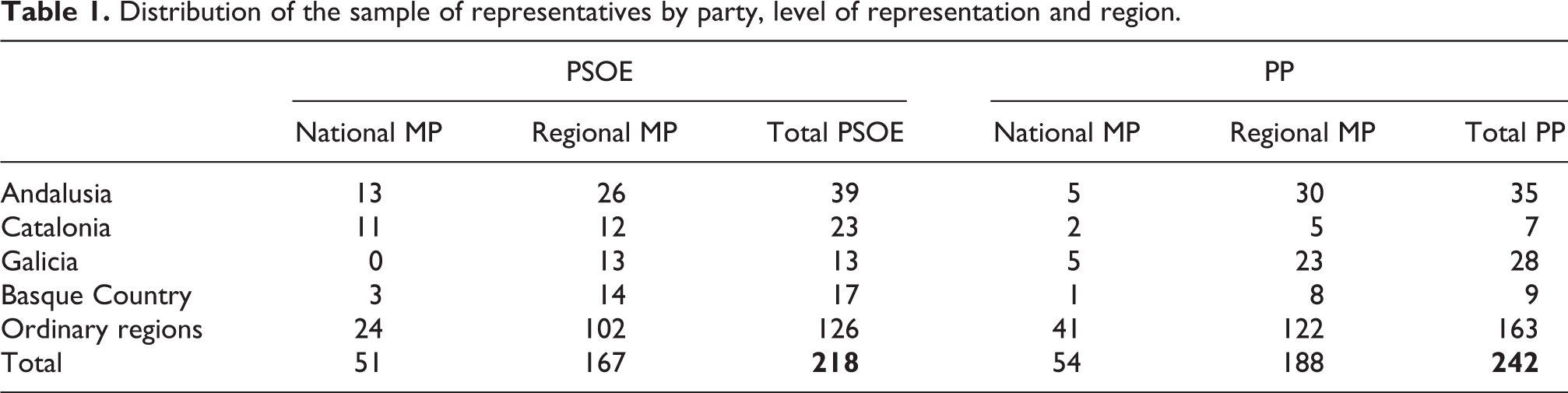
In order to test for the cleavage and institutional hypotheses I use a database from the Spanish Centre for Sociological Research (CIS study 2827) that includes survey data from personal interviews with regional and national Spanish parliamentarians. Based on multiple choice closed questionnaires, interviews were carried out between June 2009 and February 2011 with a total of 580 MPs. The selection of interviewees was based on a simple random sampling of representatives by assembly (regional assemblies, Congress and Senate) as well as political party. The margin of error is +/– 3 percent at a 95 percent level of confidence. 4 The large sample makes it the largest database on Spanish parliamentary elites published to date. It therefore provides a significant advancement in terms of individual data collection about political representatives, as so far most data collected on parliamentary elites has been gathered through a limited sample of qualitative interviews. To carry out the empirical analysis I use the sample of 460 parliamentary elites of the two most important state-wide parties, namely PP and PSOE. The large representative sample overrepresents the chambers of the four historical regions (Catalonia, Basque Country, Galicia and Andalusia). Table 1 shows the number of representatives in each party by region and level of representation.
The general dependent variable in the paper is preferences over decentralisation. To operationalise this variable we were limited by the availability of questions related to decentralisation issues in the survey questionnaire. We selected those questions that would capture different dimensions of self-rule and used them to create two different dependent variables. The first dependent variable index of self-rule is created out of four indicators that capture representatives’ preferences and attitudes towards self-rule in their region (bilateralism, an increase in tax-autonomy, attitudes towards the defence of regional interests and an increase in competences in their region). The second dependent variable “preferences over decentralisation” is based on a survey question that is formulated in very general terms (it asks respondents about their preferred level of decentralisation of the Spanish State of Autonomies, placing themselves on a scale where 1 is all power to the central government and 10 all power to the regional governments, excluding independence). So, unlike the first dependent variable, this variable captures general orientations towards the territorial organisation of the state.
The four indicators used to create the “index of self-rule” are the following. The first indicator measures respondents’ evaluation of the degree of self-rule attained by the regional government (insufficient self-rule), and it is coded 0 if they support the current allocation of powers to the regional government and 1 if they think that the level of competences achieved by their regional government is insufficient. The second indicator measures respondents’ agreement to extend to all the regions the regional financing system applied in Navarre and the Basque Country (full tax-autonomy). It is coded 1 if they respond “yes” or “yes, with some conditions” and 0 if they respond “no”. The third indicator captures respondents’ preferred model of intergovernmental relations between regional governments and the central administration (bilateralism) and it is coded 1 if they support bilateral intergovernmental relations and 0 if they support multilateral intergovernmental relations. The fourth indicator captures preferences for resolution of conflicts between party and regional interests (defence of regional interests). It is coded 1 if respondents prefer to give priority to the interests of their province or region and 0 if they give priority to the party guidelines or if the representative states that she would try to influence the party’s stance towards the issue. Table 2 provides descriptive statistics of the different indicators that make up the index of self-rule preferences for PP and PSOE.
Descriptive statistics of indicators of self-rule.
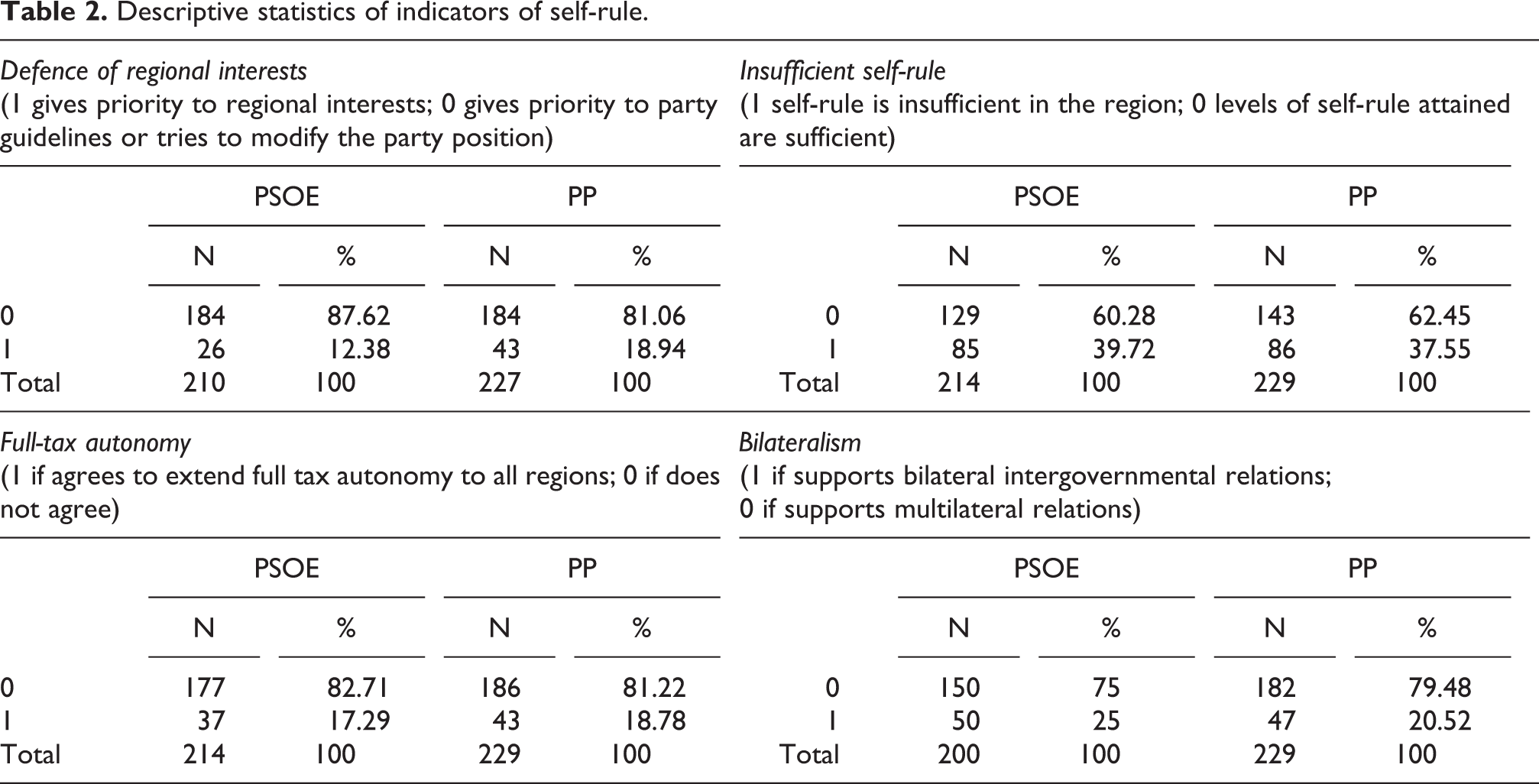
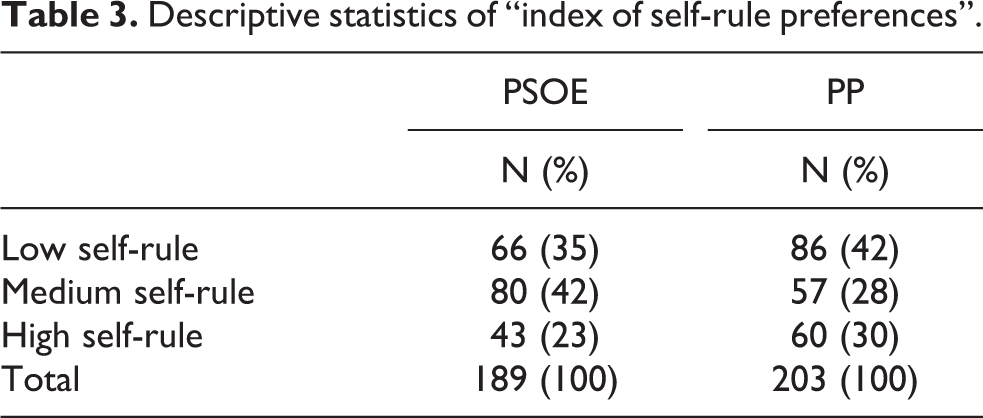
We have added responses to these four indicators and created the “index of self-rule preferences” which measures the frequency of answers in which the respondent chooses the option that reflects higher preferences towards regional self-rule (coded 1 in each indicator). Accordingly, the original index has five categories (from 0 to 4). In both parties most of the responses are concentrated at the lower end of the index, particularly between categories 0 and 2. As the frequency of answers for categories 3 and 4 is too low (only 22 and 10 cases, respectively), we recode the original index into three categories: 0 for low self-rule (where added responses sum 0), 1 for medium self-rule (if added responses sum 1) and 2 for high self-rule (if added responses sum 2 or more). 5 Table 3 provides a description of the distribution of frequencies of the “index of self-rule preferences” by party.
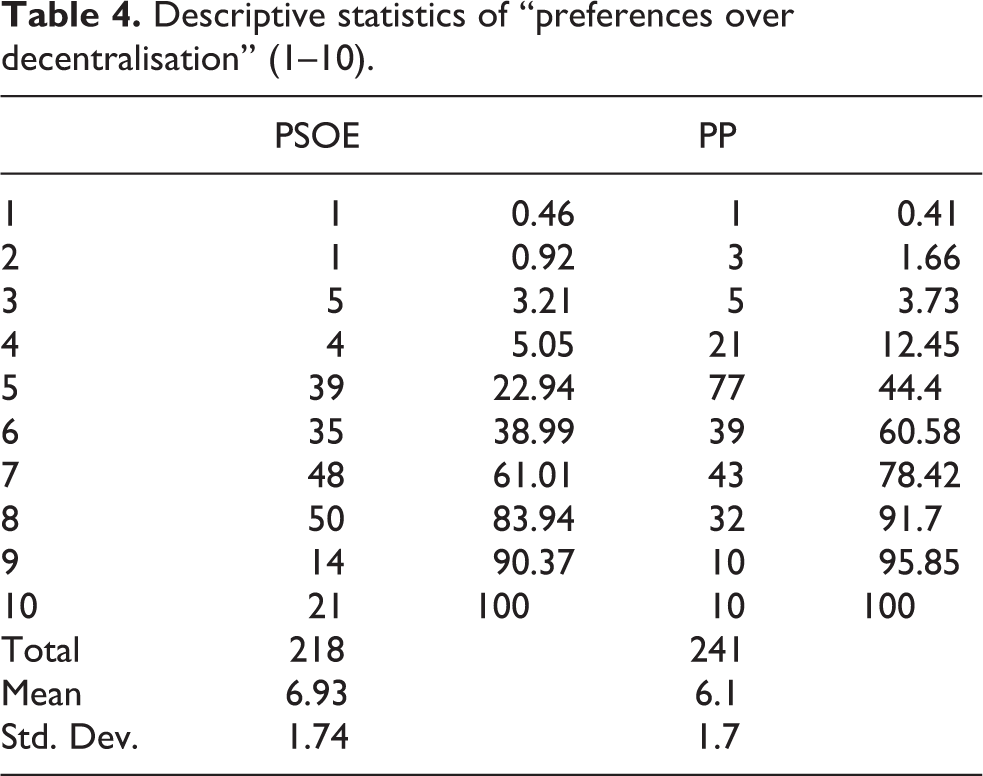
The second dependent variable is preferred level of regional autonomy (preferences over decentralisation), which goes from 1 to 10 (being 1 all power to the central government and 10 all power to the regional governments, excluding independence). Table 4 shows the distribution of this variable by party. Mean coefficients indicate that parliamentarians from the People’s Party are less supportive of decentralisation than elites from the Socialist Party, an expected result according to the PP’s traditional discourse.
The most important independent variables in the econometric model are regional member of parliament (RMP), which will help us to test the institutional hypothesis; and historical region, which will allow us to test the territorial cleavage hypothesis. RMP is coded as 1 for parliamentarians from a regional assembly and 0 for national representatives (from Congress or Senate). According to the institutional hypothesis, we expect regional deputies to hold more intense preferences towards self-rule than national elites.
Historical region is classified in three categories: 1 for representatives from regions that accessed autonomy with lower levels of competences (ordinary regions); 2 for parliamentarians from historical regions where political competition has not been dominated by nationalist or regionalist parties (non-nationalist historical regions, namely Galicia and Andalusia); and 3 for historical regions where political competition has been dominated by nationalist parties (nationalist historical regions, namely Basque Country and Catalonia). According to the territorial cleavage hypothesis we expect both national and regional representatives from historical regions to exhibit stronger preferences for regional self-rule than representatives from ordinary regions. In addition, we expect this effect to be stronger in nationalist regions than in non-nationalist historical Communities.
We also control for parliamentarians’ basic political attitudes, namely self-reported ideology, regionalism, nationalism and dual identity. Ideology is operationalised as a scale that goes from 1 to 10, where 1 stands for extreme left and 10 for extreme right. Regionalism is operationalised with a survey question that asks respondents to position themselves in a scale where “minimum regionalism” is coded as 1 and “maximum regionalism” is coded as 10. Similarly, nationalism captures respondents’ positions on a scale where “minimum nationalism” is coded as 1 and “maximum nationalism” is coded as 10. 6 Finally, dual identity has five categories that classify respondents’ identification with dual or unique identities. 7 This variable has been recoded into 3 categories: 1 for “Only Spanish” or “More Spanish than from the region”; 2 for dual identities (As Spanish as from the region) and 3 for “More from the region than Spanish” or “Only from the region”. When the econometric model is run for the overall sample, we control for the different sample size across parties by introducing a dummy variable (Party) that is coded as 1 for PSOE and 0 for PP.
The introduction of control variables in the econometric model will allow us to control for an alternative mechanism to explain why regional parliamentarians hold stronger preferences towards devolution. It has to do with a self-selection process whereby regional deputies with stronger regional identities self-select to compete for regional seats. If this was the case, then the impact of being a parliamentarian in a regional assembly (as compared to being a national representative) upon attitudes towards devolution would basically operate through regional identities and not through level of representation. By introducing as independent variables self-reported level of nationalism and regionalism we try to capture the impact of institutional representation upon preferences towards self-rule that is independent of regional identities.
Finally, estimation methods have been ordered logit 8 for the dependent variable index of self-rule and OLS for the dependent variable preferences over decentralisation.
Empirical analysis
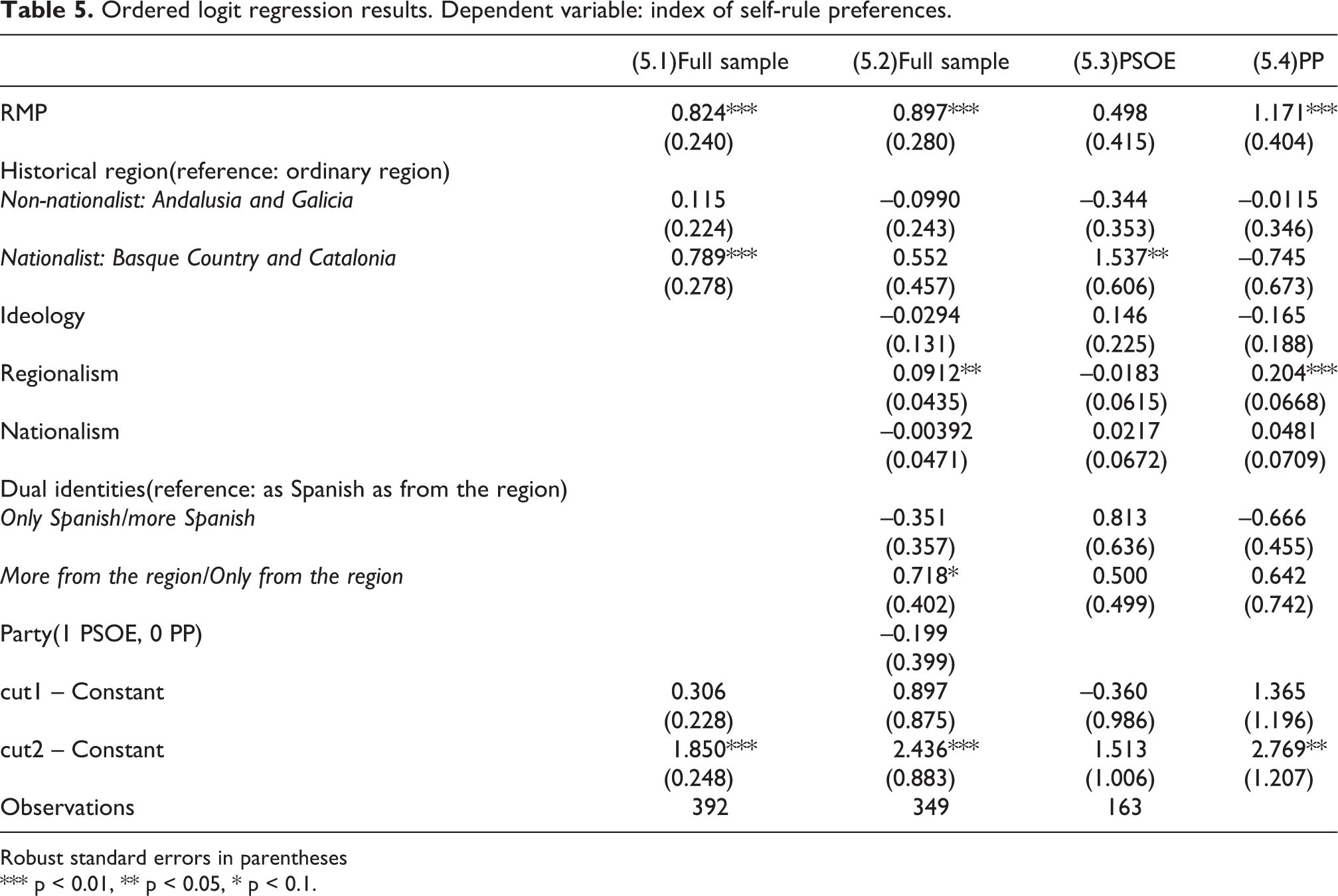
In the first econometric model the dependent variable is the “index of self-rule preferences” and results are exhibited in Table 5. In model 5.1 we run the ordered probit analysis for the overall sample of parliamentarians and control for the most important independent variables: regional MP and historical region. Both hypotheses find empirical support. Results show that members of regional parliaments exhibit higher preferences for self-rule than national elites. In addition, parliamentarians from nationalist historical regions (Catalonia and Basque Country) hold stronger preferences for regional autonomy than those from ordinary regions. However, in historical regions where political competition has not been dominated by nationalist parties (Andalusia and Galicia) representatives do not exhibit higher preferences for self-rule than elites from ordinary regions.
Robust standard errors in parentheses
*** p < 0.01, ** p < 0.05, * p < 0.1.
In model 5.2, we replicate the analysis introducing some control variables (ideology, identity, nationalism, regionalism and Party). The RMP variable in model 5.2 remains significant, which suggests that the impact of institutional representation upon the dependent variable operates, as expected, independently of individuals’ identity. However, the coefficient of nationalist historical region gets smaller and standard errors increase, which would suggest that the effect of the territorial cleavage upon the dependent variable mainly operates through regional identities. 9
However, results for the overall sample may hide significant differences across parties. We test for H3 and H4 in models 5.3 and 5.4, respectively. Empirical evidence in model 5.3 indicates that heterogeneity among Socialist parliamentary elites is mainly driven by the territorial cleavage in nationalist regions. National and regional Socialist representatives residing in Catalonia and the Basque Country hold more intense preferences towards self-rule as compared to elites from ordinary regions, whereas the coefficient of the RMP variable in Andalusia and Galicia is negative and not significantly different from zero. Thus, while the territorial cleavage shapes preferences among PSOE’s representatives, we find no evidence that supports the institutional hypothesis: the RMP variable does exhibit a positive sign, as expected, but the coefficient is not significantly different from zero.
In model 5.4 we run the ordered logit for the sample of the PP’s representatives. Results indicate that sources of variation among parliamentary elites in the People’s Party are different from those identified for the Socialist Party. Empirical evidence provides support for H4, as regional deputies hold stronger preferences for self-rule than their national counterparts, whereas representatives from historical regions do not exhibit higher preferences towards self-rule than those from ordinary regions. 10
In order to provide an easier interpretation of previous coefficients, Tables 6 and 7 display predicted probabilities of models 5.3 and 5.4. Table 6 illustrates the impact of the territorial cleavage upon preferences for self-rule among Socialist representatives. More specifically, it displays how the probability of membership in each category of the dependent variable changes with variation in historical region, holding the rest of the variables at their means. The probability of a Socialist representative from the Basque Country or Catalonia of exhibiting the low level of preference of self-rule (index = 0) is 0.12, whereas it is 0.39 among Socialist representatives from ordinary regions. On the contrary, the predicted probability for the highest level of self-rule (index = 2) for representatives from ordinary regions is 0.19 and increases to 0.52 among deputies from nationalist regions.
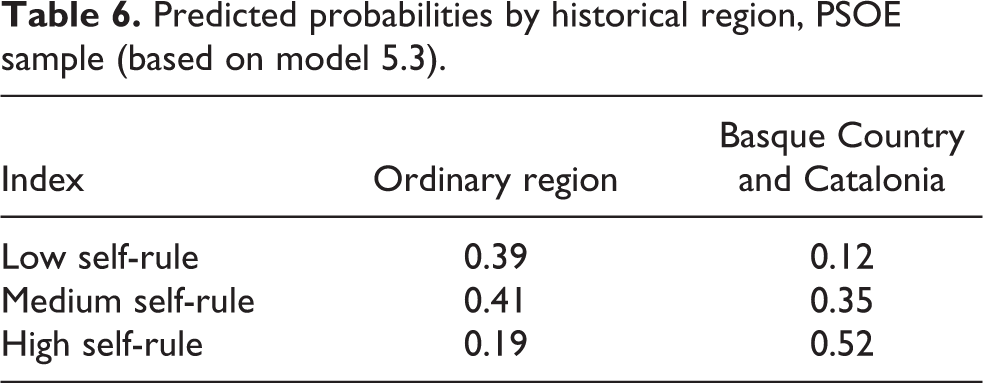
Predicted probabilities by level of representation, PP sample (based on model 5.4).
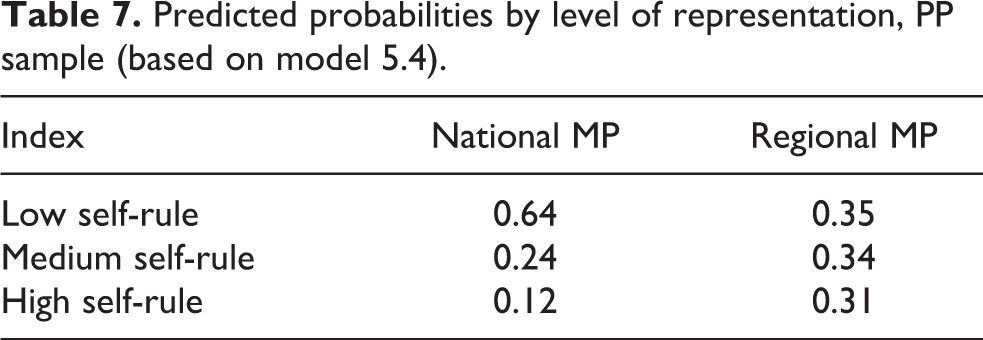
Table 7 exhibits predicted probabilities of self-rule preferences of PP representatives as we vary RMP and hold the other variables at their means. In this case, the probability that a PP national MP exhibits the lowest level of preferences towards self-rule (index = 0) is 0.64, whereas it is 0.35 among regional deputies.
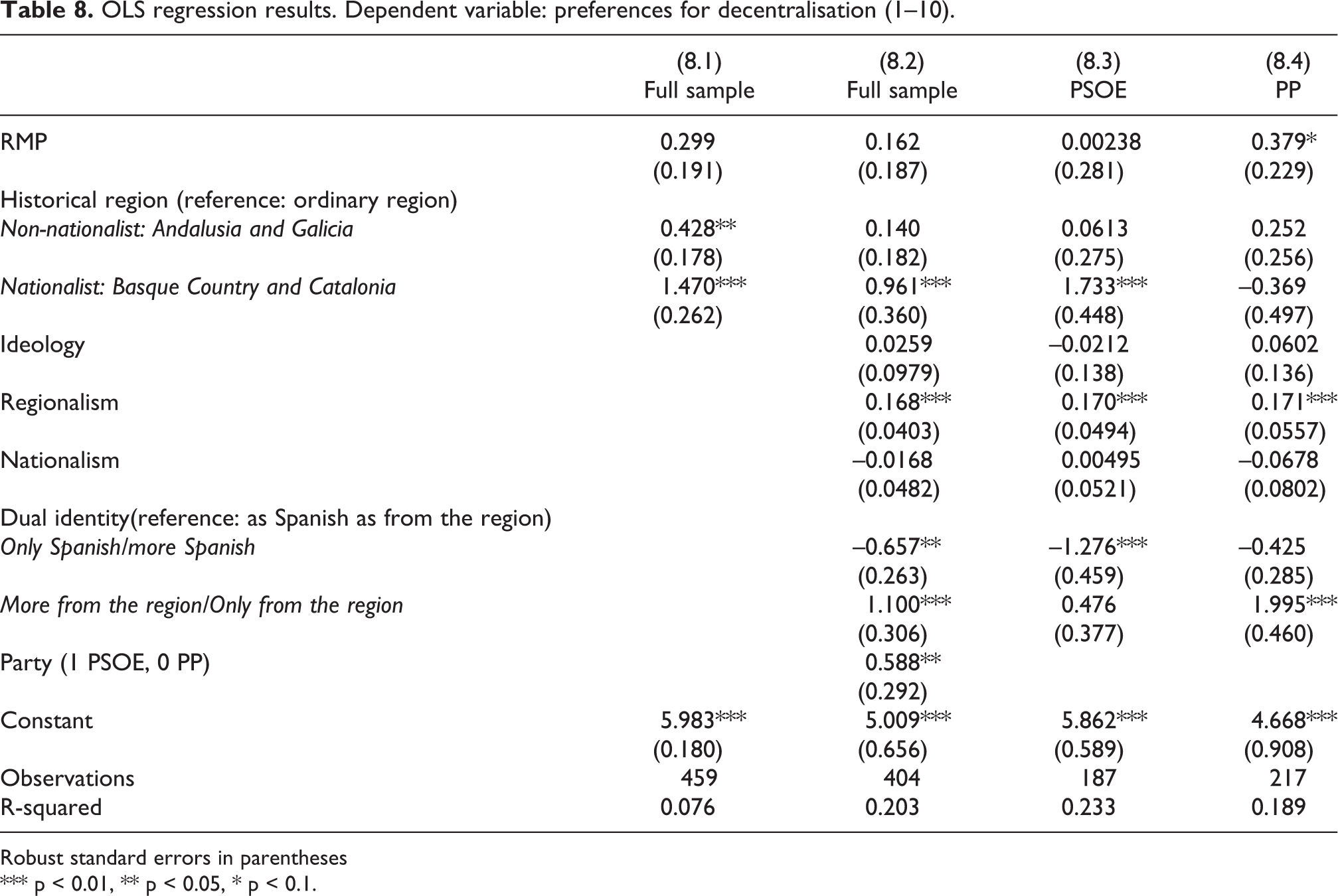
We now run similar econometric models on the second dependent variable “preferences over decentralisation”. Results are shown in Table 8. In model 8.1 we test H1 and H2 running the model in the overall sample of parliamentarians. Results show that the territorial cleavage exhibits a stronger explanatory power than the institutional one and its effect remains robust to the inclusion of further independent variables in model 8.2. The opposite applies to the coefficient of RMP, which gets smaller and loses significance when further additional controls are added (in model 8.2). We test for H3 in model 8.3, confirming that heterogeneity in preferences towards decentralisation among Socialist parliamentary elites is driven by the territorial cleavage in nationalist regions. As for People’s Party’s representatives (H4), the reverse occurs: there is no evidence to support the existence of a territorial cleavage, whereas the coefficient of RMP in the PP sample exhibits a positive sign, as expected, but it is only significant at a10% level of confidence (model 8.4).
OLS regression results. Dependent variable: preferences for decentralisation (1–10).
Robust standard errors in parentheses
*** p < 0.01, ** p < 0.05, * p < 0.1.
Altogether, empirical results provide evidence on H1 and H2 hypotheses, although the territorial cleavage becomes more relevant to account for parliamentarians’ general preferences towards the territorial organisation of the State, whereas level of representation seems to be more important to explain representatives’ preferences and attitudes towards self-rule in their region. We have also found support to the hypotheses that expect cleavages to have different explanatory power in each party (H3 and H4). The territorial cleavage is more relevant to account for heterogeneity in preferences among Socialist representatives, whereas the paper uncovers that the most important source of internal fracture among PP representatives is institutional (regional parliamentarians exhibiting stronger preferences towards self-rule than their national counterparts).
However, a concern about the long-lasting nature of the internal divergences uncovered by the empirical analysis among PP representatives is that results might be too much driven by contextual factors. The fact the PP was in opposition at the national level when the interviews were conducted may have contributed to reinforcing the institutional cleavage. The literature has shown that the capacity of national leaders to impose a coherent national agenda and restrain regional deputies’ demands diminishes when the party is in opposition at the national level (Fabre, 2008; León-Alfonso, 2007; Méndez-Lago, 2005). Heterogeneity in preferences for devolution between regional and national representatives revealed by the empirical analysis may therefore have weakened after PP took over national office in 2011. In addition, regional arenas may grant opposition parties a tribune to voice demands for self-rule as a strategy to weaken the central government (Verge, 2013: 321). Accordingly, preferences towards self-rule among PP’s regional deputies may result from an “opposition” strategy to confront a central government that was controlled by the Socialist party at the time when the surveys were conducted. Future empirical analyses will reveal the extent to which the internal fracture within the PP revealed by the empirical analysis remains over time. The institutional cleavage can potentially lead towards a less centralist stand on PP’s territorial discourse, but this will only be so if future analyses show that the institutional cleavage remains while PP runs the central government.
Concluding remarks
The literature that explores the relationship between decentralisation and the structure of the party system has barely explored an important dimension of party integration, namely the degree of ideological cohesiveness among parliamentary elites. The gap is particularly astonishing if we take into account that some of the changes that operate in the party system or in electoral competition as a result of decentralisation may ultimately originate in the degree of heterogeneity among party elites’ preferences towards self-rule.
This paper purports to fill in the literature gap by analysing attitudes towards devolution in a sample of 460 Spanish parliamentary elites, with a special focus on representatives from the two mainstream political parties, the PP and the PSOE. The analysis explores what factors account for the degree of cohesiveness among representatives’ attitudes towards regional self-rule. Empirical evidence shows that heterogeneity in preferences towards devolution is explained by the territorial cleavage, as national and regional deputies who reside in nationalist historical regions (where electoral competition is dominated by nationalist parties) exhibit stronger preferences for self-rule than parliamentarians from ordinary regions. We also find support to the institutional cleavage hypothesis, showing that regional deputies’ attitudes are more favourable to regional self-rule than national representatives. Historical region is particularly relevant to explaining variation in general orientations towards the territorial organisation of the State, whereas the role of institutional representation is more important to explaining representatives’ attitudes and preferences towards self-rule in their region.
Empirical evidence also shows that sources of heterogeneity in preferences towards devolution are different across the two mainstream parties (PP and PSOE). The institutional cleavage is more important to explaining variation in attitudes towards self-rule among the PP’s elites, whereas the territorial cleavage is more relevant to accounting for heterogeneity in preferences among Socialist representatives.
To conclude, in Spain the territorial debate has been mostly dominated by the nationalist cleavage. The presence of nationalist parties both at the regional and national level and the resulting centrifugal push of political competition has been a crucial factor in fuelling heterogeneous preferences for devolution and in triggering different reforms of political and fiscal arrangements during the last decades. This paper provides evidence on the importance of the territorial cleavage to explain heterogeneity in preferences towards devolution among Spanish parliamentary elites. The empirical analysis also shows that the creation of regional institutions in a decentralised state may in turn create additional dimensions of divisions within state-wide parties that revolve around institutional representation. These new sources of heterogeneity may operate on top of (or even surpass) the centrifugal dynamics generated by the territorial cleavage.
Footnotes
Acknowledgements

Declaration of conflicting interests
The author(s) declared no potential conflicts of interest with respect to the research, authorship, and/or publication of this article.
Funding
The author(s) disclosed receipt of the following financial support for the research, authorship, and/or publication of this article: This project has been financed by the Spanish Ministry of Economy and Competition (CSO2011-28635).