






Abstract
This article analyzes the strategies parties employ during the inter-electoral phase of party competition. It focuses on Spain’s multi-national democracy and how regional-nationalist parties frame their policy proposals in the statewide parliament (Congress of Deputies) for the period 1979–2011. Using the Catalan Convergence and Union (CiU) and the Basque Nationalist Party (PNV), it examines how frequently the parties rhetorically connect their bill proposals to the center-periphery dimension of party competition, and their justifications of these proposals in parliamentary debate. Challenging the niche party thesis, our findings indicate that the parties frame a small share of bills in center-periphery terms. They most frequently justify their center-periphery bills with reference to legal-constitutional compliance and administrative efficiency and less frequently with reference to culture, citizen rights, and economic performance. This can in part be explained by the fact that these parties are mainstream parties within their regions and operate in a clearly demarcated two-dimensional space in a multilevel state.
Introduction
In multinational democracies, party competition most prominently occurs on center-periphery and left-right policy issues. All parties face the decision of where (and if) to position themselves on each issue dimension, the degree to which to emphasize it (or not at all), and how to frame issues belonging to distinct dimensions of party competition (Elias et al., 2015). Parties’ strategic choices are typically rendered more complex because of competition within and across statewide and regionally-based party types, and, in multilevel states, because parties compete at distinct territorial levels, often during non-concurrent election cycles, and with distinct political weights at the national, regional, and local levels.
The articles in this special issue seek to advance our understanding of party competition in multinational political contexts, in particular the strategic choices parties make regarding the two-dimensional nature of political competition. We are interested in how the regionally-based nationalist parties (for simplicity, regional-nationalist) choose to frame their policy proposals in the central parliament during the inter-electoral phase of party competition (Benoit and Laver, 2006: 37). The empirical analysis focuses on the two most significant regional-nationalist parties in Spain, the Catalan nationalist Convergence and Union (CiU) and the Basque Nationalist Party (PNV), between 1979 and 2011. Different environments present different strategic challenges for distinct parties and party types. Regionally-based parties (for simplicity, regional parties) are relatively minor parliamentary actors in the central parliament, with no ability to pass their preferred policies without the support of other, major statewide parties; yet, they face a territorially-delimited electorate during the electoral phase of party competition. 1 Do they opt to frame their proposals in a way that emphasizes their territorial pedigree? Or do they choose to present bills without much reference to the center-periphery dimension?
To help answer these questions, we examine the parties’ behavior in Spain’s Congress of Deputies (for simplicity, the statewide parliament). We determine the frequency with which they rhetorically connect their bill proposals to the center-periphery dimension of party competition, and how they justify these proposals in parliamentary debate. In doing the former, we evaluate what we call the niche party thesis and the use of a uni-dimensional strategy (Elias et al., 2015), i.e. regional parties primarily focus on center-periphery issues.
Our findings indicate that Spain’s regional-nationalist parties do not frequently frame their policy proposals in center-periphery terms, indicating they opt not to pursue a uni-dimensional strategy and also should not be viewed as niche parties. When presenting bills related to center-periphery issues, they most frequently justify them with reference to legal-constitutional compliance and administrative efficiency and less frequently with reference to culture, citizen rights, and economic performance. The explanation for both likely lies in the fact that both parties, while exhibiting differences, are mainstream parties within their regions and during the entire democratic period (and before) operated in a clearly demarcated two-dimensional party system in a multilevel state. While we do not measure the parties’ use of a blurring, subsuming, or a two-dimensional strategy, our results and reading of the parliamentary debates suggest that a two-dimensional strategy is the most common, and therefore the most fruitful, path for future research.
Party competition in the inter-electoral phase and in different arenas
Party scholars recognize, but do not always investigate, that parties can, and often do, behave differently during different stages of party competition and in different arenas. The bulk of the literature on party competition generally (e.g. Budge et al., 2001; Downs, 1957) and in multinational democracies specifically (e.g. Alonso et al., 2013; Libbrecht et al., 2009; Mazzoleni, 2009) focuses on the electoral phase.
While manifestos, campaign speeches, and other public statements made as part of the electoral cycle certainly provide crucial information regarding party strategies, particularly the signals that parties try to send to voters, party strategies can also be gauged in-between elections. Parties take discursive stands on specific policy issues, which in turn may reinforce or alter party positions. Furthermore, it is during the inter-electoral phase when parties establish policy records that voters can use retrospectively to make electoral decisions. Focusing primarily on parties’ promises during an election campaign fails to integrate past policy records into establishing voters’ preferences at the ballot box.
Party strategies in the inter-electoral phase of competition may be captured in expert surveys (e.g. Hooghe et al., 2010; Szöcsik and Zuber, 2015). However, expert surveys are a holistic assessment of parties’ positions, relying on broad questions such as “where does party X fall on the left-right spectrum?”, and, at the same time, we cannot know which party document(s) or action(s) the expert is taking into consideration. It is very plausible that distinct areas of expertise, e.g. electoral compared to parliamentary politics, or regional compared to national politics, could lead experts to different conclusions. 2 Other studies employ roll-call votes to assess party positions based on the inter-electoral behavior of legislators, mainly in the USA, where party discipline is comparatively low (see Benoit and Laver, 2006: 69–71). While examining parliamentary speeches is not new and researchers have analyzed parliamentary speeches using computerized text analysis for the European Parliament (Proksch and Slapin, 2010) and national (Laver and Benoit, 2002) and subnational parliaments (Leonisio and Strijbis, 2011), these types of studies remain relatively rare.
We examine the parliamentary arena precisely because it is where all relevant parties make choices about policy, i.e. whether to propose or not, support or reject, amend or accept, and, most relevant here, how to frame their policy proposals. We assume that choices about policy proposals can affect whether or not they attain the support necessary to pass their bills (assuming the party does not have a majority) and parties’ electoral prospects, and are therefore carefully calculated.
Our empirical analysis focuses on the statewide parliament because it is typically where politicians make the most important decisions about the territorial organization and (multi)cultural, (multi)national identity of the state. Regional parliaments also constitute a significant arena for party competition in-between elections. Because of the distinct competencies of regional and statewide parliaments and the typically greater weight of regional parties at the regional level, we would not expect regional parties’ strategies to necessarily be the same across parliaments. While this is an important line of future research, as a first step we examine the statewide parliament as a useful exploratory context for our framing analysis.
Also, regional parties’ strategies in the statewide parliamentary arena are understudied. Most of the literature on political parties in multinational and multilevel states focuses on statewide parties (though see, for example, Alonso, 2012; Elias and Tronconi, 2011b; Hepburn, 2011b; Massetti, 2009; Toubeau, 2011). To our knowledge, empirical examination of how regional parties frame their policy proposals in the statewide parliament is lacking.
Regional parties’ strategies
In a multinational context, the primary dimensions of party competition are the left-right and center-periphery. We conceptualize the left-right dimension of party competition along the lines of the Chapel Hill Expert Survey of Party Positioning, i.e.
in terms of the ideological stance they [parties] take on economic issues. Parties to the right on economic issues tend to emphasize a reduction of the economic role of the government; they want lower taxes, less regulation, privatization, reduced government spending, and a leaner welfare state that poses fewer burdens on employers. Parties to the left on economic issues want the government to retain an active role in the economy. (cited in Hooghe et al., 2002: 967)
We use Alonso’s (2012: 24–27) conceptualization of center-periphery:
Today the term ‘periphery’ is used to designate territorial units with a differentiated history within the state, territories that are home to cultural minorities and that at the time of the state- and nation-building processes were subject to the homogenization policies of the state’s central elites. (Alonso, 2012: 24)
The center-periphery cleavage is essentially about territory and political control; yet, it encompasses diverse institutional, cultural, and fiscal issues. The institutional component relates to the “political status of the peripheral territory inside the state”; the cultural component relates to the “protection and preservation of the peripheral group’s cultural distinctiveness and identity”; the fiscal component is “the way in which the power of revenue and expenditure should be distributed between the central state and peripheral administrations” (Alonso, 2012: 25).
According to the theoretical framework laid out in the introductory article to this collection (Elias et al., 2015), regional and statewide parties choose whether and how to engage with each dimension, and therefore have several strategies at their disposal: a uni-dimensional strategy, where the party positions itself on the dimension that is most associated with its core issues while dismissing the second dimension; a blurring strategy involves staking a clear position on the party’s core, salient dimension of political competition, and deliberately blurring its position on the second dimension, which is less salient but not ignored; a subsuming strategy means the party rhetorically frames issues belonging to the second dimension of political competition in terms of its core dimension, while both dimensions are salient; and a two-dimensional strategy entails taking clear, distinguishable stances on issues that fall on both dimensions. The framework assumes that the primary dimension of political competition for statewide parties is the left-right dimension, while the primary dimension of political competition for regional parties is the center-periphery dimension.
In viewing both statewide and regional parties as strategic, this framework is consistent with a body of scholarship on regional parties (e.g. Alonso, 2012; Elias, 2011; Hepburn, 2011b; Massetti, 2009). Regional parties can emphasize or downplay distinct dimensions of party competition, and hold or adopt moderate or extreme positions on the center-periphery or left-right cleavage, depending on the strategic environment and the parties’ goals. Accordingly, even predominantly focusing on center-periphery issues is a strategic choice a regional party can make, i.e. the use of a uni-dimensional strategy.
Other scholars have placed regional parties in the niche party category (Ezrow, 2008; Jensen and Spoon, 2010; Meguid, 2008; Rovny and Edwards, 2012). According to Meguid (2008: 3, 4), niche parties share three features: 1) they “reject the traditional class-based orientation of politics”; 2) the issues raised by niche parties are “novel” and “often do not coincide with the existing, ‘left-right’ lines of political division”; and 3) they limit their “issue appeals.” In contrast, mainstream parties are “the electorally dominant actors in the center-left, center, and center-right blocs on the Left-Right political spectrum” (Meguid, 2005: 348).
The niche party literature often assumes the existence of an established party system with mainstream parties, which are challenged by new parties that attempt to restructure party competition to their benefit (Meguid, 2008; Rovny and Edwards, 2012). Meguid’s (2008: 14) work on the electoral success of niche parties focuses on how mainstream parties strategically respond to niche party challengers by “shifting their position on a given issue dimension” and “altering the salience and ownership of issue dimensions in the political arena.” Niche parties are viewed as having less capacity to respond strategically, in turn (Meguid, 2008: 15). In line with this thinking, we might expect regional parties to focus exclusively or predominantly on center-periphery issues because this is their niche.
We argue that the common assumptions about niche parties do not hold for all regional parties in inter-electoral competition alike. This speaks in part to the debate about the definition and operationalization of “niche party” (Meyer and Miller, 2015; Wagner, 2012). One problem is the use of party family to operationalize niche party status, which then becomes “fixed and purely binary” and “ignores the actual programmatic offer presented by parties” (Wagner, 2012: 846). Wagner defines niche parties as “parties that de-emphasize economic concerns and stress a small range of non-economic issues” and operationalizes it using expert surveys and party manifestos, instead of party family, which means that some members of a party family can be categorized as niche and others as mainstream, including regional parties (Wagner, 2012: 855). We note that using party family might be particularly risky for regional parties, which, as Urwin (1983: 227) observes, “are at once an exhilarating and difficult topic, with not too much in common.”
Furthermore, the niche party literature does not distinguish the territorial level at which political parties operate when they are classified; thus, a regional party that is a mainstream party at the regional level may get overlooked when parties are classified based on party family. For example, the regional-nationalist CiU and PNV in Spain are indeed mainstream parties because they are the “electorally dominant actors in the center-left, center, and center-right blocs on the Left-Right political spectrum” (Meguid, 2005: 348), yet at the regional level. Therefore, it is informative to study regional party behavior in Spain because it can help us establish scope conditions (Rohlfing, 2012: 144) for the niche party thesis; in other words, where are we most (least) likely to see niche party behavior.
Regionally-based parties in Spain
The literature on Spain’s regional and regional-nationalist parties is extensive (see, for example, the contributions in De Winter et al., 2006). Space limitations prevent a thorough review of this rich literature; yet, most relevant for this study, research on their behavior in the statewide parliament is scant. Existing studies tend to examine their roles in government formation and as support parties during minority governments (Aguilera de Prat, 2001; Field, 2014; Heller, 2002; Reniu, 2002; Ştefuriuc, 2013).
Spain is an important case for exploring multidimensional party competition in the statewide parliament. It has the largest number of relevant regional parties in Europe. It is a multinational democracy, with a heavily decentralized state in which both statewide and regional parties compete. In contrast to the niche party scenario, many regional parties are not “new” parties that emerge as “challengers” to existing “mainstream” parties and patterns of party competition, seeking to introduce a new issue dimension into political competition.
When democracy reemerged in Spain in the mid-1970s, some regionally-based parties were integral parts of the fledgling party system, particularly PNV and Democratic Convergence of Catalonia (CDC) (which, in 1979, began to present candidates jointly with the Democratic Union of Catalonia/UDC as CiU). Party competition already encompassed both the left-right and center-periphery dimensions, which had deep historical roots. Some regional parties had longer organizational histories than the significant statewide parties. Along with the main statewide leftist Socialist Party (PSOE), the regionally-based PNV and UDC on the center right, and Republican Left of Catalonia (ERC) on the left competed in elections in the 1930s. The new parties included the statewide center-right Union of the Democratic Center (UCD), which governed Spain at the outset of democracy, the statewide rightist Popular Alliance (AP) (later renamed the Popular Party – PP), and the regional-nationalist center-right CDC.
The Catalan CiU and the Basque PNV became mainstream governing parties at the regional level early on as the party system itself developed. It was clear after the founding elections in 1977 that political authority would be decentralized to regional governments (Aja, 2013: 60). Elections to regional parliaments in Catalonia and the Basque Country occurred in 1980 (followed by other regions). Yet all parties had a good indication of their weights in the regions from the 1977 election, and the Catalan and Basque regional-nationalists were leading players. In the Catalan provinces in 1977, Democratic Pact for Catalonia (PDC), an electoral alliance that contained CDC, emerged as one of the leading parties. CiU repeated this success in the 1979 statewide parliamentary elections and subsequently won the first regional elections in 1980, governing Catalonia from 1980 until 2003, and again after 2010. PNV won the general elections of 1977 and 1979 in the Basque provinces and the first regional elections in 1980. PNV governed in the Basque Country from 1980 until 2009, before returning to government in 2012.
Nonetheless, the two parties are considerably weaker in the statewide parliament. Between 1979 and 2011, CiU, the most significant regionally-based party, held between eight and 18 of the 350 seats in Spain’s Congress of Deputies. PNV held between five and eight seats (see Table 1). 3 Nevertheless, both parties have been important parliamentary allies of statewide minority governments. Therefore, they must balance these distinct roles, mainstream party at the regional level and small regional-nationalist party at the statewide level.
Parliamentary bills presented by regional parties, Congress of Deputies, Spain, 1977–2011.

Notes: CiU (Convergence and Union); PNV (Basque Nationalist Party); MCV (Catalan and Basque Minorities); PA (Andalusianist Party); CC (Canary Islands Coalition); ERC (Republican Left of Catalonia); IU-ICV (United Left-Initiative for Catalonia Greens). *Multiparty (statewide and regional) groups.
Source: Initiatives database, available at: www.congreso.es (accessed 22 November 2013). Search: Author (X parliamentary group), Type of initiative (Congressional parliamentary group bills).
Bill proposals
The regional-nationalist parties have a number of opportunities to articulate strategies in the multidimensional party space. Yet because they are less prominent statewide parliamentary actors, in most instances, they are reacting to the government or to another party’s policy or political agenda, such as in debates on investiture, the government’s actions, government and parliamentary bills, and amendments to other parties’ bills. However, the regional-nationalist parties in Spain have considerable autonomy to present bills and make strategic choices about their framing.
Analyzing parties’ framing strategies provides great insight into how the parties compete in the statewide parliamentary arena. The potential audiences for their statements are very distinct. On the one hand, statements are directed at voters, or a subset of voters. The parties are making public statements about the party’s policy priorities. Voters can access these debates online, and debates are also open to public attendees and the press. On the other hand, the regional-nationalist parties are minor parties in a statewide parliament dominated by statewide parties, whose support is necessary for their policy proposals or preferences to prosper. Parties can choose to frame their bill proposals in a way that is entirely directed at voters, and eschew concerns about whether or not the policies will pass, the reverse, or somewhere in-between. They also have to decide whether to appeal to public opinion at the regional level, where their potential voters are located, or more broadly, which could affect how the statewide parties react, or they can attempt to at least partially appeal to both audiences.
Evidence that their decisions are calculated is provided by PNV MP González de Txabarri Miranda, when he presents a PNV parliamentary bill that seeks to change the names of the Basque provinces to the Basque language in Gipuzkoa and Bizkaia and to a bilingual Araba/Alava:
There is no doubt … that a bill can be approached from different perspectives: linguistic, spelling, phonetic or phonological criteria. Historical criteria or institutional criteria could, from complementary perspectives, be examined in order to be able to consider this bill and each group take a position in relation to it.
4
Instead of coding the content of the bill, we code the party MP’s speech presenting the bill in a parliamentary debate, which determines whether or not parliament will take further action on the bill (referred to as toma en consideración debate in the Congress of Deputies’ official business and parliamentary records). These parliamentary speeches provide room for exposing political motives, and, while not aimed at reaching a wide public and voters in the same way as an election manifesto, they are public declarations in relatively accessible language that can be followed by the public and the media.
Dimension framing and policy justifications
The theoretical framework posits that parties make choices about issue salience, positioning, and framing. Building on prior work, we conceive of a frame as a “schemata of interpretation” (Groffman, 1974: 21) and framing as a “more or less consciously managed process by which these schemata are manufactured, selected, distributed and adopted in successive steps” (Helbling et al., 2010: 498). We do not consider framing to pertain exclusively to a subsuming strategy. In other words, framing is not a single strategic move wherein parties decide (or not) to reframe issues belonging to other dimensions of party competition onto their core dimension; framing occurs regularly throughout the political process. For example, even if a party engages in a uni-dimensional strategy, it is likely to make an argument for why it favors the policy it is proposing.
We examine how CiU and PNV frame their policy proposals. Yet, we are only interested in particular aspects of the framing process. First, we investigate what we call “dimension framing” – how parties shape whether or not a policy proposal belongs to a particular dimension of party competition (Rovny and Edwards, 2012). Second, we examine “policy justifications” – the types of arguments parties choose to justify the policy proposals (Helbling et al., 2010).
In the dimension framing analysis, we counted a bill as framed on the center-periphery dimension if the party at least in part rhetorically connects it to the center-periphery dimension of party competition, as defined in Alonso’s definition. 5 In other words, we read the entire bill to determine if the party refers to territoriality and political control. If a regional party rhetorically connects a high portion of their bill proposals to the center-periphery dimension, it could indicate the use of a uni-dimensional strategy or niche party behavior.
It is important to emphasize that we do not exogenously determine if the issue itself belongs on the center-periphery dimension. 6 This is in part because of the very nature of the center-periphery dimension of party competition. With few exceptions, such as a proposal on independence, it intersects with other dimensions of party competition, i.e. it is also about something else, whether economic, social, cultural, etc. Therefore, it is risky to exogenously posit which issues “should” pertain to the center-periphery dimension. Moreover, many issues can be framed in terms of a center-periphery dimension – or, alternatively, legislators can choose not to make reference to the center-periphery dimension. We are interested in the party’s strategic choice.
This methodology leaves it in the party’s hands to decide whether or not a policy issue belongs on the center-periphery dimension. The issue of domestic terrorism in Spain provides an example. Domestic terrorism has often been associated with the radical Basque nationalists of ETA, who used violence to attain their goal of an independent Basque state. Nonetheless, when dealing with bill proposals regarding terrorism, a party can choose how to frame the issue. For example, it could argue that the issue of terrorism will not be resolved without addressing the national identity question in the Basque Country, thereby rhetorically connecting the issue to the center-periphery dimension of party competition. Alternatively, a party could discuss law and order or protecting citizens from violence only, and thereby eschew framing the issue in center-periphery terms.
The parties we analyzed typically choose not to frame terrorism-related bills in center-periphery terms. Evidence suggests that this is a strategic choice. On a bill co-sponsored by all of the parliamentary groups, on the recognition and integral protection of terrorism victims, the PNV MP presenting the party’s defense of the bill was angered by the Socialist MP who he claimed had politicized the terrorism issue in his defense of the bill, when the parties had apparently agreed not to:
we presumed this was going to be a debate based on solidarity, on the unity that we have been able to achieve about the problems of the victims.… You made many tangential observations; you talked more of terrorists than of victims. You figured that what started well could end better. Hopefully it will end better, but to do so we need to articulate different types of statements and not continue claiming ownership of the pain of the victims to attain political benefits or whatever.
7
Once we identified the bills the party rhetorically connected to the center-periphery dimension, at least in part, we coded the party’s justification(s) for the policy. The bills that were not framed at all in center-periphery terms in the first step are dropped from the analysis at this stage. Policy justifications provide the party’s reasons for pursuing a particular policy and attempt to influence how voters and other audiences view a policy proposal. There are many ways to justify center-periphery policy proposals. We coded five policy justifications, derived exogenously from arguments frequently mentioned in the literature on multi-nationalism and centralization/decentralization: economic/welfare performance; cultural distinctiveness/similarity; administrative performance of the state; legal-constitutional compliance; and citizen rights and representation. While only these justifications were ultimately coded, we initially anticipated inductively determining additional categories. However, we noted no other common justifications. Each bill was read in its entirety to identify all of the justifications employed; multiple justifications could be used for any single bill and each type was counted once if used.
Economic/welfare performance comprises arguments that refer to advances (or regressions) of economic performance or social welfare. To illustrate, a CiU MP justified a bill on changing the limits imposed on regional governments to supplement non-contributory pensions by stating that the objective of pension subsidies supplied by the regions is to “provide a minimum of dignity to those pensioners who receive the lowest pensions”. 8
Cultural distinctiveness/similarity captures arguments that refer to the unique culture, including history, language, customs, etc. of a particular region, community, or nation within Spain, or, conversely, the shared culture of all Spaniards. For example, a CiU MP justified a bill that would devolve competencies over traffic to the Catalan regional government, in part, in terms of “the desire and ability of the Catalan people (pueblo) to govern themselves as a nation—a nation with more than a thousand years of history”. Administrative performance of the state comprises arguments that refer to advances (or regressions) of administrative efficiency, at any state level. For example, a CiU MP justified a bill that would increase regional competencies regarding traffic in terms of easing the processing of traffic violations that entail the loss of a driver’s license. 9
Legal-constitutional compliance captures arguments about compliance with or violation of existing legal or constitutional provisions, including constitutions, national laws, regional government charters, regional laws, and European Union provisions. For example, a CiU MP justified a bill that proposed to guarantee the use of all official languages in the writing of contracts in terms of the legal status of official languages in certain autonomous communities, codified in both the Spanish constitution and the regional autonomy statutes. 10 Citizen rights and representation refers to arguments about advancing (or diminishing) citizen participation in the democratic decision-making process or the representation of citizens in the institutions. This does not include justifications in terms of cultural distinctiveness/similarity, but rather citizen equality and rights. For example, a PNV MP justified a bill that would allow national sports teams representing the Basque Country, Catalonia, and elsewhere, in part, in terms of representing citizens’ preferences in certain areas; “very ample majorities, of at least three quarters of their inhabitants, above ideological and voting barriers.” 11 We do not evaluate the merits of the arguments, but rather the types of arguments parties choose to make.
Furthermore, we are interested in identifying patterns of variation. We analyze whether the framing strategies depend on the type of government, both in terms of the governing party and the government’s majority or minority status. It could be argued that the statewide PSOE has been more supportive of pro-periphery policies than the PP, thereby affecting framing strategies. The minority/majority status of the government might matter because the dynamics of gathering legislative support differ. Under minority rule, regional parties have commonly been core legislative allies for the ruling party, while they have had considerably less influence during majority rule.
Data, analysis, and results
We examined CiU of Catalonia and PNV of the Basque Country between 1979 and 2011 (Legislatures 1–9). This period begins with the first post-constitutional legislature of Spain’s democracy. Our dataset consists of 348 bills, 264 bills from CiU and 84 from PNV. The number of debates we coded is considerably smaller, however, since no debate occurred for 134 bills (104 bills for CiU and 30 for PNV) for various reasons: some expired when the legislative period ended; a few were voted without a debate (e.g. when all parliamentary party groups sponsored the bill); and a small number merged with other bills. Thus, the total number of bills coded and analyzed is 214 (160 for CiU and 54 for PNV), which represents the universe of cases.
Dimension framing
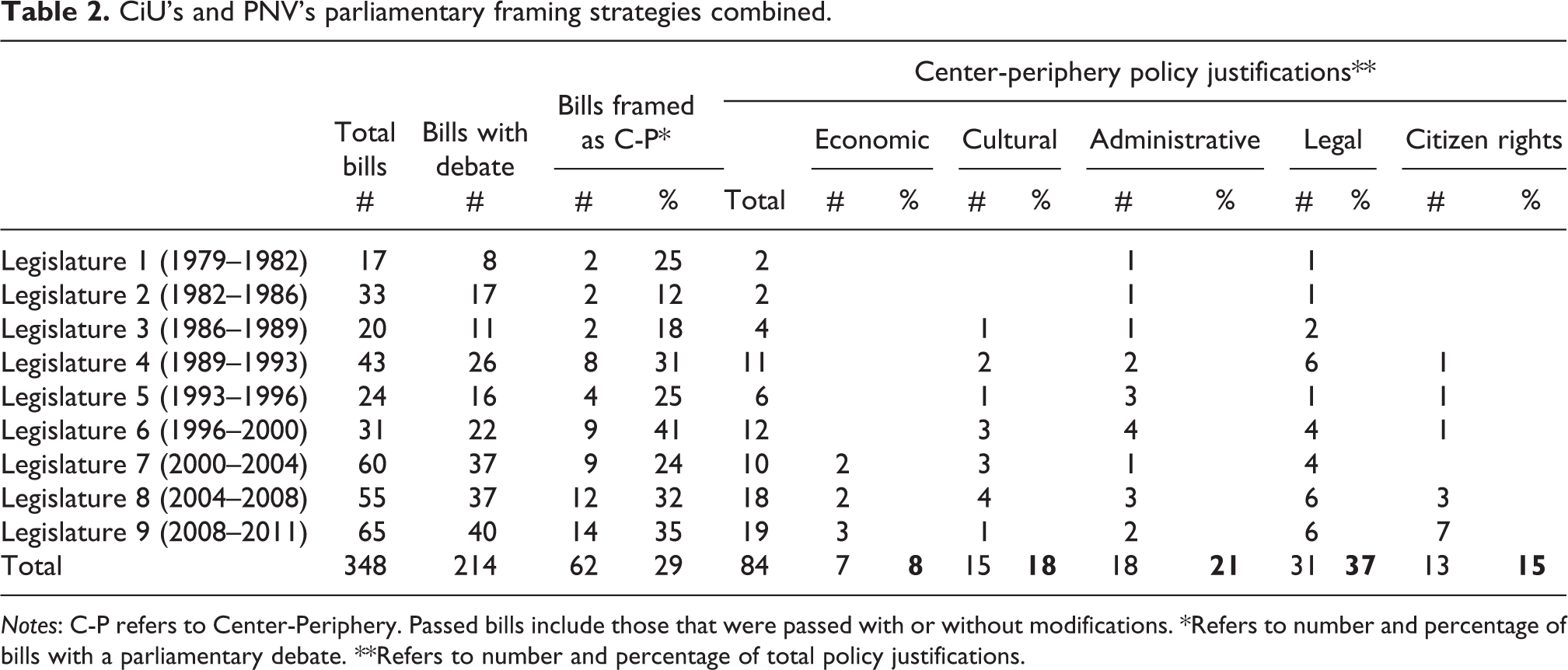
Out the 214 debates examined, the regional-nationalist parties framed 29% (62) of bills in center-periphery terms (see Table 2). Stated differently, they framed more than two thirds of the bills on other, non-center-periphery dimensions. CiU framed a total of 42 (26%) in center-periphery terms, and PNV 20 (37%), a moderately higher percentage (see Tables 3 and 4). When it comes to proposed legislation in the statewide parliament, the parties mostly refrain from framing their proposals on the basis of a center-periphery agenda.
CiU’s and PNV’s parliamentary framing strategies combined.
Notes: C-P refers to Center-Periphery. Passed bills include those that were passed with or without modifications. *Refers to number and percentage of bills with a parliamentary debate. **Refers to number and percentage of total policy justifications.
CiU’s parliamentary framing strategies.

Notes: C-P refers to Center-Periphery. Passed bills include those that were passed with or without modifications. *Refers to number and percentage of bills with a parliamentary debate. **Refers to number and percentage of total policy justifications.
PNV’s parliamentary framing strategies.

Notes: C-P refers to Center-Periphery. Passed bills include those that were passed with or without modifications. *Refers to number and percentage of bills with a parliamentary debate. **Refers to number and percentage of total policy justifications.
This finding clearly demonstrates that these parties are not niche parties that focus on a narrow issue set. They also clearly do not pursue a uni-dimensional strategy. Instead, their bill proposals rhetorically embrace a range of issues. Also, the parties at times opt to eschew rhetorically connecting a bill proposal to the center-periphery dimension of party competition when it would certainly be possible to do so. This suggests another strategy: parties may strategically avoid their primary dimension.
Regional parties vary with respect to their electoral weight and governing capacity at various state levels. The fact that both CiU and PNV are governing parties (actual or potential) at the regional level helps explain their choices regarding dimension framing. While both parties clearly prefer pro-periphery policies, these are not the only issues that concern the parties. We thus concur with Jeffery (2011: 160), who, speaking of stateless-nationalist and regionalist parties (SNRPs) generally, states: “Platforms restricted to winning (more) self-government may prove insufficiently attractive to enough voters for SNRPs to get into government. So those SNRPs that become committed to winning office face pressures to widen their programmatic base to attract a bigger electorate” (see also, Elias and Tronconi, 2011a: 363).
Institutional arrangements and partisan dynamics within institutions might further explain the parties’ choices. The Spanish model of asymmetric, non-institutional federalism (Colomer, 1998) tends to privilege bilateral negotiations between individual regions and the central government on center-periphery issues. Thus, formulating bill proposals in the statewide parliament might not always be the best strategy to advance center-periphery policy preferences. Related, CiU and PNV are involved in complex bargaining processes with the statewide government, especially during minority governments, further affecting their framing strategies. They framed their legislative proposals somewhat more frequently along a center-periphery dimension during minority governments (average of 33%) than majority ones (23%), possibly reflecting their greater bargaining power during minority governments or a strategy to highlight their territorial credentials while they more closely cooperate with the central government.
Differences between the two parties were, however, manifested, with PNV more often framing its bill proposals in center-periphery terms compared to CiU, approximately one in three and one in four, respectively (see Tables 3 and 4). While both parties have historically been considered moderate nationalist parties (and centrist in ideological left-right terms), PNV is typically characterized as more assertively nationalistic, or ambiguous in its position regarding secession (see, for example, Massetti, 2009), whereas CiU, until recently, did not advocate independence.
The governing party appears to have little effect: during the six governments headed by the PSOE, the regional-nationalist parties framed an average of 29% of bills in center-periphery terms, compared to 31% during the two governments lead by the PP, and 25% during the UCD-led governments during the first legislature. We also observe a gradual increase in the number of bills the parties frame in center-periphery terms over time, mostly due to CiU’s behavior; however, this may reflect the parties’ increasing legislative activity rather than a turn in their framing strategies.
Policy justifications
Of those bills the parties framed in center-periphery terms, the most frequently used policy justification is legal-constitutional compliance (37%), followed by administrative performance of the state (21%), cultural distinctiveness (18%), citizen rights and representation (15%), and lastly economic/welfare performance (8%) (see Table 2). 12 For each party, the legal-constitutional compliance justification is the most common. This is perhaps not surprising in a law-making environment; nonetheless, it is noteworthy that it is an innocuous justification. The relative infrequency of other policy justifications is remarkable. We identified just seven instances of an economic/welfare justification, all for CiU, and only during the most recent legislatures (Legislatures 7, 8, and 9).
There are no discernable, general trends over time. While economic justifications were not used until Legislature 7 (2000–2004) and references to cultural issues and citizen rights were absent during the first two legislative periods (see Table 2), the use of these justifications remains infrequent, and we think it premature to interpret these as meaningful, strategic actions. However, again the two parties differ. Both parties most frequently justified their policies in legal-constitutional terms, but this justification was far more frequent for PNV (45%) than CiU (33%). After legal-constitutional compliance, CiU’s most frequent policy justification is administrative performance (25%), followed by cultural (16%), and equally by citizen rights (13%) and economic or welfare performance justifications (13%). In contrast, PNV’s second-most-common policy justifications were cultural distinctiveness (21%), which was used more frequently than in the case of CiU (16%), 13 and citizen rights (21%). The other policy justification PNV used was administrative performance (14%). 14 It never employed an economic justification. These findings on dimension framing and policy justifications suggest several conclusions.
Discussion and conclusion
This article examined the frequency with which two of Spain’s regional-nationalist parties rhetorically connect their bill proposals to the center-periphery dimension of party competition, and how they justify these proposals in parliamentary debate. In doing the former, we set out to evaluate the niche party thesis and the use of a uni-dimensional strategy, evidence of which would be that regional parties primarily focus on center-periphery issues.
Our findings indicate that Spain’s regional-nationalist parties do not frequently frame their policy proposals in center-periphery terms in the statewide parliament. While both the PNV and the CiU are broadly known for their pro-periphery agenda, this agenda is not well reflected in this context. This challenges the common assumption that all regional parties are similar and can be classified as niche parties. It also indicates that they do not engage in a uni-dimensional strategy.
The explanation, we suggest, lies in the fact that both parties, while exhibiting differences, are mainstream parties within their regions and operate in a clearly demarcated two-dimensional space wherein they compete with statewide and other regional parties. They are also mobilizing and channeling existing or old issues based on a social cleavage, rather than new, unaligned issues. Our study of regional-nationalist parties in Spain therefore suggests that regionally-based parties will be very unlikely to employ uni-dimensional strategies if they are mainstream parties at the regional level. While we did not set out to measure the parties’ use of a blurring, subsuming, or two-dimensional strategy, our findings and reading of the debates suggest that a two-dimensional strategy is the most common, and therefore the most fruitful, path for future research.
Our empirical findings also suggest that the theoretical framework lends itself to further refinement. First, the center-periphery dimension is not necessarily the primary dimension of party competition for regional parties in absolute terms, i.e. more important than other dimensions of party competition, at least when it comes to their behavior in the statewide parliament. Nonetheless, it may be relatively more important to them than to their statewide party competitors. Second, framing is not only relevant to a subsuming strategy. It happens throughout the political process. We argue that framing is a strategic choice parties make, and the fact that the two parties we studied exhibit variation in their framing strategies lends some evidence to support this argument. Third, the use of the strategies outlined in the framework might be contingent on the context in which parties act, and distinct strategies might be more usefully employed for certain types of activities than for others. Finally, our empirical analysis hints at another strategy: parties may strategically avoid their core dimension.
By focusing on parties’ framing strategies in parliament during the inter-electoral period, we explored new ways to supplement existing methods for analyzing party competition. The findings demonstrate the importance of looking at the context in which parties act. In the inter-electoral cycle and inside the political institutions parties face competing pressures and audiences, which in turn constrain their strategies. Further research should explore whether the regional-nationalist parties use different framing strategies when they propose bills in their respective regional parliaments, where they can potentially govern and all legislators face the same regional voters. This would move us closer to a multilevel understanding of party competition with respect to framing strategies.
We hope that our contribution helps advance toward an understanding of if and how (and how much) party behavior varies (or not) across arenas and why, and the impact of behavior in one arena on another. We could, for example, better understand whether parties use the same strategies or mix of strategies across arenas, and whether strategies used in one constrain party behavior in another. A composite of party behaviors in different arenas and contexts may help advance a more complete understanding of party competition. We also hope that the approach to coding legislative bill proposals developed here can easily be adopted or adapted to be used for other cases, thus providing a tool for meaningful comparative work.
Footnotes
Acknowledgements
For helpful comments and suggestions, we thank the special issue editors, the anonymous reviewers, and the participants in the Position, Salience and Issue Linkage: Party Strategies in Multinational Democracies workshop, University of Aberystwyth, UK.
Funding
The authors gratefully acknowledge funding from the Ministerio de Ciència e Innovación, Gobierno de España (CSO2010-16337).