






Abstract
The primary dimension of political contestation for regionalist parties is the centre-periphery dimension but they are pressured to adopt positions on the left-right dimension by competition with state-wide parties. We argue that the relative economic position of a region is a key variable for explaining how regionalist parties adopt left-right positions and link them to the centre-periphery dimension. Based on a quantitative analysis of 74 regionalist parties – distributed in 49 regions and 11 countries – over four decades, we find strong evidence that regionalist parties acting in relatively rich regions tend to adopt a rightist ideology, while regionalist parties acting in relatively poor regions tend to adopt a leftist ideology. A qualitative illustration of two paradigmatic cases, the Lega Nord (LN) and the Scottish National Party (SNP), appears to support our interpretation that left-right orientations are subsumed into centre-periphery politics through the adoption of two ideal types of regionalist discourse: one labelled as ‘bourgeois regionalism’ (Harvie, 1994) and one labelled as ‘internal colonialism’ (Hechter, 1975).
Introduction
Regionalist parties can be considered the political manifestation of the existence and relevance of the centre-periphery cleavage in a given political system (Lipset and Rokkan, 1967; Rokkan and Urwin, 1983). Their ideology originates from the defence and promotion of territorially defined identities and interests, and is programmatically centred on self-government claims (De Winter, 1998a: 204–205). A great deal of their political struggle, therefore, consists of trying to push the territorial dimension into the political agenda, thus making it a salient dimension of party competition. However, even when they manage to do so, traditional left-right politics surely does not vanish. As a consequence, just as state-wide parties need to come to terms with what for them is a secondary (and perhaps divisive) dimension – the centre-periphery one – regionalist parties undergo systemic pressure to take into consideration what for them is also a secondary (and perhaps divisive) dimension – the left-right one. This is particularly the case for competition at the regional level, where regionalist parties might have some chance of getting into office (Elias and Tronconi, 2011; Tronconi, 2014) and are therefore expected to outline their programmatic platform across a wide range of policy areas. However, they might also be pushed to position themselves in the national arena, where important decisions on socio-economic policies are taken.
This article aims to investigate how regionalist parties position themselves along the left-right dimension and whether this dimension is somehow linked and subsumed with the centre-periphery one. Using a novel cross-sectional and longitudinal dataset – which includes ideology scores for 74 regionalist parties distributed across 49 regions and 11 countries and participating in national and/or regional elections held between 1970 and 2010 – we undertake a quantitative analysis which allows us to investigate the main determinants of regionalist parties’ positioning on the left-right dimension. In particular, in this analysis we focus on the role of the relative economic status of the region (vis-à-vis the national average). Since economic issues represent the heart of the left-right divide (Huber and Inglehart, 1995; Wagner, 2011), a correlation between left-right positioning and the relative status of the regional economy would represent a strong indicator of the presence of a context-dependent link between the two dimensions. Indeed, we find that regionalist parties in relatively poor regions position themselves overwhelmingly to the left and, vice versa, regionalist parties in relatively rich regions position themselves overwhelmingly to the right. We also provide a qualitative illustration regarding two paradigmatic cases – the Lega Nord (LN) and the Scottish National Party (SNP) – in support of our interpretation of the quantitative analysis’ results. Although only a wider and more systematic study of ‘framing’ can produce the final evidence, our analysis provides support for the thesis that regionalist parties tend to subsume their left-right ideological orientations into centre-periphery politics. They appear to do so by developing two types of regionalist discourse: a) the ‘bourgeois regionalism’ discourse (Harvie, 1994), which is based on grievances of exploitation by state policies that directly (territorial transfers) or indirectly (welfare) drag resources from the wealthy (and supposedly hard-working) region to send them to other poorer (and supposedly self-indulgent) regions; and b) the ‘internal colonialism’ discourse (Hechter, 1975), which is based on the idea of uneven development due to state choices which favour the economic development of certain regions at the expense of others, without providing enough direct (investments) or indirect (welfare) transfer of resources to close the development gap or to limit the output differential.
In the next section we discuss the literature on regionalist parties’ ideological positioning and outline our analytical framework and related hypotheses. In the following section we discuss our dataset and coding. We then present the descriptive statistics and the results of our multivariate analysis, outlining the main factors of left-right positioning and the links with the centre-periphery dimension. We follow that with a qualitative illustration concerning two exemplifying cases to explore the nature and logic of those links. We end with a brief summary and discussion of our main findings.
Analytical framework and main hypothesis
By definition (De Winter, 1998a: 204–205; De Winter et al., 2006a) – and as confirmed by recent empirical studies (Alonso, 2012: 40) – the centre-periphery cleavage represents the origin of regionalist parties and the basis of their core ideology. These parties are ideologically and programmatically focused on both the symbolic/identitarian (i.e. recognition of regional peculiarities, minority ethnic groups or minority nations) and substantive questions (attribution of institutional powers/resources to ‘their’ region) stemming from this originating cleavage (Dandoy, 2010). At the same time, the scholarship has widely acknowledged that regionalist parties do not remain (and, often, are not even born as) single-issue ‘prolocutors’ (Lucardie, 2000). Many of them, more or less reluctantly and more or less clearly, develop a multi-issue and multi-dimensional ideology (Newman, 1997; De Winter, 1998a; Massetti, 2009; Newman, 1996).Yet, given the paucity of comparative studies on regionalist parties’ ideology (Gomez-Reino et al., 2006: 252), there are still many moot points on the determinants of their ideological positioning both along their primary (centre-periphery) dimension and, even more, across the primary and secondary (left-right) dimensions.
Some scholars pointed out that the links between the centre-periphery and left-right dimensions can be deeply influenced by the specific national and regional contexts, which shape social characteristics of the regionalist movements and the dynamics of party competition (Coakley, 1992). Others even reject the possibility of generalizations, claiming that whether regionalist movements and parties will take a leftist or rightist colour depends on idiosyncratic critical junctures related to past historical events (Erk, 2005, 2009). 1 However, other studies suggest that some context-dependent factors are not incompatible with generalization. In particular, Massetti (2009) advances the hypothesis that, due to the dominant position of socio-economic issues in left-right ideologies (Huber and Inglehart, 1995; Wagner, 2011), the relative status of the region (i.e. whether the region is relatively better off or worse off vis-à-vis the whole state) might deeply affect the left-right ‘colour’ of its regionalism. In other words, regionalist parties might ‘read’ left-right politics through the prism of their territory and, in turn, as also suggested by Gourevitch (1979) and Horowitz (1985), this prism can be strongly affected by the relative economic status of the region. Regionalist parties in relatively poor regions are, arguably, more attracted by Marxist/neo-Marxist (e.g. Gramscian) theories of territorial division of labour (Nairn, 1977) or dependency theories recalibrated within the scope of nation-states, such as ‘internal colonialism’ (Hechter, 1975); while regionalist parties in relatively rich regions are, arguably, more attracted by neo-liberal discourses on the need/right of individual regions to compete in world markets, free from the oppression of state taxation aimed (also) at territorial transfers (Harvie, 1994). 2 In short, the putative subsuming of the economic left-right dimension into the centre-periphery dimension involves the translation of the idea of economic competition between socio-economic classes into competition between regions. Following this insight, we expect a correlation between the relative economic status of the region and the left-right positioning of regionalist parties. Regionalist parties in relatively poor regions tend to position themselves to the left, while regionalist parties in relatively rich regions tend to position themselves to the right.
In order to properly evaluate the presence and strength of this link we need to include in the analysis other factors, either related to the specific centre-periphery stance adopted by regionalist parties or to the structure of the electoral market, which might also affect regionalist parties’ left-right positioning. First, we look at regionalist parties’ radicalism on their primary (centre-periphery) dimension. Drawing on the empirical findings of previous studies (De Winter, 1998a: 211; Gomez-Reino et al., 2006: 250–251; Massetti, 2009: 517), we expect that leftist positions are linked to radical (secessionist) stances on the territorial dimensions, while rightist positions are linked to moderate (autonomist) claims. Then, we look at the left-right positioning of two types of competitors: the dominant state-wide party in the region and other regionalist parties in the region. The position of the dominant state-wide party in the region is used as a proxy of the regional median voter and, therefore, represents an important indicator of the electoral (left-right) demand. We expect regionalist parties to compete with state-wide parties mainly on the centre-periphery cleavage while adapting to the dominant left-right orientations of the regional electorate. Therefore, we expect them to follow the dominant state-wide party in the region in their left-right positioning. In contrast, we expect that competition with other regionalist parties occurs predominantly on the left-right dimension. Therefore, the left-right position of other regionalist parties competing in the same region represents an indicator of the electoral offer and, in particular, of the (left-right) space which is free from direct competitors. Indeed, we expect regionalist parties to occupy free space rather than replicating the same left-right positioning as other regionalist competitors.
Regionalist parties’ dataset
We define regionalist parties according to four criteria. First, they are self-contained political organizations that contest elections. Secondly, they are organizationally present and/or field candidates only in a particular sub-territory (region) of the state. Thirdly, the territorial limitation of their political/electoral activity is a consequence of their explicit objective of defending only the identities and interests of ‘their’ region. Fourthly, as stated by De Winter (1998a: 204), regionalist parties’ core mission is to achieve/protect/enhance “some kind of [territorial] self-government” for their homeland. The first criterion excludes regional parties that formally or de facto act as regional branches of a state-wide party. 3 The second criterion excludes state-wide parties that are in favour of decentralization or federalization of the state. The third criterion excludes parties that are momentarily present only in one or few regions (maybe because they are new) but with clear state-wide ambitions. The fourth criterion excludes ethnic parties that are not primarily interested in self-government claims for the region but, rather, in ethnic community rights. 4
In order to identify regionalist parties and to be able to classify them according to their ideology we proceeded in several steps. First, we collected regional vote shares 5 for regional and national elections in 19 Western countries 6 to create an initial dataset. In a second step we looked at the territorial concentration of the vote and we made use of secondary sources, party internet sites and party manifestoes and documents to determine whether a party can be considered as regionalist. We also applied a relevance criterion; we include in our dataset each regionalist party which obtained at least 1% of the vote and/or one seat in one national or regional election. 7 For a number of parties we were not able to identify their ideology on the centre-periphery dimension (i.e. we are not sure they could be considered as regionalist parties), and this led to the exclusion of six countries. 8
We look at regionalist parties participating in regional and national elections because the population of regionalist parties is different across the electoral arenas. Indeed, 54 parties participate in national elections whereas 70 parties participate in regional elections (see Appendix A). Four parties participate only in national elections whereas 20 parties participate exclusively in regional elections (50 parties participate both in national and regional elections).
Party competition and positioning on the left-right and centre-periphery dimensions may be different across electoral arenas. For regionalist parties both the national and regional electoral arenas are usually very important: the national political level because that is where decisions with regard to decentralization are taken; and the regional level because that is where they can also aim to govern, accessing patronage resources and using regional institutions to further ethno-territorial demands. Hence, at the national level regionalist parties may prioritize their position on the centre-periphery dimension whereas at the regional level they may want to emphasize their position on the left-right dimension. Which objective prevails in the end is difficult to deduce a priori and we opt to include both types of elections.
The coding scheme for the left-right dimension, which is reported in Table 1, is a reformulation of similar taxonomies proposed in earlier works (De Winter, 1998a; Massetti; 2009; Tronconi, 2009).
Classification of regionalist parties on the left-right dimension.

The main difference with previous classifications consists in the possibility of reducing the six-category scale to a dichotomous variable (left and right), which is crucial for testing the main hypothesis presented in this article. This objective was achieved by identifying prevailing left or right tendencies within ‘centrist’ parties, thus dividing the ‘centre’ class into two categories (‘Centrist, right leaning’ and ‘Centrist, left leaning’). 9
The information on which the coding was conducted comes overwhelmingly from recently published secondary sources that provide longitudinal analysis of the individual parties, usually covering almost in full the historical period that we consider: 1970–2010. These sources provide qualitative accounts of the ideological development of regionalist parties and are, therefore, very valuable for tracking their ideological positioning, as well as longitudinal changes. Appendix A provides a list of all coded parties and their average scores (since party position can change over time) for the whole period considered. Appendix B presents a brief discussion of the coding procedure, including examples, and provides a list of references used for the coding. Appendix C validates our scores with the Chapel Hill expert survey (Bakker et al., 2012) and the expert survey conducted by Szöcsik and Zuber (2012), as well as with scores derived from the party Manifesto Project Database (Budge et al., 2001; Klingemann et al., 2006).
Results
In Table 2 we report the distribution of regionalist parties along the left-right dimension, on the basis of their average scores in the considered timeframe. Three considerations are in order. First, once the left-right space is dichotomized, we find the same exact number of regionalist parties on the two sides of the divide. This empirical finding appears to confirm that regionalism, in general terms, does not have a systematic predisposition to link itself either with a leftist or rightist ideological position.
Number (and percentages) of regionalist parties participating in national and regional elections per position on the left-right dimension.
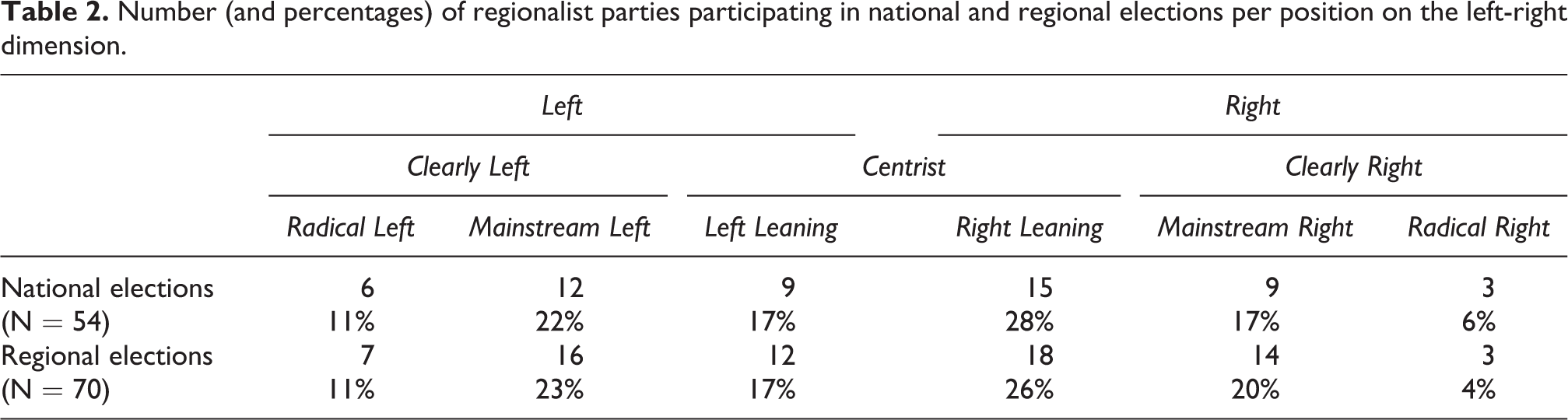
Secondly, like for state-wide parties, mainstream and centrist positions are remarkably more common than radical (especially radical right) ones. Thirdly, ‘centrist’ positions (summing up left and right leaning ones) are adopted in more than 40% (nearly 45% in national elections) of cases. In other words, almost half of the parties are not strongly characterized in their left-right ideology. Since ‘position’ can be seen as determined by various combinations of ‘salience’ and ‘direction’ (Basile, 2015), we can say that some of the parties coded as ‘centrist’ might have engaged, to various degrees, into a ‘blurring’ strategy. These data could be, therefore, interpreted as an indication of a prudent approach, adopted by many regionalist parties, in taking a stance on a secondary dimension (in this case the left-right one).
However, also for centrist ‘broad Church’ parties, such as the rally parties of the ethno-territorial German speaking minorities in Italy (SVP) and Belgium (ProDG), or other inclusive parties that have become the symbol of regional governments (like the CiU in Catalonia, PNV in the Basque Country and, more recently, the SNP in Scotland), the established literature clearly indicates the predominance of left or right leaning components. In addition, a solid majority of cases adopts very clear leftist or rightist positions. Therefore, the third and final consideration is that the general trend amongst regionalist parties is to engage in party competition beyond the original centre-periphery dimension and to position themselves on the usually more salient (at a system level) left-right dimension. The analysis that follows aims to investigate whether the adoption of a left-right position can be linked to centre-periphery politics (subsuming strategy) or if it is totally independent (two-dimensional strategy).
Multivariate analysis
We now turn to a multivariate analysis in order to explore in how far the economic status of the region can predict a regionalist party position on the left-right dimension. We operationalize the state of the economy of a particular region by calculating the GDP of a region relative to the GDP as a country as a whole (Eurostat). Percentages above 100% indicate that a region is doing well compared to the country as a whole, whereas percentages below 100% indicate that a region is economically lagging behind the rest of the country.
We coded regionalist parties on their centre-periphery positioning based on the crucial distinction between moderate/autonomist vs radical/secessionist stances, where the former do not question the territorial integrity of the state while the latter do (Massetti and Schakel, 2013a, 2013b). We also introduce three control variables on competition from statewide and other regionalist parties. The state-wide party competition dummy variable measures whether the main (largest) state-wide party can be found on the left (= 0) or on the right (= 1). To determine the main (largest) state-wide party we look at regional vote shares for a particular election year (Schakel, 2013) and determine left-right position via the data from the Manifesto Research Group/Comparative Manifestos Project for years before 1999 (Budge et al., 2001; Volkens et al., 2012) and from the Chapel Hill expert survey for 1999 and later (Bakker et al., 2012). Two regionalist party competition dummy variables indicate whether there is one (or more) regionalist party on the left or on the right participating in elections within the same region (0 = no; 1 = yes).
We analyse the left-right ideology of regionalist parties with two variables, a (robust) dichotomous variable and an ordinal/categorical variable with six categories (see Table 1). The binary variable is analysed with the help of a logit model whereby we use party clustered standard errors (positions are coded for each national and regional election and positions are clustered in parties). Theoretically speaking, an ordered logit model would be the preferred model for the ordinal/categorical variable. However, Brunt tests reveal that the parallel regression/proportional odds assumption is not met. That is, the relationship between each pair of outcome groups is not the same and each comparison requires its own model. We therefore opt for multinomial logit models with party clustered standard errors which do not assume a rank order between the categories. According to Hausman and Small-Hsiao tests, these models appear not to violate the independence of irrelevant alternatives assumption. The unit of analysis is a party participating in a particular region election year. Only when a regionalist party obtains 1 percent vote share in a regional and/or national election at the regional level it is included and we only look at elections taking place in ‘core-regions’, that is those regions for which the regionalist party demands decentralization or seeks to govern in its best interest. Some regionalist parties are multi-regional, in the sense that they participate in more than one ‘institutional’ region (e.g. the LN in the ‘Padania regions’ in Italy and the PDS in the Eastern Länder of Germany). In these cases, each party’s institutional region is analysed separately (therefore the number of parties in Tables 3 and 4 is higher than in Tables 1 and 2 or in Appendix A). Appendix D provides descriptive statistics for the dependent and independent variables.
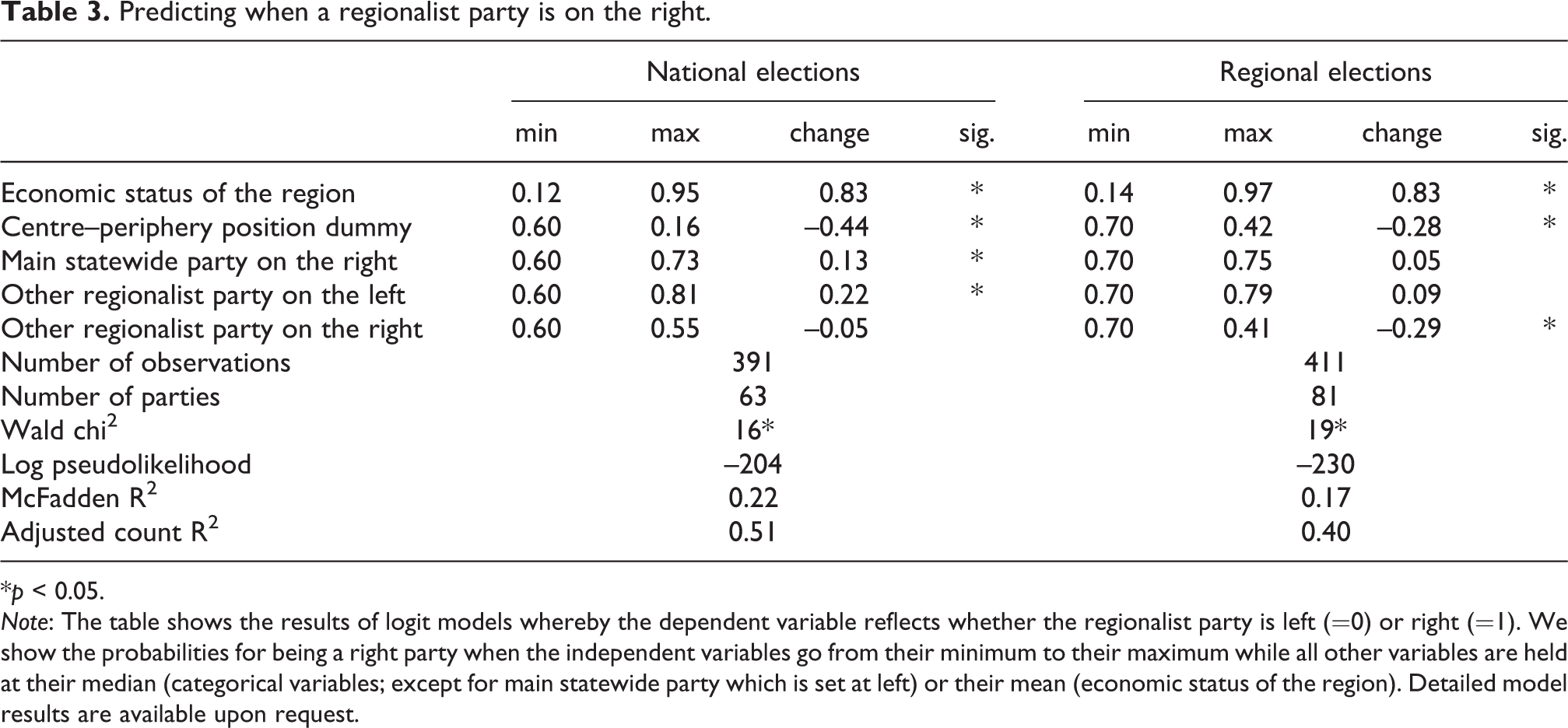
Predicting when a regionalist party is on the right.
*p < 0.05.
Note: The table shows the results of logit models whereby the dependent variable reflects whether the regionalist party is left (=0) or right (=1). We show the probabilities for being a right party when the independent variables go from their minimum to their maximum while all other variables are held at their median (categorical variables; except for main statewide party which is set at left) or their mean (economic status of the region). Detailed model results are available upon request.
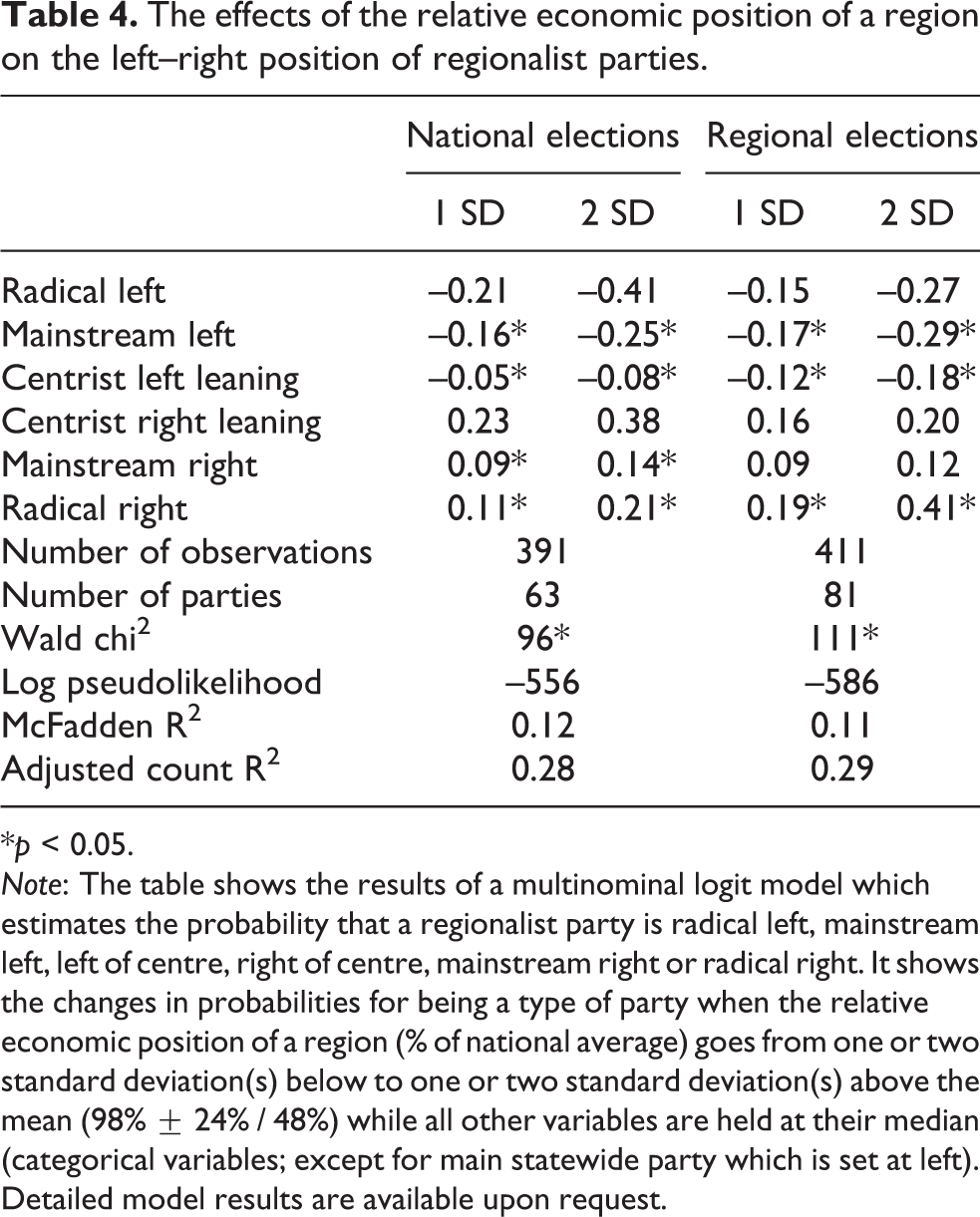
The effects of the relative economic position of a region on the left–right position of regionalist parties.
*p < 0.05.
Note: The table shows the results of a multinominal logit model which estimates the probability that a regionalist party is radical left, mainstream left, left of centre, right of centre, mainstream right or radical right. It shows the changes in probabilities for being a type of party when the relative economic position of a region (% of national average) goes from one or two standard deviation(s) below to one or two standard deviation(s) above the mean (98% ± 24% / 48%) while all other variables are held at their median (categorical variables; except for main statewide party which is set at left). Detailed model results are available upon request.
In Tables 3 and 4 we show predicted probabilities for a particular ideological position of regionalist party on the left-right dimension. These probabilities are obtained by using the prvalue and prgen command available in the SPost package for Stata developed by Long and Freese (2006). Confidence intervals for the changes in probabilities are obtained by a bootstrap percentile method with 1000 replications. The bootstrap method is more robust for ‘noisy’ data than, for example, the delta method, and does not require an assumption of normality because bootstrapping resamples from the dataset and treats the sample as the population. The bootstrap method is not often used because although it “frequently provides better estimates of the confidence interval bounds, it is computationally intensive” (Long and Freese, 2006: 127).
In Table 3 we estimate probabilities whether regionalist parties position themselves on the right when a particular independent variable goes from its minimum to its maximum while all other variables are held at their median (dummy variables) or their mean (economic status of the region). Our main hypothesis concerns the impact of the economic status of the region. As reported in Table 3, where the regional economy is relatively strong there is a significantly higher probability that a regionalist party adopts a right position on the left-right dimension. For both national and regional elections, the probability that a regionalist party places itself on the right increases by 83 percentage points when relative regional GDP goes from 35 to 162 percent of statewide GDP.
The hypothesized link between centre-periphery radicalism and left-right placement also appears to be substantiated. When a party is moderate on self-government there is a 44 percent increased probability that the party adopts a position on the right. For regional elections, the ‘linkage’ between center-periphery positions and left-right positions is weaker and radical parties have a 28 percent lower probability of placing themselves on the right. Party competition from statewide and other regionalist parties matters too. When the main (largest) statewide party in the region can be found on the right, there is a 13 percent higher probability (for national elections) that a regionalist party can also be found on the right. Since in most cases the state-wide parties are the dominant actors, this is a strategic move which follows the electoral demand (i.e. trying to be close to the median voter in terms of left-right positioning) and might heavily overlap with the ‘socio-economic region’ logic discussed above. As an example, the leader of the Ligue Savoisienne (LS), Patrice Abeille, stated: from the political point of view, you know that Savoy, similar to all the mountainous countries, is dominated by the conservative or ultra-conservative tendency. As an example, at the last legislative elections [in 1997] eight RPR-UDF MPs were elected out of eight districts. A left-wing autonomist movement would have no chance of success here. (quoted in Roux, 2006b: 110).
In Table 4 we provide the results of a multinomial logit analysis to explore how far the linkage between economic status and left-right ideology holds when using this more fine-grained coding. Table 4 displays change in probability in left-right positioning when the relative state of the economy of the region (percent of national average) goes from one or two standard deviation(s) below to one or two standard deviation(s) above the mean (98% ± 24% / 48%).
The results are quite similar for national and regional elections. When the relative economic position of a region improves, there is a higher likelihood of finding ‘mainstream right’ and ‘radical right’ parties, whereas the probability of finding ‘mainstream left’ and ‘centrist left leaning’ parties decreases. 10
In Figure 1 we plot changes in probabilities for positions on the left-right dimension when the relative position of the regional economy goes from its minimum to its maximum. Figure 1a displays the probabilities for national elections and Figure 1b for regional elections. We do this to show in visual form the results presented in Table 4 and to get a better understanding of how the probabilities change for the values in between the minimum and maximum values of the regional economy variable. The patterns in the figures confirm previous findings. Overall, the multinomial logit analysis supports the results of the logit models and the relative economic position of the region vis-a-vis the country as a whole is a very strong predictor on the question of whether a regionalist party adopts a left or right position. 11
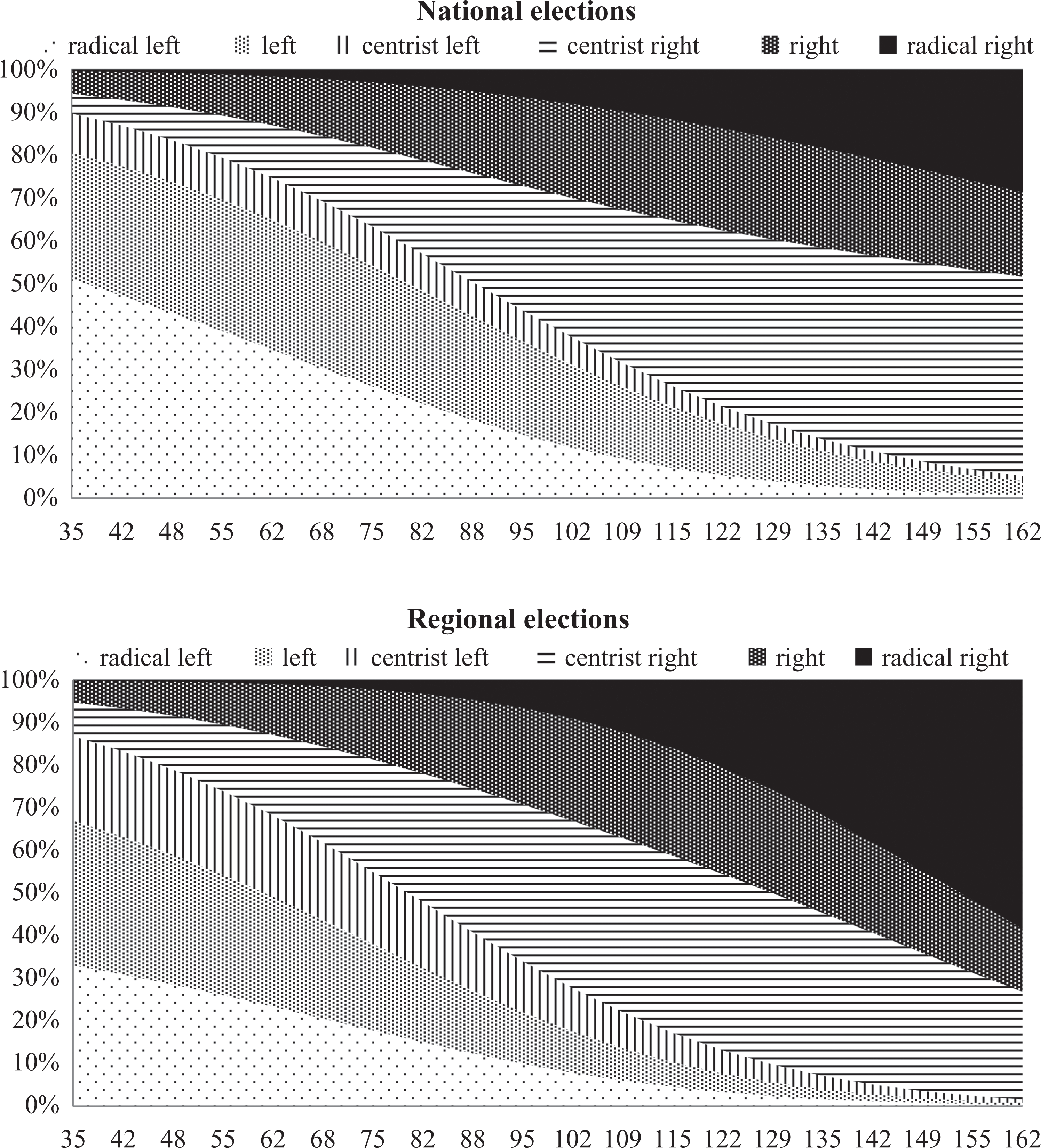
A. National elections. B. Regional elections.
We now turn to a qualitative illustration to observe how regionalist parties do indeed ‘subsume’ their left-right position into a centre-periphery discourse.
A qualitative illustration of the nature and logic of issue linkage: Strategic subsuming?
The most important finding of the analysis presented above is the extremely strong and significant correlation between the relative economic status of the region (relatively ‘rich’ vs relatively ‘poor’ regions) and the left-right ideological orientations of regionalist parties. Here we present qualitative data on two paradigmatic cases which indicate that this correlation can be interpreted as the result of a systematic process of subsuming left-right orientations into the centre-periphery (regionalist) discourse. Incidentally, the qualitative illustration is also interesting in respect to the link between centre-periphery radicalism and left-right positioning.
As far as the link between economic status and left-right positioning is concerned, the basic logic of the subsuming process is rather straightforward and is informed by electoral strategy: the regionalist party orientates itself towards the left or towards the right depending on which type of economic discourse arguably suits best the construction of coherent regionalist grievances and claims. The regionalist perspective tends to amplify the differences between the region and the rest of the state, while playing down internal (intra-regional) differences. This leads many regionalist parties to identify the whole region as a strongly characterized socio-economic entity on the basis of the prevailing features in the regional socio-economic fabric, thus substituting the concept of socio-economic class with that of socio-economic region. In order to present the main differences between the subsuming of a rightist as opposed to a leftist ideological orientation into a regionalist discourse, as well as the implicit
12
but clear centrality of the underlying concept of ‘socio-economic region’ in these subsuming processes, we present extracts from electoral manifestos of the Lega Nord (LN), a party representing the relatively rich regions of Northern Italy, and of the Scottish National Party (SNP), a party representing a region of the UK (Scotland) that has experienced long-term industrial decline and has traditionally lagged behind the national average of economic output.
13
A policy based on extensive public expenditure cannot, by any means, be called as ‘social’ because it undermines the basis of the economy. It produces: 1) low development; 2) high unemployment; 3) loss of competiveness for businesses … Mrs Thatcher and Reagan stopped the growth of public spending. Here [i.e. in Italy], public finances are out of control, producing an increase in taxation and public debt … In order to reduce public expenditure you need to eliminate useless expenditures, privileges and the ‘nanny state’ logic. To do that, you need structural reforms and the most important reform is the federalist one … Like in the U.S.A. and Switzerland, the creation of true fiscal autonomy for local institutions triggers mechanisms of competitiveness and accountability. (Lega Nord, 2001: 3–5) Scotland today is in a state of crisis, with our economy decimated by the policies of successive London Governments. Unemployment has soared … Industrial production has fallen far more than in other countries. The UK’s Regional Policy has failed to secure long-term jobs for Scotland … The British political system offers Scotland no hope of improvement. A further term of Thatcherism will devastate the Scottish economy, concentrating more wealth and power in the South East of England. The weak and divided Labour Party is powerless to protect Scotland … But there is an alternative – to choose Scotland. Never has the need for an independent Scottish Parliament and a Scottish Government been greater. Only with our own Government will Scotland have the will and the resources to reverse our economic decline and end mass unemployment … Only a Scottish Government will be able to tackle the appalling social conditions in which many of our people have to live. (SNP, 1983: 1) We are working hard for economic recovery and new jobs … However, the London parties’ proposed cuts pose a threat to this recovery … At this election, more votes means more Nats [i.e. Nationalists], and more Nats means less cuts. Local services and recovery can and must be protected … Running through this manifesto is the SNP vision of a new future for Scotland, independent, socially just and economically secure. (SNP, 2010: 5–6)
The two examples reported above can also be illuminating in regard to the second important correlation that we found in descriptive statistics and in the multivariate analysis (see Table 3). Rightist regionalist parties acting in relatively rich regions might be satisfied with the protection of regional wealth through fiscal federalism, thus challenging the centralist tendencies of the state in terms of welfare and redistributive policies but without necessarily putting into question the territorial integrity of the state. In contrast, leftist regionalist parties acting in relatively poor regions are presented with a tougher choice: either they construct a radical critique of the state, blaming it for the underdevelopment of their region and demanding secession, or they put themselves into a somehow contradictory position, i.e. accepting their condition of (economic) dependency vis-a-vis the central state while still challenging it from a (moderate) regionalist perspective. The latter option might produce a shift in the focus of the regionalist struggle from demands for the transfer of competences to demands for the transfer of resources. In turn, this shift of focus leaves regionalist parties particularly exposed to competition from state-wide parties (particularly leftist ones). Indeed, while secessionist leftist parties can radically criticize leftist state-wide parties for their failure to draw resources into the region (see the above extract from the SNP’s 1983 manifesto), autonomist leftist parties have no option but to remain subaltern to leftist state-wide parties, as the latter represent their only chance to see transfers of resources based on redistributive policies adopted by the central state.
Discussion
In this article we set out to explain how regionalist parties position themselves on the left-right dimension and whether and how this dimension of party competition is linked with the centre-periphery one. To start with, our data show that regionalist parties do take a position on left-right politics. However, the fact that they can be found everywhere along the left-right spectrum (from the radical left to the radical right) confirms that this dimension of political contestation is a secondary one, not a primary and characterizing one, for the regionalist party family. In addition, the fact that well over 40 percent of regionalist parties adopt centrist positions suggests that the left-right dimension could be potentially divisive for them, leading many of these parties to adopt a prudent positioning that avoids strong leftist or rightist stances. In these cases, we cannot exclude the possibility that regionalist parties engage in some kind of ‘blurring strategy’. Only in-depth analysis can properly investigate the contours of the four strategies presented in the introduction, exploring and discussing the empirical grey areas between them.
The main challenge of this article was to find linkages, within regionalist parties’ ideological elaboration, between the centre-periphery and left-right dimension. Although we acknowledge the complex and deeply contextual nature of these linkages, we found strong evidence in support of the generalizability of an important link: namely the economic status of the region vis-a-vis the state. Our analysis shows very clearly that regionalist parties in relatively rich regions tend to develop a rightist ideology, while regionalist parties acting in relatively poor regions tend to adopt a leftist ideology. Whether the identified linkage entails a generalized subsuming of left-right orientations into centre-periphery politics can only be proved via a wide and systematic analysis of ‘framing’. In this article, we have provided a qualitative illustration, concerning two paradigmatic cases (the LN and the SNP), which supports our interpretation that the subsuming of left-right orientations into centre-periphery politics manifests itself in the emergence of two ideal-types of regionalist discourse: the ‘bourgeois regionalism’ type (Harvie, 1994) is particularly suitable for parties acting in relatively rich regions; while the ‘internal colonialism’ type (Hechter, 1975) suits parties acting in relatively poor regions. We have used the term ‘subsuming’ here to refer to the framing of issues belonging to the secondary (left-right) dimension in terms of the core (centre/periphery) dimension. Such framing, in our view, induces an almost automatic positioning along the secondary dimension on the basis of considerations that pertain to the primary dimension. However, we remain agnostic on whether subsuming always entails an attempt by regionalist parties to ‘erase’ the secondary (left-right) dimension, as stated by the editors in the introduction to this special issue (Elias, 2015). Finally, the fact that regionalist parties appear to subsume the left-right dimension into the centre-periphery one (rather than vice versa) substantiates the hypothesis put forward in the introductory article, precisely in the terms expressed by the editors of this special issue, i.e. which dimension is subsumed into which dimension does not depend on the relative salience of the dimensions at a systemic level but, rather, on their relative salience at the party level. However, our analysis also confirmed a general correlation between radical regionalism and leftist positioning (and between moderate regionalism and rightist positioning) which fits into a systemic pattern of positioning that has emerged in some national party systems, such as Spain and the UK (Alonso, 2012). These findings, therefore, call for further comparative research into how the different mechanisms – operated by regionalist and state-wide parties – of linking left-right and centre-periphery politics interact at a systemic level.
Footnotes
Appendix A
Appendix B
Appendix C
Appendix D
Appendix E
Acknowledgements
Previous versions of this article have been presented at the workshop ‘Position, Salience and Issue Linkage: Party Strategies in Multinational Democracies’ held at the Department of International Politics, University of Aberystwyth, UK, December 12–13, 2013 and at the 64th Annual Conference of the Political Science Association, Manchester, UK, April 14–16, 2014. We would like to thank James Newell, Laura Polverari, Yu Tao, the editors of this special issue (Anwen Elias, Edina Szöcsik and Christina Zuber) and three anonymous reviewers for their valuable comments. In addition we thank Frank Schrijver for his help in obtaining election results for regionalist parties in France. Arjan H Schakel wishes to express his gratitude to the Hanse-Wissenschaftskolleg, Institute for Advanced Study, Delmenhorst, Germany for offering him a fellowship which allowed him to work on the research presented in this article. The normal disclaimers apply.
Funding
Emanuele Massetti would like to thank the ESRC for their financial support through a Postdoctoral Fellowship (PTA-026-27-2119).