







Abstract
Based on agenda-setting, priming and issue ownership theory, we know that issue ownership and party visibility in the news can be used as strategies to affect electoral support. Thus far, it is, however, unclear whether these effects are independent or work interactively. This study aims to fill this gap. We focus on the Partij voor de Vrijheid, the prominent Dutch right-wing populist party, and draw upon an experimental design in which we exposed a sample of Dutch voters (N = 600) to media coverage on one of four issues – an owned issue, an unowned issue, an issue owned by another party and a contested issue – featuring either a party cue or not. The results indicate that the impact of issue coverage is moderated by party cues: attention to owned issues and unowned issues increases support only when party cues are present. Attention to contested and trespassing issues does not increase support.
Introduction
Rising voter volatility and weakening partisan attachments of voters have increased the importance of other determinants of people’s vote choices, most notably issue voting (Lefevere et al., 2015a). Consequently, parties strategically communicate about their issues to persuade voters throughout the campaign (Budge and Farlie, 1983; Holian, 2004). Because politics is increasingly mediated, they depend on the media, not only to communicate with the public at large (Graber, 2004) but also because media attention can increase their electoral support.
Firstly, when issues are emphasized in the media, voters consider them to be more important (agenda-setting). In turn, priming then causes these issues to become more important in voter’s political evaluations (Iyengar et al., 1984). Issue ownership theory finally asserts that the issue-owning party stands to win electorally when its owned issues become primed, as it holds a competitive advantage on these issues (Budge and Farlie, 1983; Petrocik, 1989, 1996). This proposition has been demonstrated in a variety of studies (for an overview, see Walgrave et al., 2015).
Secondly, when parties and their candidates get media attention, they become better known among the public, and their accessibility increases: they become ‘top of mind’ among voters (Higgins, 1996; Scheufele and Tewksbury, 2007). This, in turn, increases the chances that voters then cast their vote for them. Regardless of issue attention, the ‘mere visibility of parties’ should thus also foster electoral support (Hopmann et al., 2010: 390), with media attention being a necessary, but not sufficient, condition for electoral success (Vliegenthart and Van Aelst, 2010).
Although we know that issues and party visibility matter, several questions remain. Firstly, it is unclear whether issue attention as such is enough to win elections. Petrocik (1989) suggests that when owned issues dominate the campaign, the issue-owning party will win. Yet, the party that is most successful in dominating the campaign’s issue agenda will also be highly visible: media favour issue-owning parties over non-owners (Hayes, 2010). Hence, it is unclear whether the impact of issue ownership occurs because the election is decided on issues that advantage some parties and disadvantage others or because some parties – by having their issues dominate the campaign – get increased visibility.
Secondly, the impact of party visibility has generated mixed results, and we argue that issue reputations can explain these conflicting findings. Oegema and Kleinnijenhuis (2000) and Hopmann et al. (2012) find that party visibility increases electoral support. These findings are corroborated by various studies on party cues (Bullock, 2011). Yet, in an experimental design, Norris and colleagues (1999) did not find any effects of party visibility. Issue reputations may explain why visibility matters in some cases but not in others. If a party is visible, but not on issues on which it holds a reputational advantage, issue ownership theory would not expect that its electoral support would increase.
Thirdly, and related to the last point, we know that parties are connected to various issues in the news, not necessarily only to the one(s) they own but also to issues that are contested, unowned or owned by another party. These connections can be made by journalists, but also strategically initiated by parties (Hopmann et al., 2012; Sigelman and Buel, 2004). Parties might want to improve their reputation on contested issues or might want to expand their issue repertoire by claiming unowned issues or trespassing. The impact of these deviating strategies on their electoral support is unclear.
This study introduces a theoretical framework for understanding how issue ownership and party visibility in the media independently and interactively affect electoral support. This results in a number of propositions, which we evaluate using an experimental set-up centred around the Partij voor de Vrijheid (PVV), the prominent Dutch right-wing populist party. Our design focuses on a right-wing populist party for several reasons. First of all, these parties generally hold a strong reputation on the immigration issue but have much weaker reputations on other issues (Kleinnijenhuis and Walter, 2014). This allows us to test whether distinct issue reputations indeed affect the impact of issue coverage on party support. Secondly, while previous work on the effect of media coverage on right-wing populist electoral success has focused on immigration (e.g. Burscher et al., 2015; Lubbers et al., 2002; Vliegenthart et al., 2012; Walgrave and De Swert, 2004; the latter also look at crime), these parties are in fact not single issue parties and emphasize various issues (Mudde, 1999). The immigration issue might have been important to their rise, but it is highly likely that established right-wing populist parties also are visible in the media with other issues (Otjes and Louwerse, 2015), as they aim to expand their issues. Thus, right-wing populist parties are key candidates to engage in issue trespassing and the claiming of unowned issues in day-to-day politics.
Hence, this article addresses these issues, examining the ability of right-wing populist parties to increase their electoral support through media coverage that explicitly and implicitly connects them to a variety of political issues – not only those that they own but also those that are owned by other parties and those that are considered contested or unowned. Further, we clarify the role and importance of party cues in facilitating these effects – Does the party in question need to be cued alongside the issue to benefit from such coverage or not? Does the party cue override the effect of the issue or vice versa? By bringing together such priming mechanisms with issue ownership considerations, we are able to build a nuanced theoretical framework for understanding the role of the media in expanding the issue reputations, in this case of a right-wing populist party. We draw upon an experimental design in which a sample of Dutch voters (N = 600) was exposed to media coverage on one of four issues – immigration, crime, privacy and taxes – and featuring either a right-wing populist party cue (PVV) or not.
News media, issue ownership and party support
The news media are a crucial intermediary for parties, allowing parties to communicate with the electorate (Bennett and Entman, 2001; Graber, 2004). Moreover, news media coverage affects parties’ electoral support through agenda setting and priming. By emphasizing some issues over others, the media set the public’s agenda (McCombs and Shaw, 1972). In doing so, media coverage primes issues and actors among the public: these considerations become more accessible to voters when they make political evaluations, hence having a greater impact on these evaluations (Lau, 1989; Scheufele and Tewksbury, 2007). It is no surprise then that parties strategically communicate through news media coverage to increase their electoral support (Hopmann et al., 2012). We focus here on two aspects of media coverage, both of which have been found to affect parties’ electoral support. One the one hand, parties try to increase their visibility in the news media (Boudreau and MacKenzie, 2013; Hopmann et al., 2010). On the other hand, parties strive to affect the issues that come to dominate the media agenda during campaigns (Budge, 2015; Hopmann et al., 2012). Our study examines to what extent the impact of media coverage on party support varies depending on the presence or absence of party cues, on the issue, or a combination of both.
The impact of issue attention
During election campaigns, parties strategically emphasize issues to foster electoral support. The theory of issue ownership asserts that parties will emphasize the issues they ‘own’ and that they ignore issues owned by their competitors (Budge, 2015; Budge and Farlie, 1983; Petrocik, 1989, 1996). Issue ownership refers to parties’ reputations in dealing with specific issues (Budge and Farlie, 1983; Petrocik, 1989). Ownership of issues is important, as it gives parties an electoral advantage: when owned issues – issues on which one party has a clear reputational advantage – are important to voters, the issue-owning party is advantaged. Thus, when parties are successful in getting the media to focus on their owned issues, these issues are primed among the electorate. This causes these issues to get greater weight on voter’s electoral decisions, and the party should gain electorally (Amorós and Puy, 2011). Indeed, a number of studies attest to the impact of issue ownership on electoral results (Bélanger and Meguid, 2008; van der Brug, 2004; Walgrave et al., 2012).
From the perspective of a political party then, media coverage can deal with four types of issues. Media coverage can emphasize an issue owned by that party (1). However, media coverage rarely focuses solely on parties’ owned issues (Hayes, 2008), and parties themselves also regularly engage in issue strategies that diverge from the pattern proposed by issue ownership (Sigelman and Buel, 2004). For example, parties engage in attempts to claim unowned issues (Spoon et al., 2014; Walgrave et al., 2009), leading to media coverage on unowned issues, on which no parties have a strong reputation (2). Moreover, parties trespass on issues that are owned by other parties, also referred to as ‘issue stealing’, which can also be reflected in media coverage (3) (Aragonès et al., 2015; Arceneaux, 2008; Spoon et al., 2014). Finally, media coverage can address issues on which a parties’ ownership is contested (4). We define contested issues as issues where the party still holds an absolute reputational advantage, but its comparative advantage with regards to other parties is small (Amorós and Puy, 2011).
Media coverage of parties’ owned issues (1) should foster electoral support. In this situation, media are covering issues on which these parties hold strong (long-standing) reputations (Egan, 2013; Walgrave et al., 2012). By priming these issues among voters, the reputational advantage of the issue-owning party should enhance its support (Aragonès et al., 2015).
Contrary to owned issues, unowned issues are not spontaneously linked to parties, and no party has a strong reputation on them (Tresch et al., 2015; Walgrave et al., 2009). Although media coverage will still prime the issue among voters, this should not affect party support as no party has a strong reputation: at least in terms of issue reputations, the issue does not contain features that allow parties to gain votes (Page, 1976). We, therefore, propose the second hypothesis:
Thirdly, parties can also emphasize issues owned by another party: issue trespassing (Arceneaux, 2008; Damore, 2004). When media cover such trespassing issues, the coverage emphasizes an issue owned by another party. Because another party has the reputational advantage, that is, owns the issue, this issue-owning party should profit from media coverage on the issue, whereas we expect no increase in party support for other parties. Which leads to:
Finally, media coverage on contested issues should increase party support but less so than media coverage on owned issues. Whereas most extant work on issue ownership distinguishes between issues that are ‘owned’ to a greater or lesser degree (Walgrave et al., 2009), Amorós and Puy (2011) outline the importance of both absolute and comparative differences between parties in terms of issue reputations. When a party holds an absolute reputational advantage on an issue – that is, most voters perceive it to be best able to handle the issue – it owns the issue. However, the smaller the reputational ‘gap’ between parties is, the more likely it is that other parties will attempt to close this gap. Similarly, Aragónes et al. (2015: 73) argue that: The fact that a party initially owns an issue is not sufficient to conclude that the party should campaign on it. What matters is the magnitude of the reputational gap on the issue between the two parties. (…) When the gap is small, the weaker party has a clear incentive to compensate for its initial handicap with higher investments, which might result in issue stealing.
The direct impact and moderating role of party cues
We argue that the impact of these four issue strategies on parties’ electoral support is moderated by the presence or absence of party cues, which entails a party being mentioned in relation to an issue (Bullock, 2011). Research on party cues has documented their role in fostering party support (see, e.g. Bullock, 2011; Druckman et al., 2013). These findings are in line with the more macro-level findings that a parties’ media visibility affects its support among voters. When parties are more visible in media prior to an election, they score better electorally (e.g. Hopmann et al., 2010). The literature offers a few explanations for the effect of party cues on party support. Priming theory suggests that when parties are increasingly visible in media, they become more accessible in voters’ minds and consequently have a higher chance of being considered as an option when voters decide whom to vote for (Higgins, 1996; Scheufele and Tewksbury, 2007). It has also been argued that party cues help voters to efficiently cope, structure and make sense of the complex political world around them. Party cues then act as a partisan heuristic which helps voters to minimize information costs (Downs, 1957), ‘while still producing relatively well-grounded political opinions’ (Mondak, 1993: 188). Party cues thus act as information shortcuts, especially in low information or motivation contexts (Lau and Redlawsk, 2001). In line with this literature, it is argued that adding a party cue may increase the preference for the mentioned party (also see Vliegenthart et al., 2012 for aggregate level support). Thus, we hypothesize a direct effect of party cues on a parties’ electoral support:
Critically, we expect that the presence or absence of party cues moderates the impact of media’s issue emphasis on party support. For owned issues (1), we expect that the presence or absence of a party cue does not affect the impact of exposure to the issue. The reason is fairly straightforward: owned issues are intimately linked to a specific party (Egan, 2013; Walgrave et al., 2012). As such, coverage dealing with such issues not only primes the issue (Althaus and Kim, 2006; Iyengar et al., 1984), but also draws attention to the issue-owning party (Lefevere et al., 2015b; Walgrave et al., 2012).
However, parties can also extend their competence on unowned issues. For unowned issues – issues on which no party has established a strong reputation (Walgrave et al., 2009) – extant research has shown that media coverage can help parties establish a reputation (Dahlberg and Martinsson, 2015; Walgrave et al., 2009; though note Walgrave et al., 2014). By being able to communicate on new issues, parties can stake their claim and show that they have solid arguments and policies to deal with the issue. As such, it makes sense to expect that issue coverage on unowned issues fosters party support. Following up on research suggesting that parties’ discussing issues in the news increases their standing on such issues (Dahlberg and Martinsson, 2015; Walgrave et al., 2009), we expect that the impact of unowned issue coverage is moderated by party cues. We only expect coverage on unowned issues to affect party support in the presence of a party cue: in the absence of any mention of the party, voters cannot attribute the coverage’s issue content to that party. In turn, the parties’ (non-existent) reputation remains unchanged, and whereas the issue is primed, this holds no advantage for the party.
Although issue ownership would expect parties to refrain from addressing issues owned by other parties, issue trespassing has a number of advantages. First, trespassing allows parties to attract new voters, which is important for upcoming parties seeking to establish themselves (Damore, 2005; Holian, 2004). By addressing new issues, parties can try to appeal to new parts of the electorate (Spoon et al., 2014). Moreover, parties may be forced to trespass because of public sentiment. When non-core issues rise on the public agenda, parties may attempt to ‘ride the wave’ of these issues (Ansolabehere and Iyengar, 1994). If parties do not address contemporary issues, they may appear out of touch with the public’s concerns.
Issue trespassing, however, may not pay off in the short term as the issue-owning party still holds the stronger reputation, and building a reputation on an issue takes time (Tresch et al., 2015; Walgrave et al., 2009). On top of this, trespassing entails paying less attention to owned issues, which may not go over well with a parties’ core electorate (Budge, 2015). Thus, we expect that party cues moderate the impact of coverage on issues owned by other parties: we expect that the presence of party cues will have a negative effect on party support. By definition, on such issues, another party has a stronger reputation. As such, by specifically cueing the party as well as the issue, such coverage has a dual effect. First, it raises the salience of an issue on which the party does not have a strong, or at least not the strongest, reputation. Secondly, by cueing the party itself, the coverage is linked even more strongly to party politics, which further raises the chances that issue reputations are triggered as well. This again works against the party on such issues, as voters recall that this party does not have the best reputation on the issue. Moreover, seeing a party address issues, it is not usually associated with may turn off voters (Budge, 2015).
Finally, on contested issues, we also expect a moderating role of party cues. When a party cue is absent, the coverage primes an issue, and thereby also makes the parties’ reputations on that issue more important for voters (Aragonès et al., 2015). However, on contested issues the comparative gap between the party and its competitor(s) is small (Amorós and Puy, 2011), hence the primed issue might not affect party support to a large extent. Conversely, when coverage on a contested issue features a party cue, this both primes the issue (Aragonès et al., 2015) and asserts the parties’ reputation on that issue (Dahlberg and Martinsson, 2015; Walgrave et al., 2009). Although this may be offset by the fact that competitors will seek to actively close the reputational gap, we still expect that coverage on owned issues has a positive effect on a parties’ electoral support if a party cue is present.
Methods
To assess the impact of issue coverage and party cues on party support, we conducted an online survey experiment among a diverse sample of Dutch adults. As mentioned earlier, our design focuses on a fairly typical right-wing populist party, the Dutch PVV. The party is mainly organized around its political leader Geert Wilders, who is considered as ‘one of the figureheads of contemporary populism’ (Vossen, 2011: 179). Moreover, the PVV has gathered a substantial amount of support in the last few elections and was relatively visible in the mass media – yet mainly through its leader Wilders (Vliegenthart and Van Aelst, 2010).
We used a between-subject 4 × 2 experimental design. Each condition contained either an owned issue (immigration), an issue owned by another party (taxes), an unowned issue (privacy) or a contested issue (crime), combined with the presence or absence of a party cue.
Participants
The participants (N = 600) for this study were recruited through the online panel of Research Now. Participants received a small financial compensation to complete the questionnaire, leading on average to a 20% response rate. Although the respondents were not randomly drawn from the Dutch population, the sample has substantial diversity, more so than convenience samples, which are commonly used in experimental research (Berinsky et al., 2012). Moreover, our sample resembles the Dutch voting population with regards to age, gender and education 1 : 51.73% of the sample is female, 33.77% is between 20 and 40 years old, 45.80% between 40 and 65 and 17.03% is 65 years and older; less than 2% of the participants only went to primary school, while 33.5% is highly educated. The participants were randomly distributed over the conditions, with the N per condition fluctuating between 64 (taxes * PVV) and 82 (crime * PVV). The experimental groups did not differ significantly between conditions with respect to variables like gender (F(7, 592) = 0.63, p = 0.73), age (F(7, 592) = 0.64, p = 0.73), education (F(7, 592) = 0.56, p = 0.79), ideology (F(7, 592) = 1.19, p = 0.30) and agreement with the crime issue (F(7, 592) = 0.81, p = 0.58), the privacy issue (F(7, 592) = 0.64, p = 0.72), the tax issue (F(7, 592) = 1.99, p = 0.05) and the immigration issue (F(7, 592) = 1.86, p = 0.07), suggesting that the random assignment was successful.
Procedure
All participants agreed with the informed consent and completed the online questionnaire. The experimental procedure consisted of three parts and started with a pretest including several socio-demographic variables, prior attitudes towards the issues and perceptions of issue ownership. Then, participants were randomly assigned to one of the eight conditions and asked to carefully read a recent news article. Finally, participants completed a post-test questionnaire, which consisted of a cognitive response, party support, the manipulation check and other attitudinal constructs. The survey ended with a short debriefing.
Stimulus material
The stimulus material comprised one news article per condition. We created four news articles, one on each issue. We made two versions of each article: one with party cues and one without, leading to eight conditions in total: privacy * no party cue (n = 76), privacy * party cue (n = 77), crime * no party cue (n = 71), crime * party cue (n = 82), immigration * no party cue (n = 74), immigration * party cue (n = 80), taxes * no party cue (n = 76) and taxes * party cue (n = 64). Constructed stimulus articles ensure a high amount of control. Effort was made to adapt the presentation and writing of the articles to the structure and language of Dutch news coverage.
The issues (privacy, crime, immigration and taxes) were chosen based on literature about issue ownership of Dutch political parties (Kleinnijenhuis and Walter, 2014) and corresponded with our measurements of participants’ associative issue ownership (‘which party spontaneously comes to mind when you think of [issue]?’) and competence issue ownership perceptions (‘which party is best able to effectuate its program on [issue]’?). 2
Table 1 shows that the PVV is indeed considered the clear owner of the immigration issue among the respondents in our study as well: it scores high on both dimensions. Crime is clearly a contested issue: PVV has a reputational advantage, but especially in terms of competence the gap with the liberal Volkspartij voor Vrijheid en Democratie (VVD) is very small. For the unowned issue of privacy, associative and competence issue ownership perceptions are quite evenly distributed between the parties, and we see the most don’t knows for this issue. Finally, in keeping with our expectations, taxes are owned by the VVD: many voters consider VVD to own taxes on both dimensions, whereas PVV scores much weaker on this issue.
Issue ownership perceptions among respondents.a
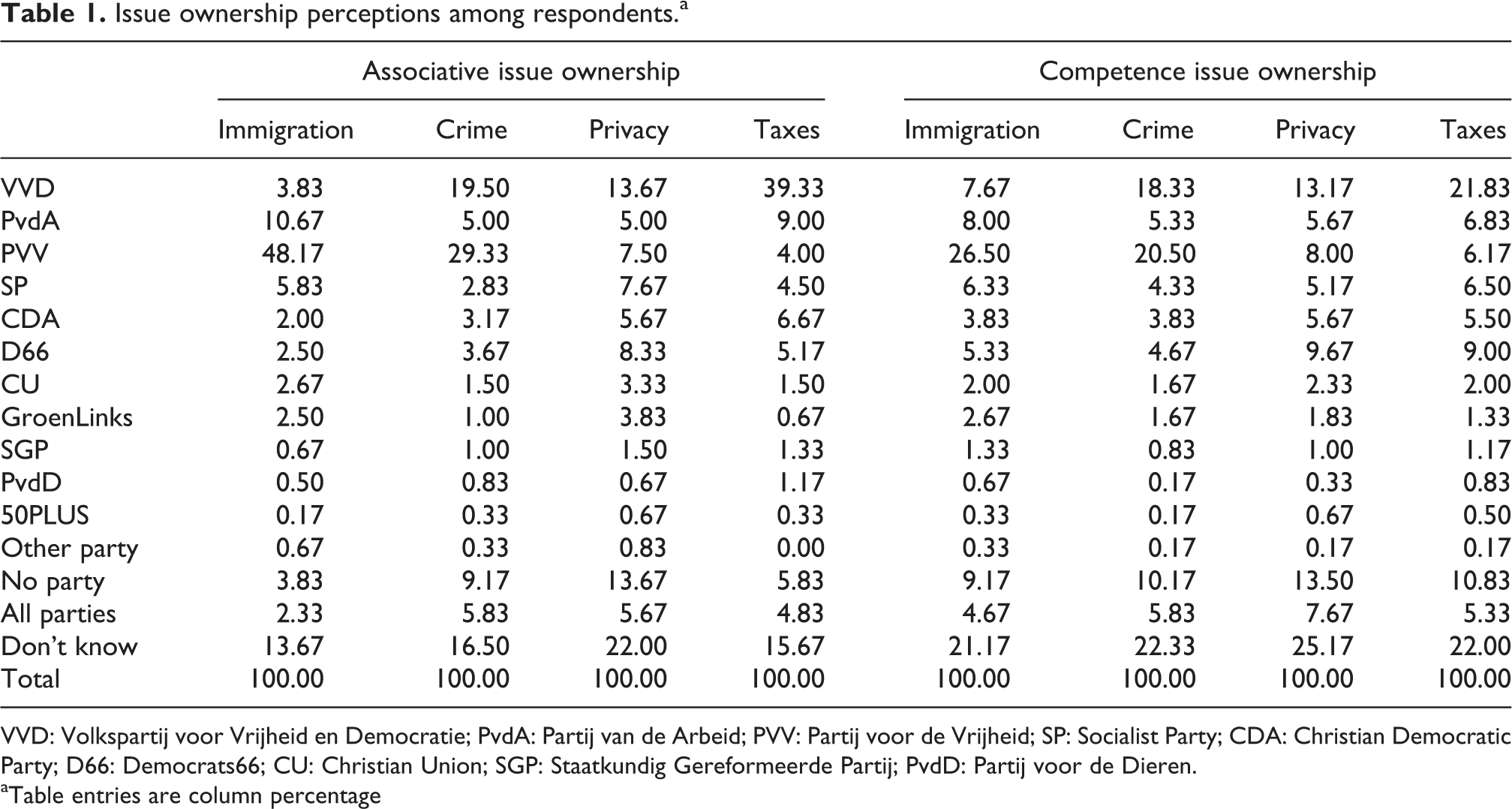
VVD: Volkspartij voor Vrijheid en Democratie; PvdA: Partij van de Arbeid; PVV: Partij voor de Vrijheid; SP: Socialist Party; CDA: Christian Democratic Party; D66: Democrats66; CU: Christian Union; SGP: Staatkundig Gereformeerde Partij; PvdD: Partij voor de Dieren.
aTable entries are column percentage
Each stimulus elaborated on a recent news topic related to these four issues to ensure external validity: east European labour migrants (immigration), early release of convicted criminals (crime), privacy online (privacy) and housing taxes (taxes). The news article consisted of four textual parts: a headline, lead and two paragraphs. The headline introduced the subject. The lead was a description of the topic based on a fictive public opinion poll. The first paragraph outlined the role of politicians related to the issue and the second paragraph stated the opinion of the Dutch public. The basic core information within all news articles was kept identical. In the PVV conditions, the issue position was attributed to the PVV by regular mentions of the party. In the non-PVV cue conditions, the same position was not attributed to any specific party. The articles were successfully tested in a pilot study, and a manipulation check in the main study uncovered successful manipulation, allowing us to attribute contrasts between treatment groups in the post-test to the experimental manipulation (see below). All stimulus material is available in Appendix A.
Measures
Our dependent variable, party support for the PVV, was measured after exposure to the stimulus, through propensity to vote questions (see Van der Eijk et al., 2006). Respondents were asked to indicate the probability that they would ever vote for any of the main parties (PVV, Socialist Party (SP), Christian Democratic Party (CDA), VVD, Partij van de Arbeid (PvdA) and Democrats66 (D66)) on a 10-point Likert scale from very unlikely (1) to very likely (10) (M = 3.732, SD = 3.319).
We rely on comparisons between conditions to test our hypotheses. However, since spatial models of issue voting suggest that voters are unlikely to vote for parties with whom they disagree on issues important to them (MacDonald et al., 1991), we also measured voters’ issue agreement. The participants’ agreement on the four different issues (privacy, crime, immigration and taxes) was assessed via four statements – one statement per issue – on a 7-point Likert scale, with higher values signifying higher agreement on the topics used in the stimuli. Participants were asked to indicate to what extent they agreed or disagreed on the following statements: ‘There should be stricter rules for foreigners who want to work in the Netherlands’ (immigration) (M = 4.627, SD = 1.343); ‘All convicts should serve their full sentence’ (crime) (M = 5.765, SD = 1.524); ‘Security services have too easy access to online information and e-mails’ (privacy) (M = 4.712, SD = 1.497) and ‘The government needs to assist citizens on the housing market through the tax system’ (taxes) (M = 5.205, SD = 1.606). The statements were shown to the participants in random order. We constructed a variable ‘issue agreement’ based on these statements in such a way that for each respondent their agreement to the position of the PVV on the issue they were exposed to in the stimulus material was included. We recoded this variable into three categories, representing the (1) 15.8% lowest scores, (2) 68.2% average scores and (3) 15.8% highest scores.
Manipulation check
After being exposed to the stimulus material and the post-test measures, participants were subject to five manipulation checks. Participants first had to indicate which political parties were mentioned in the article (either PVV, PvdA, VVD, CDA or none of the above – answer options were randomized). Then the participants had to indicate on a 7-point Likert scale (completely disagree (1) to completely agree (7)) to what extent they thought that the news article was about privacy online, early release of criminals, east European labour migrants and/or housing taxes. The manipulation check showed successful manipulation in both regards. Respondents in the party cue conditions significantly more often reported seeing the PVV in the article (F(7, 592) = 116.52, p = 0.000), and respondents in the issue conditions confirmed the article they read was about the issue manipulated (privacy: F(7, 592) = 135.45, p = 0.000; crime: F(7, 592) = 112.71, p = 0.000; immigration: F(7, 592) = 143.78, p = 0.000; taxes: F(7, 592) = 148.01, p = 0.000).
Results
We start our analyses with a straightforward examination of the average probability to vote PVV in the eight conditions of our experiment. Table 2 presents the mean propensity to vote PVV for the eight conditions. The table does show differences between issues, and it also suggests that party cues matter. However, the means do not move in the same direction in all issue conditions when a party cue is added. Exposure to the owned issue, immigration, seems to increase party support as expected (H1), though party support increases even more when a PVV cue is added (H5). In line with our expectations, on the unowned issue (privacy), exposure does not seem to increase PVV support (H2): its effect seems to be moderated by party cues, as proposed in H6. The results on the trespassing issue taxes run counter to our expectations: we find the highest level of support of any non-party cue condition (H3). As expected, the presence of a party cue lowers party support (H7). Finally, exposure to the contested issue (crime) does not increase party support (RQ1). Contrary to expectations, the party cue here decreases party support (H8).
Mean differences in propensity to vote PVV.
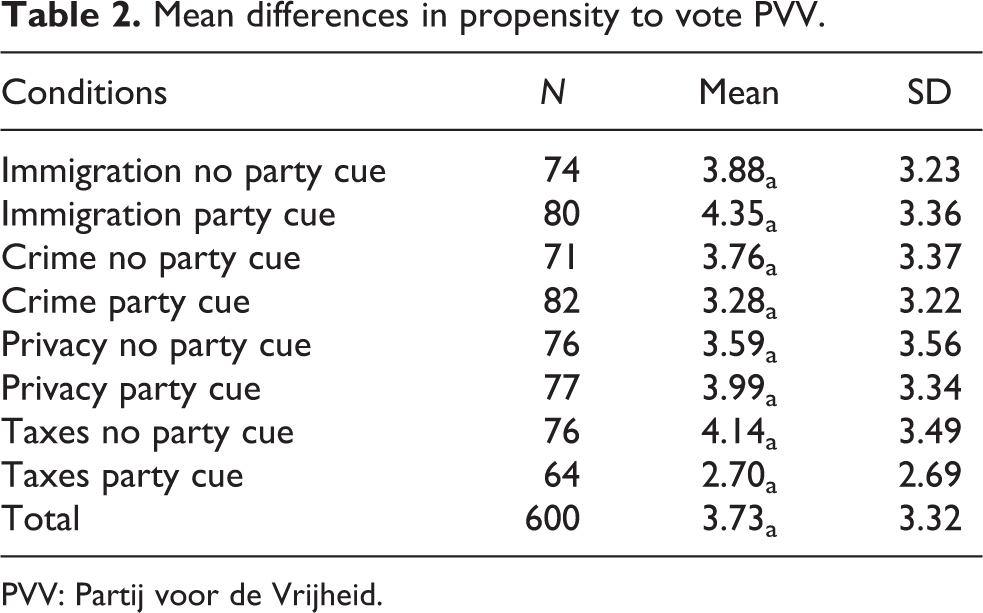
PVV: Partij voor de Vrijheid.
We continue with a regression analysis in which we estimate the effects of issue coverage and party cues on support for the PVV (Table 3) and control for issue agreement. 3 We start with a model in which we test the hypotheses on the effects of the separate issues. In the first model, we add the issues as independent variables, using the taxes issue (the trespassing issue) as the reference category. H1 predicted that exposure to media coverage on an owned issue – immigration – would lead to higher support. The coefficients indicate that this is the case, supporting H1. H2 posited that exposure to coverage on an unowned issue would not have a positive impact on right-wing populist party support and is confirmed. H3 does not receive strong support: a model with the unowned issue (privacy) as the reference category yields a negative but insignificant coefficient for the tax issue (b = −0.418, SE = 0.384, p = 0.277). Finally, exposure to the contested issue – crime – is not significant (RQ1): when multiple parties have a strong reputation an issue, coverage of the issue does not lead to a higher propensity to vote PVV.
Linear regression estimates predicting propensity to vote PVV.a
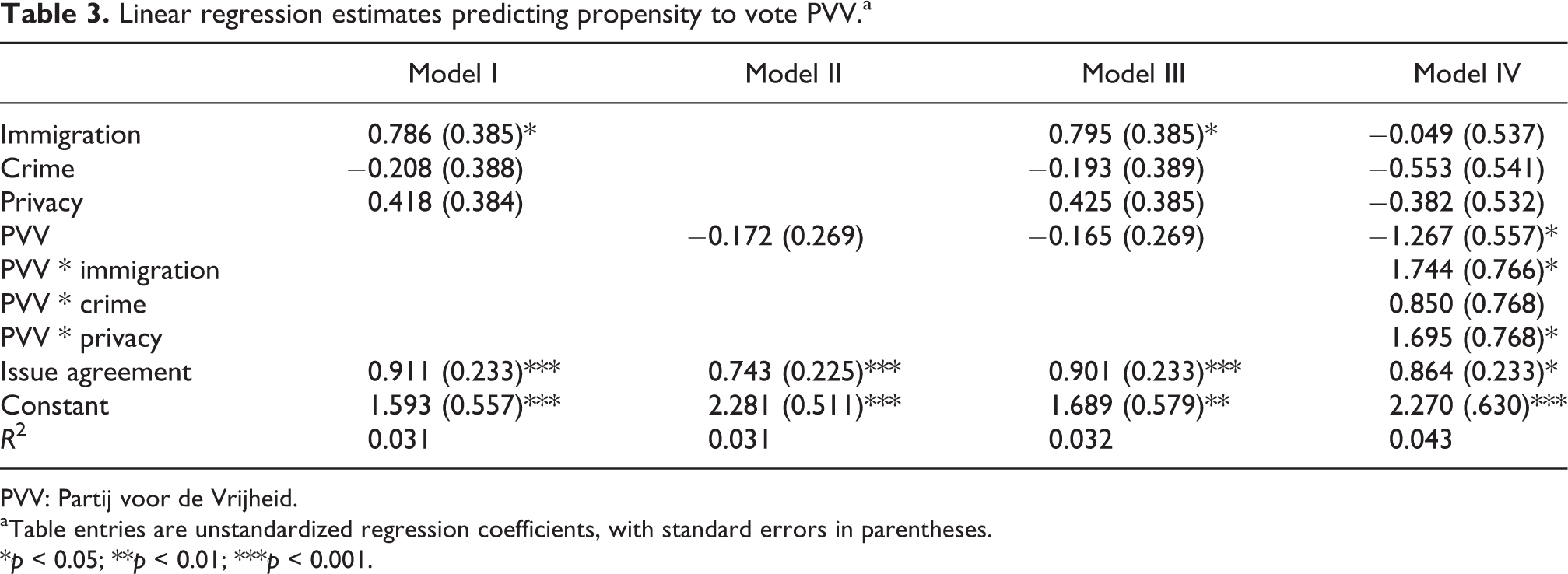
PVV: Partij voor de Vrijheid.
aTable entries are unstandardized regression coefficients, with standard errors in parentheses.
*p < 0.05; **p < 0.01; ***p < 0.001.
The second model regresses the propensity to vote PVV on the presence or absence of the party cue (H4). If we estimate the impact of a PVV cue, irrespective of the issue it is combined with, it has no significant impact on the probability to vote PVV. This indicates that, when we do not account for issue-specific differences, mentioning a party in media coverage in itself does not seem to affect right-wing populist party support, which refutes H4. In the third model, we simultaneously test the impact of the party cues and the issue cues, and find that indeed, only the owned issue affects party support positively. The party cue does not, even if we control for the issues.
To test whether party cues moderate the impact of the issue on party cues (H5–8), Model 4 includes interactions between the PVV cue and the issue cues. Both the interaction between the PVV cue and the immigration issue and the interaction between the PVV cue and the Privacy issue are significant. To better understand these interactions, Figure 1 plots the marginal effects of exposure to the four issues, with and without a party cue. We first look at our fifth hypothesis. The significant interaction effect, present in the regression table, indicates that our data do not lend support for this assumption: the impact of the immigration cue is moderated by the presence of a party cue. Figure 1 shows that if a PVV cue is embedded in the immigration issue, exposure to such coverage has a significantly positive effect on support for the PVV. If the cue is absent, we do not see a significant effect.
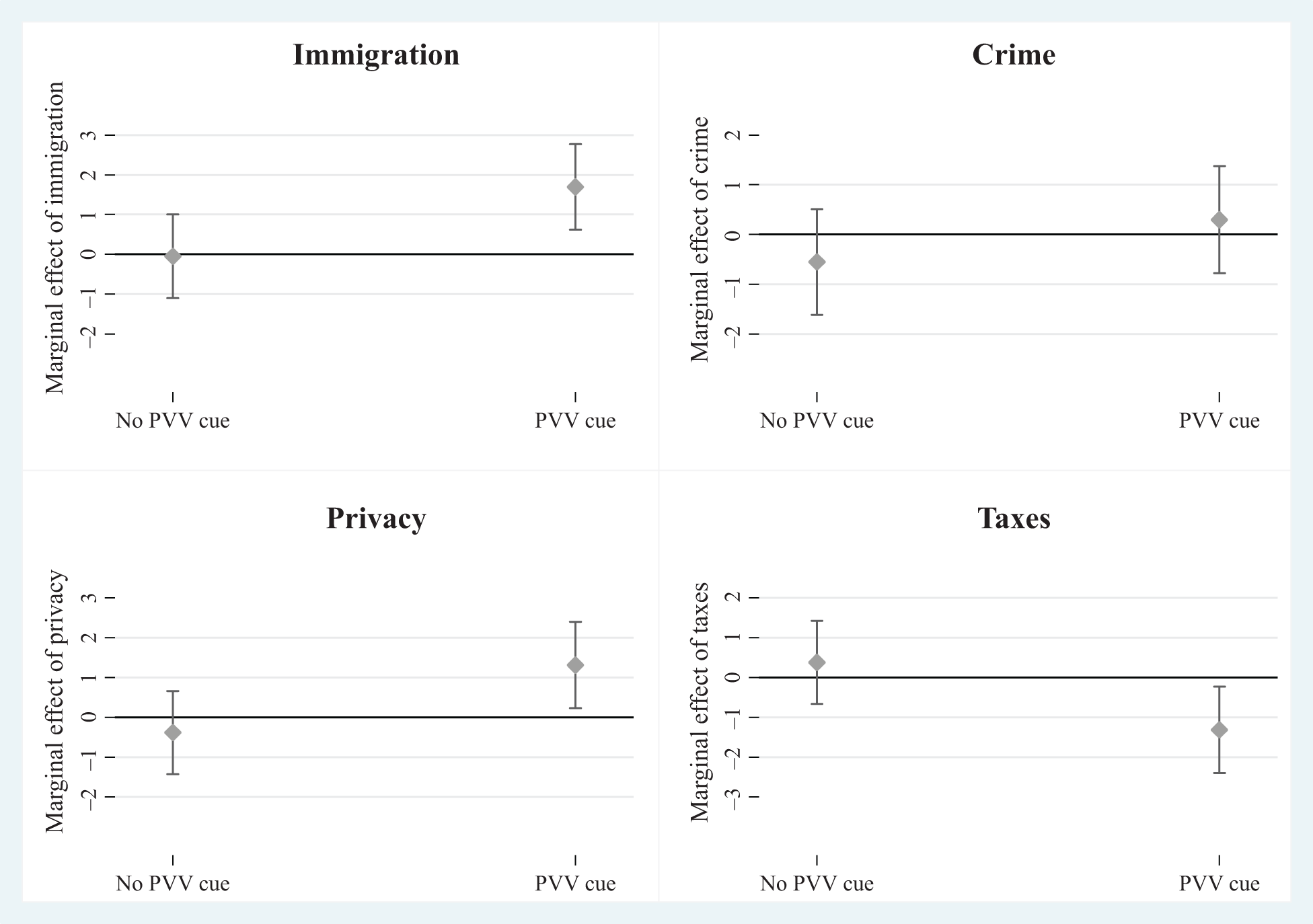
Marginal effect of exposure on propensity to vote PVV, for four issues and presence/absence of PVV cue. PVV: Partij voor de Vrijheid.
H6 stated that we expected party support to increase when an unowned issue was combined with a party cue. Our results support this hypothesis. Exposure to an item on privacy with a PVV cue indeed significantly increases the propensity to vote PVV compared to privacy coverage without such a cue.
We expected party cues to moderate the impact of coverage on an issue owned by another party (H7). The results confirm our expectation, as the bottom-right panel of Figure 1 shows. Whereas the effect of exposure to the tax issue without the PVV cue has no effect on support for the PVV, when the party is mentioned in the tax item, this decreases party support.
Finally, we expected that the effect of exposure to contested issue coverage would be moderated by party cues (H8), but the results do not support our expectation. Party cues do not moderate the impact of contested issue exposure: though the evidence does suggest that party cues lead to higher support on such issues, in both conditions the marginal effect is not significantly different from zero.
Conclusion
Our studies’ main goal was to introduce a theoretical framework for understanding how issue ownership and party visibility in the media independently and interactively affect electoral support. Our experimental design focused on a prominent right-wing populist party with strong issue reputations and examined its ability to increase electoral support through media coverage that explicitly and implicitly connects it to a variety of political issues. We looked not only at owned issues but also at those that are owned by other parties and those that are considered contested or unowned. Further, we clarified the role and importance of party cues in facilitating these effects and tested our hypotheses with a clear-cut experimental design. This allowed us to lay bare the causal relationship between exposure to media coverage on various issues and people’s support for the right-wing populist party.
Our results shed light on the independent and interactive impact of issue attention and party visibility on party support. In line with the previous study by Norris et al. (1999) we did not find an across the board effect of party cues embedded in media coverage: a parties’ presence in media coverage does not automatically foster support. As we expected, the impact of party visibility is contingent upon the issue discussed: only when the party is mentioned in connection to an owned issue, or to an unowned issue, does this positively affect party support. In the case of contested and trespassing issues, party visibility does not seem to foster support in the short term. On trespassing issues, the straightforward explanation is that a single exposure to a party being linked to an issue cannot overcome the stronger reputation of the issue owner. Contrary to our expectations, we find a positive but insignificant effect if the party is mentioned on a contested issue. This seems to suggest that on issues where the issue-owning party only enjoys a small advantage (Amorós and Puy, 2011), its issue reputation may not result in tangible electoral benefits. Combined, these results seem to suggest that issues can override party cues: when parties are visible, this only leads to increased support if it occurs on owned issues or issues that are not owned by any party. That said, we also find that issues as such may not be enough. Whereas we found a direct effect of owned issue coverage on party support, further analyses revealed that this effect was only present if the party was also mentioned. This seems to be in line with Walgrave et al.’s (2009) finding that reputations need to be actively maintained. Our results show that it is important to distinguish between party visibility on the one hand and media attention for issues on the other in their ability to affect electoral support. It is the combined impact of both that leads to better predictions.
Our study has a few limitations. Regarding generalizability, we only focus on a single party. However, since our results are in line with general theories on issue ownership we expect no differential effects for other right-wing populist parties – or mainstream parties for that matter. This is also in line with previous empirical research by (among others) Van der Brug et al. (2004) and Bos et al. (2011) testing Mudde’s ‘pathological normalcy’ thesis (2010) in which it is argued that right-wing populist parties and mainstream parties are not poles apart. Also, our study only included a single issue of every type (owned, unowned, trespassing and contested). Even though the results did seem to confirm our expectations, other issues may not quite work the same way. Previous work on issue ownership has amply demonstrated that depending on the issue the impact of issue ownership may be radically different – the distinction between valence and positional issues seems especially relevant here (Egan, 2013). The issues included here all had a positional component to them, but issue agreement does not matter for consensus issues, so perhaps the reputational advantage of being an issue owner has a greater impact on party support for those issues.
Given these limitations, our study provides more insight in parties’ ability to increase electoral support through the impact of media coverage. Most crucially, this impact is highly contingent upon both the type of issue being discussed, and the party being visible on those issues: when issues on which the party holds a strong reputation is salient in the media, this helps them gather support if they are seen addressing them. Conversely, issues owned by other parties and contested issues that dominate the news agenda do not seem to offer much opportunities for the party. Perhaps most interestingly, unowned, and less salient issues may be a way for parties to expand their voter base.
These findings are also noteworthy to the field of (right-wing) populist parties. Our findings suggest that by addressing unowned issues these parties may tap into new parts of the electorate that agrees with them on these issues. While media coverage already helps right-wing populist parties maintain and extend their voter base because of their strong ownership of the immigration issue (Boomgaarden and Vliegenthart, 2007; Vliegenthart et al., 2012), they may increase their voter base further still by expanding their issue repertoire – provided they manage to attract media coverage on these issues. When these parties strategically claim unowned issues (Hopmann et al., 2012; Sigelman and Buel, 2004), broadening their agenda, they may be here to stay even when the immigration issue ‘would cease to be an important political issue’ (1999: 193).
In sum, our findings demonstrate how media coverage of parties and issues affects party support. Our results suggest that parties’ electoral support is affected through parties’ visibility on advantageous issues. We urge future research to evaluate our propositions at the aggregate level: our experimental design only allowed us to assess the impact of a single news article. Hence, though our findings suggest that addressing issues owned by other parties decrease party support, parties may be able to overcome this disadvantage over time as they build their own reputation on the issue.
Footnotes
Declaration of Conflicting Interests
The author(s) declared no potential conflicts of interest with respect to the research, authorship, and/or publication of this article.
Funding
The author(s) disclosed receipt of the following financial support for the research, authorship, and/or publication of this article: The authors received funding from the Amsterdam School of Communication Research to conduct the experiment.