







Abstract
Political parties sometimes set up formal criteria to define the pool of potential candidates. This article represents the first large-scale comparative analysis of potential unintended gendered consequences of these formal selection criteria for parliamentary representation. Using unique data on 101 political parties in 32 African, Asian, and postcommunist European countries, we find that there is indeed a relationship between formal selection criteria and men’s and women’s political representation. Criteria that concern ethnic or geographic background and intraparty experiences are harmful to women. On the other hand, gendered consequences are not as pronounced as a result of criteria concerning qualifications or requirements in relation to electability. Taken together, the analysis points to the need to pay increased attention to formal selection criteria and how this under-researched aspect of candidate selection shapes the parliamentary representation of underrepresented groups.
Keywords
Political parties sometimes set up formal selection criteria to define the required qualities in a person who is to stand for election for the party. Despite the fact that such formal criteria may substantially circumscribe the pool of potential candidates, including in ways that unconsciously favor members of certain groups but exclude others, “the scholarly literature rarely covers this aspect of candidate selection, if at all” (Hazan and Rahat, 2010: 23). This article aims at filling this gap in the literature by examining political parties’ formal selection criteria from a gender perspective. More specifically, it is the first analysis to use cross-party comparative data to empirically investigate potential unintended gendered consequences of seemingly gender neutral formal selection criteria on the political representation of men and women.
To conduct the analysis, we draw on researchers who apply a feminist institutionalist perspective on party politics and candidate selection. Informed by a feminist institutionalist framework, candidate selection has increasingly been studied as a process that is influenced by both formal and informal rules. Informal institutions and their gendered effects on party recruitment practices have received particular attention (Bjarnegård, 2013; Bjarnegård and Kenny, 2015, 2016; Cheng and Tavits, 2011; Franceschet and Piscopo, 2014; Hinojosa, 2012; Kenny, 2013; Murray, 2010a; Verge and Claveria, 2016). These studies have demonstrated that gendered norms and practices within political parties shape the opportunities for male and female aspirants. Informally emphasizing seemingly gender neutral merits—such as to what extent an aspirant has access to clientelistic networks (Bjarnegård, 2013; Franceschet and Piscopo, 2014) is a key local figure (Kenny, 2013) or has experience of holding visible party office (Verge and Claveria, 2016)—has nevertheless generated selection patterns resulting in more men than women candidates.
The gendered impact of parties’ formalized selection criteria has, however, not been thoroughly investigated in previous studies. Formal selection criteria are interesting because they are officially recognized and can be expected to mirror party priorities as they are publically presented. It is uncommon that the criteria parties set up will be about gender per se, but it is possible that the criteria interact with gender hierarchies in the surrounding context so as to produce gendered consequences (cf. Gains and Lowndes, 2014). In this way, the requirements that political parties put on candidates may implicitly favor some groups over others. Therefore, there is a need to enlarge the scope of the scholarly focus to encompass the possibility that parties, by formalizing certain requirements, may unconsciously circumscribe the supply of potential candidates.
The empirical analysis combines two sources of data: cross-sectional survey data from International IDEA on formal party selection criteria within 101 political parties in 32 African, Asian, and postcommunist European countries and our own data collection on gendered parliamentary representation in these parties in the election that followed the International IDEA data collection (for a full list of the political parties that are included in the analysis, see the Online Appendix). The analysis focuses on four distinct formal selection criteria that are not specifically about gender but that may have gendered consequences: criteria about candidate background, candidate qualifications, candidate experience, and candidate electability. These requirements are manifest and formalized expressions of the political party demand for candidates, at the same time as they effectively control and limit the supply of potential candidates. In this way, formal selection criteria constitute clear examples of recent arguments in the literature on gender and political recruitment: that party demand for candidates cannot, in practice, be separated from the supply of candidates (Bjarnegård, 2013; Broockman, 2014; Kenny, 2013; Krook, 2010).
To preview the results, our ordinary least squares (OLS) regression analyses suggest that seemingly gender-neutral selection criteria sometimes have unintended gendered consequences, consistently benefitting men over women. Requirements that concern candidate background (in terms of coming from a certain geographical area or belonging to a specific ethnic group) and experience (measured as having experience of a certain party position) seem to be harmful to the inclusion of women. On the other hand, the gendered consequence is not as pronounced as a result of existing criteria for qualifications (such as having a certain level of education), nor is there a clear gendered pattern regarding requirements that aim to gauge the electability of the candidate among party members/voters (in terms of collecting a certain number of signatures). The analysis points to the need to focus on gendered consequences of seemingly gender neutral formal party rules. By thus looking at party politics with a gendered lens, we can understand both how parties make gender and how gender makes parties (Kenny and Verge, 2016) and how these processes are sometimes even formalized. It is in the careful unpacking of the different formal selection criteria and how gender plays out in relation to them that we can properly begin to understand their distinct consequences on gendered parliamentary representation.
Candidate selection and gendered parliamentary representation
Selecting candidates is one of the defining functions of a political party. Research has emphasized the power struggles that take place during candidate selection processes, that is, the processes by which candidates are chosen from among the pool of aspirants (Bjarnegård and Kenny, 2015; Gallagher and Marsh, 1988; Kenny and Verge, 2016; Rahat and Hazan, 2001; Siavelis and Morgenstern, 2008). At stake is control over who gets to represent the party in election campaigns and subsequently in the legislature—and consequently control over what the party does and stands for (Hazan and Rahat, 2010). However, the scholarly literature on how political parties across the globe select their candidates has, at least until recently, been largely underdeveloped (Hazan and Rahat, 2010). Although parties operate in a wide variety of political settings and constitute a heterogeneous group of organizations, their recruitment practices—nested within certain institutional constraints and opportunity structures—are largely a private affair: political parties have a large leeway in designing these internal processes themselves (Gallagher and Marsh, 1988). It is difficult to access information about the nature of these procedures, partly because they are often of an informal character (Bjarnegård, 2013; Gallagher and Marsh, 1988; Kenny, 2013; Norris, 1996; Rahat and Hazan, 2001). As a consequence, candidate selection has been likened to a “black box” (Kenny and Verge, 2016) and called “the secret garden of politics” (Bjarnegård and Kenny, 2015; Gallagher and Marsh, 1988).
This article draws on, and speaks to, research on the political importance of candidate selection methods. In their creation of a broad theoretical framework, Hazan and Rahat (2010) develop a fourfold classification of relevant aspects of candidate selection: candidacy requirements, the composition of the selectorate, the level of decision-making (decentralization), and the appointment and voting systems employed. They put these four aspects in relation to four democratic dimensions: participation, representation, competition, and responsiveness. Here, we pay attention to one of the democratic dimensions—political representation—and more specifically to the representation of politically marginalized groups in society.
In research on candidate selection procedures and group representation, the bulk of studies focus on women’s political representation. Over the last few decades, the gendered consequences of candidate selection have received increased attention (Bjarnegård, 2013; Caul Kittilson, 2006; Escobar-Lemmon and Taylor-Robinson, 2008; Gauja and Cross, 2015; Hinojosa, 2012; Kenny, 2013; Lovenduski and Norris, 1993; Murray, 2010a; Norris and Lovenduski, 1995). Out of Hazan and Rahat’s (2010) four dimensions of candidate selection, emphasis has been on the impact of the level of decision-making (centralized or decentralized) or of the inclusiveness of the selectorate (see e.g. Hinojosa, 2012; Norris and Lovenduski, 1995). In this article, we pay attention to an aspect of candidate selection that has received significantly less attention, namely the impact of the formal candidacy requirements of political parties on gendered parliamentary representation.
Such formal selection criteria refer to the limitations and priorities that a single party lays out in internal party documents concerning who may stand as a candidate for the party. These requirements complement the general eligibility criteria (e.g. age) that are documented in a country’s constitution or electoral law. The formal selection criteria of political parties provide a bridge between supply-side factors (the pool of eligible and willing aspirants) and demand-side factors (the criteria and priorities applied by the political parties) in Norris and Lovenduski’s (1995) influential model. Whereas supply and demand can be analytically distinguished, recent work has pointed to the ways in which supply is often endogenous to demand (Bjarnegård, 2013; Kenny, 2013; Lawless and Fox, 2010; Murray, 2010a). For instance, party gatekeepers sometimes actively encourage certain types of individuals to stand for office, and such encouragement is often reported to be a main motivating factor for individual decisions to step forward as an aspirant. Such outspoken party demand thus shapes the supply of candidates and structures the pool of aspirants for public office. This difficulty of separating between supply and demand is particularly evident when it comes to the study of the impact of formal selection criteria. These criteria are set up by political parties and are indicators of the demands political parties have on the characteristics of their prospective candidates. As such, these criteria are tools that parties may use to foster a certain party culture and assure certain behavior (Hazan and Rahat, 2010), and they are thus fundamental for understanding the subsequent candidate selection process. These demands can also, however, shape the supply of potential candidates in certain, sometimes unforeseen and usually unintentional, ways.
Theorizing the gendered consequences of formal selection criteria
Theorizing how formal selection criteria relate to gendered parliamentary representation, our point of departure is a suggestion that has been brought up in research on gender and candidate recruitment: that the very existence of rules formally regulating candidate selection may be beneficial for women’s possibilities to accede to political office. Commonly such a focus on formal party rules is referred to as the level of bureaucratization (also labeled institutionalization, formalization, or rule-boundedness) of candidate selection (e.g. Bjarnegård and Zetterberg, 2016; Escobar-Lemmon and Taylor-Robinson, 2008; Caul Kittilson, 2006; Bruhn, 2003; Guadagnini, 1993; Lovenduski and Norris, 1993; Czudnowski, 1976). 1 The basic argument concerning the gender-friendliness of formal party rules is that women fare better in parties whose candidate selection procedures are rule-bound and formalized rather than patronage-based and informal because it is easier for outsiders to understand what it takes to get in—and on what grounds to appeal if s/he feels unjustly treated (e.g. Escobar-Lemmon and Taylor-Robinson, 2008; Caul Kittilson, 2006; Lovenduski and Norris, 1993; Czudnowski, 1976). In contrast to formalized processes, patronage-based procedures are generally characterized by party rules that are either brief or simply not implemented. Informal arrangements and personal relationships trump written rules, which also means that “procedures may vary from one selection to another” (Norris, 1996: 203). These arguments can easily be applied to the formal selection criteria that political parties specify: with more written rules specifying who the ideal candidate is, the priorities of political parties are made transparent. It is thereby easier for outsiders to understand what parties are looking for and to challenge decisions that do not seem to be based on the formal selection criteria. Conversely, it becomes more difficult for parties to justify decisions based on an informal set of rules or on arbitrary criteria.
On the other hand, research on candidate selection has suggested that party-specific formal selection criteria, by effectively limiting the pool of potential candidates, may result in an exclusion of outsiders (e.g. Hazan and Rahat, 2010). Thus, this kind of formalization may unintentionally be harmful to relative newcomers such as women and other politically underrepresented and marginalized groups. In most cases, these groups do not set these criteria: majority men in party leadership positions do. They get to decide which merits that count and which experiences that are considered useful for candidacy. It is highly likely that these merits and experiences resemble those that the party decision makers themselves have. Kenny and Verge suggest that parties make gender in this way, because “party ‘rules of the game’ [are] established by and in benefit of the in-group (men)” (2016: 358). They also suggest that gender makes parties, because “gender norms and stereotypes [are] embedded in political parties’ norms, rules and practices” (Kenny and Verge, 2016: 358). As a consequence, formal selection criteria may serve to reproduce biases that already exist within a party and, indeed, in the surrounding political context.
By focusing on how the criteria required for candidacy are constructed by party gatekeepers, our focus is on the content of formal selection criteria. We believe that such a focus is warranted in research on the gendered consequences of political parties’ selection criteria, because the rules do not in themselves stipulate the essence of the restrictions they impose on candidate selection. In theory, political parties may stipulate any kinds of formal rules—including outright sexist or racist rules or selection criteria directly excluding certain groups. Here, we do not focus on such direct discriminatory practices. Rather, we consider the potential unintentional exclusionary mechanisms of certain formal selection criteria. Although the focus is on seemingly gender-neutral formal selection criteria, feminist institutionalism has pointed to the fact that formal rules interact with gendered institutions within and outside of the political sphere so that even this type of criteria may have unintended gendered consequences (Gains and Lowndes, 2014; Lilliefeldt, 2011). There are at least two different ways in which such unintended gendered consequences may arise from interaction between formal rules and the context: formal criteria may prescribe qualities that are more common in men than in women (Murray, 2010a: 64), or they may indirectly feed in to gendered norms and practices that favor men over women (Lilliefeldt, 2011: 27; see also Gains and Lowndes, 2014). The former can be said to be an example of how parties make gender, while the latter is an example of how gender also makes, or influences, parties (Kenny and Verge, 2016). In both these instances, one sex is more likely to meet the established criteria than the other, but for somewhat different reasons. In the first case, it is simply the fact that the criteria are unevenly distributed between men and women, while in the second case, the criteria map on to existing stereotypical constructions of politicians that rest on an often undisputed male template (Bjarnegård, 2013; Murray, 2014; Puwar, 2004). In this way, it is possible that parties, by formalizing candidate criteria, may be institutionalizing discrimination against one of the sexes “even if they are not aware that they are doing so” (Murray, 2010a: 64). Different sets of rules should thus not be studied in isolation from each other. Rather, it is the interplay between formal and informal rules, or the “gendered institutional configurations” (Krook, 2010, 707), within and outside of the political sphere that need to be in focus.
What do parties look for in an ideal candidate? There are a number of desirable candidate characteristics that can and have been formulated and formalized as explicit candidate criteria (for a brief overview of the most common selection criteria, see e.g. Hazan and Rahat, 2010). Potential criteria can range from the origin of the candidate and achievements outside of the political sphere to criteria based on political merits. Here, we look closer at four sets of criteria corresponding to different stages in life when relevant merits for candidacy may be accumulated. First, a party may consider the background characteristics of a candidate by requiring that candidates come from a certain geographical area or belong to a particular ethnic group. Second, parties may consider the nonpolitical qualifications of a candidate, such as educational attainment. Third, the political experience of candidates may be formalized into criteria. Finally, a party may look for a candidate that is, above all, electable in the eyes of the constituents. These four different criteria thus focus on different types of merits that can be achieved at different points in life: background, qualifications, experience, and electability.
Applying a gender lens on these criteria, we expect two of them—background and experience—to favor men, whereas the other two criteria—qualifications and electability—are expected to have no gendered consequences. We base these expectations on previous research about the gendered consequences of mainly informal practices and priorities in political parties, assuming that they will give an indication about what to expect when they are codified into formal party rules.
Developing these thoughts, criteria about background refer to requirements that candidates are of a certain origin, live in a certain geographical area, or belong to a certain ethnic group. Such criteria are seemingly gender-neutral, as the distribution of men and women is unlikely to be highly uneven either in geographical settings or in ethnic groups. However, in interaction with the strong male norm that exists in most political parties, it may be difficult for party gatekeepers to think “intersectionally.” When it is seen as important that a candidate lives in the constituency, it maps onto a political stereotype of local key figures or local strongmen that have favored male candidates over female in contexts as diverse as Scotland and Thailand (Bjarnegård and Kenny, 2016). Previous research on both affluent countries and developing countries has also suggested that when parties politicize, and give guarantees to, identity groups that are not based on sex, women are at a disadvantage (Arriola and Johnson, 2014; Holmsten et al., 2010; Dancygier, 2017; c.f. Celis et al., 2014). In other words, we expect formalized, seemingly nongendered, criteria about candidate background to tap onto informal constructions and ideas about politicians that will favor male politicians.
Criteria about qualifications refer to requirements that candidates should have a certain level of knowledge and skills before running for office. Usually, these criteria focus on educational attainment. If such a formal criterion interacts with a highly uneven educational performance among men and women, it might create gendered patterns of representation. However, most countries of the world experience a closing gender gap in education in general; and in higher education in more affluent countries the gender gap is even reversed, so that more women than men attain college degrees (OECD, 2016). Even in the global South, where there is a remaining gender gap in education to the detriment of girls, the pool of educated women should nevertheless be sufficiently large for educational requirements not to play a decisive part in the exclusion of women from candidate selection procedures. Previous research on a variety of political and developmental contexts has also shown that female candidates and representatives are as qualified with regard to education as are their male colleagues (Beer and Camp, 2016; Murray, 2010b; O’Brien, 2012). As a consequence, we do not expect that formalized criteria about qualifications will favor men over women.
Criteria about political experience refer to requirements that candidates possess certain leadership experiences, that they have served the party, or that they are incumbents. Where parties prefer that candidates have served the party before becoming candidates, it becomes a way of coopting and/or rewarding loyal members and promoting people who already know the rules of the game (Verge and Claveria, 2016). On the other hand, “outsiders” are perceived as less trusted and with fewer networks. Based on previous research, which has shown that most intraparty positions are held by men (see e.g. Cheng and Tavits, 2011), requiring manifested party seniority is likely to be harmful for women and other underrepresented groups (see also Hazan and Rahat, 2010). The most obvious example of this is probably incumbency. We know from a wide range of literature that incumbency is one of the key factors that reproduce male dominance in candidate selection processes, because political parties often have informal rules stipulating that incumbents should be renominated to electable positions (Hazan and Rahat, 2010). Such more or less automatic renomination of incumbents implies a continuous reproduction of a male dominated status quo. Similar mechanisms seem to be at play with regard to access to different springboard positions in political parties (Murray, 2014). As long as party positions are unevenly distributed between men and women, we thus expect that a seemingly nongendered rule formalizing such political experience as an explicit criterion for candidacy will favor men over women.
Finally, criteria about electability refer to requirements that candidates prove that they have the support of constituents and that they stand a chance of winning the election. In addition to the aforementioned incumbency rules, which clearly speak (also) to the issue of electability, parties sometimes include rules in their party statutes that require aspirants to collect a minimum number of signatures—to prove that s/he has electoral support in the constituency—in order to be eligible for candidacy (Hazan and Rahat, 2010; Murray, 2010a). Formalizing rules about proven electability would favor men over women only if they map on to and gauge strong stereotypes about male and female candidates in the electorate. However, although the findings are somewhat mixed, most studies have demonstrated that women are not discriminated against by the electorate (see e.g. McElroy and Marsh, 2010; Norris et al., 1992; Welch and Studlar, 1996;). Thus, we expect formal criteria about electability to have no gendered effects.
Data and methods
We undertake the empirical analysis by moving beyond a focus on well-established Western democracies, which has been common in research on gender, political parties, and candidate selection (see e.g. Verge and Claveria, 2016: on Spain; Kenny, 2013: on Scotland; Murray, 2010a: on France; Caul Kittilson, 2006: on Western Europe; Davidson-Schmich, 2006: on Germany; Norris and Lovenduski, 1993, 1995: on the United Kingdom; for rare exceptions, see Hinojosa, 2012: on Latin America and Bjarnegård, 2013: on Thailand). More specifically, we make use of unique data collected by International IDEA in 2005/2006 complemented by data collected by ourselves covering 101 political parties in 32 countries in Africa, Asia, and postcommunist Europe. The selected political parties operate in countries that span the democratic continuum, from relatively developed democracies (e.g. Lithuania) to authoritarian regimes (e.g. Sudan), with a majority operating in countries that are considered as being democratic but where challenges to democracy are numerous (see also Tremblay, 2007). 2 For instance, with a few exceptions problems of corruption are quite substantial in the selected countries, levels of socioeconomic development are relatively low, and women have historically been largely excluded from politics. From a political party research perspective, examining formal party rules in less developed democracies (and in electoral autocracies) is particularly interesting. Previous research has shown that there is an important variation not only in the extent to which parties in these countries have women in their party parliamentary group but also in the extent to which they have bureaucratized (or formally institutionalized) their candidate selection process (see e.g. Bjarnegård and Zetterberg, 2016). Thus, there is likely to be substantial variation both in the dependent and independent variables.
The data contains party-level data about formal selection criteria. We were granted access to internal data collected by International IDEA on the functioning of political parties. Data was collected via questionnaires given to party officials at different levels in the party organization. 3 Thus, the unit of analysis is a single political party in one of the 32 countries. The International IDEA data is complemented with data that we have collected on women’s political representation in the selected parties. We have used the websites of parliaments as sources for the share of women within each party’s parliamentary group following the first election after the International IDEA data was collected. This represents the dependent variable of the analysis. On average, the political parties have approximately 17% women and 83% men in the party parliamentary group. However, the numbers range from zero all the way to 100%.
It could, for good reasons, be argued that an analysis of the gendered consequences of political parties’ selection criteria should ideally have data on candidates and not on elected representatives. However, comparative data on candidates in a large number of parties and countries are very rare. Breaking down the number of women in parliament by party is the second best option that we believe does not make the results biased in a substantial way. Most of the surveyed countries have either a majoritarian system or a proportional system with closed lists; as a consequence, voters are rarely able to change the order of the candidate(s). Thus, in reality, there is rarely a difference in our setting between an empirical focus on candidates and a focus on representatives. 4
As for the independent variable(s), we look at four selection criteria that are established by the party rules and thus considered formal and that were developed in the theory section: whether a party’s internal regulations require a person to (i) come from a certain geographical area or belong to a certain ethnic group (measuring candidate background); (ii) have certain qualifications 5 (measuring qualifications); (iii) have a certain position in the party (measuring experience); or (iv) have obtained a specific number of signatures (measuring electability) to be able to be selected as a party candidate for the single (or lower) chamber of the national legislature. The most common selection criteria is qualifications (almost 40% of the parties have such rules), whereas approximately half as many parties (about 20%) have the other criteria.
We run four sets of analyses—with each of the four formal selection criteria as the main independent variable—to assess how each of the formal selection criteria is associated with women’s political representation (at the party level). To take potential confounders into account, we use a set of control variables at the party level and the national level. More specifically, at the party level, we use the International IDEA dataset to control for the age of the party as well as for whether or not the party has adopted voluntary party quotas in its regulations. Both these variables may be associated with a party’s propensity to adopt formal rules into its regulations and, potentially, also with women’s political representation. At the national level, we make use of the Quality of Government Dataset 6 (Teorell et al. 2013) to control, first, for a country’s level of democracy using a linear democracy score fron Polity IV (Marshall, Jaggers and Gurr 2011) as well as a curvilinear function of the measurement. It is likely that very democratic countries as well as very autocratic countries have a relatively large number of parties that are internally bureaucratic. In addition, democracy is conducive to women’s candidacy in general elections once a country reaches a certain level of democracy (Fallon et al., 2012) and semi-democracies tend to have a stronger male dominance in parliament than either democracies or autocracies (Bjarnegård and Melander, 2011). Second, we take into account a country’s level of socioeconomic development using the Human Development Index, HDI (UNDP 2013). A socioeconomically developed country is likely to bring more women into the labor force and thus into public life. This might have an impact both on political party organizations and on the number of women within the party parliamentary group. Third, we control for a politico-institutional variable, the electoral system by singling out majoritarian systems from others. 7 Various analyses have shown that majoritarian systems result in more male dominated parliaments than their more proportional counterparts (e.g. Paxton et al., 2010; Rule, 1987; Studlar and McAllister, 2002). Fourth, we control for whether a country has adopted a gender quota law or not (Quota Database, 2013). This is a formal rule in the candidate selection process that attempts to affect the gender balance in parliament. Fifth and finally, we control for the level of corruption (Transparency International, 2012). This factor is likely to spur informality and be beneficial for men in politics (Bjarnegård, 2013; Esarey and Chirillo, 2013).
A limitation in the empirical analysis is its use of cross-sectional data. Ideally, we would need time-series data to address issues of causality. Such data, however, does not exist in comparative research on political parties’ candidate selection procedures and women’s representation in party parliamentary groups. Nevertheless, we use control variables at the national level that are measured by the time of the International IDEA data collection, that is, before the specific election that we analyze. 8 By measuring the control variables at a time prior to the election, we can at least design our model so that it accounts for the time order inherent in our argument.
The analytical model is performed using OLS regression analysis. There are a few limitations with OLS regression in analyses that have data at different levels of analysis (here, party level and national level). First, the assumption that observations (in this case, political parties) are independent from each other is likely to be violated. Thus, there are likely to be so-called autocorrelation problems. Second, the error terms are not likely to be randomly distributed across an explanatory factor; that is, we are likely to have problems with heteroscedasticity. We take the former problem into account by clustering the standard errors, that is, by treating only political parties from different countries as independent from each other. The second limitation is overcome by including robust standard errors in the analysis.
Results
Models 1–4 in Table 1 present the results of the analyses in which we examine the relationship between each of the four selection criteria and women’s political representation (by party). In short, Table 1 shows that, in line with our expectations, two of the selection criteria—background and experience—are negatively associated with women’s representation in legislative bodies. As for the other two criteria—qualifications and electability—there are similarly negative relationships with women’s political representation but the relationships are not statistically significant. Thus, the content of the selection criteria to some extent seems to matter for the degree to which women are disadvantaged by political parties’ self-constraining rules.
The relationship between formal selection criteria and the proportion of women representatives per party (multivariate analysis).
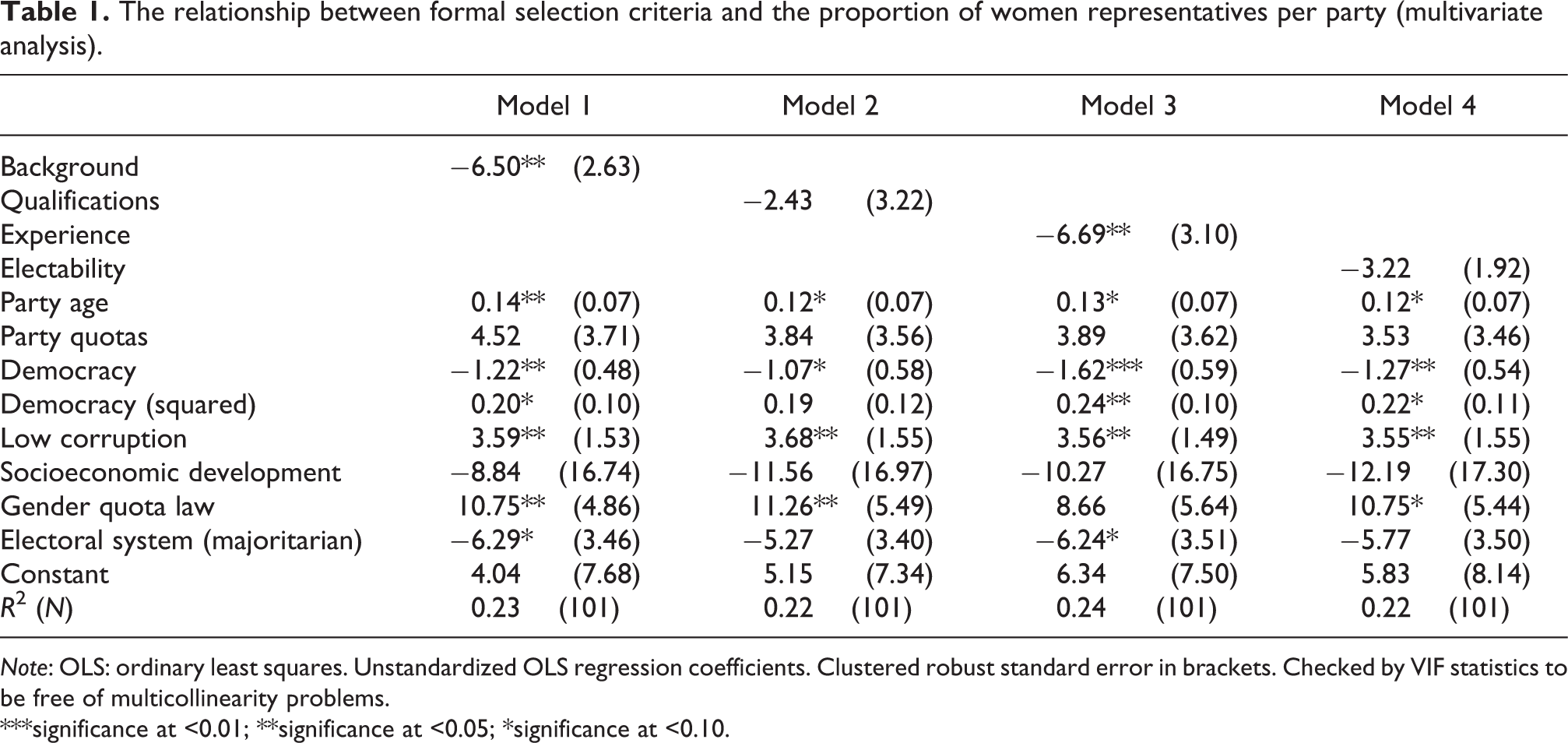
Note: OLS: ordinary least squares. Unstandardized OLS regression coefficients. Clustered robust standard error in brackets. Checked by VIF statistics to be free of multicollinearity problems.
***significance at <0.01; **significance at <0.05; *significance at <0.10.
Looking more closely at the results, and starting with candidate background, model 1 shows that parties that have restrictions concerning a candidate’s ethnic or geographic background tend to have more than 6 percentage points fewer women in their party parliamentary group than other parties (significant at the 95% level). In addition, model 3 in Table 1 shows that parties that have requirements that a person must have had a certain party position to be able to run for office are likely to have almost 7 percentage points fewer women in the party parliamentary group than other parties. The relationship is statistically significant at the 95% level of significance.
Regarding formal criteria for qualifications (such as a certain level of education) and electability (requirements for a number of signatures), on the other hand, their presence does not predict any significant gendered bias in the candidate selection. To reiterate, they certainly do not benefit women, as the direction of the relationship is the same as with the other criteria: if anything they benefit men. However, the regression coefficients are smaller than in the other two cases and none of them are statistically significant. Thus, different selection criteria appear to shape gendered patterns in parliament somewhat differently.
The findings presented in Table 1 are insensitive to model specification: they hold even if we drop some of the control variables or, alternatively, add one or two. They also hold if we vary the number of observations by removing very small parties that only have one Member of Parliament. 9 The control variables as such behave more or less as expected throughout the analyses, based on what we know from previous cross-national research on gendered parliamentary representation. Gender quota policies, PR systems, and low levels of corruption are generally positive for women. And a curvilinear relationship can be observed with regard to the level of democracy: women’s representation is lower in semi-democratic countries than in authoritarian states and liberal democracies (see also Bjarnegård and Melander, 2011; Fallon et al., 2012).
Building on our expectations, and attempting to understand why two seemingly gender neutral party selection criteria have gendered consequences, we suggest that a power analysis as well as an intersectionality perspective on intraparty politics constitute useful tools. In many of the surveyed political parties, women have traditionally been largely excluded from powerful intraparty positions. As a consequence, they have not been given as good a chance as men to prove their party loyalty, build necessary alliances, or learn the “know-how” of politics—and they are not seen as deserving of candidature as a reward, as they have not reached the same levels of seniority. As an example, several parties in the data set like the Congolese Rally for Democracy, the Sudanese People Liberation Movement (SPLM), and the Nepal Communist Party have a past as guerilla rebel organizations and were almost entirely dominated by men when they formally registered or started acting as political parties. It is, thus, not very surprising that an internal regulation requiring a potential candidate to have a certain position within the party will tend to reproduce male dominance in politics. In other words, women and other underrepresented groups in society continue to be excluded from elected bodies because they lack useful political resources such as their own power base within the party. As long as the criterion applied refers to a resource that is disproportionately lacking among women, its implementation will benefit men. On the other hand, in societies where women have found pathways to power and are and have been present as actors in party politics for a longer period of time, the gendered consequences of such a selection criterion are likely to evaporate. Thus, the specific political context probably matters here.
As for geographic or ethnic background, we have suggested that these gendered consequences may be a result of stereotypical constructions of politicians that does not allow for intersectional thinking. Political parties that constrain their pool of aspirants according to background are likely to have identities other than gender as their primary focus. The presence of such a selection criterion implies that a party’s legislators should represent not only their party but also a certain ethnic group or region. Constructions of local strongmen are inherently connected to maleness to the extent that a requirement about being from a certain region may implicitly preclude women candidates. Previous research has demonstrated that party gatekeepers are sometimes unable to think intersectionally and that when one identity is in focus representation across other cleavages may be seen as less important (see also Arriola and Johnson, 2014).
Importantly, women do not appear to be as negatively affected by formal qualifications that are unrelated to political resources and experiences. Although the specific wording of the qualifications variable is a bit vague and the variable should be interpreted with some caution, this finding, to reiterate, supports results from other studies: women in politics tend to be just as qualified and well educated as men (e.g. O’Brien, 2012). The fear that reforms such as quotas would cause political parties to recruit unqualified women is strange, particularly when qualifications are measured as educational attainment. In most countries, the pool of well-educated women is certainly large enough to give political parties a large group to select from. These results are corroborated in this analysis as requirements about qualifications do not discriminate against women. Similarly, the finding that signature requirements have no gendered consequences also supports most previous research, showing that women, once they get as far as running for office, are not at a great disadvantage and receive electoral support comparable to their male counterparts (e.g. Welch and Studlar, 1996).
Taken together, the analysis emphasizes that formal selection criteria indeed may have gendered consequences but that we need to look closer at the content of different selection criteria. Whereas some are unrelated to gender, other seemingly gender neutral factors appear to shape the chances for individuals of different groups to become selected by parties—and ultimately elected by voters. More broadly, the analysis calls on scholars to expand the research agenda on the gendered consequences of candidate selection, to encompass also a focus on the specific selection criteria that political parties choose to include in their internal party regulations.
Conclusion
This article has analyzed the gendered consequences of political parties’ self-imposed constraints regarding who may run for national parliament. Using party data on 101 political parties in 32 African, Asian, and postcommunist European countries, we investigate how four specific sets of selection criteria—background (measured by the geographical or ethnical background of the candidate), qualifications (measured by qualifications such as education), experience (measured by having experience of certain positions in the party), and electability (measured by the collection of a minimum number of signatures)—are related to women’s political representation (by party). In line with our expectations, parties that require candidates to have a particular ethnic or geographic background or a certain position within the party tend to have significantly fewer women representatives than other parties. On the other hand, no such relationship is found with selection criteria regarding formal (nonpolitical) qualifications or the collection of signatures for candidature.
There are several implications of these findings: First, they emphasize the need to broaden the research agenda on candidate selection methods and look more closely at the consequences of political parties own formal selection criteria. Within research on gender and candidate selection, it is not only the decision-making process as such (e.g. where are candidates selected, by whom, and how) that matters for women’s chances to be selected and elected (e.g. Hinojosa, 2012; Caul Kittilson, 2006; Norrisk and Lovenduski, 1995), but also the basic requirements concerning who has the right to run for office in the first place. Second, when analyzing the gendered consequences of formal selection criteria, it makes sense to scrutinize the content of the rules. Some formal selection criteria have gendered consequences, whereas others do not.
To push comparative research on gender and candidate recruitment further, a first-order priority should thus be to examine the gendered consequences of different party selection criteria in different empirical settings. Here, we have restricted the analysis to four such criteria, examining their impact using large-scale data on a set of both big and small political parties that, with a few exceptions, operate in less developed democracies (or even autocracies). It is possible that some selection criteria have gendered consequences in certain contexts and not in others, depending on for instance women’s power within the party or a party’s level of bureaucratization in processes of candidate selection. This possibility should be addressed in future empirical work.
Supplemental material
Supplemental Material, PPQ715552_Appendix - Political parties, formal selection criteria, and gendered parliamentary representation
Supplemental Material, PPQ715552_Appendix for Political parties, formal selection criteria, and gendered parliamentary representation by Elin Bjarnegård and Pär Zetterberg in Party Politics
Footnotes
Authors’ note
The authors are equal contributors to this article; names are listed in alphabetical order.
Acknowledgements
We are grateful to International IDEA for granting us access to data. We would also like to acknowledge the Electoral Integrity Project at the University of Sydney for the fellowship it provided to work on this article. We wish to thank participants in the gender and politics seminar at Uppsala University and in the Electoral Integrity Research Seminar for fruitful discussions. A special thanks to Anna Boucher, Olle Folke, Pippa Norris, and Michal Smrek for useful comments and to Malin Holm, Nina Carlsson, and Neshat Alizadeh for excellent research assistance. We also want to express our gratitude to the anonymous' reviewers for providing us with constructive comments that significantly improved the quality of the article. Any remaining errors are the responsibility of the authors.
Declaration of Conflicting Interests
The author(s) declared no potential conflicts of interest with respect to the research, authorship, and/or publication of this article.
Funding
The author(s) disclosed receipt of the following financial support for the research, authorship, and/or publication of this article: This article is based on work supported by the Riksbankens Jubileumsfond [grant no. P10-0801:1].
Supplemental material
The supplementary material for this article is available on the Journal site.
Notes
References
Supplementary Material
Please find the following supplemental material available below.
For Open Access articles published under a Creative Commons License, all supplemental material carries the same license as the article it is associated with.
For non-Open Access articles published, all supplemental material carries a non-exclusive license, and permission requests for re-use of supplemental material or any part of supplemental material shall be sent directly to the copyright owner as specified in the copyright notice associated with the article.
