







Abstract
Why do representatives prioritize certain types of constituency service in parliamentary systems? This study argues that the choice for constituency-oriented activities is conditioned by both partisan factors and legislative role orientations. Two novel data sets combining behavioral and attitudinal measures of constituency-oriented behavior are used for empirical tests: an elite survey including detailed interviews with 204 members of the Turkish parliament and 4000 parliamentary questions tabled by these members. The results from a series of ordered logit, ordinary least squares (OLS), and negative binomial regression estimations confirm that members of parliament choose different types of constituency-oriented activities based on their visibility to the party leadership and their constituency. This choice is primarily driven by partisanship and members of parliament’s perceptions about the influence of party leader in renomination. The analysis provides important insights about the role of partisan factors as drivers of parliamentary behavior.
Introduction
There is a plethora of research confirming the importance of constituency service in parliamentary systems (Denemark, 2000; Kerevel, 2015; Lancaster, 1986; Soroka et al., 2009; Strøm, 1997; Tavits, 2009). However, our understanding of why representatives choose one type of constituency service over others, especially in parliamentary systems, remains meager. Representatives may engage in different kinds of constituency-oriented activities like ensuring the provision of benefits to a district, spending time to help constituents, pursuing public investments for an electoral district, or by asking constituency-centered parliamentary questions (PQs) on the floor. Why do members of parliament (MPs) choose to pursue different types of constituency-oriented activities? Which institutional and partisan factors affect this choice?
We argue that MPs’ choice for engaging in different types of constituency service will be primarily driven by legislative role orientations and partisanship. We map these factors to constituency service activities based on their visibility to the party leadership and the constituents to generate several testable hypotheses about parliamentary behavior. It is proposed that representatives holding constituency-centered roles should be more likely to engage in activities that directly engage the constituents and less likely to spend time on activities appealing the party leadership compared to the MPs holding partisan roles. We offer two hypotheses related to partisanship. First, MPs will engage in constituency service activities satisfying the party leadership if they perceive the party leader as the most influential actor in renomination. Second, representatives whose ideological preferences deviate from the average party ideology should pursue constituency-oriented activities that are visible to their constituents. Furthermore, we argue that the behavior of MPs will differ along the partisan lines.
We use two novel data sets to conduct empirical tests of these hypotheses. The first data set includes detailed interviews with 204 members of the Turkish Grand National Assembly (TBMM) conducted during the 22nd legislative term (2002–2007). The second data set covers over 4000 PQs tabled by these MPs. The Turkish case provides an opportunity for examining the question in hand in the context of an emerging party system and high level of competition among MPs for renomination during the 22nd term.
The results of multivariate estimations show that constituency-minded representatives frequently engage in activities increasing their visibility among the constituents (constituency hour and pork-barrel politics). This dynamic is especially prevalent among members of the opposition party. MPs who believe that party leadership has the most influence in candidate selection, however, are more likely to ask PQs than spending their times in solving the problems of constituents or engaging in pork-barrel activities. These results remain robust to several alternative specifications.
Our analysis corroborates the utility of a new method that uses nonlegislative parliamentary activities for measuring representational focus while at the same time showing the effect of self-reported role conceptions and partisanship on parliamentary behavior. This study provides a highly nuanced explanation about the reasons for MPs’ swaying between the party and the constituency in parliamentary systems and provides important insights about democratic representation. We make a novel contribution to the literature by highlighting the effect of perceived strength of party leadership on parliamentary behavior.
Legislative role orientations and constituency service
There is no dearth of scholarship on constituency-oriented behavior in democratic systems (Cain et al., 1984; Fenno, 1978; Mayhew, 1974; Shepsle and Weingast, 1981). While studies of the American Congress have focused on the electoral advantages of constituency-oriented behavior, most research in the European context has examined parliamentary roles and socialization.
The distinction between the two research traditions, however, is stylistic and generally overstated. Earlier research on constituency-oriented behavior in parliamentary systems has highlighted role orientations (Searing, 1994; Wahlke et al., 1962). In an astute analysis of parliamentary roles, Strøm (1997) argued that MPs are rational individuals who try to use their scarce resources to attain four hierarchically ordered career goals: reselection, reelection, party office, and legislative office. Following Strøm’s approach, we assume that reselection and reelection are the two most important goals for MPs motivating them to engage in different types of constituency-oriented activities.
Given the complex situation an MP faces in decision-making, a distinction between constituency service that requires considerable amount of time and investment, such as spending hours to help constituency in solving their problems, and those that require minimal effort but are highly visible to party leadership, such as asking PQs about constituency-related issues, gains a great deal of importance. For example, tabling PQs in legislative sessions provides backbench MPs with the opportunity of “being noticed by party leadership” with the added advantage of sending a signal to local supporters (Franklin and Norton, 1993; Rush and Giddings, 2011: 88). PQs are less time-consuming activities compared to the constituency service activities that require direct contact, a good deal of time, and continuous efforts by the MPs.
If an MP prefers to be a “constituency servant” (Searing, 1994), she may choose to engage in activities requiring significant time and effort. MPs may also find strategic value in this type of constituency service to appeal to the party leadership. Party leaders, presumably, value constituency service for increased electoral gains in a given district (Lancaster, 1986; Strøm, 1997). While it may be difficult to allocate an MP’s contribution to specific electoral gains in multimember districts, party leaders are usually well aware of MPs’ activities through primaries, communications with local party branches, and informal channels. While this logic should apply to all representatives in parliamentary systems, MPs from opposition parties may especially engage in this behavior to increase their chances of reelection by winning the trust of the party leader and gaining new voters in the district. Therefore, MPs holding constituency-centered roles will frequently engage in activities to boost their image as a constituency servant and to increase their chances of office through credit-claiming (Kerevel, 2015).
A similar dynamic could also be in place for a special type of “low-cost high-gain” constituency service: pork barrel. A pork-barrel project is attractive because it allocates funds toward an electoral district with minimal cost to the inhabitants while at the same time increasing the worth of the representative (Weingast et al., 1981). Although this mechanism will be less visible in large districts where the effect of electoral marginality and credit claiming may be more dubious, MPs may be able to delineate their efforts from the others by engaging in a signaling game with the central party organization. Especially, representatives from the ruling party will be more likely to pursue pork for their district since they have a better chance of obtaining these, given their party’s control over investment resources relative to opposition MPs (Golden and Picci, 2008).
Overall, a representative banking on the reputation of being “constituency servant” will engage in service activities that demand significant time and effort. Through increased contact with the constituents, the MP is likely to increase her worth to the party and earn credibility in the eyes of her supporters. MPs holding partisan roles will pursue activities that are easily visible to the party leaders. One such activity is asking constituency-oriented PQs. Asking PQs is not as time intensive as other activities requiring direct contact with the constituents. However, a representative asking constituency-oriented PQs signals to the party leaders that she cares about constituents and actively pursue their interests. Since PQs are generally used to obtain information about government policies, it is more likely that this tool will be more frequently utilized by opposition MPs who hold a constituency-oriented role (Green-Pedersen, 2010).
1
We propose the following hypotheses based on the preceding discussion:
Partisanship, perceptions, and constituency service
Ideology and the influence of party leaders in candidate selection may play a significant role in the choice over different types of constituency service (Gallagher and Marsh, 1988; Mainwaring and Shugart, 1997; Schattschneider, 1942). Scholars argue that MPs with strong local ties are more likely to behave independently in parliament (Golden and Picci, 2008; Tavits, 2009, 2010, 2011). Representatives may wish to strengthen their local ties to advance their legislative career, especially when they perceive themselves ideologically distant from the party leadership (Proksch and Slapin, 2012). MPs may compensate for this ideological deviation by pursuing constituency service.
2
The opposition MPs whose ideological position deviates from their party will be particularly motivated to engage in time-intensive constituency service activities due to the intense competition they face within the party and from the ruling party MPs who already hold an advantage. We can thus hypothesize:
Since reselection serves as a gateway to prospect of reelection, MPs may also weigh the influence of different actors in renomination process before they choose to pursue certain types of constituency service. MPs’ perceptions about the role of party leadership in renomination are crucial to understanding this choice. While it may be extremely difficult to empirically separate measures of role orientations from perceptions, we can argue that the two are conceptually distinct. Roles are long-term commitments that are developed as a result of political socialization, whereas perceptions are subjective beliefs about the rules of the game at a given time.
Holding legislative role orientations constant, members of parliament will have different views about the influence of party leaders in renomination process (Crisp et al., 2004; Faas, 2003; Gallagher and Marsh, 1988). When party leadership has full control over renomination, constituency-centered legislative behavior may cater to the party leader or party central administration (Strøm, 1997). If legislative office depends on the absolute support of party leadership, “legislators have little incentive to work hard to improve their visibility in the eyes of the voters” (Jones et al., 2002: 658). In general, however, it is the strategic interaction between individual legislators, party leadership, and constituents that shapes the parliamentary behavior of deputies (Hennl, 2014). The role of party leaders in this interaction is supported by the most recent studies finding that the impact of partisan activities on renomination cannot be ignored (Frech, 2016; Hermansen, 2018). We can expect MPs to engage in parliamentary activities according to their views of party leadership strength. When an MP subjectively assigns more weight to the party leadership vis-à-vis the constituents and local actors in renomination, she will engage in activities that are less time consuming but visible to the party leadership (e.g. PQs) than those requiring time and may bear fruit in the long term (e.g. constituency help).
Alternative explanations
In addition to the above factors, district size, MPs’ rank in the party list, and socioeconomic characteristics of the district may also inform the choice about different types of constituency service. MPs ranked lower in the party list should engage in activities that require direct contact with the constituents. We expect that MPs from smaller districts will engage in all types of constituency service more frequently than those in large districts. MPs from districts with low socioeconomic development should prefer asking constituency-oriented PQs and pursuing investments (pork barrel) for their constituents. We also control for gender of the MPs in the statistical estimations.
Constituency service in Turkey
Constituency service may increase MPs’ electoral worth by increasing their personal vote base. This may particularly be evident in countries where a proportional closed-list electoral system is used and legislative turnover is relatively high such as in Turkey (Sayari and Hasanov, 2008; Somit et al., 1994). It is also known that party switching is not uncommon in the Turkish system (Turan et al., 2005). Thus, candidates may enjoy some power to maneuver between different parties, thanks to their worth among the constituents.
There is some empirical evidence confirming that individual legislators pursue different types of constituency service in the Turkish context. These include promoting the interests of the constituency, helping constituents go through bureaucratic difficulties, and finding jobs (Kalaycioglu, 1995), and MPs engagement with their constituents (Hazama, 2005; Ciftci, Forrest, and Tekin, 2008). The timing of the survey used in this study provides additional justification for investigating the choice for different types of constituency service in Turkey. The fieldwork for this survey was carried at the beginning of the 22nd legislative term (2002–2007). The post-2002 environment left Turkey with a nascent party system and a high level of uncertainty due to the unexpected transition to a new political reality in 2002. It is possible that MPs from the Justice and Development Party (AKP) and the opposition Republican People’s Party (CHP) would have given priority to constituency service activities to build a reputation in their electoral district.
This turbulent period, therefore, introduces important variation in parliamentary role orientations and perceptions of the MPs. Under these conditions, MPs can be expected to sway between the constituents and the party or in some cases engage in different types of constituency service activities that appeal to both. Overall, the Turkish case provides several opportunities for testing the effects of parliamentary roles and partisanship on the choice of constituency service.
Data and variables
We take advantage of two novel data sets for empirical analysis. The first data set is a survey conducted with 204 members of the Turkish parliament in 2003–2004. The second data set is a collection of 4000 oral PQs asked during the same term by these MPs. These novel data sets provide significant leverage for explaining MPs’ choice for constituency-oriented service by combining attitudinal and behavioral indicators of parliamentary activities.
Elite surveys can provide useful information for understanding the motives of the legislators engaging in constituency-oriented behavior (Cain et al., 1984; Heitshusen et al., 2005; Martin, 2010; Wood, 2007). Self-reported role conceptions and legislative priorities as reported in elite surveys allow vigorous testing of principal motives behind parliamentary behavior. However, elite surveys do not capture the actual behavior of the parliamentarians. By observing representatives during their work hours in the parliament, PQs provide direct evidence about representative behavior (Martin, 2011). Tabling constituency-oriented PQs may signal the priorities of representatives in allocating their time and limited resources to different tasks.
3
We operationalize different types of constituency service activities by combining attitudinal and behavioral measures.
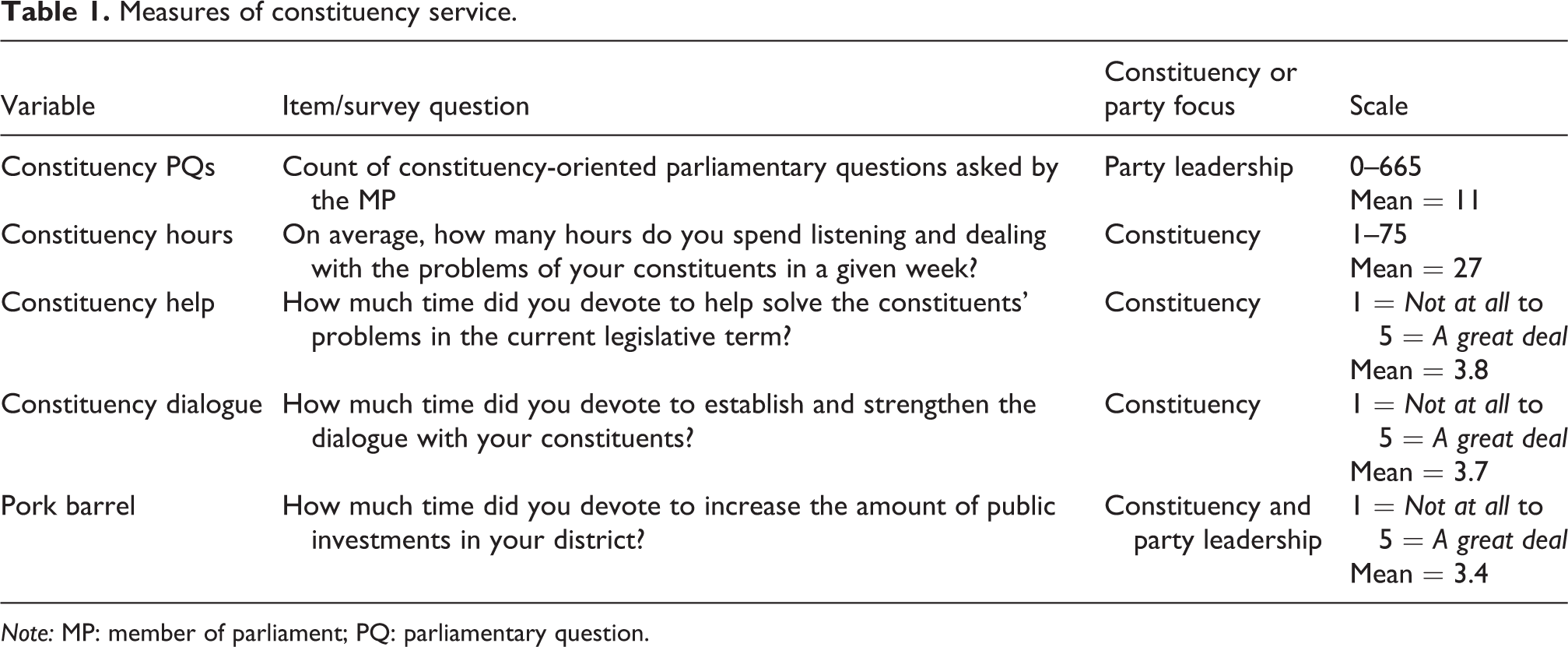
Dependent variables: We use several measures of constituency-oriented behavior. Our first measure is the simple count of constituency-oriented PQs. The 1982 Turkish Constitution and TBMM’s rules of procedure refer to written and oral PQs as means of obtaining information about certain issues from the prime minister or the council of ministers. According to the rules of procedure, at least two working days of every week is reserved as a special time for oral questions. The MP asking the question may request further information on the floor the day her question is addressed. While opposition MPs commonly use PQs to criticize government policies or signal their loyalty to the party, PQs can also serve as an instrument for pursuing constituency service by all MPs (Hazama et al., 2007: 547). In our sample, constituency-oriented PQs are 35% of all questions asked.
4
While only 11% of AKP members ask at least one constituency-oriented question, this ratio is 80% for MPs from the opposition party.
A team of two researchers participated in the collection and coding of the PQs after receiving intense training.
5
These PQs were hand coded and classified as constituency oriented when (i) cities and/or towns are mentioned, (ii) issues that are specifically related to an electoral province are mentioned, and (iii) the question wording referred to organizations and events that are located in the electoral province. We present two examples of constituency-oriented PQs below.
6
“Regarding the Konya Oncology Hospital” (March 13, 2007), Ahmet Isik (MP-Konya province). “Regarding the housing projects in the province of Igdir” (January 24, 2007), Yucel Artantas (MP-Igdir province).
Other measures of constituency service are based on self-reported measures from the survey of Turkish parliamentarians. Questionnaires were first sent to all 550 members in late 2003 and a follow-up was conducted in early 2004. In total, 204 completed responses were received (i.e. a response rate of 37%). The survey produced a highly representative sample with respect to party affiliation, gender, age, and electoral districts. For example, as of fall of 2003, 65% of the MPs in TBMM were from AKP and 35% from CHP corresponding to the ratios of 66% and 34% in the survey, respectively.
Table 1 presents the five dependent variables used in the analysis. The self-reported measures of constituency service tap different activities ranging from average weekly hours spent with constituents (constituency hours) to pork-barrel activities. Some of these activities are visible to party leadership and some require direct contact with the supporters of MPs. The MPs reported that they spend a weekly average of 27 h in dealing with constituents’ problems and give priority to helping and building dialogue with the constituents (mean score of 3.7 on a scale ranging from 1 to 5). Some MPs prefer to spend their time on pursuing public investments for their district (pork barrel), a low-cost activity that is also visible to party leadership.
Measures of constituency service.
Note: MP: member of parliament; PQ: parliamentary question.
Independent variables: To measure legislative role orientations, we use the following question from the survey:
When there is a conflict between the party interest and the interests of the people in your district, what would be your preference on a scale ranging from 1 to 10 with 1 being “always prefer party interest” and 10 being “always prefer interests of people in the district”?
We use two survey questions to measure the perceptions of MPs about the influence of party leadership and other party branches on renomination:
In the last election, what was the influence of the following actors in candidate selection? (1—not at all effective and 8—a great deal of influence) party leader and central party administration party general congress.
In addition to these two questions, the survey also asked about MPs’ perceptions related to the influence of local party branches, local party members, and supporters in the district in candidate selection. We prefer to use perceptions of party general congress on candidate selection as a proxy for the influence of local actors for both theoretical and empirical reasons. Theoretically, party general congress represents the total effect of local actors in intraparty politics to the extent that it provides a setting where local branches, party members, and local actors can shape party’s future. As the highest authority composed of representatives from local party organizations, party congresses meet periodically (1–3 years). The Turkish intraparty competition and management of factions take place during the party general congresses, which are nationally televised and subject of great media attention. Candidates vying for party leadership and for control of central party apparatus compete fiercely to appeal to local actors. Empirically, responses to items evaluating the influence of local party actors are highly correlated and their inclusion in the statistical models results in loss of efficiency in estimation due to a high degree of correlation. 8 Thus, we keep perceptions about leadership and congress in the models and treat questions about the perceptions of other actors as reference category in the statistical estimations.
The survey responses to these two questions are distributed very similarly for the members of the ruling and the opposition parties. However, the data reveal some variation in responses within each party. It is possible that MPs’ perceptions about party leaders differ due to a high level of uncertainty and election of a large number of first-time representatives in the post-2002 environment. The observed variance in perceptions of party general congress might be the result of different weights assigned to local dynamics in candidate selection. Although primaries that give more power to local actors were not common in Turkey at the time of the survey, 9 local dynamics have mattered and have been closely monitored by the central party. We expect that representatives who perceive the party leader and central party administration to be most influential in candidate selection will choose to engage in constituency service activities that cater to the party leadership (constituency-oriented PQs and pork barrel). MPs who perceive the party general congress to be more influential will engage in activities that require direct contact and investment with the constituency.
Finally, we control for government-opposition status with a dichotomous variable (members of opposition party CHP are coded as 1 and those of AKP as 0). Due to the high pressure on MPs toward reelection, we expect that opposition MPs will be more likely to pursue to time-intensive constituency service activities relative to pursuance of pork-barrel projects compared to the ruling party MPs.
We use a question asking the respondents whether they live in their districts (1) or not (0). District size, rank of placement in the party list, and an interaction term between these variables are included to control for the effect of electoral institutions. Our models also include the age and gender (female is equal to 1) of the MPs and the logged gross domestic product (GDP) per capita in US dollar for each district obtained from the Turkish Statistical Institute (TUIK). Before conducting the empirical analysis, we collapse PQs by MPs and then match these with the survey data. The summary statistics for the independent variables in the model are presented in the Online Supplementary.
Results
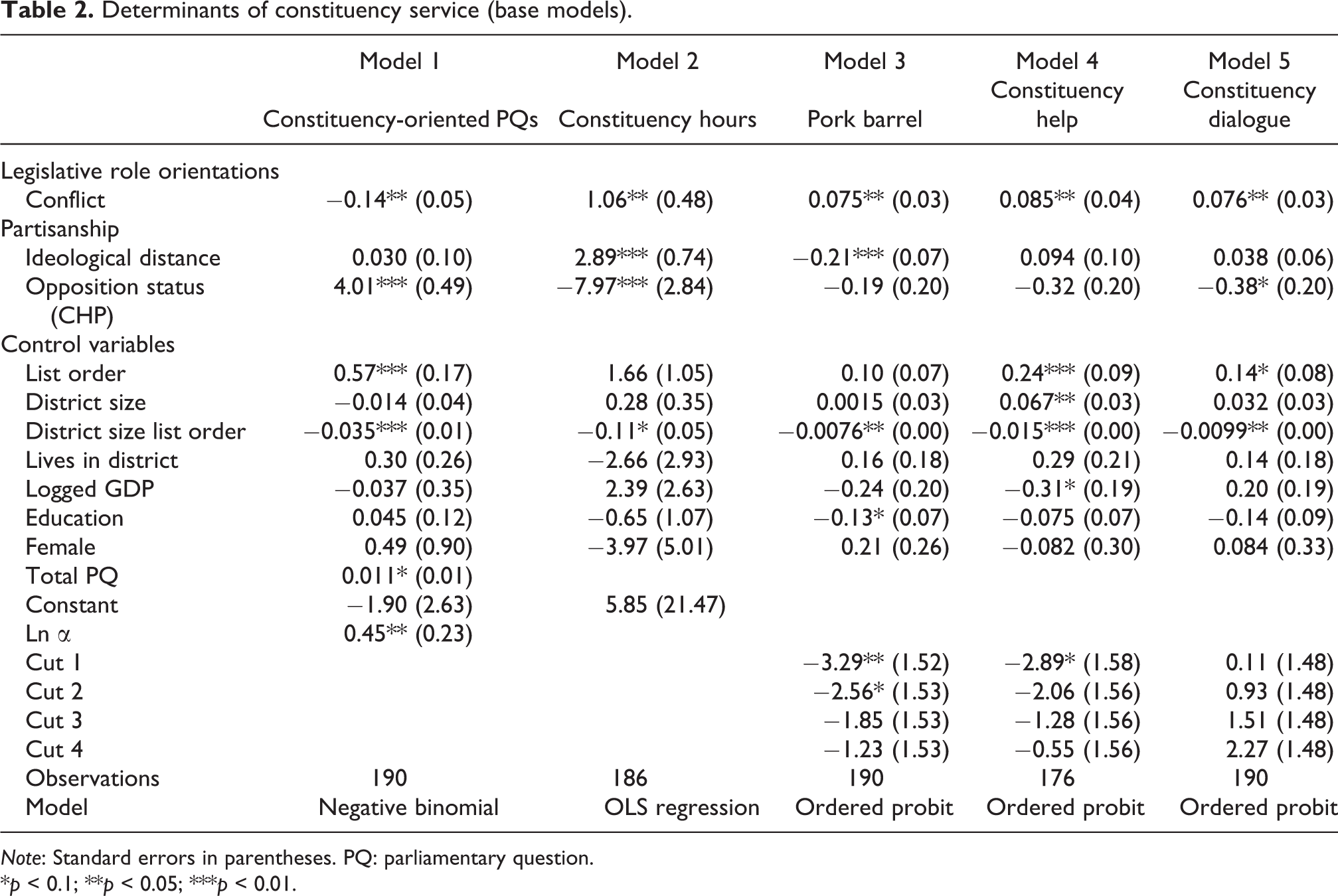
We first present the estimation results for the base models incorporating indicators of legislative role orientations, ideology, and control variables in Table 2. Model 1 runs negative binomial regression because the dependent variable (number of constituency-oriented PQs) includes a large number of zeros with highly over dispersed data (variance larger than mean). Model 2 uses OLS regression and models 3 to 5 utilize ordered probit.
Determinants of constituency service (base models).
Note: Standard errors in parentheses. PQ: parliamentary question.
*p < 0.1; **p < 0.05; ***p < 0.01.
In all models, the main predictor of constituency-oriented role perception (conflict: party vs. constituency) is significant. Models 2 to 5 clearly show that those who prioritize constituency role over partisan roles are more likely to perform constituency-oriented activities demanding time and direct contact with the constituents. This variable takes a negative sign in model 1 to confirm our suspicion that MPs with constituency-centered roles are less likely to ask PQs. Together, these results confirm hypotheses 1 to 3.
Ideological distance from the party median appears to be statistically significant in models 2 and 3. Thus, representatives whose ideology deviates from that of party’s spend more time in dealing with constituents’ problems but less time in lobbying for local investment. This is highly intuitive; lobbying for pork requires one to be highly constituency oriented and at the same time to have strong connections with party leadership. Although demands for local investment by ideologically distant MPs may be met with great suspicion, the image of “a delivering representative” may be indicative of MP’s increasing value to the party leaders that presumably want to increase party’s vote share in that district. 10 MPs from the opposition party (CHP) are significantly less likely to perform constituency-oriented activities, except for asking PQs. Since we hypothesized that MPs from the opposition party will prefer to engage in constituency service activities requiring more time and direct contact with the constituents, this finding remains at odds with our expectations (hypotheses 4 and 5b). We explore this finding in more detail in the split sample analysis below.
Institutional variables exert some influence on the choice of different types of constituency service. An MP placed lower in the ballot is more likely to ask PQs, provide help to constituents, and spend more time in establishing dialogue with them relative to an MP placed higher in the list. This effect is moderated by the district size in the negative direction. This result implies that MPs who are placed at lower ranks in the party list will engage in all kinds of constituency service but they will be less likely to do so if they are elected from larger districts.
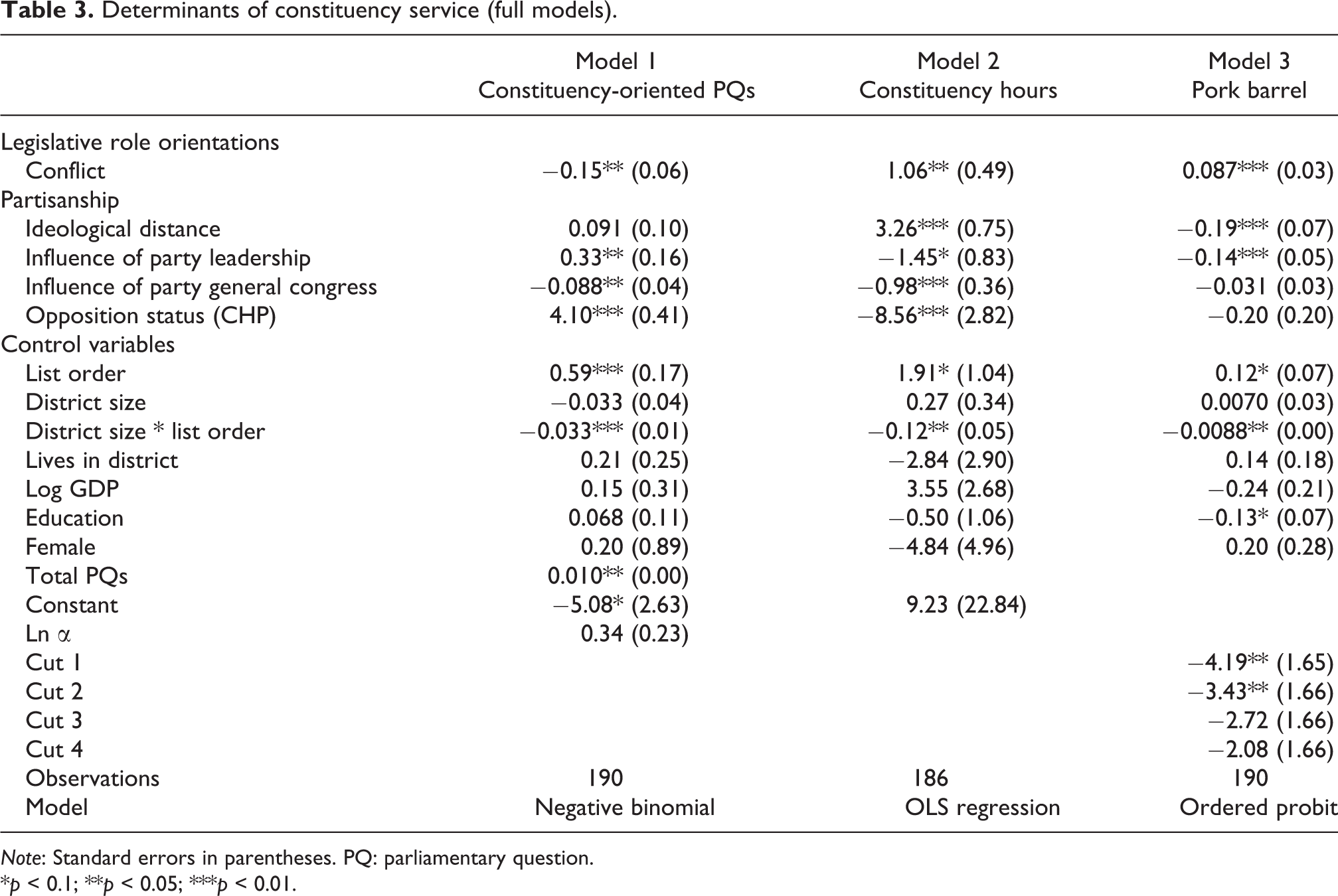
Table 3 adds the perception-based measures of partisanship to the empirical models. We present the results for three dependent variables, constituency-oriented PQs, constituency hours, and pork-barrel activities, for a focused analysis. 11 The results remain unchanged with the addition of two variables controlling for perceptions of MPs about candidate selection procedures as seen in Table 3. MPs who prioritize constituency interest over party interest are more likely to spend time with constituents and lobby for local investment and less likely to ask constituency-oriented PQs. Similar to the results presented in Table 2, ideological distance from the party median is statistically significant for constituency hour (p < 0.05) and pork-barrel models (p < 0.01); however, the latter has a negative sign.
Determinants of constituency service (full models).
Note: Standard errors in parentheses. PQ: parliamentary question.
*p < 0.1; **p < 0.05; ***p < 0.01.
As expected, MPs who believe that party leadership is the most influential actor in candidate selection are more likely to ask constituency-oriented PQs in parliament but are less likely to lobby for local investment and spend time for solving the problems of constituents (hypothesis 5). On the other hand, MPs who perceive the party general congress to be somewhat stronger in nomination decisions are less likely to ask constituency-oriented PQs (p < 0.05) as well as to lobby for local investments. Since party general congress represents the combined power of local party, it is not surprising to observe that MPs who view the general congress to be more powerful in nomination process ask fewer constituency-oriented PQs. However, this perception neither makes MPs more likely to engage in pork-barrel activities nor it makes them more conducive to spend time with their constituents. Overall, it is the perceptions about party leadership’s role in reselection, not the views about the role of other actors in this process, that drive the choice for the type of constituency service in the Turkish context.
To present substantive magnitudes for these effects, we calculate the predictive margins at different values of each variable for the models in Table 2. These are effects of the main variables on the likelihood of different types of constituency service in our estimations. By and large, Figure 1 shows that an MP’s choice for different types of constituency service can be explained by the effect of legislative role orientations and her perceptions about the strength of party leadership in reselection process. When a representative favors constituents, she becomes less likely to ask constituency-centered PQs catering to the party leadership. The margin of error becomes smaller for this effect as the narrow confidence intervals reveal. For constituency hours, we observe relatively larger substantive effects in the expected direction. MPs conceiving the party leadership as the most influential actor in renomination are significantly less likely to spend constituency service hours (approximately 10 h less in a week). Thus, while MPs choose highly time-intensive constituency service activities, they may be less likely to do so if they view their party leader as the ultimate authority for renomination.
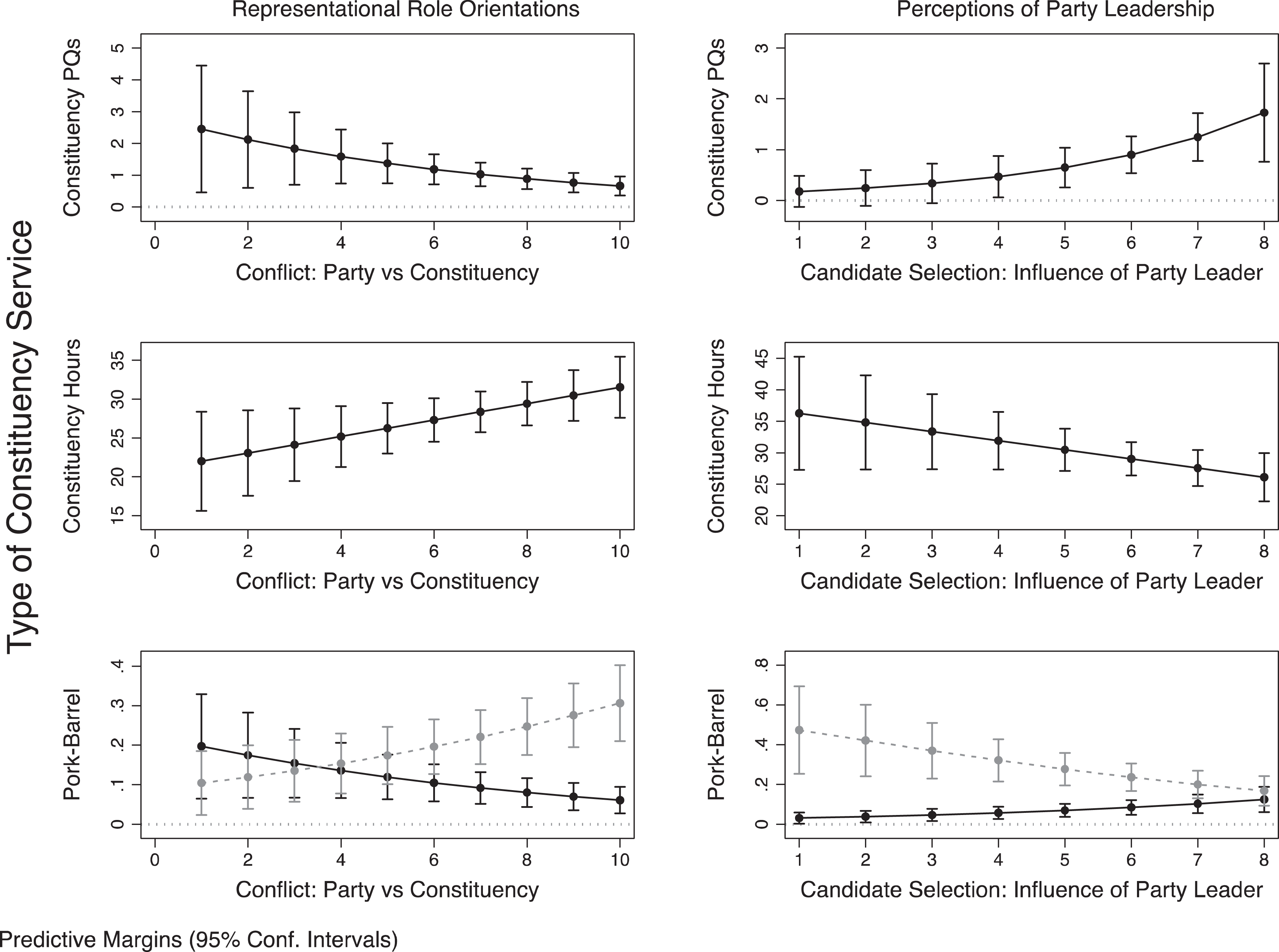
Marginal effects for different types of constituency service. Note: Marginal effects are calculated from the models reported in Table 3. The circles show predictive margins for each main effect as specified in the title and the vertical lines show 95% confidence intervals.
Finally, the bottom panel in Figure 1 presents the marginal effects from the ordered probit regression in Table 3 (model 8). We present the predicted margins for the minimum and maximum response categories: not at all (1) and a great deal (5). If an MP holds a constituency-oriented role, the likelihood of pursuing investments for her district increases. However, this difference is statistically meaningful only for these MPs who strongly identify as constituents’ man (higher values on the scale). We observe the opposite pattern for the effects associated with perceptions of party leadership. As MPs increasingly view the party leadership to be the most decisive actor in candidate selection, they become less likely to pursue pork barrel but still at a higher rate relative to nonpursuance.
We continue our analysis by presenting the marginal effects of ideology and opposition status on constituency-oriented parliamentary behavior in Figure 2. As an MP’s ideological position deviates from that of the median member of her party, she becomes more likely to ask constituency-oriented PQs and more willing to allocate her time to help constituents relative to those whose ideology is closer to the party median. Ideological proximity to the party median, however, increases the likelihood of an MP’s engagement in pork-barrel activities that aim to bring economic investments to the district. This effect is statistically meaningful only when the difference between the MP’s ideological position and the overall party ideology is minimal. MPs who hold extreme positions in relation to the median member of the party are not more or less likely to engage in this kind of constituency service.
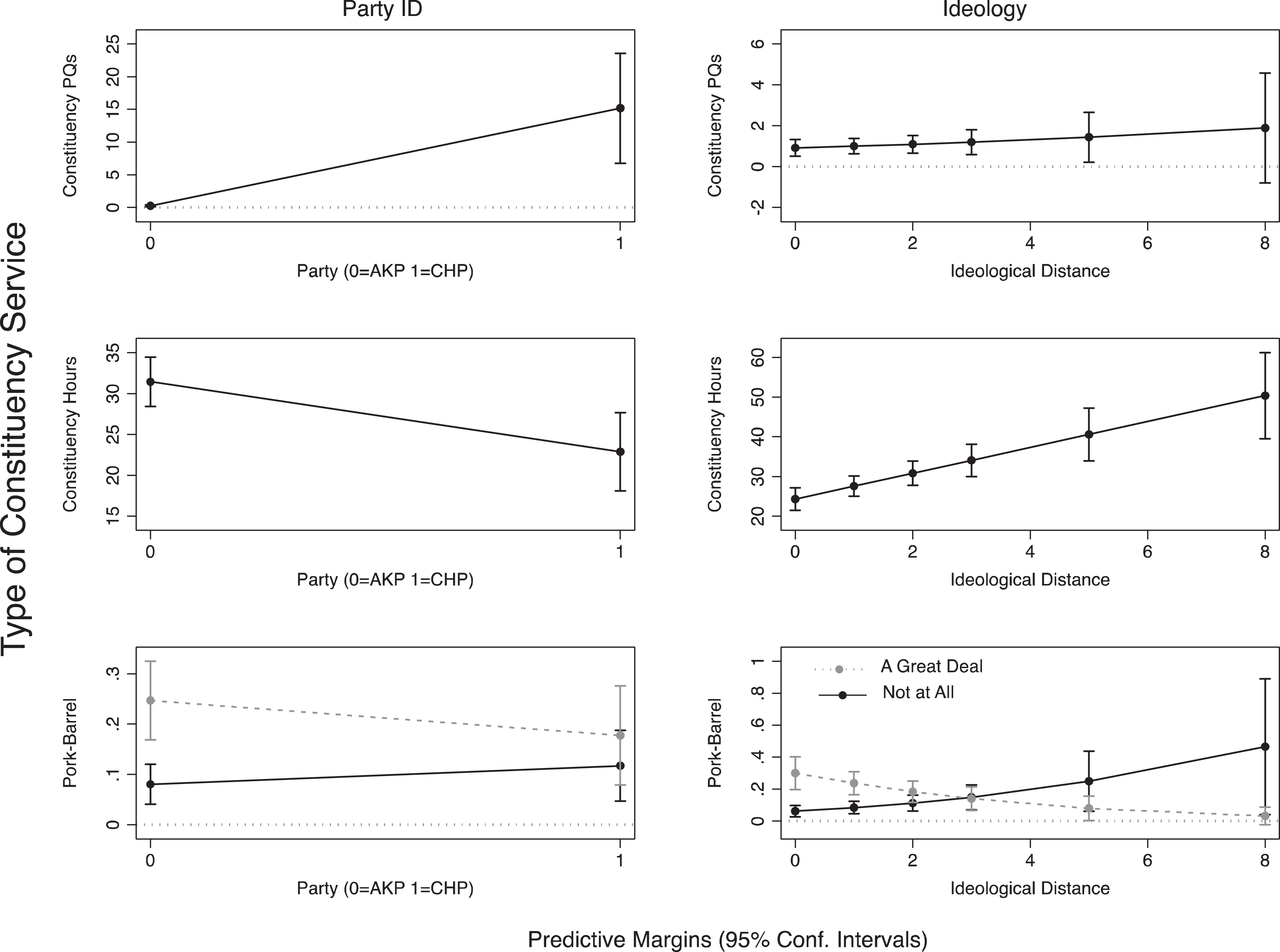
Marginal effects: ideology, opposition status and constituency service. Note: Marginal effects are calculated from the models reported in Table 3. The circles show predictive margins and the vertical lines show 95% confidence intervals.
According to Figure 2, MPs from the opposition party (CHP) are more likely to ask constituency-oriented PQs but are less likely to spend time helping their supporters solve problems relative to the members of the ruling party (AKP). The difference between the governing and opposition party MPs presents an interesting puzzle. As Table 4 demonstrates, some differences emerge between the government and opposition MPs. 12 Constituency-oriented role (conflict) increases CHP members’ likelihood of spending more time with constituents and pursuing pork-barrel projects for their districts but does not affect the likelihood of asking PQs. These results show that opposition MPs are more conducive to pursuing activities that are highly visible to their constituents. Opposition MPs who are ideologically different from the average party ideology are also more likely to spend time with their constituents. Thus, we find support for hypothesis 5b in our analysis. “Ideological distance” increases the likelihood of asking PQs for the AKP members, but it decreases the likelihood of pursuing pork for CHP members. This difference might be related to the larger odds of obtaining investment projects for governing party MPs relative to the members of opposition. Furthermore, in CHP only models, MPs who believe that the party leader has the most influence in candidate selection are more likely to ask constituency-oriented PQs but less likely to pursue pork-barrel projects. Thus, these divergent patterns in MPs’ behavior show that the calculus of representatives may be conditioned by their party’s opposition and government status. Despite these findings that lend partial support to our hypotheses about differing behavior of opposition MPs, we interpret the split-sample results cautiously due to the small sample size in each estimation.
Determinants of constituency service (split sample analysis).
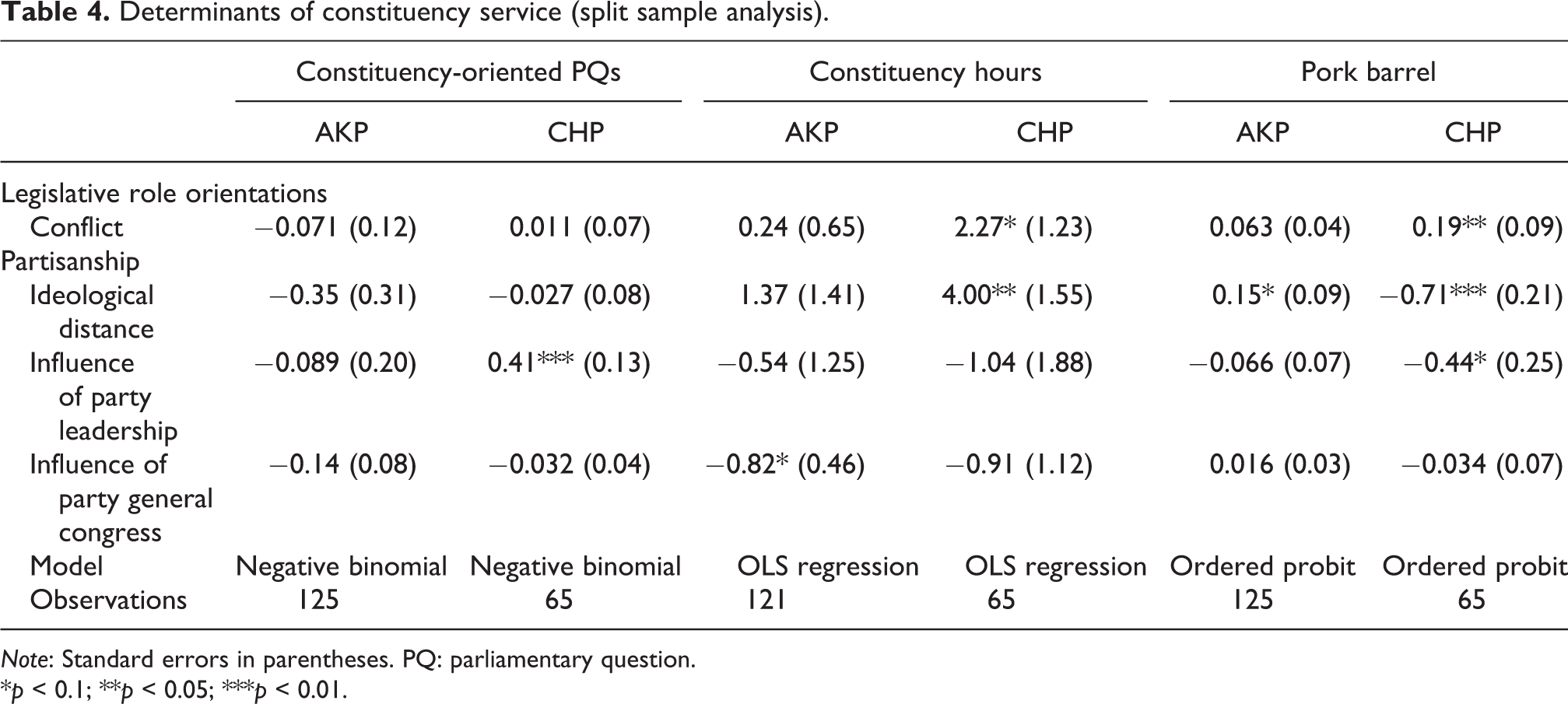
Note: Standard errors in parentheses. PQ: parliamentary question.
*p < 0.1; **p < 0.05; ***p < 0.01.
Robust analysis
The results are robust to alternative model specifications. For example, in some models we use a question asking about the time devoted for defending party policies to capture partisan role orientations with a different item. Previous research finds that explaining policies to the constituency in the district is the most important partisan role for Turkish MPs (Kim et al., 1984). Adding this alternative measure of partisan role orientation does not change the results. The coefficient for this variable is unsurprisingly positive and statistically significant in predicting activities catering to the party leadership (PQs). The results are also robust to alternative measures of perception-based indicators about the influence of local actors in candidate selection. Adding interaction terms between indicators of legislative role orientations and partisanship to the models does not alter the results. 13
One can argue that the choices regarding different types of constituency service are not independent. To account for such dependency, we also ran several seemingly unrelated regression estimations between various pairs of the dependent variables. The results are also robust to these specifications. Most of these estimations are presented in the Online Supplementary and additional analyses are available from the authors upon request.
Conclusion
This study contributes to the scholarship on partisanship and representation by examining the determinants of MPs’ choice for different kinds of constituency-oriented service. No single explanation provides an answer to the puzzle of why legislators choose to engage in different kinds of constituency service activities catering to the constituents or the party. The analysis of attitudinal and behavioral data in the Turkish context reveals that legislative role orientations, opposition status, and perceptions about party leaders’ strength in renomination can be instrumental in understanding why MPs choose to engage in different types of constituency-oriented activities.
The decision to choose a certain type of constituency service activity over others is conditioned by a representative’s calculus about her reelection and reselection prospects. In addition to institutional imperatives, how MPs perceive political reality may also be consequential for parliamentary behavior. The analysis shows that legislative role orientations and perceptions about the influence of party leaders in renomination process matter in explaining why MPs choose one type of constituency service over the others. Spending time in the district or helping constituents with their problems can require a great deal of time and effort but at the same time it may increase an MP’s worth in the district. Asking constituency-oriented PQs is less time consuming, but it may send a signal to the party leadership in their decisions to renominate from an existing pool of candidates. Furthermore, the analysis also clearly shows that opposition and government MPs may choose to ask PQs or pursue investment projects based on their ideology, role orientations, and perceptions of renomination. These findings imply that the mechanisms of MPs’ behavior in parliamentary systems can be much more complex than have been previously assumed (Cain et al, 1984; Denemark, 2000; Strøm, 1997) and that partisan factors might play a large role in this equation.
From a theoretical perspective, the results have several implications. First, the analysis confirms the utility of examining the parliamentary behavior through the lens of legislative role orientations (Searing, 1994; Strøm, 1997; Wahlke et al., 1962), elite perceptions of partisan factors, and party id (Golden and Picci, 2008; Green-Pedersen, 2010). Second, rather than pitting the attitudinal and behavioral indicators of constituency service against each other, using these indicators in conjunction will provide significant leverage in the study of comparative parliamentary behavior. Third, it would be wise to apply the theories of parliamentary politics developed for the advanced Western democracies to nascent political systems with a wavering democratization record. In the age of “democratic recession” (Diamond, 2015) where ruling party leaders are gaining significant political power, investigating the constituency-oriented parliamentary behavior in hybrid regimes such as Turkey will provide important insights about the electoral connection in democratic societies. This endeavor is particularly important in the context of the rising tide of populism and executive dominance in democratic societies.
Supplemental material
Supplemental Material, pp-2017-0031-File003 - Hiding behind the party brand or currying favor with constituents: Why do representatives engage in different types of constituency-oriented behavior?
Supplemental Material, pp-2017-0031-File003 for Hiding behind the party brand or currying favor with constituents: Why do representatives engage in different types of constituency-oriented behavior? by Sabri Ciftci and Tevfik Murat Yildirim in Party Politics
Footnotes
Acknowledgements
A previous version of this article was presented at the annual meeting of Midwest Political Science Association Meeting, in April 2016, Chicago, IL. The authors thank Abdulkadir Yildirim and the panel participants at the MPSA meeting, Goker Bilgic and Mehmet Demirsoz for valuable research assistance; Jonathan Krieckhaus, Stephanie Rodriguez Potochnick, Esra Issever-Ekinci, and Eda Bektas for helpful comments on the earlier drafts of the article. Tevfik Murat Yildirim gratefully acknowledges financial support from the Kinder Institute on Constitutional Democracy. Authors are listed alphabetically.
Declaration of Conflicting Interests
The author(s) declared no potential conflicts of interest with respect to the research, authorship, and/or publication of this article.
Funding
The author(s) disclosed receipt of the following financial support for the research, authorship and/or publication of this article: Tevfik Murat Yildirim was financially supported by the Kinder Institute on Constitutional Democracy (no. KF0041-DJX80).
Supplemental material
The Supplementary Material for this article is available on the Journal site.
Notes
References
Supplementary Material
Please find the following supplemental material available below.
For Open Access articles published under a Creative Commons License, all supplemental material carries the same license as the article it is associated with.
For non-Open Access articles published, all supplemental material carries a non-exclusive license, and permission requests for re-use of supplemental material or any part of supplemental material shall be sent directly to the copyright owner as specified in the copyright notice associated with the article.
