







Abstract
A growing literature shows robust evidence that patronage by high-level politicians greatly enhanced officials’ chance of promotion in the largest one-party dictatorship in the world, China. There have been few works on whether patrons’ exits, even when they were retirements, had an impact on followers’ career prospects. This question concerns the core theoretical issue of whether factional ties are self-reinforcing mechanisms. That is, patron–client relationships were only useful for patrons if they knew that clients would suffer if they fell from power. This mechanism creates strong incentives for clients to engage in political struggle on behalf of their patrons, regardless of the patrons’ monitoring capacity. We control for a range of unobserved heterogeneity and show that patrons’ exits from the political elite had a significantly negative impact on clients’ chance of promotion and also diminished their chance of retaining their incumbent positions.
Patron–client ties are important tools of maintaining political control for leaders in weak democracies and authoritarian regimes. A growing literature shows robust and systematic evidence that patronage by high-level politicians greatly enhances officials’ chance of promotion within the ruling party (Jia et al., 2014; Reuter and Turovsky, 2012; Shih et al., 2012). For junior officials, the factional bargain is a worthwhile one because of the disproportionate benefits and prestige attached to higher level offices in a single-party regime. Yet, why do senior politicians in such political systems pursue such a strategy? In electoral autocracies, or in weak democracies, clients are expected to deliver votes to patrons, thus yielding patrons real benefits (Blaydes, 2011; Lust Okar, 2006; Magaloni, 2006; Reuter and Remington, 2009). In one-party dictatorships without regular elections and where overt political contests are rare but stakes high, regularly bestowing benefits to a group of officials would not necessarily guarantee their loyalty when the patron faces real challenges. If factional ties are not self-enforcing mechanisms, why have them at all? Short of having perfect information on the loyalty of clients, patron–client relationships are only useful for patrons if they know that their clients would suffer with high certainty if the patrons fell from power. This mechanism would create strong incentives for clients to engage in internal political struggle on behalf of the patron.
To provide evidence for the self-enforcing nature of patron–client ties, we use fixed effect models that control for much of the unobserved heterogeneity to test whether high-level patronage (or the withdrawal thereof) had an impact on both promotion and exit of alternate members of the Central Committee (CC) in the Chinese Communist Party from 1992 to 2015. We focus on alternate members of the CC because they had no voting power, not even nominally, over the selection of Politburo Standing Committee (PSC) members, which minimizes the possibility of endogeneity (Li, 2007). We find that the exit of the patron significantly reduced one’s chance of promotion and increased the chance of retirement or purge. Our findings provide evidence that followers of failing patrons were automatically punished, even when patrons exited due to retirement instead of purges.
In combination with findings that patronage by successful patrons earns one promotion, these findings strongly suggest that factional ties are worthwhile ones for both the patron and the client. To be sure, this self-enforcing mechanism requires regular turnovers and a pyramidal power structure that make higher level positions highly desirable. These features are common among one-party dictatorships and may provide further ground for relative stability in one-party dictatorships.
Theoretical motivations
The literature on authoritarian rule has long pointed out that dictators do not rule alone and need a ruling coalition to maintain power (Bueno et al., 2003; Svolik, 2012; Wintrobe, 1998). Yet, ruling a large authoritarian regime requires the help of a sizable number of officials, some of whom may form subcoalitions to undermine or to overthrow the incumbent ruler (Acemoglu et al., 2008; Wintrobe, 1998). In response to these threats, dictators deploy a wide range of strategies, from the appointment of incompetent officials (Egorov and Sonin, 2011) to employing ethnic minorities in the secret police (Gregory, 2009) to constantly rotating officials to different positions (Debs, 2007).
In more institutionalized autocracies, high-level officials often formed patron–client ties with more junior officials to mitigate the threats of defection by junior officials. In essence, patron–client ties are implicit contracts, whereby patrons bestow jobs, promotions, fiscal subsidies, and rent-seeking opportunities to clients in exchange for cash payments, the delivery of votes, and inner party political support for the patron (Doner and Ramsay, 1997; Kang, 2002; Keefer and Khemani, 2003; Lust Okar, 2006; Reuter et al., 2016). In post-revolutionary authoritarian regimes, including China, strong patron–client ties formed during the revolutionary struggle played a major role in maintaining these regimes in power (Easter, 1996; Huang, 2000; Levitsky and Way, 2012).
With the passing of the revolutionary generation, some observers speculated that factionalism has diminished as a mechanism to assign key positions and resources, replaced by formal institutions (Huang, 2008; Miller, 2008). Yet, a large body of qualitative works on post-revolutionary regimes shows the importance of factionalism as a key organizing principle in post-revolutionary regimes (Fewsmith, 2001; Shih, 2008; Taubman, 2003). An emerging quantitative literature on the Chinese Communist Party also demonstrates that factionalism continues to drive senior-level appointments, a key “good” in parties with Leninist pyramidal structures (Jia et al., 2014; Keller, 2016; Landry et al., 2017; Meyer et al., 2016; Shih et al., 2012).
The literature, however, has overlooked the rationale of pursuing factionalism for the patrons. For patrons, the risk of cultivating entourages of fair weather friends is substantial. Although the patron can enforce the factional bargain by cutting off all future benefits to a defecting underling, the effectiveness of such a threat is reduced during an attack on the patron, when her survival is most at stake. Knowing that, clients can pretend to be loyal in ordinary times to receive benefits from the patron, only to defect to a rival coalition at the first sign of serious trouble (Egorov and Sonin, 2011).
Other typical mechanisms to enforce contracts also are not available to an authoritarian leader under attack. For example, a community of participants can help the patron identify and punish defectors, which would create incentives for followers to come to the aid of the patron during a crisis (Dixit, 2009: 12). To be sure, without a severe attack on the patron, members of a faction may patrol each other for signs of defection. However, when a faction faces an attack from a rival group, the patron cannot know whether an accuser of shirking behavior is not in fact the person who has defected to a rival coalition. Certainly, a factional patron cannot count on her enemy to help monitor the behavior of her followers.
To guard against such fair weather friends, patrons need to periodically verify the willingness of their clients to defend their interests during costly political struggles (Wintrobe, 2001). Electoral authoritarian regimes have an advantage in that patrons can periodically ascertain in a credible way whether the clients remain loyal by observing the delivery of votes to the patrons (Keefer and Khemani, 2003; Lust Okar, 2006; Magaloni, 2006; Simpser, 2013; Way and Levitsky, 2002). Elections, if carefully managed, also create credible information of a faction’s dominance, which deters defection from the ruling coalition (Magaloni, 2006). Local elections also assure clients by providing opportunities to key clients to build up their own patron–clients networks (Reuter et al., 2016).
In an established one-party dictatorship without meaningful elections at the elite level such as China, overt political competition may occur once every 10 years in the lead up to major leadership turnovers. Despite the rarity of overt political competition, senior politicians in China still pursued a strategy of patron–client relationships. However, what if their followers were fair weather friends who defected from their patrons at the first sign of trouble?
Indeed, recent events in China suggest that factional clients often rolled over when the going got tough. Even before former internal security Tsar Zhou Yongkang was arrested in 2014, several, perhaps all, of Zhou’s putative followers provided evidence of Zhou’s duplicity and corrupt dealings to the authorities (Caixin, 2014). Even Zhou’s own son and wife provided evidence of his transgressions during his trial (Areddy, 2015). On the other hand, the history of the Chinese Communist Party also records several cases where clients provided spirited defense of their patrons. During the ninth Party Congress at the height of the Cultural Revolution, a long-time follower of Liu Shaoqi and a CC member, Chen Shaomin, refused to vote for his expulsion from the party despite otherwise unanimous support for it (Li, 2007: 210). Even when the party did not undergo intense internal struggles, followers engaged in spirited campaigns to defer their patrons’ retirement and to accelerate the retirement of rivals. Jiang Zemin’s followers, for example, maneuvered successfully around both the 15th and the 16th Party Congress to defer Jiang’s full retirement while rivals were forced to step down (Lam, 1999, 2004). 1 Because of such mixed results, historical cases do not provide sufficient evidence showing that the factional bargain was a worthwhile one for factional patrons.
The literature on corporate governance has long explored the problem of “cheap talk” whereby agents have strong incentive to exaggerate their own ability and performance to principals to obtain employment and bonuses (Farrell and Rabin, 1996; Spence, 1973, 1976). The literature has long identified a key mechanism for overcoming such cheap talk—aligning the incentives of the principal and the agent in a self-enforcing way. That is, if the agent shirked in her effort to perform a job for the principal, the agent would suffer automatically, regardless of the monitoring capacity of the principal (Farrell and Rabin, 1996). For example, if an employee’s lagging effort led to diminishing reputation for the firm overall, the employee’s own employability in the market would suffer (Bull, 1987). This mechanism has the merit that regardless of the information obtained by the two contractual parties—the employer and the employee—suboptimal effort by the employee would render her less valuable in the labor market (Bull, 1987). To be sure, the assumption in this model is that firms operating in the market have sufficient information to evaluate the quality of other firms with some accuracy.
A similarly self-enforcing mechanism would be valuable in authoritarian politics because principals also have a hard time detecting the credibility of agents’ loyalty in such an information poor environment. Patrons would see patron–client relationships as credible if clients suffered significant, costly consequences with the purge or premature retirement of the patrons. This would provide strong incentive for clients to defend the interests of patrons, even when there is not an overt struggle with rivals. Once assured that the clients are “locked in” to them, patrons would pour scarce resources to the clients. Historical studies of Communist politics provide ample evidence linking the fate of clients with that of patrons. During the Cultural Revolution, for example, followers of Liu Shaoqi were systematically purged (MacFarquhar and Schoenhals, 2006). Stalin systematically purged the followers, real or imagined, of Trotsky, at the beginning of the Terror (Gregory, 2009; Montefiore, 2003; Thurston, 1996).
However, such periods of wholesale purges or overt struggle were rare, even in places like the Soviet Union and China. Beyond these unusual periods, lower level clients competed to obtain promotions, while higher level leaders tussled for one of very few positions at the top and to delay their retirement from powerful posts. Given that fewer positions were available the higher one ascended in the party hierarchy and that turnovers took place regularly, it was in the clients’ interests to maximize the power and tenures of the patrons, thus creating self-enforcing contracts between patrons and clients.
If all senior politicians naively assumed that their clients were loyal and worked to promote them higher in the hierarchy, any client whose patron has been purged or has retired will automatically suffer in the promotion game, assuming that the patron’s effort had an impact on the client’s career prospects. Even if rival clients did not naively assume the loyalty of their clients, no patron could afford to assume that other patrons weren’t working hard to promote their respective clients. Empirical evidence already shows that the dearth of patron placed an official at a disadvantage for promotions (Jia et al., 2014; Shih et al., 2012). The literature still needs to identify whether a patron’s exit in itself exerted a negative influence on an official’s promotion prospect or even her prospect of staying in her current position
This causal signal took on great importance in patron–client relationships in one-party states. If indeed the system automatically placed patronless officials at a clear disadvantage in obtaining higher level positions or in even holding on to the existing posts, patrons, even those who had little information about the loyalty of the clients, could take comfort in the clients’ strong incentive to defend their interests. The greater this causal relationship, the less the patron needed to know the loyalty type of the client, even though the literature often identifies the loyalty of the client as an important factor in the patron’s continual rule (Egorov and Sonin, 2011; Zakharov, 2016).
Moreover, in the existing literature on authoritarian regimes, a one-party dictatorship is seen as more stable because of its ability to credibly deliver benefits to members of the ruling coalition and to provide incentives for lower level officials to maintain the status quo (Brownlee, 2007; Magaloni and Kricheli, 2010; Svolik, 2012). The one-party state structure may contribute to political stability in another way. That is, ensuring incentive compatibility between patrons and clients only worked in a pyramidal structure with institutionalized turnover mechanisms such as retirement rules and party congresses (Manion, 1993; Miller, 2008). In the absence of such mechanisms, a patron would have needed to derive credible information about the loyalty of her clients through other means, including periodically initiating political turmoil or resorting to institutional changes, which can be destabilizing. The absence of such destabilizing mechanisms of obtaining information about client loyalty may have accounted for the relative stability of one-party dictatorships (Geddes, 1999)
If factions were indeed credible contracts for the patron, we would expect two simple hypotheses in China:
Alternate CC members as testing ground
Ideally, we would identify the impact of a patrons exit on her immediate followers’ fate. Methodologically, however, it is challenging to identify the impact of a patron’s exit on the fate of her immediate followers because the patron might have fallen due to shirking or betrayal by her immediate followers. Ideally, we would like to show that a cadre’s career is hurt by a patron’s exit irrespective of that cadre’s own effort to help/harm the patron. To be sure, Jones and Olken’s (2005) famous study overcomes this endogeneity problem by focusing on cases where the dictator died in office of natural deaths. Since 1949, only three PSC members had died in office of natural causes, Chairman Mao himself, Zhu De, and Zhou Enlai. Unfortunately, they all died within 6 months of each other between the 10th and the 11th Party Congress. Thus, the impact of their demise on their followers might have been caused by the political turmoil associated with the unusual period of Mao’s illness and death.
Our strategy, although not perfect, focuses on a layer of officials in China just below the level where politicians have an impact on the patron’s fate. Yet, because these officials are close to the power elite, strong evidence of them suffering from their patron’s exit would indicate the existence of a self-enforcing patron–client contract even at the highest level.
This empirical strategy is further supported by formal rules within the party and historical studies of elite politics in China. In the Chinese Communist Party, the CC is divided into two bodies. First, full CC members have full voting power to vote the politburo and the standing committee into office once every 5 years at party congresses and during emergency situations. They also vote on important policy changes during the annual CC plenum. Finally, full CC members are often consulted on high-level appointments (Fewsmith, 2003; Shirk, 1993). Shirk (1993) identifies full CC members as the “selectorate,” who has direct impact on the fate of the highest level politicians in the party. After all, it was the CC which voted to expel Liu Shaoqi from the party. Ten years later, the CC also promoted Hu Yaobang into the Party Secretary General position and also catapulted a relatively unknown Zhao Ziyang into the PSC.
In contrast, although alternate members of the Central Committee (ACC) attended CC plena and were ministerial level officials like their peers who were full CC members, they had no voting power on any decision made in the CC (Kung and Chen, 2011). When a full CC member died naturally or was purged, an alternate sometimes took his seat, although such occurrence was rare. 2 Table 1 shows that during the 5-yearly party congresses, roughly 36% of ACC members were promoted into full CC members after one term. At the same time, 37% of ACC members were retired or removed from office to a lower level after one term. Given such a high probability of being removed, ACC members who benefited from elite patronage had strong incentives to hope for the best for their patrons. Because of the institutional arrangements surrounding ACC members, they provide a nearly perfect testing ground for the self-enforceability of the factional bargain.
Mobility of ACC members.
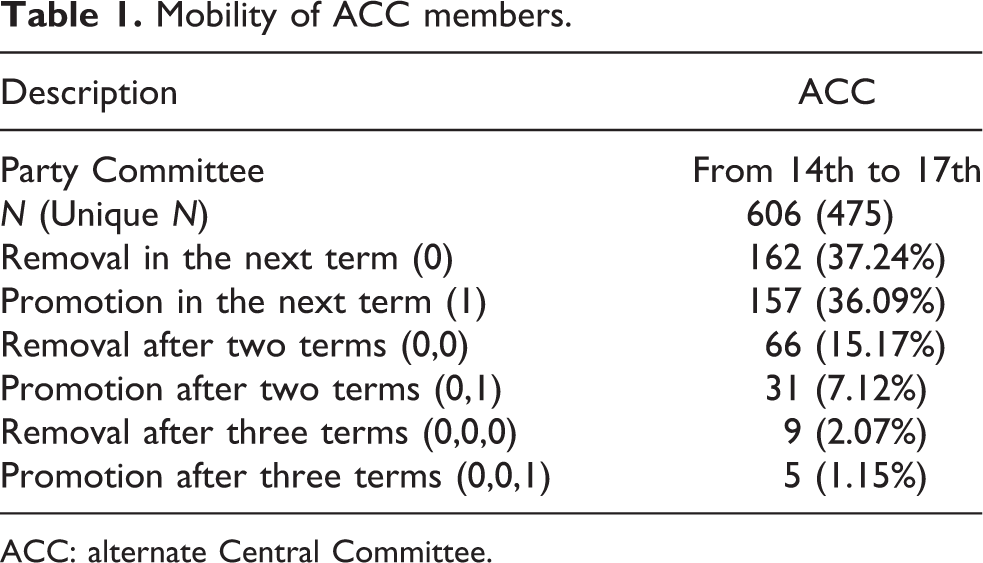
ACC: alternate Central Committee.
On the one hand, party rules and norms minimized both formal and informal influence ACC members had on high-level politicians in the party. In the history of the Chinese Communist Party, there was never a case where alternate members alone conspired to change any major policy or high-level personnel. At best, alternate members of the CC may have had a stronger tendency to zealously carry out the policies of the top leadership to curry favors or to channel benefits to families of high-level patrons (Kung and Chen, 2011), but that likely did not have any decisive impact on the fate of individual patrons in the PSC. On the other hand, alternate members sat just below the power elite such that if their careers were negatively impacted by their patron’s exits, it was very likely that full central committee members faced similar or even stronger incentives to protect their patrons.
Data and identification strategies
Both the dependent and the main independent variables are derived from a database of the Chinese elite, which include all CC full and alternate members, as well as provincial level standing committee members from 1993 to 2015. Following an earlier database of CC members (Shih et al., 2008), this database tracks every stage of officials’ careers, records the years in which they served in various positions, and records other biographic information. This detailed biographical information allows us to generate factional ties variables, defined as overlapping work units over 1 year between the patron and the client within two administrative steps of one another prior to the patron entering the Politburo. Once one official enters the Politburo, he is automatically identified as the “patron,” while the lower level official is identified as the “client.”
Table 2 reveals that ACC members with at least Politburo level or above connections accounted for the majority of promotions at the ACC level for every party congress in question. At the 16th Party Congress, connected ACC members accounted for nearly all of the promotions. This pattern suggests a patronage effect. Over the course of the two decades, the average age of ACC members remained stable at 57–58. They continued to be overwhelmingly male and Han. Average education level rose from below college level (college = 2) in 1992 to above college level in 2007. Over time, those holding central level positions increased their representation among ACC members, while local representation declined, although local officials remained in the majority as of 2007. People’s Liberation Army (PLA) representation ebbed and flowed between 12% and 17%.
Summary statistics by party congress (1992–2015).
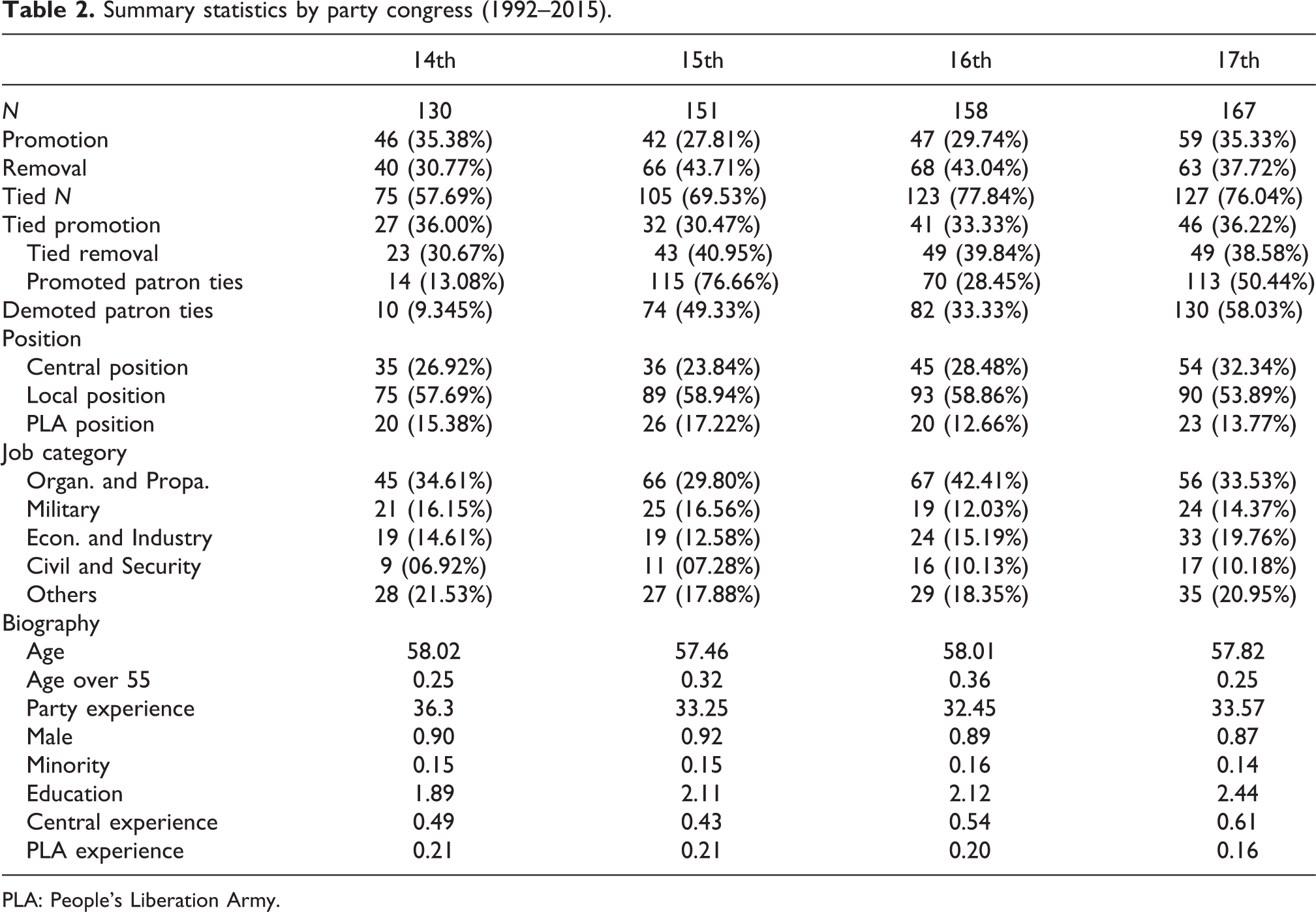
PLA: People’s Liberation Army.
Because the dependent variables are binary (promote, not promote and exit, not exit), we estimate the models using logit regressions. In terms of model specification, we use several fixed effects to overcome shortfalls in the existing literature. In essence, the existing literature on the impact of factional ties on cadres’ careers mainly compares the promotion probability or the average expected promotion level of cadres with certain factional ties with that of cadres without factional ties (Jia et al., 2014; Keller, 2014; Opper et al., 2015; Shih et al., 2012). Despite the robustness of the finding that factional ties helped promotions, this approach suffers from a potential selection bias, which would cause a bias in the estimation. In essence, the observed correlation between factional ties and promotions may be driven by observed and unobserved traits shared by the patrons and promoted officials.
The literature sometimes refers to this as the homophily problem (Opper et al., 2015). For example, ACC members with good class background were more likely to be followers of Politburo members, who also had good class background, and also more likely to obtain full CC membership. The observed advantage of connected ACC members to obtain promotion may just be driven by their class background. Thus, comparing the promotion chances of connected ACC members with their unconnected rivals may uncover spurious relationships between factional ties and the promotion of ACC members. At the very least, such an effect might have been over-estimated.
To address potential omitted variable bias, we first focus our analysis on only ACC members with at least Politburo or above level connections and estimate the impact on an ACC member’s career of a Politburo level patron’s promotion into the Standing Committee. We also estimate the impact on an ACC member’s career of a Standing Committee level patron’s exit from the elite body. 3 However, another selection bias can arise from heterogeneity between ACC members whose patrons received promotions and those whose patrons did not receive promotions. For example, under Deng’s open door policies, reform-oriented cadres enjoyed a higher chance of being promoted in the 1980s, whereas conservative cadres might have suffered from a higher chance of being forced into retirement. The fate of reformers and conservatives might have flipped in the early 1990s during a generally conservative period. Thus, Politburo promotions and ACC promotions in the same faction might have occurred in tandem because of the shared ideological dispositions of its members rather than due to the promotion or demotion of its patron per se. In the extreme, perhaps all of the promoted Politburo patrons and the promoted ACC members had been reformers in the 1980s, which explains why they were promoted in tandem. Without additional identification, ideology effect might have been misinterpreted as factional effect.
To identify the impact of factional ties, scholars ideally would randomly assign factional ties to junior officials. However, that is impossible in the real world. To control for such selection biases, we include different fixed effect variables to our base model to confirm that the effects of promoted and demoted patrons are consistent regardless of unobserved characteristics shared with each other through a variety of formal and informal channels. We use five kinds of fixed effect variables: party congresses, job positions, job categories, individual patrons, and individual ACC member. We control for party congress fixed effect in case something unusual occurred during a party congress, which resulted in unusually high or low number of promotions or exits.
We control for both positions and job categories, which record an ACC member’s job and job category at the time of a party congress. Job position is applied as a proxy of unobserved shared characteristics that potentially affect patron’s and follower’s career outcomes at the same time. In our model, there are three job categories: central, local, and PLA positions of ACC members. If PLA officials shared some distinct attributions that were prized by the top leadership such as loyalty, it is possible that the simultaneous promotions of Politburo patrons and ACC followers were observed because of the perceived loyalty trait, not because of factional ties between patrons and clients. Another specification is bureaucratic classification by job categories: organization, propaganda, military, economic affairs and industry, civil affairs, security, and others. Officials in the provinces, the State Council, or the military could have specialization in these areas, which could have equipped these officials with skills that were prized by the top leadership. For example, Politburo members and ACC members who had worked in the Ministry of Finance may have had an advantage in obtaining a promotion at a time when the central leadership was planning fiscal reform.
We also control for followers of a given patron in case there is unobserved shared characteristics across the network groups clustered by promoted or exiting patrons (i.e. factions). This eliminates any time-invariant components at the faction level that may confound the estimates. Omitted variables across the network clusters that affect patron’s and follower’s promotions at the same time should be controlled by this fixed effect. Returning to our example of ideological dispositions, if reformers were systematically promoted in the 1980s and also clustered around a few factions, adding the factional patron dummy would eliminate the unobserved effect of ideology and focus our estimates on the effect of particular patrons getting promoted or demoted.
To be sure, this estimation technique is not without costs. By including dummy variables for factional patrons, we will not be able to capture the effect of patron promotion or demotion on clients who only had one patron, potentially biasing our estimates downward. This potentially is a major bias because presumably the most loyal followers with only one patron can benefit the most from that patron’s promotion or is harmed the most from the patron’s exit. Therefore, we present results both with and without patron fixed effects. The issue with individual level fixed effect is even greater. Without taking the first difference in the ACC member’s status, we do not have enough observations to make inferences. After taking the first difference, however, this still reduces our observations from 430 to 71.
In all of our estimations, we examine the effect of a patron’s promotion to the PSC or demotion from the PSC on a client’s fate in the 5 years after the patron’s changed status, including the subsequent party congress.
Our base model is as follows:

The dependent variable
We also include the interaction terms between age over 55 and all the connection variables.
Lastly,
Due to the small number of observations in the case of individual ACC member fixed effect, we use a first difference estimator for those equations:
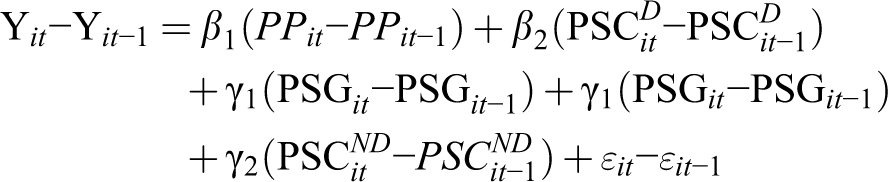
In our presentation of the findings in Figures 1 and 2, we are more interested in the average marginal effects (AMEs) of the patron variables on the probability of promotion or removal than the coefficients of the nonlinear logit estimators. Many scholars favor AME over marginal effect at the mean because the sample means of dummy variables are not realistic and it becomes biased when some of the parameter estimates are large (Tamas Bartus 2005; Greene 2003). We calculate the discrete differences of our main patron variables in the predicted probabilities for each observation and average them over all observations. We report logit coefficients in the table, but interpret results by calculating AMEs.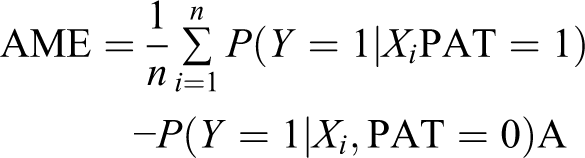
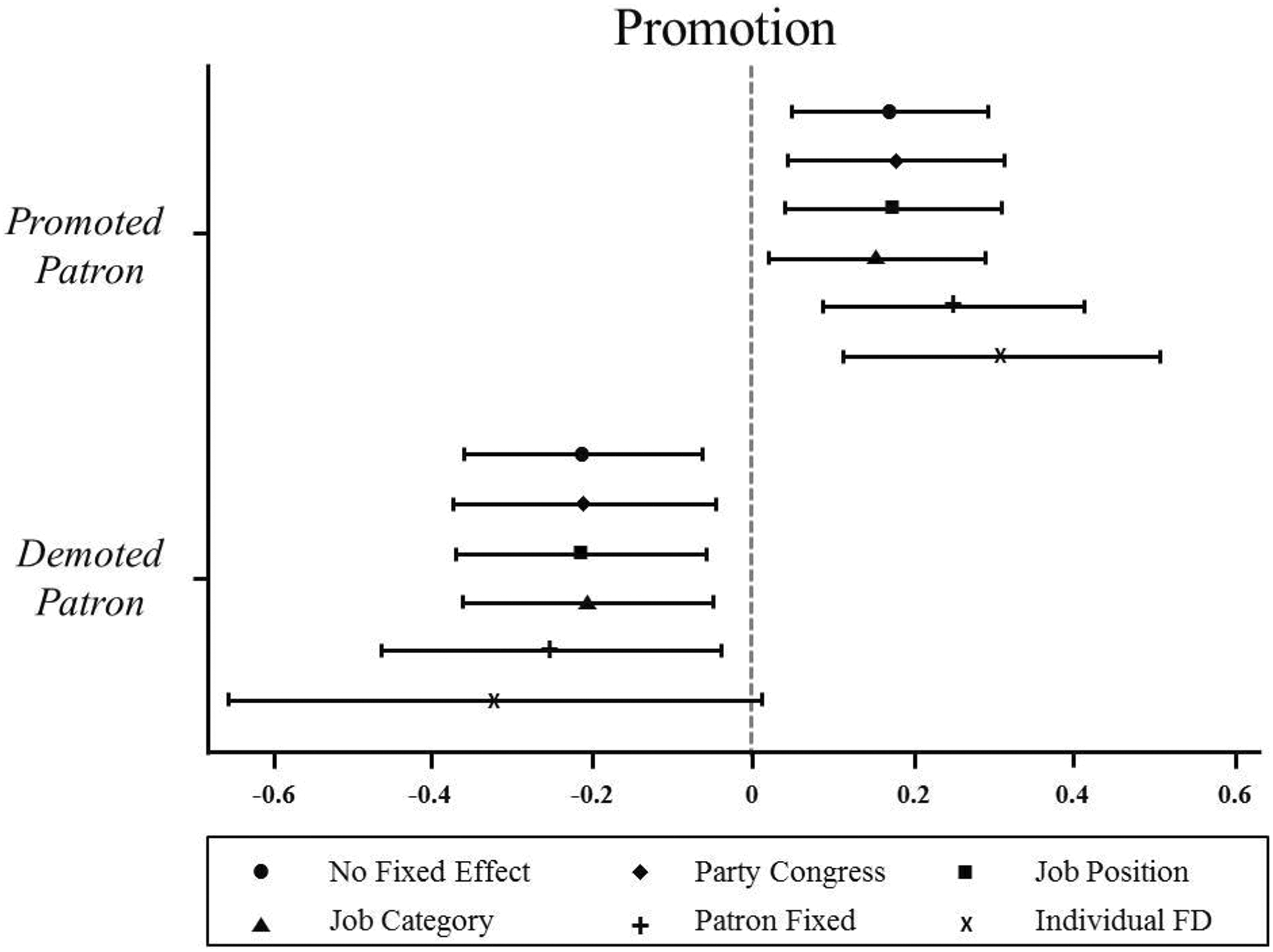
The marginal effect of patron’s promotion and exit on ACC member’s promotion, with no fixed effects and party congress, position, job category, patron, and individual fixed effects, with 95% confidence intervals. ACC: alternate Central Committee.
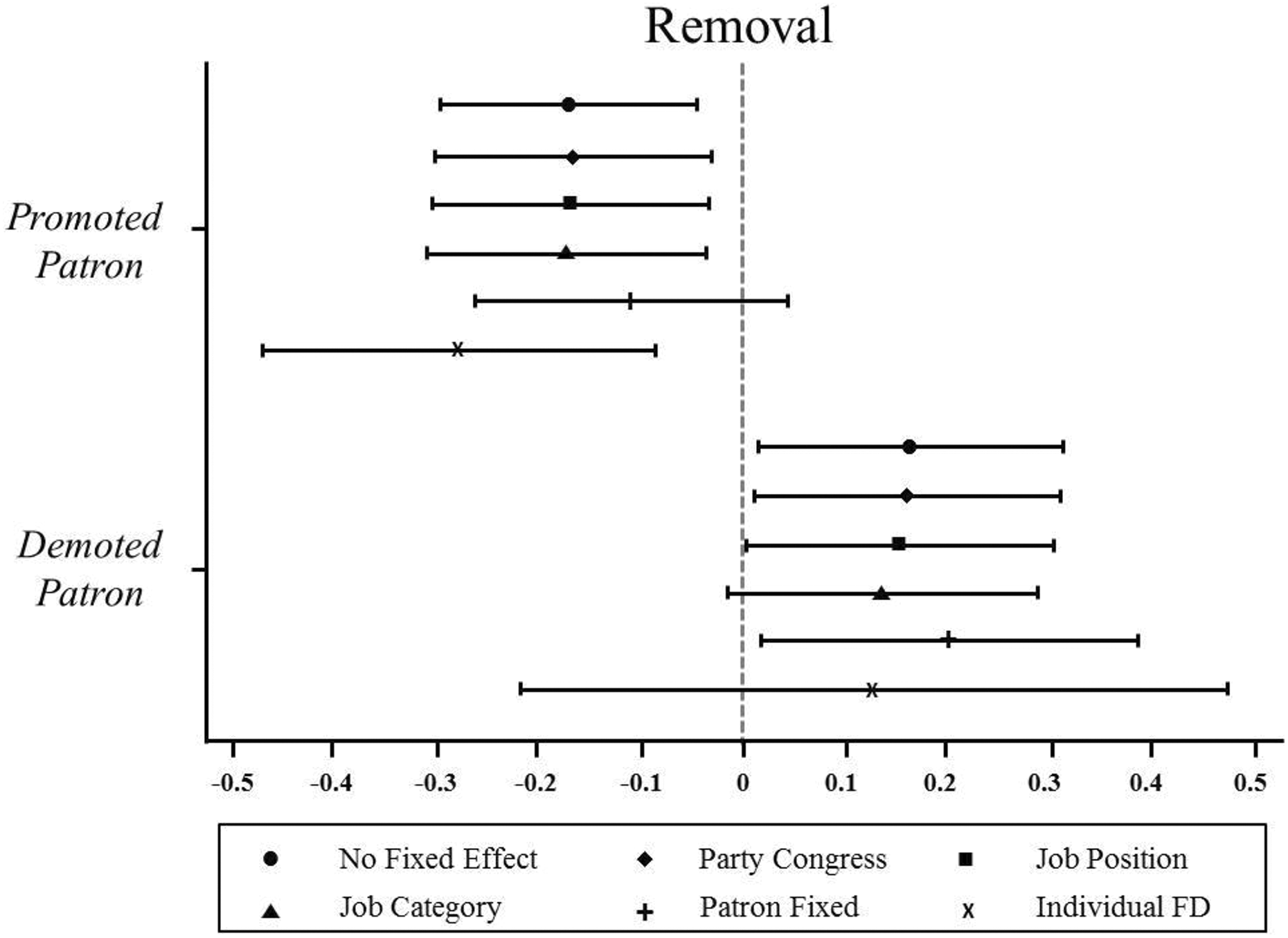
The marginal effect of patron’s promotion and exit on ACC member’s removal, with no fixed effect and with party congress, position, job category, patron, and individual fixed effects, with 95% confidence intervals. ACC: alternate Central Committee.
Findings
In Table 3, the results of estimations with different specifications are shown. In the table, models 1–6 predict ACC promotion chances, while models 7–12 predict the chance of ACC members’ exit from the elite body. The main variables of interest are “PSC Promotion,” the promotion of a Politburo patron into the PSC, and “PSC Exit,” the exit of a PSC level patron through retirement. In essence, as the literature has shown, a patron’s promotion into the PSC had a significant impact on the client’s chance of promotion. Similarly, a patron’s exit from the PSC negatively impacted the clients’ chances of promotion into the CC. These results alone show that the factional bargain was a credible one because a patron not being promoted lowered the chance of the client’s own promotion. Worse, a patron’s exit from the PSC further reduced a client’s own chance of promotion substantially.
The impact of patron promotion into or retirement from the PSC on ACC member’s own promotion into the CC or exit from alternate membership.
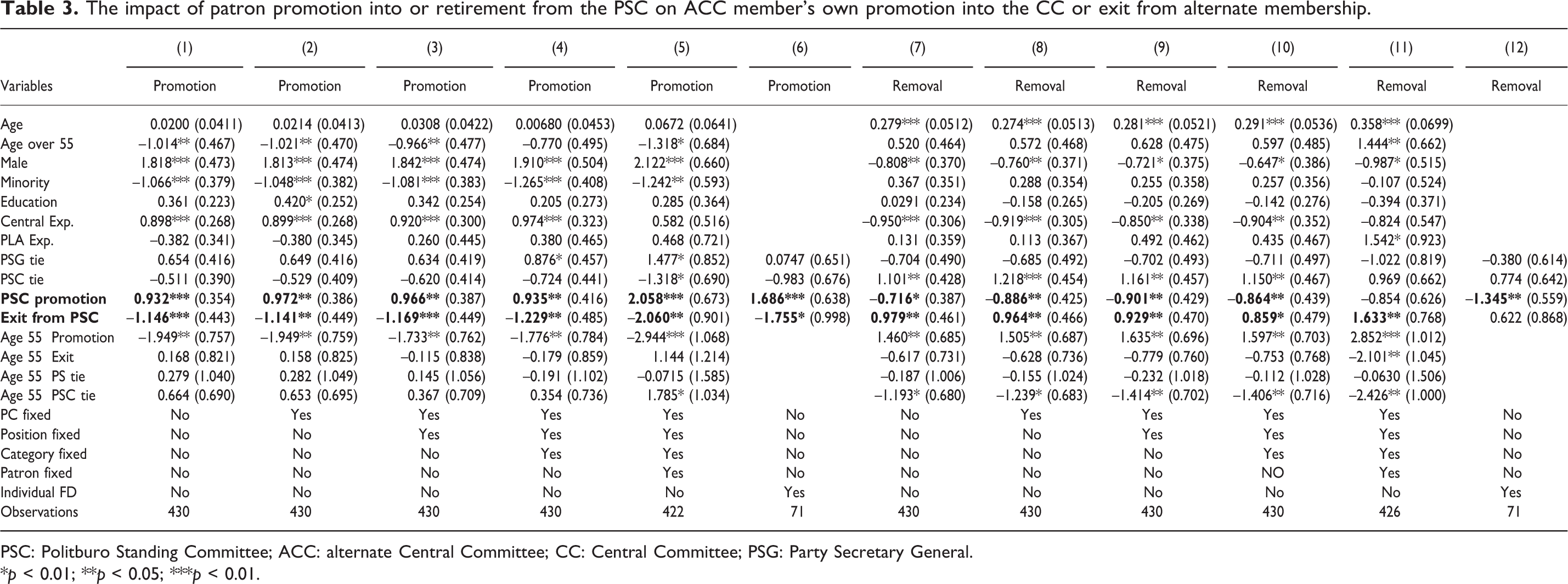
PSC: Politburo Standing Committee; ACC: alternate Central Committee; CC: Central Committee; PSG: Party Secretary General.
*p < 0.01; **p < 0.05; ***p < 0.01.
What about the impact of a patron’s career on the chance of a client losing her job? The results here are nearly as consistent. Across most of our regressions, a promoted patron on average reduced an ACC member’s chance of being forced out. This is even the case when we control for individual level fixed effects. Across most of our estimations, having a patron who just left the Standing Committee raised an ACC member’s chance of being removed, as expected. For the regression with individual level fixed effect, the coefficient for patron’s exit is not significant, although the sign of the coefficient is as expected. Given the steep reduction in the degrees of freedom and increase in standard error, the insignificant coefficient for that model is not unexpected. Taken as a whole, these largely consistent findings suggest that it was in the strong interest of the clients to defend and promote the interests of the patrons because higher status for the patrons brought direct benefits to the clients and prevented them from being removed from office in a highly competitive environment. In contrast, patrons who retired decreased their followers’ chance of promotion and increased the likelihood of their removal from office.
We note that for ACC members above the age of 55, the situation was almost completely reversed. Even with a promoted patron, they saw a reduced chance of promotion, while their chance of demotion rose. This is not surprising. Given the mix of ministerial and vice-ministerial level officials among ACC officials, the expected retirement age for this body of officials was between 60 and 65. As such, if factional rivals were attempting to unseat one’s clients, it would not be worthwhile for the patron to defend clients above the age of 55, who would retire a little after 5 years anyway. The patron’s energy was much better spent focusing on those under 55, who had a decent chance serving the next 10 or more years at the ACC or even at the full CC level.
Our findings also reveal that for those above 55, a patron’s exit seems to have little effect on both promotions and exits. Here, the explanation may be the limited political resources of the rivals of a patron, who presumably preferred to focus their resources on eliminating younger officials who were expected to serve many more years instead of officials who would have had to retire in a few years anyway. We also find that although incumbent PSC members could not affect the promotion chances of their ACC followers above the age of 55, they were able to defend their followers from being removed, which is consistent with anecdotal cases.
In terms of the coefficients of our other control variables, being male in the upper echelon of the Chinese Communist Party definitely improved one’s chance of being promoted and reduced one’s chance of removal. Being an ethnic minority reduced one’s chance of gaining entry into the CC but did not increase one’s chance of losing alternate membership of the CC. This is not surprising given affirmative action for minorities at party congresses at the alternate CC level (Li, 2007). Somewhat surprisingly, education was not significant in determining ACC members’ fate. As expected, having experience in the central government both afforded a higher chance of promotion and reduced the chance of removal. This variable could be proxying for density of connection in the central government. Having military experience had no impact on promotion or removal at the ACC level, although we suspect such ties may become useful at a higher level, such as promotion into the Standing Committee.
Figure 1 plots the AMEs of a patron’s promotion and exit for regressions where an ACC member’s promotion is the dependent variable, including specifications with no fixed effect and with party congress, job, job category, patron, and individual ACC member fixed effects along with whiskers of the 95% confidence intervals. The plotted AMEs show clear advantage of patron promotion on ACC members’ own chance of promotion to the tune of 20–35% increase in promotion odds. It also shows that patron exit from the PSC reduced an affiliated ACC member’s chance of promotion by 20–35%. This suggests that compared with a client with a promoted patron, the client of an ousted patron had roughly 40–70% lower chance of being promoted.
This made a major difference in the careers of many ACC level officials in the highly competitive tournament for higher offices in the Chinese Communist Party. For example, several officials who had worked closely with Xi Jinping in Zhejiang, including Xia Baolong and Chen Min’er, enjoyed promotions into the Central Committee at the 18th Party Congress due to Xi’s promotion into the PSC at the 17th Party Congress. At the 19th Party Congress, they both entered the Politburo, an extraordinary jump in the space of 10 years. In contrast, several promising ACC level officials in 2007, such as former Shanxi Provincial Vice Governor Chen Chuanping and Shandong vice-governor Li Qun, likely languished as ACC members at the 18th Party Congress (PC) due to patrons’ retirement or purge.
In Figure 2, we present the AMEs of patron promotion and exit on an ACC member’s own exit for models without fixed effects and with the various fixed effects. Here, the impact of patron’s promotion was also very clear. When a Politburo level patron was promoted to the Standing Committee, the clients’ chance of being removed decreased by 10–30%, depending on model specification. A particularly glaring example was Politburo member Li Zhanshu, who, at the age of 57, had been an aging vice governor on his way to an early retirement at the 2007 17th Party Congress. After all, he was to turn 62 by the 18th Party Congress in 2012, 2 years above the retirement age for vice provincial level officials. However, Xi Jinping, whom Li had known since they both had served as county officials in Hebei in the early 1980s, was promoted to the PSC in 2007. After that, Li’s risk of being removed plummeted as he enjoyed a series of rapid promotions, culminating to his elevation to the PSC at the 19th Party Congress, where the retirement age was 70 or above. In the meantime, when a PSC level patron retired, his clients’ chance of being removed rose by 10–15%. The exits of numerous Hu Jintao followers before retirement age such as Qin Yizhi and Li Yuanchao since the 18th Party Congress have followed this pattern. Similar to promotions, the risks of being removed also differed drastically depending on whether one’s patron had been promoted or removed.
Discussion
Scholars of authoritarian politics have long assumed that the factional bargain was a worthwhile one for both the patrons and the clients, else they wouldn’t have struck the implicit bargain in the first place. Although this model has been a powerful tool in analyzing elections in electoral autocracies, economic allocation in rentier states, and promotions in one-party dictatorships, it is not without problems. In authoritarian states without regular elections, what were clients delivering to patrons in exchange for regular monetary and political benefits? To be sure, patrons counted on clients to help them when political challenges emerged, but in systems without regular elections or institutionalized power competition, how could patrons know that the clients would have come to their aid when the crucial moment arrived? For high-level politicians in one-party states, pyramidal party structure and regular turnovers at the lower level afforded patrons a mechanism to ensure loyalty. Because promotions were fiercely fought over in a pyramidal system, clients knew that they must have the support of strong patrons to receive a promotion or even to retain their current positions. This created incentive for clients to help maximize the power of the patrons, regardless of whether the clients were genuinely loyal and regardless of the patron’s ability monitor clients’ loyalty.
In our empirical analysis, which takes into account several potential selection biases, we find that patron’s promotion and exit had a clear effect on the client’s chance of promotion. We also clearly show that a patron’s well-being also affected the clients’ ability to hold on to existing positions as alternate members of the Central Committee. This linkage provided the strongest incentive for lower level clients to support their patrons because the fall of one’s patron potentially meant the end of one’s career.
The self-enforceability of patron–client relationships may have provided another reason for the relative longevity of one-party states. Because regular turnovers afforded patrons a credible way of incentivizing clients, patrons had no need to initiate overt political competition with rivals to discern the loyalty of clients. Still, one party dictatorships such as China and the early Soviet Union saw major political turmoil initiated by the top level leaders of these regimes. Why? Both Mao and Stalin faced entrenched elites of revolutionary veterans who had carved out empires for themselves. Because these revolutionary veterans had been relatively young in the two decades or so after these regimes had come to power, they were not going to retire, thus minimizing turnovers in the leadership. For elite patrons, this presented a problem because low turnovers did not incentivize clients, especially those who were not revolutionary veterans, to struggle on behalf of the patrons. This left the dictators even more vulnerable to challenges by coalitions of rival revolutionary veterans.
In China, when Mao announced a delay of holding the party congress, which would have delayed turnovers, no one objected, suggesting that the political elite preferred the status quo of low turnover. Future historical and quantitative research may explore whether the desire to create incentive compatible clients constituted an important reason for Stalin and Mao to each launch their bloody purges against entrenched elites. In both the Soviet Union and in China, elite turnovers accelerated long after the purges. In China, Deng continued Mao’s system of regular elite turnovers, albeit under the more peaceful guise of retirement rather than radical revolution. Finally, the need to launch these purges may highlight a fundamental dilemma of authoritarian rule. Even when the struggle to obtain absolute power succeeded, the top leader of the regime still needed to generate political competition and elite turnovers, else faced lackeys whose loyalty was increasingly uncertain.
Footnotes
Authors’ Note
All mistakes are our own.
Acknowledgements
The authors would like to thank Melanie Manion, Jiangnan Zhu, and members of the Chinese politics workshop at Hong Kong University for insightful comments.
Declaration of Conflicting Interests
The authors declared no potential conflicts of interest with respect to the research, authorship, and/or publication of this article.
Funding
The authors received no financial support for the research, authorship, and/or publication of this article.