







Abstract
Hillary Clinton and Donald Trump secured their respective party’s 2016 nominations only after raucous, spirited debates among delegates at the start of each party convention. Groups and their preferred candidates behaved consistently with the policy demanders view of parties, which identifies parties as comprised of coalitions of groups with strong policy preferences that negotiate with one another for influence in the party decision-making and policy process. Using the 2016 Convention Delegate Study, the longest standing survey of Democratic and Republican Party activists, we examine intra-party groups as new delegates are folded into the framework along with returning delegates. We assess how the theory of parties as comprised of policy-demander groups works in a context of high external party polarization. The competition between these groups to recast their party in its preferred image in the absence of a standard party bearer for either party holds important implications for Democrats and Republicans in future presidential and congressional elections.
Keywords
The outsized presence of Bernie Sanders and Donald Trump as spoilers to establishment candidates throughout the 2016 primaries laid bare the tension between populist and party insider forces for both the Democratic and Republican parties in selecting a presidential nominee in a campaign cycle with no incumbent president running for re-election. These candidates, and their supporters, relished the opportunity to upend their affiliated party’s more pragmatist impulses and what they viewed as the privileged status of establishment candidates to advocate for competing, often populist, policy goals. On the first day of the 2016 Republican National Convention, an impromptu union of “never-Trump” delegates and conservative party activists took to the convention floor and delayed the opening of the convention’s proceedings for about an hour in their ultimately unsuccessful demand that the party change its rules that required delegates to vote in keeping with their state’s primary or caucus result (Cheney, 2016). And while the 2016 Democratic National Convention avoided a similar public display of party disunity from delegates who favored Bernie Sanders over Hillary Clinton, in 2018 the Democratic National Committee voted to change its party rules such that superdelegates (Democratic officeholders and party leaders) will no longer be allowed to vote on the first ballot in a contested nomination (Stewart, 2018). And yet the parties eventually decided, as Democratic delegates formally nominated the establishment candidate, Hillary Clinton, instead of the more populist Senator Sanders while Republican delegates formally nominated the political outsider, Donald Trump, instead of rivals Senator Cruz or Governor Kasich. In this way these groups and their preferred candidates behaved consistently with the policy demanders view of parties (Bawn et al., 2012; Cohen et al., 2008), which identifies parties as comprised of coalitions of groups with strong policy preferences that negotiate with one another for influence in the party decision-making and policy process. And, two unique components of the 2016 presidential nomination process—the absence of an incumbent running for re-election from either party AND high external polarization between the parties—provide an ideal and new opportunity to learn more about what that policy demander negotiation process within the parties looks like in deciding on a nominee.
This paper examines that specific group of deciders—convention delegates—using the 2016 Convention Delegate Study (CDS). We explore delegates’ beliefs, opinions, candidate preferences, and motivations, and also examine the role that groups play in delegate thinking and behavior. As new delegates are folded into the framework along with returning delegates, we find new divisions in the contours of existing intraparty factions in both parties with the Republican Party divided between the “establishment” and “conservatives” and the Democratic Party divided between different types of liberals and progressive populists. These groups work in competition with one another within the context of their party’s cultures (Freeman, 1986) to recast the party in the absence of a consensus party standard bearer for either party. The CDS has been conducted in nearly every presidential election cycle since 1972. Thus, we both extend the time series of important questions for delegates and place their responses in the broader context of how parties have balanced competing group demands and populist messages over time. In this examination of an understudied group of political elites we provide a clear empirical measure of policy demanders within the parties, specifically how they prioritize issues and group affiliations, integrate factional goals into the party organization, and position parties in the decision-making processes of American politics more broadly during a period of high external party polarization.
Previous research and theory
Because parties exist to run candidates for political office under a given party label (Epstein, 1986) elites determine the viability of party candidates in a multitude of ways. Earlier research identified party elites as proxies for coalitions within the parties and allies from sympathetic interest groups who provide resources and support to preferred candidates (Aldrich, 2012; Miller and Jennings, 1986). Elites also frequently comprise the pools from which prospective candidates are drawn (Maisel and Stone, 1997, 2014) and funded (LaRaja and Schaffner, 2015). More recently, Cohen et al. (2008) and Bawn et al. (2012), have refined the idea of elites as proxies within the parties in positing a theory of parties comprised of policy demanders. This theory is firmly focused on elites and suggests that groups of elites essentially co-opt the party apparatus to nominate preferred candidates to pursue their policy goals. A central but understudied aspect of the policy demanders theory is the contestation and negotiation process by which party factions compete to determine which factions have clout within the party. We apply this theory to the 2016 nomination process and its unique circumstances—the absence of an incumbent and two highly externally polarized parties—to identify the intraparty factions that emerge under these conditions. Our findings about the types of intraparty factions that emerge among party delegates is immediately germane to presidential elections but the theory of party factions and policy demanders is also generalizable to congressional elections. Indeed, Clarke (2020) finds evidence of these intra-party factions within Congress, as members create sub-brands within their parties to pursue policy objectives and energize like-minded political donors.
Although delegates pursue policy goals (Usher, 2000) and are a key part of ideological polarization when parties are divided along multiple issues (Layman et al., 2010), they also want to win elections. Extant research (see Carsey et al., 2003; Stone and Abramowitz, 1983) posits that delegates overwhelmingly resolve policy disagreements in favor of electability—pragmatism over purism—in selecting a strong nominee they believe will win. But does it need to be one group prevailing at the expense of the other? In other words, what may be traditionally perceived as a zero-sum game with one faction “winning” at the expense of others may be better understood as a balancing act of reconciling competing demands that allows for multiple winners, particularly when there is a general agreement about the direction of policy and issues. Delegates in both Republican and Democratic parties balance policy AND office driven demands even as different party factions have varying levels of support for specific party norms, behaviors, and strategies (Conger et al., 2019).
Data
The 2016 CDS was put into the field ahead of the 2018 congressional midterm elections. In January 2018, we sent postal mailings to 5,126 delegates to the 2016 Democratic National Convention and 2,186 delegates to the 2016 Republican National Convention. We sent one postcard follow-up to Democratic Party delegates in February 2018 and two postcard follow-ups to Republican Party delegates, one each in February and March 2018. The 2016 survey platform was closed to delegates in May 2018. The timeline for data collection of the 2016 CDS was similar to that of previous delegate studies conducted in 2012 and 2004. After removing delegates who were deceased at the time of the survey or for whom we did not have complete or updated address information, our number of possible mail contacts was 4,745 for Democrats and 1,969 for Republicans. The delegates completed an online survey administered through the online survey platform Qualtrics. We received valid responses from 307 Republicans and 806 Democrats, for effective response rates of 15.6% for Republicans and 17% for Democrats. This response rate is on par with recent iterations of the CDS. In 2012, 22% of Republicans and 18% of Democrats responded. In 2004, the response rate was 22% and 21% for Republicans and Democrats, respectively. There was no 2008 Convention Delegate Study. For the data analysis, we drew from respondents who completed at least 30 percent of the survey, which included 207 Republicans and 562 Democrats.
The CDS surveys are a vital data source for our study for two important reasons. First, the CDS is the longest-running set of studies of political party delegates, thereby giving us a robust time series over which to examine elite political behavior. Second, intraparty factions are malleable and defined by delegates’ profiles that include their membership in party constituency groups, attitudes on relevant issues that inform interparty conflict, and attachment to the party and its candidates. These aggregate profiles of activists change every 4 years as new delegates (often at least half of a party’s delegation at the conventions) are added in with returning delegates. Therefore, questions from the CDS regarding delegates’ group memberships, their attitudes on political issues, and their feelings about important political and social groups allow us to capture intraparty factions associated with a specific year’s nominating convention and how (or whether) those intraparty factions change over time.
Ahead of our statistical analysis of party delegates it is important to briefly address the process of delegate selection. Jewitt and Shufeldt (2020) find that state electoral rules have no relationship to delegates’ attitudes toward the selection process. Each state has its own laws and rules that govern the selection and behavior of delegates in conjunction with the national parties’ rules and bylaws. Both parties have both pledged and unpledged delegates, and parties within the states select delegates through a primary or a caucus/convention model. All Democratic pledged delegates and many Republican pledged delegates are awarded proportionally based on the relative strength of each candidate for nomination in the state. And yet by the time the delegates get to their party’s conventions, many have become unpledged delegates because their preferred candidate has suspended his or her campaign. States anticipate this contingency with laws or norms that release delegates pledged to candidates who drop out of the race before the convention. Many of the delegates in this and previous delegate studies may have voted for a different candidate than the candidate they were originally chosen to represent. And, some delegates were likely chosen to represent candidates who were not their preferred choice in states where delegate selection is not specifically linked to candidate support. We conclude that while the delegate selection process likely has an impact on the identity of selected delegates, it remains unclear that it has a systematic impact on delegates’ opinions. Their opinions and attachment to the party matter even if their personal views do not necessarily reflect the opinions of the primary voters they ostensibly represent.
Measurement of party factions—Group membership, issue positions, group affect
The 2016 CDS asks delegates to denote their membership in a wide assortment of organizations and associations, which we in turn use to identify factions within the parties and how many individual members belong to groups primarily associated with their party (Conger et al., 2019). For Republicans these include conservative religious groups, pro-life organizations, and gun-owners associations, and include pro-choice organizations, environmental groups, and LGBTQ groups for Democrats. 1 We code these group memberships as dummy variables and also include dummy variables for membership in civil liberties groups and professional or occupational groups.
To capture delegates’ policy attitudes, we use questions about respondents’ positions on eight individual issues. A factor analysis of views on these issues—conducted separately for each party—revealed that both Democrats’ and Republicans’ policy attitudes fall into three distinct dimensions: cultural; social welfare; and, security. Cultural attitudes are derived from questions on abortion, same sex marriage, and the Religious Freedom Restoration Act (RFRA). Social welfare attitudes are derived from questions on government spending and social services, free college tuition, and affirmative action. Security issues are derived from questions about defense spending, and government policy toward unauthorized immigrants. 2 To measure these three sets of policy attitudes, we used each respondent’s mean position on all of the issues in the particular dimension.
Loyalty to key social and political groups associated with the parties is our final measure of party factions. Here we measure loyalty toward key party constituencies through feeling thermometer ratings of those groups. For Republican delegates, our key groups are Christian fundamentalists, the Tea Party, and big business. For Democratic delegates, our key groups are feminists, gay men and lesbians, and labor unions.
Before we turn to identifying Democratic and Republican party factions, we first divide each issue and group affect scale into two distinct groups. For policy attitudes, we create dummy variables coded one for the most liberal for Democrats (or most conservative for Republicans) and zero for all other delegates. For group affect, we create dummy variables for Republican party activists in the top half of all Republicans in positive affect toward fundamentalists, the Tea Party, and big business and do the same for Democrats and their positive affect toward feminists, gay men and lesbians, and labor unions. We form these dichotomous variables for three reasons. First, doing so makes the identification of groups of party activists on policy issues and group affect comparable to how we identify members of social and political groups as either members or non-members. Next, policy and affect differences within the parties’ activist bases should be differences of nuance, not a yawning gap. In other words, on nearly every policy issue we find that Republican delegates are grouped at the conservative end of the spectrum and Democratic delegates are grouped at the liberal end. 3 Accordingly, the most relevant distinctions within the parties’ activist bases are likely to be between the most conservative Republicans and center-right Republicans and between the most liberal Democrats and center-left Democrats. Liberal Republicans and conservative Democrats no longer exist within either party’s activist base. Finally, the factor analyses we used to identify party factions, described below, produced more substantively interpretable intra-party groups when we used binary, not continuous, measures of policy and affect groups.
We also include several relevant independent variables, including ideology, age, race, gender, income, education. We also control for religious identification, specifically whether delegates are Catholic, Evangelical Christians, Mainline Protestants, or do not identify as religious. We also control for delegate status, specifically whether delegates are designated as super-delegates (Democrats only), at-large, or are first time delegates. See Table A-1 in the Online Appendix.
Results
Factional structures of the 2016 Democratic and Republican parties
As we are interested in uncovering the factional structures of the two parties, we employ a factor analysis of delegates’ group memberships, policy attitudes, and affect toward key party constituencies. We utilize a polychoric factor analysis for Democrats as all of their components are coded zero and one. However, for Republicans we rely on a tetrachoric factor analysis; the near uniformity among Republican activists means that the correlation matrix for a polychoric factor analysis includes missing values. For example, every single Republican delegate that was among the most conservative on the cultural issue scale was also a member of a pro-life group. This finding affirms Grossmann’s and Hopkins’ (2016) assertion that Republicans are more homogenous and utilize the party as an ideological vehicle. Each approach allows us to identify the underlying latent variables that exist within each party. The factor scores range from negative to positive values and indicate the extent to which delegates fit into each faction. This approach also has the added benefit of allowing each activist to be a member of multiple party factions, which likely reflects the reality that these groups (and their members) are not wholly separate from one another but overlap. After all, they exist within the framework of their preferred party with differences of degree, not kind. Stated another way, there is no unique candidate-specific faction, nor does a single demographic characteristic, such as race or education, that drives the factional membership of our results, a finding we confirm with additional analyses. 4 We present the rotated factor loadings among Republican (Table 1, Panel A) and Democratic (Table 1, Panel B) delegates in Table 1.
Principal component analysis: Identifying party factions.
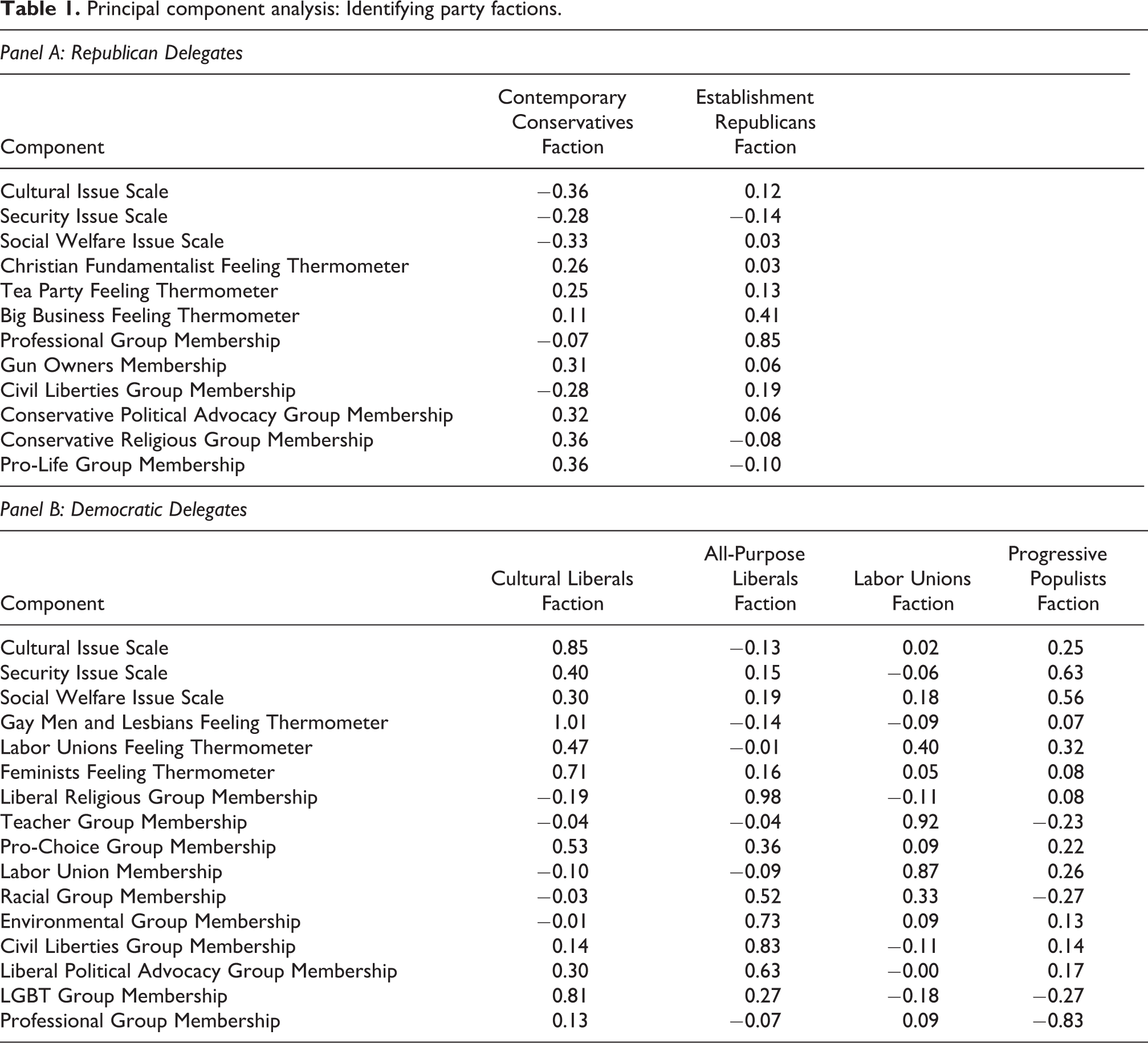
Table 1, Panel A illustrates two distinct factions among Republican Party delegates 5 in 2016, which is one less than the three factions (Contemporary Conservatives, Establishment Republicans, and Libertarians) in place among Republican delegates in 2012. Contemporary Conservatives comprise the first faction as it consists of activists who are conservative on more or less everything. They are more likely to be conservative on all three policy dimensions. The negative loadings are indicative that these three issue dimensions—cultural, security, and social welfare issues—are all coded in a conservative to liberal direction. Delegates in this faction are more likely than other Republicans to belong to core conservative groups, specifically conservative religious groups, conservative political advocacy groups, pro-life organizations, and gun owners’ associations.
The other Republican faction, Establishment Republicans, score lower on all measures of conservatism. These activists are conservative, but compared to Contemporary Conservatives they are less likely to belong to key conservative groups, to warmly rate Tea Party members and Christian fundamentalists, or to hold the most conservative positions on policy issues. As was the case with members of the Establishment Republican faction of 2012, members of this group balance their relative lack of conservative ideological zeal with a higher likelihood of belonging to professional groups. They also hold a strong affinity for big business.
There is no evidence of a third Republican faction of “Libertarians” as has been the case in the past. Among Republican delegates in 2016, membership in civil liberties groups loads most strongly among Establishment Republicans. That this one indicator does not load strongly on our first faction, Contemporary Conservatives, draws a clear line of demarcation between conservatives and libertarians among activists in the Republican Party. In sum, our analysis of the 2016 Republican delegates uncovers two factions that fit within the dividing lines of the contemporary Republican Party—a dominant conservative wing competing for influence alongside a slightly less conservative establishment wing.
Table 1, Panel B reveals a more fractured Democratic Party with four distinct intraparty factions competing for attention and resources to recast the Democratic Party in a post-Obama era. Two of the four factions, Cultural Liberals and All-Purpose Liberals, clearly resemble factions found among Democratic delegates from the 2012 CDS. The first faction of Democratic activists is Cultural Liberals who belong to core groups on the cultural left—LGBTQ groups and pro-choice organizations. Cultural Liberals also have warm feelings toward key Democratic constituency groups of feminists and gay men and lesbians. And, among Cultural Liberals, the cultural issue scale, which includes attitudes on abortion, gay marriage, and religious freedom, loads most strongly on this factor.
All-Purpose Liberals comprise the second faction of Democratic activists. Members of this faction are joiners who are more likely to belong to other core liberal groups. Interestingly, despite their proclivity to join different groups, members of this faction are less likely to belong to professional associations. The third distinct faction we identify within the Democratic Party are Labor Unions. This faction is determined by membership in labor unions and teacher’s associations. Group members feel warmly toward organized labor; this group also loads positively on the cultural liberal factor. The final faction is a group we identify as Progressive Populists. Security (questions on immigration and defense spending) and social welfare (questions on government spending, college tuition, and affirmative action) issue scales load strongly and positively for members in this faction, which means that group members take a consistently liberal position on these issues. However, Progressive Populists do not tend to belong to professional associations or key party constituency groups. Among Democratic party delegates in 2016, there is no Centrist faction.
In sum, the intraparty factions within the 2016 Democratic and Republican parties bear some resemblance to the intraparty factions observed among the party delegates in 2012. But as over half (56%) of Republican delegates and three-fourths of Democratic delegates in 2016 identified as first-time delegates, each party’s delegations have an influx of new members and are not merely duplicates of the intraparty factions of years past. The continued presence of intraparty factions in 2016 is particularly relevant as neither party had an incumbent running to again secure the party’s nomination or a decisive, popular front-runner candidate around which the party’s members coalesce. Instead, intraparty factions laid bare activists’ differences about key policy issues and ascendant party constituencies. This internal contestation and negotiation process among policy demanders identified by Cohen et al. (2008) and Bawn et al. (2012) continues in a context where the parties are highly externally polarized and do not have a preferred candidate as the leader of the party. In 2016, these fissures manifest themselves in disagreements about candidate preferences and the important question of how the party should define (or redefine itself) to pursue policy seeking and office seeking goals with a new leader at the top of the ticket.
Previous research (Conger et al., 2019) affirms that parties concomitantly pursue both policy and office seeking goals. Factions with policy seeking demands generally privilege ideological goals over party unity and electoral success whereas the reverse is true for factions with office seeking demands. It is not that a competing faction’s demands are unimportant; they are just not as important so long as the Party is responsive to factional demands. Different intraparty groups compete to determine which of their goals get prioritized and how the party proceeds in realizing them. For Republicans, Establishment Republicans faction, with its affinity for big business and strong ties to professional organizations, are the faction most likely to adhere to an office-seeking perspective with ideological goals as a second-tier priority. By contrast, Contemporary Conservatives are more likely to prioritize policy goals. The modern Republican Party is highly ideologically conservative so office-seeking and policy-seeking goals have much in common. And this seems to be the case here. The ideological diversity within the Republican Party delegates in 2016 is minimal, which affirms Grossmann’s and Hopkins’ (2016) assertion of asymmetrical party polarization with Republicans valuing ideological purity.
For Democrats, recall that the party culture identified by Freeman (1986) is one that emphasizes group-based demands from different key constituencies. As such, Cultural Liberals, All-Purpose Liberals, and Labor Unions factions should each see some compatibility between their policy demands and Democratic Party electoral success. The Progressive Populists faction, however, will pursue policy goals and place less attention on office seeking goals that require fidelity to party. And, when looking at the Democrats in 2016 we see that the factions do conform to Freeman’s (1986) identification of the Democratic Party culture as more pluralistic than hierarchical. Having identified intraparty factions in 2016 and some of our expectations for them, we now turn our attention to the consequences of factional membership.
How factions influence delegates’ political involvement, party support, and party norms
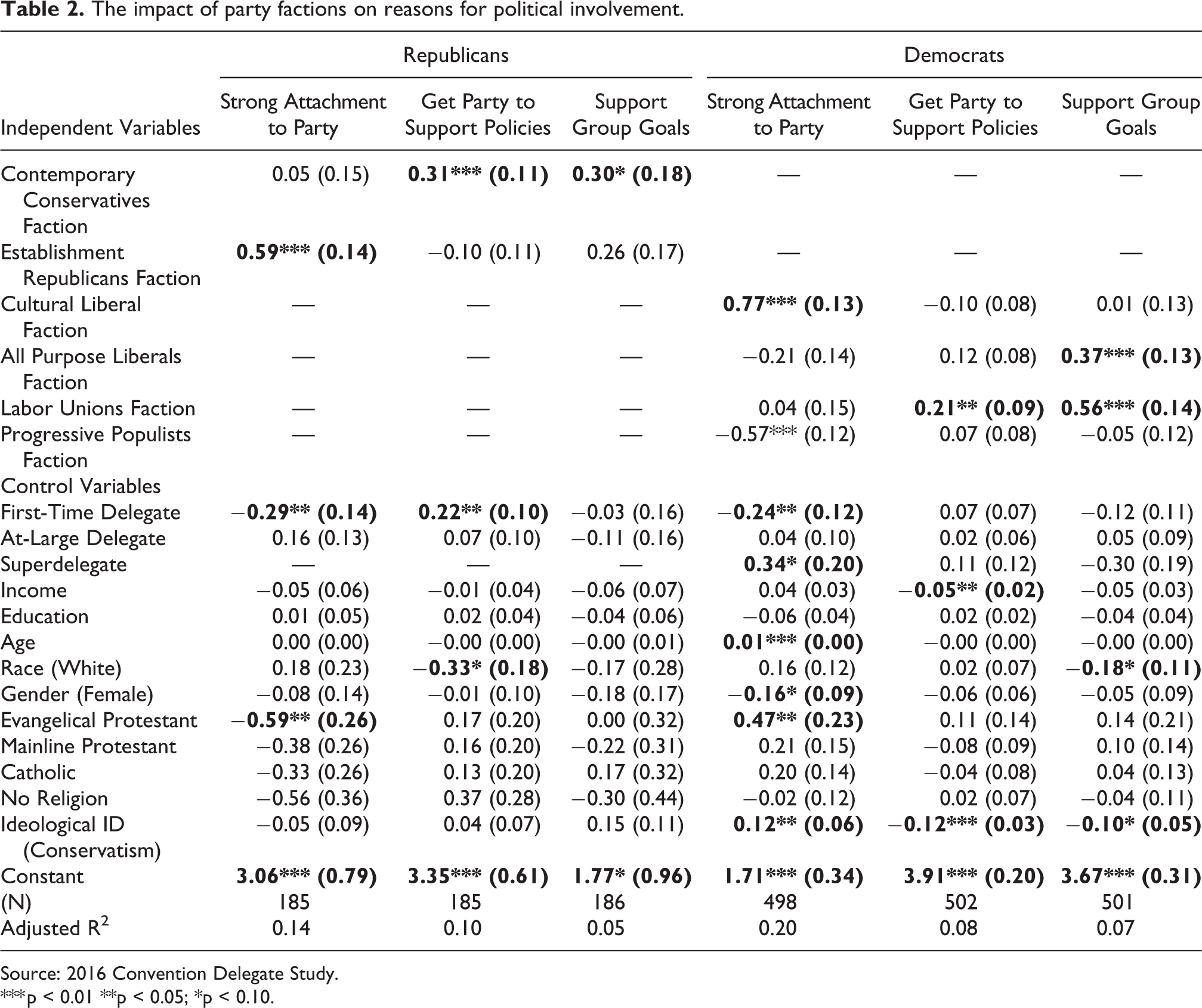
In the next step of our analysis we use ordinary least squares (OLS) regression to examine the impact of intraparty factions for different types of political participation and attitudes about political norms. Our main independent variables are the respective parties’ intraparty factions. We include a control for ideological identification (coded from extremely liberal to extremely conservative and also several relevant sociodemographic variables including income, education, age, race (dummy variable for Whites), sex (dummy variable for female), and religion (dummy variables for Evangelicals, Mainline Protestants, Catholics, and delegates with no religious affiliation). Finally, we include controls for the status of delegates, including whether they were serving for the first time, were at-large, or superdelegates (Democrats only). Our results are presented below. Table 2 examines the impact of party factions on reasons for political involvement. Table 3, Panels A-B examine the impact of party factions on political norms, specifically norms of ideological purism versus pragmatism. We take findings from each table in turn.
The impact of party factions on reasons for political involvement.
Source: 2016 Convention Delegate Study.
*** p < 0.01 **p < 0.05; *p < 0.10.
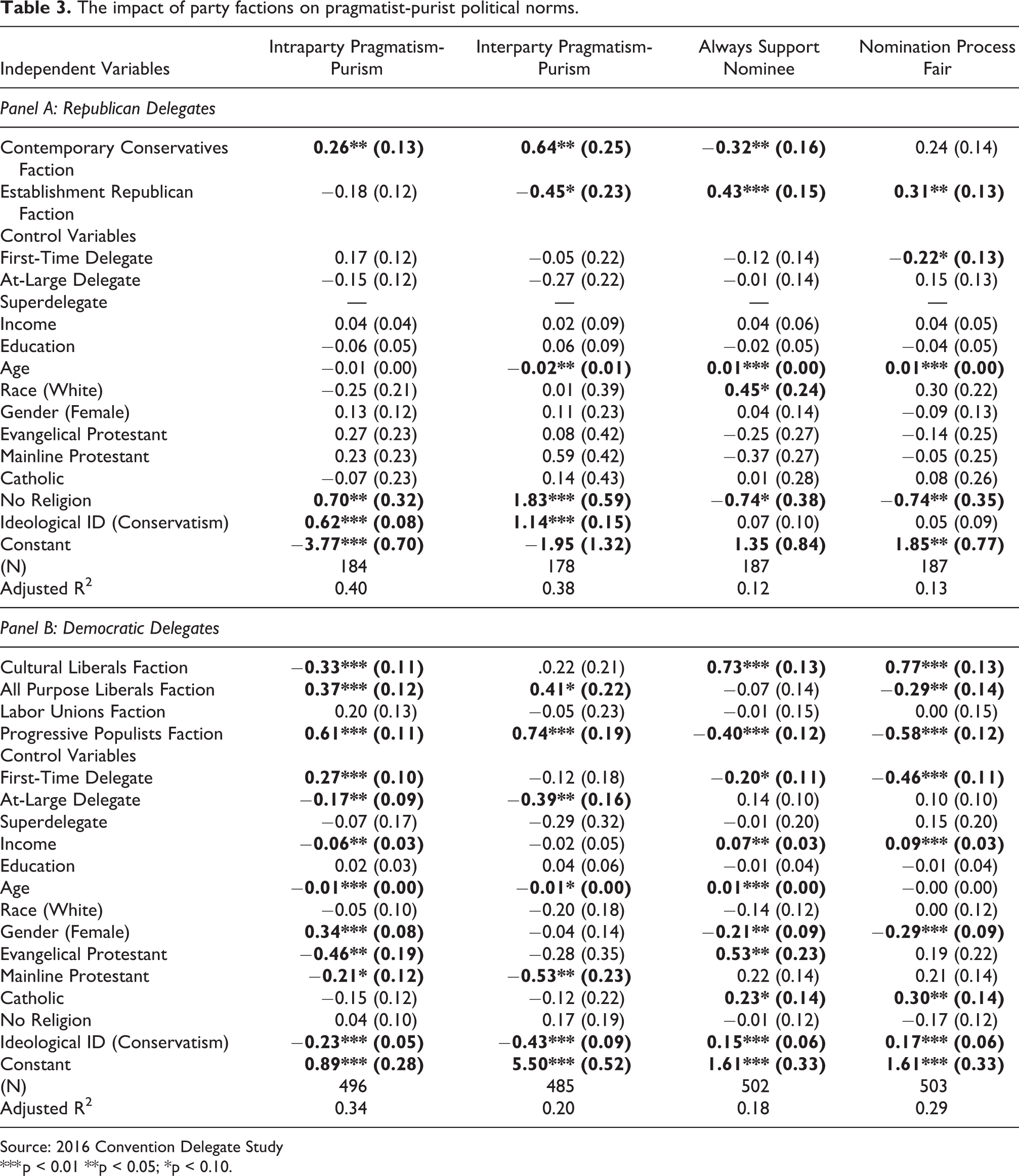
The impact of party factions on pragmatist-purist political norms.
Source: 2016 Convention Delegate Study
*** p < 0.01 **p < 0.05; *p < 0.10.
Table 2 examines the impact of intraparty factions on delegates’ reasons for political involvement. Among Republicans, members of the Establishment faction are strongly and significantly attached to the Party whereas members of the Contemporary Conservatives faction get involved to support group goals and to get the party to support its preferred policies. Looking at the control variables, among Republican delegates, first-time delegates and Evangelicals are significantly less likely to report a strong attachment to party as a motivation for their political involvement. Among Democrats, members of the Cultural Liberals faction are strongly and significantly attached to the Party while members of the Progressive Populists faction are strongly and significantly not attached to the Party. Members of the Labor Union faction are significantly more likely to get involved with politics to get the party to support its policies and also to support group goals. Members of the All-Purpose Liberals faction are significantly more likely to get involved with the Party to support group goals. As was the case on the Republican side, first-time Democratic delegates are significantly less likely to be attached to the Party while superdelegates (who generally hold elective office or a party leadership position) are significantly more strongly attached to the Party.
Table 3, Panels A-B present our final set of analyses and examines norms about intra and inter-party decision-making. Extant research (see Carsey et al., 2006; Kirkpatrick, 1975; Miller and Jennings, 1986; Stone and Abramowitz, 1983; Wildavsky, 1965) on party activism has generally focused on the purism and pragmatism divide within the parties—how the party selects candidates, negotiates a party platform, and resolves internal disagreements. Here purists are often identified as party amateurs who are uncompromising in their belief that party candidates and party platforms should be ideologically pure even at the expense of electoral appeal. In contrast, pragmatists are party professionals who will bend on ideology on candidates and platforms if doing so helps to ensure an electoral victory. These activists share a party label and so these debates and disagreements are bounded in scope with different expectations about how the party should navigate and resolve these conflicting goals while still working within the framework of the party.
To operationalize the pragmatist-purist distinction in intraparty norms, we draw on five questions that have been asked in every CDS survey since 1972. These statements are as follows: “It is best to minimize disagreement within the party”; “One should stand firm for a position even it means resigning from the party”; “The party should play down some issues if it will improve the chance of winning”; “The party should select a nominee who is strongly committed on the issues”; and, “Choosing a candidate with broad electoral appeal is more important than a consistent ideology.” We coded responses to each of these statements to range from the most pragmatic to the most purist and then conducted a factor analysis—using principal components extraction—of the five items separately for each party. The items all loaded strongly on a single factor. Our measures of pragmatist-purist norms are the factor scores from these analyses, with scores ranging from −2.73 to 2.04.
We are also interested in how these differences play out across the parties and include a measure for inter-party pragmatist-purist differences. We seek to examine delegates’ attitudes about holding fast to ideological principles or working for compromise with those with whom they do not share a party label. Previous research (Layman et al., 2010; Miller and Jennings, 1986) posits that activists who demand ideological purity within their own party will also be disinclined to tolerate compromise with their partisan rivals. More pragmatic activists will prioritize an opportunity to broker a deal/get something done on policy over holding fast to ideological goals. To operationalize this inter-party difference about government decision-making, we asked respondents to place themselves on a 7-point scale ranging from “elected officials should compromise with their opponents in order to get things done for the country” to “elected officials should stand up for their principles no matter what.” We recoded this variable to range from most pragmatist to most purist. When thinking about party factions, we expect that the more policy/ideologically focused factions will have more purist norms whereas the more office seeking focused factions will have more pragmatist norms.
We present two last dependent variables that examine the impact of intraparty factions on attitudes regarding the 2016 nomination process. We asked delegates to indicate their level of agreement with two statements: first, “you should always support the candidate nominated by the party even if you did not support that candidate during the nomination contest”; and, “the process by which my party choose a nominee is fair.” These questions were particularly relevant as each party’s nomination contest drew criticism from primary voters and delegates alike about the perceived lack of fairness of the party’s nomination’s rules. We present the results of this intra and inter party pragmatism and purism analysis and questions that speak to attitudes regarding who secured each party’s nomination among Republican (Table 3, Panel A) and Democratic (Table 3, Panel B) delegates below.
As seen in Table 3, Panel A, Contemporary Conservatives (those most likely to work to get the party to support its policies) are significantly more purist, especially when compared to Establishment Republicans. They are also less likely to want to compromise with those across the aisle. Establishment Republicans do not conform to purist intraparty norms and, not surprisingly, are significantly more likely to want to compromise with the opposing party to get things done. Regarding the control variables, we see that ideological conservatives are significantly more purist both within the party and between it as well. Older Republican delegates are more likely to seek compromise with the opposing party.
Regarding the nomination process, Contemporary Conservatives are significantly less inclined to support the party’s nominee but are agnostic as to whether they found the nomination process to be fair. Establishment Republicans are not only significantly likely to support the party’s nominee but also inclined to believe the nomination process was fair. And, recalling previous findings in Table 2 about Establishment Republicans' strong attachment to party (coupled with noticeably less attachment to the party among Contemporary Conservatives), this finding makes intuitive sense. First time Republican delegates did not believe the nomination process was fair. Older Republican delegates are both significantly likely to stand by the party’s nominee and believe the nomination process was fair.
Turning our attention to factions of Democratic delegates shown in Table 3, Panel B, Cultural Liberals are more pragmatist whereas All-Purpose Liberals and Progressive Populists are significantly more purist in their attitudes about intra-party nomination and platform decisions. The latter two factions are more likely to demand ideological purity from candidates and elected officials who run under the party label. These two factions are significantly less likely to want to compromise with the opposing party. For the control variables, first-time delegates are significantly more purist but at-large delegates are not. And, older Democratic delegates are significantly more pragmatic both within the Party and across the aisle.
Two factions of Democratic delegates had very different takeaways about the 2016 contest and candidates. Cultural Liberals (who are strongly attached to the Party) significantly and strongly support the party’s nominee and believe the nomination was fair. However, Progressive Populists (who are not at all attached to the Party) are disinclined to always support the party’s nominee nor did they find the nomination process to be fair. All-Purpose Liberals as well as members of the Labor Unions faction did not hold strong (or at least significantly positive or negative) feelings about standing by the nominee or whether they found the nomination process to be fair. First-time Democratic delegates resembled Progressive Populists in that they were also significantly less inclined to always support the party’s nominee or find the nomination process to be fair. Interestingly, women Democratic and more ideologically liberal delegates were also significantly less likely to state they would always support the nominee or that they found the nomination process to be fair.
Together, both parties have factional tensions with different groups holding different ideas about the type of nominee and candidates they prefer and their willingness to tolerate disagreement about issues and ideology embraced by the party. In 2016 the stakes were high for both parties as factional groups had an opportunity to recast the face of their preferred party, embrace new leaders, and further underscore the differences between the two already highly polarized parties. For Republican activists, the split was between ideological conservatives and the establishment. For Democratic activists, the split was more complicated with different groups liberals, traditional constituency groups (like Labor), and progressive populists each working off their own, but sometimes overlapping, ideas about what the Democratic Party should look like after Obama.
Questions exploring delegates’ attitudes about standing by the party’s nominee or the fairness of the nomination process suggest an enthusiasm gap in both parties and also the candidate that process eventually yielded. When considering that over half of Republican delegates and about three-quarters of Democratic delegates were first time delegates in 2016, it is unclear whether that dissatisfaction stems from being new to and unfamiliar with the process, a substantive criticism of the party’s nomination process and the candidates who ran, or some combination of these concerns. We leverage questions from the 2016 CDS regarding delegates’ preferred and least preferred nominee to find evidence of factional differences. Recalling that the 2016 CDS was administered to delegates in early 2018, we recognize that the timing of the survey may have been a factor in the reporting (or under-reporting) of delegates’ preferences of candidates given who won and lost. Results for the two Republican factions and four Democratic factions are in Figure 1, Panels A and B, respectively, below.
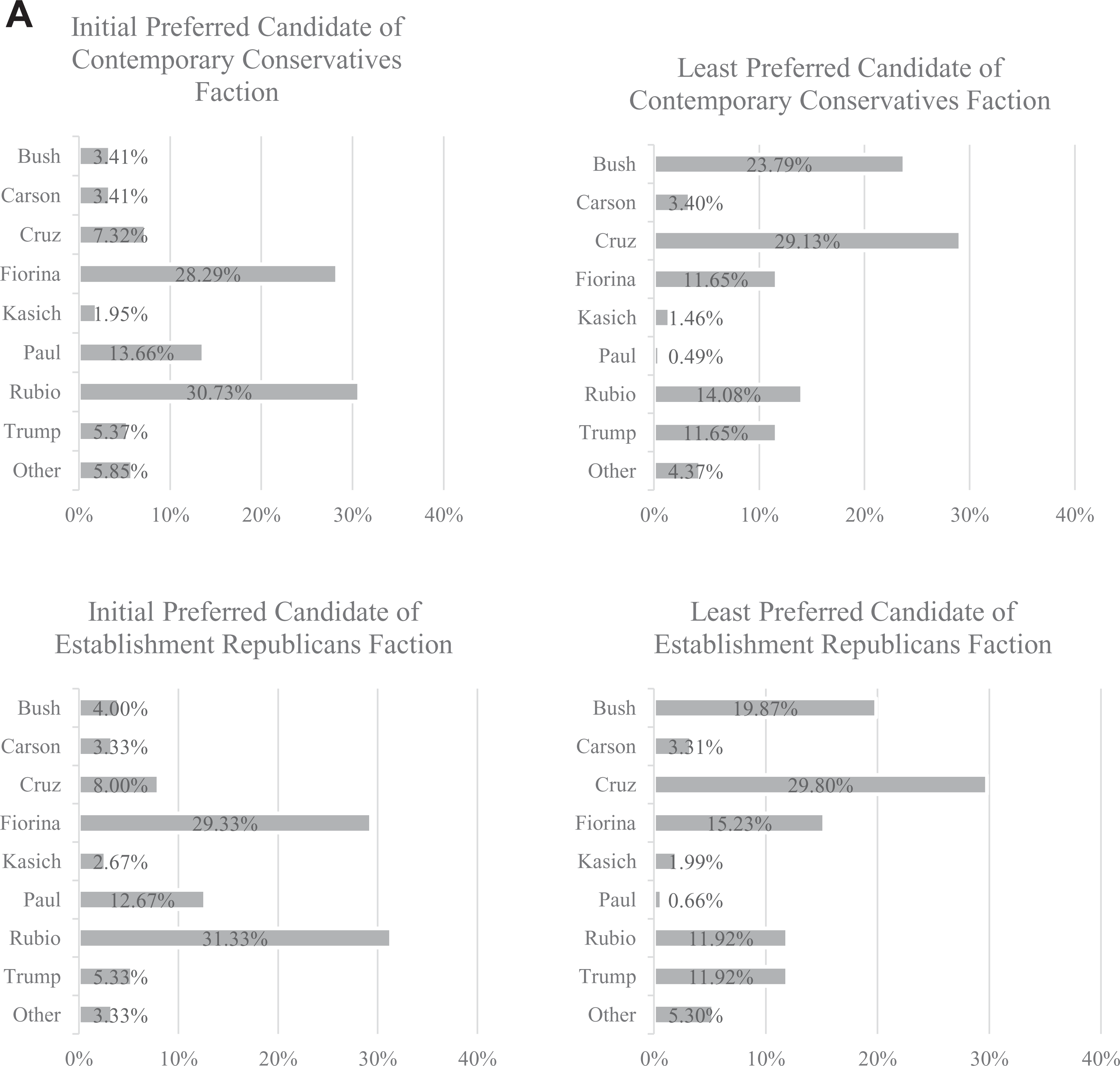
Preferred and least preferred candidate by party faction. Panel A: Republican factions. Panel B: Democratic factions.
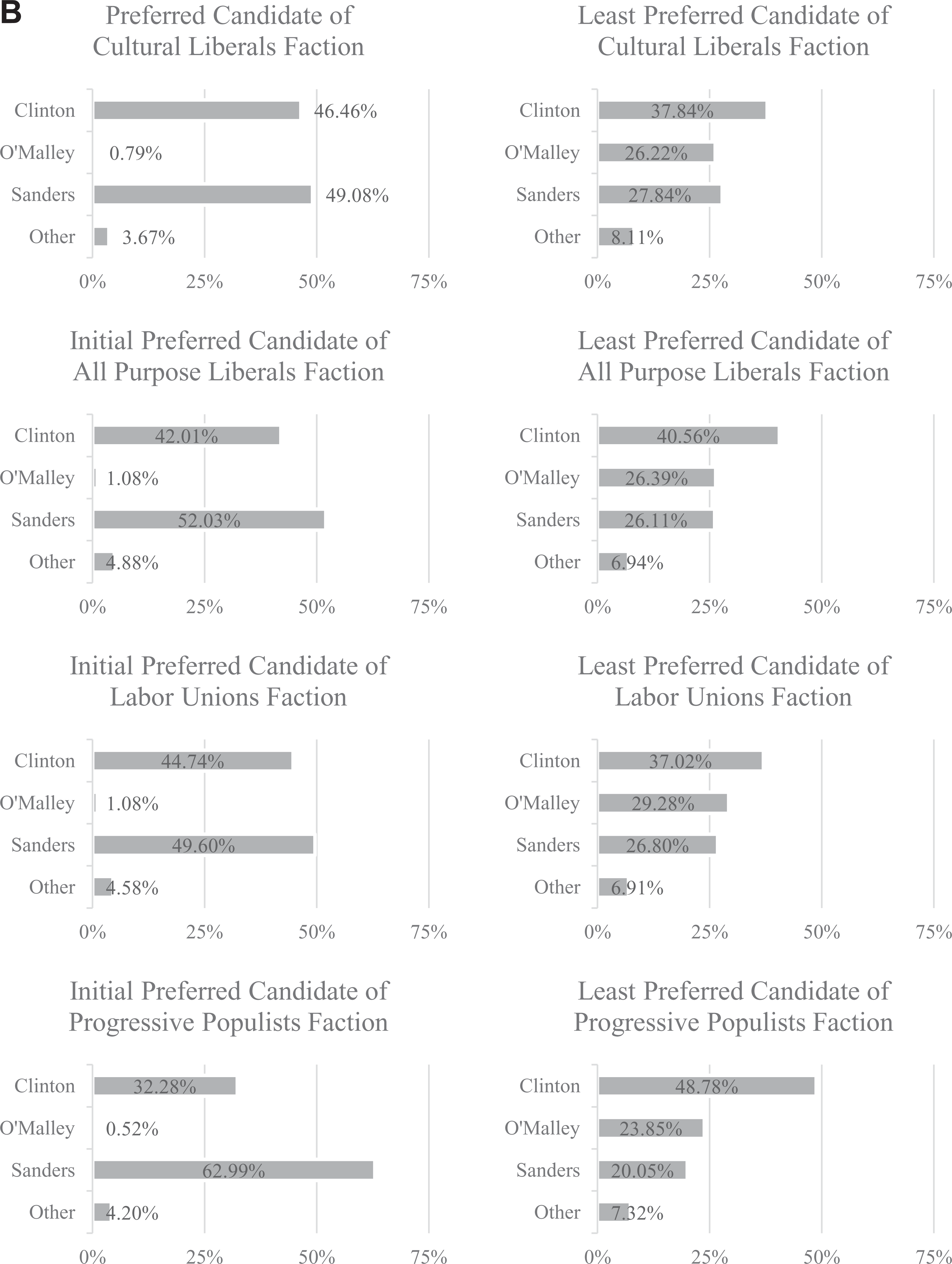
Continued.
Figure 1, shows four distinct bar graphs; the top two are for the preferred and least preferred candidate of Contemporary Conservatives, and the bottom two are for the preferred and least preferred candidate of Establishment Republicans. Factional preferences and non-preferences for candidates were largely similar despite the large number of Republicans who threw their hats in the ring for the nomination. Among Contemporary Conservatives, and Establishment Republicans, U.S. Senator Marco Rubio (FL) and former executive Carly Fiorina were the two most preferred candidates, while former Governor Jeb Bush (FL) and U.S. Senator Ted Cruz (TX) were the top two least preferred candidates (Rubio ranks third as least preferred for Contemporary Conservatives and Carly Fiorina ranks third as least preferred for Establishment Republicans). It is worth noting that the Party’s eventual nominee, Donald Trump, fares middling with Republican delegates as neither a preferred or least preferred candidate.
Figure 1, Panel B shows the preferences for Democratic party factions. Results are divided into 8 distinct bar graphs, which denote the most and least preferred nominee for members of the four factions. For Democrats, the nomination contest featured far fewer candidates with former U.S. Senator Hillary Clinton (NY) and U.S. Senator Bernie Sanders (VT) battling for the nomination with former Governor, Martin O’Malley (MD), far behind in their wake. Despite eventually winning the Democratic nomination, these figures make clear the lack of enthusiasm among Democratic delegates, regardless of faction, for Hillary Clinton. Indeed, in all four Democratic factions, members preferred Bernie Sanders over Clinton. What’s more, Clinton was also the least preferred candidate for members of all four factions. Hillary Clinton may have won the Democratic nomination in 2016, but her selection as the party’s nominee was perhaps by inevitability, not exactly preference.
Discussion and conclusion
Factional structures are an important way that scholars can examine and explain the attitudes and behavior of American political parties and their elites. Democrats and Republicans are labels for two big tent parties whose “tents” do not encompass the same variety of groups and policies from election to election. Equally complex is the impact of party structures on these loose combinations of groups and people. National party convention delegates give us the clearest picture of the interplay of those people, groups, policies, and party norms. The factional structures delegates create and inhabit serve as a decoder ring for how delegates and parties reconcile competing policy and institutional demands and for understanding the contemporary political behavior of the Democratic and Republican parties.
We examined the behavior, attitudes, and preferences of Democratic and Republican delegates in 2016. We identified the presence of internal party factions in each party, the priorities of faction members in pressing the party to pursue policy goals, their (un)willingness to compromise within and between the parties, and their preferences for the party’s nominee and willingness to support him/her. Finally, we evaluated the degree of pragmatism and purism demonstrated by individual convention delegates and the parties as a whole. While Democratic delegates’ responses are similar to their 2012 delegates, Republicans demonstrate a significant move toward the purism end of the spectrum.
For Democrats, the main take away of our analysis is that they remain pluralistic, with four identifiable factions. With nearly 75% of delegates as first-time participants in the party convention, the identifiable factions have changed since 2012, though establishment party supporters and ideological liberals remain important. The newly prominent faction of populist liberals is not strongly attached to the Party and largely purist in their approach to policy. They proved somewhat problematic for the Party overall, but their overall preference for Bernie Sanders as the nominee integrated them with the other factions. None of these factions were excited about Hillary Clinton as the 2016 nominee. This finding serves as a cautionary tale for Democrats in nominating contests moving forward. Whether the process solidifies support and enthusiasm behind a preferred candidate who is acceptable or not unacceptable to different groups is not a forgone conclusion.
For Republicans, this analysis of the 2016 convention delegates demonstrates the ongoing battle between ideological purists and establishment pragmatists. Republican ideologues now seem to have coalesced into an all-purpose conservative faction. There is some evidence that this reality helped Donald Trump secure the presidential nomination, or at least prevented both factions from mounting a coherent opposition. Each faction’s most favored and least favored candidates were mirror images of one another, suggesting that Trump was no one’s favorite but was nonetheless acceptable. That has been a tried-and-true recipe for candidates winning nominations in the past. But Trump’s win in what was widely perceived to be a chaotic set of primaries has significantly changed the Republican Party, its policy positions, and its approach to politics. It is unclear how this reality will impact the attitudes, behaviors, and factionalization of the Republican convention delegates moving forward.
In both parties, delegates voiced dissatisfaction with the presidential nomination process. While that sentiment seems to be related, in part, to the influx of first-time delegates in both parties, it is likely also a product of deep dissatisfaction with the eventual nominee among delegates in both parties. This further illustrates changes in the delegate factions and their approach to policy between 2012 and 2016. While various factions favored differing candidates in the 2012 primaries in the Republican Party (there was no challenger on the Democratic side), most were relative satisfied with the incumbent, Obama, and consensus candidate, Romney, that emerged from those processes. In 2012, delegates appeared satisfied with their party’s ability to reconcile competing demands; in 2016, this was less true.
Party factions among delegates help us better understand how policy demanders make their preferences known and exert pressure on the party to comply. While Democrats are often credited with a more pluralistic approach to party building, the 2016 CDS shows that in both parties, the conflict among party factions can lead to, or least fail to prevent, what the delegates themselves saw as sub-optimal nomination outcomes. Even Democrats are not always able to truly reconcile competing policy demands and demanders. Republicans’ more centralized focus on orthodoxy may also mean it will be more easily captured and transformed by a winning nominee. Future election cycles will provide more significant information into how party factions evolve, and their impact on the fortunes of their presidential candidates.
Supplemental material
Supplemental Material, sj-docx-1-ppq-10.1177_1354068820988635 - The life of the parties: Party activists and the 2016 presidential election
Supplemental Material, sj-docx-1-ppq-10.1177_1354068820988635 for The life of the parties: Party activists and the 2016 presidential election by Rosalyn Cooperman, Gregory Shufeldt and Kimberly Conger in Party Politics
Footnotes
Acknowledgements
The authors would like to thank Robin Kolodny, Geoff Layman, and members of the Gender and Political Psychology Writing Group for reviewing earlier versions of this manuscript. Any errors are ours.
Declaration of conflicting interests
The author(s) declared no potential conflicts of interest with respect to the research, authorship, and/or publication of this article.
Funding
The author(s) received no financial support for the research, authorship, and/or publication of this article.

Supplemental material
Supplemental material for this article is available online.
Notes
References
Supplementary Material
Please find the following supplemental material available below.
For Open Access articles published under a Creative Commons License, all supplemental material carries the same license as the article it is associated with.
For non-Open Access articles published, all supplemental material carries a non-exclusive license, and permission requests for re-use of supplemental material or any part of supplemental material shall be sent directly to the copyright owner as specified in the copyright notice associated with the article.
