







Abstract
Why do political parties implement primary elections? With multi-party elections firmly established, political parties in many young democracies have begun to democratize internally by adopting mass primaries. Previous work argues that parties institute primaries to select for high quality candidates, incentivize campaigning effort, and reduce intra-party conflict. In this paper, I theorize that parties also implement mass primaries to open up the political elite while protecting their most senior members. Consistent with this hypothesis, using original data from Botswana’s ruling party, I find that primaries facilitate a limited and controlled turnover, decreasing the likelihood of re-nomination of long-term incumbents in favor of political newcomers while still protecting senior ministers. Combined with qualitative and historical evidence, these results suggest that electorally successful political parties may implement mass primaries to replace unpopular and entrenched leaders.
Introduction
Multi-party legislative elections have become the norm across Africa and globally, and a well-established literature has analyzed how electoral systems affect election outcomes and party systems. When many legislative districts are partisan safe seats, as is typical globally, candidate selection is where representation is determined. Indeed, most legislator turnover in African single-member-district systems occurs during the candidate selection phase of elections (Warren, 2019). Although some parties have maintained elite control over the nominations process, an increasing number have begun to experiment with internal democracy, allowing all party members to participate in primary elections to determine party nominees. Why would senior party elites give up the authority to select preferred candidates? I argue that senior party elites implement mass primaries to induce limited and controlled legislator turnover within their own party in response to competitive electoral pressures. Using original data from Africa’s second-longest ruling party, the Botswana Democratic Party, I present evidence that mass primaries effectively facilitate the limited entry of a political newcomers to legislative office.
Existing studies of candidate selection are based primarily on OECD and Latin American experiences (e.g., Gallagher and Marsh, 1988; Norris, 1997b; Hazan and Rahat, 2010; Siavelis and Morgenstern, 2012), and their external validity may be limited to democracies in which political competition is structured around policy. Analyses of selection into legislative politics in developing countries has focused primarily on the role of dynasties and politically powerful families (e.g., Cruz et al., 2017; Querubin, 2016; Chhibber, 2013), criminality among politicians (Vaishnav, 2017), and descriptive representation of gender (e.g., Krook, 2010). Carey and Polga-Hecimovich (2006) and Kemahlioglu et al. (2009) address presidential primaries in Latin American parties. Ichino and Nathan (2013, 2012) examine narrow selectorate legislative primaries in Ghana. A new body of research has begun to study candidate selection outcomes in broad selectorate primaries (Casey et al., 2019; Choi, 2019). This paper contributes to our understanding of intra-party democracy by examining how mass, rather than elite, primaries affect legislator turnover, and why party elites are willing to adopt them.
The majority of legislator turnover within Botswana’s ruling party occurs via intra-party candidate selection, rather than losses at the ballot box. I theorize that mass primaries serve to induce a limited and controlled turnover within parties, and may be adopted specifically for this purpose. Using an original dataset of primary election outcomes in Botswana, I find that mass primaries facilitate elite turnover while protecting the most senior party elites. In this sense primaries offer controlled turnover since these politicians are able to tip the scales in their own favor. Combined with qualitative evidence of intent, these results suggest that mass primaries may be adopted to perform a valuable function for locally or nationally dominant parties in young democracies, ensuring turnover of entrenched political elites while conferring democratic legitimacy and maintaining party unity.
Candidate selection
Candidate selection is perhaps the most important function of a political party, affecting its public identity, development as a party and democratization more broadly (Besley, 2005; Gallagher and Marsh, 1988; Hazan and Rahat, 2010; Katz, 2001; Norris, 1997a). Indeed, Schattschneider (1942: 64) claims that “the nominating process thus has become the crucial process of the party… [and] the nature of the nominating procedure determines the nature of the party.” Candidate selection performs a gate-keeping function, determining the slate of candidates from which voters may choose, and the career opportunities for aspiring politicians.
Candidate selection procedures range from more exclusive methods, such as nomination by a single leader, to more participatory procedures such as primaries (Hazan and Rahat, 2006; Norris, 1997a). These procedures are most simply classified along two key dimensions: centralization and selectorate size. 1 Selection may occur at the national, regional, or electoral district level, and the process may be open to a small cadre of elites, a party congress or convention, all party members (a closed primary) or any registered voter (an open primary). Democratization of candidate selection entails a shift from a narrow body to a larger, more decentralized selectorate.
Throughout this study, I refer to closed primaries and open primaries collectively as mass primaries. In many young and developing democracies, the difference between a closed and open primary is not always clear-cut. There may be powerful incentives to join locally or nationally dominant parties an individual has no intention of supporting in elections. Capacity constraints may limit membership register credibility, parties may be unable to enforce limiting membership to a single party, and minimally politically active voters may easily register to participate in party primaries. Electoral management bodies may be unable, legally or politically, to get involved in intra-party membership registration.
Legislative candidate selection in Africa
African political parties have typically grown from either prior single-party regimes or centralized protest movements. In both cases, the transition toward internal democracy has often been as contentious or stalled as the initial transition to multi-party politics (LeBas, 2011). Candidate selection is often overlooked in the study of elections and democratization. Yet in countries with a large proportion of partisan safe seats, candidate selection is when elected politicians are chosen. During the 1990s and 2000s in Africa, single-member-district legislative constituencies won with a 30-percentage point margin of victory represented 25–45% of all seats in Botswana, Ghana, Tanzania, and Zambia, and the overwhelming majority of seats in Sierra Leone, Tanzania, and Zimbabwe. 2
Control over candidate selection is a powerful tool for party elites, and one not relinquished without substantial anticipated gains. Yet since the early 2000s a diverse and growing number of political parties have begun to move away from centralized candidate selection. 3 Both major political parties in Ghana began holding constituency elite primaries in 2004, and similar systems have been implemented within larger parties in Malawi, Lesotho, Liberia, Nigeria, Sierra Leone, Uganda, and Zimbabwe. The two largest political parties in Botswana also began holding elite primaries in the 1980s. In nearly all cases, central party leadership has overruled many results. Elite primaries have not effectively constrained centralized control over candidate selection. Similarly, Tanzania’s long-ruling Chama Cha Mapinduzi (CCM) party held explicitly non-binding constituency elite primaries, with all results confirmed by a central party committee, in its first three multi-party elections (1995–2005).
More recently, parties in Botswana, Ghana, Kenya, Tanzania, Uganda, and Zimbabwe have begun to implement mass primaries to select legislative candidates. Botswana’s major parties implemented these primaries prior to the 2004 elections. Ghana’s National Democratic Congress (NDC) held mass primaries for 2016. Kenya’s largest parties have held mass primaries in some constituencies since 2002. Tanzania’s CCM opened up its non-binding primaries to a mass selectorate beginning in 2010. Uganda’s ruling National Resistance Movement (NRM) began holding mass primaries in 2011. The Zimbabwe African National Union (ZANU-PF), Zimbabwe’s ruling party since 1990, began to hold mass primaries in 2005 while the opposition Movement for Democratic Change (MDC) holds mass primaries only when constituency party elites do not confirm incumbents and for ZANU-PF held seats.
The large-scale adoption of mass primaries is puzzling. Why would senior party elites give up a closed process in which they can select preferred candidates to a mass selectorate?
The puzzle of mass primaries
The puzzle of mass primaries has spurred a large literature exploring determinants of primary adoption. Starting from the assumption that parties are office-seeking, this literature can be broadly divided into three classes of arguments: selection and incentives, democratic legitimacy, and conflict reduction.
Central party leaders primarily seek to maximize party vote share and the probability of obtaining executive office in general elections. 4 Legislative—and presidential—elections have become increasingly competitive African countries including Botswana, Ghana, Liberia, Kenya, Nigeria, Senegal, Zambia, and Zimbabwe. For ruling parties, rising competition in legislative and presidential elections and uncertainty surrounding election outcomes is sufficient to incentivize maximizing party vote share. For opposition parties, maximizing vote share may attract private sector financial support and increase bargaining power in future election coalitions (Arriola, 2013), and strong performance in elections attracts more qualified candidates in future elections. Notably, these arguments rely on the assumption that central party leaders value both short-term and long-term gains for their parties, and that the leaders’ decisions are based on the good of the party rather than their own self-interest as potential legislative candidates. This is most often the case of ruling parties seeking to stay in power, which are the focus of this article.
Selection and incentives
Primaries are most frequently understood as institutions that select for higher-valence candidates. 5 Parties may face tradeoffs between candidate policy alignment and valence (Adams and Merrill, 2008; Crutzen et al., 2009; Serra, 2011). Primaries are therefore adopted when the valence payoff is worth the policy tradeoff, a condition likely to hold in developing democracies in which policy differences between and within parties are often small. Party elites may also choose to adopt mass primaries to alter the incentives of party candidates in ways that improve electoral outcomes. The additional competitive hurdle to obtain legislative office incentivizes aspirants to exert more campaigning effort to appeal to a broader selectorate (Aragón, 2014; Crutzen et al., 2009). Furthermore, mass primaries provide clear pathways to political office for newcomers who might otherwise join opposition parties.
Constituency selectorates are better-placed to identify candidates with the locally relevant campaigning skills to drive turnout and the financial resources to fund campaigns (Adams and Merrill, 2008). Evidence suggests that African voters are responsive to constituency and personal service (e.g., Wantchekon, 2003; Lindberg and Morrison, 2008; Baldwin, 2013), and mass local selectorates should be better able than party elites to identify aspirants with the best track records and future prospects for service provision.
Constituency party elites and local party activists may themselves play an important role in general election campaigns. Ichino and Nathan (2012) argue that competitive elite primaries in Ghana provide rent-seeking opportunities that bind local elites to the party. When primaries are limited to a rent-seeking elite, the decentralized process may still identify candidates with an important quality–the financial resources to potentially fund a campaign and the demonstrated willingness to use them in pursuit of political office.
Yet when the primary selectorate is small, the risk of capture is high. Constituency-level elites may select the highest bidders as candidates rather than those with extensive experience serving their party or constituency. Over time, a party selecting candidates tied to a narrow elite may be perceived to have lost touch with the needs and desires of the electorate. Parties may implement mass primaries to counteract this potentially destructive dynamic.
Democratic legitimacy
Political parties may also implement mass primaries to enhance their democratic legitimacy, as has been suggested for free and fair general elections in authoritarian regimes and weak democracies in Africa (Mozaffar, 2002), when there is electoral turnover (Moehler and Lindberg, 2009), and cross-nationally (Schedler, 2002). Where authoritarian politics are a recent or an ongoing aspect of domestic politics, political parties may struggle to overcome low public approval and deep skepticism of their commitment to democratic norms and practices. When partisan support is geographically concentrated and many electoral constituencies are safe seats, voters may doubt their ability to affect political change. In the African context, it has been ruling, and specifically dominant and legacy authoritarian, parties facing rising competition that have typically been the first to implement mass primaries, for example, Botswana’s BDP, Tanzania’s CCM, Uganda’s NRM, and Zimbabwe’s ZANU-PF. Mass primaries allow parties to actively engage their supporters in decision-making, bolstering political parties’ democratic legitimacy, and increasing party vote (Carey and Polga-Hecimovich, 2006) and longevity in office.
Intra-party conflict
Political parties may also suffer from factional rifts—for example, Botswana (Poteete, 2012), Malaysia (Rashid Moten, 2009), Kenya (LeBas, 2011; Elischer, 2013), Zimbabwe (LeBas, 2011), and many Latin American countries (Benton, 2007; Kemahlioglu et al., 2009). Preventing defections is critical to ensuring dominant party regime survival (e.g., Magaloni, 2008; Reuter and Gandhi, 2011), and party leaders may be concerned about the effects of factionalism on party unity and electoral performance. Mass primaries may defuse factional and personal conflict within the party by removing it from the political center, replacing back-door deals with more transparent practices. Indeed, Key (1949) suggests that the Democratic Party implemented primaries in the post-Reconstruction American South to manage intra-party conflict.
Factionalism can threaten party unity, and primaries may be used to contain intra-party conflict over candidate nominations. This competition is most acute where the value of the nomination is highest, partisan safe seats (Key, 1949) and within the likely ruling party for all seats that are at least not safe for other parties. Mitigating factional or personal conflict may produce partisan electoral gains by maintaining party unity and limiting defections, as has been demonstrated in Latin American presidential primaries (Kemahlioglu et al., 2009), 19th century Pennsylvania (Shoji, 2013), and in a formal model of candidate selection (Hortala-Vallve and Mueller, 2015). Mass primaries can play a role similar to legislatures, single-party elections, and other power-sharing institutions in authoritarian regimes, ensuring that outsiders enjoy a realistic possibility of access to power (Blaydes, 2010; Boix and Svolik, 2013; Gandhi and Przeworski, 2007; Magaloni, 2006). Dominant parties also need to address challenges to party unity coming from rifts between mid-level party activists who may not share the policy goals of senior party leaders. Mass primaries can serve to dilute the power of these ideologically motivated party activists and organizers by tipping the scales in favor of marginal party members whose engagement with the party may be limited to voting (Katz and Mair, 1995, 2009).
Primaries and turnover
In this paper, I argue that the selection and incentives effects of mass primaries serve another important function in long-ruling parties–to induce regular, yet controlled legislator turnover, bringing in limited numbers of new, high valence candidates while ensuring the retention of senior elites. Multi-party elections have often failed to achieve large-scale elite turnover or substantive changes in political power in young democracies. Presidents and ruling parties benefit from incumbency advantage, and authoritarian-era elites have quickly returned to power and been incorporated into the opposition movements that initially toppled them from power (Lynch and Crawford, 2011; Rakner and Van de Walle, 2009). These advantages enable the democratization of primaries to remain partially captured by a narrow elite.
Legislators are often the most visible members of a party’s elite leadership, and citizens may interpret low turnover, particularly within long dominant parties, as evidence of a captured democracy lacking in political responsiveness. Voters may begin to prefer newcomers and those with closer ties to daily life in the constituency rather than the capital, as in Mexico (Langston, 2006). If citizens cannot affect change within their long-preferred party, they may choose to change their votes at the ballot box or decide to stay home on election day. Mass primaries should therefore be implemented when ruling parties face electoral threats and need to signal renewal by replacing long-term incumbents with higher-valence newcomers, and simultaneously senior elites feel sufficiently secure in their ability to maintain substantial, if not complete, control over the nominations process.
Research design
This paper leverages a major change in the candidate selection process within Botswana’s ruling party, the Botswana Democratic Party (BDP), to analyze the consequences of democratizing candidate selection on selection into (and out of) political office. This section begins with the selection of Botswana and the BDP, including the evolution of candidate selection within the BDP. The section then outlines the empirical strategy.
Candidate selection in the Botswana Democratic Party
Democratization of candidate selection is on the rise in African and other young democracies. Although constituency elite primaries have become the most common such process within Africa, all major parties in Botswana and Uganda, as well as several Kenyan and Malawian parties, now hold mass primaries. Botswana, a single-party dominant democracy that has held regular legislative elections since 1965, is a particularly informative case. Since democratization long predates elite or mass primaries, the case offers an opportunity to understand the effects of primaries separate from democratization.
The Botswana Democratic Party (BDP) has ruled Botswana since 1966, obtaining over 65% of legislative seats in every legislative election. Until 1994, the BDP won an average of 86% of seats. Despite this dominance, in the 1960s and 1970s there was limited competition for legislative nominations, and the party sometimes had to search for qualified candidates. 6 During this period a highly centralized candidate selection process resulted in many imposed candidates lacking support of local party elites (Lekorwe, 2005), and deaths and planned retirements accounted for the majority of legislator turnover.
After the death of Botswana’s first president in 1980, competition for BDP legislative nomination rose. Rapid increases in diamond and other mining revenues concentrated economic opportunity in government tenders and intensified intra-party competition for political office. The political economy of contemporary Botswana continues to incentivize seeking elected office with the ruling party to obtain ministerial posts, privileged access to government tenders, and opportunities for contracting-related kickbacks (Makgala and Botlhomilwe, 2017; Molomo, 2012).
Responding to rising competition, the BDP adopted a non-binding constituency elite primary process in 1984, with ballots tabulated only in the capital. 7 Scholars have interpreted the introduction of these primaries as a means to open up the selection processes to newcomers, while ensuring that BDP candidates had local legitimacy (Molutsi and Holm, 1990; Parson, 1993). President Masire suggested that prior to the 1984 elections the BDP sought to bring new people into the party (Masire and Lewis, 2006: 131). Yet only one MP lost the first primaries in 1984. 8 Further, these primaries did not prevent central intervention. During primaries in 1989, for example, BDP leadership overturned balloting results in Kanye constituency, creating conflict with the supposed winner (Mokopakgosi and Molomo, 2000), who was later elected to office with the opposition.
After strong opposition performance in the 1994 election, the BDP undertook a detailed review of what had gone wrong. The assessment faulted factional competition and ossified party leadership. Recommendations included bringing in a “dynamic” new leader to unite the party, and replacing the BDP’s old guard with newcomers, particularly youth and women (Good and Taylor, 2006; Molomo, 2000). In response, the party brought in new leadership with the brokered retirement of President Masire, and the recruitment of Ian Khama, son of Botswana’s first president, heir to throne of the country’s largest chiefdom, and a political novice as vice-president in 1998. The BDP also codified regular executive turnover with 10-year party presidential term limits. After the 1999 elections the BDP turned its attention to candidate selection.
BDP leaders assessed the elite primaries as stoking factional infighting because their small size favored incumbents and facilitated manipulation.
9
Party insiders also noted that the BDP’s Central Committee had retained its decisive role in candidate selection, creating conflict.
10
Recognizing these challenges, the BDP implemented mass primaries shortly before the 2004 elections. BDP leadership anticipated that these primaries would provide a less conflictual means of ushering out independence-era politicians.
11
Figure 1 clarifies the timeline of the evolution of candidate selection within the BDP. Candidate selection methods in the BDP, 1965-present.
BDP primaries are closed primaries, open only to party members. Yet the BDP’s capacity to maintain an up-to-date party membership register has been weak and in practice anyone who is not publicly active in opposition politics may be on the list. 12 BDP regulations allow only house-to-house campaigning, specifically excluding rallies, negative intra-party campaigning, and the distribution of campaign materials. In practice, rallies are common, and BDP parliamentary aspirants rely on incumbent, former, and aspiring local government councilors to campaign on their behalf. BDP primaries typically occur approximately 11 months ahead of general elections (as in 2004 and 2014). In 2009 the process was initiated nearly 2 years ahead of general elections and completed 10 months ahead of elections. Many results have been appealed, and a few MP aspirants have defected to other parties or run as independent candidates.
Some scholars, (e.g., Makgala, 2006), have concluded that the BDP implemented these primaries to manage increased numbers of aspiring candidates. These primaries, known locally as bulela ditswe (free-for-all), have not effectively quelled intra-party conflict, and senior party leaders have expressed frustration and disappointment with the process. 13
Although primary election losers have had many complaints about the process, the BDP rank and file have taken to them whole-heartedly. An average of 2269 BDP members participated in each constituency primary for the 2004 election, 2864 for 2009, and 3306 in the 2013–2014 primaries. These primary votes represented approximately 20% of all registered voters, 25% of all general election votes, and 52% of the total BDP votes in the general elections.
Electoral competition in Botswana
Elections in Botswana have grown steadily more competitive since 1965. This trend varies both across constituencies and over time, as shown in Figure 2. Although officially a multi-party democracy since 1964, political competition was minimal until the opposition Botswana National Front (BNF) first obtained 10% of legislative seats in 1994. The percentage of seats won by a close margin—fewer than ten% points—has rapidly increased from just 15% in 1989 to 47% in 2014.
14
Changes to the BDP’s legislative candidate selection process, however, have been simultaneous across all electoral districts regardless of their level of inter-party competition. Notably, in 2010 a large group of elected office-holders left the BDP to form a new party, the Botswana Movement for Democracy (BMD). Though most defectors returned to the BDP before the 2014 electoral cycle, five of the 45 MPs elected under the BDP banner in 2009 participated in the 2014 election as opposition members.
15
Legislative competition in Botswana (outliers excluded for clarity).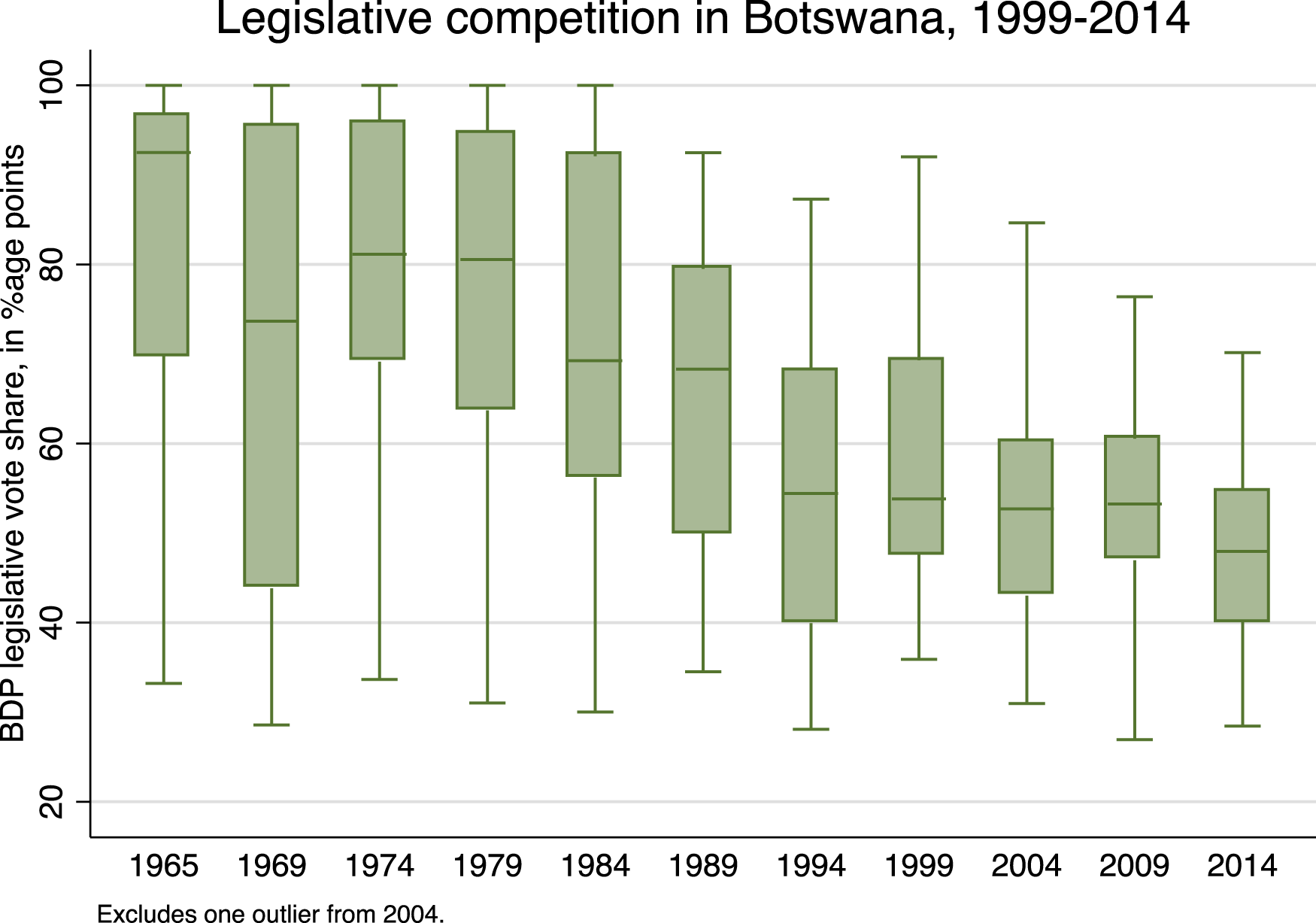
Botswana’s prosperity relative to most of sub-Saharan Africa has not insulated its ruling party from the increasingly competitive legislative elections that have become the norm in Africa since the 1990s. Levels of competition in recent elections—with mean margins of victory in the 15-to-25 percentage point range—are strikingly similar to those experienced elsewhere in Anglophone Africa, such as Ghana, Kenya, Liberia, Lesotho, Malawi, Nigeria, Uganda, and, to a lesser extent, Tanzania, and Zambia. This high level of competition is typical of young democracies with SMD legislative elections globally—for example, India, Jamaica, Lithuania, Malaysia, and Mexico.
Botswana’s single-party dominance under the BDP is also common in African countries including Angola, Namibia, Nigeria (until 2015), Rwanda, South Africa, Tanzania, Uganda, and Zimbabwe. As in those cases the BDP has held 65%–75% of legislative seats. The entrenched competition between one large party and a shifting set of opposition parties is also similar to party systems in Uganda, Zambia (until 2016), and Zimbabwe. Finally, primaries within the BDP may be compared to legislative elections under single-party regimes such as those of Mexico under the PRI, Egypt under Mubarak’s NDP, and Zimbabwe’s ZANU-PF until 2000. In all of these cases, intra-party elections have enabled ruling parties to identify strong candidates with the resources to drive local voter turnout while deflecting competition over highly-valued political offices away from the political center.
In sum, Botswana is an excellent case to examine how mass primaries affect elite turnover. First, as a long stable democracy reliable electoral data is available. Second, the BDP began holding primaries decades after multi-party elections, facilitating analysis of inter- and intra-party democratization separately. 16 Third, because the BDP was the first African ruling party to adopt mass primaries, party leaders undertook the reform absent contextual evidence of consequences and it is unlikely that concerted efforts were undertaken to mitigate any unforeseen or potentially negative impacts. Indeed, in retrospect the party was unprepared to handle many of the logistical challenges of primary election management such as establishing an accurate party voter’s roll and transparent tabulation practices. Finally, the Botswana case, with its combination of ruling party safe seats and increasingly competitive constituencies, facilitates comparison with other young democracies in Africa and globally.
Primaries and turnover
Are mass primaries more favorable to relative political newcomers or long-term incumbents? Do mass primaries protect ministers relative to backbenchers? I test the relationship between the political experience of an incumbent BDP legislator i in election t and the probability of re-nomination for election t + 1 by estimating the following model, which pools all election years, includes an indicator for mass primary years, and interacts that indicator with the experience measure

Data
Two new datasets were created for this study: candidate names with gender and ministerial appointments for all legislative elections in Botswana since 1965, and local government election results mapped to constituencies for those elections. Supplemental Appendix C Summary Statistics presents summary statistics.
A labor-intensive process of locating and matching candidate and primary aspirant names over time allowed creation of a novel dataset tracking legislative careers and candidacy across Botswana’s 50 years of democratic elections. Electoral outcomes datasets are available for all legislative elections in Botswana, 1969–2014 (Kollman et al., 2011; Lublin, 2015) and include candidate names since 1989. I located archival results with candidate names from all prior general and by-elections, and then cleaned and matched names over time. 19 I then backed out (re-)nomination, and legislative office-holding and candidacy experience. From 1965–2014, there were 699 different legislative candidates, of whom 217 ever held office. Within the BDP, there were 196 different candidates, of whom 156 ever held elected legislative office.
A dataset mapping local government elections and redistricting reports was created from archival research in Botswana’s National Archives and New York City’s Schomburg Research Library. The 57 legislative constituencies in the first three general election years since primaries were introduced (2004, 2009, and 2014) are divided into 490 local government districts. Each constituency includes between five and sixteen local government polling districts. All valid votes and all votes for the BDP in local government elections have been summed to generate a BDP local government vote share at the constituency election year level. 20 The difference between BDP legislative candidate and the local government share aggregated to constituency-level proxies for the electoral strength of a BDP legislative candidate relative to the BDP’s overall electoral strength in a constituency.
The ruling BDP has held mass primary elections for all elections since 2002. A primary election results dataset containing aspirant names and vote shares was prepared from local newspaper archives, interviews with party secretariat staff and local social media. 21 . Approximately 84% of BDP parliamentary constituency primaries have been contested. Under the bulela ditswe (free-for-all) mass primary system, 345 different aspirants have competed for legislative candidate nomination, on average three per constituency per election. 22 Data availability is much more limited for opposition party primaries. As a result of the extensive and non-random missingness, the prevalence of uncontested primaries, and opposition parties often not running candidates in all constituencies, this study examines candidate selection within the ruling BDP only.
To assess whether mass primaries affect the type of incumbents who are re-nominated, three binary indicators measure BDP legislative political experience, each equal to one if an incumbent has been in office for at least two terms (ten years) in either elected legislative office, all legislative office, or has been a legislative candidate at least twice. Well before the bulela ditswe primaries began for the cohort elected in 1999, variation in incumbent experience type profiles had begun to develop, as shown in Supplemental Appendix C1.
Ministerial appointments data were collated from the Africa South of the Sahara (1971-2018) series, and incumbents are classified as ministers if they held a Cabinet appointment during the final year of their term, when candidate selection occurs. Candidate gender data were sourced from Botswana Independent Electoral Commission reports, National Assembly publications, online media sources, and research assistant review of all Botswana legislative election and BDP primary candidate names.
Mass primaries and elite turnover
Figure 3 presents turnover rates among BDP legislators by election year, excluding 18 incumbents ineligible for re-nomination for reasons orthogonal to the candidate selection process.
23
Overall turnover rates have broadly increased since independence and are now higher than the 32% turnover rate across OECD legislatures (Matland and Studlar, 2004). Average pre-electoral turnover rate for BDP MPs was 16% through the 1970s, increasing to 23% under elite primaries (1984–1999), and has averaged 30% since mass primaries were introduced in 2002. Pre-electoral turnover has accounted for the majority of BDP turnover every year since 1969.
24
The overall finding—that pre-electoral turnover is responsible for the majority of overall turnover—is consistent with legislative turnover patterns across other young African democracies with single-member-district systems (Warren, 2019). Pre-electoral and overall legislative turnover rates (BDP).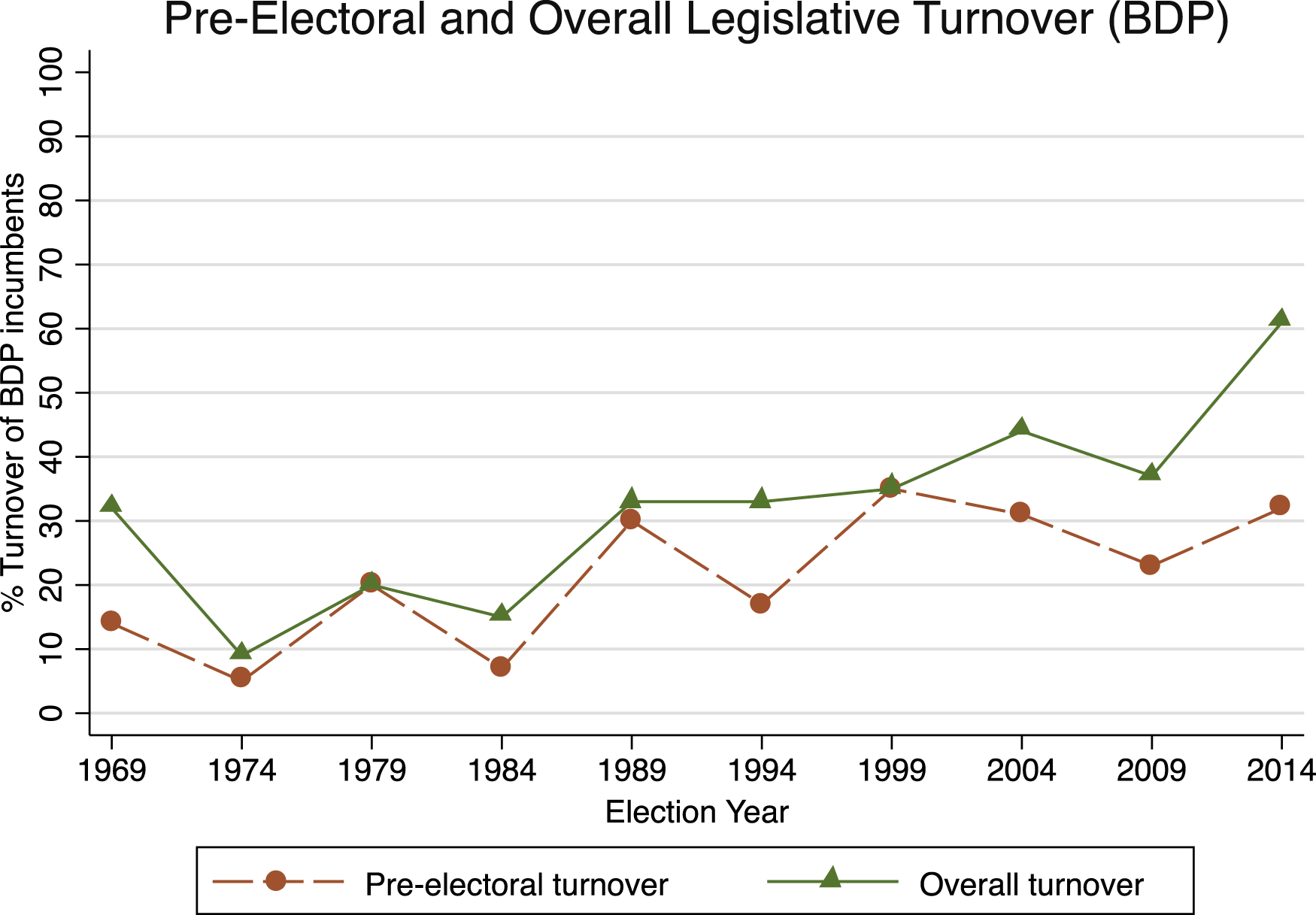
Figure excludes 18 legislators ineligible for re-nomination. See footnote. 23
Mass primaries and political experience
But which incumbents are failing to be re-nominated? Although Figure 3 makes clear that pre-electoral turnover has been increasing, it does not identify which incumbents are leaving office. Mass primaries may facilitate the removal of longer-term, entrenched incumbents, bringing in a new generation of leadership. Indeed, the percentage of first-term elected BDP MPs has risen from an average of 34% in the 1989–1999 elections to 48% since 2004. 25 The long-time BDP Chair of Elections (2004–2018) has expressed concerns about the loss of experienced MPs to the “chaotic” bulela ditswe primaries, observing that there has been a tradeoff between a more democratic process and candidate quality. Further, he suggested that more senior incumbents may have become alienated from voters, noting that ministers may lack sufficient time to campaign in their constituencies. 26
Probability of ruling party (BDP) incumbent re-nomination (marginal effects).
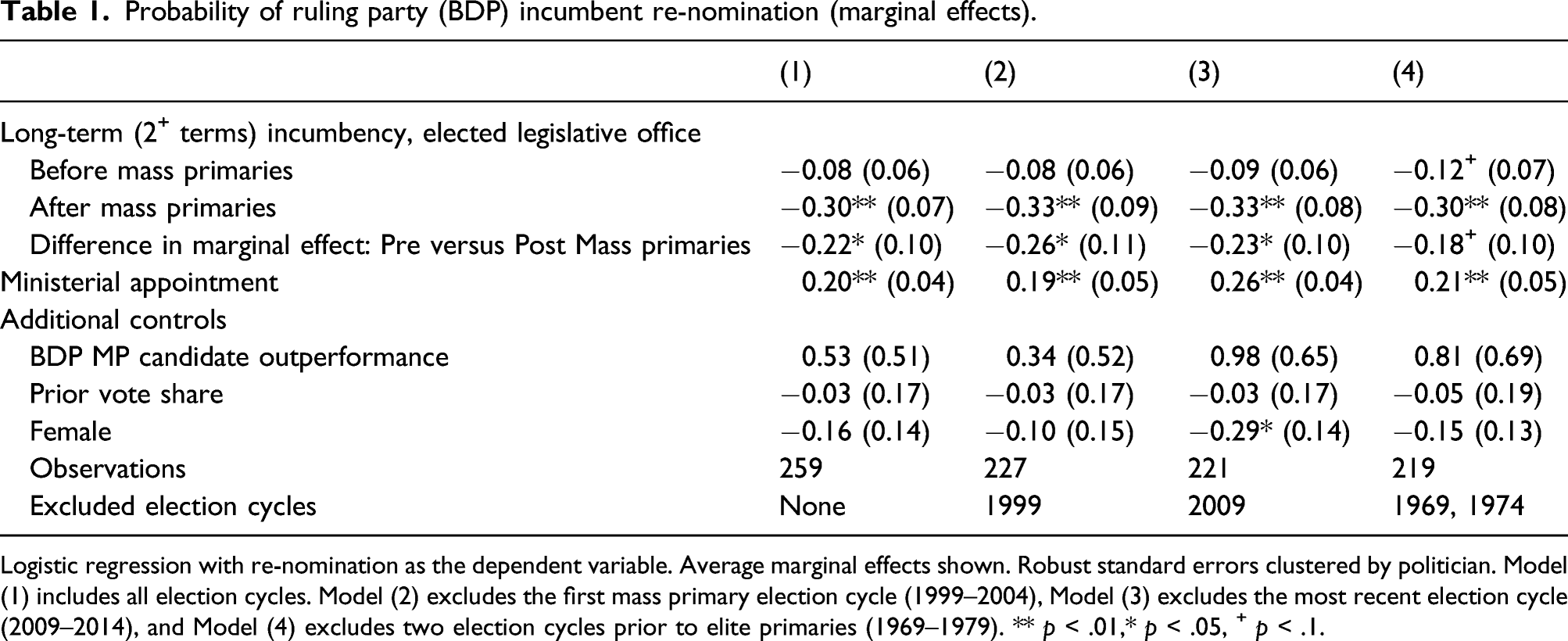
Logistic regression with re-nomination as the dependent variable. Average marginal effects shown. Robust standard errors clustered by politician. Model (1) includes all election cycles. Model (2) excludes the first mass primary election cycle (1999–2004), Model (3) excludes the most recent election cycle (2009–2014), and Model (4) excludes two election cycles prior to elite primaries (1969–1979). ** p < .01,* p < .05, + p < .1.
Model (1) includes BDP incumbent legislators from all general election years available, covering election cycles that began 1969–2009. 27 The marginal effect of long-term incumbency is negative, but not significant, prior to the introduction of mass primaries. After the introduction of primaries, long-term incumbency experience has a negative and significant average marginal effect of approximately 30% on the probability of re-nomination. The difference in average marginal effects of long-term incumbency between the two periods is negative and significant: long-term incumbents have been 22 percentage points less likely to be re-nominated since mass primaries were introduced. This finding supports the hypothesis that mass primaries increase the turnover rate of entrenched incumbents, favoring relative political newcomers.
Models (2)–(4) exclude potential outlier election cycles, broadly replicating the core finding from Model (1) that mass primaries are associated with an increased likelihood of the replacement of long-term incumbents with relative political newcomers. Model (2) excludes those incumbents elected in 1999 and eligible for re-nomination in 2004, the election cycle in which the BDP first implemented mass primaries. Information about how these primaries would be implemented, what their results might be, and if party leaders would accept these results in that first year was highly uncertain. This electoral cycle also marked by far the largest increase in the number of elected legislative seats in all of Botswanas redistricting efforts, with 40 elected seats for the 1999 elections and 57 since 2004, a 43% increase. Results are nearly identical in sign, magnitude and significance to the results from Model (1). The magnitude of the interaction term—a 26-percentage point decreased likelihood of long-term incumbent re-nomination in the mass primaries period in comparison to earlier election cycles—is somewhat larger than the baseline model and remains significant at the 95% confidence level.
Model (3) excludes another potential outlier case, incumbents elected to office in 2009 eligible for re-nomination in 2014. This election occurred after the first party split in the BDP since independence, resulting in the formation of the Botswana Movement for Democracy (BMD). Though most BMD members had returned to the BDP prior to the 2013 primaries, a significant number did not participate in the BDP primaries, and three MPs elected under the BDP banner contested the 2014 elections on the BMD ticket. Again, these results are nearly identical in sign and significance to the main analysis in Model (1).
Finally, Model (4) excludes the election cycles prior to the introduction of non-binding elite primaries in 1984. This sample compares re-nomination under elite advisory primaries (incumbents elected 1979–1994) and mass primaries (incumbents elected since 1999). Results are similar in magnitude, suggesting an approximately 18 percentage point decline in renomination probability for long-term incumbents up for re-nomination beginning in 2004 relative to those up for re-nomination in the 1980s and 1990s, but the significance of the interaction term falls just below the 95% confidence level. Given small sample sizes in each year, this result is not unexpected. A robustness test replacing the mass primaries indicator with year fixed effects produces consistent results with slightly small p-values, as shown in Supplemental Appendix Table D2.
Probability of ruling party (BDP) incumbent re-nomination (marginal effects) ministerial appointment interaction.
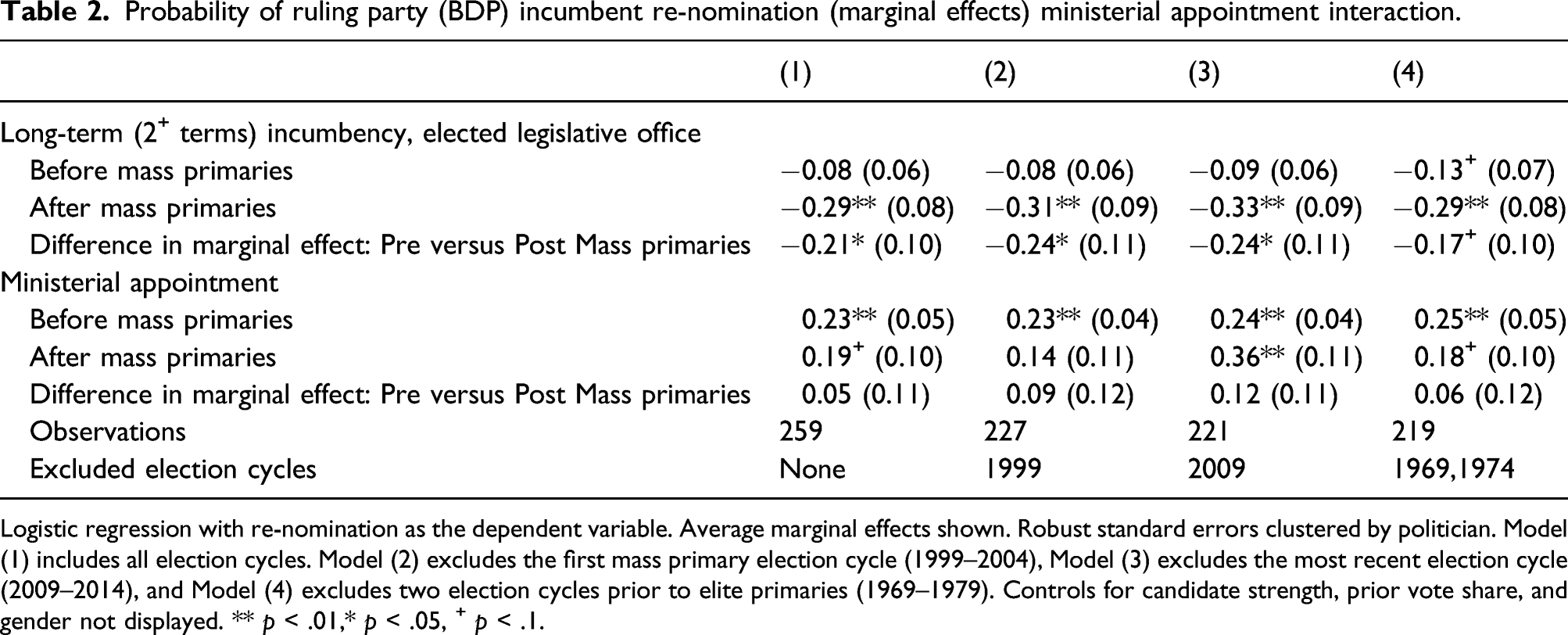
Logistic regression with re-nomination as the dependent variable. Average marginal effects shown. Robust standard errors clustered by politician. Model (1) includes all election cycles. Model (2) excludes the first mass primary election cycle (1999–2004), Model (3) excludes the most recent election cycle (2009–2014), and Model (4) excludes two election cycles prior to elite primaries (1969–1979). Controls for candidate strength, prior vote share, and gender not displayed. ** p < .01,* p < .05, + p < .1.
As a robustness test, Supplemental Appendix Table D1 replicates these four models with specifications in which all control variables are interacted with the mass primaries indicator. Again, there is a substantively and practically significant difference in the average marginal effect of long-term incumbency on re-nomination before and after primaries, and there is no statistically significant difference in the effect of ministerial appointment or any other control variable before and after the introduction of mass primaries. Two further robustness checks replace the mass primaries indicator with year fixed effects. Supplemental Appendix Table D3, produces broadly similar results to Table 2, though the significance of the interaction term falls just below the 5% significance level in Models (1) and (3) and falls below the 10% level in Model (4), as previously. Supplemental Appendix Table D4 replicates the fully interacted model using fixed effects with similar results. Mass primaries produce controlled turnover, and continue to protect the most valuable legislators from losing their seats at the intra-party stage of competition.
Could the elected-office incumbency measure not be fully capturing the entrenched BDP legislative elite? Two robustness tests substituting alternative measures demonstrate that a failure to capture all types of elite political experience is not driving the results. First, in Botswana there have been four “specially elected” MPs in every parliament. These MPs are presidentially selected and ratified by the elected legislators, and it is possible that the BDP simply moves politicians between specially and regularly elected seats, limiting the effectiveness of mass primaries in removing long-term incumbents. Supplemental Appendix Table D5 re-runs the main analysis in Tables 1 and 2 including non-elected MP office experience. Results are nearly identical in magnitude and significance. Second, given swings in opposition electoral success, the office-holding measures may be failing to capture long-time BDP politicians who have been repeatedly nominated but have not always won elections. A robustness testing substituting an indicator variable for incumbents who have been BDP legislative candidates for at least two election cycles again produces broadly similar results, as shown in Supplemental Appendix Table D6.
In sum, while mass primaries are not associated with an increased rate of intra-party legislator turnover, they do affect which legislators fail to return to office. Democratization of candidate selection, like democratization more broadly, facilitates the removal of old guard politicians and their replacement with relative political newcomers. A comparison of the experience profiles of elected BDP legislators elected to office under elite primaries versus those nominated under bulela ditswe primaries makes clear how much has changed within the BDP; while 26% of elected BDP legislators were in their first legislative term in the last two election cycles of BDP elite primaries (1994 and 1999), 39% were newcomers in the first two election cycles of bulela ditswe (2004 and 2009). 28 Mass primaries produce a controlled turnover of political elites.
Why might BDP elites have felt secure implementing this primaries starting in 2004? Ministers have notable advantages relative to backbench BDP MPs in primary campaigns. These advantages would have been clear at the time mass primaries were adopted. First, ministers have been chosen by the sitting president and head of the party, a strong public signal that of alignment with the president. Second, this alignment signals that the minister is likely to enjoy privileged access to state resources, and be better positioned to bring government spending home to their constituency and to finance primary campaigns. Access to state resources also facilitates obtaining constituency party elite support in re-nomination bids. This support is invaluable since local politicians undertake in-person campaigning on behalf of legislative aspirants during primaries. Third, based on the experience with the elite primaries, senior BDP politicians would have come to expect that they would retain the ability to influence the candidate selection process through back-door means—vetting out, or paying off, strong competitors and selective enforcement of primary regulations. Finally, should they fail to win primaries, ruling party elites have multiple exit options such as the foreign service and other appointments.
Conclusion
This paper presents evidence that mass primaries in young democracies can have substantively significant effects on the composition of the slate of legislative candidates and eventual legislators using original data from Africa’s second-longest ruling party. In the case of Botswana’s ruling BDP, mass primaries are associated with an approximately 20 percentage point decreased likelihood of re-nomination for incumbents who have already been in office at least a decade. This long-term incumbency penalty has facilitated the entry of a newer generation of politicians to legislative office within the ruling party. An average of 31% of BDP legislators were in their first term in the three elections prior to the introduction of mass primaries; an average of 48% of BDP legislators have been in their first term since mass primaries began. In effect, democratizing candidate selection may be likened to democratization more broadly. Old guard politicians are replaced in favor of political newcomers. Furthermore, senior party leaders are, at least partially, absolved of direct responsibility for ushering out unpopular legislators.
What does this mean for the democratization of candidate selection in young democracies? When intra-party competition puts party unity at risk, as has been the case with the ruling BDP since the 1990s, mass primaries offer a means to push conflict out of the political center. More importantly, mass primaries provide a mechanism to allow long-ruling parties to open themselves to limited and controlled renewal. This is of particular importance to the survival of dominant parties facing rising electoral competition. Indeed, across Africa, the parties that have first adopted mass primaries have typically been dominant parties—the BDP in Botswana, CCM in Tanzania, the NRM in Uganda, and ZANU-PF in Zimbabwe.
Supplemental Material
sj-pdf-1-ppq-10.1177_13540688211041035 – Supplemental Material for Democratizing candidate selection: Controlled turnover in Botswana’s Bulela Ditswe primaries
Supplemental Material, sj-pdf-1-ppq-10.1177_13540688211041035 for Democratizing candidate selection: Controlled turnover in Botswana’s Bulela Ditswe primaries by Shana S Warren in Party Politics
Footnotes
Declaration of conflicting interests
The author(s) declared no potential conflicts of interest with respect to the research, authorship, and/or publication of this article.
Funding
The author(s) received no financial support for the research, authorship, and/or publication of this article.

Supplemental material
Supplemental material for this article is available online.
Notes
Author biography
Shana Warren is Research Scientist at Innovations for Poverty Action. She has published research on intergroup social contact in the American Political Science Review, the economic impacts of the COVID-19 pandemic in Science Advances, and vaccine acceptance in LMICs in Nature Medicine. She holds a PhD in Politics from New York University (2019), an MA in International Relations from the Johns Hopkins University, and a BA in History and French Studies from Rice University.
References
Supplementary Material
Please find the following supplemental material available below.
For Open Access articles published under a Creative Commons License, all supplemental material carries the same license as the article it is associated with.
For non-Open Access articles published, all supplemental material carries a non-exclusive license, and permission requests for re-use of supplemental material or any part of supplemental material shall be sent directly to the copyright owner as specified in the copyright notice associated with the article.
