







Abstract
The impact of political context on a political party’s organizing and mobilizing strategies has been noted in the literature. Opposition political parties operating in autocratic contexts look for different ways in which they can communicate, organize, and mobilize their members. Advances in digital technology and, in particular social media, have created such spaces in which political parties can communicate and mobilize their members. In Tanzania, the state has imposed repressive political restrictions against opposition parties. In this context, it would be assumed that opposition political parties would turn to social media as an alternative means for mobilization and communication due to restrictions in traditional spaces such as mainstream media and rallies. This article argues that, in Tanzania, the opposition political parties’ levels of institutionalization and resources determine their use of social media more than the repressive political context. The study compares the Twitter use of two opposition parties—Chadema and ACT-Wazalendo—in two periods between 2016 and 2020, which is the period of increasing authoritarian tendencies in the country. The study deploys a qualitative research methodology using a case study approach and collection of data from the parties’ practices in their official Twitter accounts as well as key informant interviews.
Introduction
This study explores the determinants of a political party’s use of social media. It asks, what determines a political party’s use of social media? Literature on the link between social media and politics has focused more on the use of social media by civil society (Kumar and Thapa 2015; Shirky 2011), activists, political movements and protests in demanding political change (Bonilla and Rosa, 2015; Breurer et al,. 2015; Jost et al,. 2018; Khondker, 2011; Tufekci and Wilson, 2012; Wolfsfeld et al,. 2013). There is also substantial literature on the use of social media by individual politicians who use it for communication to their voters (Bennett, 2012; Enli and Rosenberg, 2018; Enli and Skogerbø, 2012; Hoffmann and Suphan, 2017; Shayo and Kersting, 2016; Stieglitz and Dang-Xuan, 2013). In relations to that, there is vibrant scholarly attention to social media and elections including campaigns (Broersma and Graham, 2012; Hitchen et al., 2019). In general, scholarly work on social media and political parties has mainly focused on two areas: (i) covering the emerging extreme parties use of social media for mobilization and communication (Ben−David and Matamoros−Fernández, 2016; Ernst et al., 2017) and (ii) political parties in Europe (Baxter and Marcella, 2012; Demirhan, 2014; Kalsnes, 2016; Klinger, 2013; McNair, 2012). Thus, there is a need to widen the analysis by including political parties from different regions and in particular from Sub-Saharan Africa. This article contributes to the literature by analyzing the use of social media by opposition political parties in a hitherto understudied context of Sub-Saharan Africa by using Tanzania as a case study. The rationale for choosing Tanzania as the main case is explained in the later sections covering the contextual analysis and methodology. For the purposes of identifying competing factors, the study takes a comparative approach using two opposition parties in Tanzania as case studies. In respect to that, the context becomes an important consideration for analysis. The context is the nascent autocratic tendencies in Tanzania since 2016 (Amnesty International, 2019; Freedom House, 2020; Human Rights Watch, 2019; Paget, 2017) and the subsequent restrictive political space. Thus, the assumption would be that the opposition parties would turn to use of social media as a means for political communication and mobilization given the narrowing of the traditional political spaces such as political rallies and news media. In light of that, it would be the context that determines the use of social media. However, the study argues that it’s the party’s level of institutionalization and resource base (membership, presence (cross−country presence), representation, leadership, and organization (including party wings—such as youth and women’s wings) more than the context that would determine the party’s use of social media. For this proposition, the context is thus held constant; that is, both of the two parties operate in a similar context yet they use social media differently. This forms the basis of our question—what determines the use of social media by opposition political parties?
Thus, the study shows that in a similar context of repression (authoritarianism leading to squeezed political space) but different levels of institutionalization and resource lead parties to use Twitter differently. The higher levels of institutionalization and resources lead to use of Twitter for communication purposes more than for mobilization purposes, while the low levels of party institutionalization and resources lead to the use of Twitter for mobilization purposes. By comparing two opposition parties that operate in the same context yet are different in terms of institutionalization and resources, the study underscores stronger determinants of the opposition political parties’ use of social media. The study does not analyze the ruling party’s use of social media in accordance to its scope, which focuses on opposition parties. Moreover, analyzing the ruling party in the context of Tanzania will not add much analytical contribution to the study’s theory since it is the opposition parties that have more limited resources and thus, they have to choose where to invest them more efficiently. It is through the examination of opposition parties that we can observe the choices for mobilization versus communication. Accordingly, the study contributes to the literature on opposition political parties in Sub−Saharan Africa and their use of social media.
The article proceeds as follows: the next section briefly explains party institutionalization and resources followed by a description of the political parties in Tanzania, which also explains their levels of institutionalization and resources. After that is the brief presentation of methodology, followed by findings, analysis, and conclusion.
Political party institutionalization and resources
Literature has presented institutionalization of political parties to include the process by which political parties’ organization and procedures acquire stability (Osei, 2016). It is also a process through which the political parties become autonomous and also acquire a certain level of “systemness” (Panebianco, 1988). Stability and “systemness” are more than formality (that is, having structures in place such as party constitution, branch network, and formal procedures). Institutionalization is also related to party’s resources base. Party resources include membership and presence (cross-country primary branches/offices with active membership and leadership structures and representation). It includes the extent to which the party is able to coordinate different practices in emerging situations where formal procedures may be incapable of dealing with the situation. Operating in an authoritarian and repressive context, the institutional status of the party can be measured by its ability to navigate through both formal and informal practices in order to survive and remain relevant. Authoritarianism and its impact on a party system has been a reoccurring theme in the literature(Bogaards and Elischer, 2016; Cheeseman, 2016; Levitsky and Way, 2002, 2010; Morse, 2014; Riedl, 2014).
Scholars have developed a range of regime typologies and arguments of how authoritarianism can affect political parties and the party system. One common regime type is Competitive Authoritarianism (Levisty and Way, 2002, 2010) whereby the regime allows for a multi-party system, yet it takes advantage of being in power and restricts space for opposition parties to operate. In this, the state adopts democracy in its form but not in its substance. The state allows for registration of multiple political parties and carries out regular elections, yet the elections are neither free nor fair (Gandhi and Lust-Okar, 2009). Competitive authoritarian regimes are related to what other scholars have called Hybrid Regimes and/or Electoral Authoritarianism (Donno, 2013; Schedler, 2006) and also Competitive Hegemony (Morse, 2014). In Hybrid regimes, opposition parties fail to win elections because they do not operate on a fair electoral playing field. Since the transition to multiparty elections, scholars have described Tanzania as a hybrid regime (Ekman, 2009; Levitsky and Way, 2002, 2010; Morse, 2014). However, the autocratic trends since 2016 have mounted and intensified (Amnesty International, 2019; Beaumont, 2019; Human Rights Watch, 2019; Paget, 2017). The Freedom House Scores show a decline from 58/100 1 in 2017 to 40/100 in 2019 (Freedom House, 2020). This is an 18 points drop in just 2°years.
The other argument shows that authoritarianism may lead to a strong party system (Paget, 2019; Riedl, 2014). This argument underscores the ironic impact of authoritarianism on a party system. Due to restrictions and constant “witch hunting,” opposition political parties tend to strengthen their institutions so that they can survive. Also, the authoritarian regimes make it difficult for registration of new parties, and thus the existing political parties strive to survive. In line with that argument is the proposition that authoritarianism may lead to democracy (Riedl et al., 2020). In that, political parties that operate in an authoritarian space tend to focus more on institutionalization. The literature presented covers analyses and cases from Sub-Saharan Africa including Zambia (Riedl, 2014); Ghana (Riedl, 2014); and Tanzania (Paget, 2019). In relation to that, an opposition party may even win an election in an authoritarian context, due to what Schedler calls a “nested game” brought about by the institutional ambivalence between authoritarian control and democratic uncertainty (Schedler, 2002).
In the midst of the rising autocratic trends are continuous technological advances, which impact political parties’ practices. Communication is one of the core functions of political parties. In democracies, the role of political parties is to facilitate communication between citizens and their governments, in that political parties behave as middlemen (Römmelle, 2003; Sartori, 1976). Thus, restricting political parties’ means of communication impedes political parties’ very core purpose. In relation to this, social media has become a tool and a space for communication and mobilization (Bennett, 2012; Howard and Parks, 2012; Kwayu et al., 2019; Loader and Mercea, 2011; Shirky, 2011; Tufekci and Wilson, 2012).
Situating this study within the literature as discussed in this section, the argument in this article is that within the context of authoritarianism, party institutionalization is a factor in determining political parties’ use of social media. This factor is examined through analysis of two opposition parties in Tanzania that operate in the same authoritarian context yet use social media differently. The article’s proposition is that when a party is less institutionalized, it will use social media for mobilization, and when a party is more institutionalized, it will use social media to inform.
Political parties in Tanzania
Tanzania re-introduced a multi-party system in 1992. Prior to that, the one party system led to an entrenched one party state (Tordoff, 1967). The ruling party—CCM—still enjoys cross country presence and huge membership across the country. 2 CCM has resources and various sources of income including real estate attributed to its historical accumulation when it was a one-party state. The constitution of Tanzania gives the ruling party an upper hand with loopholes through which the party can directly benefit from state machinery. For example, the president, who is the chairman of CCM, appoints the national electoral commissioners, the judges, the central bank governor, and the head of police force. CCM has used state resources and coercion to ensure its survival (Levitsky and Way, 2010). Scholars (Gandhi and Lust-Okar, 2009; Magaloni, 2006; Simpser, 2005) have observed similar tactics deployed by incumbents in other countries, having regimes with similar characteristics, such as a weak rule of law, ineffective parliaments, and low transparency (Gandhi and Lust-Okar, 2009). CCM has thus managed to win all general elections since 1995. Nevertheless, its vote share has been consistently declining. In 2005, CCM won by 84% of the vote, which fell to 58% in 2015. Since 2016, CCM has changed from being a competitive hegemony (Morse, 2014) to an oppressive regime that cannot tolerate the presence of opposition parties. The trend is underscored by repression, coercion, limiting opposition party resources, attempted assassination, beatings, kidnappings, disappearances, and unlawful arrests of opposition politicians. Between 2016 and 2020, a total ban on live parliament (i.e., citizens cannot see the live proceedings of the parliament) was imposed. Since 2016, non-election campaign political party rallies were banned (Amnesty International, 2019; Freedom House, 2020; Human Rights Watch, 2019). Paget (2019) showed how public rallies in Tanzania are intensive in comparison to other countries, and they have been the means through which political parties’ mobilize and communicate with voters. In the 2020 general elections, CCM used state force and machinery to manipulate the elections (Human Rights Watch, 2020; Schlimmer and Maingraud-Martinaud, 2020). The party claimed over 95% of parliamentary seats and 84.4% of the presidential vote (Tanzania Elections Watch, 2021).
Chadema was established in 1992. It is the main opposition party in the country. Between 2015 and 2020, it had approximately 17% of parliamentary seats. It enjoys cross-country membership 3 and has established a presence in all regions of the country. Paget (2019) shows how Chadema conducted an intensive election campaign in the 2015 general election. It obtained 40% of the presidential vote share. In the shrinking civic space, and in line with Riedl’s (2014) argument regarding the authoritarian origin of the party system, there is an indication that Chadema have become more institutionalized in recent years (Eriksen, 2018; Paget, 2019; Kolumbia, 2019; Oluoch, 2020). This institutionalization is implied by the registration and verification of all members (new and old) from household level in the entire country, 4 formal and procedural elections of party leaders from local branch levels to national level (Guardian Reporter, 2019; Said, 2019), systematic and monitored internal party meetings at local branch level to national level, establishment and publication of new party policy (2019), and strengthening of party wings such as women’s and youth wings. In the 2020 general elections, despite state threats, police interference and restrictions, Chadema put in place presidential and parliamentary candidates across the country. It carried out intensive campaigns with rallies that attracted big crowds across the country throughout the entire campaigning period (The Citizen, 2020b).
ACT-Wazalendo was registered in 2014. The party is relatively small with only one Member of Parliament (2015–2020). In the 5 years of its existence, the party has carried out visible efforts to establish its visibility in the country. It had a presidential candidate in the 2015 general elections. ACT-Wazalendo’s candidate obtained approximately 1% of the vote share in 2015. The party is also led by one of the municipals with a majority of 14 out of 19 elected councilors being a member (2015−2020). The party has continued to build its presence in various regions of the country. In 2019, the party size in terms of membership 5 and presence substantially increased following an internal conflict in another opposition party, CUF, which commanded the majority of membership in Zanzibar. CUF used to be the major opposition party in the country up to 2010 when Chadema took over that position. However, the party kept its stronghold in Zanzibar. Upon the splitting of CUF in 2019, a number of strong members and former leaders joined ACT-Wazalendo. Given CUF’s previous strength in Zanzibar, the movement of its leaders and members in Zanzibar to ACT-Wazalendo in 2019 made ACT-Wazalendo the main opposition party in Zanzibar overnight. In the 2020 general elections, ACT-Wazalendo put in place presidential and parliamentary candidates. However, its presidential candidate stopped campaigning a few weeks after the start of the campaigning period (The Citizen, 2020a). In the mainland, the visibility of ACT-Wazalendo during the campaign was minimal and its key leaders decided to publicly endorse the Chadema presidential candidate (Aljazeera 2020; Ng’wanakilala, 2020).
Methodology
The analysis in this study focuses on opposition political parties in Tanzania. Tanzania is selected due to its increased levels of authoritarianism and repression of the operation of opposition political parties since 2016. To better understand the determinants of the parties’ social media usage patterns, this study employs the most similar systems design. By selecting two Tanzanian opposition parties—Chadema and ACT-Wazalendo—contextual factors such as autocratic regime type are held constant. Furthermore, having two parties as case studies facilitates comparison (George and McKeown, 1985) and brings in chances to highlight factors that mostly determine the deployment of social media. These two parties are comparable since they operate in similar contexts (Yin, 1994) and are both opposition parties. Moreover, in contrast to other opposition parties, both run official social media accounts (Twitter). The two parties differ in terms of their levels of institutionalization and resources (membership, representation, presence, and organization).
The analysis is based on systematic observation of social media practices by both parties to assess the type of content and intended purpose (communication or mobilization) as well as 16 key informant interviews with party officials and social media influencers. Twitter, as opposed to other social media platforms, was chosen for practical purposes. These include ease of making systematic observations (Bruns and Stieglitz, 2014) on the official accounts of the parties and the “official” nature of practices on Twitter relative to other platforms. Conversations and interviews with party officials indicated that communication through Twitter is an informed decision to communicate not only to voters, members, and the general public but also to state officials and international organizations within and beyond the country. Also, Twitter has a functionality of hashtags, which facilitate the coordination of conversations around the same topic across a wide geographical area. A hashtag is a short key word or phrase, prefixed with a # symbol that helps to coordinate a distributed discussion between people in different places (Kwayu, 2018). Analyzing the hashtags allows for observation of patterns over time and also for the identification of important phenomena (Bruns and Stieglitz, 2014). Also, hashtags make it possible to track certain discussions that may be presented in volumes of tweets (Bruns and Stieglitz, 2014).
The study covers the period from 2016 to 2020. It compares two sets of Twitter posts by two political parties within this timeframe: the first set covers the period between June 17, 2016, and March 17, 2017, and the second set covers the period between June 17, 2019, and March 17, 2020. June 2016 is when the President banned public political rallies, while March 17, 2020, was due to the practical research timetable for this study. Furthermore, the logic behind analyzing the immediate past 9 months is in consideration with the “real-time” nature of social media and the changing political context in Tanzania. The first set thus covers the immediate 9 months period post the political rallies ban while the second set covers the last 9 months in this study’s research (data collections) time. The last day for data collection was March 17, 2020. The focus of the analysis has been on the hashtags that have been used in those two periods of time.
The study uses an interpretive method of analysis (Lijphart, 1971) through which the two cases develop inferences that can be interpreted through a theoretical background. In respect to that, the study does not only end with interpretation but also an attempt towards developing and understanding a theory of political party use of social media. Comparing the two cases can facilitate that attempt through what Eckstein and Gurr (1975: 108) term a—“plausibility probe”—that is “something more than a belief in potential validity […] and something less than actual validity, for which rigorous testing is required.”
Findings and analysis: The parties’ social media strategies
To understand the parties’ use of social media, it is important to examine their practices on social media. Gathered from interviews with party leaders in each of the two case parties, it was found that ACT-Wazalendo has an official party social media strategy while Chadema does not. “Our party has a social media strategy that guides our use of social media”—(ACT Interviewee 1—June 2019). “We don’t have a strategy that is specific for social media as a party, but the party encourages its leaders and members of parliament to use [a] social media account” (CDM Interviewee 1—June 2019). Nevertheless, both of the parties have active social media profiles. Chadema announced its digital strategy in its 2019 Annual General Meeting. This strategy has social media as one component among many others such as digital fundraising. A follow up on this strategy underscored that “the party has deployed digital methods to mobilize its members in fundraising and also in campaigning” (CDM Interviewee 4—January 2020). To note, this digital method was designed in the general election year when the party needed funds as well as different campaigning approaches. One of the purposes of this digital strategy, according to party plans, is to mobilize voters, regardless of their party affiliation, as well as convincing undecided voters. This echoes Karlsen’s (2011: 41) observation that during election campaigns, the political parties’ communicative purpose is both to mobilize supporters and convince undecided voters.
Social media (Twitter) profile summary.
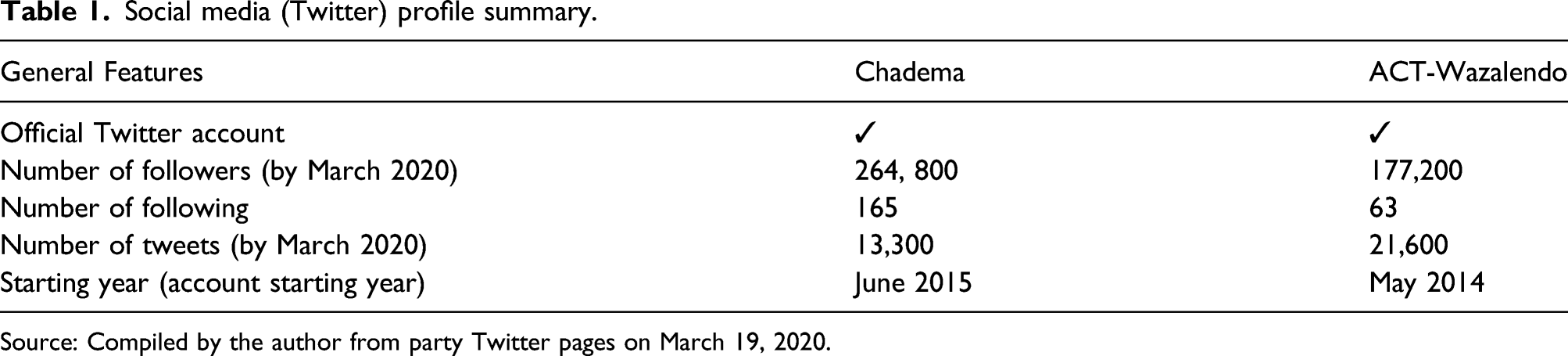
Source: Compiled by the author from party Twitter pages on March 19, 2020.
Figure 1 is an illustration of the two parties’ followership trends from 2016 to 2020. Followers in Twitter. Source: Official ACT-Wazalendo and Chadema Twitter account analytics.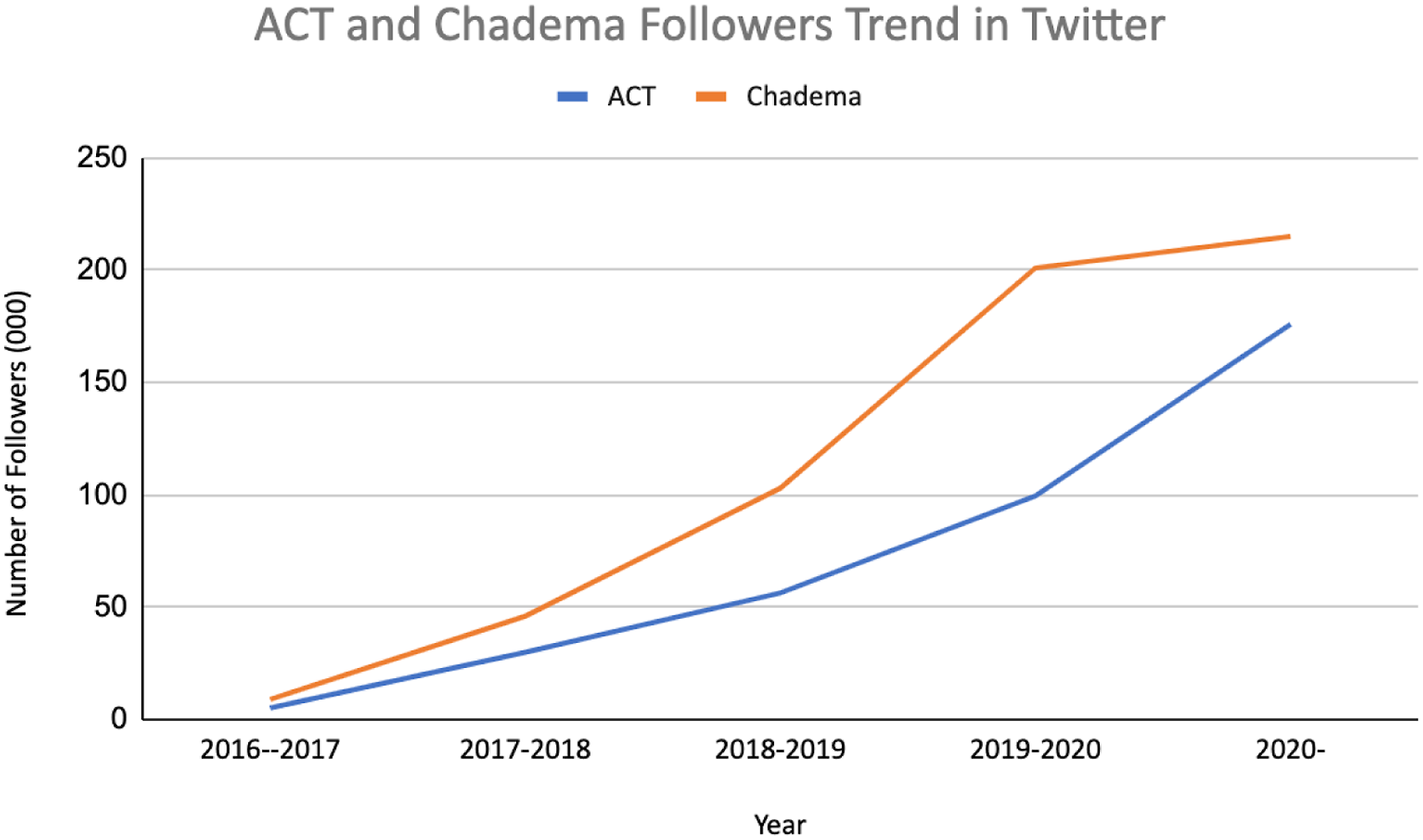
From Table 1 and Figure 1, we see that both parties have official Twitter accounts, yet they differ in relation to their social media profiles. Whereas ACT-Wazalendo is a relatively small party, it has more tweets and it joined the platform a year before Chadema. In contrast, Chadema has more followers, yet they have fewer posts (tweets). In this study, the parties’ posts in Twitter are categorized into two types based on their intended purposes. These types are communication and mobilization.
Communication is referred to when parties are posting for the purpose of sending certain information to their members and the public. It could also mean parties updating members and the public on a certain issue, event, plan, or upcoming press release. Examples of tweets (content) for communication are as follows:
Mobilization is referred to when parties are posting for the purpose of recruiting membership or marshalling support towards a certain cause such as policy advocacy, change of policy, demonstration, protest, and also boycotting. Examples of tweets (content) for mobilization are as follows: The Party Chairperson, Madam @annamughwira registering new members who have brought membership cards, #TemaUzaledeo rasmi.
8
More than 50 new members from Vingunguti Ward Dar es Salaam have joined #ACTwazalendo party this afternoon and have been given [a] membership card by the Publicity and Public Communication Committee Chairman, Mr. Salim Bimani, #TanzaniaYaZambarau #TheFutureIsPurple.
9
To comparatively analyze the parties’ engagements and use of Twitter, the study focuses on hashtags that each party used in the two periods. Hashtags facilitate tracking of coordinated discussions across large volumes of tweets. When political parties use a #Hashtag, it is for the purpose of coordinating and marshaling attention and participation of their targeted digital audience. As hashtags are often time-specific due to their focus on a specific event or situation, whenever an agenda is the top priority for the party, a hashtag might be introduced to coordinate and mobilize support across the digital platform. Social media instantaneously affords persistence, visibility, and association (Treem and Leonardi, 2012) with functionalities like groups, identity, reputation, conversation, presence, relationships, and sharing (Kietzmann et al., 2011). Thus hashtagging facilitates individual members to continue in further discussions on the agenda of the time. In light of this study’s argument, the hashtags are categorized in the two identified types of social media use (communication and mobilization). Furthermore, in this study, mobilization is divided into two sub-categorizes—support and membership.
ACT-Wazalendo Practices on Social Media
ACT-Wazalendo uses social media as the main mobilization as well as communication tool. “After founding the party we decided to strategically focus on social media as a recruiting forum as well as reaching out to people and [to] mobilize” (ACT Interviewee 2—June 2019). According to another interview (ACT Interviewee 1—June 2019), the reasons given for this strategic decision included “the environment was very bad for us to grow as other parties [grow] because of the strength of [the] CCM and UKAWA” 10 and “media coverage for us was so small, so social media became our tool” (ACT Interviewee 3—June 2019). The practices of ACT-Wazalendo on Twitter are aligned with this strategy.
Between 2016 and 2017, the party used 45 hashtags, out of those, 32 were for mobilization purposes (6 were for member recruitment; 26 for support in different causes); and 13 were for communication (see Figure 2). Between 2019 and 2020, the party used 65 hashtags, out of them, 53 were for mobilization (25 for membership recruitment; 28 for support to different causes) and 12 were for communication (see Figure 3). Proportional use of hashtags by ACT-Wazalendo between June 2016 and March 2017. Source: Analysis by the author from Twitter analytics of ACT-Wazalendo official account. Proportional use of hashtags by ACT-Wazalendo between June 2019 and March 2020. Source: Analysis by the author from Twitter analytics of ACT-Wazalendo official account.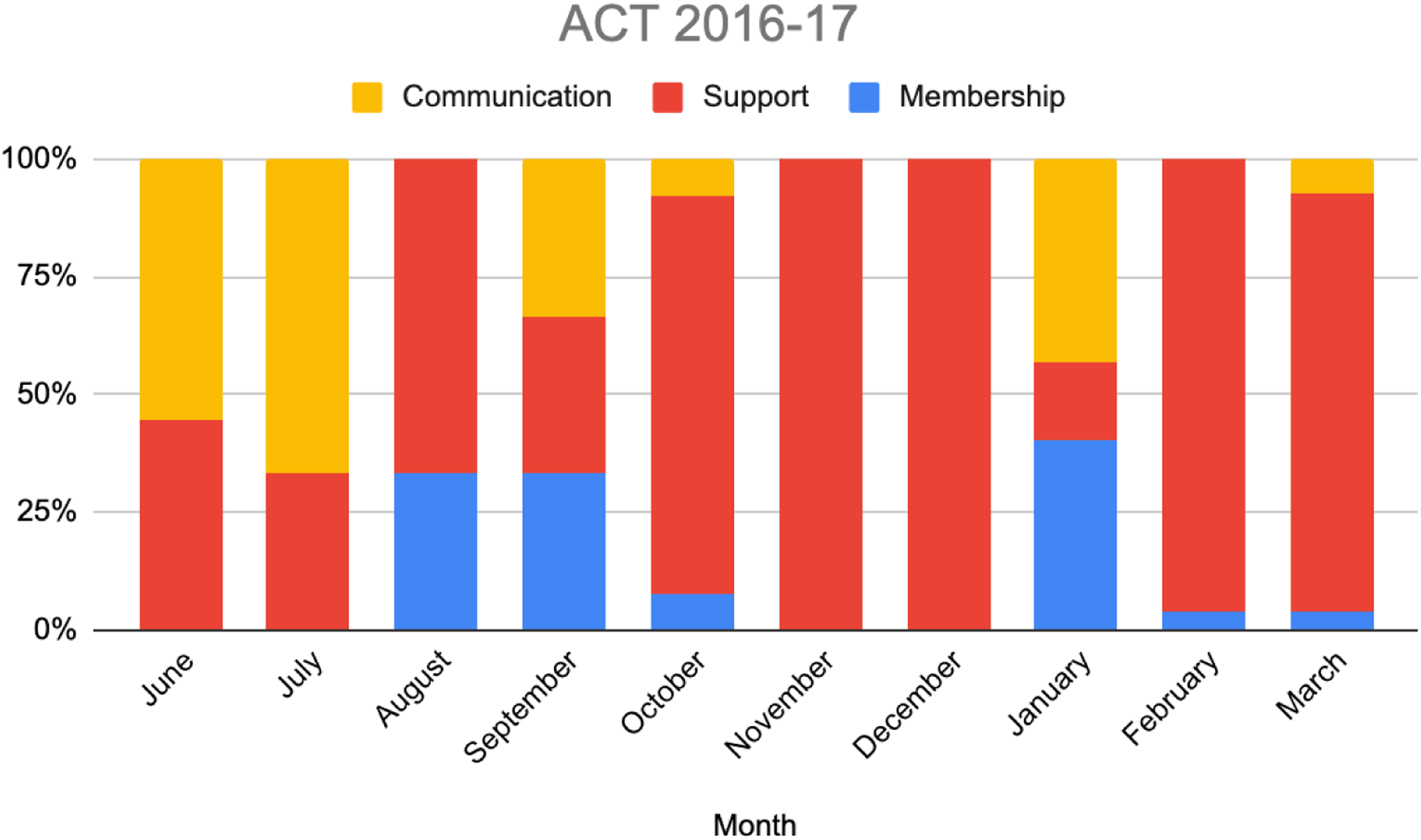
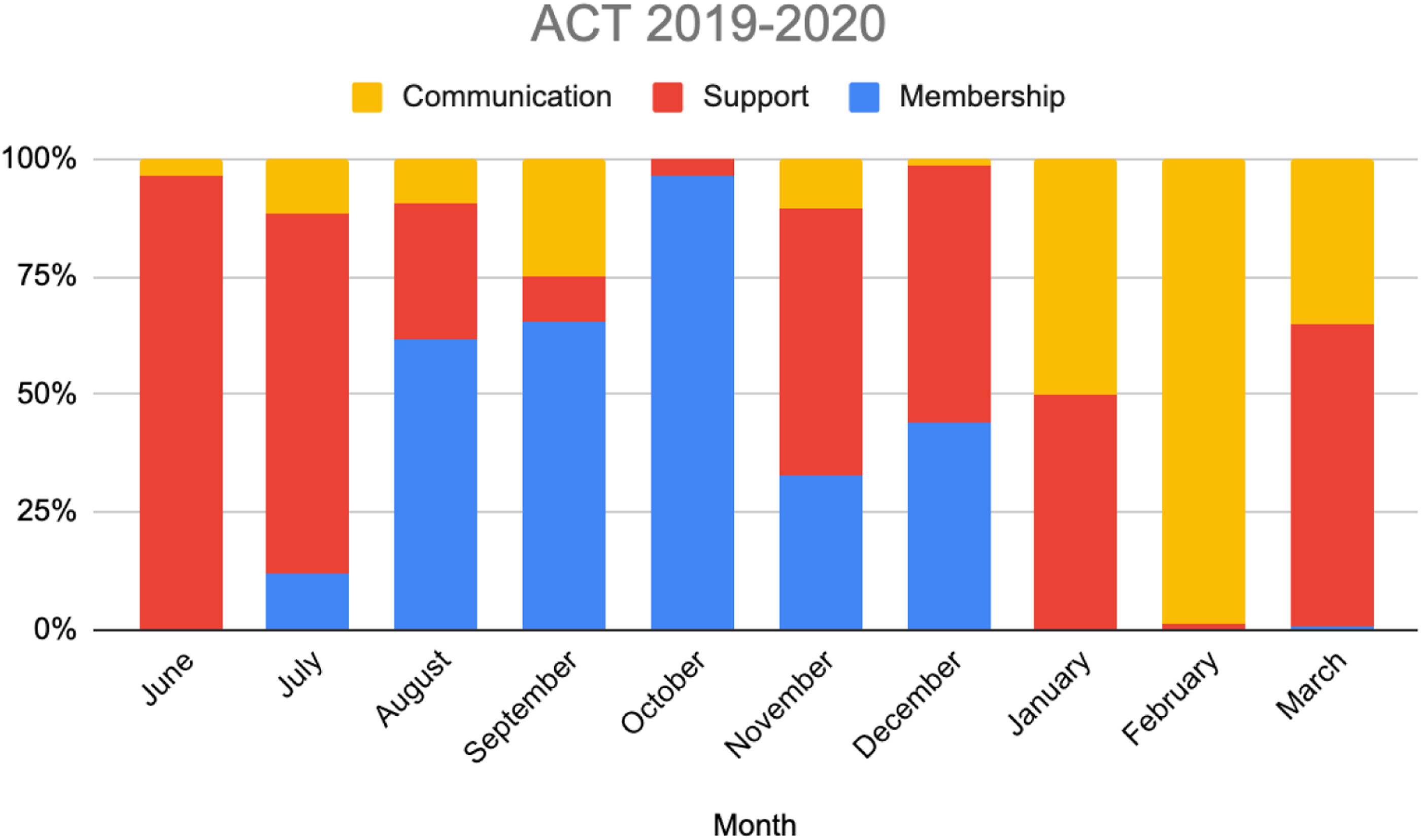
To illustrate the use of hashtags, one incidence in 2019 is discussed below.
Following the split of key leaders from one of the oldest opposition parties in Tanzania (CUF), there were defections of former top leaders and members to ACT-Wazalendo. Songs, dances, and symbolic gestures accompanied the welcoming events of new members, particular in Zanzibar. All these activities were publicized through social media. #ShushaTangaPandishaTanga (bring down one dhow cloth take up another dhow cloth) became a standard hashtag for this new move from CUF to ACT-Wazalendo. A number of Twitter users expressed an interest in joining the party and used this hashtag. The use of this hashtag has been for the purpose of communicating, coordinating, and mobilizing a distributed practice across different places in the same period of time. Hashtags are helpful in spontaneous discussion around a specific theme (Kwayu, 2018). #ShushaTangaPandishaTanga brought to attention similar events as they were happening even beyond Tanzania. Followers of defected CUF leaders, who are as far away as the UK, for example, were burning and throwing off CUF flags while posting the video with the above hashtag.
Chadema practices on social media
Observation and analysis of Chadema practices show that the party uses Twitter for communication purposes more than organizing or securing new members. Chadema’s mobilizing and organizing strategy is evidently of greater scope on the ground. Since 2018, Chadema has initiated and has been carrying out Chadema Ni Msingi (which translates as “Chadema is its Foundation”) by registering and collecting profiles of its existing members and new members at household level as well as teaching and training leaders at village/branch level. This is an improved approach from the previous ones such as Operations Sangara and Chadema Ni Tawi (which translates as “Chadema is its Branch”) that were also designed to mobilize members and establish new branches (Paget, 2019). Chadema ni Msingi started at household level as opposed to at branch level. The party does not publicize its ground mobilization activities on Twitter. “I was discouraged to publicize about Chadema ni Msingi activities by people in my party” (CDM Interviewee 4—June 2019).
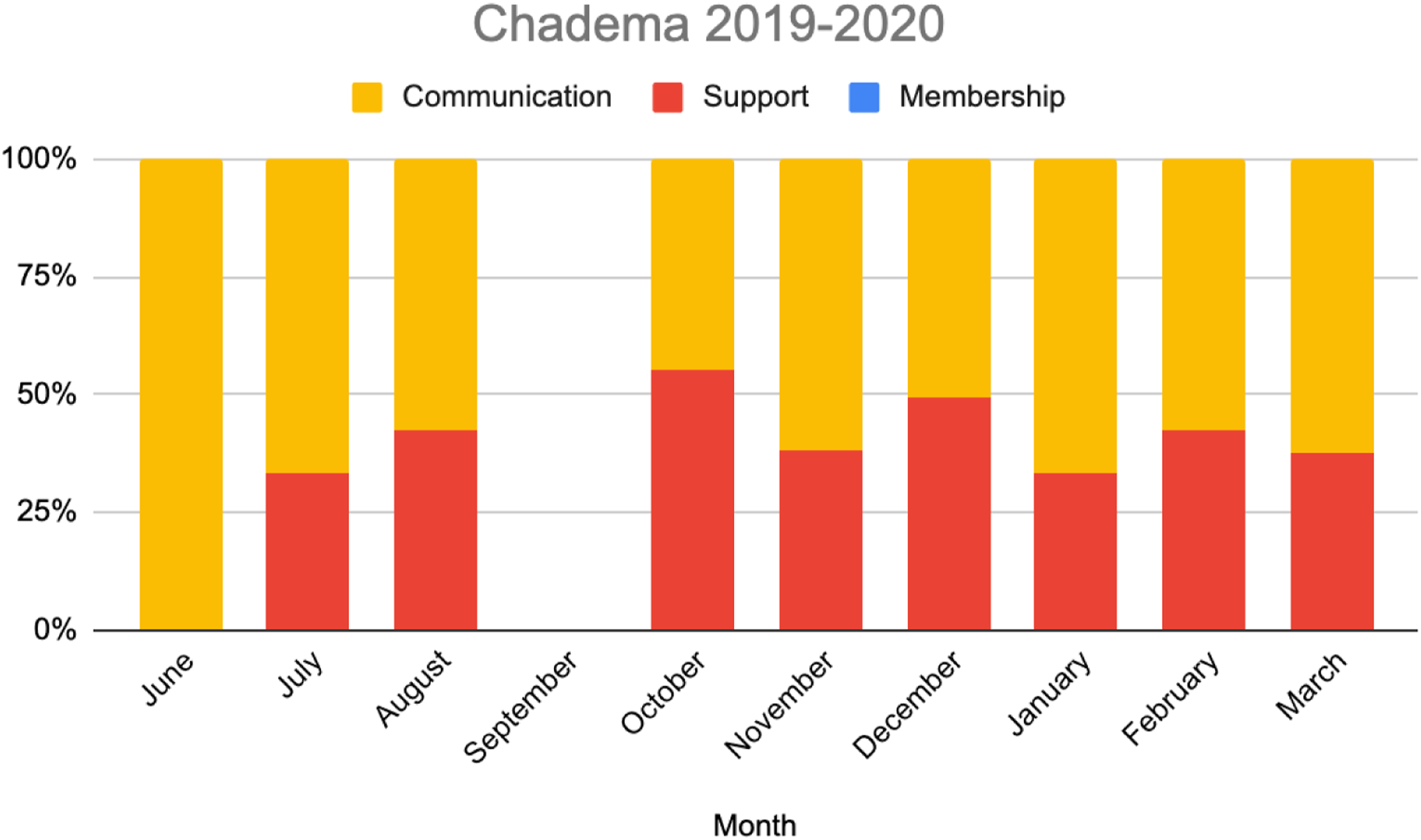
Between 2016 and 2017, out of the 11 hashtags used, 5 were for mobilization (support) and 6 were for communication (Figure 4). Between 2019 and 2020, out of the 10 hashtags, 4 were used for combined purposes of both mobilization (support) and communication, 7 were for communication while 3 hashtags were specifically for mobilization (Figure 5). Proportional use of hashtags by Chadema between June 2019 and March 2020. Source: Analysis by author of Twitter analytics of Chadema official account. Proportional use of Hashtags by Chadema Between June 2019 and March 2020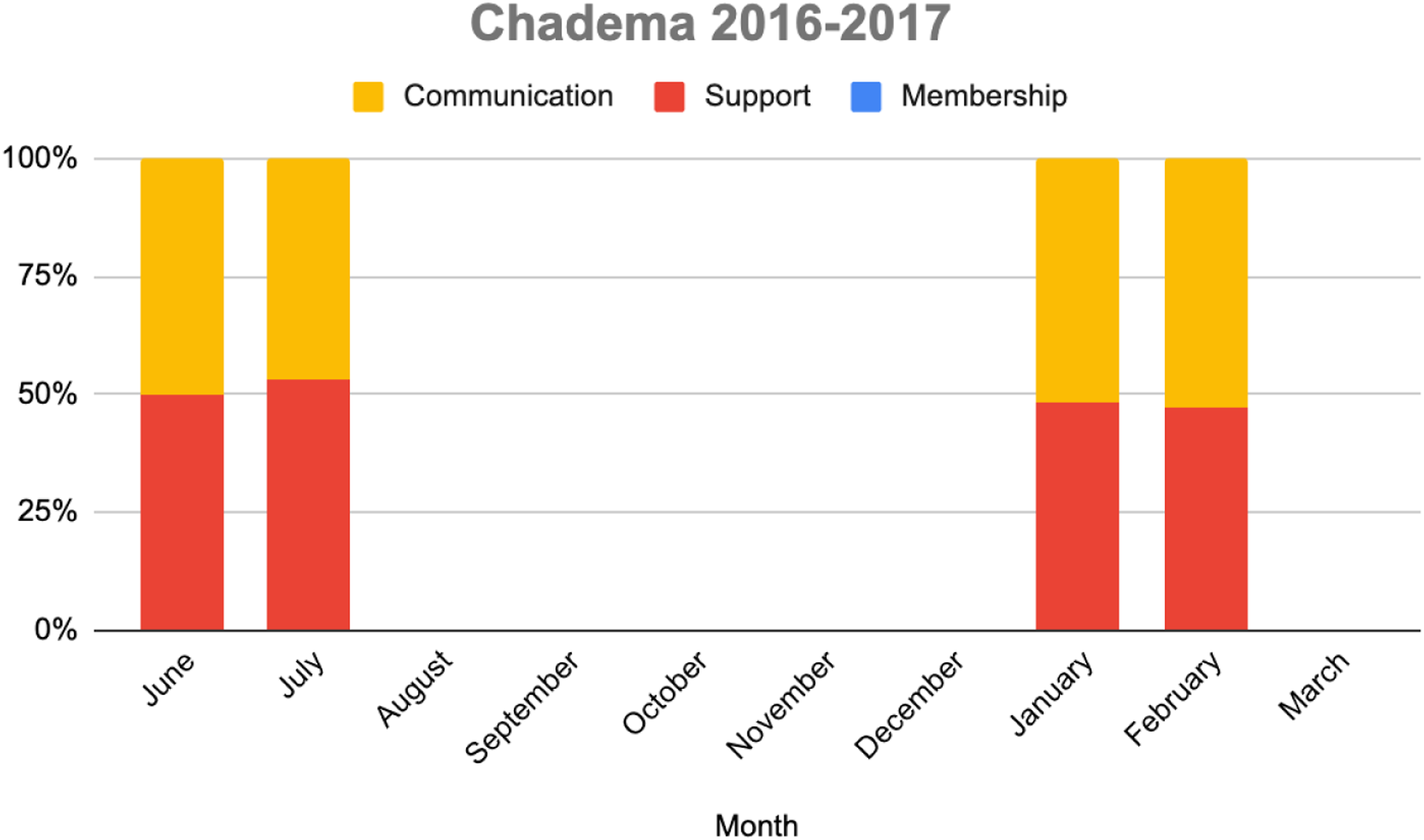
To illustrate the use of a hashtag by Chadema and how it was supported by ground mobilization (thus explaining the combined use of hashtags for mobilizing and for communication), below is the narration of an incidence whereby a hashtag was used to mobilize support.
In March 2020, following the court judgment of fines amounting to USD 175,000 (OHCHR, 2020; BBC, 2020) against Chadema key leaders, the party mobilized support from the public by using Twitter, other social media platforms, and also ground networks to raise the money from the public. The hashtag used on Twitter for this was #NguvuYaUmma (“People’s Power”) and #MichangoFainiZaViongoziChadema (“Contributions to pay the fines against Chadema leaders”). The digital campaign was complemented by the party’s ground network. Alongside, #NguvuYaUmma and #MichangoFainiZaViongoziChadema, the party posted and shared photos of its branch leaders passing through streets and going house-to-house to collect contributions. The money was collected through digital platforms such as “Mobile Money” and also by physical contributions whereby members of the public were collectively giving their contributions to the party’s branch leaders. For example, women sold chicken and farm produce to raise the funds. Other groups, such as hawkers at bus stations, collectively sent their contributions to their local Chadema leader. Thus, the party’s Twitter account did not only mobilize funds but also, and most importantly, communicated (shared information) about the fundraising activities and progress on the ground as well as the amount of funds that were raised across all platforms.
Analysis
The main argument of this study is, — higher levels of party institutionalization and resources lead to use of Twitter for communication purposes more than for mobilization purposes, while low levels of party institutionalization lead to the use of Twitter for mobilization purposes. The findings have shown that the context—for example, nascent authoritarian trends that minimize the space for political action—may partially explain the aggressive use of Twitter by opposition parties. However, it is not a strong enough explanation given that the parties with strong institutions and well-established ground structures still do ground mobilizing more than mobilizing through digital spaces. In our case, it has been shown that Chadema uses Twitter more for communication purposes in comparison to ACT-Wazalendo that use Twitter for mobilization as well as communication. The two parties operate in a similar context (authoritarian), yet they are different in their levels of institutionalization.
The findings show us how ACT-Wazalendo is systematically using Twitter not only for communication but also, and mostly, for mobilizing party membership and recruitment as well as for the promotion of the party’s agenda. ACT-Wazalendo’s secretariat use live Twitter posts for their major activities—such as meetings and also for publicizing their policy agenda. The approach of ACT-Wazalendo is discursive (Jarzabkowski, 2005) as it portrays itself as a party with an agenda that is informed by a solid and well-defined ideology. The language of ACT-Wazalendo’s account is arguably formal and specific to the agenda on the table. The findings also show that ACT-Wazalendo was increasingly using Twitter for communication in the period between 2019 and 2020, when compared to 2016 and 2017. This could be explained by the boost to membership and presence the party enjoyed from defected CUF members.
Chadema has used its established ground structure to further mobilize through its cross-country membership, branches, and network. It has done this through ground mobilization more than through Twitter. By March 2020, the party’s Twitter page had 264,800 followers—which was 87,600 more than ACT-Wazalendo, but given its wider membership on the ground (estimated registered membership is 7 million by March 2020 (Mbowe, 2020) while ACT-Wazalendo has an estimated 1.2 million members (Collins, 2019; ACT Interviewee 4—January 2020) that followership is proportionally small. As shown in the charts (Figure 4), there are months when Chadema did not use a hashtag in any of its tweets. This further underscores the argument that the party use Twitter mostly for communication, rather than mobilization, as one of the main functions of hashtags is to coordinate support across different digital followers.
Party wing account profiles by March 2020.
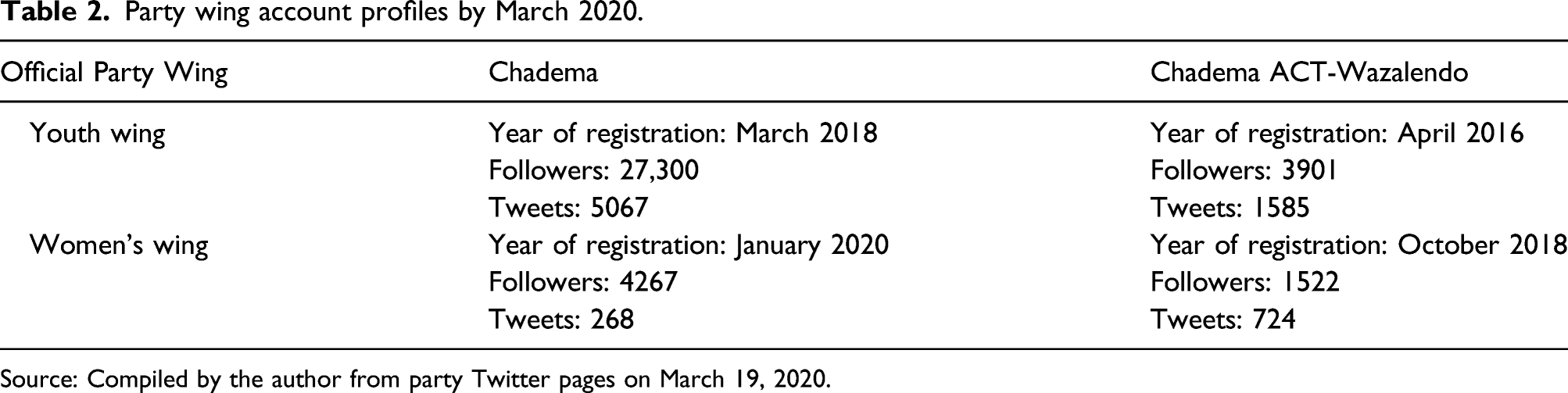
Source: Compiled by the author from party Twitter pages on March 19, 2020.
In comparing the use of Twitter by both parties in a 9 month period between 2016 and 2017 with a more recent 9 month period between 2019 and 2020, we see similar trends. That is, Chadema uses Twitter less than ACT-Wazalendo. Furthermore, Chadema uses it more for communication purposes, while ACT-Wazalendo uses it more for mobilization purposes.
These analyses can help us to further understand that the level of institutionalization allows for creativity and the ability to deploy other spaces beyond social media platforms. Chadema focuses on ground mobilizing by creating spaces such as carrying out meetings in members’ homes, using social spaces such as funerals and weddings of party leaders or active members whereby Chadema members will all wear party clothes such as dira (traditional Swahili dresses for women) or party t-shirts and combat-like suits. Another space that Chadema uses is court. Since its top leaders have had court cases and had to report once or twice each month, the courtroom and the court grounds have become a political space. Even the deployment of the digital strategy is more for enhancing the ground mobilizing rather than replacing it. Thus, the use of social media is one of the many ways to mobilize and communicate rather than it being the alternative space.
Conclusion
The study of social media and political parties in Sub-Saharan Africa is still novel and leaves room for more analysis. The analysis in this study has focused on two Tanzanian opposition political parties’ practices on Twitter. The main argument of this study was to examine the assumption that these parties would turn to a social media strategy for their main communication and mobilizing work in the context of authoritarianism, which has squeezed the political space. The findings and analysis have shown that despite the fact both parties operate in the same context, their practices differ. The practices are thus more informed by the party’s level of institutionalization and resources than by the context. This supports Römmele’s (2003) argument on the influence of party typology in adopting technology. The analysis further supports the argument that authoritarianism may lead to more party institutionalization manifested by the party’s ability to navigate and create new spaces and ways to operate within a restricted political context.
Footnotes
Declaration of conflicting interests
The author(s) declared no potential conflicts of interest with respect to the research, authorship, and/or publication of this article.
Funding
The author(s) received no financial support for the research, authorship, and/or publication of this article.
