







Abstract
This study tests the explanatory strength of the party-centered theory of electoral campaign professionalism. The theory was previously subject to testing in various types of elections during the first decade of the new millennium, covering Germany, Austria, Sweden, and Finland. Nevertheless, empirical research in this field has been on hold for almost a decade, obstructing the development of the theory during a time when politics and political campaigns have taken new paths. In this article, the theory is revisited, presenting results from a unique time series study covering 48 party campaigns between 2009 and 2019 in three consecutive European parliamentary elections in two multiparty democracies, Sweden and Finland. Our results provide weak support for the party-centered theory of campaign professionalism in the form it was originally operationalized. Only a centralized party organization and a large support base with a catch-all strategy were found to be statistically significant predictors of campaign professionalism.
Introduction
In recent decades, election campaigns in Western democracies have been characterized by increased electoral volatility and declining party identification among voters (Dalton, 2008; Ford and Jennings, 2020). Thus, there is much at stake for political parties during the campaign. At the same time, digitalization and the fragmentation of media landscapes (Davis, 2019; Newman et al., 2020) pose additional challenges for political competitors when attuning political messages and successfully targeting segments of the electorate. Consequently, campaigning requires resources, specialized skills, organizational flexibility, and new campaign tools to keep pace with ongoing changes in political communication environments and the wavering political loyalties of the electorate. In the campaign literature, it has commonly been held that these developments result in election campaigns becoming more professionalized.
The change goes by many names, including “Americanization,” “modernization,” “marketization,” “hybridization,” or “professionalization,” depending on whether it is seen as a diffusion process, adjustment to socio-economic change, commercial techniques, a mixture of global trends and country-specific contexts, or optimizing the toolbox available within existing resources (Gibson and Römmele, 2001: 31–32, 2009: 265–266; Plasser and Plasser, 2002: 348; for a critique, see Tenscher, 2013: 243).
More recent developments are challenging the assumption that the professionalization of election campaigns is an irreversible trend. The observation that apparently cynical, consultancy-driven, and well-polished campaigns may backfire, and lead to “further detaching of an already disaffected public from the electoral process” is not new (Savigny and Wring, 2009: 251). The (partial) re-entrance of a detached electorate through new parties with an apparently non-professional approach using new communication technologies and strategies requires a more precise definition of what we mean by professionalization and a discussion about its position in the current political landscape.
For democratic ideals—including the allocation of political power in a legitimate manner—this is not a minor question. As argued by Savigny and Wring (2009: 263), marketing methods may have “a detrimental impact upon the democratic process.” We argue that recent reactions to this development also merit critical study: political analysis must aim to produce accurate and structured approaches to the study of how parties of different types act professionally in the election process. Thus, the question arises of whether earlier structured comparative studies on how parties have developed their campaign techniques over time in countries with multiparty systems have become obsolete. Here, we refer to the quantitative approach to studying the role of parties in conducting professionalized electoral campaigns, based on a division between systemic and party-specific variables developed by Gibson and Römmele (2001) and its later developments (the so-called CAMPROF Index). Gibson and Römmele’s 20-year-old approach was pioneering not only in its aim to construct a universally measurable index of the degree of parties’ campaign professionalism but also in its highlighting of changes within the party as indicators of moves away or toward more professionalism.
The objective of this article is thus to examine if the theory remains valid in the rapidly changing environment of political communication. To achieve this aim, we utilize the operationalization of the concept of campaign professionalism developed by Jens Tenscher (hereafter, the Tenscher Index) to analyze a larger data set than in any preceding study of its type. The study covers 48 political party campaigns in European Parliamentary elections in Finland and Sweden between 2009 and 2019. While doing this, we also update some of the measures to better account for the role of social media. We emphasize that the theory itself was built as a universal theory. In other words, the second-order nature of EU elections should not diminish the theory’s applicability. Parties should also differ in their degree of professionalism as predicted by the theory when the overall level of parties’ campaign professionalism was lower. Further, we test whether these differences prevail independently of the differences in the political systems of the two countries, in other words, if the theory predicts professionalization equally when the leading role in campaigning is played by party organizations (Sweden) or when individual candidates are more on the center stage (Finland). In this sense, our design taps on a main division of democratic political systems. Informed by the results of this study, we discuss the current validity of the items included in the index as well as the explanatory power of the party-centered theory of campaign professionalism. Our aim is to draw conclusions on the potential of this approach and the need to respond to the challenge (as noted by Strömbäck, 2009: 97) of adjusting the model to the context- and time-bound nature of campaign structures, strategies and techniques.
The following section introduces the party-centered theory, its empirical support, and possible developments of the theory in the light of ongoing transformations in party-voter relations within Western democracies. This is followed by a comparison of the systemic and contextual features of Finland and Sweden and an empirical section presenting data from the party campaigns analyzed in this study. Finally, the validity of the party-centered theory and the need for possible revisions are discussed.
The party-centered theory
The party-centered theory of professionalized campaigning emphasizes the organizational and internal aspects of political parties as the forces driving the professionalization process. The theory argues that not only structural conditions but also party-specific factors explain the degree of campaign professionalization (Gibson and Römmele, 2001). Thus, some parties will professionalize more easily than others in a similar systemic environment. The theory identifies seven party-specific variables that are expected to encourage professionalized campaigning: a right-wing ideology, a catch-all orientation, material resources, a centralized organization, prior electoral loss, the loss of incumbency, and a new party leader. According to the theory, for ideological reasons and due to their support base, right-wing parties may favor commercial techniques that originate in the business sector and are therefore more likely than left-wing parties to resort to outsourced services and marketing methods. The wider the support base a party attempts to reach, the more prone the party is to invest in campaigning because reaching out to such a heterogeneous electorate goes beyond traditional class-based appeals. The same logic applies to material resources and centralization: richer and more organizationally centralized parties tend to invest more money in their campaigns and run more coordinated and uniform campaigns than poorer and less centralized parties, and hence, they are more likely to use professionalized methods. In turn, electoral defeats and shifts from government to opposition are likely to encourage parties to increase efforts to regain their previous position, which again leads to the use of professionalized methods. Furthermore, a new party leader usually wants to demonstrate that his or her selection means an upward swing for the party in subsequent elections. This, in turn, increases the likelihood of professional campaigns.
The CAMPROF Index of parties’ degree of professionalization, created by Gibson and Römmele, aims to test the explanatory power of these variables. In the original index, dependent, party-specific variables measuring campaign professionalization included the following components: use of telemarketing, use of direct mail, use of outside PR/media consultants, use of computerized databases, use of opinion polling, conducting opposition research, presence of an intranet, use of email lists, outside campaign headquarters, and permanent campaigning (Gibson and Römmele, 2001: 38–39).
The initial studies that empirically tested the party-centered theory were encouraging. The first study, in Germany, confirmed Gibson and Römmele’s hypothesized levels of professionalism and supported assumptions made in the wider literature on the subject (Gibson and Römmele, 2009). The second study, in Sweden, demonstrated a positive correlation between the variables claimed to prime parties to professionalize their campaigning and the extent to which parties ran professionalized campaigns (Strömbäck, 2009). The third study, comparing EP elections in Finland and Sweden, provided partial support for the theory, while nevertheless demonstrating its limitations in a system like Finland’s, where votes are cast for individual candidates, and failing to predict electoral success (Moring et al., 2011). The fourth study, based partly on the same data but adding Germany and Austria to the two Nordic countries, reinforced the theory by showing larger differences in professionalism between parties within countries than between countries and pointing to a general “Western” style of campaigning. However, this study questioned the explanatory value of some hypotheses, such as the assumption that catch-all parties are more professionalized (Tenscher et al., 2012). The fifth study of this kind demonstrated a general tendency towards higher levels of professionalization in both first-order and second-order elections, while also revealing that larger parties professionalize through structural reforms, whereas smaller and less resourceful parties resort to strategic solutions (Tenscher, 2013). Finally, a sixth study showed a general tendency toward professionalization in German and Finnish national and EP elections, particularly on a structural level. It also empirically confirmed the assumption present in earlier research that second-order elections (Reif and Schmitt, 1980) are less professionalized (Tenscher and Mykkänen, 2013, 2014). In addition, although not a direct test of the party-centered theory, we should mention the series of studies conducted by Bernd Schlipphak and colleagues in Germany in the context of local elections in the German Länder. Their results showed that a party’s resources and a centralized campaign coordination were related to professional aspects of campaigns (Schlipphak, 2018). All these studies present themselves as at least partly successful in demonstrating the strength of the party-centered theory; yet, the differences in their findings also indicate evident weak points.
Most importantly, the idea of party campaign professionalization is not undisputed. Leaning on Papathanassopoulus et al. (2007), Tenscher noted that professionalization does not stand for a specific communication phase; rather, it indicates the process of change toward better and more efficiently organized resources and skills to achieve the desired objectives, “whatever they might be” (Tenscher, 2013: 244). The idea of professionalization developed jointly with studies on party change, hence the evolutionist undertone. In this tradition, professional campaigning is closely related to the development of mass or “catch-all” parties—in need of professional skills and expertise to successfully navigate in an increasingly volatile electorate—and also to the later cartel party type, with even more centralized party organizations increasingly detached from citizens and party members (Katz and Mair, 2009; Kirchheimer, 1966). Contemporary European party landscapes partly deviate from this picture as new party types have emerged, weaker as organizations but more flexible in their campaign activities and more adapted to digital media developments and social media networking (Davis, 2019). The growing number of successful right-wing (and in some cases left-wing) populist parties, whose distinctive features differ significantly from the party types referred to in the party-centered theory of campaign professionalization, is particularly important.
The current situation with different party types existing side by side certainly poses a challenge to the theory, but hardly makes it completely irrelevant. First, as professionalization should be defined as a continuous process, the analytical framework is open for modifications that consider socio-economic and technological changes and include updates on relevant measurements. Second, populist parties campaign differently in some aspects, but their underdog rhetoric, anti-establishment attacks, and striking of anti-political chords have not appeared randomly. On the contrary, these campaign elements are in most cases products of explicit communication strategies with the same basic aim to “achieve desired objectives” as expressed by other political parties (cf. Jagers and Walgrave, 2007; Mazzoleni, 2008). The party-centered theory may have its conceptual roots in traditional party systems, but it is still reasonable to test its validity in contemporary campaign contexts.
Systemic aspects of electoral competition in Finland and Sweden
Here, we provide a brief overview of the country features that at least partly shape electoral competition in Finland and Sweden. Both Finland and Sweden are Nordic welfare states with multiparty systems and consensual democratic traditions. However, they differ in an important respect in their electoral systems, which may have implications on the parties’ incentives to professionalize.
The electoral system in Sweden is proportional, with a four-percent threshold for receiving seats in parliament. Voters use party list ballots that allow them to select the single candidate they prefer, but most votes are still based solely on party preferences. All candidates are nominated by party organizations. The electoral system in Finland is also proportional, but it does not feature a fixed threshold for receiving seats. Furthermore, votes are cast for individual candidates, who are almost always—but not exclusively—nominated by registered political parties, and seats are allotted to parties according to the number of votes polled. This creates a two-way contest: between parties and between candidates within the same party. As will be seen below, this is perhaps the most important systemic difference between the countries (besides the dominant block voting in Sweden). This emphasis in Sweden of the role of parties in voting gives reason to expect the level of professionalization to be higher among Swedish parties.
Campaign financing in Sweden is completely dominated by public funding, with money channeled to parties based on their proportion of seats in parliament. Campaign budgets have increased steadily, reaching an all-time high of 350 MSEK (c. $40 M) for the eight seat-holding parties in the latest parliamentary election in 2018. In turn, the total figure for party campaign budgets in the 2019 European parliamentary elections in Sweden was 86.5 MSEK (c. $10 M). This was a considerable increase in campaign spending compared to the previous EP election in 2014, when the total figure for party budgets was 69 MSEK (c. $8.1 M), a year when national elections were held 4 months after the EP elections.
Political parties also enjoy public funding in Finland. However, in addition, both parties and single candidates partially finance their campaigns through donations, and the campaigns of leading candidates comprise a significant part of parties’ total election budgets. The resources used by elected candidates in the Finnish EP election campaign (c. $1.8 M) were nine percent higher in 2019 than in 2014 (National Audit Office of Finland, 2020: 27). A little less than two-thirds of this sum came from outside donors, the rest being derived from the candidates themselves or their campaign support organizations. On average, however, Finnish parties invested less in their EP election campaigns in 2019 (c. $3 M) compared to the campaigns in 2009 (−26%) and 2014 (−14%). No free broadcasting time for party programs is offered on radio or television. In Sweden, paid political advertising on commercial television was allowed for the first time on the main channels in 2009. In Finland, paid political advertising on television has been allowed since the early 1990s.
The most significant development in voting patterns in Sweden is not a single drift toward the left or right, but an overall increase in volatility. Voting decisions are also taken later during the campaign (Oscarsson and Holmberg, 2016). In 2018, a record 41% of the electorate voted for a different party than 4 years earlier (Valu, 2018). A similar development has occurred in Finland. In the 2019 parliamentary election, stability, measured as the proportion of eligible voters who remained with the same party in two consecutive elections, was 47% (Borg, 2020: 250).
In Sweden, the majority of the electorate made their voting decision during the campaign, one fifth during the very last week of campaigning. In Finland, late decision-making was even more common. More than half of voters made their decision during the final weeks preceding the election, and almost 40% during the last few days. One reason for this may be that in Finland the decision includes the choice not only of a party but also of a candidate within that party. Most voters first decide on a party and then choose a candidate (Data from TNS-Gallup 1995–2015 and Kantar-TNS 2019).
The increased volatility in Sweden certainly reflects different public perceptions of politics. Traditional class-based, generational voting still exists, but individual preferences and issue voting are becoming more important. Similarly, in Finland, the traditional voting pattern has partly given way to voting according to individual preference. Moreover, the surge toward right-wing populism in recent elections has changed the political climate in both countries. In the most recent national elections, the Sweden Democrats in Sweden and the Finns Party in Finland both received 17.5% of the vote.
Measuring campaign professionalism
As previously stated, this study uses the measurement of campaign professionalism developed by Tenscher (2007) and applied in a series of subsequent studies (Moring et al., 2011; Schlipphak, 2018; Tenscher, 2013; Tenscher and Mykkänen, 2013, 2014; Tenscher et al., 2012). We use the data from these previous studies as far as they pertain to European parliamentary elections in Finland and Sweden in combination with data collected from the most recent EP elections in 2019. Together, these data cover Finnish and Swedish EP elections in 2009, 2014, and 2019.
Finnish and Swedish parties that responded to campaign surveys in 2009, 2014 and 2019.
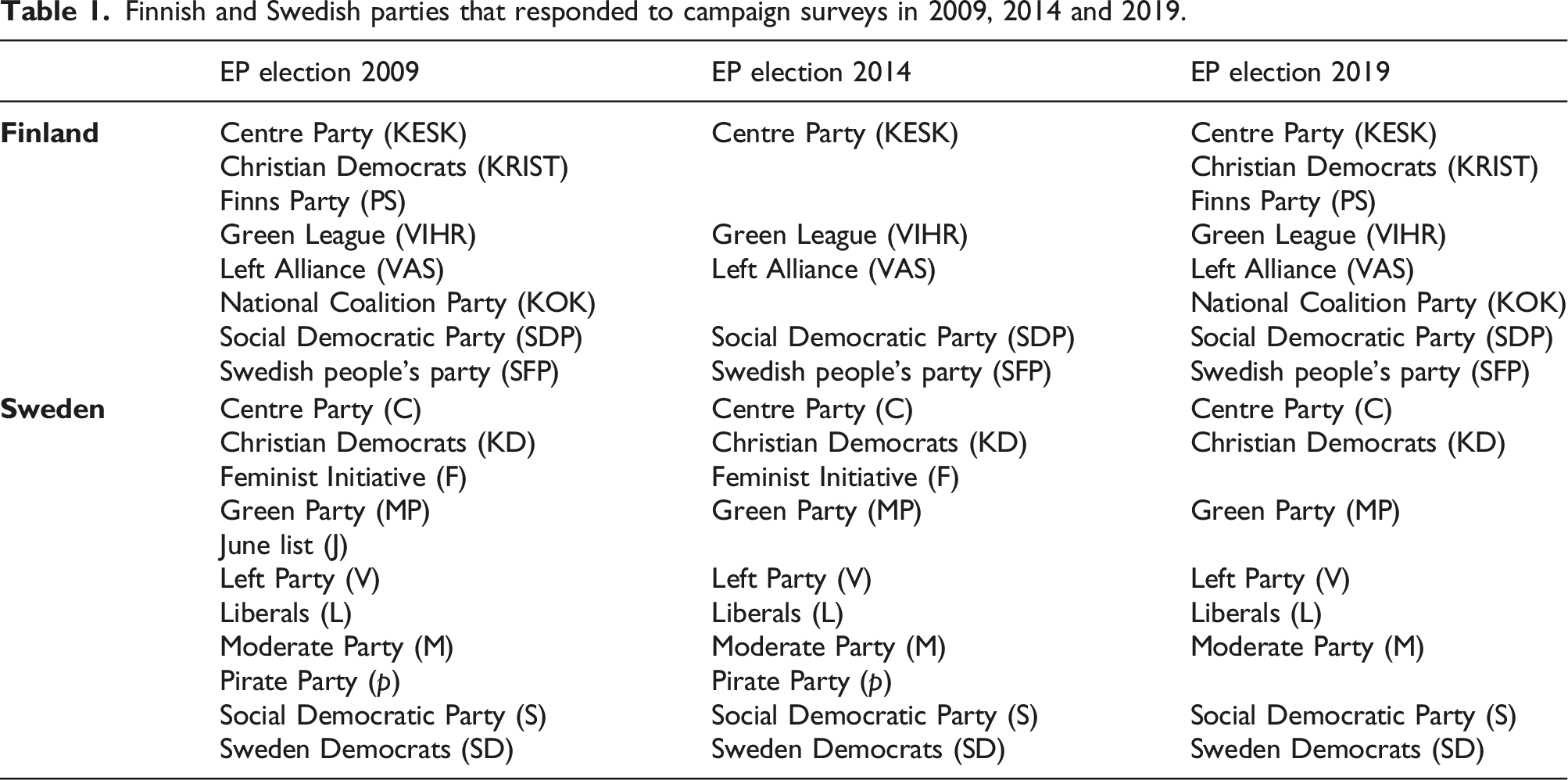
The Tenscher Index consists of items probing different aspects of campaign professionalism as identified in the campaign literature over the years. As noted above, the index items are split into two groups, depending on whether they measure the structural aspects of a campaign or a campaign’s strategic choices. Campaign structure consists of eight items, campaign budget, staff size, degree of campaign centralization, use of external experts and consultants, means of intra-campaign communication, use of opinion polls and focus group research, opposition monitoring, and the duration of the campaign. The strategic side of the index contains seven indicators: target group identification, means of targeted communication, use of paid media, use of free media, relevance of talk shows, event and news management, and personalization. The measurement scales of the items vary.
Compared to earlier studies using the Tenscher Index, we slightly modified a small number of indicators to increase validity. Instead of relying on a simple subjective assessment of the campaign’s centralized nature, we subtracted the value assigned by campaign managers for the role played by individual candidates from the value they provided for the role of the national central organization. This modification was performed equally in all three data sets. Also, we decided to drop direct mailing from the variable that measures a campaign’s internal communication channels as an outdated method (even in 2009) and to use social media instead in all three data sets. In the variable measuring the relevance of free media, social media channels were included in the Internet category without any change in coding. These minor modifications reflect the changing campaign environment, and they should not be considered a measurement problem as they do not introduce any inconsistencies between the data sets.
The original item values were recoded into categories, which were then assigned raw points. As the range of the individual scales varies, with some items carrying a maximum raw score of 2 and some others 5 or even 6, the items were standardized before utilizing them in further analysis to avoid biasing the index. This was achieved using z-scores, which equalize differences in item scales and their distributions. Only after this operation were the item scales combined into an index. The z-scores have no absolute low or high end. To render the index more illustrative and easier to understand, we normalized the z-score based index to a range of 0–100.
We also decided to construct an index to reflect the party-centered theory. In other words, we scored the factors that, according to the theory, explain the use of professionalized campaign methods. Here, we relied on the selection of factors identified by Gibson and Römmele (2001) and Strömbäck (2009). This index is comprised of a party’s economic resources, ideological orientation, and vote-seeking character; the centralization of the party organization; and internal shocks, defined as electoral defeats, loss of incumbency, and change of party leader. We used party size as a proxy for resources. In addition to the practical difficulties of obtaining a reliable and comparable estimate of a party’s financial resources, in Finland and Sweden it is much easier to assess this dimension by using electoral support as a measure, as parties in both countries receive most of their liquid income as state subsidies in proportion to seats in parliament. The index is based on categorical variables, which, as with the Tenscher Index, were assigned raw scores. The raw score assigns index items different weights, and z-scores were again calculated to solve the problem. The index was normalized to a range of 0–100. The index items of both indices and their operationalization are described in detail in the Supplementary Appendix.
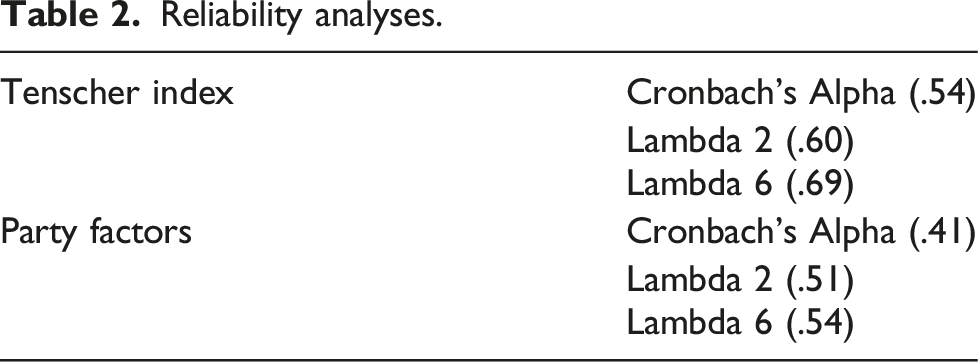
Reliability analyses.
Results: Is local context still the most important factor?
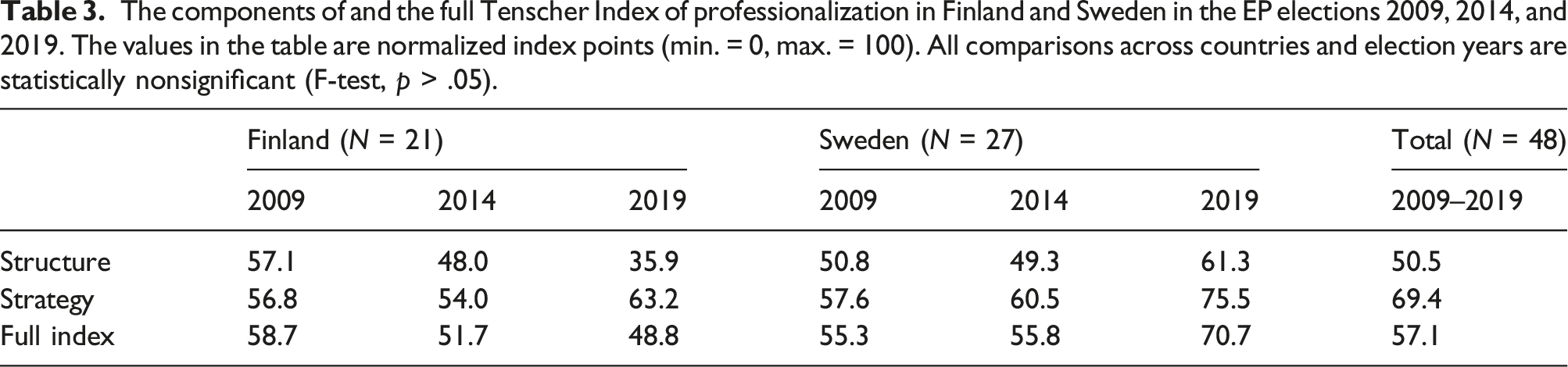
The components of and the full Tenscher Index of professionalization in Finland and Sweden in the EP elections 2009, 2014, and 2019. The values in the table are normalized index points (min. = 0, max. = 100). All comparisons across countries and election years are statistically nonsignificant (F-test, p > .05).
Parametric (Pearson) and non-parametric (Kendall’s Tau and Spearman’s Rho) correlations between the Tenscher Index of professionalization and the index for party factors predicting campaign professionalism.

*p ≤.05.
Our primary hypothesis states that campaign professionalism can best be explained by factors that are directly linked to a party’s internal affairs, its character as a party, and its success and failure in electoral competition and governing. As can be seen above, when these factors are measured and compared against the Tenscher Index of campaign professionalism, we see only moderate but statistically significant correlations. However, the strength of association remains on the 0.2–0.3 level, which leaves the greater part of the variance unaccounted for and lends rather weak support to the party-centered theory of campaign professionalism. What is more, when we split the data set into two parts, the positive correlation almost disappeared in Finland. In Sweden, however, the correlation coefficients were larger and ranged from 0.36 up to 0.51 (p ≤ .01). We will return to this in our concluding discussion but let us first examine the data as a whole.
Our previous studies have also produced mixed results. For example, in a study based on data from four European countries (28 campaigns in the 2009 EP elections), only parts of the theory were confirmed (Tenscher et al., 2012). The present study is based on a much larger pool of party campaigns (N = 48). Although quite narrow in geographical and cultural scope, there are more campaigns than in any preceding study of this type. Thus, the party-centered theory has not proved itself an undisputed theory, but we cannot reject it completely either, as some connection clearly exists between internal events within parties and the type of campaigns they run. We should also remember that the theory was tested in the context of EP elections, which are relatively comparable across countries, in contrast to more diverse national elections. In this way, we have controlled for a major contextual factor, thus making our theory testing more robust.
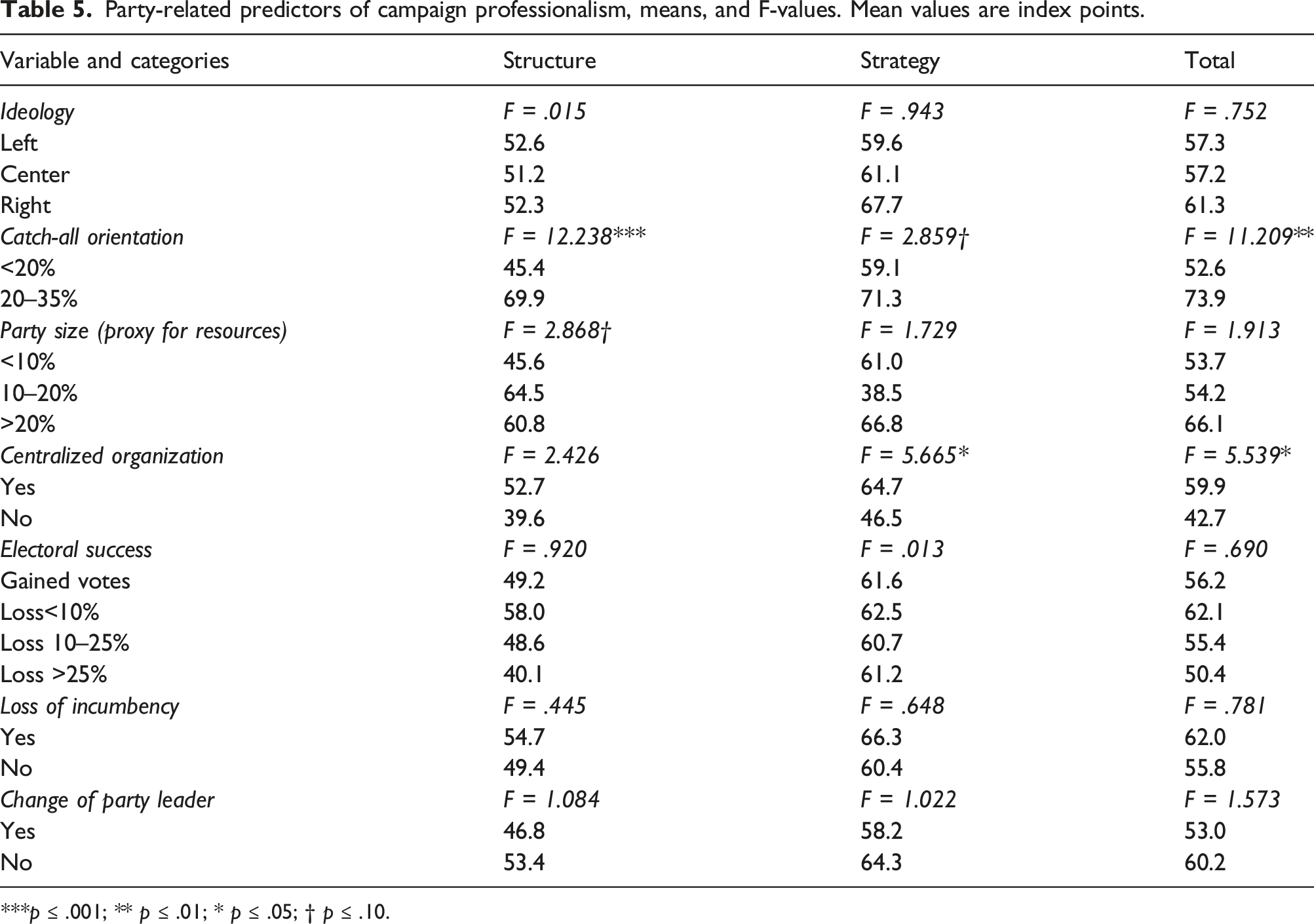
Party-related predictors of campaign professionalism, means, and F-values. Mean values are index points.
***p ≤ .001; ** p ≤ .01; * p ≤ .05; † p ≤ .10.
Overall, the index means tend to rise as expected: a right-wing ideology, catch-all orientation, large size, and centralized organization are factors that are positively associated with higher index means, as is a party’s loss of incumbency in government as a result of coalition building. However, contrary to the predictions of the theory, electoral defeat and a new party leader appear to produce the opposite result. Cuts in income may explain why electoral defeat results in a decline in the structural aspects of professional campaigning. Losing seats means losing state subsidies, which are the main source of income for parties in Finland and Sweden. As already noted, parties receive state subsidies according to the number of seats they hold in parliament.
Although the variables of the party-centered theory behave empirically as expected, only three out of seven indicators exert any statistically significant effect on professionalism. Remember that the correlation between the indices was 0.3 at best, which is already an indication of problems in terms of a linear explanation. Furthermore, the proxy measurement of resources comes very close to our measurement of a catch-all orientation. Thus, it seems that a centralized culture and large support base are the basic direct predictors of campaign professionalism. Here, as before, we find that the theory applies more accurately to Sweden, where all three variables performed as the theory predicts (country comparisons not shown). As stated above, this is expected because parties play a more pronounced role in the Swedish electoral system. In Finland, only a catch-all orientation exerts any statistically significant effect (if a .10 level of probability is acceptable). Moreover, the catch-all orientation is by far the strongest variable. Finally, our measure is based on a party’s share of the vote in the previous parliamentary election, which also has some bearing on the party’s resource base in the Finnish and Swedish contexts.
Conclusion: Revision rather than rejection
The main objective of this article was to examine whether the party-centered theory of campaign professionalization remains valid. 10 years after the first tests of the theory, more empirical studies have been conducted and election campaigns have developed in new directions, digitalizing their activities, and embracing social media platforms. At the same time, we have witnessed the electoral success of anti-establishment and populist parties and their use of unconventional campaign techniques. This has seriously questioned the idea of professionalism (see Davis, 2019: 69–72; Davis et al., 2020: 88; Savigny and Wring, 2009).
Besides changes in party systems and campaign cultures, the party-centered theory should respond to the challenge of finding a sufficiently large empirical data set. Thus far, the theory has rested on a rather thin empirical base. To test the theory in a robust manner, we obviously require as large a number of party campaigns as possible. Although we have not discussed this issue at length in this article, we should also consider research designs to control for the “random” effects of local campaign contexts. European parliamentary elections provide an approximation of such control, as the EU member states organize these elections in a relatively uniform manner in comparison to national elections. Further, if the theory is valid, it should work regardless of the point in time when campaigns are observed. In this article, we have attempted to consider these methodological points. The data set contains 48 party campaigns from three consecutive EP elections from two Nordic countries with multiparty systems. With this design, we hope to raise the testing of the party-centered theory to a new level.
Although our analysis confirms the general explanatory value of the party-centered theory overall, there are serious caveats in how it has been operationalized. When the party-centered theory is operationalized as an index and paired with the Tenscher index of campaign professionalism, we obtain only moderate correlations. Nevertheless, for theory testing, we maintain that a positive confirmation requires higher correlations. To assess the relative importance of the different factors of the theory, we tested the associations between each factor separately. We can confirm that party size, a centralized party organization and a party’s catch-all strategy are important predictors of campaign professionalization, most of all the catch-all strategy. Again, we must admit that most factors that should have affected the level of professionalism had no explanatory value. In short, the party-centered theory was reduced to a fraction of its original richness. We can conclude that the three significant explanatory factors still describe a traditional professional electoral party that positions itself at the center and aims to maximize support, but the weakness of the main part of the theory reflect recent changes in party systems, with radical niche parties as the main contenders and deviations from the previously established professional blueprint.
Putting these observations into their Nordic contexts, the importance of party size can be further elaborated. In Finland and Sweden, bigger parties enjoy larger campaign budgets, as state subsidies are based on the proportion of seats in parliament. Thus, party size and resources amalgamate into a single variable. This also explains why electoral defeats may work in the opposite direction and lead to less professionalized campaigning. This was indicated in our analysis, although with weak statistical significance. In this context, size also implies a catch-all orientation in a mutually strengthening cycle.
Our main interest was not to examine differences between countries, but the striking distinction between Finland and Sweden requires some discussion. We admit that it remains somewhat unclear why the party-centered theory works better in Sweden than in Finland. One likely reason is the Swedish system of list voting. The electoral system places parties in a central position in the planning and conducting of campaigns, whereas in Finland candidates also run their own campaigns. This probably does not result in the same level of professionalism as party-driven campaigning. This is evident when we compare campaign budgets between the two countries. For example, the total party campaign budget in the Swedish EP election in 2019 was $10 M, but in Finland the total party level expenditure stood at just $3 M. Another factor to consider is the unusual character of the 2019 EP election in Sweden, where it became more of a “first-order” election: It took place only 4 months after a very complicated government formation process that resulted in a new political landscape and new party coalitions. Thus, this EP election became more of a national political test, triggering more campaign resources. These observations indicate that in the future more attention should be paid to research designs and controlling for systemic differences.
Although it is justified to say that the party-centered theory has been seriously challenged, we maintain that we do not have to discard the entire theoretical framework. Rather, more attention must be paid to how professionalization is defined, and to the obvious limits of the current operationalizations. Our study indicates that many of the variables that have been understood to define professionalization offer poor evidence. Those that still appear relevant, such as party size (including financial resource base), a centralized party structure (including centralization of campaign organization), and catch-allism (including measures of traditional methods to achieve positive media appeal) also leave too much unexplained variance for the theory to be supported comfortably.
The systematic use of new media to disseminate underdog rhetoric, make anti-establishment attacks and strike anti-political chords have shaken a political establishment that has left its flanks open to exactly this type of attack. However, for the populist newcomers to engage not only their immediate followers but also the mainstream media system in spreading the word apparently requires communication strategies with the same basic aims as in other parties, that is, to establish an agenda for political influence. We may assume that over time and with increasing financial resources, the newcomers will develop both their professionalized structures and their distinctive use of professional strategies. The trick would then be to validly redefine professionalization and to develop new operationalizations that will allow us to study these new trends more adequately. This may require a new approach that leaves the concept of professionalization behind. Then new conceptualizations will have to be developed, albeit with the same basic aim, to structurally study the features of all types of parties and other relevant social movements and their contribution to the election process.
We close this study by concluding that the party-centered theory may require more of a revision than a total rejection. The main argument is that all parties and candidates—regardless of ideology and size—seek effective campaign structures and strategies in order to achieve their goals. Nevertheless, it is likely that different parties prefer different methods, tools, and practices. Mainstream electoral parties can be expected to rely on a more rational-oriented toolbox, while populist and extremist parties are more oriented toward emotional campaign elements. An improved and updated operationalization that allows for a systematic study of party strategies should therefore pay more attention to new items in order to achieve a more appropriate measurement of various campaign strategies, including the aspects we are used to calling professional campaigning. Such new items should include the visualization aspects of campaigning, such as the use of personal images, photos, and videos on, for example, YouTube and Instagram. Emotional messages and campaign features should also be more thoroughly examined in future studies. Naturally, this would require larger data sets than those at our disposal here.
Supplemental Material
sj-pdf-1-ppq-10.1177_13540688211045260 – Supplemental Material for Ten years after: Is the party-centered theory of campaign professionalization still valid?
Supplemental Material, sj-pdf-1-ppq-10.1177_13540688211045260 for Ten years after: Is the party-centered theory of campaign professionalization still valid? by Juri Mykkänen, Lars Nord and Tom Moring in Party Politics
Footnotes
Declaration of conflicting interests
The author(s) declared no potential conflicts of interest with respect to the research, authorship, and/or publication of this article.
Funding
The author(s) received no financial support for the research, authorship, and/or publication of this article.

Notes
Supplemental material
Supplemental material for this article is available online.
Author biographies
References
Supplementary Material
Please find the following supplemental material available below.
For Open Access articles published under a Creative Commons License, all supplemental material carries the same license as the article it is associated with.
For non-Open Access articles published, all supplemental material carries a non-exclusive license, and permission requests for re-use of supplemental material or any part of supplemental material shall be sent directly to the copyright owner as specified in the copyright notice associated with the article.
