






Abstract
Politicians perceive their representative role in a variety of ways: as a delegate of their party, a delegate of voters, or a trustee who exercises their mandate independent of any external principal. Existing research finds that the tendency to adopt a specific style of representation depends on system-level institutions and individuals’ political experience and profile. The influence of the party organisational context remains little understood. This study contributes to filling this gap by examining the effects of parties’ resources and intra-party distribution of power on the prevalence of party delegates among their candidates. Drawing on data from the Comparative Candidates Survey (CCS) and the Political Party Database (PPDB) we find that party organisation shapes representation in a way that has not previously been demonstrated: parties with more resources and parties in which members have the final say in candidate selection have a higher proportion of party delegates among their candidates. This demonstrates the centrality of party organisation to representation.
Introduction
Different sources of authority or principals may guide party representatives’ attitudes and decisions, and sometimes they must choose which of these principals will orient their decision-making. Representatives may feel above all tied to their party (a party-delegate), or to their constituency voters (a voter-delegate), or they may prioritise their own judgment and independence when making decisions (a trustee). Representational roles and styles can help to explain how representatives behave in parliamentary committees and how they relate to their voters (Andeweg, 2012), for instance in terms of policy congruence (Önnudóttir, 2014). Representatives’ attitudes towards the party-delegate role, in particular, influence their willingness to ‘toe the party line’ by voting with and otherwise supporting the party when this conflicts with other incentives. This in turn has implications for the unity of parties and the quality of democracy qua party democracy (Andeweg, 2012; Converse and Pierce, 1986; Katz, 1997; Önnudóttir, 2014; Studlar and McAllister, 1996; Wessels and Giebler, 2011). In view of the centrality of parties as agents of linkage, better-understanding how representational roles of party representatives are shaped and the prevalence of these roles in parties is crucial.
Scholars have for the most-part put forth institutional and individual-level explanations for differences between parties and between representatives in their style of representation (Farrell and Scully, 2010; Strøm, 2012; Sudulich et al., 2020; Wessels and Giebler, 2011). But the effects of party attributes, and especially the characteristics of the extra-parliamentary party organisation, remain understudied (although see Önnudóttir, 2016). Parties provide elected representatives and candidates with different structures of opportunity and behavioural norms. Consequently, it can be expected that the characteristics of these organisations, in which they operate, may explain differences in their style of representation. Candidates should be affected by party-level characteristics given that, as rational actors, they seek selection and electoral success within the framework of the party organisation, but also because they are socialised within the party organisation and culture. Party characteristics should have a particular bearing on the propensity to be a party-delegate because, intuitively, the characteristics of a principal can have an important bearing on the likelihood of becoming an agent of that principal (Önnudóttir, 2016: 734).
In this study, we focus on two aspects of the party organisation: party strength (resources) and intra-party power relations. First, we hypothesise that in resource-rich parties the proportion of party-delegates is higher. We examine two forms of resources: party income and party membership. Second, regarding intra-party power relations, we expect that parties in which party members have more formal rights will have higher proportions of party-delegates. We distinguish between two aspects of intra-party power relations: first, members’ power to decide the nomination of candidates; second, the degree of members’ power within the broader party structure.
Empirically, we examine the relationship between party attributes and the prevalence of party-delegates among party candidates in 60 parties, by combining data from the Comparative Candidates Survey (CCS) and the Political Party Database (PPDB). We find that party resources and the role of members in nominating candidates is associated with a higher prevalence of the party-delegate style, although the degree of intra-party democracy in processes other than candidate selection seems negatively associated with the prevalence of party-delegates. These findings contribute to debates in the literature on party organisation and representational styles, in addition to providing a better understanding of the role of party organisation in shaping behavioural norms of representation.
The paper proceeds in four sections. The first section reviews the existing literature and formulates the hypotheses. The second section presents the dataset and describes how we operationalise the main variables. The third section reports the analysis and the main results. A final section draws some general conclusions, underlining the importance of party organisation for the study of styles of representation.
Theoretical framework
Representational roles
Representational roles refer to the way in which representatives conceive of their role in the democratic system (Önnudóttir and von Schoultz, 2021). It is an attitudinal concept, relating most directly to the general set of values representatives hold and their socialisation to norms. Since the seminal work of Eulau et al. (1959), the literature has mainly discussed two aspects of representational roles (Blomgren and Rozenberg, 2012; Esaiasson, 2000; Eulau and Karps, 1977; Wahlke et al., 1962): first, the focus of representation, referring to the group(s) in society the representative considers herself to represent (e.g. her constituency, the nation as a whole, or specific groups of voters); and second, the style of representation: ‘what criterion the representative ought to use when making decisions’ (Önnudóttir and von Schoultz, 2021: 122). Three styles of representation are usually distinguished according to the ‘source’ or ‘principal’ that guides the representative’s decision (Converse and Pierce, 1986): the party-delegate style, in which representatives believe above all in following their party’s line, the voter-delegate style, according to which representatives follow their (constituency) voters’ preferences, and the trustee style, following which representatives take their decisions independently, without reference to any external principal. An additional category of ‘politicos’ describes those who alternate between a trustee and a delegate style depending on the context (Wahlke et al., 1962) or whose choices do not clearly indicate a predominant style. Styles of representation have implications for the focus of representation: party-delegates believe that they primarily represent their party, which may in turn represent certain groups of voters; voter-delegates represent their constituency voters; and trustees are more inclined to conceive of themselves as representatives of the national interest.
In this study, we focus on styles of representation, and being a party-delegate (rather than a voter-delegate, a trustee, or a politico) in particular. The party-delegate style of representation is important, as it underpins central assumptions of the Responsible Party Model (Pierce, 1999).
It is separate from, but has direct implications for representatives’ behaviour (Andeweg, 2012) - including voting behaviour during plenary sessions (see e.g. Carey and Shugart, 1995 and (Shomer, 2009; Shomer, 2016) for studies of MPs’ behaviour and their determinants). The concept of party ‘loyalty’ has also been used in the literature addressing the issues of party cohesion and/or party discipline (Andeweg and Thomassen, 2011; Close and Gherghina, 2019). However, the concept of ‘loyalty’ can be confusing: it is sometimes used to refer to representatives’ attitudes towards their party, sometimes to their (voting) behaviour (for a broader discussion, see Close and Gherghina 2019). In this contribution, we clearly want to address representatives’ attitudes towards their party, by relying on theoretical concepts developed in the field of representation studies. We believe that the representation literature offers the best theoretical framework to analyse these attitudes, as it allows to reflect upon the role of both values and interests in shaping attitudes towards representation.
Empirically, we will examine the influence of party attributes on the percentage of candidates in each party adopting the party-delegate style; thus, we examine party-delegate outcomes at party level. This party-level approach follows Önnudóttir (2016: 734) who argues that the collective, party level is vital to representation. The contention that the mode of representation at party level matters is also complemented by the party organisation literature in which organisational types are associated with different representational styles (e.g. Katz and Mair, 1995).
Explaining the styles of representation
Two trends can be discerned among the scientific works dedicated to explaining representational styles. The first of these trends is theoretical. Two theoretical perspectives have dominated the literature, and have sometimes been combined: approaches rooted in rational choice theories have conceived of representational roles as strategic responses to specific incentives (Searing, 1994; Strøm, 1997), while representational roles have also been conceived of as ‘habits of the heart’ resulting from socialisation processes (Zittel, 2012). The second trend is empirical: most attention has been devoted to macro-level and micro-level determinants of representational roles, with less attention directed towards the influence of the meso- or party-level factors.
By conceiving of candidates and legislators as mainly driven by their prospects of (re)election (Mayhew, 1974), rational choice approaches have found that systems in which the election of individuals depends more on party reputation than on their personal reputation (Carey and Shugart, 1995) produce more representatives who consider themselves party-delegates. In this regard, two variables have been examined: first, district magnitude, with larger districts associated with party-centred systems and smaller or single-member district systems associated with an emphasis on candidates’ personal reputations (Farrell and Scully, 2010; Önnudóttir & von Schoultz, 2021; Pilet et al., 2012); and second, the degree of openness of the ballot, distinguishing between systems allowing preferential voting and closed-list systems, with the latter encouraging a party-delegate style (Önnudóttir & von Schoultz, 2021; Wessels and Giebler, 2011). Individuals’ perceptions of their chances of winning their district (Zittel, 2012) or being elected (Wessels and Giebler, 2011) have also been examined; findings suggest that secure candidates are less in hock to their party.
Previous studies have also highlighted the explanatory role of individual-level determinants, mostly related to political experience within the party (e.g. duration of party membership or political experience within the organisation) and experience in local or national elected assemblies (Önnudóttir, 2016; Önnudóttir and von Schoultz, 2021; Sudulich et al., 2020; Wessels and Giebler, 2011; Zittel, 2012). Experience increases individuals’ tendency to adopt a party-delegate style as a result of socialisation within the party and public offices (Önnudóttir & von Schoultz, 2021; Önnudóttir, 2016; Sudulich et al., 2020). Socialisation effects could also be related to candidates’ and legislators’ sociodemographic traits, such as age and gender. While the effect of age is not straightforward (Kam, 2009: 199; Sudulich et al., 2020), some evidence seems to suggest that women are less likely to ‘rebel’ attitudinally against the party (Cowley and Childs, 2003; Close, 2018: 213), and consider themselves more dependent on external authorities (parties or voters) when making their decision (Önnudóttir and von Schoultz, 2021; Sudulich et al., 2020).
Existing studies that have explored the role of parties and their organisations have mostly relied on rational choice approaches and have conceived of party characteristics as institutional constraints. In this vein, a common argument is that when the selection of candidates is controlled by the party leader, candidates tend to adopt a party-delegate style (Esaiasson, 2000; Önnudóttir, 2016; Strøm, 2012; Wessels and Giebler, 2011): party leaders reward loyal members, and they strategically nominate politicians who tend to stick to the party line. Other party level variables include party size in the parliamentary arena (Gherghina, 2011) or in terms of vote share in the constituency (Wessels and Giebler, 2011: 12) and government incumbency (Önnudóttir, 2016; Sudulich et al., 2020), but the findings in respect of these variables are quite inconsistent across studies.
Building on socialisation approaches, some scholars have considered party ideology or party family. However, the findings are limited, and the theory is quite underdeveloped. According to some accounts, parties of the right should be more likely to have a higher number of trustees, while parties of the left should have more ‘partisans’ or party-delegates (Andeweg, 1997; Önnudóttir, 2016; Wessels and Giebler, 2011). Damgaard’s (1997) and Heidar’s (1997) studies slightly nuance this left-right divide by uncovering party differences that might be related to parties’ culture or ideology. Showing that party-delegates dominate both the two main parties in Norway, Heidar (1997: 106) further argues that the party is probably no longer as central in shaping representational roles as the Duvergerian tradition suggests. Sudulich et al. (2020) and Önnudóttir and von Schoulz (2021) find that Green party candidates are more likely than other candidates to consider themselves trustees, and thus less likely to consider themselves as being subject to an outside authority (party or voter); they also find this to be the case for Liberal parties’ candidates. Close (2018) argues that party family differences are due to different ‘norms’ of party solidarity, and different sets of values (e.g. individualism vs. authoritarianism) embodied in the parties’ ideologies, but also in their organisational structure and ‘culture’. Nevertheless, these analyses do not distinguish between two correlates of party family: ideology and organisation. In this contribution, we aim to contribute to better understand the role of organisational characteristics in shaping candidates’ attitudes.
Political parties and styles of representation: hypotheses
Our first hypothesis relates to a party’s organisational strength, with an emphasis on financial or human resources that it can deploy in support of its candidates. The idea that party organisational strength influences representational styles has its roots in the seminal works of Converse and Pierce (1986) and of Wahlke et al. (1962), which suggested that the difference between the dominant trustee style of representation in the US presidential system and the dominant party-delegate style of European parliamentary party-based systems result from the weakness of party organisations in the US compared to their relative strength in Europe. Yet, this organisational weakness has been inadequately operationalized in further studies on representational styles; at best, scholars have used proxies such as party size and incumbency in executive office (see above).
Some research on party unity adopts a more varied and organisation-focused operationalisation of party strength. Little and Farrell (2017) investigate the influence of party strength on legislative party unity, and they measure party strength through party income and membership (both relative to the size of the electorate), as well as government incumbency and party size in parliament. In her study of parties’ legislative voting unity in post-Communist countries, Tavits (2012) demonstrates a positive relationship between party strength (operationalised as membership, local organisational strength, and electoral strength) and legislative unity. Although she does not consider party income as a measure as such of organisational strength, her statistical models control for party budget (as a percentage of the country’s GDP) and uncover a positive relationship with party unity.
The line of argument concerning party organisational strength that is pursued by Tavits (2012) and Little and Farrell (2017) provides the basis for our first hypothesis. Party strength in the form of resources is relevant in the sense described above, which is consistent with the rational choice perspective: party resources provide incentives for representatives to be more party-oriented in their attitudes, as a well-resourced party has greater potential to help them to achieve their goals, and to hinder them by withholding resources. We consider two types of organisational resources – financial (party income) and human (party membership) – combining them into a single measure of organisational strength (details below).
H1: The greater is the party’s resource-strength, the higher the proportion of party-delegates.
Our second set of hypotheses aims to test how intra-party power relations can shape the prevalence of the party-delegate style. Existing research focuses on the effect of candidate selection in terms of (de)centralisation. The argument is mostly rooted in a rational choice perspective and identifies party discipline as the core mechanism: when the nomination of candidates rests in the hands of the leadership (a centralised or exclusive process), candidates comply with the party line and adopt a party-delegate style since being loyal to the party (leader) would be a rewarding strategy for MPs seeking re-selection (Esaiasson, 2000; Önnudóttir, 2016). Also from a rational choice point of view, leaders who can control the selection procedures are expected to be more likely to nominate candidates who value party loyalty (Sieberer, 2006). They could also use more centralised procedures as punitive means to discipline the party (Ceron, 2016). These arguments, however, concern the legislators’ behaviour responding rationally to organisational incentives and produce inconclusive results when the questions of attitudes and role perception are introduced (e.g. Close et al., 2019). We could however assume that the introduction of stronger party discipline will not only have the direct effect of changing representatives’ behaviour but will also contribute to diffusing a culture that is more likely to shape their attitudes towards the party. Hence, a ‘centralisation’ hypothesis can be formulated as following:
H2: If the party leader has the final say in the selection of candidates, then the proportion of party-delegates is higher.
Yet, the argument proposed by Gauja (2012) provides another interpretation of this phenomenon at work. She suggests that the party’s organisational culture, resulting from the party’s origin, shapes the way members of the parliamentary party relate to the rest of the party organisation. Hence, grassroots parties born outside of parliament would have developed an organisation in which the parliamentary party is seen as the delegate of the members and the wider organisational structure, resulting in a party-delegate style of representation. By contrast, parties formed in parliament would tend to contain more trustees, as the organisation puts a greater emphasis on ‘the independence of parliamentarians in their organisational ethos’ (Gauja, 2012: 122). This echoes this idea that mass parties would embody a much stronger orientation by representatives towards their large number of extra-parliamentary members and their somewhat homogenous voters (Katz and Mair, 1995).
We extend this line of reasoning, although we do not conceptualise intra-party culture by referring to ‘types’ of party organisation. Rather, we rely on indicators of the degree of membership-orientation of party organisations, understood as the extent of grassroots influence on party activities and decision-making. We aim to measure party members’ influence within the organisation by delineating their role in candidate selection processes, which should directly affect candidates (hypothesis 3), and their role in the broader intra-party structure, which may have a less direct effect (hypothesis 4).
We argue in hypothesis 3 and 4 that power accorded to members within the organisation will grant the party-on-the-ground more controlling prerogatives over the activities of party representatives, and stronger norms of representatives being accountable to the membership and, thus, the party. We first examine the effect of members’ power to select candidates on the proportion of party-delegates within parties. This ‘decentralisation’ hypothesis states that where the selection of candidates rests ultimately in the hands of party members, parties will have more party-delegates as a result of rational incentives that this presents to candidates, but also because of the organisational culture with which it is associated. This runs contrary to the conventional argument that party leaders, rather than members, select party-delegates, and therefore is in tension with hypothesis 2. What both leader-centred and membership-centred forms of organisation are likely to have in common, however, is a stronger culture of the party compared to parties in which other faces of the party organisation have the final say, which in turns shapes attitudes towards representation.
H3: If party members have the final say in the selection of candidates, then the proportion of party-delegates is higher.
Second, we consider in the same vein the power of party members in the broader party structure, excluding their role in candidate selection. We understand ‘grassroots influence’ in the sense of the assembly-based type of intra-party democracy (Poguntke et al., 2016; von dem Berge and Poguntke, 2017), which allows members to participate (directly or via delegates) within the organisation at different stages of the processes. From a sociological point of view, candidates’ conception of their representational roles in internally democratic parties will reflect the internalisation of the norm of party solidarity. As a result, MPs and candidates in membership-oriented organisations are more likely to identify primarily as a delegate of the broader party organisation. Hence, we expect that:
H4: The more democratic are intra-party structures, the higher the proportion of party-delegates.
Data and methodology
Data sources
To test these hypotheses, we rely on an overlapping sample from two cross-national projects: the Comparative Candidates Survey 16 and the PPDB 1 (Poguntke et al., 2016). Our dataset includes 5825 candidates in 11 national parliamentary elections that took place between 2013 and 2017 (see Table 2 in the Appendix for details). In total, 70 parties are covered by our analyses, although there is some missing data for a few parties (detailed below), which reduces the number of parties to 60 in the final models. Each party includes between 13 and 275 respondents (candidates), with a median of 60.5 respondents per party.
Measuring candidates’ style of representation
As outlined above, three styles of representation have been extensively discussed in the literature: the trustee style, the party-delegate style, and the voter-delegate style. These styles have often been measured empirically using survey items that ask legislators or candidates about how they should vote in case of a difference between their own opinion, that of their party, and that of the voters. The voters’ opinion is the most difficult to apprehend, and may refer to the parties’ voters or to the candidate’s constituency voters. Similarly, we use three questions from the CCS, each implying a choice between two ‘principals’:
D4. How should a Member of Parliament vote in parliament? D4a: If the voters in his/her constituency have one opinion and his/her party takes a different opinion 1 = According to party’s opinion 2 = According to voters’ opinion D4b: If his/her own opinion on an issue does not correspond with the opinion of the voters in his/her constituency 1 = According to own opinion 2 = According to voters’ opinion D4c: If his/her own opinion on an issue differ from the party’s opinion? 1 = According to own opinion 2 = According to party’s opinion
Four categories of candidate can be distinguished empirically: party-delegates (candidates choosing the party in items D4a and D4c), trustees (candidates choosing their own opinion in items D4b and D4c), voter-delegates (candidates choosing his/her voters in items D4a and D4b), and candidates who do not consistently choose one principal when presented with it as part of different combinations (the politicos). The distribution of candidates across these categories is as follows: 1808 (31%) respondents can be categorized as party-delegates, 1315 (22.5%) as voter-delegates, 2235 (38.5%) as trustees and 467 (8%) as being part of the politico category. While each category represents a substantial proportion of the candidates in the sample, the size of the politicos category also suggests that most respondents have rather clear preferences and opinions about the style of representation they want to apply. This distribution is in line with previous studies (Önnudóttir, 2016; Wessels and Giebler, 2011)
In the analysis, we test our hypotheses by examining variation in the percentage of party-delegates by party, following the approach of Önnudottir (2016). While existing analyses often examine individual-level variations, party-level variations have somehow been overlooked. Our analysis precisely makes a contribution by analysing variations across parties and party “types” (in terms of organisation, family, size etc.). This party-level focus allows to consider each party as equal to another – unsensitive to the number of respondents by party.
The percentage of party-delegates by party varies from a minimum of 4.3% (ANEL in Greece) to a maximum of 77.8% (the radical right SD in Sweden), with an average of 28.9% and a median at 25.3% (see Table 2 in the Appendix for details by party and for a list of all party acronyms). There is considerable variation by country, with the median Norwegian and Swedish parties having the highest proportions of party-delegates (>40%), followed by Belgium and Italy (>30%), and then by other countries (<25%). There is also some variation by party family, with the median Green parties and Liberal parties (<20%) having lower proportions of party-delegates than other party families.
Party strength: financial resources and party membership
Two types of intra-party resources are considered in relation with the first hypothesis, from which a measure of party organisational strength is derived using factor analysis. Party income is expressed in (or converted to) Euro. We standardize it by the size of the country’s electorate (thus, income per member of the electorate), then by the national economy (income per member of the electorate as a proportion of GDP) (Poguntke et al., 2016; van Biezen and Kopecky, 2015: 5). This variable ranges from a minimum of 0.0000917 (i.e. the German AfD) to a maximum of 0.058 (i.e. the radical right Norwegian Progress Party), with an average of 0.004 and a standard deviation of 0.008. Data is missing for three parties. 2
The second intra-party resource, party membership, is measured through the use of the Membership/Electorate (M/E) ratio has the merit of showing the proportion of the electorate that are members of a party in a given system. This indicator also makes it possible to compare membership rates between parties in the same country over time and in different countries (Kölln, 2014: 76; Mair and Van Biezen, 2001; Van Haute and Gauja, 2015). The variable ranges from 0.0000971 (the Hungarian Greens, LMP) to 0.031 (Belgian PS). 3 High scores are found mainly in former mass parties – such as the Norwegian Labour Party, the Swedish Social Democrats or the Flemish Christian Democrats (CD&V). Note that data is missing for seven parties. 4
These two variables do not follow a normal distribution: they are in fact highly skewed. We will therefore use their log in the regression models. Note that when we log the two variables and then examine their correlation, the correlation at the party level is around 0.49 (p-value < .001). One way to deal with this collinearity 5 is to reduce the information to one dimension. For that purpose, we use a factor analysis that results in one component 6 (eigenvalue = 1.49), accounting for about 75% of the variation. Cronbach’s alpha (0.66) indicates that this scale is quite reliable. In the analysis, we will use this party strength component to account for both resources at the same time.
Intra-party power: candidate selection and intra-party democratic structure
In order to test H2 and H3, we use a categorical variable identifying the ultimate selectorate in parties’ candidate selection process, according to formal rules in party statutes. The PPDB data identifies which part of the party has the final say in deciding or approving the final list of candidates. The data allows us to identify four categories: the party members or local organisations (18 parties), the regional or national party organisation (42 parties), the party leader (6 parties) and a mixture of local party/members and party organisation (10 parties) 7 .
In order to test H4, we use the ‘organisational structure’ component of the assembly-based intra-party democracy measure drawn from the PPDB database and developed by Poguntke et al. (Poguntke et al., 2016; von dem Berge and Poguntke, 2017). The organisational structure component index synthesises the involvement of members in the life of the party independently from their involvement during personnel selection processes (including candidate selection). It covers the question of the frequency of congresses, the people entitled to vote at them, the composition of the party’s executive bodies and their voting rights. The index can range from 0 (no internal democracy) to 1 (high internal democracy). In our dataset, the index ranges from 0.375 (National Liberal Party in Romania) to 0.91 (Green Party of England and Wales), with a mean value of 0.66. 8 The index is normally distributed. 9
Control variables
Based on previous research (see above), we control for party size 10 (percentage of seats in parliament), status of the party in opposition (coded 0: 45 parties) or in government (coded 1: 25 parties), and we also include party age in years (min. 1, max.176, mean 52.6), given that a party’s level of resources could be related to its access to power and level of institutionalisation. We then control for party family, in order to control for a potential ‘ideological’ effect. We distinguish seven categories: Radical Left (6 parties), Social Democrats (12), Green (7), Liberals (14), Christian Democrats/Conservatives (19), Radical Right (8) and an ‘Other’ category (4), including mostly (ethno)regionalist parties but also parties like the Pirate Party in Germany.
At the system level, we first control for the type of electoral system. We consider the type of formula (party list proportional or single-member plurality system) and, for list systems, the openness of the ballot (i.e. whether voters can cast preferences for individual candidates and/or alter the order of the list). We employ four categories, from the most party-centred to the most candidate-centred: closed-list systems (Norway, Romania, Italy 11 ), (semi)open list systems (Belgium, the Czech Republic, Greece, Finland, Sweden), mixed systems (Germany and Hungary) and single-member plurality (United Kingdom). A second system-level control variable relates to the age of the democratic system, as younger democracies can display more political instability, resulting for instance in more frequent party switching (Klein, 2021). We use a simple dichotomous variable distinguishing between ‘young’ (i.e. Czech Republic, Greece, Hungary, Romania) and ‘old’ democracies. 12
Given that the literature has found effects of party and career socialisation on the tendency of (elected) candidates to adopt a party-delegate style, we should also take into account these factors. However, there is missing data across the dataset regarding candidates’ previous experience at national and local levels (in party or in political office), as well as regarding length of membership. For each set of these variables, data was missing for one, two or even three countries – which then affected substantially the sample size. We nevertheless provide robustness checks in the Appendix (see Table 3), by testing the effects of two variables: average membership length of the party’s candidates, and average previous experience of the party’s candidates in local politics. Including these controls does not alter the findings.
Analysis and findings
Proportion of party-delegates and party characteristics - linear regression models (OLS).
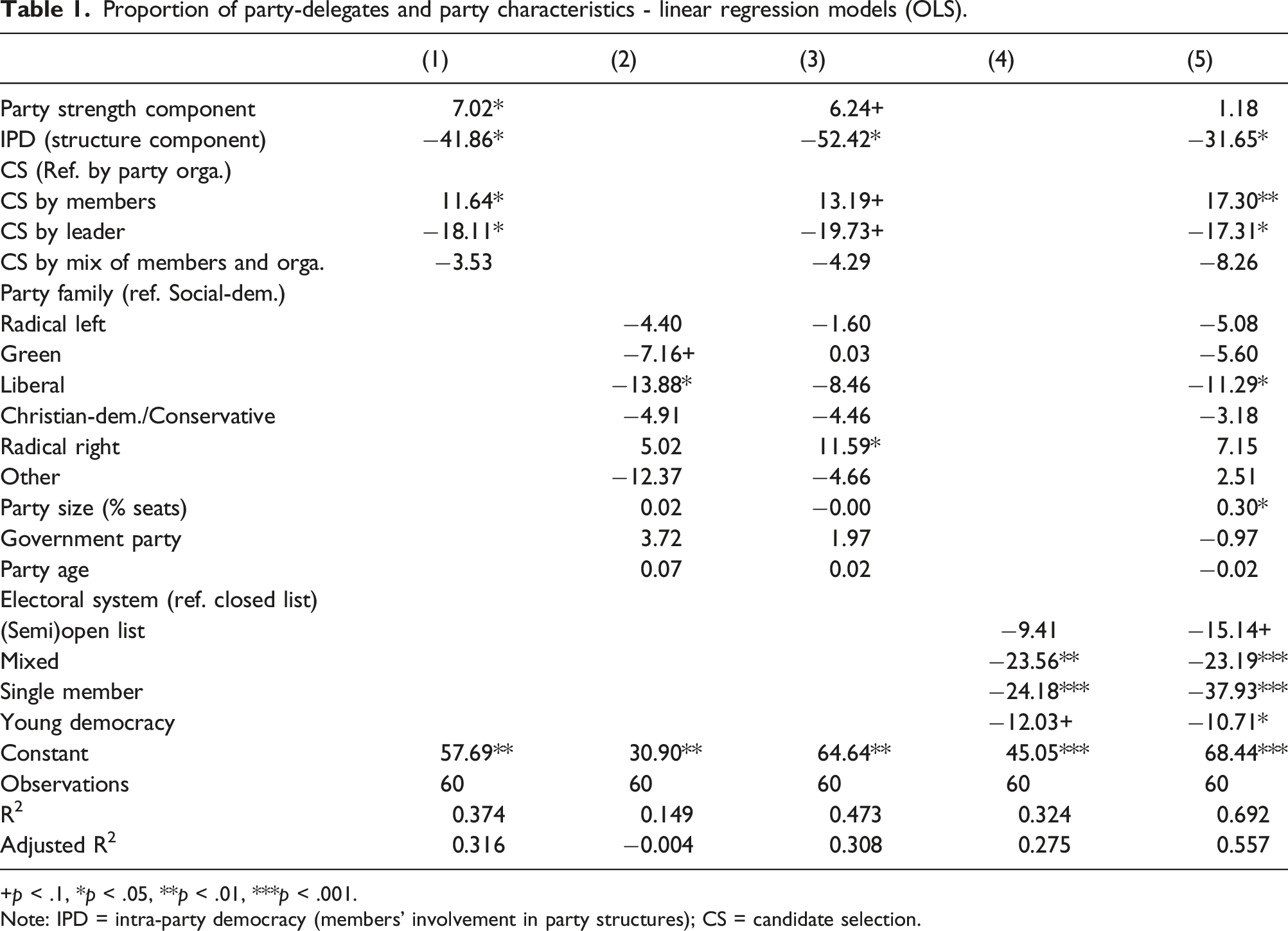
+p < .1, *p < .05, **p < .01, ***p < .001.
Note: IPD = intra-party democracy (members’ involvement in party structures); CS = candidate selection.
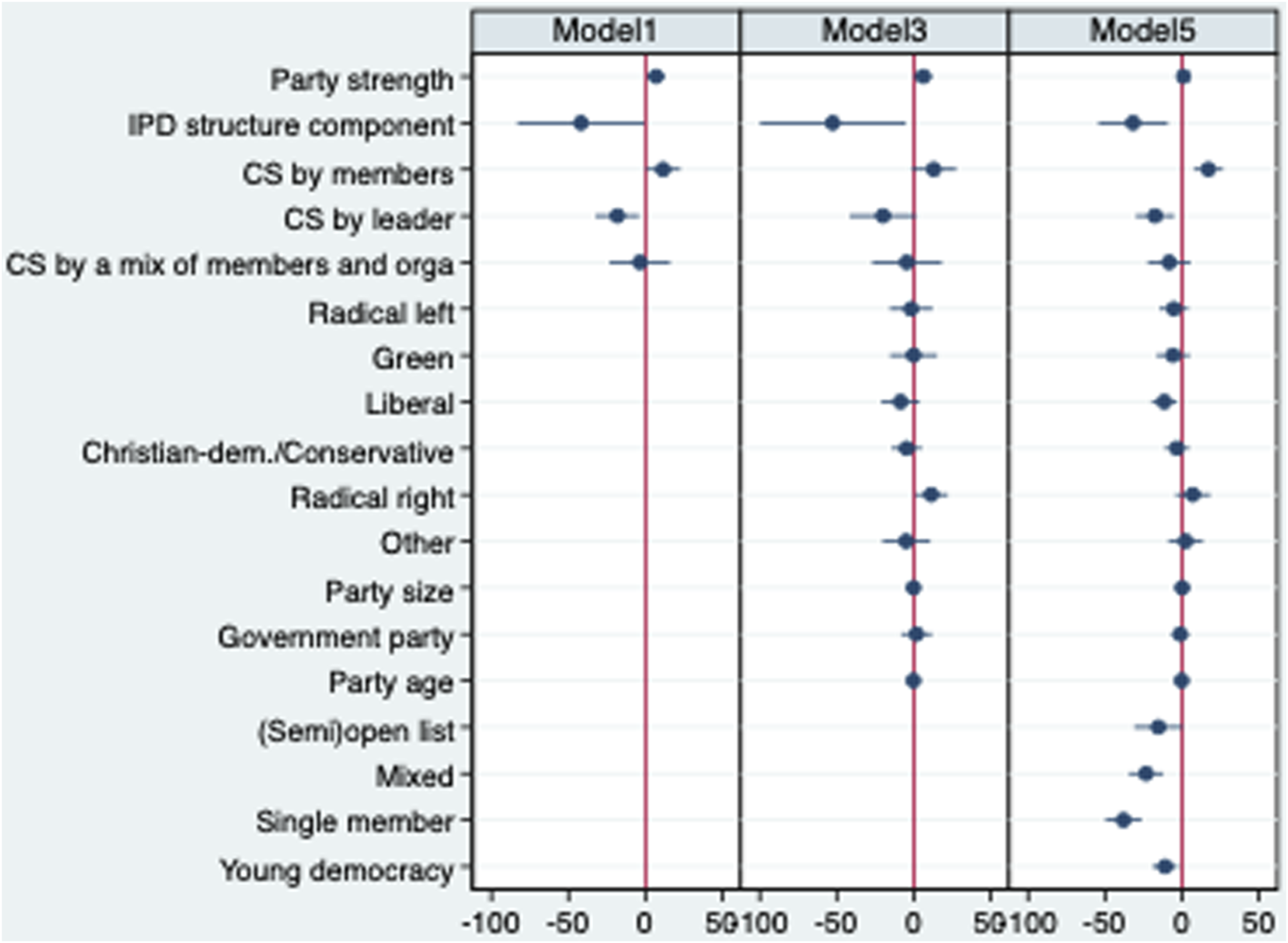
Predicting the proportion of party-delegates - point estimates and confidence intervals Note: IPD = Intra-party democracy (members’ involvement in party structures); CS = Candidate selection.
Regarding our hypotheses, H1 seems confirmed: the greater the party’s level of resources, the higher the proportion of party-delegates within the party. The coefficient remains positive across the models – although it declines in size and the relationship loses statistical significance in the full model. This is explained by its correlation with party size
14
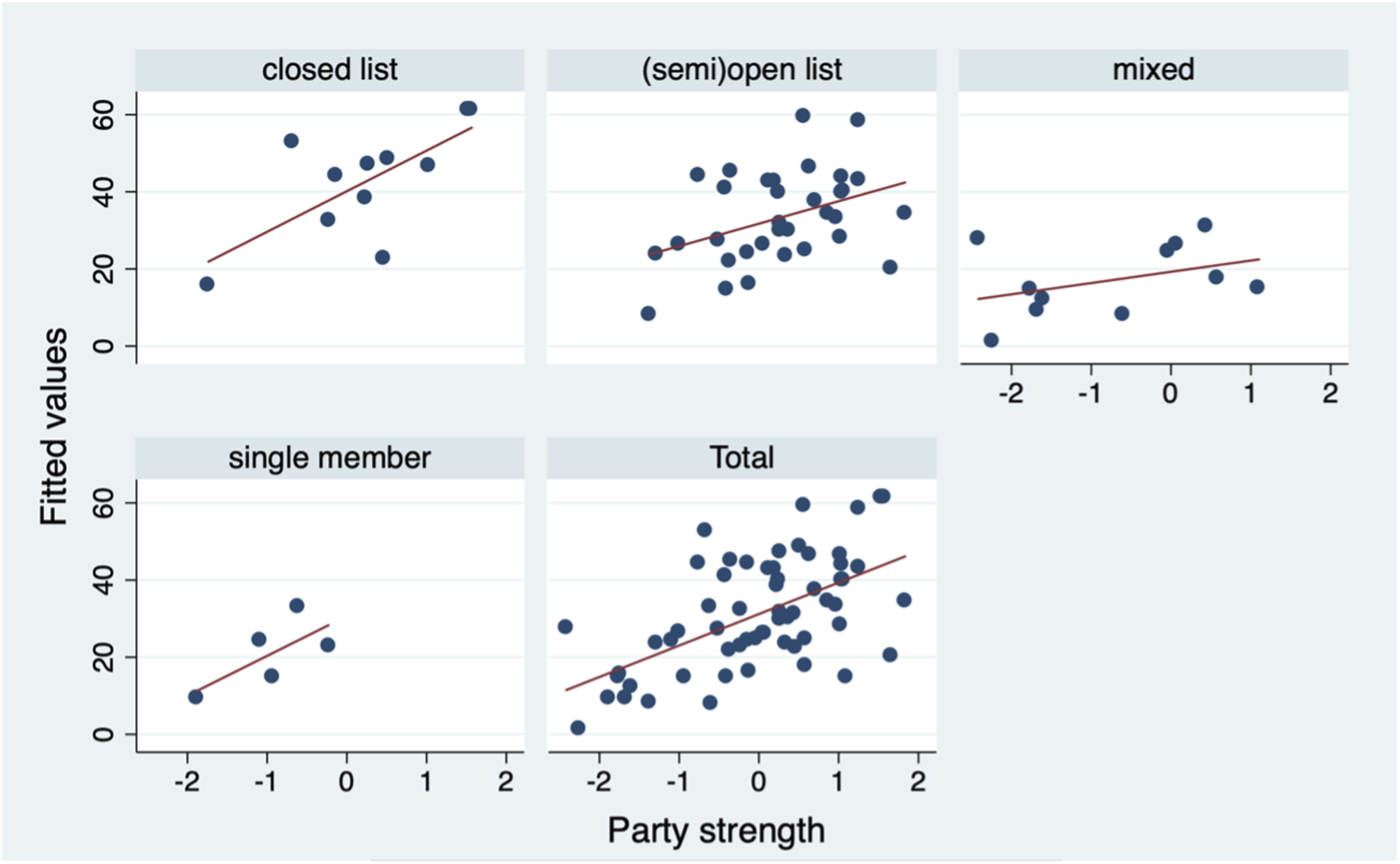
but also with the type of electoral system: party strength is significantly higher in party-list system than in mixed and single-member plurality systems. This is illustrated by Figures 2(a) and (b), which draw the predicted values of the proportion of the party-delegates across the values of party strength, both before (Figure 2(a)) and after (Figure 2(b)) controlling for system-level characteristics. One way to further examine this issue is to graph the predicted values for the party-delegate style (calculated on the basis of Model 5) and party strength across the types of electoral system, all other variables kept constant (see Figure 3). The positive relationship between party strength and the party-delegate style holds across the different contexts – although it is slightly less strong in (semi)open list systems and mixed systems than in closed-list and single-member plurality contexts. This positive relationship also holds whatever the type of democracy (young or old), and in most countries (see Appendix, Figures 4 and 5). Thus, the relationship between party organisational strength and attitudes to representation echoes some findings on party strength and voting unity (e.g. Tavits, 2012), which emphasise the rational calculations of representatives and parties. Predicted values of party-delegate and party strength – (a). Model 3, (b). Model 5. Note: all other variables at their means. Predicted values for the party-delegate style and party strength, by type of electoral system.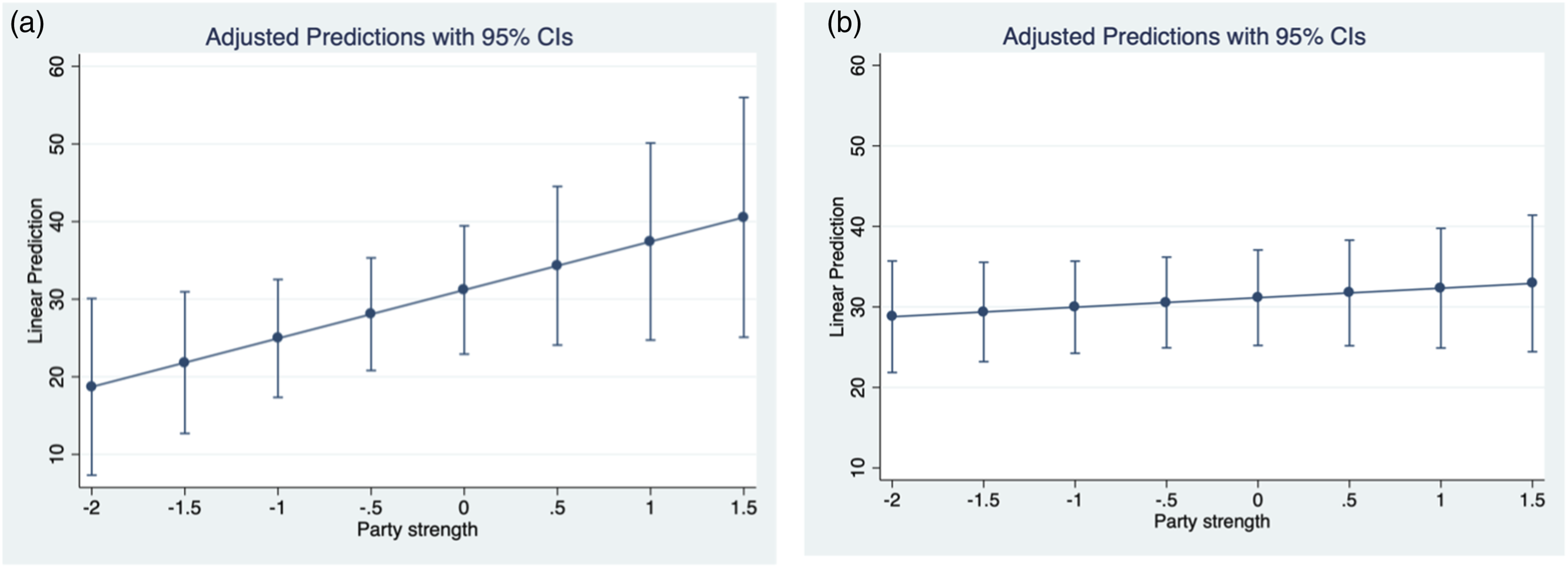
Regarding the effect of intra-party power relations, the analysis confirms our expectations in H3: the proportion of party-delegates among candidates is higher in parties that give members the final say in candidate selection. By contrast, when party leaders are in charge, the proportion of party-delegates is lower, leading us to reject H2. In terms of linear prediction (based on Model 5, all other variables at their means), the party-delegate variable takes the value of 46.2% when party members decide, compared to 28.9% when the party organisation decides, and 11.6% when the leader has the final word17. Hence, our analyses of the formal power of intra-party actors bring a different perspective to the conventional wisdom that party leaders select party-delegates.
However, our argument does not hold when considering grassroots influence within the wider party structure beyond candidate selection (congresses, decisional bodies, etc.) (H4). Indeed, contrary to our hypothesis, the effect is consistently negative across the main models; more (less) intra-party democracy is associated with a lower (higher) proportion of party delegates. However, additional analyses suggest that the sign of this effect is not constant across institutional contexts (electoral system, age of democracy, countries), as shown in figures 6 and 7 in appendix. Overall, the findings indicate that while the degree of intra-party democracy of the candidate selection matters, the degree of intra-party democracy of party structure (excluding candidate selection procedure) has no clear effect on the proportion of party-delegates.
At the macro level, the effect of age of democracy and of the type of electoral system is consistent with previous research: parties in older democracies have proportionally more party-delegates than parties in younger democracies; parties in more party-centred systems have more party-delegates than parties in more candidate-centred systems. Regarding the effect of party family, the sign of the coefficients indicates that the Social Democratic family (reference category) is associated with having more party-delegates than Radical Left, Green, Liberal and Conservative parties, although the statistical significance of these differences varies across the models; this is consistent with their identification as archetypally – or at least by their origins – a mass party (Katz and Mair, 1995). Once organisational characteristics are taken into account, party family differences are less striking. Party age and government participation do not appear to be crucial explanations of variation in the prevalence of party-delegates, but party size, which has previously been included in the concept of party strength (e.g. Little and Farrell, 2017) becomes positive and significant in the full model (model 5), consistent with a broader conception of party strength.
Finally, examining the goodness of fit of the models, one of the most striking findings is the relatively high adjusted R2 for Model 1 (including the independent variables), compared to that observed for Model 2 (other party characteristics). This is an important finding, as previous research often used party size, government status and party family as the main party-level determinants of representational styles. When introduced separately in bivariate regressions (not displayed), the party strength component has the highest predictive power (R2 = 0.231), followed by candidate selection (R2 = 0.103), while intra-party democracy structure has a weak predictive power (R2 = 0.022). Among party organisational characteristics affecting representational style, hence, party resources should be considered, along with the candidate selection process. 17
Conclusion
While existing research on representational styles has extensively studied macro-level and micro-level determinants, party-level determinants have been less often considered. Besides, when party-level variables were examined, they were often limited to measures related to the size of the party-in-public-office or membership of government, rather than focusing on party organisational attributes. Variation in representational styles have sometimes been observed across party ideologies (left vs right) or party families, but without strong theoretical foundation. By examining the potential impact of party strength (resources in the form of membership and income) and the membership-orientation of intra-party decision-making processes (in candidate selection and in the broader organisation) on the prevalence of party-delegates among parties’ candidates, this study aimed to shed light on dynamics related to the extra-parliamentary party organisation, which constitutes one of the primary arenas in which party representatives are socialised and which structures the pursuit of their goals.
The analysis revealed two major patterns. First, party organisational strength – operationalised as the level of parties’ financial and human resources – appears to be a determinant of the prevalence of the party-delegate style among their candidates across institutional contexts, echoing some findings from research on voting unity (e.g. Tavits 2012). Future studies should therefore consider organisational resource-strength as a central party-level determinant of representational style. This hypothesis rests theoretically on mechanisms that fit within the rational choice perspective: richer organisations can have more ‘power’ (also in symbolic terms, if we think about the effect of a large membership) over their individual members, and make their more compliant and attached towards the organisation. Or, richer organisations may attract a greater pool of potential candidates, allowing the organisation to be more selective – and select the most ‘loyal’ candidates. But those mechanisms should be investigated further. Second, contrary to the idea that highly centralised candidate selection procedures produce more party-delegates, our findings suggest quite the reverse. Where party members have the formal power to decide the nomination of candidates, more candidates adopt a party-delegate style of representation. In other words, where candidates are selected through inclusive candidate selection procedures, they tend to feel more attached to their party. The mechanism could also be that party members are more likely to select party-delegates, as they expect them to act as an agent of the party. This finding is consistent with our argument that candidates in membership-oriented organisations will tend to be party-delegates. However, this seems true only when considering the power of members in candidate selection processes, but not in the broader party organisation and structure. Our analysis suggests that the democratic nature of the selection of party personnel, which is a crucial component of intraparty democracy, seems to the determining factor, while the organisational structure taken independently from the party personnel component does not relate to a party-delegate style of representation. Regarding the underlying mechanism behind such relationship, it speaks perhaps to a more rational interaction within that process, rather than a more widespread organisational culture: party members select a party personnel that displays a certain ‘loyalty’ to the party, in order to make sure that their voice will be represented and followed in parliament; and, the other way around, members of the parliamentary party would show to their (future) selectorate that they abide by the party values and line.
At the theoretical level, testing the impact of organisational resources such as party income and membership size on representational styles is novel; in the study of representational styles resources have usually been grasped through party size in terms of seats in parliament and/or government incumbency. Testing the effect of intra-party democracy beyond candidate selection processes by delineating different components of intra-party democracy likewise breaks new ground. This permits us to examine more comprehensively the party context - beyond alleged party family effects - that provides candidates with strategic resources and socialises them to certain norms.
At the empirical level, combining party organisational data collected in the framework of the PPDB project with data collected through the CCS has offered innovative perspectives for the study of representational styles. Nevertheless, this exercise comes with several limitations, including those related to matching cases and time-periods, but also related to data availability. One of the major methodological issues relates to the quite limited sample size (60 parties). Despite these limitations, our findings can contribute to the development of analyses of the role of party organisation in shaping norms of representation. We think that examining representation at the party level and highlighting party variations brings valuable insights into the literature. The high predictive power of both party strength and candidate selection in the models, as compared to other party-level characteristics (size in parliament, government status, party family, etc.) should be further underlined. These results also contribute to the wider debate on the growing influence of the extra-parliamentary organisation on party outputs, among which the issue of representation is central.
Supplemental Material
Supplemental Material - Party organisation and the party-delegate style of representation: A comparative study
Supplemental Material for Party organisation and the party-delegate style of representation: A comparative study by Caroline Close, Thomas Legein, and Conor Little in Party Politics
Footnotes
We want to thank the project leaders of the Political Party Database, Thomas Poguntke, Susan Scarrow and Paul Webb, for coordinating the network and data collection and management, but also fo providing feedback at different stages of the analysis and writing process. Warmful thanks as well to the whole PPDB team who worked hard during the data collection and data coding processes, and permitted us to rely on their work. We also want to thank the Comparative Candidate Survey network for allowing us and the broader scientific community to access their data.
Declaration of conflicting interests
The author(s) declared no potential conflicts of interest with respect to the research, authorship, and/or publication of this article.
Funding
The author(s) received no financial support for the research, authorship, and/or publication of this article.
Ethics approval statement
The research is consistent with ethical guidelines of the institutions to which the authors are affiliated. It did not require ethical approval from those institutions.

Supplemental Material
Supplemental material for this article is available online.
Notes
Author Biographies
References
Supplementary Material
Please find the following supplemental material available below.
For Open Access articles published under a Creative Commons License, all supplemental material carries the same license as the article it is associated with.
For non-Open Access articles published, all supplemental material carries a non-exclusive license, and permission requests for re-use of supplemental material or any part of supplemental material shall be sent directly to the copyright owner as specified in the copyright notice associated with the article.
