







Abstract
The rise of nativist parties in Europe has been accompanied by an increase in religious rhetoric. There is no reason to suggest that voters for nativist parties are motivated by religion; to the contrary, more Christian voters tend to vote for Christian Democratic parties. This article argues that religious rhetoric allows nativist parties to pursue ethno-centric agendas in an acceptable way and differently from Christian Democratic parties. Through the compilation of an original dataset of religious appeals from Austrian, German, and Swiss nativist and Christian Democratic party platforms between 1990–2021, this article demonstrates that changes in the distribution of the religious demographics of Muslims rather than Christians provide a catalyst for religious rhetoric but not an explanation for type of appeal. Instead, the historical role religious identities played in the development of nationalities explains how nativist parties deploy religious rhetoric in the present.
Introduction
In 2018, Alice Weidel, a leader of the nativist German Alternative fur Deutschland (AfD) boldly declared: “From my point of view, the AfD is the only Christian party that remains. … The ‘C’ in CDU has become a joke” (Rackow, 2018) 1 For many, including Christian Democratic party members, statements like Weidel’s that claim the AfD represents Christians are laughable. Bavarian Christian Socialist Tanja Schorer-Dremel characterized Weidel’s stance as “a fig leaf” (Author Interview, 2019). 2 Yet such a quick dismissal of the nativist appropriation of the mantle of Christian authority is a mistake. Over the past two decades, a socially acceptable political ethno-nationalism has increased that leverages religious identities to demarcate the “true” people.
Since the end of World War II, European political parties have faced two major hurdles towards pursuing socially conservative, ethno-nationalist agendas: proximity to the disastrous effects of Nazism and fascism and to anti-nationalist, socialist dictatorships. By the 1990s, the opportunities for successful ethno-centrist political platforms increased. Between 1990 and 2021, dozens of nativist parties emerged such as the Hungarian Fidesz, the German AfD, and the French Rassemblement National, that placed members in parliaments, some of whom even won government control, such as the Polish Law and Justice Party.
For centuries, religious rhetoric was the domain of Christian Democratic parties. However, at the same time as nativist parties increased their electoral power, religious rhetoric became common in the discourse of such parties as the Slovakian SMER, the Austrian Freedom Party, and the League of Polish Families. Additionally, as the pews empty across Europe, and religious and political institutions continue to lose the faith of those whom they purport to represent, the use of religious rhetoric by Christian Democratic parties, let alone nativist parties, to motivate voters is puzzling. As self-proclaimed representatives of the “people,” what aspect of religion are nativist parties reflecting? As the newest iteration of radical right parties, are nativist parties using religious rhetoric in a novel way, or are they imitating their Christian Democratic counterparts? Finally, what explains variation in the use of religious rhetoric across countries?
This article provides a systematic overview of nativist religious rhetoric from Austria, Germany, and Switzerland, to demonstrate that despite framing themselves as champions of the “people,” nativist parties use religious rhetoric to delineate who the “people” are not rather than who they are. Second, rather than interpret the increase in nativist party religious rhetoric as an attempt to use religious rhetoric like Christian Democratic parties do to signal a commitment to Christian values and institutionalized religion, I demonstrate that nativist use religious rhetoric as an additional identity-marker (Ozzano, 2019) to promote an exclusionary, populist concept of citizenship. The increase in nativist religious rhetoric reflects changes in a religious out-group demographic, Muslims, rather than changes in Christian behavior and affiliation. Finally, cross-country variations in nativist party religious rhetoric can be traced to different aspects of a nation’s historic relationship with religious identities and church-state relations. Exploring nativist parties through the lens of religious references underlines their exclusionary nature and how wrapping exclusionary language in religious packaging can be a safer strategy than explicit xenophobia. 3
This article is organized as follows: the first section describes the history of nativist and Christian Democratic parties in Austria, Germany, and Switzerland. The next provides an overview of the data and methods, specifically, the analysis of 31 years (1990–2021) of nativist and Christian Democratic party rhetoric from an original dataset. I document that nativist parties focus on negative references to Muslims while Christian Democratic parties focus on positive references to Christians. Further, nativist parties employ religious rhetoric in response to a threat to the demographic status quo, as opposed to characteristics of the Christian population. Finally, I illustrate how historical relationships between religious identities and the state contribute to contemporary patterns in nativist religious rhetoric. The article concludes by highlighting further paths of inquiry.
This paper makes several contributions. One is by bringing the role of religion and religious identity into ongoing debates about the rise of right-wing populism and nativism in Europe. Another is to highlight similarities and differences between Christian Democrats and nativist party communications. Finally, this paper illuminates when and why political parties turn to religious and cultural appeals even as religiosity is in decline.
Religious rhetoric and political parties
Since 1555, when the Holy Roman Emperor Charles V declared “cuius regio, eius religio” (his realm, his religion) at the Peace of Augsburg, intending to end the decades of violence sparked by the Reformation, religion and realm have remained inextricably linked. For centuries, religious identities demarcated the Volk as future nation-states vied for self-determination in the shadows of the great Habsburg, Russian, and Ottoman Empires. With the rise of the nation-state, nationality and religious identity began their relationship, well-documented in the work of Marx (2005), Grzymala-Busse (2015), and Wittenberg (2006).
The scholarship addressing the relationship between nationality and religion primarily addresses how a positive association with Christianity can be politically advantageous (Marzouki et al. 2016; Grzymala-Busse 2015). Voters frequently respond well to references to Christianity which allows political parties to signal a commitment to religion, nationalism, and tradition ((Albertson, 2011; Boas, 2014). However, references to religious out-groups also have symbolic power and political salience. Theiss-Morse (2009) argues that a nationality is defined by both commitment towards the national group as well as boundaries set within the nationality that demarcate between “true” citizens and marginalized citizens (Thomassen and Forlenza 2016). Forlenza (2020) demonstrates that anti-Communist rhetoric delineating the Italian nationality still resonated decades after the threat dissipated. A focus on what the “people” are not in religious terms promotes what Brubaker (2017) terms “exclusionary nationality” (2017); a vision of nationality which highlights “the supra-confessional civilizational divide between (Judeo-) Christianity and Islam” rather than “the intra-Christian confessional differences that have historically been closely aligned with national identities in Europe” (11).This shift from sectarian religious differences to civilizational and cultural is integral to understanding why nativist parties use religious rhetoric.
As most-similar cases, Austria, Germany, and Switzerland are ideal cases for an initial comparison of nativist and Christian Democratic religious rhetoric. The comparison allows me to build on a body of scholarship that has found comparisons among Austria, Germany, and Switzerland provide insights into right-wing politics (Art 2007; Betz 2001; Dolezal et al. 2010). Located at the crossroads of Central Europe, all three are wealthy, majority German-speaking and Christian, with similar conceptions of ethnic citizenship (Dolezal et al. 2010). Austrian, German, and Swiss federal lines are still based on historical Catholic and Protestant strongholds and share other institutional similarities, including federal structure. The party systems are multi-party where a party wins when it gains more votes than any other party. Additionally, two of the top three parties are Christian Democrat and nativist in each case. There are important demographic similarities as well: for all three, Christian attendance and affiliation are declining while the Muslim and migrant and refugee populations are increasing. Echoing the approach taken by Dolezal et al. (2010), I find that the similarities between Austria, Germany, and Switzerland allow me to control for institutional, linguistic, and many political and demographic differences, and to focus on my main variables of interest: religious history and identity. Naturally, the focus on Austrian, German, and Swiss nativist parties limits the scope of this initial inquiry into the nativist use of religious rhetoric to Christian-heritage parties with similar religious out-groups: Jews and Muslims. However, my work contributes an empirical measure of comparative nativist and Christian Democratic religious rhetoric and provides a replicable methodology that can be easily expanded beyond these cases.
European Christian Democratic parties developed within the context of church-interactions, often forged in the context of church responses to liberal anti-clericalism (Kalyvas 2000; Gould,1999). During the 19th century, Christian Democratic parties prioritized institutionalizing as many church rights as possible. It was in the interest of Christian Democratic parties not only to support the establishment but to be perceived as an integral part of it. Since their inception in the 19th century, Christian Democratic parties have used religious references in political communications to shore up their electoral bases and signal their commitment to core religious values: subsidiarity, anti-materialism, and Christian socialism (Accetti and Carlo, 2019). In the aftermath of the Second World War, Christian Democratic parties throughout Europe enjoyed relative hegemony, spearheading the rebuilding of Europe, the creation of welfare states, and European integration with cultural parallels to the medieval Christian Abendland in the face of a threatening atheistic communism (Forlenza 2017, 2020). An argument could be made that the electoral success of nativist parties and their use of religious rhetoric has only been made possible by a power vacuum created by the decline of established parties including Christian Democratic ones (Scarrow 2019).
The oldest of the Christian Democratic parties in this study, the Swiss Christian Democratic People’s Party (Christlichdemokratische Volkspartei-CVP), was founded in 1912. Originally the Catholic-Conservative Party of Switzerland, it relied heavily on a Catholic base for decades before slipping in power during the 1970s as the base decreased. The Austrian Christian Democratic party, the Austrian People’s Party (Österreichische Volkspartei-ÖVP) and the German Christian Democratic Union/Christian Socialist Union (Christlichdemokratische Union/Christlichsozialistiche Union-CDU/CSU) were both founded later, in the immediate aftermath of WWII and were associated with the Catholic, and Protestant and Catholic state institutions, respectively. The religious underpinnings of the ÖVP and CDU/CSU were seen to offer an anti-materialist alternative to the moral vacuum believed to have created the Nazi movement and as a Western-sanctioned counterweight to socialism (Rosenberg, 2019). All three parties are right of center and appeal to both the moderate mainstream and a Christian voter base. They are all pro-European Union, pro-welfare state, and socially conservative.
Nativist parties, often known as right-wing populist parties, formed—or conservative parties became—nativist by taking on an antiestablishment, anti-elitist positions as they seek to represent the “people” against a threatening foreign or internal elite (Mudde and Kaltwasser 2017). Nativist parties consist of an incredibly diverse group of parties: “[s]ome are the ultimate heirs of the interwar fascist and anti-democratic right” while others “promote a libertarian socio-cultural and economic agenda, ethical values, human rights and liberal democracy” (Forlenza 2018; 134). Nonetheless, they share a common perspective on Islam: “Christianity and Islam function as devices to construct the opposition between the self and the other, the good and the evil, us and them” (Forlenza 2018, 134–135). In other words, for nativist parties, Christianity and Islam serve to demarcate who “people” are and who the “people” are not. Additionally, religious references can help nativist parties promote ethno-nationalist agendas in palatable ways that explicit racial language cannot (Rydgren 2005). Rather than positioning themselves as anti-Arab which would alienate supporters, nativist parties can frame their exclusionary agenda in terms of protecting Christianity from Islam.
The oldest of the three nativist parties in this study, the Austrian Freedom Party (Freiheitliche Partei Österreichs-FPÖ), a successor to the pan-Germanic nationalist third camp, was founded in the aftermath of WWII in 1956 as a catch-all party for former Nazi officials. While its ideology was more centrist than far-right, anti-clericalism was a defining characteristic of the FPÖ which had inherited this position from the pan-Germanicists who viewed both the Catholic Church and Habsburgs as impediments to the unification of Austria and Germany (Erk and Austria2004). In the 1990s, anti-Muslim sentiment became a cornerstone of the FPÖ’s appeal and became more nativist; meanwhile, positive or neutral attitudes towards the Church almost entirely replaced historic anti-clericalism (Arwine and Lawrence, 2008). The Swiss People’s Party (Schweizerische Volkspartei-SVP) was founded in 1971 in German-speaking Bern when the Party of Farmers, Traders, and Independents (BGB) merged with the Democratic Party (SP). Like the FPÖ, the SVP was virulently anti-clerical for most of its existence. By 2017, however, the party reinvented itself as an ethno-nationalist, socially conservative nativist party that capitalized on the same sort of anti-Muslim rhetoric that its Austrian counterpart, the FPÖ, employs. The most recent of the nativist parties, the Alternative for Germany (Alternative fur Deutschland-AfD) was founded in 2013 by economists in response to the Euro crisis with a Eurosceptic platform that lacked any religious references. After the refugee crisis in 2015, the AfD pivoted to the right in advance of the 2017 elections and made anti-Muslim policies a cornerstone of its agenda. Like the FPÖ and SVP, the AfD saw its vote shares dramatically increase when it began embracing a right-wing ideology characterized by Euroscepticism, strong Islamophobia, opposition to immigration, and depicting itself as the protectors of their country’s threatened Christian culture.
While churches were important actors in the rise of Christian Democratic parties in Europe, that is not the case for nativist parties. In fact, loss of faith in religious institutions dovetails with the nativist tenet of anti-elitism often expressed as Euroscepticism (Scarrow, 2019). Althoff and Andera (2018) argues that the AfD focuses on depicting Christianity as under threat, while the Christian Democratic CDU/CSU focuses more on Christian traditions. Cremer (2021b) similarly finds that the French nativist Rassemblement National “employs Catholicism and laïcité as cultural identity markers against Islam” (1). Building upon this scholarship, I predict that Christian Democratic parties will use religious references to positively reference Christianity, in line with core religious values that emphasize the universality of human dignity (Accetti and Carlo, 2019). In contrast, nativist parties will use religious references to primarily negatively reference Islam.
One might expect countries with higher levels of Christian religiosity and affiliation to have nativist parties that employ religious rhetoric more frequently—higher demand translating into higher supply, an extension of religious market theory (Gill 1998; Stark and Iannaccone 1994). However, Marcinkiewicz and Ruth (2021) demonstrate that for Western European countries, religiosity, measured by church attendance, does not correspond with voting for radical right parties, and in Austria, Germany, and Switzerland, actually decreases the likelihood. Similarly, Montgomery and Ryan (2015) write that although “[a]cross Europe populist radical right (PRR) parties advertise themselves as defenders of Christian identity and values, but they do not seem to strongly attract religious Christian voters” (379). If, as theorized, Christian Democratic and nativist parties employ religious rhetoric differently, it follows that they are responding to different motivations.
Church attendance and self-affiliation in Europe are closely entwined with support for religious institutions. The Catholic Church and, to some extent, the Protestant churches too, have been sullied by 21st century church scandals. Christian Democratic parties seeking to appeal to a broad electorate may find that signaling support for institutionalized religion can backfire. Therefore, I predict that as church attendance and affiliation decrease, Christian Democratic religious rhetoric should decrease as well. Nativist parties, in contrast, should deploy religious rhetoric when a nationality is perceived to be threatened along religious lines, which, in the 21st century is migration. Scholars of right-wing populism (Norris and Inglehart, 2019) attribute the rise of populist parties to “cultural backlash”, a reaction against perceived threats to culture through an event such as immigration (30). I build upon this argument to predict that, as threats to religious identities and norms grow, such as through the Syrian refugee crisis and influx of Muslim migrants and refugees from the Middle East, nativist parties will use religious appeals more.
Alternatively, where Christian Democratic parties are strongest, nativist parties may strategically focus their rhetoric on non-religious voters rather than waste their time on inaccessible ones. Arzheimer and Carter (2009) argue that the presence of strong Christian Democratic parties provides voters “immunity” from the appeal of right-wing radical parties. Siefers and Jedinger (2021, 163), find, however, that religiosity only sometimes immunizes citizens from the appeal of right-wing populist parties, but when it does, the immunization effect of Christian affiliation works for both Christian Democratic and non-religious Social Democratic parties. If these theories hold true where Christian Democratic parties are strongest, nativist parties may strategically focus their rhetoric on non-religious voters rather than waste their time on inaccessible ones.
As self-proclaimed protectors of a country’s heritage, it would make sense for nativist parties to leverage the political salience of the historic relationship between Christianity and the nation. Grzymala-Busse (2015, 8) argues that one way the positive relationship between Christianity and a nationalism develops is when “when oppression threatened the nation in the past, religion protected national representatives and safeguarded national identity,” creating a situation where “religion demarcates the nation” (2017, 23). Therefore, I expect that in countries where the church and religious figures are more positively associated with a nationality or a nation’s self-determination, nativist parties will employ religious rhetoric more.
On the other hand, the relationship between religion and a nation can be sullied when institutionalized religion collaborates with a nation’s oppressors or is seen as responsible for a nation’s downfall. Sectarian violence during pivotal moments in a nation’s history, especially, tarnishes this relationship These moments, I argue, dampen the positive association between Christianity and a nation, and should lead, therefore, to nativist parties employing positive references to Christianity less frequently.
An integral part of the relationship between nationality and religious identity is the historical relationship between religious identities and institutions. This has been proven to have a powerful influence to this day; Fetzer and Christopher Soper (2005) demonstrate how a country historically conceptualized citizenship influences contemporary Muslim integration. Ahmet Kuru (2009) underlines how the historic relationship between an ancién regime and a hegemonic religious entity influences contemporary church-state relationships. However, Minkenberg (2018) finds in Europe “hardly any overall correlation between the church‒state arrangements and the politics of religious minority accommodation; instead, the confessional difference matters” (61–62). In the context of exclusionary nativist rhetoric, Dolezal et al. (2010) demonstrate that the extent to which Islam is invited into a national institutional framework impacts how Muslims and Islam are framed by the press. Similarly, Cremer (2021a) finds that the historically close relationship between clergy and the German state allows clergy to interven and serve as a buffer from right-wing populism. However close church-state relations do not always signify positive attitudes towards religious minorities. Helbing and Traunmüller (2016) find that in Swiss cantons where religion is highly supported by the state, in other words, where church-state relations are close, citizens feel more threatened by Muslims. In contrast, to Christian Democratic parties, nativist parties, with their anti-establishment agendas cannot viably tap into positive associations with churches and religious leaders, they must rely on the strength of their ability to capitalize on threats to the religio-demographic status quo. The political salience of this threat, I argue, can be found in the history of religious minorities and the state. I predict that in countries where citizenship was demarcated by excluding religious Jews, nativist parties will employ more negative references to Muslims. In countries where religious minorities more easily gained more equitable, we should see fewer negative references to Islam and Muslims by nativist parties.
Data and methods
Religious rhetoric
Religious rhetoric is defined as any reference that implicitly or explicitly mentions a religious group, symbol, or faith. Although religious rhetoric can be found, for instance, on Twitter, in political platforms, and interviews, for comparability, I limit the media to the national platforms of the political parties. This article relies on an original dataset of a comprehensive list of Christian Democratic and nativist party religious references from 45 platforms from six Austrian, German, and Swiss parties which I coded across 28 elections between 1990 and 2021 from the Berlin Center for Social Science Research’s Manifesto Project (MARPOR 2021a) database. I build on the significant scholarship that has already used these platforms to make important contributions to the analysis right-wing populist rhetoric (see, especially, Dancygier and Margalit 2020; Schwörer, 2019), but focus on the rhetoric as a response to the increased political salience of religious identity triggered by perceived threats. MARPOR’s coding criteria breaks down rhetoric into seven domains and 58 categories, none of which, however, directly address religion. My study contributes an additional domain “Attitudes Towards Religion” to the MARPOR coding criteria by recoding every manifesto for any appeal that explicitly or implicitly contains a religious reference. I followed the MARPOR protocol which codes individual quasi-sentences or appeals; although a sentence may contain more than one appeal, no appeal is longer than one sentence. Every manifesto was either read and coded by the author and a native-German speaking coder, or reconciled by the author after having been originally coded by two native-German speaking coders.
Party religious rhetoric is often very straightforward, for example, the sentence from the 2017 ÖVP platform below contains two positive references, one to the work of churches and the other to religious communities. [1]. Churches and [2]religious communities are of the utmost importance for the creation of meaning and the longing for transcendence as well as education and charitable commitment and the search for transcendence.
4
Other references are less straightforward; a sentence may contain several different kinds, such as a juxtaposition of the negative influence of a religious out-group’s behavior in contrast to a positive reference to a religious in-group. These are found more frequently in nativist platforms, such as the passage from the 2017 German AfD: [1]Minarets and [2]Muezzin calls to prayer are in conflict with a tolerant side-by-side existence of the religions, which the [3]Christian churches, [4]Jewish communities and [5]other religious communities have been practicing in modern times.
5
Here, the AfD criticizes Muslim religious behavior—minarets and calls to prayer, (appeals 1 and 2)—and contrasts it with the upstanding character of Christian communities (appeal 3), as well as Jewish communities (appeal 4) and other religious communities (appeal 5).
Some appeals are simply explicitly anti-Muslim, such as the negative reference to Muslim behavior found in the 2019 FPÖ platform: [1] They [headscarves] are not a symbol of the emancipation of women, [2] but of their oppression.
6
Christian Democratic parties also make negative references to religion, but generally constitute abstract references towards non-Christians or unnamed minority religions that threaten Christians, such as this reference from the 2002 ÖVP platform: [1] Immigrants to Europe, regardless of their ethnic or religious background, must recognize the European canon of human rights.
7
There are occasional positive references to minority religions, usually to either differentiate them from Islam, in support of religious tolerance, or concerning the Holocaust. These last only appear in German and Austrian platforms, and primarily in German ones, such as the reference in the 2021 AfD platform: [1] “Attacks on Jews and anti-Semitic insults must be consistently prosecuted.”
8
Finally, some appeals are coded or dog-whistles, such as the negative reference to Islam found in the 2008 FPÖ platform: [1] We reject the construction of symbols by a foreign country’s claim to power over Austria under the guise of religious freedom.”
9
Here, the FPÖ signals its disapproval of Saudi and Turkish governments funding the building of mosques without explicitly criticizing Muslims.
These examples are meant to be illustrative, not exhaustive, but demonstrate the main bins that nativist and Christian Democratic religious rhetoric fall into; negative references to Islam and positive references to Christianity, respectively.
Religious emographics
For measures of religiosity, I rely upon aggregate self-reported responses to questions about religious affiliation and church attendance from the European Social Sciences Survey (ESS Round 10, 2020), from 2002–2018. For the Muslim population, I relied upon studies from the (Pew Research Center, 2011, Pew Research Center, 2017) that included actual data and projections and I imputed gaps between. For a measure that captures a perceived demographic threat to an ethno-nationalist exclusionary citizenship, I overlay percentage of successful asylum applications from the EU’s (Eurostat, 2022) database, from 2009–2020. Successful asylum applications are a measure of how much a nation extends its citizenship to non-natives and therefore can serve as an indicator for perceived threat to a nationality.
History
I rely upon process-tracing to test two historical explanations for Christian Democratic and nativist use of religious rhetoric. First, I examine the role of institutionalized religion, both religious leaders and churches, during moments of national self-determination and nation-building. Second, I chart the extent to which excluding a religious minority contributed to the development of a nationality.
Analysis and discussion
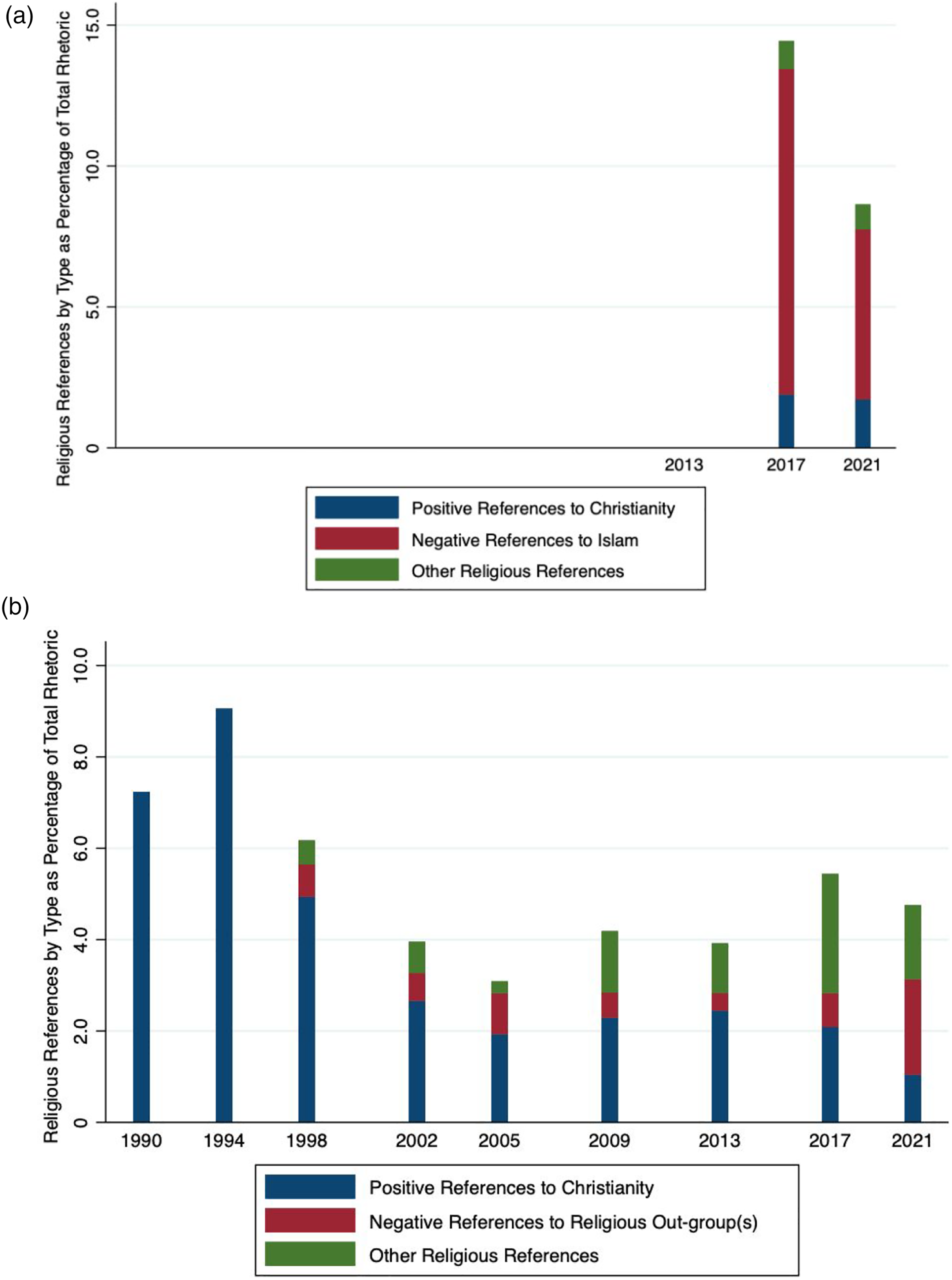
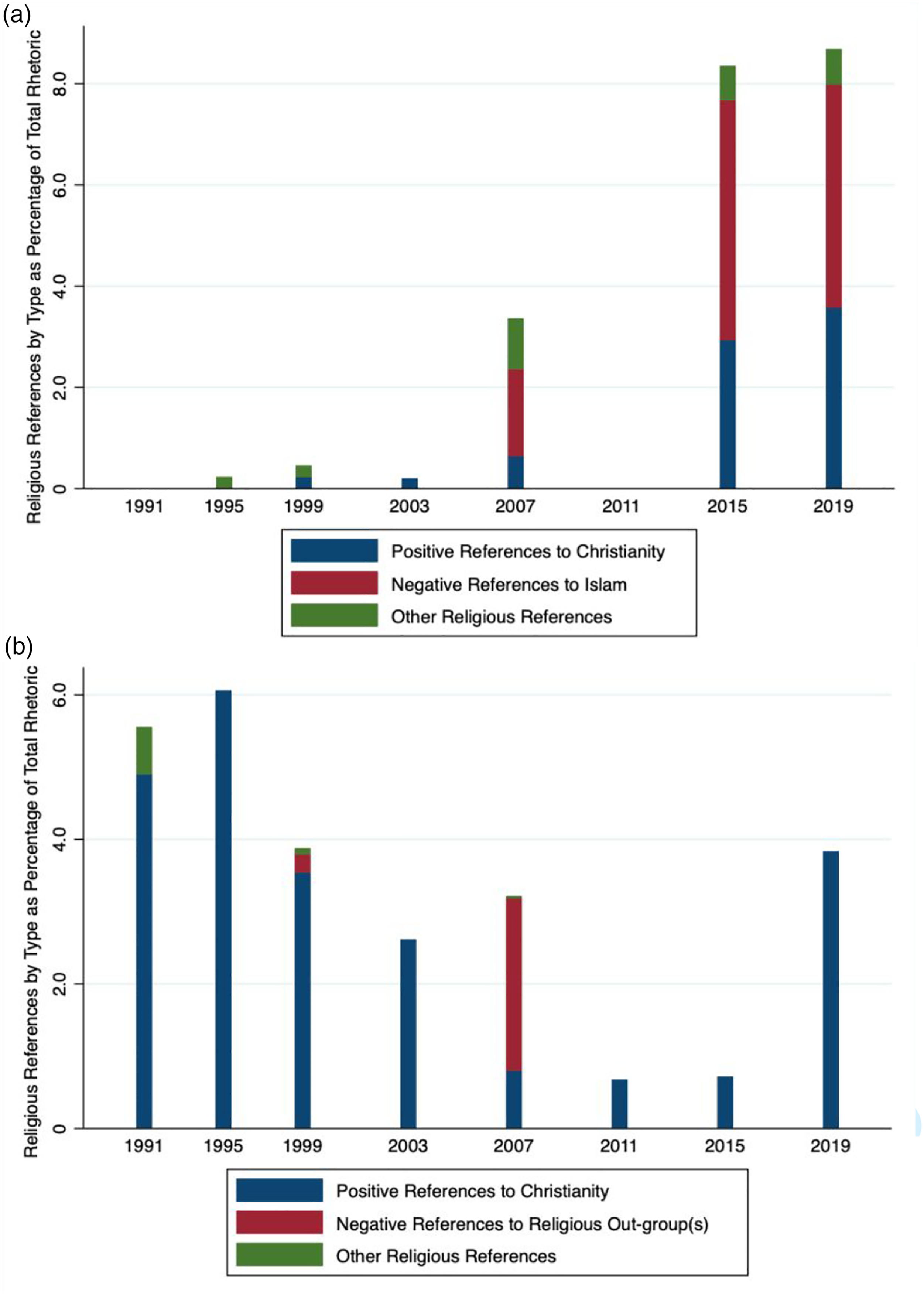
What does Christian Democratic and nativist religious rhetoric look like across Austria, Germany, and Switzerland, between 1990 and 2021? Does it in fact differ by party type? Figures 1 to 3 show the change over time in percentage of total platform rhetoric made up by religious rhetoric, as well as the breakdown by type: Positive references to Christianity, negative references to Islam, and other forms of religious rhetoric. (a) Austrian Nativist FPÖ Religious Rhetoric (1990–2019)10. (b) Austrian Christian Democratic ÖVP Religious Rhetoric (1990–2019). (a) German Nativist AfD Religious Rhetoric (1990–2021). (b) German Christian Democratic CDU/CSU Religious Rhetoric (1990–2021). (a) Swiss Nativist SVP Religious Rhetoric (1990–2021). (b) Swiss Christian Democratic CVP Religious Rhetoric (1990–2021).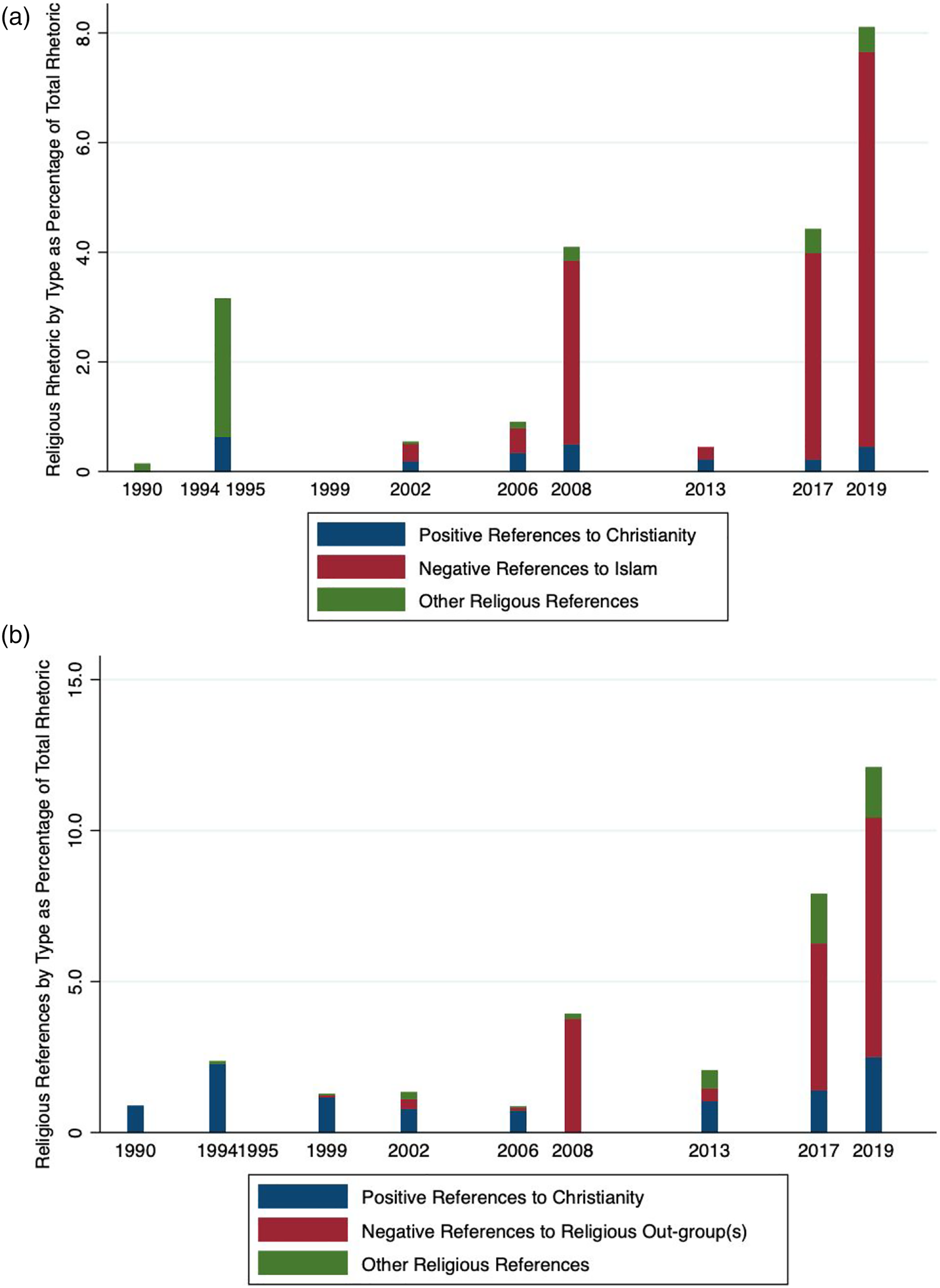
Across Austrian party type (Figure 1), religious rhetoric increases over the course of the 10 elections between 1990 and 2019. Although religious rhetoric increases more rapidly for the nativist FPÖ, the Christian Democratic ÖVP uses more religious rhetoric. Second, between the two parties, the FPÖ clearly employs more and increasingly frequent negative references to Islam and fewer positive references to Christianity than the ¨ÖVP.
Despite having only participated in three elections, as Figure 2 shows, the German AfD employs more religious rhetoric than the CDU/CSU. In the 2021 election, after the advent of COVID-19, the percent of religious rhetoric decreased to under 10%, similar to their vote share, but still significantly higher than in 2013. In contrast to the Austrian ÖVP, the German/CDU/CSU has relatively decreased its use of religious rhetoric across the nine elections in which it has participated, but like the ÖVP, employs more positive references to Christianity than the AfD. Here the difference in distribution by type is far more dramatic.
The Swiss nativist SVP and Christian Democratic ÖVP resemble their German counterparts, but on a smaller scale: The SVP has dramatically increased its use of religious rhetoric over eight elections, while the CVP has gradually decreased its use. As in Austria and Germany, nativist parties employ far greater negative references to Islam than the CVP uses to refer to any minority religion, and far fewer positive references to religion. Across countries, and prior to the 2015 refugee crisis, Christian Democratic parties employed more religious rhetoric than their nativist counterparts. After the crisis, nativist parties eclipse Christian Democratic parties in their use of religious rhetoric. Across countries, the German CDU/CSU and AfD use the most religious rhetoric within their party type, followed by the Swiss and then last the Austrians. Is this simply a question of party competition?
Figure 4 shows that party competition does not provide a clear explanation for patterns of religious rhetoric use by nativist parties or Christian Democratic parties. Overall, the fluctuations and trajectories of party competition do not correspond with patterns of increased nativist religious rhetoric or the fluctuations of Christian Democratic religious rhetoric. Austrian, German, and Swiss Nativist and Christian Democratic Party Vote Share (1990–2021).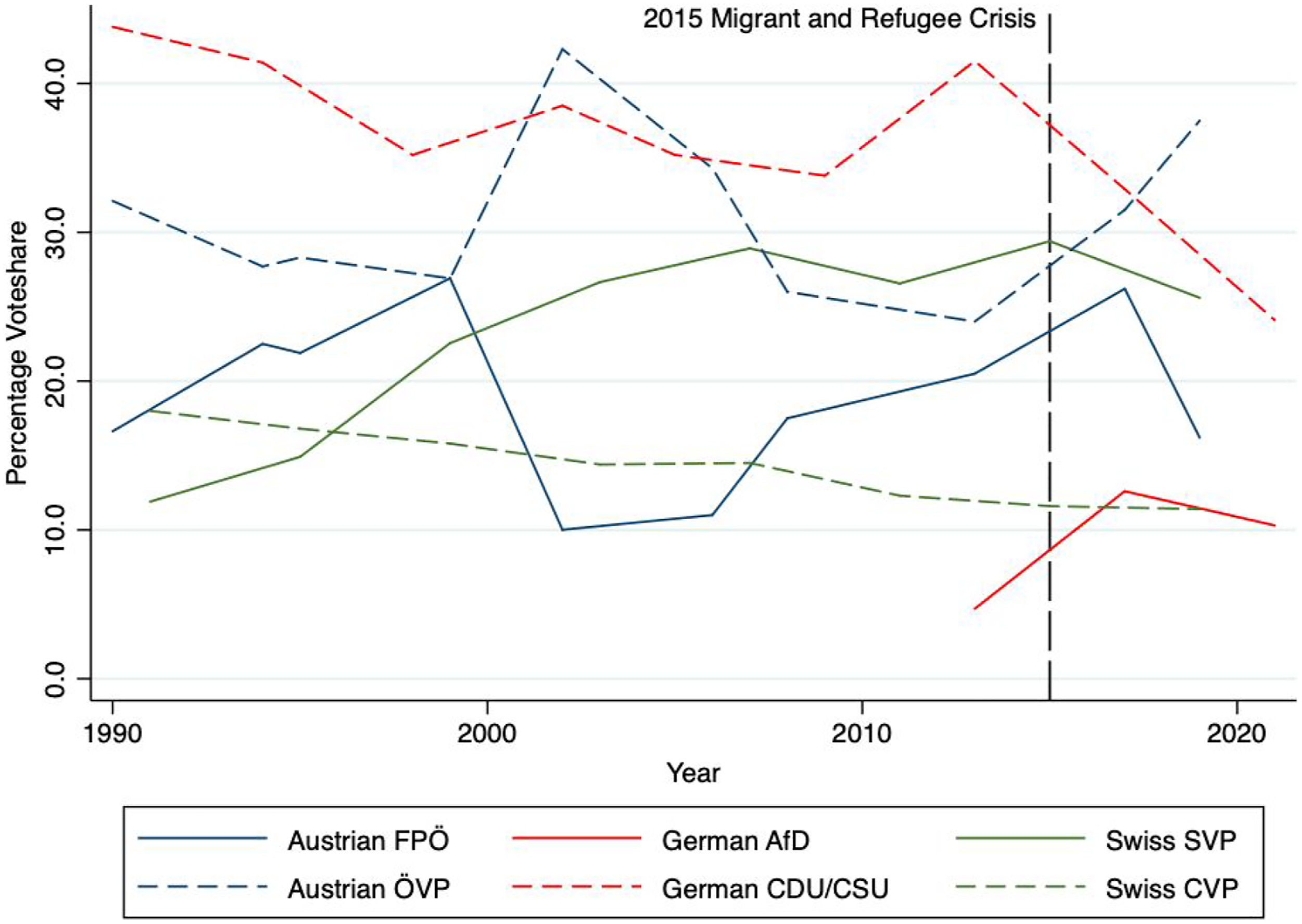
Figure 5 shows, neither cross-national differences in the distribution or in changes in the distribution of religiosity account for the differential uses of religious rhetoric by either Christian Democratic or nativist parties. Austrians respondents affiliate as Christians and attend church at higher levels than German or Swiss respondents, however, this does not correspond with either Christian Democratic or nativist use of religious rhetoric. Similarly, the distribution of church attendance across the three cases does not account for the use of religious rhetoric by either party. Christian Affiliation and Weekly Attendance in Austria, Germany, and Switzerland (2002–2018). Sources: (ESS Round 10, 2020) and (Eurostat, 2022).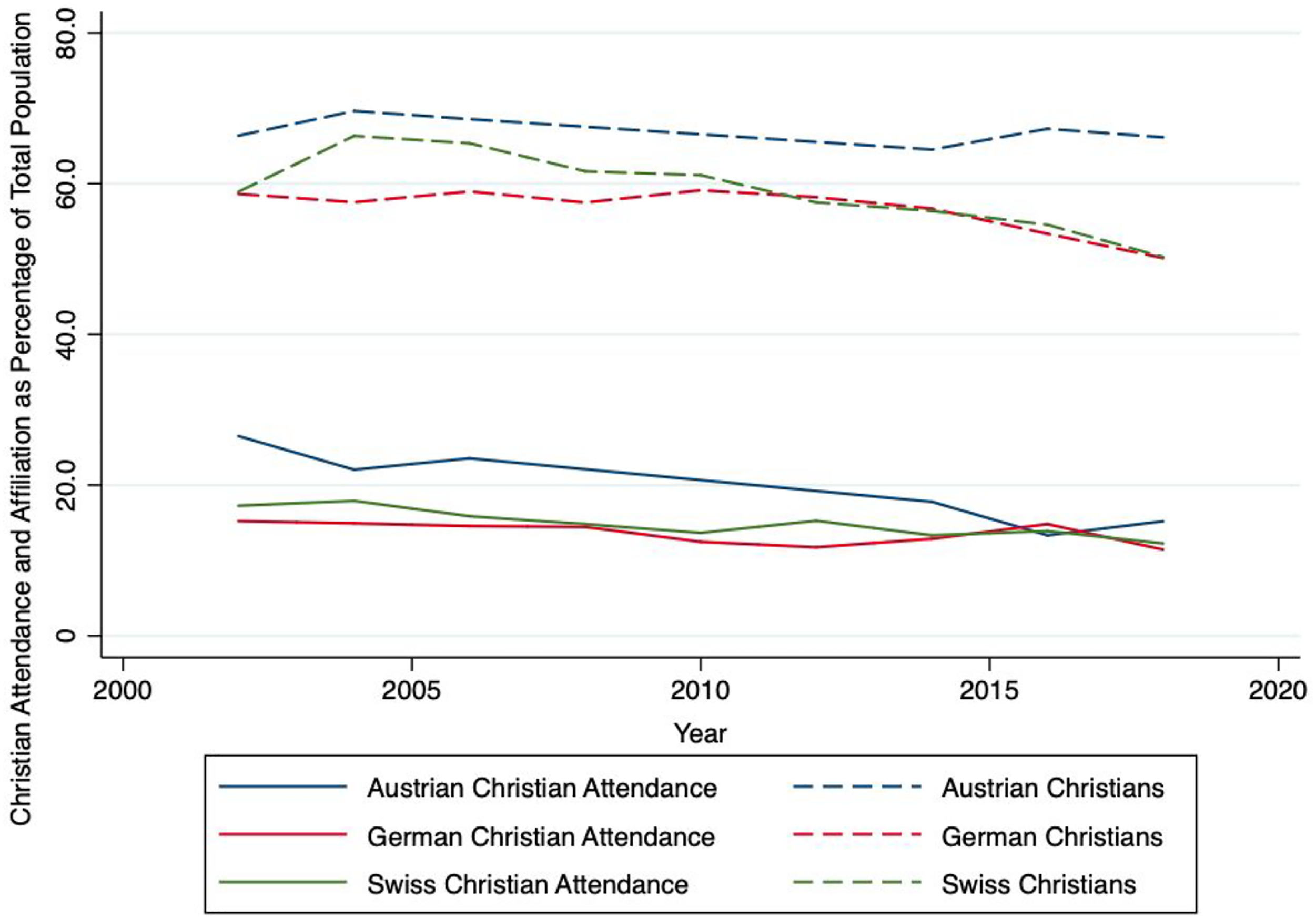
Similar to the distribution of Christian attendance and affiliation, the distribution of Muslim and successful asylum seekers across all three cases fails explain distribution of Christian Democratic or nativist religious rhetoric. However, changes in Muslim populations and successful asylum seekers do appear to offer insight into the use of nativist religious rhetoric for both party types. Following the 2015 (MARPOR, 2021) refugee crisis, Germany’s Muslim population and number of successful asylum seekers increased the most, followed by Switzerland, and then Austria as shown in Figure 6 This pattern corresponds with the distribution of anti-Muslim rhetoric in nativist and anti-religious minority rhetoric in Christian Democratic party platforms across countries. At the start of 2020, the arrival of migrants and refugees decreased significantly due to COVID. In Germany, the only country to hold post-COVID elections, use of religious rhetoric by both the AfD and CDU/CSU decreased, suggesting that when a threat cannot be framed in ethno-centric religious terms, that the impetus to use religious rhetoric will decrease. Muslims and Asylums Granted in Austria, Germany, and Switzerland Between 2000 and 2020. Sources: (ESS Round 10, 2020; Pew Research Center, 2011, Pew Research Center, 2017).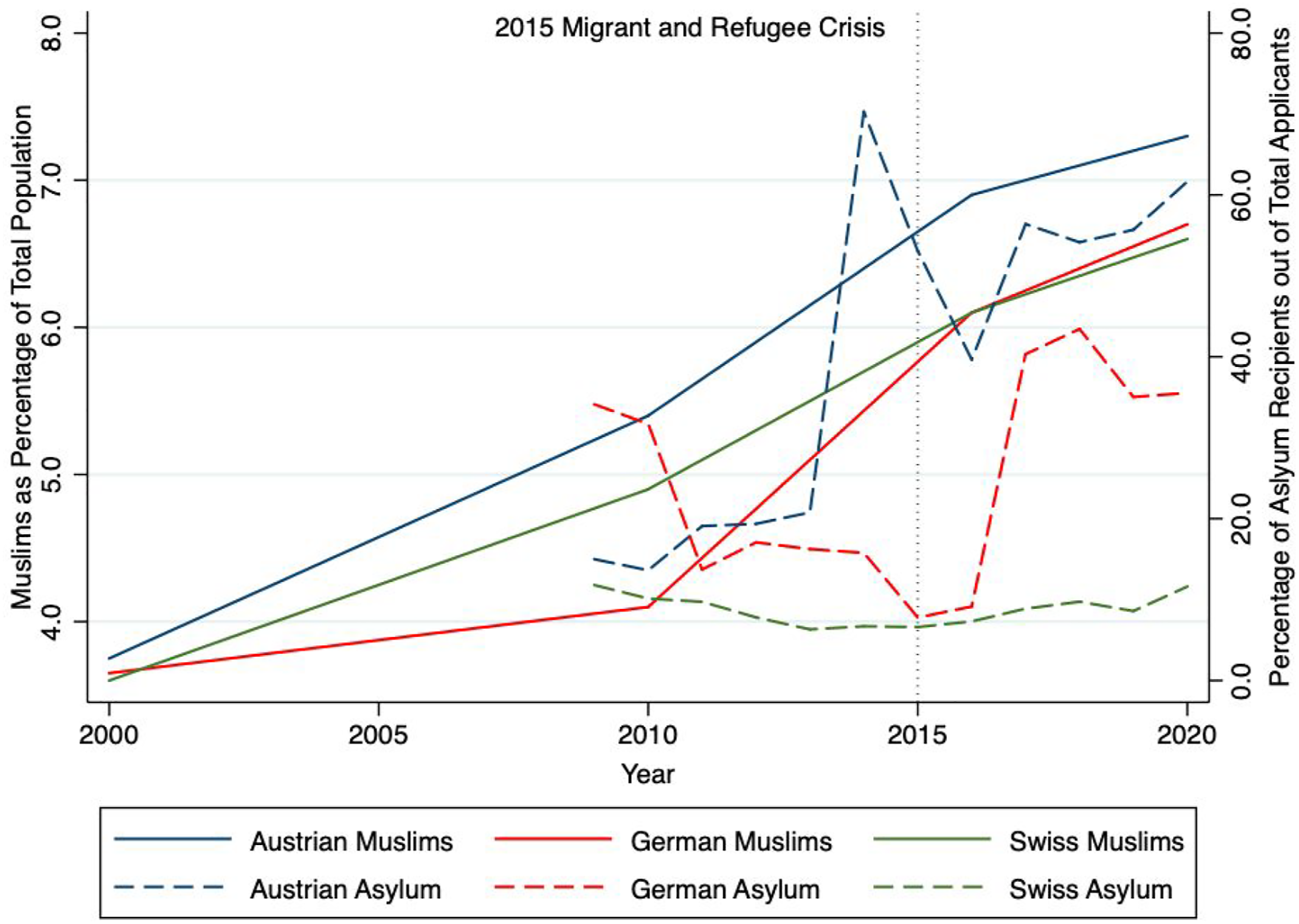
I have demonstrated that nativist parties are increasingly using religious rhetoric and that it differs significantly from Christian Democratic rhetoric. Religious explanations found in an increase of the minority religion and Muslim population affect patterns of religious rhetoric across both party types, but especially appear to incentivize the use of negative references to Islam. However, changes in minority religion and Muslim demographics only account for distribution of all religious rhetoric. What explains why the Austrian FPÖ employs the most negative references to Islam than the German, but the fewest positive references to Christianity? Why is the Swiss SVP the only party that negatively references Jews?
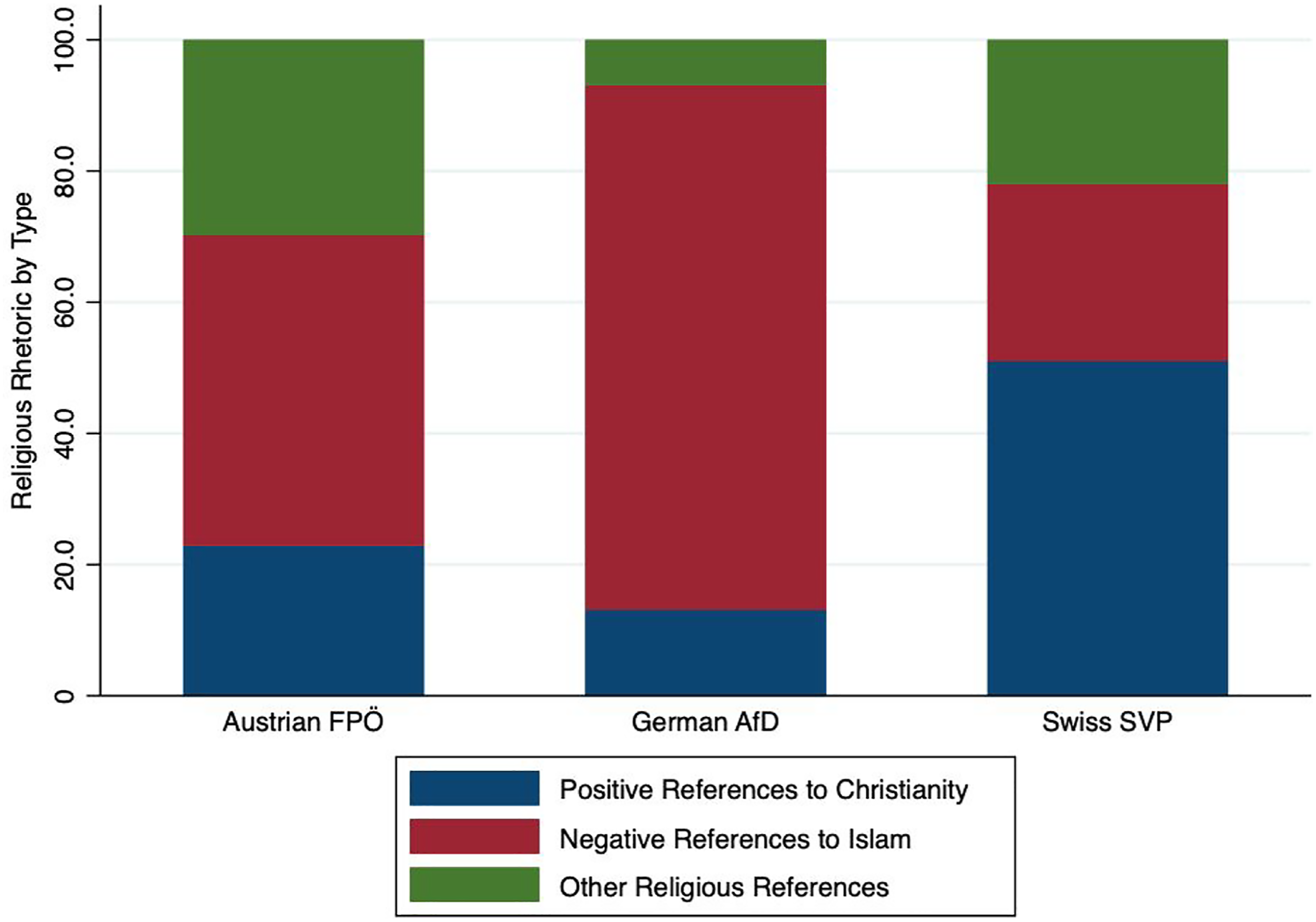
Figure 7 illustrates the aggregate mean per election of religious rhetoric per party while Figure 8 shows the distribution by type. Not included in the graph are the several negative references to Jews found in the 1999 SVP platform, the only anti-Jewish rhetoric across all three parties. Although a very new party, the German AfD deploys both the most religious rhetoric and the greatest percentage of negative references to Islam. In contrast, the SVP employs the greatest positive references to Christianity. What explains this cross-country distribution? Aggregate Nativist Religious Rhetoric in Austria, Germany, and Switzerland (1990–2021). Source: MARPOR, 2021a.10 Average Nativist Religious Rhetoric by Type in Austria, Germany, and Switzerland (1990–2021). Source: MARPOR 2021a.10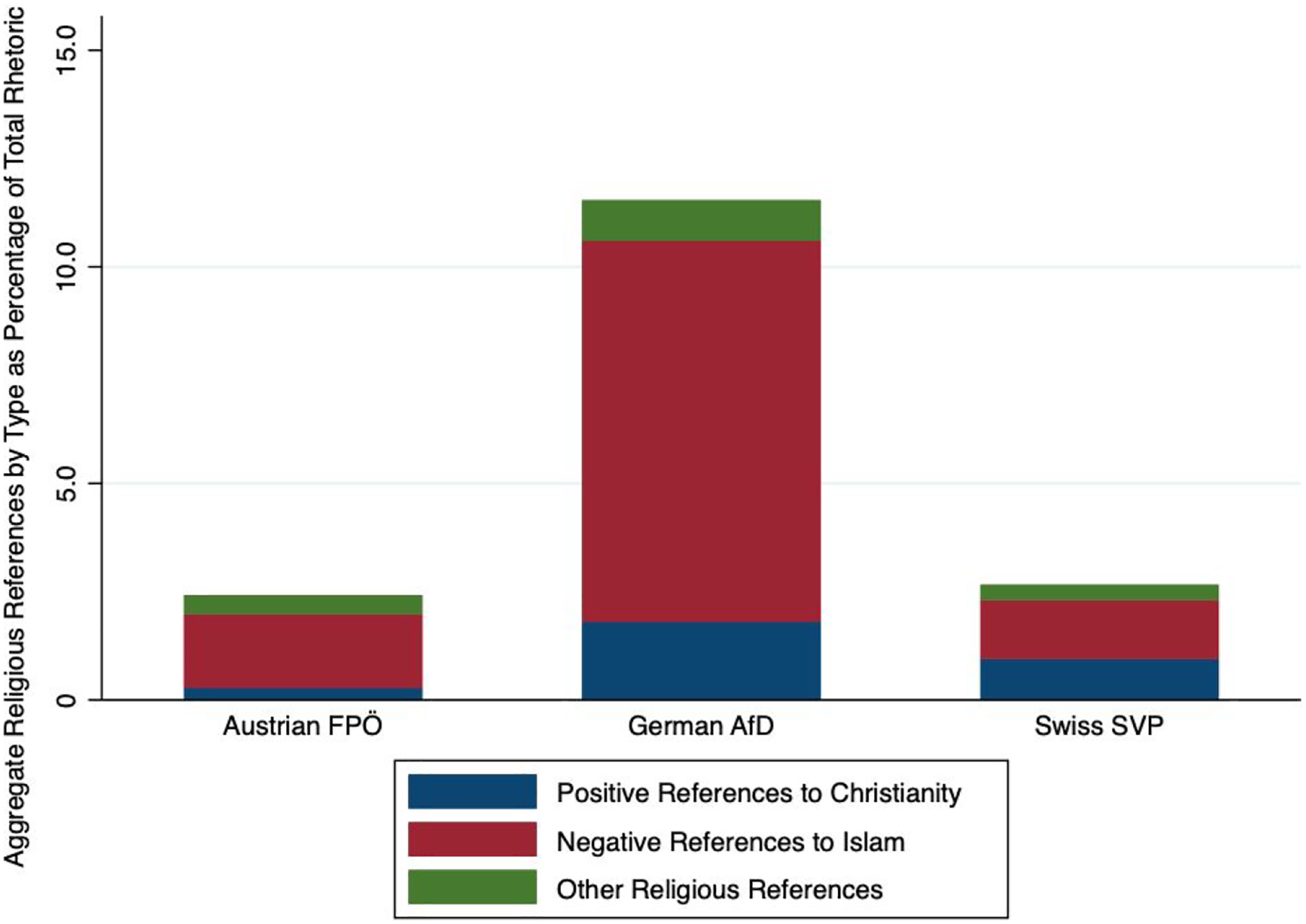
As explained earlier, the historic relationship between religious identities and institutions has a powerful influence to this day. Significant scholarship charts how even medieval persecution with church approval of religious minorities could affect nativist attitudes and actions even centuries later (Voigtländer and Voth 2012, 2015; Cantoni et al. 2019). I argue that the greater the extent to which a regime was associated with Christianity contributed to a linked-fates scenario where not only successes, but failures, acquired religious sheens. Similarly, the extent to which religious minorities, usually Jews, but sometimes Muslims, were recognized as citizens, able to own land, be promoted in the military, and so on, contribute to the contemporary credibility of an exclusionary citizenship anchored by the past. Is this in fact the case? i. Conflation of Christianity and Nationality, Close Church-State Relations
Austria clearly stands out from Germany and Switzerland as the country whose nationality is most closely conflated with Catholicism and whose church-state relations were the most consistently aligned. Grzymala-Busse (2015) convincingly demonstrates that in instances where churches took the side of the people against an oppressive force, then they gain positive political influence, yet the opposite may hold true. If positive and negative associations between Christianity and nationality are a zero-sum game, then a country such as Austria with a homogeneous Catholic tradition closely associated with nearly every political and military victory for centuries, might nevertheless, be undone by defeats. Sectarian diversity on the other hand, while precluding a straightforward conflation between a nationality and a homogeneous Christian faith, might in fact provide insurance against a linked-fates scenario. Among all three parties, the German AfD employs the greatest amount of religious references followed by the Austrian FPÖ and Swiss SVP who employ religious rhetoric at nearly the same aggregate level. Among the three cases, the Swiss SVP employs the most positive references to Christianity as a percentage of all religious rhetoric, followed by the Austrian FPÖ and then the German AfD. Does the historic conflation of Christianity and a nationality, the closeness of church-state relations, or violent sectarianism explain this distribution?
The conflation of the Holy Roman, Habsburg, and even Austro-Hungarian empires with Catholicism was incredibly close. For centuries, Austrian imperial legitimacy was validated by Church institutions and the divine monarchy of the Holy Roman Empire meant that defeats as well as victories were associated with Catholicism. Therefore, while the Reformation and Counterreformation bolstered the Catholic association with Austrian nationality, the failures of the Catholic Habsburgs during the Napoleonic Wars and the siding of the churches with Habsburgs during the Age of Revolutions led to virulent anti-clericalism (Clark and Kaiser, 2003). Additionally, the overt collaboration of the Austrian Catholic Church with the Nazis further sullied the reputation of Austrian Catholicism. While all three countries have institutionalized Catholic and Protestant churches, institutionalized religion in Austria is the most centralized and homogeneously, partially due to the majority Catholic population and partially to the legacy of institutionalized Catholicism under the Habsburgs.
The conflation of nationality and Christianity in Germany lies somewhere in between as does institutional proximity of church-state relations. The foundation for the present German state was due to the religious self-determination gained in bloody battles during the Reformation and Counterreformation when movements for internal autonomy from the Holy Roman Empire were first made through the foundation of alliances among German Protestant rulers such as the Schmalkaldic League. Protestantism was a feature of pan-Germanicism, but not integrally (Smith 2014). Germany was not unscathed by Christian sectarian violence, but it diminished considerably after the Counterreformation, with the notable exception of the short-lived Kulturkampf. The Kulturkamp, Bismarck’s all-out offensive on Catholicism, was a tool used as he consolidated German principalities, to form a new German empire under the Prussian Kingdom, to weed out powerful Catholics and weaken the influence of the Catholic Church on German politics, especially education and the appointment of bishops (Smith 2014). The lack of a homogenous religious identity also meant that Germany’s successes and defeats were not as closely associated with the religion of the ruler. The Kaiser’s loss in World War I, for example, was not seen as a defeat to Protestantism. The collaboration of the Catholic and especially the Protestant churches, however, dealt a huge blow to the moral reputation of Christianity in Germany. In Germany, religion is institutionalized, or codified as part of the state apparatus, at the subnational level, although all sixteen Länder have institutionalized Catholic and Protestant churches, there is variation in the extent to which religion enters the public sphere.Of all three cases, Switzerland has the weakest conflation between a nationality and homogenous Christian identity. Swiss Christian sectarianism has been the most violent and extended well into the 19th century. At the same time, Switzerland was a haven for persecuted Christians and Christian sectarianism was lauded as a hallmark of Swiss nationality. Following the Reformation and Counterreformation, proximity to Catholic France magnified the threat of an external Catholic force and perceived disloyalty of Catholic citizens (Steinberg 2015). Even after Napoleon’s invasion, Switzerland continued to invoke outside powers for decades during inter-cantonal fighting, including a brief civil war when seven Catholic cantons attempted to secede and form a separate alliance, the Sonderbund, eventually defeated by the Protestant cantons. Without a homogenous religious identity, the conflation of Christianity and nationalism is weaker in Switzerland than in Austria and Germany, yet this also means that Swiss failures were not associated with either institutionalized religion. Similarly, the relationship between religious institutions and the state was weak compared to Germany and especially Austria.
If the historic relationship between a nationality and Christianity was responsible for the extent to which nativist parties use religious rhetoric or positive references to Christianity, then the Austrian FPÖ would lead the other parties in the deployment. This is not case. Instead, the SVP, coming from a country with a legacy of violent sectarianism, celebrated Christian pluralism, and weakly institutionalized religion employs the most positive references to Christianity. The positive conflation of nationality and Christianity similarly fails to offer a conclusive explanation for the distribution of positive references to Christianity by nativist parties. This suggests that close church-state relationships are more of a liability to nativist parties than an asset when influencing the political salience of positive references to Christianity.
Negative association with religious minorities/exclusionary institutions
What role might the negative associations between a nationality and a religious minority play in predicting contemporary nativist references to religious minorities? How might the historic institutional recognition of religious minorities influence this trend? What about the relationship between an exclusive citizenship based on citizens not being Jewish and nativist anti-Muslim rhetoric? If the historic relationship between religious minorities and nationality, and religious minorities and the state do impact contemporary nativist religious rhetoric, then countries that were historically the most anti-Semitic and restricted citizenship based on religious identity the most will now have nativist parties who use most anti-Muslim rhetoric. In other words, the culture of an exclusionary citizenship defined along religious lines should persist.
Among Austrian, German, and Swiss nativist parties, the German AfD employs the most negative references to Islam, followed by the Austrian FPÖ, and then the Swiss SVP. In contrast, the German AfD makes no negative references to Jews or Israel, explicit or otherwise. In fact, the German AfD makes positive references to Jews and Israel in both its 2017 and 2021 platforms. In contrast, the Austrian FPÖ makes no mention of Jews during a discussion of the victims of World War II, while the Swiss SVP includes several anti-Semitic references in political platforms from the 1990s. Do Austrian, German, and Swiss histories of exclusionary citizenship along religious lines explain this?
Prior to the Holocaust, the extent to which Jews were able to access more equitable citizenship was comparatively easier in the states that would form Germany. Under the Holy Roman Empire, Jews were protected as subjects of the emperor but were not citizens (Deák, 1988). Although Jews gained citizenship in 1812 in Prussia and were emancipated in 1813 in Bavaria, it was not until 1848 in Austria and Switzerland that they gained full citizenship. The “Romanian Question” --the international dilemma over whether to recognize Romanian statehood--offers additional insight into the comparative exclusionary citizenship Jews experienced. In 1878, Romania declared its independence and requested recognition as a state although denying Jews full citizenship (Stern, 2013). The “Romanian Question” reverberated across Central Europe. Austria held off signing for 2 years until 1880 as did Switzerland. Germany waited a decade to recognize Romania until Jews gained full civic status. In Austria, the Jewish community became part of the Austrian institutional framework in 1890 with the founding of the Israelitische Kultusgemeinde. In Germany, institutional recognition occurred in a more piecemeal, for example the Duchy of Baden passed the Grand Ducal Jewish Edict in1809 which created a representative body for Jews, the Oberrat der Israeliten Badens. In contrast, Jews were not granted full equality with German citizens until 1864. Today, every German Länder has signed a contract with the local Jewish community and the national Zentralrat der Juden, founded in 1950, is well-entrenched within the German institutional framework. Swiss recognition of Jews was even less centrally led. While there are dozens of Jewish communities in Switzerland, there is no Jewish community partner institutionalized at the national level or at the subnational level in each canton as in Austria or Germany.
During the Holocaust, Jews lost not only their rights as citizens but their lives in Austria and Germany. In Switzerland, despite Nazi sympathy, Jewish lives were spared, if not their property due to Swiss neutrality. Austria’s participation in the Holocaust is well-documented, but it was not until 1991 that the Austrian government publicly apologized for its role (Pick 2000).
It is important to note, however, the unique legacy of German division in the second half of 20th century on contemporary nativist parties. In the aftermath of WWII, Germany was sub-divided with West Germany, under American, British, and French control, being at least superficially forced to take responsibility for the Jewish genocide. While West Germany was welcomed into the Western European fold after the German defeat in World War II, East Germany, under Soviet occupation experienced nearly 50 years of political suppression and the banishment of religion from the public sphere. Not only were the German Protestant and Catholic churches severely curtailed in their abilities to minister to their congregants, but the victims of Nazism were not delineated along religious lines as defining Nazi victims as Jews was at odds with a Soviet narrative of Russian victimhood and Soviet anti-Semitism. Further, the divided structure of post-war Germany meant that while West Germany was superficially de-Nazified and condemnation relatively accepted, East Germany not only was not de-Nazified, but under Soviet rule, the historical association of Jews and Communism meant that even when the Wall came down in 1989, the anti-Semitism did not disappear but simply took on a new form (Kopecek 2008). Additionally, while West Germany spearheaded a Gästarbeiter program in the 1970s that brought primarily Muslim Turkish immigrants to Germany to compensate for the post-war labor shortage, East Germany did not experience a diversification of its workforce until the fall of the Wall. The first elections for a unified Germany in 1990 highlighted a party vacuum in the East; despite lower levels of religiosity among East German voters, they voted resoundingly for the CDU/CSU as the Social Democratic Party had been tainted by Soviet association. It makes sense, therefore, that the AfD not only originated in East German Länder but maintains its stronghold there.
The relationship between Islam, nationality, state institutions differs from that of Jews in Austria, Germany, and Switzerland. Austrian identity was predicated on the idea of being the last defense against an invading Islam, as exemplified by the Austrian ability to withstand the Ottoman Siege of Vienna in 1683. Germany and Switzerland never faced territorial threats from Muslims the same way. On the other hand, the Habsburg Empire’s multinational makeup meant that Muslim citizens in places like Serbia were considered citizens. In fact, Austria brought Islam into its institutional framework in 1918. In Germany, religion is handled at the subnational level and three of the 16 Länder have extended institutional recognition to Islam, the first of which, Hamburg, signed a contract with a Muslim community in 2012. In contrast, Switzerland has not extended institutional recognition at either the national or subnational levels and in 2021 passed a national ban on Muslim veiling.
In the context of historical exclusionary citizenship, we should expect that the Austrian FPÖ employ the least negative references to Muslims, followed by the German AfD and then the Swiss SVP. This is clearly not the case, as in the SVP employs the fewest negative references to Islam despite religious minorities enjoying the least institutional protection and historically were provided weak paths to equitable citizenship. On the other hand, if we interpret nativist negative references to Islam as connected to histories of religious repression, with the Holocaust carrying the greatest weight, then the use of negative references to Muslims follows the pattern for national complicity in the Holocaust; over 50% of the German AfD rhetoric contain anti-Muslim references, such “[t]he AfD sees the spread of Islam and the presence of over 5 million Muslims, whose number is constantly growing, a great danger for our state, our society and our system of values” (2017, 22, 33). 11
What about references to Jews in nativist rhetoric? Does it follow the same pattern of distribution as anti-Muslim rhetoric mimicking responsibility for the Holocaust? In fact, the opposite proves true. Despite or perhaps because the AfD employs the most negative references to Islam, the AfD is the only party that positively references Jews, one time in the 2017 platform and six times in the 2021 platform. Statements such as “Attacks on Jews and anti-Semitic insults must be prosecuted consistently,” signal to voters that the AfD is a right-wing party, but not the Nazi party. Mirroring their post-war distancing, the Austrian FPÖ does address the victims of the Second World War, but without mentioning Jews. However, the SVP appears immune from what nativists call Schuldkult, a pejorative term for the German Culture of Remembrance, and is the only party to make negative references to Jews, such as the one found in the 1999 SVP platform: “The anniversary donation becomes interpreted by other countries as a declaration of guilt. The consequence is blackmailing in the name of Holocaust victims.” 12 Once again, the AfD is the party that make the most positive references to a religious minority, not only Jews, but also Muslims, in their attempt to distance themselves as much as possible from Nazi ideology: “Many Muslims live law-abidingly (and integrated) and are treasured members of our society” 13 (AfD, 2017; 33) and “Jewish life in Germany is not only threatened by right-wing extremists, but also increasingly by anti-Jewish and anti-Israel Muslims” (AfD 2021, 84). 14 This last set of religious references underlines that while the relationship between religious history and contemporary nativist rhetoric is far from straightforward, its influence and contextualization of the rhetoric is critical to understanding its political salience.
Conclusion
This article demonstrates that religious identities are critical pillars supporting the promotion of national identities at the heart of both Christian Democratic and nativist political parties, but not in ways that correspond neatly with traditional patterns of religiosity. Although Europeans are attending religious services and identifying as Christian less and Muslim populations are growing, Christian Democratic and nativist parties are frequently employing religious rhetoric at increasing rates. Christianity has been a civilization and nationality marker for centuries, what is new is its cooption by nativist parties with weak ties to Christian institutions.
The past matters to both Christian Democratic and nativist parties, but in different ways. Christian Democratic parties prioritize positive association between a nationality and institutionalized religion, whereas nativist parties prioritize policing the nationality through exclusionary references to a religious out-group, most commonly Islam. In other words, despite the nativist ethno-nationalist claim to represent the “people,” the focus is outwards rather than inwards. Across countries, how citizenship was historically demarcated along religious lines and the role institutionalized religion played in supporting the nation influences the type of nativist religious rhetoric that resonates. In Austria, the historic conflation of an imperial Catholic identity with the nascent Austrian nationality created a linked-fates scenario where the eventual downfall of the Austrian Empire was associated with the Church, reducing the efficacy of pro- Christian rhetoric. In Germany, an exclusive citizenship based on not being Jewish incentivizes the AfD to use anti-Muslim rhetoric more than the FPÖ or ÖVP.
This article makes both empirical and theoretical contributions. It generates theory as to how political parties use religious rhetoric differently and provides new insight into the religious rhetoric of nativist parties across Europe. The methodology can and should be expanded to other countries, such as Croatia or Slovenia, to test whether divergent experiences under socialist dictatorships similarly influences how nativist parties employ religious rhetoric. Here, I predict that the nativist Croatian SMER would employ more references to religion than the nativist Slovenian SLS due to the comparatively greater use of religion as a rallying point for nationalism during formative moments in Croatian self-determination such as during the Kingdom of Yugoslavia and the dissolution of the Federal People’s Republic of Yugoslavia. Similarly, exploring alternative hypotheses such as the role of subnational variation and migrant and refugee policies are necessary next steps to test the generalizability of these findings. For example, in the German case, the less religious former East Germany is a bastion of AfD support, while Austrian Carinthia, also a historically geographically contested region, votes disproportionately for the FPÖ.
Nonetheless, my findings shed light on the need to explore religious trends outside of the confines of institutionalized religious structures. This article suggests that while behaving, believing, and belonging may be more accurate indicators of the politicization of religion in the past, a nuanced understanding of cultural religious identity is a more appropriate lens moving forward. As the scale and frequency of migrant and refugee crises increases, nativism and the success of nativist parties are unlikely to dissipate. The promotion of exclusionary citizenship along religious, ethno-centric lines will likely be a constant as long as an out-group can be framed along religious lines.
Supplemental Material
Supplemental Material - Barbarians at the gate: Nativist religious rhetoric and defining the “people” by who they are not
Supplemental Material for Barbarians at the gate: Nativist religious rhetoric and defining the “people” by who they are not by Emma Rosenberg in Party Politics
Footnotes
Declaration of conflicting interests
The author(s) declared no potential conflicts of interest with respect to the research, authorship, and/or publication of this article.
Funding
The author(s) received no financial support for the research, authorship, and/or publication of this article.
Supplemental Material
Supplemental material for this article is available online.
Notes
Author biography

References
Supplementary Material
Please find the following supplemental material available below.
For Open Access articles published under a Creative Commons License, all supplemental material carries the same license as the article it is associated with.
For non-Open Access articles published, all supplemental material carries a non-exclusive license, and permission requests for re-use of supplemental material or any part of supplemental material shall be sent directly to the copyright owner as specified in the copyright notice associated with the article.
