







Abstract
Are legislators ideologically close to their co-partisans? And, when not, what policies drive the lack of party unity? To address these questions, we propose two measures of intra-party ideological cohesion: dissonance and frustration. Based on a survey of legislators across 18 Latin American countries, we show that half of the region’s representatives self-identify as substantially far from the mean of their parties (dissonance) and almost 40% perceive large differences (frustration). Relying on a series of statistical tests, we find that these patterns are distinct for left-wing and right-wing legislators. The right is more dissonant than frustrated, and they are also more dissonant than the left. In terms of policy, we show that moral issues drive dissonance and frustration on both sides of the ideological spectrum, but disagreements on economic topics are more correlated with ideological distance for the left than the right. In presenting new measurements of intra-party disagreements, our paper proposes new pathways for the study of party cohesion.
Keywords
Introduction
The study of party politics often relies on the Downsian assumption that parties are meaningful groups composed of like-minded actors (Downs 1957). Of course, many parties fail to meet these criteria, and instead only operate as personalist electoral vehicles or as unorganized groups that are riven with factions and infighting. In this paper, we quantify the frequently high but diverse levels of internal disagreement among Latin American co-partisans, and then embark on a search for the sources of the variance.
Efforts to quantify the level of intra-party (dis)unity among legislators have relied on roll-call votes to evaluate the overall propensities of co-partisans to vote together (Ansolabehere et al., 2001; Hansen, 2022; Poole and Rosenthal, 1984), or sometimes concerning specific subsets of the votes (Cox and McCubbins, 1994; Jaeger, 2019; Matos, 2017). Roll-call votes, however, cannot distinguish whether unity is the result of an agreement among like-minded legislators (cohesion) or coercion (discipline) from a hierarchical leader (Morgenstern 2004; Özbudun 1970). Further, since serpentine procedures make it difficult for a bill to survive to the floor for a vote when there is internal disagreement, roll calls will overrepresent policies on which intra-partisan colleagues agree (Ames 2002a; 2002b).
In evaluating cohesion among voters, these problems of measurement are overcome by using survey analyses that inquire into attitudes about left-right ideological identification for different partisan identifiers. These studies are commonly combined with analyses of policy preferences in efforts to show congruence between the more abstract idea of ideology and attitudes about specific policies (Lehrer and Lin 2020; Lin and Lehrer 2021; Luna and Zechmeister 2005; Rosas 2005; Somer-Topcu 2015). While surveys bring their own limitations, such as the potential for respondents to dissimulate, they suggest an alternative means for studying dissensus among legislators. This is not possible in many cases, but for Latin America the Parliamentary Elites of Latin America project from the University of Salamanca (PELA) supplies the path for such a study, having surveyed legislators for their policy and ideological positions in every Latin American country after every election for about 20 years. In this paper, we rely on PELA data to measure and understand intra-party cohesion in Latin America.
With these longitudinal and cross-national survey data, we develop two variables that measure intra-party ideological cohesion. The first of these is the distance between each legislator’s self-placement on the left-right scale and where they perceive their own parties to be. We label this frustration, presuming that legislators would prefer that their colleagues align with their own preferences. A second measure, in turn, captures the actual ideological distance between each legislator and the average of their co-partisans’ self-reported positions. We label that variable dissonance. The data make clear that while many legislators are ideologically close to their colleagues, others are frustrated and/or dissonant.
In this paper, we reserve the terms dissonance and frustration to talk about differences in left-right ideology, which we distinguish from distances among co-partisans on particular policy issues. We use the ideological distance measures as our dependent variables and use them to demonstrate the level of intra-party discord. Our theoretical goal is to evaluate the two variables as a function of co-partisan policy differences, taking into account the potential for legislators to dissimulate in their self-ideological positioning. Fueling the inquiry about policy, we combine issues into moral, welfare, and size-of-state policy baskets and evaluate the relative salience of each by querying how differences within each issue basket impact the perceived or actual ideological distances. To conduct the analysis, we ask how similar distances between a legislator and her party on three different issue baskets--morals, welfare, and size of the state—correlate with the two measures of ideological dispersion. We find that those correlations, which we argue are indicators of salience, are inconsistent among parties. In particular, we show that moral issues have the largest (and statistically significant) correlation with dissonance and frustration, and while differences on the economic policy baskets are salient across party types, they are more pertinent to leftist parties.
While policy is a key determinant of ideological distance, studies relying on surveys must wrestle with the possibility that some of the intra-party differences are a measurement mirage, based on the respondents misrepresenting their ideological labels. Work on the “ashamed right” thesis suggests that some, but not all self-identified right-wing legislators will indicate that they hold more centrist positions than they truly believe (see Power 2000; Zucco and Power 2024). Since only some will hide their views, there will be variance within the party, implying high dissonance. But, since the obfuscating legislators would also likely say that their parties are similarly centrist, there should be low frustration.
The expected dynamic among the left is different: rather than being ashamed of their positions, we posit that they see themselves as vanguards and would therefore be frustrated that their colleagues are not radical enough (in other words, they will place their colleagues more towards the center). 1 As an example, the US Democratic party faces strong internal criticism from members who complain that their colleagues are too staid to take needed radical stances on themes such as race or income distribution; others, closer to the center, will argue that radicals are missing the opportunity to attract independents, especially in contested elections. This is similar to the frustration of radicals and centrists in the history of electoral socialism described by Przeworski and Sprague (1988). More recently, Spain’s Podemos party has experienced a similar internal conflict (Errejon and Mouffe 2016). Dissonance is also possible among the left, if some party members who held radical beliefs were to hide their views to avoid derision resulting from shame about the fall of the Soviet Union or the excesses of leftist leaders.
Our theoretical explanation for the variance in frustration and dissonance is summarized in Figure 1. As it indicates, we first consider how legislators from different ends of the ideological scale respond when asked questions about their ideology or that of their parties. As the bold lines in the figure suggest, we expect (and find) that the right will be more dissonant than the left. The broken line pointing from “left” towards frustration indicates that we expect that leftist legislators will be more frustrated than the right. We use a broken line there to indicate that our empirical analysis is not supportive of that link. The other parts of the graph are suggestive of our hypotheses regarding the impact of policy divisions, which, as noted, we separate into issues related to morality and two economics themes (welfare and size of the state). These are filtered by left-right ideology, because policies do not have the same salience for all parties or legislators. Roadmap to ideological frustration and dissonance. Note: The figure illustrates our empirical expectations. Bold lines indicate stronger effects compared to thinner lines. The dashed line from “Left” to “Frustration” indicates that we do not find robust support for the proposition that the relationship between frustration and left-wing relationship will be stronger than left-wing and dissonance. We find support for all other expectations.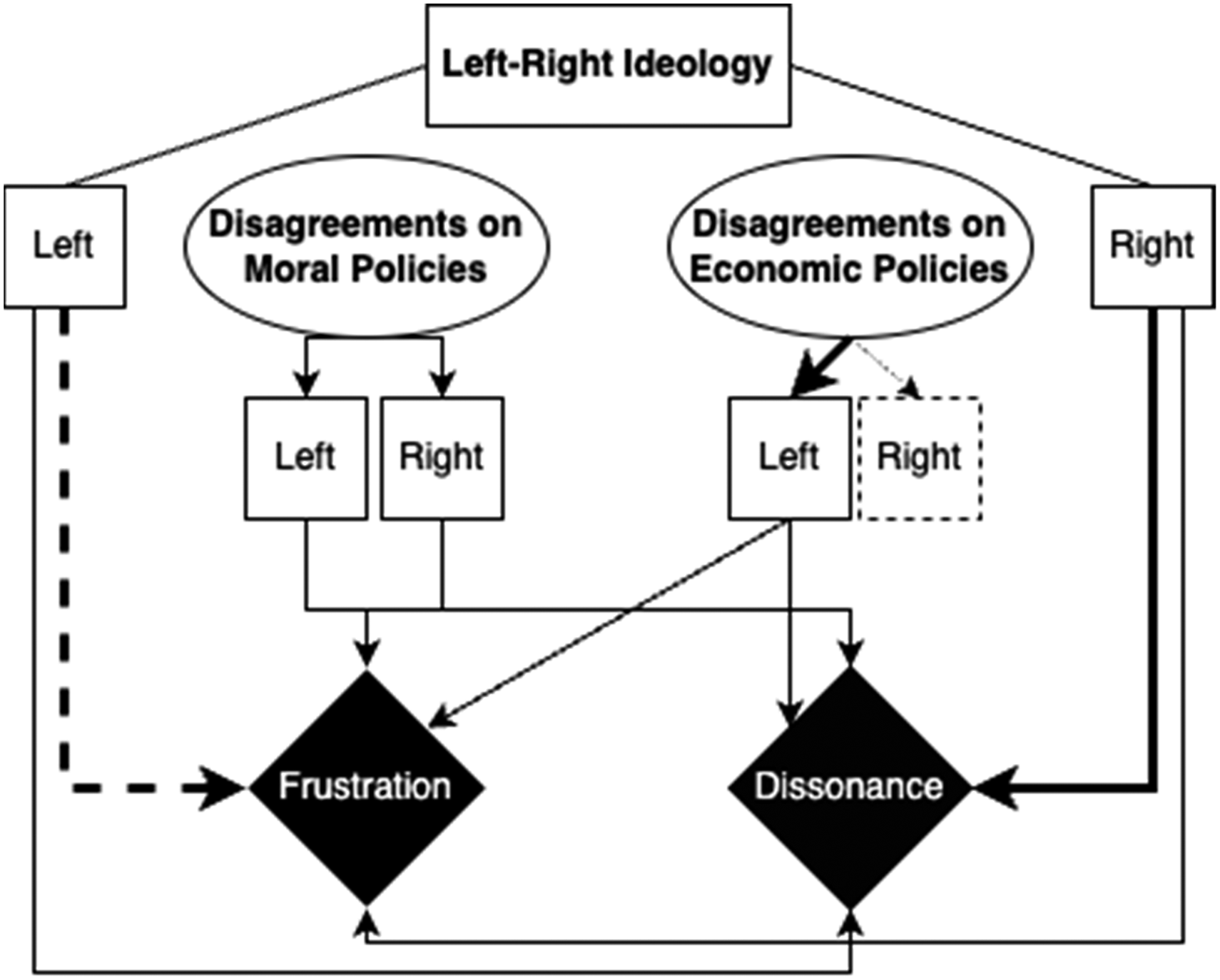
In sum, this paper provides a new means for examining parties’ ideological dissensus, which has implications for understanding intra-partisan dynamics and inter-partisan politics. To this end, it first defines, operationalizes, and empirically details our survey-based measures of ideological cohesion (frustration and dissonance). We then provide a theory to explain the variance we uncover, focusing on how dissimulation and policy differences have explicable but inconsistent impacts on left versus right parties. We test and confirm the hypotheses with bivariate as well as hierarchical multivariate models. Our conclusion returns to the issue of implications.
The extent of the problem: Measuring dissonance and frustration
Most literature interested in investigating mass-elite linkages relies on measurements that are comparable to what we refer to as dissonance. Studies such as Luna and Zechmeister (2005) and Rosas (2005), compare legislators’ mean left-right self-placement within a party or government with how voters self-place on the same scale. Similarly, Blais and Bodet (2006) compare voters’ self-placement to the estimation of party positions based on their manifestos, while Golder and Stramski (2010) calculate party ideology based on the assessment of the most educated voters. These studies of voters are directly transferable to the distance between legislators and their co-partisans.
However, this objective variable does not account for how voters (or, in our case, legislators) perceive their own parties. 2 Frustration provides the necessary subjective measure of the distance between a voter or a legislator and where they perceive their parties to be. While less common, concern with perceived distance of voters to their parties has not evaded study. Somer-Topcu (2015), for example, shows that voter perceptions of distance from their parties affects electoral support and Lin and Lehrer (2021) as well as Lehrer and Lin (2020) show that the voter perceptions are dependent on whether parties are unified. Frustration, in sum, does not deplete the value of measuring dissonance, but the subjective measure provides a distinct perspective on intra-partisan relations.
To be sure, legislators will not always feel frustrated for deviating from their party’s ideology. For example, former Brazilian congressman Lael Varella, who represented the center-right Democratas from 1987 to 2014, was once ranked “the most disloyal” legislator in the Brazilian Congress (Vizeu 2010). Yet, since his exceptional electoral results helped co-partisans through the country’s open-list proportional representation system, it appears that the “disloyalty” did not unduly affect his electoral performance or his relationship with co-partisan legislators. While this example does show that some legislators learn to live with ideologically diverse colleagues, it seems reasonable to presume that even Lael Varella would have been happier if others in his party held more similar views. This logic justifies our use of the term frustration.
We formally operationalize the two variables as follows. As defined in equation (1), the frustration of each legislator (F
i
) is the absolute difference between legislator i’s ideological self-placement (SP) in the left-right ideological spectrum (0-10 scale) and how the same legislator places her party on the same scale (party placement or PP
i
). The resulting individual-level variable is a 0-10 scale where 0 means perfect agreement and 10 is total frustration.

Next, dissonance (D
i
) is the absolute difference between the self-placement of each legislator (SP
i
) and the mean of that legislator’s co-partisans (


To operationalize frustration and dissonance, we rely on the PELA survey, which samples, for every country in Latin America, 50 to 100 legislators after every election. The survey provides the necessary data for both dependent variables--self-placement and legislators’ perceptions of their parties’ ideological score–as well as information about policy preferences which are essential to our hypothesis testing. Using data between 2010 and 2017, we have a sample of 1,753 legislators across 51 political parties (or 79 party-years) in 18 Latin American countries; for most countries, this encompasses two waves of the survey (details in Appendix A). 3
In the sample, the mean frustration rate is 0.73 while the standard deviation is 1.21. The mean for dissonance is 50% higher, 1.26, though its standard deviation (1.07) is lower. Reflective of this difference, about 62% of all legislators state that they and their parties’ ideological placements are equivalent on the left-right scale (i.e., no frustration), while about 50% of legislators have dissonance scores that are less than one point away from the mean of their parties. 4
To display the range of and relation between the dependent variables, Figure 2 graphs the dissonance and frustration rates for the 1,753 legislators in our sample. As expected, many are comfortable with their parties and colleagues, but more than one-half are dissonant, frustrated, or both (the two variables only correlate at a level of 0.26). If we define high levels of the two dependent variables as values greater than one (indicated by the red lines), then 15.2% of legislators are frustrated but not dissonant, 27.3% are dissonant and not frustrated, and 23.1% rank high on both dimensions. Frustration and dissonance of individual legislators.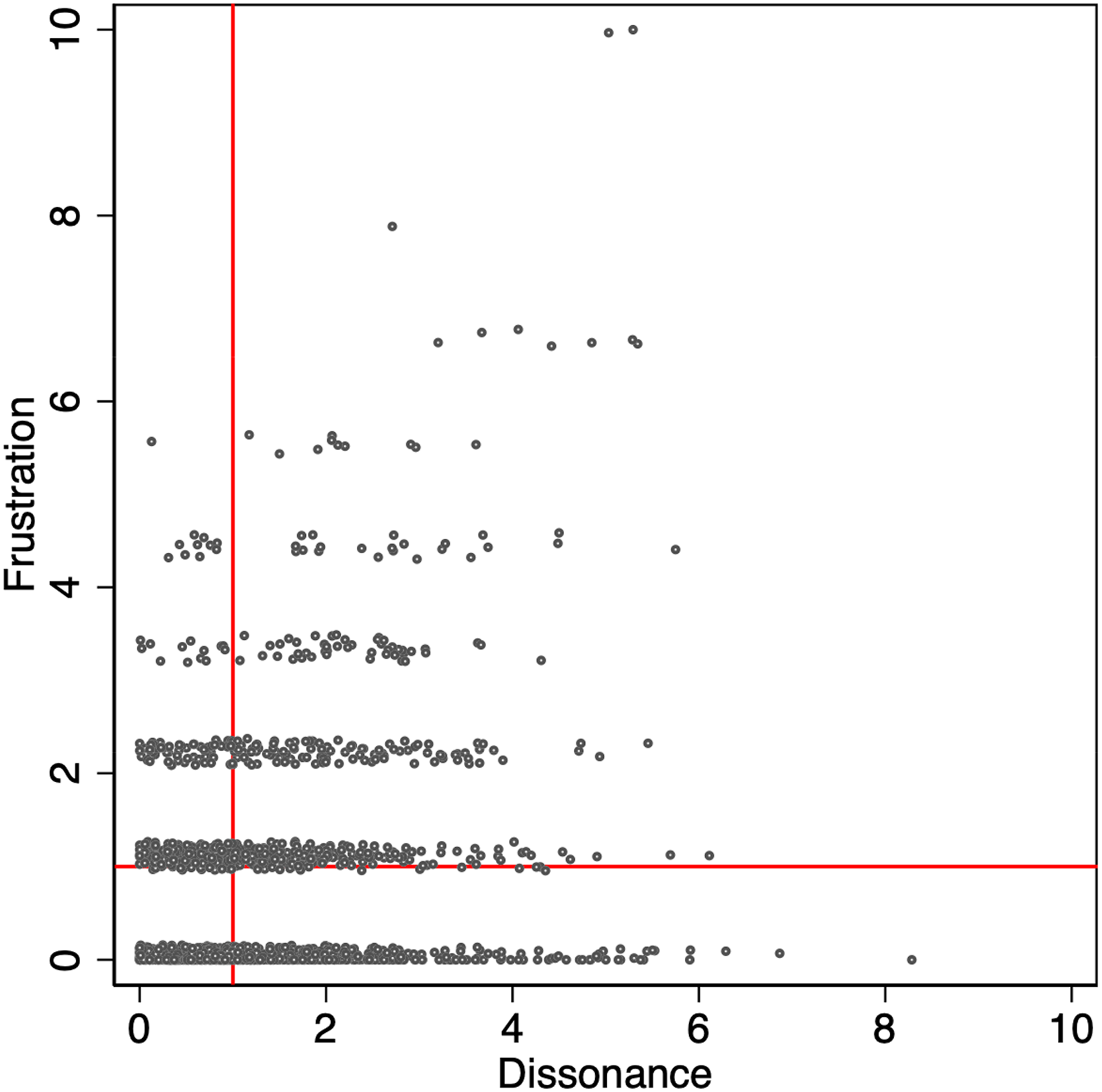
Frustration and dissonance among 79 Latin American parties.
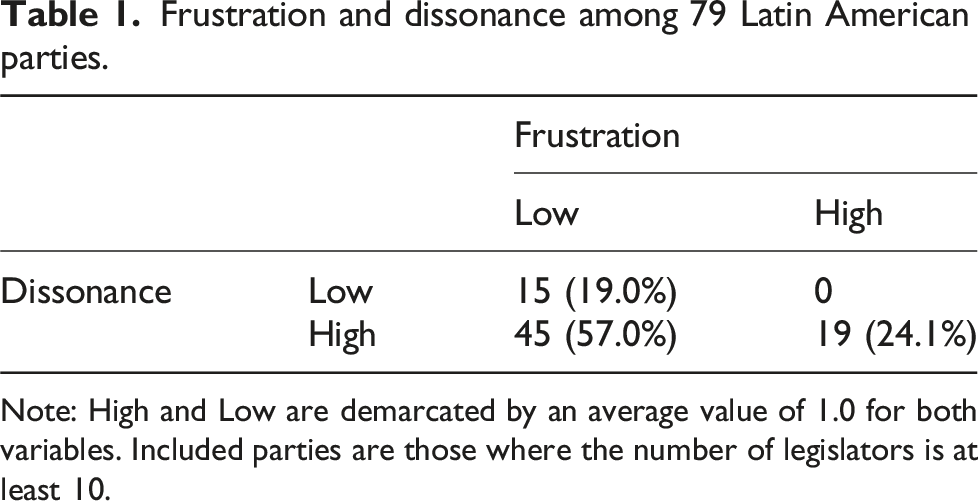
Note: High and Low are demarcated by an average value of 1.0 for both variables. Included parties are those where the number of legislators is at least 10.
Who are these dissonant and frustrated legislators and to which types of parties do they belong? The short answer is that all parties face these concerns, as every party in our sample, across all 18 counties, has both frustrated and dissonant legislators (again defined as distances greater than one on either scale). The propensity for high levels of frustration and/or dissonance, however, is highly variable. As an example, while only about one-quarter of Brazil’s MDB legislators claim that they align with their party ideologically (frustration = 0), three-quarters of that country’s PSDB members fall into that category. Similarly, in Bolivia, while over 80% of the MAS legislators give equivalent scores for themselves and their party, that percentage is under one-half for the country’s PPB. By contrast, at least 60% of legislators in each of the four sampled parties in Chile are content, as are about 50% in each of the three Mexican parties. This variance provides a puzzle, which we address by focusing on the ideology and policy positions of the legislators.
A theory of frustration and dissonance
Ideological bases of frustration and dissonance
What determines whether legislators align ideologically with their co-partisans? While many factors are relevant—political networks, religious faith, regional ties, etc.—we highlight the salience of dissent on different policies. We hypothesize, however, that the policy differences will have different impacts on left versus right-leaning legislators, owing to the expectation that the right will have a higher propensity to camouflage their ideological positions. The camouflage, it should be emphasized, implies that the ideological differences may be more apparent than real. In testing these ideas, we contend that dissonance provides a better vantage point for evaluating dissimulation since legislators who misrepresent their own views are also likely to mispresent those of their parties. As such, even dissimulating legislators are likely to have low frustration. We thus have different expectations and interpretations for dissonance and frustration.
Consider the following illustration. Legislator A self-places at 7 on the 0-10 left-right ideological scale and places her party in the same position, therefore reflecting no frustration. However, her co-partisans’ average self-placement is 8, meaning a dissonance of 1 point. Perhaps this could be the result of A not knowing her colleagues well. It is also possible, however, that A opted for purposely misrepresenting her own and her party’s position as more centrist than they actually are. Comparing the legislator’s and the party’s policy preferences could signal whether there is dissimulation. If there is a positive correlation between distance on policy and distance on ideology, there would be evidence that the legislator is providing a true view of their positions. By contrast, if the policy distance is small but the ideological distance is large, then there would be evidence of dissimulation, assuming, of course, that the policy of reference is salient, an issue to which we return below. 5
The issue of ideological camouflage has been the focus of several studies (e.g., Ames and Smith 2010; Zucco and Power 2024). As Power and Zucco (2009) and Power and Rodrigues-Silveira (2018) explain for the case of Brazil—but with applications for the rest of the region—the right is still dealing with the legacy of the country’s dictatorial period, even though it ended almost 40 years ago. Part of that legacy is a social desirability bias—labeled the “ashamed right”—which discourages some ideological rightists from labeling themselves as such (Ames and Smith 2010; Dinas and Northmore-Ball 2020; Power 2000). The former president of Brazil’s right-wing Democratas, Senator Agripino Maia, provided a clear example of the ashamed right when he claimed that he headed a centrist party (Fellet 2017) during a 2017 interview with the BBC, but then joined, along with his co-partisans, the far-right presidential campaign of Jair Bolsonaro.
To be sure, not all rightists are shy about their ideology, and those who self-place on the right should be discontented if some of their colleagues disingenuously place themselves towards the center. However, since some (but not all) of the radicals’ ashamed colleagues obfuscate when labeling themselves, parties that host legislators with conservative policy positions would mix legislators who label themselves rightists with others who choose a centrist label. This mix will equate to dissonance, even though true beliefs are relatively similar. Frustration, however, might be low if these legislators label the rest of their party as similar to their own position. The first hypothesis is thus:
Dissonance among right-wing legislators will be higher than frustration. The left is also shadowed by the legacy of leaders associated with hyperinflation (Garcia in Peru), economic collapse (Maduro in Venezuela), usurpation of power (Ortega in Nicaragua) and communist authoritarianism (Castro and Díaz-Canel in Cuba). This, plus the fall of the Berlin Wall and further changes in the international economic and political contexts (Dinas and Northmore-Ball 2020), has led some leftist parties to move towards the center (Cleary 2006; Flores-Macías 2010). Still, the ongoing social and economic crisis in the region, which is exemplified by the exorbitant wealth inequality, continues to justify leftist position-taking. On top of that, the left has organized to attend to social issues such as indigenous rights (Raúl Madrid 2012) and same-sex marriage (Bohigues et al. 2022; Corrales 2021; González-Rostani and Morgenstern 2023), as well as expanding participatory governance (Wampler, 2008). We, therefore, argue that while there may be some dissonance on the left, this type of ideological disagreement will be more prevalent among Latin America’s right-wing legislators.
Right-wing legislators will be more dissonant than left-wing legislators. One way to interpret this hypothesis is that there should be more heterogeneity in self-placement among the right than the left. Since both rightist obfuscators (who place themselves to the left of the truth-tellers) and their co-partisan truth-tellers (who will place themselves to the right of the obfuscators) will be dissonant, the test of this hypothesis relies on the absolute value of intra-party distances rather than a measure that considers whether a legislator is to the left or right of co-partisans. Beyond the issue of obfuscation, whether a party is from the left or right should have an independent impact on ideological distance. When analyzing the history of electoral socialism, Przeworski and Sprague (1988) describe the vanguardist left, which has become frustrated to see their colleagues leaning towards the center to expand the left’s support basis. In modern politics, the vanguardist hypothesis is clear in the debate between Errejon and Mouffe (2016) on how the Spanish party Podemos should label itself. In the book, Mouffe advocates that the party should take a clear stance and self-identify as a left-wing party while Errejon, who is a party leader, contends that the party could advance more by avoiding “orthodox” ideological labels. In the US, leaders such as Bernie Sanders or Alexandria Ocasio-Cortez frequently exhibit frustration, if not anger, that their party fails to fight for radical change. Of course, frustration by the radicals would be matched by those closer to the center who worry about extremist pulls. As with the right, however, frustration among leftist legislators might be limited since the variable relies on responses from the legislators about their colleagues. Even legislators who disagree with some members of their own party might therefore label their party’s ideology similar to their own. Except for members who see themselves continually on the outside of the intra-partisan decisions, this would seem a natural occurrence. We thus conclude that frustration rates should be low overall. But, combining our earlier explanation that the right should have particularly low frustration rates, plus the expectation that some leftists will express a significant difference between their own and their party’s ideology, we expect that frustration rates will be higher for the left than the right.
Left-wing legislators will be more frustrated than right-wing legislators.
Policy bases of frustration and dissonance
Our second set of hypotheses considers how the size of different policy disagreements correlates with perceived and actual ideological distances. Conceptually, the left-right ideology scale results from collapsing attitudes of potentially unrelated policy issues (Campbell et al., 1960; Downs 1957; Enelow and Hinich 1982). The rubble from the collapse, however, will necessarily hide disagreements on particular policy issues. Analysts have tested how this works in Latin America to show that right and left labels combine a wide range of unconnected policy positions (Hawkins and Morgenstern 2010; Rosas 2005).
At the same time, the extensive literature on the salience and ownership of issues demonstrates that certain policy preferences are left aside in order to prioritize others (Fagan 2021; Green and Jennings 2017; Petrocik 1996), and thus not every policy affects ideology, and as such, not every policy disagreement will increase the ideological distance between a legislator and their party. Hinich and Munger (1996) explain such differences in salience using non-circular indifference curves which imply different weights for different policies in legislators’ calculus of their ideal points. By extension, we propose that a legislator motivated by environmental concerns would exhibit and recognize an ideological distance from her colleagues if they did not work to protect natural resources, but disagreements on other issues might weigh less heavily on the legislator’s actual or perceived ideological distance from her party. In sum, only salient policy disagreements will translate to ideological frustration and dissonance.
Which issues are salient to ideology? During the period under study (2010 to 2017), parts of the region experienced two opposing pressures: a substantial expansion of evangelism and new pressures to recognize progressive social agendas. As a result, some parties with a leftist brand that is based on pro-worker or anti-imperialist positions (e.g. Brazil’s PT, Nicaragua’s FSLN, and Mexico’s Morena) have taken conservative policy positions concerning issues such as abortion or same-sex marriage (Díaz Domínguez 2020; Kampwirth 2008; Rennó and Ames 2014). Not all policies, in sum, are equally germane to ideological identity. But since germaneness might vary not only among but also within parties, new moral issues have the potential to create internecine rifts. In examples such as those above, party members might divide on the new issues and reconsider their own or their colleagues’ ideology as a result. Members of a leftist party who take a progressive position might see their conservative colleagues as having moved right, for example. Or, members who have thought of themselves as leftists who cannot abide by the progressive view of social policy might reconsider their own ideology. These scenarios, which have parallels on the right, would generate, in turn, frustration and dissonance.
On average, the distance between a legislator and the rest of her party on moral issues will positively correlate with the size of frustration and dissonance. In short, we expect that disagreements on moral issues will lead legislators to distance themselves from their parties, but when they are close to the party on those issues, they will also be and feel close on ideology. While H2a predicts that moral policies will similarly influence legislators from both ends of the political spectrum, we suggest a different dynamic for economic issues, expecting them to have a stronger correlation with dissonance and frustration for the left than the right. This hypothesis is based on the strenuous debates among the left about development strategies as contrasted with the right’s continual unity around the idea of pro-business prescriptions, even if that comes with disagreements around the edges. The ashamed right thesis also plays a role in explaining a weaker correlation between economic policy differences and ideological coherence among conservatives. At least through the end of the Cold War, Latin America’s left has been diverse (Falleti and Parrado 2018; Levitsky and Roberts 2011), but still clearly defined by socialist ideals in addition to anti-imperialism (Castaneda and Morales 2006; Webber and Carr 2012). Since that time, leftists have continued to emphasize a pro-poor philosophy, but the proposed strategies toward that goal have remained controversial. Looking at Europe even before the end of the Cold War, Prezeworski and Sprague (1988) found that there were “two lefts,” one based on revolutionary zeal and one targeting more moderate pro-poor policies in the pursuit of larger mass support. In their telling, the revolutionaries were disillusioned with the rightward move of their electorally-oriented co-partisans precisely because they moved away from the preferred economic model. Those that held to the revolutionary goals, then, would have been frustrated with their colleagues, and dissonance would have resulted if the electorally oriented group had labeled themselves more centrist. This division has continued into the current period in Latin America. Madrid (2010, 587) explains that the liberal left has “embraced the market-oriented economic policies” while the interventionist left “boosted public spending and expanded state intervention in the economy.” Cleary (2006) divides the groups into the social-democratic and the populist left, and Flores-Macías (2010) calls them pro-market and statist left. Perhaps most memorably, Castaneda and Morales (2006) labeled the “good” and “bad” lefts, which Vargas Lllosa (2006, 2009) distinguished as “vegetarians” and “carnivores.”
6
The right, by contrast, has not faced severe challenges to its preferred economic model. There have been disagreements over the extent to which the state should be involved in the economy (state-led growth), trade and globalization, and the legacy of authoritarian governments (Power and Rodrigues-Silveira 2018) but the right has not moved from the core tenets of neoliberalism. It also coheres in its views about law and order and ties to the church.
7
As a result, rightists can dispute issues such as trade openness without challenging their core ideology. The expectation, then, is that rightists could tolerate some disagreements on particular economic policies, which in our language implies that among this group, economic policy distances should not highly correlate with ideological distances. In addition to the right tolerating policy differences, the ashamed right thesis provides a second reason that differences in economics might not correlate with dissonance. Since that thesis suggests that some (but not all) legislators who favor conservative economic policies will self-identify with the center on ideology, the correlations involving policy positions and the left-right position will be weak. Without that link, policy distances and ideological distances cannot correlate, either. The argument about obfuscation is most applicable to dissonance, but the argument about tolerance would still work against economics generating frustration among the right. As such, the final hypothesis is that:
For the left but not for the right, greater distances between a legislator’s position and her party’s average on economic issues will correlate with higher frustration and dissonance.
8
In combination, these two hypotheses provide insight about potential obfuscation. Since H2a expects that those further from their parties on morals will also be further away on ideology, it suggests that those in rightist parties who choose more centrist ideological positions will also select moral positions to the left of their party’s average. This would indicate a policy basis to the centrist ideological positioning, rather than obfuscation. Adding H2b can also counter the idea of widescale obfuscation, since if it is true that morals do but economic positions do not correlate with ideology for the right, a reasonable conclusion would be that morals are more salient to ideology than economics.
Empirical analysis
In this section, we statistically operationalize our independent variables, policy positions, and ideology, and test them in a bivariate format vis-à-vis dissonance and frustration. We then present our multivariate tests, relying on hierarchical mixed-effects models.
Our first set of hypotheses requires the categorization of a legislator’s ideology into left, center, and right. We rescaled the PELA data such that it runs 0 to 10, and then categorized as leftists those answering 0-2 and as rightists those who self-placed 8-10. 9 This yields 31.6% of legislators on the left, 13.2% on the right, and the remaining 55.2% as centrists.
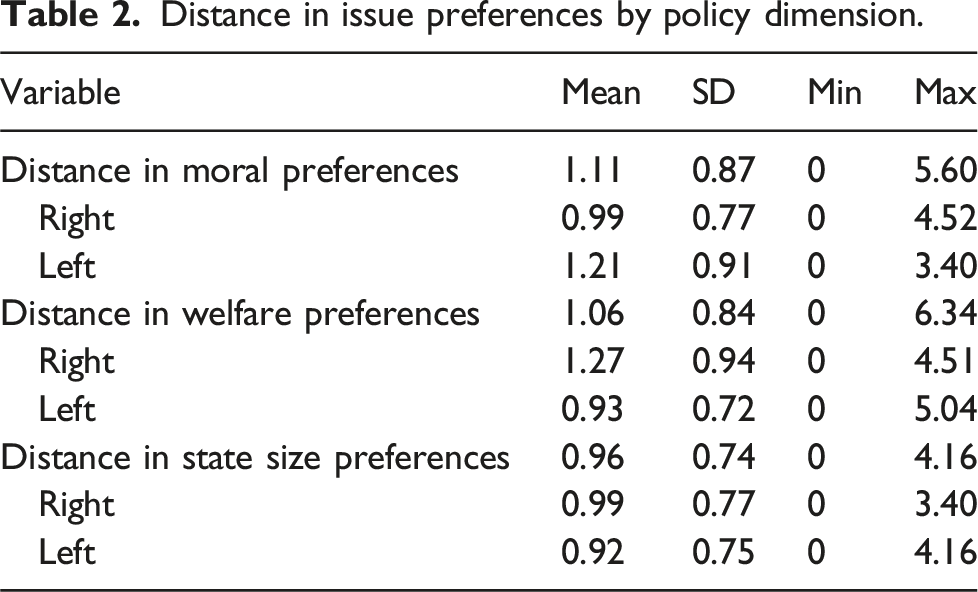
Distance in issue preferences by policy dimension.
Bivariate analysis
Dissonance according to the size of policy distance.
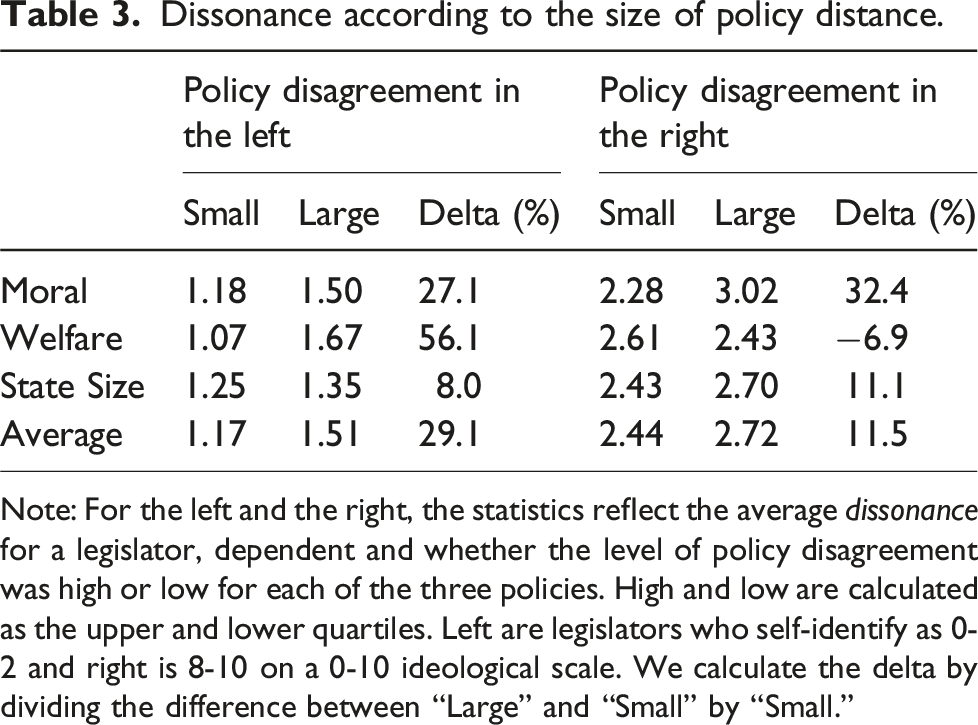
Note: For the left and the right, the statistics reflect the average dissonance for a legislator, dependent and whether the level of policy disagreement was high or low for each of the three policies. High and low are calculated as the upper and lower quartiles. Left are legislators who self-identify as 0-2 and right is 8-10 on a 0-10 ideological scale. We calculate the delta by dividing the difference between “Large” and “Small” by “Small.”
Frustration according to the size of policy distance.
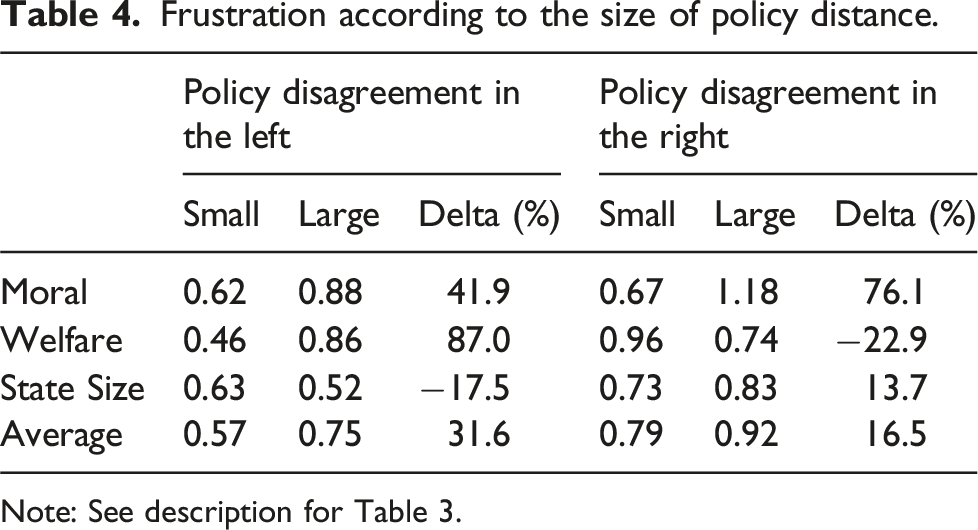
Note: See description for Table 3.
H1a predicts that rightist legislators would have higher dissonance than frustration scores. Comparing the columns in the two tables pertaining to the right confirms this expectation; the average rightist has a dissonance score over 2.0 while frustration rates are below one, regardless of the size of policy disagreements. These tables also support H1b since right-wing legislators’ dissonance rates are significantly higher than those on the left. H1c expected left-wing legislators to be more frustrated than right-wing legislators; in most cases, this is not confirmed, but it is notable that frustration rates for both the left and right are small.
The next hypothesis, H2a, proposes that regardless of their position on the ideological scale, increasing distances between legislators and their parties on moral issues will generate more frustration and dissonance. H2b, however, is a one-sided hypothesis, expecting that the left will be more impacted by distances on economic issues. The tables clearly show that the size of disagreements on moral issues leads both left and right legislators to large actual and perceived ideological distances (the delta is 27.1% to 76.1%). The two measures of economics, however, differ both in magnitude and in their impact on the two sides of the ideological scale. For the left, legislators who are far from their party on welfare issues are also far from their colleagues in terms of actual and perceived differences in ideology. For the right, however, larger differences in welfare policy actually reduce the average levels of both frustration and dissonance, suggesting that the issue is not germane to their ideological positioning. The question on state size yielded smaller impacts, with little difference for either the left or right in terms of dissonance or frustration (and a negative result for frustration among the left). In sum, the bivariate data support H2a and the responses about welfare (but not state size) support H2b.
Finding that policies are related to ideological distance provides evidence against widescale obfuscation, but it does not preclude that it still occurs. To evaluate obfuscation further, we identified 560 legislators who have conservative moral positions and centrist or left ideological positions (Appendix D). 12 In contrast to that large group of potential obfuscators, there were no legislators who held progressive moral views but counted themselves as a conservative on ideology. 13 In short, there are legislators whose ideological position is to the left of their conservative policy positions, but moral progressives do not associate with the right. 14 Rather than obfuscation, this perhaps suggests that there is a non-linear association of moral policy views and ideological perceptions. The economics questions do not provide such clear findings. There are economic conservatives who identify with the center (in accord with the ashamed right thesis), but there are also some economic moderates who identify with the right. The finding, therefore, is that economics are only weakly related to ideology, at least among economic conservatives or ideological rightists.
The two findings–policy distance correlating with ideological distance, and some holders of conservative policy positions identifying as centrists–are not irreconcilable. Obfuscation would be inconsistent with the positive correlation, but if the parties also have progressive and conservative truth tellers (whose ideological positions match their policy positions), plus relatively few cases of reverse-obfuscation (where legislators with progressive policy positions identify as rightist ideologically) then the data could evince a positive correlation. This pattern, it must be emphasized, implies heterogeneous policy and ideological positions among those in rightist parties.
Multivariate analysis
Regressions predicting dissonance (actual distance).
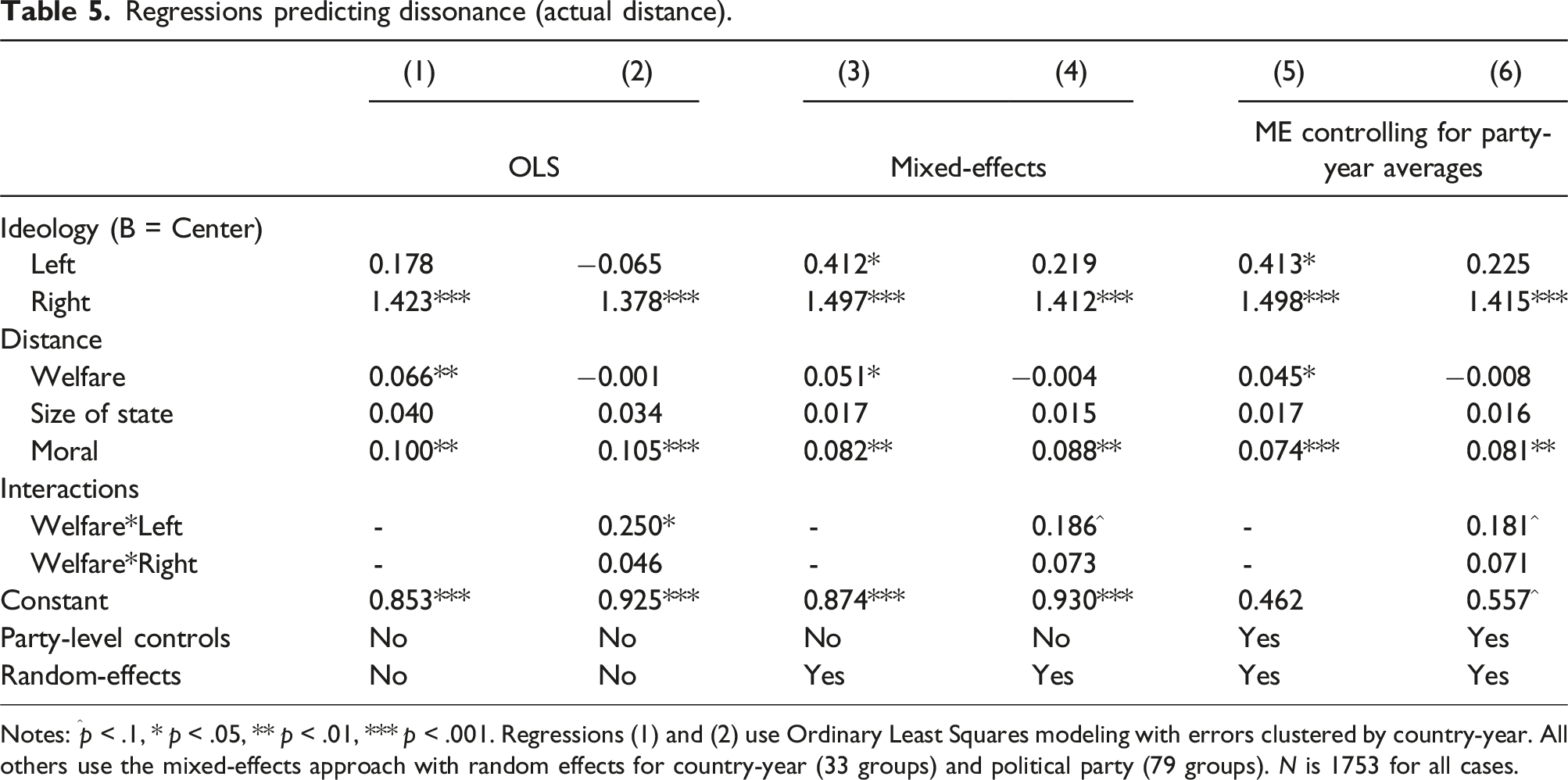
Notes: ^p < .1, * p < .05, ** p < .01, *** p < .001. Regressions (1) and (2) use Ordinary Least Squares modeling with errors clustered by country-year. All others use the mixed-effects approach with random effects for country-year (33 groups) and political party (79 groups). N is 1753 for all cases.
Regressions predicting frustration (perceived distance).
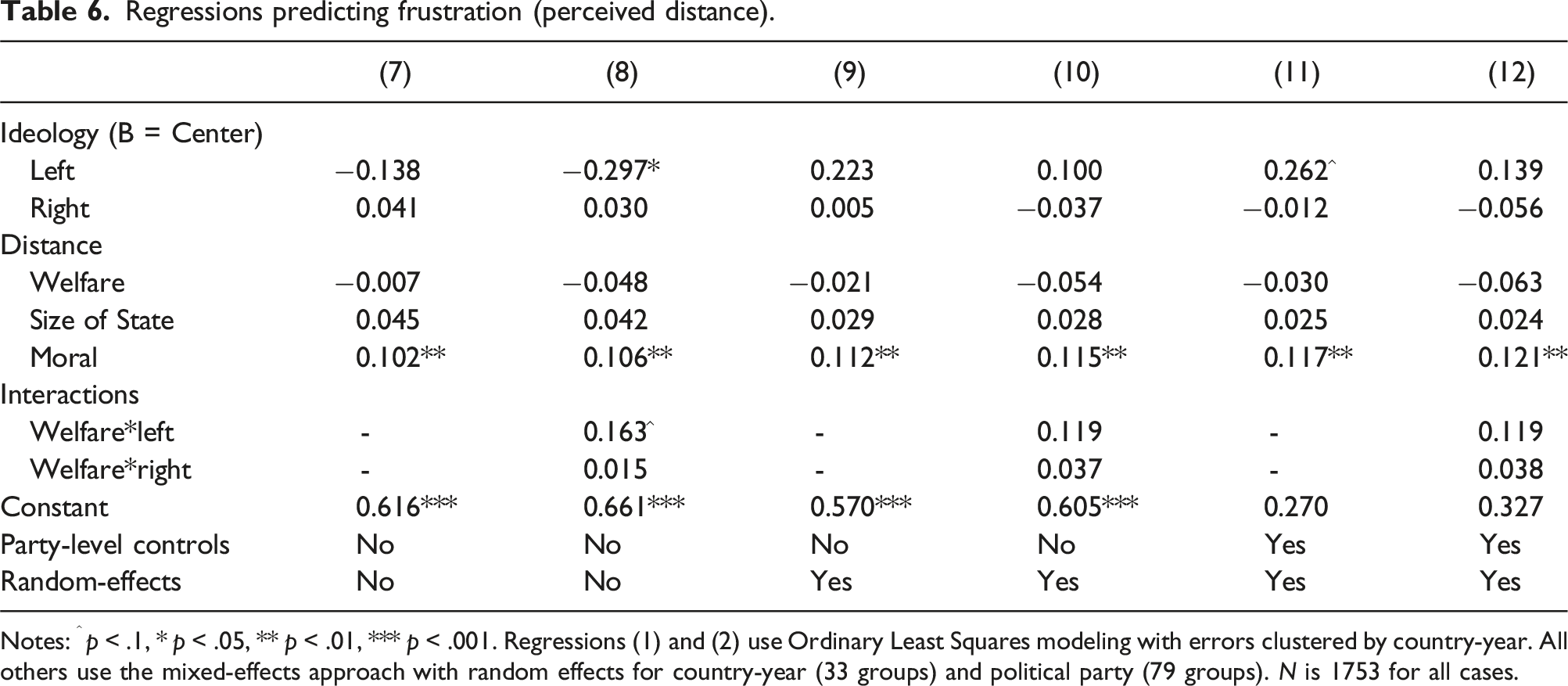
Notes: ^ p < .1, * p < .05, ** p < .01, *** p < .001. Regressions (1) and (2) use Ordinary Least Squares modeling with errors clustered by country-year. All others use the mixed-effects approach with random effects for country-year (33 groups) and political party (79 groups). N is 1753 for all cases.
For each of the dependent variables, we present the results of six tests. The first two sets of models (1-2 and 7-8) use OLS regressions without (1 and 7) and with (2 and 8) interactions. The next models (3-4 and 9-10) consider the mixed-effects approach. Finally, we utilize the mixed-effects approach controlling for party-year averages (5-6 and 11-12).
The bivariate data gave clear confirmation of H1a, which suggested that the right will have higher dissonance rates than frustration. This is also supported by our regressions. We find large and statistically significant coefficients for right in all regressions of Table 5 (dissonance), while they are close to zero and not statistically significant at conventional levels in Tables 6 (frustration).
The regressions also provide key tests for H1b and H1c which compare the relative dissonance and frustration rates, in turn, between the left and right. For the test, the key independent variable is ideological self-placement, which we group into left, center, and right. In comparison to the centrists, H1b expects that the effect of right will be greater than that of left for dissonance, while H1c expects that the effect of left will be greater than that of right in the models for frustration. Note that we do not have expectations about the center, so there is no necessary expectation that both left and right will have statistically significant coefficients. 16 The implication, instead, is that the coefficients for left and right will be substantively different from one another.
All models in Table 5 support H1b, because the coefficients for right are positive and statistically significant, while they are insignificant at conventional levels for left. These are relative to the center, but the comparison supports the hypothesis since it implies that the impact of identifying as a right is considerably larger. Specifically, a marginal-effects analysis using Regression 2 (see Figure 3) suggests that a rightist legislator would have a dissonance score of roughly 2.5, which is a one and one-quarter points more than the expectation for a leftist (holding other variables at their means). Marginal effects plot of dissonance, using regression 2.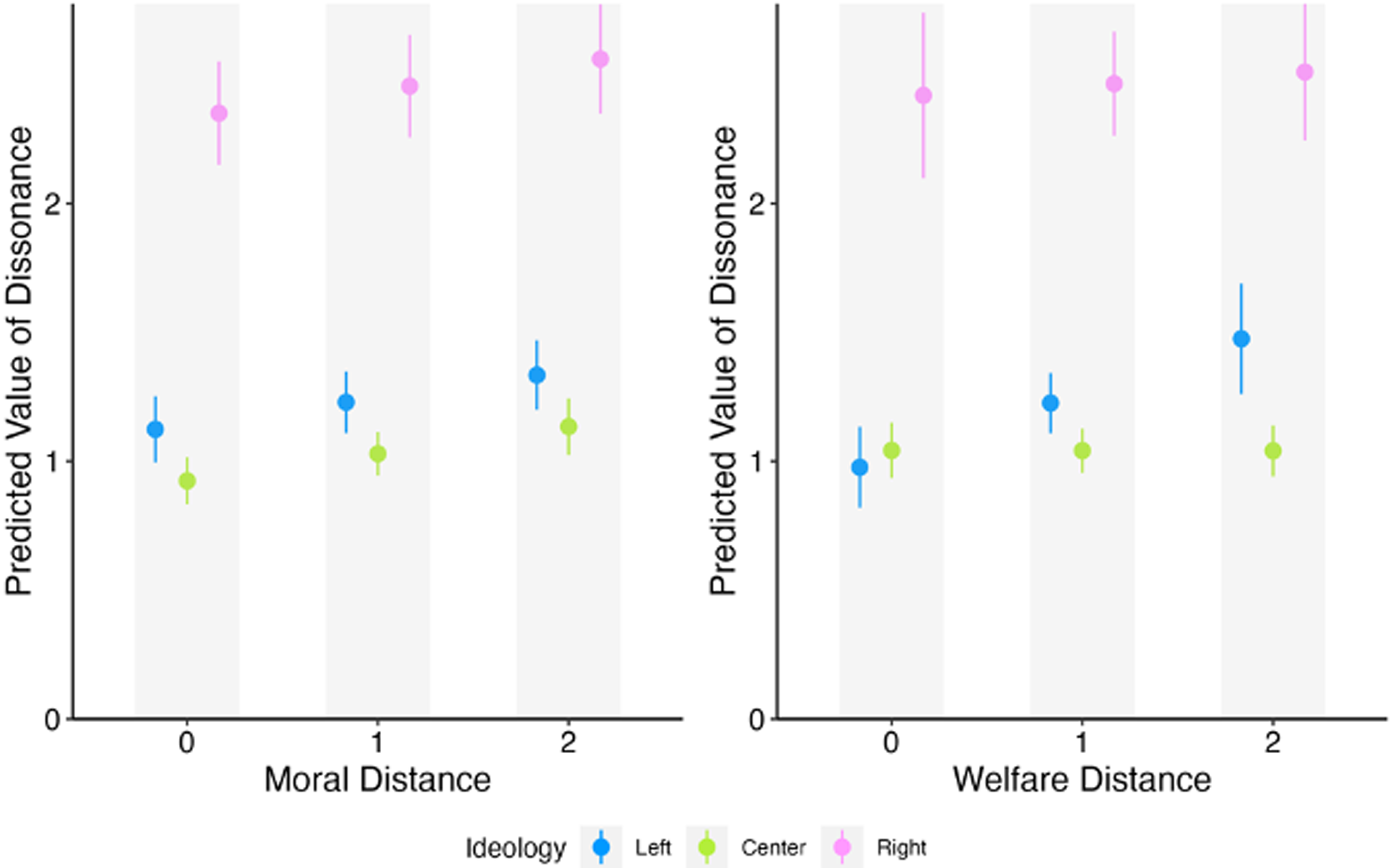
As in the bivariate analysis, the regressions in Table 6 do not usually support H1c, since the coefficient for left is not significantly higher than that for right (considering that the coefficients are relative to the center). 17 As we suggested, this may be because the frustration rates are generally quite low, suggesting that most legislators, regardless of ideology, place their parties similar to themselves.
Next, the regressions support H2a by returning, for both dependent variables, a positive and significant coefficient for the variable capturing the size of differences in moral policies. We show a marginal effects analysis of the dissonance rates in Figure 3 (based on Regression 2). In addition to highlighting the differences between the left and right, it shows that increasing distance on moral issues does have a substantively meaningful impact. Specifically, Regression 2 suggests that moving from 0 to 2 on a legislator’s distance from her party on moral issues changes the distance on dissonance from 1.16 to 1.37 for the left and from 2.38 to 2.59 for the right. For frustration, Regression 7 implies that moving from perfect agreement to a two-point distance on moral issues translates into a change in frustration of 0.51 to 0.72 for the left and 0.69 to 0.99 for the right.
Unlike the dual-sided expectation for moral issues, H2b suggests that economic issues will affect the ideological distance of the left more than the right. The models’ interaction terms give confirmatory evidence of this proposition. The figure shows an almost 50% change in dissonance (from 1.1 to 1.5) for the left as distance on welfare policy increases from 0 to 2, but a negligible (from 2.4 to 2.5) change for the right. Note that welfare is statistically significant at conventional levels in the regressions on dissonance that do not include the interaction, but the significance fades away when this is multiplied by our ideological categorical variable—thus, suggesting that the effects are exclusive to left-wing legislators. When testing the hypothesis on frustration, the interaction term variable is also significant in the simplest regressions (Model 8), but not for the others.
To assure that our results derive from our theory and not operationalization, we applied four robustness checks for each dependent variable. The results and explanations are in Appendix B. In brief, we conducted tests excluding extremist parties, considering specific policy issues rather than the PCA scores, limiting the analysis to only those countries with at least 150 observations, and applying an alternative (SUR) model specification (see Srivastava and Giles 2020; Zellner 1963). Overall, the results indicate similar findings to our main models.
Discussion and conclusion
This paper has sought to contribute to the debate about the factors that drive partisan dissensus. We have shown that even in an age when ideology is amorphous, gaps in the policy distances among co-partisan legislators are indicative of ideological distances. Not all policy differences divide parties ideologically, but we have shown that as differences between a legislator and her party’s positions on morality issues grow, so too does ideological dissensus. Economic issues have a generally smaller impact, and some (welfare) are more impactful than others (size of the state). The analysis also shows that left and right parties differ in terms of their overall levels of ideological agreement as well as in how they assimilate different types of policy.
In this task, we have argued in favor of the value of surveys for assessing legislators’ ideological cohesion and provided two measures for that task. We have also wrestled, however, with the theoretical and methodological challenge posed by the possibility that some legislators, particularly on the right, might misrepresent their ideological positions. Dissonance, which is the more common way to evaluate intra-party cohesion, might overestimate dissensus if some legislators mask their true identities. It is thus important to evaluate whether the dissensus is more apparent than real. We did find that dissonance rates are higher for the right than the left, which would be consistent with the ashamed right legislators cohabiting with their truth-telling colleagues (see also Zucco and Power 2024). Not all the dissensus is a function of camouflaging, however, since there was evidence that there is a policy basis (especially with regard to moral issues) to the ideological distances. Relatedly, very few legislators with progressive policy views, especially for morality, self-identify as ideological rightists. Further, the policy-ideology correlation is confirmed in the finding that policy distances are significant predictors of how legislators perceive differences with their co-partisan colleagues, which we measured via frustration.
To conclude, there is much work to be done regarding the measurement, causes, and consequences of party cohesion. In terms of consequences, in this era of low partisanship, could a populist propel a realignment by cleaving off sectors of the traditional left and right based on the policy and ideological divisions we have uncovered? Populism, defined as a thin-centered ideology (Mudde and Kaltwasser, 2018), is also a potential factor in weakening ideological attachments. Also, with respect to causes, we have not considered how electoral laws, a key variable in many studies of party system differences, impact inter-country variance on party cohesion. We have also ignored here how factors such as parties’ (or countries’) level of heterogeneity in terms of gender, race, class, or political experience make legislators more dissonant or frustrated. We note that the PELA survey data provide the needed information for these types of analyses.
Supplemental Material
Supplemental Material - Frustrated marriage? The ideological distance of members of congress from their parties in Latin America
Supplemental Material for Frustrated marriage? The ideological distance of members of congress from their parties in Latin America by João V Guedes-Neto and Scott Morgenstern in Party Politics.
Footnotes
Declaration of conflicting interests
The author(s) declared no potential conflicts of interest with respect to the research, authorship, and/or publication of this article.
Funding
The author(s) disclosed receipt of the following financial support for the research, authorship, and/or publication of this article: This work was supported by the São Paulo Research Foundation (FAPESP) - 2023/04853-0.

Supplemental Material
Supplemental material for this article is available online.
Notes
Author biographies
References
Supplementary Material
Please find the following supplemental material available below.
For Open Access articles published under a Creative Commons License, all supplemental material carries the same license as the article it is associated with.
For non-Open Access articles published, all supplemental material carries a non-exclusive license, and permission requests for re-use of supplemental material or any part of supplemental material shall be sent directly to the copyright owner as specified in the copyright notice associated with the article.
