







Abstract
The rise of new populist parties has raised concerns for representative political systems and the quality of democracies, by challenging the liberal checks and balances in the name of the ‘general will’. Empirical research has found that populist voters tend to be more dissatisfied with democracy and supportive of direct procedures, while feelings of misrepresentation increase the display of populist attitudes. However, it remains unclear whether this also applies to candidates. This study investigates the differences in democratic attitudes of candidates from populist and non-populist parties, relying on data from the Comparative Candidates Survey. It explores the factors that account for diverging attitudes, particularly regarding party- and individual-level mechanisms. Results suggest that populist candidates tend to reveal lower levels of democratic satisfaction and more negative attitudes towards elections, as well as stronger preferences for direct procedures. These findings have significant implications for both populist studies and the field of political representation.
Introduction
The extensive body of literature addressing the growing significance of populism in contemporary politics converges on a pivotal factor driving its proliferation: the crisis of political representation (e.g. Canovan, 1999; Taggart, 2000). Representative institutions are seen as distant arenas of political decision-making, no longer reflecting social interests and the popular will. Moreover, populism implies a widespread dissatisfaction towards traditional political parties and elites, which are seen as self-centered entities whose main objective is to retain power.
Scholarship exploring the connection between populism and political representation has concentrated predominantly on the perspectives of voters and the programmatic stances adopted by political parties. Empirical research has investigated populist attitudes and their impact on citizens’ views about political representation and voting choice (e.g. Zanotti and Rama, 2021; Zaslove and Meijers, 2023). In addition, scholars have examined the peculiarities of their platforms and the way they emphasize innovative issues, not only in terms of policies, but also regarding democratic reforms (Bedock et al., 2023; Best, 2020). While these contributions have developed our understanding of populist politics from both the demand- and supply-sides, the knowledge on prospective representatives – i.e. those party officials who bridge the gap between the top leadership and grassroots supporters - is very limited, especially from a comparative perspective. 1
Surprisingly, although conventional wisdom argues that supportive attitudes among political elites play a crucial role for the stability and survival of democracy, there are few empirical studies investigating the extent to which populist actors, namely party office-seekers, present distinct beliefs on democracy. Thus, the present study aims to contribute to this literature by focusing on candidates’ attitudes towards democracy, examining whether (and why) representatives from populist parties hold distinct views on political representation compared to those affiliated with non-populist parties.
It is important to put populist candidates’ attitudes at center stage for several reasons. First, it allows us to expand our understanding of the distinctiveness of populist parties, and to delve further into their (allegedly) ambiguous relationship with representative democracies. Second, it advances the knowledge on an important layer of party politics -, namely candidates running in national parliamentary elections. This is a particularly important stratum within parties given that candidates contribute to citizens’ mobilization, especially during election campaigns, and they have the potential to shape public opinion. Therefore, the analysis of candidates’ attitudes sheds light on an important stratum of office-seekers, contributing to our understanding of their views on electoral democracy (and its alternative) and the degree to which they may disseminate democratic values, and to strengthening diffuse support, particularly with regard to political representation. Indeed, candidates’ views on democracy may determine the shape of new democratic institutions. Finally, investigating candidates’ attitudes is relevant for their systemic implications, as populist discourse challenges the traditional political establishment and mainstream actors, with important consequences not only in terms of (potential) policy shifts, but also for strategic alliances and democratic reforms.
To what extent are populist candidates dissatisfied with the way democracies work? Are candidates from populist parties more likely to display lower levels of confidence in elections than candidates from non-populist parties? Do prospective populist representatives differ in their views about direct democracy? Are there differences between populist candidates belonging to different parties? To answer these questions, we examine candidates’ attitudes towards several aspects of representative democracies drawing on data from the Comparative Candidates Survey (CCS). While scholarship has partially examined candidates’ political attitudes (e.g. De Winter et al., 2020), the degree of differentiation between candidates belonging to populist parties and those associated with other political entities has been substantially neglected hitherto. Consequently, the relevance of this study is twofold. First, we add to the literature on populism and populist parties by addressing a relevant aspect for democratic theory. Second, by employing a comparative approach, we are not only able to grasp the differences across countries and parties but also to uncover the pivotal factors at the party level that influence candidates’ views on political representation.
The paper is structured as follows. The next section explores theoretical arguments combining two strands of research, namely the literature on populist views of representative democracy, and comparative party elites research. The data and methods employed in this study are presented in section three, before examining the main findings in section four. The concluding section summarizes our results and outlines some theoretical and empirical implications for further research.
Populism, representation, and party elites
The crisis of party government and political representation is a key challenge of our contemporary democracies. Many studies highlight the decline of public confidence or trust in political parties and democratic institutions, as well as the emerging trend of technocratic governments (see Caramani, 2017; Dalton, 2004; Pharr and Putnam, 2000). Overall, empirical research has provided solid evidence regarding the downward trend of democratic legitimacy, which is also reflected in the growing success of anti-system discourse.
While scholarship has focused mainly on voters’ perspectives, some empirical studies have also investigated parliamentary elites’ attitudes towards democratic support and the representative linkage between voters and elected representatives (e.g. Best et al., 2012; Essaiason and Holmberg, 1996). However, this approach offers a limited perspective on ‘political representation from above,’ as it confines differences among representatives to the traditional left-right spectrum, overlooking the growing significance of anti-establishment or challenger actors. By doing so, it neglects the mounting challenges faced by mainstream political parties in maintaining public appeal and shaping policy agendas. This is of the utmost importance because parties often curate candidate lists that align with the views and beliefs of the constituencies they seek to represent, while politicians aim to capture the electorate’s sentiments to bolster their electoral prospects. As Gaxie (2018: 498) notes, ‘political representation is also a theatrical presentation through which political worlds try to demonstrate that representatives mirror their fellow citizens’.
The evolving political landscape has prompted scholars to explore office-seekers’ preferences regarding both democracy and its alternatives, revealing that MPs hold divergent views on how democracy should operate and reflecting a broader spectrum of opinions on democratic functioning. Notably, anti-establishment parties have shown a stronger inclination towards embracing democratic innovations, possibly as a means of differentiating themselves from traditional political actors and appealing to voters seeking systemic change (Close, 2020; Núñez et al., 2016). Similarly, MPs on the extremes also show greater enthusiasm for democratic reforms, with left- and right-wing parties respectively promoting deliberation and plebiscitary tools (Junius et al., 2020). Furthermore, it has been found that parties in opposition are more likely to advocate for democratic innovations, potentially viewing them as tools to challenge the status quo and mobilize support against incumbent governments (Gherghina et al., 2023; Gherghina et al., 2024a; Junius et al., 2020). This trend suggests that a party’s position within the political system—both ideologically and in terms of power dynamics—plays a crucial role in shaping attitudes towards representative democracy and political representation.
Existing scholarship on local representatives confirms several key insights. First, elected officials vary in their understanding of democracy, showing different levels of support for representative, participatory, or direct forms of democracy (Denters and Klok, 2013; Heinelt, 2013). Second, political orientations play a crucial role in explaining these differences, both at the local and national levels. Finally, representatives’ attitudes toward democracy are also shaped by subjective norms, with party elites from more established parties tending to be more skeptical of alternative decision-making models that go beyond traditional electoral processes (Koskimaa et al., 2023).
Some studies have used candidate’ surveys to investigate political attitudes towards the functioning of representative democracies. The first noteworthy result highlights the importance of candidate status, i.e. whether it pertains to elite or non-elite groups. Drawing on the CCS (Module I), Zittel (2020) found that candidates who already held previous legislative offices at the local, regional or national levels tend to display more positive views about democracy. In addition, partisanship is important in shaping support for democracy. Indeed, candidates who are ideologically closer to their party are more likely to display positive attitudes about the functioning of representative democracies. Party size also matters, as candidates who belong to parties with better regime access are more likely to be positive about democracy compared to candidates representing smaller parties. The findings of this study corroborate and expand upon previous empirical research based on surveys of MPs, in particular the fact that representatives’ views on democracy depend to a great extent on their integration in the political system.
A study on the attitudes of Belgian electoral candidates towards democracy discovered that a significant proportion of office-seekers hold critical views about the functioning of representative democracy (Niessen et al., 2018). The findings also reveal that outsider candidates —those who do not belong to mainstream parties and lack prior electoral experience —tend to have more negative perspectives on democratic representation. Moreover, these ‘critical candidates’ are more likely to advocate for nationwide popular consultations.
These results are of the utmost importance and emphasize the significant role of political socialization processes and strategic (office-seeking) considerations. Among the first set of factors, partisan identities clearly assume a fundamental place in explaining elites’ opinions and preferences. However, research has been ‘blind’ with regard to the nature of this partisan connection. In other words, it is crucial to untangle how distinct parties may affect the way candidates view representative democracies. In this paper, we contend that candidates from populist parties exhibit distinct perspectives on democratic representation compared to office-seekers belonging to non-populist parties, owing to their unique interpretations of political representation and the challenges they pose to traditional mechanisms of liberal democracies.
Populist parties have been the focus of growing scholarly attention over the last decades. Despite different approaches, it is consensual to characterize populism as ‘an ideology that considers society to be ultimately separated into two homogeneous and antagonistic groups, ‘the pure people’ versus ‘the corrupt elite’, and which argues that politics should be an expression of the volonté générale (general will) of the people’ (Mudde, 2004: 542). Most studies have investigated the electoral basis of populist parties (Norris and Inglehart, 2019; Rooduijn, 2018) or their policy positions, as well their impact on party system dynamics (Wolinetz and Zaslove, 2018). We know far less about how candidates pertaining to populist parties differ in terms of their political attitudes compared to candidates from non-populist parties.
If we consider the literature on populism, we can find two distinct perspectives that relate political attitudes towards democracy and populist discourse. The first focuses on the relationship between populism and democracy at the citizen level. Scholarship highlights the importance of distinguishing two distinct components of democracy (e.g. Beetham et al., 2008; Ferrín and Kriesi, 2016). On the one hand, there is a normative view of democracy, i.e. what people think about democratic principles and democracy as an ideal. On the other, there is a component related to democratic performance that is associated with citizens’ evaluation of democracy (or democracy in action). Conventional wisdom suggests that people displaying populist attitudes are more likely to hold higher levels of dissatisfaction with the state of democracy compared to individuals with no populist attitudes (Gherghina and Pilet, 2021b; Kaltwasser and Hauwaert, 2020). Indeed, empirical research found that individuals with stronger populist attitudes are clearly dissatisfied with how democracy works (Kaltwasser and Hauwaert, 2020; Zaslove and Meijers, 2023). These attitudes may be drawn from policy discontent (Huber et al., 2023) or failures of representation (Silva and Wratil, 2021), but these individuals are no less supportive of the principle of democracy (i.e. in terms of ‘diffuse support’).
Empirical studies also suggest that discontent with representative democracy may correlate with greater support for participatory democracy, although citizens do not differ significantly in their views on direct democracy (Bedock and Pilet, 2021; Bowler et al., 2017). With respect to supporters of populist parties or citizens with populist attitudes, extant research indicates that these individuals show increasing preferences for direct democracy (Gherghina et al., 2024b; Mohrenberg et al., 2021; Seyd et al., 2018; Wegscheider et al., 2023) and openness to reform (Wuttke et al., 2023). Moreover, there is evidence that populist candidates, particularly those from right-wing parties, tend to exhibit higher levels of support for direct democracy (Bowler et al., 2017).
However, if we look at party members, populist rhetoric does not seem to affect individuals’ democratic attitudes. Indeed, members of populist parties’ do not display significant differences in their levels of dissatisfaction towards democracy, political trust and political interest (Dassonneville and McAllister, 2023). Additionally, research on candidates’ attitudes concerning intra-party democracy (IPD) in populist parties have enlightened two noteworthy issues. First, it is thought that low levels of trust and satisfaction towards democracy amongst candidates lead to stronger preferences for open IPD procedures. Second, these preferences do seem to have a correspondence with preferences for democracy models at the system-level (Close et al., 2017; Heinze et al., 2023).
Another important strand of research focuses on the link between populist parties and democracy. It is often assumed that populist actors question the legitimacy of representative democracies, leading to democratic erosion or backslide (e.g. Vachudova, 2021). This is also true for populist leaders who express hostility towards key democratic institutions, such as the independent judiciary or free press, creating potential threats to the regular functioning of liberal democracies. Although some authors argue that populist perspectives are almost unavoidably incompatible with democracy - or with liberal democracy (see Pappas, 2014) - the dominant view is that populists are not necessarily anti-democratic. Yet they defend a new mode of representation and challenge the very essence of democracy by claiming that elections are useless, and that traditional elites have deteriorated and corrupted the ‘true’ will of the people. Indeed, most populist actors are seen as radical actors; in other words, they critique existing political systems by attempting to transform them from within, using democratic and institutional mechanisms (Betz, 1994; Damiani, 2020). While there is broad consensus that a key aspect of populism is its critique of elected politicians and their disconnection from the needs of the ‘real’ people, empirical research on the relationship between populism and alternative forms of democracy (such as direct, deliberative, or participatory democracy) remains complex and inconclusive (Pilet and Gherghina, 2024). In spite of evidence supporting a positive effect on participation and representation (Juon and Bochsler, 2020; Huber and Ruth, 2017; Leininger and Meijers, 2021; Plescia et al., 2019), the idea that populists enhance democratic representation by stressing direct participation has not been observed (Bedock et al., 2023; Paxton, 2020; Ruth-Lovell and Grahn, 2023). Findings from the analysis of populist parties’ programmatic orientations also indicate that there is no direct link between populism and direct democracy (Gherghina and Pilet, 2021a; Gherghina et al., 2024a; Taggart, 2000).
Hypotheses
The existing literature on how populist office-seekers perceive democracy presents a fragmented and often contradictory landscape. This inconsistency in findings can be attributed to two primary factors. Firstly, there is a notable lack of standardization in research methodologies. Studies in this field frequently employ diverse batteries of questions as dependent variables and utilize varying units of analysis. This methodological heterogeneity makes it challenging to draw coherent conclusions or conduct meaningful comparative analyses across different studies. Secondly, the concept of democracy itself is inherently complex and multidimensional (Dahl, 1989). This intrinsic complexity makes it difficult to precisely capture and interpret representatives’ attitudes towards democratic systems. When considering representative democracies, individuals may focus on different aspects, ranging from electoral processes and institutional structures to principles of representation and civic participation. This variability in individual interpretation further complicates efforts to untangle and systematically analyze representatives' attitudes. As a consequence, the likelihood of finding uniformity in their opinions is limited. Be this as it may, we can still elaborate some hypotheses to be tested by relying on extant research. In the following paragraphs, we propose several testable hypotheses that will help qualify the link between populism and candidates’ attitudes towards democracy.
Populist rhetoric stresses the democratic deficit that weakens the legitimacy of the political system: it is well-known that populists attempt to offer the opportunity to express the sense of detachment and dissatisfaction with conventional politics held by a vast proportion of voters (e.g. Kitschelt, 2002; Norris and Inglehart, 2019). Populism often stems from new parties or political entrepreneurs that aggregate support from a variety of groups who share a general discontent with mainstream political elites and conventional representative institutions. Indeed, a study on MPs’ perspectives on democracy found that representatives from populist parties are more likely to criticize the processes of representative democracy (Gherghina et al., 2023). Additionally, empirical findings suggest that candidates from non-traditional parties tend to be more critical of democratic systems (Niessen et al., 2018). Therefore, our first hypothesis states the following:
Candidates belonging to populist parties will present higher levels of democratic dissatisfaction compared to candidates from non-populist parties.
Populism also challenges the role of elections as a key mechanism to achieve fair and good political representation. In particular, populists follow a longstanding tradition that associates elections with an elitist principle and criticizes the professionalization of politics (Caramani, 2017; Invernizzi-Accetti and Wolkenstein, 2017; Urbinati, 2019). From a populist perspective, elections are not appropriate instruments for ensuring elite responsiveness and fair representation. Populist parties aim to represent those citizens who feel powerless and who display low levels of confidence in elections. In addition, populism challenges liberal democracy, aiming to construct a unitary (or hegemonic) vision of popular sovereignty through a binary and simplistic worldview (Bischof and Senninger, 2018; Roberts, 2022). This stands in stark contrast to the fragmentation and plurality of interests that are fundamental to the electoral process and representative democracies. Finally, the attitudes of office-seekers from mainstream parties tend to show a stronger commitment to the core principles of representative democracy, while they remain more skeptical of alternative democratic models (Paulis and Rangoni, 2023; Rangoni et al., 2021). Given these considerations, our second hypothesis claims:
Candidates belonging to populist parties will present more negative attitudes towards elections compared to candidates from non-populist parties. Most populist parties advocate the use of direct democracy, through the expansion of referenda or popular initiatives for example, as a means of reforming party democracy and avoiding political intermediation (Gherghina et al., 2024a). Indeed, the use of referenda to resolve major political issues seems to fit the populist ideology of democracy (e.g. Canovan, 1999; Papadopoulos, 2002). Nevertheless, populist parties often employ referenda strategically (Gherghina and Silagadze, 2020), meaning that they tend to use instruments of direct democracy especially when they are in opposition (Angelucci et al., 2024). It is also common for populist platforms to replace mechanisms of horizontal accountability by other branches of government with variants of vertical accountability, through elections, referenda or plebiscites. Research on the electoral manifestos of populist parties in European countries suggests that these parties view direct democracy as a key tool for advancing a model of policymaking driven by the people. In particular, they emphasize the use of citizen-initiated referenda, aligning closely with the populist understanding of democracy (Gherghina et al., 2024a). Moreover, empirical evidence based on MPs’ survey data across distinct countries found that radical right parties and populist forces tend to show more positive attitudes towards the use of referenda, often as a way of correcting (or complementing) traditional structures of representation (Close, 2020; Gherghina et al., 2023; Junius et al., 2020). Thus, our third hypothesis states that candidates of populist parties are more likely to display positive views on referenda than candidates from non-populist parties.
Candidates belonging to populist parties will present higher levels of support for direct democracy compared to candidates from non-populist parties.
Scholarship on populism indicates the importance of distinguishing different types of populist discourse, namely differentiating inclusionary versus exclusionary populism (e.g. Caiani and Graziano, 2019; Mudde and Kaltwasser, 2013). While the first type is situated on the left side of the ideological spectrum and prioritizes equality, political participation and a deeper integration in the political system of groups that are excluded from decision-making processes, the second type emphasizes the importance of protecting the ‘in-group’ by excluding socio-economic, cultural or ethnic outsiders. This also has relevant implications for political representation (Juon and Bochsler, 2020). Inclusionary populist parties tend to further participation and deliberation as a way of improving the functioning of representative democracies. By contrast, exclusionary populist parties focus on constitutional identity, majoritarian-partisan political dominance and top-down reform, as well as weaker liberal rules (cf. Engler et al., 2022; Paxton, 2020). In other words, the latter aim to strengthen direct political representation by translating the popular will directly into governance. In addition, left-wing populist parties often advocate for greater pluralism and the implementation of inclusive mechanisms to enhance liberal democracies (Mouffe, 1993), whereas right-wing populists aim to prioritize the assertion of people’s sovereignty through more vertical and authoritarian measures (Mudde, 2007). Indeed, qualitative and quantitative evidence suggests that left-wing MPs are more likely to support democratic innovations and citizens’ participation in democratic processes, but radical right representatives are more strongly in favor of instruments of direct democracy (Jacquet et al., 2015; Junius et al., 2020; Paulis and Rangoni, 2023). Given these considerations, we do not expect to find differences between these distinct varieties of populism in terms of overall democratic support, but we hypothesize that they display different attitudes towards direct forms of democracy and elections.
Candidates belonging to right-wing populist parties (exclusionary populism) will present more negative attitudes towards elections than candidates from left-wing populist parties.
Candidates belonging to right-wing populist parties (exclusionary populism) will present more positive attitudes towards referenda than to candidates from left-wing populist parties.
Our final set of hypotheses relates to the role of the democratic trajectory in shaping elites’ attitudes. Previous studies indicate that populist governments in more mature democracies are less likely to challenge and erode key democratic institutions (Wolinetz and Zaslove, 2018). Moreover, the institutionalization of the party system and the age of democracy influence how populist parties perceive democratic decision-making, particularly in their emphasis on the use of direct democracy (Angelucci et al., 2024). Although we do not know to what extent this distinction also holds for political attitudes, it is likely that the democratic trajectory will impact candidates’ views on democracy. The reasons are twofold. First, democratic experience leads candidates to be socialized under democratic rule, thus incorporating the principles of democratic representation, regardless of their ideological orientation. Second, the evaluation of the way democracies work is linked to the overall level of democratic quality and social and political development. In advanced democracies, parties have higher levels of resources for distribution at their disposal and higher quality public services. This is likely to positively impact political attitudes of both citizens and political elites.
Populist candidates in mature democracies are expected to display higher levels of satisfaction with democracy than populist candidates in more recent democracies.
Populist candidates in mature democracies are expected to display higher levels of confidence in elections than populist candidates in more recent democracies.
Populist candidates in recent democracies are expected to display more positive attitudes towards referenda than populist candidates in more mature democracies.
Data and methods
To test the above-mentioned hypotheses, this paper makes use of the Comparative Candidate Survey (CCS) by relying on its three modules: Module I (2005–2012), II (2013–2018), and III (2019–2024). This dataset comprises cross-country survey data on candidates running for national parliamentary elections, and it includes candidates from 20 countries, covering Western and Eastern Europe. Overall, the dataset comprises 33 699 candidate-year entries, and it includes 43 populist parties from a total of 189 (22.8%); 5506 candidates belong to these parties (16.3%). The distribution of data across countries, as well as the elections considered, are displayed in Table A1 (Supplemental Appendix).
We consider sociodemographic variables originally included in the CCS as control variables, to explore the differences between candidates. These comprise gender, age, and education, as well as a dummy variable on whether candidates were previously elected to parliament. Additional party-level data is also included. First, parties are classified as either populist or non-populist according to The PopuList 2 (Rooduijn et al., 2023), and they are also coded as right- or left-wing populist parties. Then, variables on the party’s current governing status and previous vote share are included. At the system-level, regression models control for democratic consolidation and the electoral system, as well as the popular referendum index, which measures the ease of initiating and approving referenda. The complete set of control variables, as well as their sources and measures, is available in Table A2 (Supplemental Appendix). Additionally, Tables A3a and A3b in the Supplemental Appendix present the descriptive statistics for all variables included in the analysis displayed by populist and non-populist parties.
Opinion-items’ wording and respective scales.
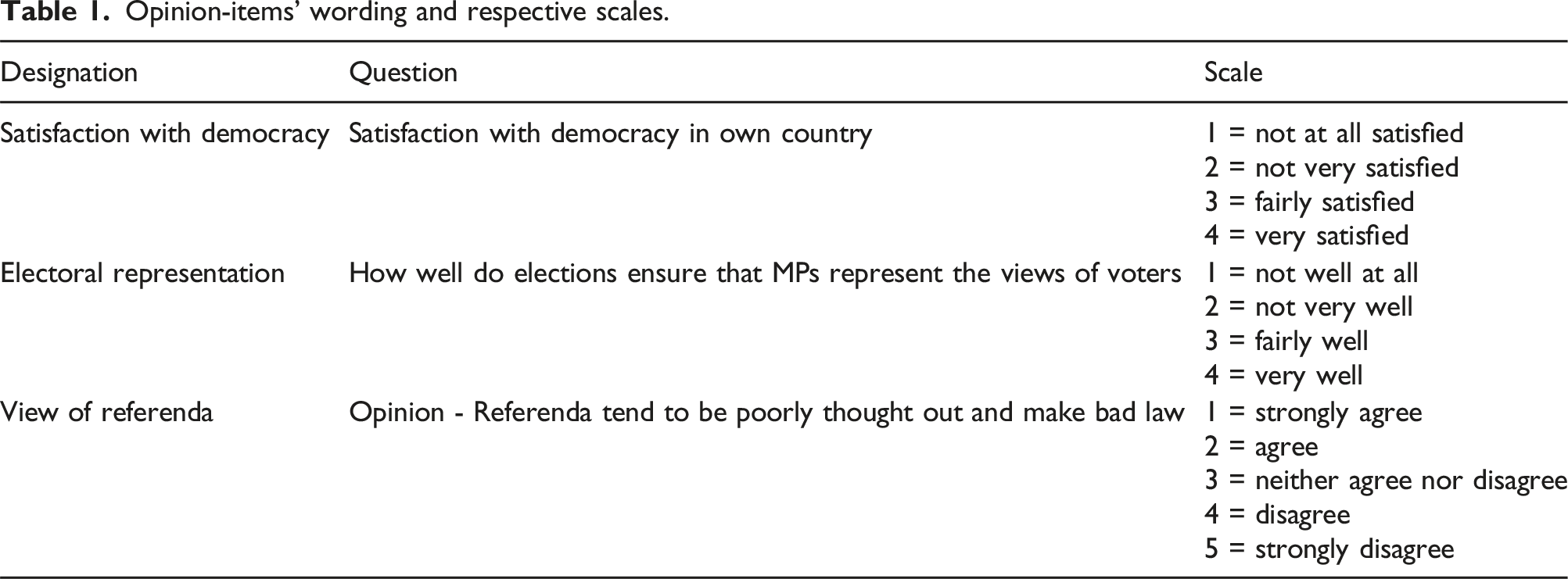
Hypotheses are tested by regressing the dependent variables on the party-, individual-, and country-level predictors by using ordered logit models with nested random effects for countries grouped within years. Given the nested structure of our database - with candidates being nested in political parties within countries across different years -, this approach allows us to study variation both within and between countries over time. As this modelling option incorporates nested random effects for countries within years, we can capture the effect of temporal and country-specific factors on individual attitudes towards democracy. In other words, this specification allows for variation between countries and across time that is not explained by the fixed effects in the intercepts.
Results
Figure 1 summarizes the results for the models using populism as a main predictor for the candidates’ positioning regarding the different views on democracy.
3
In line with previous theoretical expectations, Hypotheses 1, 2 and 3 are thus confirmed by the ordered logit models. In particular, the results indicate that candidates belonging to a populist party are associated with a decrease of 1.156 and 0.732 (p < 0.001) in the likelihood of higher levels of satisfaction with democracy and evaluation of electoral representation. Likewise, populist affiliation is related to an increase of 1.272 (p < 0.001) in the log-odds of positive views toward the use of referenda, thus offering empirical evidence of the association between populism and the latter at the candidate-level. Not only are the coefficients significant in the expected direction, but their magnitude also stresses the substantial impact of populist affiliation on these attitudes: thus, belonging to a populist party appears to be a significant predictor of what political candidates think about democratic political systems. Populism consistently exhibits strong, statistically significant correlations with all positional issues under analysis, holding significance after controlling for individual-, party-, and system-level variables. Ordered logit models for populist parties and sociodemographic variables.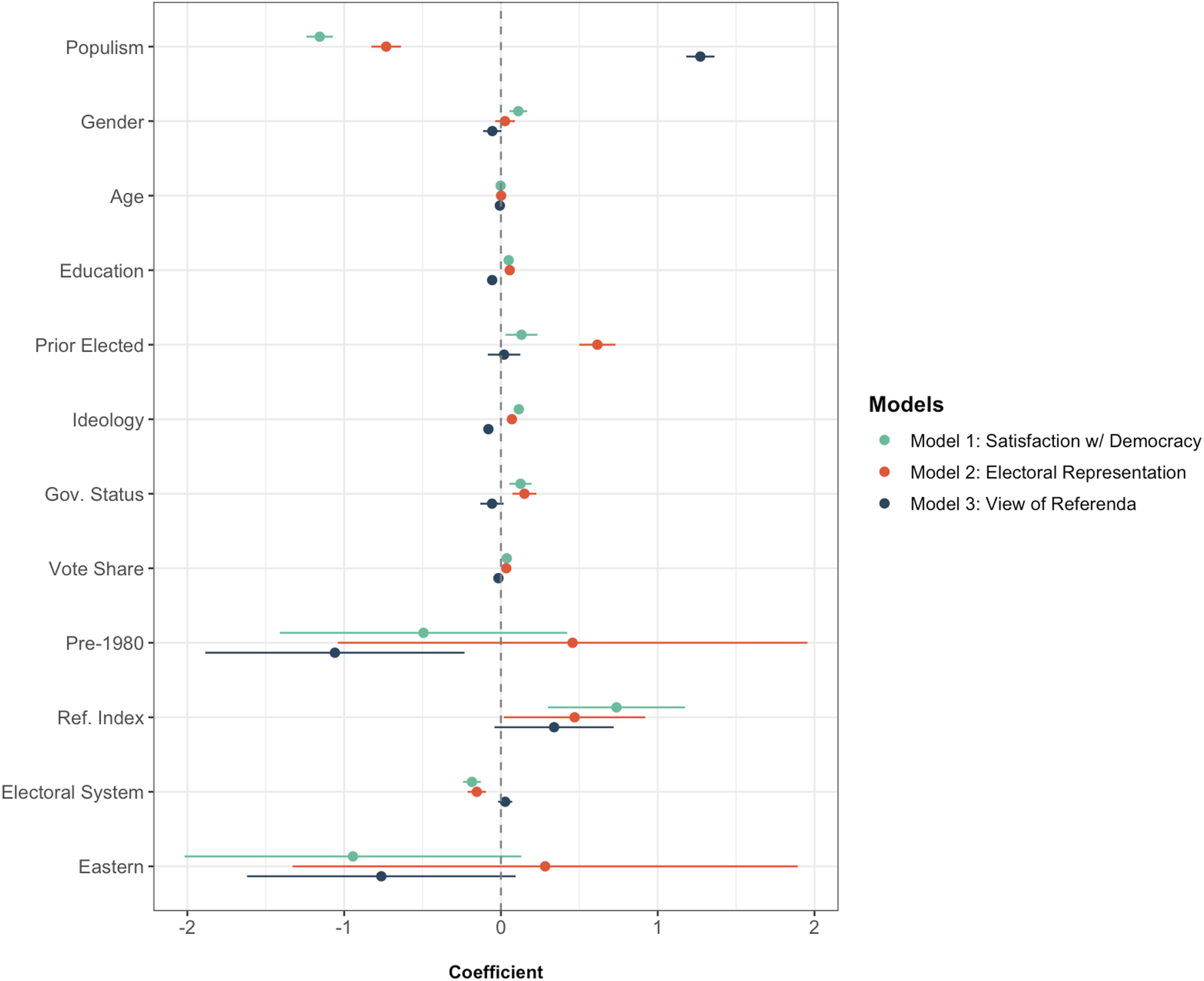
Coefficients for socio-demographic and party-level controls generally present significant effects, although with distinct levels of magnitude. First, gender is only significant when influencing satisfaction with democracy (0.111, p < 0.001), suggesting that men tend to be associated with higher levels of this variable. In turn, age presents a significant association solely with positive views of referenda, but the coefficient has a low effect size (−0.007, p < 0.001). Education is statistically significant across all three models, but the low magnitude coefficients indicate a modest impact on the log-odds of displaying higher levels of such attitudes. Specifically, this indicates that a one-unit increase in the candidate’s level of education is associated with an increase of 0.049 and 0.056 (p < 0.001) in the likelihood of greater satisfaction with democracy and positive evaluations of the representative role of elections, respectively; in contrast, the negative coefficient in Model 3 suggests that more educated candidates have more negative attitudes towards instruments of direct democracy.
Second, candidates who had previously been elected at least once display more positive evaluations of all three items, but this coefficient is only statistically significant at p < 0.001 (0.615) for the candidates’ views of electoral representation. Third, candidates from right-leaning parties also tend to present more positive opinions on democratic satisfaction and electoral representation, but they hold more negative attitudes in terms of the use of referenda – nonetheless, the effects are fairly modest for Models 2 and 3. Finally, candidates from governing parties tend to hold more positive views regarding democratic satisfaction and elections. Additionally, those from parties with greater electoral weight present statistically significant associations with higher democratic satisfaction and favorable views of electoral and direct democracy, yet with modest magnitude.
Looking at country-level variables, the electoral system only seems to matter to democratic satisfaction and electoral representation, as lower disproportionality is argued to be significatively related to favorable views on these attitudes. While democratic consolidation is only slightly significant for positive views on referenda (−1.059, p < 0.05), the ease of initiating and passing referenda is highly correlated with democratic satisfaction. In contrast, it is only marginally associated with positive views on electoral representation, and shows no association with direct democracy. Lastly, the distinction between Eastern and Western party systems does not exhibit any statistical significance.
The interaction between populism and ideology seems to allow us to accept H4a and H4b.
4
While both right- and left-wing populism present substantial associations with negative attitudes towards electoral representation, the effect is more accentuated in the former than the latter (Figure 2). Hence, the findings are in line with the expectations posited by H4a, indicating that candidates from right-wing populist parties tend to have a more negative perception of the role of elections in representing voters’ views. Nevertheless, this is opposed to the general pattern, as suggested by the positive, significant coefficient of ideology: despite the low magnitude (0.070, p < 0.001), right-leaning parties generally tend to have more positive views on electoral representation. Populism thus appears to be a key driver of negative evaluations of electoral representation. Ordered logit models for left- and right-wing populism.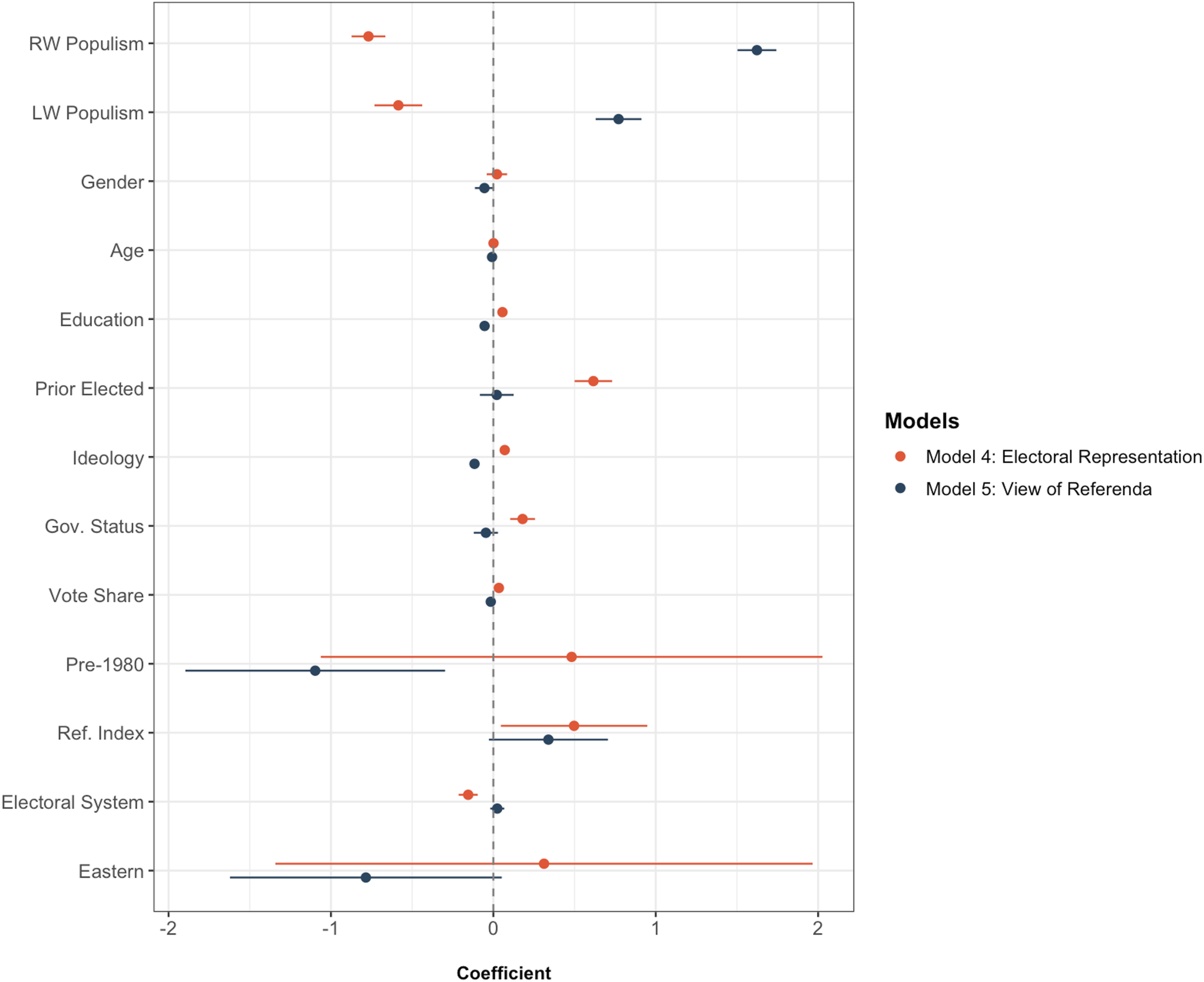
With regard to the views on referenda, coefficients for both ideational varieties of populism are also positive and significant, but the effect is again considerably higher for candidates from right-wing populist parties (1.623 compared to 0.771, both at p < 0.001). As with the previous model, this finding is in contrast with the general pattern indicated by the coefficient for ideology, as it is denoted that left-wing parties present more positive attitudes towards the use of referenda (−0.116, p < 0.001).
Democracy age is also suggested to moderate the effect of populism in predicting the candidates’ attitudes towards democracy. 5 In spite of its non-significant coefficients when isolated, democracies that were established before 1980 present mixed findings: while these are associated with more negative perspectives on democratic satisfaction, coefficients indicate a favorable view of electoral representation; established democracies also present a moderately strong association with negative attitudes on the use of referenda (−1.286, p < 0.01).
In this regard, the interaction of democracy age and populism presents some noteworthy findings. First, this interaction only shows significant coefficients when predicting the candidates’ view of electoral representation and use of referenda (Figure 3). While candidates affiliated to populist parties in consolidated democracies are positively related to democratic satisfaction, this relation is not statistically significant. As a result, H5a is not empirically supported: democratic consolidation does not seem to moderate the satisfaction of populist candidates with democracy. Ordered logit models for the interaction effects of populism and democracy age.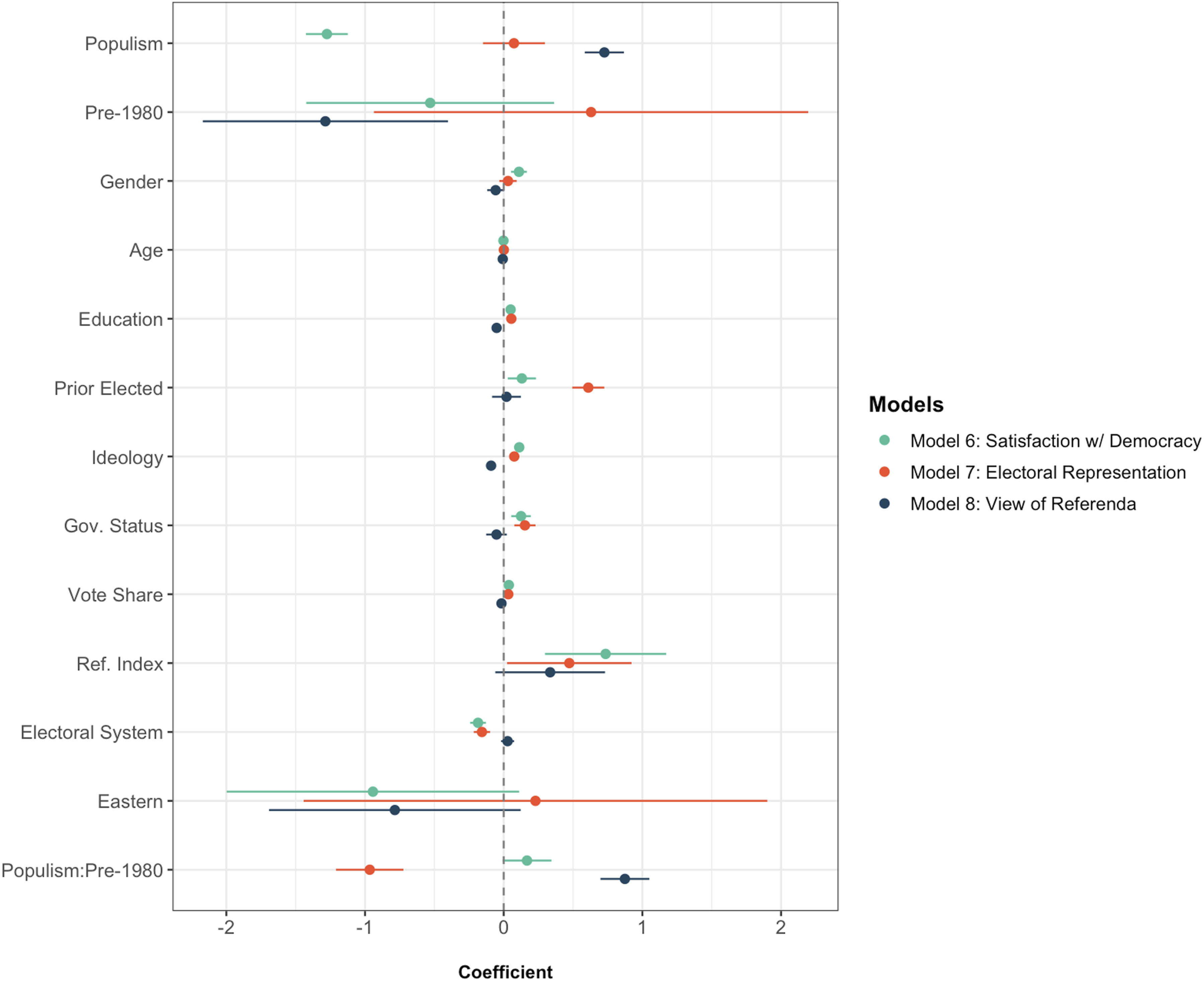
Second, the moderation between populism and democratic age presents a negative coefficient when we look at the assessment of the representative function of elections. This association is substantial and statistically significant (−0.966, p < 0.001), thus suggesting that candidates from populist parties in less consolidated democracies tend to perceive electoral representation more negatively, in line with H5b.
Lastly, H5c is empirically rejected by the models. The interaction between populism and democratic consolidation presents a substantially positive and significative association (0.874, p < 0.001), thus indicating that candidates from populist parties in more established democracies tend to view the use of referenda in a positive light. As a matter of fact, this interaction amplifies the effect of populism (0.726, p < 0.001): candidates affiliated to a populist party in more established democracies are more likely to display positive attitudes toward direct democracy than their counterparts in younger democracies.
Concerning the control variables, effects are fully aligned with those previously presented in the models not including the interaction terms.
Robustness checks were also conducted by rerunning our analysis using a continuous variable of populism, relying on data from the V-Party (Lindberg et al., 2022), namely the Populism Index (v2xpa_popul). This variable addresses the extent to which party representatives use populist rhetoric and varies from 0 to 1. For this purpose, multilevel models comprising populism as a predictor of attitudes on democratic satisfaction, electoral representation and referenda were rerun. Results are available in the Supplemental Appendix (see Table A7), and the tests support our previous findings: populism consistently holds significant, negative associations with democratic satisfaction and electoral representation, as well as a significant, positive coefficient with regard to positive views of referenda. Control variables also hold similar patterns, with only minimal differences. For instance, ideology loses statistical significance in predicting the candidates’ evaluations of electoral representation, and the robustness model reflects a shift to a positive coefficient. Moreover, affiliation to the party in office and Eastern democracies become modestly associated to less favorable views of referenda, while a country’s popular referendum index now presents a slightly significant association to a positive perspective of this tool. All in all, robustness checks support the main idea that candidates from populist parties hold distinctive attitudes towards democracy and political representation.
Discussion and conclusion
This paper referred to the highly disputed ‘non (or less)-democratic’ hypothesis associated to populist politics, using a comparative research design. The empirical analysis examines candidates’ attitudes towards several dimensions of political representation and distinct aspects of democracy. This is a much-needed endeavor, as populist candidates have not only shaped the content and dynamics of elections in several European countries, but have also increasingly influenced the composition of parliaments and policy-making process. This study demonstrates that it is crucial to consider party-related aspects, in particular whether parties adopt a populist discourse, if we want to fully account for the high variation in candidates’ political attitudes towards electoral democracy.
Overall, the results support most of our main hypotheses. The analysis found evidence that candidates belonging to populist parties are more likely to display lower levels of satisfaction with democracy and greater skepticism about elections as a key mechanism of representation, as well as a higher degree of support for direct instruments of democracy, particularly through the use of referenda. These findings ultimately align with previous studies on populism from both the demand and supply side. As stressed by Wuttke et al. (2023), a lower evaluation of electoral representation does not necessarily imply the refusal of core democratic principles. Instead, candidates seem to dwell on the populist parties’ response to poor practices of democratic representation (Stoker and Hay, 2017). Moreover, candidates’ favorable view of referenda might signal the alignment with a majoritarian vision of democracy (Urbinati, 2019) that privileges disintermediating practices. All in all, results indicate that candidates from populist parties tend to follow the usual programmatic stances of these parties: the critique of the establishment and representative practices, and advocacy for the use of direct democratic procedures.
Our analysis also refines prior empirical research on populism by highlighting the pivotal role of the parties’ underlying ideological orientation. Notably, our findings reveal that populist candidates within right-leaning parties tend to exhibit markedly more negative attitudes regarding electoral democracy when compared to their left-wing counterparts. By contrast, right-wing populist candidates view direct democracy more enthusiastically. While the monist or pluralist lean of candidates’ attitudes towards the use of referenda cannot be estimated from the data in use (cf. Piccolino and Puleo, 2024), this finding might reflect the populist parties’ elaboration on different understandings of democracy, as radical right populist parties tend to favor majoritarian forms of decision-making and weaker liberal rules, also driven by anti-pluralism and nativism (e.g. Christensen and Setälä, 2024). Furthermore, whereas populist radical left parties are said to predominantly highlight both egalitarian and participative visions of democracy, the populist radical right parties focus mainly only on participation, also rejecting electoral or liberal understandings (see Schwörer and Koß, 2023).
Furthermore, we discern that the interplay between candidates’ attitudes and populism is contingent on the prevailing political context. This underscores the significance of democratic experience in shaping the perspectives of political elites. While results do not support the expectation that populist candidates in older democracies express more favorable attitudes towards democratic satisfaction, we observe that democratic consolidation has a moderating role on electoral representation: candidates with a populist party affiliation in more established democracies tend to evaluate electoral representation better when compared to their counterparts in newer democratic regimes. Contrary to our initial expectations, candidates from populist parties in consolidated democracies still perceive referenda as a positive democratic mechanism, and this attitude is even reinforced in such a context. It thus stresses that direct democracy and majoritarian forms of decision-making indeed lie at the core of populism’s understanding of democracy.
The results have relevant implications for our understanding of populism and elites’ behavior. Nevertheless, two main limitations might be addressed by forthcoming studies. First, there is a need for future research to focus on the candidates’ own populist attitudes. Lacking this data, our study argues that belonging to a populist party has a significant impact on views towards democracy. However, exploring candidates’ attitudes on populism might prove useful to properly disentangle this relationship. Second, it might also be beneficial to delve into a more detailed analysis of democratic dimensions, namely the rejection or support for liberal values and their interplay with participatory ones.
Moreover, while it is already clear that populist candidates – and their supporters – are more critical of democratic representation, less attention has been paid to their behavior in parliaments or in other institutional arenas. Future avenues of research might explore whether candidates’ opinions also shape the policy direction of a democracy, in particular democratic reforms and the chances of building consensus on democratic innovations or key policy issues. Furthermore, the results may have implications for populist parties’ capacity to either motivate or disengage voters. More critical stances towards electoral democracy can energize populist supporters and encourage either voter turnout or, conversely, uninspiring or polarizing opinions, thus leading to voter apathy or even backlash.
Our findings hold significant implications for research aimed at comprehending the challenges faced by liberal democracies and the erosion of democratic legitimacy. The emergence of parties mobilizing around populist agendas in Western European politics is a relatively recent phenomenon. Their ascent into parliaments, and into governmental roles in some instances, introduces the potential for a process of ‘normalization.’ This process may involve moderation, where these parties accept the established rules of the political game, or conversely, it could contribute to the proliferation of negative public opinions. This underscores the need to adopt a longitudinal perspective when examining the relationship between candidates’ attitudes and their levels of political support. Additionally, a promising avenue for future research involves shifting the focus toward specific party systems, as opposed to the comparative approach employed in this study. While our research reveals that populist candidates tend to exhibit lower levels of trust in traditional democratic representation, it does not explore how these attitudes inform their electoral strategies. This presents an opportunity for both qualitative and quantitative investigations. In any case, our findings raise thought-provoking questions that demand further exploration, prompting the need for additional research into the preferences of political elites. Such research should extend beyond the current predominant emphasis on citizen opinions in comparative studies.
Supplemental Material
Supplemental Material - Populism and democratic attitudes: Comparing populist and non-populist candidates’ views on democracy and its alternatives
Supplemental Material for Populism and democratic attitudes: Comparing populist and non-populist candidates’ views on democracy and its alternatives by João Gaio e Silva and Marco Lisi in Party Politics.
Footnotes
Declaration of conflicting interests
The author(s) declared no potential conflicts of interest with respect to the research, authorship, and/or publication of this article.
Funding
The author(s) disclosed receipt of the following financial support for the research, authorship, and/or publication of this article: This work is supported by the Portuguese Fundação para a Ciência e a Tecnologia (FCT) under grant number 2022.11777.BD.

Supplemental Material
Supplemental material for this article is available online.
Notes
Author biographies
References
Supplementary Material
Please find the following supplemental material available below.
For Open Access articles published under a Creative Commons License, all supplemental material carries the same license as the article it is associated with.
For non-Open Access articles published, all supplemental material carries a non-exclusive license, and permission requests for re-use of supplemental material or any part of supplemental material shall be sent directly to the copyright owner as specified in the copyright notice associated with the article.
