







Abstract
Does intra-party dissent affect parties’ salience strategies? And if so, do leadership-dominated parties de-emphasize a divisive issue dimension more than activist-dominated ones? Scholars have long highlighted the role of intra-party dissent in informing parties’ salience strategies. However, the literature has overwhelmingly focused on EU issues while devoting less attention to the economic and socio-cultural dimensions of party competition. I argue that, driven by the imperative of projecting unity and ensuring survival, parties facing internal dissent over an issue dimension reduce the emphasis attributed to it. Importantly, the effectiveness of this strategy hinges on the control party leaders wield over their parties’ platforms. Focusing on 15 Western European countries and 130 political parties, the findings confirm that higher levels of intra-party dissent are associated with lower emphasis awarded to the divisive issue dimension. The pooled results also suggest that markedly leadership-dominated parties are more effective in de-emphasizing a divisive dimension than activist-dominated ones. However, I find less robust evidence for the latter finding when testing the model separately for the two dimensions.
Introduction
As developed by Budge and Farlie (1983), saliency theory features among the most prominent approaches to party competition. The theory claims that political parties selectively emphasize those issues on which they enjoy a reputational advantage. These often coincide with policy areas where a party possesses a long history of “attention, initiative, and innovation” (Petrocik, 1996: 826). Over time, the literature has elucidated the strategic considerations informing parties’ decisions to either engage with or steer away from specific issues (Green-Pedersen and Mortensen, 2015). For instance, Green-Pedersen and Mortensen (2010) noted how parties are often limited in their ability to focus solely on their topics due to the presence of a broader party system agenda. Alternatively, silencing an issue may sometimes represent a party’s only viable option. Challenged by opponents on an emerging issue, a party may deem it necessary to avoid campaigning on it due to the risk of alienating its own electorate (Rovny, 2012) or compromising future coalition negotiations (Koedam, 2021).
Importantly, how parties engage in issue competition also depends on their internal dynamics. Several contributions have highlighted the role of intra-party dissent in affecting a party salience strategy (De Vries and Van de Wardt, 2010; Netjes and Binnema, 2007; Spoon, 2012; Steenbergen and Scott, 2004). Notably, higher levels of intra-party conflict on European integration are associated with lower emphasis attributed to that issue domain. To my knowledge, only one study has tested this association on the two-dimensional space of party competition (Steiner and Mader, 2017), which comprises an economic and socio-cultural dimension. Yet the authors focus on a distinct concept from intra-party dissent (i.e. intra-party heterogeneity).
Building on previous findings, I argue that intra-party dissent over an issue dimension significantly and negatively affects the salience attributed to that dimension. Rational vote-seeking party elites facing activists’ discontent are incentivized to steer public attention away from their divisions as voters may perceive these as an indication of unreliability to implement the party’s policy program effectively (Greene and Haber, 2015). Further, activists represent crucial labor and valuable personnel at leaders’ disposal (Ceron, 2012; Wagner and Meyer, 2014). Ignoring the demands of disgruntled militants may ultimately endanger their leadership status, lead to party splits, or endanger the party’s survival.
However, intra-party conflict 1 should not affect all parties equally. As noted, parties’ leaders, who live from politics, “are primarily motivated by their expected office benefits” (Strøm, 1990: 574), while activists, who live for politics, tend to be ideologues whose support to the party is driven by policy-seeking motives (e.g. Schumacher et al., 2013). This implies that the hierarchical structure of a party has profound implications for both its positional and salience strategies (Kölln and Polk, 2024). I hypothesize and empirically substantiate that the internal balance of power between leaders and activists significantly conditions a party’s responsiveness to intra-party dissent. Leadership-dominated parties, enjoying greater leeway over policy choices vis-à-vis internal veto players, should be more effective in de-emphasizing a divisive issue dimension, as the hierarchical nature of the organization facilitates decision-making and substantially reduces risks of principled opposition (Schumacher and Giger, 2018).
I test these arguments against fine-grained measures of intra-party dynamics provided by the 2019 Chapel Hill Expert survey (Jolly et al., 2022) through a series of OLS linear regression analyses with country fixed effects. The cross-sectional analysis extends to 15 Western European countries and 130 political parties.
The results provide evidence that parties de-emphasize a divisive issue dimension when faced with intra-party dissent. This association remains negative and statistically significant, irrespective of the issue dimension over which conflict ensues. Further, leader-dominated parties tone down an internally divisive issue dimension significantly more than activist-dominated ones. Importantly, however, the sensitivity analysis urges it to view the findings from the pooled analysis with a grain of salt. More specifically, I find the interaction term to be statistically insignificant when analyzing the two dimensions separately.
By contributing to the literature linking parties’ hierarchical structure to party behavior (Koedam, 2022b; Schumacher et al., 2013; Schumacher and Giger, 2018), the results also point to the usefulness of measures directly tapping into the internal party structure vis-à-vis less fine-grained proxies that rely on party distinctions based either on ideology (e.g. party families) or issue attention profile (e.g. mainstream/niche).
The paper is organized as follows. The subsequent two sections discuss the literature on saliency theory and intra-party dynamics. Then, hypotheses are presented, followed by the research design and the analysis of the empirical results. Finally, a conclusion puts the findings in context and underscores potential limitations.
Which issues do parties talk about?
Since Anthony Downs’ seminal work (1957), there has been a flourishing scholarly discussion around the mechanisms underpinning electoral competition. One of the most influential contributions has been represented by saliency theory (Budge and Farlie, 1983), later expanded by Petrocik’s notion of issue ownership (Petrocik, 1996). The central claim of the theory is that parties compete by directing the electorate’s attention on the issues that are advantageous for themselves, namely the ones on which they possess a history of “attention, initiative and innovation” (Petrocik, 1996: 826), while silencing those topics that could favor their opponents.
Extant research has questioned some of those theoretical claims (for an extensive review, see Dolezal et al., 2014). One counterargument to selective emphasis is that voters’ concerns may shape salience strategies as parties try to ‘ride the wave’ of public debate by focusing on issues most discussed by voters and the media (e.g. Ansolabehere and Iyengar, 1994; Wagner and Meyer, 2014). Alternatively, parties may opt to emphasize only those issues that integrate the concerns of their supporters with the preferences of the electorate at large (De Sio and Weber, 2014).
Parties’ issue attention profiles might also be shaped by the salience strategies of their competitors (Abou-Chadi and Krause, 2020; Rovny and Edwards, 2012). Familiar to this last strand of literature is the idea of a ‘party system agenda’ (Green-Pedersen and Mortensen, 2010, 2015) limiting the extent to which a party can evade specific issues, no matter how disadvantageous these appear to the party. Parties have been found to engage more with issues already discussed by their rivals when the election draws closer (Seeberg, 2022), when facing competitive elections (Kaplan et al., 2006), as well as in response to heightened media attention (Jones and Baumgartner, 2005), public salience (Sides, 2006), and real-world events (Seeberg, 2023).
Having said that, parties may have very good reasons to avoid flagging certain issues, even when they become highly salient in the party system. First, parties’ issue attention responds to party-specific components such as its historical issue ownership and ideology (e.g. Walgrave and De Swert, 2007). It is reasonable to expect that a social democratic party would be electorally disadvantaged if it were to start advocating for tax cuts, given its history of prioritizing the expansion of the welfare state. Notably, the literature has enumerated additional factors influencing a party’s decision to eschew specific issues from their agenda. They may include a party enjoying a poor reputation on the issue, holding unpopular positions, or being crowded out by competitors. These issues may risk alienating a party’s electorate (Rovny, 2012, 2013) and compromising future coalition negotiations (Koedam, 2021).
Finally, a party’s low-salience strategy may also be motivated by intra-party dynamics. In line with previous research, I argue that party leaders may have excellent reasons to try to curb the emphasis on internally divisive issue dimensions to prevent the party from factionalizing, splitting, or losing its electoral appeal. However, the extent to which they succeed should depend on their degree of control over policymaking within the party. In the remainder of this study, I set to elaborate on and empirically substantiate these claims.
Intra-party dissent and leader domination
Parties are not unitary actors; instead, two main hierarchical groups with often competing and diverging goals can be identified: the leadership and the activists Harmel and Janda (1994); Kitschelt (1989); Kölln and Polk (2024). Generally, the former includes critical leader figures, professional politicians in executive roles within the central party organizations, and influential members of parliaments (Narud and Skare, 1999). Given their reliance on re-election and office, leaders are often assumed to be opportunistic vote-maximizers incentivized to formulate policies resembling the policy positions of voters as closely as possible (Strom, 1990). Conversely, activists are those party members, sympathizers, or members of local branches who live for politics and “invest blood, sweat and tears into the party while they do not directly benefit in economic or office terms” (Schumacher, 2012: 1028). Often depicted as policy-seekers (Kitschelt, 1989), they are primarily interested in voicing their often-radical ideological views (May, 1973).
Importantly, the struggle over power and intra-organizational control may ultimately affect party behavior (Kölln and Polk, 2024). In this paper, I understand intra-party dissent as the level of disagreement among party members and activists concerning the party line set forth by the leadership.
Spatial theories assume parties to be rational actors interested in crafting strategies that attract the most votes (Downs, 1957). Intra-party conflict over the preferred policy position set forth by the leadership may erupt nonetheless, limiting the latter’s ability to pursue an optimal vote-maximizing strategy (König, 2017). Importantly, internal disagreement may also shape decisions over the salience to be attributed to an issue or, more generally, to an issue dimension.
I expect intra-party dissent over an issue dimension to be associated with lower emphasis attributed to that issue dimension. Vote-seeking goals support this argument. To begin with, flagging internal conflict to the public, over the media, in parliament, or party congresses (Greene and Haber, 2016) may jeopardize a party’s electoral fortunes (Greene and Haber, 2015). Internally divided parties may risk losing the support of their core voters, ultimately curtailing their electoral appeal. Indeed, the extent to which a party is perceived as internally cohesive strongly affects voters’ assessment of party policy competence and, ultimately, their voting decisions (see also, Wagner et al., 2020). Greene and Haber (2015: 26) noted that “voters account for parties' internal divisions or previous legislation at odds with their stated policy goals as they rank parties’ policy reputations”. This suggests that political parties should be mindful of their policy coherence and the image they project when seeking to increase voter support. Secondly, research has illustrated a dynamic process in which party competitors leverage their opponents’ internal quarrels to highlight their inconsistencies as well as lack of unity, ultimately aiming at discouraging electoral support for those parties (Kam, 2009). Lastly, greater levels of dissent have been shown to affect a party’s ability to influence public opinion in its favor (Ray, 2003) and run the risk of steering supporters in undesired directions (Gabel and Scheve, 2007).
Most notably, intra-party conflict endangers a party’s own survival. Activists represent crucial labor and valuable personnel at leaders’ disposal (Ceron, 2012). As noted by Wagner and Meyer (2014), activists’ labor has a substantial impact on a party’s issue agenda, allowing parties to sustain electoral campaigns and focus on a broader range of issues. Given the role of activists within parties, conflict between the two hierarchical groups may undermine the leadership’s role and foster changes in the dominant faction (Budge et al., 2010; Kölln and Polk, 2024; Schumacher et al., 2013). It follows that leaders in divided parties are better off silencing highly divisive issues, closing ranks, and commanding discipline over internal infighting.
Previous contributions have tested this argument over the issue of European integration (De Vries and Van de Wardt, 2010; Netjes and Binnema, 2007; Spoon, 2012; Steenbergen and Scott, 2004). For instance, Steenbergen and Scott (2004: 189) found evidence suggesting that parties experiencing internal dissent significantly downplay the European integration issue “as they may fear the consequences of discussing integration politics”. Similarly, Spoon (2012) found internally divided parties over European integration to award a lower share of their manifestos to European issues. Lastly, while employing it merely as a control variable, Van De Wardt (2014) found the association to hold when considering not only the level-effect of intra-party dissent on the level of EU salience but also the effect of changes in intra-party dissent.
This paper departs from the narrow focus on European integration, assessing the impact of intra-party dynamics on salience strategies over the two-dimensional Western European political space. The latter is structured by an economic and a socio-cultural (GAL/TAN) dimension (Hooghe et al., 2002; Jackson and Jolly, 2021). To my knowledge, only one study has systematically tested a kindred version of this argument over these two overarching issue dimensions (Steiner and Mader, 2017). However, while the present study focuses on divisions between leaders and activists, Steiner and Mader (2017: 337) examined intra-party heterogeneity, that is the extent to which party elites hold different policy preferences. As noted by the authors (2017: 338), “differences in opinion will not always result in open conflict. Rather, open conflict (which can be observed by experts) is probably a consequence of preference heterogeneity, issue salience, and the unwillingness to compromise”.
I do not expect the association between intra-party dissent and issue salience to vary substantially across the two issue dimensions. The drawbacks associated with internal dissent should alert the party irrespective of the specific issue on which conflict ensues. Accordingly, this paper presents the following hypothesis:
The higher the level of intra-party dissent on an issue dimension, the lower the salience attributed to that dimension. However, do parties differ in the extent to which they effectively de-emphasize an internally divisive issue dimension? I claim that the success of a low-salience strategy strongly depends on the degree of control the leadership wields over the party organization. As previously stated, vote-seeking elites, cognizant of the electoral consequences of internal dissent, are expected to try to curb the salience of the divisive issue dimension. Nevertheless, party leaders differ substantially in the leeway they enjoy over party policy vis-à-vis activists, rank-and-file, and other potential veto players. As noted by Schumacher and Giger (2017), leaders in markedly hierarchical organizations enjoy a great deal of autonomy, allowing them to control the platform construction, goal formulation, and candidate selection. In others, instead, party policy is heavily conditioned by the preferences of multiple veto players (Tsebelis, 2022). Given the substantial variation among party organizations, the balance of power between the two hierarchical groups can be more readily conceptualized in terms of a ‘leader domination’ scale stretching from ‘activist-dominated parties’ (ADPs) to ‘leader-dominated’ (LDPs) ones (Schumacher et al., 2013). A growing literature suggests that the degree of leader domination has important consequences for party platform change. First, LDPs are more likely to alter their issue positions than ADPs (Schumacher and Giger, 2018). This reflects the latter’s tendency to follow shifts in the mean party voter, while LDPs are more responsive to mean voter shifts (Schumacher et al., 2013), especially in markedly polarized party systems or in response to electoral defeat (Koedam, 2022b). That said, previous studies have found the internal balance of power between leaders and activists to be, at best, a weak predictor of changes in issue salience (Schumacher and Giger, 2018). To elucidate this relationship, I argue that leader domination may rather affect party salience strategies indirectly; that is, by moderating a party’s response to intra-party dissent. Notably, I expect LDPs to manage internal dissent more effectively than ADPs by de-emphasizing a divisive issue dimension to a significantly larger extent. ADPs comprise horizontal organizations in which decision-making is dispersed across various actors (Kitschelt, 1989). In turn, the decentralization of power produces more activists in positions where they can block a leader’s action, resulting in stability over the party agenda (Tsebelis, 2002). Further, activists are not a monolithic group, and considerable variation exists in their preference distribution (Kölln and Polk, 2024). Accordingly, well-structured intra-party factions with heterogeneous views on an issue dimension should make any salience change more convoluted. ADPs’ leaders determined to downplay a conflictual issue dimension will be forced to carefully navigate between diverse and often dogmatic preferences, ultimately hampering a party’s responsiveness. Conversely, leaders in LDPs enjoy greater leeway to pursue their vote-seeking and office-seeking goals. Incentivized by the daunting prospect of appearing divided before the electorate (Johns and Kölln, 2020), I expect them to de-emphasize an internally divisive issue dimension more decisively than ADPs. It must be noted that my argument diverges from prior research employing party family typologies as less-than-perfect proxies of variation in party structures (Ezrow et al., 2011; Van De Wardt, 2014). Among these, while still holding considerable explanatory power (Lehmann, 2024), the mainstream-niche dichotomy risks overshadowing parties’ heterogeneity in their internal balance of power and their level of intra-party democracy. By focusing on leader domination, I explicitly account for the role of organization-related characteristics on party behavior. Accordingly, the second hypothesis reads as follows:
The higher the leader’s domination in the party, the larger the negative effect of intra-party dissent on the salience attributed to an issue dimension.
Methods
Data and case selection
I rely on the 2019 Chapel Hill Expert Survey (henceforth CHES) (Jolly et al., 2022). With the help of political expert evaluations, CHES provides party position and salience data on ideological dimensions, specific policies, and other party characteristics. Arguably, the CHES also represents the only source with sufficient time-series cross-sectional data on internal party dynamics. Unfortunately, prior to the last wave, information on intra-party dissent was limited to the issue of European integration, hampering a broader assessment of intra-party dynamics and their impact on party salience strategies. Luckily, the 2019 wave allows to gauge information on internal party divisions more broadly. Indeed, the dataset includes two items assessing the degree of intra-party dissent on the economic left-right and the GAL/TAN dimensions, respectively. The latter dimension commonly encompasses ‘new politics’, socio-cultural issues such as environmental protection, lifestyle choices, individual civil rights, immigration and ethnic minorities issues, and EU integration 2 (e.g. Hooghe and Marks, 2018). It distinguishes green, alternative, and libertarian attitudes, orientations, and parties (GAL) from traditional, authoritarian, and nationalist ones (TAN) (Hooghe et al., 2002). Additionally, the survey contains one question evaluating the extent to which the power to make party policy choices rests with the activists/party members or the leadership. The focus on activists and party members, rather than other potential veto players such as elite factions (Budge et al., 2010) and unions (Allern and Bale, 2017), allows me to assess their influence over party strategy. More specifically, it permits evaluating whether the organization’s balance of power moderates the association between intra-party dissent and issue salience. The analysis extends to 130 political parties in 15 Western European countries 3 .
CHES represents an optimal choice over other comparable sources, namely manifesto data. Firstly, manifestos present parties as coherent entities, hindering the measurement of dissent within the party (Marks et al., 2007). Compared to data derived from single sources, it is also fair to assume experts’ judgments incorporate a wider range of information, stretching from interviews, parliamentary debates, speeches held during party congresses, and programmatic policy documents. In turn, this should prove extremely valuable when studying internal party dissent, for which knowledge derived from party meetings and speeches constitutes valuable insights into intra-party politics (Greene and Haber, 2016).
However, expert surveys also hide systematic error that can potentially undermine the validity and reliability of their estimates. Importantly for this paper, several validation studies have found the accuracy of expert-based issue measures to be associated with the systemic salience these issues hold in the party system (Hooghe et al., 2010; Marks et al., 2007). The first implication is that the reliability of measures of intra-party dissent over an issue may largely be context- as well as time-dependent. The second implication relates to the fact that, besides real-world events (Seeberg, 2023) and media priming (Thesen et al., 2017), systemic salience is often molded by parties themselves (Green-Pedersen and Mortensen, 2015).
This reasoning suggests that the causal arrow I propose here should be reversed since issue salience will influence the degree of intra-party dissent experts perceive. While keeping in mind the potential for endogeneity when interpreting the findings, I believe that this bias will be attenuated by the specific research focus of this study, that is, issue dimensions rather than single issues. On the one hand, party system agendas are seldom dominated by issues belonging to one dimension only but rather reflect the concomitant salience of specific economic and socio-cultural issues. Further, evaluations over two broader dimensions pose less of a challenge for experts as these structure national party systems in Western Europe quite uniformly (Jackson and Jolly, 2021), likely compressing error.
Dependent variable
I set out to provide generalizable insights into the effects of intra-party dissent and leader domination on salience strategies. Accordingly, I stacked the data so that each original observation unit (party) is multiplied by the number of issue dimensions (two) evaluated by experts, resulting in party-issue dimension pairs. The dependent variable captures the salience attributed by each party to either the traditional economic dimension or the GAL/TAN. To measure the emphasis awarded to each dimension, experts were asked to evaluate the ‘relative salience of economic issues in the party’s public stance in 2019’ and the ‘relative salience of libertarian/traditional issues in the party’s public stance in 2019’, respectively 4 . Both scores range from 0 ‘No importance’ to 10 ‘Great importance’.
Independent variables
My two main independent variables are intra-party dissent and leader domination over policy choices. Concerning intra-party dissent, CHES asks experts to score parties with reference to ‘how divided’ the latter were in 2019 on economic and libertarian/traditional (socio-cultural) issues, respectively. A value of 0 indicates that the ‘Party was completely united’ while 10 stands for the ‘Party was extremely divided’. To be fair, the way in which these questions were formulated does not allow it to discern between two distinct sources of internal dissent. On the one hand, disagreement may arise between hierarchical groups (the focus of this study); on the other hand, it could result from conflict within hierarchical groups, namely between party elite factions (Ceron, 2019). Consequently, my empirical model may capture the conjoint effect on salience of these two sources of internal dissent. In fact, evidence of a weak association between CHES’s estimate of dissent on EU integration and measures of elite-level preference heterogeneity (Steiner and Mader, 2017) provides, at the very least, some reassurance of the chosen variable effectively capturing dissent at the level of leaders and activists. I decided to stick to the measures provided by the CHES, as I additionally lack valid and equally fine-grained (cross-country) alternatives to draw from 5 . Just as for the dependent variable, the two original variables have been stacked so that a single variable includes measures of dissent on each dimension separately.
The level of leader domination within the party gauges the ‘Position [of the party] on party leadership versus members/activists making party policy choices’ where 0 indicates that ‘Members/activists have complete control over policy choices’ and 10 that ‘Leadership has complete control over policy choices’.
Control variables
The empirical assessment of the hypotheses includes controls traditionally associated with party salience strategies. Party size is often considered an indicator of a party’s ‘mainstreamness’ (Van De Wardt and Van Witteloostuijn, 2021). In turn, research has shown that mainstream parties differ from parties with fewer internal resources with respect to the issues mostly emphasized in the party agenda (Wagner and Meyer, 2014), as well as the issue dimensions along which they compete (Rovny and Edwards, 2012). Accordingly, party size is controlled and operationalized as a party’s vote share in the most recent elections as of 2019. Additionally, previous studies illustrate how the salience strategies of opposition parties are less constrained than the ones of government parties, as the latter face public scrutiny and are bound to support an executive agenda (Koedam, 2021). Therefore, this analysis also controls for government participation by assigning a value of 1 to parties in government and 0 to parties in opposition as of 2019. Finally, to account for experts’ greater acquaintance with older and more established parties vis-à-vis newer ones (Whitefield et al., 2007), party age is also controlled for and operationalized as the number of years since the party’s first inclusion into the CHES.
Descriptive statistics.
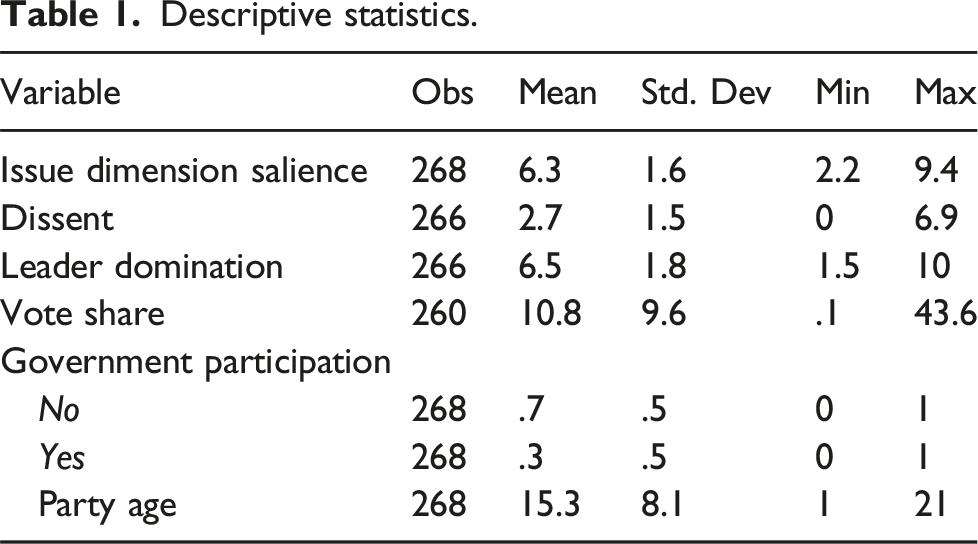
Estimation technique
This study runs a cross-sectional analysis employing a series of linear OLS regression models. Country fixed effects are operationalized through country dummies in each model to account for variations in electoral systems, salient issues in the party system agenda, and other country-specific unobserved characteristics. Moreover, robust standard errors clustered by party are employed to account for the stacked nature of the data.
Results
Predictors of issue dimension salience (2019).
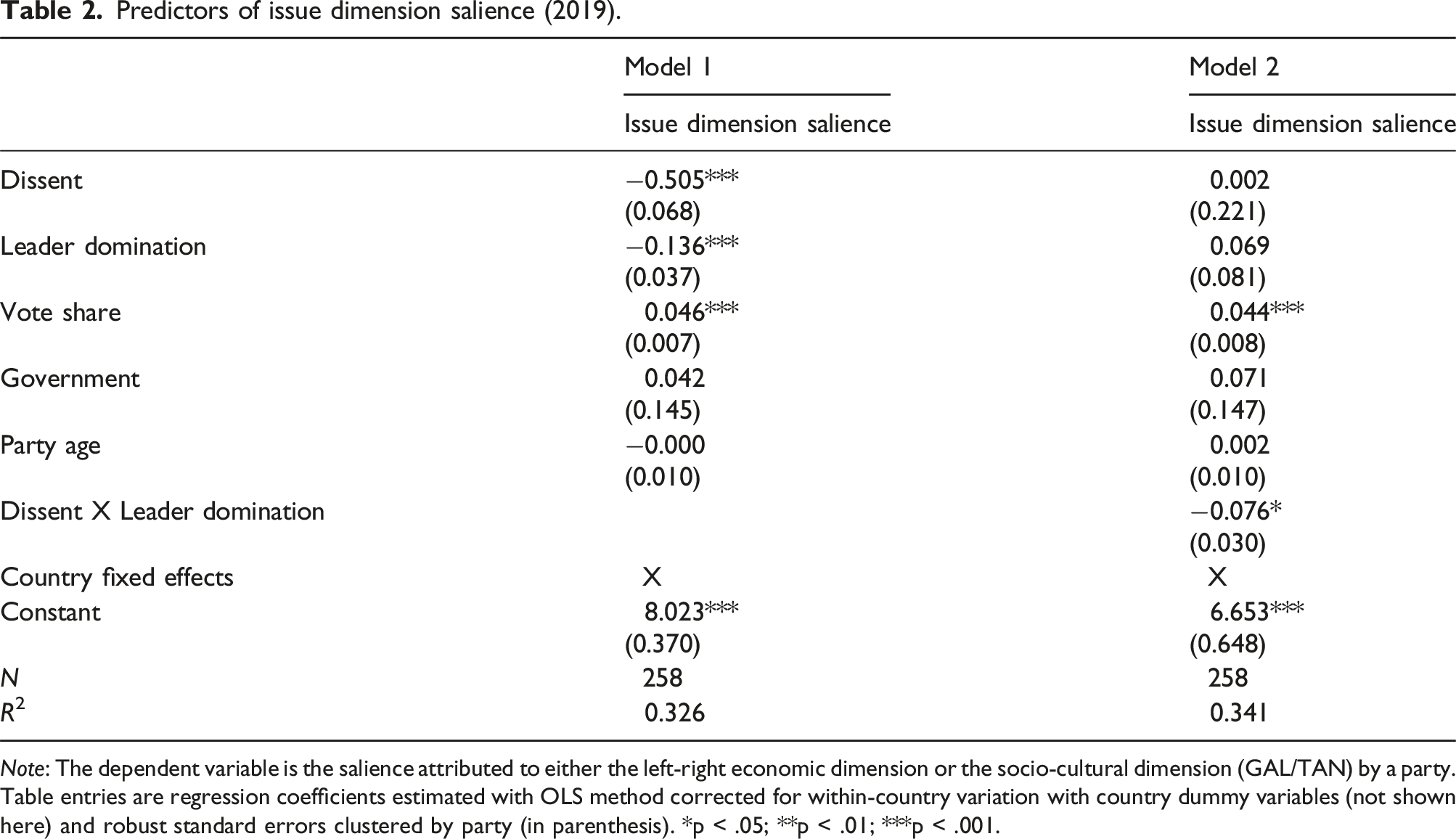
Note: The dependent variable is the salience attributed to either the left-right economic dimension or the socio-cultural dimension (GAL/TAN) by a party. Table entries are regression coefficients estimated with OLS method corrected for within-country variation with country dummy variables (not shown here) and robust standard errors clustered by party (in parenthesis). *p < .05; **p < .01; ***p < .001.
Model 1 also returns a negative and statistically significant coefficient (b = −0.14; p < .01) for leader domination. This suggests that, on average, LDPs award less emphasis to an issue dimension vis-à-vis ADPs. Furthermore, the coefficient for vote share is positive and statistically significant throughout all three model specifications. Following Wagner and Meyer (2014), this could indicate that larger parties, endowed with additional money, media, and personnel resources, are better equipped than smaller ones to emphasize a wide array of issues. Additionally, it may point to a substantive difference between mainstream and niche parties’ salience strategies, with the latter displaying a narrower issue profile.
Turning to H2
8
, the results from Model 2 go into the hypothesized direction. They indicate that LDPs de-emphasize an internally divisive issue dimension to a significantly larger extent than parties in which the balance of power leans toward the party activists. First, the interaction term between intra-party dissent and leader domination is negative and statistically significant (b = −0.08; p < .05). Second, a closer examination of the marginal effects plot adds crucial information for substantive interpretation. Figure 1 illustrates that the negative effect of intra-party dissent on salience becomes statistically significant only for values of leader domination greater than 3. This is important, as it suggests that low-salience strategies designed to stash internal divisions may be ineffective in strongly ADPs. As my argument goes, I believe this to reflect the horizontal nature of these party organizations. Leaders in ADPs are more likely to face unwavering opposition when dealing with internal disagreement over the party line. The resulting salience awarded to the issue may thus reflect the hampered responsiveness of the party organization, as leaders find it impossible to mold such principled preferences. Additionally, the marginal effects plot also indicates that the negative effect is significantly larger for markedly LDPs (leader domination equal to or greater than 9.5) vis-à-vis moderately activist-dominated ones (leader domination equal to 4). The same holds for ‘fully’ LDPs (10) compared to parties with a leader domination score equaling 4.5. Substantially, this suggests that also leaders in moderately ADPs encounter more challenges in amending their issue agenda than their leadership-dominated counterparts. Interestingly, however, this holds only for leaders exerting full control over the party line. Faced with no counterbalances to their vote-seeking objectives (Schumacher et al., 2013), they are significantly more effective in de-emphasizing the divisive dimension, ultimately highlighting the role of intra-party power relationships in shaping inter-party competition. Average Marginal effect (AME) of intra-party dissent on issue dimension salience at varying levels of leader domination. Note: Confidence intervals computed at 95% level.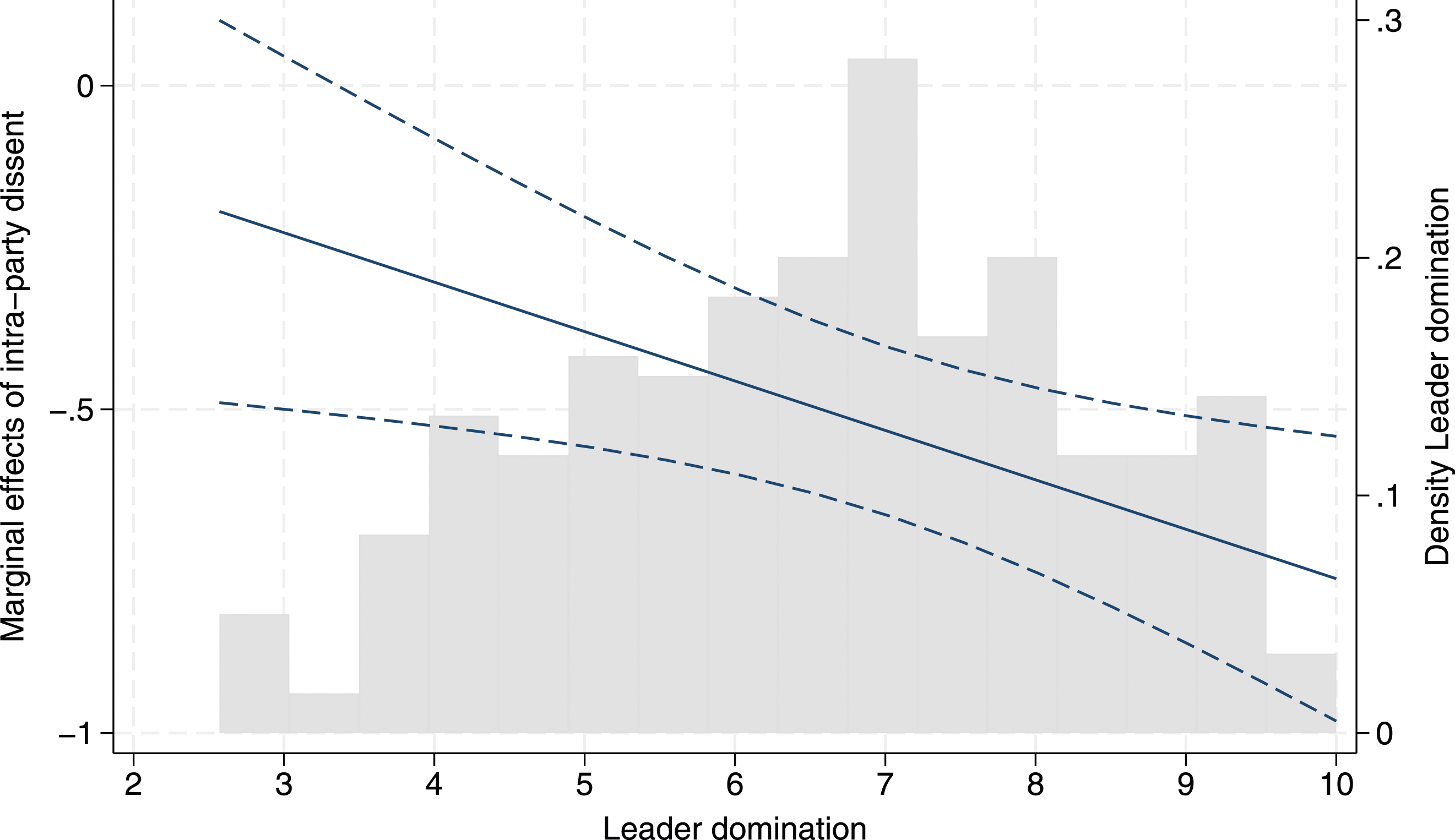
I also run robustness checks to test the sensitivity of the findings. Importantly, I tested the two hypotheses over the EU issue dimension (Table B3). Similarly to previous contributions, I find a statistically significant linear negative effect of dissent on salience. Importantly however, I don’t find support for H2. Model 3 indicates that the conditional effect of dissent on salience is statistically insignificant and slightly positive (b = 0.02). The marginal effects plot in Figure B confirms the flat pattern of the effect, suggesting that leaders may have a hard time defusing internal conflict when dealing with heavily contested domains of competition (e.g. Lynch and Whitaker, 2013).
Further, I also checked whether the associations differ across the economic and cultural dimensions. Table B4 in the Appendix indicates that dissent has a negative and statistically significant effect on salience, irrespective of the dimension of competition. Moving to H2, Figure 2(a) and (b) in the main text compare the moderating effect of leader domination. I find only partial evidence for the economic dimension (b = −0.09; p < .10), while the interaction is just slightly positive and statistically insignificant for the GAL/TAN dimension (b = 0.00). I discuss possible substantive explanations of these patterns in the concluding remarks. Average Marginal effect (AME) of intra-party dissent on the salience of the (a) economic and (b) GALTAN dimensions at varying levels of leader domination.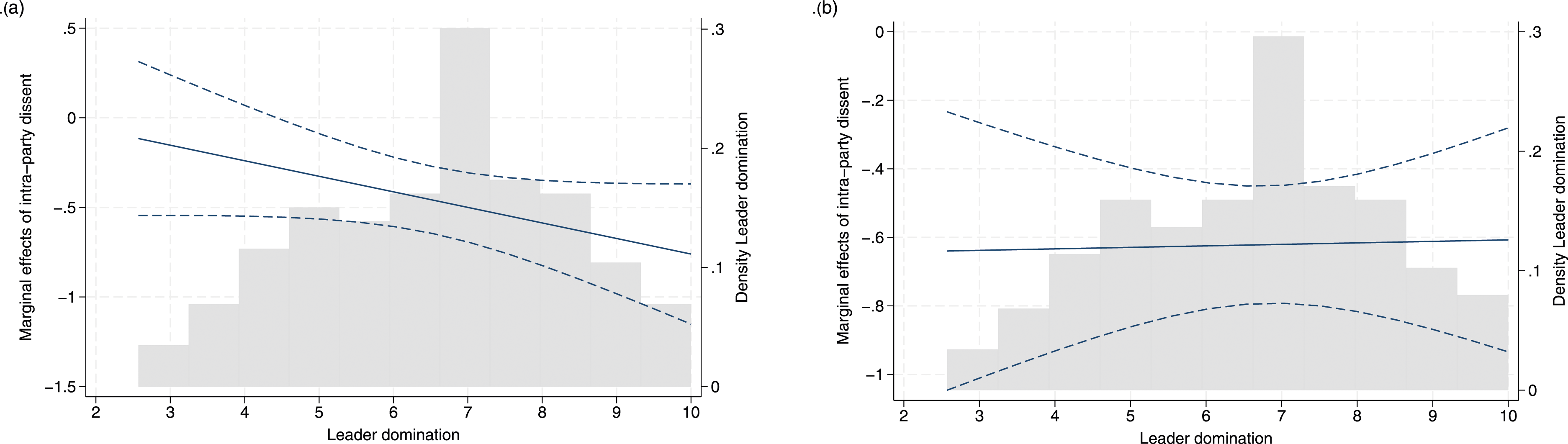
Conclusion and implications
In this study, I highlighted the role of different dimensions of intra-party organization in shaping party salience strategies. The pooled analysis confirms my two hypotheses. First, the empirical analysis underscores the relevance of intra-party dissent for predicting low-salience strategies. The identified patterns are compatible with the idea that leaders facing internal disagreement react by de-emphasizing the divisive issue dimension. Notably, this study extends the scope of previous contributions beyond EU issues (Spoon, 2012). In line with Steiner and Mader (2017), I tested these propositions on the economic and cultural dimensions of party competition in Western Europe, although I focused on intra-party dissent rather than intra-party heterogeneity.
Innovatively, I argued and empirically demonstrated that whether and the extent to which parties de-emphasize a divisive issue dimension depends on the degree of leader domination within the party. Departing from previous contributions focusing on party families and types, I assessed the impact of party organization on party behavior more concretely, finding markedly LDPs to be more effective in eschewing divisive issues from the party agenda than moderate ADPs. I deem this result extremely relevant as small increases in the control over the party line do not seem to make a difference in parties’ strategic responses. Rather, only unhindered power over the organization proves decisive for parties’ heightened responsiveness. The empirical evidence also indicates that this moderating effect is not significant for markedly ADPs, thus suggesting that a high number of veto players with dogmatic policy preferences (Koedam, 2022b; Schumacher and Giger, 2018) are conducive to policy purity (Tsebelis, 2002).
Having said that, evidence at the dimensional level adds a layer of complexity to the findings. Table B4 in the Appendix shows the conditional effect of leader domination on dissent being statistically insignificant for both the economic and cultural dimensions. The two patterns, however, are markedly distinct. The coefficient for the economic dimension is in the hypothesized negative direction while coming just short of customary levels of statistical significance (p < 0.10). I believe this reflects the small sample size of the subset. This contrasts with the cultural dimension’s statistically insignificant yet slightly positive interaction term. Interestingly, this pattern echoes the results of Steiner and Mader’s study (2017), which found the effect of intra-party heterogeneity on salience to be positive (rather than negative) and statistically significant for the cultural dimension. I agree with the two authors in potentially tracing the source of deviation in the multi-faceted nature of the GAL/TAN dimension (see also Brigevich et al., 2017). That is, positive and negative associations at the issue level might have canceled each other out at the aggregate level.
Alternatively, the quasi-flat line in Figure 2(b) may reflect the polarized and contested nature of the emerging second dimension in Western Europe. The increasing salience of immigration, gender, and European integration issues (see Figure B) has greatly impacted party organizations, engendering internal infighting and divisions over the party line (Orhan, 2023). This dynamic may not spare markedly leader-dominated parties, which could not help but discuss internally divisive yet systematically salient issues in the party system.
These latter findings may raise doubts about the adequacy of the pooled design employed in this paper. I defend my original choice in studying intra-party dynamics from a unified perspective as I do not find strong a priori theoretical reasons to expect party organizational characteristics to matter differently across dimensions. At the same time, however, I urge future research to test these findings by expanding the analysis to specific issue domains. Importantly, I invite scholars to elucidate further whether the cultural (and EU integration) dimension rather than the economic one constitute a diverging pattern for the conditional effect of leader domination, and not the other way around.
Finally, I encourage future contributions to amend arguably the main limitation of this study, that is its cross-sectional nature. This would also address an (another) endogeneity concern, that is the potential for reversed causality inherent in my design. On the one hand, disagreement may be a function of the centrality an issue (dimension) holds in the party agenda. As parties tend to trace back their identity to and promote their unity on one issue dimension over another (Koedam, 2022a), I may find intra-party preferences to be more divided on parties’ secondary dimensions of competition. On the other hand, leaders may prevent a party’s salient issue from becoming internally contested by preemptively employing persuasion and offering incentives to the rank-and-file so as to minimize the electoral risks inherent in appearing divided. Accordingly, future studies may extend the analysis either in the past (by leveraging unexplored datasets) or in the future, for example, through incoming CHES waves.
Supplemental Material
Supplemental Material - Managing the grumbles: The role of intra-party dissent and leader domination on salience strategies in western Europe
Supplemental Material for Managing the grumbles: The role of intra-party dissent and leader domination on salience strategies in western Europe by Mattia Gatti in Party Politics.
Footnotes
Acknowledgements
An earlier version of this paper was presented at the 2024 EDC Elections-Democracy-Crisis Conference in Warsaw. I am particularly grateful for the valuable insights of Davide Angelucci, Matteo Boldrini, e Aldo Paparo.
Declaration of conflicting interests
The author(s) declared no potential conflicts of interest with respect to the research, authorship, and/or publication of this article.
Funding
The author(s) received no financial support for the research, authorship, and/or publication of this article.

Supplemental Material
Supplemental material for this article is available online.
Notes
Author biography
References
Supplementary Material
Please find the following supplemental material available below.
For Open Access articles published under a Creative Commons License, all supplemental material carries the same license as the article it is associated with.
For non-Open Access articles published, all supplemental material carries a non-exclusive license, and permission requests for re-use of supplemental material or any part of supplemental material shall be sent directly to the copyright owner as specified in the copyright notice associated with the article.
