







Abstract
While polarisation is on the rise in Western Europe, there is little descriptive evidence about which issues divide voters and how. There are even fewer studies that seek to explain how party salience strategies respond to polarising issues. This study addresses these gaps, underscoring a conceptual distinction that is often missed in the literature on issue competition — namely, that issues can divide the electorate at large (‘general issue polarisation’), or according to the party they support (‘party issue polarisation’). Survey data about voter preferences in six Western European countries shows that the correlation between these two types of issue polarisation is weak. For example, while some cultural issues like soft drug policy and same-sex marriage are highly polarising in general, they do not divide supporters of opposing parties so much. Using party Twitter activity as the dependent variable, it is shown that parties put less emphasis on issues the more extreme voter preferences are, running contrary to predictions based on prior work. By contrast, issues higher in party polarisation received more attention. This study highlights the importance of taking a multidimensional approach to issue polarisation, and calls for more refined theories of how parties deal with polarising issues.
Introduction
The literature on issue competition suggests that parties compete to increase the salience of vote-winning issue positions – for example, those which unite the party’s base but have broad appeal (i.e. spatial incentives; De Sio and Weber, 2014; Hobolt and De Vries, 2015), or those where the party is perceived as credible (i.e. reputational incentives; Petrocik, 1996; Walgrave et al., 2015). Indeed, the emergence of this literature coincides with the issue diversification of Western European party manifestos, and therefore, the growing importance of issue competition (Green-Pedersen, 2007). However, the work on issue competition has little to say about how the polarisation of voter preferences affects party issue emphasis. In short, this gap is worth exploring, because voter polarisation should matter. On the one hand, intense polarisation may benefit extreme parties that oppose liberal democracy (Sartori, 1976). On the other hand, both the work on social cleavages (Hooghe and Marks, 2018; Lipset and Rokkan, 1967) and issue evolution (Carmines and Stimson, 1989) suggest that there is no representation without division.
In short, the main objectives of this article are (1) to describe issue polarisation in contemporary Western Europe, and (2) to explore the effects of issue polarisation on party issue emphasis. Surprisingly, there is relatively little empirical evidence about either of these topics. However, the main theoretical contribution of this article is to stress the multidimensional nature of issue polarisation in this context. More specifically, I highlight a distinction between general and party issue polarisation, drawing on the framework outlined in DiMaggio et al. (1996). In short, general issue polarisation means that the distribution of the electorate’s preferences is extreme or bimodal. Meanwhile, party issue polarisation means that voter preferences are clustered according to party support. More specifically, it is the combination of maximum between-party distance paired with minimal within-party dissent (i.e. ‘consolidation’; DiMaggio et al., 1996).
The first part of this article describes these two types of issue polarisation using data about voter issue preferences in six Western European countries (Issue Competition Comparative Project; De Sio et al., 2019). Crucially, the correlation between general and party issue polarisation is relatively low (r = 0.26-0.35). As a result, some issues which are extremely polarising in general, including soft drug policy and same-sex marriage, tend to not polarise voters according to party support. By contrast, immigration issues score highly in party issue polarisation, even though voter preferences about them are quite narrowly dispersed and unimodal. Therefore, the distinction between general and party issue polarisation matters for describing voter polarisation in contemporary Western Europe.
The second part of this article examines the association between issue polarisation and party issue emphasis. More specifically, I revisit the hypothesis that polarising issues should encourage party attention, because voters should care more about these issues (Han, 2020; Spoon and Klüver, 2015). In addition, I predict a positive interaction between issue polarisation and three other explanations of party issue emphasis – namely, party supporter extremity, the credibility-weighted issue yield (i.e. spatial and reputational incentives; D’Alimonte et al., 2020), and issue salience. Using data from party Twitter feeds to measure party issue emphasis, I find that the effects of issue polarisation deviate from prior expectations. More specifically, parties focus less on issues the more extreme voter preferences are. Remarkably, parties ignore otherwise advantageous issues when voter preferences are extreme. Crucially, the effect of party issue polarisation diverges. Parties focus more on issues that separate supporters of opposing parties – moreover, this effect appears to be explained by the coincidence of party issue polarisation and familiar causes of party issue emphasis.
To summarise, this article reaches three conclusions relevant to the issue competition literature. First, issue polarisation in contemporary Western Europe can be described in two distinct ways. Second, party issue emphasis depends on the type of issue polarisation. Third, the positive effect of spatial and reputational incentives on party issue emphasis is diminished when voter preferences are extreme.
Literature review
Which issues are polarising?
First, this article addresses the description of issue polarisation in contemporary Western Europe. While several recent studies describe between-party animosity in this context (i.e. affective polarisation; Gidron et al., 2023; Reiljan, 2020; Wagner, 2024), relatively few have looked at which issues are dividing voters. Unsurprisingly, most descriptive evidence comes from the US, where congressional partisanship has grown steadily since the 1980s (McCarty et al., 2016), followed by voter polarisation in more recent years (Abramowitz, 2021; Hare, 2022; Kozlowski and Murphy, 2021; Schmidt and Carmines, 2025; Zhou, 2019).
By contrast, there are just a handful of descriptive studies in Europe. These include a few single country, longitudinal analyses that focus on issue depolarisation during the latter decades of the 20th century. For instance, both British and Dutch voters depolarised on economic and cultural issues during this period, largely in response to elite-level convergence (Adams, De Vries, et al., 2012; Adams, Green, et al., 2012). Similarly, German voter preferences depolarised across most issues in the period from 1980 to 2010 (Munzert and Bauer, 2013). However, these studies miss the more recent period in which radical right parties have had a polarising effect (Bischof and Wagner, 2019; Emanuele and Marino, 2024), amid the rising salience of issues like EU integration and immigration (Hooghe and Marks, 2018). In fact, only a couple of descriptive analyses cover this more recent period. First, Caldwell finds that after the Brexit referendum, the gap between Conservative and Labour voters widened on several cultural issues (Caldwell, 2023). Second, Pless et al. find that immigration is most likely to divide European voters according to ideological identity – although, the extent to which voter preferences are bimodal rather than unimodal varies substantially between countries (Pless et al., 2023).
Crucially, there are several ways of measuring issue polarisation – a recent review finds that about 80% of studies take the mean difference between supporters of competing parties, with the remaining 20% mostly using the standard deviation of the whole electorate, with a much smaller fraction using the kurtosis (Mehlhaff, 2024). While these measures tap different aspects of polarisation, rather few studies compare these measures of issue polarisation at once, and to the best of my knowledge, no European cross-national analysis has done so. To summarise, this article addresses this empirical gap by undertaking a cross-national, descriptive analysis of issue polarisation that compares these different measures.
Voter polarisation and representation
Second, this article addresses the relationship between voter polarisation and party strategy. So far, most studies that have done so focus on the effect of ideological polarisation on spatial competition (Downs, 1957). For instance, countries with a wider dispersion of voter ideologies (i.e. left-right identification) give rise to more extreme parties (Ezrow, 2007). Essentially, voter polarisation is a ‘centrifugal’ force that creates and sustains ideologically extreme parties (Adams et al., 2005; Cox, 1990; Merrill III & Adams, 2002; Sartori, 1976; but see Moral and Best, 2023). Similarly, Sani and Satori suggest that voter polarisation is marked by ‘defensive’ competition, where parties focus on mobilising their existing supporters due to the lack of otherwise available voters (Sani and Sartori, 1983).
However, there is little integration between the work on voter polarisation and issue competition. In fact, only a couple of studies examine how issue polarisation affects party issue emphasis. For example, Spoon and Klüver find that voter polarisation about EU integration and immigration spurred parties to allocate these issues more manifesto space (Spoon and Klüver, 2015). In theory, parties should state their position at greater length on issues where voter preferences are extreme, and more is at stake (Spoon and Klüver, 2015). Similarly, Han finds that issue polarisation encourages parties to take clearer positions on core issues (Han, 2020). In short, this is because polarising issues are simple binaries, which permit even low information voters to take a side, and relate it to their political identity and vote choice (Han, 2020). Therefore, parties should expect a greater backlash if they blur, or evade stating at-length their position on polarising issues (Han, 2020; Spoon and Klüver, 2015). 1
However, this work prior work has a couple of limitations. First, issue polarisation is measured using only the standard deviation. Second, polarisation is measured on just a few issue dimensions. Therefore, the variation on the independent variable has been rather limited. To summarise, this article addresses this empirical gap by bring multiple measures of issue polarisation to bear on an analysis of party issue emphasis, which spans dozens of policy issues – ranging from the not at all polarising to the extremely polarising.
Theoretical framework
Defining issue polarisation
Voter polarisation is “the extent to which opinions on an issue are divided in relation to some theoretical maximum” (DiMaggio et al., 1996). Moreover, polarisation is a multidimensional concept. More specifically, there are four ways in which public opinion might be divided – (1) extremity, (2) bimodality, (3) constraint, and (4) consolidation (DiMaggio et al., 1996). Therefore, issue polarisation means how, in the aggregate, voter preferences are distributed, whether they are more extreme or bimodal (‘general issue polarisation’). Otherwise, polarisation means the extent to which conflict is consolidated by group membership – in this case, support for a political party (‘party issue polarisation’). 2
General issue polarisation
‘General issue polarisation’ means that an issue divides the electorate at large. This can refer to either the extremity or bimodality of voter preferences. More specifically, extremity is the extent to which voter preferences are dispersed. This corresponds to the standard deviation (Equation 1). While intuitive, the standard deviation does not always provide a complete picture. For instance, its value is sensitive to the way in which voter preferences are skewed (Van der Eijk, 2001).
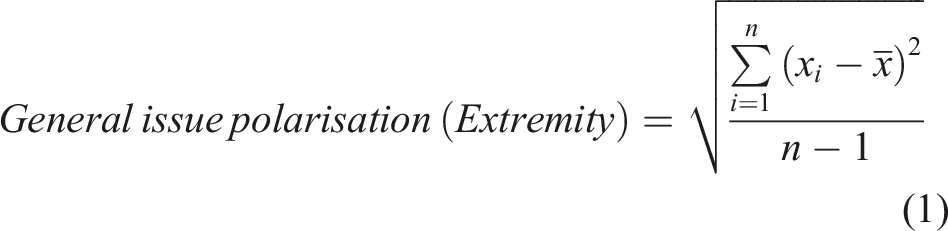
Equation (1). The standard deviation of N voters each located at point x on a finite issue scale (DiMaggio et al., 1996).
More generally, having more extreme voters does not necessarily increase the intensity of conflict around an issue. In particular, if polarisation is a matter of groups (e.g. Esteban and Ray, 1994), then the standard deviation might omit crucial information about how voter preferences are distributed, such as the extent to which they are divided evenly into two sides (i.e. bimodality). To measure bimodality, a handful of studies rely on the kurtosis (Equation 2; e.g. DiMaggio et al., 1996; Down and Han, 2021; Down and Wilson, 2010). However, the kurtosis provides little clue as to how far apart the two modes are (DiMaggio et al., 1996). Therefore, it should be used in conjunction with the standard deviation to provide a more complete picture of general issue polarisation.
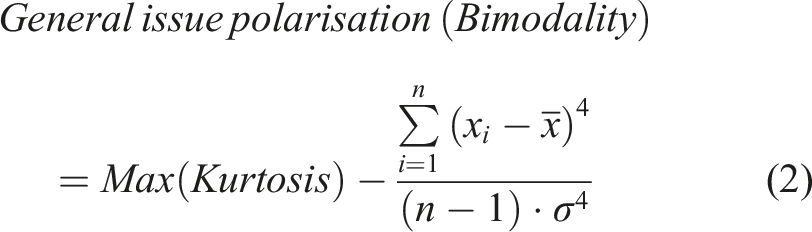
Equation (2). The kurtosis of N voters located at point x on a finite issue scale, where σ is the standard deviation of voter preferences (DiMaggio et al., 1996) – subtracted from the maximum kurtosis value so that higher values reflect bimodality.
Party issue polarisation
However, in explaining party competition, the distance between supporters of competing parties is surely also relevant. If voters choose the party that best represents their issue positions, then differences between parties in the aggregate will emerge (i.e. sorting; Levendusky, 2009). In this sense, DiMaggio et al. refer to the polarisation between partisan groups as ‘consolidation’ (DiMaggio et al., 1996). The challenge becomes how to measure the distance between the supporters of different parties. Indeed, most work focuses on party polarisation at the elite-rather than voter-level (Dalton, 2008; Emanuele and Marino, 2024; Koedam et al., 2025; Lachat, 2008; Sani and Sartori, 1983). To this end, the most widely used measure is from Dalton (2008), who takes the size-weighted variance of party positions on an ideological scale (Equation 3).
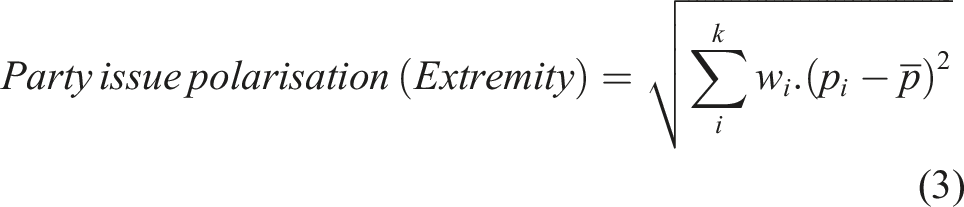
Equation (3). Aggregated extremity of k groups of party supporters of w size located at mean position p on a finite issue scale.
By replacing party positions with the mean positions of party supporter groups, equation 3 can be used to measure the extremity of said groups relative to one another. While this is a helpful starting point, it overlooks the extent to which these groups are internally homogenous, a key aspect of group-based polarisation (DiMaggio et al., 1996). In short, party issue polarisation requires not only that the mean distance between groups is high, but that the overlap between said groups is low, like in Figure 1(a) as opposed to Figure 1(b). (a) Preferences of party supporter groups on an issue scale are internally homogenous and distant, increasing polarisation (E.g. M. S. Levendusky and Pope, 2011). (b) Preferences of party supporter groups on an issue scale are distant but internally divided, reducing polarisation (E.g. M. S. Levendusky and Pope, 2011).
Surprisingly, this measurement challenge has only been addressed recently.
3
In his contribution, Mehlhaff derives the cluster polarisation coefficient, which works by normalising the variance between groups by the variance of the sample as a whole (Mehlhaff, 2024). While Mehlhaff’s coefficient is designed to aggregate conflict over several dimensions, the intuition behind the measurement can be applied to a single issue. In short, party issue polarisation is the distance between group means (Equation 3), normalised by the population-wide variance (Mehlhaff, 2024). In other words, if the mean difference between two groups of party supporters is held constant, but the variance of the sample as a whole drops, this must reflect a net increase in the internal homogeneity of the groups. Put simply, the score increases with between-group heterogeneity and within-group homogeneity (Mehlhaff, 2024). Therefore, at constant between-group distance, party issue polarisation is inversely related to the standard deviation of the preferences of supporters of all parties (Equation 4).
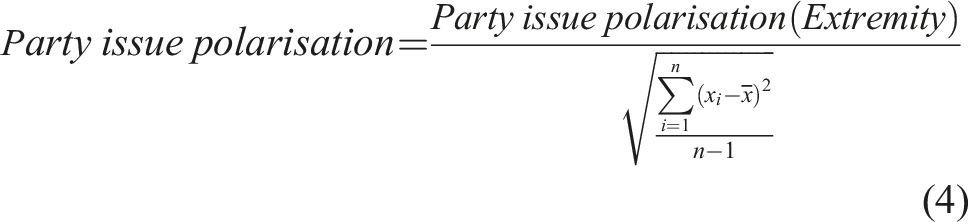
Equation (4). Party issue polarisation of n voters each located at point x on a finite issue scale, where non-supporters have been excluded from the sample.
Party issue emphasis
In election campaigns, parties selectively emphasise issues that they want to raise the salience of (Budge and Farlie, 1983). As discussed, relatively little attention has been paid to how issue polarisation affects selective emphasis strategies. Existing work suggests that, all else equal, voter polarisation should increase party issue emphasis. This is because polarising issues should be particularly likely to factor into voter decision-making – therefore, parties face a more severe penalty if their position on the issue is uncertain (Alvarez, 1998; Bartels, 1986). As Han’s framework explains, there are several reasons that polarising issues should matter when it comes to voting (Han, 2020). First, voter polarisation suggests that the gap between the alternative outcomes is severe – essentially, whichever side of the issue prevails demands an ‘extreme’ policy (e.g. Downs, 1957; Sartori, 1976). Therefore, polarisation should raise the stakes of competition. Second, polarising issues can be thought of as simple binaries that allow even low information voters to engage in spatial voting, much like the ‘easy issues’ described in Carmines and Stimson (1980). Third, issues where voter preferences are clustered into distinct groups, potentially consolidated by party support, are more likely to give rise to and sustain political identities (Bornschier, 2010; Han, 2020). For all these reasons, I re-examine the leading hypothesis of previous work, which suggests that parties are compelled to focus on polarising issues more regularly (H1).
the more polarising an issue is, the more that parties will emphasise it in their election campaigns In theory, parties should emphasise issues when the salience of said issue is likely to bring in votes. Therefore, the effect of issue polarisation should depend on whether the issue affords the party a clear advantage. In particular, if polarising issues matter most to those who are polarised (i.e. those who are extreme), then it follows that parties with relatively extreme supporters should be the most incentivised to emphasise the issue. Hypothetically, these parties face the greatest penalty if they avoid addressing the issue, because it should matter more to their supporters (H2).
the effect of polarisation on party issue emphasis is positively moderated by party supporter extremity Similarly, it is well-established that parties typically emphasise the parts of their platform that unite their existing supporters, and command relatively high support in the electorate at large (‘issue yield’; De Sio and Weber, 2014). In addition, parties tend to focus on issues where they are judged to be credible, perhaps due to historical association, or recent government performance (‘issue ownership’; Petrocik, 1996). Recently, D’Alimonte et al. developed an indicator – the credibility-weighted issue yield score (CWIY) – that summarises these incentives, based on data about voter preferences and their perceptions of party-issue credibility (D’Alimonte et al., 2020). Party-issue combinations with the highest CWIY are those where (a) a party’s supporters are internally united about a policy goal, (b) the goal is more popular than the party – so has the potential to bring in new supporters (‘bridge issues’), and (c) the party is perceived as credible in delivering the goal (Equation 5; D’Alimonte et al., 2020). Therefore, I expect that parties should emphasise polarising issues more where they have a higher CWIY (H3). Equation (5). The credibility-weighted issue yield, where i is the fraction of voters that support a policy, p is the fraction that support the party, and f is the fraction that support both the policy and the party. Ptycred is the party’s issue credibility among their own supporters, while elecred is the party’s credibility in the electorate at-large.
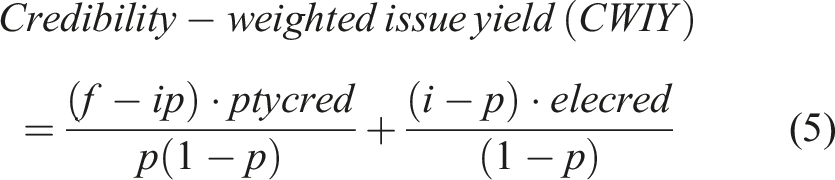
the effect of polarisation on party issue emphasis is positively moderated by the credibility-weighted issue yield Finally, previous work suggests that voter polarisation interacts positively with issue salience (Spoon and Klüver, 2015). Put simply, some polarising issues might just not be seen as a priority by voters at the time of the election, possibly due to the high salience of other issues. Assuming that parties want to be viewed as responsive to the public’s priorities (Ansolabehere and Iyengar, 1994), then the decision to emphasise a polarising issue should depend also on its salience (H4).
the effect of polarisation on party issue emphasis is positively moderated by issue salience
Research design
Data and measures
To address the research questions, data is required about voter preferences plus party issue emphasis in Western Europe. In this respect, among the most exhaustive datasets published in recent years is from the Issues Competition Comparative Project (ICCP; De Sio et al., 2019). For the demand-side, the ICCP surveyed ∼1000 eligible voters in six Western European countries (Austria, Germany, France, Great Britain, Netherlands, and Italy) amid national elections in 2017 and 2018. 4 Respondents were asked to report their ideal position on a 1 to 6 scale on a range of policy trade-offs, related to a broad range of issue domains, such as economic redistribution, cultural liberalism, EU integration, and immigration (Supplemental Material – Tables A1a-1l).
In total, voter polarisation is measured for 108 policy trade-offs across the six countries. General issue polarisation is measured in terms extremity (Equation 1) and bimodality (Equation 2). Meanwhile, party issue polarisation is measured based on equation 4, where voters were assigned to parties based on their voting intention. Party supporter extremity is the distance between the mean party supporter and the mean voter on the issue. The credibility-weighted issue yield is calculated as described in D’Alimonte et al. (2020) (Equation 5). Finally, salience is the average priority voters gave the issue on a scale of 1 to 3.
For the supply-side, the ICCP analysed the Twitter feeds of the official party accounts in each country for the duration of the campaign. Tweets were coded according to the policy issue they addressed, with the codes aligned to the survey questions. Therefore, party issue emphasis is the percentage of a party’s Tweets that were made about the issue. The use of Twitter to measure party issue emphasis relies on the ‘press release assumption’, which argues that journalists who follow party Twitter accounts are likely to pick-up on party Tweets, and publish their contents in more traditional media (De Sio et al., 2018). Therefore, party Twitter feeds are a proxy for wider campaign communications.
To ensure representativeness, parties with less than 3% vote intention were excluded from the analysis. Finally, purely ‘valence’ issues were also excluded, as data about voter preferences on these was deliberately not collected (De Sio et al., 2019). Therefore, my analysis is focused exclusively on how polarisation on positional issues affects party issue emphasis. This leaves 700 observations in the final dataset, one for each party-issue combination.
Methods
To begin, both general and party issue polarisation are recorded for all issues in the dataset. These measurements are then used to predict emphasis via several OLS regression models. Each model includes three additional controls at the party-level to account for the fact that some parties might focus on positional issues more than others. First, party size based on vote intention, because smaller parties tend to respond more to the preferences of their own supporters rather than the wider electorate (Ezrow et al., 2011). Second, whether a party is considered niche – that is, focusing disproportionately on non-economic issues (Meguid, 2005; Wagner, 2012). Third, whether the party was in government at the time of the election. In short, parties in government are usually expected to defend their record on valence issues (Petrocik, 1996). Of these three controls, only party size had a nontrivial effect, with larger parties focusing slightly less on positional issues in all models. 5
Results
Which issues are polarising?
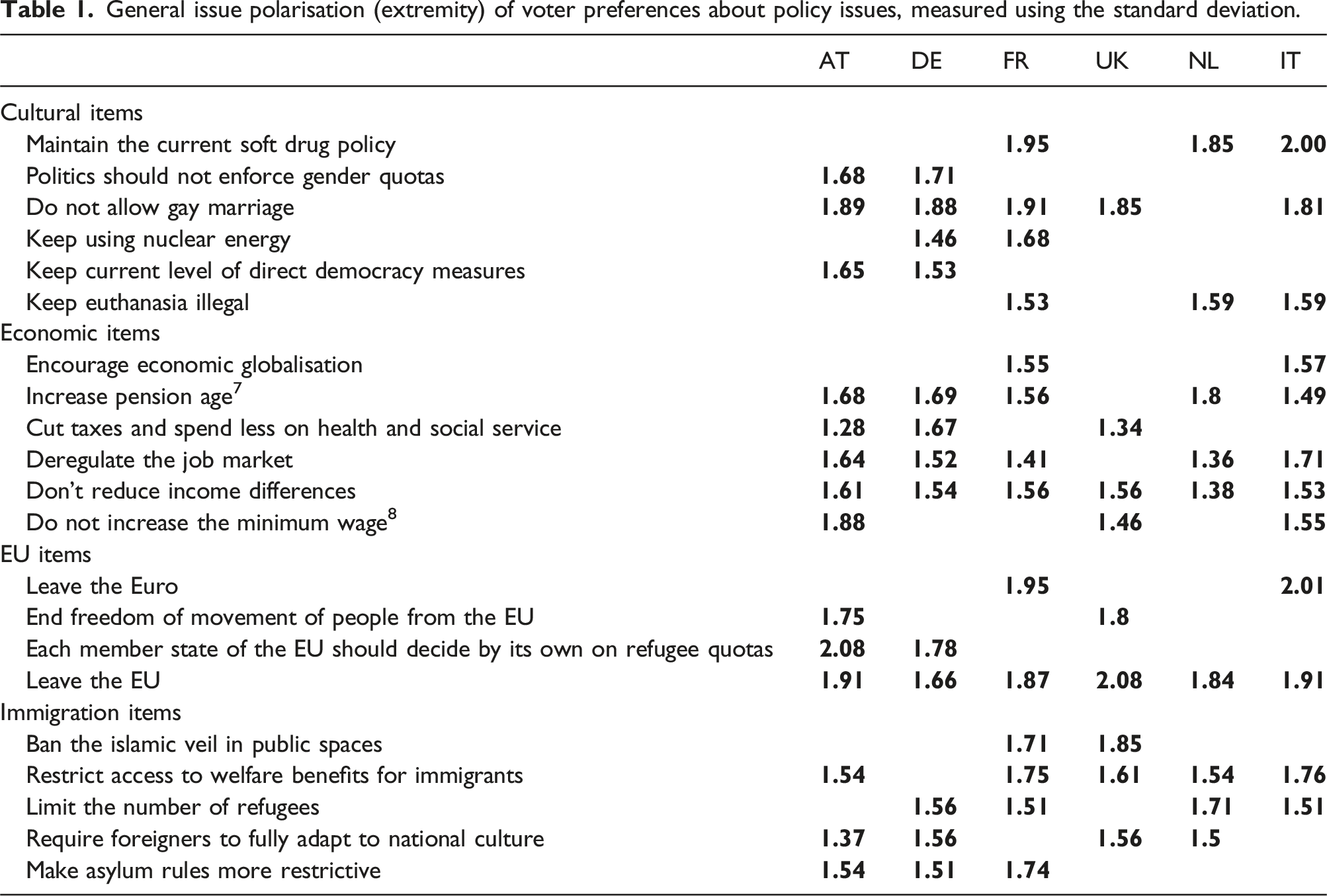
General issue polarisation (extremity) of voter preferences about policy issues, measured using the standard deviation.
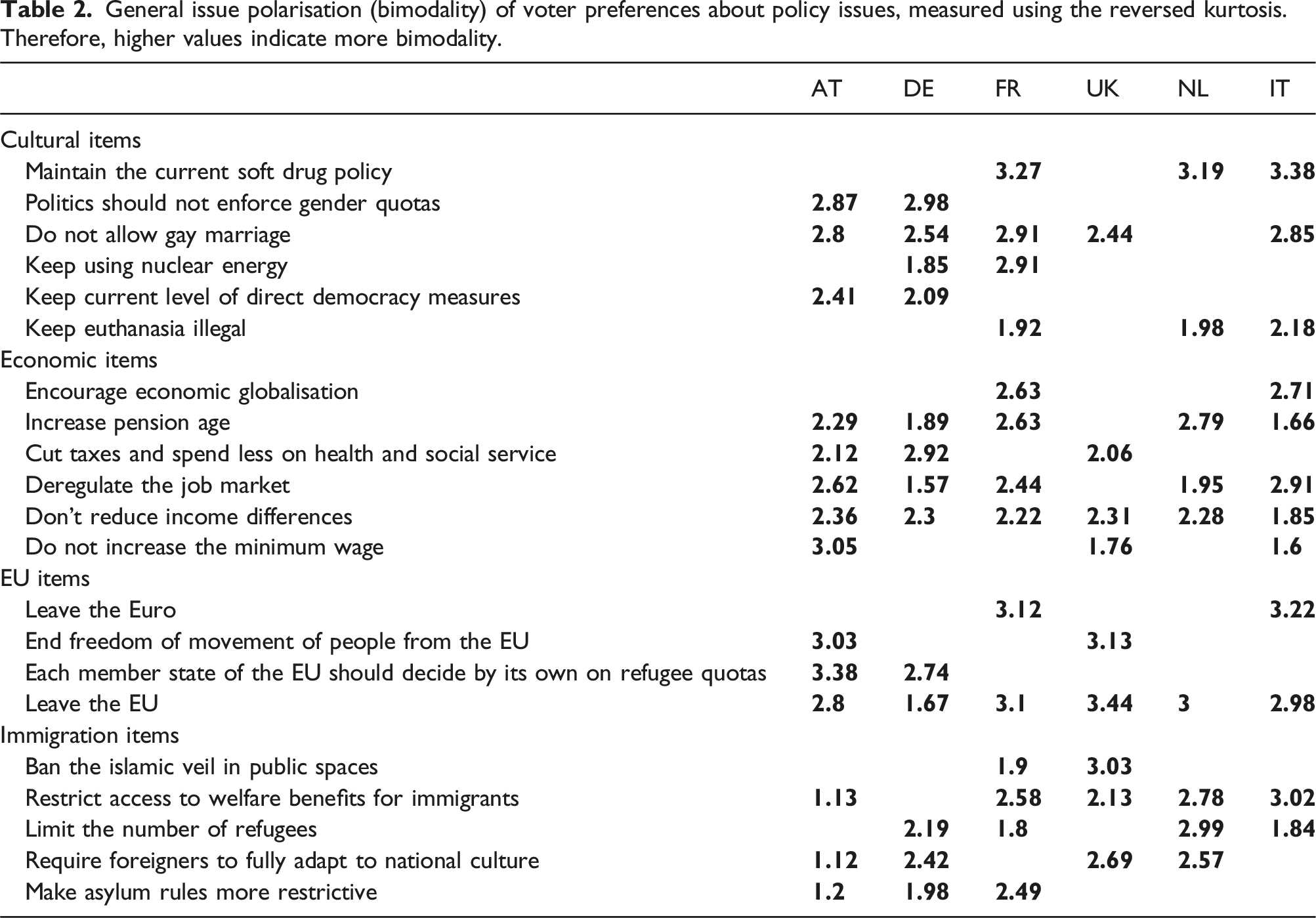
General issue polarisation (bimodality) of voter preferences about policy issues, measured using the reversed kurtosis. Therefore, higher values indicate more bimodality.
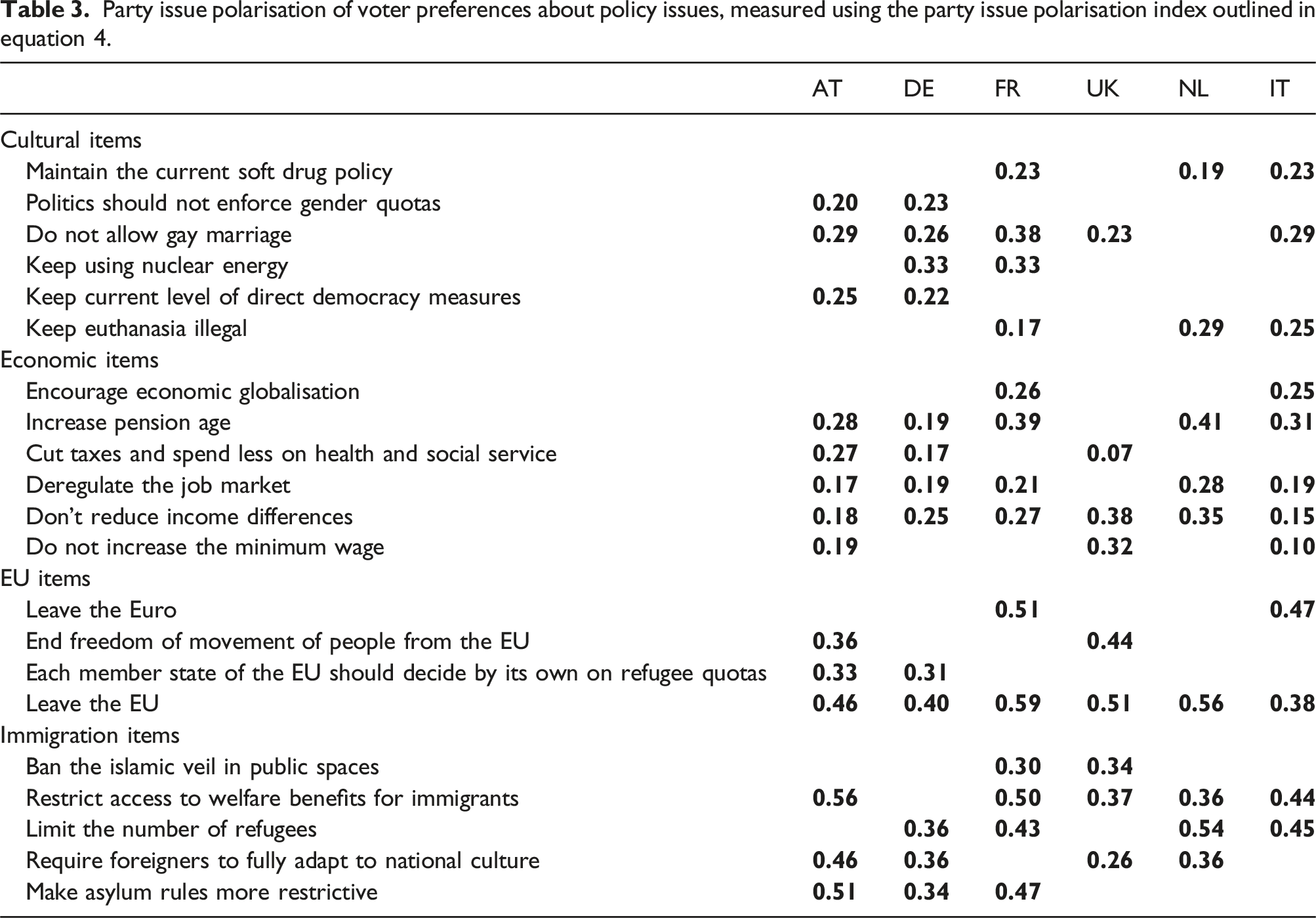
Party issue polarisation of voter preferences about policy issues, measured using the party issue polarisation index outlined in equation 4.
To begin, Table 1 documents the extremity of issue preferences. First, there are a few items where voter preferences are extreme in nearly all countries surveyed – for example, two of the cultural issues (“Maintain the current soft drug policy”, “Do not allow gay marriage”), and the EU-related issues. Second, there are a handful of items where voter preferences are particularly extreme in one country. For instance, while economic issues are remarkably non-polarising overall, this is not always the case (e.g. “Increase pension age” in the Netherlands, and “Do not increase the minimum wage” in Austria). To summarise, Western European voters are most extreme on EU issues, and some cultural issues. By contrast, preferences about economic and immigration issues are more narrowly dispersed. Next, Table 2 shows that bimodality usually accompanies extremity. Indeed, the bivariate correlation is 0.74 (Supplemental Material – Table A2). Nevertheless, there are a handful of issues where bimodality and extremity diverge. For instance, some issues are more bimodal than they are extreme (“Keep using nuclear energy” in France, “Cut taxes and spend less on health and social service” in Germany, and “Limit the number of refugees” in the Netherlands). In these cases, voter preferences are divided into two sides which are quite close together.
Finally, Table 3 shows how party issue polarisation varies across the same issues. Most importantly, party issue polarisation differs markedly from general issue polarisation. In fact, the correlation with bimodality is only 0.26, while for extremity it rises to 0.35 (Supplemental Material – Table A2). Therefore, party issue polarisation is only weakly correlated with general issue polarisation, further justifying the distinction between these two types (Adcock and Collier, 2001). Crucially, this means that issues can be divisive without said divisions mapping onto party support – for example, the policy goals “Maintain the current soft drug policy” and “Do not allow gay marriage” score low on party issue polarisation, despite being rather polarising in general. By contrast, while immigration issues are not so polarising in general, they separate voters according to party support to a much higher degree. Finally, EU issues score high in party issue polarisation, while most economic issues score low.
Voter polarisation and representation
OLS regression of party issue emphasis at the issue-level.
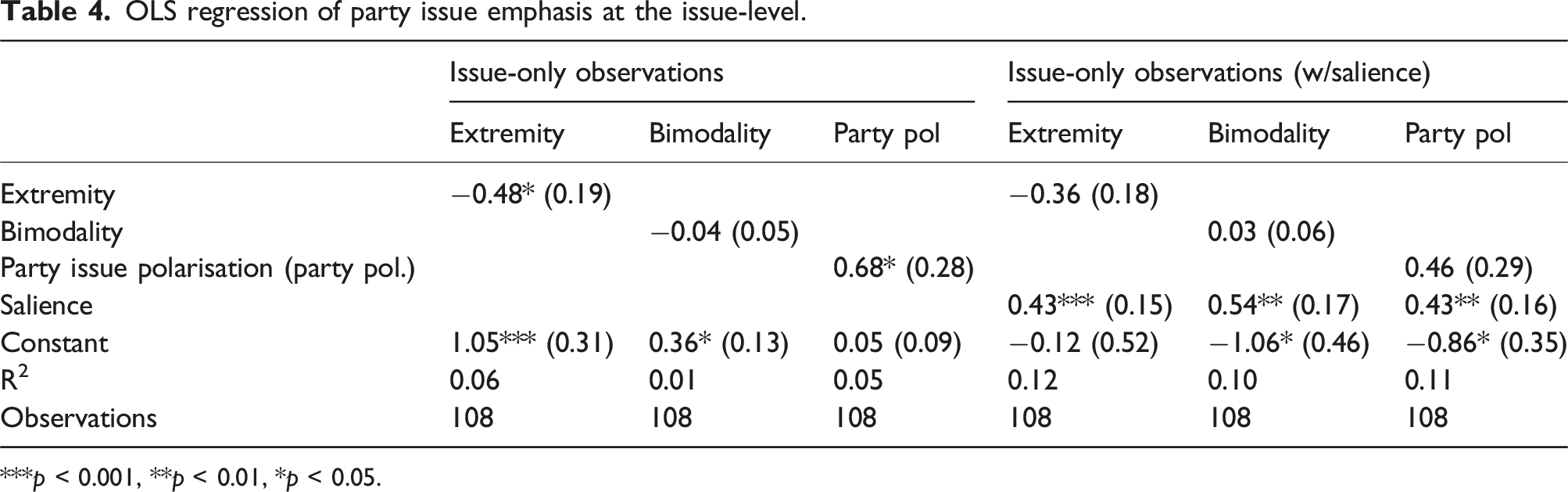
***p < 0.001, **p < 0.01, *p < 0.05.
OLS regression of party issue emphasis at the party-issue level.
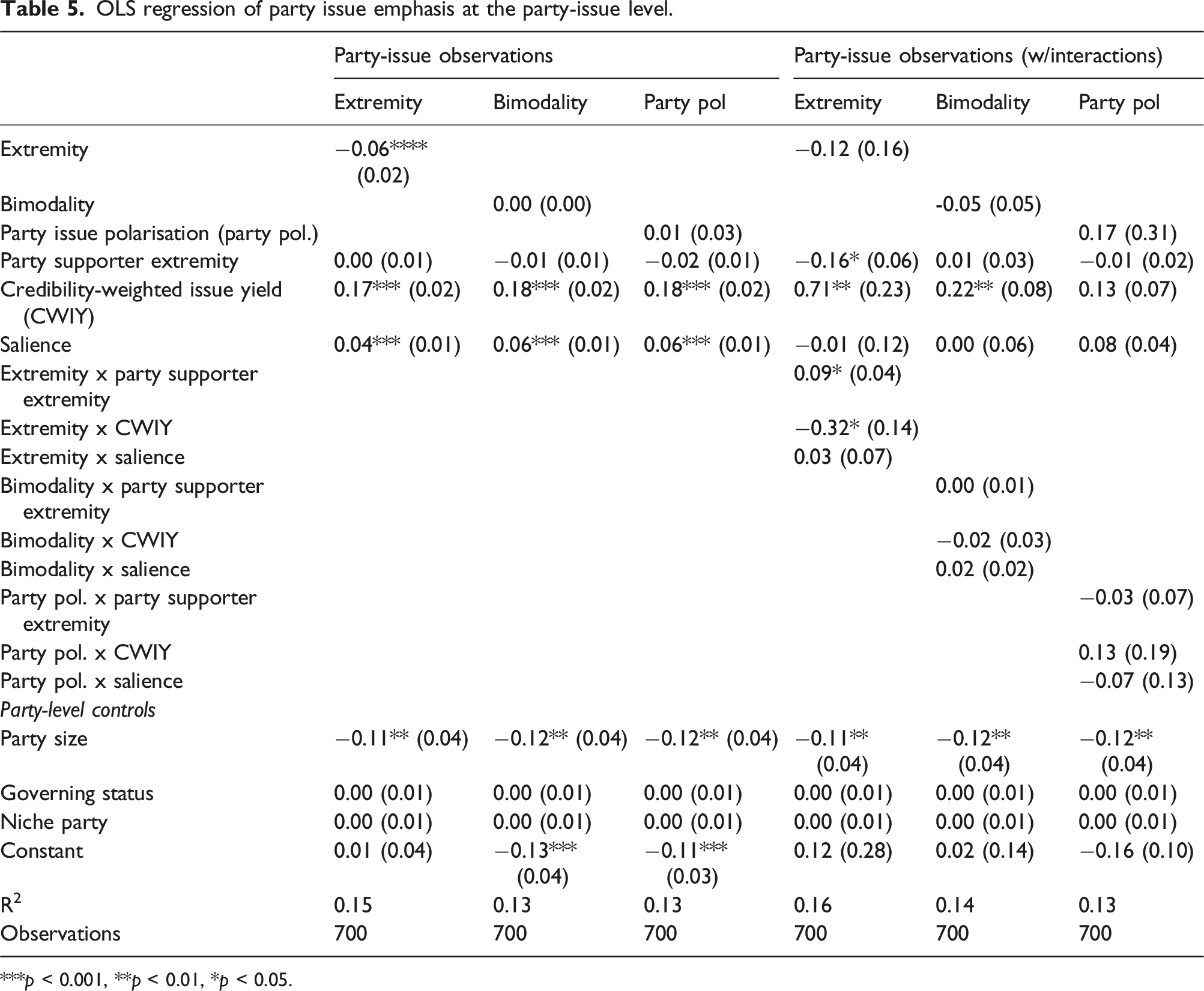
***p < 0.001, **p < 0.01, *p < 0.05.
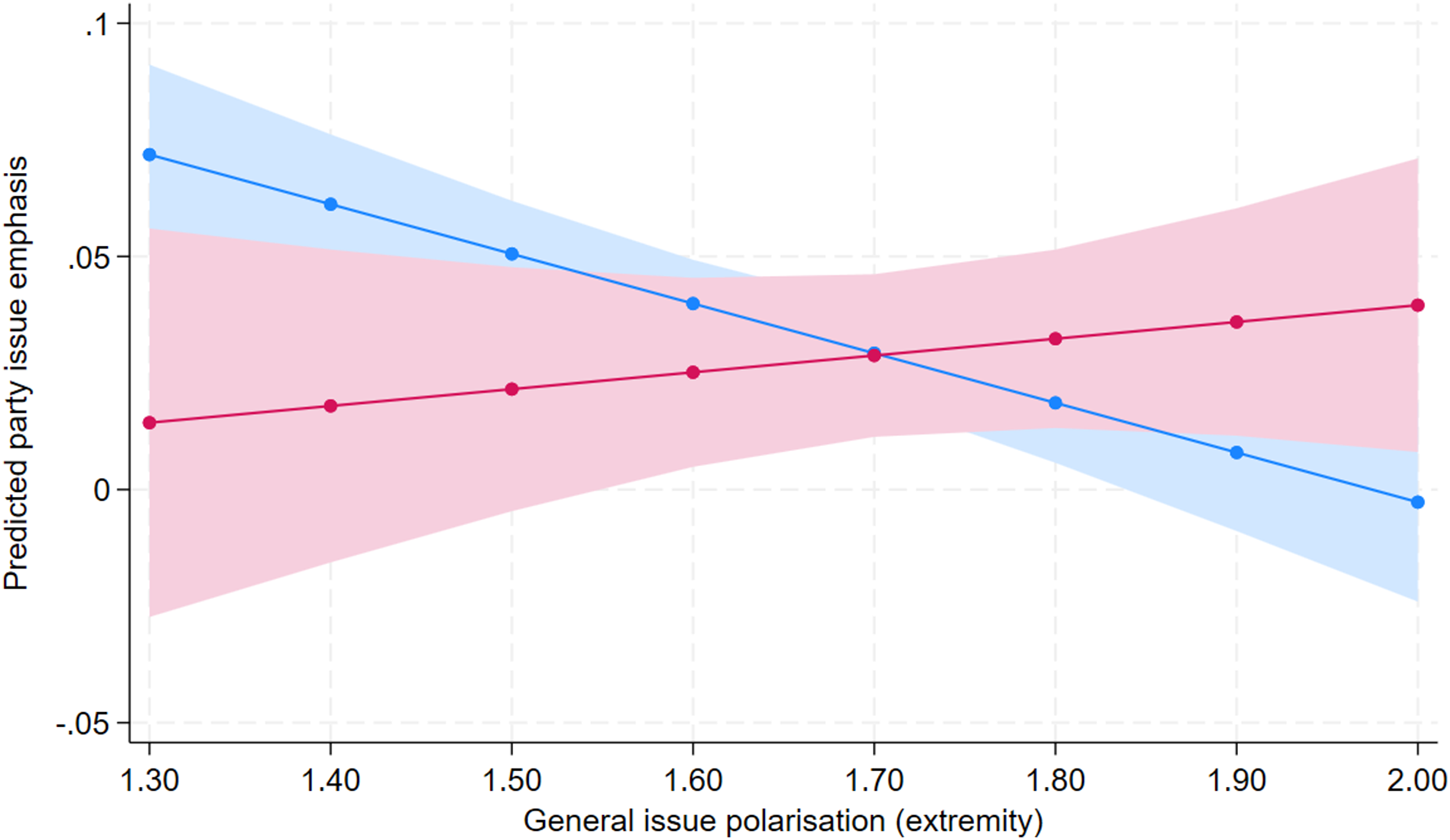
Finally, I analyse the interactions between issue polarisation and party supporter extremity, CWIY, and salience. To recap, H2-H4 predict that all three interactions should be positive in each model. However, out of nine interactions tested, only two are significant. First, there is is a negative interaction between extremity and CWIY. Figure 2 illustrates this relationship – as expected, parties put hardly any emphasis on issues with very low yields. However, extremity significantly reduces the emphasis parties place on high yield issues. This contradicts the theory that issue polarisation compels party attention – if anything, parties are reluctant to engage in these potentially controversial issues. The only other significant interaction is between extremity and party supporter extremity. Figure 3 implies that extremity has a particularly negative effect on emphasis when a party’s supporters are relatively centrist on the issue. On the other hand, parties with the most extreme supporters emphasise the issue at all values of extremity. Predicted values of party issue emphasis at different values of extremity and CWIY. Blue = 0 (low yield), red = 0.6 (high yield). Predicted values of party issue emphasis at different values of extremity and party supporter extremity. Blue = 0 (centrist), red = 1.5 (extreme).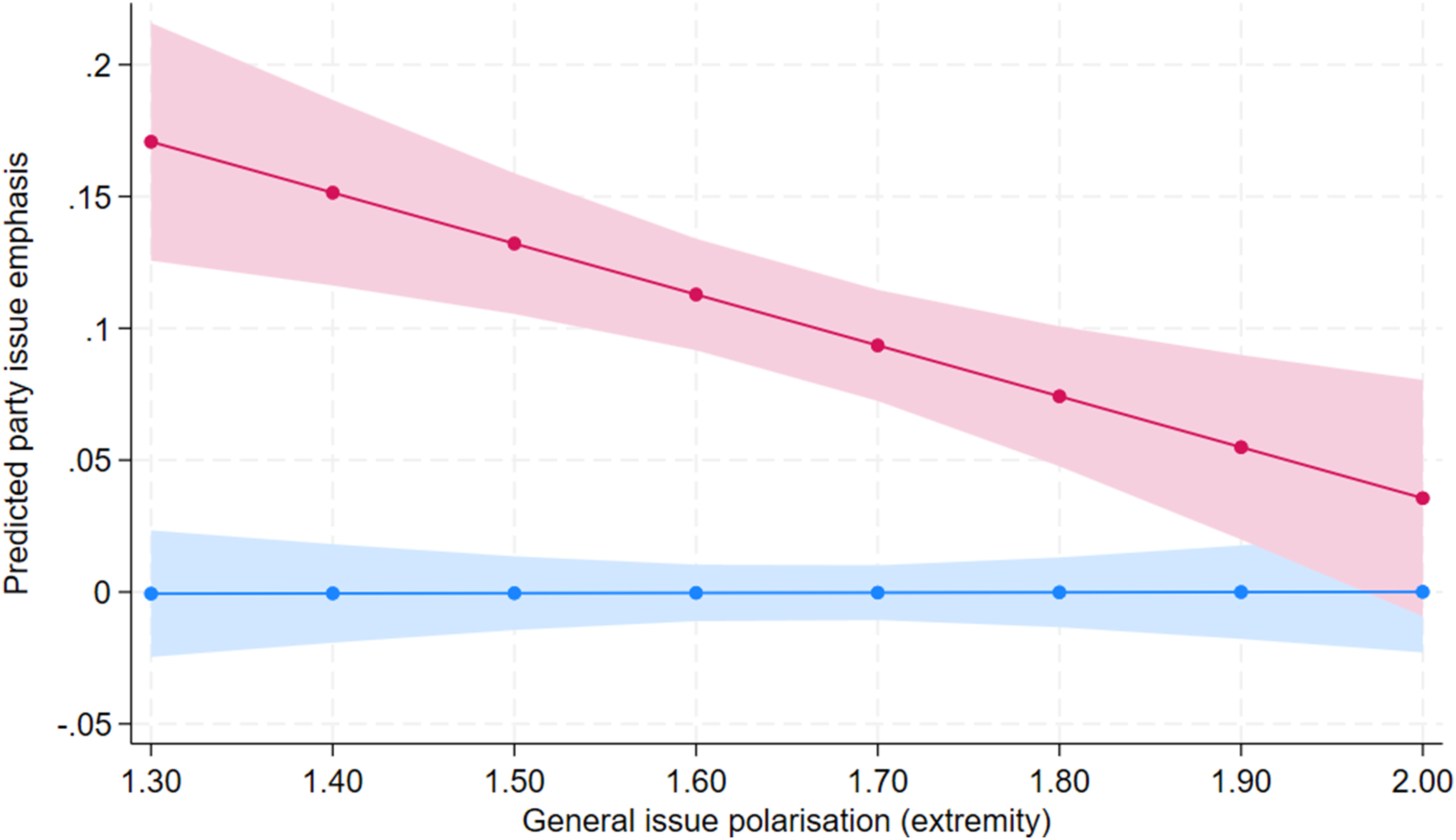
Discussion and conclusions
Despite concern about rising polarisation in Western Europe, not so much is understood about its consequences for issue competition. This article has addressed two research questions in this regard. First, which policy issues are polarising in contemporary Western Europe? Second, how does voter polarisation about an issue affect how much parties emphasise it? In short, the answers to these questions depended on the type of issue polarisation – in particular, the difference between general issue polarisation and party issue polarisation.
First, the correlation between general and party issue polarisation was quite low (r = 0.26-0.35). Therefore, when describing issue polarisation, the picture is incomplete in absence of a multidimensional approach. For example, the ICCP data revealed that while voters were quite united around anti-immigration positions (low general issue polarisation), there were greater differences between supporters of opposing parties (high party issue polarisation). Therefore, although immigration is sometimes described as a polarising issue, this polarisation is quite specific to supporters of particular parties. By contrast, issues like soft drug policy and same-sex marriage were very polarising in general, but did not separate voters so much according to party support. An open question is whether such untapped divisions could be exploited by challenger parties, eventually leading to party issue polarisation.
Nonetheless, I found little evidence that issue polarisation encouraged party issue emphasis as predicted by H1. On the contrary, parties paid less attention to issues where voter preferences were more extreme, and this was the case even where parties would ordinarily be expected to emphasise the issue (i.e. due to high CWIY score). At first sight, the negative effect of extremity appears to contradict the findings of Spoon and Klüver (2015). However, there is a crucial difference between the two articles, in that Spoon and Klüver (2015) analysed the effects of within-issue changes in voter polarisation, while I focused on how the variation between issues affects party issue emphasis. While I leave it to future work to unpack this unexpected finding at-length, I offer a couple of plausible explanations. First, parties might be more risk-averse than originally thought (Budge, 1994). If so, then the incentive to focus an issue might be heavily discounted if the party’s position risks a countermobilisation, as should be the case when voters on both sides of the issue have extreme preferences. Moreover, this could help explain why extremity, rather than bimodality, had a significant negative effect on party issue emphasis. Second, without party cues to guide voters, issue polarisation might have little effect on the vote. In this regard, Alvarez and Morrier have recently shown that in the US, only ‘partisan polarisation’ (i.e. party issue polarisation) is associated with issue voting, whereas ‘policy polarisation’ is not (Alvarez and Morrier, 2025). In turn, parties should be less compelled to emphasise polarising issues when the polarisation does not correspond to partisanship. However, these hypotheses require more theoretical development, plus further testing against alternative data sources.
Notably, parties did pay more attention to issues that scored highly in party issue polarisation. However, this effect appears to be largely explained by more ordinary incentives. For example, party issue polarisation increases with intra-party unity (Equation 4), which is a well-established predictor of party issue emphasis (De Sio and Weber, 2014; Hobolt and De Vries, 2015). As a result, party issue polarisation had no independent effect in the final model. One implication of this finding is that by following a rational issue emphasis strategy, parties may end up drawing attention to party issue polarisation, even if this is not their intention. This tracks with the finding that affective polarisation tends to increase during election campaigns, as the differences between parties become more salient (Hernández et al., 2021).
To summarise, this article has addressed the lack of integration between the increasingly influential work on voter polarisation and the literature on issue competition. Most importantly, I have shown that the type of issue polarisation matters, not only descriptively, but also in explaining party issue emphasis.
Supplemental Material
Supplemental material - The two faces of issue polarisation and their impact on party competition in Western Europe
Supplemental material for The two faces of issue polarisation and their impact on party competition in Western Europe by William John Atkinson in Party Politics.
Footnotes
Declaration of conflicting interests
The authors declared no potential conflicts of interest with respect to the research, authorship, and/or publication of this article.
Funding
The authors received no financial support for the research, authorship, and/or publication of this article.

Supplemental Material
Supplemental material for this article is available online.
Notes
References
Supplementary Material
Please find the following supplemental material available below.
For Open Access articles published under a Creative Commons License, all supplemental material carries the same license as the article it is associated with.
For non-Open Access articles published, all supplemental material carries a non-exclusive license, and permission requests for re-use of supplemental material or any part of supplemental material shall be sent directly to the copyright owner as specified in the copyright notice associated with the article.
