







Abstract
This study argues that election years shape whether majority ethnonationalist (MEN) organizations in European countries engage in ethnic riot and protest, with effects differing by party status. For MEN non-parties, elections highlight a good (votes) that they do not pursue, reducing incentives for ethnic riots and protests during election years. In contrast, for MEN parties, elections make votes more salient, increasing their incentive to employ such tactics. Using original data on 281 MEN organizations across 18 European countries, two-way fixed effects estimations show that for MEN non-parties, an election year is associated with a 3.40 percentage point decrease in the predicted probability of ethnic riot. In contrast, for MEN parties, election years are positively associated with riots. No clear interactive association is found for protests. The findings advance existing evidence on majority ethnonationalism and far right politics in Europe with evidence of organizational mobilization differences.
In February 2014, two majority ethnonationalist parties in Bulgaria, Bulgaria without Censorship and IMRO-Bulgarian National Movement, engaged in an ethnic riot in the city of Plovdiv. Targets included the Djumaya mosque, the office of the Turkish Movement for Rights and Freedoms party, and a pastry shop. The ethnic riot evolved from an ethnic protest expressing grievances related to a local Muslim leader’s request to transfer ownership of the Djumaya mosque to his office (from the local municipality) (Jane's country risk daily report, 2014). This episode motivates inquiry into why some majority ethnonationalist (MEN) organizations engage in ethnic riot and protest, while others do not.
This study examines MEN organizations in 18 European countries, and their participation in riots and protests against ethnic minorities. 1 Existing work documents country-level patterns of far-right and majority ethnonationalist protest and violence in Europe (Castelli Gattinara et al., 2022), but two limitations motivate the current study. First, country level analyses do not explain between and within organization variation in ethnic riot and protest.
Second, we lack systematic theory and evidence on how electoral competition shapes ethnic riot and protest in European settings, despite influential work from other regions – most notably India – suggesting that elections can be central to understanding ethnic violence.
This study posits that an organization feature, party status, interacts with electoral timing to influence ethnic riot and protest by MEN organizations. For MEN parties, elections increase the expected payoff to tactics that heighten ethnic salience, because the goods pursued – votes – have greater salience. For MEN non-parties, by contrast, election timing reduces the relative value of the goods they pursue – e.g., donations, membership, or diffuse attitudinal backing – compared to non-election periods. As a result, elections should raise incentives for ethnic protest and riot among MEN parties while lowering them among MEN non-parties.
This study collects yearly data on ethnic riots and nonviolent protests by 281 MEN organizations from 18 European countries from 1990 to 2017 and uses two-way fixed effects linear regressions to estimate how party status and election years jointly relate to these outcomes. Among MEN non-parties, a negative association is observed between election year and ethnic riot. For non-parties an election year associates with a 3.40 percentage point decrease in predicted ethnic riot probability. In contrast, for MEN parties, moving from a non-election year to an election-year results in a 1.70 percentage point increase in the predicted probability of ethnic riot.
In contrast, no clear evidence is observed of an interactive association between elections, party and ethnic protest. Possible reasons for the divergent results are discussed.
The findings of this study first advance research on majority ethnonationalist and far right behavior (Mylonas and Tudor, 2021) in Europe and other developed countries (e.g., Boutcher et al., 2017). Studies, often focusing on similar or overlapping concepts such as far right and populism actors (e.g., Rooduijn et al., 2024), examine electoral support (e.g., Arzheimer and Carter 2006; Golder, 2016; Norris, 2005), organizational emergence (Rydgren, 2005), hate crimes (Belgioiso et al., 2023), terrorism (Matsunaga, 2023; Ravndal, 2018) and other violence (Koopmans, 1996), and more general claim-making mobilization (Giugni et al., 2005).
This article specifically advances research on far right riot and protests in Europe (Castelli Gattinara et al., 2022), 2 which overlaps heavily with majority ethnonationalist actors, by providing novel theory, data, and evidence at the organizational level, improving understanding of which actors participate in ethnic riot and protest. Country-level studies implicitly treat the organizational composition of participants as constant, yet organizational types differ in goals and incentives – especially when goods like votes become more salient. This study thus advances broader approaches to nonconventional political behavior grounded in grievance, resource mobilization, and political opportunity explanations (e.g., Della Porta and Diani, 2006) but focus less on within-country divergent actor behavior (Castelli Gattinara et al., 2022).
The findings second advance studies on nonconventional behavior by distinguishing between types. Multiple studies have assessed riot and protest in combination (e.g., Castelli Gattinara et al., 2022; Boutcher et al., 2017). Yet, riots and protests may differ in both their costs and benefits, suggesting distinct determinants. This study advances evidence on the distinctions between tactic types (e.g., Brubaker and Laitin, 1998), by illustrating that their determinants can differ.
Third, the findings advance research on how electoral factors shape non-conventional political behavior, including ethnic violence in Africa (e.g., Birch et al., 2020), terrorism (Aksoy, 2014), religious riots in India (Wilkinson, 2006), and protests (Rød, 2019). Electoral-related behavior in Europe may differ from other regions, such as India, because of differences in electoral systems, party strength, riot costs; as well as grievances, resources, and political opportunity structures (e.g., Della Porta and Diani, 2006). This study theoretically advances existing work on elections and violence by demonstrating that the relationship is moderated by organizational type. In doing so, it introduces a novel theoretical expectation of electoral violence in which the same institutional incentive produces opposite responses across actors with different political goals.
Electoral competition and organization type: Consequences for ethnic riot and protest
MEN organizations are defined as organizations that make political claims on behalf of the majority ethnic group in a country. This overlaps with how some studies classify far-right actors in Europe – particularly those identifying organizations advancing ‘cultural’ or ‘nativist’ claims (e.g., Rooduijn et al., 2024; Castelli Gattinara et al., 2022). Studies describing far right actors often describe xenophobic or exclusionary forms of nationalism oriented toward preserving the perceived ethnic or cultural homogeneity of the nation-state.
However, scholarly use of the the far-right terminology – especially when rooted in the concept of nativism – is not always clear whether it distinguishes between actors promoting a civic form of nationalism (which may include ethnic minorities while excluding non-citizens) and those advancing an explicitly ethnic conception of the national native population based on real or perceived descent, which are ethnicity requirements (e.g., Bernhard et al., 2017; Golder, 2016; Mudde, 2000). Because the term far right is used diversely – including to capture civic nationalist actors that do not target internal ethnic minorities – this study uses the term majority ethnonationalism. This aligns the concept with the study’s empirical focus on organizations engaging in ethnic riots and protests directed at internal minority populations and the broader literature on ethnic violence. At the same time, a focus on MEN organizations remains substantively consistent with how majority exclusionary far-right actors are sometimes identified in European contexts (e.g., Rooduijn et al., 2024; Castelli Gattinara et al., 2022) while enabling conceptual application across regions where far right is not standard terminology (e.g., Vogt et al., 2021).
The benefits and costs of ethnic riot and protest
Although evidence on the effects of ethnic protest is more limited, research suggests that ethnic riots can increase ethnic salience, which may advantage MEN organizations given their preexisting emphasis on majority–minority relations. Heavily studied in India, ethnic riots have produced electoral gains and political advantages for MEN organizations by polarizing society and provoking minority responses (Iyer and Shrivastava, 2018; Wilkinson, 2006; Dhattiwala and Biggs, 2012). Minority backlash can heighten fears of broader ethnic conflict, pressuring individuals to align with their ethnic group and increasing the salience of ethnicity (Brass, 2005). 3
European cases also offer suggestive evidence. By polarizing ethnic divisions, ethnic riots can enable MEN organizations to present themselves as protectors of the majority and signal commitment to defending the nation (Viganò et al., 2025). Violence can thus prioritize majority–minority tensions and frame organizational tactics as defensive reactions to threatening outgroups (Krause and Matsunaga, 2023; Petersen, 2002). Heightened threat perceptions may also increase support for ethnic exclusionary or anti-immigrant positions (Lavine et al., 2002), which mirror many European MEN organization platforms (Klein and Muis, 2019).
Electoral benefits may then follow. For instance, the British National Party gained electoral support following the 2001 riots (Copsey et al., 2008). In Hungary, Roma neighborhood ‘security patrols’ escalated into riots aimed at legitimizing ethnic-based security agendas (Mareš, 2018; Mireanu, 2013). Germany’s 1991 Hoyerswerda riots preceded unexpected electoral gains for the German People’s Union (Karapin, 2002), and violence linked to Alternative for Germany also associates with increased votes (Krause and Matsunaga, 2023).
While this study assumes that ethnic riots and protests can increase support for MEN organizations, severe violence that causes deaths or substantial economic damage may generate backlash in European contexts. Compared to India, ethnic riots in Europe rarely produce similar levels of fatalities indicating both different regional baselines and potential ceiling effects in the violence–benefits relationship. Journalistic reports also note ceiling effects – for example, lower-intensity ethnic rioting rather than more severe violence in Bulgaria appeared to benefit MEN actors (‘'Violent ethnic protests' 2014). Scholars note that some MEN organizations strategically rely on non-violent protest to avoid such costs (Volk and Weisskircher, 2023). For these reasons, the study’s theoretical expectations apply primarily to less severe forms of violence and protests. More extreme events – such as large scale fatal riots and terrorist attacks – are not present to the same extent as in India; and may not generate similar political gains and provoke condemnation (Mareš, 2018). By focusing on non-fatal riots and protests, the argument assumes that lower-intensity violence can heighten ethnic salience without triggering severe backlash, creating incentives for MEN organizations to use such tactics strategically. In contrast, more intense forms of violence may reflect different motivations and constraints and are not expected to produce similar benefits.
While possibly beneficial, riots and protests are costly: they entail risks of opportunity costs, arrest, retaliation, surveillance, and organizational sanctions. MEN organizations are therefore expected to deploy ethnic riot and protest selectively.
Ethnic riot and protest – parties and non-parties
Independently, there is no clear theoretical expectation for how party status influences the use of ethnic riot and protest. Resource-mobilization theories (e.g., McCarthy and Zald, 1977) suggest that differences in non-conventional tactics stem from variation in organizational resources: parties devote substantial resources to elections and may therefore have fewer available for disruptive action. Yet parties typically possess greater financial and organizational capacity than non-parties, which could offset these constraints and leave their overall ability to mobilize similar.
A second complication is that resources are not uniform, and different resource mixes can produce comparable protest capacities. Smaller MEN organizations may be money-poor but have committed activists capable of small-scale actions, whereas larger MEN organizations may be money-rich with weaker activist cores but still able to mount sizeable demonstrations. This heterogeneity of resource profiles and event types makes it difficult to theorize how party status alone should shape ethnic riot or protest.
Political opportunities (e.g., Gelashvili, 2024), such as elite divisions or reduced repression (Kitschelt 1986), also cannot fully explain differences, as parties and non-parties in the same country face similar structural conditions. Exceptions may relate to specific MEN organizations that are banned.
The interactive effect of party and election year: Implications for ethnic riot and protest
Existing work shows that European far-right actors – which substantially overlap with majority ethnonationalist (MEN) organizations – engage in both electoral and non-electoral collective action (Borbáth and Susánszky, 2025). Yet, MEN parties compete directly for votes but can also engage in riot and protest (Kitschelt, 2003); in contrast, MEN non-parties do not contest elections. Based on the distinct political goods pursued, the second component of the theorized interaction is whether it is an election year.
The interaction between party status and election timing follows from differences in what each type seeks to maximize. Parties primarily seek votes; non-parties pursue attitudes, membership, donations, and issue visibility. The electoral calendar is expected to shift the salience of the votes, that is, the relative value of votes v. other goods can temporally vary. During elections, vote acquisition has more value, which is the primary good that MEN parties pursue. For MEN parties, this increases the expected payoff to costly tactics that heighten ethnic salience – including ethnic riot and protest – consistent with theories linking electoral timing and contentious action (McCarthy and Zald, 1977).
By contrast, MEN non-parties face the opposite dynamic. When vote acquisition increases in value, a marginal decrease in the value of non-vote goods is expected. As a result, ethnic riot or protest are expected to less easily translate into their central payoffs such as membership growth, attitudinal shifts, fundraising, and networking (e.g., PEGIDA; Volk and Weisskircher, 2023). When society’s focus shifts toward vote acquisition, the potential benefits of ethnic riot and protest to non-parties decline relatively, reducing incentives for their use (Figure 1). Theoretical explanation for the interaction of MEN organization type and election year.
Another salience feature is societal attention. Election years are also expected to shift societal attention toward voting, and thus parties and their candidates. Because attention is a finite resource, a visibility crowd-out mechanism can reduce the marginal visibility that non-party organizations can capture through costly actions such as riots or protests. A non-party’s riot, and the claimed goods they pursue, must now compete with denser party-centered societal discussions and news flows and their focus on voting. As a result, ethnic riots and protests may be deemed unlikely to attract attention amidst the election coverage and reduced visibility, reducing incentives for tactic use. 4
MEN parties experience the opposite dynamic. When societal attention becomes party-centric, tactics such as ethnic riot and protest and claims related to voting that increase their visibility may more readily translate into electoral support. The same attention shift that disadvantages non-parties therefore raises the expected utility of contentious action for MEN parties.
Whether through the increased relative value of votes or societal attention dynamics, election years are expected to moderate the relationship between MEN organizational type and ethnic riot and protest.
Data: A focus on MEN organizations in European countries
Original data are collected on 281 majority ethnonationalist organizations from 18 European countries between 1990 and 2017. The 18 countries are based on a random sample of 90 countries from across the world as part of a larger data collection effort and project (Ives, forthcoming).
Although not randomly selected from the full set of European countries, the sample is derived from a global sample, and spans western, eastern, northern, and southern Europe, providing meaningful regional variation and allowing for theory-building and preliminary inference. Moreover, focusing exclusively on European countries aligns with prior research (e.g., Castelli Gattinara et al., 2022; Ravndal, 2023; Rooduijn et al., 2024) and avoids comparing MEN organizations across dissimilar political systems, 5 enabling more consistent analysis of ethnic riot and protest.
Before identifying MEN organizations, identification of majority ethnic groups is required. The data collection strategy combines insights from the systematic, cross-national leverage of the Ethnic Power Relations (EPR) data with country-specific insights from the comparative European far-right politics literature. EPR data (Girardin et al., 2015) are first used to identify majority ethnic groups (>50%), but several conceptualization challenges emerge. In Switzerland, German-speakers constitute the ethnic majority (63.0%) with minorities including French- (22.7%), and Italian-speakers (8.1%). However, Switzerland’s Muslim population (approximately 5% in 2015) (Brown and James, 2018) is not classified as an ethnic group per EPR, despite meeting widely accepted criteria for ethnic categorization (Chandra, 2012). Moreover, neo-Nazi, White- or European-focused political organizations operate, suggesting a broader ethnic identity category inclusive of German-, French-, and Italian-speakers but exclusive of Muslims and non-White groups. Thus, a politically salient ethnic boundary is not only ‘Swiss German vs. Swiss French’ but ‘European/White vs. non-European/Muslim.’
This pattern appears elsewhere. In France, EPR classifies French as the majority and Basques, Corsicans, and Roma as minorities. Yet, far-right mobilization frequently targets North African, Muslim, and sub-Saharan African minorities – populations that meet EPR’s criteria of socially recognized and politically mobilized ethnic categories (e.g., Musulmans de France) but remain unlisted (Wimmer et al., 2009; Girardin et al., 2015). Moreover, researchers document a key cleavage structuring far-right contention in Europe is not currently ‘French vs. Corsican,’ but ‘European/White vs. non-European/Muslim’ (e.g., Mudde, 2005; 2007; Castelli Gattinara et al., 2022; Klein and Muis, 2019; Volk and Weisskircher, 2023).
Because EPR reflects one yearly snapshot of ethnic diversity, it may miss multiple, hierarchically salient boundaries (Chandra, 2012). Thus, relying solely on EPR may risk misclassification in some contexts as it is not clear how to classify organizations mobilizing on behalf of a ‘European’ or ‘White’ majority and targeting Muslims or Africans as these are not listed as politically relevant groups.
List of countries and majority ethnic groups used to identify majority ethnonationalist organizations in dataset.
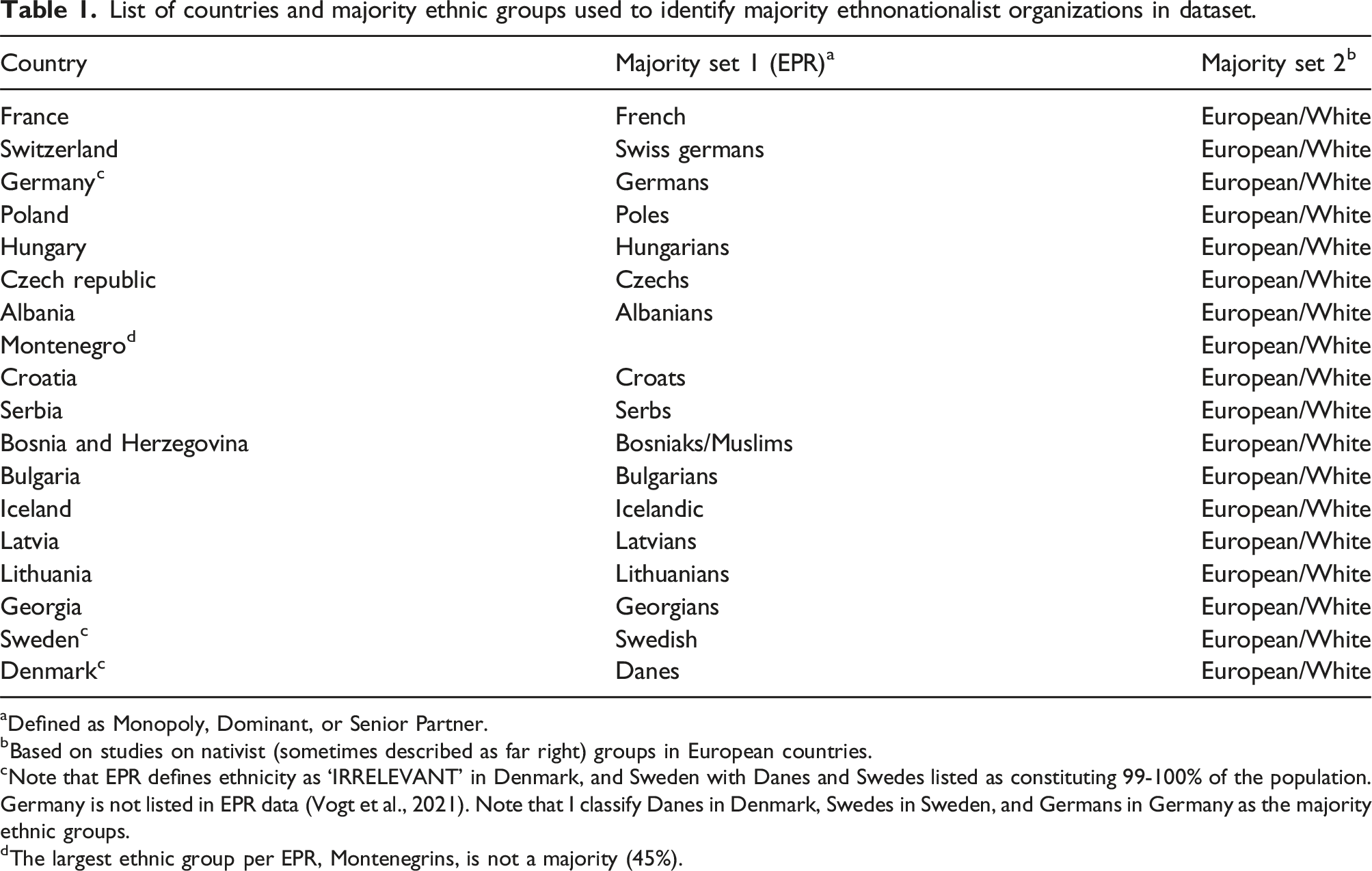
aDefined as Monopoly, Dominant, or Senior Partner.
bBased on studies on nativist (sometimes described as far right) groups in European countries.
cNote that EPR defines ethnicity as ‘IRRELEVANT’ in Denmark, and Sweden with Danes and Swedes listed as constituting 99-100% of the population. Germany is not listed in EPR data (Vogt et al., 2021). Note that I classify Danes in Denmark, Swedes in Sweden, and Germans in Germany as the majority ethnic groups.
dThe largest ethnic group per EPR, Montenegrins, is not a majority (45%).
Once majority ethnic groups are identified, MEN organizations are identified as those making claims to represent either the majority in either Set 1 or Set 2. Organizations are identified using established datasets and literature on political parties (Lindberg et al., 2022; Rooduijn et al., 2024; Szöcsik and Zuber, 2015; Zuber and Szöcsik, 2019), extremist organizations (Mudde 2005, 2017), and Nexis Uni searches.
The data collection identifies 281 MEN organizations – 119 parties and 176 non-parties (some shift party status over time). On average, there are 4.28 MEN organizations per majority per year (median = 4.00). The maximum number of parties recorded in a single country-year is 9 (Croatia, 2017), with a mean of 2.56 and a median of 2.00. For non-parties, the highest count is 10 (Hungary, 2003), with a mean of 1.72 and a median of 1.00.
Hungary has the most MEN organizations in a single year, with 15 in 2003. Conversely, in some country-years only one MEN organization is present. A complete list of MEN organizations can be found in the Supplemental Information (SI) (F1).
Dependent variable: Original collection of data on ethnic riot and protest
Nexus Uni searches are used to identity MEN organization ethnic riots and protests, combining variations of organization names with riot- and protest-related terms (see SI Table A1). Two dichotomous dependent variables are constructed: whether a MEN organization engaged in at least (1) one ethnic protest and (2) one ethnic riot in a given year (the list of MEN organization–years with ethnic riots is provided in SI A3).
Because existing event datasets such as ACLED, 2024 do not fully cover Europe during this period, events are hand-coded using criteria mainly aligned with ACLED. Ethnic protests require ACLED’s ‘public demonstration’ standard plus evidence of participation by MEN organization members. Unlike ACLED’s three-participant threshold for a riot or protest, this study uses a minimum of 20 participants or clear descriptions of crowd behavior, given limitations in media reporting. Protests are classified as ethnic when demands are made on behalf of the majority group or against minority groups.
A riot is defined as public, crowd-based violence that causes physical harm or property destruction, following classic scholarship (Olzak and Shanahan, 1996). Events are classified as riots when reports indicate collective violence and substantial damage or injuries. A crowd-based violence requirement helps ensure that cases coded as riots reflect meaningful episodes of crowd violence rather than minor scuffles or ambiguous incidents. Such a definition is consistent with ACLED definitions of riot, violent demonstration, and some of its crowd-based observations of mob violence. Note that fatalities are not required for riot classification.
Riots meet the ethnic requirement when the crowd-based violence targets minority populations or when participants make explicit majority-group claims. Some riots involve participants making stated claims on behalf of the majority ethnic group, but the violence targets government institutions or political opposition figures (leftist or left-leaning parties; ethnicity undefined). Because these riots consist of claims on behalf of the majority ethnic group, they are classified as ethnic riots.
For example, in a December 2013 riot, the Nordic Resistance Movement clashed with left-wing activists and police. Although the ethnicity of the left-wing activists was not specified, the absence of minority targets suggests they were likely ethnic Swedes. The event is classified as an ethnic riot because the organization made explicit majority ethnic claims during the violence, even though the immediate targets were not a minority group (Swedish neo-Nazis sentenced to prison for rioting, 2014).
Organizational participation is coded when the organization organizes or clearly participates in the event. Multiple organizations may participate in the same event.
Dichotomous indicators are used rather than counts to limit measurement error common in media-based event coding, especially when reports describe prolonged or spatially diffuse episodes, such as repeated marches or village-level patrols. Although count variables could ideally capture additional variation, binary measures reduce accuracy-related bias and follow the approach taken in other media-based conflict datasets (e.g., Fjelde et al., 2019). The difficulty of producing reliable counts becomes evident in cases such as the Defence Force’s ethnic protest activities in Hungary, where reports describe extended and overlapping events: Several other villages with large numbers of Roma residents have likewise seen right-wing marches -- protests, the groups say, which are meant to highlight “gypsy criminality.” In the small town of Hajdúhadháza, where members of Szebb Jövöert have been “patrolling” for weeks, five right-wing radicals were arrested 10 days ago for disturbing the peace (Right-wing militants on patrol: A new wave of anti-Roma violence in Hungary, 2011).
The description highlights that multiple protests occurred in ‘several other villages’ for ‘weeks’. Both the geographic and spatial boundaries of ethnic protest are unclear. This challenge is of particular concern when generating measures for organizational participation in protests and riots as compared to event-based datasets.
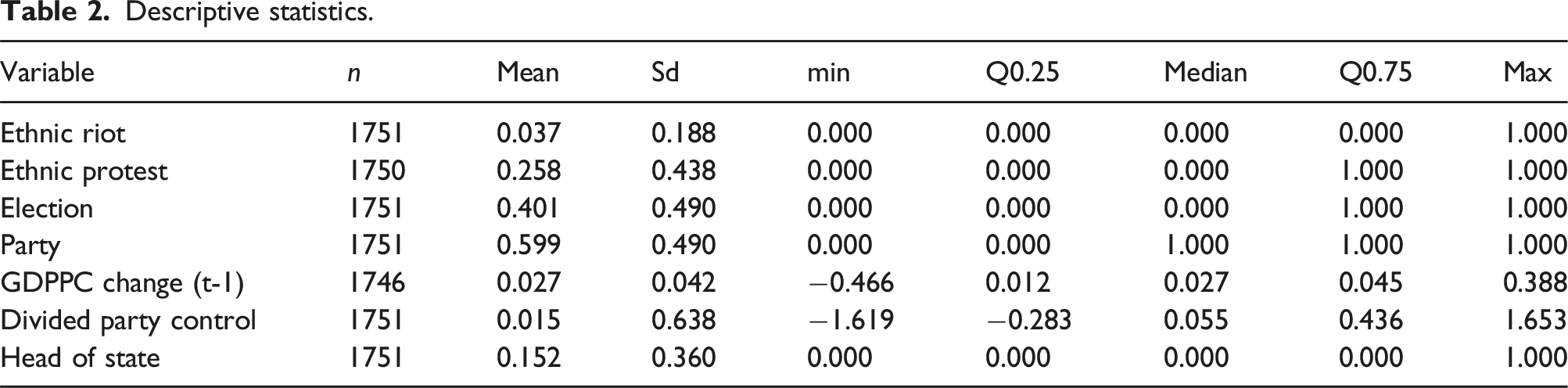
Descriptive statistics reveal higher use of ethnic protests compared to ethnic riots, as expected and consistent with country level data (Castelli Gattinara et al., 2022). From 1990 to 2017, MEN organizations engage in ethnic protest in 25.77% of MEN organizations-years. In contrast, only 3.66% of MEN organization-years observe ethnic riot.
Figure 2 illustrates ethnic riot and ethnic protest over time. The data illustrate a sharp rise in ethnic riot in 2007, which is driven by Hungarian MEN organizations. After a fall in ethnic riots in 2009 and 2010, an increase is observed, resulting in 2014 having the second highest rate of MEN organizations engaging in ethnic riot. After 2015, ethnic riot again observes a decline (2A). Majority ethnonationalist organization ethnic riot and protest over time.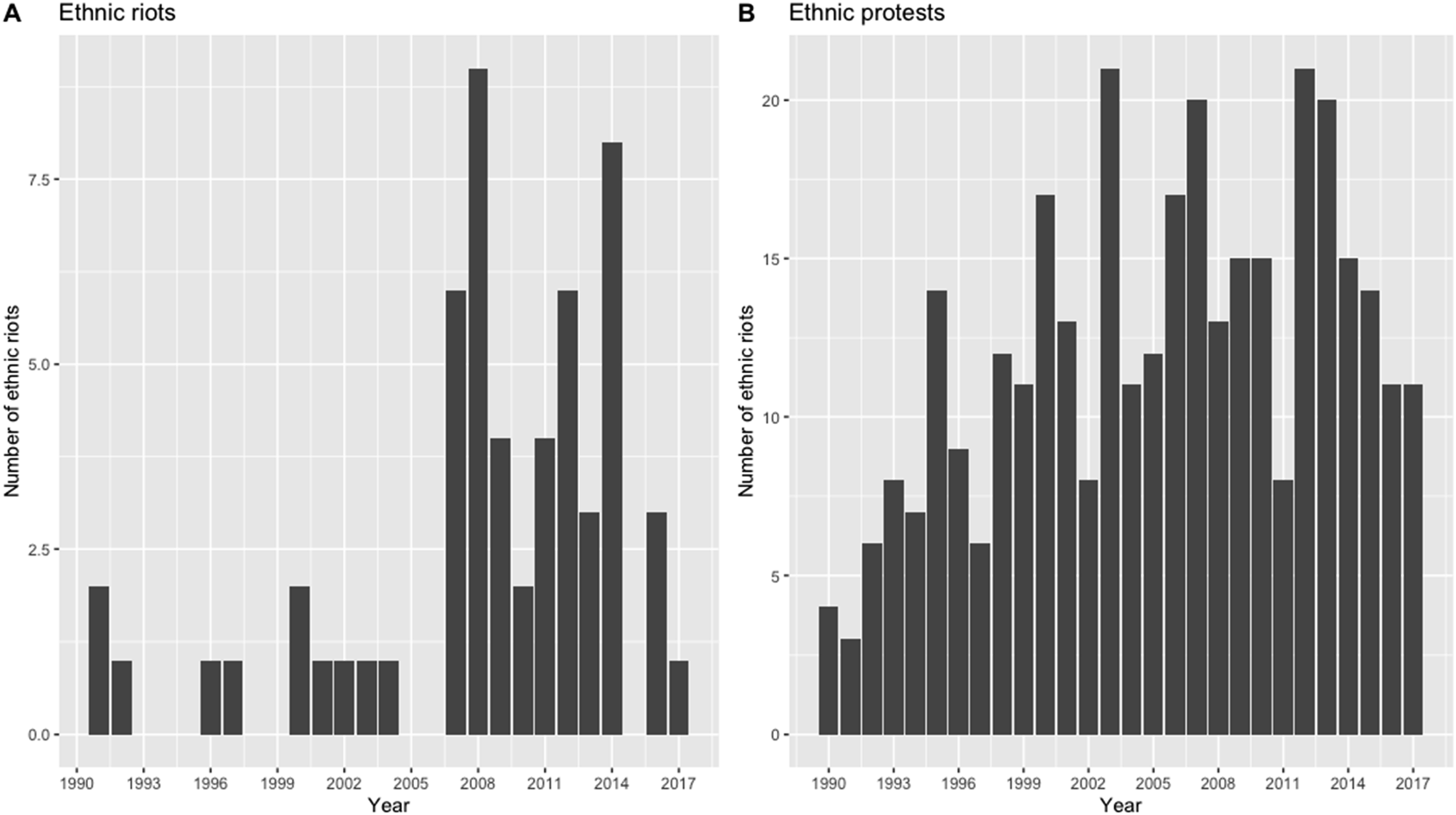
Ethnic protest observes a more consistent and less sharp rise from 1990 to 2013. Starting in 2014, the number of MEN organizations participating in ethnic protest begins to decline (2B). However, given the 2017 data stop, this decline may not indicate deviation from the longer-term pattern of an increasing rate of ethnic protest.
The sharp rise in ethnic riot in 2007 may result from news media differences over time and may not reflect a real increase in ethnic riot. Time related concerns are addressed in robustness checks.
Independent variable
The interaction term consists of party and electoral year constituent terms. The first constituent variable is a dichotomous indicator of whether the MEN organization is a party (1) or not (0). Existing datasets are used to determine party status (Lindberg et al., 2022; Szöcsik and Zuber, 2015; Zuber and Szöcsik, 2019) as well as original Nexis Uni searches and secondary information to account for MEN organizations that temporally are not found in the above mentioned data sources.
The second constituent variable is a dichotomous indicator of whether the country experienced a national executive or legislative election (1) or did not (0) in a given year (Hyde and Marinov, 2012). Either election type is included in the measure to address electoral competition across variable voting systems.
Covariates
Organization fixed effects adjust for time invariant organization and country particularities, capturing long-term contextual factors – such as stable patterns of organization size, resources, visibility, ethnic diversity, repression, or political openness – that do not vary within an organization over the study period. Year fixed effects adjust for time particularities, such as changes in migration common to European countries, and concerns that right wing mobilization in Western democracies undergoes temporal shifts (e.g., Ravndal, 2023). Reverse causality concerns are limited because party status is mainly time-invariant and election years commonly pre-scheduled.
A minority of MEN organizations do shift party status over time. To address this, models are first estimated with the interaction term, its constituents and the two way fixed effects with the assumption that the treatments are not driven by a covariate and to avoid biasing the estimates.
To address omitted variable bias concerns, several time varying covariates are included in a second set of models. An economic growth measure [GDPPC (t-1) – GDPPC (t-2)] is included to assess factors related to macro-economic conditions (e.g., Fariss et al., 2021; Scheiring et al., 2024;), which may relate to MEN organization participation in electoral politics as declining economic conditions may reduce support for more popular parties and present political opportunities for MEN organizations to participate electorally.
Descriptive statistics.
Analysis
Linear regression with organization and year fixed effects estimates the relationship between party, election year, and ethnic riot and protest. Standard errors are clustered on the country level.
Two-way fixed effects linear estimations of MEN organization ethnic riot and protest in 18 European countries, 1990 – 2017.
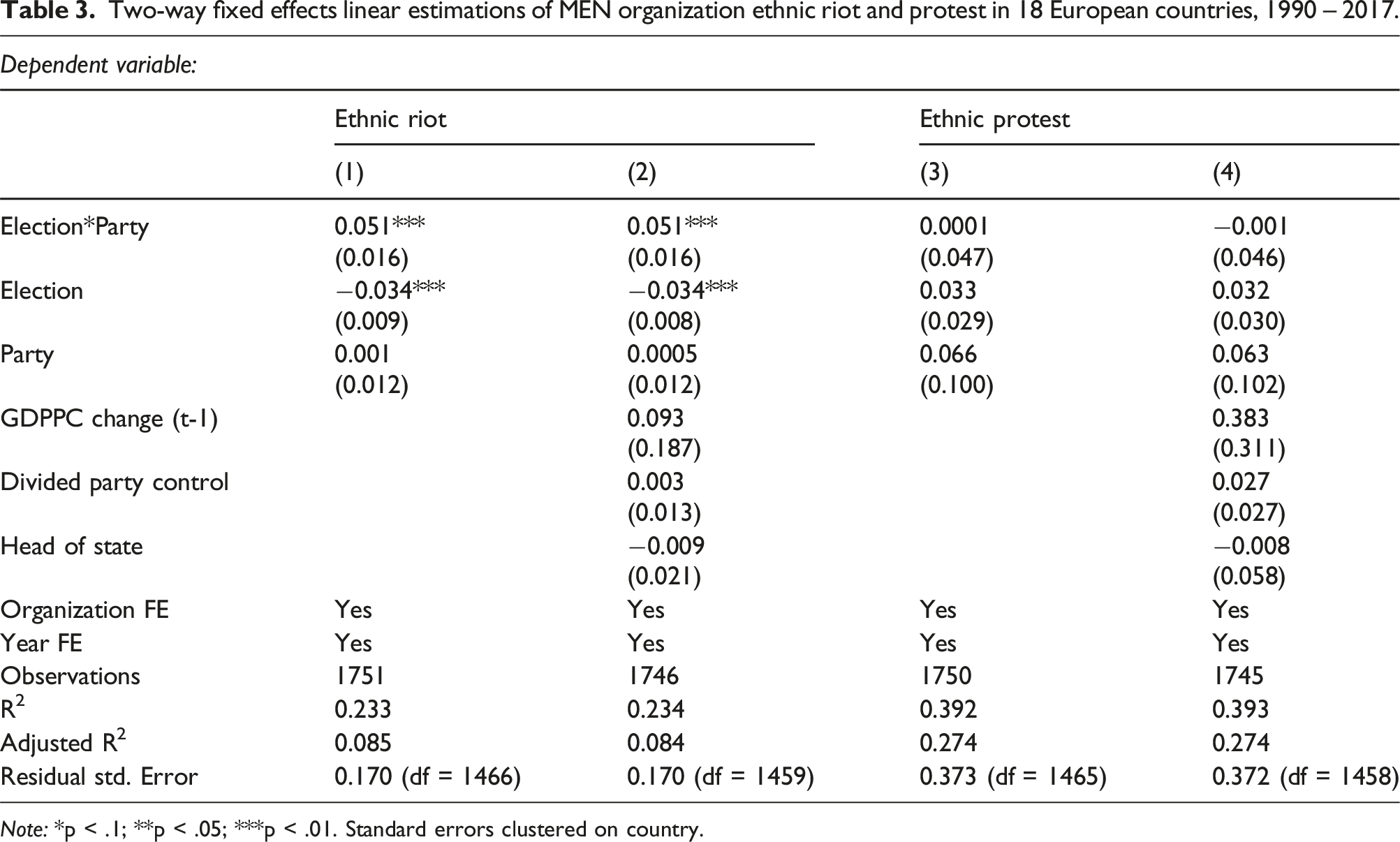
Note: *p < .1; **p < .05; ***p < .01. Standard errors clustered on country.
Examining ethnic riot, the interaction term generates a positive coefficient (p < .05) (M1,M2), The association between elections and ethnic riot is moderated by whether the MEN organization is a party.
Predicted probabilities are generated to evaluate substantive relationships. Among parties, an election year increases the predicted probability of ethnic riot by 1.70 percentage points. In contrast, among non-parties, an election year decreases the predicted probability of an ethnic riot by 3.40 percentage points. Overall, the results demonstrate that the interaction coefficient is driven by non-parties conducting ethnic riots in non-election years.
In contrast to ethnic riot, a clear relationship is not observed when estimating ethnic protest (p = .91) (M4). The results suggest that ethnic riots and protests may diverge along characteristics that are meaningful in their relation to the interaction of party status and election. 6
One possibility for the divergent results on ethnic riot and protest is that the two behaviors generate different anticipated benefits. Research highlights qualitative – not simply quantitative differences – between violence and nonviolence (e.g., Brubaker and Laitin, 1998). In other countries such as India, communal violence is not ‘more intense protest’ but a distinct outcome produced by an institutionalized riot system involving brokers and state actors (Brass, 2005). Violence has also produced electoral gains in European countries, including Interwar Italy (Viganò et al., 2025) and contemporary Germany, where violence linked to Alternative for Germany increases support among predisposed voters (Krause and Matsunaga, 2023). These studies emphasize that violence heightens insecurity and outgroup threat, enabling MEN organizations to claim a protector role for the majority. While ethnic riots may therefore boost support (e.g., Copsey et al., 2008), protests lack this threat-amplifying effect and may generate weaker emotional or electoral responses (Krause and Matsunaga, 2023), especially in Europe where protest is relatively low-cost and normalized political behavior. That is, while ethnic riot may generate emotional responses such as anger as part of increasing ethnicity salience, protest in European contexts may be normalized to the extent that it does not generate any broader societal response.
Differences in costs and signals may further reinforce this divergence. Because protests are low cost and common, they may convey a weaker signal of organizational commitment than riots. Their lower cost and threat potential may make protests less sensitive to election-year dynamics, with both parties and non-parties behaving similarly. That is, if a signal mechanism depends on the costliness of the behavior, then ethnic protest may be too low-cost to function as a meaningful signal, and thus lack substantive signaling capacity, resulting in comparable protest activity by parties and non-parties, pre- and post-elections.
Robustness checks
Sensitivity tests include additional covariates, alternative measures and specifications, subset analyses, and entropy balancing. First, additional covariates address possible confounders related to the presence of MEN organizations in a country (B1). A yearly measure is included of refugees and people in refugee-like situations (United Nations High Commissioner for Refugees, n.d.), indicators for regime type (Marshall and Jaggers, 2020), party bans (Pemstein et al., 2023), and restrictions on civil society (Bernhard et al., 2017; Pemstein et al., 2023). To capture emboldening or threat effects (Dugan and Chenoweth, 2020), dichotomous measures are included for nationalist, conservative, socialist, and religious governments (Bernhard et al., 2017); results remain consistent (B1).
An alternative dependent variable is used. Some newspaper reports only suggest organizational participation or the organization participated in a larger protest with rioting conducted by unspecified participants from the larger pool of protestors. Such examples are coded as ambiguous participation and are not included in the main analysis. Robustness test include ambiguous participation as an ethnic riot, and results are consistent (C1).
Organization fixed effects are replaced with country fixed effects, and standard errors clustered on organization (C2). I also estimate logit models with organization and year random intercepts and organization level random slopes (C2–C3).
Subset analyses remove iteratively each of the five countries with the most MEN organizations (D1), and exclude observations from 2015 to 2017 to address the migration surge and associated media changes (D2).
Another timing concern relates to further temporal heterogenous effects as well as coding challenges associated with identifying organizational ethnic riot through news reports. The divergent levels of ethnic riot before and after 2005 may reflect an actual increase or may reflect increased news coverage, suggesting biased reporting of ethnic riot. The sample is thus subset into observations that occur in 2005 or earlier, to ensure sufficient observations for the organization fixed effects analysis, and then subset into observations occurring in 2000 or after (D3).
Another concern is that MEN non-parties may participate in a MEN party organized ethnic riot. Because the MEN party may have organized the event, news sources may report only the MEN party participation. Such underreporting may not be a concern since the study adjusts for cross-organization time invariant differences – more concerning is if possible joint ethnic riots by MEN parties and non-parties occur more frequently during election years. Underreporting might then introduce a bias whereby MEN non-party ethnic riots are reported, inaccurately, to participate in ethnic riots less during election years. I thus conduct subset analysis on only MEN non-parties and in years in which no MEN party within the same majority ethnic group participated in ethnic riot. This allows for analysis of the relationship without the possibility that MEN non-parties’ participation in ethnic riot is being underreported during election years. The election variable generates a negative coefficient (p < .10), consistent with expectations (D4).
Finally, to reduce model dependency concerns, entropy balancing weights are constructed using the main covariates (Hainmueller, 2012). Results remain consistent (p < .01) (E1).
Conclusion
Motivated by research agendas on majority behavior in Europe and ethnic rioting in India, this study identifies 281 majority ethnonationalist organizations in 18 European countries from 1990 to 2017 and presents novel data on their ethnic riot and protest behavior. Linear regression with two way fixed effects estimates the interactive association between party, election year, and ethnic riot or protest. Among parties, election years increase the probability of ethnic riot. The relationship reverses for non-parties, where election years are associated with a lower probability of ethnic riot. In contrast, no clear interactive association emerges for ethnic protest. The findings advance existing evidence on majority ethnonationalism and far right politics in Europe with evidence of organizational mobilization differences in response to electoral timing.
The findings suggest five avenues for research. First, the results of the study are correlational. A potential limitation is that party status may correlate with organizational characteristics, such as resources, professionalization, or visibility. The empirical strategy mitigates this concern with organization fixed effects, but cannot fully disentangle vote-seeking from a correlated characteristic that may drive the distinct reactions to elections. Party status should therefore be interpreted with caution, and disentangling it from other characteristics that may meaningful for riot reactions to electoral timing is a key area of future research. One approach is a disaggregated single country design testing micro-level causal mechanisms. Second, where possible, future studies may incorporate count measures of ethnic riot and protest at the organization level. Third, researchers could leverage close-election regression discontinuity designs, treating narrowly decided races as quasi-random to study vote competition with stronger causal identification. However, such approaches typically require restricting the analysis to narrow spatial and temporal windows, which can limit the ability to examine interactive relationships among key variables. Fourth, MEN organizations sometimes target non-ethnic issues, including gender-related and economic issues. Investigating variation in issue area would benefit the study of majority ethnonationalism. Fifth, it remains unclear whether the findings extend to contexts such as India, where high baseline fatality levels may dampen the political effects of non-fatal riots. Testing both fatal and non-fatal riots across organizational types and electoral timing across regional contexts is a key possible extension.
Supplemental material
Supplemental material - Majority ethnonationalist ethnic riot and protest in 18 European countries: Variable levels of vote salience
Supplemental material for Majority ethnonationalist ethnic riot and protest in 18 European countries: Variable levels of vote salience by Brandon Ives in Party Politics.
Footnotes
Author note
A previous version of this manuscript was presented at the Asian Political Methodology group and the Australian Society for Quantitative Political Science 2025 joint conference at Victoria University of Wellington, New Zealand.
Declaration of conflicting interests
The author declared the following potential conflicts of interest with respect to the research, authorship, and/or publication of this article: The author has published studies with the following researchers in the last 5 years: Jori Breslawski, Jacob Lewis, SoYun Chang, Jieun Oh.
Funding
The author received no financial support for the research, authorship, and/or publication of this article.

Data Availability Statement
Data and code for this study are available on Harvard Database.
Supplemental material
Supplemental material for this article is available online.